10400 Clarence Drive, Frisco, TX 75033
Support 24/7: 945-777-3345
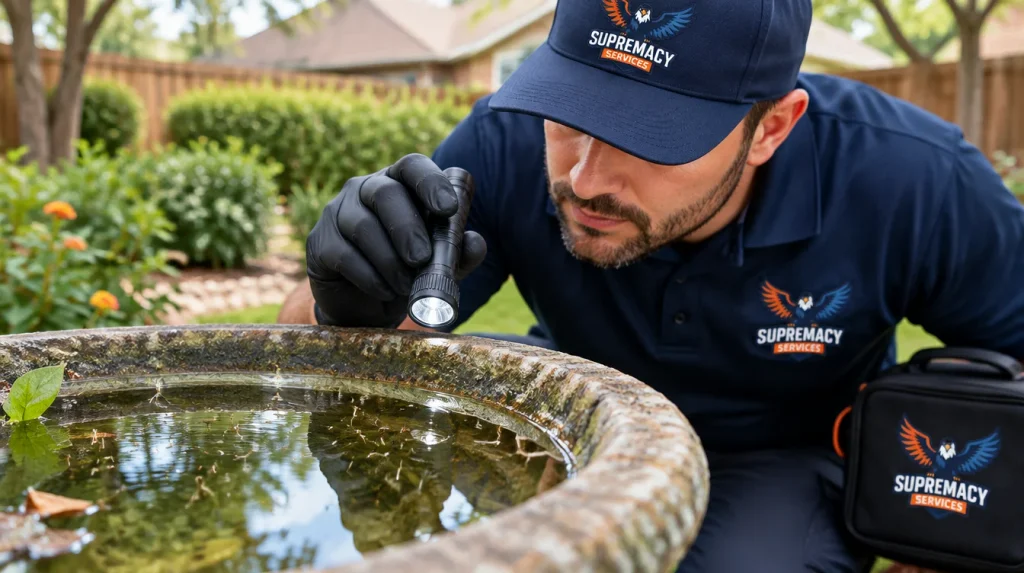
Pest control technician inspecting a North Texas backyard for mosquito activity

Mosquito Treatment Cost in North Texas: What Homeowners Should Expect

Professional mosquito treatment commonly costs about $80–$150 per visit nationally for a roughly quarter- to half-acre yard, while seasonal mosquito-control programs are commonly reported around $350–$1,000. These are market estimates—not Supremacy Services pricing—and your actual cost in Dallas–Fort Worth can vary significantly based on yard size, vegetation, mosquito pressure, treatment method and how often the property needs service.

For North Texas homeowners, the bigger question is often not simply “How much does mosquito treatment cost?” but “What am I actually getting for that price, and will one treatment be enough?”

This guide explains the costs, options and tradeoffs so you can compare quotes intelligently.

Table of Contents

  1. How Much Does Mosquito Treatment Cost?
  2. What Affects Mosquito Treatment Cost?
  3. One-Time vs. Recurring Mosquito Treatment
  4. What Does Professional Mosquito Treatment Include?
  5. Why Mosquito Control Matters in North Texas
  6. DIY vs. Professional Mosquito Control
  7. How to Reduce Mosquitoes Between Treatments
  8. How to Compare Mosquito Control Quotes
  9. Frequently Asked Questions

How Much Does Mosquito Treatment Cost?

As a general market benchmark, professional mosquito control is commonly reported at approximately $80–$150 per visit, with seasonal programs commonly ranging from approximately $350–$1,000.

Those figures should be treated as budgeting guidance rather than a Dallas-specific price guarantee.

Mosquito-control optionTypical published market rangeBest suited for
Professional single visitAbout $80–$150Short-term or targeted treatment
Seasonal mosquito serviceAbout $350–$1,000Ongoing mosquito pressure
DIY treatmentVaries widelyLight problems and prevention
Professional quoteProperty-specificMost accurate Dallas/DFW pricing

HomeGuide reports the $80–$150 per-visit range for roughly quarter- to half-acre yards and approximately $350–$1,000 for seasonal service. Other current cost guides publish broader ranges because mosquito-control programs vary substantially by treatment method, property size and frequency.

That distinction matters: comparing two mosquito companies only by the advertised starting price can be misleading if one quote includes inspection, breeding-site management and recurring applications while another covers only a basic spray.

Want a property-specific price instead of a national average? Explore Supremacy Services’ mosquito barrier misting in Dallas and DFW and request an estimate based on your yard.


What Affects Mosquito Treatment Cost?
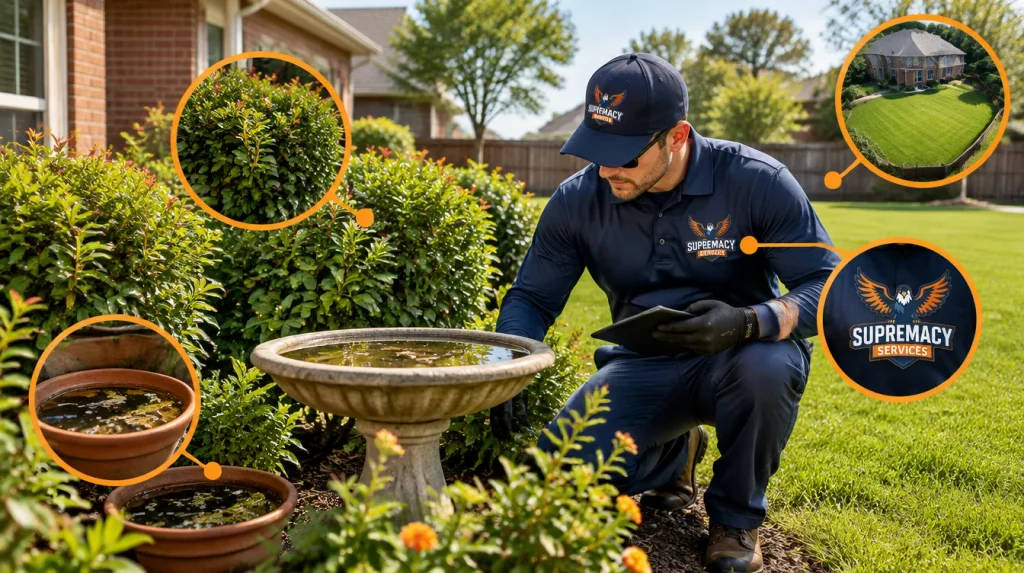
North Texas backyard showing factors that affect mosquito treatment cost
Yard size, landscaping, mosquito pressure and treatment frequency can influence the overall cost of mosquito control.

The biggest cost factors are property size, landscaping, mosquito pressure, treatment method and service frequency.

Two homes on the same street may require different treatment plans because their outdoor environments are different.

1. Yard Size

A larger treatment area usually requires more technician time and treatment material.

A compact suburban backyard generally presents a different scope than a large property with extensive landscaping, detached structures, tree lines and multiple outdoor entertainment areas.

Ask whether your quote covers:

  • backyard only;
  • front and backyard;
  • fence lines;
  • side yards;
  • vegetation around structures;
  • decks and patios;
  • detached structures; and
  • other relevant outdoor areas.

2. Amount of Landscaping and Shade

Adult mosquitoes commonly rest in sheltered, humid locations, including dense vegetation and the undersides of leaves.

Properties with thick shrubs, mature landscaping, shaded patios, groundcover and tree lines may therefore require more detailed inspection and treatment than an open yard.

The CDC specifically identifies vegetation, areas beneath decks and porches, and other moist, shaded locations as potential adult mosquito resting areas.

3. Standing Water and Breeding Sites

Mosquitoes require water during their immature stages.
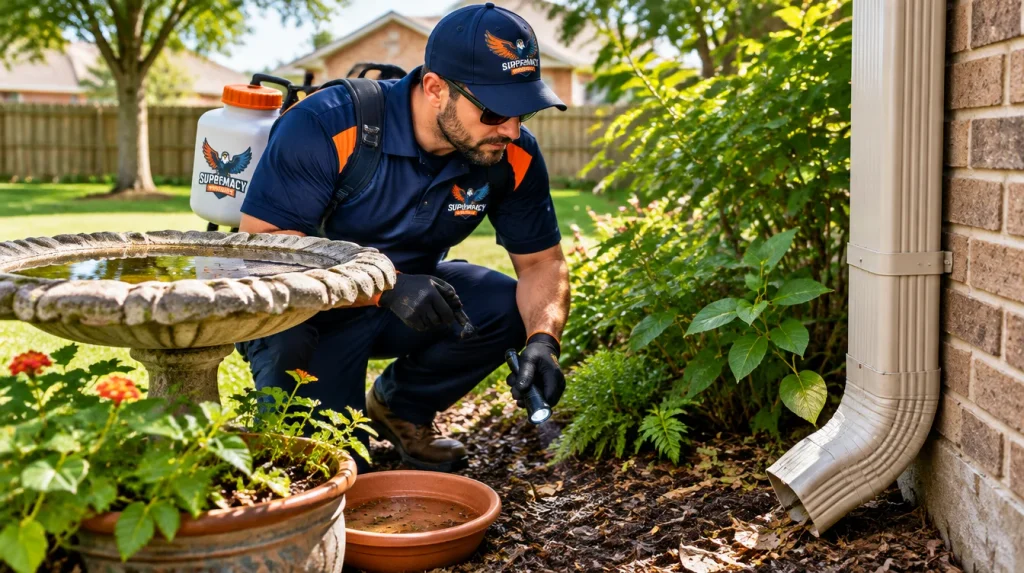
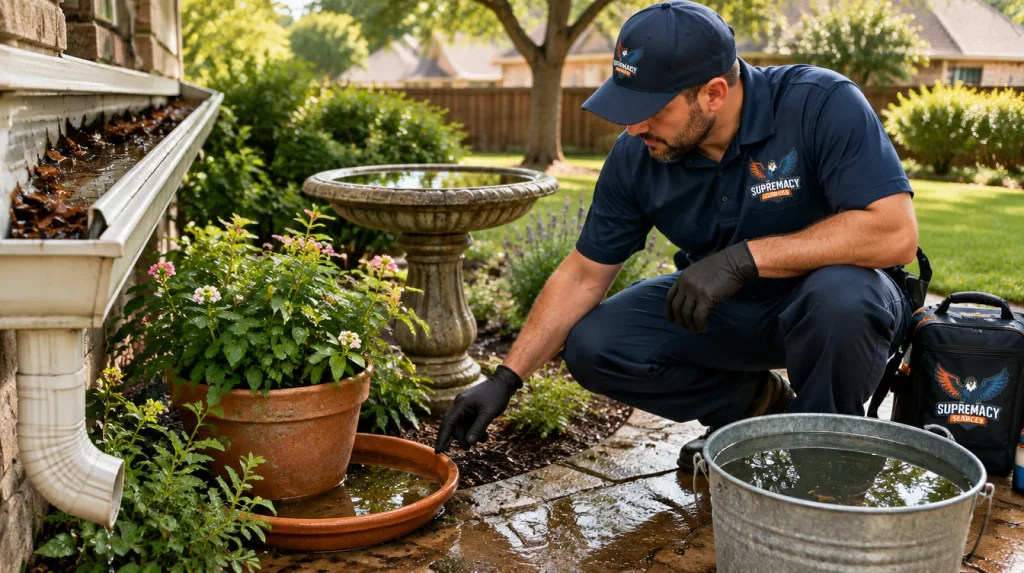
Pest control technician inspecting standing water and mosquito breeding areas in a North Texas backyard
Standing water in birdbaths, containers, gutters and other areas can provide breeding sites for mosquitoes.

Common residential sources include:

  • clogged gutters;
  • birdbaths;
  • buckets;
  • plant saucers;
  • toys;
  • pool covers;
  • rain barrels;
  • low areas that hold water;
  • neglected containers; and
  • other objects capable of retaining water.

A good mosquito-control strategy therefore addresses more than flying adults.

If water cannot reasonably be emptied or removed, an appropriate larvicide may sometimes be used according to its label.

4. Mosquito Pressure

A yard with occasional mosquitoes does not necessarily require the same approach as a property where people are repeatedly bitten whenever they step outside.

Heavy vegetation, nearby breeding habitat, standing water and weather conditions can all contribute to mosquito pressure.

Texas A&M notes that rainfall and water availability can substantially affect mosquito emergence and populations.

5. Treatment Method

Not every mosquito-control service is identical.

Depending on the property and service plan, mosquito management may involve:

  • source reduction;
  • larval control;
  • targeted treatment of adult resting areas;
  • barrier applications;
  • recurring applications; or
  • combinations of these approaches.

The EPA describes effective mosquito management as an integrated approach rather than relying on one tactic alone.

6. One-Time vs. Recurring Service

A one-time treatment usually has a lower immediate cost than a seasonal program.

One-Time vs. Recurring Mosquito Treatment

One-time and recurring mosquito control services for a North Texas backyard
One-time treatments can help with specific events, while recurring service is designed for ongoing mosquito pressure throughout the season.

However, mosquitoes can continually emerge or move into a property. Homeowners comparing prices should therefore consider cost per treatment, treatment frequency and total seasonal cost, rather than looking only at the first visit.


One-time treatment makes the most sense when the need is temporary. Recurring service is designed for homeowners who want ongoing mosquito suppression through periods of regular activity.

FactorOne-Time TreatmentRecurring/Seasonal Service
Upfront expenseUsually lowerHigher total seasonal cost
DurationTemporaryOngoing management
Best useEvent or short-term problemPersistent mosquito pressure
Follow-upUsually limitedScheduled applications
Breeding-site monitoringDepends on providerMore opportunity for continued monitoring
ConvenienceSingle appointmentScheduled service

When a One-Time Treatment May Make Sense

Consider a one-time service when:

  • you are preparing for an outdoor party;
  • mosquitoes recently increased after wet weather;
  • you want temporary suppression before an event; or
  • you want professional treatment without committing to a seasonal plan.

When Recurring Service May Make More Sense

Recurring mosquito control may be more appropriate when:

  • mosquitoes repeatedly interfere with backyard use;
  • your property has dense landscaping or shaded areas;
  • mosquito activity returns after individual treatments;
  • your family spends substantial time outdoors; or
  • you want treatment maintained throughout the active season.

Dallas County has historically treated mosquito-borne disease as a seasonal concern and conducts mosquito surveillance. This is one reason North Texas mosquito management should be viewed as an ongoing outdoor-maintenance issue rather than simply a one-day pest problem.


What Does Professional Mosquito Treatment Include?
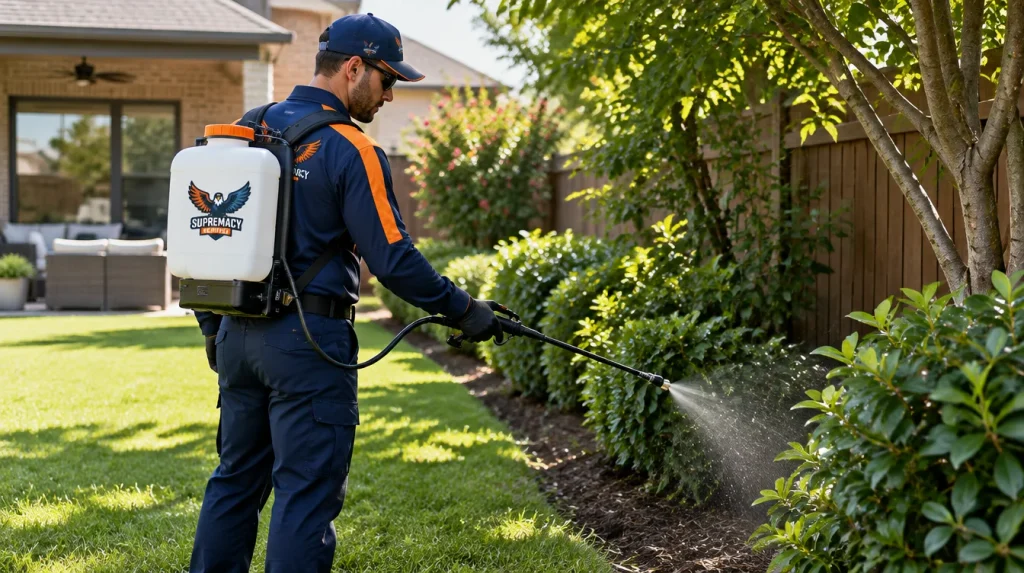
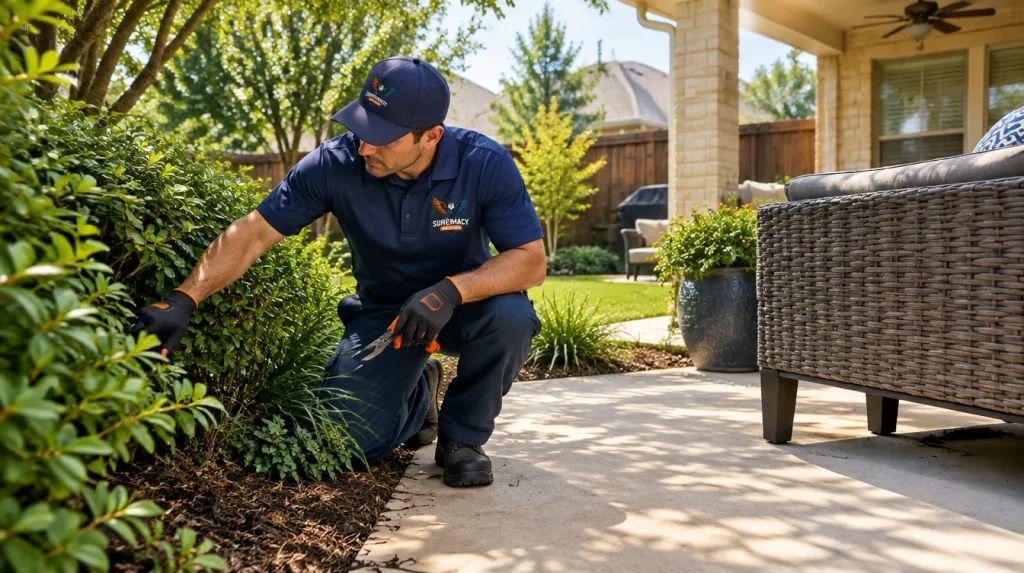
Supremacy Services technician applying mosquito barrier treatment to backyard vegetation
Professional mosquito treatments target shaded vegetation and other areas where adult mosquitoes commonly rest.

Professional mosquito control should begin with understanding where mosquitoes are breeding and resting, followed by treatment appropriate to those areas.

The exact service varies by provider, so homeowners should ask what is included before comparing prices.

1. Property Inspection

A technician may inspect for:

  • standing water;
  • shaded vegetation;
  • tall grass and brush;
  • areas under decks;
  • gutters and drainage issues;
  • containers holding water; and
  • other mosquito resting or breeding areas.

2. Source Reduction Recommendations

Sometimes the most important treatment does not involve spraying anything.

CDC recommends emptying, scrubbing, covering or removing water-holding containers weekly.

Removing breeding habitat can reduce the number of mosquitoes developing on the property.

3. Larval Control Where Appropriate

When standing water cannot simply be removed, larvicides can be used in suitable locations according to label directions.

Larvicides target immature mosquitoes before they become biting adults.

4. Treatment of Adult Resting Areas

Adult mosquitoes commonly rest in vegetation and other sheltered areas.

A professional may target those locations with an appropriately labeled product rather than indiscriminately treating every surface in the yard.

5. Follow-Up or Recurring Applications

Mosquito management is rarely permanent.

New mosquitoes can emerge from untreated breeding sources or enter the yard from neighboring areas.

This is why recurring programs exist.

If mosquitoes repeatedly make your patio or backyard difficult to use, see how Supremacy’s professional mosquito barrier treatment approaches breeding areas and outdoor resting zones across the DFW area.


Why Mosquito Control Matters in North Texas

Mosquito control is partly about outdoor comfort, but mosquitoes can also transmit disease.

Dallas County Health and Human Services conducts mosquito surveillance and tracks mosquito-borne disease activity, including West Nile virus.

Dallas County also emphasizes removing standing water around homes as a core prevention measure.

That does not mean every mosquito in a Dallas backyard carries disease. It means reducing mosquito exposure and breeding habitat is a legitimate public-health recommendation, not simply a landscaping preference.

Weather Matters

North Texas mosquito activity can change substantially after rainfall.

Texas A&M has documented how rain and saturated conditions can create habitat for floodwater and container-breeding mosquitoes.

This helps explain why a yard that seemed manageable one week can experience noticeably greater mosquito activity after wet weather.


Is Mosquito Treatment Worth the Cost?

Professional treatment may be worth the cost when mosquitoes consistently prevent you from comfortably using your outdoor space or when DIY source reduction is not adequately controlling the problem.

Consider how you use your property.

Professional service may offer more value when you regularly use:

  • a patio;
  • outdoor kitchen;
  • pool area;
  • children’s play area;
  • garden;
  • backyard seating area; or
  • outdoor entertainment space.

For a household that rarely uses the backyard, intensive recurring treatment may provide less value.

The goal should be proportional mosquito management—not paying for services your property does not need.


DIY vs. Professional Mosquito Control

Homeowners can perform several important mosquito-control tasks themselves.

In fact, professional treatment works best when homeowners also eliminate breeding habitat.

DIY mosquito controlProfessional mosquito control
Empty standing waterDetailed property inspection
Clean guttersIdentification of likely breeding/resting zones
Maintain poolsTargeted treatment
Trim excessive vegetationAppropriate professional equipment
Repair screensLarval/adult control when appropriate
Use EPA-registered repellentsScheduled recurring applications
Follow pesticide labelsProfessional pesticide application

Start With DIY Prevention When:

  • mosquito activity is light;
  • you can identify obvious standing water;
  • the problem appeared after temporary rainfall; or
  • mosquitoes are primarily entering through damaged screens.

Consider Professional Service When:

  • mosquitoes return despite source reduction;
  • your property has extensive vegetation;
  • you cannot identify the source;
  • the problem regularly interferes with outdoor activities; or
  • you want ongoing seasonal management.

Texas Licensing Matters

Texas regulates structural pest-control businesses and individuals performing pest control for compensation.

The Texas Department of Agriculture specifically includes mosquitoes within its pest-control licensing category.

Before hiring a mosquito-control company, homeowners can verify that the provider is appropriately licensed rather than choosing solely on price.

Homeowners dealing with mosquitoes alongside ants, spiders or other outdoor pests may need a broader pest-management plan


How to Reduce Mosquitoes Between Treatments

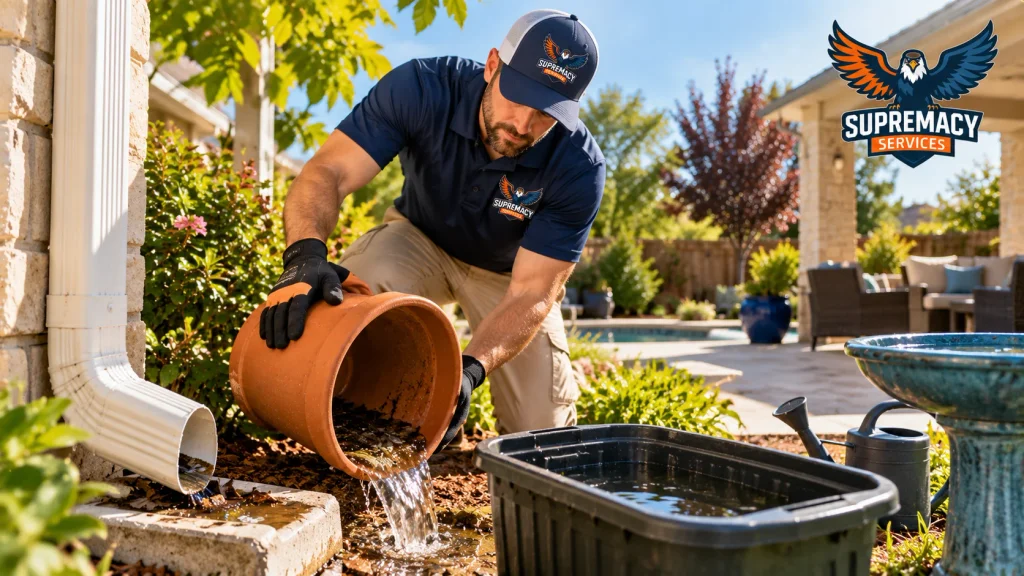
Homeowner removing standing water to help prevent mosquitoes in a North Texas backyard
Eliminating standing water and maintaining the yard can help reduce mosquito breeding around North Texas homes.

Professional treatment should not replace basic mosquito prevention.

Use this weekly homeowner checklist:

  • Empty water from buckets and containers.
  • Check flowerpot saucers.
  • Clean birdbaths.
  • Check toys and outdoor equipment for trapped water.
  • Inspect gutters and downspouts.
  • Keep swimming pools properly maintained.
  • Check pool covers for standing water.
  • Repair leaking outdoor faucets.
  • Trim excessive vegetation where appropriate.
  • Maintain window and door screens.
  • Use EPA-registered insect repellent according to the label when needed.

CDC recommends checking water-holding containers weekly, because interrupting mosquito development is an important part of residential control.


Mosquito Treatment vs. Mosquito Repellent: They Are Not the Same

A common source of confusion is treating personal mosquito repellent and yard mosquito control as interchangeable.

They serve different purposes.

Repellent helps prevent mosquitoes from landing on or biting a person.

Mosquito-control treatment attempts to reduce mosquitoes or mosquito development in a particular environment.

Homeowners may therefore use personal protection even when the yard receives professional mosquito treatment.

No residential yard treatment should be interpreted as a guarantee that a mosquito will never enter the property.


How to Compare Mosquito Control Quotes

Do not compare mosquito companies using price alone.

Ask each provider:

  1. What parts of my property are included?
  2. Is an inspection included?
  3. Do you inspect for breeding sites and standing water?
  4. What type of treatment will be used?
  5. Are larval and adult mosquitoes addressed?
  6. How frequently is service recommended?
  7. What happens after heavy weather?
  8. Are follow-up visits included?
  9. What homeowner preparation is required?
  10. Is the business appropriately licensed in Texas?
  11. What is the total seasonal cost?
  12. Are there additional charges for a larger yard or special treatment areas?

A $90 treatment and a $140 treatment are not necessarily comparable if their scope is different.

Ask for the scope first and compare the price second.


How Much Should You Budget for Mosquito Control in North Texas?

For initial planning, homeowners can use published national ranges of roughly $80–$150 per professional visit and approximately $350–$1,000 for seasonal service as broad reference points.

But don’t treat those figures as a Supremacy Services quote or a guaranteed Dallas market price.

Your actual price can change according to:

Property size + treatment scope + mosquito pressure + treatment method + service frequency = actual mosquito-control cost.

The most useful estimate is therefore one based on your actual property.


Frequently Asked Questions

How much does mosquito treatment cost in Dallas?

Published national market guides commonly place professional mosquito treatment around $80–$150 per visit, but Dallas pricing varies by yard size, treatment method, vegetation, mosquito pressure and service frequency. Request a property-specific quote for accurate pricing.

How much is mosquito control for an entire season?

Market guides commonly estimate seasonal mosquito-control programs at roughly $350–$1,000. The actual total depends heavily on the number of visits, property size and services included.

Is one mosquito treatment enough?

One treatment may provide temporary reduction, but it cannot permanently prevent mosquitoes from emerging or entering your property. Recurring treatment may be more appropriate when mosquito pressure persists through the season.

What makes mosquito treatment more expensive?

Large yards, extensive landscaping, difficult treatment areas, severe mosquito pressure, specialized treatment requirements and more frequent service can increase cost.

Is professional mosquito treatment better than DIY spraying?

Not every property requires professional treatment. DIY source reduction can be highly valuable. Professional service becomes more useful when mosquito pressure persists, the property is difficult to manage or ongoing treatment is desired.

Does removing standing water really help with mosquitoes?

Yes. Mosquito larvae develop in water, and CDC, EPA, Dallas County and Texas A&M all recommend eliminating standing water as a fundamental mosquito-control measure.

How often should I check my yard for standing water?

CDC recommends checking water-holding containers weekly and emptying, scrubbing, covering, turning over or disposing of them where appropriate.

Are mosquito-control companies licensed in Texas?

Businesses and individuals providing structural pest-control services for compensation are regulated by the Texas Department of Agriculture. Mosquitoes are specifically included within the pest-control licensing category.

Should I get mosquito treatment before an outdoor event?

A one-time treatment can be considered for events, but timing and expected results depend on the treatment and provider. Ask the company how far in advance treatment should be scheduled.


Mosquito-control pricing makes more sense when it is tied to the property rather than a generic national average.

If mosquitoes are keeping you from comfortably using your backyard, patio or pool area, Supremacy Services provides mosquito barrier misting for Dallas and surrounding DFW communities.

Take Back Your Backyard — Request a Mosquito Control Quote

Get a property-specific mosquito-control recommendation from Supremacy Services for your Dallas–Fort Worth home.

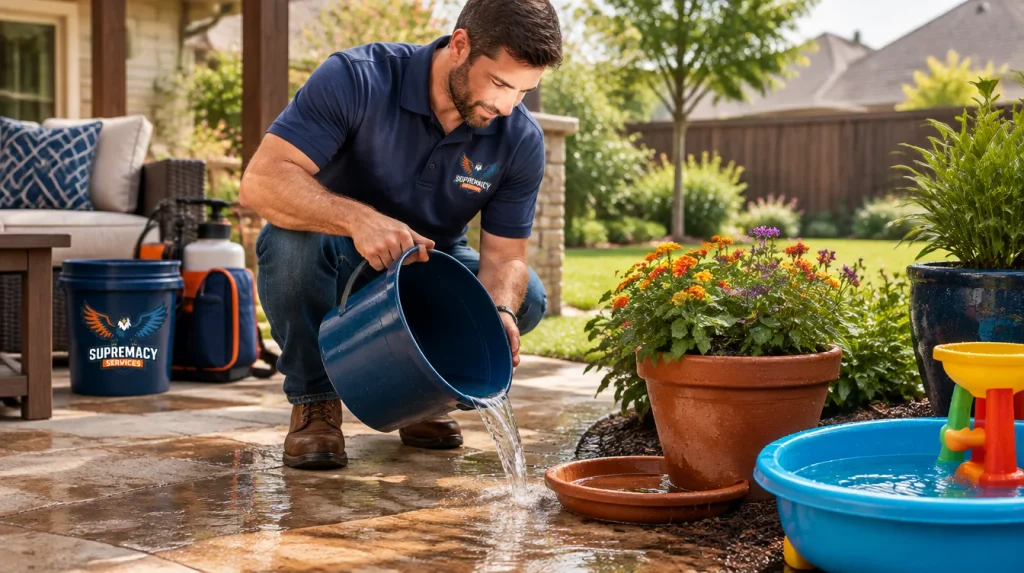
Supremacy Services technician inspecting a Dallas backyard for mosquito activity

How to Get Rid of Mosquitoes in Your Backyard in North Texas

If mosquitoes are making it difficult to enjoy your backyard, start with the water.

The most effective way to get rid of mosquitoes in your backyard is to eliminate or manage places where mosquitoes reproduce, especially standing water. Then address shaded resting areas, protect people from bites and, when mosquito activity remains high, consider targeted mosquito treatment.

For Dallas–Fort Worth homeowners, mosquito control usually works better as an ongoing process than as a single spray. Buckets, gutters, plant saucers, toys, birdbaths and poorly drained areas can all contribute to mosquito activity if they repeatedly hold water.

Texas health officials recommend routinely removing standing water, maintaining pools and hot tubs, screening water-storage containers and considering appropriate larvicides for water that cannot be removed.

Table of Contents

  1. The fastest way to reduce backyard mosquitoes
  2. Why mosquitoes keep coming back
  3. Step 1: Eliminate standing water
  4. Step 2: Deal with water you cannot remove
  5. Step 3: Make the yard less attractive to mosquitoes
  6. Step 4: Protect your patio and family from bites
  7. What doesn’t work well for mosquitoes?
  8. DIY vs. professional mosquito control
  9. What professional mosquito control involves
  10. North Texas mosquito-control considerations
  11. Backyard mosquito prevention checklist
  12. Frequently asked questions

The Fastest Way to Reduce Backyard Mosquitoes

Start by finding and eliminating standing water. Mosquitoes need water during their immature life stages, so removing breeding habitat interrupts the problem before more adult mosquitoes emerge.

EPA guidance specifically recommends eliminating standing water from gutters, tires, buckets, toys, covers and similar containers and changing water in birdbaths, fountains, rain barrels and plant trays regularly.

Walk your property and inspect:

CheckWhat to Look ForWhat to Do
GuttersWater trapped behind leaves or debrisClean gutters and restore drainage
Plant saucersWater remaining beneath potsEmpty regularly
Buckets & containersRainwaterEmpty, turn over or cover
BirdbathsStagnant waterRefresh and clean regularly
Children’s toysSmall pockets of rainwaterDrain and store properly
Tarps & coversSagging areas holding waterTighten or reposition
Pet bowlsOld outdoor waterRefresh frequently
Pools & hot tubsPoor circulation or maintenanceMaintain treatment and circulation
Low yard areasPersistent puddlingInvestigate drainage
Rain barrelsOpen accessProperly screen openings

Do not assume a water source is too small to matter. Texas DSHS warns that mosquitoes can reproduce in surprisingly small quantities of water.

Why Mosquitoes Keep Coming Back to Your Backyard

A backyard can remain mosquito-heavy even after you kill the adults you see because the property may still provide breeding habitat and resting habitat.

Adult mosquito control and mosquito breeding control solve different parts of the problem.

Breeding sites create the next generation

Different mosquito species use different types of standing water. EPA lists common residential sources including tires, buckets, toys, plant trays, plastic covers and even very small containers.

That means spraying adult mosquitoes without finding the water sources can leave the underlying cycle intact.

Dense, sheltered areas can harbor adult mosquitoes

Mosquito management should therefore include a complete yard inspection rather than concentrating exclusively on the patio where people notice the bites.

Look around:

  • dense landscaping;
  • underneath decks;
  • around sheds;
  • beneath outdoor furniture;
  • around fences and property edges;
  • near drainage areas;
  • around irrigation equipment;
  • underneath heavily shaded vegetation.

The goal is not to remove healthy landscaping. It is to identify unnecessarily dense, damp and protected areas associated with mosquito activity.

The source may not be entirely on your property

Mosquitoes do not recognize property lines.

A homeowner can maintain a clean yard and still experience mosquito pressure associated with nearby drainage, unmanaged water, neighboring properties or broader neighborhood conditions.

That is why good backyard mosquito management aims to reduce the conditions you can control, rather than promising a completely mosquito-free outdoor environment.

Step 1: Eliminate Standing Water

Homeowner removing standing water from containers to prevent mosquitoes in a North Texas backyard
Emptying standing water is one of the most important steps homeowners can take to reduce mosquito breeding.

This is the most important homeowner action.

Dallas County Health and Human Services specifically identifies draining standing water as a key component of its mosquito-prevention recommendations. The county advises residents to check flowerpots, kiddie pools, birdbaths, ponds, tires, gutters and landscape depressions.

Do a weekly water inspection

Choose one day each week during mosquito season and walk around the entire property.

Check anything capable of collecting rain or irrigation water.

Pay particular attention after:

  • rainfall;
  • irrigation;
  • storms;
  • landscaping work;
  • pool maintenance;
  • leaving toys or equipment outside.

Small containers are easy to overlook.

Clean clogged gutters

Gutters are especially easy to miss because the water may be above eye level.

Leaves and organic debris can slow drainage and allow water to remain trapped.

Clean gutters and confirm that downspouts discharge correctly rather than simply checking them from the ground.

Empty containers instead of merely topping them off

Adding fresh water to an outdoor container does not necessarily eliminate the old habitat.

Empty and clean appropriate containers before refilling them.

Texas DSHS recommends changing water in wading pools and birdbaths several times per week and changing pet-dish water daily.

Check irrigation and drainage

A mosquito problem can sometimes reveal a water-management problem.

Look for:

  • irrigation overspray;
  • leaking outdoor faucets;
  • continuously wet soil;
  • drainage depressions;
  • blocked drains;
  • water accumulating near structures.

Fixing the water source can provide benefits beyond mosquito control.

Step 2: Deal With Water You Cannot Remove

Not every water source can simply be dumped.

Ornamental water features, drainage structures and other necessary water sources may require a different approach.

One option for appropriate standing-water habitats is a mosquito larvicide.

Larvicides target mosquitoes during their immature aquatic stages before they become flying adults.

EPA explains that Bacillus thuringiensis israelensis (Bti) is used against developing mosquito larvae in standing water and is available in registered mosquito-control products.

Dallas County likewise advises that standing water can be treated with EPA-approved larvicides where appropriate.

Always select a product specifically labeled for the intended use and follow its label exactly.

Never assume that because a product is sold for mosquito control it can be applied to every pond, drain, water feature or other aquatic environment.

Mosquito larvae developing in standing water in a North Texas backyard
Finding mosquito larvae in standing water is a strong sign that the water source should be addressed.

Step 3: Make the Yard Less Attractive to Mosquitoes

After addressing breeding sites, inspect the places where adult mosquitoes are regularly encountered.

Manage excessive vegetation

Trim vegetation when it becomes unnecessarily dense around frequently used outdoor areas.

Concentrate on:

  • patio borders;
  • pathways;
  • seating areas;
  • play areas;
  • fence lines;
  • vegetation immediately around entrances.

The objective is improved yard management—not stripping the property of landscaping.

Supremacy Services technician inspecting dense backyard vegetation where mosquitoes may rest
Managing dense, shaded vegetation can help reduce mosquito resting areas around patios and outdoor living spaces.

Remove unnecessary clutter

Unused pots, overturned lids, children’s toys, old equipment and discarded materials can create sheltered spaces and collect rainwater.

Removing clutter makes the property easier to inspect after rain.

Correct persistent moisture

If part of the yard stays wet long after surrounding areas have dried, determine why.

Potential causes include irrigation issues, poor grading, blocked drainage or plumbing leaks.

Mosquito control works better when persistent water problems are corrected rather than repeatedly treating their consequences.

Need help when backyard mosquitoes persist? Supremacy Services provides pest-control services across the DFW Metroplex, with mosquito barrier treatment available as part of its outdoor pest-control offerings.

Step 4: Protect Your Patio and Family From Mosquito Bites

Reducing mosquito populations and preventing bites are related but different goals.

Even a well-maintained yard can still receive mosquitoes from surrounding areas.

Use EPA-registered repellents

EPA recommends registered mosquito repellents and advises consumers to follow the product label for application and reapplication. Registration means EPA has reviewed supporting information concerning the product’s safety and effectiveness when used according to its labeling.

Use clothing as another layer of protection

Dallas County recommends long, loose, light-colored clothing as part of its mosquito-prevention guidance.

This can be especially useful when mosquito activity is high.

Keep screens in good condition

Mosquito management should not stop at the yard.

Inspect:

  • window screens;
  • screen doors;
  • door seals;
  • damaged screening around outdoor rooms.

EPA recommends physical barriers such as properly maintained door and window screens as part of mosquito management.

Consider airflow around seating areas

Outdoor fans can make patios more comfortable and may help make a small seating area less favorable to flying mosquitoes.

They should be viewed as a supplemental comfort measure—not a replacement for breeding-source reduction.

Common mosquito breeding sites including gutters, birdbaths, buckets and plant saucers in a Dallas backyard
Even small amounts of standing water around a yard can provide potential mosquito breeding habitat

What Doesn’t Work Well for Mosquitoes?

Homeowners encounter a large number of mosquito-control gadgets and home remedies.

Some deserve more skepticism than others.

Ultrasonic mosquito devices

EPA notes that devices relying on sound waves are not EPA-registered as repellents, meaning EPA does not have the safety and effectiveness data required for registered repellent products and does not know whether such devices effectively repel mosquitoes.

Do not make an ultrasonic gadget the foundation of your mosquito-control strategy.

One-time spraying without source reduction

Spraying may reduce adult mosquito activity, but if buckets, gutters, toys and other containers continue producing mosquitoes, the underlying problem remains.

EPA’s integrated mosquito-management guidance specifically combines habitat removal with other control methods rather than relying on one tactic.

Ignoring tiny amounts of water

Large puddles are obvious.

The forgotten flowerpot saucer is not.

Small residential containers can still provide mosquito habitat, so inspect the entire yard rather than looking only for large pools of stagnant water.

Family enjoying a North Texas backyard with outdoor fan and mosquito prevention measures
Combining yard maintenance, airflow and mosquito prevention can make outdoor spaces more comfortable.

DIY vs. Professional Mosquito Control

DIY mosquito control is often appropriate when mosquito pressure is limited and the property contains identifiable water sources you can correct.

Professional mosquito control becomes more reasonable when activity remains high despite consistent prevention.

SituationDIY May Be EnoughProfessional Evaluation May Help
A few obvious water containers✓
Dirty birdbath or plant saucers✓
Clogged gutter✓
Occasional mosquitoes✓
Persistent heavy backyard activity✓
Numerous shaded/resting areas✓
Mosquitoes quickly return after DIY efforts✓
Large or complicated property✓
Difficult-to-identify breeding sources✓
Outdoor entertaining repeatedly disrupted✓

A professional service should complement—not replace—basic property maintenance.

Even professionally treated properties benefit from eliminating standing water.

If you’ve removed obvious breeding sites but your Dallas-area backyard is still difficult to use, consider scheduling a professional pest inspection so the property can be evaluated as a whole rather than repeatedly treating individual mosquitoes.

What Professional Mosquito Control Involves

Professional mosquito management should begin with understanding the property.

Depending on the property and treatment program, service may involve evaluating:

  1. potential breeding sites;
  2. standing-water sources;
  3. drainage conditions;
  4. shaded vegetation;
  5. common adult mosquito resting areas;
  6. patios and high-use outdoor spaces;
  7. conditions around the home’s exterior.

Treatment recommendations should depend on what is actually found.

Professional treatment does not mean every surface in the yard should automatically be sprayed.

EPA describes successful mosquito management as an integrated approach involving habitat reduction, barriers, larval management and, when appropriate, adult mosquito control.

For DFW homeowners dealing with recurring outdoor pest activity, Supremacy Services’ pest-control options can provide a logical next step after basic source reduction has been addressed.

North Texas Mosquito-Control Considerations

Mosquito prevention has particular relevance in Dallas and the surrounding Metroplex because mosquito-borne disease is actively monitored by local public-health agencies.

Dallas County identifies West Nile virus, chikungunya, dengue and Zika among mosquito-borne illnesses of concern and promotes its 4Ds approach:

DEET — Dress — Drain — Dusk & Dawn.

The City of Dallas also operates mosquito surveillance and control activities, including mosquito trapping, breeding-site monitoring, larviciding and responses to standing-water complaints.

That does not mean every mosquito in a Dallas backyard is carrying disease.

It does mean mosquito management is more than a comfort issue.

Rain can expose overlooked breeding sites

After rainfall, repeat your property inspection.

Objects that appeared harmless while dry can become water-holding containers after a storm.

Irrigation can create mosquito habitat too

Rain is not the only source of standing water.

Check whether sprinkler systems repeatedly leave water in:

  • plant containers;
  • landscape depressions;
  • drainage areas;
  • toys;
  • tarps;
  • equipment.

Mosquitoes can bite at different times

Do not assume mosquito protection matters only at sunset.

Texas DSHS notes that mosquitoes can bite during both day and night, while Dallas County explains that activity patterns vary among mosquito species.

Backyard Mosquito Prevention Checklist

Use this quick checklist once a week and after significant rainfall.

Water

  • □ Empty buckets and containers.
  • □ Check flowerpot saucers.
  • □ Refresh birdbath water.
  • □ Refresh pet water.
  • □ Inspect children’s toys.
  • □ Check tarps and outdoor covers.
  • □ Clean clogged gutters.
  • □ Maintain pool circulation and treatment.
  • □ Check rain barrels and water-storage screens.
  • □ Look for persistent puddles.

Landscape

  • □ Trim excessive vegetation near high-use areas.
  • □ Remove unnecessary yard clutter.
  • □ Check shaded areas.
  • □ Inspect underneath decks and furniture.
  • □ Investigate persistently wet soil.

Home

  • □ Repair damaged window screens.
  • □ Check screen doors.
  • □ Keep frequently used entrances protected.
  • □ Use EPA-registered repellent according to its label.

After Rain

  • □ Repeat the entire standing-water inspection.

When Should You Call a Mosquito-Control Professional?

Consider professional help when mosquito activity remains consistently high after you’ve removed obvious standing water and corrected manageable yard conditions.

Other reasons include:

  • you cannot identify where mosquitoes are coming from;
  • the property has extensive landscaping;
  • standing-water areas cannot easily be eliminated;
  • mosquitoes return quickly after DIY measures;
  • your patio or backyard is difficult to use;
  • you want a property-specific prevention and treatment plan.

Professional service is particularly useful when the goal shifts from killing the occasional mosquito to managing mosquito pressure across the entire outdoor environment.


Frequently Asked Questions

What is the fastest way to get rid of mosquitoes in my backyard?

Start by removing standing water from buckets, plant saucers, toys, gutters, birdbaths and other containers. Then address persistent resting areas and use appropriate mosquito-control and bite-prevention measures.

Why do I have so many mosquitoes in my yard?

Your property may contain breeding water, shaded resting areas or recurring moisture. Mosquitoes may also be entering from nearby properties or neighborhood breeding sites.

Does standing water really cause mosquitoes?

Standing water provides habitat for the immature stages of mosquitoes. Eliminating unnecessary standing water is therefore one of the most important mosquito-prevention measures recommended by EPA, Texas DSHS and Dallas County.

How often should I check my backyard for mosquito breeding sites?

Check at least weekly and again after rainfall or other events that can fill containers with water. Texas DSHS specifically recommends weekly removal or emptying of many common water-holding containers.

What can I put in standing water to kill mosquito larvae?

For standing water that cannot be removed, an appropriately labeled mosquito larvicide may be an option. EPA recognizes Bti as an active ingredient used to control developing mosquito larvae. Always use the product only as its label directs.

Do mosquito sprays permanently eliminate mosquitoes?

No mosquito treatment should be treated as a permanent substitute for prevention. New mosquitoes can emerge or enter from surrounding areas, particularly if breeding sites remain.

Are mosquito-repellent devices effective?

It depends on the device. EPA evaluates registered repellent products, but notes that sound-wave devices are not EPA-registered as repellents and EPA does not have data establishing their mosquito-repelling effectiveness.

When are mosquitoes most active in Dallas?

Activity depends on mosquito species. Dallas County advises particular caution around dusk and dawn for mosquitoes associated with West Nile virus while noting that other species may be active during the day.

When should I hire a professional mosquito-control company?

Professional service makes sense when mosquito activity remains significant after consistent source reduction, when breeding or resting sites are difficult to identify, or when you need a more comprehensive treatment strategy for the property.


Take Back Your Backyard

Effective backyard mosquito control begins with a simple principle: remove the conditions mosquitoes need before relying on treatments to control the adults you see.

Drain standing water. Maintain gutters and outdoor water features. Manage persistent moisture. Protect yourself from bites. Repeat your inspection after rain.

If mosquitoes continue making your Dallas–Fort Worth backyard difficult to enjoy after you’ve addressed those conditions, contact Supremacy Services for professional mosquito and pest-control options across the DFW Metroplex.

A property-specific inspection can help determine where mosquito pressure is coming from and which combination of prevention and treatment makes sense for your yard.

Mosquito near a landscaped Dallas-Fort Worth backyard during spring;

When Does Mosquito Season Start in North Texas?

Table of Contents

  1. When Does Mosquito Season Start in North Texas?
  2. North Texas Mosquito Season Month by Month
  3. Why Mosquito Activity Increases in Spring
  4. What Makes Mosquitoes So Active Around DFW Homes?
  5. When Should You Start Mosquito Prevention?
  6. How to Prepare Your Yard
  7. DIY vs. Professional Mosquito Control
  8. What Does Professional Mosquito Control Include?
  9. When Does Mosquito Season End?
  10. Frequently Asked Questions

When Does Mosquito Season Start in North Texas?

Mosquito activity can occur outside a fixed calendar, but April is a practical start to the main mosquito season across much of North Texas. Activity generally remains elevated through October, with Dallas officially identifying May 1 through October 30 as its 2026 mosquito season.

Several nearby DFW cities provide an even broader local benchmark. Richardson, Irving and Coppell say mosquito-control activity is increased from April through October, describing that period as the most active mosquito season in North Texas.

That does not mean the first mosquito suddenly appears on April 1.

Mosquito activity responds to environmental conditions rather than a date on the calendar. Warm periods, rainfall, irrigation and available standing water can support mosquito activity before or after the main season.

Dallas County consequently conducts mosquito surveillance and control efforts rather than relying solely on a calendar. Its mosquito-control program includes surveillance, larval and adult mosquito mitigation, public education and disease monitoring.

For DFW homeowners, the useful rule is simple:

Begin checking your property for mosquito breeding conditions before the main April–October activity period rather than waiting until your backyard is already full of biting adults.


North Texas Mosquito Season Month by Month

April through October mosquito activity timeline for North Texas homeowners;
DFW municipalities identify April through October as the area’s most active mosquito period

Mosquito activity varies from year to year, so the following should be understood as a practical seasonal framework rather than a prediction that every year will behave identically.

PeriodTypical homeowner concernWhat to do
February–MarchPreparation and occasional warm-weather activityClean gutters, inspect drainage and remove water-holding debris
AprilMain North Texas activity period beginsBegin consistent weekly water inspections
May–JuneIncreasing mosquito pressureMaintain source reduction and personal protection
July–AugustSustained warm-season activityContinue prevention; do not let irrigation create standing water
SeptemberMosquito activity can remain significantContinue protection despite approaching fall
OctoberActivity generally begins moving toward seasonal declineContinue prevention while mosquitoes remain active
November–winterLower activity during colder periods, but not necessarily zeroCorrect drainage and eliminate persistent breeding sites

Richardson and Irving both identify April through October as the most active mosquito period in North Texas, while Dallas currently defines its official mosquito season as May 1 through October 30.

Does mosquito season start earlier after a warm winter?

It can.

A fixed calendar cannot account for every warm spell, rainfall event or protected mosquito habitat.

The better homeowner strategy is to watch conditions as well as dates. If temperatures have warmed and spring rain or irrigation is leaving water around your property, start inspecting for mosquito habitat even if peak summer biting has not arrived.


Why Mosquito Activity Increases in Spring

Mosquitoes depend heavily on water.

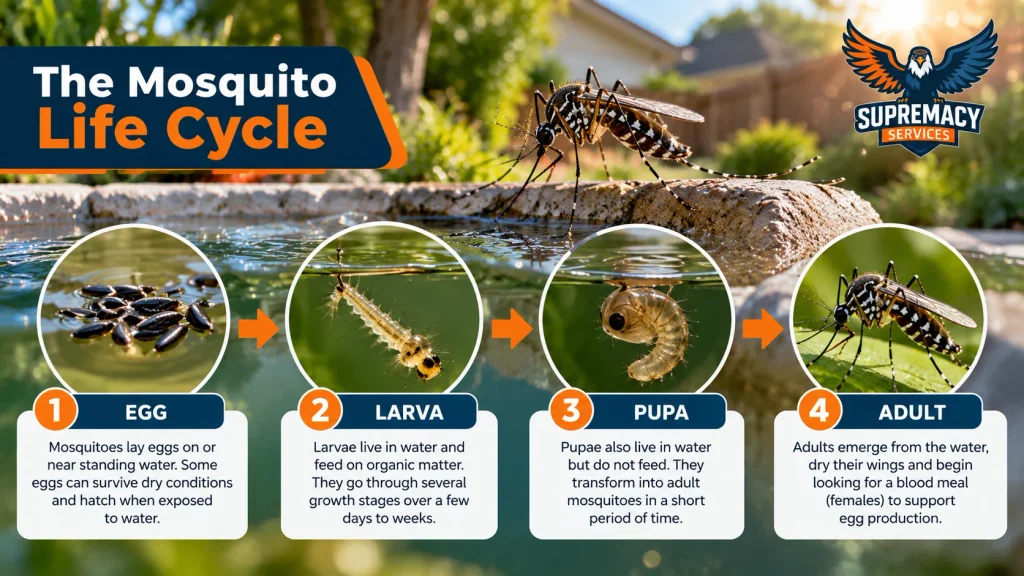
The EPA explains that mosquitoes develop through four stages:

egg → larva → pupa → adult

The first three stages are associated with water. Depending on species and environmental conditions, the mosquito life cycle can take from only several days to several weeks.

That biology explains why spring property maintenance matters.

Rainfall or irrigation can refill:

  • plant saucers;
  • buckets;
  • children’s toys;
  • clogged gutters;
  • birdbaths;
  • tarps;
  • drainage areas;
  • neglected containers;
  • low areas around landscaping.

A container does not need to look like a pond to become relevant. EPA guidance lists items as small as bottle caps among possible mosquito breeding locations.

Why rainfall matters

Rain itself does not automatically create a mosquito infestation.

The issue is what happens after the rain.

Water left sitting in containers and poorly draining locations provides aquatic habitat where immature mosquitoes can develop.

Some mosquito eggs can also survive dry conditions for extended periods and hatch after they are exposed to water.

That is why a yard that seemed mosquito-free during a dry stretch can become noticeably different after changing weather conditions.


What Makes Mosquitoes So Active Around DFW Homes?

Birdbath, plant saucer, gutter and bucket holding standing water around a North Texas home
Small water-holding areas can provide mosquito breeding habitat

North Texas mosquito problems are rarely caused by one factor.

Around a Dallas-Fort Worth home, inspect the combination of water, vegetation, irrigation and drainage.

Standing water

This is the first place to look.

Dallas County emphasizes draining or treating standing water because it interrupts mosquito breeding.

Check:

  • birdbaths;
  • flowerpot saucers;
  • buckets;
  • toys;
  • pool covers;
  • trash containers;
  • clogged gutters;
  • wheelbarrows;
  • tarps;
  • pet water containers;
  • landscape drainage;
  • neglected pools;
  • low areas that retain irrigation water.

Irrigation and drainage

A mosquito problem can persist even during periods without much rain if sprinklers repeatedly refill the same low spot or container.

The City of Dallas specifically advises homeowners to repair leaking outdoor faucets and sprinkler systems, avoid overwatering, correct low spots and keep gutters and downspouts draining properly.

Shaded outdoor areas

A property assessment should also look beyond obvious standing water.

Dense landscaping, patios, decks, fences and shaded areas can affect where adult mosquitoes spend time.

This is one reason mosquito management should distinguish between breeding habitat and adult mosquito activity.

Removing breeding habitat addresses one part of the problem; reducing exposure to adult mosquitoes is another.


Are Mosquitoes in North Texas Just an Annoyance?

No.

Most mosquito encounters result in an irritating bite, but mosquito management also has a public-health component.

Dallas County notes that mosquitoes can transmit diseases including West Nile virus and maintains mosquito surveillance and control activities accordingly.

The southern house mosquito is particularly relevant locally. Dallas County identifies it as active in the county and notes that mosquitoes associated with West Nile virus are especially active around dusk and dawn.

That does not mean every mosquito carries disease.

It means bite prevention and mosquito management should not be treated purely as a backyard-comfort issue.


When Should You Start Mosquito Prevention in North Texas?

Start mosquito prevention before mosquito populations become obvious—ideally during early spring property cleanup and no later than the beginning of the main April–October North Texas activity period.

The first step does not need to involve pesticides.

Start with habitat reduction.

A simple weekly routine can prevent many water sources from remaining available long enough to support mosquito development.

Early-season mosquito checklist

Before and during mosquito season:

  • clean clogged gutters;
  • remove unused buckets and containers;
  • turn wheelbarrows and similar equipment upside down;
  • empty water trapped in toys;
  • check tarps and outdoor covers;
  • inspect flowerpot saucers;
  • repair irrigation leaks;
  • correct areas where sprinklers create persistent pooling;
  • maintain swimming pools;
  • inspect drainage after rainfall;
  • keep window and door screens in good repair.

The CDC recommends emptying, scrubbing, turning over, covering or throwing away water-holding items once a week.

Still seeing heavy mosquito activity after removing standing water? Explore Supremacy Services’ professional mosquito-control options for Dallas-Fort Worth properties.


How Can You Reduce Mosquitoes Around Your Yard?

Think in terms of three layers:

1. Remove breeding habitat

Eliminate unnecessary standing water wherever practical.

EPA describes habitat removal as a critical part of integrated mosquito control because mosquitoes require water during immature stages.

2. Prevent bites

Dallas County promotes the “4Ds”:

  • Drain standing water.
  • Dress in protective clothing.
  • Use DEET or another EPA-approved repellent according to its label.
  • Be especially cautious around dusk and dawn, when important local mosquito vectors can be particularly active.

Not every mosquito species follows exactly the same biting schedule, so repellent can still be relevant during daylight hours.

3. Address persistent mosquito pressure

If mosquitoes remain abundant despite correcting obvious water sources, inspect the entire property rather than repeatedly spraying whichever mosquito happens to be visible.

The source may involve:

  • hidden standing water;
  • neighboring habitat;
  • stormwater features;
  • dense vegetation;
  • neglected containers;
  • drainage problems;
  • inaccessible water sources.

Persistent activity is where a professional property assessment can become useful.


DIY vs. Professional Mosquito Control

control technician inspecting shaded landscaping around a Dallas-Fort Worth backyard
Persistent mosquito activity may warrant a professional property assessment

Many mosquito-prevention tasks belong firmly in the DIY category.

DIY mosquito preventionProfessional assessment/control
Empty containersEvaluate persistent mosquito pressure
Clean guttersIdentify overlooked habitat
Fix minor drainage issuesAssess adult resting areas
Maintain poolsDetermine appropriate treatment areas
Repair screensApply professional products when appropriate
Use EPA-registered repellentBuild a recurring management strategy where justified
Follow product labelsAdjust treatment to property conditions

When DIY mosquito prevention makes sense

Homeowners can and should eliminate accessible breeding habitat.

That remains important even when professional treatment is used.

Professional mosquito control should not become an excuse to leave buckets, blocked gutters and other unnecessary water sources around the property.

When professional mosquito service becomes reasonable

Consider professional help when:

  • mosquito activity remains high despite consistent source reduction;
  • you cannot identify where mosquitoes are coming from;
  • the yard contains extensive vegetation or difficult-to-access areas;
  • outdoor living areas become difficult to use;
  • mosquito problems repeatedly return;
  • you want a property-specific prevention and treatment plan.

If source reduction alone is not keeping mosquito pressure manageable, see how Supremacy’s mosquito barrier service in DFW approaches outdoor mosquito management.


What Does Professional Mosquito Control Include?

The exact process depends on the company, property and treatment method, but professional mosquito management should begin by understanding where mosquito activity is occurring and what conditions are supporting it.

A property assessment may include inspection of:

  • vegetation;
  • shaded areas;
  • patios and decks;
  • gutters and drainage;
  • standing-water sources;
  • landscape features;
  • irrigation;
  • containers;
  • other mosquito-prone outdoor areas.

Where pesticide treatment is appropriate, the product must be used according to its label.

EPA’s broader mosquito-management guidance supports an integrated approach involving habitat reduction, larval control and, where appropriate, adult mosquito control rather than relying on one tactic alone.

What about mosquito larvicides?

Larvicides target immature mosquitoes in water before they become flying adults.

Dallas County notes that standing water that cannot simply be drained may sometimes be treated with EPA-approved larvicides. Homeowners should always follow product-label directions.

EPA also provides information on Bacillus thuringiensis israelensis (Bti), an active ingredient used in mosquito-larval control products.

Do not assume every body of water should automatically receive a pesticide. Removing unnecessary standing water is usually the simpler first step.

Egg, larva, pupa and adult stages of the mosquito life cycle
: Mosquito eggs, larvae and pupae are closely associated with water before adults emerge

Does Mosquito Control Eliminate Every Mosquito?

No responsible mosquito-management article should promise a mosquito-free property.

Mosquitoes are mobile insects, environmental conditions continually change and surrounding properties can contribute additional mosquito pressure.

A better goal is to:

  1. reduce breeding opportunities;
  2. reduce mosquito populations around frequently used areas;
  3. reduce bites;
  4. monitor conditions;
  5. respond when rainfall, irrigation or other environmental changes create new habitat.

Homeowners should be especially cautious about products or services promising absolute elimination regardless of surrounding conditions.


When Does Mosquito Season End in North Texas?

October is generally the end of the main North Texas mosquito-control season, but mosquito activity does not necessarily stop on a specific date.

Richardson, Irving and Coppell describe April through October as the area’s most active mosquito period. Dallas’s official 2026 mosquito season extends through October 30.

Warm conditions can still allow activity outside that window.

That is why Dallas-area mosquito programs conduct surveillance beyond a simplistic “summer only” approach.

Homeowners should continue draining standing water even as temperatures cool.

The same drainage improvements that reduce mosquito habitat can also improve general property maintenance going into fall and winter.


Mosquitoes vs. Other Biting Pests

Not every unexplained bite is caused by a mosquito.

PestWhere homeowners commonly encounter itUseful clue
MosquitoYard, patio, gardenFlying insect; exposed-skin bites
FleaPet areas, carpeting, yardSmall jumping insects; pets may also be affected
TickVegetation, pet areasAttaches to skin rather than flying
Bed bugBeds and upholstered furnitureIndoor sleeping/resting areas
Biting flyOutdoor areasAppearance and behavior differ from mosquitoes

Correct identification matters because mosquito yard treatment will not solve an unrelated indoor bed-bug infestation or flea problem.

If bites occur primarily indoors, particularly around sleeping areas, investigate before assuming mosquitoes are responsible.


A Practical North Texas Mosquito Calendar

Homeowner emptying standing water from backyard containers after rain
Weekly source reduction can remove water mosquitoes need to develop

February–March: Prepare

Clean gutters, correct drainage and remove unnecessary containers before the main activity period.

April: Start watching closely

April marks the beginning of the period several DFW municipalities describe as North Texas’s most active mosquito season.

Walk the property weekly.

May–June: Stay consistent

Warm conditions and available water can support repeated mosquito development.

Do not allow spring rain or irrigation to leave persistent breeding habitat.

July–August: Maintain prevention

Continue weekly water checks even during hot or dry periods.

Irrigation can create mosquito habitat even without significant rainfall.

September–October: Don’t stop too early

Mosquito activity can remain relevant into fall.

Dallas’s official mosquito season currently runs through October 30.

Winter: Fix the property

Use lower-pressure months to correct drainage, leaking irrigation, clogged gutters and recurring water-holding areas.


Frequently Asked Questions

What month do mosquitoes start coming out in North Texas?

Mosquitoes can be active outside fixed calendar dates, but April begins the main active period identified by several DFW municipalities. Dallas officially defines its 2026 mosquito season as May 1 through October 30.

What months are mosquito season in Dallas?

For 2026, the City of Dallas identifies May 1 through October 30 as its official mosquito season. Nearby North Texas cities describe April through October as the area’s most active period.

When is the best time to start mosquito prevention?

Start before mosquitoes become a major backyard problem. Early spring is a good time to clean gutters, eliminate water-holding containers and correct drainage so breeding habitat is reduced before the main April–October activity period.

Why do mosquitoes get worse after rain?

Rain can fill containers, gutters and low areas with the water mosquitoes need for immature development. The first three mosquito life stages—egg, larva and pupa—are closely associated with water.

How often should I check my yard for standing water?

The CDC recommends checking water-holding items weekly and emptying, scrubbing, turning over, covering or discarding them where appropriate.

Can mosquitoes breed in a small amount of water?

Yes. EPA guidance lists small containers, including bottle caps, among possible mosquito breeding sites.

When do mosquitoes go away in North Texas?

Activity generally declines as North Texas moves beyond the main April–October season, but there is no guaranteed date when every mosquito disappears. Weather and local habitat affect activity.

Does professional mosquito treatment replace removing standing water?

No. Source reduction remains an important part of mosquito management. EPA recommends integrated control rather than relying exclusively on adult mosquito treatment.

Are mosquitoes in Dallas dangerous?

Not every mosquito carries disease, but some mosquito species can transmit pathogens. Dallas County conducts surveillance and mosquito-control programs with particular attention to diseases such as West Nile virus.

Should I start mosquito control before summer?

Yes. If you plan to actively manage mosquitoes, preparation should begin before summer because the most active North Texas mosquito period begins in spring. Start by eliminating standing water and correcting drainage.


Prepare Before North Texas Mosquito Season Peaks

You do not need to wait until every evening outside turns into a battle with mosquitoes.

For Dallas-Fort Worth homeowners, the better approach is to begin with early-season prevention: remove standing water, clean gutters, correct irrigation and drainage problems, maintain screens and use appropriate personal protection.

If mosquito activity remains heavy despite those measures, a professional property assessment can help identify overlooked breeding and resting areas and determine whether additional treatment is appropriate.

Seeing persistent mosquitoes around your Dallas-Fort Worth yard? Explore Supremacy Services’ mosquito-control options and request a property-specific assessment.

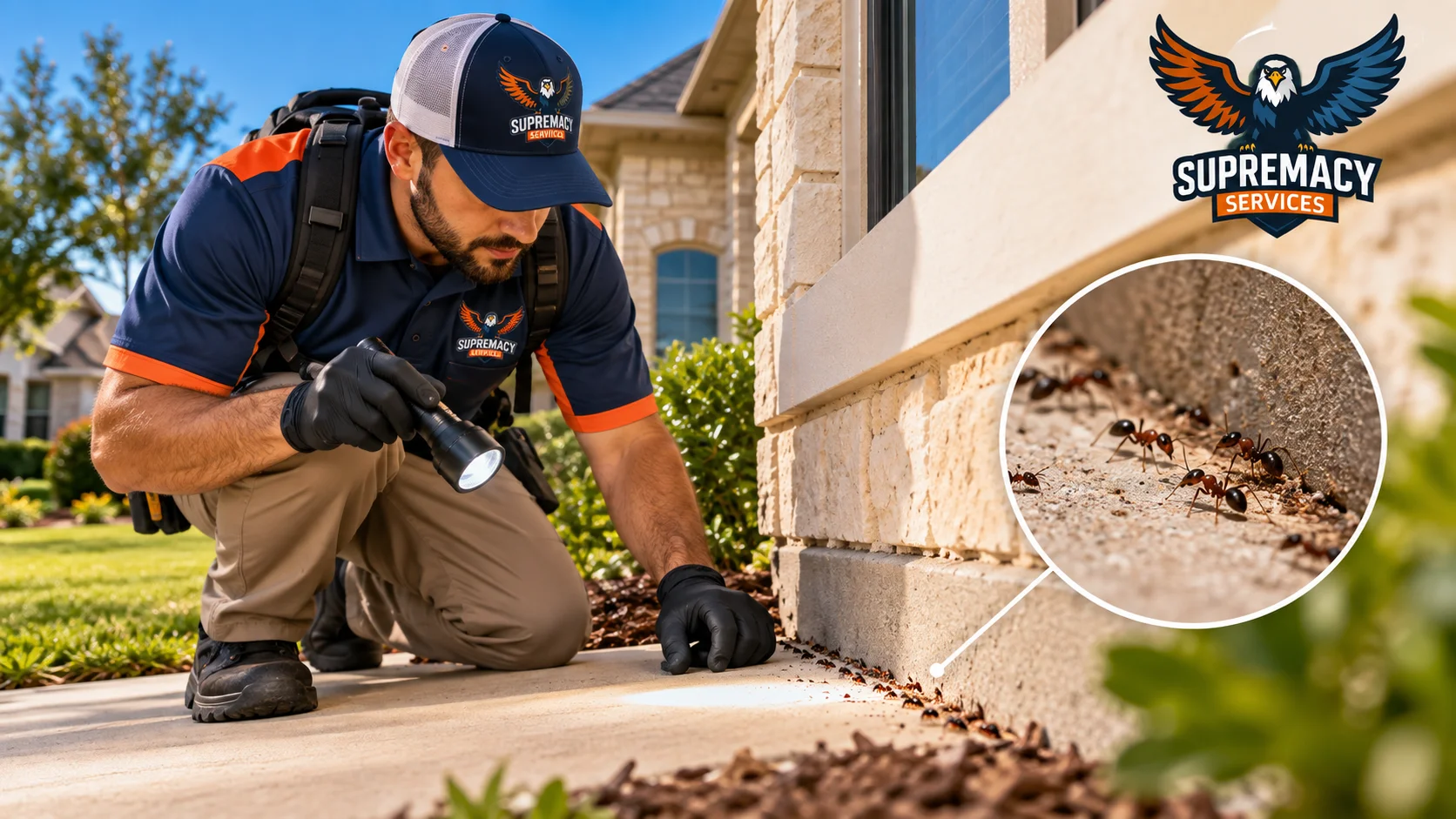
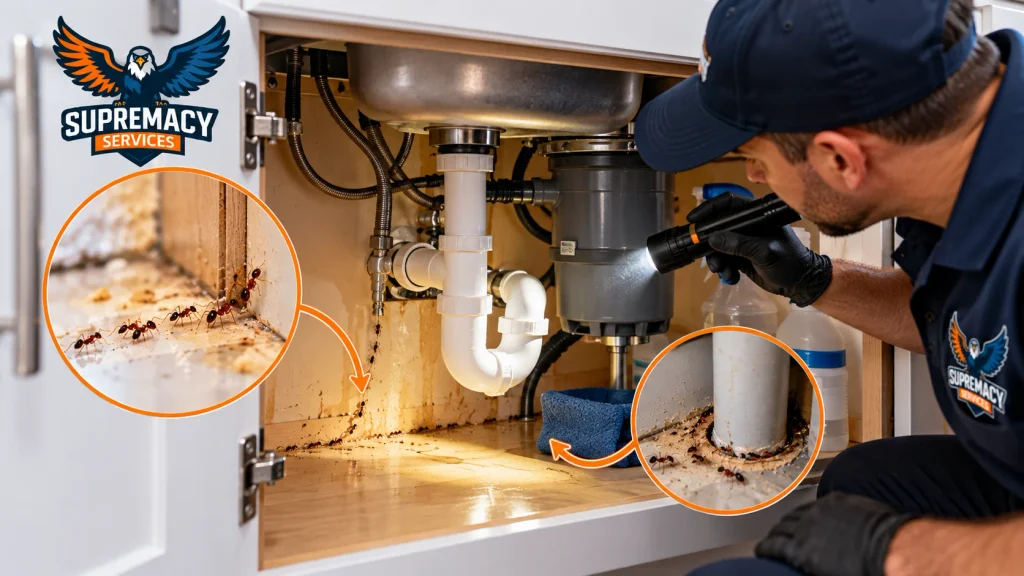
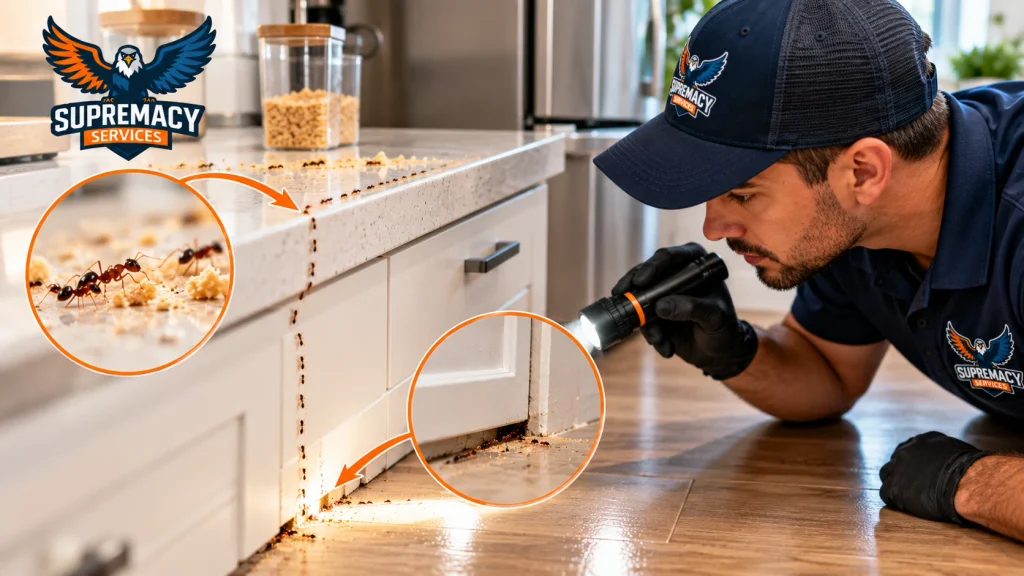
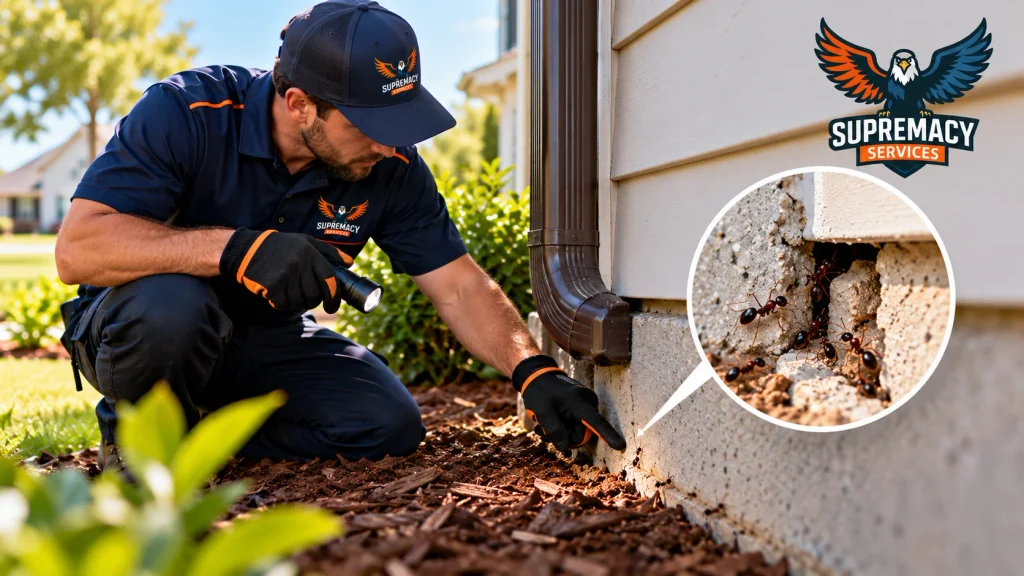
Supremacy Services technician inspecting ants along a home foundation in North Texas

How Much Does Ant Pest Control Cost in North Texas?

Table of Contents

  1. How Much Does Ant Pest Control Cost in North Texas?
  2. Ant Treatment Cost by Type of Problem
  3. What Determines the Cost of Ant Control?
  4. Does the Type of Ant Affect the Price?
  5. One-Time vs. Recurring Ant Control
  6. What Does Professional Ant Control Include?
  7. DIY vs. Professional Ant Control
  8. When Should You Call a Professional?
  9. How to Prevent Ants From Returning
  10. How to Compare Ant-Control Quotes
  11. Frequently Asked Questions

For budgeting purposes, professional ant pest control in North Texas can range from roughly $80 to $500 for many conventional treatments, based on current national consumer-market estimates. One 2026 national cost guide places the typical range at $80–$500 with an average around $150, while a Dallas-specific third-party pricing source reports approximately $100–$450 per treatment. These are market-planning figures—not Supremacy Services prices or guaranteed Dallas averages.

Your actual quote can be lower or higher depending on the ant species, size and location of the colony, extent of the infestation, property size, treatment method and whether follow-up or recurring exterior service is needed.

That distinction matters because “ant control” can describe very different jobs.

A few foraging ants entering beside a kitchen window are not necessarily the same treatment problem as:

  • multiple colonies around a large property;
  • recurring ants entering from the foundation;
  • fire-ant mounds throughout a lawn;
  • ants nesting inside wall voids; or
  • suspected carpenter ants associated with damp wood.

Texas A&M notes that identifying the ant is an important first step because Texas homes can encounter several species with different nesting habits and control requirements.

Bottom line: Use online ant-control prices to establish a budget, not as a substitute for a property-specific quote.


Ants keep returning? Explore Supremacy Services’ perimeter pest-control options for recurring ant activity around Dallas-Fort Worth homes.


Ant Treatment Cost by Type of Problem

The cost of professional ant control depends more on what needs to be done than on the simple fact that ants are present.

Ant-control situationLikely pricing tendencyWhy
Small, localized ant problemLowerLimited treatment area and simpler inspection
Recurring household antsLow–moderateSource and entry points may need investigation
Multiple indoor activity areasModerateGreater inspection and treatment scope
Large exterior infestationModerateLarger treatment area
Fire ants across a lawnModerate–higherFull-yard treatment may differ from ordinary perimeter service
Carpenter antsVariableNest location and moisture/wood conditions can complicate treatment
Ants nesting in inaccessible voidsVariableLocating and reaching the colony may require additional work
Recurring prevention programDifferent pricing structureCost is spread across scheduled service visits

These categories describe relative complexity rather than fixed prices.

Why isn’t there one standard ant exterminator price?

Because two homes with the same number of visible ants may have completely different underlying problems.

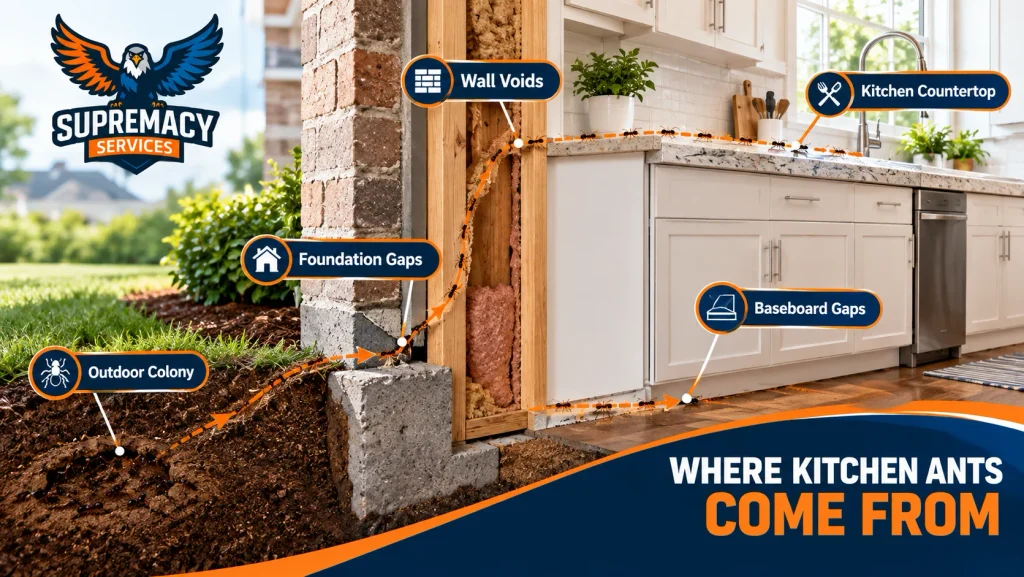
In one home, workers may simply be foraging from a colony outside.

In another, ants may repeatedly enter through several foundation or utility openings.

Texas A&M explains that most ant species invading Texas homes normally nest outdoors, although some species can establish nests in walls or other interior areas.

The technician therefore needs to determine where the ants are coming from, not simply count the ants you can see.


What Determines the Cost of Ant Control?

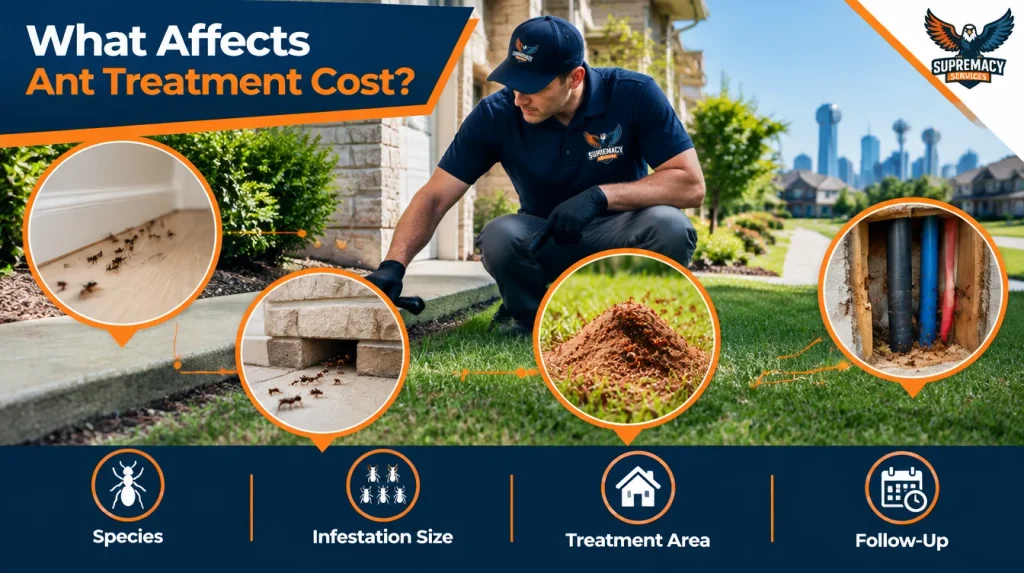
Factors that affect professional ant pest control cost in Dallas-Fort Worth
Ant-control pricing can vary based on the ant species, infestation severity, colony location, property size and treatment method.

1. Ant species

Species identification can change the treatment strategy.

Texas A&M identifies red imported fire ants, carpenter ants and several smaller household ants among the species encountered around Texas properties. Different ants have different nesting locations, food preferences and responses to treatment.

That means a generic “spray the ants” approach is not necessarily appropriate.

2. Location of the colony

An accessible outdoor colony may be relatively straightforward.

A colony associated with:

  • wall voids;
  • window or door frames;
  • landscaping;
  • trees;
  • inaccessible structural cavities; or
  • areas affected by moisture

can require additional investigation.

The farther the treatment must go beyond controlling visible foragers, the greater the potential service scope.

3. Severity and spread of activity

Seeing three ants beside one window is different from finding established trails in the kitchen, pantry, bathroom and garage.

More widespread activity can require:

  1. inspection;
  2. identification;
  3. trail tracing;
  4. locating likely nesting areas;
  5. treatment;
  6. sanitation or moisture recommendations;
  7. entry-point investigation; and
  8. follow-up.

4. Interior versus exterior activity

Many Texas ant problems originate outside.

If ants are simply entering from an exterior colony, a technician may focus on exterior activity, entry areas and the colony source.

Supremacy already maintains a dedicated perimeter pest-control service built around exterior inspection and treatment of foundations and common pest-entry areas, including ants.

5. Size and layout of the property

Square footage can matter, particularly when large exterior areas require inspection or treatment, but it is not the only factor.

Landscaping, patios, attached garages, foundation design, irrigation, vegetation and other property features can change the amount of work involved.

6. One-time versus recurring treatment

A one-time corrective service and an ongoing preventive pest-control program have different pricing models.

A recurring program may make sense when ants are one part of broader seasonal pest pressure around the structure.

7. Follow-up requirements

Some ant problems can be resolved relatively quickly.

Others require monitoring or repeat visits, particularly when the nest is difficult to locate or activity returns.

Ask whether follow-up visits or callbacks are included before comparing quotes.


Does the Type of Ant Affect the Price?

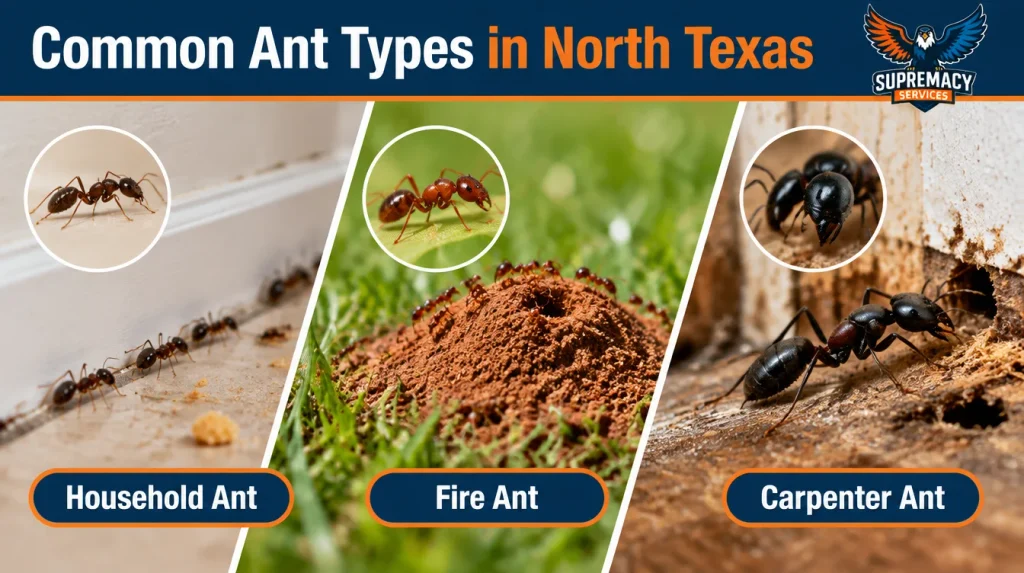
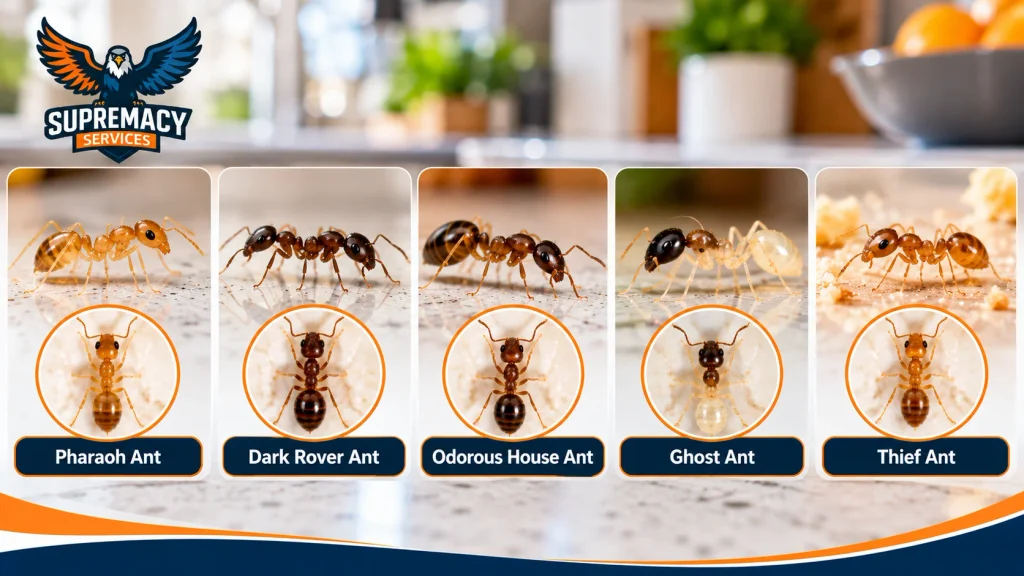
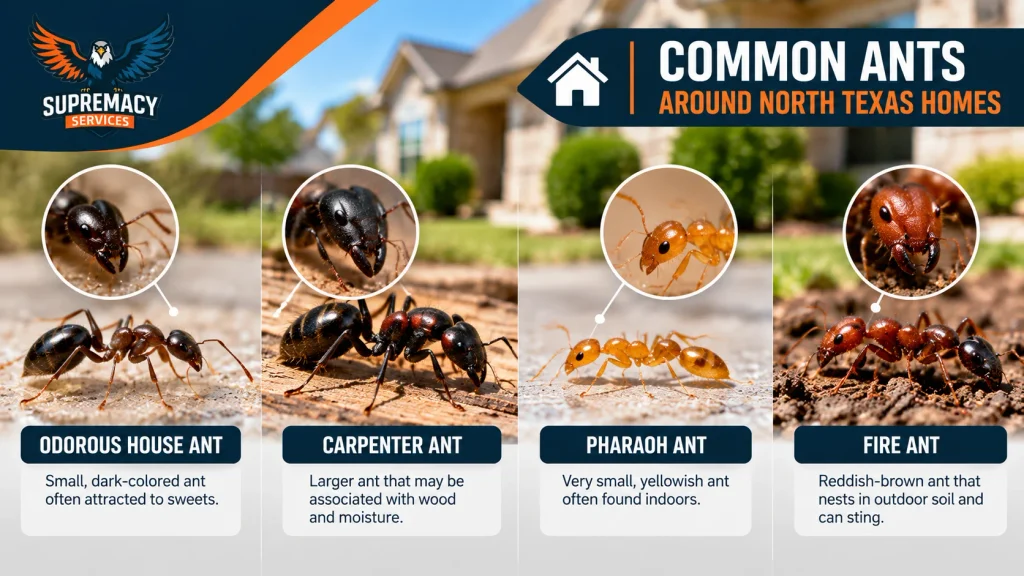
Common household ant species found in Dallas and North Texas homes
Identifying the ant species matters because different ants may require different treatment strategies.

Yes. Ant species can affect treatment complexity and therefore cost because different species nest and forage differently.

Common household ants

Small household ants may enter kitchens and bathrooms looking for food or moisture.

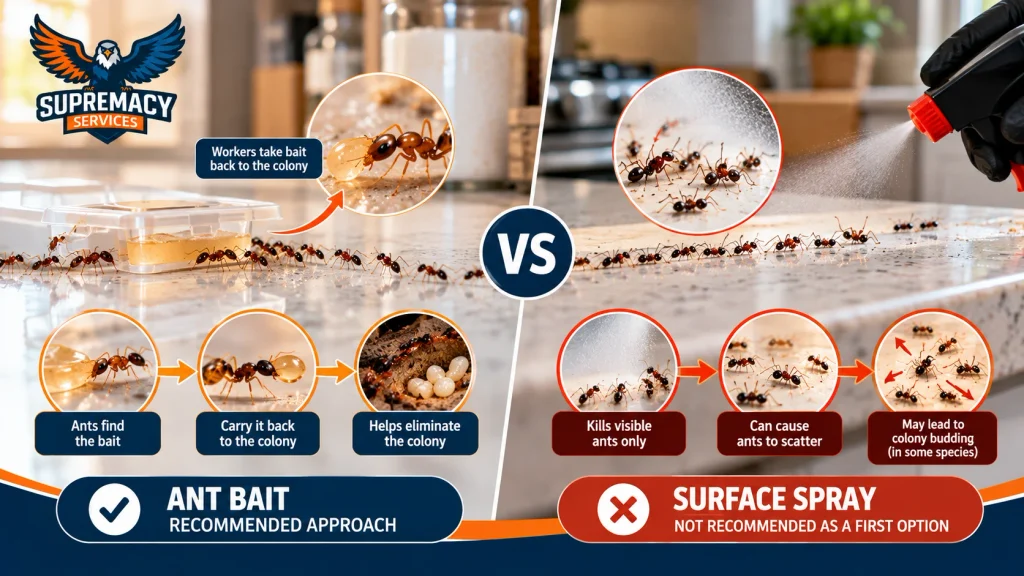
Treatment may involve identifying trails, correcting food or water sources, baiting where appropriate and determining where ants are entering.

Fire ants

Fire ants present a different problem because colonies are generally outdoors.

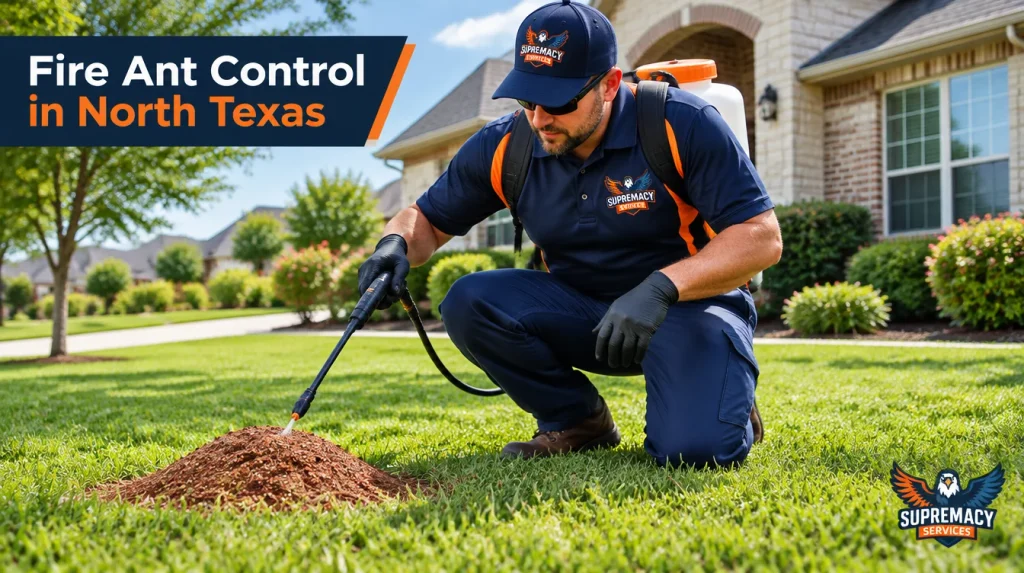
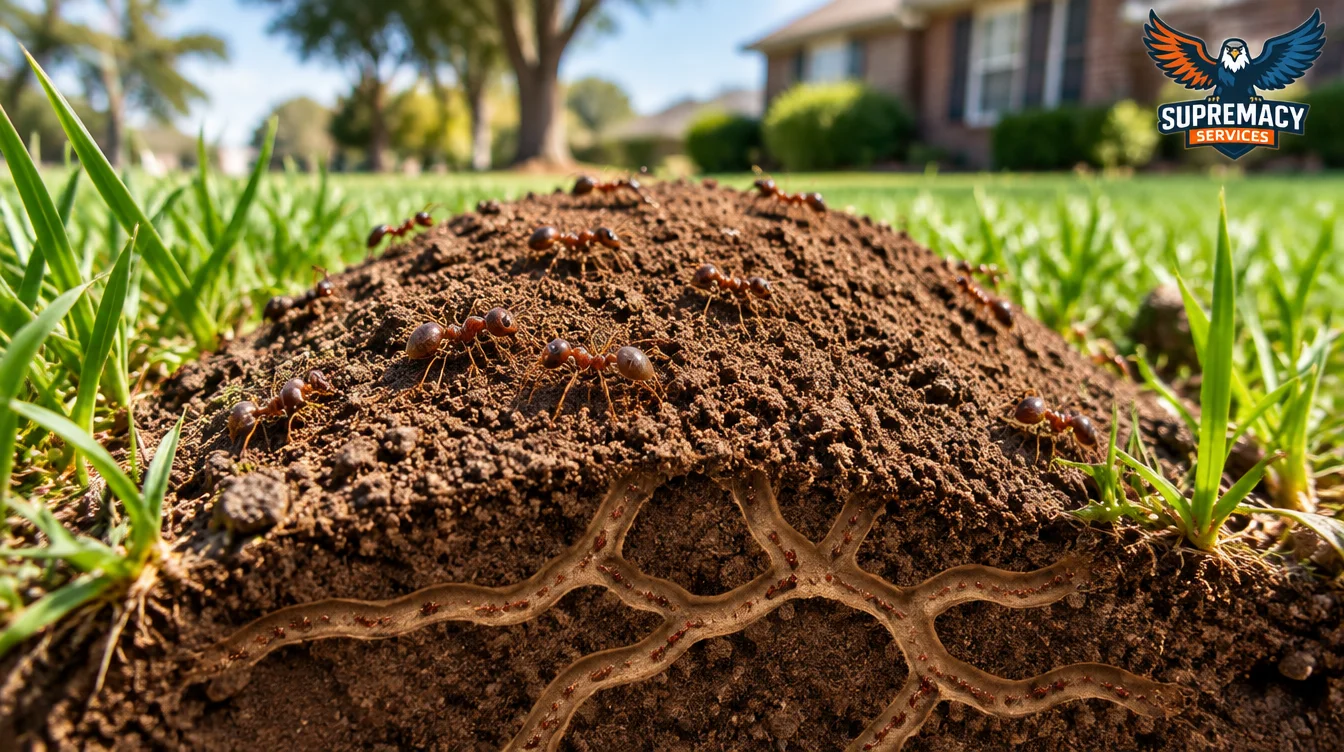
Texas A&M recommends a specific two-step approach for fire-ant management involving broadcast bait followed, where needed, by treatment of individual problem mounds. Fire-ant baits are not interchangeable with products intended for every household ant.

Supremacy also has a separate Fire Ant Yard Shield service, which means fire-ant intent should be routed toward that specialized service rather than treated as ordinary indoor ant control.

Carpenter ants

Carpenter ants can require more investigation because they can nest in structural cavities and are often associated with damp or deteriorated wood.

Importantly, Texas A&M explains that carpenter ants do not eat wood like termites. Texas species are generally less structurally destructive than carpenter ants in some other parts of the country, but an indoor colony can still require specialized management.

Texas A&M further notes that carpenter-ant control can be specialized and may require professional assistance when nests are difficult to locate.

Pharaoh and other tiny indoor ants

Tiny ants should not automatically be treated as one interchangeable pest.

Correct identification matters because treatment that works for one ant may perform poorly against another.

That is one reason repeated DIY spraying without knowing the species can become an expensive cycle.


One-Time vs. Recurring Ant Control

One-time ant treatment targets an existing problem; recurring pest control combines treatment with ongoing inspection and prevention.

One-Time Ant TreatmentRecurring Pest Control
Targets a defined infestationDesigned around ongoing pest pressure
May have higher cost per visitCost distributed across scheduled visits
Appropriate for some isolated problemsUseful when ants repeatedly return
Limited future monitoringRegular exterior monitoring
New activity may require another appointmentFuture activity may be addressed within the service program, depending on terms
Best compared by treatment scopeBest compared by annual cost and coverage

Neither approach is automatically better.

If one small outdoor colony is causing a temporary problem, ongoing service may not be necessary.

If ants repeatedly enter the home along with roaches, spiders or other seasonal pests, broader perimeter protection may be more practical.

Supremacy’s current pest-control page specifically lists ants among the everyday household pests covered by its standard protection approach.


Dealing with recurring ants around your foundation, kitchen or entry points? Request a pest assessment from Supremacy Services to determine whether targeted treatment or ongoing perimeter protection makes more sense for your property.


What Does Professional Ant Control Include?

Pest control technician inspecting a Dallas home for signs of an ant infestation
A professional inspection can help locate ant trails, entry points, nesting areas and conditions that may be supporting the infestation.

Professional ant management should begin with identification and inspection, rather than automatically spraying every visible ant.

A thorough assessment may include:

1. Identifying the ant

Correct identification helps determine:

  • likely nesting location;
  • feeding behavior;
  • whether baiting is appropriate;
  • whether the colony is likely indoors or outdoors; and
  • what treatment approach makes sense.

2. Following active trails

Ant trails can reveal considerably more than the place where ants were first noticed.

A technician may trace activity toward:

  • doors;
  • windows;
  • foundation gaps;
  • plumbing penetrations;
  • wall openings;
  • landscaping; or
  • exterior nesting areas.

3. Checking food and water sources

EPA’s integrated pest-management guidance emphasizes reducing the food, water and shelter that support pest activity.

For ants, that may mean checking:

  • crumbs and food residue;
  • pantry products;
  • pet food;
  • leaking plumbing;
  • condensation;
  • damp cabinets;
  • irrigation; and
  • other persistent moisture.

4. Locating likely nesting areas

Killing workers on a countertop does not necessarily eliminate the colony producing them.

Professional inspection therefore focuses on where the activity originates.

5. Selecting treatment for the species and location

Depending on the situation, treatment might involve appropriately labeled:

  • baits;
  • targeted exterior applications;
  • crack-and-crevice treatment;
  • nest treatment;
  • perimeter management; or
  • another species-specific strategy.

The appropriate method should follow identification.

6. Prevention recommendations

A professional may also identify conditions contributing to recurring activity, such as:

  • vegetation touching the structure;
  • accessible food;
  • moisture;
  • gaps around penetrations;
  • deteriorated seals;
  • nearby nesting habitat.

DIY vs. Professional Ant Control: Which Costs Less?

DIY ant control compared with professional ant pest control for a North Texas home
Small, isolated ant problems may respond to basic measures, while persistent or widespread infestations may require professional identification and treatment.

DIY treatment costs less initially, but professional treatment can become more cost-effective when ants repeatedly return, the species is uncertain or the colony cannot be located.

DIY can be reasonable when:

  • only a few ants are present;
  • you can identify the pest with reasonable confidence;
  • the source is accessible;
  • sanitation or exclusion can solve the problem;
  • activity has not spread throughout the home; and
  • you can safely follow the label of an appropriate consumer product.

EPA advises consumers to read pesticide labels carefully, follow directions and never assume that applying more pesticide will produce better results.

Professional ant control becomes more reasonable when:

  • ants keep returning after DIY treatment;
  • several rooms have activity;
  • you cannot identify the species;
  • ants appear to be emerging from a wall;
  • you suspect an indoor colony;
  • large numbers of carpenter ants are present indoors;
  • numerous fire-ant colonies affect the property;
  • the infestation is spreading; or
  • repeated store-bought treatments have not solved the problem.

Don’t use unsafe homemade treatments

Texas A&M specifically warns against using gasoline or other flammable liquids to destroy ant nests because of the safety and environmental risks.

“Cheap” treatment is not cheaper if it creates another problem.


Why Do Ants Keep Coming Back After Treatment?

Ants commonly return when treatment removes visible workers without correcting the underlying source.

Possible reasons include:

  • the colony was never located;
  • food remains available;
  • water or moisture remains available;
  • ants continue using the same entry point;
  • treatment was not appropriate for the species;
  • outdoor colonies remain close to the structure; or
  • new ants recolonize favorable areas.

This is why the objective should not simply be to kill the ants you can see.

The better questions are:

What species is it? Where is the colony? Why is it using this property?

Supremacy’s separate guide to ants suddenly appearing inside a house explores those causes in greater depth and should remain the primary page for “why are ants in my house?” intent.


Are Ants More of a Problem During Certain North Texas Conditions?

Ant activity can change with environmental conditions.

Texas A&M notes that red imported fire ants are widespread in eastern Texas and that fire ants may enter buildings looking for food or water. It also emphasizes that many common household ants normally maintain colonies outdoors.

For homeowners, that means changing outdoor conditions can alter where ants forage.

Rather than assuming every seasonal ant sighting requires treatment, watch:

  • where ants are traveling;
  • whether they are indoors or outdoors;
  • whether activity persists;
  • whether they are associated with moisture;
  • whether visible mounds are present; and
  • whether the same trail repeatedly returns.

Persistent activity provides more useful information than one isolated ant.


How Can You Prevent Ants From Returning?

Ant prevention and perimeter pest control around a Dallas-Fort Worth home
Reducing food, moisture and accessible entry points can help make a property less attractive to ants and support an ongoing pest-management program.

Prevention should focus on food, water, shelter and access.

Indoor ant-prevention checklist

  • Clean food residue and spills promptly.
  • Store food in closed containers.
  • Keep pet food from sitting out unnecessarily.
  • Clean beneath appliances.
  • Empty food-contaminated trash regularly.
  • Repair leaking plumbing.
  • Investigate moisture beneath sinks and around appliances.
  • Follow ant trails before wiping them away when trying to determine their source.

Exterior checklist

  • Inspect doors and windows for pest-access gaps.
  • Check utility and plumbing penetrations.
  • Reduce unnecessary debris beside the foundation.
  • Address persistent moisture and drainage issues.
  • Avoid allowing vegetation to create easy bridges to the structure.
  • Monitor recurring ant trails rather than repeatedly treating only individual workers.

EPA’s IPM framework recommends combining prevention, monitoring and appropriate control methods instead of relying automatically on pesticide applications.


How to Compare Ant-Control Quotes in Dallas-Fort Worth

Don’t compare two quotes solely by their headline price.

Ask each provider:

QuestionWhy it matters
What ant species do you believe is present?Treatment should follow identification
Where does the activity appear to originate?Visible ants may only be foragers
What areas will you inspect?Inspection scope affects value
What areas will be treated?Interior and exterior proposals can differ
Is this a one-time treatment or program?Changes total annual cost
Are follow-up visits included?Important for recurring activity
Which other pests are included?General plans can offer broader coverage
Are fire ants included?Lawn treatment may be a separate service
Are carpenter ants handled differently?Specialized treatment may be required
Is there a service agreement?Understand the commitment
What is the total cost?Avoid comparing partial prices
Is the pest-control business properly licensed?Texas regulates structural pest-control services

Texas law requires businesses and individuals performing structural pest control for compensation to meet applicable licensing requirements. The Texas Department of Agriculture identifies ants within the structural pest-control category.

You can also verify current structural pest-control licensing information through the Texas Department of Agriculture.


Ants or Termites? Don’t Pay for the Wrong Treatment

Winged ants are commonly confused with termite swarmers.

That distinction is especially important when pricing pest control because termite inspection and treatment belong to a completely different service category.

Flying ants generally have:

  • elbowed antennae;
  • a visibly constricted waist; and
  • front wings longer than their rear wings.

Termite swarmers have a broader waist, relatively straight antennae and wings that are more similar in length.

If you are uncertain, identify the insect before buying treatment.

Supremacy’s existing Flying Ants vs. Termites guide covers this identification intent in detail and should receive an internal link rather than duplicating that information here.


Is Professional Ant Control Worth the Cost?

Professional treatment becomes most useful when the service solves a problem the homeowner cannot reliably diagnose or correct.

The value is not simply having someone spray insecticide.

It is the combination of:

identification + inspection + source location + appropriate treatment + prevention + follow-up when necessary.

For a minor, correctly identified problem, reasonable DIY measures may be enough.

For recurring ants, widespread activity, inaccessible colonies or uncertain identification, professional inspection can prevent homeowners from repeatedly spending money on treatments aimed only at visible workers.


How Much Should You Budget for Ant Pest Control?

A reasonable online budgeting reference is approximately $80–$500 for many conventional professional ant treatments, based on current 2026 national market data, with Dallas-specific third-party estimates also falling broadly within that territory.

But don’t treat that range as a quote.

Your actual cost depends on:

  1. ant species;
  2. infestation severity;
  3. colony location;
  4. property size;
  5. treatment area;
  6. treatment method;
  7. follow-up requirements; and
  8. whether you choose one-time or ongoing pest management.

A quote based on your actual property is therefore more useful than choosing a company because its online “starting price” is lower.


Frequently Asked Questions

How much does an ant exterminator cost in Dallas?

Current third-party consumer pricing guides suggest many professional ant treatments fall roughly between $80 and $500 nationally, while one Dallas-specific market estimate reports approximately $100–$450. These are planning benchmarks rather than guaranteed Dallas or Supremacy Services prices.

What makes ant extermination more expensive?

Species, infestation severity, colony location, property size, treatment area, accessibility and follow-up requirements can all increase the scope and price.

Is one ant treatment enough?

Sometimes. A localized problem may respond to one correctly selected treatment, while established or recurring colonies may require follow-up or ongoing prevention.

Is monthly or quarterly pest control better for ants?

It depends on the property and recurrence of pest activity. Instead of choosing frequency alone, compare the pests covered, inspection scope, callbacks and annual cost.

Can I get rid of ants myself?

Minor ant activity can sometimes be handled with sanitation, exclusion and appropriately labeled consumer products. Recurring, unidentified or inaccessible colonies are stronger candidates for professional evaluation.

Why do ants return after spraying?

Spraying visible workers may not eliminate the colony. Food, moisture, entry points or an untreated nest may continue supporting activity.

Does regular pest control include ants?

It depends on the provider and plan. Supremacy’s current general pest-control program lists ants among the everyday household pests addressed by its standard protection service.

Does fire-ant treatment cost more?

It can because fire-ant treatment may involve a larger outdoor treatment area and a different strategy from controlling household ants. Texas A&M recommends a specific two-step approach for fire-ant management.

Are carpenter ants the same as termites?

No. Carpenter ants excavate areas for nesting but do not consume wood the way termites do. Accurate identification matters because their control methods differ.

Should I hire a licensed pest-control company in Texas?

Texas regulates structural pest-control businesses and individuals providing these services for compensation. Homeowners can check current licensing information through the Texas Department of Agriculture.


Get an Ant-Control Assessment in Dallas-Fort Worth

The cheapest treatment is not necessarily the one with the lowest initial price.

It is the treatment that correctly identifies the ant, addresses the source and reduces the likelihood that you will keep paying to solve the same problem.

If ants keep appearing in your kitchen, bathroom, foundation area, patio or lawn, request an ant and pest assessment from Supremacy Services. A property-specific evaluation can determine whether you need targeted ant treatment, perimeter pest control or specialized fire-ant management.

Supremacy serves homeowners throughout Dallas and surrounding DFW communities, including Frisco, Plano, McKinney, Allen, Richardson and other North Texas service areas.
Request a North Texas Pest-Control Assessment → Identify the ants, find the source and get a treatment plan based on your property—not an online average.

Tiny ants following a trail toward food crumbs on a kitchen countertop in a Dallas-area home.
Tiny Ants in the Kitchen: What Are They & Where Are They Coming From?

Tiny ants in the kitchen are usually worker ants searching for food, water or both. In North Texas homes, possibilities include pharaoh ants, dark rover ants, odorous house ants, thief ants and other small household species. Some colonies live outdoors and send workers inside, while others can nest in wall voids and other protected areas within a building.

The most useful first step is not spraying every ant you see. Look at their size and color, what they are feeding on, where the trail disappears and whether activity is concentrated around the sink, pantry, cabinets, dishwasher or an exterior wall.

Correct identification matters because ants that look remarkably similar can have very different nesting habits and control requirements. Texas A&M notes that household ants can be difficult to identify without proper equipment and experience.

Table of Contents

  1. What are the tiny ants in my kitchen?
  2. Where are tiny kitchen ants coming from?
  3. Why are they around my kitchen sink?
  4. Why do they keep coming back?
  5. How to find where the ants are entering
  6. What should you do about tiny kitchen ants?
  7. DIY vs. professional ant control
  8. What professional ant control should include
  9. How to prevent kitchen ants
  10. Frequently asked questions

What Are the Tiny Ants in My Kitchen?

Comparison of pharaoh ants, dark rover ants, odorous house ants, ghost ants and thief ants found around homes.
Several small ant species can enter North Texas kitchens, and correct identification helps determine the appropriate control approach.

There is no single species called a “kitchen ant” or “sugar ant.” Those names are commonly used to describe several small ants found around food and moisture.

In Texas, several species can fit the description.

Quick Identification Guide

Possible antApproximate appearanceCommon kitchen cluePossible source
Pharaoh antExtremely small; yellowish to reddish-brownSweets, grease and other foodsOften nests indoors near warmth and moisture
Dark rover antTiny; dark brownOften attracted to sweetsUsually originates outdoors but can establish around structures
Odorous house antSmall; brownStrong attraction to sweetsOutdoors under objects/mulch or indoors in structural voids
Ghost antExtremely small; dark head with pale/translucent abdomen and legsMay be difficult to see except for darker headProtected indoor/outdoor nesting sites
Thief antExtremely small; yellowish to light brownCan reach packaged foods; may favor protein/fatSoil, cracks, crevices and wall voids

These descriptions are clues—not a substitute for identification.

Texas A&M specifically warns that ants can be challenging to identify without proper equipment because many household species have similar sizes and appearances.

Are they pharaoh ants?

Pharaoh ants are among the most important possibilities when the ants are extremely small and yellowish or reddish-brown.

Texas A&M describes workers as roughly 1/12 to 1/16 inch long. They feed on sweets as well as greasy and fatty foods and can establish multiple interconnected nests inside buildings.

They deserve special attention because their management differs from many other ants.

Are they dark rover ants?

Dark rover ants are another possibility when the ants are extremely small but noticeably darker.

Texas A&M describes rover ants as tiny, dark brown ants that are frequently found outdoors along house edges, sidewalks and trees. They can also enter homes and are attracted to sweet foods.

A kitchen trail does not necessarily mean the nest is in the kitchen.

Are they odorous house ants?

Odorous house ants are brown ants that frequently nest outdoors beneath objects, mulch and other protected areas, although they can also establish nests in walls and other structural locations.

They are attracted to sweets.

Texas A&M describes them as approximately 1/8 inch long and notes their distinctive odor when crushed.

Do not deliberately crush ants merely as your primary identification method. Trail location, appearance and professional identification provide better information.

Could they be ghost ants?

Ghost ants are exceptionally small—less than 1/16 inch according to Texas A&M—and have a dark head and thorax contrasted with pale, almost translucent legs and abdomen.

Their coloration can make them appear almost as if the dark portion of the ant is moving by itself across a light countertop.

What about thief ants?

Thief ants are also extremely small and can enter packaged foods because their size lets them exploit very small openings.

Texas A&M reports that they consume a range of foods including meats, breads, sweets, nuts, fats, oils and dairy products. They can nest in soil, cracks, crevices and wall voids.

They can be confused with pharaoh ants, which is another reason identification should precede aggressive treatment.


Where Are Tiny Kitchen Ants Coming From?

Cutaway diagram showing ants traveling from an outdoor colony through foundation gaps and wall voids into a kitchen.
The ants visible on a countertop may originate from a colony outside the home and travel indoors through small structural openings

Tiny kitchen ants can come from an outdoor colony, an indoor nest or a nearby structural void. Follow their trail instead of assuming the countertop is the source.

Common routes include:

  • gaps around plumbing pipes;
  • spaces behind backsplashes;
  • cracks beside cabinets;
  • window and door gaps;
  • baseboard joints;
  • utility penetrations;
  • wall voids;
  • gaps beneath appliances;
  • exterior foundation openings;
  • nearby landscaping and mulch.

A line of ants across the counter only shows where workers are foraging. The colony could be several feet—or much farther—away.

Texas A&M’s household-ant guidance recommends identifying the ant and locating nests or trails because species and nesting location influence management.

Are the ants actually nesting inside the kitchen?

Possibly, but not necessarily.

Many household ants nest outside and send workers indoors. Others, particularly pharaoh ants, can establish colonies in protected interior spaces.

That distinction changes the solution.

An outdoor colony entering through a foundation or utility gap calls for a different strategy from ants nesting inside wall voids.

If you keep finding ant trails entering from outside, explore Supremacy Services’ perimeter pest control options for DFW homes to see how exterior pest pressure and common entry areas can be addressed.


Why Are Tiny Ants Around My Kitchen Sink?

Pest-control technician inspecting ants, moisture and plumbing openings beneath a kitchen sink.
Moisture, food residue and openings around plumbing can make the area beneath a kitchen sink an important place to inspect for ant activity.

Ants around the sink are often finding water, food residue or both.

Inspect:

  • the faucet and fixtures;
  • plumbing beneath the sink;
  • pipe penetrations through the cabinet or wall;
  • damp cabinet materials;
  • dishwasher connections;
  • condensation;
  • sponges and dishcloths;
  • garbage disposal residue;
  • recycling containers;
  • pet bowls nearby.

A plumbing opening can serve two roles simultaneously: it may provide access through a wall while the sink supplies moisture.

Texas A&M notes that some household ants nest near heat and moisture sources, and Argentine ants, for example, may be found around sinks, water pipes and leaks.

Does finding ants around the sink mean you have a leak?

No.

A leak is one possibility, not a diagnosis.

Ants can use ordinary sink moisture, food residue or an entry route around plumbing without there being a plumbing failure.

However, persistent dampness beneath a cabinet should be investigated independently of the ant problem.


Why Are Tiny Ants in the Pantry?

Pantries provide concentrated food sources in a protected environment.

Check:

  • sugar and sweeteners;
  • cereal;
  • flour and baking products;
  • bread;
  • snacks;
  • pet food;
  • nuts;
  • grease or cooking residue;
  • damaged packaging;
  • crumbs on shelving;
  • spills beneath containers.

Do not assume the ants are interested only in sugar.

Different species have different food preferences, and preferences can include sweets, grease, protein and other foods.

Texas A&M’s household-ant comparison shows significant differences in food preferences among Texas species.

Move affected products aside, inspect packaging and clean the shelf so you can determine whether ants continue arriving from a crack, cabinet joint or wall.


Why Do Tiny Ants Keep Coming Back After I Clean?

Cleaning removes food and disrupts foraging opportunities, but it does not necessarily eliminate the colony.

If ants return, one or more of these conditions may remain:

  1. the colony is still active;
  2. another food source is available;
  3. water remains available;
  4. the entry route remains open;
  5. workers are traveling from an indoor nest;
  6. treatment killed visible workers without affecting the colony.

This explains why wiping down the counter can produce a temporary improvement followed by another trail.

Sanitation is important, but recurring ant activity is ultimately a source-and-colony problem, not simply a countertop problem.


How Can You Find Where Tiny Ants Are Entering the Kitchen?

Pest-control technician following an ant trail from a kitchen countertop toward a cabinet and baseboard gap.
Following an active ant trail can help reveal where workers are entering the kitchen instead of focusing only on the ants you can see.

Watch the ants for several minutes before removing the trail. Follow workers in both directions and pay particular attention to the point where they disappear.

Kitchen Ant Inspection Checklist

AreaWhat to inspect
SinkPlumbing penetrations, moisture, cabinet seams
BacksplashCracks and gaps
CountertopDirection of the trail
CabinetsCorners, hinges, seams and wall junctions
PantryOpen food and shelf gaps
DishwasherMoisture and surrounding voids
RefrigeratorCrumbs, condensation and wall/floor gaps
WindowsFrame and sill openings
DoorsThreshold and weather stripping
BaseboardsCracks where trails disappear
Exterior wallFoundation, utility penetrations and landscaping

Step 1: Find the busiest trail

Start where activity is greatest.

Step 2: Follow ants away from the food

Workers traveling back from food may help reveal their route toward the colony.

Step 3: Look beneath and behind nearby items

Check appliances, containers and removable items without unnecessarily disturbing inaccessible structural areas.

Step 4: Match the interior route to the outside wall

If the trail disappears near an exterior wall, inspect the corresponding outdoor area.

Look around the foundation, vegetation, mulch, stones, utility penetrations and other protected locations.

Step 5: Check whether activity emerges from a wall

Repeated ants coming from a switch plate, baseboard gap, plumbing opening or cabinet-wall junction may indicate that workers are traveling through a structural void.

That does not automatically prove the colony is inside the wall, but it warrants closer investigation.


Should You Spray Tiny Ants in the Kitchen?

Avoid automatically spraying an unidentified ant trail. Killing visible workers may not eliminate the colony, and the wrong strategy can make certain ant infestations harder to control.

Pharaoh ants are the most important example.

Texas A&M specifically advises against repellent liquid or dust insecticides indoors for pharaoh ants because these treatments can cause colonies to bud, potentially worsening the infestation. Strategic bait placement is the recommended control approach described in its guidance.

That is a strong reason to identify extremely small indoor ants before treating them like any other crawling insect.


What Should You Do About Tiny Kitchen Ants?

Start with observation and source reduction.

1. Identify what they are feeding on

Check sweets, grease, pet food, crumbs and other accessible foods.

2. Trace the trail

Find where workers enter and leave the kitchen.

3. Remove competing food

Clean spills and crumbs and securely store food.

This is particularly important if bait will be used because abundant alternative food can compete with it.

4. Correct moisture problems

Repair leaks and eliminate avoidable standing moisture.

5. Store pantry products securely

Use appropriately sealed containers where practical.

6. Clean trash and recycling areas

Food residue can sustain foraging ants even when counters are spotless.

7. Seal appropriate entry points

After determining where activity originates, correct practical structural gaps around windows, doors and penetrations.

Do not seal ants into a wall without understanding the infestation.

8. Use only appropriately labeled products

If using a pesticide, follow the product label exactly and make sure it is labeled for the pest and application location.

Never improvise pesticide applications around food-preparation surfaces.


Do Ant Baits Work Better Than Sprays?

Comparison showing ant bait carried toward a colony versus surface spray affecting visible ants.
Ant-control methods work differently. Correct species identification should guide treatment, particularly when pharaoh ants may be present

Ant bait can be particularly useful because foraging workers consume it and can carry it back toward other members of the colony.

Texas A&M recommends ant baits as one option when a nest cannot be located and notes that bait preferences can differ among species.

But bait is not simply a matter of placing any product anywhere.

Effectiveness can depend on:

  • correct species identification;
  • what food the ants currently prefer;
  • bait placement;
  • competing food;
  • colony location;
  • infestation size;
  • whether another pesticide has disrupted normal foraging.

Never place pesticide where the label prohibits its use.


DIY vs. Professional Ant Control

Minor activity associated with an obvious food spill may be manageable with cleaning, monitoring and exclusion. Recurring trails, uncertain species or ants emerging from inaccessible areas justify a more thorough investigation.

SituationReasonable approach
A few ants around a recent spillClean and monitor
Ant trail from an obvious exterior gapRemove attractants and investigate entry
Ants around a minor moisture sourceCorrect moisture and monitor
Repeated trail every dayIdentify species and colony source
Extremely tiny yellow antsConsider possible pharaoh ants before treatment
Ants emerging from wall voidsProfessional identification may be useful
Multiple rooms affectedBroader inspection
DIY treatment repeatedly failsProfessional assessment
Winged insects appearConfirm ants vs. termites

When should you call pest control?

Consider professional ant control when:

  • trails return after sanitation;
  • you cannot identify the species;
  • ants are appearing in multiple rooms;
  • ants appear to be emerging from walls;
  • you suspect pharaoh ants;
  • you cannot locate the source;
  • activity persists after reasonable DIY measures;
  • treatments appear to make the infestation spread;
  • you are unsure which pesticide strategy is appropriate.

Tiny ants returning despite cleaning and DIY treatment? Request a DFW pest-control assessment from Supremacy Services to identify the ant, trace the source and determine the appropriate control strategy.


What Should Professional Ant Control Include?

Professional ant management should start with inspection and identification, not indiscriminate spraying.

Depending on the infestation, an assessment may involve:

  1. identifying the species or likely ant group;
  2. tracing active trails;
  3. determining likely nesting areas;
  4. checking kitchen food and moisture sources;
  5. inspecting plumbing and utility penetrations;
  6. examining exterior foundation conditions;
  7. locating outdoor nests where practical;
  8. selecting species-appropriate treatment;
  9. addressing entry points and contributing conditions;
  10. monitoring results and adjusting treatment when needed.

Texas structural pest-control work performed for compensation is regulated by the Texas Department of Agriculture. TDA identifies ants among the pests covered by its pest-control licensing category.

The treatment itself should depend on what was found during inspection.


Can Tiny Kitchen Ants Contaminate Food?

Ants traveling through kitchens can reach exposed foods and food-contact areas, so contaminated food should be handled sensibly and food should be stored securely.

Pharaoh ants receive additional attention in healthcare and similar settings because of their ability to mechanically carry microorganisms. Texas A&M discusses this concern in its pharaoh-ant guidance.

For an ordinary home, the practical response is straightforward: prevent ants from accessing food, clean food-preparation surfaces and address the infestation rather than allowing trails to continue through the kitchen.


How Can Dallas Homeowners Prevent Tiny Ants From Coming Back?

Prevention combines food management, moisture correction, exclusion and exterior monitoring.

Inside the kitchen

  • Clean crumbs and spills promptly.
  • Store food securely.
  • Clean beneath small appliances.
  • Inspect pantry products.
  • Rinse food residue from recycling.
  • Keep trash containers clean.
  • Avoid leaving pet food accessible unnecessarily.
  • Repair leaking fixtures.
  • Check beneath sinks periodically.
  • Monitor recurring trails.

Around the house

  • Check weather stripping.
  • Inspect gaps around windows and doors.
  • Examine utility penetrations.
  • Monitor the foundation for ant trails.
  • Correct unnecessary moisture near the structure.
  • Inspect mulch and objects beside exterior walls.
  • Avoid allowing debris to create undisturbed shelter immediately beside the foundation.

For colonies originating outdoors, exterior management can reduce the number of ants reaching the building.

Supremacy’s existing perimeter pest-control service is specifically positioned around foundations, doors, windows and exterior pest entry areas and identifies ants among the pests it targets.


Why Tiny Ants Can Become Noticeable in Dallas and North Texas Homes

North Texas conditions can change ant foraging behavior, but weather should be treated as one contributing factor rather than the automatic explanation for every infestation.

Outdoor colonies may move or forage differently when food, water or nesting conditions change.

This means a Dallas homeowner may suddenly notice ants even though the colony itself has existed near the property for much longer.

The practical question is still:

What resource did they find, where are they entering and where is the colony located?

For a broader explanation of weather, food, water and sudden indoor activity, see Why Are Ants Suddenly Appearing Inside My House?

That article should remain Supremacy’s broad “why ants appear” resource, while this guide focuses specifically on identifying and tracing tiny kitchen ants.


Tiny Ants vs. Carpenter Ants: What’s the Difference?

Tiny kitchen ants are generally much smaller than carpenter ants.

Carpenter ants are comparatively large ants associated with wood nesting sites. If the insects in your kitchen are large rather than tiny—particularly when moisture or damaged wood is present—you may be dealing with a different problem.

Texas A&M notes that carpenter ants excavate wood for nesting rather than eating it like termites.

Correct identification becomes especially important when large ants or winged insects are involved.


Tiny Ants vs. Termites

Tiny worker ants walking across a countertop generally look very different from termite workers or swarmers, but winged ants are frequently confused with termite swarmers.

Do not assume that every winged insect around a window is an ant.

If winged insects are repeatedly emerging indoors or around structural wood and you cannot identify them confidently, professional identification is preferable to guessing.


Frequently Asked Questions

What are the tiny ants in my kitchen?

They may be pharaoh ants, dark rover ants, odorous house ants, ghost ants, thief ants or another small household species. Size, color, food preference, trail location and nesting behavior can help narrow the possibilities, but professional identification may be necessary.

Why do tiny ants suddenly appear on my kitchen counter?

Workers may have discovered food or water and established a successful foraging route. The colony may have been present nearby before the visible trail appeared.

Why are tiny ants coming out around my kitchen sink?

The sink area can provide moisture, food residue and access through plumbing penetrations. Check beneath the sink for leaks, damp materials and the point where pipes enter the wall.

Are tiny kitchen ants sugar ants?

“Sugar ant” is a loose common name rather than a reliable species identification. Several household ants feed on sweets, including pharaoh and odorous house ants.

What are the extremely tiny yellow ants in my kitchen?

Pharaoh ants are one possibility. Texas A&M describes them as approximately 1/12 to 1/16 inch long and yellowish to reddish-brown. Correct identification matters because their control requires particular care.

What are the tiny black or dark-brown ants in my kitchen?

Dark rover ants or other small dark-colored household ants are possibilities. Color alone is not enough for reliable identification.

Will cleaning the kitchen get rid of ants?

Cleaning removes food sources and is an important part of control, but it will not necessarily eliminate a colony. If ants return, investigate their entry route, water sources and nesting location.

Why do ants keep coming back after I spray them?

A spray may kill workers without eliminating the colony. With certain ants—particularly pharaoh ants—an inappropriate repellent treatment can also disrupt colonies and contribute to budding.

Should I use ant bait in my kitchen?

Appropriately labeled ant bait can be useful for some infestations because workers carry bait back toward the colony. Species, bait preference and placement matter, and all label directions must be followed.

When should I call an exterminator for tiny ants?

Professional help becomes more appropriate when trails repeatedly return, ants appear in multiple areas, the species cannot be identified, activity appears to originate inside walls, pharaoh ants are suspected or DIY efforts have not addressed the source.


Stop Treating the Countertop and Find the Source

Tiny ants in a Dallas kitchen are usually there because workers have found something valuable—food, water or a reliable route through the building.

Start by identifying what the ants look like, following their trail, checking food and moisture sources and finding where they enter.

If they repeatedly return, the question is no longer simply how to kill the ants you can see. It is which ant is present and where the colony is coming from.

If tiny ants keep returning to your kitchen, contact Supremacy Services for pest control in Dallas-Fort Worth. A source-focused inspection can help identify the ant, locate active trails and determine an appropriate treatment and prevention strategy.

Pest control technician inspecting a fire ant mound in a North Texas lawn.

Fire Ant Control in North Texas: Treatment & Prevention

Fire ant control in Texas works best when you treat the colony rather than simply killing the ants visible on the surface. For many residential yards, that means combining an appropriately labeled broadcast bait with targeted treatment of problem mounds and then monitoring the property for new activity.

That distinction matters because a fire-ant mound is only the visible part of a much larger underground colony. Treating random workers—or repeatedly knocking down the mound—does not necessarily reach the queen or eliminate the colony.

For Dallas-Fort Worth homeowners, the goal should therefore be more than making a mound disappear. Effective management means correctly identifying fire ants, selecting a treatment method appropriate for the property, applying it under suitable conditions, and reducing the chance that new colonies will become established.

Table of Contents

  1. How Do You Know If You Have Fire Ants?
  2. Why Fire Ants Are a Problem in North Texas
  3. What Is the Best Way to Control Fire Ants?
  4. Broadcast Bait vs. Individual Mound Treatment
  5. How to Treat Fire Ants Step by Step
  6. When Is the Best Time to Treat Fire Ants?
  7. Why Fire Ants Seem to Appear After Rain
  8. DIY vs. Professional Fire Ant Control
  9. How Much Does Fire Ant Treatment Cost?
  10. How to Prevent Fire Ants From Taking Over Your Yard
  11. What Professional Fire Ant Service Should Include
  12. Fire Ant FAQs

How Do You Know If You Have Fire Ants?

Reddish-brown fire ants emerging from a loose soil mound in a North Texas lawn.
Fire ant mounds can appear as loose, disturbed soil and may not have an obvious central entrance.

Fire ants commonly build loose-soil mounds without the obvious center entrance found on many other ant nests. When disturbed, numerous reddish-brown workers may quickly emerge and aggressively defend the colony.

Texas A&M notes that red imported fire-ant workers vary in size, generally about 1/8 to 1/4 inch long. Their variation in worker size can help distinguish them from some other ants. Fire-ant workers can also sting repeatedly.

Common signs around a North Texas yard

Look for:

  • loose or fluffy mounds of worked soil;
  • mounds without an obvious central entrance;
  • reddish-brown ants of different sizes;
  • large numbers of workers rapidly emerging when a mound is disturbed;
  • recurring mounds in lawns or sunny open areas;
  • ants around sidewalks, landscape edges, trees or other disturbed ground;
  • painful stings after stepping or working near a colony.

Mounds may become especially easy to notice following rainfall. Texas A&M specifically identifies freshly worked soil a few days after heavy rain as a useful identification clue.

Fire ants are not the only ants in Texas

Do not assume every mound contains fire ants.

Texas supports numerous ant species, including pyramid ants, harvester ants, bigheaded ants and other native or introduced species. Some have substantially different behavior and management requirements.

Correct identification should come before treatment.


Why Fire Ants Are a Problem in North Texas

Fire ants are more than a cosmetic lawn problem because they aggressively defend their colonies and can sting people and animals repeatedly.

Red imported fire ants prefer open, sunny environments including lawns, parks, fields and other turf areas. Colonies can also occur around trees, stumps and structures.

Around a home, that creates problems where people naturally spend time:

  • lawns;
  • children’s play areas;
  • patios;
  • gardens;
  • sidewalks;
  • dog runs;
  • pool surroundings;
  • landscape beds.

A mound near an unused corner of a large property creates a different exposure risk from one beside a swing set or frequently used patio.

What happens when a fire ant stings?

Fire ants bite to gain a grip and use their stinger repeatedly. A sting commonly causes an immediate burning sensation, followed later by a characteristic white pustule.

Some people can experience serious allergic reactions.

Seek urgent medical attention for severe symptoms such as difficulty breathing, significant swelling, chest pain or other signs of a systemic allergic reaction.


What Is the Best Way to Control Fire Ants?

For many yards with multiple colonies, Texas A&M recommends a two-step approach: broadcast an appropriately labeled fire-ant bait across the affected area and use individual mound treatments where faster control is needed.

The two methods solve different problems.

Fire ant treatment showing broadcast yard bait followed by targeted treatment of active mounds.
A two-step approach combines broad-area baiting with targeted treatment of problem mounds.

Broadcast treatment targets colonies across a larger area—including colonies that may not yet have an obvious mound.

Individual mound treatment focuses on a specific known colony.

Using the appropriate combination can therefore provide broader control than walking around the yard treating only the mounds you happen to see.

The Texas A&M two-step concept

Step 1: Broadcast bait

Apply a fire-ant bait labeled for broadcast application over the treatment area according to its label.

Foraging workers collect the bait and carry it back toward the colony.

Step 2: Treat problem mounds

Individual mound treatments can be used where a specific colony requires more immediate control.

Texas A&M describes options including labeled drenches, dusts and granular mound treatments. Application methods differ, which is why following the product label is essential.


Broadcast Bait vs. Individual Mound Treatment

Comparison of broadcast fire ant bait and individual mound treatment on a residential lawn.
Broadcast bait targets fire ants across a wider area, while mound treatments focus on individual colonies.
MethodBest suited forMain advantageImportant limitation
Broadcast fire-ant baitMultiple or widespread coloniesTreats a broader area, including less-visible coloniesUsually requires suitable weather and active foraging
Individual mound baitClearly identified moundTargets a known colonyDoes not address other colonies across the property
Mound drenchMounds requiring faster interventionCan act relatively quicklyEvery mound must be located and correctly treated
Labeled granular mound treatmentIndividual coloniesTargeted applicationApplication and watering requirements vary by label
Professional whole-yard programRecurring or widespread pressureProperty-wide assessment and treatment planRequires professional service cost

The right method depends on how many colonies are present, how quickly control is needed, property size, treatment location and the product label.


How to Treat Fire Ants Step by Step

1. Confirm that they are actually fire ants

Look at the mound structure, worker appearance and behavior.

Avoid identifying an ant species solely by color.

If identification is uncertain, a pest-management professional can inspect the activity before treatment.

2. Map active mounds

Walk the property carefully and note activity around:

  • lawns;
  • landscaping;
  • pavement edges;
  • utility equipment;
  • fence lines;
  • playgrounds;
  • pet areas;
  • garden beds.

Do not unnecessarily kick or disturb mounds while inspecting.

3. Decide between spot treatment and broader management

One isolated mound may call for a different strategy from ten or twenty colonies spread across a yard.

If fire ants repeatedly appear throughout the property, focusing exclusively on individual mounds can become an endless cycle.

This is where broadcast management becomes particularly useful.

Need help with widespread fire-ant activity? Supremacy’s professional Fire Ant Yard Shield service is designed specifically for Dallas-Fort Worth properties where homeowners want whole-yard treatment rather than repeatedly chasing individual mounds.

4. Check weather and soil conditions

Conditions matter particularly when using bait.

Texas A&M recommends applying bait when the ground and grass are dry and rain is not expected for roughly the next 24–48 hours. Worker ants should also be actively foraging.

Always defer to the specific product label because application instructions differ among products.

5. Apply exactly as directed

More pesticide does not automatically produce better control.

Follow the label for:

  • application rate;
  • approved treatment areas;
  • watering requirements;
  • re-entry precautions;
  • proximity restrictions;
  • storage;
  • disposal;
  • reapplication intervals.

The label—not a social-media tip or generic online recommendation—should determine how a pesticide product is used.

6. Recheck the property

Do not judge success solely by whether the mound looks flatter the next morning.

Monitor for continuing activity and newly established colonies.

Fire-ant management is usually better viewed as an ongoing property-management issue than as a permanent one-time eradication.

Texas A&M notes that red imported fire ants cannot currently be permanently eradicated across large infested regions, although populations can be greatly reduced or temporarily eliminated from smaller areas.


When Is the Best Time to Treat Fire Ants?

Bait works best when fire ants are actively foraging and the ground is dry enough for the bait to remain attractive. Avoid applying bait immediately before expected rain unless the particular product label explicitly allows it.

Texas A&M recommends dry ground and grass, with no rain expected for approximately 24–48 hours, for its two-step bait approach. It also suggests confirming activity by placing a small amount of bait near a mound and checking whether workers find it within about 30 minutes.

A more recent Texas A&M AgriLife recommendation notes that bait application is appropriate when temperatures are warm enough for active foraging and advises avoiding application close to rain.

Why timing matters

Bait depends on worker ants finding the material and carrying it back.

Wet, stale or poorly timed bait can be less attractive.

That means successful treatment is partly about ant behavior, not simply choosing a pesticide.


Why Fire Ants Seem to Appear After Rain

Fresh fire ant mounds appearing across a North Texas residential lawn after rainfall.
Freshly disturbed soil can make fire ant colonies easier to notice following rainy weather.

Rain can make existing fire-ant activity much more visible because colonies work soil and rebuild their mound structures after wet weather. Flooding can also force colonies to relocate.

That is why homeowners may walk outside after a rainy period and suddenly notice several fresh mounds.

It does not necessarily mean all of those colonies appeared overnight.

Texas A&M also documents that flooding can displace colonies, which may form floating masses until they reach suitable ground and establish another nest.

For North Texas homeowners, post-rain inspections can therefore be useful for identifying active areas before outdoor events, lawn work or children’s play.


DIY vs. Professional Fire Ant Control

Supremacy Services technician applying professional fire ant treatment to a Dallas-Fort Worth lawn.
Widespread or recurring fire ant activity may require a professional whole-property treatment strategy.

Some fire-ant problems can reasonably be handled by homeowners. Others become much easier to manage with professional treatment.

SituationDIY may be reasonableProfessional treatment becomes more useful
One or two accessible mounds✓
Correct identification is uncertain✓
Mounds repeatedly return✓
Colonies spread across a large lawn✓
Activity near children’s play areasPossible with strict label compliance✓
Heavy activity around petsPossible with strict label compliance✓
Multiple treatment attempts have failed✓
Large or complicated property✓
Homeowner cannot safely apply treatment✓

What DIY fire-ant control gets wrong most often

A common mistake is concentrating entirely on what can be seen.

Visible workers represent only part of the colony.

Another mistake is disturbing the mound before applying bait. Texas A&M recommends avoiding mound disturbance when using bait because defensive ants may be less likely to forage normally.

Do gasoline, bleach or household chemicals work?

Do not pour gasoline or other flammable liquids onto ant nests.

Texas A&M specifically warns against gasoline and similar flammable materials because they are dangerous and can contaminate soil.

What about boiling water?

Very hot water can kill some colonies, but Texas A&M reports only partial reliability and notes that it can damage surrounding grass and vegetation while creating a burn hazard.

That makes it a poor universal solution for landscaped residential lawns.


How Much Does Fire Ant Treatment Cost?

There is no responsible single price for professional fire-ant treatment without knowing the size of the property, infestation level, treatment method and service scope.

Important pricing variables include:

  • lawn size;
  • number and distribution of colonies;
  • whether treatment covers individual mounds or the entire yard;
  • treatment material;
  • accessibility;
  • recurring versus one-time service;
  • follow-up or retreatment terms;
  • whether other pest services are bundled with treatment.

Supremacy’s broader North Texas pest-control pricing guide provides general pest-management budgeting information, but those numbers should not be treated as fire-ant-specific pricing.

For fire ants, a property-specific quote is more useful than forcing general pest-control averages onto a specialized yard treatment.

If mounds are spread throughout your property, request a fire-ant assessment and compare the proposed treatment area, treatment method and follow-up coverage—not simply the initial price.


How to Prevent Fire Ants From Taking Over Your Yard

Pest control technician inspecting a North Texas yard for new fire ant activity and mounds.
Regular yard inspections can help homeowners spot new fire ant activity before colonies become widespread.

No realistic residential strategy can guarantee that fire ants will never enter a North Texas property again. Prevention is primarily about suppressing colonies, detecting new activity early and maintaining treatment where pest pressure warrants it.

Check the lawn regularly

Inspect:

  • after periods of rain;
  • before children’s outdoor activities;
  • before hosting outdoor events;
  • around gardens;
  • near patios and sidewalks;
  • around pet areas;
  • before mowing heavily infested sections.

Address new colonies early

A newly noticed mound is easier to manage than numerous established colonies spread throughout the property.

Think beyond individual mounds

If mounds keep appearing in different parts of the yard, repeatedly spot-treating them may not provide the broad control you need.

A broadcast strategy can address a larger treatment area.

Follow a sensible maintenance schedule

Texas A&M notes that broadcast baits may be reapplied periodically as part of a fire-ant management program. The appropriate interval depends on the chosen product and its label.

Never create your own pesticide schedule that exceeds label directions.


What Professional Fire Ant Service Should Include

A professional visit should start with the property rather than immediately applying material.

A useful service should generally involve:

Identification

The technician should determine whether the problem is actually fire ants and distinguish it from other ant activity.

Property assessment

The yard should be evaluated for visible mounds, widespread activity, sensitive locations and treatment boundaries.

Treatment selection

The treatment method should reflect the infestation rather than using the same approach automatically on every property.

Label-compliant application

Professional pesticide use in and around structures is regulated in Texas. The Texas Department of Agriculture’s Structural Pest Control Service licenses pest-management professionals performing applicable pest-control services.

Homeowner instructions

You should know:

  • where treatment was applied;
  • whether watering is required;
  • when people and pets may return to treated areas;
  • what activity to expect afterward;
  • when the property should be checked again;
  • what the service agreement actually covers.

These instructions should reflect the specific pesticide label and service performed, not a generic rule.


Fire Ants vs. Other Ants

Not every outdoor ant should be eliminated automatically.

Texas contains many ant species, and some native ants compete with imported fire ants.

FeatureImported fire antsOther lawn ants
Worker sizeWorkers vary noticeably in sizeDepends on species
Mound openingUsually no obvious central entranceSome species have visible entrance holes
Reaction to disturbanceOften rapidly and aggressively emergeVaries
Sting riskCan sting repeatedlyVaries by species
TreatmentFire-ant-specific management often requiredDepends on identification

If you cannot confidently identify the ants, identify the species before choosing a pesticide.


Fire Ant FAQs

What is the best way to get rid of fire ants in a North Texas yard?

For widespread activity, Texas A&M recommends a two-step approach involving broadcast fire-ant bait followed by treatment of individual problem mounds when necessary. Always use products labeled for the site and follow label directions.

Should I treat the mound or the entire yard?

An isolated colony may justify individual mound treatment. If mounds occur throughout the lawn or repeatedly return, a broader broadcast strategy can target colonies beyond the obvious mounds.

Why do fire-ant mounds suddenly appear after rain?

Wet conditions make freshly worked mound soil easier to see, and colonies may rebuild or relocate following significant rain or flooding.

Does destroying a mound kill the fire ants?

Physically flattening or kicking apart a mound does not reliably eliminate the underground colony. Effective treatment must address the colony rather than simply removing the visible mound.

Can fire ants sting dogs?

Yes. Fire ants can sting animals as well as people. Pay particular attention to colonies around dog runs, fences, kennels and other places pets regularly use.

Can fire ants come inside a house?

Yes. Although fire ants commonly nest outdoors, Texas A&M notes that colonies can occur under or around structures and may migrate indoors under certain conditions.

How quickly does fire-ant bait work?

It depends on the active ingredient and product. Some baits are intentionally slower acting because workers must collect and distribute them through the colony. Use the product label—not a universal online timeline—to determine expected results.

Can I permanently eliminate fire ants from my property?

You can substantially reduce or temporarily eliminate colonies from a treated area, but reinvasion is possible. Texas A&M states that permanent eradication across broadly infested regions is not currently practical.

When should I call a professional?

Consider professional treatment when colonies are widespread, mounds continually return, identification is uncertain, sensitive areas are affected, DIY treatment has not worked, or you prefer a whole-property management approach.


Take Back Your North Texas Yard

A fire-ant problem is easier to control when you stop thinking mound by mound.

Identify the pest correctly, determine how widespread the colonies are, use properly labeled treatments under suitable conditions, and monitor the lawn for new activity.

For homeowners dealing with recurring or widespread colonies, professional whole-yard treatment can remove much of the guesswork involved in product selection, application and follow-up.

If fire-ant mounds are taking over your Dallas-Fort Worth lawn, explore Supremacy Services’ Fire Ant Yard Shield and request a property-specific treatment assessment.

Carpenter ant beside wood shavings compared with termites inside damaged wood

Carpenter Ants vs. Termites: How to Tell the Difference

Carpenter ants and termites can both be associated with wood, but they affect it in fundamentally different ways. Carpenter ants excavate wood to create nesting galleries; they do not eat the wood. Termites consume cellulose and can feed directly on structural wood. Texas A&M AgriLife specifically notes this distinction and warns that winged carpenter ants and termites can appear at the same time in Texas.

For Dallas-Fort Worth homeowners, identification should come before treatment. Look at the insect itself, but also examine the evidence around it: sawdust-like debris, smooth galleries and moisture-damaged wood point more toward carpenter ants, while mud tubes and concealed wood consumption are stronger indicators of subterranean termites.

Finding either insect around wood does not tell you how extensive the problem is. When the identification is uncertain—or structural wood appears affected—an inspection is more useful than guessing from a single sign.

Table of Contents

  1. Carpenter Ants vs. Termites: Quick Comparison
  2. What Are Carpenter Ants?
  3. What Are Termites?
  4. How to Tell Carpenter Ants From Termites
  5. Carpenter Ant Damage vs. Termite Damage
  6. What Does Carpenter Ant Frass Look Like?
  7. Where Carpenter Ants Nest
  8. What to Do If You Find Suspicious Wood Damage
  9. DIY vs. Professional Inspection
  10. Prevention
  11. Dallas-Fort Worth Considerations
  12. FAQs

Carpenter Ants vs. Termites: Quick Comparison

The simplest difference is that carpenter ants excavate wood to make nesting space, while termites consume cellulose as food. The insects and the evidence they leave behind also differ.

FeatureCarpenter antsTermites
What they do to woodExcavate galleries for nestingConsume cellulose
Worker appearanceUsually relatively large, darker and clearly ant-likeWorkers generally pale, soft-bodied
AntennaeElbowedRelatively straight/bead-like
WaistNarrow/constrictedBroad
Winged formsFront wings longer than rear wingsFour wings roughly equal in length
Wood galleriesTypically relatively clean/smoothOften irregular; may contain soil or debris depending on termite type
DebrisMay push coarse sawdust-like frass from galleriesSubterranean termites do not normally produce carpenter-ant-style piles of wood shavings
Mud tubesNoCommon evidence of subterranean termites
Relationship with moistureFrequently associated with damp, decayed or compromised woodMoisture and soil conditions can facilitate subterranean termite activity
TreatmentNest/source-specific ant managementTermite-specific inspection and treatment

Texas A&M AgriLife describes Texas carpenter ants as insects that hollow out wood or excavate insulation to establish nests but do not eat wood. The agency also emphasizes that correctly distinguishing carpenter ants from termites matters because their control methods differ substantially.


What Are Carpenter Ants?

Carpenter ants are ants in the genus Camponotus. They create nesting galleries by excavating wood rather than consuming it.

In Texas, carpenter ants may be black, reddish, yellowish-red or combinations of those colors. Texas A&M reports worker carpenter ants at roughly ¼ to ⅝ inch long, with winged reproductives potentially larger.

An important Dallas-homeowner clue is moisture.

Carpenter-ant activity can indicate damp, decayed or otherwise compromised wood. Texas A&M notes that infestations are often associated with conditions such as moisture and rotting wood.

That means discovering carpenter ants should trigger two questions:

  1. Where is the colony or satellite nest?
  2. Is a moisture or wood-decay problem helping support it?

Killing individual ants walking across a countertop does not necessarily answer either question.

Do carpenter ants eat wood?

No. Carpenter ants do not eat wood.

They remove material to create nesting galleries. Their diet includes other food sources, including insects and sugary materials.

That distinction is one of the most important differences between carpenter ants and termites.


What Are Termites?

Termites are social insects that feed on cellulose-containing materials. Structural wood can therefore become a food source.

For Dallas-area homeowners, subterranean termites are particularly relevant because these termites live in association with soil and can reach structures through concealed routes.

They may construct shelter or mud tubes across foundations and other surfaces to move between soil and a food source.

This is why termite activity can be harder to detect than a trail of ants moving openly through a room.

Supremacy already has a detailed guide explaining what termite mud tubes look like. If you see a raised soil-like tunnel running across a foundation, wall, pier or penetration, compare it with those signs rather than assuming the material is ordinary dirt.


How to Tell Carpenter Ants From Termites

Carpenter ant and termite comparison showing differences in antennae, waist and wings
Carpenter ants have elbowed antennae and a narrow waist; termites have straighter antennae and a broader body.

Use several clues together rather than relying on color or size alone.

1. Check the antennae

Carpenter ants have elbowed or bent antennae.

Termites have antennae that appear comparatively straight and bead-like.

This difference is easier to see on a dead specimen, close-up photograph or magnified image than on an insect moving quickly across the floor.

2. Look at the waist

Ants have a visibly constricted waist between the thorax and abdomen.

Termites lack that narrow ant-like waist and appear broader through the middle.

3. Compare wings—but only if the insects are winged

Winged carpenter ants have front wings that are longer than their rear wings.

Termite swarmers have two pairs of wings that are much closer to equal in length.

If winged insects are your primary concern, see Supremacy’s dedicated Flying Ants vs. Termites guide. That article covers swarmer identification in more depth, while this guide focuses primarily on carpenter-ant activity and wood evidence.

4. Look at the wood

The condition of the wood may be more useful than the insect itself.

Carpenter ants excavate galleries and remove material from their nesting areas.

Termites actually consume cellulose.

The resulting evidence can therefore look different.


Carpenter Ant Damage vs. Termite Damage

Subterranean termite mud tube running from soil onto a home foundation with termites shown close up
Mud shelter tubes along a foundation can be an important sign of subterranean termite activity.

Carpenter-ant galleries tend to look excavated and relatively clean, while termite damage results from the wood actually being consumed.

Carpenter-ant galleries

Carpenter ants remove wood while enlarging their nesting spaces.

Possible clues include:

  • smooth internal galleries;
  • openings or cracks associated with nesting areas;
  • coarse sawdust-like material nearby;
  • insect fragments mixed with debris;
  • activity around damp or deteriorated wood;
  • ants repeatedly emerging from the same wall, trim or structural area.

Texas A&M notes that carpenter ants may excavate wood or insulation and that their presence can be associated with moisture and rotting wood.

Termite-damaged wood

Subterranean termite damage can remain concealed beneath the surface of wood.

Possible accompanying evidence includes:

  • mud or shelter tubes;
  • soil associated with concealed pathways;
  • damaged or hollowed wood;
  • termite workers;
  • swarmers;
  • piles of shed wings after a swarm.

A key distinction is that subterranean termites can connect their soil environment to structural wood using mud tubes. Carpenter ants do not construct termite-style shelter tubes.

If you find an actual raised mud passage on a foundation, prioritize termite investigation rather than carpenter-ant treatment.


What Does Carpenter Ant Frass Look Like?

Carpenter ants beside coarse sawdust-like frass and excavated wood galleries
Carpenter ants can push coarse wood debris from galleries as they excavate nesting areas.

Carpenter-ant frass often resembles coarse sawdust or wood shavings pushed out of nesting galleries.

As carpenter ants excavate a nest, they have to remove the material they loosen.

You may therefore find small accumulations beneath:

  • wall openings;
  • window or door trim;
  • baseboards;
  • wooden beams;
  • attic framing;
  • porch components;
  • roof or fascia areas;
  • other wooden structural features.

The material may contain more than wood particles. Debris removed from a nest can also contain insect fragments and other material.

Carpenter-ant frass vs. termite evidence

Do not assume every pile of wood-colored debris means termites.

EvidenceMore consistent with carpenter antsMore consistent with subterranean termites
Coarse sawdust/wood shavings✓
Smooth excavated galleries✓
Mud shelter tubes✓
Soil associated with wood pathways✓
Visible large ants✓
Pale termite workers✓
Shed swarmer wingsPossiblePossible
Smooth carpenter ant galleries and wood shavings compared with termite-damaged wood
Carpenter ants excavate galleries and remove wood debris, while termites consume cellulose within the wood.

One sign by itself is not always enough for identification.

Photograph the insect and the surrounding evidence before cleaning everything away.


Where Do Carpenter Ants Nest in a House?

Carpenter ants often favor wood affected by moisture, deterioration or previous damage.

Around a Dallas-area home, investigate accessible areas such as:

  • window and door frames;
  • roof edges and fascia;
  • areas around plumbing leaks;
  • attic framing near roof leaks;
  • porch or deck connections;
  • wall areas around penetrations;
  • wood near poorly drained areas;
  • damaged exterior trim;
  • tree limbs or stumps close to the structure.

An indoor carpenter-ant problem can also originate from an outdoor colony.

Seeing workers foraging indoors does not automatically tell you where the main nest is located.

Why moisture deserves attention

A leaking pipe, roof leak, damaged flashing, condensation problem or persistent exterior moisture can deteriorate wood and make an area more suitable for carpenter-ant nesting.

Correcting that condition is important even if pest treatment is also needed.

Seeing large ants repeatedly emerging from the same wall, trim or damp wooden area? Supremacy Services can help identify the pest and determine whether you’re dealing with carpenter ants, termites or another structural pest before treatment begins.


Does Seeing Carpenter Ants Mean Your House Has Structural Damage?

Not necessarily.

Texas A&M specifically notes that carpenter ants in Texas generally cause less structural damage than carpenter ants in some other regions and that they rarely cause significant damage to framing lumber. Their presence can nevertheless reveal moisture, decay or another condition that deserves investigation.

That distinction prevents two common mistakes:

Mistake 1: “They’re carpenter ants, so the house must be severely damaged.”

That conclusion is not supported simply by seeing the ants.

Mistake 2: “They’re only ants, so I can ignore them.”

Recurring activity, a nest inside structural material, unexplained frass or moisture-damaged wood still warrants investigation.

The goal is to determine what is present, where it is nesting and why that location is attractive.


Carpenter Ants vs. Termite Swarmers

Winged carpenter ants and termite swarmers are easy to confuse.

Texas A&M notes that both may swarm at the same time in Texas, making correct identification especially important.

Remember the three-point test:

Ant: elbowed antennae + pinched waist + unequal wing pairs.

Termite: straighter antennae + broad waist + roughly equal wing pairs.

Because Supremacy already has a complete article dedicated to flying ants versus termites, avoid expanding this subsection into another full swarmer guide.

That keeps both pages focused and prevents keyword cannibalization.


What Should You Do If You Find Suspicious Wood Damage?

Step 1: Photograph what you found

Take both close-up and wider photographs.

Capture:

  • insects;
  • wings;
  • frass;
  • damaged wood;
  • mud-like material;
  • the surrounding wall or foundation.

Context can help with identification.

Step 2: Save a specimen if practical

If you safely find a dead insect, keeping it in a sealed container can make identification easier.

Do not deliberately damage structural material simply to obtain a specimen.

Step 3: Look for additional evidence

Check nearby accessible areas for:

  • large ants;
  • recurring ant trails;
  • sawdust-like debris;
  • moisture damage;
  • mud tubes;
  • discarded wings;
  • hollow or deteriorated wood;
  • plumbing or roof leaks.

Step 4: Check for moisture

Look for obvious sources such as:

  • leaking pipes;
  • roof leaks;
  • irrigation wetting the structure;
  • drainage problems;
  • damaged exterior wood;
  • persistent condensation.

Correcting a moisture problem is worthwhile property maintenance, but it does not establish that an existing pest colony has disappeared.

Step 5: Avoid treating before identifying

A random insecticide application can kill insects you can see without locating the colony or determining whether the problem is even carpenter ants.

More importantly, carpenter-ant and termite treatments are not interchangeable. Texas A&M explicitly cautions that treatments for termites or other pests will not necessarily control carpenter ants.

Step 6: Get an inspection when termite evidence is possible

If you see mud tubes, suspected termite workers, substantial wood damage or unexplained swarmers, termite evaluation becomes more important than continued DIY experimentation.

Not sure whether the damage came from carpenter ants or termites? Have the evidence identified before choosing a treatment. Explore Supremacy Services’ Termite Vault Security options for suspected termite activity in Dallas-Fort Worth.


DIY vs. Professional Inspection

Pest-control technician inspecting damaged wood for carpenter ant or termite activity
When wood damage, recurring frass or termite evidence is unclear, a professional inspection can help identify the source.

Homeowners can perform useful visual checks, but identification becomes more difficult when activity disappears inside walls or structural wood.

DIY monitoring is reasonable when:

  • you have only occasional ants;
  • there is no obvious structural damage;
  • you can photograph or collect the insect;
  • the source is accessible;
  • you are investigating an obvious moisture problem;
  • activity stops after correcting sanitation or entry conditions.

Professional evaluation becomes more appropriate when:

  • ants repeatedly emerge from walls or wood;
  • frass keeps reappearing;
  • you cannot locate the nest;
  • damaged structural wood is visible;
  • mud tubes are present;
  • swarmers emerge indoors;
  • you cannot determine whether the insects are ants or termites;
  • activity continues after reasonable preventive measures;
  • a real-estate transaction requires formal wood-destroying-insect evaluation.

Texas treats structural pest control as a regulated activity. The Texas Department of Agriculture licenses businesses and individuals who perform structural pest identification, inspection and control for compensation, with termite control treated as a specific licensing category.


What Does Professional Service Include?

The appropriate process depends on which pest is actually present.

A carpenter-ant investigation may involve evaluating:

  • where workers are appearing;
  • likely nest locations;
  • moisture-damaged wood;
  • exterior colony sources;
  • entry points;
  • wall or structural voids;
  • plumbing or roof moisture;
  • tree or landscape conditions near the structure.

Termite evaluation follows a different path and may include:

  • accessible foundation areas;
  • mud tubes;
  • structural wood;
  • slab or utility penetrations;
  • previous termite evidence;
  • conducive moisture conditions;
  • evidence of previous treatment;
  • termite entry routes.

If termite treatment is proposed, Texas requires specified consumer disclosures. TDA states that a proposal must include information such as a treatment diagram, approximate perimeter measurement, areas of active or previous termite activity, warranty/guarantee terms, the chemical label and relevant liquid-treatment or bait-system information.

That is another reason not to treat “carpenter ants or termites” as one generic pest problem.


How to Reduce Carpenter Ant and Termite Risk

Prevention begins with moisture management, property maintenance and reducing conditions that make pest activity difficult to detect.

Repair moisture problems

Address:

  • plumbing leaks;
  • roof leaks;
  • damaged flashing;
  • persistent condensation;
  • poor drainage;
  • irrigation repeatedly soaking structural areas.

Replace badly deteriorated wood when appropriate

Decayed exterior trim, fascia and other compromised wood can provide attractive nesting conditions for carpenter ants.

Fix the moisture source before replacing damaged material so the same condition does not immediately return.

Keep vegetation managed

Tree branches and vegetation touching the structure can provide pest travel routes and make exterior inspection more difficult.

Avoid unnecessary wood-to-soil contact

Wood contacting soil can create conditions favorable to wood-destroying organisms and can make inspection more difficult.

Keep the foundation visible

Dense landscaping, stored materials and other obstructions can hide mud tubes or entry areas.

Inspect rather than spray automatically

When you see an unfamiliar insect, identify it first.

A pest-management decision based on the wrong species can waste time while the actual problem continues.


Dallas-Fort Worth Considerations

Dallas homeowners can encounter carpenter ants and termites during overlapping periods, so season alone is not a reliable identification method.

Texas A&M specifically notes that winged carpenter ants and termites can swarm at the same time in Texas.

DFW homes also vary significantly in construction, age, drainage, landscaping and moisture exposure. A slab-on-grade house with exterior wood deterioration presents a different inspection situation from a property with accessible crawlspace components.

Avoid assuming a pest is a termite simply because it appeared around wood—or assuming it is harmless because it looks like an ant.

The insect, wood evidence and property conditions should be considered together.


Carpenter Ants, Termites or Something Else?

Other insects can complicate identification.

Texas A&M notes that acrobat ants may be mistaken for carpenter ants because both can nest in dead wood. Acrobat ants are generally smaller and have different body characteristics.

Wood deterioration itself can also have non-insect causes.

For example:

  • fungal decay can weaken damp wood;
  • water damage can discolor or soften material;
  • old insect damage may remain after activity ends;
  • ordinary construction debris can resemble pest-generated material.

This is why “damaged wood” should be treated as evidence requiring diagnosis rather than a pest identification by itself.


Frequently Asked Questions

How can I tell if I have carpenter ants or termites?

Check several features together. Carpenter ants have elbowed antennae and a narrow waist and may leave sawdust-like debris from excavated galleries. Termites have broader bodies, straighter antennae and may be associated with mud tubes and wood that has actually been consumed.

Do carpenter ants eat wood like termites?

No. Carpenter ants excavate wood to create nesting galleries but do not eat it. Termites consume cellulose, including wood.

Which is worse: carpenter ants or termites?

The appropriate response depends on the pest and extent of activity rather than assuming the two cause identical problems. Texas A&M notes that Texas carpenter ants rarely cause significant framing damage, while termites are wood-consuming structural pests. Both should be correctly identified before treatment.

What does carpenter-ant damage look like?

Look for excavated galleries, openings in wood and coarse sawdust-like debris. Carpenter-ant galleries tend to be relatively clean because the ants remove excavated material from the nesting area.

Do carpenter ants make mud tubes?

No. Carpenter ants do not construct the soil shelter tubes characteristic of subterranean termites. A raised mud-like tunnel between soil and a structure should be investigated as possible termite evidence.

Does sawdust mean I have carpenter ants?

Not automatically. Carpenter ants can produce coarse sawdust-like debris while excavating galleries, but other insects, construction activity and wood deterioration can produce debris. Look for ants, galleries and recurring piles before drawing a conclusion.

Can carpenter ants and termites infest the same wood?

They can occur in the same general environment. Texas A&M notes that carpenter ants may nest in wood already rotten or damaged by termites. Finding carpenter ants therefore does not automatically rule out previous or separate termite activity.

Why am I finding carpenter ants inside my house?

Indoor activity can come from a nest inside the structure or ants foraging indoors from an outdoor colony. Moisture-damaged or deteriorated wood can provide suitable nesting conditions, so recurring activity should prompt inspection for both the colony source and moisture problems.

Should I spray carpenter ants when I see them?

Killing visible workers may not eliminate the nest. If ants repeatedly return, identifying their species, travel route and nesting source is more useful than repeatedly spraying individual insects.

When should I call a pest professional?

Consider professional inspection when ants repeatedly emerge from structural areas, frass returns after cleaning, wood appears damaged, you find mud tubes or swarmers, or you cannot confidently determine whether the insects are carpenter ants or termites.


Carpenter Ants or Termites? Identify the Problem Before Treating It

Carpenter ants and termites may both lead homeowners to suspicious wood, but they are not the same problem.

Remember the most useful distinctions:

Carpenter ants excavate wood. Termites eat cellulose.

Carpenter ants may leave coarse sawdust-like debris. Subterranean termites commonly create mud shelter tubes.

Ants have elbowed antennae and constricted waists. Termites have relatively straight antennae and broader bodies.

And when the evidence is unclear, identification should come before treatment.

For homeowners in Dallas, Frisco, Plano, McKinney, Allen, Richardson and surrounding DFW communities, Supremacy Services can inspect suspicious pest activity and determine whether the appropriate next step is general pest management or specialized termite service.

Found ants, mud tubes, unexplained wood debris or structural damage? Request a pest assessment from Supremacy Services to identify the problem before choosing a treatment.

Ant trail following food crumbs across a kitchen counter in a Dallas-area home

Why Are Ants Suddenly Appearing Inside My House?

Why Are Ants Suddenly Appearing? If ants suddenly appear inside your house, they are usually searching for food, water, shelter or a more favorable nesting environment. A few worker ants may discover a resource inside and establish a trail that recruits many more ants, making the invasion seem to happen overnight.

Weather can also play a role. Very wet conditions can disrupt outdoor nesting areas, while hot, dry Texas weather can increase insects’ search for water. Texas A&M has specifically reported ants moving indoors during periods of Texas heat and drought in search of water.

For Dallas-Fort Worth homeowners, the important question therefore is not simply, “How do I kill these ants?” It is:

Why are they entering, where is the colony, and what is sustaining the activity?

Table of Contents

  1. Why Do Ants Suddenly Appear Inside?
  2. 7 Common Reasons Ants Suddenly Invade a House
  3. Where Are the Ants Coming From?
  4. Does a Clean House Still Get Ants?
  5. What Types of Ants Enter North Texas Homes?
  6. Do Ants Inside Mean You Have a Nest?
  7. Ants vs. Termites
  8. What Should You Do When Ants Suddenly Appear?
  9. DIY vs. Professional Ant Control
  10. What Professional Ant Control Should Include
  11. How to Prevent Ants From Coming Back
  12. Frequently Asked Questions

Why Do Ants Suddenly Appear Inside?

Ants traveling from an outdoor colony through a foundation gap into a home
Many indoor ant problems begin outside, where workers find small openings that lead to food or moisture indoors.

Ants can appear suddenly because worker ants have discovered an accessible source of food or water, outdoor conditions have changed, their nest has been disturbed, or a colony has found a reliable route into the building.

Many ants use chemical trails to recruit other workers after locating resources. Texas A&M explains that foraging workers of some species establish temporary pheromone trails that allow other ants to find food and water quickly. That helps explain why you may notice only two or three ants one day and a well-defined trail the next.

Texas A&M also notes that ants are among the most common household pests in Texas and that most species invading homes normally nest outdoors.

That distinction matters: ants inside your kitchen do not automatically mean the colony itself is inside your kitchen.

7 Common Reasons Ants Suddenly Invade a House

1. They Found Food

A tiny food source can be enough to attract foraging workers.

Potential attractants include:

  • crumbs beneath appliances;
  • sugary spills;
  • grease residue;
  • open pantry products;
  • pet food;
  • dirty dishes;
  • food residue inside trash or recycling containers;
  • fruit and other exposed foods.

Different ant species prefer different foods. Texas A&M’s household-ant guidance shows that preferences can range from sweets to grease, meats and other foods depending on the species.

Once a worker discovers a dependable food source, recruitment can turn an isolated sighting into an obvious trail.

2. They Are Looking for Water

If ants are appearing around a sink, dishwasher, tub or bathroom rather than the pantry, moisture deserves attention.

Check for:

  • dripping faucets;
  • plumbing leaks;
  • condensation;
  • wet cabinet materials;
  • damp wood;
  • moisture around dishwashers;
  • pet water bowls.

Texas A&M reported that during extreme Texas heat and drought, ants can move indoors specifically in search of water.

This is particularly relevant during prolonged hot and dry periods in North Texas.

3. Heavy Rain Disturbed Their Outdoor Nest

Heavy rain and hot dry weather contributing to ants moving toward a North Texas home
Heavy rain, hot weather and access to food or moisture can change ant foraging patterns around North Texas homes.

The opposite weather extreme can produce a similar result.

Texas A&M’s integrated pest-management guidance says entire colonies can move when nesting areas are flooded and notes that ant complaints commonly occur following heavy rain.

So if ants suddenly show up shortly after a North Texas storm, the timing may not be coincidental.

Do not automatically assume, however, that every post-rain ant sighting proves the nest flooded. Weather is one clue that should be considered alongside the ant species, trail and entry location.

4. Hot, Dry Weather Is Driving Them Toward Moisture

Dallas summers can create the reverse pressure.

During prolonged hot, dry conditions, outdoor resources become less reliable. Texas A&M AgriLife specialists have documented increased reports of ants and other pests moving into Texas homes during extreme heat and drought while searching for food and water.

That makes kitchens, bathrooms and other moisture-producing areas especially worth inspecting.

5. A Scout Found an Easy Entry Point

Ants do not need a front door left open.

They can exploit small structural openings around:

  • door frames;
  • window frames;
  • foundation transitions;
  • utility penetrations;
  • plumbing lines;
  • exterior wall openings;
  • cracks and joints.

Follow the trail instead of concentrating only on the countertop where you first noticed it.

If the trail consistently disappears beneath a baseboard or through an exterior opening, you have learned something much more useful than simply knowing where the ants are feeding.

Seeing ant trails repeatedly entering from outside? Learn how Supremacy Services’ [perimeter pest control] program targets pest activity around foundations and common exterior entry areas before pests establish themselves indoors.

6. Landscaping Is Supporting a Colony Near the House

The source may be immediately outside your walls.

Ants can establish nests beneath or around:

  • mulch;
  • stones;
  • landscape materials;
  • pavement;
  • tree areas;
  • boards and debris;
  • soil adjacent to foundations.

Texas A&M notes that common Texas species have widely different nesting preferences. Odorous house ants, for example, may nest beneath stones or boards and sometimes within walls or beneath floors, while other species primarily occupy outdoor soil or wood.

The closer a colony is to the structure, the shorter the trip workers need to make after discovering food or water inside.

7. The Colony May Actually Be Inside the Structure

Most household ants entering Texas homes originate outside, but some species can nest inside buildings.

Potential nesting locations include:

  • wall voids;
  • insulation;
  • moisture-damaged wood;
  • areas near plumbing;
  • electrical or utility voids;
  • protected cracks and cavities.

Repeated ants emerging from the same interior opening—especially without an obvious outdoor trail—deserve closer investigation.


How Can I Tell Where the Ants Are Coming From?

Pest control technician inspecting an ant trail entering through a foundation gap
Following an ant trail can help reveal where workers are entering and whether the activity originates outdoors.

Watch the ants before you remove them. Their trail may lead directly toward the entry point or nesting area.

Start at the area with the most activity and trace workers in both directions.

Quick ant-trail inspection checklist

CheckWhat to look for
CountertopsTrail disappearing behind backsplash or cabinets
SinkActivity around plumbing penetrations or moisture
WindowsAnts entering around frame gaps
DoorsTrail near thresholds or weather stripping
BaseboardsAnts repeatedly entering one crack
PantryOpen or contaminated food
DishwasherMoisture and protected voids
Exterior wallTrail moving toward foundation or landscaping
YardMounds, soil activity or nests under objects

Texas A&M recommends looking around the foundation, nearby trees, stones, lumber and other outdoor nesting locations when trying to trace an ant problem.

Avoid immediately wiping out every visible ant before observing where the trail leads.

Why Do I Have Ants If My House Is Clean?

A clean house can still get ants. Sanitation reduces food opportunities, but ants can enter for water, shelter or because an outdoor colony happens to be close to the structure.

A spotless kitchen does not repair a leaking pipe, seal an exterior opening or relocate a colony beside the foundation.

If ants continue appearing despite good sanitation, investigate:

  1. moisture;
  2. entry points;
  3. exterior nesting areas;
  4. landscaping;
  5. the species involved.

This distinction prevents homeowners from assuming an ant problem automatically reflects poor housekeeping.


What Types of Ants Can Enter North Texas Homes?

Comparison of odorous house ants, carpenter ants, pharaoh ants and fire ants found around North Texas homes
Correct ant identification matters because different species have different nesting habits and may require different control strategies.

Correct identification matters because not all ants should be managed the same way.

Texas A&M lists numerous household-invading species, including odorous house ants, carpenter ants, acrobat ants, pharaoh ants, rover ants and others.

Ant typeUseful homeowner clueWhy identification matters
Odorous house antSmall; often attracted to sweetsCan nest outdoors or in structural voids
Carpenter antRelatively largeMay be associated with wood and moisture conditions
Acrobat antHeart-shaped abdomen when viewed closelyCan nest in trees, walls and insulation
Pharaoh antExtremely small and yellowishRequires particularly careful control
Rover antTiny, dark-colored antMay enter for sweets and establish around structures
Fire antPrimarily outdoor, soil-nesting antStinging hazard and different treatment strategy

Do not identify an ant solely from this table. Size, color, nesting behavior and microscopic characteristics can overlap.

A special note about carpenter ants

Texas carpenter ants are often misunderstood.

Texas A&M explains that carpenter ants excavate wood to create nesting galleries but do not eat wood like termites. Their presence can also be associated with moisture or deteriorated wood. Texas species generally cause less structural damage than carpenter ants in some other regions.

That makes moisture investigation especially worthwhile when large ants repeatedly appear around bathrooms, windows or other damp areas.

A special note about pharaoh ants

Pharaoh ants are tiny indoor pests that may nest in narrow protected spaces, including wall and electrical voids. Texas A&M notes that specially designed baits are generally needed for good control.

This is one reason random treatment without identifying the species can be counterproductive.


Does Seeing Ants Inside Mean There Is a Nest in My House?

Not necessarily. Most ants found inside Texas homes may be workers foraging from outdoor colonies.

An indoor nest becomes more plausible when:

  • ants emerge repeatedly from the same wall opening;
  • activity continues regardless of accessible food;
  • ants remain active in a localized interior area;
  • large numbers of winged ants emerge indoors;
  • carpenter ants are associated with damp or deteriorated wood.

Texas A&M states that winged carpenter ants found indoors can indicate an indoor colony, while its general guidance notes that most household-invading species nest outside.

So the pattern matters more than a single ant.


Are Those Winged Ants—or Termites?

Flying ant and termite swarmer comparison showing differences in antennae, waist and wings
Flying ants have elbowed antennae and a narrow waist, while termite swarmers have straighter antennae, a broader waist and similarly sized wings.

Winged ants and termite swarmers can be confused, and correct identification matters because termites require a very different response.

Typical ant characteristics include:

  • elbowed antennae;
  • a visibly constricted waist;
  • forewings and hindwings of different sizes.

Termite swarmers have a different body and wing profile.

Texas A&M specifically warns that carpenter ants and termites may swarm around similar times and emphasizes accurate identification because their control methods differ substantially.

If winged insects are repeatedly emerging from the structure and you cannot confidently identify them, obtain a professional identification rather than assuming they are ants.


What Should You Do When Ants Suddenly Appear?

Do not start by spraying every ant you see.

Start by determining why they are there.

Step 1: Follow the trail

Observe where workers are traveling and where they disappear.

Step 2: Remove accessible food

Clean spills and crumbs, store food securely, rinse recycling and avoid leaving pet food accessible unnecessarily.

Step 3: Check for water

Inspect sinks, faucets, dishwashers, bathrooms and plumbing penetrations for leaks or persistent moisture.

Step 4: Clean established trails

After observing the route, clean food-contact and trail surfaces appropriately to remove residues and reduce the established foraging path.

Step 5: Inspect outside

Look along the corresponding exterior wall for ant trails, landscaping, mounds and protected nesting areas.

Step 6: Seal practical entry points

Correct accessible gaps around doors, windows and utility penetrations where appropriate.

Step 7: Consider appropriately labeled ant bait

Baits can work differently from contact sprays because foraging workers can carry bait back toward a colony.

Texas A&M recommends nest treatment or ant bait when exclusion alone does not solve household ant problems. It also emphasizes following pesticide labels.

Never use gasoline or other flammable liquids on an ant nest. Texas A&M specifically warns that these methods are dangerous and can contaminate soil.


DIY vs. Professional Ant Control

A small, temporary ant trail associated with an obvious food source may be manageable without professional treatment.

Recurring or unexplained activity is different.

SituationReasonable first step
A few ants around spilled foodClean and monitor
Trail from an obvious exterior openingRemove attractant and address entry point
Ants around a plumbing leakCorrect moisture source and monitor
Recurring trails despite correctionsIdentify species/source
Ants emerging from wall voidProfessional inspection may be appropriate
Suspected pharaoh antsSpecies-specific strategy is important
Large carpenter ants associated with moistureInspect moisture/wood conditions
Winged ants or possible termitesProfessional identification
Fire ants entering living areasIdentify outdoor colony and use appropriate fire-ant management

Why repeated surface spraying may not solve the problem

Killing the workers you can see does not necessarily eliminate the colony producing them.

If ants continue traveling indoors from an exterior nest, treating only the countertop addresses the visible symptom rather than the source.

If ant trails keep returning after you remove food and moisture sources, [professional pest control in DFW] can help identify where the activity originates and whether exterior, entry-point or targeted treatment is appropriate.

Supremacy’s existing pest-control program specifically lists ants among the pests addressed by its residential protection services.


What Should Professional Ant Control Include?

Professional ant management should begin with identification and inspection, not automatic treatment of every visible surface.

A useful assessment may include:

  1. identifying the ant species or likely group;
  2. locating active trails;
  3. determining whether the colony is indoors or outside;
  4. checking food and water sources;
  5. inspecting moisture conditions;
  6. locating likely entry points;
  7. examining exterior nesting conditions;
  8. selecting treatment appropriate to the species and site;
  9. recommending sanitation or exclusion corrections;
  10. monitoring whether activity actually declines.

Texas regulates structural pest-control work performed for compensation. The Texas Department of Agriculture states that structural pest-control businesses and individuals performing covered services must meet applicable licensing requirements.

For ants originating around a home’s exterior, perimeter management may form part of the strategy. Supremacy’s dedicated perimeter service is already positioned around foundations, doors, windows and other exterior entry areas and specifically includes ants among its targeted crawling pests.


How Can Dallas Homeowners Keep Ants From Coming Back?

Long-term prevention means making your home less rewarding and harder to enter.

Inside

  • Clean food residue promptly.
  • Store pantry foods securely.
  • Avoid leaving pet food out unnecessarily.
  • Keep trash and recycling clean.
  • Repair plumbing leaks.
  • Check moisture beneath sinks and appliances.
  • Monitor recurring trails instead of repeatedly treating visible workers.

Outside

  • Inspect doors and window seals.
  • Check utility and plumbing penetrations.
  • Look for recurring trails along the foundation.
  • Keep unnecessary debris away from exterior walls.
  • Monitor mulch, stones and landscaping near the structure.
  • Address moisture conditions.
  • Watch for colonies immediately adjacent to the house.

The goal is not simply to create an ant-free countertop today. It is to reduce the conditions allowing workers to repeatedly travel from their colony into the building.


Why Dallas Weather Can Make Ant Activity Seem Sudden

North Texas homeowners experience periods of both intense heat and significant storms.

Those weather swings matter because ants respond to conditions around their nesting sites.

Texas A&M’s school IPM program notes that abnormally hot, dry conditions and very wet conditions can cause colonies to migrate when nesting areas lose food or water or become flooded.

Texas A&M has also documented increased indoor pest activity during extreme Texas heat and drought, with ants entering homes in search of water.

That provides a practical explanation for a familiar Dallas homeowner experience:

“There were no ants yesterday. Why are there dozens today?”

The colony probably did not materialize overnight. What changed may have been the ants’ need for resources—or one worker finally discovering a dependable route to them.


Frequently Asked Questions

Why are ants suddenly in my house?

Ants usually appear suddenly because workers discovered food or water, weather disrupted an outdoor colony, conditions became hot or dry, or ants found a reliable route into the building. A pheromone trail can then recruit additional workers quickly.

Why are ants coming inside when my house is clean?

Ants do not enter only because of dirty conditions. They can be searching for water or shelter or simply foraging from a colony close to your foundation.

Why do ants suddenly appear after rain?

Heavy rain can disturb or flood outdoor nesting areas. Texas A&M notes that ant complaints commonly occur following heavy rain and that colonies can move when nests become flooded.

Why are ants in my bathroom?

Bathrooms provide potential moisture sources. Inspect plumbing, faucets, condensation and damp areas and determine where the ants’ trail leads.

Why are ants around my kitchen sink?

Food residue may be involved, but water is another possibility. Check the sink, plumbing and nearby cabinets for leaks or condensation as well as food sources.

Does seeing ants mean I have a nest inside the house?

No. Many ants found indoors originate from outdoor colonies. However, repeated activity emerging from wall voids or large numbers of winged ants indoors can justify closer inspection.

Should I spray ants when I see them?

Killing visible workers may provide immediate relief but does not necessarily address the colony. Identifying the species, food or water source and entry route usually provides more useful information for long-term control.

Can ants damage my house?

Most household ants are primarily nuisance pests. Carpenter ants excavate wood to create nesting galleries, but Texas A&M notes that they do not eat wood and Texas species generally cause less structural damage than carpenter ants in some other regions.

Are flying ants the same as termites?

No. Winged ants and termite swarmers are different insects, although homeowners frequently confuse them. Because management differs significantly, have uncertain swarmers correctly identified.

When should I call pest control for ants?

Consider professional help when ants repeatedly return, you cannot locate their source, activity appears to originate inside walls, species identification is uncertain, DIY measures have not solved the problem, or winged insects could be ants or termites.

Final Takeaway

A sudden line of ants across your Dallas kitchen does not necessarily mean your home became infested overnight.

More often, something changed: workers discovered food or water, weather affected their outdoor environment, an existing colony found an entry route, or ants established a reliable trail between the colony and a resource inside.

Start by following the trail, removing food and moisture sources and checking how the ants are entering. If the activity repeatedly returns, identifying the species and finding the source becomes more important than killing individual workers.

Ants keep coming back? Explore Supremacy Services’ [perimeter pest control in Dallas] to learn how exterior pest management targets ants and other crawling pests around the areas where they approach and enter your home.
Cutaway view of subterranean termites damaging wood framing in a Dallas-area home

How Fast Can Termites Damage a House?

How Fast Can Termites Damage a House; Termites can begin feeding on accessible wood as soon as workers reach it, but significant structural damage generally develops over months or years—not overnight. How quickly the damage becomes serious depends on the termite species, colony size, number of workers reaching the structure, moisture and temperature conditions, available wood and how long the infestation remains undetected.

For Dallas-Fort Worth homeowners, the more useful question is therefore not, “How many days do I have?” It is, “How much activity and damage already exist?”

Termites often work inside wood, soil and concealed structural spaces. By the time mud tubes, swarmers or damaged wood become noticeable, the infestation may have been present longer than the visible evidence suggests.

Table of Contents

  1. How Long Does It Take Termites to Damage a House?
  2. Why There Is No Universal Termite Damage Timeline
  3. How Much Wood Can Termites Eat?
  4. What Makes Termite Damage Progress Faster?
  5. What Termite Damage Looks Like
  6. How Can You Tell Whether the Damage Is Serious?
  7. What Should You Do If You Find Termites?
  8. DIY vs. Professional Termite Evaluation
  9. How Professional Termite Service Works
  10. How to Reduce Future Termite Risk
  11. Frequently Asked Questions

How Long Does It Take Termites to Damage a House?

Illustration showing termite damage progressing from hidden activity to more extensive wood damage over time
Termite damage does not follow an exact countdown; the extent depends on colony activity, access, moisture and how long the infestation remains undetected.

Significant termite damage usually takes months or years of sustained feeding rather than days or weeks. However, no reliable inspection method can determine the exact age of termite damage simply by looking at damaged wood.

University of Missouri Extension notes that subterranean termites do not normally cause significant damage in days or weeks; substantial damage typically results from several months or years of feeding.

North Carolina State Extension similarly notes that serious structural damage from eastern subterranean termites typically develops over years of continuing infestation.

That does not mean a homeowner who discovers termites should intentionally wait.

The important distinction is between urgency and panic.

Finding active termites warrants investigation and an appropriate response. But the evidence does not support claims that an otherwise sound house will suddenly be destroyed within a few days.

A practical termite damage timeline

Time/activity scenarioWhat it means
Days to weeksWorkers can continue feeding, but major new structural destruction would not normally develop from scratch this quickly.
Several monthsContinued feeding can accumulate meaningful localized damage, especially where activity is concentrated.
YearsA concealed, untreated infestation has much more opportunity to cause extensive damage.
Unknown infestation ageThis is the most realistic situation for many homeowners because termites may have been present before signs became visible.

These are not deadlines or guarantees. Termite activity varies too much for a calendar alone to determine structural condition.

Why There Is No Universal Termite Damage Timeline

You may see claims online that termites can “destroy a house in X months” or consume a precise amount of lumber every day.

Those numbers can be misleading when applied to an individual home.
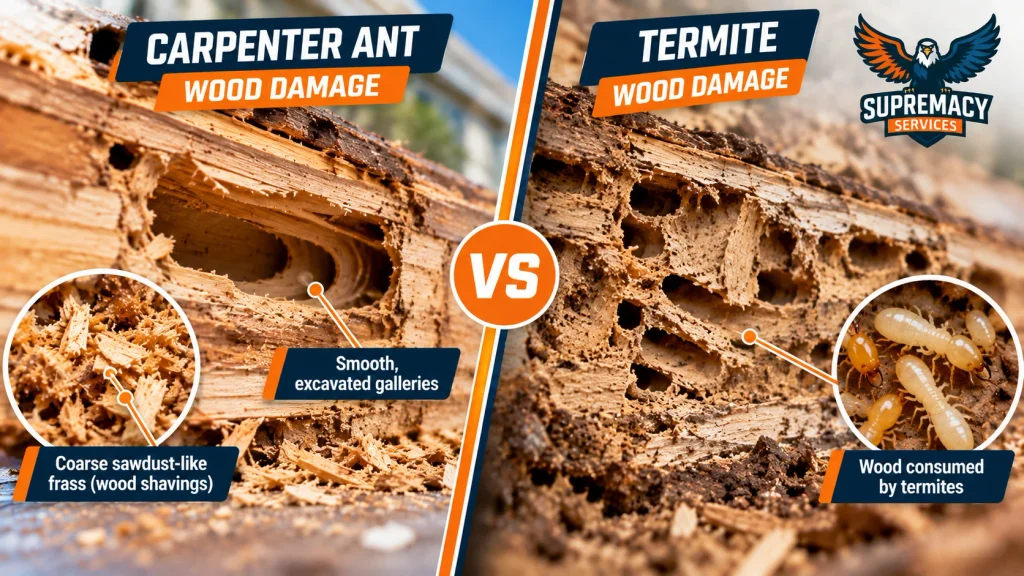
The rate of damage depends on several interacting variables.

Colony size

A developing colony with relatively few workers does not have the same feeding capacity as a large, established colony.

Worker termites are the members responsible for gathering food and damaging wood.

Termite species

Not every termite behaves identically.

Texas A&M AgriLife identifies the eastern subterranean termite and Formosan subterranean termite among economically important subterranean termites in Texas.

Formosan subterranean termites deserve particular attention because Texas A&M describes them as aggressive termites capable of attacking materials at a faster rate than many other termites.

That still does not provide a reliable countdown for an individual house.

Number of feeding locations

A colony may have access to more than one food source.

Visible damage in one baseboard or framing member does not necessarily reveal every area where termites are foraging.

Moisture

Subterranean termites depend heavily on moisture.

Plumbing leaks, drainage problems, persistent moisture near foundations and wood-to-soil contact can create conditions favorable to termite activity.

Temperature and environmental conditions

Termite activity and foraging can be affected by environmental conditions.

This is another reason laboratory consumption rates should not be converted into precise predictions for a Dallas home.

Access to the structure

Foundation cracks, construction joints, plumbing penetrations, hidden wood-to-soil contact and other accessible routes can allow subterranean termites to reach cellulose-containing building materials while remaining difficult to see.
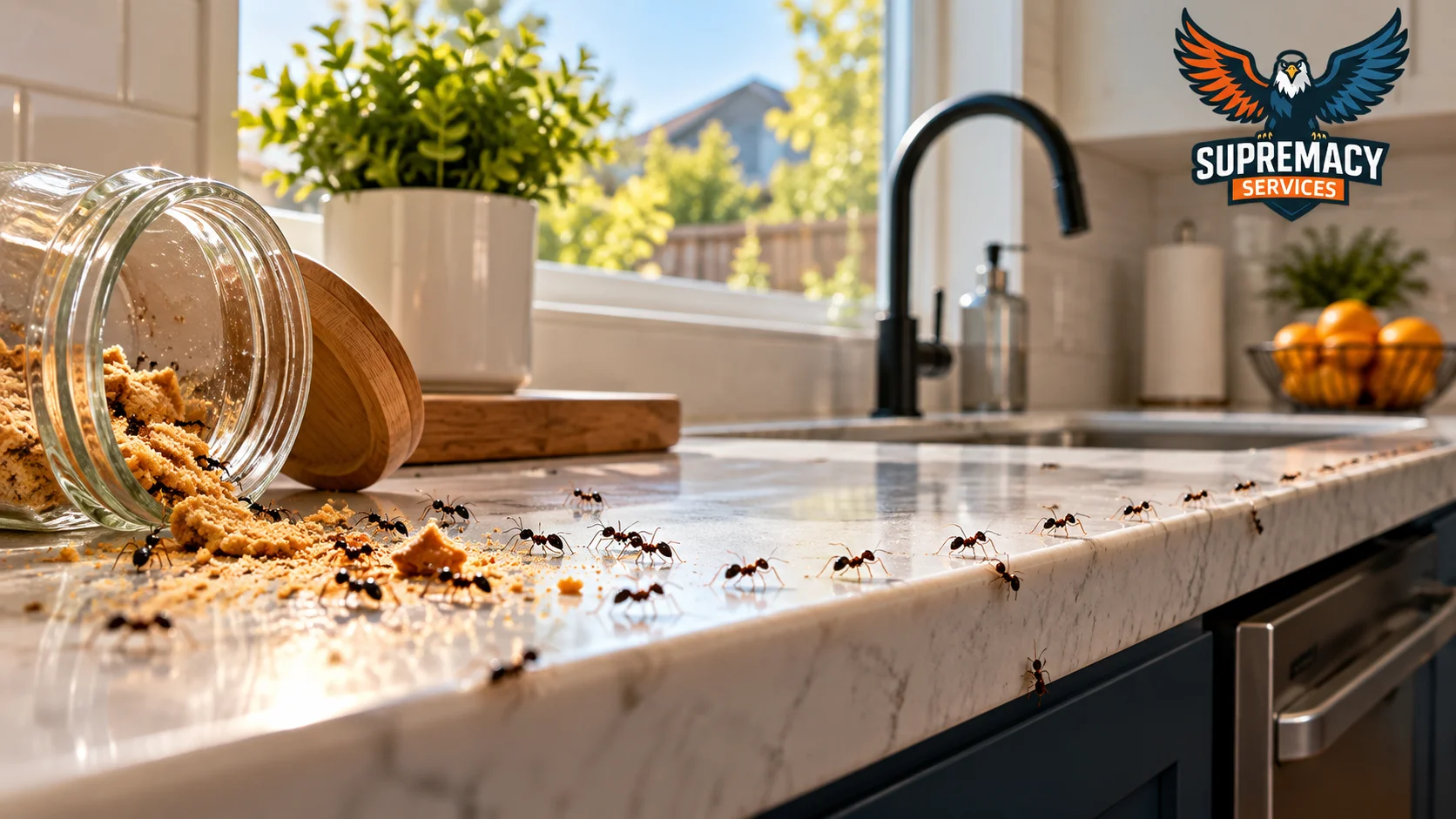
How Much Wood Can Termites Eat?

The amount of wood consumed depends heavily on the number of workers feeding and the conditions surrounding the colony, so a single consumption rate should not be used to predict damage to a particular house.
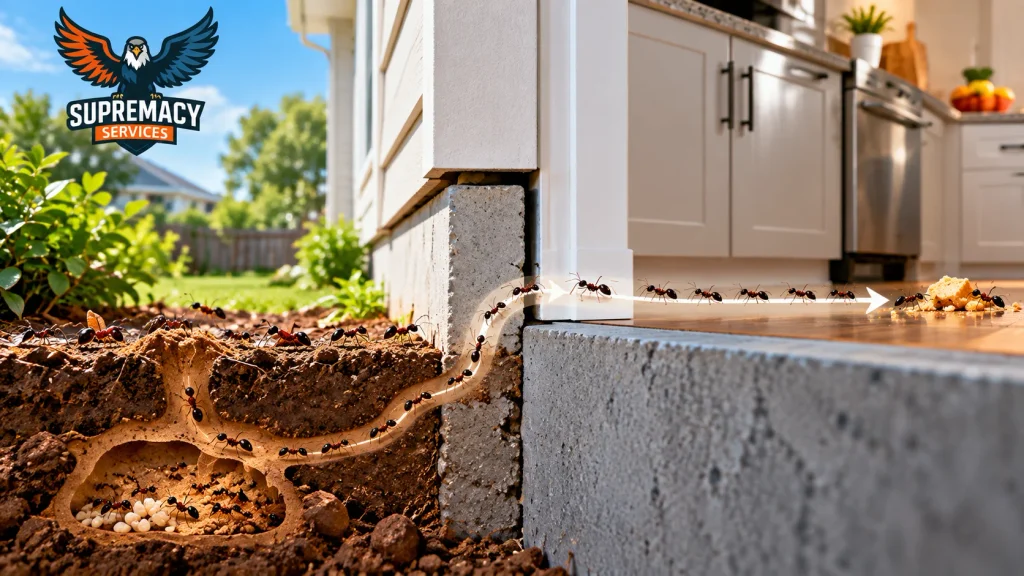
For perspective, North Carolina State Extension provides an educational example in which a colony of approximately 60,000 eastern subterranean termites could consume about one foot of 2×4 lumber in roughly five months.

The important part of that example is not to start calculating how many boards remain in your house.

Real infestations are more complicated.

A colony can forage through multiple locations, worker populations vary, several colonies may occur around a property, and structural materials differ.

A better rule for homeowners: the longer active termites have uninterrupted access to structural wood, the greater the opportunity for cumulative damage.

What Makes Termite Damage Progress Faster?

Worker termites feeding in wood with moisture, colony size and structural access illustrated as damage factors
Colony size, moisture, termite species, access to wood and time can all influence how much damage develops.

Several conditions can influence how much damage develops.

1. A large, established colony

More foraging workers can mean more feeding activity.

2. Long-term undetected access

Termites cause much of their damage out of sight.

The EPA notes that people often do not realize termites are present until they encounter a swarm or discover damage.

3. Favorable moisture conditions

Persistent moisture can support subterranean termite activity and can also contribute to wood decay.

That combination is important because rot and termite damage can occur in the same general area.

4. Wood touching soil

Wood-to-soil contact creates a particularly favorable access route for subterranean termites.

Examples may include buried wood, structural components contacting grade, stored lumber or other cellulose materials positioned against the structure.

5. Concealed entry routes

Termites may travel through cracks, joints and protected structural areas without creating an obvious exterior warning sign.

6. Termite species

Species and colony biology matter.

Texas A&M describes Formosan subterranean termites as particularly aggressive, although the species involved must be correctly identified before conclusions about an individual infestation can be made.

What Termite Damage Looks Like

Mud tubes, discarded termite wings, swarmers and damaged wood around a North Texas home
Mud tubes, swarmers, discarded wings and damaged wood are among the warning signs homeowners should investigate.

Termite damage is frequently concealed beneath an apparently intact surface.

Warning signs worth investigating include:

  • mud or shelter tubes on foundations, walls or piers;
  • wood that sounds hollow when tapped;
  • wood that is unusually easy to probe;
  • galleries inside damaged wood;
  • swarmers emerging indoors;
  • piles of discarded wings;
  • soil or mud inside cracks and wood galleries;
  • visibly weakened structural wood;
  • recurring termite evidence after previous treatment.

Mud tubes

Subterranean termites construct protected earthen passageways between soil and food sources.

Finding a genuine mud tube does not tell you how long the infestation has existed or how much damage has occurred, but it is evidence worth investigating.

Swarmers

Indoor termite swarmers can be especially important.

Texas A&M notes that swarming termites inside a house usually indicate an active infestation in the structure.

Winged ants can look similar, however, so identification matters.

Damaged wood

Subterranean termite galleries generally follow the grain of the wood and can contain soil or mud-like material.

One particularly important limitation is that the age of termite-damaged wood cannot reliably be determined from appearance alone.

A professional therefore needs to assess the extent and location of evidence rather than trying to date a damaged board.

How Can You Tell Whether the Damage Is Serious?

You cannot reliably determine structural severity from the number of termites you see.

A homeowner might see only a few termites even though much more activity is concealed.

Conversely, seeing a large swarm does not automatically prove that major structural repairs are required.

The evaluation should answer separate questions:

QuestionWhy it matters
Are termites currently active?Establishes whether an active infestation is present
Where are they entering?Helps determine treatment strategy
How many areas show evidence?Helps establish infestation extent
Which materials are damaged?Separates cosmetic from potentially structural concerns
Is the wood still structurally adequate?Determines whether repair evaluation is necessary
Are moisture or construction conditions contributing?Helps reduce future risk

If load-bearing framing or other important structural components appear significantly compromised, termite treatment and structural repair should be treated as separate issues. The damaged components may require evaluation by an appropriately qualified construction or structural professional.

Termite Damage vs. Wood Rot

Side-by-side comparison of termite-damaged wood and moisture-related wood rot
Termite damage and wood rot can sometimes appear similar, but they have different causes and require different solutions.

These two problems can look similar but have different causes.

FeatureTermite damageWood decay/rot
CauseWood-feeding insectsWood-destroying fungi
Mud/soil in galleriesCommon with subterranean termite activityNot characteristic
Wood consumptionTermites consume celluloseFungal deterioration breaks down wood
Moisture associationMoisture can favor termite activityMoisture is fundamental to decay
TreatmentTermite-management strategyMoisture correction plus appropriate repair
Can both occur together?YesYes

Do not assume soft or deteriorated wood automatically proves termites.

Should You Panic If You Find Termites?

No—but you should investigate promptly.

University extension guidance consistently distinguishes termite problems from emergencies that change dramatically overnight.

That gives homeowners time to:

  1. document what they found;
  2. avoid destroying useful evidence;
  3. obtain a proper inspection;
  4. understand where activity exists;
  5. compare appropriate treatment options; and
  6. review the written treatment scope.

It does not justify ignoring confirmed activity for months while termites continue feeding.

Found mud tubes, swarmers or suspicious wood? Have Supremacy Services evaluate the termite evidence before assuming how old or extensive the infestation is.

What Should You Do If You Find Termites?

Step 1: Document the evidence

Photograph suspected termites, wings, mud tubes and damaged areas.

Take close-up and wider photographs showing where the evidence occurs in relation to the foundation or structure.

Step 2: Don’t immediately remove everything

Scraping away tubes or discarding damaged wood can eliminate useful evidence before an inspection.

Step 3: Check nearby accessible areas

Look around:

  • slab and foundation edges;
  • plumbing penetrations;
  • garage walls;
  • crawlspace piers where safely accessible;
  • siding transitions;
  • wood stored against the building;
  • damp areas;
  • nearby structural wood.

Do not dismantle walls simply to look for termites.

Step 4: Look for moisture problems

Check for leaking plumbing, poor drainage, irrigation repeatedly wetting the foundation and other persistent moisture sources.

Correcting moisture is good property maintenance, but it does not eliminate an established termite colony.

Step 5: Arrange an inspection when evidence is credible

An inspection becomes especially appropriate when you find:

  • live termites;
  • indoor swarmers;
  • multiple shelter tubes;
  • damaged structural wood;
  • repeated termite evidence;
  • activity following previous treatment; or
  • evidence you cannot confidently identify.

DIY vs. Professional Termite Evaluation

Pest control technician inspecting a Dallas home foundation and wood framing for signs of termites
A professional termite inspection helps identify activity, entry points and accessible evidence of damage.

Homeowners can perform useful visual monitoring, but DIY investigation has important limitations.

What you can do yourself

You can:

  • inspect exposed foundation areas;
  • watch for swarmers;
  • document mud tubes;
  • look for discarded wings;
  • move firewood away from the structure;
  • correct plumbing leaks;
  • improve obvious drainage problems;
  • eliminate unnecessary wood-to-soil contact.

What DIY inspection cannot reliably establish

A visual homeowner inspection usually cannot establish:

  • the full extent of concealed activity;
  • every termite entry route;
  • colony size;
  • exactly how long the infestation has existed;
  • whether concealed structural members are damaged;
  • which professional treatment method is appropriate.

Surface insecticide applied to the termites you can see also does not establish that the colony or concealed infestation has been controlled.

The EPA notes that many termite treatments are appropriately performed by trained pest-management professionals.

What Does Professional Termite Service Include?

A termite evaluation should begin with identifying evidence and understanding the structure rather than automatically prescribing one treatment.

A professional process may include:

  1. inspecting accessible foundation areas;
  2. identifying termite evidence;
  3. examining accessible damaged wood;
  4. checking potential entry routes;
  5. evaluating moisture and wood-to-soil conditions;
  6. determining the likely termite type;
  7. identifying active and previous evidence;
  8. developing a treatment scope; and
  9. explaining monitoring or follow-up requirements.

Texas termite-treatment proposals

Texas regulates structural pest-control services.

When a termite-treatment estimate or proposal is provided, the Texas Department of Agriculture requires specific written disclosure information, including a detailed diagram identifying areas to be treated and active or previous termite activity, warranty or guarantee information, the chemical label, and applicable information about liquid termiticide concentration or baiting systems.

That documentation gives homeowners a better way to compare termite proposals than price alone.

If an inspection confirms subterranean termite activity, explore Termite Vault Security in Dallas to understand Supremacy Services’ termite protection and monitoring approach.

How Are Subterranean Termites Treated?

Treatment depends on the infestation, structure, termite involved and site conditions.

The EPA identifies recognized approaches that include:

  • liquid soil-applied termiticides;
  • termite bait systems;
  • certain wood treatments; and
  • termite-resistant or treated building materials in applicable situations.

Liquid soil treatments

These use appropriately labeled termiticides to establish treated areas between subterranean termites and the structure.

Installation requirements vary according to construction.

Termite bait systems

Bait systems use cellulose material containing a slow-acting active ingredient.

The delayed action is intentional: foraging termites must have an opportunity to interact with and distribute the bait through the colony.

Consequently, bait programs should not be judged by whether every termite disappears immediately after installation.

Wood treatments

Certain appropriately labeled products can be applied to wood in applicable situations.

Treatment selection should follow the actual inspection findings and product label rather than a homeowner choosing a method solely because it appears fastest.

Why Dallas-Fort Worth Homeowners Should Pay Attention

Texas A&M AgriLife identifies subterranean termites as significant structural pests throughout Texas.

Dallas-Fort Worth homes can also contain many of the construction conditions relevant to subterranean termite inspections: slab edges, utility penetrations, landscaping adjacent to foundations, attached garages and other transitions between soil and building materials.

The useful local takeaway is not that every DFW property will develop termites.

It is that North Texas homeowners should recognize the signs and avoid assuming that the absence of visible insects means the structure has no activity.

Subterranean termites are specifically adapted to remain concealed.

How to Reduce Future Termite Risk

You cannot make a property biologically impossible for termites to approach, but you can reduce favorable conditions and improve inspection visibility.

Keep soil and drainage conditions under control

Direct drainage away from the structure where appropriate and repair leaks promptly.

Reduce wood-to-soil contact

Avoid leaving untreated lumber, firewood, stumps, cardboard or similar cellulose materials against the house.

Keep foundation areas visible

Dense vegetation and stored materials can hide mud tubes and other evidence.

Maintain plumbing

Persistent leaks can create moisture conditions favorable to termites and wood decay.

Seal appropriate cracks and penetrations

The EPA recommends reducing openings around foundations and utility penetrations that can provide termite access.

Sealing a crack, however, is preventive maintenance—not treatment for an established infestation.

Inspect periodically

Because termites remain concealed, periodic inspection can identify warning signs before damage becomes more extensive.

How Much Does Termite Damage Cost to Repair?

There is no responsible universal repair price.

Repair cost depends on what was damaged, not simply whether termites were found.

Replacing cosmetic trim is fundamentally different from repairing structural framing, flooring systems or multiple concealed areas.

Termite treatment and building repair should also be treated as separate scopes unless a written contract specifically combines them.

For treatment budgeting, see Supremacy Services’ separate Termite Treatment Cost in North Texas: 2026 Guide rather than turning this timeline article into another pricing page.


Frequently Asked Questions

Can termites destroy a house in a few weeks?

Significant new structural damage generally does not develop from scratch in only a few weeks. Extension guidance indicates that meaningful subterranean-termite damage usually accumulates over months or years. Existing damage, however, may already be present when termites are discovered.

Can termites damage a house in six months?

Termites can continue feeding and produce additional damage over six months, but the amount cannot be predicted without knowing the species, colony size, feeding locations and conditions. A calendar alone cannot determine severity.

Can termites cause major damage in one year?

It is possible for meaningful damage to accumulate during a year of active feeding, particularly when an established colony already has access to a structure. However, there is no universal one-year damage level.

How long can termites be in a house before you notice?

Potentially a long time. Subterranean termites commonly remain concealed in soil, shelter tubes and wood, and homeowners may not discover an infestation until swarmers or damage appear.

Does seeing termites mean my house already has structural damage?

No. Finding termites confirms or strongly suggests activity depending on where they were found, but it does not establish the severity of structural damage. Inspection is needed to determine what materials are affected.

How do I know whether termite damage is old or new?

Appearance alone cannot reliably date termite-damaged wood. Live termites and active shelter tubes can demonstrate current activity, but determining the age of existing wood damage is much more difficult.

Are termite mud tubes a sign of damage?

Mud tubes indicate subterranean termite activity or previous activity, but the tube itself does not reveal how much wood has been damaged. Additional inspection is necessary.

Should I treat termites immediately?

Confirmed termite activity should be addressed rather than ignored, but homeowners generally have time to obtain an inspection, understand the findings and compare appropriate treatment proposals instead of making a panic decision.

Can I kill termites myself?

Killing exposed termites does not necessarily control the colony or termites hidden elsewhere in the structure. Structural termite control often requires specialized inspection and treatment techniques.

How often should a Dallas home be checked for termites?

Inspection frequency should reflect the property’s history, construction, termite protection system and risk conditions rather than a universal schedule. Homes with previous activity or an active monitoring/treatment agreement should follow the inspection requirements associated with that program.


Don’t Let an Unknown Timeline Become a Larger Problem

The biggest problem with asking how fast termites damage a house is that homeowners rarely know when the clock started.

A visible mud tube might be new. The concealed activity behind it may not be.

A swarm might be the first thing you noticed. It may not represent the beginning of the infestation.

And damaged wood can reveal that termites were present without telling you precisely when the feeding began.

If you discover termites, mud tubes, indoor swarmers or suspicious wood around a Dallas-Fort Worth home, document the evidence and have the property evaluated.

Schedule a termite assessment with Supremacy Services to determine whether activity is present, where termites may be entering and what treatment or monitoring strategy is appropriate for your property.

Supremacy Services technician inspecting a North Texas home foundation for signs of subterranean termites.

Subterranean Termites in North Texas: Signs, Damage & Treatment

Subterranean termites live primarily in the soil and can enter North Texas homes through hidden routes in or around the foundation while searching for cellulose-based food such as wood. Common warning signs include mud tubes, termite swarmers or discarded wings, damaged wood and activity around areas where structural materials meet or approach the soil.

The difficult part is that subterranean termites usually remain concealed. The EPA notes that homeowners often do not discover termites until they encounter a swarm or find damage. That means a Dallas–Fort Worth home can have termite activity without termites crawling openly across the floor.

If you find a suspected termite sign, the goal is not simply to kill the insects you can see. You first need to determine whether termites are present, where they are gaining access and what treatment—if any—is appropriate for the structure.

Table of Contents

  1. What Are Subterranean Termites?
  2. What Do Subterranean Termites Look Like?
  3. Signs of Subterranean Termites
  4. What Does Termite Damage Look Like?
  5. Where Should You Check Around Your Home?
  6. Termites vs. Other Wood Problems
  7. How Are Subterranean Termites Treated?
  8. DIY vs. Professional Termite Treatment
  9. How Much Does Treatment Cost?
  10. How to Reduce Termite Risk
  11. What to Expect From Professional Service
  12. FAQs

What Are Subterranean Termites?

Subterranean termites are termites that typically maintain colonies associated with the soil and travel between the ground and cellulose-containing materials that provide food.

The Texas Department of Agriculture explains that subterranean termites usually live outside a house in underground nests and rely on moisture from the earth. They can tunnel into nearby structures in search of cellulose.

Wood is an obvious cellulose source, but termites do not need a large piece of exposed lumber sitting beside the foundation to become a concern.

Their ability to remain concealed in soil, shelter tubes and structural materials is one reason infestations can be difficult for homeowners to detect.

Texas A&M AgriLife provides specific research-based guidance for identifying, preventing and controlling subterranean termites and identifies Texas as a state with substantial termite risk.

Subterranean termites vs. drywood termites

The distinction matters because termite biology affects how an infestation is investigated and treated.

FeatureSubterranean termitesDrywood termites
Typical colony environmentAssociated with soil/ground moistureColonies can live within wood
Soil contactNormally importantNot required
Common evidenceMud/shelter tubes, swarmers, damaged woodSwarmers, damaged wood, fecal pellets
Treatment approachOften soil treatment, baiting or other labeled methodsMay require localized treatment, wood removal or fumigation depending on circumstances
DiagnosisProfessional identification recommendedProfessional identification recommended

Texas regulators specifically distinguish subterranean termites from drywood termites because drywood termites do not require the same connection with the earth.

What Do Subterranean Termites Look Like?

Close-up of subterranean termite workers and a soldier inside damaged wood.
Subterranean termite colonies contain different castes, including pale workers and soldiers that help defend the colony.

A termite colony contains different castes, so not every termite looks identical.

Workers

Workers are generally small, pale-bodied insects and are the termites most likely to be encountered when infested wood or an active shelter tube is disturbed.

Soldiers

Soldiers have more developed heads and jaws and help defend the colony.

Swarmers

Winged reproductive termites—often called swarmers or alates—leave established colonies during suitable conditions to reproduce and establish new colonies.

Swarmers are frequently confused with flying ants.

One useful distinction is wing proportion: EPA identification guidance notes that termite swarmers have wings of approximately equal length, whereas the front wings of winged ants are longer than their hind wings.

Finding swarmers indoors deserves particular attention because it can indicate termite activity associated with the structure.

What Are the Signs of Subterranean Termites?

The most useful warning signs are shelter tubes, swarmers or discarded wings, suspicious wood damage and evidence of activity near foundations or other structural entry routes.

No single homeowner observation tells you the full extent of an infestation. Look for patterns of evidence.

1. Mud tubes on the foundation

Termite mud tube extending from soil onto the concrete foundation of a North Texas home.
Subterranean termites construct shelter tubes that allow them to travel between the soil and a structure while remaining protected.

Mud tubes—also called shelter tubes—are narrow, soil-like passageways subterranean termites construct across exposed surfaces.

They commonly appear along:

  • slab edges;
  • concrete foundation walls;
  • piers;
  • crawlspaces;
  • masonry;
  • plumbing or utility penetrations;
  • cracks and construction joints.

Termites can build a tube across concrete or masonry even though those materials are not food.

The passage allows them to travel toward accessible cellulose while remaining protected.

If you want detailed photographs and identification guidance, see Termite Mud Tubes: What They Look Like & What They Mean.

2. Termite swarmers inside or around the home

Winged termites are among the most noticeable termite signs.

You may find:

  • live winged insects around windows;
  • insects near doors or lights;
  • discarded wings on windowsills;
  • wings near baseboards;
  • concentrations of swarmers emerging from a wall or structural opening.

A swarm does not tell you how much damage exists, but it is a reason to investigate.

3. Damaged or hollowed wood

Subterranean termites feed within wood, so the surface can sometimes conceal damage underneath.

Possible signs include:

  • wood that sounds unusually hollow when tapped;
  • weakened trim or framing;
  • wood that breaks more easily than expected;
  • internal galleries revealed when damaged material opens;
  • soil-like material associated with concealed feeding areas.

Do not deliberately tear apart structural components to investigate suspected termites.

4. Discarded wings

After swarming, reproductive termites shed their wings.

Small piles of similar-sized wings around windows, doors or other openings can therefore be useful evidence even when the insects themselves are gone.

5. Termites discovered during remodeling

Removing flooring, drywall, trim or other building materials can expose previously concealed activity.

If renovation reveals live termites, shelter material or damaged structural wood, avoid simply closing the area back up before the problem is evaluated.

6. Previous termite evidence

Old tubes, previous treatment marks or known termite history do not prove that a current infestation exists.

They do, however, provide useful information during an inspection.

Does a Mud Tube Always Mean Termites Are Active?

A genuine subterranean termite shelter tube is evidence of termite activity, but the tube alone does not establish whether termites are currently using that route or how extensive an infestation is.

An old tube can remain after activity changes.

That is why scraping away a tube and checking whether it reappears should not be treated as a complete termite inspection.

A professional assessment looks beyond the one visible tube for other evidence and potential entry routes.

What Does Subterranean Termite Damage Look Like?

Cutaway diagram showing subterranean termites traveling from an underground colony through a mud tube into structural wood.
Subterranean termites can travel from colonies in the soil through protected shelter tubes to reach wood within a structure.

Termite damage is often more difficult to recognize than dramatic photographs online suggest.

Because termites can feed inside wood while leaving portions of the exterior surface intact, damage may remain concealed until wood is probed, opened during construction or has become significantly weakened.

Potential signs include:

ObservationPossible explanationWhat to do
Hollow-sounding woodInternal termite feeding or another wood problemInspect further
Wood breaks easilyTermites, decay or other deteriorationIdentify cause before repair
Soil-like material within damaged woodPossible subterranean termite activityRequest inspection
Blistered-looking surfaceMultiple possible causesDo not diagnose by appearance alone
Mud tube connecting soil and structureStrong termite warning signInvestigate surrounding area
Damaged wood plus swarmersMultiple termite indicatorsProfessional inspection appropriate

The EPA recommends examining exposed wood for hollow areas as one component of termite awareness, but identification should consider multiple signs rather than relying on one symptom.

How serious is termite damage?

The seriousness depends on where termites have been feeding, how much material has been affected and whether load-bearing components are involved.

Visible damage does not reliably tell a homeowner when an infestation began or how far it extends.

Pest control and structural repair are also different tasks. If structural components have been significantly damaged, termite control may need to be followed by evaluation and repair by the appropriate building professional.

Where Should North Texas Homeowners Check for Termites?

Start with accessible areas where the building meets the soil or where termites could move from the soil toward structural materials.

Foundation perimeter

Walk the accessible exterior foundation and look for raised soil-like tubes crossing concrete, masonry or other surfaces.

Pay particular attention to locations where the foundation is obscured.

Plumbing and utility penetrations

Pipes, conduits and other penetrations create transitions through construction materials.

Inspect accessible areas around these locations for suspicious shelter material or moisture problems.

Garages

Check accessible slab edges, wall transitions, stored-item areas and penetrations.

Crawlspaces and piers

Where a home has an accessible crawlspace, termite evidence can occur around piers, foundation walls and structural wood.

Do not enter a confined, unstable or otherwise unsafe crawlspace simply to perform a DIY inspection.

Areas with wood close to soil

Wood-to-soil contact can create favorable access conditions and can make termite evidence harder to see.

Check deck components, steps, siding, posts and other accessible wood around the structure.

Moisture-prone areas

Termites require moisture, so persistent plumbing leaks, drainage problems and chronically damp areas deserve attention.

Correcting the moisture problem is worthwhile, but drying an area does not prove that an established termite infestation has been eliminated.

Subterranean Termites vs. Other Wood Problems

Not all damaged wood means termites.

Termites vs. carpenter ants

Carpenter ants excavate wood to create nesting areas rather than consuming it as termites do.

Texas A&M notes that carpenter ants are commonly associated with moisture-damaged wood and may occur around leaks, poor drainage, wood-to-soil contact and other damp structural areas.

Termites vs. wood decay

Moisture can cause fungal decay that weakens wood without termites being present.

Unfortunately, moisture problems and wood-destroying insects can also occur in the same general area.

Termite swarmers vs. flying ants

Do not identify them solely because the insect has wings.

Look at body shape, antennae and wing proportions, and save a specimen when practical for professional identification.

How Are Subterranean Termites Treated?

Comparison of termite bait stations, professional soil treatment and targeted wood treatment methods.
Professional subterranean termite management may involve bait systems, soil-applied termiticides or targeted wood treatments depending on the property and infestation.

Common professional approaches include soil-applied termiticides, termite bait systems and certain wood treatments. The appropriate method depends on the infestation, structure, product label and treatment objective.

EPA identifies liquid soil-applied termiticides, termite baits, treated building materials and wood treatments among recognized termite-management approaches.

Liquid soil treatments

A labeled liquid termiticide may be applied to appropriate soil areas to establish a treated zone according to the product’s directions.

Application requirements vary with:

  • foundation construction;
  • soil access;
  • slabs and adjoining concrete;
  • utility locations;
  • treatment perimeter;
  • product label;
  • areas of known activity.

This is not simply a matter of spraying insecticide around the exterior.

Termite bait systems

Bait stations are installed in appropriate locations and monitored according to the particular system and treatment program.

Termites that encounter an active bait feed on it, and the treatment is designed to affect termite activity beyond the individual insects found in the station.

Monitoring and maintenance matter because a bait program is a system rather than a one-time spray.

Wood treatments

Certain labeled products can be applied to wood in appropriate circumstances.

Whether wood treatment makes sense depends on accessibility, construction and the overall treatment plan.

Can different methods be combined?

Yes. A treatment plan may incorporate more than one approach when appropriate for the property and permitted by product labels.

Supremacy’s Termite Vault Security service, for example, describes a program using perimeter baiting together with targeted soil treatment. Homeowners should review the actual property-specific proposal, treatment diagram, product labels and warranty terms before authorizing work.

Found mud tubes, swarmers or suspicious wood damage? Request a termite inspection from Supremacy Services to identify the problem before selecting a treatment.

DIY vs. Professional Subterranean Termite Treatment

Homeowners can reduce termite-conducive conditions and document visible evidence, but treatment of an established structural infestation is generally a job for trained, properly licensed pest-management professionals.

EPA specifically warns that soil termiticide treatments can fail or create contamination risks if improperly performed and states that, in most cases, termiticide application can only be properly performed by a trained pest-management professional.

Useful DIY steps

You can:

  • photograph suspected tubes before disturbing them;
  • save several swarmers for identification;
  • check accessible foundation areas;
  • repair plumbing leaks;
  • improve obvious drainage problems;
  • remove unnecessary wood debris near the structure;
  • reduce inappropriate wood-to-soil contact where practical;
  • keep inspection areas accessible.

What not to rely on

Avoid assuming that the problem has been solved because you:

  • killed visible swarmers;
  • sprayed one shelter tube;
  • scraped tubes from the foundation;
  • replaced one damaged board;
  • sealed one visible crack;
  • no longer see termites.

Those actions do not establish what is occurring in the soil, hidden structural areas or elsewhere around the building.

How Much Does Subterranean Termite Treatment Cost in North Texas?

There is no reliable universal termite-treatment price without knowing the property and treatment scope.

Important pricing factors can include:

  • size and configuration of the structure;
  • treatment perimeter;
  • foundation design;
  • areas of termite activity;
  • treatment method;
  • accessibility;
  • amount of drilling or specialized access required;
  • bait-station quantity and monitoring;
  • follow-up service;
  • warranty terms.

Rather than duplicating changing market-price information here, see Termite Treatment Cost in North Texas: 2026 Guide for Supremacy’s dedicated cost breakdown.

The more useful process is:

Inspection → identification → treatment scope → written proposal → price

Texas requires termite-treatment proposals to provide consumers with important disclosure information, including a diagram of areas to be treated, approximate perimeter measurement, known active or previous termite areas, warranty or guarantee terms, the chemical label and information about liquid-treatment concentration or minimum bait-station quantities, as applicable.

That makes the scope of the proposal just as important as the headline price.

How Can You Reduce the Risk of Subterranean Termites?

No maintenance checklist can guarantee that termites will never reach a home, but homeowners can make the property easier to inspect and reduce avoidable conditions that favor concealed termite access.

Termite-prevention checklist

  • Correct persistent plumbing leaks.
  • Maintain appropriate drainage around the structure.
  • Avoid unnecessary wood-to-soil contact.
  • Keep accessible foundation areas visible where practical.
  • Do not stack firewood directly against the house.
  • Remove unnecessary cellulose debris near the foundation.
  • Maintain gutters and drainage systems.
  • Investigate unexplained moisture.
  • Check the foundation periodically for shelter tubes.
  • Do not ignore indoor termite swarmers.

EPA also recommends reducing openings around foundations and utility penetrations and keeping vents free from blockage as part of termite prevention.

Remember: prevention measures are not substitutes for treatment when an active infestation has already been identified.

What Should You Expect From a Professional Termite Inspection and Treatment Proposal?

Termite technician examining a home foundation and documenting suspected termite activity during an inspection.
A professional termite inspection evaluates visible evidence, accessible entry points and property conditions before a treatment plan is recommended.

A professional inspection should do more than confirm the insect in a photograph.

The inspector may evaluate:

  1. visible evidence of current or previous termite activity;
  2. accessible foundation and structural areas;
  3. shelter tubes and potential entry routes;
  4. moisture and construction conditions relevant to termite activity;
  5. previous treatment evidence;
  6. other wood-destroying organisms or damage;
  7. treatment options appropriate to the findings.

Texas regulates structural pest-control businesses and individuals performing structural pest control for compensation.

For termite-treatment estimates specifically, homeowners should receive written disclosure information describing the proposed treatment.

Before signing, ask:

  • What evidence of termites did you find?
  • Where was the activity found?
  • What areas will be treated?
  • Which treatment method are you recommending?
  • Why is that method appropriate for this structure?
  • Which product will be used?
  • What does the product label require?
  • What monitoring or follow-up is included?
  • What exactly does the warranty cover?
  • Are there homeowner responsibilities that affect coverage?

If you have confirmed or suspected subterranean termite activity, explore Supremacy’s termite treatment and monitoring options for Dallas–Fort Worth homes.

When Should You Call a Termite Professional?

Consider arranging an inspection when you find:

  • suspected mud tubes;
  • indoor termite swarmers;
  • piles of discarded termite wings;
  • live termites;
  • suspicious structural wood damage;
  • termite evidence uncovered during remodeling;
  • unexplained wood deterioration accompanied by soil-like material;
  • signs of previous termite activity when the treatment history is unknown.

You do not need to choose a treatment before the inspection.

The inspection exists to determine what problem you actually have.


Frequently Asked Questions

Are subterranean termites common in Texas?

Texas A&M AgriLife identifies Texas as a state with substantial termite infestation risk and publishes dedicated guidance for identifying and controlling subterranean termites. Local risk to an individual house still depends on property conditions and termite activity.

Where do subterranean termites live?

They typically maintain colonies associated with the soil. Texas regulators explain that they usually live in underground nests and depend on moisture from the earth while tunneling toward cellulose food sources.

What is the clearest sign of subterranean termites?

Mud or shelter tubes are one of the most characteristic signs, particularly when they connect soil with a structure. Swarmers, discarded wings and damaged wood are other important evidence.

Do subterranean termites eat concrete?

No. Termites do not use concrete as food. They can, however, construct shelter tubes across concrete or exploit suitable gaps and construction routes to reach cellulose-containing materials.

Does one termite mud tube mean my house is infested?

A genuine shelter tube indicates termite activity, but one tube alone cannot tell you whether that particular route is currently active, how extensive the infestation is or how much damage exists. The surrounding structure should be evaluated.

Can I spray subterranean termites myself?

Killing visible termites does not necessarily address the hidden infestation. EPA notes that effective structural termite treatments require appropriate products and application methods and that professional training is important, particularly for soil treatments.

Are termite baits better than liquid treatments?

Neither method is automatically best for every property. Foundation construction, activity location, accessibility, treatment objectives, product requirements and ongoing monitoring can affect the choice. In some situations, a professional treatment program may use multiple methods.

How quickly do subterranean termites destroy a house?

There is no responsible universal timeline. The extent and rate of damage vary with colony activity, infestation conditions, affected materials and other factors. Finding termites warrants investigation, but a visible termite sign does not by itself tell you how long the colony has been present.

Should damaged wood be replaced before termite treatment?

First determine whether active termites are present and coordinate the pest-control and repair plans. Replacing visible damaged material without addressing active termite access can leave the underlying pest problem unresolved.


Found Signs of Subterranean Termites Around Your DFW Home?

Mud tubes, swarmers or suspicious wood damage deserve investigation, but they do not tell you everything about the infestation.

Start by documenting what you found and avoid relying on surface sprays or destroying all visible evidence before it can be inspected.

For homeowners in Dallas and surrounding DFW communities, Supremacy Services’ Termite Vault Security provides a path from professional inspection to a property-specific termite-management plan.

Schedule a termite assessment with Supremacy Services to identify the activity, understand your treatment options and determine the appropriate next step for your home.