
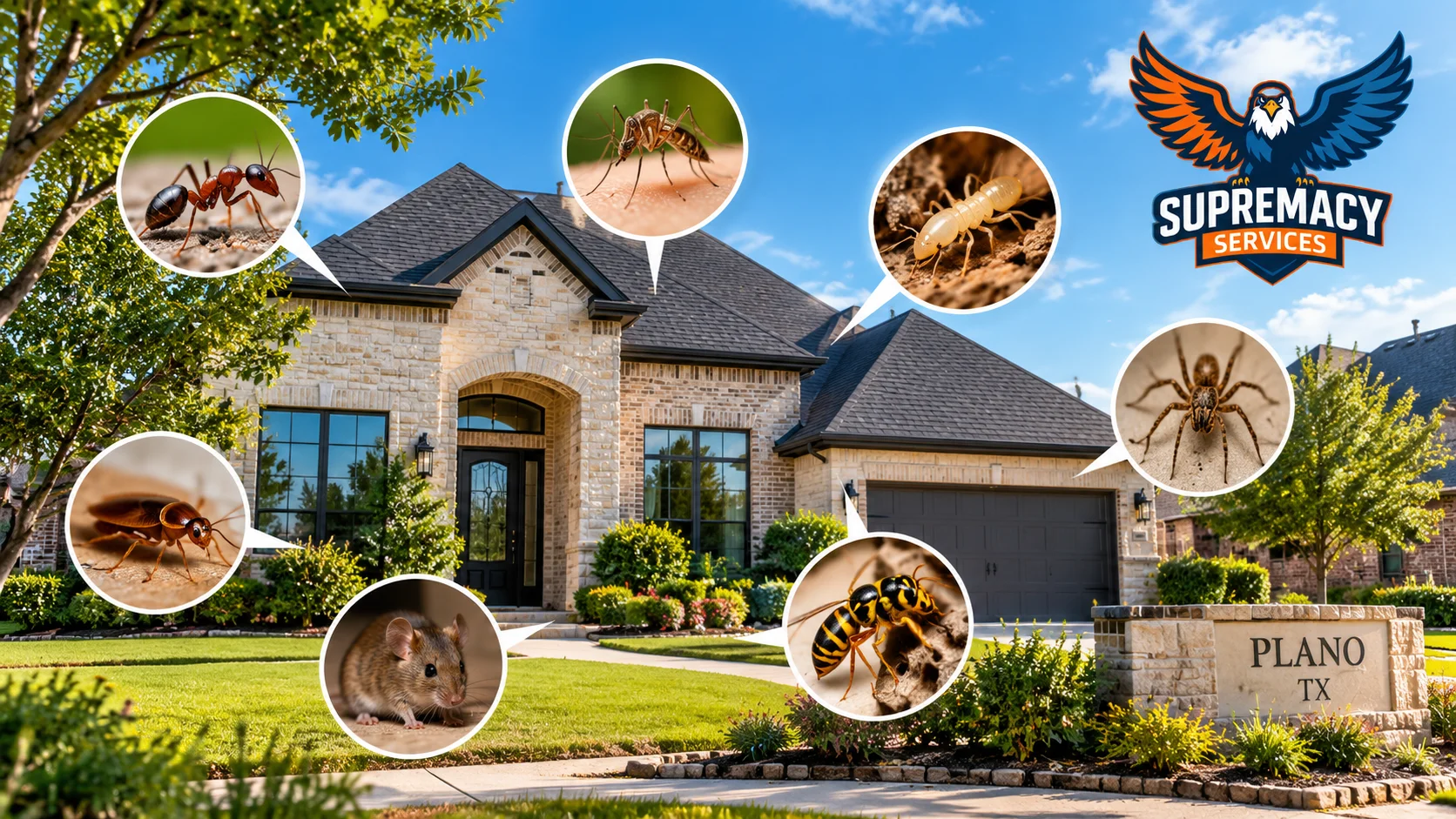
Plano homeowners can encounter several recurring household pests, including ants, cockroaches, mosquitoes, termites, spiders, rodents, fire ants, wasps, fleas, ticks and occasional scorpions. Which pests you see—and where you see them—depends on the season, moisture, food sources, landscaping, entry points and conditions around the property.
Some are mostly nuisances. Others can contaminate food, sting or bite, damage structural materials, or indicate a larger infestation that is difficult to solve with a store-bought spray alone.
The key is not simply knowing which common pests in Plano, TX exist. It is learning how to identify the problem, what is attracting it and when prevention should give way to professional treatment.
Table of Contents
- What Are the Most Common Pests in Plano?
- Why Do Plano Homes Get Pest Problems?
- Ants and Fire Ants
- Cockroaches
- Mosquitoes
- Termites
- Spiders
- Rodents
- Wasps and Other Stinging Insects
- Fleas and Ticks
- Scorpions
- Which Pests Can Homeowners Handle Themselves?
- How to Make a Plano Home Less Attractive to Pests
- What Professional Pest Control Should Include
- Frequently Asked Questions
What Are the Most Common Pests in Plano?
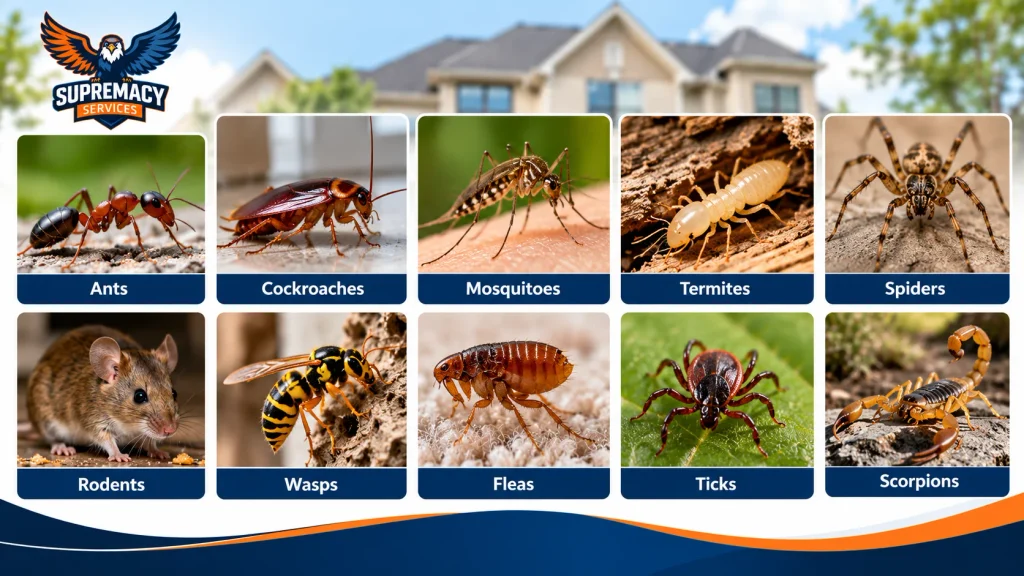
The pests Plano homeowners are most likely to encounter include ants, cockroaches, mosquitoes, termites, spiders, rodents, wasps, fleas, ticks and occasionally scorpions. Their activity is influenced by access to food, water, shelter and suitable places to reproduce.
Texas A&M AgriLife specifically identifies several cockroach species common in Texas, including German, American, oriental and smokybrown cockroaches. German cockroaches are primarily indoor pests, while several of the larger species commonly live outdoors but can enter structures looking for food or water.
| Pest | Common warning signs | Areas to check | Why it matters |
|---|---|---|---|
| Ants | Trails, workers around food, outdoor mounds | Kitchens, foundations, patios, lawns | Nuisance, food contamination or stings depending on species |
| Cockroaches | Live/dead roaches, droppings, egg cases | Kitchens, bathrooms, drains, garages | Rapid indoor infestations can become difficult to control |
| Mosquitoes | Frequent biting activity | Shaded yards, standing water, gutters | Outdoor nuisance and potential disease-vector concern |
| Termites | Mud tubes, swarmers, damaged wood | Foundation, wood components, moisture-prone areas | Potential structural damage |
| Spiders | Webs or recurring sightings | Eaves, garages, storage areas | Usually nuisance/beneficial predators; some species require caution |
| Rodents | Droppings, gnawing, noises | Attics, garages, kitchens | Contamination and property damage |
| Wasps | Repeated flight to one location or visible nest | Eaves, trees, sheds, wall openings | Defensive stings near nests |
| Fleas/ticks | Bites or parasites on pets | Lawns, shaded areas, pet resting areas | Biting pests; some species can transmit disease |
| Scorpions | Indoor sightings, especially around garages | Rock beds, foundations, storage | Stings and recurring exterior pest pressure |
A single sighting does not always mean an infestation. Repeated sightings, multiple life stages, droppings, nests, structural damage or pests appearing during daytime can be more useful indicators that the population needs investigation.
Why Do Plano Homes Get Pest Problems?
Pests generally establish themselves where they can obtain food, moisture and shelter.
The EPA recommends an integrated pest-management approach that begins by removing those resources rather than relying solely on pesticides. Practical measures include sealing food, removing garbage, repairing plumbing leaks, eliminating standing water and reducing potential entry points.
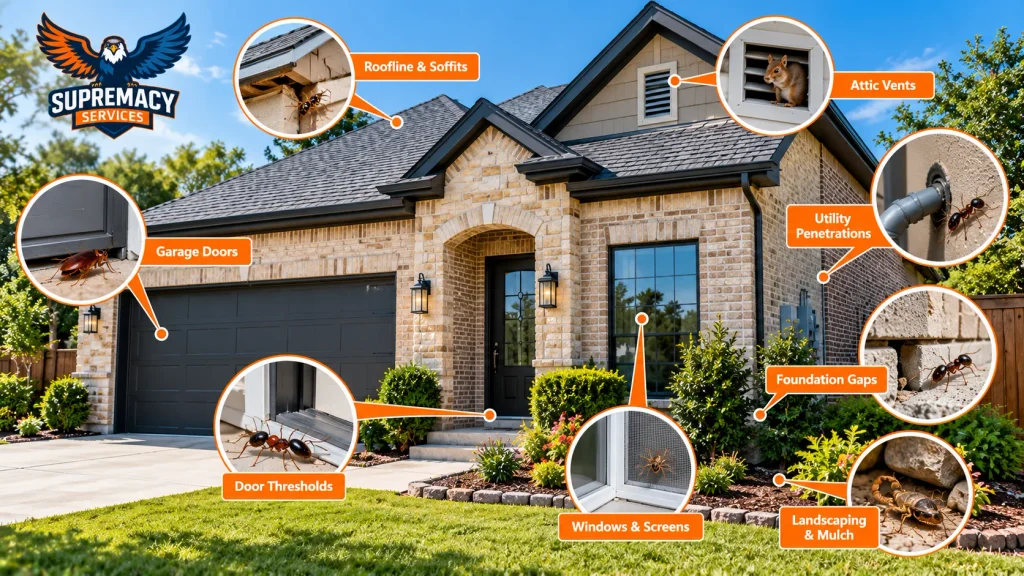
Around a Plano property, favorable conditions can include:
- gaps around exterior doors and utility penetrations;
- damaged screens or weather stripping;
- plumbing or irrigation leaks;
- standing water after irrigation or rain;
- dense vegetation against the structure;
- leaves, wood or debris near the foundation;
- open or poorly sealed trash containers;
- pet food left accessible;
- cardboard and clutter in garages;
- gaps around rooflines or attic penetrations.
Plano’s own mosquito-control activities reinforce the importance of moisture management. In an April 2026 city presentation, officials said Plano conducts mosquito surveillance across multiple sites and investigates drainage problems and stagnant-water conditions when positive mosquito results occur.
The city’s code also treats untreated stagnant water capable of breeding mosquitoes as a public-health nuisance.
Pest pressure often starts outside
Many pest problems do not begin in the kitchen or bathroom where homeowners first notice them.
Ants may trail in from exterior colonies. Large cockroach species can migrate indoors. Spiders follow insect prey. Scorpions can occupy sheltered exterior areas. Rodents exploit structural openings. Mosquito populations depend heavily on suitable water and resting habitat.
That makes the exterior of the property an important part of prevention.
If ants, roaches, spiders or other crawling pests repeatedly move from the exterior toward your home, learn how perimeter pest control targets pest pressure around foundations and common entry areas.
1. Ants and Fire Ants
Ants are among the most familiar pests around Texas homes, but identifying the type matters because different species behave differently.
Indoors, homeowners may first notice workers following a trail toward food, moisture or a wall opening. Outdoors, activity can occur around pavement edges, landscaping, foundations and lawns.
What attracts ants?
Common contributing conditions include accessible food, sugary residues, pet food, moisture and protected nesting locations.
For household ants, Texas A&M AgriLife recommends prevention measures such as sealing pests out, locating nests when possible and using appropriately labeled baits or treatments. Fire ants require different management strategies from many household ants.
Fire ants require special attention
Red imported fire ants are an invasive pest found in Texas and can create stinging hazards in yards and landscaped areas. Texas A&M maintains a dedicated statewide research and management program for this pest.
Avoid improvised treatments such as gasoline or other flammable liquids. Texas A&M specifically warns against using such materials on ant nests.
2. Cockroaches
Cockroaches are not one single pest problem.
Texas A&M identifies German, American, oriental and smokybrown cockroaches among the common Texas species. Their behavior differs significantly.
German vs. American cockroaches
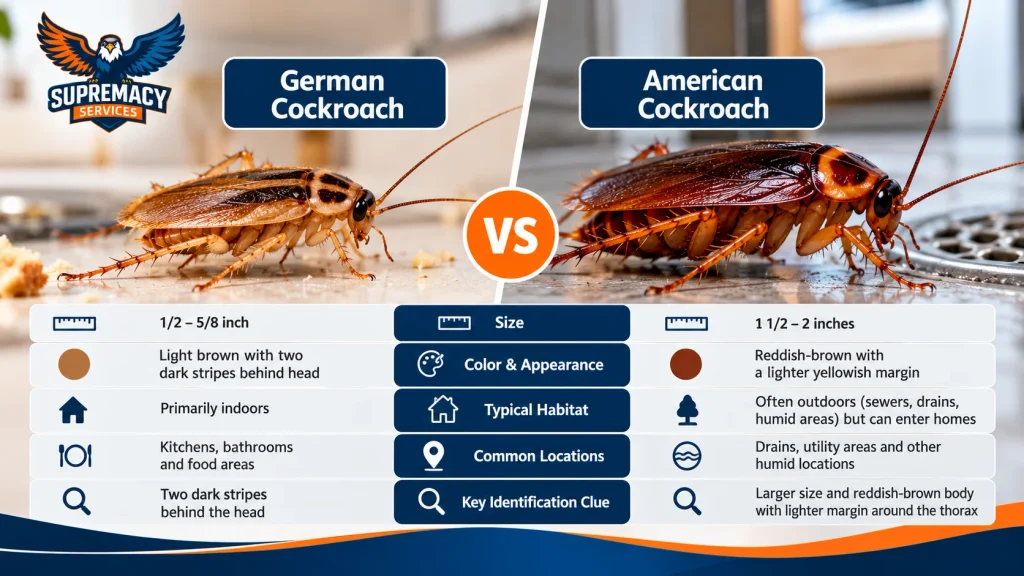
| Feature | German cockroach | American cockroach |
|---|---|---|
| Approximate adult size | 1/2–5/8 inch | 1 1/2–2 inches |
| Typical environment | Primarily indoors | Often outdoors, sewers and humid environments |
| Common indoor locations | Kitchens and bathrooms | Drains, utility areas and other humid locations |
| Important clue | Two dark stripes behind head | Large reddish-brown body with lighter margin |
German cockroaches are especially important to identify early because they reproduce rapidly and spend their lives indoors. Texas A&M notes that kitchens, bathrooms and other areas providing food, moisture, warmth and shelter are preferred habitats.
Large American cockroaches behave differently. They commonly occupy outdoor or sewer environments and can enter buildings through structural openings or drainage routes.
Signs that deserve attention
Look for:
- small roaches around kitchen appliances;
- nighttime activity around sinks and cabinets;
- droppings or egg cases;
- repeated sightings in bathrooms;
- roaches appearing during daylight;
- activity behind refrigerators, stoves or dishwashers.
Seeing a single large outdoor cockroach indoors is different from repeatedly finding German cockroaches and nymphs in a kitchen.
That distinction determines the treatment strategy.
Repeated indoor cockroach sightings—especially small roaches or multiple life stages—deserve more than repeated surface spraying. See Supremacy Services’ cockroach control and extermination options for DFW homes.
3. Mosquitoes
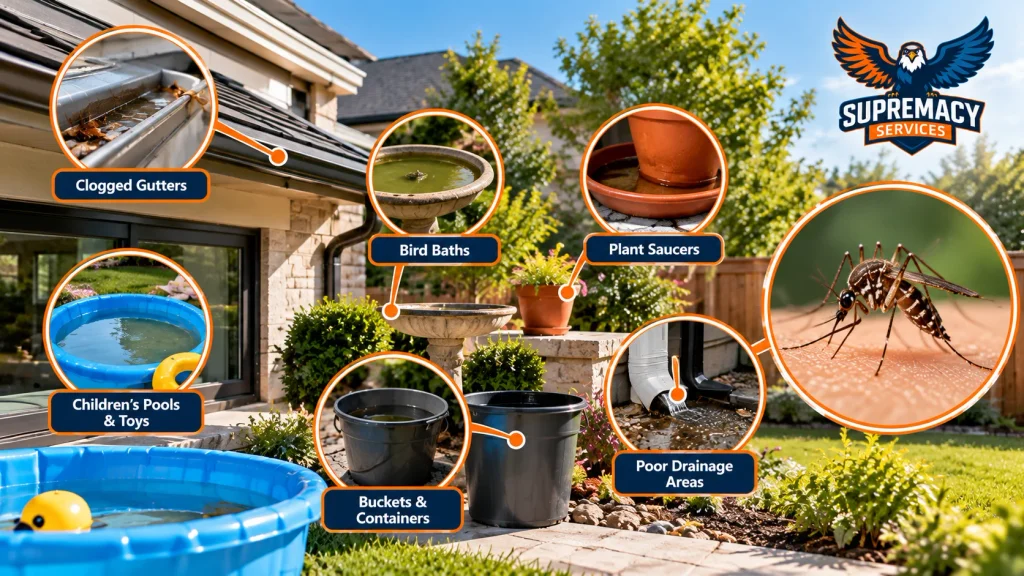
Mosquitoes are primarily an outdoor pest problem, and controlling breeding habitat is an important first step.
Mosquitoes require water for their development. The EPA recommends regularly checking rain gutters, buckets, covers, bird baths, fountains, children’s pools and plant saucers for standing water.
For Plano homeowners, inspect:
- clogged gutters;
- plant saucers;
- children’s toys;
- buckets;
- poorly draining areas;
- bird baths;
- unused containers;
- pool covers;
- landscape drainage;
- irrigation-related pooling.
Plano operates a mosquito surveillance and monitoring program and uses measures including neighborhood surveys and larviciding when warranted.
That makes mosquito prevention more than a comfort issue: reducing breeding habitat is a practical part of local property maintenance.
4. Termites
Termites deserve a different response from ordinary nuisance insects because they can damage structural wood while remaining difficult to detect.
Texas A&M describes Texas as one of the states at substantial risk for termite infestation and provides specific guidance for identifying and managing subterranean termites.
Possible termite warning signs
Homeowners should investigate:
- mud tubes along foundations or structural surfaces;
- winged termites or discarded wings;
- damaged or hollow-sounding wood;
- suspicious wood deterioration;
- activity around moisture-damaged structural areas.
Do not automatically assume every winged insect is a termite. Flying ants are commonly confused with termite swarmers.
Because termite identification and treatment can affect the structure itself, suspected activity is an appropriate reason to obtain a professional inspection rather than experimenting with general household insect spray.
5. Spiders
Most spiders around Plano homes are predators of other insects and do not represent the same kind of infestation as cockroaches or ants.
Texas A&M notes that spiders are largely beneficial because they feed on insects and other arthropods. Only two groups in Texas—recluse and widow spiders—are considered medically significant.
Why do spiders appear around homes?
Recurring spider activity can be associated with:
- abundant insect prey;
- exterior lighting attracting insects;
- protected eaves;
- garages;
- cluttered storage;
- wood piles;
- dense vegetation;
- quiet, undisturbed spaces.
Rather than treating every spider sighting as a major infestation, consider whether the property is supporting a larger population of insects on which spiders feed.
Texas A&M recommends sanitation and physical removal as important components of spider management.
Exercise additional caution when you suspect a brown recluse or widow spider. Avoid handling an unidentified spider with bare hands.
6. Rodents
Mice and rats are different from ordinary insect pests because exclusion is fundamental to long-term control.
Common warning signs include:
- droppings;
- gnaw marks;
- scratching or movement noises;
- damaged food packaging;
- nesting material;
- unexplained activity in an attic or garage.
A successful strategy should determine how rodents are entering and what resources are supporting them rather than simply removing individual animals.
Check garage-door edges, utility penetrations, roofline openings, vents and other potential structural gaps.
7. Wasps and Other Stinging Insects
An occasional wasp visiting flowers is different from repeated traffic entering a nest around the home.
Potential nesting areas include:
- eaves;
- soffits;
- sheds;
- trees and shrubs;
- patio structures;
- wall cavities;
- protected exterior corners.
The main concern is nest location. A nest close to a doorway, children’s play area or frequently used patio presents a different level of exposure than a solitary insect passing through the yard.
Avoid disturbing a nest when you cannot identify the species or safely reach the location.
8. Fleas and Ticks
Fleas and ticks can become concerns in yards, pet areas and homes.
They should not automatically be treated as the same problem. Fleas can establish indoor populations under suitable conditions, while ticks are more often associated with outdoor environments and animal hosts.
Inspect pet resting areas and shaded outdoor zones, and discuss appropriate parasite prevention with your veterinarian when pets are involved.
The EPA classifies mosquitoes, ticks and fleas among disease-vector pests, which makes correct identification and appropriate management particularly important.
9. Scorpions
Scorpions are occasional invaders around North Texas properties.
They can shelter beneath rocks, landscape materials, wood, debris and other protected areas and may enter buildings through structural openings. Because scorpions prey on insects and other arthropods, abundant insect activity can also help support them around a property.
If you repeatedly find scorpions indoors, inspect:
- garage-door gaps;
- exterior doors;
- utility penetrations;
- foundation joints;
- stored materials;
- rock landscaping;
- wood piles;
- areas with heavy insect activity.
The goal should be to address shelter, prey and entry opportunities rather than simply killing the individual scorpion you happen to see.
Which Pests Can Homeowners Handle Themselves?
Minor pest activity can often be reduced through sanitation, exclusion, moisture management and habitat modification.
| Situation | Reasonable homeowner response | Consider professional help when… |
|---|---|---|
| Occasional ants | Clean food residues, seal entry points, identify trails | Activity repeatedly returns or nests cannot be located |
| One outdoor cockroach indoors | Inspect doors, drains and openings | Small indoor roaches or multiple life stages appear |
| Mosquitoes | Remove standing water | Activity remains severe despite source reduction |
| Occasional harmless spider | Physical removal and web cleanup | Numerous spiders recur or hazardous species are suspected |
| Fire ants | Properly labeled control methods | Multiple colonies or high-use areas are affected |
| Termites | Inspection rather than DIY guesswork | Any credible evidence of active termites exists |
| Rodents | Sanitation and identifying openings | Droppings, noises or recurring activity indicate an established problem |
| Wasps | Avoid disturbing active nests | Nest is difficult to access or near high-traffic areas |
| Scorpions | Remove shelter and seal gaps | Indoor sightings continue |
The EPA’s broader recommendation is to use integrated pest management (IPM): identify the pest first, remove the resources supporting it, prevent access and use appropriate control methods when necessary.
How to Make a Plano Home Less Attractive to Pests
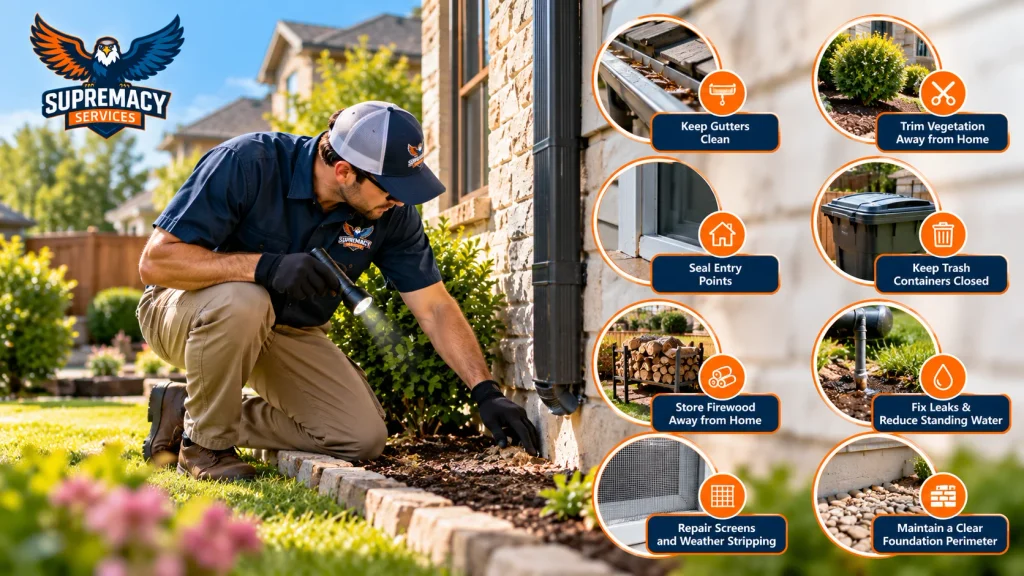
A useful pest-prevention routine focuses on the property rather than any one species.
Exterior checklist
- Remove unnecessary standing water.
- Keep gutters draining correctly.
- Repair irrigation or plumbing leaks.
- Keep trash containers closed.
- Remove unnecessary debris near the foundation.
- Store firewood appropriately away from living areas.
- Trim vegetation where it creates dense shelter against the house.
- Inspect weather stripping and door sweeps.
- Repair damaged screens.
- Examine utility penetrations and exterior gaps.
- Monitor garages and storage spaces.
- Watch for ant mounds and wasp nests before working in the yard.
Interior checklist
- Store food in closed containers.
- Clean crumbs and grease from cooking areas.
- Avoid leaving pet food accessible overnight.
- Repair plumbing leaks.
- Reduce unnecessary cardboard and clutter.
- Check beneath sinks and appliances.
- Inspect incoming boxes when appropriate.
- Respond to recurring pest evidence instead of relying solely on repeated aerosol spraying.
These steps align with EPA recommendations to deprive pests of food, water and shelter and prevent entry into the home.
What Professional Pest Control Should Include
Professional pest management should begin with identification and inspection, not simply routine spraying.
A useful assessment may examine:
- the pest species or likely pest group;
- where activity is occurring;
- food and moisture sources;
- nesting or harborage areas;
- exterior entry points;
- landscaping and perimeter conditions;
- the extent of the infestation;
- appropriate treatment and prevention measures.
For general crawling pests originating around the exterior, a perimeter-based program may be appropriate. Termites, rodents, mosquitoes, bed bugs and other specialized pests may require different treatment strategies.
Texas regulates structural pest-control businesses and applicators through the Texas Department of Agriculture’s Structural Pest Control Service. TDA states that businesses performing structural pest control commercially must be licensed.
Homeowners using pesticides themselves should always read and follow the product label. The EPA likewise emphasizes correct and responsible pesticide use rather than unnecessary application.
Don’t Treat Every Plano Pest Problem the Same Way
A recurring pest problem is often a clue rather than the entire problem.
Ants around a sink can point toward food or moisture.
German cockroaches in a kitchen can indicate an established indoor population.
Large cockroaches may be entering from exterior or utility environments.
Spiders may reflect abundant insect prey.
Mosquitoes can point toward standing water.
Rodent droppings indicate that exclusion and sanitation deserve attention.
Termite evidence requires specialized identification.
The most effective response starts by answering three questions:
What pest is it? Where is it coming from? What conditions are allowing it to remain?
That produces a much better pest-management strategy than treating every insect with the same spray.
Frequently Asked Questions
What are the most common pests in Plano, Texas?
Plano homeowners commonly encounter ants, cockroaches, mosquitoes, spiders, termites, rodents, wasps, fleas, ticks and occasional scorpions. The exact pest pressure varies by property conditions and season.
Why do bugs keep getting into my Plano home?
Pests may enter through door gaps, damaged screens, utility penetrations, roofline openings and other structural gaps. Food, water, shelter and insect prey can encourage them to remain once inside.
Are cockroaches common in North Texas?
Yes. Texas A&M identifies German, American, oriental and smokybrown cockroaches among common Texas cockroach species. Their habitat and treatment requirements differ considerably.
Are termites a concern in Plano?
Termites are a legitimate Texas homeowner concern. Texas A&M describes Texas as one of the states at substantial risk for termite infestation. Suspected activity should be correctly identified before treatment.
What attracts mosquitoes to Plano yards?
Standing water is particularly important because mosquitoes require water for development. Gutters, containers, plant saucers, toys and poorly draining areas should be checked regularly.
Does seeing one cockroach mean my house is infested?
Not necessarily. Species matters. A large outdoor cockroach that wanders inside represents a different situation from repeated German cockroach sightings, nymphs or daytime activity in a kitchen.
Should I spray every spider I find?
Usually not. Most Texas spiders are beneficial predators, and Texas A&M identifies only recluse and widow spiders as the two medically significant spider groups in the state.
When should I call professional pest control?
Professional help becomes appropriate when pests repeatedly return, identification is uncertain, an established indoor infestation is suspected, structural damage may be occurring, rodents have entered the structure, a dangerous nest is difficult to access, or DIY prevention has not corrected the problem.
How can I prevent pests without constantly spraying pesticides?
Start with integrated pest management: identify the pest, remove food and water sources, eliminate shelter, seal entry points, monitor activity and use targeted control methods only when needed.
Need Help Identifying or Controlling a Pest in Plano?
The right solution depends on what is actually living around your property.
If you’re seeing recurring ants, cockroaches, spiders, mosquitoes, rodents, scorpions or other pest activity, Supremacy Services can inspect the property, identify likely pressure points and recommend a treatment strategy appropriate to the problem.
Explore residential pest control from Supremacy Services to learn about pest-management options available throughout Plano and the Dallas-Fort Worth area.

