
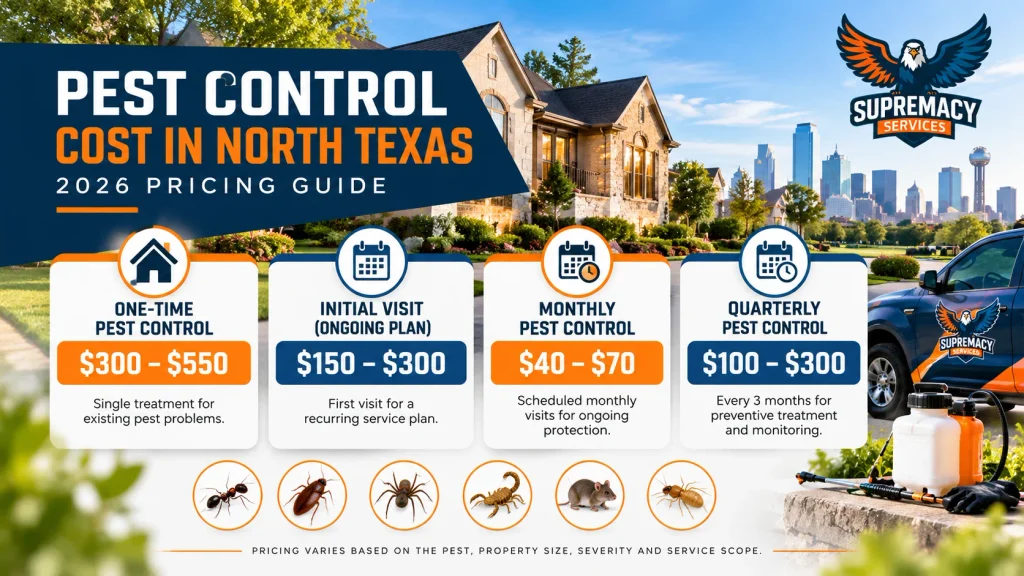
If you’re budgeting for pest control in North Texas, a useful 2026 starting point is roughly $300–$550 for a one-time general pest-control service, $150–$300 for the initial visit on an ongoing program, $40–$70 per monthly visit, or about $100–$300 per quarterly visit for a typical 1,500-square-foot Dallas home, according to current Dallas market estimates. Angi
Those figures are market-planning ranges, not Supremacy Services prices.
Your actual quote can be lower or higher depending on the pest, severity of the infestation, size and construction of the property, treatment method, frequency of service and whether structural exclusion or specialized treatment is required.
A few ants around a kitchen window, for example, are a very different job from rats in an attic, termites around a foundation or bed bugs established throughout several bedrooms.
This guide explains what Dallas-Fort Worth homeowners should expect to pay, what influences the price and what should actually be included in a professional pest-control quote.
Table of Contents
- Pest Control Cost in North Texas at a Glance
- One-Time vs. Recurring Pest Control
- What Determines Pest Control Cost?
- Why the Type of Pest Matters
- What Does Professional Pest Control Include?
- DIY vs. Professional Pest Control
- How to Reduce Pest Problems and Costs
- How to Compare Pest-Control Quotes
- When Should You Call a Professional?
- Frequently Asked Questions
How Much Does Pest Control Cost in North Texas?
For ordinary residential pest problems, homeowners should generally distinguish between one-time corrective treatment and ongoing preventive service.
Current Dallas consumer-market data provides the following budgeting benchmarks for a 1,500-square-foot home. Angi
| Service | Current Dallas planning range |
|---|---|
| One-time pest-control service | $300–$550 |
| Initial visit for ongoing service | $150–$300 |
| Monthly visit | $40–$70 |
| Quarterly visit | $100–$300 |
| Annual visit | $300–$550 |
| Specialized infestations | Often priced separately |
These ranges should not be interpreted as a Supremacy Services price list or guaranteed DFW averages.
They are useful for establishing a budget, but an inspection or property-specific quote is much more meaningful.
Why can two Dallas homes receive very different quotes?
Because pest control isn’t simply priced according to square footage.
A technician may need to determine:
- what pest is present;
- how established the infestation is;
- where pests are entering;
- where they are nesting or hiding;
- whether interior treatment is required;
- how much exterior treatment is appropriate;
- whether exclusion is needed;
- whether follow-up visits are necessary;
- whether the pest requires specialized equipment or treatment.
That scope determines the real cost.
One-Time vs. Recurring Pest Control: Which Costs Less?
One-time treatment generally costs more per visit, while recurring pest-control programs spread preventive service across scheduled visits.
Current Dallas estimates illustrate that distinction: a one-time treatment is estimated around $300–$550, while quarterly visits are estimated around $100–$300 each. Angi
But price per visit isn’t the only consideration.
| One-Time Treatment | Recurring Pest Control |
|---|---|
| Targets a defined problem | Focuses on prevention and ongoing control |
| Higher cost per visit may apply | Cost spread across scheduled visits |
| Limited monitoring | Regular property monitoring |
| Useful for some isolated problems | Useful where pest pressure repeatedly returns |
| Future infestations may require another service | Problems may be identified earlier |
| Specialized pests may still require separate service | Specialized treatments may not be included |
A recurring program makes the most sense when a property experiences repeated pest pressure rather than a genuinely isolated problem.
Is quarterly pest control worth it in North Texas?
It can be appropriate when a property regularly experiences ants, cockroaches, spiders, scorpions or other pests around the structure.
The important question isn’t simply whether quarterly service is cheaper.
Ask what each visit includes and which pests are covered.
Dealing with recurring pest activity? Explore Supremacy’s Dallas-Fort Worth pest-control services and request a property-specific assessment.
Supremacy’s main pest page already functions as the commercial hub for its general pest services, including perimeter, mosquito, termite, flea/tick, wasp, rodent, bed-bug and wildlife solutions. Supremacy Services
What Determines the Cost of Pest Control?
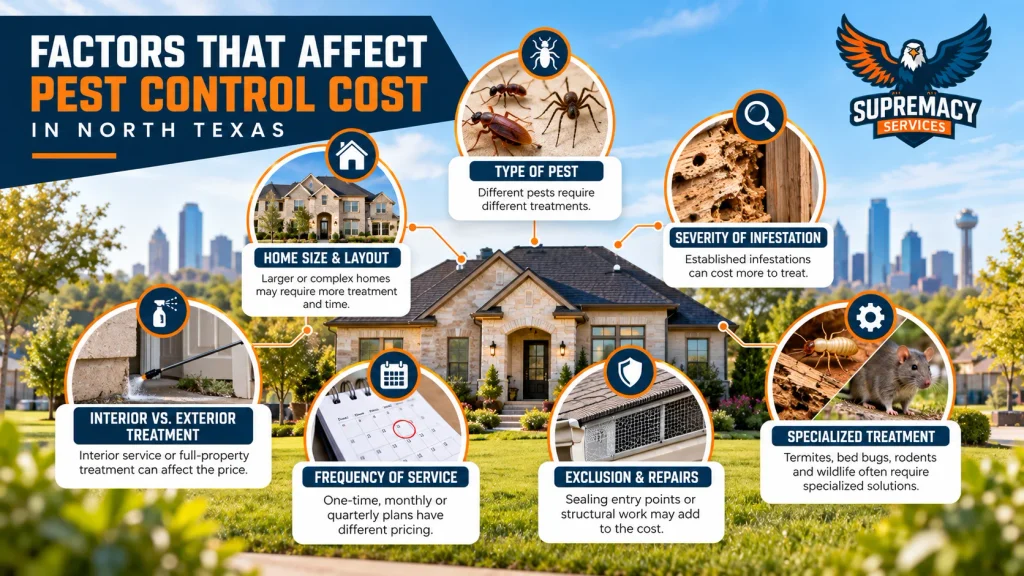
1. Type of pest
The pest is usually one of the biggest pricing variables.
General crawling-insect management is fundamentally different from termite treatment, bed-bug remediation or rodent exclusion.
Some problems require specialized equipment, monitoring, multiple visits or structural work.
2. Severity of the infestation
Preventing pests around a home is different from correcting an established infestation.
A widespread problem can require:
- detailed inspection;
- identification;
- initial corrective treatment;
- locating nests or harborages;
- follow-up;
- exclusion or sanitation corrections;
- ongoing monitoring.
Earlier intervention may therefore prevent a relatively simple problem from developing into a much more involved treatment.
3. Home size and layout
Larger homes generally create more areas to inspect and treat, but square footage alone doesn’t determine price.
Two similarly sized homes may have completely different pest-management needs because of their construction, landscaping, garages, attics, patios, drainage or surrounding environment.
4. Interior vs. exterior treatment
A preventive exterior service may have a different scope than an established indoor infestation requiring treatment of kitchens, bathrooms, wall junctions or other activity areas.
Supremacy’s existing perimeter pest-control service, for example, is explicitly designed around exterior treatment. Supremacy Services
5. Entry-point sealing and exclusion
Sometimes killing pests doesn’t solve the underlying problem.
Rats and mice are a good example.
If rodents are entering through roof gaps, vents, utility penetrations or other structural openings, trapping animals without addressing those openings may leave the property vulnerable to recurring activity.
Supremacy’s rodent service consequently combines active rodent control with inspection of structural access points and exclusion where appropriate. Supremacy Services
6. Frequency of service
A single treatment and an ongoing pest-management program are priced differently.
Compare annual cost rather than simply comparing one visit.
Also determine whether the plan includes:
- scheduled inspections;
- exterior treatment;
- interior service when needed;
- callbacks;
- monitoring;
- web or nest removal;
- seasonal treatments.
7. Specialized treatment
General pest-control pricing should not be used to estimate every infestation.
Termites, bed bugs, extensive rodent problems and wildlife can involve very different treatment strategies.
For example, Supremacy maintains dedicated termite, bed-bug and rodent services rather than treating these problems as interchangeable with ordinary perimeter pest management. Supremacy Services
Does Pest Control Cost More for Certain Pests?
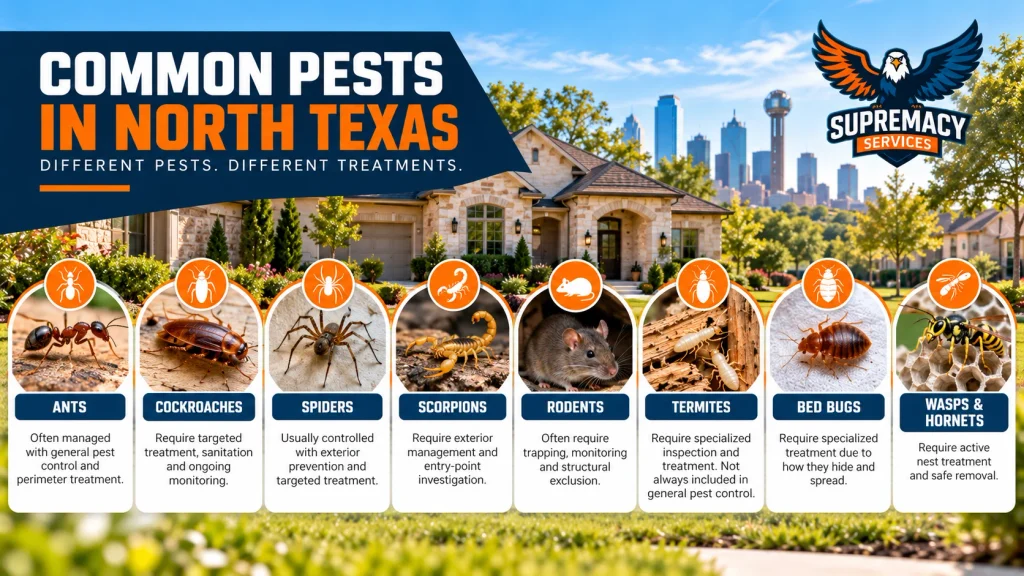
Yes. Specialized pests can cost considerably more than routine general pest control because treatment requirements differ.
Rather than publishing unsupported pest-by-pest prices, homeowners should think about the complexity of the treatment.
| Pest/problem | Typical service complexity |
|---|---|
| Ants | Often general pest management |
| Spiders | Exterior prevention + targeted control |
| Cockroaches | Identification, sanitation, targeted treatment and monitoring |
| Scorpions | Exterior management + entry-point investigation |
| Wasps/hornets | Active nest treatment/removal |
| Fleas/ticks | Yard/interior strategy depending on activity |
| Mosquitoes | Outdoor habitat + targeted treatment |
| Rats/mice | Trapping/control + possible exclusion |
| Termites | Specialized inspection/treatment |
| Bed bugs | Specialized infestation treatment |
| Wildlife | Species-specific trapping/removal/exclusion |
This is also why homeowners should be cautious about comparing quotes without confirming which pests are actually included.
General pest control vs. termite control
Termites are wood-destroying insects requiring specialized inspection and management.
Texas A&M AgriLife provides dedicated guidance for subterranean termites and describes Texas as particularly susceptible to termite infestation. Texas A&M AgriLife Extension Service
Termite work therefore shouldn’t be assumed to be included in an ordinary general-pest plan.
General pest control vs. bed bugs
Bed bugs require a different management strategy because they hide in mattresses, furniture, bed frames, baseboards and narrow structural spaces.
EPA recommends a comprehensive IPM approach rather than relying exclusively on pesticide applications. US EPA
General pest control vs. rodents
Rodents frequently turn pest control into a structural problem.
Removing active animals can be only part of the job if the building still contains accessible entry points.
That makes rodent exclusion an important line item to identify when comparing estimates.
What Should Professional Pest Control Include?
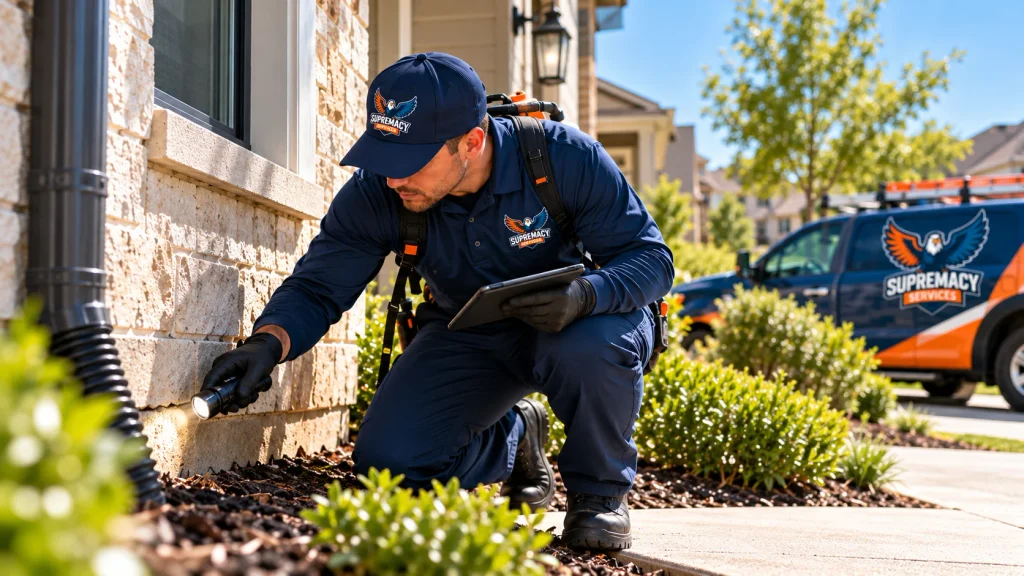
A quality pest-control service should involve more than automatically spraying pesticide around the house.
EPA’s Integrated Pest Management framework emphasizes identification, monitoring, prevention and appropriate control methods. US EPA
A professional residential program may therefore include:
Inspection
Identify pests, activity zones, entry points and environmental conditions contributing to the problem.
Correct identification
Not every insect requires treatment.
Correct identification helps prevent unnecessary or ineffective pesticide applications—one of the principles emphasized in EPA’s IPM guidance. US EPA
Exterior assessment
Technicians may inspect:
- foundation areas;
- door thresholds;
- utility penetrations;
- landscaping;
- patios;
- garages;
- eaves;
- accessible cracks and gaps.
Targeted treatment
Treatment should correspond to the pest and the areas where activity occurs rather than treating every problem identically.
Prevention recommendations
You may receive recommendations concerning moisture, food storage, vegetation, structural gaps or sanitation.
Monitoring and follow-up
Some infestations require follow-up to determine whether pest activity has declined or whether treatment needs adjustment.
What Should You Ask Before Paying for Pest Control?
Don’t compare companies using price alone.
Ask these questions:
| Question | Why it matters |
|---|---|
| Which pests are included? | Specialty pests may cost extra |
| Is the initial service priced separately? | Initial corrective treatment may involve more work |
| How often are visits performed? | Frequency affects annual cost |
| Are interior treatments included? | Plans vary |
| Are callbacks included? | Important when activity returns |
| Is rodent exclusion included? | Structural work may be separate |
| Are termites included? | Usually a specialized service |
| Are bed bugs included? | Usually require separate treatment |
| Is there a contract? | Understand the commitment |
| What does cancellation involve? | Avoid surprises |
| Is the business licensed in Texas? | Structural pest-control businesses are regulated |
Texas requires businesses performing structural pest control for compensation to hold appropriate licensing, and licensed businesses must designate a certified applicator. Texas Agriculture
Not sure what type of service your home needs? Request a pest assessment from Supremacy Services before choosing a treatment plan.
DIY vs. Professional Pest Control: Which Is More Cost-Effective?
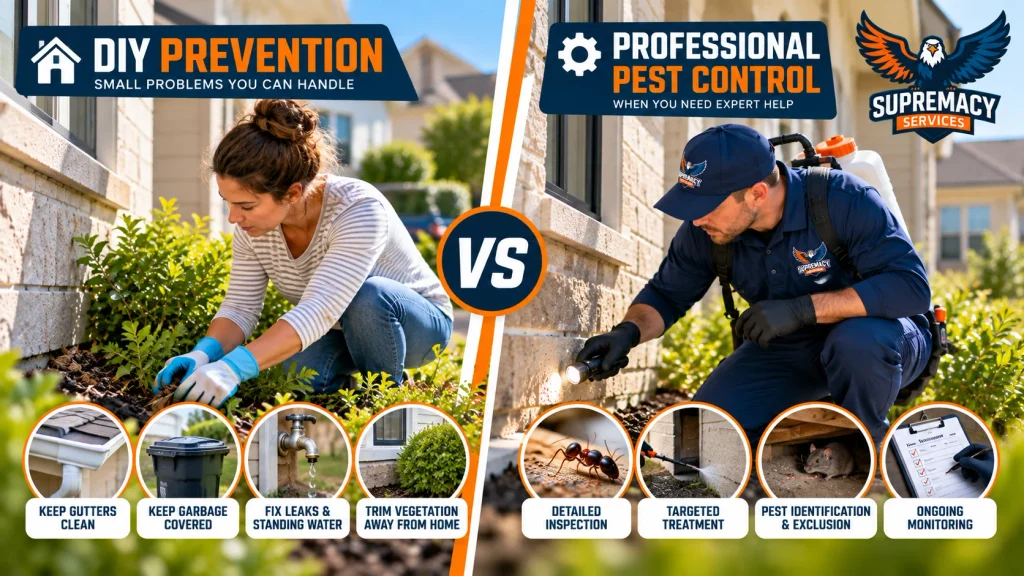
DIY pest control can be reasonable for minor, correctly identified pest problems, but recurring or established infestations may require professional inspection and targeted treatment.
The key word is identified.
EPA recommends identifying pests before deciding whether control is necessary and selecting appropriate methods rather than automatically applying pesticides. US EPA
DIY can make sense when:
- activity is minor;
- you can confidently identify the pest;
- the source is accessible;
- exclusion or sanitation can solve the problem;
- you’re using a consumer product specifically labeled for the pest and location.
EPA instructs consumers to read pesticide labels and follow their directions and restrictions rather than applying more product than directed. US EPA
Professional service becomes more appropriate when:
- pests repeatedly return;
- you cannot identify the pest;
- cockroaches are established indoors;
- rodents are inside the attic or walls;
- termites are suspected;
- bed bugs are confirmed or strongly suspected;
- a wasp nest is difficult to access safely;
- several rooms are affected;
- DIY treatment has repeatedly failed;
- structural exclusion is required.
Texas A&M’s pest-prevention guidance similarly identifies situations such as rodents and possible termite damage as cases where professional assistance can be appropriate. Texas A&M AgriLife Extension Service
How Can North Texas Homeowners Reduce Pest Problems?
One of the most effective ways to control long-term pest-management costs is to make the property less attractive and accessible to pests.
EPA recommends reducing access to food, water and shelter and sealing entryways as basic pest-prevention measures. US EPA
North Texas homeowner prevention checklist
- Repair plumbing leaks.
- Eliminate unnecessary standing water.
- Keep food in sealed containers.
- Don’t leave pet food outside overnight.
- Keep garbage containers closed.
- Seal appropriate exterior gaps.
- Repair damaged screens.
- Maintain door sweeps.
- Reduce clutter in garages and storage areas.
- Trim vegetation away from the structure where practical.
- Remove unnecessary debris around foundations.
- Inspect utility penetrations.
- Address recurring moisture problems.
- Watch for droppings, nests and other pest evidence.
- Deal with recurring activity before it becomes widespread.
Texas A&M’s ant-control guidance likewise recommends repairing dripping plumbing, sealing cracks around doors and windows and keeping vegetation from contacting the house. Texas A&M AgriLife Extension Service
These steps don’t eliminate every pest problem, but they reduce conditions that support infestations.
Why North Texas Homes Can Need Different Pest Strategies
DFW homes aren’t all exposed to the same pest conditions.
A newer Frisco property with extensive landscaping may have different vulnerabilities from an older Dallas home, a heavily wooded Southlake property or a townhome sharing walls with neighboring units.
The practical local variables include:
Landscaping. Vegetation, mulch, rocks, wood and debris can create shelter near structures.
Moisture. Irrigation, plumbing leaks, drainage and standing water can support pest activity.
Building openings. Door gaps, rooflines, utility penetrations, garages and vents can provide access.
Other pest populations. Predator pests such as scorpions can be supported by abundant insect prey. Supremacy’s existing scorpion material specifically addresses this relationship. Supremacy Services
Shared walls. Apartments, duplexes and townhomes can require a broader inspection because activity may not originate solely within one living space.
The correct pest-control plan should therefore be based on the property—not simply the ZIP code.
How to Compare Pest-Control Quotes in Dallas-Fort Worth
Suppose Company A quotes $125 and Company B quotes $175.
That doesn’t automatically make Company A less expensive.
The $125 proposal might cover one treatment with limited pests, while the $175 proposal could include inspection, exterior treatment, follow-up and callbacks.
Compare scope against scope.
Ask each company to identify:
- What pests are covered?
- What areas will be inspected?
- What areas will be treated?
- Is the first visit different from recurring visits?
- How frequently will service occur?
- What happens if pests return?
- Are callbacks included?
- Is structural exclusion included?
- Which problems require separate treatment?
- What is the total annual cost?
Then compare the answers.
Does the Cheapest Pest-Control Quote Save Money?
Not necessarily.
Nor does the most expensive quote automatically mean better service.
The useful comparison is:
price + treatment scope + frequency + exclusions + follow-up + prevention.
A quote should make it reasonably clear what you’re buying.
For example, a basic general-pest plan shouldn’t be compared directly with a proposal containing substantial rodent exclusion.
Likewise, termite protection shouldn’t be compared with ordinary insect-control pricing.
When Should You Call a Pest-Control Professional?
Consider professional inspection when pest activity is recurring, spreading, difficult to identify or connected with a structural infestation.
Warning signs include:
- cockroaches repeatedly appearing indoors;
- ants returning despite cleaning and exclusion;
- rodent droppings;
- scratching inside walls or ceilings;
- gnaw marks;
- termite mud tubes or suspected wood damage;
- bed-bug evidence around sleeping areas;
- repeated scorpion sightings;
- inaccessible wasp or hornet nests;
- pests appearing in multiple rooms;
- continued activity after reasonable DIY measures.
The goal is to identify the pest and source before repeatedly spending money on treatments that don’t address the underlying problem.
How Supremacy Services Approaches Pest Control in DFW
Supremacy’s current pest-control structure separates general pest management from specialized problems such as termites, mosquitoes, fleas and ticks, wasps, rodents, bed bugs, wildlife and commercial pest management. Supremacy Services
That distinction is important when discussing price.
A homeowner with routine crawling-insect pressure should not automatically be given the same treatment scope as someone with rats in an attic or bed bugs throughout a bedroom.
The starting point should be determining what pest is present, where activity is occurring and what level of intervention the property actually needs.
Frequently Asked Questions
How much does pest control cost in Dallas?
Current third-party Dallas estimates place one-time general pest service around $300–$550, an initial recurring-plan visit around $150–$300, monthly visits around $40–$70, and quarterly visits around $100–$300 for a 1,500-square-foot home example. Actual quotes vary by property and pest.
How much is quarterly pest control in North Texas?
A current Dallas market estimate puts quarterly service around $100–$300 per visit. Treat that as a budgeting reference rather than a guaranteed local or Supremacy price.
Is monthly pest control cheaper than quarterly pest control?
Monthly visits can cost less individually, but there are more visits. Compare the total annual cost and scope of service, not simply the price of one appointment.
What makes pest control more expensive?
Pest species, infestation severity, home size and layout, treatment method, frequency, interior activity, follow-up requirements and structural exclusion can all affect price.
Are termites included in regular pest control?
Don’t assume they are. Termite management is a specialized pest-control category, and Supremacy maintains a dedicated termite service rather than presenting termite treatment as ordinary perimeter pest control.
Does regular pest control include rats and mice?
It depends on the plan. Significant rodent problems can require trapping, monitoring and structural exclusion, which may be quoted separately from general insect control.
Is professional pest control worth it?
Professional service becomes particularly useful when an infestation is recurring, difficult to identify, widespread, structurally related or requires treatment beyond straightforward homeowner prevention.
Can I do pest control myself?
Minor problems can sometimes be managed with sanitation, exclusion, monitoring and appropriately labeled consumer products. EPA recommends identifying the pest first and following pesticide-label directions exactly when pesticides are used.
How often should I have pest control in North Texas?
There is no universal schedule. Frequency should reflect the pest, property conditions, infestation history and whether the objective is corrective treatment or ongoing prevention.
How do I get an accurate pest-control price?
Request a property-specific assessment and ask for a clear explanation of the pests covered, treatment areas, frequency, follow-up, exclusions and total expected cost.
Get a Pest-Control Assessment in Dallas-Fort Worth
Online pricing guides are useful for setting expectations, but they cannot tell you exactly what your home needs.
A house with occasional exterior ants should not be priced or treated like a home with German cockroaches, rodents, termites or bed bugs.
If you’re seeing recurring pest activity in Dallas, Frisco, Plano, McKinney, Allen, Richardson, Southlake or another DFW community, request a pest-control assessment from Supremacy Services to identify the problem and determine the appropriate treatment scope.

