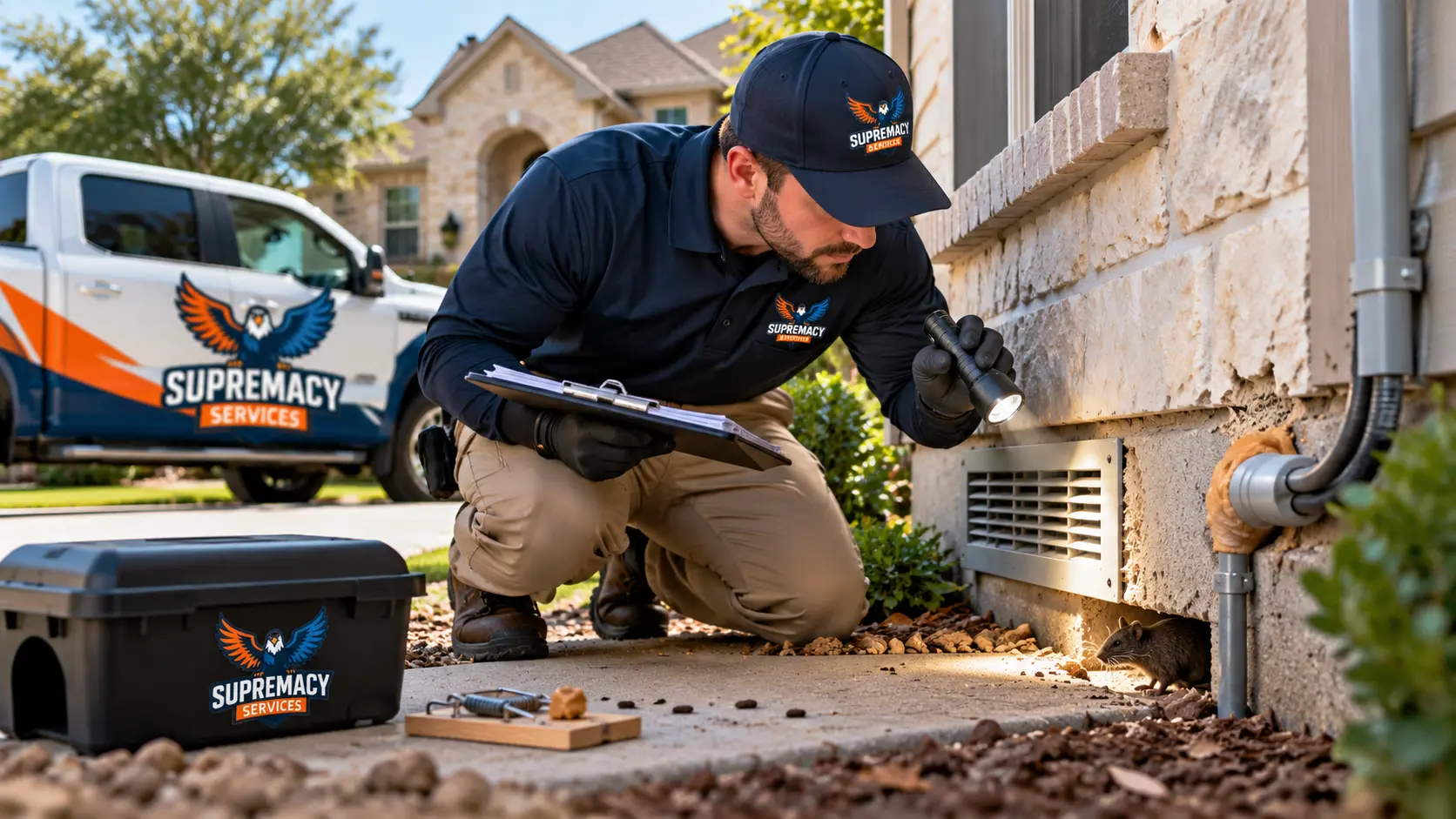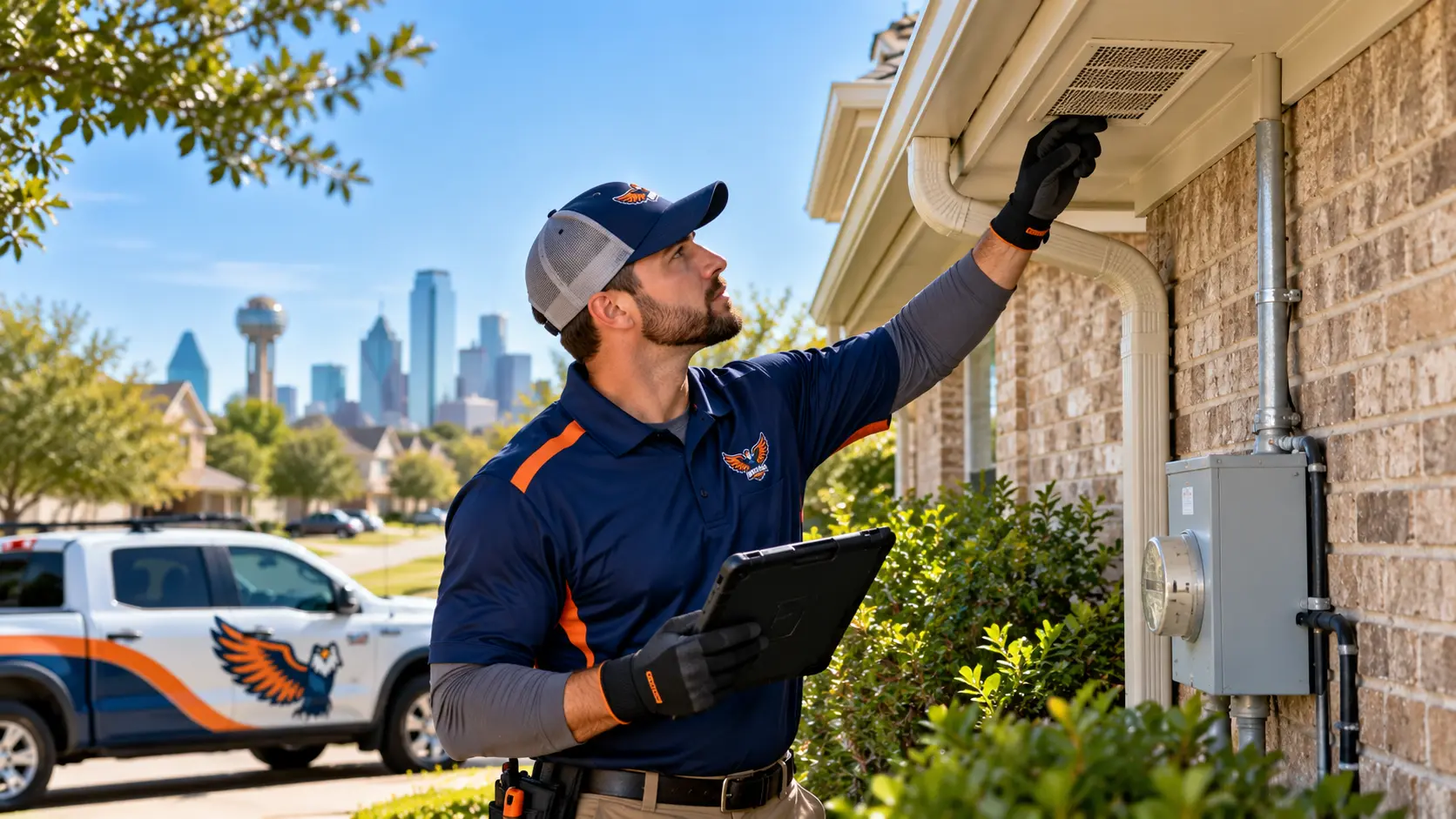
Rodent exclusion is the process of finding and closing the openings rats and mice use to enter a building. Instead of focusing only on rodents already inside, exclusion addresses the structure itself—roof gaps, vents, utility penetrations, garage openings, damaged screening and other vulnerable areas that can allow rodents to return.
For Dallas and DFW homeowners, that distinction matters. Traps may remove individual rats or mice, but if the access point remains open, the house is still vulnerable to another infestation.
A complete rodent-control plan therefore usually has two separate goals: deal with the rodents currently inside and reduce the ways additional rodents can get in.
Table of Contents
- What Is Rodent Exclusion?
- How Does Rodent Exclusion Work?
- Why Trapping Alone May Not Solve a Rodent Problem
- Where Do Rats and Mice Enter a House?
- What Materials Are Used for Rodent Exclusion?
- Should You Seal the Hole Immediately?How-Does
- Signs Your Home May Need Rodent Exclusion
- DIY vs. Professional Rodent Exclusion
- What Does Professional Rodent Exclusion Include?
- How Much Does Rodent Exclusion Cost?
- Rodent Exclusion in Dallas and North Texas
- How to Make Exclusion More Effective
- Frequently Asked Questions
What Is Rodent Exclusion?
Rodent exclusion means identifying and physically closing openings that rats and mice can use to enter a home or other building.
It is different from simply setting traps.
Trapping addresses rodents that have already entered. Exclusion addresses how they entered and helps reduce the chance of the same problem happening again.
The CDC specifically recommends inspecting homes for gaps and holes and sealing them to help prevent rodents from entering. It notes that mice can pass through an opening approximately 1/4 inch, or 6 millimeters, in diameter. CDC
A rodent-exclusion inspection may therefore look at areas such as:
- roof edges and roof intersections;
- eaves and soffits;
- attic vents;
- damaged vent screens;
- plumbing penetrations;
- electrical and cable penetrations;
- gaps around HVAC lines;
- exterior-wall openings;
- foundation transitions;
- garage-door edges;
- doors without effective weather stripping;
- crawl-space openings;
- construction gaps.
The purpose is not to make a house theoretically airtight. The purpose is to identify realistic rodent-access routes and reinforce them with appropriate materials.
“If you are finding droppings, hearing attic activity or dealing with rodents that keep returning, learn how Supremacy Services approaches [rodent control and exclusion in DFW].”
How Does Rodent Exclusion Work?
Rodent exclusion usually follows four basic steps: inspect, control active rodents, seal appropriate entry points and monitor for continuing activity.
1. Inspect the structure
A useful rodent inspection looks both inside and outside.
Inside, the technician or homeowner is looking for evidence such as:
- droppings;
- gnaw marks;
- nesting material;
- damaged food packaging;
- tracks or rub marks;
- disturbed insulation;
- recurring noises;
- areas where rodents appear to travel.
Outside, the goal changes from finding rodents to finding access.
Rooflines, vents, soffits, utility penetrations, foundation transitions, doors and other gaps should be considered.
The EPA lists droppings, nesting material, gnawed food packaging, chewed openings and stale odors among signs that rats or mice may be present.
2. Determine what is actually inside
Rats, mice, squirrels and other attic wildlife should not automatically be treated as the same problem.
For example, Supremacy’s existing attic guide explains that noises alone may not positively identify the animal and recommends considering activity patterns, physical evidence and entry routes. Supremacy Services
Species identification can affect:
- trap selection;
- trap placement;
- entry-point assessment;
- whether wildlife removal rather than standard rodent control is appropriate;
- when an opening can safely be closed.
3. Control rodents already inside
Exclusion is not simply a matter of finding a hole and closing it immediately.
If rats or mice are already living inside the structure, the active population also has to be addressed.
The CDC recommends traditional snap traps for household rat and mouse control and advises placing traps where rodent activity has been observed. It also stresses keeping traps and baits away from children and pets.
4. Seal appropriate openings
Once the situation has been evaluated, vulnerable entry points can be repaired, screened or sealed using materials suitable for the opening.
The goal is straightforward:
remove the current access route and make it harder for another rodent to use the same weakness later.
5. Recheck the property
Effective exclusion should not end the instant the last visible hole is covered.
Follow-up may be useful to determine whether:
- new droppings are appearing;
- traps are still showing activity;
- another entry route was missed;
- a repair has moved or failed;
- additional structural work is required.
Why Trapping Alone May Not Solve a Rodent Problem
Traps remove rodents. Exclusion addresses the route they used to enter.
That is the key difference.
Consider a rat entering an attic through a damaged roof vent.
A trap may catch that particular rat.
But the damaged vent remains available.
A second rat could potentially use the same opening later.
The same problem applies to mice entering around plumbing pipes, beneath garage doors or through construction gaps.
| Approach | Primary purpose | Does it address existing rodents? | Does it address entry points? |
|---|---|---|---|
| Trapping | Remove rodents already inside | Yes | No |
| Baiting | Control an active population | Yes | No |
| Sanitation | Reduce food, water and shelter | Indirectly | No |
| Exclusion | Close structural access points | No, not by itself | Yes |
| Integrated approach | Control + prevention | Yes | Yes |
That is why the EPA encourages both controlling rodents and preventing access by sealing openings and reducing food, water and shelter around a property.
Where Do Rats and Mice Enter a House?
Rodents can enter through gaps in rooflines, vents, foundations, utility penetrations, garages and other parts of the building envelope.
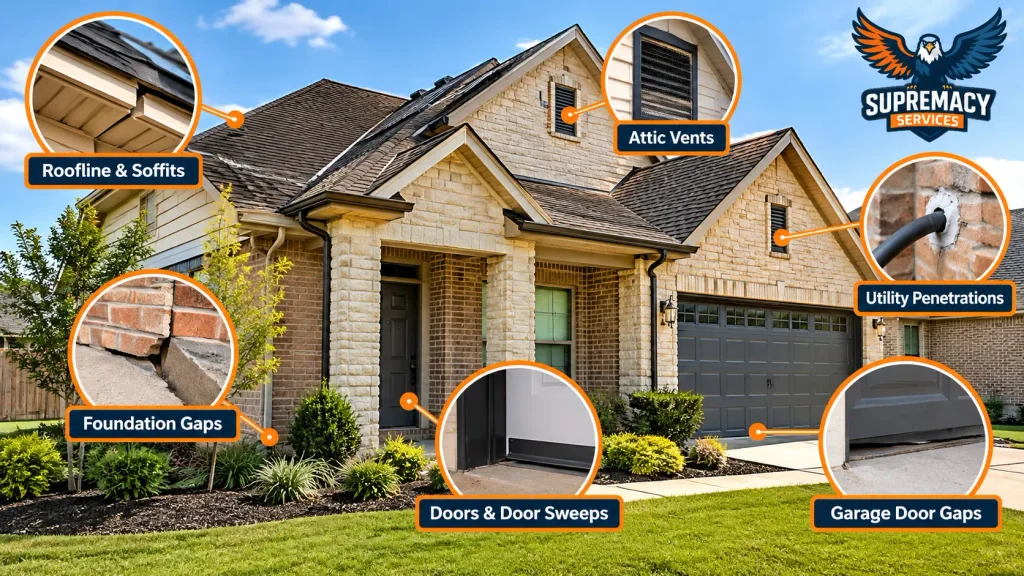
Supremacy’s existing North Texas rat-entry guide already covers this subject in detail and identifies rooflines, soffits, vents, utility penetrations, foundations and garage areas among important areas to inspect. Supremacy Services
Rooflines, soffits and eaves
Gaps where roofing materials meet fascia, soffits or adjoining walls can provide concealed access.
These areas deserve particular attention when activity is occurring in an attic.
Attic and exterior vents
Vents need airflow, so simply filling them is generally not the solution.
Instead, damaged or inadequate screening may need to be repaired or reinforced in a way that preserves the vent’s intended function.
Utility penetrations
Homes contain openings for:
- plumbing;
- electrical cables;
- refrigerant lines;
- gas lines;
- internet and television cables;
- drains and other utilities.
The CDC specifically recommends inspecting around electrical, water, gas and sewer lines for possible rodent openings. CDC
Doors and garage doors
A worn door sweep or poorly fitting garage-door edge may leave a gap at floor level.
Because these openings move every time the door operates, they generally require a proper mechanical repair rather than simply applying sealant.
Foundation and wall gaps
Changes in materials, previous repairs and penetrations near the foundation can create small openings that are easily overlooked.
Roof intersections and flashing
Complex roof shapes can hide vulnerabilities from someone inspecting only from ground level.
This is one reason repeated attic activity may justify a more detailed exterior and roofline inspection.
What Materials Are Used for Rodent Exclusion?
The correct material depends on the opening, its size, its location and whether the component needs ventilation or movement.
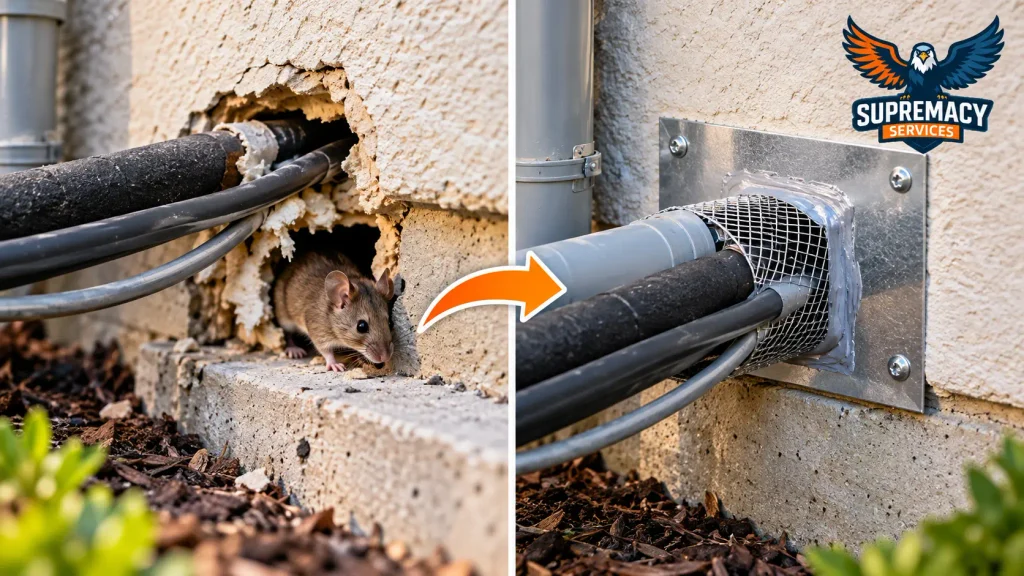
The CDC recommends several options for closing rodent openings, including steel wool for some small gaps and materials such as hardware cloth, metal sheeting, cement and lath screen for larger repairs.
Common exclusion materials can include:
- metal mesh;
- hardware cloth;
- sheet metal or flashing;
- appropriately secured steel wool for small openings;
- mortar or cement where suitable;
- durable exterior sealants;
- replacement vent screening;
- properly fitted door sweeps.
What about spray foam?
Expanding foam can be useful as part of some sealing projects, but homeowners should not assume foam alone is appropriate for every rodent opening.
Rodent-resistant repairs often rely on a physical barrier, particularly where gnawing is likely.
The goal should be a durable repair appropriate to that part of the building—not simply making the opening disappear visually.
Should You Seal the Hole Immediately?
Not always. If rodents or other wildlife are still inside, sealing an active opening without a control plan can create a new problem.
This is especially important when you do not know:
- what animal is using the opening;
- whether more than one animal is inside;
- whether young animals could be present;
- whether another exit exists;
- whether the opening is the primary entry route.
Supremacy’s squirrel-exclusion page makes the same practical distinction: determining whether wildlife remains inside should come before simply closing the opening. Supremacy Services
For an obviously unused gap, preventative sealing may be straightforward.
For an opening associated with active scratching, droppings or nesting, identification and control should come first.
Signs Your Home May Need Rodent Exclusion
Consider inspecting for entry points if you notice:
- fresh rodent droppings;
- repeated scratching in walls or ceilings;
- nighttime attic movement;
- chewed packaging;
- gnaw marks;
- damaged insulation;
- nesting materials;
- rub marks near openings;
- rats or mice repeatedly appearing after trapping;
- visible holes around utility lines;
- damaged screening;
- gaps at soffits or roof edges;
- light visible through unexpected attic openings.
Repeated infestations deserve particular attention
Catching one mouse is different from catching mice repeatedly over several weeks or months.
When rodents continue appearing, the question should change from:
“How do I catch this mouse?”
to:
“How are rodents continuing to enter?”
That is the point at which exclusion becomes especially important.
DIY vs. Professional Rodent Exclusion
Some small, accessible repairs can be reasonable DIY projects. Others involve active infestations, roofs, contamination or difficult structural conditions.
| Situation | DIY may be reasonable | Professional evaluation is preferable |
|---|---|---|
| Replace a worn door sweep | ✓ | |
| Seal a small accessible unused utility gap | ✓ | |
| Secure food and trash | ✓ | |
| Remove outdoor clutter | ✓ | |
| Persistent attic noises | ✓ | |
| Multiple possible entry points | ✓ | |
| High roofline openings | ✓ | |
| Rodents returning after trapping | ✓ | |
| Large amounts of droppings | ✓ | |
| Activity inside wall cavities | ✓ | |
| Unsure whether it is a rat, mouse or squirrel | ✓ | |
| Complex vent or roof repair | ✓ |
Safety also matters
Rodent droppings and nesting materials should not simply be swept or vacuumed dry.
The CDC provides specific recommendations for safely cleaning areas contaminated by rodents because rodent waste can present health risks.
Similarly, roof and attic work should not become a DIY project if the location cannot be reached safely.
What Does Professional Rodent Exclusion Include?
A thorough professional service should identify both the rodents and the structural conditions allowing them into the property.
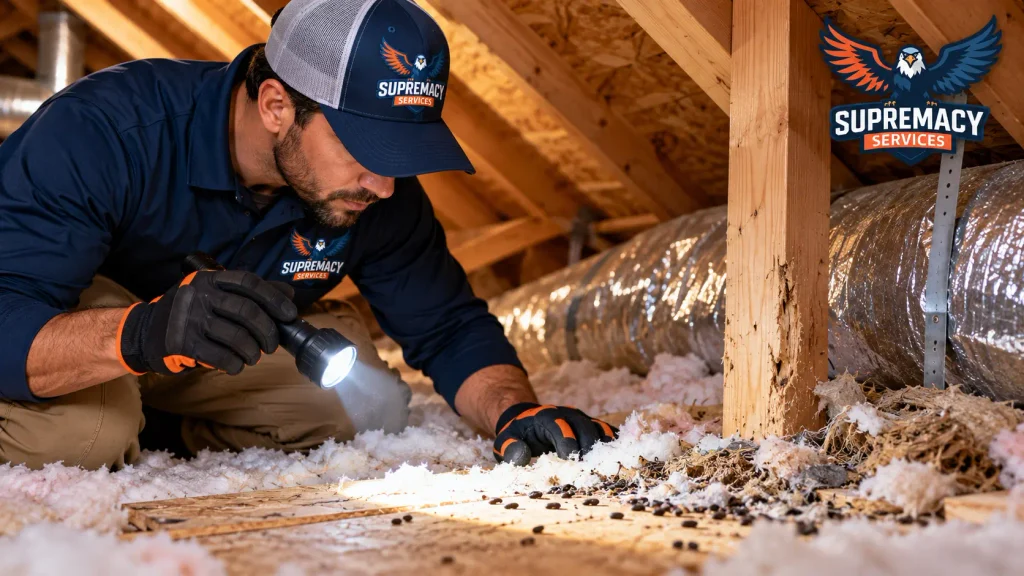
Depending on the home and infestation, the process may include:
1. Interior inspection
Checking attics, garages, utility spaces and other areas for:
- droppings;
- nests;
- gnawing;
- travel routes;
- damaged insulation;
- contamination.
2. Exterior inspection
Examining:
- rooflines;
- soffits;
- eaves;
- vents;
- wall penetrations;
- garage openings;
- doors;
- foundations.
3. Species identification
Determining whether the evidence is consistent with rats, mice, squirrels or another pest.
4. Active rodent control
Developing an appropriate trapping or control strategy for rodents currently inside.
5. Structural exclusion
Closing appropriate openings using materials suitable for the location.
6. Sanitation recommendations
Identifying food, water, nesting material or contamination that may need attention.
7. Follow-up
Checking whether rodent activity has stopped and whether additional vulnerabilities need correction.
Supremacy’s existing service page follows a similar structural approach and should be the conversion destination for readers who reach this stage of the article. Supremacy Services
“Rodents keep returning after trapping? Supremacy Services can inspect the attic, exterior and likely entry routes and recommend an appropriate [rodent control and exclusion solution for your DFW property].”
How Much Does Rodent Exclusion Cost?
There is no responsible single price for rodent exclusion because the scope can vary substantially from one property to another.
Rather than publishing an unsupported Dallas price range, the better homeowner guidance is to explain what changes the scope.
Cost can depend on:
- number of entry points;
- size of the openings;
- whether entry points are at ground level or on a roof;
- accessibility;
- materials required;
- whether active rats or mice also need to be controlled;
- whether vents, soffits or other components require repair;
- whether attic contamination or nesting material needs attention;
- property size;
- whether follow-up work is required.
Ask what the quote actually includes
A useful rodent-exclusion estimate should make clear whether the proposal covers:
- inspection;
- active rodent control;
- entry-point repairs;
- exclusion materials;
- sanitation or cleanup;
- return visits;
- any limitations or warranty terms.
That makes two quotes much easier to compare than looking only at the total price.
Rodent Exclusion in Dallas and North Texas
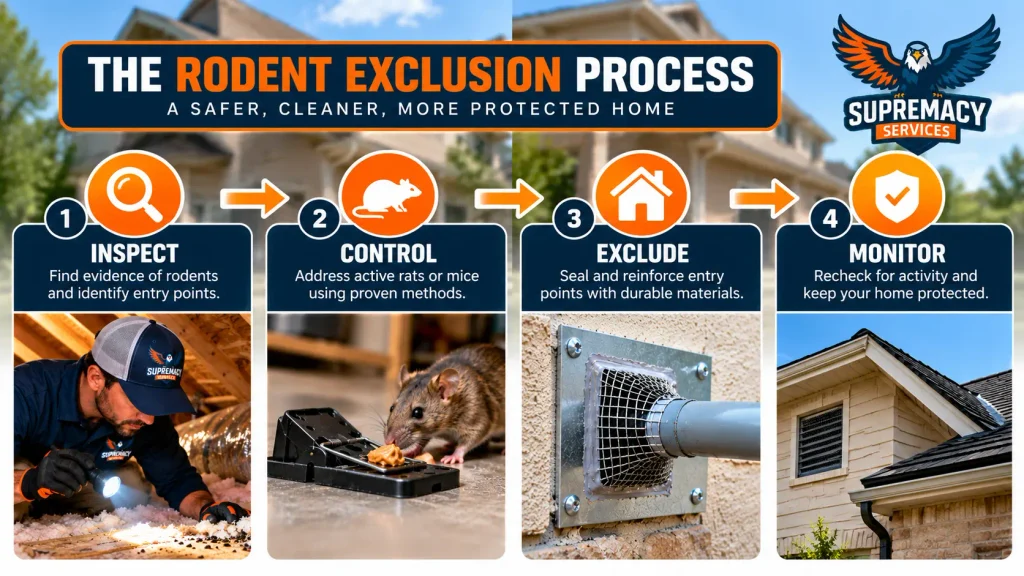
Rodent exclusion is fundamentally a building-envelope problem, which means the important local factor is not simply that the home is in Dallas. It is how that particular North Texas home was built, modified and maintained.
Homes throughout DFW can contain numerous potential transitions:
- brick veneer to soffit;
- roof-to-wall intersections;
- plumbing penetrations;
- AC and utility penetrations;
- attached garages;
- attic vents;
- remodeled rooflines;
- additions;
- aging door seals.
Supremacy’s existing North Texas guide also distinguishes between elevated and lower-level rat activity. Roof rats are commonly associated with elevated areas such as rooflines and attics, while Norway rat activity is more commonly associated with ground-level areas and burrows. Supremacy Services
That distinction helps explain why a complete inspection should not concentrate on only one part of the property.
A homeowner hearing attic activity might need a roofline inspection.
A homeowner seeing activity around a garage, exterior storage or foundation may require a different search pattern.
How to Make Rodent Exclusion More Effective
Exclusion works best when the property is also made less attractive to rodents.
Closing an opening is important, but food, water and shelter around the structure also influence rodent pressure.
The CDC and EPA recommend reducing these resources as part of rodent prevention.
Keep food inaccessible
- Store food in secure containers.
- Clean food spills promptly.
- Avoid leaving pet food available overnight.
- Store bird seed and animal feed securely.
Manage garbage
Use trash containers with secure-fitting lids and clean food residue around them.
Reduce shelter
Remove unnecessary clutter and inspect storage areas where rodents could remain concealed.
Check vegetation and exterior conditions
Look for protected areas immediately against the structure where rodents could hide or travel unnoticed.
Fix water sources
Repair leaks and reduce persistent water sources where practical.
Inspect periodically
Pay particular attention to:
- roof edges;
- vents;
- utility penetrations;
- garage doors;
- door sweeps;
- previously repaired openings.
A five-minute exterior check can sometimes identify a developing problem before it turns into another attic infestation.
Rodent Exclusion vs. Rodent Control: What’s the Difference?
Rodent control deals with the animals; rodent exclusion deals with the building.
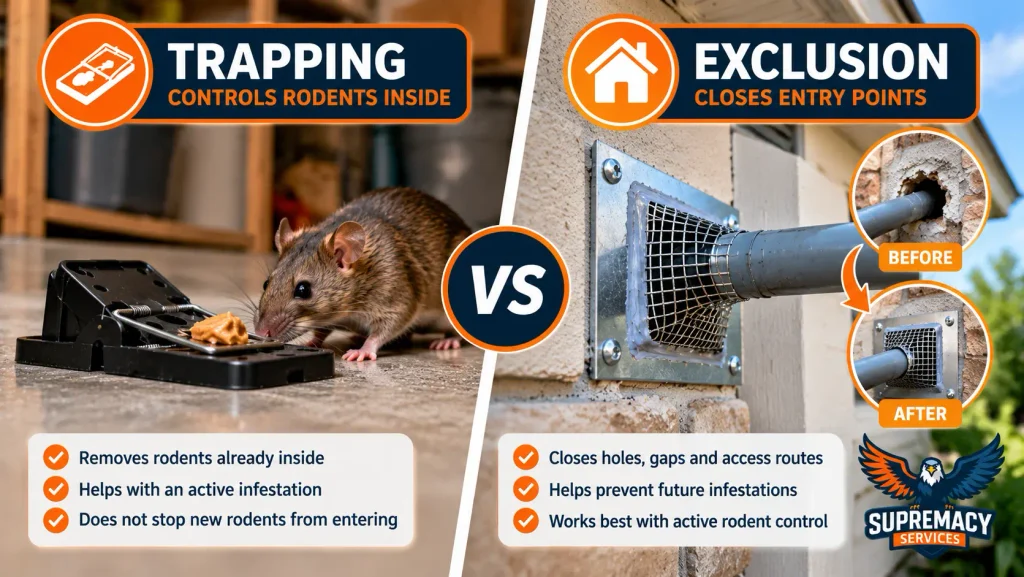
In practice, an established infestation often requires both.
| Rodent control | Rodent exclusion |
|---|---|
| Targets active rats or mice | Targets access routes |
| Uses trapping or other control methods | Uses structural repairs/barriers |
| Addresses the current population | Helps reduce future entry |
| Usually starts after activity is detected | Can be corrective or preventive |
| Does not automatically close holes | Does not automatically remove rodents already inside |
The strongest long-term strategy is therefore not “trapping versus exclusion.”
It is determining when each is needed and in what order.
Can Rodent Exclusion Prevent Every Future Rat or Mouse?
No pest-control method should be described as making future activity impossible.
Homes change.
Sealants age. Roof components move. Construction work creates new penetrations. Doors wear. Animals may discover different vulnerabilities.
Good exclusion can substantially reduce accessible entry routes, but homeowners should still maintain the property and watch for new damage.
This article should not repeat absolute phrases such as “100% rodent-free” or “permanently prevents rodents” unless Supremacy has specific written terms supporting those representations.
That is particularly important because the current commercial page contains stronger guarantee language than I would recommend repeating in educational copy. Supremacy Services
Frequently Asked Questions
What is rodent exclusion?
Rodent exclusion is the process of finding and closing structural openings that rats and mice can use to enter a home. It usually complements trapping or other control methods rather than replacing them.
Does rodent exclusion get rid of rats already inside?
Not by itself. Exclusion closes entry points, while active rodents inside the building usually require an appropriate trapping or control strategy.
What is the difference between rodent control and rodent exclusion?
Rodent control targets the rats or mice currently present. Rodent exclusion targets the holes, gaps and structural vulnerabilities that allow rodents to enter.
How small of a hole can a mouse enter?
The CDC states that mice can fit through a hole approximately 1/4 inch, or 6 millimeters, in diameter, which is why apparently minor exterior gaps can matter.
Should I seal a rodent hole as soon as I find it?
Not necessarily. If rodents or wildlife are still inside, closing the opening without first assessing the situation can trap animals in the structure or cause them to seek another route.
Does expanding foam keep mice and rats out?
Foam may be useful as part of certain repairs, but it should not automatically be treated as a complete rodent barrier. Materials and repair methods should match the type and location of the opening.
Is rodent exclusion worth doing after I catch the rats?
Yes, particularly if you can identify how they entered. Catching active rodents without addressing their access route may leave the property vulnerable to another infestation.
Can I do rodent exclusion myself?
Simple repairs such as replacing a door sweep or sealing a safe, accessible gap may be reasonable DIY work. Active attic infestations, inaccessible rooflines, multiple entry points, significant contamination or uncertain animal identification are better candidates for professional inspection.
How long does rodent exclusion last?
There is no universal lifespan. Durability depends on the materials used, the repair location, weather exposure, structural movement and subsequent changes to the building. Previously excluded areas should still be inspected periodically.
What does professional rodent exclusion include?
A thorough service can include interior and exterior inspection, species identification, active rodent control, identification of entry points, structural sealing or reinforcement, sanitation recommendations and follow-up.