
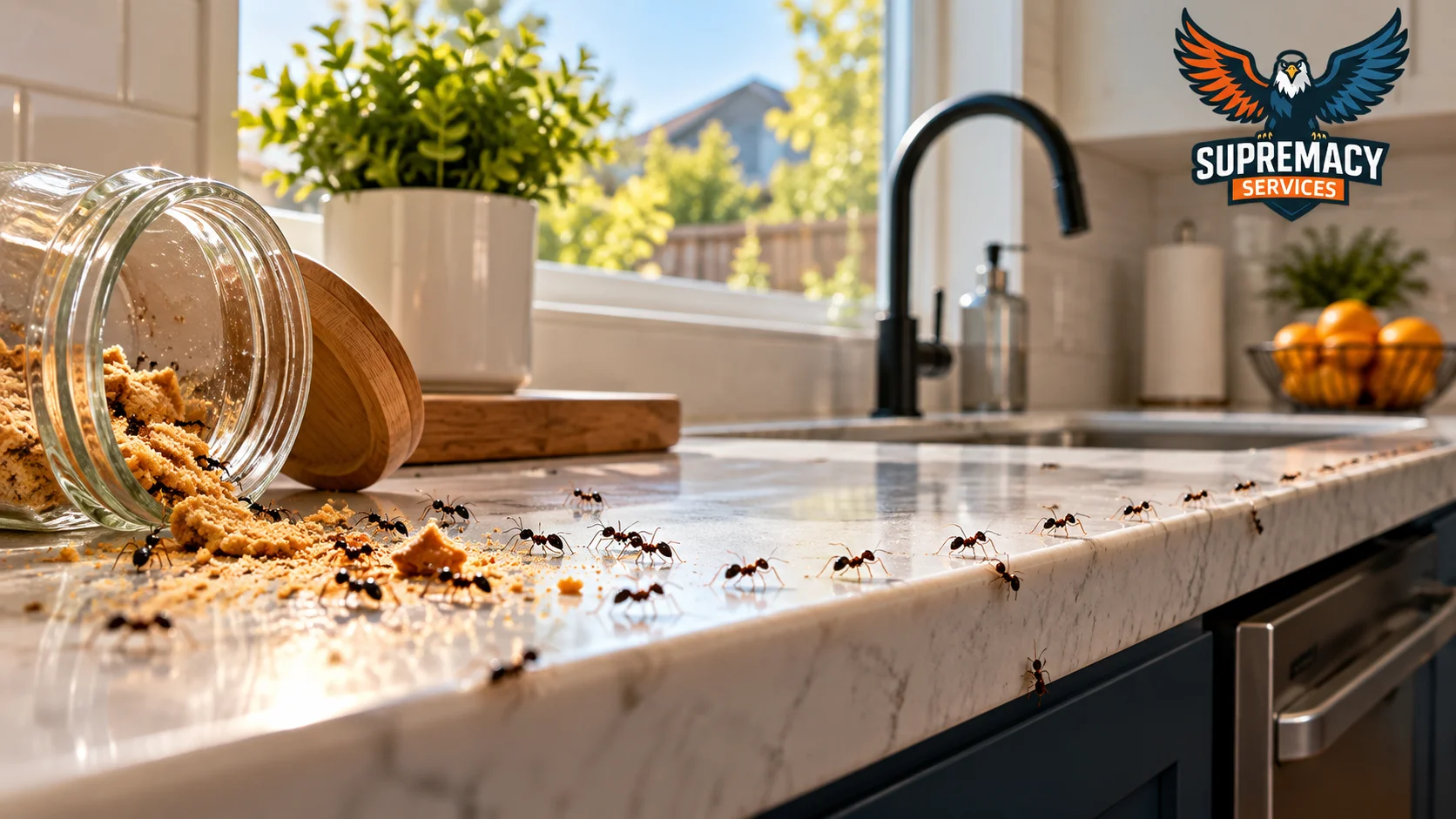
Why Are Ants Suddenly Appearing? If ants suddenly appear inside your house, they are usually searching for food, water, shelter or a more favorable nesting environment. A few worker ants may discover a resource inside and establish a trail that recruits many more ants, making the invasion seem to happen overnight.
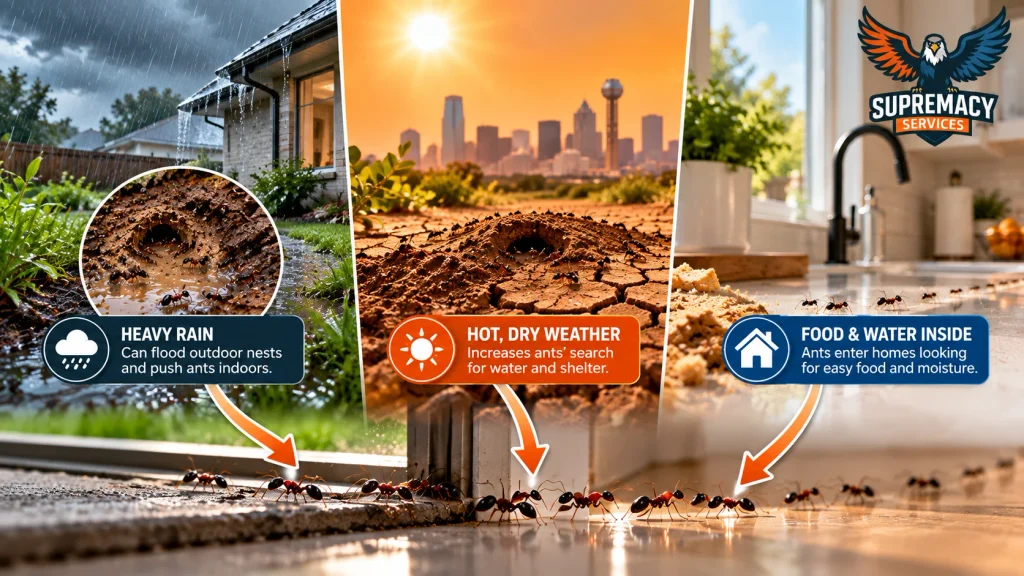
Weather can also play a role. Very wet conditions can disrupt outdoor nesting areas, while hot, dry Texas weather can increase insects’ search for water. Texas A&M has specifically reported ants moving indoors during periods of Texas heat and drought in search of water.
For Dallas-Fort Worth homeowners, the important question therefore is not simply, “How do I kill these ants?” It is:
Why are they entering, where is the colony, and what is sustaining the activity?
Table of Contents
- Why Do Ants Suddenly Appear Inside?
- 7 Common Reasons Ants Suddenly Invade a House
- Where Are the Ants Coming From?
- Does a Clean House Still Get Ants?
- What Types of Ants Enter North Texas Homes?
- Do Ants Inside Mean You Have a Nest?
- Ants vs. Termites
- What Should You Do When Ants Suddenly Appear?
- DIY vs. Professional Ant Control
- What Professional Ant Control Should Include
- How to Prevent Ants From Coming Back
- Frequently Asked Questions
Why Do Ants Suddenly Appear Inside?
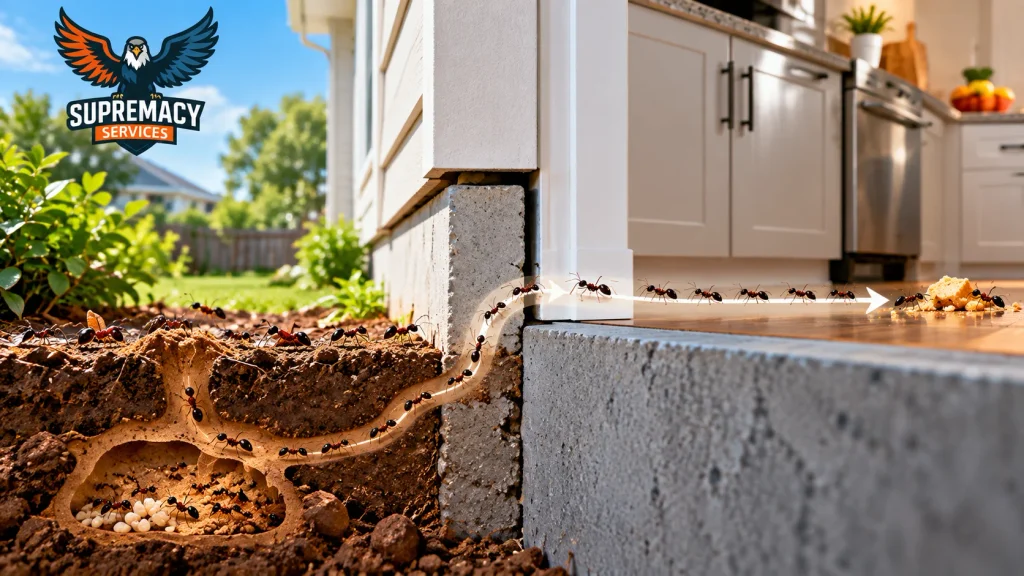
Ants can appear suddenly because worker ants have discovered an accessible source of food or water, outdoor conditions have changed, their nest has been disturbed, or a colony has found a reliable route into the building.
Many ants use chemical trails to recruit other workers after locating resources. Texas A&M explains that foraging workers of some species establish temporary pheromone trails that allow other ants to find food and water quickly. That helps explain why you may notice only two or three ants one day and a well-defined trail the next.
Texas A&M also notes that ants are among the most common household pests in Texas and that most species invading homes normally nest outdoors.
That distinction matters: ants inside your kitchen do not automatically mean the colony itself is inside your kitchen.
7 Common Reasons Ants Suddenly Invade a House
1. They Found Food
A tiny food source can be enough to attract foraging workers.
Potential attractants include:
- crumbs beneath appliances;
- sugary spills;
- grease residue;
- open pantry products;
- pet food;
- dirty dishes;
- food residue inside trash or recycling containers;
- fruit and other exposed foods.
Different ant species prefer different foods. Texas A&M’s household-ant guidance shows that preferences can range from sweets to grease, meats and other foods depending on the species.
Once a worker discovers a dependable food source, recruitment can turn an isolated sighting into an obvious trail.
2. They Are Looking for Water
If ants are appearing around a sink, dishwasher, tub or bathroom rather than the pantry, moisture deserves attention.
Check for:
- dripping faucets;
- plumbing leaks;
- condensation;
- wet cabinet materials;
- damp wood;
- moisture around dishwashers;
- pet water bowls.
Texas A&M reported that during extreme Texas heat and drought, ants can move indoors specifically in search of water.
This is particularly relevant during prolonged hot and dry periods in North Texas.
3. Heavy Rain Disturbed Their Outdoor Nest
The opposite weather extreme can produce a similar result.
Texas A&M’s integrated pest-management guidance says entire colonies can move when nesting areas are flooded and notes that ant complaints commonly occur following heavy rain.
So if ants suddenly show up shortly after a North Texas storm, the timing may not be coincidental.
Do not automatically assume, however, that every post-rain ant sighting proves the nest flooded. Weather is one clue that should be considered alongside the ant species, trail and entry location.
4. Hot, Dry Weather Is Driving Them Toward Moisture
Dallas summers can create the reverse pressure.
During prolonged hot, dry conditions, outdoor resources become less reliable. Texas A&M AgriLife specialists have documented increased reports of ants and other pests moving into Texas homes during extreme heat and drought while searching for food and water.
That makes kitchens, bathrooms and other moisture-producing areas especially worth inspecting.
5. A Scout Found an Easy Entry Point
Ants do not need a front door left open.
They can exploit small structural openings around:
- door frames;
- window frames;
- foundation transitions;
- utility penetrations;
- plumbing lines;
- exterior wall openings;
- cracks and joints.
Follow the trail instead of concentrating only on the countertop where you first noticed it.
If the trail consistently disappears beneath a baseboard or through an exterior opening, you have learned something much more useful than simply knowing where the ants are feeding.
Seeing ant trails repeatedly entering from outside? Learn how Supremacy Services’ [perimeter pest control] program targets pest activity around foundations and common exterior entry areas before pests establish themselves indoors.
6. Landscaping Is Supporting a Colony Near the House
The source may be immediately outside your walls.
Ants can establish nests beneath or around:
- mulch;
- stones;
- landscape materials;
- pavement;
- tree areas;
- boards and debris;
- soil adjacent to foundations.
Texas A&M notes that common Texas species have widely different nesting preferences. Odorous house ants, for example, may nest beneath stones or boards and sometimes within walls or beneath floors, while other species primarily occupy outdoor soil or wood.
The closer a colony is to the structure, the shorter the trip workers need to make after discovering food or water inside.
7. The Colony May Actually Be Inside the Structure
Most household ants entering Texas homes originate outside, but some species can nest inside buildings.
Potential nesting locations include:
- wall voids;
- insulation;
- moisture-damaged wood;
- areas near plumbing;
- electrical or utility voids;
- protected cracks and cavities.
Repeated ants emerging from the same interior opening—especially without an obvious outdoor trail—deserve closer investigation.
How Can I Tell Where the Ants Are Coming From?
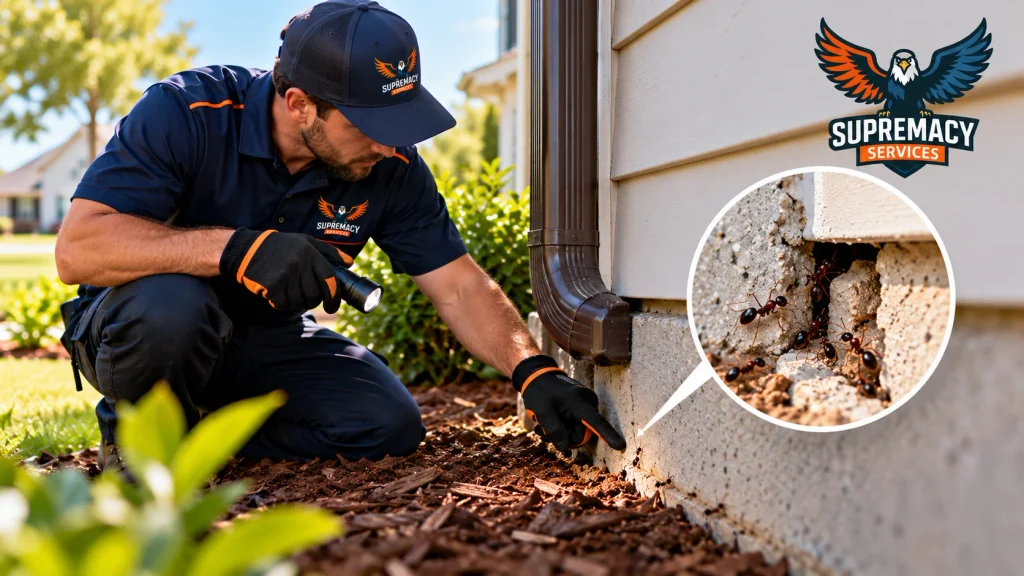
Watch the ants before you remove them. Their trail may lead directly toward the entry point or nesting area.
Start at the area with the most activity and trace workers in both directions.
Quick ant-trail inspection checklist
| Check | What to look for |
|---|---|
| Countertops | Trail disappearing behind backsplash or cabinets |
| Sink | Activity around plumbing penetrations or moisture |
| Windows | Ants entering around frame gaps |
| Doors | Trail near thresholds or weather stripping |
| Baseboards | Ants repeatedly entering one crack |
| Pantry | Open or contaminated food |
| Dishwasher | Moisture and protected voids |
| Exterior wall | Trail moving toward foundation or landscaping |
| Yard | Mounds, soil activity or nests under objects |
Texas A&M recommends looking around the foundation, nearby trees, stones, lumber and other outdoor nesting locations when trying to trace an ant problem.
Avoid immediately wiping out every visible ant before observing where the trail leads.
Why Do I Have Ants If My House Is Clean?
A clean house can still get ants. Sanitation reduces food opportunities, but ants can enter for water, shelter or because an outdoor colony happens to be close to the structure.
A spotless kitchen does not repair a leaking pipe, seal an exterior opening or relocate a colony beside the foundation.
If ants continue appearing despite good sanitation, investigate:
- moisture;
- entry points;
- exterior nesting areas;
- landscaping;
- the species involved.
This distinction prevents homeowners from assuming an ant problem automatically reflects poor housekeeping.
What Types of Ants Can Enter North Texas Homes?
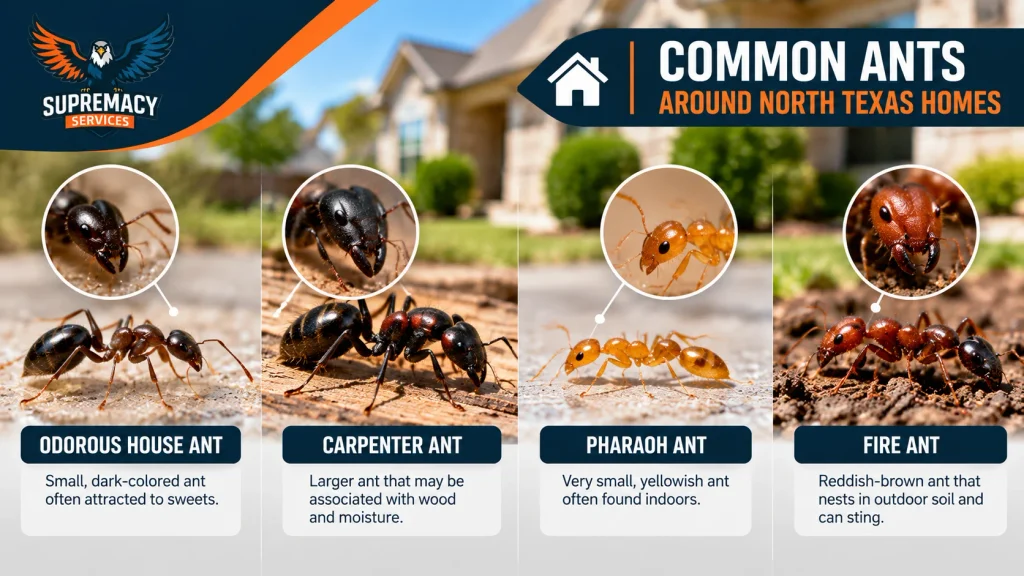
Correct identification matters because not all ants should be managed the same way.
Texas A&M lists numerous household-invading species, including odorous house ants, carpenter ants, acrobat ants, pharaoh ants, rover ants and others.
| Ant type | Useful homeowner clue | Why identification matters |
|---|---|---|
| Odorous house ant | Small; often attracted to sweets | Can nest outdoors or in structural voids |
| Carpenter ant | Relatively large | May be associated with wood and moisture conditions |
| Acrobat ant | Heart-shaped abdomen when viewed closely | Can nest in trees, walls and insulation |
| Pharaoh ant | Extremely small and yellowish | Requires particularly careful control |
| Rover ant | Tiny, dark-colored ant | May enter for sweets and establish around structures |
| Fire ant | Primarily outdoor, soil-nesting ant | Stinging hazard and different treatment strategy |
Do not identify an ant solely from this table. Size, color, nesting behavior and microscopic characteristics can overlap.
A special note about carpenter ants
Texas carpenter ants are often misunderstood.
Texas A&M explains that carpenter ants excavate wood to create nesting galleries but do not eat wood like termites. Their presence can also be associated with moisture or deteriorated wood. Texas species generally cause less structural damage than carpenter ants in some other regions.
That makes moisture investigation especially worthwhile when large ants repeatedly appear around bathrooms, windows or other damp areas.
A special note about pharaoh ants
Pharaoh ants are tiny indoor pests that may nest in narrow protected spaces, including wall and electrical voids. Texas A&M notes that specially designed baits are generally needed for good control.
This is one reason random treatment without identifying the species can be counterproductive.
Does Seeing Ants Inside Mean There Is a Nest in My House?
Not necessarily. Most ants found inside Texas homes may be workers foraging from outdoor colonies.
An indoor nest becomes more plausible when:
- ants emerge repeatedly from the same wall opening;
- activity continues regardless of accessible food;
- ants remain active in a localized interior area;
- large numbers of winged ants emerge indoors;
- carpenter ants are associated with damp or deteriorated wood.
Texas A&M states that winged carpenter ants found indoors can indicate an indoor colony, while its general guidance notes that most household-invading species nest outside.
So the pattern matters more than a single ant.
Are Those Winged Ants—or Termites?
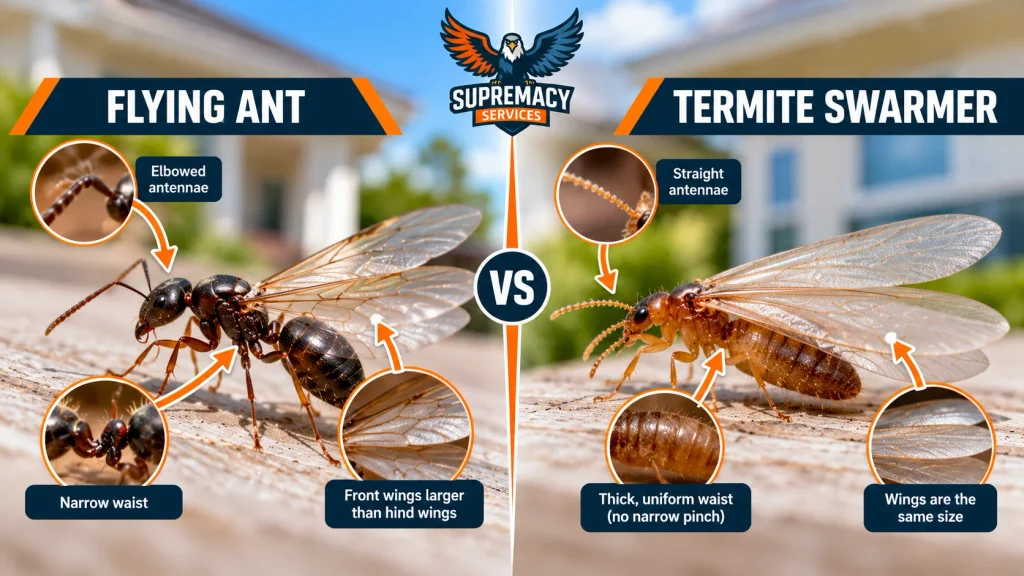
Winged ants and termite swarmers can be confused, and correct identification matters because termites require a very different response.
Typical ant characteristics include:
- elbowed antennae;
- a visibly constricted waist;
- forewings and hindwings of different sizes.
Termite swarmers have a different body and wing profile.
Texas A&M specifically warns that carpenter ants and termites may swarm around similar times and emphasizes accurate identification because their control methods differ substantially.
If winged insects are repeatedly emerging from the structure and you cannot confidently identify them, obtain a professional identification rather than assuming they are ants.
What Should You Do When Ants Suddenly Appear?
Do not start by spraying every ant you see.
Start by determining why they are there.
Step 1: Follow the trail
Observe where workers are traveling and where they disappear.
Step 2: Remove accessible food
Clean spills and crumbs, store food securely, rinse recycling and avoid leaving pet food accessible unnecessarily.
Step 3: Check for water
Inspect sinks, faucets, dishwashers, bathrooms and plumbing penetrations for leaks or persistent moisture.
Step 4: Clean established trails
After observing the route, clean food-contact and trail surfaces appropriately to remove residues and reduce the established foraging path.
Step 5: Inspect outside
Look along the corresponding exterior wall for ant trails, landscaping, mounds and protected nesting areas.
Step 6: Seal practical entry points
Correct accessible gaps around doors, windows and utility penetrations where appropriate.
Step 7: Consider appropriately labeled ant bait
Baits can work differently from contact sprays because foraging workers can carry bait back toward a colony.
Texas A&M recommends nest treatment or ant bait when exclusion alone does not solve household ant problems. It also emphasizes following pesticide labels.
Never use gasoline or other flammable liquids on an ant nest. Texas A&M specifically warns that these methods are dangerous and can contaminate soil.
DIY vs. Professional Ant Control
A small, temporary ant trail associated with an obvious food source may be manageable without professional treatment.
Recurring or unexplained activity is different.
| Situation | Reasonable first step |
|---|---|
| A few ants around spilled food | Clean and monitor |
| Trail from an obvious exterior opening | Remove attractant and address entry point |
| Ants around a plumbing leak | Correct moisture source and monitor |
| Recurring trails despite corrections | Identify species/source |
| Ants emerging from wall void | Professional inspection may be appropriate |
| Suspected pharaoh ants | Species-specific strategy is important |
| Large carpenter ants associated with moisture | Inspect moisture/wood conditions |
| Winged ants or possible termites | Professional identification |
| Fire ants entering living areas | Identify outdoor colony and use appropriate fire-ant management |
Why repeated surface spraying may not solve the problem
Killing the workers you can see does not necessarily eliminate the colony producing them.
If ants continue traveling indoors from an exterior nest, treating only the countertop addresses the visible symptom rather than the source.
If ant trails keep returning after you remove food and moisture sources, [professional pest control in DFW] can help identify where the activity originates and whether exterior, entry-point or targeted treatment is appropriate.
Supremacy’s existing pest-control program specifically lists ants among the pests addressed by its residential protection services.
What Should Professional Ant Control Include?
Professional ant management should begin with identification and inspection, not automatic treatment of every visible surface.
A useful assessment may include:
- identifying the ant species or likely group;
- locating active trails;
- determining whether the colony is indoors or outside;
- checking food and water sources;
- inspecting moisture conditions;
- locating likely entry points;
- examining exterior nesting conditions;
- selecting treatment appropriate to the species and site;
- recommending sanitation or exclusion corrections;
- monitoring whether activity actually declines.
Texas regulates structural pest-control work performed for compensation. The Texas Department of Agriculture states that structural pest-control businesses and individuals performing covered services must meet applicable licensing requirements.
For ants originating around a home’s exterior, perimeter management may form part of the strategy. Supremacy’s dedicated perimeter service is already positioned around foundations, doors, windows and other exterior entry areas and specifically includes ants among its targeted crawling pests.
How Can Dallas Homeowners Keep Ants From Coming Back?
Long-term prevention means making your home less rewarding and harder to enter.
Inside
- Clean food residue promptly.
- Store pantry foods securely.
- Avoid leaving pet food out unnecessarily.
- Keep trash and recycling clean.
- Repair plumbing leaks.
- Check moisture beneath sinks and appliances.
- Monitor recurring trails instead of repeatedly treating visible workers.
Outside
- Inspect doors and window seals.
- Check utility and plumbing penetrations.
- Look for recurring trails along the foundation.
- Keep unnecessary debris away from exterior walls.
- Monitor mulch, stones and landscaping near the structure.
- Address moisture conditions.
- Watch for colonies immediately adjacent to the house.
The goal is not simply to create an ant-free countertop today. It is to reduce the conditions allowing workers to repeatedly travel from their colony into the building.
Why Dallas Weather Can Make Ant Activity Seem Sudden
North Texas homeowners experience periods of both intense heat and significant storms.
Those weather swings matter because ants respond to conditions around their nesting sites.
Texas A&M’s school IPM program notes that abnormally hot, dry conditions and very wet conditions can cause colonies to migrate when nesting areas lose food or water or become flooded.
Texas A&M has also documented increased indoor pest activity during extreme Texas heat and drought, with ants entering homes in search of water.
That provides a practical explanation for a familiar Dallas homeowner experience:
“There were no ants yesterday. Why are there dozens today?”
The colony probably did not materialize overnight. What changed may have been the ants’ need for resources—or one worker finally discovering a dependable route to them.
Frequently Asked Questions
Why are ants suddenly in my house?
Ants usually appear suddenly because workers discovered food or water, weather disrupted an outdoor colony, conditions became hot or dry, or ants found a reliable route into the building. A pheromone trail can then recruit additional workers quickly.
Why are ants coming inside when my house is clean?
Ants do not enter only because of dirty conditions. They can be searching for water or shelter or simply foraging from a colony close to your foundation.
Why do ants suddenly appear after rain?
Heavy rain can disturb or flood outdoor nesting areas. Texas A&M notes that ant complaints commonly occur following heavy rain and that colonies can move when nests become flooded.
Why are ants in my bathroom?
Bathrooms provide potential moisture sources. Inspect plumbing, faucets, condensation and damp areas and determine where the ants’ trail leads.
Why are ants around my kitchen sink?
Food residue may be involved, but water is another possibility. Check the sink, plumbing and nearby cabinets for leaks or condensation as well as food sources.
Does seeing ants mean I have a nest inside the house?
No. Many ants found indoors originate from outdoor colonies. However, repeated activity emerging from wall voids or large numbers of winged ants indoors can justify closer inspection.
Should I spray ants when I see them?
Killing visible workers may provide immediate relief but does not necessarily address the colony. Identifying the species, food or water source and entry route usually provides more useful information for long-term control.
Can ants damage my house?
Most household ants are primarily nuisance pests. Carpenter ants excavate wood to create nesting galleries, but Texas A&M notes that they do not eat wood and Texas species generally cause less structural damage than carpenter ants in some other regions.
Are flying ants the same as termites?
No. Winged ants and termite swarmers are different insects, although homeowners frequently confuse them. Because management differs significantly, have uncertain swarmers correctly identified.
When should I call pest control for ants?
Consider professional help when ants repeatedly return, you cannot locate their source, activity appears to originate inside walls, species identification is uncertain, DIY measures have not solved the problem, or winged insects could be ants or termites.
Final Takeaway
A sudden line of ants across your Dallas kitchen does not necessarily mean your home became infested overnight.
More often, something changed: workers discovered food or water, weather affected their outdoor environment, an existing colony found an entry route, or ants established a reliable trail between the colony and a resource inside.
Start by following the trail, removing food and moisture sources and checking how the ants are entering. If the activity repeatedly returns, identifying the species and finding the source becomes more important than killing individual workers.
Ants keep coming back? Explore Supremacy Services’ [perimeter pest control in Dallas] to learn how exterior pest management targets ants and other crawling pests around the areas where they approach and enter your home.

