
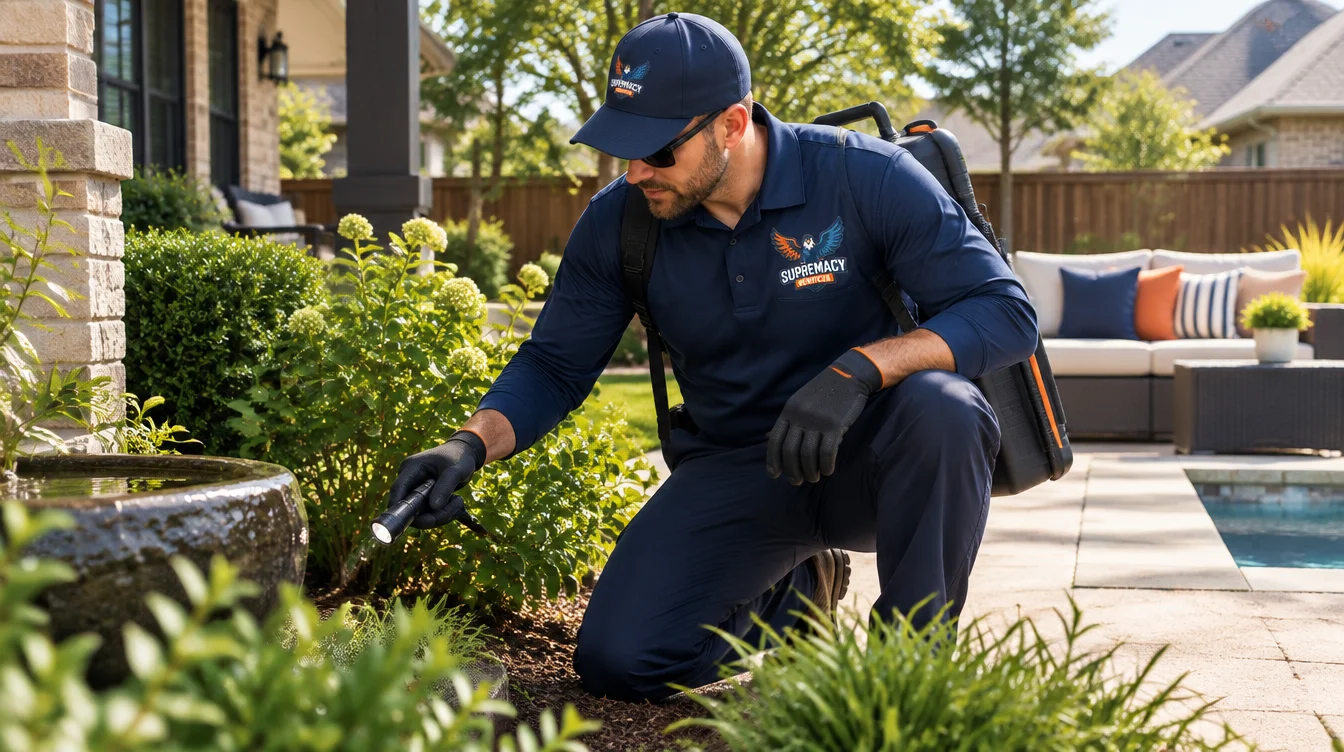
If mosquitoes are making it difficult to enjoy your backyard, start with the water.
The most effective way to get rid of mosquitoes in your backyard is to eliminate or manage places where mosquitoes reproduce, especially standing water. Then address shaded resting areas, protect people from bites and, when mosquito activity remains high, consider targeted mosquito treatment.
For Dallas–Fort Worth homeowners, mosquito control usually works better as an ongoing process than as a single spray. Buckets, gutters, plant saucers, toys, birdbaths and poorly drained areas can all contribute to mosquito activity if they repeatedly hold water.
Texas health officials recommend routinely removing standing water, maintaining pools and hot tubs, screening water-storage containers and considering appropriate larvicides for water that cannot be removed.
Table of Contents
- The fastest way to reduce backyard mosquitoes
- Why mosquitoes keep coming back
- Step 1: Eliminate standing water
- Step 2: Deal with water you cannot remove
- Step 3: Make the yard less attractive to mosquitoes
- Step 4: Protect your patio and family from bites
- What doesn’t work well for mosquitoes?
- DIY vs. professional mosquito control
- What professional mosquito control involves
- North Texas mosquito-control considerations
- Backyard mosquito prevention checklist
- Frequently asked questions
The Fastest Way to Reduce Backyard Mosquitoes
Start by finding and eliminating standing water. Mosquitoes need water during their immature life stages, so removing breeding habitat interrupts the problem before more adult mosquitoes emerge.
EPA guidance specifically recommends eliminating standing water from gutters, tires, buckets, toys, covers and similar containers and changing water in birdbaths, fountains, rain barrels and plant trays regularly.
Walk your property and inspect:
| Check | What to Look For | What to Do |
|---|---|---|
| Gutters | Water trapped behind leaves or debris | Clean gutters and restore drainage |
| Plant saucers | Water remaining beneath pots | Empty regularly |
| Buckets & containers | Rainwater | Empty, turn over or cover |
| Birdbaths | Stagnant water | Refresh and clean regularly |
| Children’s toys | Small pockets of rainwater | Drain and store properly |
| Tarps & covers | Sagging areas holding water | Tighten or reposition |
| Pet bowls | Old outdoor water | Refresh frequently |
| Pools & hot tubs | Poor circulation or maintenance | Maintain treatment and circulation |
| Low yard areas | Persistent puddling | Investigate drainage |
| Rain barrels | Open access | Properly screen openings |
Do not assume a water source is too small to matter. Texas DSHS warns that mosquitoes can reproduce in surprisingly small quantities of water.
Why Mosquitoes Keep Coming Back to Your Backyard
A backyard can remain mosquito-heavy even after you kill the adults you see because the property may still provide breeding habitat and resting habitat.
Adult mosquito control and mosquito breeding control solve different parts of the problem.
Breeding sites create the next generation
Different mosquito species use different types of standing water. EPA lists common residential sources including tires, buckets, toys, plant trays, plastic covers and even very small containers.
That means spraying adult mosquitoes without finding the water sources can leave the underlying cycle intact.
Dense, sheltered areas can harbor adult mosquitoes
Mosquito management should therefore include a complete yard inspection rather than concentrating exclusively on the patio where people notice the bites.
Look around:
- dense landscaping;
- underneath decks;
- around sheds;
- beneath outdoor furniture;
- around fences and property edges;
- near drainage areas;
- around irrigation equipment;
- underneath heavily shaded vegetation.
The goal is not to remove healthy landscaping. It is to identify unnecessarily dense, damp and protected areas associated with mosquito activity.
The source may not be entirely on your property
Mosquitoes do not recognize property lines.
A homeowner can maintain a clean yard and still experience mosquito pressure associated with nearby drainage, unmanaged water, neighboring properties or broader neighborhood conditions.
That is why good backyard mosquito management aims to reduce the conditions you can control, rather than promising a completely mosquito-free outdoor environment.
Step 1: Eliminate Standing Water
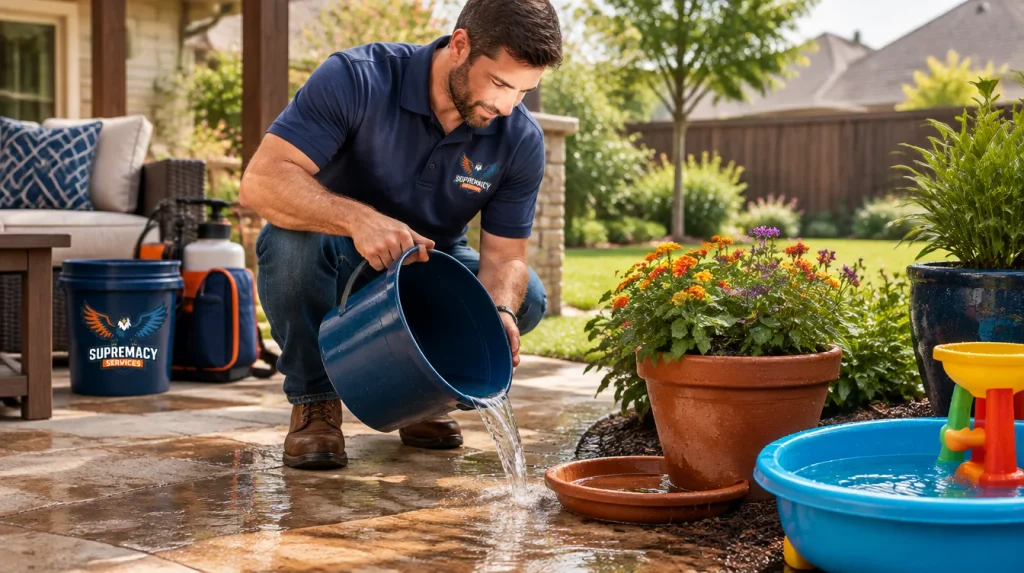
This is the most important homeowner action.
Dallas County Health and Human Services specifically identifies draining standing water as a key component of its mosquito-prevention recommendations. The county advises residents to check flowerpots, kiddie pools, birdbaths, ponds, tires, gutters and landscape depressions.
Do a weekly water inspection
Choose one day each week during mosquito season and walk around the entire property.
Check anything capable of collecting rain or irrigation water.
Pay particular attention after:
- rainfall;
- irrigation;
- storms;
- landscaping work;
- pool maintenance;
- leaving toys or equipment outside.
Small containers are easy to overlook.
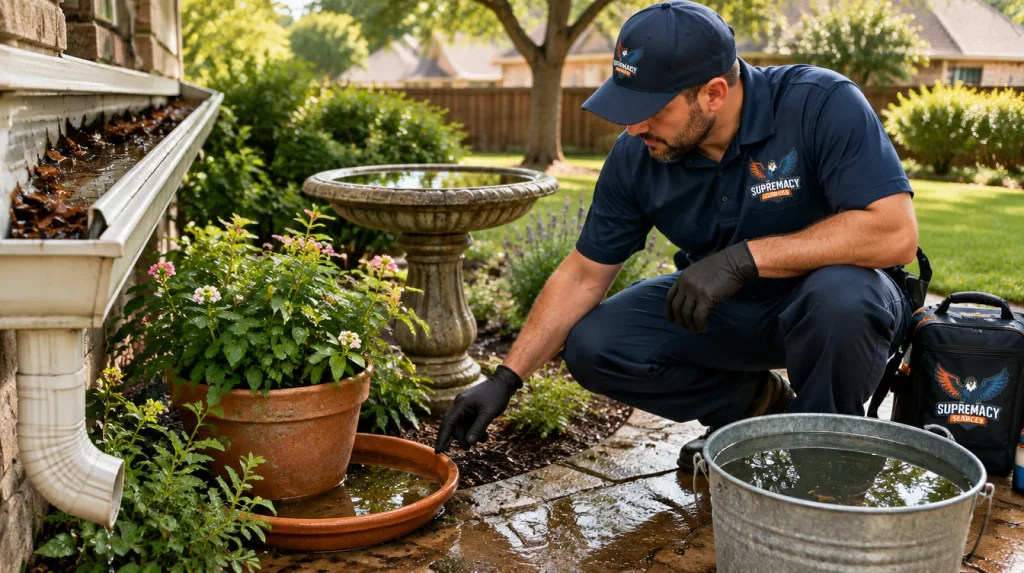
Clean clogged gutters
Gutters are especially easy to miss because the water may be above eye level.
Leaves and organic debris can slow drainage and allow water to remain trapped.
Clean gutters and confirm that downspouts discharge correctly rather than simply checking them from the ground.
Empty containers instead of merely topping them off
Adding fresh water to an outdoor container does not necessarily eliminate the old habitat.
Empty and clean appropriate containers before refilling them.
Texas DSHS recommends changing water in wading pools and birdbaths several times per week and changing pet-dish water daily.
Check irrigation and drainage
A mosquito problem can sometimes reveal a water-management problem.
Look for:
- irrigation overspray;
- leaking outdoor faucets;
- continuously wet soil;
- drainage depressions;
- blocked drains;
- water accumulating near structures.
Fixing the water source can provide benefits beyond mosquito control.
Step 2: Deal With Water You Cannot Remove
Not every water source can simply be dumped.
Ornamental water features, drainage structures and other necessary water sources may require a different approach.
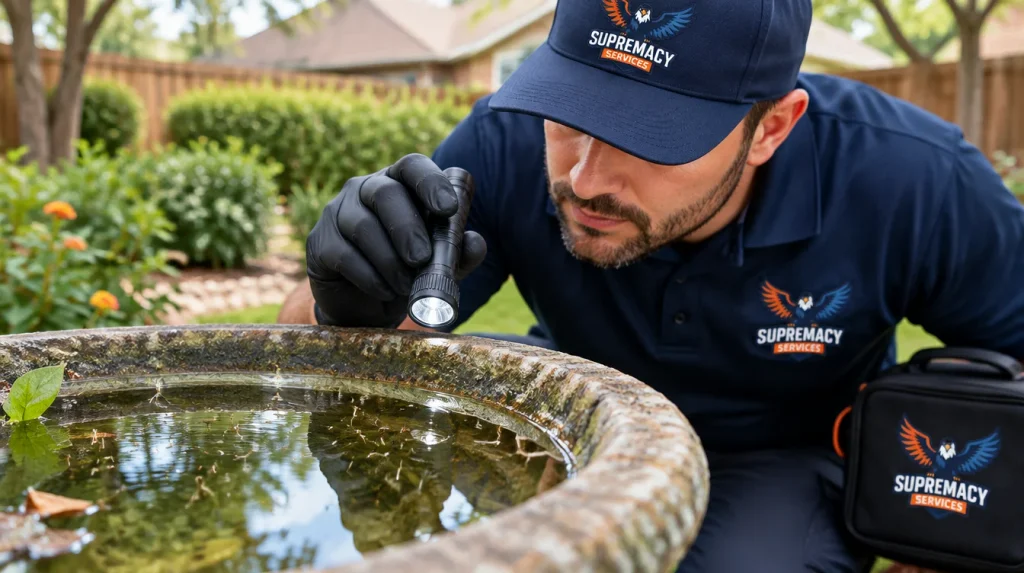
One option for appropriate standing-water habitats is a mosquito larvicide.
Larvicides target mosquitoes during their immature aquatic stages before they become flying adults.
EPA explains that Bacillus thuringiensis israelensis (Bti) is used against developing mosquito larvae in standing water and is available in registered mosquito-control products.
Dallas County likewise advises that standing water can be treated with EPA-approved larvicides where appropriate.
Always select a product specifically labeled for the intended use and follow its label exactly.
Never assume that because a product is sold for mosquito control it can be applied to every pond, drain, water feature or other aquatic environment.
Step 3: Make the Yard Less Attractive to Mosquitoes
After addressing breeding sites, inspect the places where adult mosquitoes are regularly encountered.
Manage excessive vegetation
Trim vegetation when it becomes unnecessarily dense around frequently used outdoor areas.
Concentrate on:
- patio borders;
- pathways;
- seating areas;
- play areas;
- fence lines;
- vegetation immediately around entrances.
The objective is improved yard management—not stripping the property of landscaping.

Remove unnecessary clutter
Unused pots, overturned lids, children’s toys, old equipment and discarded materials can create sheltered spaces and collect rainwater.
Removing clutter makes the property easier to inspect after rain.
Correct persistent moisture
If part of the yard stays wet long after surrounding areas have dried, determine why.
Potential causes include irrigation issues, poor grading, blocked drainage or plumbing leaks.
Mosquito control works better when persistent water problems are corrected rather than repeatedly treating their consequences.
Need help when backyard mosquitoes persist? Supremacy Services provides pest-control services across the DFW Metroplex, with mosquito barrier treatment available as part of its outdoor pest-control offerings.
Step 4: Protect Your Patio and Family From Mosquito Bites
Reducing mosquito populations and preventing bites are related but different goals.
Even a well-maintained yard can still receive mosquitoes from surrounding areas.
Use EPA-registered repellents
EPA recommends registered mosquito repellents and advises consumers to follow the product label for application and reapplication. Registration means EPA has reviewed supporting information concerning the product’s safety and effectiveness when used according to its labeling.
Use clothing as another layer of protection
Dallas County recommends long, loose, light-colored clothing as part of its mosquito-prevention guidance.
This can be especially useful when mosquito activity is high.
Keep screens in good condition
Mosquito management should not stop at the yard.
Inspect:
- window screens;
- screen doors;
- door seals;
- damaged screening around outdoor rooms.
EPA recommends physical barriers such as properly maintained door and window screens as part of mosquito management.
Consider airflow around seating areas
Outdoor fans can make patios more comfortable and may help make a small seating area less favorable to flying mosquitoes.
They should be viewed as a supplemental comfort measure—not a replacement for breeding-source reduction.
What Doesn’t Work Well for Mosquitoes?
Homeowners encounter a large number of mosquito-control gadgets and home remedies.
Some deserve more skepticism than others.
Ultrasonic mosquito devices
EPA notes that devices relying on sound waves are not EPA-registered as repellents, meaning EPA does not have the safety and effectiveness data required for registered repellent products and does not know whether such devices effectively repel mosquitoes.
Do not make an ultrasonic gadget the foundation of your mosquito-control strategy.
One-time spraying without source reduction
Spraying may reduce adult mosquito activity, but if buckets, gutters, toys and other containers continue producing mosquitoes, the underlying problem remains.
EPA’s integrated mosquito-management guidance specifically combines habitat removal with other control methods rather than relying on one tactic.
Ignoring tiny amounts of water
Large puddles are obvious.
The forgotten flowerpot saucer is not.
Small residential containers can still provide mosquito habitat, so inspect the entire yard rather than looking only for large pools of stagnant water.

DIY vs. Professional Mosquito Control
DIY mosquito control is often appropriate when mosquito pressure is limited and the property contains identifiable water sources you can correct.
Professional mosquito control becomes more reasonable when activity remains high despite consistent prevention.
| Situation | DIY May Be Enough | Professional Evaluation May Help |
|---|---|---|
| A few obvious water containers | ✓ | |
| Dirty birdbath or plant saucers | ✓ | |
| Clogged gutter | ✓ | |
| Occasional mosquitoes | ✓ | |
| Persistent heavy backyard activity | ✓ | |
| Numerous shaded/resting areas | ✓ | |
| Mosquitoes quickly return after DIY efforts | ✓ | |
| Large or complicated property | ✓ | |
| Difficult-to-identify breeding sources | ✓ | |
| Outdoor entertaining repeatedly disrupted | ✓ |
A professional service should complement—not replace—basic property maintenance.
Even professionally treated properties benefit from eliminating standing water.
If you’ve removed obvious breeding sites but your Dallas-area backyard is still difficult to use, consider scheduling a professional pest inspection so the property can be evaluated as a whole rather than repeatedly treating individual mosquitoes.
What Professional Mosquito Control Involves
Professional mosquito management should begin with understanding the property.
Depending on the property and treatment program, service may involve evaluating:
- potential breeding sites;
- standing-water sources;
- drainage conditions;
- shaded vegetation;
- common adult mosquito resting areas;
- patios and high-use outdoor spaces;
- conditions around the home’s exterior.
Treatment recommendations should depend on what is actually found.
Professional treatment does not mean every surface in the yard should automatically be sprayed.
EPA describes successful mosquito management as an integrated approach involving habitat reduction, barriers, larval management and, when appropriate, adult mosquito control.
For DFW homeowners dealing with recurring outdoor pest activity, Supremacy Services’ pest-control options can provide a logical next step after basic source reduction has been addressed.
North Texas Mosquito-Control Considerations
Mosquito prevention has particular relevance in Dallas and the surrounding Metroplex because mosquito-borne disease is actively monitored by local public-health agencies.
Dallas County identifies West Nile virus, chikungunya, dengue and Zika among mosquito-borne illnesses of concern and promotes its 4Ds approach:
DEET — Dress — Drain — Dusk & Dawn.
The City of Dallas also operates mosquito surveillance and control activities, including mosquito trapping, breeding-site monitoring, larviciding and responses to standing-water complaints.
That does not mean every mosquito in a Dallas backyard is carrying disease.
It does mean mosquito management is more than a comfort issue.
Rain can expose overlooked breeding sites
After rainfall, repeat your property inspection.
Objects that appeared harmless while dry can become water-holding containers after a storm.
Irrigation can create mosquito habitat too
Rain is not the only source of standing water.
Check whether sprinkler systems repeatedly leave water in:
- plant containers;
- landscape depressions;
- drainage areas;
- toys;
- tarps;
- equipment.
Mosquitoes can bite at different times
Do not assume mosquito protection matters only at sunset.
Texas DSHS notes that mosquitoes can bite during both day and night, while Dallas County explains that activity patterns vary among mosquito species.
Backyard Mosquito Prevention Checklist
Use this quick checklist once a week and after significant rainfall.
Water
- □ Empty buckets and containers.
- □ Check flowerpot saucers.
- □ Refresh birdbath water.
- □ Refresh pet water.
- □ Inspect children’s toys.
- □ Check tarps and outdoor covers.
- □ Clean clogged gutters.
- □ Maintain pool circulation and treatment.
- □ Check rain barrels and water-storage screens.
- □ Look for persistent puddles.
Landscape
- □ Trim excessive vegetation near high-use areas.
- □ Remove unnecessary yard clutter.
- □ Check shaded areas.
- □ Inspect underneath decks and furniture.
- □ Investigate persistently wet soil.
Home
- □ Repair damaged window screens.
- □ Check screen doors.
- □ Keep frequently used entrances protected.
- □ Use EPA-registered repellent according to its label.
After Rain
- □ Repeat the entire standing-water inspection.
When Should You Call a Mosquito-Control Professional?
Consider professional help when mosquito activity remains consistently high after you’ve removed obvious standing water and corrected manageable yard conditions.
Other reasons include:
- you cannot identify where mosquitoes are coming from;
- the property has extensive landscaping;
- standing-water areas cannot easily be eliminated;
- mosquitoes return quickly after DIY measures;
- your patio or backyard is difficult to use;
- you want a property-specific prevention and treatment plan.
Professional service is particularly useful when the goal shifts from killing the occasional mosquito to managing mosquito pressure across the entire outdoor environment.
Frequently Asked Questions
What is the fastest way to get rid of mosquitoes in my backyard?
Start by removing standing water from buckets, plant saucers, toys, gutters, birdbaths and other containers. Then address persistent resting areas and use appropriate mosquito-control and bite-prevention measures.
Why do I have so many mosquitoes in my yard?
Your property may contain breeding water, shaded resting areas or recurring moisture. Mosquitoes may also be entering from nearby properties or neighborhood breeding sites.
Does standing water really cause mosquitoes?
Standing water provides habitat for the immature stages of mosquitoes. Eliminating unnecessary standing water is therefore one of the most important mosquito-prevention measures recommended by EPA, Texas DSHS and Dallas County.
How often should I check my backyard for mosquito breeding sites?
Check at least weekly and again after rainfall or other events that can fill containers with water. Texas DSHS specifically recommends weekly removal or emptying of many common water-holding containers.
What can I put in standing water to kill mosquito larvae?
For standing water that cannot be removed, an appropriately labeled mosquito larvicide may be an option. EPA recognizes Bti as an active ingredient used to control developing mosquito larvae. Always use the product only as its label directs.
Do mosquito sprays permanently eliminate mosquitoes?
No mosquito treatment should be treated as a permanent substitute for prevention. New mosquitoes can emerge or enter from surrounding areas, particularly if breeding sites remain.
Are mosquito-repellent devices effective?
It depends on the device. EPA evaluates registered repellent products, but notes that sound-wave devices are not EPA-registered as repellents and EPA does not have data establishing their mosquito-repelling effectiveness.
When are mosquitoes most active in Dallas?
Activity depends on mosquito species. Dallas County advises particular caution around dusk and dawn for mosquitoes associated with West Nile virus while noting that other species may be active during the day.
When should I hire a professional mosquito-control company?
Professional service makes sense when mosquito activity remains significant after consistent source reduction, when breeding or resting sites are difficult to identify, or when you need a more comprehensive treatment strategy for the property.
Take Back Your Backyard
Effective backyard mosquito control begins with a simple principle: remove the conditions mosquitoes need before relying on treatments to control the adults you see.
Drain standing water. Maintain gutters and outdoor water features. Manage persistent moisture. Protect yourself from bites. Repeat your inspection after rain.
If mosquitoes continue making your Dallas–Fort Worth backyard difficult to enjoy after you’ve addressed those conditions, contact Supremacy Services for professional mosquito and pest-control options across the DFW Metroplex.
A property-specific inspection can help determine where mosquito pressure is coming from and which combination of prevention and treatment makes sense for your yard.

