
Tiny ants in the kitchen are usually worker ants searching for food, water or both. In North Texas homes, possibilities include pharaoh ants, dark rover ants, odorous house ants, thief ants and other small household species. Some colonies live outdoors and send workers inside, while others can nest in wall voids and other protected areas within a building.
The most useful first step is not spraying every ant you see. Look at their size and color, what they are feeding on, where the trail disappears and whether activity is concentrated around the sink, pantry, cabinets, dishwasher or an exterior wall.
Correct identification matters because ants that look remarkably similar can have very different nesting habits and control requirements. Texas A&M notes that household ants can be difficult to identify without proper equipment and experience.
Table of Contents
- What are the tiny ants in my kitchen?
- Where are tiny kitchen ants coming from?
- Why are they around my kitchen sink?
- Why do they keep coming back?
- How to find where the ants are entering
- What should you do about tiny kitchen ants?
- DIY vs. professional ant control
- What professional ant control should include
- How to prevent kitchen ants
- Frequently asked questions
What Are the Tiny Ants in My Kitchen?
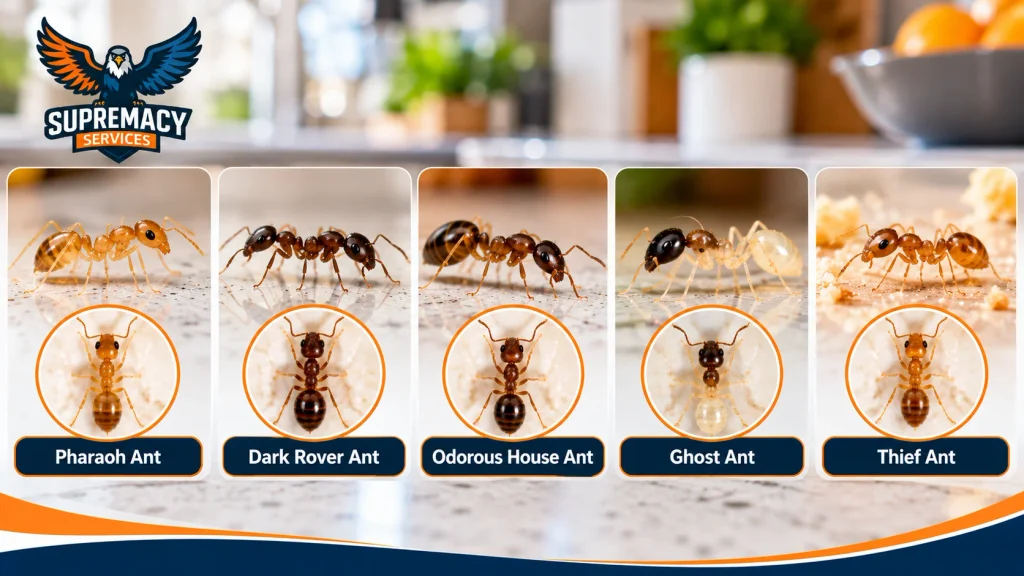
There is no single species called a “kitchen ant” or “sugar ant.” Those names are commonly used to describe several small ants found around food and moisture.
In Texas, several species can fit the description.
Quick Identification Guide
| Possible ant | Approximate appearance | Common kitchen clue | Possible source |
|---|---|---|---|
| Pharaoh ant | Extremely small; yellowish to reddish-brown | Sweets, grease and other foods | Often nests indoors near warmth and moisture |
| Dark rover ant | Tiny; dark brown | Often attracted to sweets | Usually originates outdoors but can establish around structures |
| Odorous house ant | Small; brown | Strong attraction to sweets | Outdoors under objects/mulch or indoors in structural voids |
| Ghost ant | Extremely small; dark head with pale/translucent abdomen and legs | May be difficult to see except for darker head | Protected indoor/outdoor nesting sites |
| Thief ant | Extremely small; yellowish to light brown | Can reach packaged foods; may favor protein/fat | Soil, cracks, crevices and wall voids |
These descriptions are clues—not a substitute for identification.
Texas A&M specifically warns that ants can be challenging to identify without proper equipment because many household species have similar sizes and appearances.
Are they pharaoh ants?
Pharaoh ants are among the most important possibilities when the ants are extremely small and yellowish or reddish-brown.
Texas A&M describes workers as roughly 1/12 to 1/16 inch long. They feed on sweets as well as greasy and fatty foods and can establish multiple interconnected nests inside buildings.
They deserve special attention because their management differs from many other ants.
Are they dark rover ants?
Dark rover ants are another possibility when the ants are extremely small but noticeably darker.
Texas A&M describes rover ants as tiny, dark brown ants that are frequently found outdoors along house edges, sidewalks and trees. They can also enter homes and are attracted to sweet foods.
A kitchen trail does not necessarily mean the nest is in the kitchen.
Are they odorous house ants?
Odorous house ants are brown ants that frequently nest outdoors beneath objects, mulch and other protected areas, although they can also establish nests in walls and other structural locations.
They are attracted to sweets.
Texas A&M describes them as approximately 1/8 inch long and notes their distinctive odor when crushed.
Do not deliberately crush ants merely as your primary identification method. Trail location, appearance and professional identification provide better information.
Could they be ghost ants?
Ghost ants are exceptionally small—less than 1/16 inch according to Texas A&M—and have a dark head and thorax contrasted with pale, almost translucent legs and abdomen.
Their coloration can make them appear almost as if the dark portion of the ant is moving by itself across a light countertop.
What about thief ants?
Thief ants are also extremely small and can enter packaged foods because their size lets them exploit very small openings.
Texas A&M reports that they consume a range of foods including meats, breads, sweets, nuts, fats, oils and dairy products. They can nest in soil, cracks, crevices and wall voids.
They can be confused with pharaoh ants, which is another reason identification should precede aggressive treatment.
Where Are Tiny Kitchen Ants Coming From?
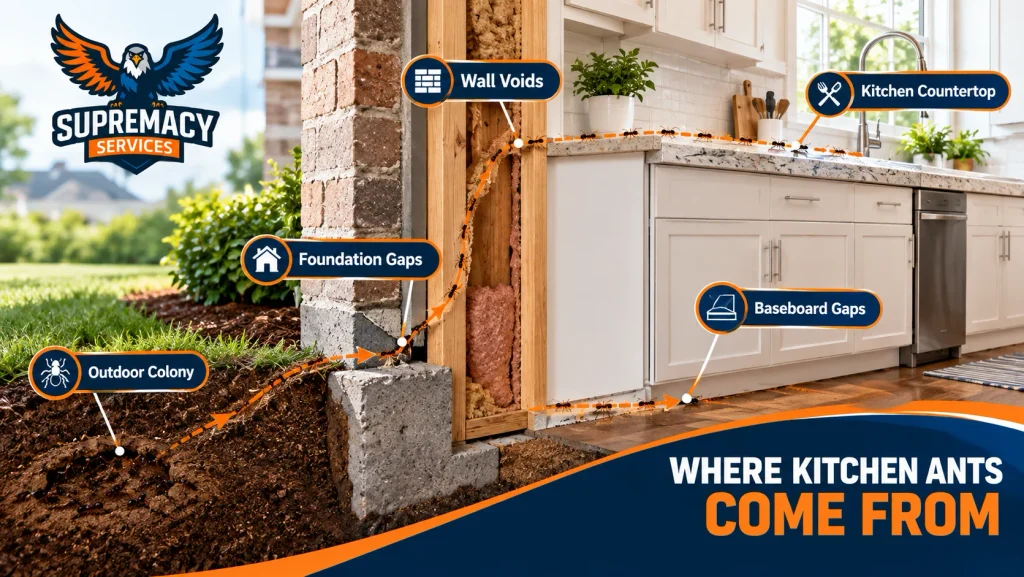
Tiny kitchen ants can come from an outdoor colony, an indoor nest or a nearby structural void. Follow their trail instead of assuming the countertop is the source.
Common routes include:
- gaps around plumbing pipes;
- spaces behind backsplashes;
- cracks beside cabinets;
- window and door gaps;
- baseboard joints;
- utility penetrations;
- wall voids;
- gaps beneath appliances;
- exterior foundation openings;
- nearby landscaping and mulch.
A line of ants across the counter only shows where workers are foraging. The colony could be several feet—or much farther—away.
Texas A&M’s household-ant guidance recommends identifying the ant and locating nests or trails because species and nesting location influence management.
Are the ants actually nesting inside the kitchen?
Possibly, but not necessarily.
Many household ants nest outside and send workers indoors. Others, particularly pharaoh ants, can establish colonies in protected interior spaces.
That distinction changes the solution.
An outdoor colony entering through a foundation or utility gap calls for a different strategy from ants nesting inside wall voids.
If you keep finding ant trails entering from outside, explore Supremacy Services’ perimeter pest control options for DFW homes to see how exterior pest pressure and common entry areas can be addressed.
Why Are Tiny Ants Around My Kitchen Sink?
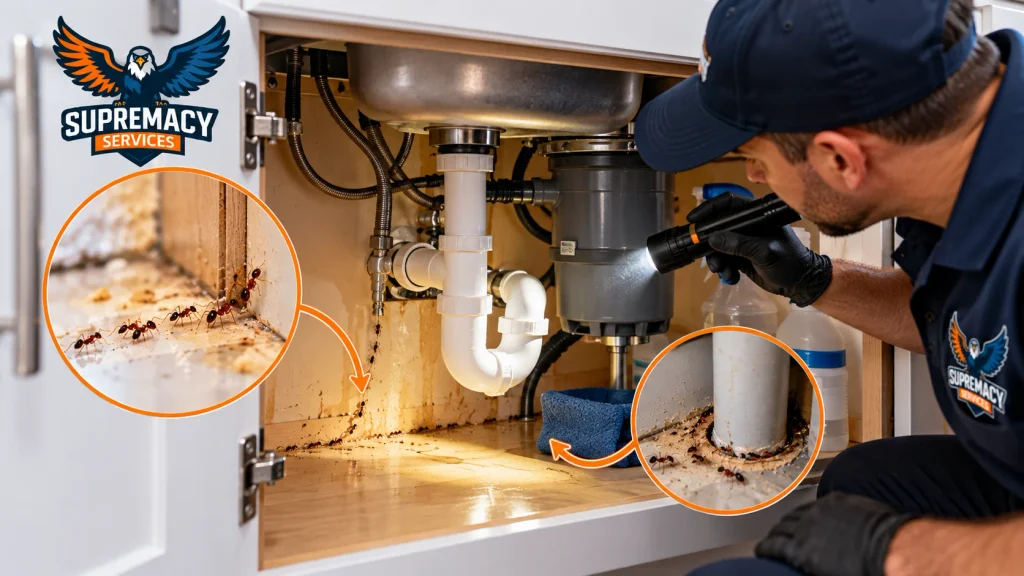
Ants around the sink are often finding water, food residue or both.
Inspect:
- the faucet and fixtures;
- plumbing beneath the sink;
- pipe penetrations through the cabinet or wall;
- damp cabinet materials;
- dishwasher connections;
- condensation;
- sponges and dishcloths;
- garbage disposal residue;
- recycling containers;
- pet bowls nearby.
A plumbing opening can serve two roles simultaneously: it may provide access through a wall while the sink supplies moisture.
Texas A&M notes that some household ants nest near heat and moisture sources, and Argentine ants, for example, may be found around sinks, water pipes and leaks.
Does finding ants around the sink mean you have a leak?
No.
A leak is one possibility, not a diagnosis.
Ants can use ordinary sink moisture, food residue or an entry route around plumbing without there being a plumbing failure.
However, persistent dampness beneath a cabinet should be investigated independently of the ant problem.
Why Are Tiny Ants in the Pantry?
Pantries provide concentrated food sources in a protected environment.
Check:
- sugar and sweeteners;
- cereal;
- flour and baking products;
- bread;
- snacks;
- pet food;
- nuts;
- grease or cooking residue;
- damaged packaging;
- crumbs on shelving;
- spills beneath containers.
Do not assume the ants are interested only in sugar.
Different species have different food preferences, and preferences can include sweets, grease, protein and other foods.
Texas A&M’s household-ant comparison shows significant differences in food preferences among Texas species.
Move affected products aside, inspect packaging and clean the shelf so you can determine whether ants continue arriving from a crack, cabinet joint or wall.
Why Do Tiny Ants Keep Coming Back After I Clean?
Cleaning removes food and disrupts foraging opportunities, but it does not necessarily eliminate the colony.
If ants return, one or more of these conditions may remain:
- the colony is still active;
- another food source is available;
- water remains available;
- the entry route remains open;
- workers are traveling from an indoor nest;
- treatment killed visible workers without affecting the colony.
This explains why wiping down the counter can produce a temporary improvement followed by another trail.
Sanitation is important, but recurring ant activity is ultimately a source-and-colony problem, not simply a countertop problem.
How Can You Find Where Tiny Ants Are Entering the Kitchen?
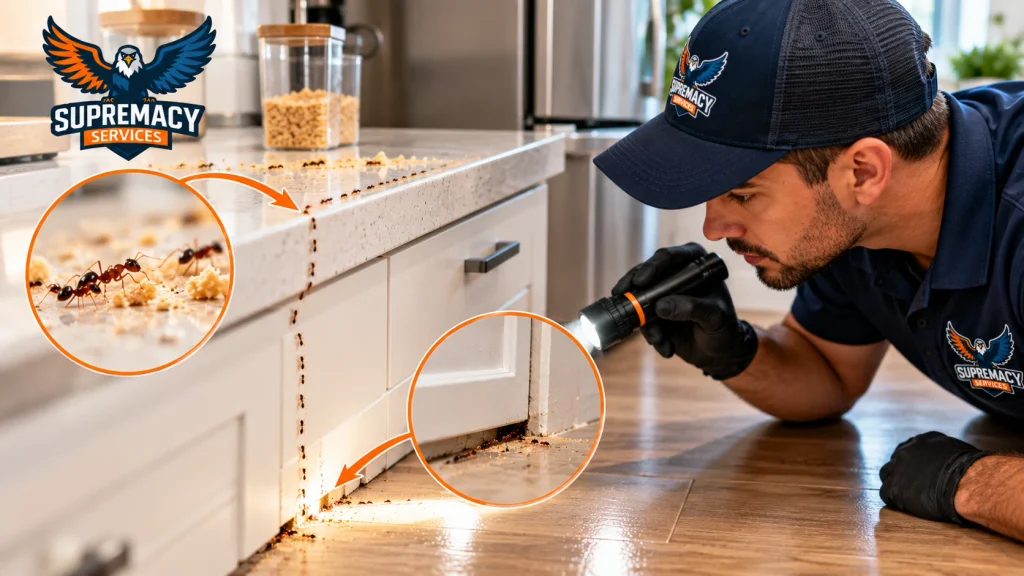
Watch the ants for several minutes before removing the trail. Follow workers in both directions and pay particular attention to the point where they disappear.
Kitchen Ant Inspection Checklist
| Area | What to inspect |
|---|---|
| Sink | Plumbing penetrations, moisture, cabinet seams |
| Backsplash | Cracks and gaps |
| Countertop | Direction of the trail |
| Cabinets | Corners, hinges, seams and wall junctions |
| Pantry | Open food and shelf gaps |
| Dishwasher | Moisture and surrounding voids |
| Refrigerator | Crumbs, condensation and wall/floor gaps |
| Windows | Frame and sill openings |
| Doors | Threshold and weather stripping |
| Baseboards | Cracks where trails disappear |
| Exterior wall | Foundation, utility penetrations and landscaping |
Step 1: Find the busiest trail
Start where activity is greatest.
Step 2: Follow ants away from the food
Workers traveling back from food may help reveal their route toward the colony.
Step 3: Look beneath and behind nearby items
Check appliances, containers and removable items without unnecessarily disturbing inaccessible structural areas.
Step 4: Match the interior route to the outside wall
If the trail disappears near an exterior wall, inspect the corresponding outdoor area.
Look around the foundation, vegetation, mulch, stones, utility penetrations and other protected locations.
Step 5: Check whether activity emerges from a wall
Repeated ants coming from a switch plate, baseboard gap, plumbing opening or cabinet-wall junction may indicate that workers are traveling through a structural void.
That does not automatically prove the colony is inside the wall, but it warrants closer investigation.
Should You Spray Tiny Ants in the Kitchen?
Avoid automatically spraying an unidentified ant trail. Killing visible workers may not eliminate the colony, and the wrong strategy can make certain ant infestations harder to control.
Pharaoh ants are the most important example.
Texas A&M specifically advises against repellent liquid or dust insecticides indoors for pharaoh ants because these treatments can cause colonies to bud, potentially worsening the infestation. Strategic bait placement is the recommended control approach described in its guidance.
That is a strong reason to identify extremely small indoor ants before treating them like any other crawling insect.
What Should You Do About Tiny Kitchen Ants?
Start with observation and source reduction.
1. Identify what they are feeding on
Check sweets, grease, pet food, crumbs and other accessible foods.
2. Trace the trail
Find where workers enter and leave the kitchen.
3. Remove competing food
Clean spills and crumbs and securely store food.
This is particularly important if bait will be used because abundant alternative food can compete with it.
4. Correct moisture problems
Repair leaks and eliminate avoidable standing moisture.
5. Store pantry products securely
Use appropriately sealed containers where practical.
6. Clean trash and recycling areas
Food residue can sustain foraging ants even when counters are spotless.
7. Seal appropriate entry points
After determining where activity originates, correct practical structural gaps around windows, doors and penetrations.
Do not seal ants into a wall without understanding the infestation.
8. Use only appropriately labeled products
If using a pesticide, follow the product label exactly and make sure it is labeled for the pest and application location.
Never improvise pesticide applications around food-preparation surfaces.
Do Ant Baits Work Better Than Sprays?
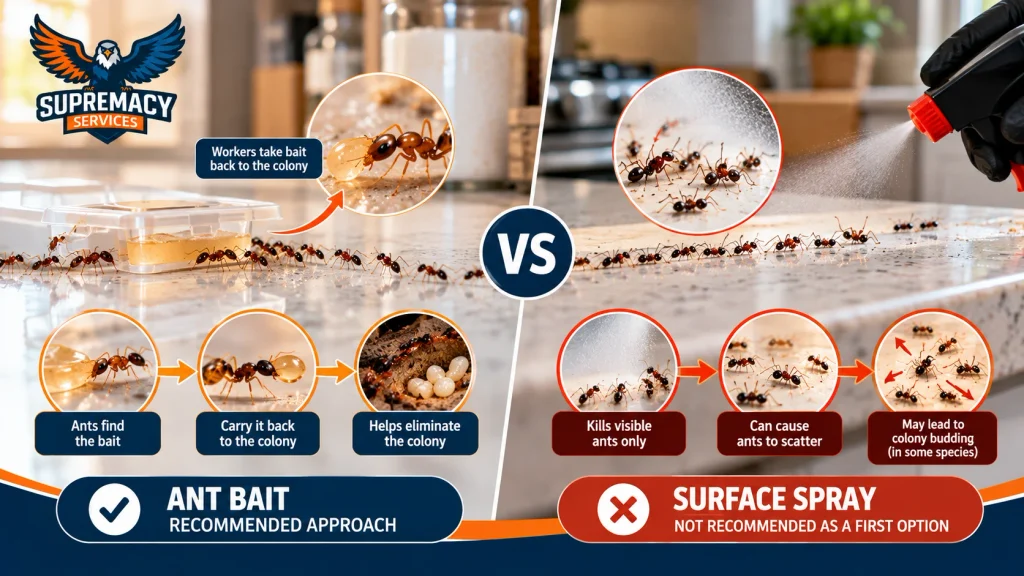
Ant bait can be particularly useful because foraging workers consume it and can carry it back toward other members of the colony.
Texas A&M recommends ant baits as one option when a nest cannot be located and notes that bait preferences can differ among species.
But bait is not simply a matter of placing any product anywhere.
Effectiveness can depend on:
- correct species identification;
- what food the ants currently prefer;
- bait placement;
- competing food;
- colony location;
- infestation size;
- whether another pesticide has disrupted normal foraging.
Never place pesticide where the label prohibits its use.
DIY vs. Professional Ant Control
Minor activity associated with an obvious food spill may be manageable with cleaning, monitoring and exclusion. Recurring trails, uncertain species or ants emerging from inaccessible areas justify a more thorough investigation.
| Situation | Reasonable approach |
|---|---|
| A few ants around a recent spill | Clean and monitor |
| Ant trail from an obvious exterior gap | Remove attractants and investigate entry |
| Ants around a minor moisture source | Correct moisture and monitor |
| Repeated trail every day | Identify species and colony source |
| Extremely tiny yellow ants | Consider possible pharaoh ants before treatment |
| Ants emerging from wall voids | Professional identification may be useful |
| Multiple rooms affected | Broader inspection |
| DIY treatment repeatedly fails | Professional assessment |
| Winged insects appear | Confirm ants vs. termites |
When should you call pest control?
Consider professional ant control when:
- trails return after sanitation;
- you cannot identify the species;
- ants are appearing in multiple rooms;
- ants appear to be emerging from walls;
- you suspect pharaoh ants;
- you cannot locate the source;
- activity persists after reasonable DIY measures;
- treatments appear to make the infestation spread;
- you are unsure which pesticide strategy is appropriate.
Tiny ants returning despite cleaning and DIY treatment? Request a DFW pest-control assessment from Supremacy Services to identify the ant, trace the source and determine the appropriate control strategy.
What Should Professional Ant Control Include?
Professional ant management should start with inspection and identification, not indiscriminate spraying.
Depending on the infestation, an assessment may involve:
- identifying the species or likely ant group;
- tracing active trails;
- determining likely nesting areas;
- checking kitchen food and moisture sources;
- inspecting plumbing and utility penetrations;
- examining exterior foundation conditions;
- locating outdoor nests where practical;
- selecting species-appropriate treatment;
- addressing entry points and contributing conditions;
- monitoring results and adjusting treatment when needed.
Texas structural pest-control work performed for compensation is regulated by the Texas Department of Agriculture. TDA identifies ants among the pests covered by its pest-control licensing category.
The treatment itself should depend on what was found during inspection.
Can Tiny Kitchen Ants Contaminate Food?
Ants traveling through kitchens can reach exposed foods and food-contact areas, so contaminated food should be handled sensibly and food should be stored securely.
Pharaoh ants receive additional attention in healthcare and similar settings because of their ability to mechanically carry microorganisms. Texas A&M discusses this concern in its pharaoh-ant guidance.
For an ordinary home, the practical response is straightforward: prevent ants from accessing food, clean food-preparation surfaces and address the infestation rather than allowing trails to continue through the kitchen.
How Can Dallas Homeowners Prevent Tiny Ants From Coming Back?
Prevention combines food management, moisture correction, exclusion and exterior monitoring.
Inside the kitchen
- Clean crumbs and spills promptly.
- Store food securely.
- Clean beneath small appliances.
- Inspect pantry products.
- Rinse food residue from recycling.
- Keep trash containers clean.
- Avoid leaving pet food accessible unnecessarily.
- Repair leaking fixtures.
- Check beneath sinks periodically.
- Monitor recurring trails.
Around the house
- Check weather stripping.
- Inspect gaps around windows and doors.
- Examine utility penetrations.
- Monitor the foundation for ant trails.
- Correct unnecessary moisture near the structure.
- Inspect mulch and objects beside exterior walls.
- Avoid allowing debris to create undisturbed shelter immediately beside the foundation.
For colonies originating outdoors, exterior management can reduce the number of ants reaching the building.
Supremacy’s existing perimeter pest-control service is specifically positioned around foundations, doors, windows and exterior pest entry areas and identifies ants among the pests it targets.
Why Tiny Ants Can Become Noticeable in Dallas and North Texas Homes
North Texas conditions can change ant foraging behavior, but weather should be treated as one contributing factor rather than the automatic explanation for every infestation.
Outdoor colonies may move or forage differently when food, water or nesting conditions change.
This means a Dallas homeowner may suddenly notice ants even though the colony itself has existed near the property for much longer.
The practical question is still:
What resource did they find, where are they entering and where is the colony located?
For a broader explanation of weather, food, water and sudden indoor activity, see Why Are Ants Suddenly Appearing Inside My House?
That article should remain Supremacy’s broad “why ants appear” resource, while this guide focuses specifically on identifying and tracing tiny kitchen ants.
Tiny Ants vs. Carpenter Ants: What’s the Difference?
Tiny kitchen ants are generally much smaller than carpenter ants.
Carpenter ants are comparatively large ants associated with wood nesting sites. If the insects in your kitchen are large rather than tiny—particularly when moisture or damaged wood is present—you may be dealing with a different problem.
Texas A&M notes that carpenter ants excavate wood for nesting rather than eating it like termites.
Correct identification becomes especially important when large ants or winged insects are involved.
Tiny Ants vs. Termites
Tiny worker ants walking across a countertop generally look very different from termite workers or swarmers, but winged ants are frequently confused with termite swarmers.
Do not assume that every winged insect around a window is an ant.
If winged insects are repeatedly emerging indoors or around structural wood and you cannot identify them confidently, professional identification is preferable to guessing.
Frequently Asked Questions
What are the tiny ants in my kitchen?
They may be pharaoh ants, dark rover ants, odorous house ants, ghost ants, thief ants or another small household species. Size, color, food preference, trail location and nesting behavior can help narrow the possibilities, but professional identification may be necessary.
Why do tiny ants suddenly appear on my kitchen counter?
Workers may have discovered food or water and established a successful foraging route. The colony may have been present nearby before the visible trail appeared.
Why are tiny ants coming out around my kitchen sink?
The sink area can provide moisture, food residue and access through plumbing penetrations. Check beneath the sink for leaks, damp materials and the point where pipes enter the wall.
Are tiny kitchen ants sugar ants?
“Sugar ant” is a loose common name rather than a reliable species identification. Several household ants feed on sweets, including pharaoh and odorous house ants.
What are the extremely tiny yellow ants in my kitchen?
Pharaoh ants are one possibility. Texas A&M describes them as approximately 1/12 to 1/16 inch long and yellowish to reddish-brown. Correct identification matters because their control requires particular care.
What are the tiny black or dark-brown ants in my kitchen?
Dark rover ants or other small dark-colored household ants are possibilities. Color alone is not enough for reliable identification.
Will cleaning the kitchen get rid of ants?
Cleaning removes food sources and is an important part of control, but it will not necessarily eliminate a colony. If ants return, investigate their entry route, water sources and nesting location.
Why do ants keep coming back after I spray them?
A spray may kill workers without eliminating the colony. With certain ants—particularly pharaoh ants—an inappropriate repellent treatment can also disrupt colonies and contribute to budding.
Should I use ant bait in my kitchen?
Appropriately labeled ant bait can be useful for some infestations because workers carry bait back toward the colony. Species, bait preference and placement matter, and all label directions must be followed.
When should I call an exterminator for tiny ants?
Professional help becomes more appropriate when trails repeatedly return, ants appear in multiple areas, the species cannot be identified, activity appears to originate inside walls, pharaoh ants are suspected or DIY efforts have not addressed the source.
Stop Treating the Countertop and Find the Source
Tiny ants in a Dallas kitchen are usually there because workers have found something valuable—food, water or a reliable route through the building.
Start by identifying what the ants look like, following their trail, checking food and moisture sources and finding where they enter.
If they repeatedly return, the question is no longer simply how to kill the ants you can see. It is which ant is present and where the colony is coming from.
If tiny ants keep returning to your kitchen, contact Supremacy Services for pest control in Dallas-Fort Worth. A source-focused inspection can help identify the ant, locate active trails and determine an appropriate treatment and prevention strategy.

