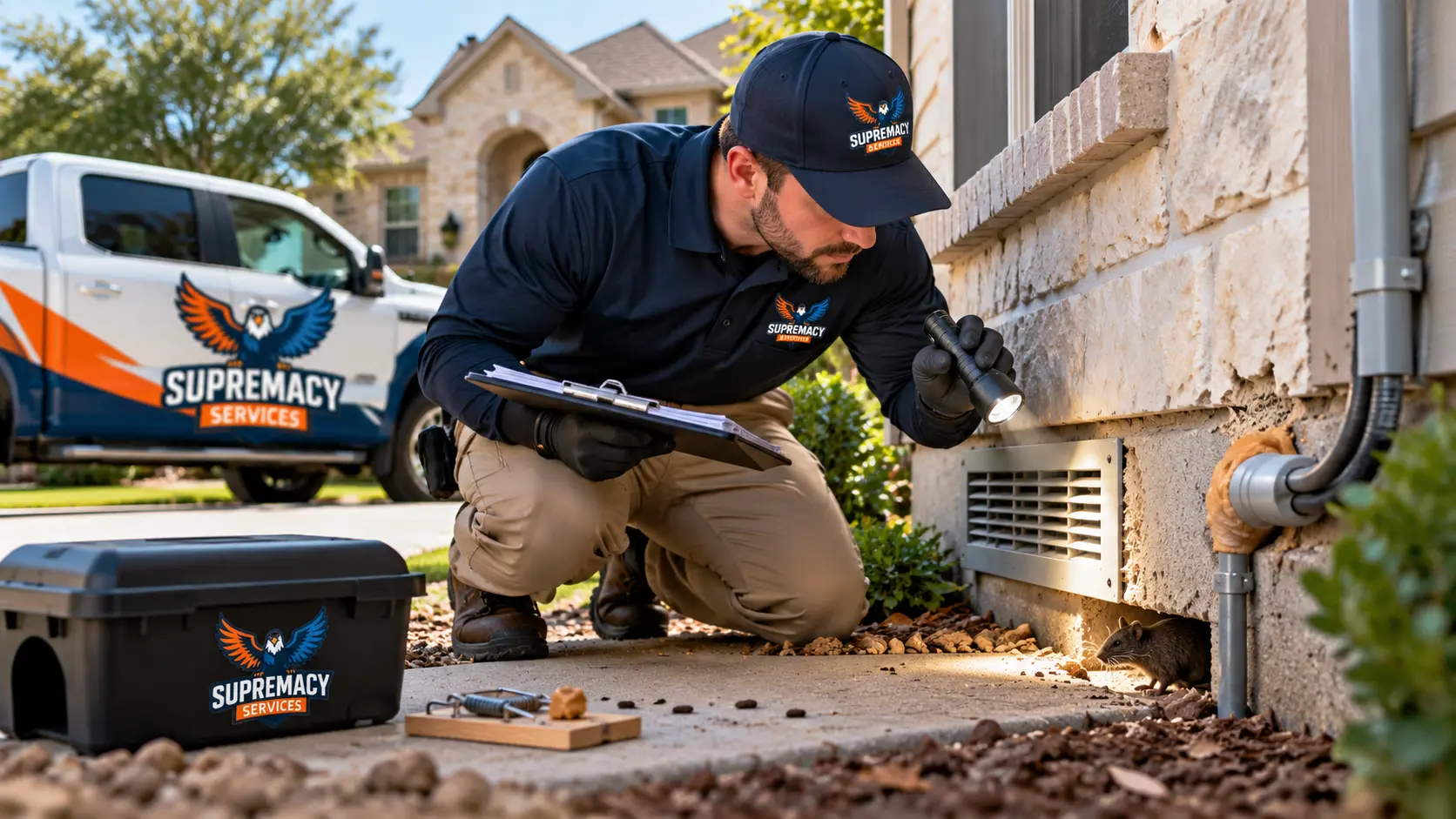
If rats or mice are already inside your Dallas-area home, the answer is usually not trapping or exclusion. In many infestations, you need both.
Trapping addresses rodents that are already inside the structure. Rodent exclusion addresses the openings that allowed them inside in the first place. Trapping without correcting access points can leave your home vulnerable to another infestation, while sealing an active opening without first determining whether rodents remain inside can create a different problem.
For Dallas and DFW homeowners, the most effective approach usually begins with an inspection: identify the animal, determine where it is active, locate possible entry points, control the rodents already inside and then correct vulnerable openings where appropriate.
Table of Contents
- Rodent exclusion vs. trapping: what is the difference?
- When does your home need trapping?
- When does your home need rodent exclusion?
- Do you usually need both trapping and exclusion?
- Should you seal rodent holes before or after trapping?
- How do rats and mice get into a home?
- What does professional rodent control include?
- DIY trapping vs. professional rodent control
- What affects the cost?
- How can you prevent rodents from coming back?
- Frequently asked questions
Rodent Exclusion vs. Trapping: What Is the Difference?

Rodent trapping removes rats or mice that are already inside or actively using a property. Rodent exclusion is the process of finding and correcting structural openings that allow rodents to enter.
They solve different parts of the same problem.
| Rodent trapping | Rodent exclusion |
|---|---|
| Targets active rats or mice | Targets entry routes |
| Helps reduce the existing population | Helps prevent additional rodents from entering |
| Usually performed inside or near active areas | Usually focuses on the building envelope |
| Requires correct trap placement and monitoring | Requires inspection and suitable repair materials |
| Does not repair structural openings | Does not automatically remove rodents already inside |
The CDC similarly treats trapping and sealing as complementary parts of rodent control: it recommends checking how rodents entered, sealing openings and trapping rodents that remain inside.
That distinction is important because homeowners often focus on whichever part of the problem they notice first.
Seeing a mouse may lead you to buy traps. Finding a hole near the roof may make you want to seal it immediately. A proper control plan considers both the occupants and the access route.
If you are already finding droppings, hearing nighttime movement or repeatedly catching rodents, schedule a rodent inspection and control evaluation with Supremacy Services to determine whether the property needs active control, exclusion or both.
When Does Your Home Need Trapping?
Trapping is appropriate when rats or mice are already inside the home or there is evidence of active rodent activity.
Common signs include:
- fresh droppings;
- scratching or movement inside walls or ceilings;
- gnaw marks;
- damaged food packaging;
- nesting material;
- disturbed attic insulation;
- tracks or rub marks;
- rodents seen indoors;
- continued activity around known travel areas.
The CDC recommends traditional snap traps for household rats and mice and says traps should be placed in areas where evidence of rodents has been found.
Correct identification matters. A mouse trap and rat trap are not interchangeable, and the animal’s travel pattern influences where trapping is likely to be effective.
Trapping treats the current infestation
Imagine a rat entering through a damaged soffit and nesting in the attic.
A trap can address the rat currently living there.
It cannot repair the soffit.
If another rat can use the same opening next week, the structural problem remains.
That is why repeatedly trapping rodents without investigating access points may become an ongoing cycle rather than a permanent solution.
When Does Your Home Need Rodent Exclusion?
Your home needs rodent exclusion when rats or mice can access the structure through gaps, damaged vents, roofline openings, utility penetrations, door gaps or other vulnerabilities.
Exclusion means finding these access routes and repairing or reinforcing them appropriately.
Potential rodent entry areas include:
- gaps around soffits and fascia;
- attic and crawl-space vents;
- openings around plumbing lines;
- electrical and cable penetrations;
- gaps around gas or utility lines;
- damaged screens;
- gaps beneath exterior doors;
- attached garage openings;
- openings around foundations;
- roof intersections and construction gaps.
Mice are particularly challenging because they can use extremely small openings. CDC guidance notes that mice can fit through a hole approximately 1/4 inch, or 6 millimeters, wide.
Exclusion treats the access problem
Rodent exclusion is not simply filling the one hole you happen to notice.
A useful exclusion inspection evaluates the building as a system.
For example, sealing a pipe penetration at ground level does little good if rodents are also reaching an attic through an unscreened vent.
A complete inspection should therefore consider both the evidence inside the building and vulnerable areas around the exterior.
Do You Usually Need Both Trapping and Exclusion?
If rodents are already inside and structural openings are allowing entry, trapping and exclusion generally perform two necessary but different jobs.
A typical sequence looks like this:
- Inspect the property.
Confirm rodent activity and look for possible access routes. - Identify the rodent.
Determine whether the evidence points toward rats, mice or another animal. - Control active rodents.
Use an appropriate strategy based on the species and location. - Correct entry points.
Seal or reinforce vulnerable openings once the situation has been evaluated properly. - Monitor the property.
Look for new droppings, sounds, gnawing or other evidence that activity continues. - Reduce attractants.
Improve food, trash and exterior conditions that may encourage rodents around the structure.
This is also why “I caught a rat, so the problem is solved” can be a risky assumption.
Catching one animal proves only that one animal was caught. It does not prove there are no others, nor does it explain how that animal entered.
Should You Seal Rodent Holes Before or After Trapping?
Do not automatically seal an active opening without first determining whether rodents remain inside.
If an entry point is being actively used, closing it at the wrong stage can potentially leave animals inside walls, an attic or another inaccessible part of the structure.
The better approach is to determine:
- what animal is present;
- whether the opening is active;
- whether additional access points exist;
- whether rodents remain inside;
- and when permanent repair should occur.
This is particularly important when the animal has not been positively identified. Scratching in an attic, for example, could involve rats, mice, squirrels or another animal, and wildlife situations may require a different removal process.
If you are unsure what you are hearing, Supremacy’s guide to scratching noises in the attic can help you compare rat, mouse and squirrel evidence before deciding what kind of control is appropriate.
How Do Rats and Mice Get Into a Home?
Rats and mice enter wherever the structure provides a usable route to shelter, food or water.
Around Dallas-area homes, an inspection may include:
Rooflines and soffits
Roof-level gaps, damaged soffits and unscreened openings can provide access to attic spaces.
Roof rats are particularly relevant when evidence is concentrated high in a building because they are capable climbers.
Vents
Damaged or inadequately protected attic, crawl-space and mechanical vents can become access points.
Utility penetrations
Openings around plumbing, electrical, cable, HVAC or gas penetrations deserve attention because even a relatively small unfinished gap can create a route into a wall or interior void.
Garages and doors
Worn weather stripping and gaps at garage or exterior doors can provide lower-level access.
Foundation and construction gaps
Transitions between building materials and unfinished openings around the foundation should also be checked.
The CDC recommends inspecting both the inside and outside of a home, including roofs, eaves, gables, soffits, vents, doors and utility penetrations.
Why Do Rodents Keep Coming Back After Trapping?
Recurring rodent activity usually means the underlying conditions that supported the infestation have not all been corrected.
Possible reasons include:
- one or more entry points remain open;
- not all rodents were removed;
- the wrong areas are being trapped;
- food or pet food remains accessible;
- garbage is easy to reach;
- exterior shelter remains attractive;
- damaged screens or vents have not been repaired;
- new structural openings have developed.
This is one of the biggest differences between population control and long-term prevention.
Trapping can reduce the animals currently present. Exclusion changes the building conditions that make repeated entry possible.
What Does Professional Rodent Control Include?
A professional rodent-control visit should begin with evidence, not assumptions.
Depending on the property and infestation, a service may include:
1. Interior inspection
The technician looks for:
- droppings;
- gnawing;
- nesting material;
- tracks;
- rub marks;
- disturbed insulation;
- travel routes;
- likely feeding areas.
2. Exterior inspection
The building envelope is checked for possible access points around:
- the roof;
- soffits;
- fascia;
- vents;
- garage doors;
- utility penetrations;
- foundations;
- exterior openings.
3. Identification
Rat and mouse behavior differs, so the evidence should guide the control strategy.
4. Active rodent control
Where rodents are present, appropriate control measures are placed in locations consistent with their travel patterns and the site’s safety requirements.
5. Exclusion recommendations
Openings that are contributing to the problem can be identified for sealing or reinforcement.
6. Follow-up and monitoring
Fresh evidence after the initial work can reveal whether additional activity remains or another entry route was overlooked.
If trapping has become an ongoing routine in your home, the next step should be finding why rodents are still getting inside. Learn about Supremacy Services’ rat control and exclusion in Dallas-Fort Worth and schedule an inspection focused on both active rodents and structural access.
DIY Trapping vs. Professional Rodent Control
A small, clearly identified mouse problem may sometimes be manageable by a homeowner using appropriate traps, sanitation and exclusion practices.
Professional help becomes more appropriate when:
- you continue finding fresh droppings after trapping;
- activity is occurring in walls or inaccessible attic spaces;
- you cannot determine whether you have rats, mice or wildlife;
- several possible entry points are present;
- roof-level inspection is needed;
- rodents continue returning;
- children or pets complicate trap placement;
- there is substantial contamination;
- you are uncomfortable handling dead rodents;
- the infestation appears widespread.
Texas also regulates structural pest-control services performed for compensation. The Texas Department of Agriculture lists rats and mice within its structural pest-control licensing category.
Safety matters during cleanup
Do not dry sweep or vacuum rodent droppings.
Rodent urine, droppings and nesting material can present health risks. Follow CDC cleanup guidance when contaminated material is present rather than disturbing dry waste and sending particles into the air.
What Affects the Cost of Rodent Trapping and Exclusion?
There is no responsible single price for every rodent problem because the scope can differ dramatically from one property to another.
Important cost factors include:
| Factor | Why it matters |
|---|---|
| Rodent species | Rats and mice may require different strategies |
| Infestation extent | One localized area differs from activity throughout a home |
| Number of entry points | More repair locations generally mean more exclusion work |
| Entry-point location | Ground-level gaps are different from high roof or soffit repairs |
| Building construction | Brick, siding, masonry, roofing and other materials require different repair approaches |
| Accessibility | Attics, crawl spaces and steep rooflines can affect the scope |
| Contamination | Significant nesting or waste may require additional cleanup considerations |
| Follow-up needs | Persistent activity may require additional monitoring |
Ask for an inspection-based scope rather than relying on an online price that cannot account for your house.
A useful proposal should make clear whether the price includes:
- inspection;
- trapping or other active control;
- trap monitoring;
- exclusion work;
- materials;
- follow-up;
- cleanup, if offered;
- and any areas specifically excluded from the scope.
Dallas and DFW Rodent-Control Considerations
Dallas-area rodent control should be based on the building and the actual evidence rather than generic seasonal assumptions.
Homes throughout DFW may have multiple potential access zones: attached garages, attic vents, rooflines, utility penetrations, exterior kitchens, storage spaces and landscaped areas close to the structure.
Roof rats also deserve attention when activity appears in an attic or along higher sections of a home. Supremacy’s current rodent-control page notes that roof rats can use trees, fences, utility lines and structural features to reach elevated areas.
The practical implication is simple: an inspection limited to the kitchen or garage can miss the route being used higher on the building.
How Can You Prevent Rodents From Coming Back?
Long-term rodent prevention focuses on access, food, water and shelter.
Seal vulnerable openings
Inspect the exterior periodically and repair damaged screening, gaps and deteriorated exclusion work.
Store food securely
Use sealed containers where appropriate and clean spills or accessible food promptly.
Control pet food
Avoid leaving pet food accessible in garages, patios or other areas where rodents can feed.
Secure garbage
Use containers with well-fitting lids and clean spilled waste around bins.
Reduce clutter
Dense storage, debris and unused materials can create protected areas around garages, sheds and exterior walls.
Watch repaired areas
An exclusion repair should not be forgotten permanently. Building materials weather, doors shift and new openings can develop.
Periodic inspection helps identify vulnerabilities before another rodent establishes itself inside.
Rodent Trapping vs. Exclusion: Quick Decision Guide
| What you are seeing | Likely next step |
|---|---|
| Fresh droppings inside | Investigate active rodent control |
| Rodent caught indoors | Continue evaluating for additional activity and entry points |
| Known exterior gaps but no confirmed activity | Inspect and consider preventive exclusion |
| Repeated infestations | Prioritize a full entry-point inspection |
| Scratching in walls or attic | Identify the animal before choosing a solution |
| Trapping works temporarily but rodents return | Investigate unresolved exclusion problems |
| Multiple openings plus active infestation | A combined control-and-exclusion plan is likely appropriate |
Frequently Asked Questions
Is rodent exclusion better than trapping?
Neither replaces the other. Trapping addresses rats or mice already inside, while exclusion addresses how rodents enter. If you have an active infestation and open entry points, both may be necessary.
Can you get rid of rats with traps alone?
Traps can remove rats currently inside, but they do not close structural openings. If access remains available, new rats may enter later.
Should I seal holes while rats are still inside?
Do not permanently close an active entry point without first determining whether rodents remain in the structure. The sequence of control and exclusion should be based on inspection findings.
What is included in rodent exclusion?
Rodent exclusion generally involves locating potential access points and sealing or reinforcing vulnerable openings such as gaps around vents, rooflines, utility penetrations, doors and other parts of the building envelope.
Why do mice keep returning after I trap them?
Recurring activity can indicate additional mice remain inside, entry points are still open or food and shelter continue attracting rodents around the structure.
How small a hole can a mouse enter?
CDC guidance states that mice can fit through an opening about 1/4 inch, or approximately 6 millimeters, wide.
Does rodent exclusion permanently guarantee that mice will never return?
No responsible service should treat a building as permanently immune to rodents. Materials deteriorate, buildings change and new openings can develop. Inspection, maintenance and sanitation remain important.
Can I do rodent exclusion myself?
Simple, safely accessible gaps may be manageable for some homeowners. Professional assistance is more appropriate when openings are difficult to reach, roof access is required, the infestation persists, the animal cannot be identified or several entry points are involved.
Is scratching in the attic always a rat?
No. Rats and mice are possibilities, especially with nighttime activity, but squirrels and other animals can also occupy attics. Droppings, nesting material, gnawing, tracks and entry-point evidence provide a better diagnosis than sound alone.
The Bottom Line: Trapping Removes Rodents; Exclusion Helps Keep Them Out
The difference between trapping and rodent exclusion is straightforward:
Trapping deals with the rodents that are already there. Exclusion deals with how they got there.
For a Dallas or DFW home with active rodents and structural entry points, the strongest long-term strategy is usually to identify the species, control the current activity, correct access routes and continue monitoring for new evidence.
Still catching rats or mice after you thought the problem was solved? Schedule a rodent inspection with Supremacy Services. We can evaluate active rodent evidence, inspect likely entry routes and determine whether your Dallas-Fort Worth home needs trapping, exclusion or a combination of both.