
Table of Contents
- How Much Does Ant Pest Control Cost in North Texas?
- Ant Treatment Cost by Type of Problem
- What Determines the Cost of Ant Control?
- Does the Type of Ant Affect the Price?
- One-Time vs. Recurring Ant Control
- What Does Professional Ant Control Include?
- DIY vs. Professional Ant Control
- When Should You Call a Professional?
- How to Prevent Ants From Returning
- How to Compare Ant-Control Quotes
- Frequently Asked Questions
For budgeting purposes, professional ant pest control in North Texas can range from roughly $80 to $500 for many conventional treatments, based on current national consumer-market estimates. One 2026 national cost guide places the typical range at $80–$500 with an average around $150, while a Dallas-specific third-party pricing source reports approximately $100–$450 per treatment. These are market-planning figures—not Supremacy Services prices or guaranteed Dallas averages.
Your actual quote can be lower or higher depending on the ant species, size and location of the colony, extent of the infestation, property size, treatment method and whether follow-up or recurring exterior service is needed.
That distinction matters because “ant control” can describe very different jobs.
A few foraging ants entering beside a kitchen window are not necessarily the same treatment problem as:
- multiple colonies around a large property;
- recurring ants entering from the foundation;
- fire-ant mounds throughout a lawn;
- ants nesting inside wall voids; or
- suspected carpenter ants associated with damp wood.
Texas A&M notes that identifying the ant is an important first step because Texas homes can encounter several species with different nesting habits and control requirements.
Bottom line: Use online ant-control prices to establish a budget, not as a substitute for a property-specific quote.
Ants keep returning? Explore Supremacy Services’ perimeter pest-control options for recurring ant activity around Dallas-Fort Worth homes.
Ant Treatment Cost by Type of Problem
The cost of professional ant control depends more on what needs to be done than on the simple fact that ants are present.
| Ant-control situation | Likely pricing tendency | Why |
|---|---|---|
| Small, localized ant problem | Lower | Limited treatment area and simpler inspection |
| Recurring household ants | Low–moderate | Source and entry points may need investigation |
| Multiple indoor activity areas | Moderate | Greater inspection and treatment scope |
| Large exterior infestation | Moderate | Larger treatment area |
| Fire ants across a lawn | Moderate–higher | Full-yard treatment may differ from ordinary perimeter service |
| Carpenter ants | Variable | Nest location and moisture/wood conditions can complicate treatment |
| Ants nesting in inaccessible voids | Variable | Locating and reaching the colony may require additional work |
| Recurring prevention program | Different pricing structure | Cost is spread across scheduled service visits |
These categories describe relative complexity rather than fixed prices.
Why isn’t there one standard ant exterminator price?
Because two homes with the same number of visible ants may have completely different underlying problems.
In one home, workers may simply be foraging from a colony outside.
In another, ants may repeatedly enter through several foundation or utility openings.
Texas A&M explains that most ant species invading Texas homes normally nest outdoors, although some species can establish nests in walls or other interior areas.
The technician therefore needs to determine where the ants are coming from, not simply count the ants you can see.
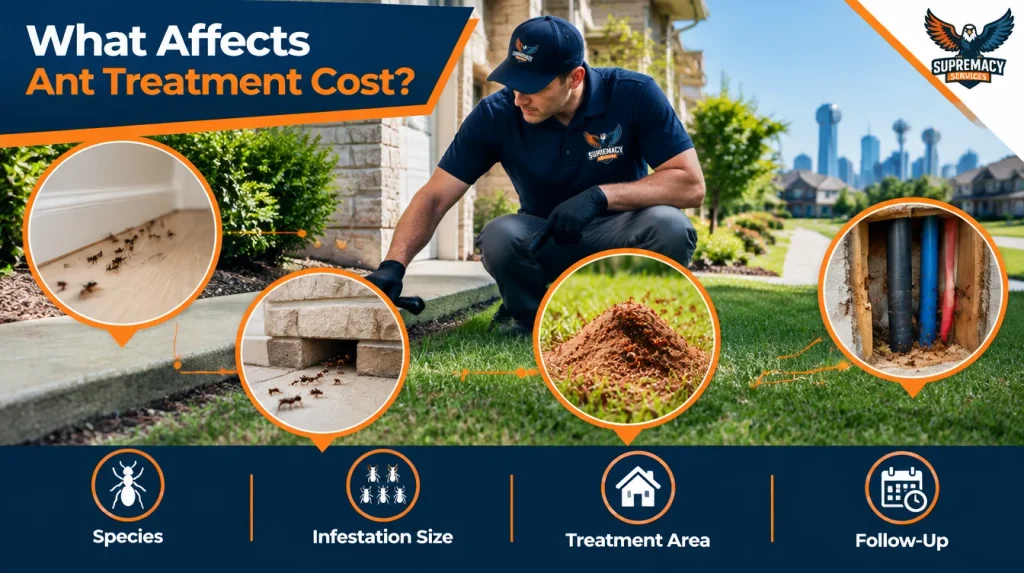
What Determines the Cost of Ant Control?
1. Ant species
Species identification can change the treatment strategy.
Texas A&M identifies red imported fire ants, carpenter ants and several smaller household ants among the species encountered around Texas properties. Different ants have different nesting locations, food preferences and responses to treatment.
That means a generic “spray the ants” approach is not necessarily appropriate.
2. Location of the colony
An accessible outdoor colony may be relatively straightforward.
A colony associated with:
- wall voids;
- window or door frames;
- landscaping;
- trees;
- inaccessible structural cavities; or
- areas affected by moisture
can require additional investigation.
The farther the treatment must go beyond controlling visible foragers, the greater the potential service scope.
3. Severity and spread of activity
Seeing three ants beside one window is different from finding established trails in the kitchen, pantry, bathroom and garage.
More widespread activity can require:
- inspection;
- identification;
- trail tracing;
- locating likely nesting areas;
- treatment;
- sanitation or moisture recommendations;
- entry-point investigation; and
- follow-up.
4. Interior versus exterior activity
Many Texas ant problems originate outside.
If ants are simply entering from an exterior colony, a technician may focus on exterior activity, entry areas and the colony source.
Supremacy already maintains a dedicated perimeter pest-control service built around exterior inspection and treatment of foundations and common pest-entry areas, including ants.
5. Size and layout of the property
Square footage can matter, particularly when large exterior areas require inspection or treatment, but it is not the only factor.
Landscaping, patios, attached garages, foundation design, irrigation, vegetation and other property features can change the amount of work involved.
6. One-time versus recurring treatment
A one-time corrective service and an ongoing preventive pest-control program have different pricing models.
A recurring program may make sense when ants are one part of broader seasonal pest pressure around the structure.
7. Follow-up requirements
Some ant problems can be resolved relatively quickly.
Others require monitoring or repeat visits, particularly when the nest is difficult to locate or activity returns.
Ask whether follow-up visits or callbacks are included before comparing quotes.
Does the Type of Ant Affect the Price?
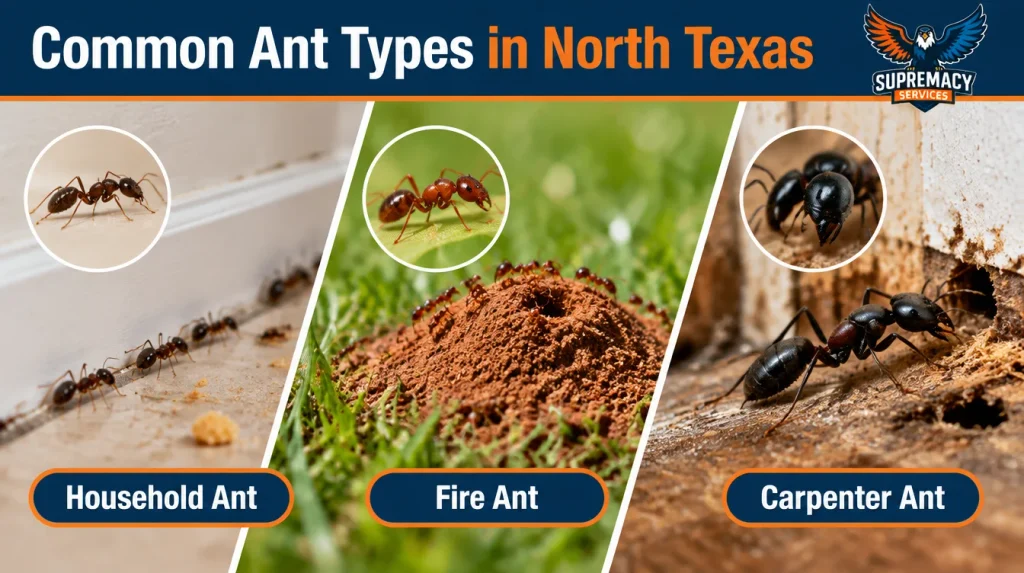
Yes. Ant species can affect treatment complexity and therefore cost because different species nest and forage differently.
Common household ants
Small household ants may enter kitchens and bathrooms looking for food or moisture.
Treatment may involve identifying trails, correcting food or water sources, baiting where appropriate and determining where ants are entering.
Fire ants
Fire ants present a different problem because colonies are generally outdoors.
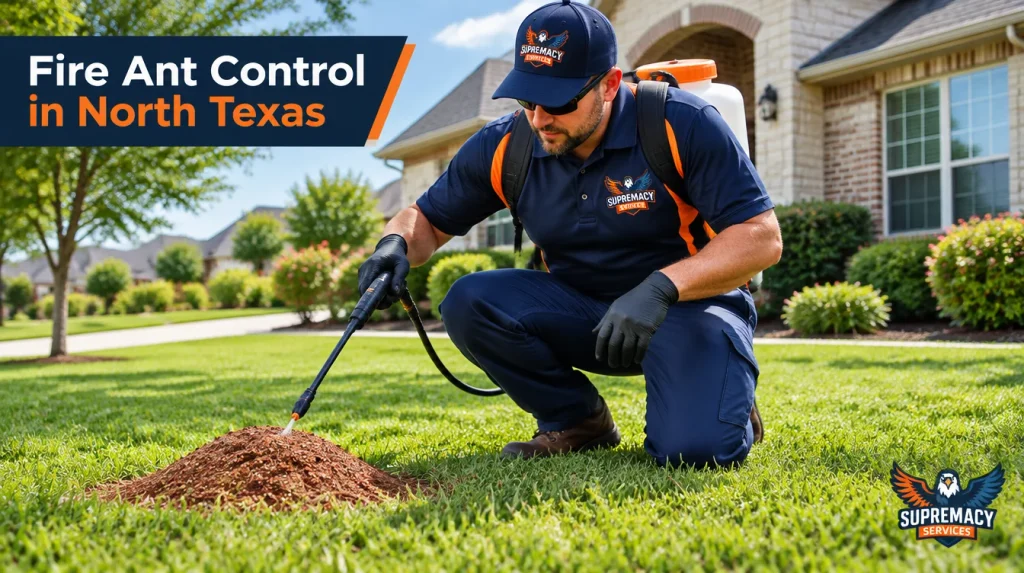
Texas A&M recommends a specific two-step approach for fire-ant management involving broadcast bait followed, where needed, by treatment of individual problem mounds. Fire-ant baits are not interchangeable with products intended for every household ant.
Supremacy also has a separate Fire Ant Yard Shield service, which means fire-ant intent should be routed toward that specialized service rather than treated as ordinary indoor ant control.
Carpenter ants
Carpenter ants can require more investigation because they can nest in structural cavities and are often associated with damp or deteriorated wood.
Importantly, Texas A&M explains that carpenter ants do not eat wood like termites. Texas species are generally less structurally destructive than carpenter ants in some other parts of the country, but an indoor colony can still require specialized management.
Texas A&M further notes that carpenter-ant control can be specialized and may require professional assistance when nests are difficult to locate.
Pharaoh and other tiny indoor ants
Tiny ants should not automatically be treated as one interchangeable pest.
Correct identification matters because treatment that works for one ant may perform poorly against another.
That is one reason repeated DIY spraying without knowing the species can become an expensive cycle.
One-Time vs. Recurring Ant Control
One-time ant treatment targets an existing problem; recurring pest control combines treatment with ongoing inspection and prevention.
| One-Time Ant Treatment | Recurring Pest Control |
|---|---|
| Targets a defined infestation | Designed around ongoing pest pressure |
| May have higher cost per visit | Cost distributed across scheduled visits |
| Appropriate for some isolated problems | Useful when ants repeatedly return |
| Limited future monitoring | Regular exterior monitoring |
| New activity may require another appointment | Future activity may be addressed within the service program, depending on terms |
| Best compared by treatment scope | Best compared by annual cost and coverage |
Neither approach is automatically better.
If one small outdoor colony is causing a temporary problem, ongoing service may not be necessary.
If ants repeatedly enter the home along with roaches, spiders or other seasonal pests, broader perimeter protection may be more practical.
Supremacy’s current pest-control page specifically lists ants among the everyday household pests covered by its standard protection approach.
Dealing with recurring ants around your foundation, kitchen or entry points? Request a pest assessment from Supremacy Services to determine whether targeted treatment or ongoing perimeter protection makes more sense for your property.
What Does Professional Ant Control Include?
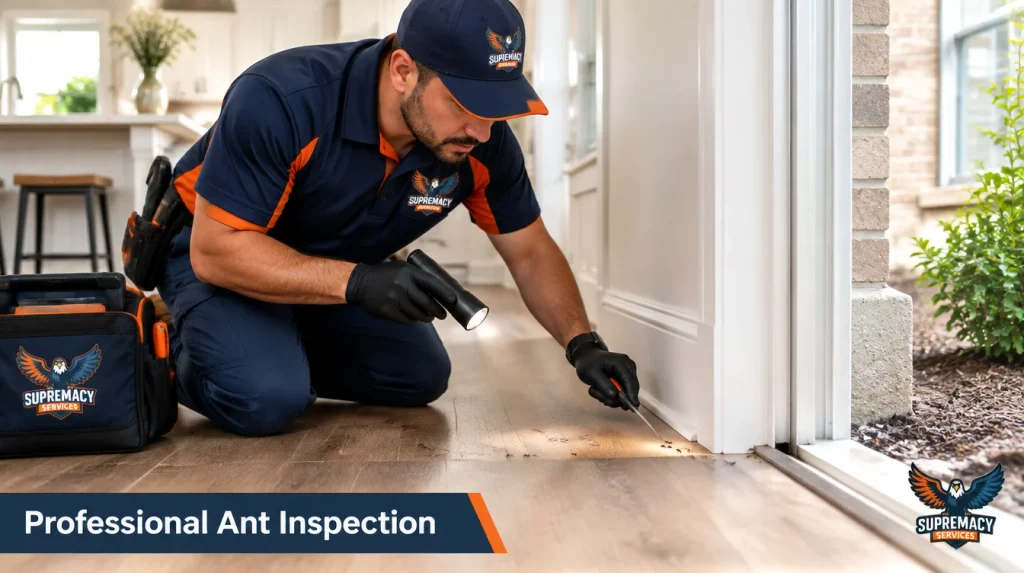
Professional ant management should begin with identification and inspection, rather than automatically spraying every visible ant.
A thorough assessment may include:
1. Identifying the ant
Correct identification helps determine:
- likely nesting location;
- feeding behavior;
- whether baiting is appropriate;
- whether the colony is likely indoors or outdoors; and
- what treatment approach makes sense.
2. Following active trails
Ant trails can reveal considerably more than the place where ants were first noticed.
A technician may trace activity toward:
- doors;
- windows;
- foundation gaps;
- plumbing penetrations;
- wall openings;
- landscaping; or
- exterior nesting areas.
3. Checking food and water sources
EPA’s integrated pest-management guidance emphasizes reducing the food, water and shelter that support pest activity.
For ants, that may mean checking:
- crumbs and food residue;
- pantry products;
- pet food;
- leaking plumbing;
- condensation;
- damp cabinets;
- irrigation; and
- other persistent moisture.
4. Locating likely nesting areas
Killing workers on a countertop does not necessarily eliminate the colony producing them.
Professional inspection therefore focuses on where the activity originates.
5. Selecting treatment for the species and location
Depending on the situation, treatment might involve appropriately labeled:
- baits;
- targeted exterior applications;
- crack-and-crevice treatment;
- nest treatment;
- perimeter management; or
- another species-specific strategy.
The appropriate method should follow identification.
6. Prevention recommendations
A professional may also identify conditions contributing to recurring activity, such as:
- vegetation touching the structure;
- accessible food;
- moisture;
- gaps around penetrations;
- deteriorated seals;
- nearby nesting habitat.
DIY vs. Professional Ant Control: Which Costs Less?
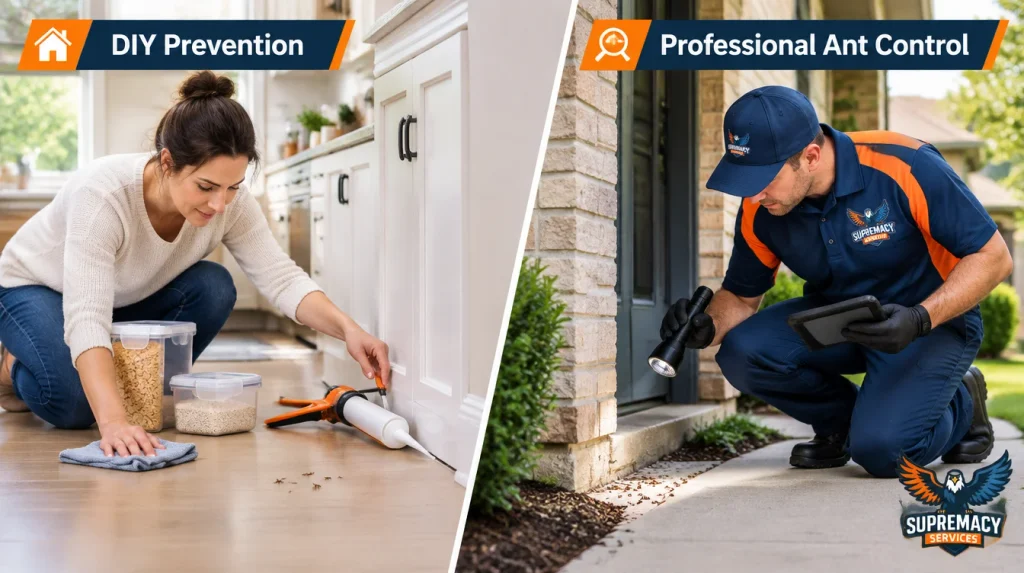
DIY treatment costs less initially, but professional treatment can become more cost-effective when ants repeatedly return, the species is uncertain or the colony cannot be located.
DIY can be reasonable when:
- only a few ants are present;
- you can identify the pest with reasonable confidence;
- the source is accessible;
- sanitation or exclusion can solve the problem;
- activity has not spread throughout the home; and
- you can safely follow the label of an appropriate consumer product.
EPA advises consumers to read pesticide labels carefully, follow directions and never assume that applying more pesticide will produce better results.
Professional ant control becomes more reasonable when:
- ants keep returning after DIY treatment;
- several rooms have activity;
- you cannot identify the species;
- ants appear to be emerging from a wall;
- you suspect an indoor colony;
- large numbers of carpenter ants are present indoors;
- numerous fire-ant colonies affect the property;
- the infestation is spreading; or
- repeated store-bought treatments have not solved the problem.
Don’t use unsafe homemade treatments
Texas A&M specifically warns against using gasoline or other flammable liquids to destroy ant nests because of the safety and environmental risks.
“Cheap” treatment is not cheaper if it creates another problem.
Why Do Ants Keep Coming Back After Treatment?
Ants commonly return when treatment removes visible workers without correcting the underlying source.
Possible reasons include:
- the colony was never located;
- food remains available;
- water or moisture remains available;
- ants continue using the same entry point;
- treatment was not appropriate for the species;
- outdoor colonies remain close to the structure; or
- new ants recolonize favorable areas.
This is why the objective should not simply be to kill the ants you can see.
The better questions are:
What species is it? Where is the colony? Why is it using this property?
Supremacy’s separate guide to ants suddenly appearing inside a house explores those causes in greater depth and should remain the primary page for “why are ants in my house?” intent.
Are Ants More of a Problem During Certain North Texas Conditions?
Ant activity can change with environmental conditions.
Texas A&M notes that red imported fire ants are widespread in eastern Texas and that fire ants may enter buildings looking for food or water. It also emphasizes that many common household ants normally maintain colonies outdoors.
For homeowners, that means changing outdoor conditions can alter where ants forage.
Rather than assuming every seasonal ant sighting requires treatment, watch:
- where ants are traveling;
- whether they are indoors or outdoors;
- whether activity persists;
- whether they are associated with moisture;
- whether visible mounds are present; and
- whether the same trail repeatedly returns.
Persistent activity provides more useful information than one isolated ant.
How Can You Prevent Ants From Returning?
Prevention should focus on food, water, shelter and access.
Indoor ant-prevention checklist
- Clean food residue and spills promptly.
- Store food in closed containers.
- Keep pet food from sitting out unnecessarily.
- Clean beneath appliances.
- Empty food-contaminated trash regularly.
- Repair leaking plumbing.
- Investigate moisture beneath sinks and around appliances.
- Follow ant trails before wiping them away when trying to determine their source.
Exterior checklist
- Inspect doors and windows for pest-access gaps.
- Check utility and plumbing penetrations.
- Reduce unnecessary debris beside the foundation.
- Address persistent moisture and drainage issues.
- Avoid allowing vegetation to create easy bridges to the structure.
- Monitor recurring ant trails rather than repeatedly treating only individual workers.
EPA’s IPM framework recommends combining prevention, monitoring and appropriate control methods instead of relying automatically on pesticide applications.
How to Compare Ant-Control Quotes in Dallas-Fort Worth
Don’t compare two quotes solely by their headline price.
Ask each provider:
| Question | Why it matters |
|---|---|
| What ant species do you believe is present? | Treatment should follow identification |
| Where does the activity appear to originate? | Visible ants may only be foragers |
| What areas will you inspect? | Inspection scope affects value |
| What areas will be treated? | Interior and exterior proposals can differ |
| Is this a one-time treatment or program? | Changes total annual cost |
| Are follow-up visits included? | Important for recurring activity |
| Which other pests are included? | General plans can offer broader coverage |
| Are fire ants included? | Lawn treatment may be a separate service |
| Are carpenter ants handled differently? | Specialized treatment may be required |
| Is there a service agreement? | Understand the commitment |
| What is the total cost? | Avoid comparing partial prices |
| Is the pest-control business properly licensed? | Texas regulates structural pest-control services |
Texas law requires businesses and individuals performing structural pest control for compensation to meet applicable licensing requirements. The Texas Department of Agriculture identifies ants within the structural pest-control category.
You can also verify current structural pest-control licensing information through the Texas Department of Agriculture.
Ants or Termites? Don’t Pay for the Wrong Treatment
Winged ants are commonly confused with termite swarmers.
That distinction is especially important when pricing pest control because termite inspection and treatment belong to a completely different service category.
Flying ants generally have:
- elbowed antennae;
- a visibly constricted waist; and
- front wings longer than their rear wings.
Termite swarmers have a broader waist, relatively straight antennae and wings that are more similar in length.
If you are uncertain, identify the insect before buying treatment.
Supremacy’s existing Flying Ants vs. Termites guide covers this identification intent in detail and should receive an internal link rather than duplicating that information here.
Is Professional Ant Control Worth the Cost?
Professional treatment becomes most useful when the service solves a problem the homeowner cannot reliably diagnose or correct.
The value is not simply having someone spray insecticide.
It is the combination of:
identification + inspection + source location + appropriate treatment + prevention + follow-up when necessary.
For a minor, correctly identified problem, reasonable DIY measures may be enough.
For recurring ants, widespread activity, inaccessible colonies or uncertain identification, professional inspection can prevent homeowners from repeatedly spending money on treatments aimed only at visible workers.
How Much Should You Budget for Ant Pest Control?
A reasonable online budgeting reference is approximately $80–$500 for many conventional professional ant treatments, based on current 2026 national market data, with Dallas-specific third-party estimates also falling broadly within that territory.
But don’t treat that range as a quote.
Your actual cost depends on:
- ant species;
- infestation severity;
- colony location;
- property size;
- treatment area;
- treatment method;
- follow-up requirements; and
- whether you choose one-time or ongoing pest management.
A quote based on your actual property is therefore more useful than choosing a company because its online “starting price” is lower.
Frequently Asked Questions
How much does an ant exterminator cost in Dallas?
Current third-party consumer pricing guides suggest many professional ant treatments fall roughly between $80 and $500 nationally, while one Dallas-specific market estimate reports approximately $100–$450. These are planning benchmarks rather than guaranteed Dallas or Supremacy Services prices.
What makes ant extermination more expensive?
Species, infestation severity, colony location, property size, treatment area, accessibility and follow-up requirements can all increase the scope and price.
Is one ant treatment enough?
Sometimes. A localized problem may respond to one correctly selected treatment, while established or recurring colonies may require follow-up or ongoing prevention.
Is monthly or quarterly pest control better for ants?
It depends on the property and recurrence of pest activity. Instead of choosing frequency alone, compare the pests covered, inspection scope, callbacks and annual cost.
Can I get rid of ants myself?
Minor ant activity can sometimes be handled with sanitation, exclusion and appropriately labeled consumer products. Recurring, unidentified or inaccessible colonies are stronger candidates for professional evaluation.
Why do ants return after spraying?
Spraying visible workers may not eliminate the colony. Food, moisture, entry points or an untreated nest may continue supporting activity.
Does regular pest control include ants?
It depends on the provider and plan. Supremacy’s current general pest-control program lists ants among the everyday household pests addressed by its standard protection service.
Does fire-ant treatment cost more?
It can because fire-ant treatment may involve a larger outdoor treatment area and a different strategy from controlling household ants. Texas A&M recommends a specific two-step approach for fire-ant management.
Are carpenter ants the same as termites?
No. Carpenter ants excavate areas for nesting but do not consume wood the way termites do. Accurate identification matters because their control methods differ.
Should I hire a licensed pest-control company in Texas?
Texas regulates structural pest-control businesses and individuals providing these services for compensation. Homeowners can check current licensing information through the Texas Department of Agriculture.
Get an Ant-Control Assessment in Dallas-Fort Worth
The cheapest treatment is not necessarily the one with the lowest initial price.
It is the treatment that correctly identifies the ant, addresses the source and reduces the likelihood that you will keep paying to solve the same problem.
If ants keep appearing in your kitchen, bathroom, foundation area, patio or lawn, request an ant and pest assessment from Supremacy Services. A property-specific evaluation can determine whether you need targeted ant treatment, perimeter pest control or specialized fire-ant management.
Supremacy serves homeowners throughout Dallas and surrounding DFW communities, including Frisco, Plano, McKinney, Allen, Richardson and other North Texas service areas.
Request a North Texas Pest-Control Assessment → Identify the ants, find the source and get a treatment plan based on your property—not an online average.

