
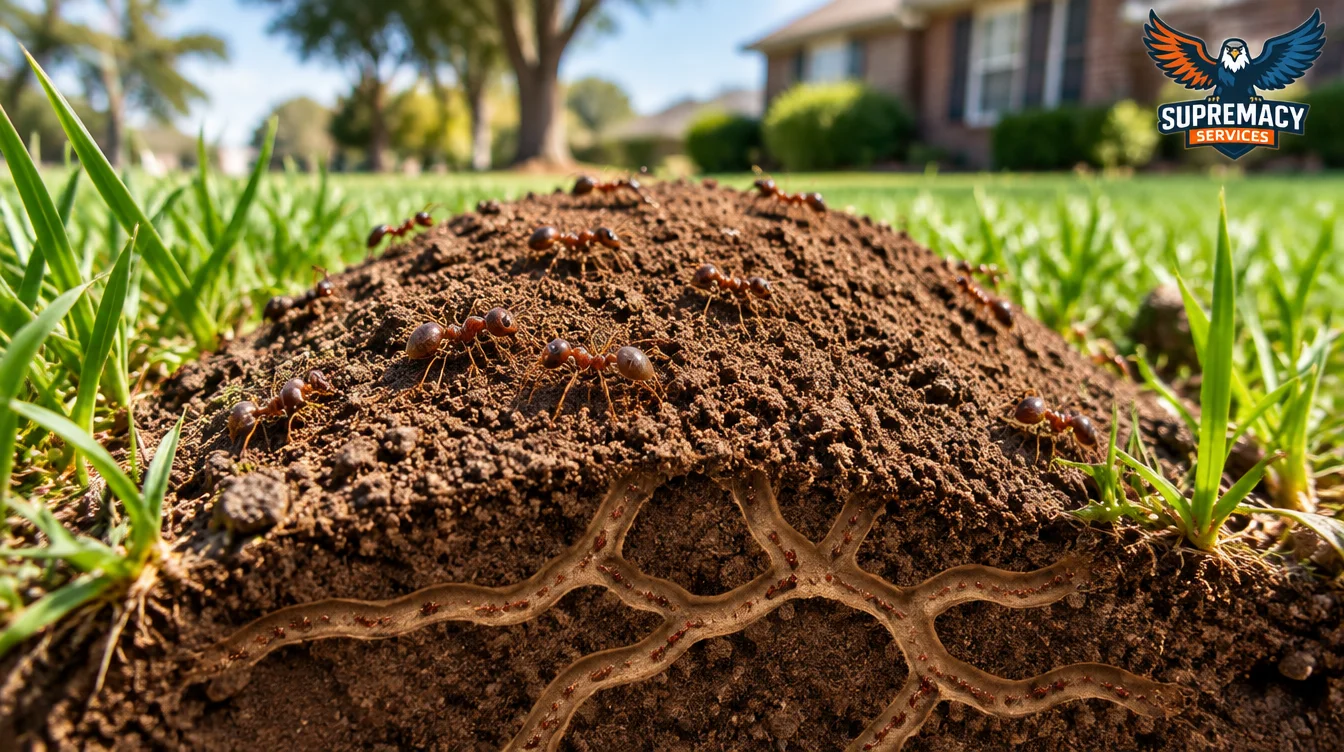
Fire ant control in Texas works best when you treat the colony rather than simply killing the ants visible on the surface. For many residential yards, that means combining an appropriately labeled broadcast bait with targeted treatment of problem mounds and then monitoring the property for new activity.
That distinction matters because a fire-ant mound is only the visible part of a much larger underground colony. Treating random workers—or repeatedly knocking down the mound—does not necessarily reach the queen or eliminate the colony.
For Dallas-Fort Worth homeowners, the goal should therefore be more than making a mound disappear. Effective management means correctly identifying fire ants, selecting a treatment method appropriate for the property, applying it under suitable conditions, and reducing the chance that new colonies will become established.
Table of Contents
- How Do You Know If You Have Fire Ants?
- Why Fire Ants Are a Problem in North Texas
- What Is the Best Way to Control Fire Ants?
- Broadcast Bait vs. Individual Mound Treatment
- How to Treat Fire Ants Step by Step
- When Is the Best Time to Treat Fire Ants?
- Why Fire Ants Seem to Appear After Rain
- DIY vs. Professional Fire Ant Control
- How Much Does Fire Ant Treatment Cost?
- How to Prevent Fire Ants From Taking Over Your Yard
- What Professional Fire Ant Service Should Include
- Fire Ant FAQs
How Do You Know If You Have Fire Ants?
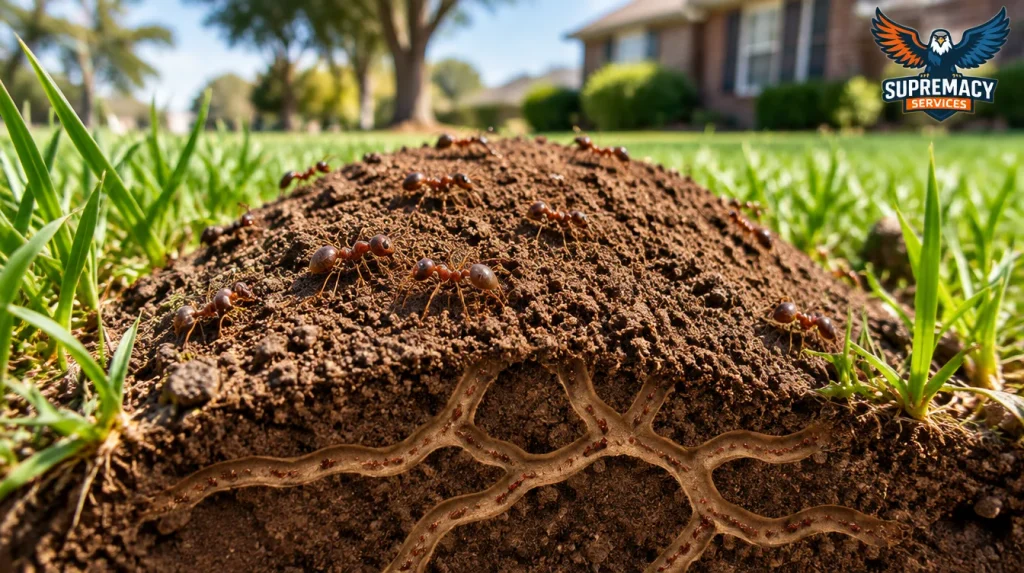
Fire ants commonly build loose-soil mounds without the obvious center entrance found on many other ant nests. When disturbed, numerous reddish-brown workers may quickly emerge and aggressively defend the colony.
Texas A&M notes that red imported fire-ant workers vary in size, generally about 1/8 to 1/4 inch long. Their variation in worker size can help distinguish them from some other ants. Fire-ant workers can also sting repeatedly.
Common signs around a North Texas yard
Look for:
- loose or fluffy mounds of worked soil;
- mounds without an obvious central entrance;
- reddish-brown ants of different sizes;
- large numbers of workers rapidly emerging when a mound is disturbed;
- recurring mounds in lawns or sunny open areas;
- ants around sidewalks, landscape edges, trees or other disturbed ground;
- painful stings after stepping or working near a colony.
Mounds may become especially easy to notice following rainfall. Texas A&M specifically identifies freshly worked soil a few days after heavy rain as a useful identification clue.
Fire ants are not the only ants in Texas
Do not assume every mound contains fire ants.
Texas supports numerous ant species, including pyramid ants, harvester ants, bigheaded ants and other native or introduced species. Some have substantially different behavior and management requirements.
Correct identification should come before treatment.
Why Fire Ants Are a Problem in North Texas
Fire ants are more than a cosmetic lawn problem because they aggressively defend their colonies and can sting people and animals repeatedly.
Red imported fire ants prefer open, sunny environments including lawns, parks, fields and other turf areas. Colonies can also occur around trees, stumps and structures.
Around a home, that creates problems where people naturally spend time:
- lawns;
- children’s play areas;
- patios;
- gardens;
- sidewalks;
- dog runs;
- pool surroundings;
- landscape beds.
A mound near an unused corner of a large property creates a different exposure risk from one beside a swing set or frequently used patio.
What happens when a fire ant stings?
Fire ants bite to gain a grip and use their stinger repeatedly. A sting commonly causes an immediate burning sensation, followed later by a characteristic white pustule.
Some people can experience serious allergic reactions.
Seek urgent medical attention for severe symptoms such as difficulty breathing, significant swelling, chest pain or other signs of a systemic allergic reaction.
What Is the Best Way to Control Fire Ants?
For many yards with multiple colonies, Texas A&M recommends a two-step approach: broadcast an appropriately labeled fire-ant bait across the affected area and use individual mound treatments where faster control is needed.
The two methods solve different problems.
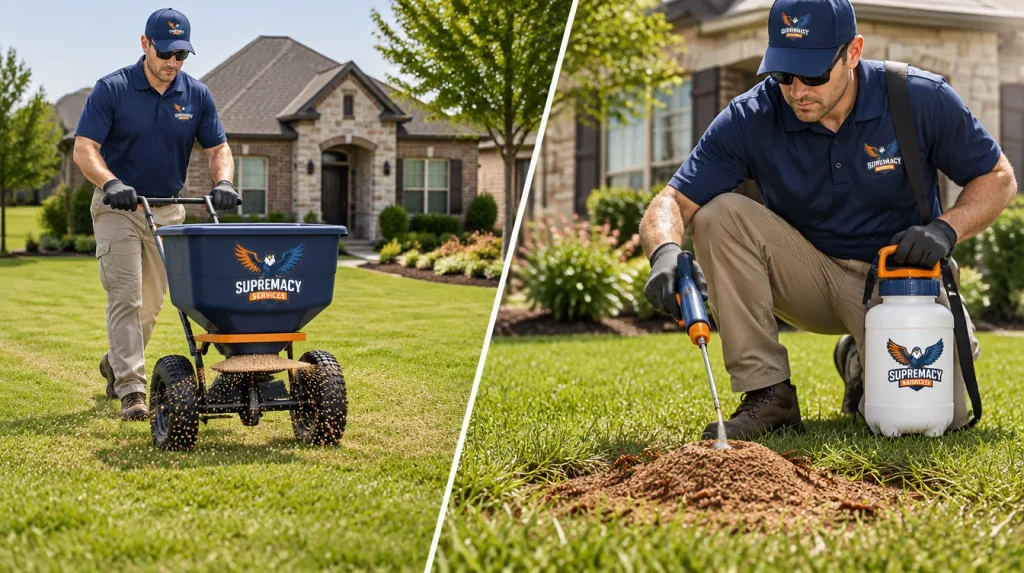
Broadcast treatment targets colonies across a larger area—including colonies that may not yet have an obvious mound.
Individual mound treatment focuses on a specific known colony.
Using the appropriate combination can therefore provide broader control than walking around the yard treating only the mounds you happen to see.
The Texas A&M two-step concept
Step 1: Broadcast bait
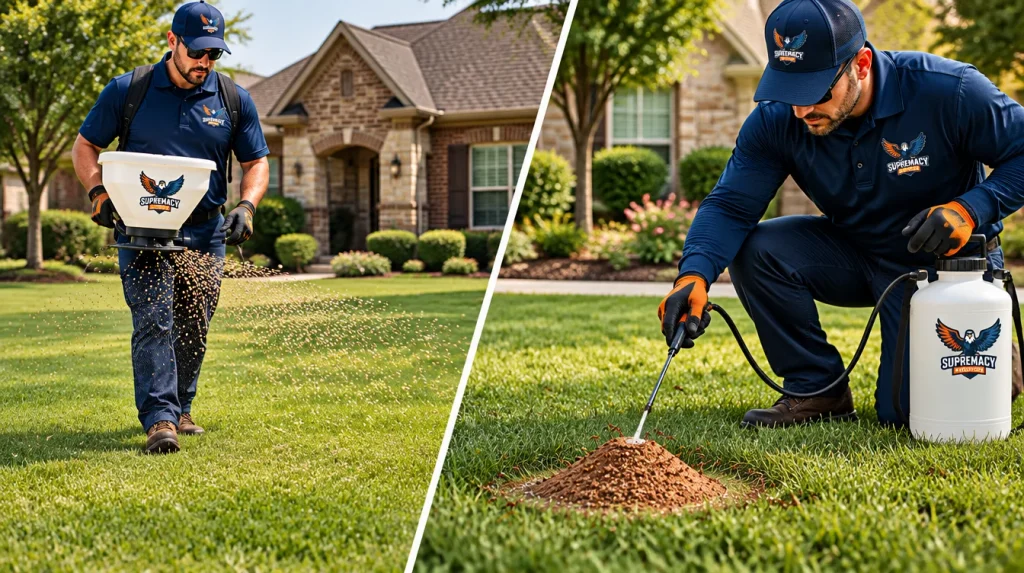
Apply a fire-ant bait labeled for broadcast application over the treatment area according to its label.
Foraging workers collect the bait and carry it back toward the colony.
Step 2: Treat problem mounds
Individual mound treatments can be used where a specific colony requires more immediate control.
Texas A&M describes options including labeled drenches, dusts and granular mound treatments. Application methods differ, which is why following the product label is essential.
Broadcast Bait vs. Individual Mound Treatment
| Method | Best suited for | Main advantage | Important limitation |
|---|---|---|---|
| Broadcast fire-ant bait | Multiple or widespread colonies | Treats a broader area, including less-visible colonies | Usually requires suitable weather and active foraging |
| Individual mound bait | Clearly identified mound | Targets a known colony | Does not address other colonies across the property |
| Mound drench | Mounds requiring faster intervention | Can act relatively quickly | Every mound must be located and correctly treated |
| Labeled granular mound treatment | Individual colonies | Targeted application | Application and watering requirements vary by label |
| Professional whole-yard program | Recurring or widespread pressure | Property-wide assessment and treatment plan | Requires professional service cost |
The right method depends on how many colonies are present, how quickly control is needed, property size, treatment location and the product label.
How to Treat Fire Ants Step by Step
1. Confirm that they are actually fire ants
Look at the mound structure, worker appearance and behavior.
Avoid identifying an ant species solely by color.
If identification is uncertain, a pest-management professional can inspect the activity before treatment.
2. Map active mounds
Walk the property carefully and note activity around:
- lawns;
- landscaping;
- pavement edges;
- utility equipment;
- fence lines;
- playgrounds;
- pet areas;
- garden beds.
Do not unnecessarily kick or disturb mounds while inspecting.
3. Decide between spot treatment and broader management
One isolated mound may call for a different strategy from ten or twenty colonies spread across a yard.
If fire ants repeatedly appear throughout the property, focusing exclusively on individual mounds can become an endless cycle.
This is where broadcast management becomes particularly useful.
Need help with widespread fire-ant activity? Supremacy’s professional Fire Ant Yard Shield service is designed specifically for Dallas-Fort Worth properties where homeowners want whole-yard treatment rather than repeatedly chasing individual mounds.
4. Check weather and soil conditions
Conditions matter particularly when using bait.
Texas A&M recommends applying bait when the ground and grass are dry and rain is not expected for roughly the next 24–48 hours. Worker ants should also be actively foraging.
Always defer to the specific product label because application instructions differ among products.
5. Apply exactly as directed
More pesticide does not automatically produce better control.
Follow the label for:
- application rate;
- approved treatment areas;
- watering requirements;
- re-entry precautions;
- proximity restrictions;
- storage;
- disposal;
- reapplication intervals.
The label—not a social-media tip or generic online recommendation—should determine how a pesticide product is used.
6. Recheck the property
Do not judge success solely by whether the mound looks flatter the next morning.
Monitor for continuing activity and newly established colonies.
Fire-ant management is usually better viewed as an ongoing property-management issue than as a permanent one-time eradication.
Texas A&M notes that red imported fire ants cannot currently be permanently eradicated across large infested regions, although populations can be greatly reduced or temporarily eliminated from smaller areas.
When Is the Best Time to Treat Fire Ants?
Bait works best when fire ants are actively foraging and the ground is dry enough for the bait to remain attractive. Avoid applying bait immediately before expected rain unless the particular product label explicitly allows it.
Texas A&M recommends dry ground and grass, with no rain expected for approximately 24–48 hours, for its two-step bait approach. It also suggests confirming activity by placing a small amount of bait near a mound and checking whether workers find it within about 30 minutes.
A more recent Texas A&M AgriLife recommendation notes that bait application is appropriate when temperatures are warm enough for active foraging and advises avoiding application close to rain.
Why timing matters
Bait depends on worker ants finding the material and carrying it back.
Wet, stale or poorly timed bait can be less attractive.
That means successful treatment is partly about ant behavior, not simply choosing a pesticide.
Why Fire Ants Seem to Appear After Rain
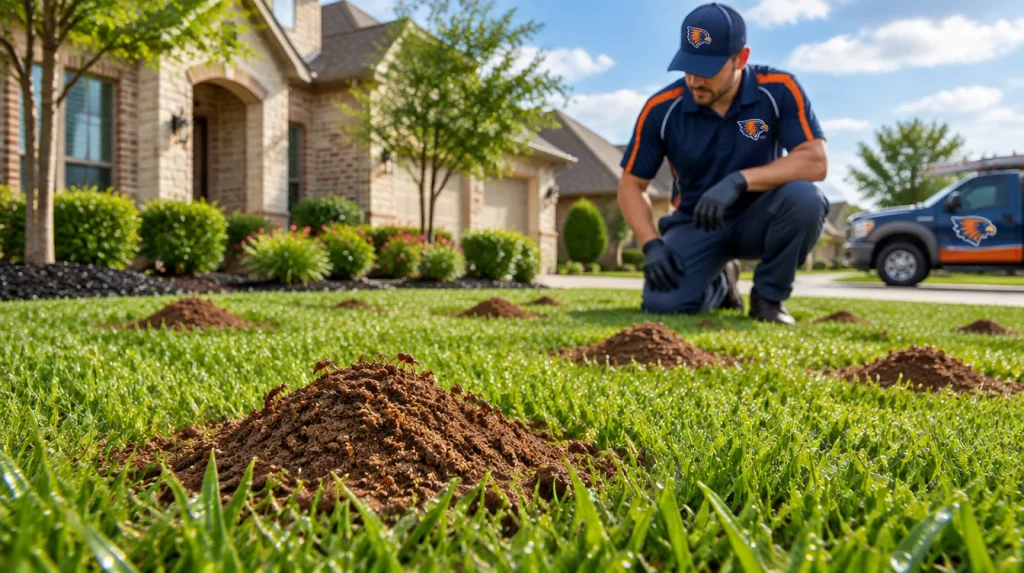
Rain can make existing fire-ant activity much more visible because colonies work soil and rebuild their mound structures after wet weather. Flooding can also force colonies to relocate.
That is why homeowners may walk outside after a rainy period and suddenly notice several fresh mounds.
It does not necessarily mean all of those colonies appeared overnight.
Texas A&M also documents that flooding can displace colonies, which may form floating masses until they reach suitable ground and establish another nest.
For North Texas homeowners, post-rain inspections can therefore be useful for identifying active areas before outdoor events, lawn work or children’s play.
DIY vs. Professional Fire Ant Control
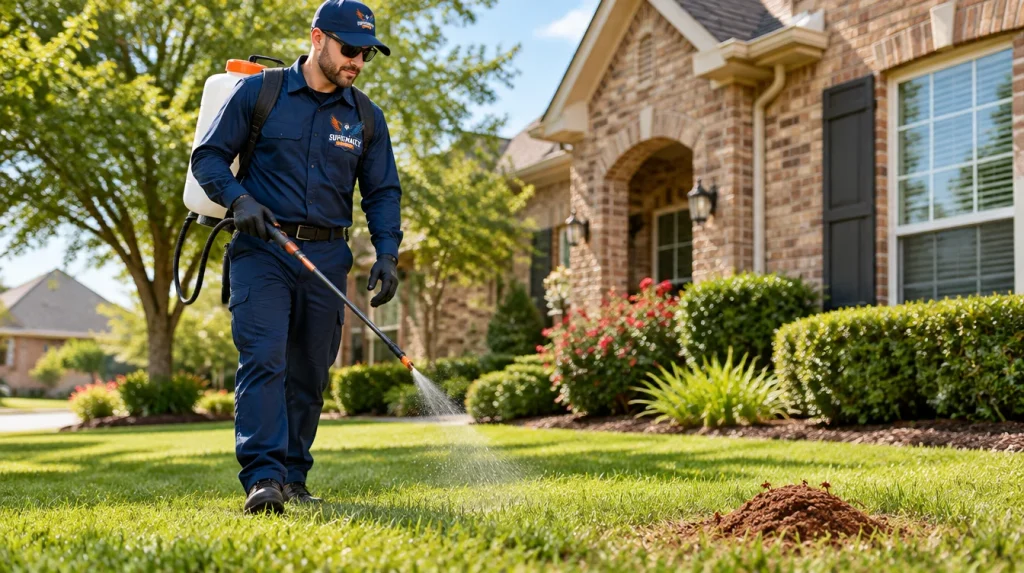
Some fire-ant problems can reasonably be handled by homeowners. Others become much easier to manage with professional treatment.
| Situation | DIY may be reasonable | Professional treatment becomes more useful |
|---|---|---|
| One or two accessible mounds | ✓ | |
| Correct identification is uncertain | ✓ | |
| Mounds repeatedly return | ✓ | |
| Colonies spread across a large lawn | ✓ | |
| Activity near children’s play areas | Possible with strict label compliance | ✓ |
| Heavy activity around pets | Possible with strict label compliance | ✓ |
| Multiple treatment attempts have failed | ✓ | |
| Large or complicated property | ✓ | |
| Homeowner cannot safely apply treatment | ✓ |
What DIY fire-ant control gets wrong most often
A common mistake is concentrating entirely on what can be seen.
Visible workers represent only part of the colony.
Another mistake is disturbing the mound before applying bait. Texas A&M recommends avoiding mound disturbance when using bait because defensive ants may be less likely to forage normally.
Do gasoline, bleach or household chemicals work?
Do not pour gasoline or other flammable liquids onto ant nests.
Texas A&M specifically warns against gasoline and similar flammable materials because they are dangerous and can contaminate soil.
What about boiling water?
Very hot water can kill some colonies, but Texas A&M reports only partial reliability and notes that it can damage surrounding grass and vegetation while creating a burn hazard.
That makes it a poor universal solution for landscaped residential lawns.
How Much Does Fire Ant Treatment Cost?
There is no responsible single price for professional fire-ant treatment without knowing the size of the property, infestation level, treatment method and service scope.
Important pricing variables include:
- lawn size;
- number and distribution of colonies;
- whether treatment covers individual mounds or the entire yard;
- treatment material;
- accessibility;
- recurring versus one-time service;
- follow-up or retreatment terms;
- whether other pest services are bundled with treatment.
Supremacy’s broader North Texas pest-control pricing guide provides general pest-management budgeting information, but those numbers should not be treated as fire-ant-specific pricing.
For fire ants, a property-specific quote is more useful than forcing general pest-control averages onto a specialized yard treatment.
If mounds are spread throughout your property, request a fire-ant assessment and compare the proposed treatment area, treatment method and follow-up coverage—not simply the initial price.
How to Prevent Fire Ants From Taking Over Your Yard

No realistic residential strategy can guarantee that fire ants will never enter a North Texas property again. Prevention is primarily about suppressing colonies, detecting new activity early and maintaining treatment where pest pressure warrants it.
Check the lawn regularly
Inspect:
- after periods of rain;
- before children’s outdoor activities;
- before hosting outdoor events;
- around gardens;
- near patios and sidewalks;
- around pet areas;
- before mowing heavily infested sections.
Address new colonies early
A newly noticed mound is easier to manage than numerous established colonies spread throughout the property.
Think beyond individual mounds
If mounds keep appearing in different parts of the yard, repeatedly spot-treating them may not provide the broad control you need.
A broadcast strategy can address a larger treatment area.
Follow a sensible maintenance schedule
Texas A&M notes that broadcast baits may be reapplied periodically as part of a fire-ant management program. The appropriate interval depends on the chosen product and its label.
Never create your own pesticide schedule that exceeds label directions.
What Professional Fire Ant Service Should Include
A professional visit should start with the property rather than immediately applying material.
A useful service should generally involve:
Identification
The technician should determine whether the problem is actually fire ants and distinguish it from other ant activity.
Property assessment
The yard should be evaluated for visible mounds, widespread activity, sensitive locations and treatment boundaries.
Treatment selection
The treatment method should reflect the infestation rather than using the same approach automatically on every property.
Label-compliant application
Professional pesticide use in and around structures is regulated in Texas. The Texas Department of Agriculture’s Structural Pest Control Service licenses pest-management professionals performing applicable pest-control services.
Homeowner instructions
You should know:
- where treatment was applied;
- whether watering is required;
- when people and pets may return to treated areas;
- what activity to expect afterward;
- when the property should be checked again;
- what the service agreement actually covers.
These instructions should reflect the specific pesticide label and service performed, not a generic rule.
Fire Ants vs. Other Ants
Not every outdoor ant should be eliminated automatically.
Texas contains many ant species, and some native ants compete with imported fire ants.
| Feature | Imported fire ants | Other lawn ants |
|---|---|---|
| Worker size | Workers vary noticeably in size | Depends on species |
| Mound opening | Usually no obvious central entrance | Some species have visible entrance holes |
| Reaction to disturbance | Often rapidly and aggressively emerge | Varies |
| Sting risk | Can sting repeatedly | Varies by species |
| Treatment | Fire-ant-specific management often required | Depends on identification |
If you cannot confidently identify the ants, identify the species before choosing a pesticide.
Fire Ant FAQs
What is the best way to get rid of fire ants in a North Texas yard?
For widespread activity, Texas A&M recommends a two-step approach involving broadcast fire-ant bait followed by treatment of individual problem mounds when necessary. Always use products labeled for the site and follow label directions.
Should I treat the mound or the entire yard?
An isolated colony may justify individual mound treatment. If mounds occur throughout the lawn or repeatedly return, a broader broadcast strategy can target colonies beyond the obvious mounds.
Why do fire-ant mounds suddenly appear after rain?
Wet conditions make freshly worked mound soil easier to see, and colonies may rebuild or relocate following significant rain or flooding.
Does destroying a mound kill the fire ants?
Physically flattening or kicking apart a mound does not reliably eliminate the underground colony. Effective treatment must address the colony rather than simply removing the visible mound.
Can fire ants sting dogs?
Yes. Fire ants can sting animals as well as people. Pay particular attention to colonies around dog runs, fences, kennels and other places pets regularly use.
Can fire ants come inside a house?
Yes. Although fire ants commonly nest outdoors, Texas A&M notes that colonies can occur under or around structures and may migrate indoors under certain conditions.
How quickly does fire-ant bait work?
It depends on the active ingredient and product. Some baits are intentionally slower acting because workers must collect and distribute them through the colony. Use the product label—not a universal online timeline—to determine expected results.
Can I permanently eliminate fire ants from my property?
You can substantially reduce or temporarily eliminate colonies from a treated area, but reinvasion is possible. Texas A&M states that permanent eradication across broadly infested regions is not currently practical.
When should I call a professional?
Consider professional treatment when colonies are widespread, mounds continually return, identification is uncertain, sensitive areas are affected, DIY treatment has not worked, or you prefer a whole-property management approach.
Take Back Your North Texas Yard
A fire-ant problem is easier to control when you stop thinking mound by mound.
Identify the pest correctly, determine how widespread the colonies are, use properly labeled treatments under suitable conditions, and monitor the lawn for new activity.
For homeowners dealing with recurring or widespread colonies, professional whole-yard treatment can remove much of the guesswork involved in product selection, application and follow-up.
If fire-ant mounds are taking over your Dallas-Fort Worth lawn, explore Supremacy Services’ Fire Ant Yard Shield and request a property-specific treatment assessment.

