
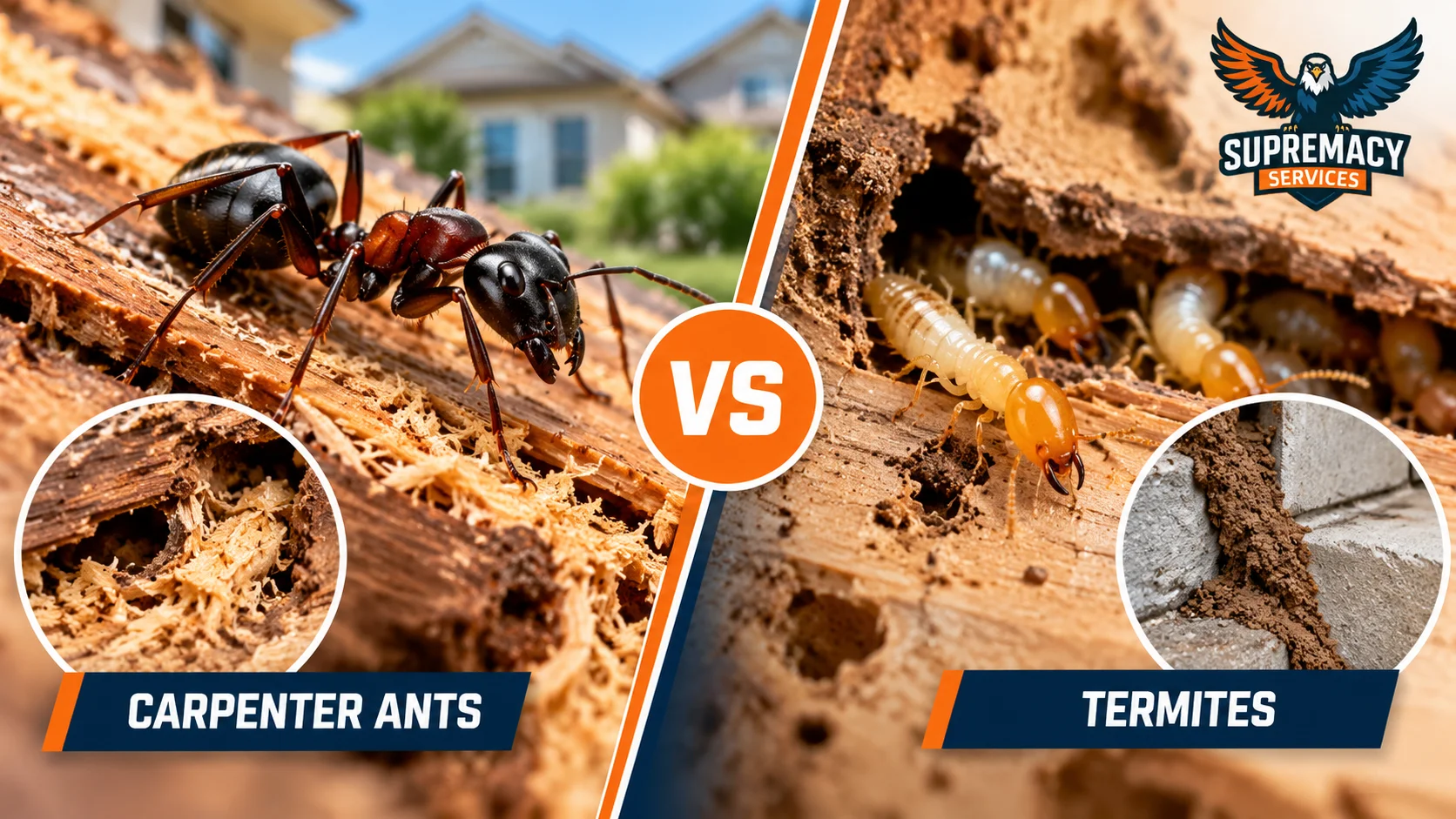
Carpenter ants and termites can both be associated with wood, but they affect it in fundamentally different ways. Carpenter ants excavate wood to create nesting galleries; they do not eat the wood. Termites consume cellulose and can feed directly on structural wood. Texas A&M AgriLife specifically notes this distinction and warns that winged carpenter ants and termites can appear at the same time in Texas.
For Dallas-Fort Worth homeowners, identification should come before treatment. Look at the insect itself, but also examine the evidence around it: sawdust-like debris, smooth galleries and moisture-damaged wood point more toward carpenter ants, while mud tubes and concealed wood consumption are stronger indicators of subterranean termites.
Finding either insect around wood does not tell you how extensive the problem is. When the identification is uncertain—or structural wood appears affected—an inspection is more useful than guessing from a single sign.
Table of Contents
- Carpenter Ants vs. Termites: Quick Comparison
- What Are Carpenter Ants?
- What Are Termites?
- How to Tell Carpenter Ants From Termites
- Carpenter Ant Damage vs. Termite Damage
- What Does Carpenter Ant Frass Look Like?
- Where Carpenter Ants Nest
- What to Do If You Find Suspicious Wood Damage
- DIY vs. Professional Inspection
- Prevention
- Dallas-Fort Worth Considerations
- FAQs
Carpenter Ants vs. Termites: Quick Comparison
The simplest difference is that carpenter ants excavate wood to make nesting space, while termites consume cellulose as food. The insects and the evidence they leave behind also differ.
| Feature | Carpenter ants | Termites |
|---|---|---|
| What they do to wood | Excavate galleries for nesting | Consume cellulose |
| Worker appearance | Usually relatively large, darker and clearly ant-like | Workers generally pale, soft-bodied |
| Antennae | Elbowed | Relatively straight/bead-like |
| Waist | Narrow/constricted | Broad |
| Winged forms | Front wings longer than rear wings | Four wings roughly equal in length |
| Wood galleries | Typically relatively clean/smooth | Often irregular; may contain soil or debris depending on termite type |
| Debris | May push coarse sawdust-like frass from galleries | Subterranean termites do not normally produce carpenter-ant-style piles of wood shavings |
| Mud tubes | No | Common evidence of subterranean termites |
| Relationship with moisture | Frequently associated with damp, decayed or compromised wood | Moisture and soil conditions can facilitate subterranean termite activity |
| Treatment | Nest/source-specific ant management | Termite-specific inspection and treatment |
Texas A&M AgriLife describes Texas carpenter ants as insects that hollow out wood or excavate insulation to establish nests but do not eat wood. The agency also emphasizes that correctly distinguishing carpenter ants from termites matters because their control methods differ substantially.
What Are Carpenter Ants?
Carpenter ants are ants in the genus Camponotus. They create nesting galleries by excavating wood rather than consuming it.
In Texas, carpenter ants may be black, reddish, yellowish-red or combinations of those colors. Texas A&M reports worker carpenter ants at roughly ¼ to ⅝ inch long, with winged reproductives potentially larger.
An important Dallas-homeowner clue is moisture.
Carpenter-ant activity can indicate damp, decayed or otherwise compromised wood. Texas A&M notes that infestations are often associated with conditions such as moisture and rotting wood.
That means discovering carpenter ants should trigger two questions:
- Where is the colony or satellite nest?
- Is a moisture or wood-decay problem helping support it?
Killing individual ants walking across a countertop does not necessarily answer either question.
Do carpenter ants eat wood?
No. Carpenter ants do not eat wood.
They remove material to create nesting galleries. Their diet includes other food sources, including insects and sugary materials.
That distinction is one of the most important differences between carpenter ants and termites.
What Are Termites?
Termites are social insects that feed on cellulose-containing materials. Structural wood can therefore become a food source.
For Dallas-area homeowners, subterranean termites are particularly relevant because these termites live in association with soil and can reach structures through concealed routes.
They may construct shelter or mud tubes across foundations and other surfaces to move between soil and a food source.
This is why termite activity can be harder to detect than a trail of ants moving openly through a room.
Supremacy already has a detailed guide explaining what termite mud tubes look like. If you see a raised soil-like tunnel running across a foundation, wall, pier or penetration, compare it with those signs rather than assuming the material is ordinary dirt.
How to Tell Carpenter Ants From Termites
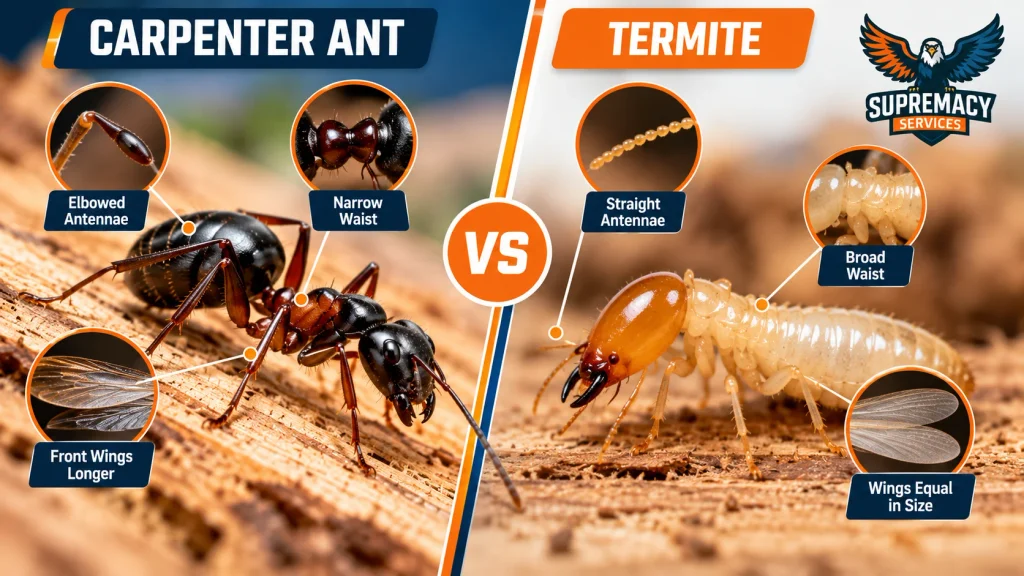
Use several clues together rather than relying on color or size alone.
1. Check the antennae
Carpenter ants have elbowed or bent antennae.
Termites have antennae that appear comparatively straight and bead-like.
This difference is easier to see on a dead specimen, close-up photograph or magnified image than on an insect moving quickly across the floor.
2. Look at the waist
Ants have a visibly constricted waist between the thorax and abdomen.
Termites lack that narrow ant-like waist and appear broader through the middle.
3. Compare wings—but only if the insects are winged
Winged carpenter ants have front wings that are longer than their rear wings.
Termite swarmers have two pairs of wings that are much closer to equal in length.
If winged insects are your primary concern, see Supremacy’s dedicated Flying Ants vs. Termites guide. That article covers swarmer identification in more depth, while this guide focuses primarily on carpenter-ant activity and wood evidence.
4. Look at the wood
The condition of the wood may be more useful than the insect itself.
Carpenter ants excavate galleries and remove material from their nesting areas.
Termites actually consume cellulose.
The resulting evidence can therefore look different.
Carpenter Ant Damage vs. Termite Damage
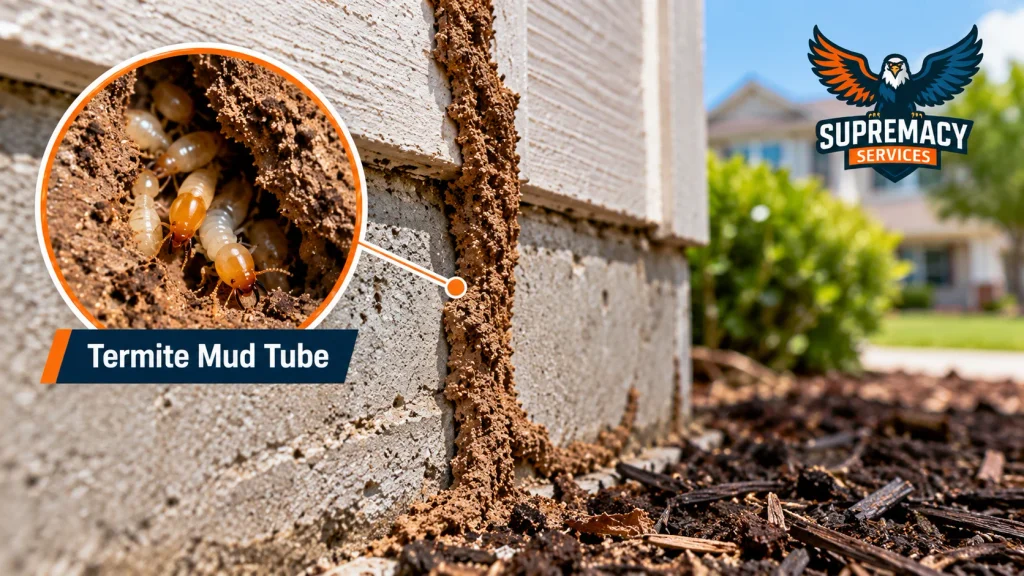
Carpenter-ant galleries tend to look excavated and relatively clean, while termite damage results from the wood actually being consumed.
Carpenter-ant galleries
Carpenter ants remove wood while enlarging their nesting spaces.
Possible clues include:
- smooth internal galleries;
- openings or cracks associated with nesting areas;
- coarse sawdust-like material nearby;
- insect fragments mixed with debris;
- activity around damp or deteriorated wood;
- ants repeatedly emerging from the same wall, trim or structural area.
Texas A&M notes that carpenter ants may excavate wood or insulation and that their presence can be associated with moisture and rotting wood.
Termite-damaged wood
Subterranean termite damage can remain concealed beneath the surface of wood.
Possible accompanying evidence includes:
- mud or shelter tubes;
- soil associated with concealed pathways;
- damaged or hollowed wood;
- termite workers;
- swarmers;
- piles of shed wings after a swarm.
A key distinction is that subterranean termites can connect their soil environment to structural wood using mud tubes. Carpenter ants do not construct termite-style shelter tubes.
If you find an actual raised mud passage on a foundation, prioritize termite investigation rather than carpenter-ant treatment.
What Does Carpenter Ant Frass Look Like?
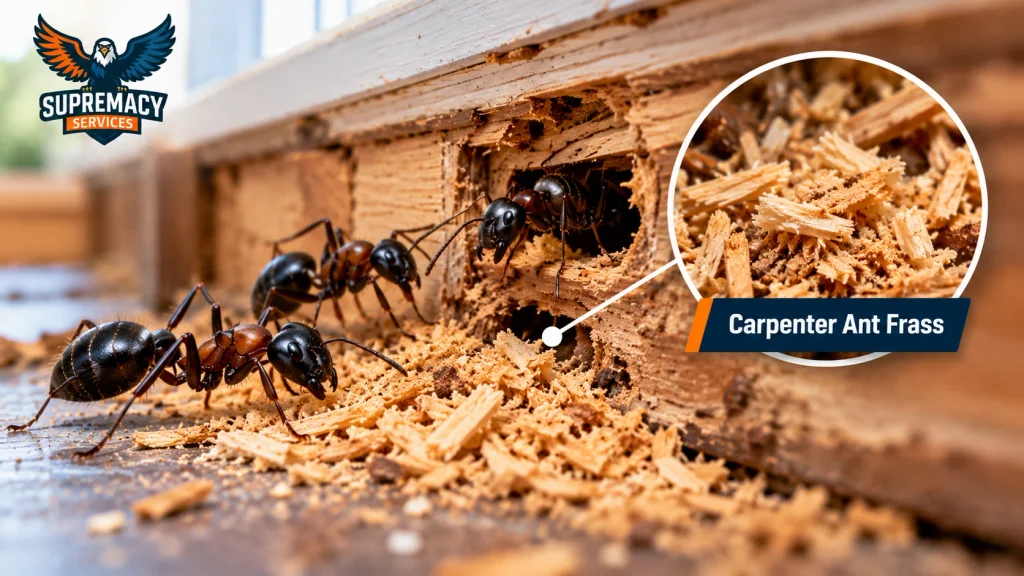
Carpenter-ant frass often resembles coarse sawdust or wood shavings pushed out of nesting galleries.
As carpenter ants excavate a nest, they have to remove the material they loosen.
You may therefore find small accumulations beneath:
- wall openings;
- window or door trim;
- baseboards;
- wooden beams;
- attic framing;
- porch components;
- roof or fascia areas;
- other wooden structural features.
The material may contain more than wood particles. Debris removed from a nest can also contain insect fragments and other material.
Carpenter-ant frass vs. termite evidence
Do not assume every pile of wood-colored debris means termites.
| Evidence | More consistent with carpenter ants | More consistent with subterranean termites |
|---|---|---|
| Coarse sawdust/wood shavings | ✓ | |
| Smooth excavated galleries | ✓ | |
| Mud shelter tubes | ✓ | |
| Soil associated with wood pathways | ✓ | |
| Visible large ants | ✓ | |
| Pale termite workers | ✓ | |
| Shed swarmer wings | Possible | Possible |
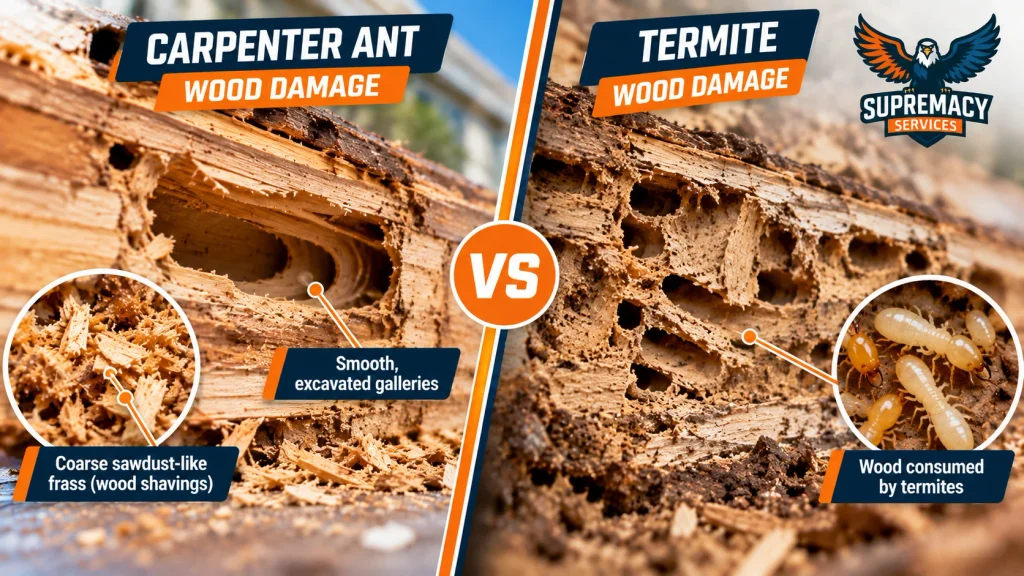
One sign by itself is not always enough for identification.
Photograph the insect and the surrounding evidence before cleaning everything away.
Where Do Carpenter Ants Nest in a House?
Carpenter ants often favor wood affected by moisture, deterioration or previous damage.
Around a Dallas-area home, investigate accessible areas such as:
- window and door frames;
- roof edges and fascia;
- areas around plumbing leaks;
- attic framing near roof leaks;
- porch or deck connections;
- wall areas around penetrations;
- wood near poorly drained areas;
- damaged exterior trim;
- tree limbs or stumps close to the structure.
An indoor carpenter-ant problem can also originate from an outdoor colony.
Seeing workers foraging indoors does not automatically tell you where the main nest is located.
Why moisture deserves attention
A leaking pipe, roof leak, damaged flashing, condensation problem or persistent exterior moisture can deteriorate wood and make an area more suitable for carpenter-ant nesting.
Correcting that condition is important even if pest treatment is also needed.
Seeing large ants repeatedly emerging from the same wall, trim or damp wooden area? Supremacy Services can help identify the pest and determine whether you’re dealing with carpenter ants, termites or another structural pest before treatment begins.
Does Seeing Carpenter Ants Mean Your House Has Structural Damage?
Not necessarily.
Texas A&M specifically notes that carpenter ants in Texas generally cause less structural damage than carpenter ants in some other regions and that they rarely cause significant damage to framing lumber. Their presence can nevertheless reveal moisture, decay or another condition that deserves investigation.
That distinction prevents two common mistakes:
Mistake 1: “They’re carpenter ants, so the house must be severely damaged.”
That conclusion is not supported simply by seeing the ants.
Mistake 2: “They’re only ants, so I can ignore them.”
Recurring activity, a nest inside structural material, unexplained frass or moisture-damaged wood still warrants investigation.
The goal is to determine what is present, where it is nesting and why that location is attractive.
Carpenter Ants vs. Termite Swarmers
Winged carpenter ants and termite swarmers are easy to confuse.
Texas A&M notes that both may swarm at the same time in Texas, making correct identification especially important.
Remember the three-point test:
Ant: elbowed antennae + pinched waist + unequal wing pairs.
Termite: straighter antennae + broad waist + roughly equal wing pairs.
Because Supremacy already has a complete article dedicated to flying ants versus termites, avoid expanding this subsection into another full swarmer guide.
That keeps both pages focused and prevents keyword cannibalization.
What Should You Do If You Find Suspicious Wood Damage?
Step 1: Photograph what you found
Take both close-up and wider photographs.
Capture:
- insects;
- wings;
- frass;
- damaged wood;
- mud-like material;
- the surrounding wall or foundation.
Context can help with identification.
Step 2: Save a specimen if practical
If you safely find a dead insect, keeping it in a sealed container can make identification easier.
Do not deliberately damage structural material simply to obtain a specimen.
Step 3: Look for additional evidence
Check nearby accessible areas for:
- large ants;
- recurring ant trails;
- sawdust-like debris;
- moisture damage;
- mud tubes;
- discarded wings;
- hollow or deteriorated wood;
- plumbing or roof leaks.
Step 4: Check for moisture
Look for obvious sources such as:
- leaking pipes;
- roof leaks;
- irrigation wetting the structure;
- drainage problems;
- damaged exterior wood;
- persistent condensation.
Correcting a moisture problem is worthwhile property maintenance, but it does not establish that an existing pest colony has disappeared.
Step 5: Avoid treating before identifying
A random insecticide application can kill insects you can see without locating the colony or determining whether the problem is even carpenter ants.
More importantly, carpenter-ant and termite treatments are not interchangeable. Texas A&M explicitly cautions that treatments for termites or other pests will not necessarily control carpenter ants.
Step 6: Get an inspection when termite evidence is possible
If you see mud tubes, suspected termite workers, substantial wood damage or unexplained swarmers, termite evaluation becomes more important than continued DIY experimentation.
Not sure whether the damage came from carpenter ants or termites? Have the evidence identified before choosing a treatment. Explore Supremacy Services’ Termite Vault Security options for suspected termite activity in Dallas-Fort Worth.
DIY vs. Professional Inspection
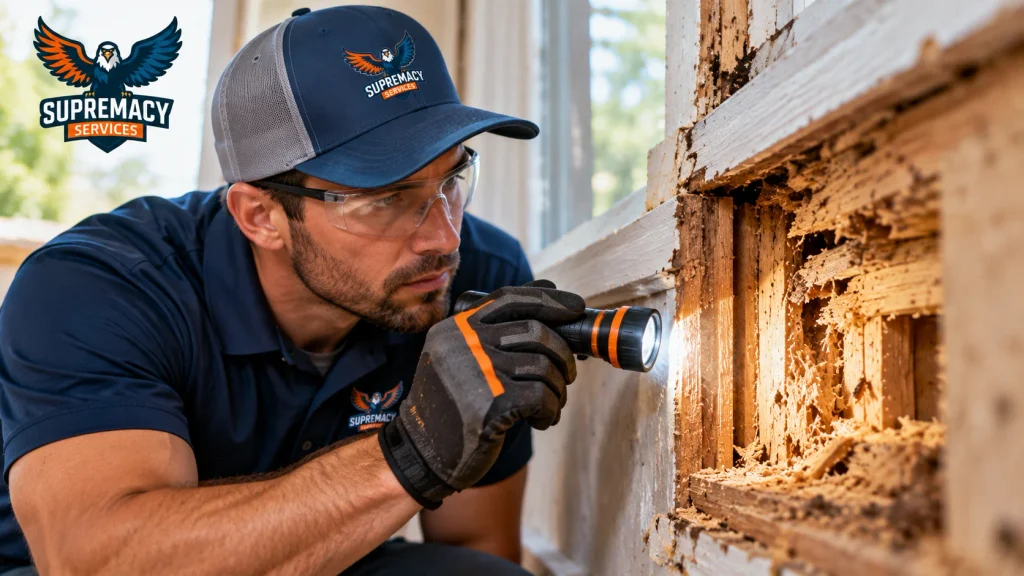
Homeowners can perform useful visual checks, but identification becomes more difficult when activity disappears inside walls or structural wood.
DIY monitoring is reasonable when:
- you have only occasional ants;
- there is no obvious structural damage;
- you can photograph or collect the insect;
- the source is accessible;
- you are investigating an obvious moisture problem;
- activity stops after correcting sanitation or entry conditions.
Professional evaluation becomes more appropriate when:
- ants repeatedly emerge from walls or wood;
- frass keeps reappearing;
- you cannot locate the nest;
- damaged structural wood is visible;
- mud tubes are present;
- swarmers emerge indoors;
- you cannot determine whether the insects are ants or termites;
- activity continues after reasonable preventive measures;
- a real-estate transaction requires formal wood-destroying-insect evaluation.
Texas treats structural pest control as a regulated activity. The Texas Department of Agriculture licenses businesses and individuals who perform structural pest identification, inspection and control for compensation, with termite control treated as a specific licensing category.
What Does Professional Service Include?
The appropriate process depends on which pest is actually present.
A carpenter-ant investigation may involve evaluating:
- where workers are appearing;
- likely nest locations;
- moisture-damaged wood;
- exterior colony sources;
- entry points;
- wall or structural voids;
- plumbing or roof moisture;
- tree or landscape conditions near the structure.
Termite evaluation follows a different path and may include:
- accessible foundation areas;
- mud tubes;
- structural wood;
- slab or utility penetrations;
- previous termite evidence;
- conducive moisture conditions;
- evidence of previous treatment;
- termite entry routes.
If termite treatment is proposed, Texas requires specified consumer disclosures. TDA states that a proposal must include information such as a treatment diagram, approximate perimeter measurement, areas of active or previous termite activity, warranty/guarantee terms, the chemical label and relevant liquid-treatment or bait-system information.
That is another reason not to treat “carpenter ants or termites” as one generic pest problem.
How to Reduce Carpenter Ant and Termite Risk
Prevention begins with moisture management, property maintenance and reducing conditions that make pest activity difficult to detect.
Repair moisture problems
Address:
- plumbing leaks;
- roof leaks;
- damaged flashing;
- persistent condensation;
- poor drainage;
- irrigation repeatedly soaking structural areas.
Replace badly deteriorated wood when appropriate
Decayed exterior trim, fascia and other compromised wood can provide attractive nesting conditions for carpenter ants.
Fix the moisture source before replacing damaged material so the same condition does not immediately return.
Keep vegetation managed
Tree branches and vegetation touching the structure can provide pest travel routes and make exterior inspection more difficult.
Avoid unnecessary wood-to-soil contact
Wood contacting soil can create conditions favorable to wood-destroying organisms and can make inspection more difficult.
Keep the foundation visible
Dense landscaping, stored materials and other obstructions can hide mud tubes or entry areas.
Inspect rather than spray automatically
When you see an unfamiliar insect, identify it first.
A pest-management decision based on the wrong species can waste time while the actual problem continues.
Dallas-Fort Worth Considerations
Dallas homeowners can encounter carpenter ants and termites during overlapping periods, so season alone is not a reliable identification method.
Texas A&M specifically notes that winged carpenter ants and termites can swarm at the same time in Texas.
DFW homes also vary significantly in construction, age, drainage, landscaping and moisture exposure. A slab-on-grade house with exterior wood deterioration presents a different inspection situation from a property with accessible crawlspace components.
Avoid assuming a pest is a termite simply because it appeared around wood—or assuming it is harmless because it looks like an ant.
The insect, wood evidence and property conditions should be considered together.
Carpenter Ants, Termites or Something Else?
Other insects can complicate identification.
Texas A&M notes that acrobat ants may be mistaken for carpenter ants because both can nest in dead wood. Acrobat ants are generally smaller and have different body characteristics.
Wood deterioration itself can also have non-insect causes.
For example:
- fungal decay can weaken damp wood;
- water damage can discolor or soften material;
- old insect damage may remain after activity ends;
- ordinary construction debris can resemble pest-generated material.
This is why “damaged wood” should be treated as evidence requiring diagnosis rather than a pest identification by itself.
Frequently Asked Questions
How can I tell if I have carpenter ants or termites?
Check several features together. Carpenter ants have elbowed antennae and a narrow waist and may leave sawdust-like debris from excavated galleries. Termites have broader bodies, straighter antennae and may be associated with mud tubes and wood that has actually been consumed.
Do carpenter ants eat wood like termites?
No. Carpenter ants excavate wood to create nesting galleries but do not eat it. Termites consume cellulose, including wood.
Which is worse: carpenter ants or termites?
The appropriate response depends on the pest and extent of activity rather than assuming the two cause identical problems. Texas A&M notes that Texas carpenter ants rarely cause significant framing damage, while termites are wood-consuming structural pests. Both should be correctly identified before treatment.
What does carpenter-ant damage look like?
Look for excavated galleries, openings in wood and coarse sawdust-like debris. Carpenter-ant galleries tend to be relatively clean because the ants remove excavated material from the nesting area.
Do carpenter ants make mud tubes?
No. Carpenter ants do not construct the soil shelter tubes characteristic of subterranean termites. A raised mud-like tunnel between soil and a structure should be investigated as possible termite evidence.
Does sawdust mean I have carpenter ants?
Not automatically. Carpenter ants can produce coarse sawdust-like debris while excavating galleries, but other insects, construction activity and wood deterioration can produce debris. Look for ants, galleries and recurring piles before drawing a conclusion.
Can carpenter ants and termites infest the same wood?
They can occur in the same general environment. Texas A&M notes that carpenter ants may nest in wood already rotten or damaged by termites. Finding carpenter ants therefore does not automatically rule out previous or separate termite activity.
Why am I finding carpenter ants inside my house?
Indoor activity can come from a nest inside the structure or ants foraging indoors from an outdoor colony. Moisture-damaged or deteriorated wood can provide suitable nesting conditions, so recurring activity should prompt inspection for both the colony source and moisture problems.
Should I spray carpenter ants when I see them?
Killing visible workers may not eliminate the nest. If ants repeatedly return, identifying their species, travel route and nesting source is more useful than repeatedly spraying individual insects.
When should I call a pest professional?
Consider professional inspection when ants repeatedly emerge from structural areas, frass returns after cleaning, wood appears damaged, you find mud tubes or swarmers, or you cannot confidently determine whether the insects are carpenter ants or termites.
Carpenter Ants or Termites? Identify the Problem Before Treating It
Carpenter ants and termites may both lead homeowners to suspicious wood, but they are not the same problem.
Remember the most useful distinctions:
Carpenter ants excavate wood. Termites eat cellulose.
Carpenter ants may leave coarse sawdust-like debris. Subterranean termites commonly create mud shelter tubes.
Ants have elbowed antennae and constricted waists. Termites have relatively straight antennae and broader bodies.
And when the evidence is unclear, identification should come before treatment.
For homeowners in Dallas, Frisco, Plano, McKinney, Allen, Richardson and surrounding DFW communities, Supremacy Services can inspect suspicious pest activity and determine whether the appropriate next step is general pest management or specialized termite service.
Found ants, mud tubes, unexplained wood debris or structural damage? Request a pest assessment from Supremacy Services to identify the problem before choosing a treatment.

