

Table of Contents
- When Does Mosquito Season Start in North Texas?
- North Texas Mosquito Season Month by Month
- Why Mosquito Activity Increases in Spring
- What Makes Mosquitoes So Active Around DFW Homes?
- When Should You Start Mosquito Prevention?
- How to Prepare Your Yard
- DIY vs. Professional Mosquito Control
- What Does Professional Mosquito Control Include?
- When Does Mosquito Season End?
- Frequently Asked Questions
When Does Mosquito Season Start in North Texas?
Mosquito activity can occur outside a fixed calendar, but April is a practical start to the main mosquito season across much of North Texas. Activity generally remains elevated through October, with Dallas officially identifying May 1 through October 30 as its 2026 mosquito season.
Several nearby DFW cities provide an even broader local benchmark. Richardson, Irving and Coppell say mosquito-control activity is increased from April through October, describing that period as the most active mosquito season in North Texas.
That does not mean the first mosquito suddenly appears on April 1.
Mosquito activity responds to environmental conditions rather than a date on the calendar. Warm periods, rainfall, irrigation and available standing water can support mosquito activity before or after the main season.
Dallas County consequently conducts mosquito surveillance and control efforts rather than relying solely on a calendar. Its mosquito-control program includes surveillance, larval and adult mosquito mitigation, public education and disease monitoring.
For DFW homeowners, the useful rule is simple:
Begin checking your property for mosquito breeding conditions before the main April–October activity period rather than waiting until your backyard is already full of biting adults.
North Texas Mosquito Season Month by Month
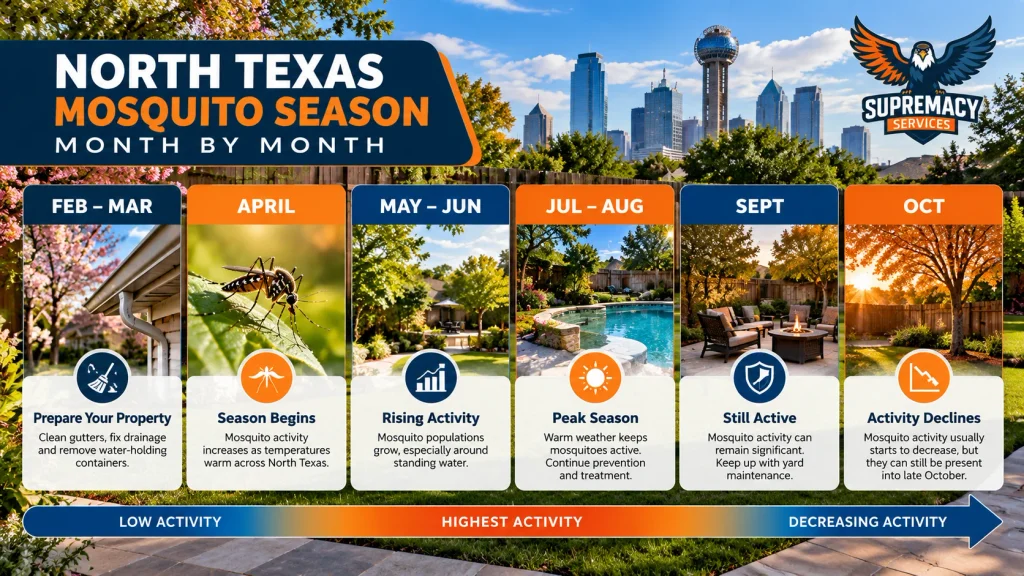
Mosquito activity varies from year to year, so the following should be understood as a practical seasonal framework rather than a prediction that every year will behave identically.
| Period | Typical homeowner concern | What to do |
|---|---|---|
| February–March | Preparation and occasional warm-weather activity | Clean gutters, inspect drainage and remove water-holding debris |
| April | Main North Texas activity period begins | Begin consistent weekly water inspections |
| May–June | Increasing mosquito pressure | Maintain source reduction and personal protection |
| July–August | Sustained warm-season activity | Continue prevention; do not let irrigation create standing water |
| September | Mosquito activity can remain significant | Continue protection despite approaching fall |
| October | Activity generally begins moving toward seasonal decline | Continue prevention while mosquitoes remain active |
| November–winter | Lower activity during colder periods, but not necessarily zero | Correct drainage and eliminate persistent breeding sites |
Richardson and Irving both identify April through October as the most active mosquito period in North Texas, while Dallas currently defines its official mosquito season as May 1 through October 30.
Does mosquito season start earlier after a warm winter?
It can.
A fixed calendar cannot account for every warm spell, rainfall event or protected mosquito habitat.
The better homeowner strategy is to watch conditions as well as dates. If temperatures have warmed and spring rain or irrigation is leaving water around your property, start inspecting for mosquito habitat even if peak summer biting has not arrived.
Why Mosquito Activity Increases in Spring
Mosquitoes depend heavily on water.
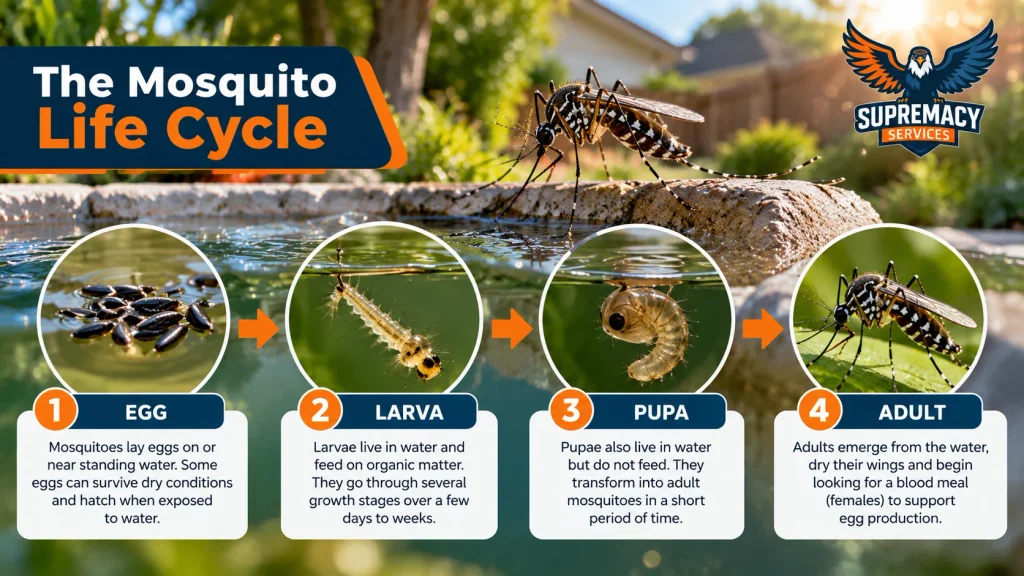
The EPA explains that mosquitoes develop through four stages:
egg → larva → pupa → adult
The first three stages are associated with water. Depending on species and environmental conditions, the mosquito life cycle can take from only several days to several weeks.
That biology explains why spring property maintenance matters.
Rainfall or irrigation can refill:
- plant saucers;
- buckets;
- children’s toys;
- clogged gutters;
- birdbaths;
- tarps;
- drainage areas;
- neglected containers;
- low areas around landscaping.
A container does not need to look like a pond to become relevant. EPA guidance lists items as small as bottle caps among possible mosquito breeding locations.
Why rainfall matters
Rain itself does not automatically create a mosquito infestation.
The issue is what happens after the rain.
Water left sitting in containers and poorly draining locations provides aquatic habitat where immature mosquitoes can develop.
Some mosquito eggs can also survive dry conditions for extended periods and hatch after they are exposed to water.
That is why a yard that seemed mosquito-free during a dry stretch can become noticeably different after changing weather conditions.
What Makes Mosquitoes So Active Around DFW Homes?
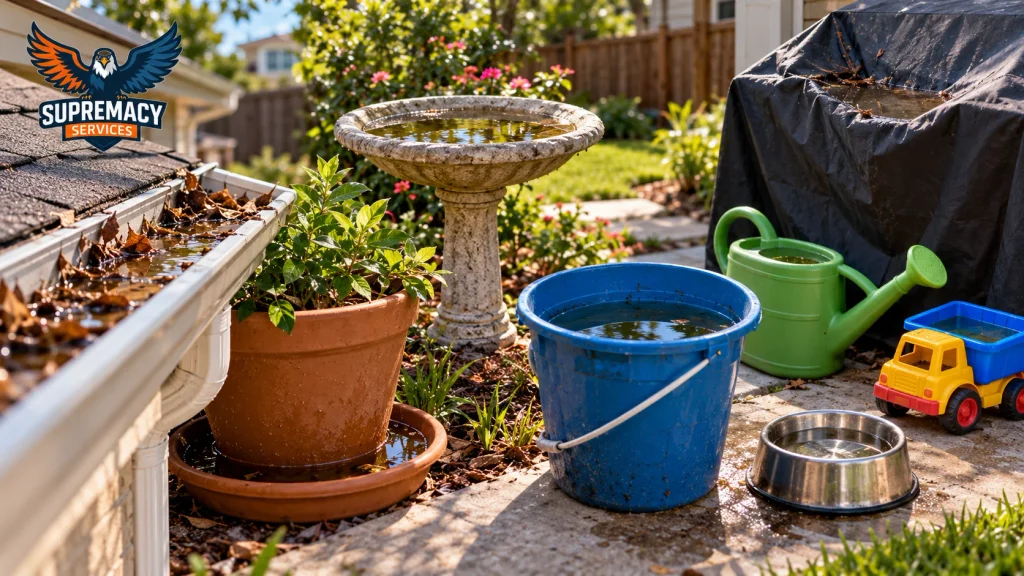
North Texas mosquito problems are rarely caused by one factor.
Around a Dallas-Fort Worth home, inspect the combination of water, vegetation, irrigation and drainage.
Standing water
This is the first place to look.
Dallas County emphasizes draining or treating standing water because it interrupts mosquito breeding.
Check:
- birdbaths;
- flowerpot saucers;
- buckets;
- toys;
- pool covers;
- trash containers;
- clogged gutters;
- wheelbarrows;
- tarps;
- pet water containers;
- landscape drainage;
- neglected pools;
- low areas that retain irrigation water.
Irrigation and drainage
A mosquito problem can persist even during periods without much rain if sprinklers repeatedly refill the same low spot or container.
The City of Dallas specifically advises homeowners to repair leaking outdoor faucets and sprinkler systems, avoid overwatering, correct low spots and keep gutters and downspouts draining properly.
Shaded outdoor areas
A property assessment should also look beyond obvious standing water.
Dense landscaping, patios, decks, fences and shaded areas can affect where adult mosquitoes spend time.
This is one reason mosquito management should distinguish between breeding habitat and adult mosquito activity.
Removing breeding habitat addresses one part of the problem; reducing exposure to adult mosquitoes is another.
Are Mosquitoes in North Texas Just an Annoyance?
No.
Most mosquito encounters result in an irritating bite, but mosquito management also has a public-health component.
Dallas County notes that mosquitoes can transmit diseases including West Nile virus and maintains mosquito surveillance and control activities accordingly.
The southern house mosquito is particularly relevant locally. Dallas County identifies it as active in the county and notes that mosquitoes associated with West Nile virus are especially active around dusk and dawn.
That does not mean every mosquito carries disease.
It means bite prevention and mosquito management should not be treated purely as a backyard-comfort issue.
When Should You Start Mosquito Prevention in North Texas?
Start mosquito prevention before mosquito populations become obvious—ideally during early spring property cleanup and no later than the beginning of the main April–October North Texas activity period.
The first step does not need to involve pesticides.
Start with habitat reduction.
A simple weekly routine can prevent many water sources from remaining available long enough to support mosquito development.
Early-season mosquito checklist
Before and during mosquito season:
- clean clogged gutters;
- remove unused buckets and containers;
- turn wheelbarrows and similar equipment upside down;
- empty water trapped in toys;
- check tarps and outdoor covers;
- inspect flowerpot saucers;
- repair irrigation leaks;
- correct areas where sprinklers create persistent pooling;
- maintain swimming pools;
- inspect drainage after rainfall;
- keep window and door screens in good repair.
The CDC recommends emptying, scrubbing, turning over, covering or throwing away water-holding items once a week.
Still seeing heavy mosquito activity after removing standing water? Explore Supremacy Services’ professional mosquito-control options for Dallas-Fort Worth properties.
How Can You Reduce Mosquitoes Around Your Yard?
Think in terms of three layers:
1. Remove breeding habitat
Eliminate unnecessary standing water wherever practical.
EPA describes habitat removal as a critical part of integrated mosquito control because mosquitoes require water during immature stages.
2. Prevent bites
Dallas County promotes the “4Ds”:
- Drain standing water.
- Dress in protective clothing.
- Use DEET or another EPA-approved repellent according to its label.
- Be especially cautious around dusk and dawn, when important local mosquito vectors can be particularly active.
Not every mosquito species follows exactly the same biting schedule, so repellent can still be relevant during daylight hours.
3. Address persistent mosquito pressure
If mosquitoes remain abundant despite correcting obvious water sources, inspect the entire property rather than repeatedly spraying whichever mosquito happens to be visible.
The source may involve:
- hidden standing water;
- neighboring habitat;
- stormwater features;
- dense vegetation;
- neglected containers;
- drainage problems;
- inaccessible water sources.
Persistent activity is where a professional property assessment can become useful.
DIY vs. Professional Mosquito Control
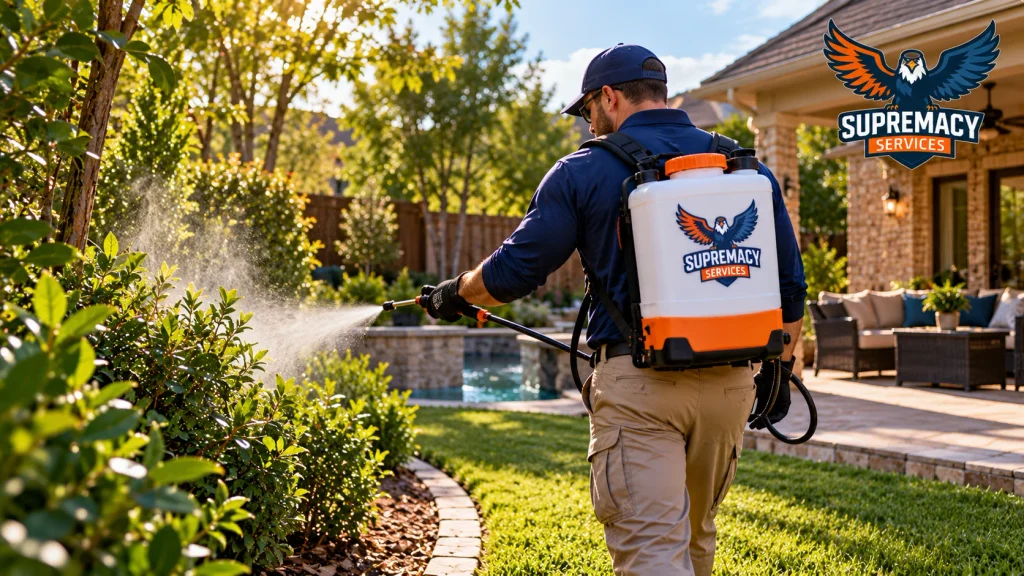
Many mosquito-prevention tasks belong firmly in the DIY category.
| DIY mosquito prevention | Professional assessment/control |
|---|---|
| Empty containers | Evaluate persistent mosquito pressure |
| Clean gutters | Identify overlooked habitat |
| Fix minor drainage issues | Assess adult resting areas |
| Maintain pools | Determine appropriate treatment areas |
| Repair screens | Apply professional products when appropriate |
| Use EPA-registered repellent | Build a recurring management strategy where justified |
| Follow product labels | Adjust treatment to property conditions |
When DIY mosquito prevention makes sense
Homeowners can and should eliminate accessible breeding habitat.
That remains important even when professional treatment is used.
Professional mosquito control should not become an excuse to leave buckets, blocked gutters and other unnecessary water sources around the property.
When professional mosquito service becomes reasonable
Consider professional help when:
- mosquito activity remains high despite consistent source reduction;
- you cannot identify where mosquitoes are coming from;
- the yard contains extensive vegetation or difficult-to-access areas;
- outdoor living areas become difficult to use;
- mosquito problems repeatedly return;
- you want a property-specific prevention and treatment plan.
If source reduction alone is not keeping mosquito pressure manageable, see how Supremacy’s mosquito barrier service in DFW approaches outdoor mosquito management.
What Does Professional Mosquito Control Include?
The exact process depends on the company, property and treatment method, but professional mosquito management should begin by understanding where mosquito activity is occurring and what conditions are supporting it.
A property assessment may include inspection of:
- vegetation;
- shaded areas;
- patios and decks;
- gutters and drainage;
- standing-water sources;
- landscape features;
- irrigation;
- containers;
- other mosquito-prone outdoor areas.
Where pesticide treatment is appropriate, the product must be used according to its label.
EPA’s broader mosquito-management guidance supports an integrated approach involving habitat reduction, larval control and, where appropriate, adult mosquito control rather than relying on one tactic alone.
What about mosquito larvicides?
Larvicides target immature mosquitoes in water before they become flying adults.
Dallas County notes that standing water that cannot simply be drained may sometimes be treated with EPA-approved larvicides. Homeowners should always follow product-label directions.
EPA also provides information on Bacillus thuringiensis israelensis (Bti), an active ingredient used in mosquito-larval control products.
Do not assume every body of water should automatically receive a pesticide. Removing unnecessary standing water is usually the simpler first step.
Does Mosquito Control Eliminate Every Mosquito?
No responsible mosquito-management article should promise a mosquito-free property.
Mosquitoes are mobile insects, environmental conditions continually change and surrounding properties can contribute additional mosquito pressure.
A better goal is to:
- reduce breeding opportunities;
- reduce mosquito populations around frequently used areas;
- reduce bites;
- monitor conditions;
- respond when rainfall, irrigation or other environmental changes create new habitat.
Homeowners should be especially cautious about products or services promising absolute elimination regardless of surrounding conditions.
When Does Mosquito Season End in North Texas?
October is generally the end of the main North Texas mosquito-control season, but mosquito activity does not necessarily stop on a specific date.
Richardson, Irving and Coppell describe April through October as the area’s most active mosquito period. Dallas’s official 2026 mosquito season extends through October 30.
Warm conditions can still allow activity outside that window.
That is why Dallas-area mosquito programs conduct surveillance beyond a simplistic “summer only” approach.
Homeowners should continue draining standing water even as temperatures cool.
The same drainage improvements that reduce mosquito habitat can also improve general property maintenance going into fall and winter.
Mosquitoes vs. Other Biting Pests
Not every unexplained bite is caused by a mosquito.
| Pest | Where homeowners commonly encounter it | Useful clue |
|---|---|---|
| Mosquito | Yard, patio, garden | Flying insect; exposed-skin bites |
| Flea | Pet areas, carpeting, yard | Small jumping insects; pets may also be affected |
| Tick | Vegetation, pet areas | Attaches to skin rather than flying |
| Bed bug | Beds and upholstered furniture | Indoor sleeping/resting areas |
| Biting fly | Outdoor areas | Appearance and behavior differ from mosquitoes |
Correct identification matters because mosquito yard treatment will not solve an unrelated indoor bed-bug infestation or flea problem.
If bites occur primarily indoors, particularly around sleeping areas, investigate before assuming mosquitoes are responsible.
A Practical North Texas Mosquito Calendar
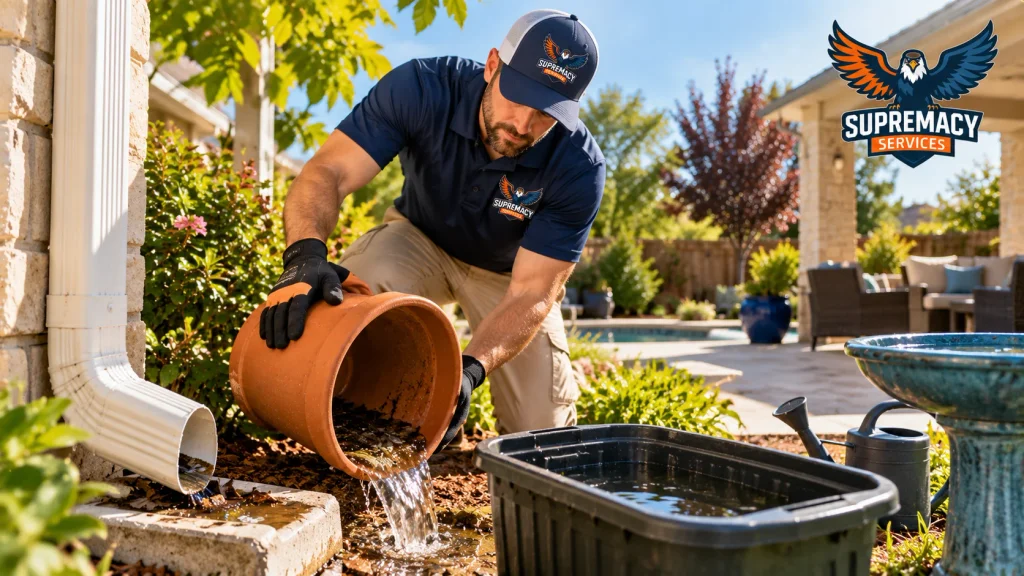
February–March: Prepare
Clean gutters, correct drainage and remove unnecessary containers before the main activity period.
April: Start watching closely
April marks the beginning of the period several DFW municipalities describe as North Texas’s most active mosquito season.
Walk the property weekly.
May–June: Stay consistent
Warm conditions and available water can support repeated mosquito development.
Do not allow spring rain or irrigation to leave persistent breeding habitat.
July–August: Maintain prevention
Continue weekly water checks even during hot or dry periods.
Irrigation can create mosquito habitat even without significant rainfall.
September–October: Don’t stop too early
Mosquito activity can remain relevant into fall.
Dallas’s official mosquito season currently runs through October 30.
Winter: Fix the property
Use lower-pressure months to correct drainage, leaking irrigation, clogged gutters and recurring water-holding areas.
Frequently Asked Questions
What month do mosquitoes start coming out in North Texas?
Mosquitoes can be active outside fixed calendar dates, but April begins the main active period identified by several DFW municipalities. Dallas officially defines its 2026 mosquito season as May 1 through October 30.
What months are mosquito season in Dallas?
For 2026, the City of Dallas identifies May 1 through October 30 as its official mosquito season. Nearby North Texas cities describe April through October as the area’s most active period.
When is the best time to start mosquito prevention?
Start before mosquitoes become a major backyard problem. Early spring is a good time to clean gutters, eliminate water-holding containers and correct drainage so breeding habitat is reduced before the main April–October activity period.
Why do mosquitoes get worse after rain?
Rain can fill containers, gutters and low areas with the water mosquitoes need for immature development. The first three mosquito life stages—egg, larva and pupa—are closely associated with water.
How often should I check my yard for standing water?
The CDC recommends checking water-holding items weekly and emptying, scrubbing, turning over, covering or discarding them where appropriate.
Can mosquitoes breed in a small amount of water?
Yes. EPA guidance lists small containers, including bottle caps, among possible mosquito breeding sites.
When do mosquitoes go away in North Texas?
Activity generally declines as North Texas moves beyond the main April–October season, but there is no guaranteed date when every mosquito disappears. Weather and local habitat affect activity.
Does professional mosquito treatment replace removing standing water?
No. Source reduction remains an important part of mosquito management. EPA recommends integrated control rather than relying exclusively on adult mosquito treatment.
Are mosquitoes in Dallas dangerous?
Not every mosquito carries disease, but some mosquito species can transmit pathogens. Dallas County conducts surveillance and mosquito-control programs with particular attention to diseases such as West Nile virus.
Should I start mosquito control before summer?
Yes. If you plan to actively manage mosquitoes, preparation should begin before summer because the most active North Texas mosquito period begins in spring. Start by eliminating standing water and correcting drainage.
Prepare Before North Texas Mosquito Season Peaks
You do not need to wait until every evening outside turns into a battle with mosquitoes.
For Dallas-Fort Worth homeowners, the better approach is to begin with early-season prevention: remove standing water, clean gutters, correct irrigation and drainage problems, maintain screens and use appropriate personal protection.
If mosquito activity remains heavy despite those measures, a professional property assessment can help identify overlooked breeding and resting areas and determine whether additional treatment is appropriate.
Seeing persistent mosquitoes around your Dallas-Fort Worth yard? Explore Supremacy Services’ mosquito-control options and request a property-specific assessment.

