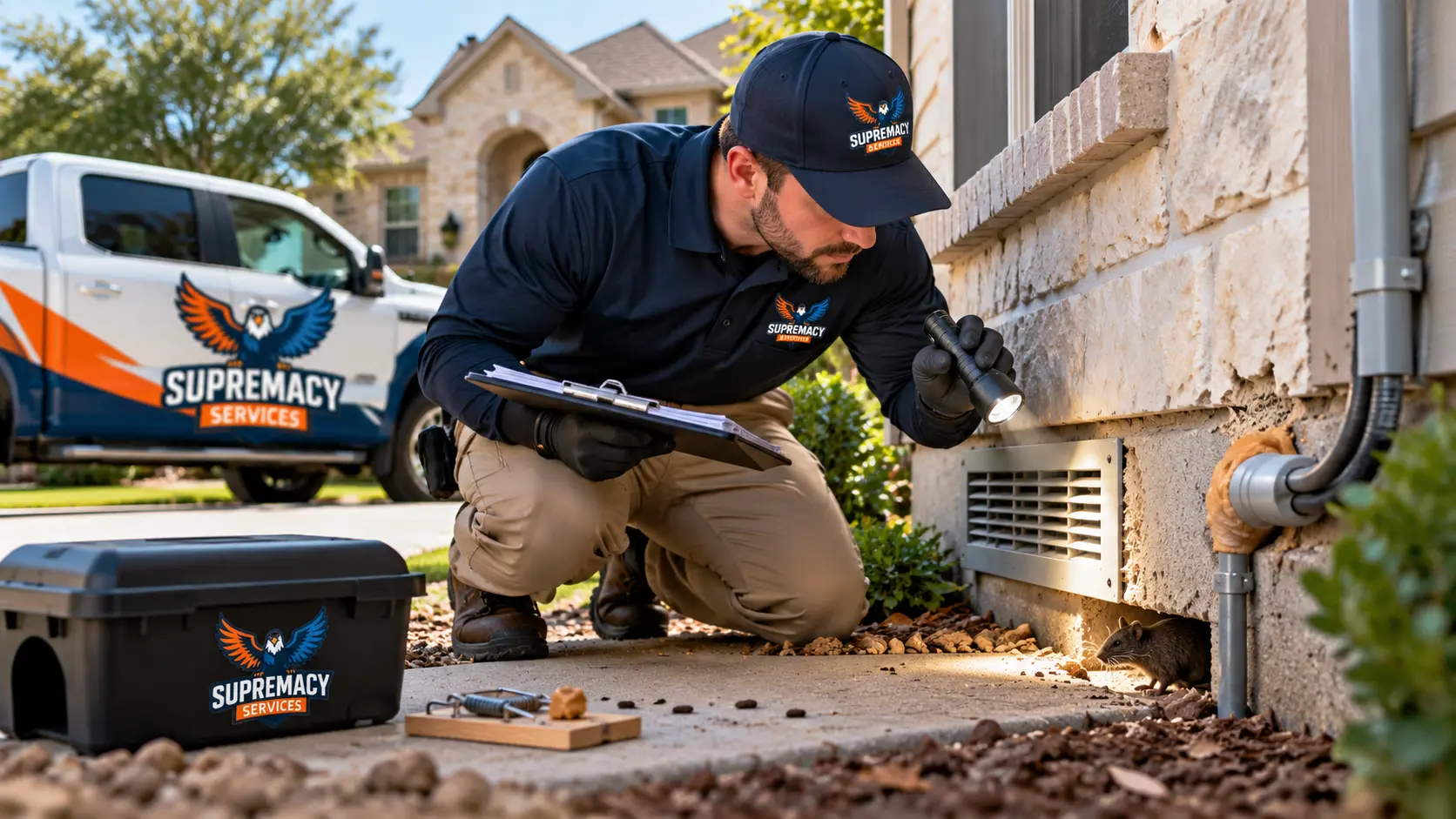
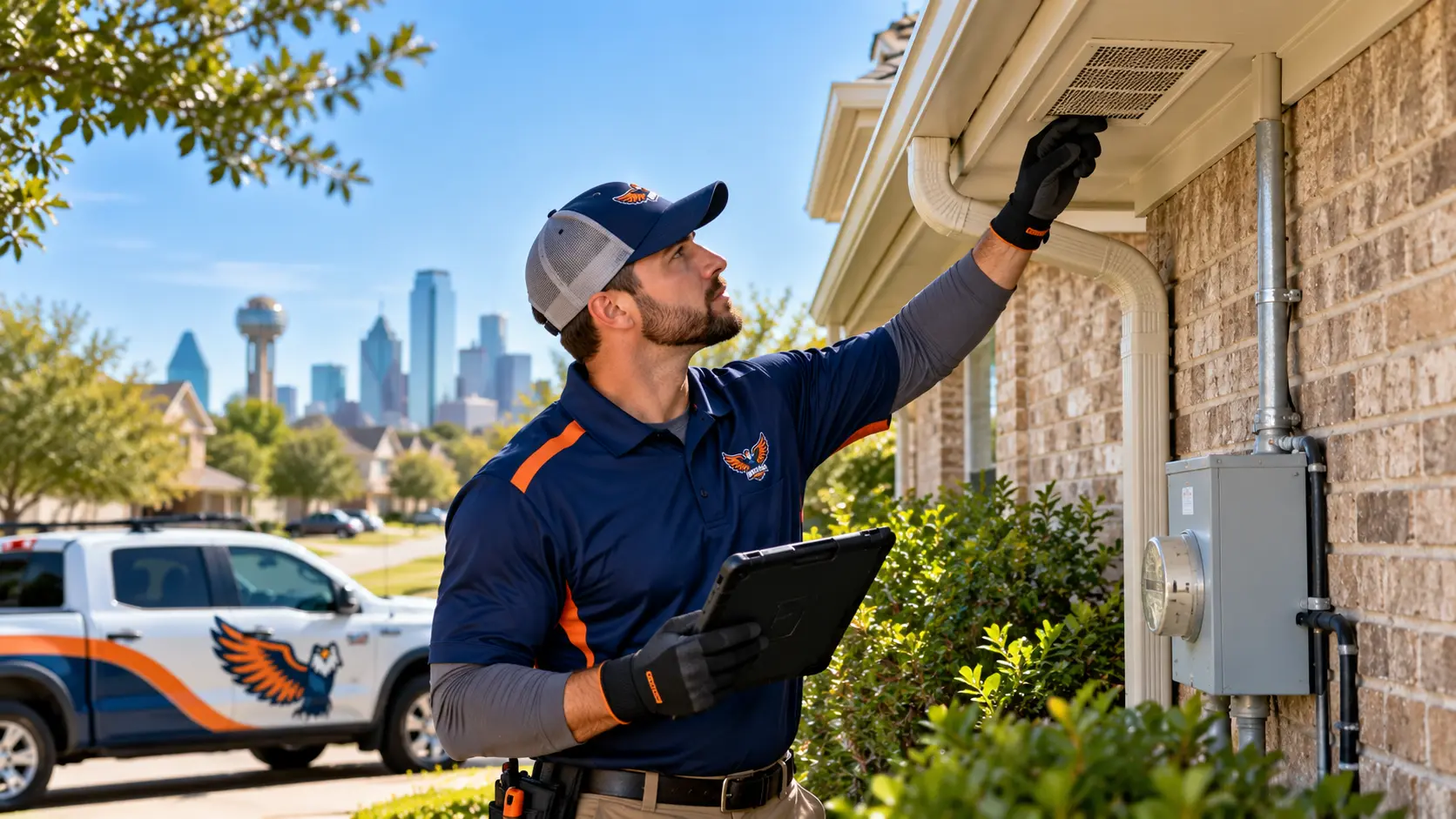
Commercial rodent exclusion is the process of finding and closing the openings rats and mice use to enter a building, while also correcting the food, water, shelter and operational conditions that encourage them to return.
For Dallas businesses, that distinction matters. Trapping may remove rodents that are already inside, but if loading doors, utility penetrations, roof gaps, vents, damaged seals or other access points remain open, another rodent can use the same route later.
A long-term rodent strategy therefore requires more than catching the animals you can see. It combines inspection, active control, structural exclusion, sanitation and ongoing monitoring.
Table of Contents
- What Is Commercial Rodent Exclusion?
- Why Rodent Infestations Keep Returning
- Where Rodents Enter Commercial Buildings
- Signs Your Business Needs Rodent Exclusion
- Exclusion vs. Trapping
- What Professional Rodent Exclusion Includes
- How Dallas Businesses Can Reduce Rodent Pressure
- Which Commercial Properties Face the Greatest Risk?
- DIY vs. Professional Exclusion
- How Much Does Commercial Rodent Exclusion Cost?
- What Happens After Exclusion?
- Frequently Asked Questions
What Is Commercial Rodent Exclusion?
Commercial rodent exclusion is the process of physically preventing rats and mice from entering a commercial building by identifying and repairing entry points and reducing conditions that support rodent activity.
This may involve areas such as:
- gaps around utility penetrations;
- damaged door seals;
- openings around loading docks;
- roofline and soffit gaps;
- plumbing penetrations;
- exterior vents;
- wall and foundation openings;
- damaged screening;
- openings around mechanical equipment.
Exclusion is different from simply placing traps or bait stations.
A trap deals with a rodent that has already entered the building. Exclusion addresses how that rodent entered in the first place.
That makes exclusion especially important when a Dallas business experiences the same rodent problem repeatedly.
The U.S. Environmental Protection Agency describes integrated pest management as an approach that combines multiple practical control methods rather than relying exclusively on pesticides. Structural maintenance, sanitation, monitoring and barriers that prevent pest entry are all consistent with this approach.
If rodents keep returning after previous treatments, schedule a commercial rodent inspection in DFW to identify active areas and structural entry points before another control program is started.
Why Do Rodent Infestations Keep Returning to Commercial Buildings?
Rodent problems commonly recur when the animals are removed but the conditions that allowed them inside remain unchanged.
A building can continue attracting rodents because it still provides one or more of four things:
Access. Openings allow rodents into the structure.
Food. Waste, stored products, crumbs, pet food, spilled ingredients or unsecured inventory may provide feeding opportunities.
Water. Plumbing leaks, condensation and standing water can support pest activity.
Shelter. Wall voids, storage areas, ceiling spaces, clutter and protected exterior areas can provide nesting or hiding locations.
The CDC recommends reducing rodent pressure by removing access to food, water and shelter and by sealing openings that allow rodents into structures.
That means a recurring infestation is often a building-management problem as well as a trapping problem.
For example, a warehouse may repeatedly trap mice near the same storage racks. The real source, however, may be an unscreened opening around a pipe penetration several rooms away.
Likewise, a restaurant may find droppings near a dry-storage area even though the rodents are entering through a damaged rear door sweep near the dumpster enclosure.
Effective exclusion follows the rodents’ travel routes back to the point of entry.
Where Do Rats and Mice Enter Commercial Buildings?
Rodents do not need a front door left open to enter a building.
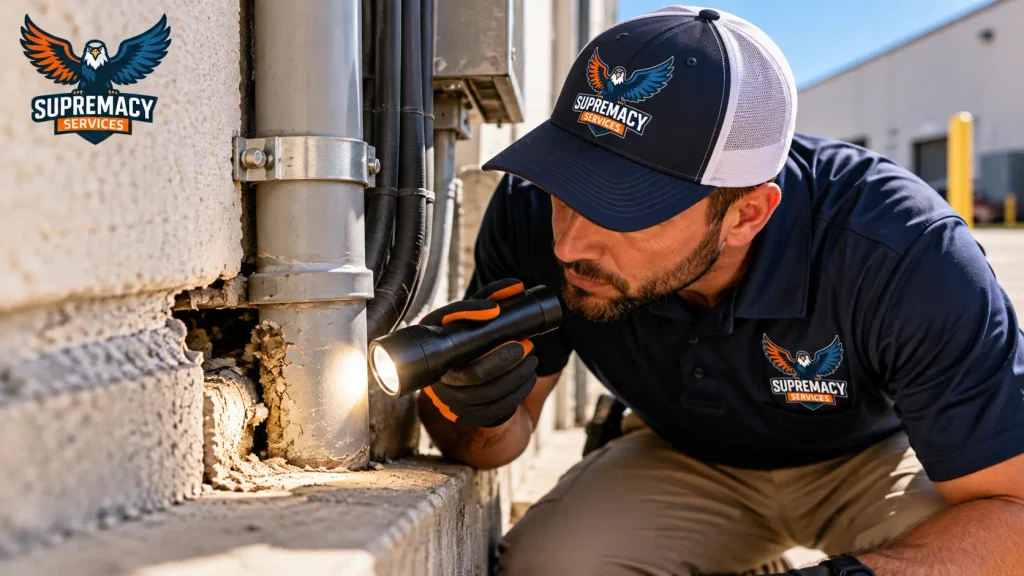
The CDC notes that mice can enter through openings approximately 1/4 inch wide. That makes small construction and maintenance defects important during a rodent inspection.
Loading and delivery areas
Commercial loading areas experience frequent door movement, equipment traffic and wear.
Inspect:
- gaps beneath overhead doors;
- worn weather stripping;
- damaged door sweeps;
- wall penetrations;
- openings beside dock equipment;
- areas where walls and slabs meet.
Utility penetrations
Electrical conduit, plumbing, telecommunications, refrigeration lines and gas piping frequently pass through exterior walls.
The space around those penetrations should be checked rather than assuming the visible pipe or cable completely fills the opening.
Rooflines and upper walls
Roof rats are capable climbers, which means rodent inspection should not stop at ground level.
Roof edges, vents, soffits, flashing, mechanical penetrations and adjoining structural features may require inspection when evidence suggests upper-building activity.
Exterior vents
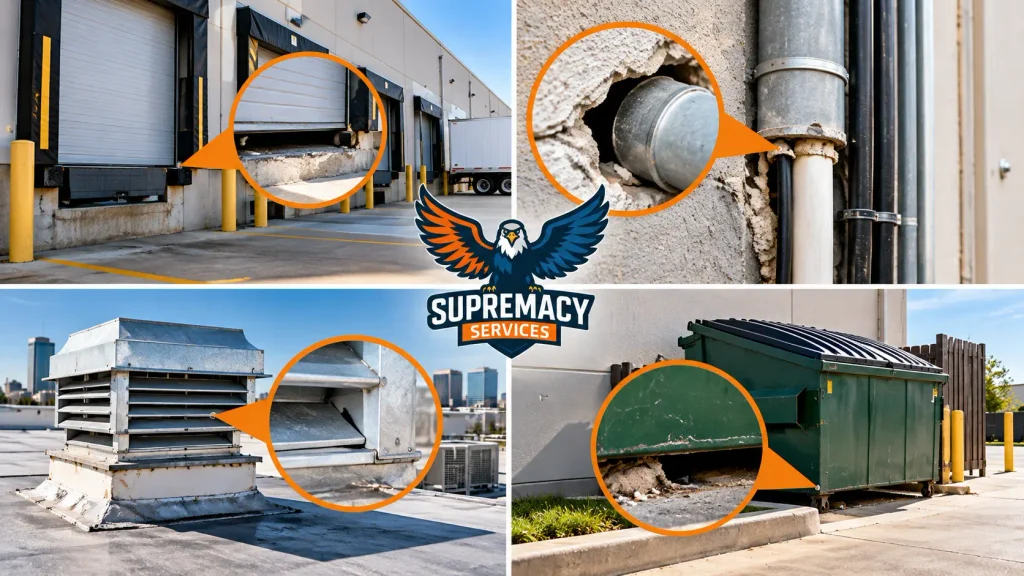
Damaged or improperly protected vents can provide another potential path into commercial structures.
Any correction must preserve the vent’s intended airflow or drainage function. Exclusion should never create a new building-performance or safety problem.
Doors
A frequently used service door may appear closed while still leaving enough space underneath or along its edge for a mouse.
Rear doors, receiving doors, mechanical-room doors and rarely inspected secondary entrances deserve particular attention.
Pipe chases and internal pathways
Finding rodents inside one room does not necessarily mean they entered through that room.
Once rodents enter a building envelope, wall voids, ceiling spaces, pipe chases and utility routes may allow them to move between areas.
That is why a complete inspection tracks both exterior entry and interior movement.
Signs Your Business Needs Rodent Exclusion
Recurring droppings, repeated captures, gnawing, nighttime noises or rodent sightings after previous control are strong reasons to inspect the building for unresolved entry points.
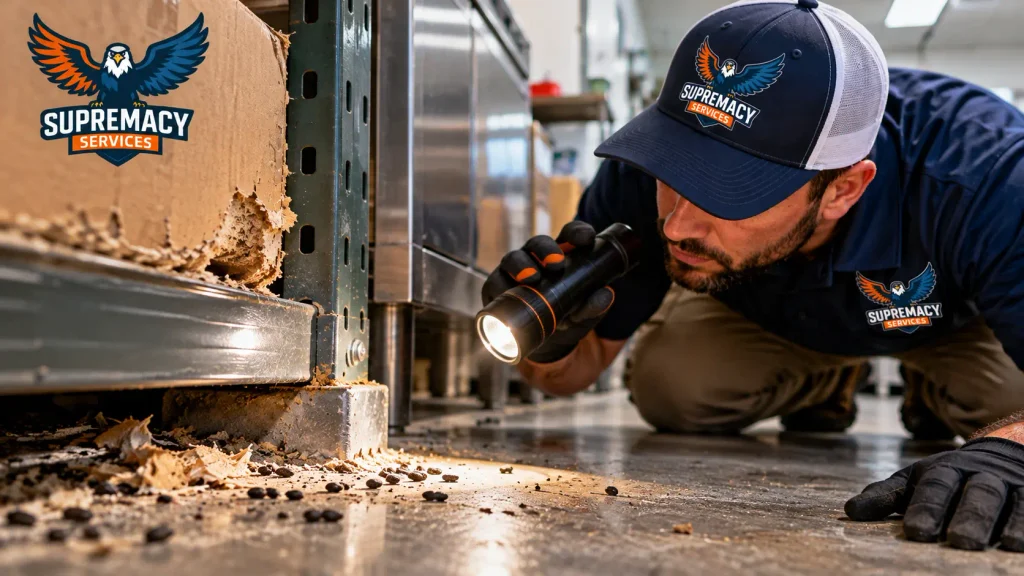
Watch for:
| Sign | What it may indicate |
|---|---|
| Fresh droppings | Current travel or feeding area |
| Gnawed packaging | Access to stored products or food |
| Rub or grease marks | Repeated travel along a route |
| Damaged door seals | Possible exterior access |
| Chewed materials | Active rodent presence |
| Scratching in walls or ceilings | Movement in concealed spaces |
| Repeated trap catches | An access route may still be open |
| Activity near dumpsters | Food or harborage pressure outside |
| Nesting material | An established interior harboring area |
| New activity after previous treatment | Control occurred without complete exclusion |
One rodent sighting does not tell you where the animal entered. The inspection has to connect evidence inside the facility with vulnerabilities outside it.
Commercial Rodent Exclusion vs. Trapping
Trapping removes rodents that are already present. Exclusion reduces the chance that additional rodents can enter. Most established infestations require both functions rather than choosing only one.
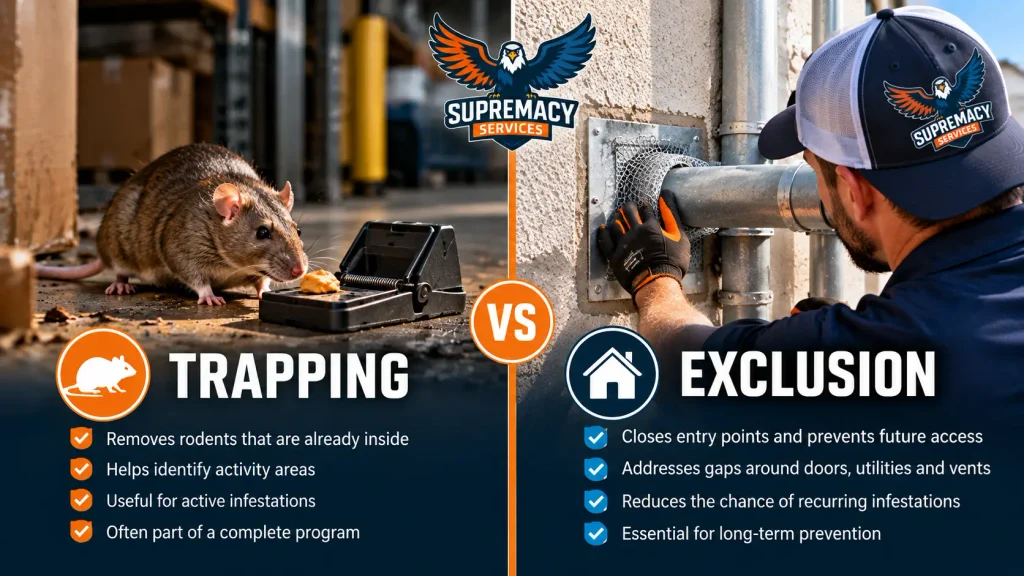
| Issue | Trapping | Exclusion |
|---|---|---|
| Removes active rodents | Yes | No |
| Closes entry points | No | Yes |
| Helps determine activity areas | Yes | Yes |
| Reduces future access | Limited | Primary purpose |
| Addresses damaged door seals | No | Yes |
| Addresses gaps around utilities | No | Yes |
| Useful for existing infestation | Yes | Usually combined with control |
| Useful for long-term prevention | Partly | Yes |
This is why simply installing more traps can become an endless cycle.
If five rodents are removed but an opening remains accessible, the building is still vulnerable.
At the same time, sealing a building without first determining whether rodents are already inside can create a different problem. Active animals must be considered as part of the exclusion sequence.
The correct order depends on what the inspection finds.
What Does Professional Commercial Rodent Exclusion Include?
A professional program should begin with evidence, not assumptions.
1. Facility inspection
The technician evaluates areas where rodents have been seen or where evidence has been found.
The inspection may extend to:
- exterior walls;
- loading areas;
- waste-management zones;
- utility rooms;
- kitchens;
- stockrooms;
- ceiling spaces;
- rooftops where appropriate;
- storage areas;
- mechanical rooms.
2. Rodent identification
The control plan should reflect whether the activity involves rats, mice or another animal.
Different species may use a commercial property differently.
Correct identification therefore helps determine where technicians should inspect, trap and monitor.
3. Entry-point assessment
Potential entry routes are documented and prioritized.
A useful report should distinguish between:
Confirmed entry points — openings supported by physical evidence.
Likely vulnerabilities — openings that may permit entry based on their construction and location.
Conducive conditions — conditions such as food, water, clutter or waste that make the property more attractive to rodents.
4. Active rodent control
If animals are already inside, an appropriate removal or control strategy is needed.
CDC guidance emphasizes trapping as part of rodent control and recommends placing traps in locations where rodent activity is present.
Commercial environments require added consideration for customers, employees, inventory, sanitation programs and operating schedules.
5. Structural exclusion
Once access points have been identified, appropriate openings can be closed or reinforced using materials suited to the opening and the building component.
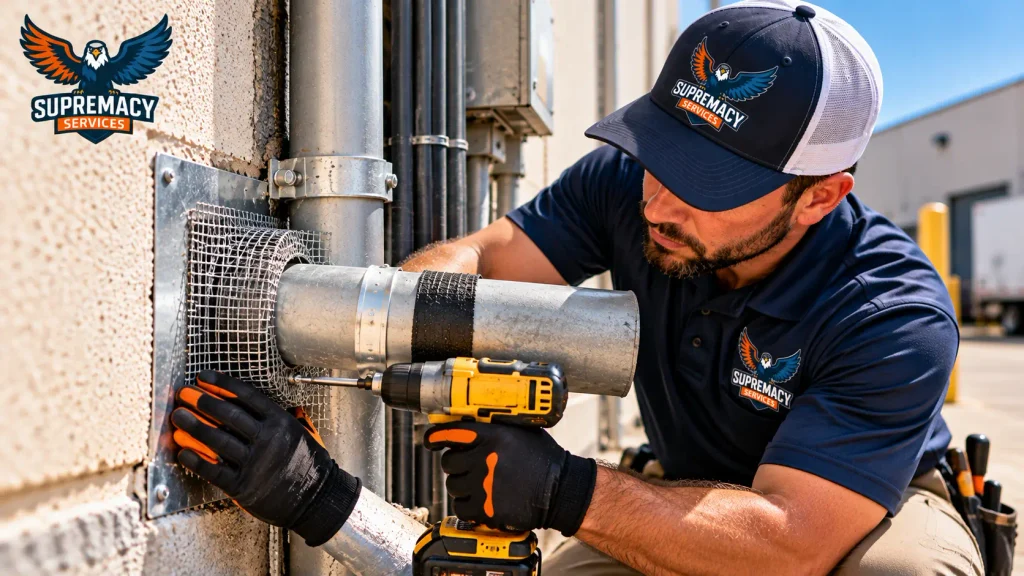
The goal is not simply to cover a hole.
A successful repair should:
- prevent rodent access;
- remain durable;
- fit the surrounding construction;
- preserve required ventilation;
- preserve drainage where necessary;
- avoid interfering with utilities or equipment.
6. Sanitation and attractant correction
Exclusion works better when the property also reduces food, water and shelter.
That can involve:
- improving waste storage;
- cleaning spills promptly;
- correcting leaks;
- reducing clutter;
- protecting stored foods;
- modifying storage practices;
- maintaining landscaping around the structure.
7. Monitoring and follow-up
Exclusion should be verified.
The CDC identifies monitoring and evaluation as important components of integrated pest management.
Follow-up determines whether:
- new droppings are appearing;
- traps continue to show activity;
- repaired areas remain intact;
- new vulnerabilities have developed;
- operational conditions are contributing to continued activity.
If your facility is trapping rodents repeatedly but the activity keeps returning, request a commercial pest and rodent assessment from Supremacy Services. The inspection should identify both active rodent pressure and the building conditions allowing recurrence.
How Dallas Businesses Can Reduce Rodent Pressure
Commercial rodent prevention is partly structural and partly operational.
Keep waste areas controlled
Dumpsters and waste containers should be managed so food residue and accessible waste do not continuously attract rodents toward the building.
Keep lids functional, clean surrounding areas and address spills.
Inspect delivery areas frequently
Loading docks and delivery doors experience more wear than many other building components.
Door seals that were effective when installed may deteriorate over time.
Correct plumbing leaks
Water availability can support pest activity.
Mechanical rooms, kitchens, wash areas and utility spaces deserve particular attention because small leaks may go unnoticed.
Reduce clutter
Rodents benefit from protected, rarely disturbed spaces.
Stored cardboard, unused equipment and poorly organized storage can also make inspections more difficult.
Keep food protected
Restaurants and food operations are not the only businesses with rodent food sources.
Employee break rooms, snack storage, vending areas, pet products, bird seed, damaged inventory and unsecured waste can all matter.
Include the exterior
Rodent prevention should not end at the interior wall.
Exterior inspections should consider vegetation, stored materials, waste areas and building penetrations near likely rodent travel routes.
Dallas and DFW Commercial Building Considerations
Dallas-Fort Worth contains a wide range of commercial property types, from urban restaurants and retail centers to suburban office parks, warehouses, multifamily developments and large distribution facilities.
The exclusion problem differs by property.
A warehouse may have large loading doors and frequent product movement.
A restaurant may have high food and waste pressure.
An apartment community may have numerous utility penetrations and shared structural pathways.
An office building may have comparatively little food pressure but still develop rodent activity around mechanical spaces, landscaping or exterior waste areas.
The correct plan therefore should not be based solely on the words “commercial rodent control.”
It should be based on how the individual property is built and operated.
Which Commercial Properties Face the Greatest Rodent-Control Challenges?
Any building can experience rodent activity, but certain operating environments require especially disciplined inspection and prevention.
Restaurants and food businesses
Food storage, frequent deliveries, waste handling and water availability can create multiple points of pressure.
Warehouses and distribution centers
Large structures, loading docks, stored inventory and frequent door openings increase the number of areas that need monitoring.
Multifamily properties
Shared walls, utility pathways, trash areas and numerous occupied units can make it difficult to isolate a problem to one location.
Retail stores
Stockrooms, loading areas and customer-facing spaces create both operational and reputational reasons to identify rodent activity early.
Hotels and hospitality properties
Large buildings with food-service areas, storage spaces and continuous occupancy require pest-management plans that account for multiple facility zones.
Healthcare and institutional environments
Pest management must be coordinated carefully with facility policies, sanitation requirements and occupied sensitive spaces.
Offices
Even properties without commercial kitchens can develop issues around break rooms, dumpsters, mechanical areas, storage spaces and landscaping.
Supremacy’s commercial pest-control service already supports facilities including restaurants, multifamily properties, offices, warehouses, hotels, healthcare facilities, schools and property-management portfolios.
Can a Business Handle Rodent Exclusion In-House?
Minor maintenance issues can sometimes be corrected by a facility team, but recurring activity, inaccessible entry points or an established infestation usually justify professional inspection.
A maintenance team may reasonably address straightforward issues such as a visibly damaged door sweep or obvious housekeeping problem.
Professional help becomes more appropriate when:
- rodents continue appearing after traps are installed;
- the species is uncertain;
- entry points cannot be identified;
- activity is occurring above ceilings or inside walls;
- roof access is required;
- multiple units or tenant spaces are involved;
- food-service environments are affected;
- contamination is significant;
- specialized pest-control work is required.
Texas regulates structural pest-control businesses and individuals who perform covered pest-control activities for compensation through the Texas Department of Agriculture.
For a commercial property, pest-control responsibilities should therefore be separated appropriately between ordinary building maintenance and regulated professional pest-management activities. Supremacy services
How Much Does Commercial Rodent Exclusion Cost?
There is no meaningful single price for commercial rodent exclusion because the scope depends heavily on the building, infestation and number of repairs required.
Rather than publishing an unsupported flat price, businesses should expect an estimate to consider factors such as:
| Cost factor | Why it matters |
|---|---|
| Building size | More exterior and interior area must be inspected |
| Number of entry points | More repairs increase material and labor requirements |
| Height/access | Roof and elevated areas may require additional access |
| Infestation severity | More active control and monitoring may be necessary |
| Building construction | Different materials require different repair methods |
| Facility type | Restaurants, warehouses and multifamily properties present different conditions |
| Contamination | Cleanup requirements may change the project |
| Follow-up | Some properties require ongoing monitoring |
| Multiple buildings | Campuses and portfolios increase inspection scope |
For that reason, the most useful quote is normally one based on an actual facility assessment rather than a generic price-per-building estimate.
What Happens After Rodent Exclusion?
Exclusion is not a reason to stop monitoring.
Commercial buildings change.
Doors wear out. Contractors create new utility penetrations. Roofing work can alter flashing. Tenants change. Landscaping grows. Waste-management practices change.
A facility that was well sealed two years ago may develop a new vulnerability today.
An ongoing prevention program may therefore include:
- inspection of previously repaired areas;
- monitoring for fresh rodent evidence;
- review of waste and sanitation conditions;
- inspection of doors and loading areas;
- review of exterior conditions;
- correction of newly developed gaps.
The EPA’s integrated pest-management framework emphasizes monitoring and prevention rather than relying only on repeated pesticide treatments.
That principle is especially useful for commercial properties where preventing the next infestation is often less disruptive than reacting after rodents become established.
Rodent Exclusion Checklist for Dallas Businesses
Before considering a recurring rodent problem resolved, confirm that the property has addressed the following areas:
- Active rats or mice have been identified and controlled.
- Exterior walls have been inspected.
- Loading and service doors have been checked.
- Roofline vulnerabilities have been evaluated where relevant.
- Utility and pipe penetrations have been checked.
- Vents and screens are intact.
- Waste containers are properly managed.
- Food and inventory are stored appropriately.
- Plumbing leaks have been corrected.
- Clutter and potential harborage have been reduced.
- Exclusion repairs have been documented.
- Follow-up monitoring is scheduled.
If several items remain unresolved, the building may still be vulnerable even if current trapping activity has declined.
Frequently Asked Questions
What is commercial rodent exclusion?
Commercial rodent exclusion is the process of identifying and closing structural openings that allow rats and mice into a business, together with correcting conditions that encourage recurring activity.
Is rodent exclusion the same as pest control?
No. Rodent control addresses active animals, while exclusion focuses specifically on preventing entry. A comprehensive program may combine inspection, trapping or other control, structural repairs, sanitation and monitoring.
Will trapping alone stop rats from coming back?
Not necessarily. Trapping can remove rodents already inside, but recurring activity can continue when entry points, food, water or shelter remain available.
Where do mice enter commercial buildings?
Common inspection areas include gaps around doors, utility penetrations, exterior walls, loading areas, vents, rooflines and openings around plumbing or mechanical systems.
Can mice really enter through very small gaps?
Yes. CDC guidance notes that mice can pass through openings approximately 1/4 inch wide, which is why relatively small construction gaps can matter during an inspection.
Should entry points be sealed while rodents are still inside?
The sequence should be based on the inspection. Active animals need to be considered before sealing so that exclusion work does not simply trap rodents within inaccessible areas.
How often should a commercial building be inspected for rodents?
There is no universal interval appropriate for every property. Inspection frequency should reflect the facility type, pest pressure, operating conditions, past rodent activity and findings from ongoing monitoring.
Are warehouses more difficult to rodent-proof?
They can be. Warehouses often contain multiple loading doors, large wall areas, stored goods and frequent deliveries, which creates more locations that must be inspected and monitored.
Does rodent exclusion eliminate the need for sanitation?
No. Exclusion addresses access, while sanitation reduces food, water and shelter. Long-term rodent management works best when both are addressed.
Who should perform commercial rodent control in Texas?
Businesses performing regulated structural pest-control work for compensation in Texas fall under the Texas Department of Agriculture’s Structural Pest Control Service licensing framework.
The Bottom Line
Recurring rodent infestations usually require a different question than, “How do we catch another rat?”
The better question is:
Why are rodents able to keep using this building?
For Dallas businesses, successful commercial rodent exclusion means investigating the entire system—entry routes, active rodents, sanitation, waste, water, building maintenance and ongoing monitoring.
Trapping can remove today’s problem.
Exclusion and prevention are what help keep tomorrow’s rodents outside.
If rats or mice keep returning to your Dallas-Fort Worth commercial property, schedule a commercial rodent inspection with Supremacy Services. The goal should be to identify the activity, locate structural vulnerabilities and build a prevention strategy around how your facility actually operates.