10400 Clarence Drive, Frisco, TX 75033
Support 24/7: 945-777-3345
Supremacy Services technician inspecting a Dallas hotel room for bed bug activity with a property manager

Commercial Bed Bug Treatment: How Dallas Businesses Eliminate Bed Bugs Without Major Disruption

Commercial bed bug treatment does not automatically mean shutting down an entire business for days. A well-planned response starts by confirming the pest, identifying where activity is occurring, containing potentially affected belongings and choosing treatment methods appropriate for the affected areas.

For Dallas hotels, apartment communities, offices, healthcare facilities and other businesses, the goal is not simply to kill the bed bugs that can be seen. It is to control the infestation while limiting unnecessary movement of people and possessions, protecting unaffected areas and verifying that treatment worked.

Bed bugs can occur in clean, well-maintained properties. The CDC notes that cleanliness does not determine whether bed bugs are present, and they can occur in hotels, apartments, dormitories, transportation and other environments where people spend time or sleep.

Table of Contents

What Is Commercial Bed Bug Treatment?

Commercial bed bug treatment is a structured pest-management program designed to identify, contain, eliminate and monitor bed bugs in a business or managed property.

Unlike treating a single bedroom in a detached home, commercial situations may involve occupied rooms, employees, customers, adjacent units, housekeeping operations, shared furniture or continual movement of luggage and personal belongings.

Effective management therefore starts with investigation rather than indiscriminate spraying.

The EPA recommends an Integrated Pest Management—or IPM—approach to bed bugs. IPM can combine inspection, monitoring, physical controls, heat, encasements and appropriately selected pesticides rather than depending on one control method alone.

For a business, the practical sequence is usually:

  1. confirm that the pest really is a bed bug;
  2. determine which areas may be affected;
  3. contain potentially infested materials;
  4. select an appropriate treatment strategy;
  5. treat affected areas;
  6. inspect and monitor afterward; and
  7. correct operational practices that could contribute to further spread.

Found evidence of bed bugs at a Dallas-area business? [Request a commercial pest assessment from Supremacy Services] before moving furniture or potentially affected belongings between areas.

Does a Business Have to Close for Bed Bug Treatment?

Not necessarily. Whether operations must stop depends on where the infestation is located, its extent and the treatment method being used.

A single affected hotel room, apartment unit, employee rest area or office may require a very different response from activity detected across multiple adjoining spaces.

The objective should be to isolate the affected area without unnecessarily disrupting parts of the building that inspection shows are not involved.

However, treatment instructions take priority over convenience.

For example, occupants cannot remain in an area while professional whole-room thermal treatment is underway. Pesticide applications may also have specific re-entry requirements established by the product label and treatment professional.

Businesses should therefore avoid assuming either extreme:

  • “The entire building has to close,” or
  • “Everyone can stay where they are.”

The correct scope should follow inspection and the treatment plan.

Which Businesses Can Develop Bed Bug Problems?

Bed bugs are particularly associated with environments where people sleep, rest or regularly transport personal possessions.

The CDC identifies homes, apartments, hotels, shelters, dormitories, cruise ships, buses and trains among environments where bed bugs may occur. Bed bugs can also be transported on luggage, clothing and personal belongings.

Commercial properties that may need a bed bug response plan include:

  • hotels and motels;
  • multifamily apartment communities;
  • assisted-living or healthcare environments;
  • college or dormitory housing;
  • shelters;
  • offices with employee lounges or upholstered furniture;
  • transportation-related facilities;
  • property-management portfolios; and
  • other properties with frequent movement of people and belongings.

Hotels and hospitality properties

Hotels face a distinct challenge because new guests and luggage continually enter the property.

A bed bug discovery therefore requires more than treating the visible insect. Management needs to understand where activity is occurring, whether adjacent areas warrant inspection and how housekeeping and maintenance personnel should handle potentially affected materials.

Multifamily properties

Apartments and other attached housing require careful investigation because one resident’s report does not necessarily reveal the entire extent of the problem.

EPA guidance specifically emphasizes management participation in bed bug IPM programs in multifamily housing.

Offices and workplaces

Finding a bed bug in an office does not automatically mean that an established infestation exists there.

Bed bugs can hitchhike on belongings, and EPA school guidance makes an important distinction: one bed bug is not necessarily an infestation; inspection and monitoring are required.

That same principle is useful for businesses.

Confirm first. Escalate the treatment response according to the evidence.

What Are the Signs of Bed Bugs in a Business?

Physical evidence is more reliable than relying on unexplained bites alone.
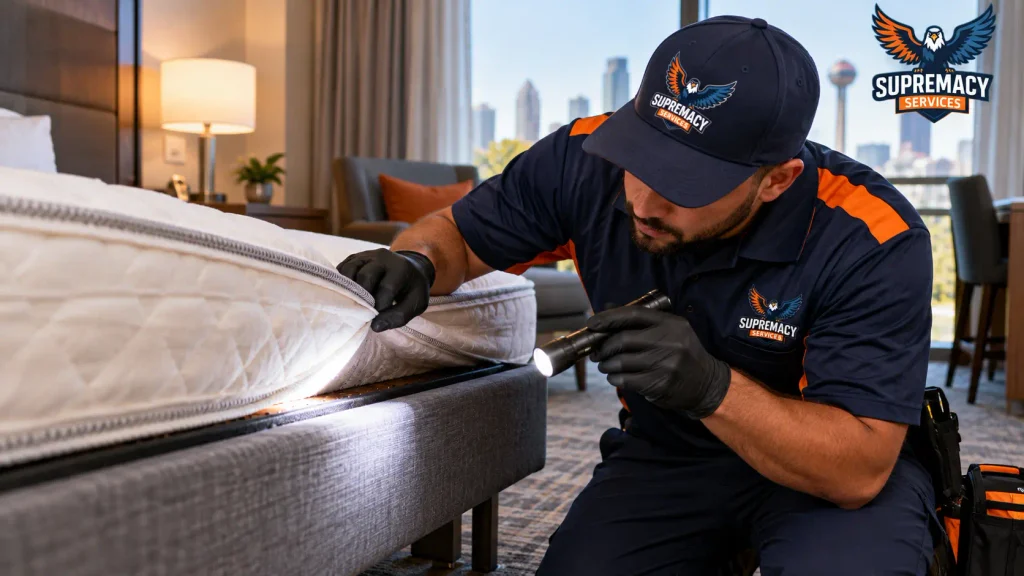
Pest control technician inspecting mattress seams for bed bugs in a Dallas commercial property
Detailed inspection of mattress seams, furniture and surrounding cracks helps determine where bed bug activity is actually occurring.

Potential evidence includes:

  • live bed bugs;
  • dark fecal spotting;
  • rusty or reddish stains;
  • shed skins;
  • pale eggs or eggshells; and
  • concentrations of evidence in cracks, seams or furniture.

The CDC also notes that bite reactions can take time to appear and differ substantially between people, so a skin reaction by itself cannot reliably establish that a workplace has bed bugs.

Where should staff inspect?

Depending on the type of property, inspection may concentrate around:

  • mattress seams and box springs;
  • bed frames and headboards;
  • upholstered chairs and couches;
  • furniture joints;
  • baseboards and nearby cracks;
  • luggage-storage areas;
  • employee lockers or storage areas when exposure is suspected; and
  • nearby rooms or units when the situation warrants expansion of the inspection.

For detailed identification guidance, Supremacy’s existing Signs of Bed Bugs Besides Bites guide should handle the broader identification search intent.

What Should a Business Do Immediately?

If a suspected bed bug is discovered, the first objective is controlled investigation—not panic.

1. Preserve the evidence

If practical, safely capture the suspected insect in a sealed container or take clear photographs.

Correct identification helps prevent an expensive response to the wrong pest.

2. Avoid moving furniture

Do not immediately drag upholstered furniture, mattresses or other suspected items through hallways or unaffected rooms.

Moving infested possessions without containment can make the situation more difficult to manage.

3. Contain movable belongings
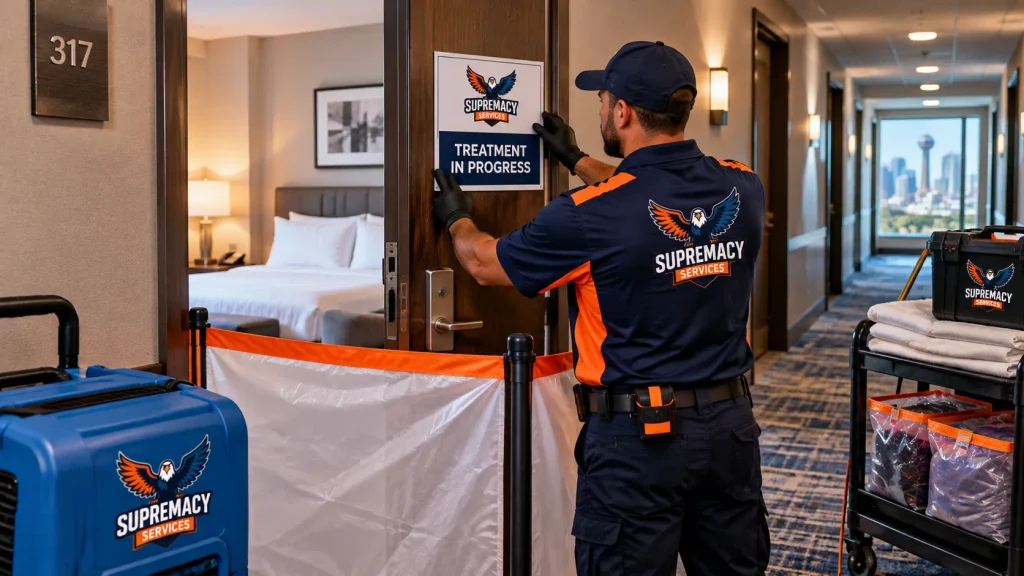
Supremacy Services technician isolating a hotel room during commercial bed bug treatment
Containing the affected room and limiting unnecessary movement can help reduce the risk of spreading bed bugs to other areas.

Potentially affected items should be handled according to the treatment provider’s instructions.

EPA guidance recommends sealed bags when moving potentially infested items between areas so insects are not inadvertently transported during preparation.

4. Document where the evidence was found

Record:

  • room or unit;
  • exact location;
  • date and time;
  • item where evidence was found;
  • photographs, where available; and
  • any related reports.

This information can help the pest professional determine where inspection should begin.

5. Arrange professional identification or inspection

Treatment should follow evidence.

Texas regulates structural pest-control businesses and pest-management professionals that perform this work for customers through the Texas Department of Agriculture’s Structural Pest Control Service.

How Does Professional Commercial Bed Bug Treatment Work?

A commercial treatment program should be tailored to the building rather than applied as a generic spray-and-leave service.

Step 1: Inspection and identification

The technician confirms the pest and looks for evidence around likely harborages.

The inspection may then expand according to what is found.

The EPA’s federal bed bug strategy recommends confirming an infestation before control begins because bed bugs can be confused with insects such as carpet beetles, cockroach nymphs and booklice.

Step 2: Determine the treatment zone

The presence of one insect does not automatically tell you how far an infestation extends.

The professional may need to determine:

  • whether activity is localized;
  • whether adjoining rooms or units require inspection;
  • whether furniture has been moved;
  • whether belongings could have transported bed bugs elsewhere; and
  • whether multiple areas show independent evidence.

This step is critical to minimizing disruption.

Treat too little and the infestation may persist.

Treat far more than the evidence supports and the business may absorb unnecessary operational disruption.

Step 3: Preparation and containment

Preparation requirements depend on the selected treatment.

They may involve:

  • handling heat-sensitive items;
  • bagging or isolating certain possessions;
  • laundering appropriate fabrics;
  • reducing excessive clutter;
  • providing access around furniture;
  • keeping cleaned items separated from untreated ones; and
  • temporarily removing occupants from treatment areas.

EPA recommends keeping potentially infested materials contained and avoiding unnecessary movement into other areas.

Step 4: Treatment

Treatment could involve one or several methods.

Common professional tools may include:

  • controlled thermal treatment;
  • steam;
  • vacuuming;
  • encasements;
  • monitoring devices;
  • targeted EPA-registered pesticides; and
  • other measures incorporated into an IPM program.

EPA specifically recommends using pesticides as one component of a broader bed bug strategy rather than relying on pesticides alone.

Step 5: Follow-up and monitoring

Treatment is not complete simply because staff no longer see bugs the next morning.

Monitoring helps determine whether activity continues.

EPA specifically identifies interceptors and other monitoring devices as tools for helping determine whether bed bugs have actually been eliminated.

For a business, documentation of inspections, treatments and follow-up findings is particularly useful because multiple employees or managers may be involved in the response.

Heat Treatment vs. Targeted Bed Bug Treatment
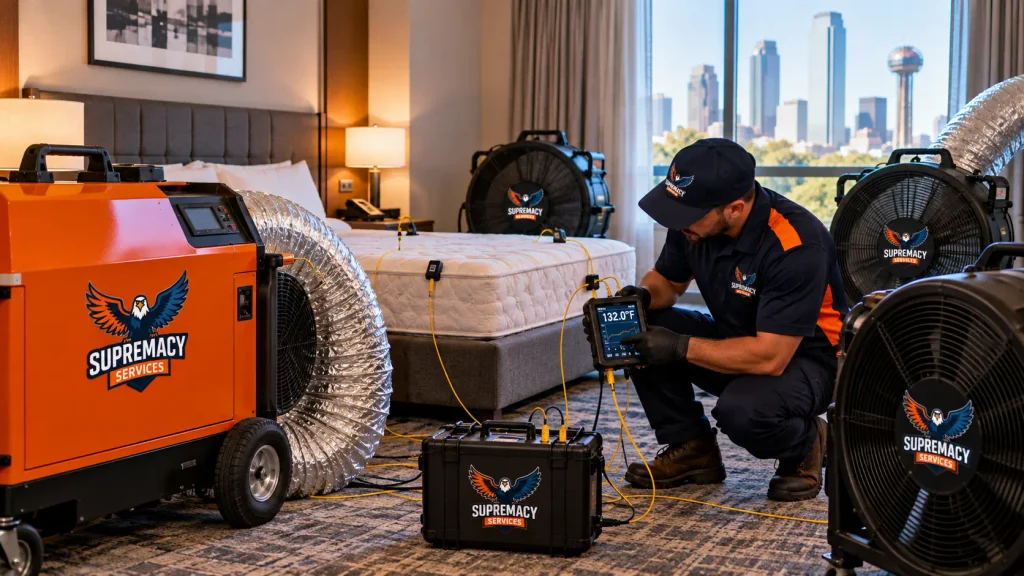
Supremacy Services technician monitoring professional bed bug heat treatment equipment in a Dallas hotel room
Professional thermal treatment uses specialized heaters, air movers and temperature monitoring to treat designated bed bug areas.

No single treatment strategy is automatically best for every commercial property.

FactorProfessional heatTargeted/IPM program
Treatment areaCan treat rooms or larger designated spacesCan target specific harborages and affected areas
EggsLethal heat can kill eggs when required temperatures reach themEffect depends on methods/products used
Residual activityNoneSome registered pesticides can provide residual activity
Occupancy during treatmentTreated area must be vacatedDepends on treatment and product label
PreparationRequiredRequired
MonitoringStill importantImportant
Repeat visitsMay still be required depending on resultsOften incorporated into the program
Best applicationDepends on infestation and propertyDepends on infestation and property

EPA guidance states that heating infested areas to at least 120°F for 90 minutes can kill eggs, but effective professional heat treatment depends on lethal temperatures reaching the actual hiding locations—not merely heating the open air in a room.

This is why whole-room thermal remediation requires specialized equipment, air movement and temperature monitoring.

A Dallas business considering thermal remediation can review Supremacy’s dedicated Bed Bug Thermal Treatments DFW service information rather than using this article as the service page.

How Can Commercial Bed Bug Treatment Be Completed With Less Disruption?

The best way to reduce disruption is not to rush treatment.

Supremacy Services technician reviewing a commercial bed bug treatment plan with a property manager
Planning the treatment scope carefully can help businesses address confirmed activity while minimizing unnecessary operational disruption.

It is to determine the correct treatment scope before work begins.

Use inspection to avoid unnecessary treatment

A confirmed insect in one room should trigger a systematic assessment.

It should not automatically trigger treatment of every square foot of the property without evidence.

Isolate affected areas when appropriate

When operationally and technically appropriate, management may temporarily remove an individual room, unit or section from use while unaffected areas continue normal operations.

Whether this is appropriate depends on the inspection findings and treatment strategy.

Schedule around operations

Commercial treatment can sometimes be coordinated:

  • after checkout periods;
  • between tenant occupancies;
  • after office hours;
  • during low-traffic periods; or
  • around housekeeping and maintenance schedules.

Supremacy’s commercial pest-control page specifically positions flexible scheduling as part of its commercial service model.

Control the movement of belongings

Randomly relocating furniture, uniforms, linens or personal items can undermine containment.

Employees need clear instructions explaining:

  • what may be moved;
  • what must remain in place;
  • what must be bagged;
  • what requires laundering;
  • and where treated materials should be stored.

Create one point of contact

For hotels, apartment communities and larger facilities, one facilities or management contact should ideally coordinate with the pest-management company.

This reduces contradictory instructions and creates a clearer record of affected locations, completed treatments and follow-up inspections.

Need to control bed bugs without turning the entire property upside down? [Talk with Supremacy Services about a commercial bed bug inspection] to determine the affected area and appropriate treatment scope before scheduling service.

How Much Does Commercial Bed Bug Treatment Cost?

There is no responsible universal price for commercial bed bug treatment.

A 20-room hotel with evidence limited to one confirmed room is fundamentally different from a multifamily building where evidence appears in several units.

Commercial pricing can depend on:

Cost factorWhy it matters
Number of affected roomsMore treatment zones require more labor and equipment
Property layoutAdjoining units and complex layouts may expand inspection requirements
Infestation extentEstablished activity can require broader intervention
Treatment methodHeat, targeted treatment and combined programs have different resource requirements
Furniture and contentsDense furnishings can make inspection and treatment more involved
Preparation requirementsCommercial properties may require coordinated staff preparation
SchedulingAfter-hours or operational constraints can affect project planning
Monitoring/follow-upContinued inspection may be part of the treatment program
Reintroduction riskHotels and other high-turnover facilities may require stronger monitoring procedures

For that reason, commercial treatment should be quoted from the actual scope of work rather than extrapolated from residential per-room or whole-home pricing.

Supremacy’s existing Commercial Pest Control Cost in Dallas article should continue to own broader commercial pest-control pricing intent, while its dedicated bed bug cost guides handle residential cost searches.

DIY vs. Professional Commercial Bed Bug Control

Businesses can take useful containment and monitoring steps, but established commercial infestations usually warrant professional involvement.

DIY/Staff ActionAppropriate role
Document suspected evidenceUseful
Capture a specimen safelyUseful for identification
Restrict unnecessary furniture movementUseful
Follow laundering instructionsUseful when part of treatment plan
Reduce clutter carefullyUseful
Vacuum designated areasCan support an IPM plan
Apply random pesticidesPoor strategy
Use foggers indiscriminatelyNot recommended
Attempt improvised whole-room heatingDangerous/inappropriate

EPA specifically warns that DIY whole-room heating using thermostats, propane space heaters or fireplaces does not work reliably and can be dangerous.

Businesses should also remember that pesticide use is governed by product labeling and Texas structural pest-control requirements.

Professional intervention is especially appropriate when:

  • bed bugs are confirmed in occupied commercial property;
  • evidence occurs in multiple areas;
  • the property contains adjoining rooms or units;
  • guests, tenants or patients could be affected;
  • prior treatment has failed;
  • professional heat treatment is being considered; or
  • management cannot confidently determine the infestation boundaries.

How Can Businesses Prevent Another Bed Bug Introduction?

No prevention system can guarantee that a bed bug will never be carried into a property.
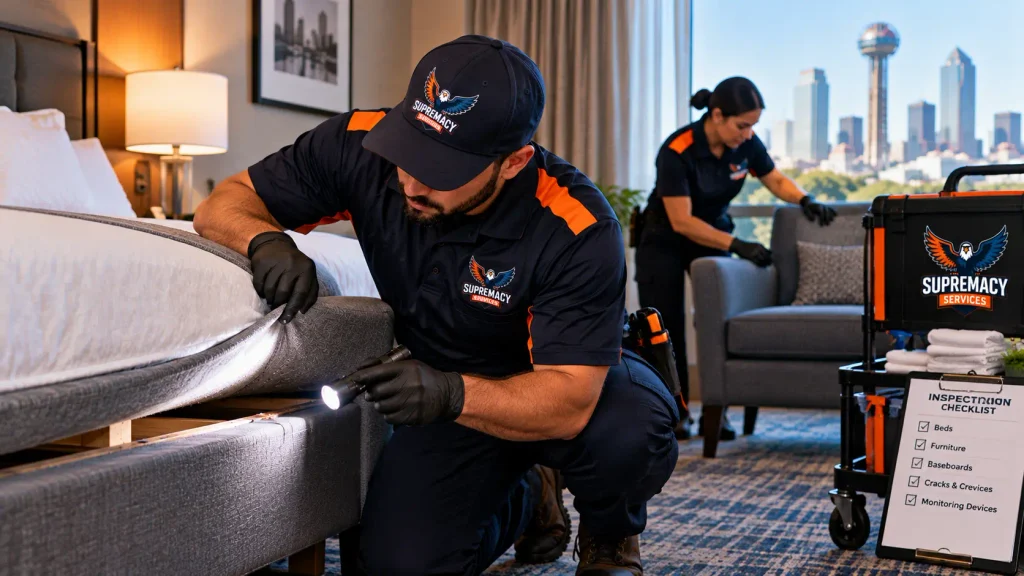
Supremacy Services technicians inspecting beds and furniture for bed bugs during a commercial follow-up visit
Routine inspection and monitoring help businesses identify new bed bug activity early and verify whether treatment has been successful.

Businesses can, however, make introductions easier to detect and less likely to become established infestations.

Train the people most likely to see early evidence

For hospitality and housing properties, this can include:

  • housekeeping staff;
  • maintenance employees;
  • property managers;
  • unit-turn teams; and
  • supervisors.

Staff do not need to become entomologists.

They need to recognize suspicious evidence and know whom to report it to.

Establish a written response procedure

Employees should know what happens after a suspected bed bug is discovered.

A useful protocol defines:

  1. who receives the report;
  2. how evidence is preserved;
  3. whether the area is removed from use;
  4. what items must not be moved;
  5. who contacts pest management;
  6. who communicates treatment instructions; and
  7. how follow-up results are documented.

Inspect secondhand furniture

Bed bugs can hitchhike in furniture and other belongings.

Avoid bringing used upholstered furniture into the property without appropriate inspection.

Monitor high-risk areas

Monitoring does not prevent every introduction, but it can help reveal activity before an infestation becomes obvious.

Do not stigmatize customers, tenants or employees

Bed bugs are not evidence of poor hygiene.

The CDC specifically notes that cleanliness does not determine whether a location has bed bugs.

A calm, standardized response is usually more useful than trying to identify who supposedly “caused” the problem.

What Can Be Mistaken for a Commercial Bed Bug Problem?

Before treatment, make sure the insect is correctly identified.

Potential confusion can include:

  • carpet beetles;
  • cockroach nymphs;
  • booklice;
  • fleas;
  • unrelated stains on furniture;
  • other small insects; and
  • skin irritation from causes unrelated to bed bugs.

EPA’s federal strategy specifically cautions that bed bugs can be difficult to distinguish from some other common insects.

The best evidence is an identified specimen or characteristic physical evidence—not a photograph of an unexplained bite.

Commercial Bed Bug Treatment in Dallas and DFW

Dallas businesses have the same fundamental bed bug challenge as businesses elsewhere: people and belongings move continually between buildings.

A commercial response should therefore focus less on generic seasonal pest pressure and more on inspection, containment, treatment logistics and monitoring.

Texas adds one practical consideration: businesses should use appropriately licensed structural pest-management providers when regulated pest-control work is being performed.

The Texas Department of Agriculture’s Structural Pest Control Service licenses and regulates professionals who apply pesticides in and around structures.

Supremacy Services provides pest-control and bed-bug services throughout Dallas and the surrounding DFW Metroplex. Its existing service pages cover commercial pest management, general bed bug control and thermal remediation; this guide is intended to help facility managers understand the treatment process before requesting service.

Frequently Asked Questions

Can a business stay open during bed bug treatment?

Sometimes. The answer depends on the treatment area and method. A specific room or section may be taken out of service while unrelated areas remain operational. People must leave areas undergoing professional thermal treatment and must follow any pesticide-label re-entry requirements.

Does finding one bed bug mean the whole building is infested?

No. One correctly identified bed bug warrants investigation, but it does not establish the size of an infestation. Inspect and monitor before determining the treatment scope.

How do hotels eliminate bed bugs?

Professional hotel bed bug management typically combines inspection, containment, treatment of confirmed areas and follow-up monitoring. The precise method may include heat, physical controls, pesticides or an integrated combination.

Can bed bugs spread between hotel rooms or apartments?

Bed bugs can move or be transported with furniture, luggage, clothing and other possessions. When activity is confirmed, surrounding areas may warrant inspection depending on the circumstances.

Can offices get bed bugs?

Yes, bed bugs can be transported into workplaces on belongings. However, finding a single hitchhiking insect does not necessarily mean an established office infestation is present.

Is commercial bed bug heat treatment effective?

Professional heat can kill bed bugs at all life stages when lethal temperatures reach the insects and eggs for the required exposure. Proper equipment, air circulation and temperature monitoring are important.

How long does commercial bed bug treatment take?

There is no universal treatment duration. Timing depends on property size, affected areas, treatment method, preparation requirements and whether follow-up service is needed.

Should a business throw away infested furniture?

Not automatically. Furniture may sometimes be incorporated into a treatment plan. Moving or discarding potentially infested furniture without a containment plan can create additional problems.

How much does commercial bed bug treatment cost in Dallas?

There is no reliable standard commercial price. Cost depends on the number of rooms or areas involved, infestation extent, treatment method, furniture, preparation, operational scheduling and follow-up requirements.

Who regulates professional pest-control companies in Texas?

The Texas Department of Agriculture’s Structural Pest Control Service regulates structural pest-control businesses and licensed pest-management professionals performing regulated services in and around buildings.

Need Commercial Bed Bug Treatment in Dallas-Fort Worth?

A bed bug report does not automatically mean your entire building needs to shut down or that every room requires the same treatment.

The first step is determining what was found, where activity exists and how far the problem extends.

Supremacy Services provides commercial pest management and professional bed bug treatment across Dallas and the DFW Metroplex.

If your hotel, apartment property, office or commercial facility has confirmed or suspected bed bug activity, schedule a commercial inspection with Supremacy Services to determine the appropriate treatment scope before the problem spreads further.

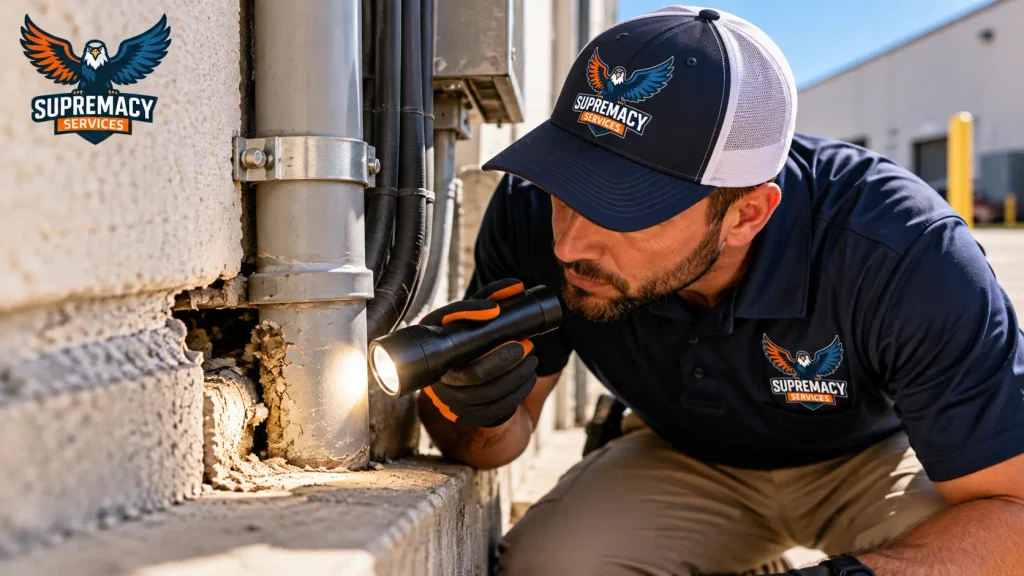
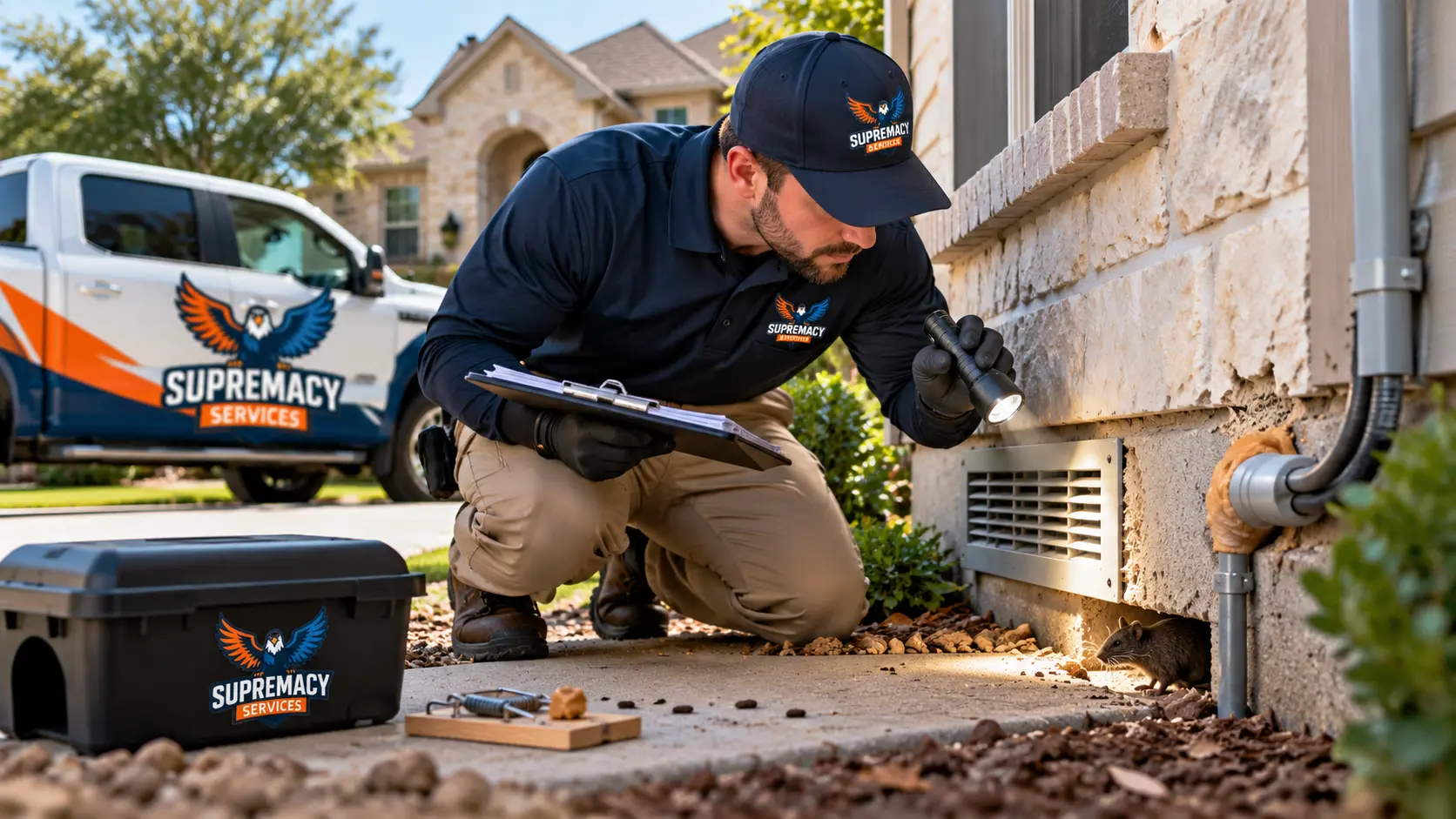
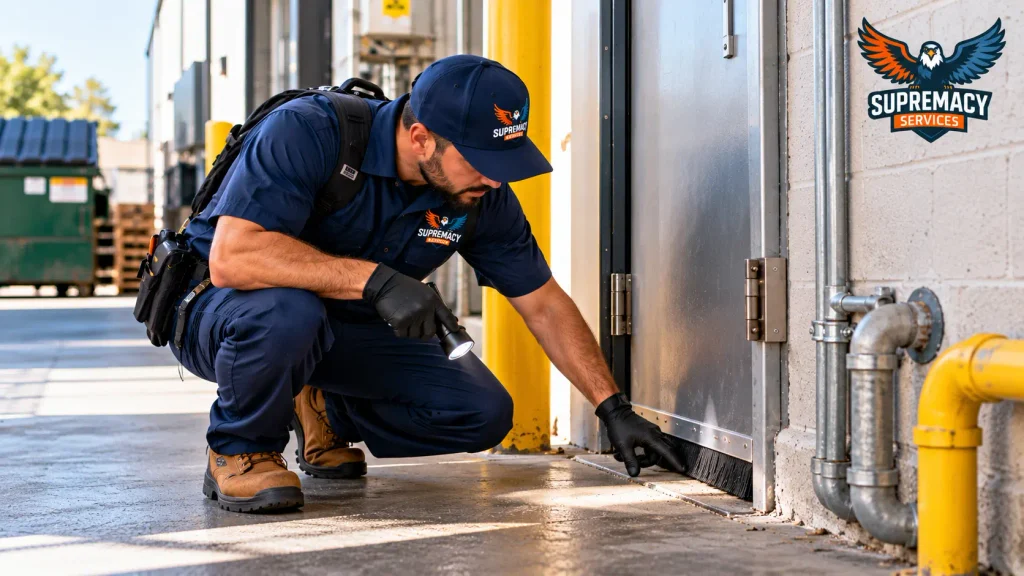
Supremacy Services technician inspecting exterior rodent entry points at a Dallas commercial property

Commercial Rodent Exclusion: How Dallas Businesses Prevent Recurring Infestations

Commercial rodent exclusion is the process of finding and closing the openings rats and mice use to enter a building, while also correcting the food, water, shelter and operational conditions that encourage them to return.

For Dallas businesses, that distinction matters. Trapping may remove rodents that are already inside, but if loading doors, utility penetrations, roof gaps, vents, damaged seals or other access points remain open, another rodent can use the same route later.

A long-term rodent strategy therefore requires more than catching the animals you can see. It combines inspection, active control, structural exclusion, sanitation and ongoing monitoring.

Table of Contents

  1. What Is Commercial Rodent Exclusion?
  2. Why Rodent Infestations Keep Returning
  3. Where Rodents Enter Commercial Buildings
  4. Signs Your Business Needs Rodent Exclusion
  5. Exclusion vs. Trapping
  6. What Professional Rodent Exclusion Includes
  7. How Dallas Businesses Can Reduce Rodent Pressure
  8. Which Commercial Properties Face the Greatest Risk?
  9. DIY vs. Professional Exclusion
  10. How Much Does Commercial Rodent Exclusion Cost?
  11. What Happens After Exclusion?
  12. Frequently Asked Questions

What Is Commercial Rodent Exclusion?

Commercial rodent exclusion is the process of physically preventing rats and mice from entering a commercial building by identifying and repairing entry points and reducing conditions that support rodent activity.

This may involve areas such as:

  • gaps around utility penetrations;
  • damaged door seals;
  • openings around loading docks;
  • roofline and soffit gaps;
  • plumbing penetrations;
  • exterior vents;
  • wall and foundation openings;
  • damaged screening;
  • openings around mechanical equipment.

Exclusion is different from simply placing traps or bait stations.

A trap deals with a rodent that has already entered the building. Exclusion addresses how that rodent entered in the first place.

That makes exclusion especially important when a Dallas business experiences the same rodent problem repeatedly.

The U.S. Environmental Protection Agency describes integrated pest management as an approach that combines multiple practical control methods rather than relying exclusively on pesticides. Structural maintenance, sanitation, monitoring and barriers that prevent pest entry are all consistent with this approach.

If rodents keep returning after previous treatments, schedule a commercial rodent inspection in DFW to identify active areas and structural entry points before another control program is started.

Why Do Rodent Infestations Keep Returning to Commercial Buildings?

Rodent problems commonly recur when the animals are removed but the conditions that allowed them inside remain unchanged.

A building can continue attracting rodents because it still provides one or more of four things:

Access. Openings allow rodents into the structure.

Food. Waste, stored products, crumbs, pet food, spilled ingredients or unsecured inventory may provide feeding opportunities.

Water. Plumbing leaks, condensation and standing water can support pest activity.

Shelter. Wall voids, storage areas, ceiling spaces, clutter and protected exterior areas can provide nesting or hiding locations.

The CDC recommends reducing rodent pressure by removing access to food, water and shelter and by sealing openings that allow rodents into structures.

That means a recurring infestation is often a building-management problem as well as a trapping problem.

For example, a warehouse may repeatedly trap mice near the same storage racks. The real source, however, may be an unscreened opening around a pipe penetration several rooms away.

Likewise, a restaurant may find droppings near a dry-storage area even though the rodents are entering through a damaged rear door sweep near the dumpster enclosure.

Effective exclusion follows the rodents’ travel routes back to the point of entry.

Where Do Rats and Mice Enter Commercial Buildings?

Rodents do not need a front door left open to enter a building.

Technician inspecting a gap around pipes and utility penetrations on a commercial building
Small gaps around pipes, cables and other utility penetrations can become access points for rats and mice.

The CDC notes that mice can enter through openings approximately 1/4 inch wide. That makes small construction and maintenance defects important during a rodent inspection.

Loading and delivery areas

Commercial loading areas experience frequent door movement, equipment traffic and wear.

Inspect:

  • gaps beneath overhead doors;
  • worn weather stripping;
  • damaged door sweeps;
  • wall penetrations;
  • openings beside dock equipment;
  • areas where walls and slabs meet.

Utility penetrations

Electrical conduit, plumbing, telecommunications, refrigeration lines and gas piping frequently pass through exterior walls.

The space around those penetrations should be checked rather than assuming the visible pipe or cable completely fills the opening.

Rooflines and upper walls

Roof rats are capable climbers, which means rodent inspection should not stop at ground level.

Roof edges, vents, soffits, flashing, mechanical penetrations and adjoining structural features may require inspection when evidence suggests upper-building activity.

Exterior vents

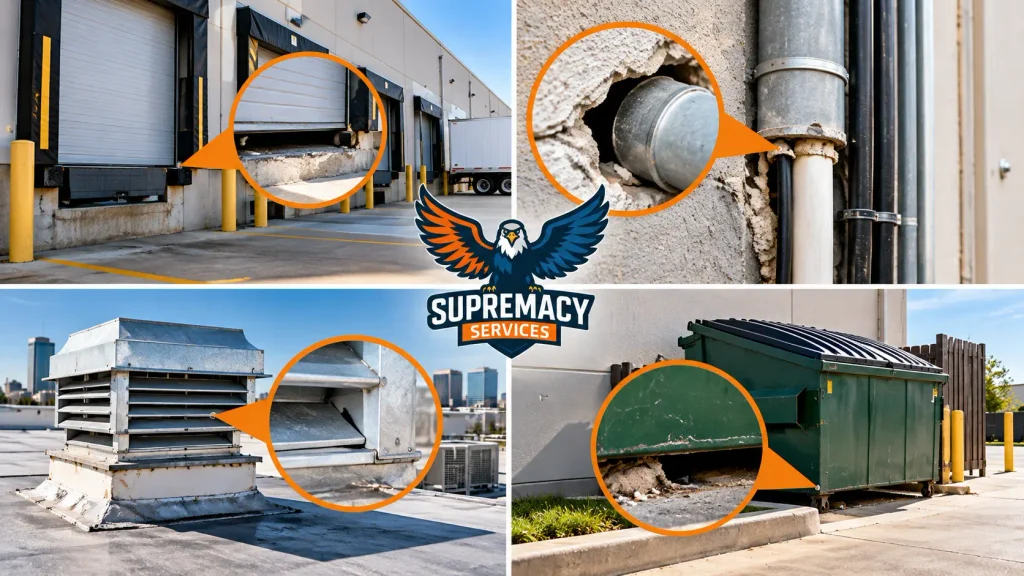
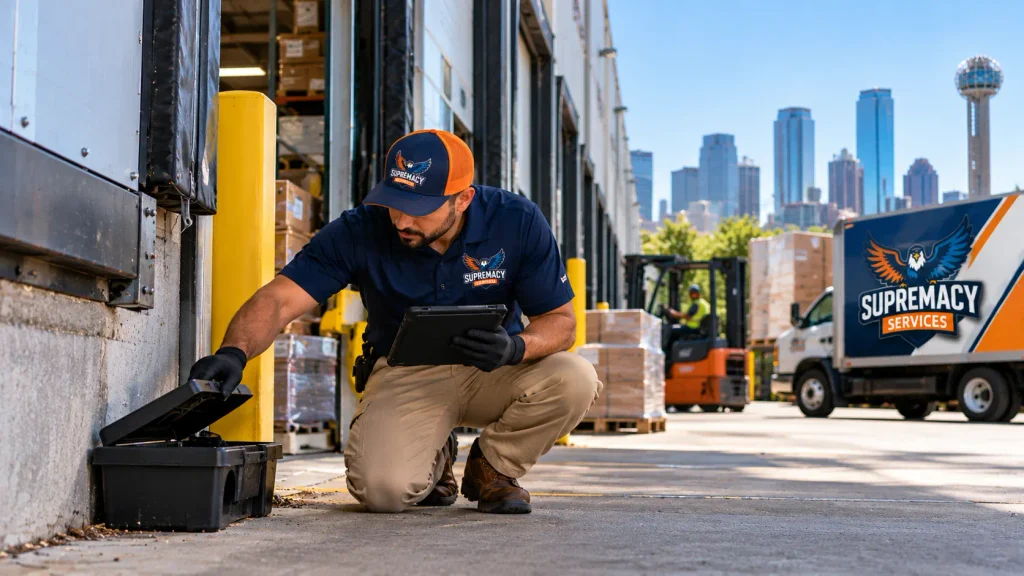
Common commercial rodent entry points at loading doors, utility penetrations, rooftop vents and waste areas
Loading docks, utility penetrations, rooftop openings and waste areas are important zones to inspect for rodent access.

Damaged or improperly protected vents can provide another potential path into commercial structures.

Any correction must preserve the vent’s intended airflow or drainage function. Exclusion should never create a new building-performance or safety problem.

Doors

A frequently used service door may appear closed while still leaving enough space underneath or along its edge for a mouse.

Rear doors, receiving doors, mechanical-room doors and rarely inspected secondary entrances deserve particular attention.

Pipe chases and internal pathways

Finding rodents inside one room does not necessarily mean they entered through that room.

Once rodents enter a building envelope, wall voids, ceiling spaces, pipe chases and utility routes may allow them to move between areas.

That is why a complete inspection tracks both exterior entry and interior movement.

Signs Your Business Needs Rodent Exclusion

Recurring droppings, repeated captures, gnawing, nighttime noises or rodent sightings after previous control are strong reasons to inspect the building for unresolved entry points.

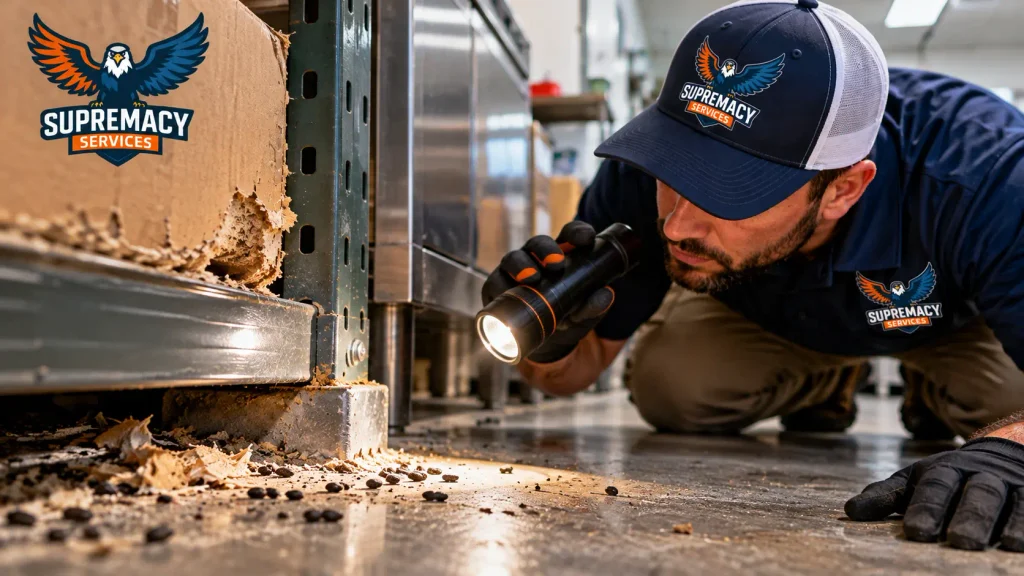
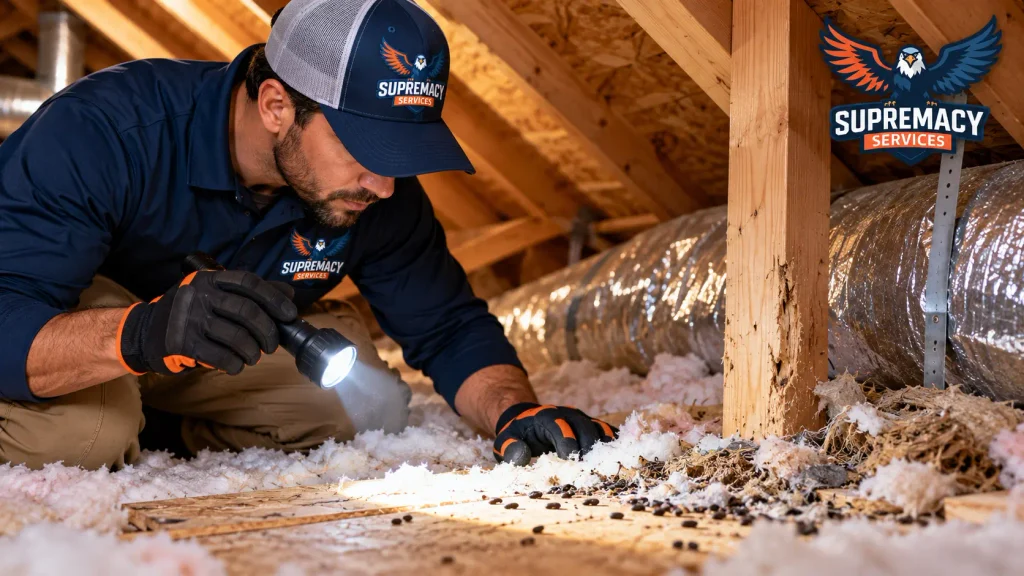
Supremacy technician inspecting rodent droppings and gnaw damage inside a commercial storage area
Droppings, gnaw damage and disturbed materials can help identify active rodent travel and feeding areas.

Watch for:

SignWhat it may indicate
Fresh droppingsCurrent travel or feeding area
Gnawed packagingAccess to stored products or food
Rub or grease marksRepeated travel along a route
Damaged door sealsPossible exterior access
Chewed materialsActive rodent presence
Scratching in walls or ceilingsMovement in concealed spaces
Repeated trap catchesAn access route may still be open
Activity near dumpstersFood or harborage pressure outside
Nesting materialAn established interior harboring area
New activity after previous treatmentControl occurred without complete exclusion

One rodent sighting does not tell you where the animal entered. The inspection has to connect evidence inside the facility with vulnerabilities outside it.

Commercial Rodent Exclusion vs. Trapping

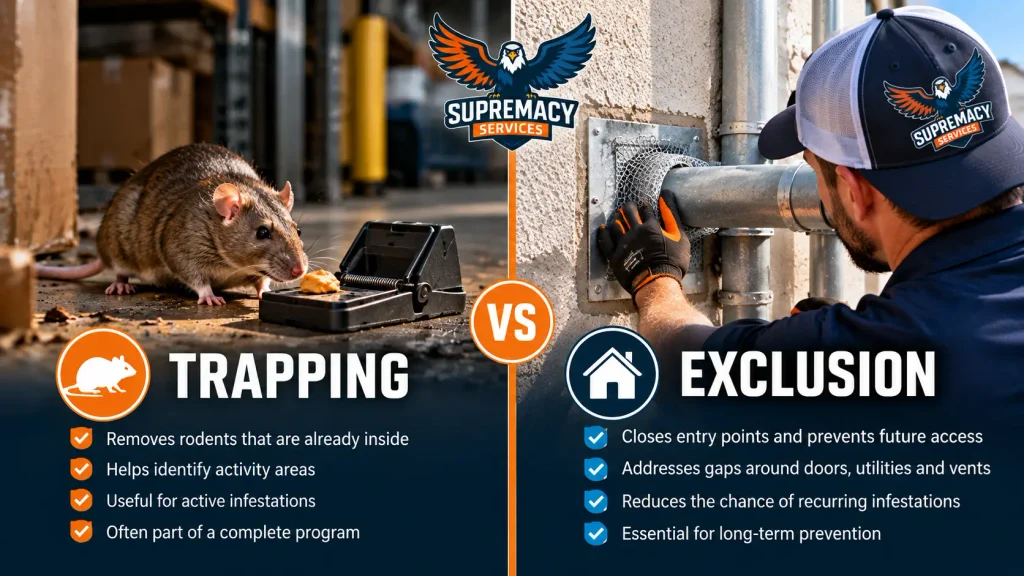
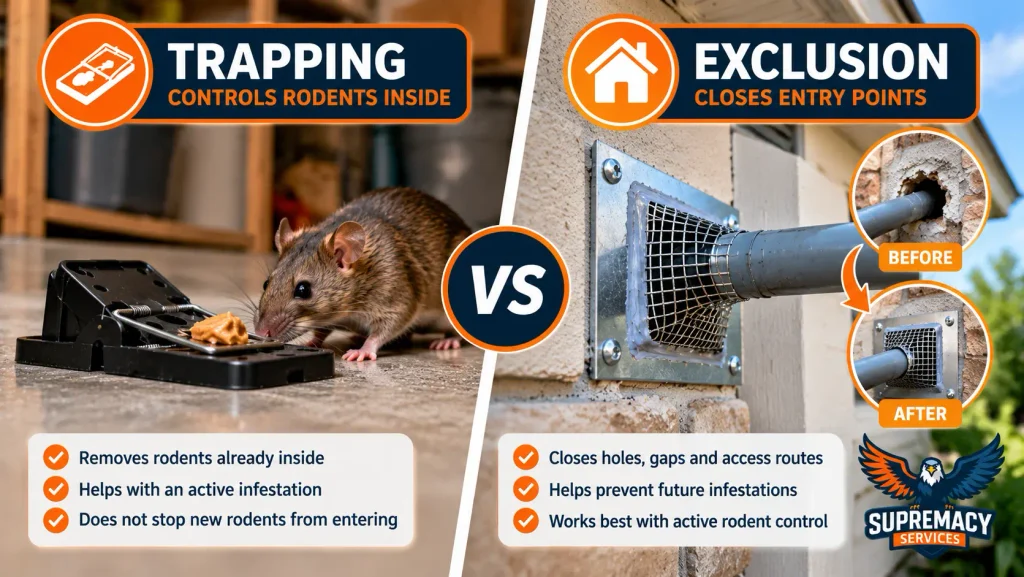
Trapping removes rodents that are already present. Exclusion reduces the chance that additional rodents can enter. Most established infestations require both functions rather than choosing only one.

Comparison of rodent trapping and structural exclusion for a commercial building
Trapping removes rodents already inside, while exclusion helps prevent additional rats and mice from entering.
IssueTrappingExclusion
Removes active rodentsYesNo
Closes entry pointsNoYes
Helps determine activity areasYesYes
Reduces future accessLimitedPrimary purpose
Addresses damaged door sealsNoYes
Addresses gaps around utilitiesNoYes
Useful for existing infestationYesUsually combined with control
Useful for long-term preventionPartlyYes

This is why simply installing more traps can become an endless cycle.

If five rodents are removed but an opening remains accessible, the building is still vulnerable.

At the same time, sealing a building without first determining whether rodents are already inside can create a different problem. Active animals must be considered as part of the exclusion sequence.

The correct order depends on what the inspection finds.

What Does Professional Commercial Rodent Exclusion Include?

A professional program should begin with evidence, not assumptions.

1. Facility inspection

The technician evaluates areas where rodents have been seen or where evidence has been found.

The inspection may extend to:

  • exterior walls;
  • loading areas;
  • waste-management zones;
  • utility rooms;
  • kitchens;
  • stockrooms;
  • ceiling spaces;
  • rooftops where appropriate;
  • storage areas;
  • mechanical rooms.

2. Rodent identification

The control plan should reflect whether the activity involves rats, mice or another animal.

Different species may use a commercial property differently.

Correct identification therefore helps determine where technicians should inspect, trap and monitor.

3. Entry-point assessment

Potential entry routes are documented and prioritized.

A useful report should distinguish between:

Confirmed entry points — openings supported by physical evidence.

Likely vulnerabilities — openings that may permit entry based on their construction and location.

Conducive conditions — conditions such as food, water, clutter or waste that make the property more attractive to rodents.

4. Active rodent control

If animals are already inside, an appropriate removal or control strategy is needed.

CDC guidance emphasizes trapping as part of rodent control and recommends placing traps in locations where rodent activity is present.

Commercial environments require added consideration for customers, employees, inventory, sanitation programs and operating schedules.

5. Structural exclusion

Once access points have been identified, appropriate openings can be closed or reinforced using materials suited to the opening and the building component.

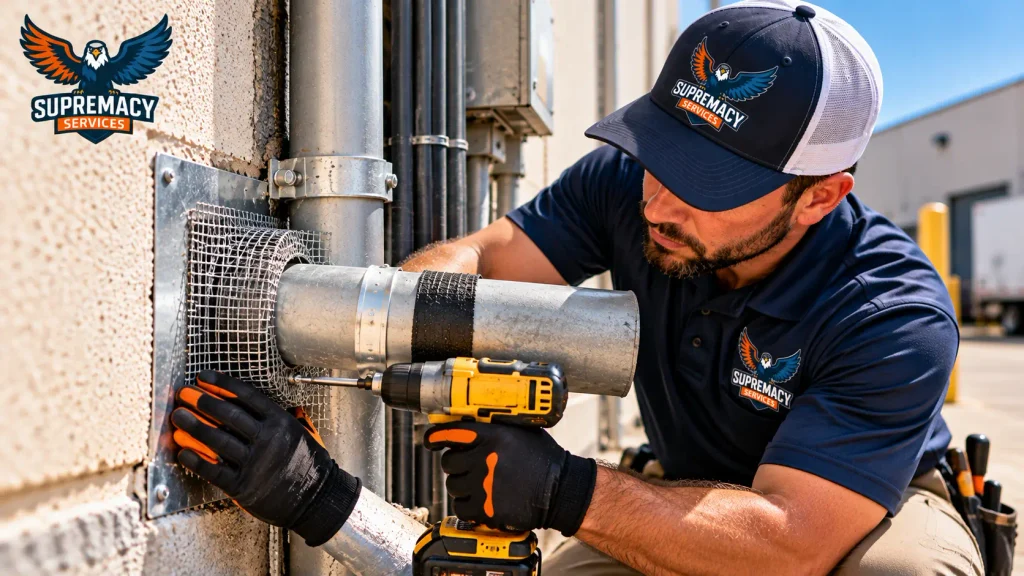
Supremacy technician sealing a commercial pipe penetration with metal mesh and durable exclusion materials
Durable exclusion repairs help close structural openings that rodents could use to enter a commercial building.

The goal is not simply to cover a hole.

A successful repair should:

  • prevent rodent access;
  • remain durable;
  • fit the surrounding construction;
  • preserve required ventilation;
  • preserve drainage where necessary;
  • avoid interfering with utilities or equipment.

6. Sanitation and attractant correction

Exclusion works better when the property also reduces food, water and shelter.

That can involve:

  • improving waste storage;
  • cleaning spills promptly;
  • correcting leaks;
  • reducing clutter;
  • protecting stored foods;
  • modifying storage practices;
  • maintaining landscaping around the structure.

7. Monitoring and follow-up

Exclusion should be verified.

The CDC identifies monitoring and evaluation as important components of integrated pest management.

Follow-up determines whether:

  • new droppings are appearing;
  • traps continue to show activity;
  • repaired areas remain intact;
  • new vulnerabilities have developed;
  • operational conditions are contributing to continued activity.

If your facility is trapping rodents repeatedly but the activity keeps returning, request a commercial pest and rodent assessment from Supremacy Services. The inspection should identify both active rodent pressure and the building conditions allowing recurrence.

How Dallas Businesses Can Reduce Rodent Pressure

Commercial rodent prevention is partly structural and partly operational.

Keep waste areas controlled

Dumpsters and waste containers should be managed so food residue and accessible waste do not continuously attract rodents toward the building.

Keep lids functional, clean surrounding areas and address spills.

Inspect delivery areas frequently

Loading docks and delivery doors experience more wear than many other building components.

Door seals that were effective when installed may deteriorate over time.

Correct plumbing leaks

Water availability can support pest activity.

Mechanical rooms, kitchens, wash areas and utility spaces deserve particular attention because small leaks may go unnoticed.

Reduce clutter

Rodents benefit from protected, rarely disturbed spaces.

Stored cardboard, unused equipment and poorly organized storage can also make inspections more difficult.

Keep food protected

Restaurants and food operations are not the only businesses with rodent food sources.

Employee break rooms, snack storage, vending areas, pet products, bird seed, damaged inventory and unsecured waste can all matter.

Include the exterior

Rodent prevention should not end at the interior wall.

Exterior inspections should consider vegetation, stored materials, waste areas and building penetrations near likely rodent travel routes.

Dallas and DFW Commercial Building Considerations

Dallas-Fort Worth contains a wide range of commercial property types, from urban restaurants and retail centers to suburban office parks, warehouses, multifamily developments and large distribution facilities.

The exclusion problem differs by property.

A warehouse may have large loading doors and frequent product movement.

A restaurant may have high food and waste pressure.

An apartment community may have numerous utility penetrations and shared structural pathways.

An office building may have comparatively little food pressure but still develop rodent activity around mechanical spaces, landscaping or exterior waste areas.

The correct plan therefore should not be based solely on the words “commercial rodent control.”

It should be based on how the individual property is built and operated.

Which Commercial Properties Face the Greatest Rodent-Control Challenges?

Any building can experience rodent activity, but certain operating environments require especially disciplined inspection and prevention.

Restaurants and food businesses

Food storage, frequent deliveries, waste handling and water availability can create multiple points of pressure.

Warehouses and distribution centers

Large structures, loading docks, stored inventory and frequent door openings increase the number of areas that need monitoring.

Multifamily properties

Shared walls, utility pathways, trash areas and numerous occupied units can make it difficult to isolate a problem to one location.

Retail stores

Stockrooms, loading areas and customer-facing spaces create both operational and reputational reasons to identify rodent activity early.

Hotels and hospitality properties

Large buildings with food-service areas, storage spaces and continuous occupancy require pest-management plans that account for multiple facility zones.

Healthcare and institutional environments

Pest management must be coordinated carefully with facility policies, sanitation requirements and occupied sensitive spaces.

Offices

Even properties without commercial kitchens can develop issues around break rooms, dumpsters, mechanical areas, storage spaces and landscaping.

Supremacy’s commercial pest-control service already supports facilities including restaurants, multifamily properties, offices, warehouses, hotels, healthcare facilities, schools and property-management portfolios.

Can a Business Handle Rodent Exclusion In-House?

Minor maintenance issues can sometimes be corrected by a facility team, but recurring activity, inaccessible entry points or an established infestation usually justify professional inspection.

A maintenance team may reasonably address straightforward issues such as a visibly damaged door sweep or obvious housekeeping problem.

Professional help becomes more appropriate when:

  • rodents continue appearing after traps are installed;
  • the species is uncertain;
  • entry points cannot be identified;
  • activity is occurring above ceilings or inside walls;
  • roof access is required;
  • multiple units or tenant spaces are involved;
  • food-service environments are affected;
  • contamination is significant;
  • specialized pest-control work is required.

Texas regulates structural pest-control businesses and individuals who perform covered pest-control activities for compensation through the Texas Department of Agriculture.

For a commercial property, pest-control responsibilities should therefore be separated appropriately between ordinary building maintenance and regulated professional pest-management activities. Supremacy services

How Much Does Commercial Rodent Exclusion Cost?

There is no meaningful single price for commercial rodent exclusion because the scope depends heavily on the building, infestation and number of repairs required.

Rather than publishing an unsupported flat price, businesses should expect an estimate to consider factors such as:

Cost factorWhy it matters
Building sizeMore exterior and interior area must be inspected
Number of entry pointsMore repairs increase material and labor requirements
Height/accessRoof and elevated areas may require additional access
Infestation severityMore active control and monitoring may be necessary
Building constructionDifferent materials require different repair methods
Facility typeRestaurants, warehouses and multifamily properties present different conditions
ContaminationCleanup requirements may change the project
Follow-upSome properties require ongoing monitoring
Multiple buildingsCampuses and portfolios increase inspection scope

For that reason, the most useful quote is normally one based on an actual facility assessment rather than a generic price-per-building estimate.

What Happens After Rodent Exclusion?

Exclusion is not a reason to stop monitoring.

Commercial buildings change.

Doors wear out. Contractors create new utility penetrations. Roofing work can alter flashing. Tenants change. Landscaping grows. Waste-management practices change.

A facility that was well sealed two years ago may develop a new vulnerability today.

An ongoing prevention program may therefore include:

  1. inspection of previously repaired areas;
  2. monitoring for fresh rodent evidence;
  3. review of waste and sanitation conditions;
  4. inspection of doors and loading areas;
  5. review of exterior conditions;
  6. correction of newly developed gaps.

The EPA’s integrated pest-management framework emphasizes monitoring and prevention rather than relying only on repeated pesticide treatments.

That principle is especially useful for commercial properties where preventing the next infestation is often less disruptive than reacting after rodents become established.

Rodent Exclusion Checklist for Dallas Businesses

Before considering a recurring rodent problem resolved, confirm that the property has addressed the following areas:

  • Active rats or mice have been identified and controlled.
  • Exterior walls have been inspected.
  • Loading and service doors have been checked.
  • Roofline vulnerabilities have been evaluated where relevant.
  • Utility and pipe penetrations have been checked.
  • Vents and screens are intact.
  • Waste containers are properly managed.
  • Food and inventory are stored appropriately.
  • Plumbing leaks have been corrected.
  • Clutter and potential harborage have been reduced.
  • Exclusion repairs have been documented.
  • Follow-up monitoring is scheduled.

If several items remain unresolved, the building may still be vulnerable even if current trapping activity has declined.

Frequently Asked Questions

What is commercial rodent exclusion?

Commercial rodent exclusion is the process of identifying and closing structural openings that allow rats and mice into a business, together with correcting conditions that encourage recurring activity.

Is rodent exclusion the same as pest control?

No. Rodent control addresses active animals, while exclusion focuses specifically on preventing entry. A comprehensive program may combine inspection, trapping or other control, structural repairs, sanitation and monitoring.

Will trapping alone stop rats from coming back?

Not necessarily. Trapping can remove rodents already inside, but recurring activity can continue when entry points, food, water or shelter remain available.

Where do mice enter commercial buildings?

Common inspection areas include gaps around doors, utility penetrations, exterior walls, loading areas, vents, rooflines and openings around plumbing or mechanical systems.

Can mice really enter through very small gaps?

Yes. CDC guidance notes that mice can pass through openings approximately 1/4 inch wide, which is why relatively small construction gaps can matter during an inspection.

Should entry points be sealed while rodents are still inside?

The sequence should be based on the inspection. Active animals need to be considered before sealing so that exclusion work does not simply trap rodents within inaccessible areas.

How often should a commercial building be inspected for rodents?

There is no universal interval appropriate for every property. Inspection frequency should reflect the facility type, pest pressure, operating conditions, past rodent activity and findings from ongoing monitoring.

Are warehouses more difficult to rodent-proof?

They can be. Warehouses often contain multiple loading doors, large wall areas, stored goods and frequent deliveries, which creates more locations that must be inspected and monitored.

Does rodent exclusion eliminate the need for sanitation?

No. Exclusion addresses access, while sanitation reduces food, water and shelter. Long-term rodent management works best when both are addressed.

Who should perform commercial rodent control in Texas?

Businesses performing regulated structural pest-control work for compensation in Texas fall under the Texas Department of Agriculture’s Structural Pest Control Service licensing framework.

The Bottom Line

Recurring rodent infestations usually require a different question than, “How do we catch another rat?”

The better question is:

Why are rodents able to keep using this building?

For Dallas businesses, successful commercial rodent exclusion means investigating the entire system—entry routes, active rodents, sanitation, waste, water, building maintenance and ongoing monitoring.

Trapping can remove today’s problem.

Exclusion and prevention are what help keep tomorrow’s rodents outside.

If rats or mice keep returning to your Dallas-Fort Worth commercial property, schedule a commercial rodent inspection with Supremacy Services. The goal should be to identify the activity, locate structural vulnerabilities and build a prevention strategy around how your facility actually operates.

Supremacy Services technician inspecting a Dallas-area home for rodent activity and possible entry points

Rodent Exclusion vs. Trapping: Which Does Your Home Need?

If rats or mice are already inside your Dallas-area home, the answer is usually not trapping or exclusion. In many infestations, you need both.

Trapping addresses rodents that are already inside the structure. Rodent exclusion addresses the openings that allowed them inside in the first place. Trapping without correcting access points can leave your home vulnerable to another infestation, while sealing an active opening without first determining whether rodents remain inside can create a different problem.

For Dallas and DFW homeowners, the most effective approach usually begins with an inspection: identify the animal, determine where it is active, locate possible entry points, control the rodents already inside and then correct vulnerable openings where appropriate.

Table of Contents

Rodent Exclusion vs. Trapping: What Is the Difference?

Split view showing indoor rodent trapping and exterior rodent exclusion work on a home
Trapping removes rodents already inside, while exclusion helps block the openings they use to enter.

Rodent trapping removes rats or mice that are already inside or actively using a property. Rodent exclusion is the process of finding and correcting structural openings that allow rodents to enter.

They solve different parts of the same problem.

Rodent trappingRodent exclusion
Targets active rats or miceTargets entry routes
Helps reduce the existing populationHelps prevent additional rodents from entering
Usually performed inside or near active areasUsually focuses on the building envelope
Requires correct trap placement and monitoringRequires inspection and suitable repair materials
Does not repair structural openingsDoes not automatically remove rodents already inside

The CDC similarly treats trapping and sealing as complementary parts of rodent control: it recommends checking how rodents entered, sealing openings and trapping rodents that remain inside.

That distinction is important because homeowners often focus on whichever part of the problem they notice first.

Seeing a mouse may lead you to buy traps. Finding a hole near the roof may make you want to seal it immediately. A proper control plan considers both the occupants and the access route.

If you are already finding droppings, hearing nighttime movement or repeatedly catching rodents, schedule a rodent inspection and control evaluation with Supremacy Services to determine whether the property needs active control, exclusion or both.

When Does Your Home Need Trapping?

Trapping is appropriate when rats or mice are already inside the home or there is evidence of active rodent activity.

Common signs include:

  • fresh droppings;
  • scratching or movement inside walls or ceilings;
  • gnaw marks;
  • damaged food packaging;
  • nesting material;
  • disturbed attic insulation;
  • tracks or rub marks;
  • rodents seen indoors;
  • continued activity around known travel areas.

The CDC recommends traditional snap traps for household rats and mice and says traps should be placed in areas where evidence of rodents has been found.

Correct identification matters. A mouse trap and rat trap are not interchangeable, and the animal’s travel pattern influences where trapping is likely to be effective.

Trapping treats the current infestation

Imagine a rat entering through a damaged soffit and nesting in the attic.

A trap can address the rat currently living there.

It cannot repair the soffit.

If another rat can use the same opening next week, the structural problem remains.

That is why repeatedly trapping rodents without investigating access points may become an ongoing cycle rather than a permanent solution.

When Does Your Home Need Rodent Exclusion?

Your home needs rodent exclusion when rats or mice can access the structure through gaps, damaged vents, roofline openings, utility penetrations, door gaps or other vulnerabilities.

Exclusion means finding these access routes and repairing or reinforcing them appropriately.

Potential rodent entry areas include:

  • gaps around soffits and fascia;
  • attic and crawl-space vents;
  • openings around plumbing lines;
  • electrical and cable penetrations;
  • gaps around gas or utility lines;
  • damaged screens;
  • gaps beneath exterior doors;
  • attached garage openings;
  • openings around foundations;
  • roof intersections and construction gaps.

Mice are particularly challenging because they can use extremely small openings. CDC guidance notes that mice can fit through a hole approximately 1/4 inch, or 6 millimeters, wide.

Exclusion treats the access problem

Rodent exclusion is not simply filling the one hole you happen to notice.

A useful exclusion inspection evaluates the building as a system.

For example, sealing a pipe penetration at ground level does little good if rodents are also reaching an attic through an unscreened vent.

A complete inspection should therefore consider both the evidence inside the building and vulnerable areas around the exterior.

Do You Usually Need Both Trapping and Exclusion?

If rodents are already inside and structural openings are allowing entry, trapping and exclusion generally perform two necessary but different jobs.

A typical sequence looks like this:

  1. Inspect the property.
    Confirm rodent activity and look for possible access routes.
  2. Identify the rodent.
    Determine whether the evidence points toward rats, mice or another animal.
  3. Control active rodents.
    Use an appropriate strategy based on the species and location.
  4. Correct entry points.
    Seal or reinforce vulnerable openings once the situation has been evaluated properly.
  5. Monitor the property.
    Look for new droppings, sounds, gnawing or other evidence that activity continues.
  6. Reduce attractants.
    Improve food, trash and exterior conditions that may encourage rodents around the structure.

This is also why “I caught a rat, so the problem is solved” can be a risky assumption.

Catching one animal proves only that one animal was caught. It does not prove there are no others, nor does it explain how that animal entered.

Should You Seal Rodent Holes Before or After Trapping?

Do not automatically seal an active opening without first determining whether rodents remain inside.

If an entry point is being actively used, closing it at the wrong stage can potentially leave animals inside walls, an attic or another inaccessible part of the structure.

The better approach is to determine:

  • what animal is present;
  • whether the opening is active;
  • whether additional access points exist;
  • whether rodents remain inside;
  • and when permanent repair should occur.

This is particularly important when the animal has not been positively identified. Scratching in an attic, for example, could involve rats, mice, squirrels or another animal, and wildlife situations may require a different removal process.

If you are unsure what you are hearing, Supremacy’s guide to scratching noises in the attic can help you compare rat, mouse and squirrel evidence before deciding what kind of control is appropriate.

How Do Rats and Mice Get Into a Home?

Rats and mice enter wherever the structure provides a usable route to shelter, food or water.

Around Dallas-area homes, an inspection may include:

Rooflines and soffits

Roof-level gaps, damaged soffits and unscreened openings can provide access to attic spaces.

Roof rats are particularly relevant when evidence is concentrated high in a building because they are capable climbers.

Vents

Damaged or inadequately protected attic, crawl-space and mechanical vents can become access points.

Utility penetrations

Openings around plumbing, electrical, cable, HVAC or gas penetrations deserve attention because even a relatively small unfinished gap can create a route into a wall or interior void.

Garages and doors

Worn weather stripping and gaps at garage or exterior doors can provide lower-level access.

Foundation and construction gaps

Transitions between building materials and unfinished openings around the foundation should also be checked.

The CDC recommends inspecting both the inside and outside of a home, including roofs, eaves, gables, soffits, vents, doors and utility penetrations.

Why Do Rodents Keep Coming Back After Trapping?

Recurring rodent activity usually means the underlying conditions that supported the infestation have not all been corrected.

Possible reasons include:

  • one or more entry points remain open;
  • not all rodents were removed;
  • the wrong areas are being trapped;
  • food or pet food remains accessible;
  • garbage is easy to reach;
  • exterior shelter remains attractive;
  • damaged screens or vents have not been repaired;
  • new structural openings have developed.

This is one of the biggest differences between population control and long-term prevention.

Trapping can reduce the animals currently present. Exclusion changes the building conditions that make repeated entry possible.

What Does Professional Rodent Control Include?

A professional rodent-control visit should begin with evidence, not assumptions.

Depending on the property and infestation, a service may include:

1. Interior inspection

The technician looks for:

  • droppings;
  • gnawing;
  • nesting material;
  • tracks;
  • rub marks;
  • disturbed insulation;
  • travel routes;
  • likely feeding areas.

2. Exterior inspection

The building envelope is checked for possible access points around:

  • the roof;
  • soffits;
  • fascia;
  • vents;
  • garage doors;
  • utility penetrations;
  • foundations;
  • exterior openings.

3. Identification

Rat and mouse behavior differs, so the evidence should guide the control strategy.

4. Active rodent control

Where rodents are present, appropriate control measures are placed in locations consistent with their travel patterns and the site’s safety requirements.

5. Exclusion recommendations

Openings that are contributing to the problem can be identified for sealing or reinforcement.

6. Follow-up and monitoring

Fresh evidence after the initial work can reveal whether additional activity remains or another entry route was overlooked.

If trapping has become an ongoing routine in your home, the next step should be finding why rodents are still getting inside. Learn about Supremacy Services’ rat control and exclusion in Dallas-Fort Worth and schedule an inspection focused on both active rodents and structural access.

DIY Trapping vs. Professional Rodent Control

A small, clearly identified mouse problem may sometimes be manageable by a homeowner using appropriate traps, sanitation and exclusion practices.

Professional help becomes more appropriate when:

  • you continue finding fresh droppings after trapping;
  • activity is occurring in walls or inaccessible attic spaces;
  • you cannot determine whether you have rats, mice or wildlife;
  • several possible entry points are present;
  • roof-level inspection is needed;
  • rodents continue returning;
  • children or pets complicate trap placement;
  • there is substantial contamination;
  • you are uncomfortable handling dead rodents;
  • the infestation appears widespread.

Texas also regulates structural pest-control services performed for compensation. The Texas Department of Agriculture lists rats and mice within its structural pest-control licensing category.

Safety matters during cleanup

Do not dry sweep or vacuum rodent droppings.

Rodent urine, droppings and nesting material can present health risks. Follow CDC cleanup guidance when contaminated material is present rather than disturbing dry waste and sending particles into the air.

What Affects the Cost of Rodent Trapping and Exclusion?

There is no responsible single price for every rodent problem because the scope can differ dramatically from one property to another.

Important cost factors include:

FactorWhy it matters
Rodent speciesRats and mice may require different strategies
Infestation extentOne localized area differs from activity throughout a home
Number of entry pointsMore repair locations generally mean more exclusion work
Entry-point locationGround-level gaps are different from high roof or soffit repairs
Building constructionBrick, siding, masonry, roofing and other materials require different repair approaches
AccessibilityAttics, crawl spaces and steep rooflines can affect the scope
ContaminationSignificant nesting or waste may require additional cleanup considerations
Follow-up needsPersistent activity may require additional monitoring

Ask for an inspection-based scope rather than relying on an online price that cannot account for your house.

A useful proposal should make clear whether the price includes:

  • inspection;
  • trapping or other active control;
  • trap monitoring;
  • exclusion work;
  • materials;
  • follow-up;
  • cleanup, if offered;
  • and any areas specifically excluded from the scope.

Dallas and DFW Rodent-Control Considerations

Dallas-area rodent control should be based on the building and the actual evidence rather than generic seasonal assumptions.

Homes throughout DFW may have multiple potential access zones: attached garages, attic vents, rooflines, utility penetrations, exterior kitchens, storage spaces and landscaped areas close to the structure.

Roof rats also deserve attention when activity appears in an attic or along higher sections of a home. Supremacy’s current rodent-control page notes that roof rats can use trees, fences, utility lines and structural features to reach elevated areas.

The practical implication is simple: an inspection limited to the kitchen or garage can miss the route being used higher on the building.

How Can You Prevent Rodents From Coming Back?

Long-term rodent prevention focuses on access, food, water and shelter.

Seal vulnerable openings

Inspect the exterior periodically and repair damaged screening, gaps and deteriorated exclusion work.

Store food securely

Use sealed containers where appropriate and clean spills or accessible food promptly.

Control pet food

Avoid leaving pet food accessible in garages, patios or other areas where rodents can feed.

Secure garbage

Use containers with well-fitting lids and clean spilled waste around bins.

Reduce clutter

Dense storage, debris and unused materials can create protected areas around garages, sheds and exterior walls.

Watch repaired areas

An exclusion repair should not be forgotten permanently. Building materials weather, doors shift and new openings can develop.

Periodic inspection helps identify vulnerabilities before another rodent establishes itself inside.

Rodent Trapping vs. Exclusion: Quick Decision Guide

What you are seeingLikely next step
Fresh droppings insideInvestigate active rodent control
Rodent caught indoorsContinue evaluating for additional activity and entry points
Known exterior gaps but no confirmed activityInspect and consider preventive exclusion
Repeated infestationsPrioritize a full entry-point inspection
Scratching in walls or atticIdentify the animal before choosing a solution
Trapping works temporarily but rodents returnInvestigate unresolved exclusion problems
Multiple openings plus active infestationA combined control-and-exclusion plan is likely appropriate

Frequently Asked Questions

Is rodent exclusion better than trapping?

Neither replaces the other. Trapping addresses rats or mice already inside, while exclusion addresses how rodents enter. If you have an active infestation and open entry points, both may be necessary.

Can you get rid of rats with traps alone?

Traps can remove rats currently inside, but they do not close structural openings. If access remains available, new rats may enter later.

Should I seal holes while rats are still inside?

Do not permanently close an active entry point without first determining whether rodents remain in the structure. The sequence of control and exclusion should be based on inspection findings.

What is included in rodent exclusion?

Rodent exclusion generally involves locating potential access points and sealing or reinforcing vulnerable openings such as gaps around vents, rooflines, utility penetrations, doors and other parts of the building envelope.

Why do mice keep returning after I trap them?

Recurring activity can indicate additional mice remain inside, entry points are still open or food and shelter continue attracting rodents around the structure.

How small a hole can a mouse enter?

CDC guidance states that mice can fit through an opening about 1/4 inch, or approximately 6 millimeters, wide.

Does rodent exclusion permanently guarantee that mice will never return?

No responsible service should treat a building as permanently immune to rodents. Materials deteriorate, buildings change and new openings can develop. Inspection, maintenance and sanitation remain important.

Can I do rodent exclusion myself?

Simple, safely accessible gaps may be manageable for some homeowners. Professional assistance is more appropriate when openings are difficult to reach, roof access is required, the infestation persists, the animal cannot be identified or several entry points are involved.

Is scratching in the attic always a rat?

No. Rats and mice are possibilities, especially with nighttime activity, but squirrels and other animals can also occupy attics. Droppings, nesting material, gnawing, tracks and entry-point evidence provide a better diagnosis than sound alone.

The Bottom Line: Trapping Removes Rodents; Exclusion Helps Keep Them Out

The difference between trapping and rodent exclusion is straightforward:

Trapping deals with the rodents that are already there. Exclusion deals with how they got there.

For a Dallas or DFW home with active rodents and structural entry points, the strongest long-term strategy is usually to identify the species, control the current activity, correct access routes and continue monitoring for new evidence.

Still catching rats or mice after you thought the problem was solved? Schedule a rodent inspection with Supremacy Services. We can evaluate active rodent evidence, inspect likely entry routes and determine whether your Dallas-Fort Worth home needs trapping, exclusion or a combination of both.

Supremacy Services technician inspecting a Dallas home exterior for possible rat and mouse entry points

What Is Rodent Exclusion and How Does It Keep Rats and Mice Out?

Rodent exclusion is the process of finding and closing the openings rats and mice use to enter a building. Instead of focusing only on rodents already inside, exclusion addresses the structure itself—roof gaps, vents, utility penetrations, garage openings, damaged screening and other vulnerable areas that can allow rodents to return.

For Dallas and DFW homeowners, that distinction matters. Traps may remove individual rats or mice, but if the access point remains open, the house is still vulnerable to another infestation.

A complete rodent-control plan therefore usually has two separate goals: deal with the rodents currently inside and reduce the ways additional rodents can get in.

Table of Contents

  1. What Is Rodent Exclusion?
  2. How Does Rodent Exclusion Work?
  3. Why Trapping Alone May Not Solve a Rodent Problem
  4. Where Do Rats and Mice Enter a House?
  5. What Materials Are Used for Rodent Exclusion?
  6. Should You Seal the Hole Immediately?How-Does
  7. Signs Your Home May Need Rodent Exclusion
  8. DIY vs. Professional Rodent Exclusion
  9. What Does Professional Rodent Exclusion Include?
  10. How Much Does Rodent Exclusion Cost?
  11. Rodent Exclusion in Dallas and North Texas
  12. How to Make Exclusion More Effective
  13. Frequently Asked Questions

What Is Rodent Exclusion?

Rodent exclusion means identifying and physically closing openings that rats and mice can use to enter a home or other building.

It is different from simply setting traps.

Trapping addresses rodents that have already entered. Exclusion addresses how they entered and helps reduce the chance of the same problem happening again.

The CDC specifically recommends inspecting homes for gaps and holes and sealing them to help prevent rodents from entering. It notes that mice can pass through an opening approximately 1/4 inch, or 6 millimeters, in diameter. CDC

A rodent-exclusion inspection may therefore look at areas such as:

  • roof edges and roof intersections;
  • eaves and soffits;
  • attic vents;
  • damaged vent screens;
  • plumbing penetrations;
  • electrical and cable penetrations;
  • gaps around HVAC lines;
  • exterior-wall openings;
  • foundation transitions;
  • garage-door edges;
  • doors without effective weather stripping;
  • crawl-space openings;
  • construction gaps.

The purpose is not to make a house theoretically airtight. The purpose is to identify realistic rodent-access routes and reinforce them with appropriate materials.

“If you are finding droppings, hearing attic activity or dealing with rodents that keep returning, learn how Supremacy Services approaches [rodent control and exclusion in DFW].”


How Does Rodent Exclusion Work?

Rodent exclusion usually follows four basic steps: inspect, control active rodents, seal appropriate entry points and monitor for continuing activity.

1. Inspect the structure

A useful rodent inspection looks both inside and outside.

Inside, the technician or homeowner is looking for evidence such as:

  • droppings;
  • gnaw marks;
  • nesting material;
  • damaged food packaging;
  • tracks or rub marks;
  • disturbed insulation;
  • recurring noises;
  • areas where rodents appear to travel.

Outside, the goal changes from finding rodents to finding access.

Rooflines, vents, soffits, utility penetrations, foundation transitions, doors and other gaps should be considered.

The EPA lists droppings, nesting material, gnawed food packaging, chewed openings and stale odors among signs that rats or mice may be present.

2. Determine what is actually inside

Rats, mice, squirrels and other attic wildlife should not automatically be treated as the same problem.

For example, Supremacy’s existing attic guide explains that noises alone may not positively identify the animal and recommends considering activity patterns, physical evidence and entry routes. Supremacy Services

Species identification can affect:

  • trap selection;
  • trap placement;
  • entry-point assessment;
  • whether wildlife removal rather than standard rodent control is appropriate;
  • when an opening can safely be closed.

3. Control rodents already inside

Exclusion is not simply a matter of finding a hole and closing it immediately.

If rats or mice are already living inside the structure, the active population also has to be addressed.

The CDC recommends traditional snap traps for household rat and mouse control and advises placing traps where rodent activity has been observed. It also stresses keeping traps and baits away from children and pets.

4. Seal appropriate openings

Once the situation has been evaluated, vulnerable entry points can be repaired, screened or sealed using materials suitable for the opening.

The goal is straightforward:

remove the current access route and make it harder for another rodent to use the same weakness later.

5. Recheck the property

Effective exclusion should not end the instant the last visible hole is covered.

Follow-up may be useful to determine whether:

  • new droppings are appearing;
  • traps are still showing activity;
  • another entry route was missed;
  • a repair has moved or failed;
  • additional structural work is required.

Why Trapping Alone May Not Solve a Rodent Problem

Traps remove rodents. Exclusion addresses the route they used to enter.

That is the key difference.

Consider a rat entering an attic through a damaged roof vent.

A trap may catch that particular rat.

But the damaged vent remains available.

A second rat could potentially use the same opening later.

The same problem applies to mice entering around plumbing pipes, beneath garage doors or through construction gaps.

ApproachPrimary purposeDoes it address existing rodents?Does it address entry points?
TrappingRemove rodents already insideYesNo
BaitingControl an active populationYesNo
SanitationReduce food, water and shelterIndirectlyNo
ExclusionClose structural access pointsNo, not by itselfYes
Integrated approachControl + preventionYesYes

That is why the EPA encourages both controlling rodents and preventing access by sealing openings and reducing food, water and shelter around a property.


Where Do Rats and Mice Enter a House?

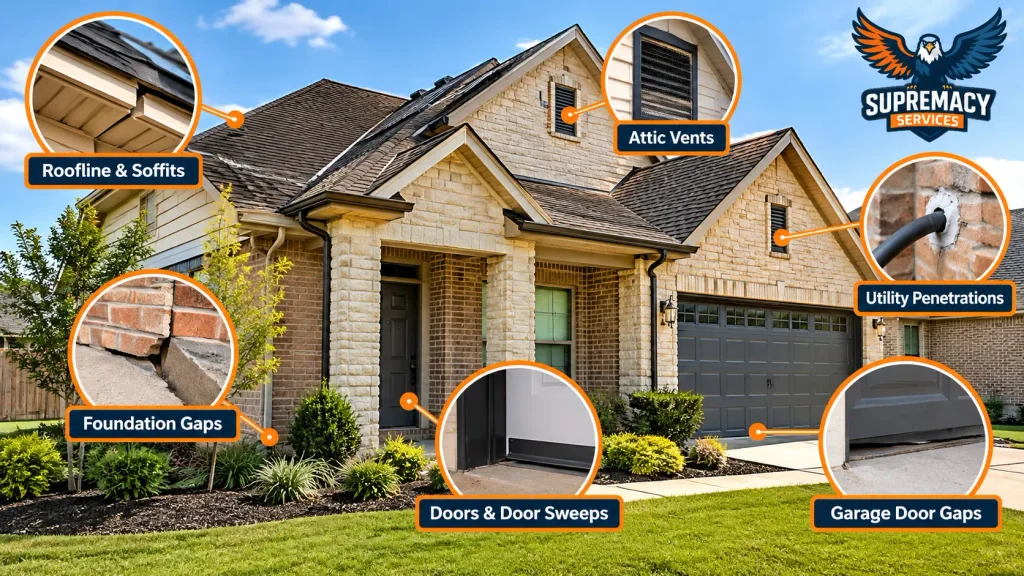
Rodents can enter through gaps in rooflines, vents, foundations, utility penetrations, garages and other parts of the building envelope.

Dallas-area house showing common rodent entry points including rooflines, attic vents, utility gaps, foundations and garage doors
Rats and mice can enter through vulnerable areas from the foundation to the roofline, making a full exterior inspection important.

Supremacy’s existing North Texas rat-entry guide already covers this subject in detail and identifies rooflines, soffits, vents, utility penetrations, foundations and garage areas among important areas to inspect. Supremacy Services

Rooflines, soffits and eaves

Gaps where roofing materials meet fascia, soffits or adjoining walls can provide concealed access.

These areas deserve particular attention when activity is occurring in an attic.

Attic and exterior vents

Vents need airflow, so simply filling them is generally not the solution.

Instead, damaged or inadequate screening may need to be repaired or reinforced in a way that preserves the vent’s intended function.

Utility penetrations

Homes contain openings for:

  • plumbing;
  • electrical cables;
  • refrigerant lines;
  • gas lines;
  • internet and television cables;
  • drains and other utilities.

The CDC specifically recommends inspecting around electrical, water, gas and sewer lines for possible rodent openings. CDC

Doors and garage doors

A worn door sweep or poorly fitting garage-door edge may leave a gap at floor level.

Because these openings move every time the door operates, they generally require a proper mechanical repair rather than simply applying sealant.

Foundation and wall gaps

Changes in materials, previous repairs and penetrations near the foundation can create small openings that are easily overlooked.

Roof intersections and flashing

Complex roof shapes can hide vulnerabilities from someone inspecting only from ground level.

This is one reason repeated attic activity may justify a more detailed exterior and roofline inspection.


What Materials Are Used for Rodent Exclusion?

The correct material depends on the opening, its size, its location and whether the component needs ventilation or movement.

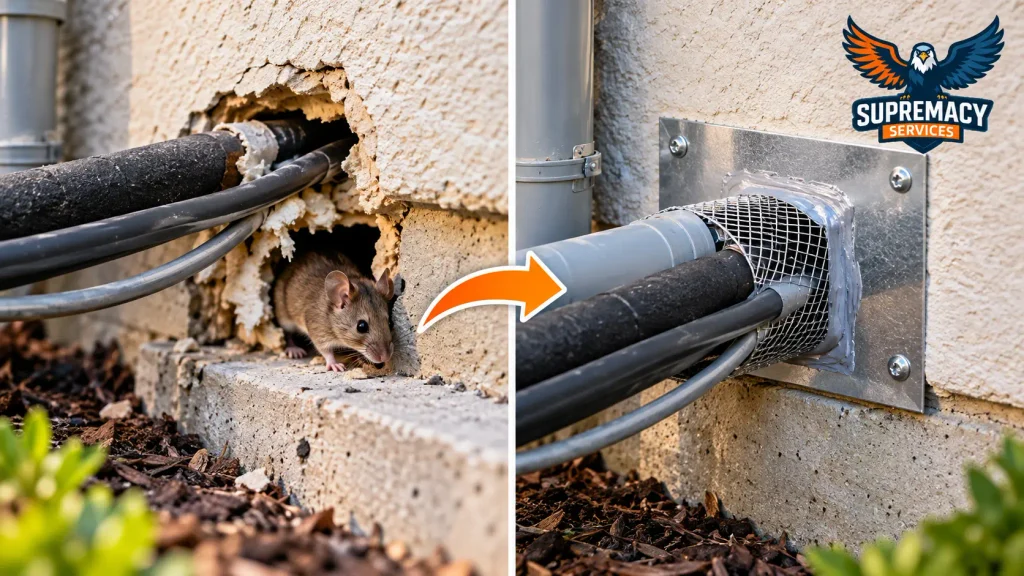
Rodent entry gap around utility pipes before and after a professional exclusion repair
Durable rodent exclusion closes vulnerable openings with appropriate barriers rather than leaving access points available for rats and mice.

The CDC recommends several options for closing rodent openings, including steel wool for some small gaps and materials such as hardware cloth, metal sheeting, cement and lath screen for larger repairs.

Common exclusion materials can include:

  • metal mesh;
  • hardware cloth;
  • sheet metal or flashing;
  • appropriately secured steel wool for small openings;
  • mortar or cement where suitable;
  • durable exterior sealants;
  • replacement vent screening;
  • properly fitted door sweeps.

What about spray foam?

Expanding foam can be useful as part of some sealing projects, but homeowners should not assume foam alone is appropriate for every rodent opening.

Rodent-resistant repairs often rely on a physical barrier, particularly where gnawing is likely.

The goal should be a durable repair appropriate to that part of the building—not simply making the opening disappear visually.


Should You Seal the Hole Immediately?

Not always. If rodents or other wildlife are still inside, sealing an active opening without a control plan can create a new problem.

This is especially important when you do not know:

  • what animal is using the opening;
  • whether more than one animal is inside;
  • whether young animals could be present;
  • whether another exit exists;
  • whether the opening is the primary entry route.

Supremacy’s squirrel-exclusion page makes the same practical distinction: determining whether wildlife remains inside should come before simply closing the opening. Supremacy Services

For an obviously unused gap, preventative sealing may be straightforward.

For an opening associated with active scratching, droppings or nesting, identification and control should come first.


Signs Your Home May Need Rodent Exclusion

Consider inspecting for entry points if you notice:

  • fresh rodent droppings;
  • repeated scratching in walls or ceilings;
  • nighttime attic movement;
  • chewed packaging;
  • gnaw marks;
  • damaged insulation;
  • nesting materials;
  • rub marks near openings;
  • rats or mice repeatedly appearing after trapping;
  • visible holes around utility lines;
  • damaged screening;
  • gaps at soffits or roof edges;
  • light visible through unexpected attic openings.

Repeated infestations deserve particular attention

Catching one mouse is different from catching mice repeatedly over several weeks or months.

When rodents continue appearing, the question should change from:

“How do I catch this mouse?”

to:

“How are rodents continuing to enter?”

That is the point at which exclusion becomes especially important.


DIY vs. Professional Rodent Exclusion

Some small, accessible repairs can be reasonable DIY projects. Others involve active infestations, roofs, contamination or difficult structural conditions.

SituationDIY may be reasonableProfessional evaluation is preferable
Replace a worn door sweep✓
Seal a small accessible unused utility gap✓
Secure food and trash✓
Remove outdoor clutter✓
Persistent attic noises✓
Multiple possible entry points✓
High roofline openings✓
Rodents returning after trapping✓
Large amounts of droppings✓
Activity inside wall cavities✓
Unsure whether it is a rat, mouse or squirrel✓
Complex vent or roof repair✓

Safety also matters

Rodent droppings and nesting materials should not simply be swept or vacuumed dry.

The CDC provides specific recommendations for safely cleaning areas contaminated by rodents because rodent waste can present health risks.

Similarly, roof and attic work should not become a DIY project if the location cannot be reached safely.


What Does Professional Rodent Exclusion Include?

A thorough professional service should identify both the rodents and the structural conditions allowing them into the property.

Supremacy Services technician inspecting attic insulation and structural areas for rodent activity
Attic inspections can reveal droppings, nesting material, damaged insulation and travel routes that help identify an active rodent problem.

Depending on the home and infestation, the process may include:

1. Interior inspection

Checking attics, garages, utility spaces and other areas for:

  • droppings;
  • nests;
  • gnawing;
  • travel routes;
  • damaged insulation;
  • contamination.

2. Exterior inspection

Examining:

  • rooflines;
  • soffits;
  • eaves;
  • vents;
  • wall penetrations;
  • garage openings;
  • doors;
  • foundations.

3. Species identification

Determining whether the evidence is consistent with rats, mice, squirrels or another pest.

4. Active rodent control

Developing an appropriate trapping or control strategy for rodents currently inside.

5. Structural exclusion

Closing appropriate openings using materials suitable for the location.

6. Sanitation recommendations

Identifying food, water, nesting material or contamination that may need attention.

7. Follow-up

Checking whether rodent activity has stopped and whether additional vulnerabilities need correction.

Supremacy’s existing service page follows a similar structural approach and should be the conversion destination for readers who reach this stage of the article. Supremacy Services

“Rodents keep returning after trapping? Supremacy Services can inspect the attic, exterior and likely entry routes and recommend an appropriate [rodent control and exclusion solution for your DFW property].”


How Much Does Rodent Exclusion Cost?

There is no responsible single price for rodent exclusion because the scope can vary substantially from one property to another.

Rather than publishing an unsupported Dallas price range, the better homeowner guidance is to explain what changes the scope.

Cost can depend on:

  • number of entry points;
  • size of the openings;
  • whether entry points are at ground level or on a roof;
  • accessibility;
  • materials required;
  • whether active rats or mice also need to be controlled;
  • whether vents, soffits or other components require repair;
  • whether attic contamination or nesting material needs attention;
  • property size;
  • whether follow-up work is required.

Ask what the quote actually includes

A useful rodent-exclusion estimate should make clear whether the proposal covers:

  1. inspection;
  2. active rodent control;
  3. entry-point repairs;
  4. exclusion materials;
  5. sanitation or cleanup;
  6. return visits;
  7. any limitations or warranty terms.

That makes two quotes much easier to compare than looking only at the total price.


Rodent Exclusion in Dallas and North Texas

Four-step rodent exclusion process showing inspection, rodent control, entry-point sealing and monitoring
Effective rodent management combines inspection, active control, structural exclusion and follow-up monitoring.

Rodent exclusion is fundamentally a building-envelope problem, which means the important local factor is not simply that the home is in Dallas. It is how that particular North Texas home was built, modified and maintained.

Homes throughout DFW can contain numerous potential transitions:

  • brick veneer to soffit;
  • roof-to-wall intersections;
  • plumbing penetrations;
  • AC and utility penetrations;
  • attached garages;
  • attic vents;
  • remodeled rooflines;
  • additions;
  • aging door seals.

Supremacy’s existing North Texas guide also distinguishes between elevated and lower-level rat activity. Roof rats are commonly associated with elevated areas such as rooflines and attics, while Norway rat activity is more commonly associated with ground-level areas and burrows. Supremacy Services

That distinction helps explain why a complete inspection should not concentrate on only one part of the property.

A homeowner hearing attic activity might need a roofline inspection.

A homeowner seeing activity around a garage, exterior storage or foundation may require a different search pattern.


How to Make Rodent Exclusion More Effective

Exclusion works best when the property is also made less attractive to rodents.

Closing an opening is important, but food, water and shelter around the structure also influence rodent pressure.

The CDC and EPA recommend reducing these resources as part of rodent prevention.

Keep food inaccessible

  • Store food in secure containers.
  • Clean food spills promptly.
  • Avoid leaving pet food available overnight.
  • Store bird seed and animal feed securely.

Manage garbage

Use trash containers with secure-fitting lids and clean food residue around them.

Reduce shelter

Remove unnecessary clutter and inspect storage areas where rodents could remain concealed.

Check vegetation and exterior conditions

Look for protected areas immediately against the structure where rodents could hide or travel unnoticed.

Fix water sources

Repair leaks and reduce persistent water sources where practical.

Inspect periodically

Pay particular attention to:

  • roof edges;
  • vents;
  • utility penetrations;
  • garage doors;
  • door sweeps;
  • previously repaired openings.

A five-minute exterior check can sometimes identify a developing problem before it turns into another attic infestation.


Rodent Exclusion vs. Rodent Control: What’s the Difference?

Rodent control deals with the animals; rodent exclusion deals with the building.

Comparison showing rodent trapping for active rats and mice versus exclusion that closes entry points
Trapping removes rodents already inside, while exclusion closes the structural openings that can allow new rodents to enter.

In practice, an established infestation often requires both.

Rodent controlRodent exclusion
Targets active rats or miceTargets access routes
Uses trapping or other control methodsUses structural repairs/barriers
Addresses the current populationHelps reduce future entry
Usually starts after activity is detectedCan be corrective or preventive
Does not automatically close holesDoes not automatically remove rodents already inside

The strongest long-term strategy is therefore not “trapping versus exclusion.”

It is determining when each is needed and in what order.


Can Rodent Exclusion Prevent Every Future Rat or Mouse?

No pest-control method should be described as making future activity impossible.

Homes change.

Sealants age. Roof components move. Construction work creates new penetrations. Doors wear. Animals may discover different vulnerabilities.

Good exclusion can substantially reduce accessible entry routes, but homeowners should still maintain the property and watch for new damage.

This article should not repeat absolute phrases such as “100% rodent-free” or “permanently prevents rodents” unless Supremacy has specific written terms supporting those representations.

That is particularly important because the current commercial page contains stronger guarantee language than I would recommend repeating in educational copy. Supremacy Services


Frequently Asked Questions

What is rodent exclusion?

Rodent exclusion is the process of finding and closing structural openings that rats and mice can use to enter a home. It usually complements trapping or other control methods rather than replacing them.

Does rodent exclusion get rid of rats already inside?

Not by itself. Exclusion closes entry points, while active rodents inside the building usually require an appropriate trapping or control strategy.

What is the difference between rodent control and rodent exclusion?

Rodent control targets the rats or mice currently present. Rodent exclusion targets the holes, gaps and structural vulnerabilities that allow rodents to enter.

How small of a hole can a mouse enter?

The CDC states that mice can fit through a hole approximately 1/4 inch, or 6 millimeters, in diameter, which is why apparently minor exterior gaps can matter.

Should I seal a rodent hole as soon as I find it?

Not necessarily. If rodents or wildlife are still inside, closing the opening without first assessing the situation can trap animals in the structure or cause them to seek another route.

Does expanding foam keep mice and rats out?

Foam may be useful as part of certain repairs, but it should not automatically be treated as a complete rodent barrier. Materials and repair methods should match the type and location of the opening.

Is rodent exclusion worth doing after I catch the rats?

Yes, particularly if you can identify how they entered. Catching active rodents without addressing their access route may leave the property vulnerable to another infestation.

Can I do rodent exclusion myself?

Simple repairs such as replacing a door sweep or sealing a safe, accessible gap may be reasonable DIY work. Active attic infestations, inaccessible rooflines, multiple entry points, significant contamination or uncertain animal identification are better candidates for professional inspection.

How long does rodent exclusion last?

There is no universal lifespan. Durability depends on the materials used, the repair location, weather exposure, structural movement and subsequent changes to the building. Previously excluded areas should still be inspected periodically.

What does professional rodent exclusion include?

A thorough service can include interior and exterior inspection, species identification, active rodent control, identification of entry points, structural sealing or reinforcement, sanitation recommendations and follow-up.

Supremacy Services technician reviewing rooftop HVAC replacement options with a property owner beside a commercial packaged unit in Dallas.

How Much Does Rooftop HVAC Replacement Cost in Dallas?

Rooftop HVAC replacement cost in Dallas depends on equipment capacity and the work needed to install it. As an early budgeting reference, published U.S. estimates place a standard 6–10 ton packaged rooftop replacement at $12,000–$30,000 installed. That is a national planning range, not a verified Dallas average or a Supremacy Services quote.

The useful number is the complete project price: suitable equipment, removal, lifting, roof connections, utilities and startup. A low equipment-only listing cannot tell you what your building will cost to finish.

This guide covers packaged rooftop units used on commercial properties and some homes. If your home has an outdoor condenser on the roof connected to an indoor furnace or air handler, confirm whether you have a split system before using commercial RTU estimates.

Table of contents

What does a rooftop replacement cost?

Published estimates vary by capacity and installation scope. The following figures are useful starting points for a single packaged rooftop replacement.

Packaged rooftop capacityU.S. installed-cost planning range
3–5 tons$7,500–$16,000
6–10 tons$12,000–$30,000
15–25 tons$25,000–$60,000+

Source: PickHVAC’s commercial rooftop cost guide, published October 4, 2026. These estimates assume standard equipment, removal of one existing unit, ordinary crane access and basic connections, with no major structural work. Dallas proposals can fall outside them. Unlisted capacities require their own estimate; do not interpolate a price from the table.

Confirm which kind of system you have

A packaged rooftop unit, usually called an RTU, contains its principal cooling components and, where fitted, heating equipment in one outdoor cabinet. A split system has components in separate indoor and outdoor assemblies. ENERGY STAR’s system definitions explain that distinction.

For a homeowner, a photograph of a rooftop cabinet may not establish the configuration. Share the model information already in your records and ask the contractor what the replacement includes. Replacing a roof-mounted condenser alone is a different scope from replacing an entire packaged RTU.

What should the installed price include?

Packaged rooftop HVAC unit with illustrated icons for equipment, crane service, roof connection, utilities and startup.
A complete rooftop HVAC replacement quote should account for more than the equipment alone, including lifting, roof connections, utilities and startup.

A complete proposal should identify the equipment and every installation task included in the total. Ask the contractor to mark each item as included, excluded or subject to an allowance.

Project itemWhat to confirm in writing
New equipmentExact model, capacity, heating type, efficiency rating and options
Removal and disposalExisting equipment removal, applicable refrigerant handling and haul-away
Crane and riggingWhether the lift is included and what access assumptions apply
Roof curb and roofingReuse, adapter or replacement; responsibility for flashing and roof repairs
Duct connectionsTransitions, sealing and any separate airflow corrections
UtilitiesElectrical compatibility and modifications, gas work where applicable, condensate drainage
Controls and ventilationThermostat or building-control integration, outdoor-air settings and included accessories
Permits and inspectionsWho obtains approvals, pays fees and closes out required inspections
Startup and handoverManufacturer-prescribed checks, operating settings, documentation and warranty terms

A crane charge may already be included in an installed quote. Confirm that before adding another crane allowance to your budget.

Ask separately about tax treatment, major structural or electrical work, temporary cooling, premium scheduling and any roof repair excluded from the base price.

For help defining your project’s scope, explore Supremacy Services’ rooftop HVAC installation and replacement services.

Why do rooftop replacement quotes differ?

Two units with the same nominal capacity can require different equipment, connections and installation work. Compare the assumptions behind each total.

Capacity and current building needs

Tonnage describes cooling capacity, not the unit’s physical weight. The existing capacity is a starting point for assessment.

Tell the contractor about changes in occupancy, operating hours, insulation, windows, lighting, kitchens or equipment. Ask for a load assessment before approving a larger unit or automatically matching the old one. DOE’s guidance on proactive rooftop replacement includes appropriate sizing and replacement timing in the planning process.

A larger purchase will not necessarily solve a duct or control problem.

Roof curb and installation fit

Cutaway illustration showing a rooftop HVAC unit, curb adapter, roof curb and separate supply and return duct connections.
Roof curb condition, compatibility and duct alignment can affect the scope of a rooftop HVAC replacement.

The curb is the raised base connecting the equipment to the roof and duct openings. Its dimensions, condition, support and airflow arrangement must suit the proposed unit.

Manufacturer roof-curb adapter instructions require checks of roof and curb support and account for the adapter’s effect on airflow. Depending on the actual installation, reinforcement or other modifications may be needed. shareddocs.com

Some replacement equipment is designed around compatible existing footprints. The proposal should explain whether your project needs a direct fit, an adapter or a new curb arrangement. Matching tonnage alone does not settle that question.

Crane access and project coordination

Ask where the crane will stand, what reach is required, how deliveries will enter the property and whether occupied areas need protection or temporary restrictions.

Commercial rooftop HVAC unit being lifted by crane onto a Dallas building while technicians coordinate the installation.
Crane access, staging space and lifting requirements can influence the scope of a rooftop HVAC replacement project.

A clear lift plan helps explain the scope. Shared parking, adjacent buildings, overhead obstructions or limited access hours should be addressed before the price is treated as complete.

Confirm who handles any required access approvals. A lift over a private parking area and a project involving public access restrictions may involve different coordination.

Electrical, heating and controls

Ask whether the proposed equipment matches the available voltage and phase, and whether its electrical requirements call for modifications. For gas-heated equipment, have the quote identify the relevant gas connection work.

Controls also deserve a separate line of discussion. Establish whether the replacement will use a basic thermostat, connect to existing building automation or require additional controls. Have outdoor-air and ventilation needs checked against the space’s actual use.

The question is which of these tasks your proposal includes, rather than whether every project needs every possible upgrade.

Efficiency and ongoing costs

A higher purchase price can be worth evaluating when the equipment operates for many hours, but the savings calculation needs building-specific inputs.

Ask for the proposed model’s applicable efficiency rating and an explanation of the comparison. Use consistent assumptions for operating hours, weather, utility rates and building use. Pacific Northwest National Laboratory’s Rooftop Unit Comparison Calculator provides a screening approach that accounts for local climate and performance at different loads.

An estimate of cooling-energy savings is not a guarantee that the whole electricity bill will fall by the same percentage.

What matters specifically in Dallas and DFW?

Local climate, roof access and the property’s permitting jurisdiction should shape the proposal.

Summer conditions and exposed equipment

The National Weather Service describes Dallas–Fort Worth’s hot summers and seasonal severe weather. For replacement planning, that makes cooling performance, the condition of exposed equipment and weather-sensitive scheduling practical considerations.

Tell the contractor whether comfort problems occur only during the hottest afternoons, throughout the day or in one part of the building. Those patterns help focus the assessment; they do not establish the required capacity by themselves.

Have observed hail damage or deteriorated roof details assessed before assuming a new rooftop cabinet is the entire repair.

Dallas permits and nearby cities

The City of Dallas identifies HVAC replacement as mechanical-permit work. Have the contractor confirm the requirements for your exact scope and explain who obtains the permit and arranges inspections.

Electrical alterations, structural changes or roof work may need additional coordination. Do not assume every item is covered simply because a quote says “permit included.”

For properties in Plano, Frisco, Allen or another DFW municipality, confirm requirements with the jurisdiction where the building is located. If you lease the property, establish approval, payment and roof-access responsibilities before accepting the work.

Should you repair the unit before replacing it?

Get a diagnosis before using a replacement estimate as the answer to every cooling complaint. Replacement deserves evaluation when major deterioration, recurring failures or unsuitable performance make further repairs poor value.

A single repairable fault may justify keeping an otherwise serviceable unit. For the detailed decision, read our guide to rooftop HVAC repair versus replacement.

Several symptoms can have more than one explanation:

What you noticeWhat to investigate before approving replacement
Weak coolingFilters, coils, airflow, refrigerant condition, controls and actual building load
One persistently warm room or zoneDuct distribution, airflow balance, controls and localized heat gains
Frequent starting and stoppingControl settings, safety trips, operating conditions and equipment sizing
Water near a ceiling penetrationCondensate drainage, condensation and separate roof leakage
A higher electricity billEnergy consumption, rates, weather, operating hours and equipment performance

Manufacturer rooftop troubleshooting guidance illustrates why airflow, controls, refrigerant and electrical conditions must be distinguished.

Persistent hot spots may justify a duct inspection and airflow assessment before equipment selection. Our guide to commercial rooftop HVAC lifespan in North Texas provides additional context for aging equipment.

If inspection identifies an unsafe condition, follow the professional’s shutdown and repair guidance promptly. Do not keep resetting a unit that repeatedly trips.

How should you compare replacement proposals?

Compare complete projects with equivalent performance requirements, then examine the exclusions. The lowest total is difficult to judge when the bids describe different work.

Supremacy Services technician and property owner comparing two rooftop HVAC replacement proposals covering equipment, roof work, controls and warranty.
Compare equipment specifications and included installation work before choosing between rooftop HVAC replacement proposals.

Use this sequence:

  1. Identify each unit. Match the quote to the equipment and spaces it serves.
  2. Confirm the design. Compare capacity, heating configuration, electrical requirements, efficiency and included controls.
  3. Align installation scope. Check removal, lift, curb, roofing, ductwork, utilities and permits.
  4. Separate fixed prices from allowances. Ask what triggers an extra charge and how changes will be approved.
  5. Separate delivery from downtime. Request the equipment lead time, work schedule and expected period without heating or cooling.
  6. Check completion requirements. Ask for startup records, control settings, required inspections and operating instructions.
  7. Read warranty coverage. Establish the actual parts, labor, refrigerant and access-work terms. Check exclusions and registration requirements for the exact equipment.

For example, one proposal may reuse compatible utilities and include a curb adapter, while another includes new electrical work and roof repairs. The difference cannot be evaluated fairly until those scopes are reconciled.

A complete comparison also records temporary arrangements, financing costs where relevant, expected maintenance and projected energy use. Ask for the assumptions behind any claimed payback.

Ready to turn a planning range into a property-specific scope? Request a rooftop replacement assessment and discuss the equipment, access and installation work your proposal should address.

How can you control costs and prevent repeat problems?

Plan early, document the existing equipment and maintain the system you install. That gives you more information when comparing repairs, replacements and scheduling options.

Supremacy Services technician performing startup checks and recording service information on a commercial rooftop HVAC unit.
Proper startup documentation and ongoing maintenance help protect the value of a new rooftop HVAC system.

Useful steps include:

  • Keep service invoices, model information and a separate history for each RTU.
  • Ask whether compatible existing curbs, ducts, utilities and controls can be retained.
  • Correct confirmed airflow or drainage problems that could persist after a changeout.
  • For buildings with several units, request a condition-based replacement sequence and compare coordinated versus separate work.
  • Agree on a maintenance plan based on the manufacturer’s instructions and actual operating conditions.

The national laboratory RTU maintenance guide emphasizes maintenance of items such as filters, coils, drains and controls, while preserving manufacturer-specific requirements.

Planning can improve your choice of equipment and scheduling. A particular offseason discount or guaranteed energy payback should only be included if supported by an actual offer or calculation.

What can owners do themselves?

Owners can prepare records and describe symptoms; rooftop replacement requires qualified professionals.

Collect utility bills, service history, operating schedules and equipment details already available to you. Note which areas are uncomfortable and when. Arrange building access through the owner or property manager.

Equipment lifting, electrical disconnection, refrigerant work, gas connections and commissioning involve hazards and specialized requirements. Manufacturer instructions call for trained, qualified personnel for rooftop installation and service.

Before hiring, verify the contractor’s active Texas license and confirm that its class and endorsement cover the proposed equipment. Ask for clear responsibility for any other trades involved.

Frequently asked questions

How much does a 5-ton rooftop HVAC replacement cost?

Use the 3–5 ton planning range above as an initial reference, then obtain a proposal for the exact model and property. A 5-ton label does not determine the heating configuration, roof fit, electrical work or installation scope.

Why can two 10-ton rooftop replacement quotes be different?

The units may differ in heating type, efficiency, controls or accessories. The bids may also include different amounts of crane, curb, duct, electrical and roof work. Compare model numbers and written inclusions before comparing totals.

Is crane service included in rooftop HVAC replacement?

It may be included in the installed price or listed separately. Ask the contractor to identify the lifting plan and any access assumptions. Avoid adding a second crane allowance when the quote already includes it.

Can the existing roof curb be reused?

Possibly, if its condition, dimensions, support and duct arrangement work with the new equipment. Some projects need an adapter or another modification. The contractor should verify compatibility before ordering the replacement.

Does using R-410A mean I must replace my unit now?

No. EPA explains that the HFC transition does not require retiring existing equipment simply because of its refrigerant. Condition and repair practicality still matter. Have the contractor confirm current requirements for any proposed new model; do not substitute a different refrigerant into equipment not designed for it.

Is rooftop replacement on a house priced like a commercial RTU?

Only comparable equipment and scope make a useful comparison. A house may have a packaged rooftop unit or a roof-mounted component of a split system. Identify the configuration first and request a complete residential proposal.

Can I replace one rooftop unit at a time?

A phased approach may be practical. Have the contractor check which spaces each unit serves and whether controls or ventilation affect sequencing. Prioritize condition and operational needs, then compare the logistics of separate versus coordinated replacements.

How long will the property be without cooling?

Ask for a shutdown plan separate from equipment delivery and permitting. Roof work, utility changes, weather, startup checks and the number of units affect the schedule. The proposal should identify affected spaces and any temporary arrangements.

Get a rooftop replacement plan for your property

A useful replacement proposal starts with your building, its equipment and the work needed to connect the two. Bring your service records, comfort concerns and any existing quotes so the assessment can address the same questions you are using to compare options.

Discuss your rooftop HVAC replacement with Supremacy Services to review suitable options and installation requirements for your Dallas or DFW property. Ask for a written scope that makes the equipment, installation work, exclusions and next steps clear.

Technician and property manager reviewing a tablet beside a commercial rooftop HVAC unit, with the Dallas skyline behind them.

Rooftop HVAC Repair vs Replacement: How Dallas Businesses Should Decide

Repair a commercial rooftop HVAC unit when a confirmed fault can be corrected reliably and the rest of the equipment still meets your building’s needs. Consider replacement when major problems accumulate, breakdowns disrupt the business, or the unit no longer provides suitable performance.

For Dallas businesses, rooftop HVAC repair vs replacement should come down to equipment condition, complete project costs, and the consequences of another interruption. Age is useful context, but it cannot make the decision by itself.

A rooftop unit, often called an RTU, packages cooling and, where equipped, heating components in an outdoor cabinet and distributes conditioned air through ductwork. The most useful comparison starts with that whole system, including the spaces it serves.

Table of contents

Should you repair or replace your rooftop HVAC unit?

Repair is a stronger option when the fault is isolated and the remaining equipment is sound. Replacement becomes more attractive when several major deficiencies, unreliable service, or a mismatch with the building make further repairs poor value.

The DOE rooftop unit decision framework considers condition, age, size, field evaluation, and projected economics before selecting a retrofit or replacement. www1.eere.energy.gov

Use the following comparison to guide the discussion with your contractor.

FindingRepair is more attractive whenReplacement deserves evaluation when
Failed componentOne repair has a clear cause and defined scopeSeveral expensive components have deteriorated
Overall conditionCoils, cabinet, and other major assemblies remain serviceableWidespread deterioration remains after the proposed repair
ReliabilityService records show occasional, unrelated problemsRepeat failures keep interrupting the same operation
Parts and supportCompatible parts and technical support are availableDelays or unavailable parts make recovery impractical
Building performanceThe system can meet the actual load after correctionEquipment selection or configuration no longer suits the space
Business plansRepair supports an acceptable period of continued useA planned upgrade fits the building’s longer-term needs

When another repair can be sensible

A failed control, fan component, or other replaceable part does not automatically justify discarding the whole unit. Even a compressor replacement can be reasonable if the surrounding equipment is sound, the failure’s cause is addressed, and the complete repair proposal is competitive.

Ask what the repair restores and which existing components remain a concern. A new compressor does not renew the rest of an aging RTU.

For age and maintenance context, read our guide to commercial rooftop HVAC lifespan in North Texas.

When to investigate replacement or a targeted upgrade

Repeated failures, several unresolved defects, or equipment that cannot meet the current building load justify a complete replacement proposal. An identified unsafe condition requires prompt professional attention; the assessment should establish whether a safe, durable repair remains practical.

There may also be a useful middle option: repair serviceable equipment and improve compatible controls, airflow, or economizer operation. An economizer manages outdoor-air cooling when conditions allow. A targeted improvement deserves consideration when the main equipment remains worth keeping.

What should be diagnosed before you approve major work?

Confirm what failed, why it failed, and whether the proposed work will correct the complaint. A hot building, high bill, or leaking ceiling is a symptom, not a complete diagnosis.

For example, Trane’s rooftop equipment troubleshooting guidance identifies airflow, filters, coils, refrigerant, electrical conditions, and controls among the issues technicians may need to distinguish. The exact checks depend on the equipment model.

Technician recording inspection findings on a tablet beside the condenser coil of a commercial rooftop HVAC unit.
A useful diagnosis identifies the failed component, explains the likely cause, and documents the condition of the remaining equipment.
What the business noticesWhat the assessment should distinguish
Weak cooling throughout the spaceEquipment faults, restricted airflow, dirty coils, refrigerant problems, or an unsuitable load match
One consistently warm areaDuct distribution, control zones, unusual heat gains, or airflow balance
Frequent starts and stopsControl behavior, operating conditions, safety trips, or equipment sizing
Water near a ceiling or roof penetrationCondensate drainage problems, duct condensation, or a separate roof leak
A higher electricity billActual consumption changes, weather, operating hours, electricity rates, and equipment performance

Persistent hot spots may justify a duct inspection and airflow assessment before equipment replacement is approved. In a restaurant or renovated tenant space, ask whether exhaust, outdoor-air needs, or layout changes are contributing to the complaint.

Service records are especially useful when a problem keeps returning. PNNL’s commercial HVAC maintenance guidance recommends recording diagnostic findings, corrective work, and downtime to identify recurring or system-wide problems. PNNL

Before authorizing a major repair, arrange an HVAC diagnostic evaluation and ask for a written explanation of the fault and the remaining condition of the system.

How should you compare repair and replacement costs?

Compare complete written proposals over the same planning period. Include the work needed now, ongoing costs, likely later work, and disruption to your business.

A component price and a fully installed replacement price describe different scopes. Ask what each proposal includes before comparing the totals.

Build a comparison using your own quotes

Choose a planning period that fits your property and occupancy plans. Then complete these categories for both options.

Rooftop HVAC repair and replacement options compared using icons for work now, energy, future service, and downtime.
Compare both options over the same planning period, including immediate work, energy use, future service, and business interruption.
Cost categoryRepair and keep the unitReplace the unit
Work nowDiagnosis, parts, labor, and associated corrective workEquipment and the complete installation scope
Roof and access workAccess equipment and any related roof workLift, curb or adapter, connections, and roof coordination
Future equipment workForecast repairs and replacement if needed within the periodForecast repairs and any major work within the same period
MaintenanceService needed for retained equipmentService required by the new equipment
EnergyExpected use after the repairExpected use under the same weather and operating assumptions
Business interruptionRepair downtime and plausible repeat-outage exposurePlanned changeover and any temporary arrangements
Financial adjustmentsApplicable financing costs and remaining asset valueApplicable financing costs and remaining asset value

For the project items that shape the installed price, see our Dallas rooftop AC replacement cost guide.

A crucial question is whether the repair is likely to carry the unit through your comparison period. If replacement is expected during that period, include it in the repair option. Otherwise, the comparison can make keeping the old unit look artificially inexpensive.

Past invoices help reveal reliability problems, but money already spent should not be counted again as a future expense. Ask for a reasonable range of future outcomes instead of treating a guessed failure date as certain.

Examine energy savings and downtime separately

PNNL’s Rooftop Unit Comparison Calculator can help screen equipment options using local climate, building use, and performance at different loads. It provides estimates; the actual building still needs an appropriate equipment selection and project evaluation.

Ask what supports any promised savings. Useful inputs include utility records, operating schedules, existing equipment condition, and the proposed unit’s performance. An increased bill alone does not prove that replacement will pay for itself.

For downtime, identify which spaces would lose cooling, how long the business can tolerate that condition, and the cost of temporary arrangements. Use your actual operating exposure rather than a generic lost-revenue figure. Check warranty coverage carefully: parts coverage, labor, refrigerant, access work, and response arrangements may have different terms.

Treat an age-times-repair-price formula or a fixed repair percentage as a prompt for closer review. Neither captures all the costs and operational consequences of a commercial rooftop project.

Considering a change-out? Review Supremacy Services’ rooftop AC installation options in Dallas and request an assessment of your equipment and building requirements.

What makes the decision different in Dallas and DFW?

Summer cooling performance, roof access, building use, and the permitting jurisdiction all deserve attention. Their importance depends on the property.

Hot-weather performance and changing building loads

Dallas-Fort Worth climate normals put July’s average daily high at 95.6°F and August’s at 95.8°F. That makes hot-weather operation relevant to a Dallas cooling assessment; those monthly averages are not equipment-sizing design temperatures. Normals, Means, and Extremes

Ask whether the building has changed since the existing unit was selected. More occupants, different operating hours, a restaurant build-out, or a revised floor plan can change the assessment. DOE guidance on rooftop unit sizing calls for calculating the heating and cooling load of the spaces served before equipment selection.

Roof conditions and project access

Conceptual cutaway showing a rooftop HVAC unit on a roof curb, with two duct connections extending through the roof.
Replacement planning should account for the roof curb, duct connections, and the condition of the surrounding roof.

Have the replacement proposal address the existing roof curb, which supports the unit and interfaces with the roof and ducts. Check compatibility, support requirements, roof condition, electrical supply, and gas connections where applicable.

Crane access and weather can affect the work plan. Confirm staging space, protection of occupied areas, roof access, and coordination with the building owner or roofer. If the project requires public-way restrictions, have the contractor establish the applicable approvals before scheduling the lift.

Permits and property responsibilities

Have the contractor confirm Dallas permit requirements and exemptions for the actual scope. The city’s published code includes exemptions for some mechanical work, so neither “every replacement needs a permit” nor “same-size equipment never needs one” is a reliable blanket answer.

For properties in Plano, Frisco, Allen, Garland, or another DFW municipality, confirm requirements with that jurisdiction. Tenants should also establish who can approve the project and who pays under the property agreement before accepting a proposal.

If the building has several RTUs, prioritize them by condition and the importance of the spaces they serve. Replacing the most problematic unit first may be a practical phased approach if the building’s systems allow it.

Does the refrigerant type mean you need a new RTU?

An existing unit does not automatically need replacement simply because it uses R-410A or R-22. Serviceability and compliance for proposed new equipment are separate questions.

EPA’s guidance on existing HFC equipment distinguishes equipment already in use from restrictions on new products and systems. Its guidance also explains that refrigerants such as R-32 and R-454B cannot be used in systems that were not designed for them.

EPA’s guidance for existing R-22 equipment permits continued operation and servicing with available lawful supplies. A leak, an expensive repair, or difficulty sourcing compatible components can still make replacement the better business choice.

Ask the contractor to identify the refrigerant, explain the repair options, and verify current requirements for any proposed replacement. Do not approve a refrigerant substitution on the assumption that it is a simple drop-in upgrade.

What should a professional assessment and quote include?

Crane lifting a packaged HVAC unit above a commercial roof, with workers, a roof curb, and a marked staging area visible.
Coordinate equipment delivery, crane access, roof work, and business downtime before the scheduled changeover.

Ask for enough written information to understand both the repair and the replacement. A useful scope should address the following:

  1. Equipment identity and condition. Model, capacity, refrigerant, service history, and the condition of major assemblies.
  2. Diagnosis. The confirmed fault, relevant measurements, probable cause, and what remains uncertain.
  3. Repair scope. Parts and labor, related corrective work, expected availability, exclusions, and warranty terms.
  4. Replacement design. Load assessment, suitable equipment, roof and utility compatibility, controls, and applicable approvals.
  5. Schedule and disruption. Equipment lead time, onsite work, the expected period without heating or cooling, and contingency arrangements.
  6. Completion checks. Startup and commissioning records, airflow and controls verification, required inspections, operating instructions, and a maintenance plan.

Check Texas HVAC contractor licensing requirements and verify the contractor’s active license. Refrigerant work must also meet the applicable EPA Section 608 certification requirements.

What can your staff safely do first?

Gather service invoices, operating schedules, utility records, and a list of affected rooms. Check thermostat settings and note when problems occur. Use equipment information already available in your records.

Roof access, electrical testing, refrigerant handling, gas work, and opening equipment panels should follow the site’s safety procedures and be handled by appropriately qualified personnel. Do not bypass safety controls or repeatedly reset a unit that trips.

How can you reduce the next breakdown?

Use a maintenance plan tied to the equipment manufacturer’s instructions and the building’s operating conditions. The rooftop unit maintenance guide covers filters, coils, drains, controls, and other serviceable components while emphasizing manufacturer-specific requirements.

Technician updating an HVAC maintenance log beside a replacement air filter and inspection tools, with a rooftop unit behind him.
Keep a separate service history for each rooftop unit to identify recurring problems and plan future repairs or replacement.

Keep a record for each unit showing service dates, findings, repairs, downtime, and unresolved recommendations. For sites with several RTUs, identify each unit consistently so recurring problems are easy to track.

Ask your provider which tasks your staff may perform and which require professional service. Revisit the maintenance plan after a major repair, equipment replacement, or a significant change in building use.


Frequently asked questions

Is replacing a rooftop compressor worth it?

It can be, if the failure is isolated, its cause is corrected, and the remaining unit is in good condition. Compare the complete repair price, warranty coverage, parts availability, and other unresolved defects with a complete replacement proposal.

Should a 15-year-old rooftop unit automatically be replaced?

No. Age should prompt a closer condition and reliability review. A serviceable unit with a limited repair may be worth keeping; one with recurring failures and several deteriorated assemblies may justify replacement. Use inspection findings alongside age.

Will a larger rooftop unit fix hot spots?

Not necessarily. Hot spots can involve duct distribution, controls, airflow balance, or heat gains in a particular area. Ask for a building-load and airflow assessment before approving greater capacity.

Is my R-410A rooftop unit illegal to keep using?

No. EPA’s technology-transition restrictions do not automatically require retirement of equipment already in use. Have the contractor evaluate repair practicality and verify the requirements for any new equipment being proposed.

Can we replace one rooftop unit at a time?

Often a phased project is worth evaluating. The contractor should check how the units serve different areas and whether shared controls, ventilation, or other building systems affect sequencing. Base the order on condition and operational importance.

How long will the business be without heating or cooling?

Ask for an equipment-delivery timeline and a separate onsite shutdown plan. Roof access, curb work, utilities, weather, inspections, and commissioning affect the schedule. The proposal should identify the affected spaces and any temporary arrangements.

Can a commercial tenant approve replacement?

Confirm the approval and payment responsibilities in the property’s agreement before signing. The owner or property manager may need to coordinate roof access and building work. A service estimate alone does not establish a tenant’s authority to approve the project.

Will a new rooftop unit lower our energy bill?

It may, but the result depends on equipment performance, controls, maintenance, building use, and utility costs. Ask for the assumptions behind the estimate. Avoid treating a rated efficiency improvement as a guaranteed reduction in the whole building’s bill.

Get a clear plan for your building

The next step is a diagnosis and a comparison you can use. Bring your service history, operating hours, affected spaces, and any existing repair proposal to the assessment.

Request a rooftop HVAC assessment from Supremacy Services to discuss a defined repair scope and a complete replacement proposal for your Dallas or DFW property.

Supremacy Services technician inspecting commercial rooftop HVAC units overlooking the Dallas skyline

How Long Do Commercial Rooftop HVAC Units Last in North Texas?

A commercial rooftop HVAC unit typically reaches the point where replacement planning becomes important at around 15 years, although actual service life can be shorter or considerably longer depending on the equipment, operating hours, maintenance history, installation quality and building conditions.

ASHRAE’s public service-life database reports a median service life of about 16 years for packaged rooftop DX units in its dataset. The U.S. Department of Energy likewise warns that rooftop units more than 15 years old often provide reduced service and can waste substantial energy. Neither number should be treated as an automatic expiration date. A well-maintained RTU can remain economically useful beyond that point, while a neglected or heavily loaded system may become unreliable much earlier.

For commercial buildings in Dallas and the DFW Metroplex, age matters because rooftop equipment works through a long cooling season. National Weather Service climate normals for Dallas/Fort Worth show about 2,825 annual cooling degree days and roughly 20 days per year reaching at least 100°F, reinforcing why cooling equipment performance deserves close attention in North Texas.

Table of Contents

How Many Years Should a Commercial Rooftop Unit Last?

For planning purposes, about 15 years is a useful point to begin evaluating a commercial rooftop unit more critically rather than assuming it should continue operating indefinitely.

Commercial rooftop HVAC units shown at early life, mid-life and 15-plus years of age
Rooftop HVAC condition typically changes over time, making maintenance history and replacement planning increasingly important as equipment ages.

ASHRAE’s service-life database contains reported data for hundreds of buildings and thousands of pieces of HVAC equipment. For packaged rooftop DX units, the reported median is approximately 16 years. That is a statistical reference point—not a manufacturer’s promise and not a mandatory replacement age.

A commercial RTU’s real lifespan may look more like this:

Equipment conditionPractical interpretation
Under 10 yearsUsually still within an earlier or middle lifecycle phase if properly maintained
10–15 yearsIncreasingly important to track repair history, efficiency and component condition
15+ yearsReplacement planning deserves serious consideration
20+ yearsContinued operation may be possible, but reliability, parts availability and lifecycle cost deserve close review

The important distinction is between physical life and economic life.

A unit may still start, cool and heat after 18 or 20 years. That does not necessarily mean keeping it is the best business decision. Repeated repairs, declining capacity, comfort complaints, energy use and the consequences of an unexpected outage may make replacement sensible before complete mechanical failure.

The Department of Energy specifically encourages owners and facility teams to consider proactive replacement instead of automatically waiting for older RTUs to fail.

Why Rooftop HVAC Lifespan Varies

Two identical RTUs installed in the same year can reach very different conditions a decade later.

1. Operating hours and building use

A lightly occupied office that operates primarily during business hours does not place the same demand on an RTU as a restaurant, retail location, medical facility or building with extended operating schedules.

More compressor cycles, fan runtime and heating or cooling hours generally mean more component wear.

2. Preventive maintenance

Maintenance does not make equipment immortal, but it can help prevent minor operating problems from becoming major failures.

HVAC technician inspecting internal components of a commercial rooftop unit in Dallas
Regular inspections can identify developing mechanical, electrical and airflow problems before they cause major rooftop HVAC failures.

DOE guidance for unitary HVAC equipment emphasizes effective operations and maintenance to maximize efficiency, maintain occupant comfort and reduce failures.

Depending on equipment and manufacturer requirements, commercial HVAC maintenance may involve inspecting or servicing items such as:

  • filters;
  • condenser and evaporator coils;
  • belts and pulleys;
  • blower assemblies;
  • drains;
  • electrical connections;
  • contactors and capacitors;
  • refrigerant-system performance;
  • economizer operation;
  • controls and sensors;
  • heating components;
  • cabinet condition and weather exposure.

The correct schedule and procedures should follow the equipment manufacturer’s documentation and the actual building conditions.

3. Installation and commissioning quality

RTU lifespan begins with installation.

Problems involving airflow, electrical supply, curb fit, duct transitions, drainage, control setup or equipment sizing can affect performance from the beginning.

Commissioning is the process of verifying that HVAC systems are installed and operating according to their intended design criteria. DOE notes that commissioning can uncover equipment faults and control problems that waste energy and affect indoor comfort.

4. Equipment sizing

Bigger is not automatically better.

An oversized unit may cycle differently than intended and may not provide the best part-load performance or humidity control. An undersized unit can struggle during peak loads.

When replacing an RTU, the correct approach is not automatically to copy the tonnage of the old nameplate. Changes to insulation, windows, lighting, occupancy, ventilation, tenant layout and other building loads may justify a new load evaluation.

5. Maintenance history before you owned the property

Commercial property buyers and new facility managers sometimes inherit equipment with little documentation.

A 12-year-old RTU with a detailed maintenance record may present a very different risk than a 12-year-old unit that has experienced years of deferred maintenance.

If records are unavailable, physical inspection and operating data become more important.

How North Texas Conditions Affect RTUs

North Texas does not create a special universal RTU lifespan, but local operating conditions can influence how hard commercial cooling equipment works.

Commercial rooftop HVAC units operating during hot summer conditions in the Dallas area
North Texas commercial rooftop HVAC systems can face long cooling seasons and sustained summer operating demand.

Long cooling demand

Dallas/Fort Worth’s 1991–2020 normals show approximately 2,825 cooling degree days annually. July and August each account for more than 640 normal cooling degree days, illustrating how concentrated summer cooling demand can become.

That matters because a rooftop unit serving a Dallas commercial building may spend long periods operating under high cooling loads.

Hot summer days

DFW averages roughly 20 days per year with temperatures reaching at least 100°F under current climate normals.

During those conditions, a marginal RTU that seems acceptable in April or October may reveal problems with cooling capacity, airflow, condenser performance or controls.

Outdoor rooftop exposure

Unlike equipment located in protected mechanical rooms, RTUs live outdoors.

Their cabinets, condenser sections, wiring, seals and exposed components experience sun, rain, wind, airborne debris and temperature swings.

That does not mean rooftop equipment is unsuitable for Texas—it is designed for outdoor installation—but inspection and maintenance remain especially important because the equipment is continuously exposed.

Signs an RTU Is Approaching the End of Its Useful Life

Age alone should not determine replacement. A pattern of age plus declining reliability, performance or operating economics is more meaningful.

Watch for the following.

Repairs are becoming more frequent

One isolated repair does not automatically justify replacement.

A better warning sign is a trend:

  • compressor trouble followed by fan or electrical failures;
  • repeated refrigerant-related service;
  • recurring control faults;
  • repeated belt, motor or bearing problems;
  • multiple service calls during peak cooling season.

Review the total repair history, not just the latest invoice.

The unit can no longer maintain conditions reliably

An aging RTU may run but still fail to meet the building’s needs.

Possible symptoms include:

  • occupied spaces staying too warm;
  • unusually long runtime;
  • inconsistent temperatures between zones;
  • complaints increasing during afternoon peak heat;
  • system recovery taking longer after setbacks;
  • cooling performance deteriorating under high outdoor temperatures.

Those symptoms can also be caused by ductwork, controls, sensors, economizers, airflow restrictions or building-envelope problems, so diagnosis should come before replacement.

Energy use is rising without an obvious operational explanation

Higher utility bills do not prove the RTU is failing. Weather, occupancy, operating hours, utility rates and other equipment can all change consumption.

However, an older RTU that shows deteriorating performance while energy consumption rises deserves further evaluation.

DOE’s Advanced RTU resources specifically identify aging, inefficient rooftop units as candidates for proactive evaluation and replacement.

Major components are failing late in the unit’s life

A relatively minor repair on a 15-year-old unit is different from a major compressor or heat-exchanger problem on the same unit.

When a major component fails, evaluate the repair in the context of:

  1. RTU age;
  2. condition of the rest of the system;
  3. repair history;
  4. replacement-part availability;
  5. remaining expected service life;
  6. business downtime risk;
  7. efficiency of replacement options.

Parts are becoming difficult to source

A mechanically repairable unit may still create operational problems if important components are obsolete or have long lead times.

For businesses where cooling or heating is mission-critical, parts availability becomes part of lifecycle planning.

Downtime is becoming expensive

For some commercial properties, the biggest cost of an HVAC failure is not the repair invoice.

It may be:

  • lost retail traffic;
  • tenant complaints;
  • uncomfortable staff;
  • spoiled temperature-sensitive products;
  • cancelled operations;
  • emergency portable cooling;
  • after-hours service;
  • expedited equipment or crane scheduling.

That is why planned replacement and failure-driven replacement should be evaluated differently.

If your rooftop equipment is entering the 12–15+ year range and service calls are becoming more frequent, schedule a commercial rooftop HVAC assessment before deciding whether another repair or planned replacement makes more sense.

Repair or Replace an Aging Rooftop Unit?

Aging rusted rooftop HVAC unit compared with a modern commercial replacement unit
Rising repairs and declining reliability can make planned RTU replacement more practical than continuing to repair aging equipment.

There is no responsible one-number formula that can make this decision for every commercial building.

Instead, compare the remaining value of the existing unit against the total consequences of keeping it.

Keep repairing when…Start replacement planning when…
The unit is otherwise in good conditionThe RTU is well into its later service life
Failure is isolated and economically reasonableMajor components are failing
Parts remain readily availableParts availability is deteriorating
Performance still meets the building’s needsComfort or capacity is becoming unreliable
Repair history is limitedRepair frequency is accelerating
Energy performance remains acceptableOperating performance has declined
Failure would create manageable disruptionUnexpected downtime would significantly affect the business

Do not base the decision only on age

A 16-year-old RTU with good performance and a limited repair history may deserve continued service.

A 10-year-old RTU with a damaged coil, serious compressor problems, installation deficiencies and repeated downtime may justify a different decision.

Do not base it only on the latest repair price

Lifecycle decisions should include more than repair cost.

Consider:

Repair cost + expected future repairs + operating performance + downtime risk + remaining useful life

versus:

Replacement project cost + expected operating performance + warranty + reduced failure risk + building needs

The correct answer depends on the actual equipment and business.

What about replacement cost?

Commercial rooftop replacement pricing varies widely enough that this lifespan article should not attempt to duplicate a full pricing guide.

Factors can include:

  • RTU tonnage and configuration;
  • heat type;
  • efficiency level;
  • curb compatibility;
  • duct transitions;
  • electrical modifications;
  • controls;
  • ventilation requirements;
  • crane access;
  • roof access;
  • structural considerations;
  • permits and inspections where applicable;
  • commissioning;
  • project phasing.

For detailed budgeting factors, see Supremacy Services’ Rooftop AC Replacement Cost in Dallas: 2026 RTU Pricing Guide.


Considering replacement? Review Supremacy Services’ rooftop AC installation options in Dallas, or request an on-site assessment so the existing RTU, curb, ductwork, electrical requirements and building load can be evaluated before equipment is selected.

Can Preventive Maintenance Extend RTU Life?

Preventive maintenance can help rooftop equipment remain reliable and efficient for longer, but it cannot reverse advanced wear or guarantee a specific lifespan.

The strongest maintenance programs do more than respond when the building becomes uncomfortable.

They track equipment condition over time.

A practical commercial RTU maintenance program can include

Filters and airflow

Restricted airflow can reduce system performance and place unnecessary stress on equipment.

Filter service should be based on the correct filter type, building use and manufacturer’s recommendations rather than an arbitrary universal interval.

Coil condition

Dirty or damaged coils can interfere with heat transfer.

Outdoor condenser coils are particularly exposed to rooftop debris and environmental conditions.

Belts, bearings and blower components

Wear in the air-moving system can affect airflow and eventually create secondary problems if ignored.

Electrical components

Loose or deteriorating electrical connections, contactors, capacitors and motors can lead to intermittent faults or shutdowns.

Economizers and outside-air controls

Economizers can improve operation under suitable conditions, but dampers and controls must function correctly.

DOE specifically recommends checking outside-air dampers and controls where HVAC systems use economizers or demand-controlled ventilation.

Refrigerant-system performance

Low capacity can result from many causes. Refrigerant-related diagnosis should be performed by qualified HVAC personnel rather than assuming that adding refrigerant is routine maintenance.

Drainage

Blocked drains or poor drainage can cause leaks and moisture problems around the unit and building.

Controls and sensors

A mechanically sound RTU can still operate poorly if sensors, schedules or control sequences are incorrect.

What Can a Building Owner Safely Check?

Commercial building staff can often perform useful observation without opening energized equipment.

Reasonable checks include:

  • note unusual noises or vibration;
  • record recurring comfort complaints;
  • watch for unexpected runtime;
  • inspect accessible filters according to facility procedures;
  • look for obvious exterior damage;
  • keep roof drains and the surrounding roof area clear where this can be done safely;
  • document service calls and component replacements;
  • compare energy use with weather and occupancy patterns.

Do not open electrical compartments, bypass safety controls, handle refrigerant systems or attempt internal repairs unless qualified to do so.

Texas regulates air-conditioning and refrigeration contracting. TDLR states that contractors installing, repairing or maintaining air-conditioning, refrigeration or heating systems must meet state licensing requirements.

What a Professional RTU Assessment Should Include

When an older rooftop unit becomes a replacement candidate, a good assessment should examine more than whether the compressor starts.

Supremacy Services technician performing a detailed rooftop HVAC condition assessment with a tablet
A professional RTU assessment reviews equipment condition, operating performance, service history and replacement risk.

1. Equipment identification

Document:

  • manufacturer;
  • model;
  • serial number;
  • approximate installation date;
  • nominal capacity;
  • heating type;
  • refrigerant type;
  • control configuration.

2. Maintenance and repair history

Look for patterns instead of isolated events.

An RTU that has required increasingly frequent repairs should be evaluated differently from one that has operated reliably.

3. Current operating condition

Depending on equipment and scope, technicians may evaluate:

  • temperature performance;
  • airflow;
  • blower condition;
  • electrical operation;
  • coil condition;
  • controls;
  • heating operation;
  • economizer function;
  • refrigerant-system performance;
  • visible cabinet deterioration.

4. Curb and duct compatibility

Replacing an RTU is not always a simple matter of lifting away one box and installing another.

Existing roof curbs, duct openings, adapters, roof conditions and unit dimensions have to be evaluated.

Supremacy’s existing Rooftop AC Unit Installation in Dallas service page should be the commercial destination for readers who move from lifecycle research to installation planning.

5. Building load and usage

Before assuming that the replacement should match the old equipment exactly, assess whether the building has changed.

Questions include:

  • Has occupancy increased?
  • Has the tenant layout changed?
  • Have operating hours changed?
  • Has insulation been upgraded?
  • Have windows or doors changed?
  • Has ventilation demand changed?
  • Has lighting density changed?
  • Have heat-producing appliances or equipment been added?

6. Replacement timing

A proactive replacement can be scheduled around business operations.

An emergency replacement happens on the failed unit’s schedule.

That difference may affect:

  • equipment availability;
  • crane scheduling;
  • tenant coordination;
  • temporary cooling;
  • project phasing;
  • procurement options.

How to Plan Replacement Before Failure

For a portfolio of rooftop units, do not treat every RTU as an isolated emergency.

Create an equipment lifecycle plan.

Step 1: Build an RTU inventory

Record each unit’s:

  • location;
  • model and serial number;
  • capacity;
  • installation year;
  • served area;
  • service history.

Step 2: Rank units by condition and business risk

A 17-year-old unit serving a storage room does not necessarily carry the same risk as a 17-year-old unit serving a restaurant dining room, medical office or critical retail space.

Step 3: Identify the highest-risk units

Prioritize units with combinations of:

  • advanced age;
  • expensive repairs;
  • poor performance;
  • scarce parts;
  • high operating hours;
  • critical spaces;
  • recurring downtime.

Step 4: Evaluate replacement options before peak season

Early evaluation creates time to compare equipment, efficiency levels, curb requirements, controls and project scheduling.

Step 5: Replace strategically rather than automatically

Not every old unit needs to be replaced simultaneously.

The DOE’s proactive RTU replacement guidance is built around evaluating equipment inventories and identifying units where replacement makes economic and operational sense.

Does a New RTU Automatically Reduce Energy Costs?

No.

Newer commercial equipment can offer improved efficiency and control capabilities, but actual energy performance depends on more than equipment age.

Results are influenced by:

  • equipment efficiency;
  • correct sizing;
  • building loads;
  • controls;
  • ventilation;
  • operating schedules;
  • duct condition;
  • commissioning;
  • maintenance;
  • weather;
  • occupancy.

DOE’s commercial rooftop resources encourage owners to evaluate high-efficiency replacement as part of a lifecycle strategy rather than simply replacing old equipment with an identical unit.

Related Problems That Can Look Like a Failing RTU

Before condemning an aging unit, rule out problems elsewhere in the system.

Duct leakage or airflow restrictions

Poor airflow can make a functional unit appear undersized or weak.

Control or thermostat problems

Incorrect schedules, sensors or building controls can cause comfort issues unrelated to major equipment failure.

Economizer problems

A stuck or improperly controlled outside-air damper can significantly affect performance.

Building-envelope changes

Doors, windows, insulation, roofing or tenant modifications can change the load the RTU has to handle.

Ventilation changes

More occupants or revised ventilation requirements can alter system demand.

Electrical problems

Voltage or electrical-distribution issues can create intermittent HVAC symptoms and should be investigated appropriately.

The goal of diagnosis is to determine whether the problem is the RTU itself, another part of the HVAC system, the building or a combination of factors.

Supremacy services

Frequently Asked Questions

How long does a commercial rooftop HVAC unit usually last?

A useful planning benchmark is around 15 years. ASHRAE’s service-life database reports a median of approximately 16 years for packaged rooftop DX units, but actual service life varies significantly with maintenance, operating hours, installation and equipment condition.

Can a rooftop HVAC unit last 20 years?

Yes. Some RTUs remain operational beyond 20 years. However, continued operation does not automatically mean continued operation is economical. Reliability, efficiency, parts availability and repair history should be reviewed.

Should I replace a 15-year-old commercial RTU?

Not automatically. Fifteen years is a good point for closer lifecycle evaluation. If the unit remains reliable and economical to operate, continued service may be reasonable. Frequent repairs or declining performance can strengthen the case for replacement.

What shortens the life of a rooftop HVAC unit?

Poor maintenance, heavy operating hours, airflow problems, installation deficiencies, control problems and unresolved mechanical or electrical issues can all contribute to premature deterioration.

Does Dallas heat reduce rooftop AC lifespan?

There is no authoritative rule assigning Dallas RTUs a specific shorter lifespan. However, Dallas/Fort Worth has substantial annual cooling demand and frequent very hot summer days, which means commercial cooling systems can experience long operating periods.

Is it better to replace an RTU before it fails?

For some businesses, yes. Planned replacement provides more control over equipment selection, scheduling, procurement and downtime. DOE guidance specifically encourages evaluation of proactive replacement for aging and inefficient rooftop equipment.

How can I tell if my commercial RTU is losing efficiency?

Possible indicators include longer runtime, declining cooling capacity, increasing comfort complaints and energy use that rises after accounting for weather and building operation. A professional evaluation is needed to identify the actual cause.

Can maintenance make an RTU last longer?

Good maintenance can reduce failures and help equipment operate more effectively, but it cannot guarantee a specific lifespan or eliminate normal mechanical wear.

Should a replacement RTU be the same tonnage as the existing one?

Not automatically. Building use, occupancy, envelope improvements, ventilation and internal loads may have changed since the old unit was installed. Replacement planning should confirm the current load rather than relying only on the old nameplate.

Final Takeaway: Use Age as a Planning Trigger, Not an Expiration Date

Commercial rooftop HVAC systems do not fail according to a calendar.

For Dallas and DFW building owners, around 15 years should be viewed as a lifecycle-review point. At that stage, examine repair frequency, operating performance, major component condition, parts availability, business-critical downtime and the economics of continued repairs.

An older unit that remains reliable may still have useful service ahead of it. An RTU with repeated failures, declining performance and escalating downtime may be better replaced before the next peak-cooling emergency.

If you’re managing an aging commercial rooftop unit in Dallas or the DFW Metroplex, schedule a rooftop HVAC assessment with Supremacy Services. The existing equipment, roof curb, ductwork, controls, electrical requirements and building needs can be evaluated before you decide whether to repair, plan a replacement or continue monitoring the system.

Supremacy Services pest-control technician inspecting a Dallas commercial property with a facility manager

Commercial Pest Control Cost in Dallas: What Determines the Price?

Commercial pest control in Dallas is rarely priced with one flat rate because two businesses of the same size can create very different pest-management demands. A small professional office may need basic inspection, monitoring and exterior prevention, while a restaurant, warehouse or apartment community may require more frequent visits, rodent stations, drain monitoring, documentation, exclusion work and corrective treatments.

For budgeting purposes, published Dallas-Fort Worth commercial pricing examples suggest that relatively straightforward recurring accounts can sometimes fall around $100–$300 per scheduled service, although actual quotes may be lower or substantially higher depending on the property.

Those figures are market-planning references—not Supremacy Services pricing.

The final price is usually determined by the type of business, property size and layout, pest species, level of infestation, number of monitoring points, service frequency, exclusion needs, reporting requirements and the amount of technician time required.

For most businesses, the best way to compare commercial pest-control prices is therefore to compare scope of service, not simply the monthly number.

Table of Contents

  1. How much does commercial pest control cost in Dallas?
  2. What determines the price?
  3. Commercial pest-control costs by property type
  4. One-time treatment vs. recurring service
  5. Is commercial pest control priced by square foot?
  6. What should be included in the price?
  7. Integrated Pest Management vs. routine spraying
  8. Restaurant and food-business requirements
  9. DIY vs. professional commercial pest control
  10. How to reduce long-term pest-management costs
  11. How to compare commercial pest-control quotes
  12. What to expect during a commercial inspection
  13. When to call a professional
  14. Frequently asked questions

How Much Does Commercial Pest Control Cost in Dallas?

There is no single standard commercial pest-control price in Dallas. Smaller, relatively low-risk properties may encounter recurring services in the low hundreds of dollars per visit, while large, highly regulated or heavily infested facilities can require substantially larger programs.

A published DFW commercial provider, for example, reports a typical range of approximately $115–$200 per monthly service for an average-size commercial building. Another North Texas provider publishes ongoing commercial plans beginning around $50–$200 per month for some properties.

These figures should be used only as budgeting references because commercial pest control is usually quoted after the facility’s pest risks and service requirements have been evaluated.

Commercial pest-control cost at a glance

Commercial situationRelative cost tendencyWhat typically drives the scope
Small professional officeLowerLimited food activity and fewer pest-sensitive areas
Retail storefrontLow–moderateDoor traffic, stockrooms and customer-facing areas
Restaurant or caféModerate–highKitchens, drains, grease, waste and food storage
WarehouseModerate–highLarge perimeter, docks, inventory and rodent monitoring
Apartment communityHighly variableUnit count, common areas and recurring tenant requests
HotelModerate–highGuest areas, kitchens, laundry and multiple rooms
Healthcare propertyHigher complexitySensitive treatment environment and documentation
Food storage facilityHigher complexitySanitation, monitoring and food-safety requirements
Property-management portfolioVariableNumber of sites or units and service frequency
Active infestationHigher initial costCorrective treatment before routine prevention

A commercial quote should therefore tell you considerably more than the price.

It should tell you what will be inspected, which pests are covered, how often the property will be serviced, which monitoring devices are included, how follow-ups work and what conditions remain the responsibility of the property owner or facility manager.

Need an accurate number for your property? Explore Supremacy Services’ commercial pest-control programs in DFW and request a facility-specific assessment.

What Determines Commercial Pest Control Cost?

The biggest pricing factors are facility type, size and complexity, pest species, infestation severity, service frequency, monitoring requirements, structural exclusion needs and reporting requirements.

Commercial pest-control pricing factors including property type, building size, pest species, infestation level, service frequency and monitoring
Commercial pest-control cost depends on far more than building size alone.

Square footage matters, but it is only one part of the calculation.

1. Property size and layout

Larger buildings usually require more inspection time, more monitoring points and longer service visits.

But layout can matter as much as total floor area.

A technician may need to inspect:

  • exterior walls;
  • employee entrances;
  • loading docks;
  • kitchens;
  • floor drains;
  • storage rooms;
  • mechanical areas;
  • utility penetrations;
  • tenant suites;
  • dumpster enclosures;
  • roof or attic spaces;
  • landscaping;
  • receiving areas.

A compact but complicated commercial kitchen can therefore require more pest-management work than a much larger, low-risk office.

2. Type of business

How the business operates directly affects pest risk.

An accounting office does not normally have the same combination of food, grease, moisture, floor drains, incoming deliveries and waste found in a restaurant.

Likewise, a warehouse with constantly opening dock doors, palletized products and hundreds of feet of exterior perimeter presents a different management problem from a small retail storefront.

Common commercial environments include:

  • offices;
  • restaurants;
  • grocery stores;
  • retail stores;
  • warehouses;
  • manufacturing facilities;
  • healthcare properties;
  • hotels;
  • schools;
  • apartment communities;
  • property-management portfolios.

A good commercial pest-control program should be designed around the way the property actually operates.

3. Pest species

Not every pest requires the same treatment.

Routine ant activity around an exterior wall is very different from:

  • German cockroaches in a commercial kitchen;
  • rodents inside a warehouse;
  • flies breeding around drains;
  • stored-product insects in food inventory;
  • bed bugs in a hotel;
  • termites affecting structural materials.

Different pests may require different monitoring equipment, products, treatment methods, technician time and follow-up schedules.

Specialized services such as termites, bed bugs, wildlife removal or major rodent exclusion may therefore be quoted separately from a general commercial pest-management contract.

4. Severity of the infestation

Preventing a pest problem generally requires a different scope from correcting an established infestation.

A property with widespread activity may initially require:

  1. detailed inspection;
  2. pest identification;
  3. identification of food, water and harborage sources;
  4. corrective treatment;
  5. trapping or monitoring devices;
  6. sanitation recommendations;
  7. structural exclusion;
  8. follow-up visits.

Once the infestation is under control, the account can often move toward routine monitoring and prevention.

5. Number of monitoring devices

Commercial programs sometimes involve numerous devices.

Depending on the pest and facility, these may include:

  • rodent stations;
  • interior rodent monitors;
  • insect monitors;
  • fly-monitoring equipment;
  • other pest-specific devices.

A small office may need only limited monitoring.

A warehouse, food facility or multi-building property may require a much larger device network that must be inspected and documented during each service.

6. Service frequency

The frequency of service has a direct effect on pricing.

A low-risk office may not need the same monitoring schedule as a restaurant with food preparation, waste, drains and continual deliveries.

Commercial service may be scheduled:

  • periodically;
  • monthly;
  • more frequently for higher-risk environments;
  • through a customized schedule based on activity and facility risk.

The cheapest frequency is not necessarily the most economical if inadequate monitoring allows pest activity to become established between visits.

7. Structural exclusion

Pesticides cannot permanently compensate for a building that continually allows pests to enter.

Potential entry points include:

  • worn door sweeps;
  • gaps around loading doors;
  • utility penetrations;
  • pipe openings;
  • roofline gaps;
  • vents;
  • wall penetrations;
  • damaged weather stripping.

Rodent or insect exclusion may therefore be recommended separately from routine treatment.

That can increase the initial cost while addressing the source of recurring pest entry.

8. Sanitation and maintenance conditions

A pest-management company cannot completely overcome conditions that continually provide pests with food, water and shelter.

Examples include:

  • leaking plumbing;
  • standing water;
  • uncovered food;
  • accumulated grease;
  • overflowing dumpsters;
  • food debris;
  • clutter;
  • damaged doors;
  • unsealed penetrations;
  • excessive cardboard storage.

When these conditions remain unresolved, a facility may require additional corrective service.

9. Documentation and reporting

Commercial pest management can involve substantially more documentation than residential service.

Depending on the property, reporting may include:

  • technician service reports;
  • pest-activity observations;
  • monitoring-device records;
  • treatment information;
  • corrective recommendations;
  • site maps;
  • trend records;
  • management notes.

Businesses that need detailed documentation for internal quality programs or inspections should include those requirements when requesting quotes.

Commercial Pest-Control Costs by Property Type

Office buildings

Offices are usually among the lower-risk commercial environments.

Common pressure points include:

  • employee break rooms;
  • vending areas;
  • plumbing penetrations;
  • landscaping;
  • trash areas;
  • food stored at desks;
  • shared walls.

Multi-tenant office properties can be more complicated because pests may move through wall voids and utility pathways between suites.

The emphasis is often prevention and early detection rather than aggressive corrective treatment.

Restaurants and cafés

Supremacy Services technician inspecting beneath commercial kitchen equipment for pest activity in a Dallas restaurant
Restaurants can require closer pest monitoring because kitchens combine food, moisture, drains, waste and frequent deliveries.

Restaurants generally require more intensive pest management because kitchens provide several resources pests need in one place: food, moisture, shelter and access.

Important inspection areas can include:

  • food-preparation areas;
  • floor drains;
  • beverage stations;
  • dry storage;
  • equipment voids;
  • receiving areas;
  • dumpsters;
  • grease areas;
  • exterior doors.

Cockroaches, rodents and flies can also create food-safety concerns, making consistent monitoring especially important.

Texas food-establishment rules require pests to be controlled and emphasize routine inspection of the premises and incoming supplies for evidence of pest activity.

That does not mean every restaurant requires the same service schedule. It means the pest-management program should reflect the facility’s actual risk.

Grocery stores

Grocery stores combine customer traffic, food storage, produce, loading areas, waste and frequent deliveries.

Potential concerns can include:

  • rodents;
  • cockroaches;
  • flies;
  • stored-product pests;
  • ants;
  • occasional invaders.

Because grocery facilities may have many separate departments, the service scope should clearly define which areas and pests are covered.

Warehouses and distribution centers

Commercial pest-control technician checking a rodent monitoring station at a Dallas-Fort Worth warehouse loading dock
Warehouses may require extensive perimeter inspections, loading-dock monitoring and rodent-control devices.

Warehouses are often priced according to both size and operational complexity.

Important pest-pressure areas include:

  • dock doors;
  • receiving bays;
  • pallet storage;
  • exterior walls;
  • employee break areas;
  • waste areas;
  • utility penetrations;
  • stored inventory.

Rodent monitoring can become particularly important where exterior doors remain open during shipping and receiving.

A large warehouse may also require a substantial number of monitoring locations, which increases inspection and documentation time.

Apartment and multifamily properties

Multifamily pest management can be priced in several ways depending on the provider and property.

Relevant factors may include:

  • number of units;
  • number of buildings;
  • common areas;
  • turnover units;
  • dumpster locations;
  • recurring tenant requests;
  • exterior pest pressure;
  • severity of existing activity.

Your Search Console data is already showing interest in per-door pest-control pricing for property-management portfolios, making this an especially valuable area for Supremacy to develop further.
Property managers should clarify whether a proposal includes:

  • exterior prevention;
  • common areas;
  • individual-unit treatments;
  • vacant-unit service;
  • emergency callbacks;
  • monitoring;
  • reporting.

One-Time Commercial Treatment vs. Recurring Pest Control

One-time treatmentRecurring commercial program
Addresses a specific immediate problemCombines prevention with management of active problems
Usually a single corrective projectOngoing inspections and monitoring
Lower immediate commitmentPredictable ongoing expense
Appropriate for some isolated problemsBetter suited to recurring commercial risk
Limited long-term monitoringRegular reassessment
Future introductions may not be coveredNew activity can be detected earlier

For many businesses, pests can continually be reintroduced by deliveries, employees, customers, neighboring properties, landscaping or open doors.

That makes recurring monitoring valuable even after the original pest problem is controlled.

Is Commercial Pest Control Priced by Square Foot?

Sometimes square footage contributes to the quote, but commercial pest control should not normally be evaluated by square footage alone.

Consider two 10,000-square-foot buildings.

One is a professional office.

The other is a restaurant and food-storage facility containing floor drains, commercial kitchens, multiple exterior doors, dumpsters and receiving areas.

Their pest-management requirements could be dramatically different even though the buildings occupy the same amount of floor space.

A more useful commercial quote evaluates:

property size + facility use + pest pressure + monitoring requirements + treatment scope + service frequency + documentation requirements.

What Should Commercial Pest Control Include?

A professional commercial pest-control program should generally begin with inspection and pest identification rather than simply applying pesticide throughout the property.

Depending on the account, the program may include:

Facility inspection

Identify pest activity, entry points, food sources, moisture, sanitation concerns and potential harborage.

Correct pest identification

Treatment should be based on the pest actually present.

Different cockroach, ant, rodent or fly problems can require different management strategies.

Monitoring

Monitoring helps determine where pest activity is occurring and whether conditions are improving.

Prevention recommendations

Technicians may identify structural or operational changes that could reduce pest pressure.

Targeted treatment

Control methods should be selected according to the pest, location and facility conditions.

Structural-exclusion recommendations

Entry points should be identified where pests continually enter through openings in the building.

Documentation

Commercial service records can help property managers understand what technicians found, what was done and what requires attention.

Follow-up

Pest activity should be reassessed so the strategy can be adjusted when necessary.

If your current commercial program consists mainly of routine spraying without inspection, monitoring or documented recommendations, request a commercial pest assessment from Supremacy Services to compare the actual scope of protection.

Integrated Pest Management vs. Routine Spraying

Integrated Pest Management, or IPM, combines pest identification, monitoring, prevention and appropriate control methods rather than relying only on routine pesticide applications.

Commercial Integrated Pest Management process showing inspection, identification, prevention, monitoring and targeted contro
Integrated Pest Management combines inspection, prevention, monitoring and targeted treatment instead of relying only on routine spraying.

That distinction matters for commercial properties.

Repeatedly treating visible cockroaches, for example, may not solve:

  • moisture around equipment;
  • sanitation issues;
  • drain activity;
  • food debris;
  • structural cracks;
  • hidden harborages.

Rodent problems may require:

  • monitoring;
  • trapping;
  • sanitation;
  • exterior management;
  • structural exclusion.

The U.S. Environmental Protection Agency describes IPM as a practical approach that combines multiple pest-management methods while emphasizing prevention and informed control decisions.

For commercial facilities, that means spending money on the cause of pest pressure, not simply treating the visible symptom repeatedly.

Dallas and DFW Conditions That Can Affect Pest Pressure

The most useful local factors are not generic claims about “Texas pests.” They are conditions around individual North Texas commercial properties.

Landscaping against buildings

Dense vegetation and organic debris near walls can create sheltered pest areas and complicate inspections.

Dumpsters and refuse areas

Food residue and spilled liquids can attract flies, rodents and cockroaches.

Loading docks

Frequently opened doors increase opportunities for pests to enter warehouses, restaurants and distribution facilities.

Moisture

Leaks, condensation and standing water can support pest activity.

Shared commercial walls

Restaurants, offices and retailers in multi-tenant developments may experience pest movement through common structural pathways.

Frequent deliveries

Pests can arrive with pallets, cartons, food products and other incoming supplies.

The Texas Food Establishment Rules specifically recognize the importance of inspecting incoming food and supplies for evidence of pests.

DIY vs. Professional Commercial Pest Control

Employees play an important role in pest prevention.

Your staff can:

  • clean spills quickly;
  • keep food properly stored;
  • maintain dumpster areas;
  • report pest sightings;
  • reduce clutter;
  • inspect incoming products;
  • correct leaks;
  • keep exterior doors closed when practical;
  • alert maintenance staff to damaged doors or gaps.

However, significant pest activity should not be treated as a housekeeping problem alone.

Professional commercial pest management becomes especially appropriate when:

  • rodents are active indoors;
  • cockroaches appear in food areas;
  • pest activity keeps returning;
  • inventory is being damaged;
  • multiple tenant spaces are affected;
  • formal monitoring is required;
  • pest activity could affect customers or guests;
  • employees cannot identify the source;
  • specialized treatment is required.

Texas regulates structural pest-control companies and professionals. Businesses offering structural pest-control services for compensation must meet applicable licensing requirements through the Texas Department of Agriculture.

How Can a Dallas Business Reduce Pest-Control Costs?

The most effective strategy is usually not simply reducing the number of service visits.

It is reducing the conditions that create repeat pest problems.

Commercial pest-prevention checklist

  • Repair plumbing leaks.
  • Eliminate standing water.
  • Replace worn door sweeps.
  • Keep exterior doors properly sealed.
  • Seal appropriate utility penetrations.
  • Keep dumpster lids closed.
  • Keep refuse areas clean.
  • Clean food spills quickly.
  • Reduce unnecessary cardboard and clutter.
  • Rotate stored inventory.
  • Inspect incoming deliveries.
  • Keep food in suitable containers.
  • Maintain landscaping around the structure.
  • Train staff to report pests early.
  • Follow corrective recommendations from pest inspections.

When the building and operating environment are working with the pest-management program instead of against it, technicians can focus more effectively on prevention and monitoring.

How to Compare Commercial Pest-Control Quotes

Do not choose a commercial pest-control company based only on the monthly price. Compare what the quote actually covers.

Facility manager reviewing a commercial pest-control inspection report with a Supremacy Services technician
Commercial pest-control quotes should be compared by scope of service, monitoring and recommendations—not by monthly price alone.

Ask every provider the following:

QuestionWhy it matters
Which pests are included?Specialized pests may cost extra
Which areas are inspected?Limited inspections may miss exterior sources
How frequently will you visit?Frequency affects monitoring and cost
Are rodent devices included?Equipment and servicing can affect pricing
Are follow-up visits included?Activity can occur between scheduled visits
Is exclusion included?Treatment cannot permanently fix structural entry points
Are sanitation recommendations documented?Management needs actionable corrective steps
Will we receive service records?Important for facility management
Can service occur after hours?Useful for customer-facing businesses
What happens if pest activity increases?Shows whether the program adapts
What services cost extra?Prevents surprise charges
Is the business properly licensed in Texas?Commercial structural pest control is regulated

A cheaper quote may actually cost more if important services are excluded.

What Should You Expect During a Commercial Pest Inspection?

A useful pest inspection should answer four questions:

  1. What pest is present?
  2. Where is it coming from?
  3. What conditions are allowing it to survive?
  4. What combination of monitoring, prevention and treatment is appropriate?

Depending on the property, the technician may examine:

  • exterior walls;
  • doors;
  • utility penetrations;
  • drains;
  • kitchens;
  • storage areas;
  • mechanical rooms;
  • landscaping;
  • dumpster areas;
  • receiving zones;
  • loading docks;
  • tenant areas.

The final proposal should then explain the service scope rather than presenting only a monthly price.

Warning Signs That a Commercial Property Needs Professional Pest Control

A business should investigate promptly when pest activity begins affecting customers, employees, food, inventory or multiple parts of the property.

Warning signs include:

  • cockroaches seen during operating hours;
  • rodent droppings;
  • gnaw marks;
  • damaged food packaging;
  • recurring flies near drains;
  • insects around stored goods;
  • repeated employee pest sightings;
  • pest activity near customer entrances;
  • pests appearing in several tenant spaces;
  • repeated problems despite cleaning;
  • unexplained pest odors.

Early investigation is usually easier than attempting to correct a problem after pests have become established throughout the facility.

Commercial Pest Control in Dallas: When an Inspection Makes Sense

Because commercial properties differ so widely, an on-site assessment is usually the best way to establish a realistic pest-control budget.

Supremacy Services provides commercial pest-management programs for Dallas-Fort Worth properties including:

  • restaurants;
  • retail businesses;
  • offices;
  • warehouses;
  • multifamily properties;
  • hotels;
  • healthcare facilities;
  • schools;
  • property-management portfolios.

A commercial assessment can help determine:

  • what pests are present;
  • where they are entering;
  • which areas require monitoring;
  • whether corrective treatment is needed;
  • whether exclusion should be performed;
  • what service frequency is appropriate.

That information produces a far more meaningful quote than relying on a generic square-foot calculation.

Frequently Asked Questions

How much does commercial pest control cost per month in Dallas?

There is no universal monthly rate. Published DFW examples place some smaller recurring commercial programs in roughly the low hundreds of dollars per service, while restaurants, warehouses, large properties and heavily infested facilities can cost considerably more. A facility inspection is the best basis for pricing.

Why does restaurant pest control usually cost more than office pest control?

Restaurants generally contain more food, moisture, drains, grease, waste and incoming deliveries. Those conditions can require closer monitoring and more frequent service than a typical professional office.

Is commercial pest control priced by square foot?

Square footage may influence pricing, but it is rarely the only factor. Facility type, pest species, infestation severity, monitoring requirements, building layout and service frequency can matter just as much.

How often should commercial pest control be performed?

There is no schedule appropriate for every property. Frequency should reflect the type of business, pest pressure, operating conditions and monitoring needs.

Does commercial pest control include rodents?

Many commercial programs can include rodent monitoring or control, but significant infestations, large monitoring networks and structural exclusion may be priced separately. Confirm exactly what the proposal covers.

What should a commercial pest-control contract include?

The proposal should clearly describe the areas inspected, pests covered, service frequency, monitoring equipment, treatment scope, documentation, follow-up policy, exclusions and services that require additional charges.

Can employees perform pest control themselves?

Employees can support prevention through sanitation, maintenance, waste management and pest reporting. Structural pest-control services performed commercially in Texas are regulated, so professional treatment should be handled in accordance with applicable licensing and pesticide requirements.

What is Integrated Pest Management?

Integrated Pest Management combines pest identification, monitoring, prevention and appropriate control methods. The goal is to address both the pests and the conditions allowing them to survive.

Do commercial pest-control companies provide inspection records?

Many programs provide service records and pest observations, but documentation varies by provider. Businesses requiring records for management or audits should make that requirement clear when requesting proposals.

What affects multifamily pest-control pricing?

Unit count, number of buildings, common areas, dumpsters, turnover units, infestation distribution, individual-unit requests and service frequency can all affect a property-management pest-control program.

Get a Commercial Pest-Control Assessment in Dallas

The most useful commercial pest-control quote is not simply the lowest monthly number. It is a clearly defined program that matches the building’s actual pest risks.

If you operate or manage a restaurant, office, retail property, warehouse, apartment community or other commercial property in Dallas-Fort Worth, request a commercial pest-control assessment from Supremacy Services.

An inspection can identify current activity, vulnerable areas, monitoring requirements and the appropriate service schedule so you can compare the cost against a clearly defined scope of work.

Supremacy Services technician inspecting a commercial restaurant kitchen for pest activity in Dallas

Commercial Pest Control for Restaurants and Grocery Stores: What Dallas Businesses Need to Know

For restaurant Pest Control Dallas or grocery store, pest control is not simply a matter of treating insects after someone sees them. Food businesses need an ongoing system for preventing entry, eliminating food and water sources, monitoring activity, correcting sanitation or structural conditions, documenting findings, and treating active pests appropriately.

That is especially important in food environments because receiving doors, kitchens, drains, storage rooms, dumpsters, cardboard shipments and frequent deliveries continuously create new opportunities for cockroaches, rodents, flies, ants and stored-product pests.

Texas food-establishment guidance specifically addresses controlling insects and rodents, eliminating entry points and harborage areas, and properly locating insect-control devices.

For Dallas businesses, the best approach is therefore a facility-specific Integrated Pest Management, or IPM, program rather than relying on periodic spraying alone.

Table of Contents

  1. Why pest control is different in food businesses
  2. What pests create the greatest problems
  3. Where pest problems usually begin
  4. What a restaurant or grocery pest-control program should include
  5. Restaurant vs. grocery-store pest risks
  6. What Texas food businesses need to know
  7. How often should food businesses receive pest control?
  8. DIY vs. professional commercial pest control
  9. How Dallas businesses can reduce pest pressure
  10. What to expect from a commercial pest-control provider
  11. Frequently asked questions

Why Pest Control Is Different in Food Businesses

Restaurants and grocery stores require more than conventional reactive pest treatment because food, water, warmth, deliveries, waste and customer traffic can continuously reintroduce pest pressure.

A restaurant might eliminate one cockroach harboring area only for another introduction to occur through a delivery, cardboard case or neighboring tenant. A grocery store may have excellent sanitation on the sales floor while receiving areas, compactor zones or damaged packaged goods create problems elsewhere.

That is why effective food-business pest control focuses on the whole facility rather than treating the location where an insect happened to be seen.

The U.S. Environmental Protection Agency describes Integrated Pest Management as an approach that combines knowledge of pest biology with monitoring, prevention and appropriate control methods while minimizing unnecessary risk to people, property and the environment.

For a food facility, that generally means asking four questions:

QuestionWhy it matters
What pest is present?Different pests require different controls.
Where is it entering or breeding?Treating the visible insect alone may not solve the source.
What condition is supporting it?Water, food residue, clutter, damaged doors or drains can sustain activity.
What corrective action will prevent recurrence?Exclusion, sanitation, repairs and monitoring are often as important as treatment.


Managing a food-service or retail facility? See how Supremacy approaches commercial pest control across Dallas-Fort Worth.

What Pests Create the Greatest Problems for Restaurants and Grocery Stores?

Food businesses can encounter many pests, but several deserve particularly close attention.

Cockroaches

Cockroaches are particularly concerning around kitchens, food-storage areas, equipment, plumbing penetrations and other warm or moist environments.

Simply treating the insect that is visible may not address activity behind equipment, inside cracks, near plumbing or in other concealed harborages.

Warning signs can include:

  • live or dead cockroaches;
  • droppings;
  • egg cases;
  • repeated activity near drains or equipment;
  • activity appearing after closing;
  • sightings in more than one part of the building.

A single sighting should prompt investigation rather than an assumption that the problem is isolated.

Texas DSHS guidance notes that even insect presence can become a food-establishment compliance issue and emphasizes evaluation of whether the establishment is effectively controlling pest activity.

Rodents

Mice and rats may gain access through structural openings, loading areas, utility penetrations or doors that do not seal properly.

Possible signs include:

  • droppings;
  • gnaw marks;
  • damaged packages;
  • nesting material;
  • greasy rub marks;
  • unexplained noises;
  • disturbed stored goods;
  • damaged exterior seals.

Rodent control should therefore include both population control and exclusion—finding and addressing how animals are getting into the building.

FDA food guidance emphasizes protecting outer openings against insect and rodent entry through measures such as closing gaps and maintaining tight-fitting doors and windows.

Flies

Different fly species may point toward different underlying conditions.

Drain-associated activity may indicate organic buildup or moisture. Other flies may be tied to waste handling, produce, food residue or exterior conditions.

The important lesson is that repeatedly killing adult flies without identifying where they are developing often produces only temporary improvement.

Ants

Ant problems may begin outdoors but become persistent when workers find reliable food or moisture indoors.

Instead of relying only on contact sprays, the better approach is identifying the species, locating trails and entry points, reducing attractants and choosing a treatment method appropriate to the specific ant.

Stored-Product Pests

Grocery stores, bakeries, food warehouses and restaurants that store dry ingredients can also encounter insects associated with grains, flour, cereals, spices, nuts, pet foods and other packaged goods.

When this happens, inspection needs to extend beyond the building itself to inventory condition, damaged packaging, shelf residues, stock rotation and receiving procedures.

Where Pest Problems Usually Begin

For a food business, pest control should be organized around risk zones, not just rooms.

1. Receiving and Delivery Areas

Pest-control technician inspecting a restaurant receiving door and food deliveries for pest entry risks
Receiving doors, pallets and incoming shipments can introduce pests even into a well-maintained food facility.

Receiving docks and back doors are frequent points of introduction because merchandise, pallets, reusable containers and cardboard regularly enter the building.

Inspect for:

  • damaged door seals;
  • gaps around dock doors;
  • pests or evidence on incoming goods;
  • accumulated cardboard;
  • spilled food;
  • doors remaining open longer than necessary.

2. Dry Storage

Storage rooms combine food, packaging and hiding areas.

Products should be inspected for damage and pest activity, and inventory practices should make cleaning and inspection possible.

3. Commercial Kitchens

Commercial kitchen pest inspection highlighting drains, food storage, equipment gaps and door seals
Drains, storage areas, equipment voids and exterior openings are important inspection points in a commercial kitchen pest-management program.

Cooking lines, equipment voids, plumbing penetrations and hard-to-clean areas may provide warmth, moisture and food residue.

Movable equipment should not create permanent blind spots where grease and debris accumulate unnoticed.

4. Floor Drains and Plumbing Areas

Moisture is one of the most important conditions to investigate when pest activity repeatedly returns.

Check for:

  • leaks;
  • standing water;
  • organic buildup;
  • damaged plumbing;
  • condensation;
  • poorly maintained drains.

5. Waste and Dumpster Areas

Waste areas can sustain flies, rodents and other pests before they ever enter the building.

The exterior should therefore be part of the pest-management program, not an afterthought.

6. Employee Break Areas

A spotless commercial kitchen does not eliminate the risk posed by crumbs, open snacks or overflowing waste in staff spaces.

7. Grocery Produce and Floral Areas

Produce deliveries, moisture and organic material create a different pest profile from a conventional retail aisle.

8. Bakery and Bulk-Food Areas

Flour, grains and other dry ingredients require careful stock inspection and cleaning because spilled material can remain in equipment seams and shelving.

9. Exterior Walls and Utility Penetrations

Pipes, conduits, damaged seals and structural gaps can create direct pathways indoors.

This is why exclusion should be part of routine commercial pest management.

What Should a Restaurant or Grocery Pest-Control Program Include?

A strong food-business pest-control program should combine inspection, identification, monitoring, sanitation recommendations, exclusion, targeted treatment, documentation and follow-up.

Facility Inspection

The provider should understand how the facility operates before designing the service.

That includes:

  • food preparation;
  • receiving;
  • storage;
  • employee areas;
  • customer areas;
  • waste handling;
  • mechanical spaces;
  • building exterior;
  • neighboring pest pressures.

Pest Identification

“Bug problem” is not a useful diagnosis.

Treatment should be based on the pest involved and evidence found during inspection.

Monitoring

Monitoring helps reveal trends before pests become obvious to customers or staff.

Depending on the pest and facility, a professional may use appropriately selected monitoring devices in suitable locations.

Importantly, insect-control equipment must itself be installed correctly. FDA Food Code guidance says devices used to electrocute or stun flying insects should not be installed over food-preparation areas or in locations where insect fragments can contaminate exposed food or food-contact items.

Exclusion

Exclusion means making it harder for pests to enter.

Examples include identifying:

  • door gaps;
  • damaged sweeps;
  • penetrations around plumbing or utilities;
  • cracks and openings;
  • improperly protected exterior openings.

Sanitation and Corrective Recommendations

A pest-control technician cannot compensate indefinitely for a condition that continually supports an infestation.

A useful service report should therefore identify conducive conditions such as:

  • food debris;
  • moisture;
  • clutter;
  • damaged packaging;
  • unsealed openings;
  • waste-management problems.

Targeted Treatment

Chemical treatment is one tool, not the entire program.

EPA’s IPM framework emphasizes using appropriate combinations of preventive and control measures rather than defaulting to indiscriminate pesticide application.

For food establishments, any pesticide use also needs to be consistent with product labeling and applicable requirements.

Documentation and Trend Tracking

Service documentation is particularly valuable for commercial facilities because it creates continuity.

Records may document:

  • areas inspected;
  • pest evidence;
  • monitoring results;
  • corrective recommendations;
  • treatments performed;
  • recurring problem locations;
  • follow-up needs.

Over time, that can turn disconnected service visits into an actual pest-management program.

Restaurant vs. Grocery-Store Pest Risks

Both environments handle food, but their pest risks are not identical.

Supremacy Services technician inspecting grocery store shelving and food storage for pest activity
Grocery stores require routine inspection of food storage, produce, receiving and back-of-house areas because each zone can create different pest risks.
AreaRestaurantGrocery store
Cooking greaseHigh concernUsually localized
Floor drainsOften numerous in kitchen areasMore concentrated in prep/service departments
ReceivingFrequentVery high volume
CardboardModerate to highOften very high
ProduceDepends on conceptMajor department risk
Dry-food inventoryModerateExtensive
Customer trafficHighHigh
BakeryConcept-dependentCommon specialized department
Compactors/dumpstersImportantOften substantial volume
Stored-product pestsPossibleGreater range of susceptible merchandise

Restaurants

A restaurant program should pay particular attention to kitchens, bars, beverage stations, dishwashing areas, drains, grease areas, back doors, storage and dumpsters.

Grocery Stores

A grocery-store plan usually needs a broader departmental approach because the building may include produce, bakery, deli, meat or seafood areas, dry grocery, loading docks, storage, compactors and large amounts of packaged inventory.

That makes communication between pest-control personnel and department managers especially important.

What Texas Food Businesses Need to Know

Texas does not treat pests in restaurants and grocery stores as merely a cosmetic concern.

The Texas Food Establishment Rules establish minimum standards for retail food establishments, and DSHS states that these establishments include restaurants and grocery stores. Local jurisdictions enforce food rules within their authority.

Texas inspection guidance specifically evaluates whether insects, rodents and other animals are absent and whether operators are taking measures such as eliminating entry points and harborage areas.

The City of Dallas also maintains food-establishment requirements addressing protection of food and food-related items from contamination by insects and rodents.

That does not mean every business should follow an identical treatment schedule or automatically apply pesticides on a fixed calendar.

It means management needs a functioning pest-prevention and control system.

Use properly licensed professionals

Texas regulates structural pest-control providers. The Texas Department of Agriculture states that businesses performing structural pest control for compensation must be licensed, and its pest-control category specifically includes pests in restaurants, stores and other buildings.

Before hiring a provider, a business can verify current licensing information through TDA’s Structural Pest Control Service resources.

How Often Should Food Businesses Receive Pest Control?

There is no single service interval that is appropriate for every restaurant or grocery store. Frequency should be based on facility risk, pest history, monitoring data, sanitation conditions, building characteristics and ongoing pest pressure.

A high-volume restaurant with recurring cockroach activity may require a different level of monitoring and follow-up from a small, well-sealed specialty food store with no active infestation.

Factors that can justify more intensive service include:

  • confirmed pest activity;
  • repeated introductions;
  • extensive food handling;
  • long operating hours;
  • multiple kitchens or food departments;
  • neighboring pest pressure;
  • loading docks or frequent deliveries;
  • large waste volumes;
  • documented structural deficiencies.

Businesses should therefore avoid choosing a schedule simply because “monthly” or “quarterly” sounds standard.

The service frequency should follow the risk.
If recurring pest pressure is affecting a Dallas restaurant, grocery store or other commercial property, request a facility assessment and a pest-management plan built around the building’s actual risk areas.

DIY vs. Professional Commercial Pest Control

Employees play an essential role in pest prevention, but an active or recurring pest problem in a food establishment is usually not a good place for improvised pesticide use.

Tasks employees can handle

Staff should be trained to:

  • report sightings promptly;
  • clean food spills;
  • maintain waste areas;
  • inspect incoming goods;
  • reduce unnecessary cardboard;
  • keep doors closed;
  • identify water leaks;
  • maintain accessible cleaning zones;
  • follow stock-rotation procedures;
  • record recurring pest observations.

When professional help makes sense

Professional evaluation is appropriate when:

  • cockroaches or rodents are confirmed;
  • activity continues after sanitation corrections;
  • the source cannot be identified;
  • pests are appearing in food-handling areas;
  • multiple areas of the facility are affected;
  • structural exclusion is needed;
  • management needs consistent monitoring and documentation;
  • pest activity is recurring between attempted treatments.

Texas requires commercial structural pest-control businesses performing services for compensation to meet state licensing requirements.

How Dallas Businesses Can Reduce Pest Pressure

Professional pest control works best when facility management and the pest-control provider work together.
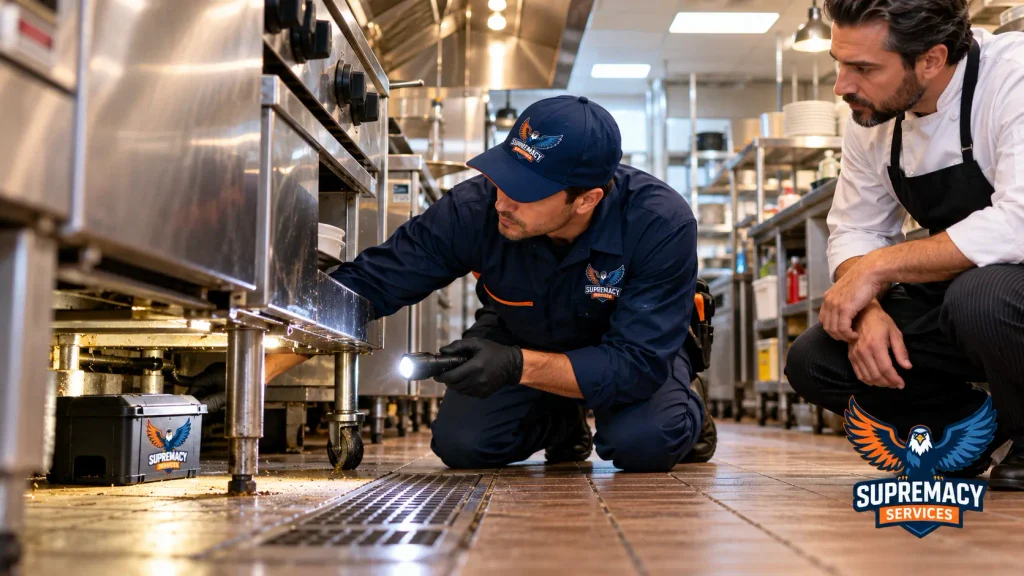
Daily

  • Clean spills promptly.
  • Keep food appropriately contained.
  • Empty waste before it becomes a pest source.
  • Report pest sightings.
  • Keep receiving and exterior doors closed when not actively in use.
  • Address obvious standing water.
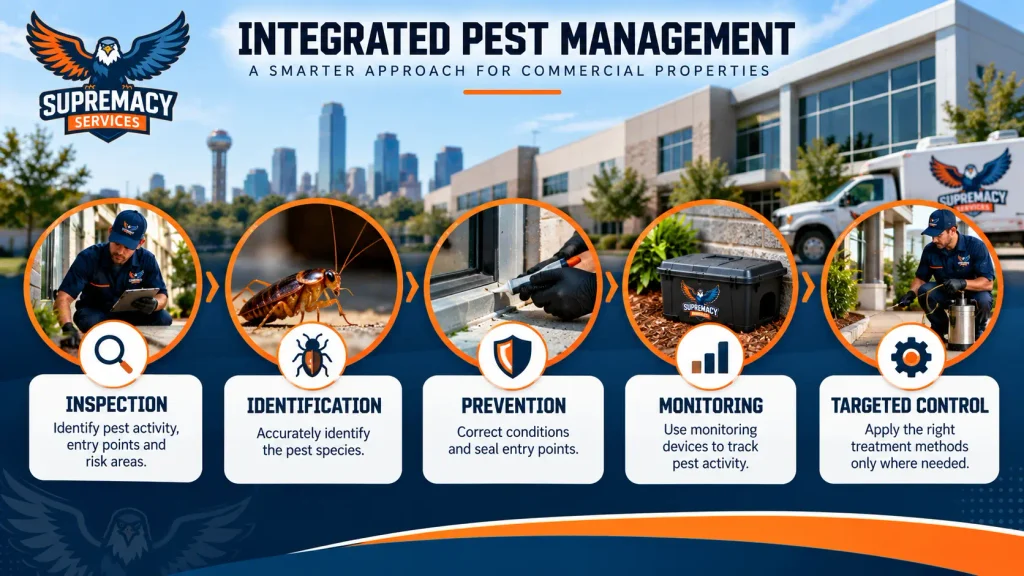
Weekly

  • Inspect hard-to-reach areas.
  • Check storage for damaged packages.
  • Remove unnecessary cardboard.
  • Review recurring pest observations.
  • Inspect waste and exterior zones.

Routinely

  • Check door sweeps and seals.
  • Repair plumbing leaks.
  • Inspect utility penetrations.
  • Review pest-monitoring trends.
  • Correct structural openings.
  • Review receiving practices with staff.

After Deliveries

Pay particular attention to incoming cartons, pallets, produce and other goods.

Pests can be introduced even into a clean facility, so receiving procedures form an important line of defense.

After Construction or Maintenance

A new plumbing penetration, damaged door, remodel or equipment installation can create pest access where none previously existed.

When building work changes the envelope of the structure, inspect the affected area before assuming the pest-control system remains intact.

What Should Dallas Businesses Expect From a Commercial Pest-Control Provider?

Pest-control technician checking a commercial door sweep and utility openings for insect and rodent entry points
Pest exclusion focuses on closing structural openings that allow insects and rodents to enter a food establishment.

A professional food-business program should begin with questions and inspection—not automatically with spraying.

Supremacy’s current commercial program describes a process built around facility assessment, a customized management plan, treatment and monitoring, and digital reporting.

For a restaurant or grocery store, a productive provider relationship should establish:

Supremacy Services technician reviewing pest-monitoring results with a restaurant manager on a tablet
Pest-control documentation helps restaurant and grocery managers track recurring activity, service findings and corrective actions over time.
  1. Who reports sightings.
  2. Who receives service reports.
  3. Which areas require routine inspection.
  4. What constitutes an urgent finding.
  5. Which corrective actions belong to facility management.
  6. When the technician should return or escalate treatment.
  7. How recurring activity will be tracked.

That communication matters because pest control in a food business is a shared process.

The technician can identify a damaged door sweep, for example, but management still needs to ensure that repair occurs. Conversely, employees may see insects but need a pest professional to identify the species and source accurately.

A Practical Restaurant and Grocery Pest-Control Checklist

Before considering your program complete, ask:

  • Are pest sightings documented and reported quickly?
  • Are receiving areas inspected?
  • Are exterior doors properly sealed?
  • Are plumbing leaks corrected?
  • Are drains and moisture-prone areas maintained?
  • Are food spills cleaned promptly?
  • Is cardboard managed instead of allowed to accumulate?
  • Are waste areas clean and included in inspections?
  • Are pest-monitoring devices checked routinely?
  • Are findings documented?
  • Are structural entry points corrected?
  • Are recurring problem areas receiving follow-up?
  • Is the pest-control provider appropriately licensed?
  • Can management explain what corrective action followed the last significant pest finding?

If several answers are “no,” the weakness may be in the pest-management system, even if the building currently appears pest-free.

Frequently Asked Questions

Do restaurants in Dallas need professional pest control?

Food establishments must control pest presence and meet applicable food-safety requirements, but regulations should not be interpreted as requiring every facility to purchase an identical private service plan. Many businesses use professional pest management because ongoing monitoring, identification, exclusion and treatment require specialized expertise.

What pests are most common in commercial kitchens?

Cockroaches, flies, ants and rodents are among the pests commercial kitchens need to watch closely. The actual problem depends on food sources, moisture, building condition, sanitation, deliveries and surrounding conditions.

How often should a Dallas restaurant receive pest-control service?

There is no universal schedule that fits every restaurant. The right frequency depends on pest history, monitoring results, building conditions, operating environment and risk level.

Can restaurant employees spray pests themselves?

Employees should prioritize sanitation, reporting, food protection and correcting conducive conditions. Pesticide use in food environments requires particular care and must comply with product labeling and applicable regulations. Recurring or significant activity is a strong reason to involve a properly licensed pest-management professional.

Does seeing one cockroach mean a restaurant has an infestation?

Not necessarily, but it warrants investigation. One sighting may indicate an isolated introduction or concealed activity. Inspection and monitoring are more reliable than guessing from the number of insects seen.

Why do cockroaches keep returning after treatment?

Repeated activity can occur when harborages, moisture, food sources, structural openings or repeated introductions remain unresolved. Treatment works best when those contributing conditions are addressed as part of an IPM program.

Are grocery stores at risk for different pests than restaurants?

Yes. Grocery stores may have additional risk associated with large receiving operations, produce, bakeries, dry packaged goods, bulk storage, compactors and extensive inventory.

What should be included in a commercial pest-control service report?

Useful documentation can include areas inspected, evidence observed, monitoring findings, treatment performed, conducive conditions, corrective recommendations and follow-up needs.

Can pest-control devices be placed anywhere in a commercial kitchen?

No. Placement matters. FDA food guidance specifically restricts the positioning of insect-control devices where dead insects or fragments could fall onto exposed food, equipment or food-contact items.

Build Pest Prevention Into Your Food-Safety Routine

The most effective commercial pest control for restaurants and grocery stores is preventive, documented and specific to the facility.

A successful program does not depend solely on how often someone sprays.

It depends on how well the business controls entry points, sanitation, moisture, storage, waste, deliveries, monitoring and corrective action—and how quickly management responds when activity appears.

For Dallas and DFW food businesses experiencing recurring cockroaches, rodents, flies, ants or other pest pressure, Supremacy Services can assess the facility and develop a commercial pest-management strategy around its operating environment.

Request a Dallas-Fort Worth commercial pest-control assessment from Supremacy Services and build a prevention plan around your restaurant, grocery store or food facility.

Supremacy Services technician inspecting the exterior of a Dallas commercial property with a facility manager

How Often Should Commercial Pest Control Be Done in Dallas?

There is no single pest-control schedule that is right for every Dallas business.

For many commercial properties, regular inspections ranging from monthly to quarterly can be a practical starting point, while restaurants, food-handling facilities, healthcare environments, properties with recurring infestations, and other higher-risk operations may require more frequent monitoring or service.

The important distinction is that commercial pest control should not be scheduled solely by the calendar. A good program adjusts frequency according to the facility, pest pressure, previous activity, sanitation conditions, structural vulnerabilities, operational requirements, and monitoring results.

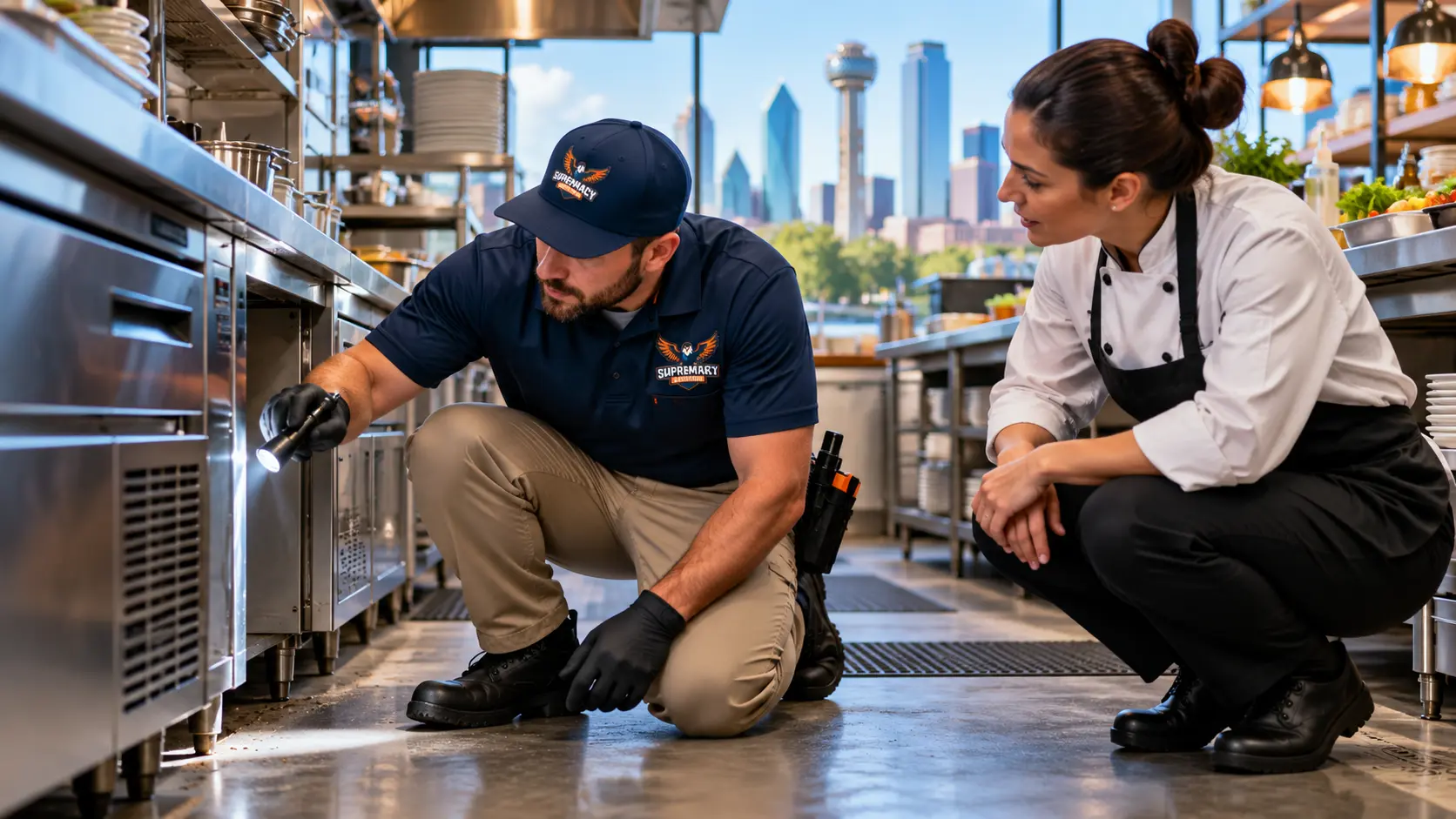
That risk-based approach is consistent with Integrated Pest Management, or IPM: inspect and identify pests, monitor activity, prevent conditions that support infestations, establish appropriate action thresholds, and use targeted control where necessary.

For Dallas-Fort Worth businesses, the real question therefore is not simply, “Should we have pest control every month?” It is:

How often does this particular property need to be inspected, monitored and serviced to keep pest activity under control?

Table of Contents

How Often Should Commercial Pest Control Be Scheduled?

Commercial pest control should be scheduled according to facility risk rather than using one universal interval. Lower-risk offices or retail properties may sometimes be managed with monthly or quarterly inspections, while restaurants and other high-risk facilities often benefit from monthly or more frequent monitoring.

Those are planning ranges—not Texas legal requirements and not a substitute for an inspection.

A professional should first evaluate:

  • the type of business;
  • pests historically found on the property;
  • current pest activity;
  • food and water sources;
  • dumpsters and waste areas;
  • loading and receiving activity;
  • building construction;
  • cracks, utility penetrations and other entry points;
  • neighboring properties;
  • landscaping;
  • sanitation practices;
  • previous infestations;
  • monitoring results; and
  • any operational or industry requirements affecting the facility.

EPA’s Integrated Pest Management framework emphasizes monitoring, correct pest identification, prevention and using control measures based on actual conditions rather than automatically treating every facility the same way.

A business with no visible activity can therefore still need regular inspections, while another property experiencing an active cockroach or rodent problem may temporarily require much closer follow-up.

Not sure what schedule your property needs? Request a commercial pest-control assessment from Supremacy Services so the program can be based on your facility, pest history and operating environment.

Commercial Pest-Control Frequency by Business Type

Commercial pest control frequency comparison for offices, restaurants, warehouses, hotels, and retail properties
Different types of commercial properties may require different pest inspection and service intervals.

There is no official schedule that applies to every property category, but risk generally increases when a facility has abundant food, water, waste, storage areas, frequent deliveries, overnight occupancy or large numbers of exterior openings.

A practical framework looks like this:

FacilityPractical starting pointWhy frequency may increase
Professional officeMonthly to quarterly inspectionBreak rooms, landscaping, shared walls or previous activity
Retail storeMonthly to quarterlyCustomer traffic, stockrooms, receiving doors and adjoining tenants
Restaurant/caféOften monthly or more frequentFood, grease, drains, waste, deliveries and continuous pest attractants
Grocery/food retailMonthly or more frequent based on riskFood inventory, receiving areas and storage
Warehouse/distributionMonthly to quarterly depending on stored goods and riskLoading docks, open doors, pallets and rodent entry
Hotel/hospitalityOften monthly; targeted areas may need closer monitoringGuest turnover, food service, laundry and bed-bug risk
Multifamily propertyMonthly or risk-based recurring programShared walls, utility routes and multiple occupants
Healthcare facilityRisk-based recurring monitoringSensitive occupied environment and strict sanitation expectations
ManufacturingMonthly or customizedProduction activity, materials, storage and loading operations
Food processing/storageFrequently monitored, customized programElevated food-safety and pest-risk concerns

These intervals should be treated as starting points for planning, not automatic treatment schedules.

The actual interval should change when monitoring shows that the risk has changed.

Why monthly pest control is common in higher-risk businesses

Monthly commercial pest-control service gives the pest-management provider frequent opportunities to:

  • inspect monitoring devices;
  • identify new pest activity;
  • compare findings with previous visits;
  • inspect high-risk locations;
  • identify sanitation or maintenance issues;
  • adjust the management plan;
  • treat confirmed activity when appropriate; and
  • document what was found and what was done.

Monthly service is especially useful when conditions can change quickly.

A restaurant can receive dozens of deliveries between visits. A warehouse can have doors opening throughout the day. A multifamily property can experience activity moving through shared utility penetrations. A retail facility can develop a problem in a stockroom even when the sales floor appears clean.

When quarterly commercial pest control may be enough

Quarterly professional visits can sometimes be appropriate for a lower-risk commercial property with:

  • little or no history of infestation;
  • limited food handling;
  • good sanitation;
  • effective waste management;
  • few structural entry points;
  • effective door sweeps and screens;
  • minimal moisture problems; and
  • reliable internal pest reporting.

However, quarterly service should not mean ignoring the property for three months.

Employees and facility staff should continue watching for pest evidence between professional inspections.

Why Some Dallas Businesses Need More Frequent Service

The appropriate frequency is determined by risk—not simply square footage.

Supremacy Services technician inspecting drains and equipment inside a commercial restaurant kitchen
Restaurants often require closer pest monitoring because food, moisture, drains, and deliveries can create ongoing pest pressure.

1. Food availability

Restaurants, cafés, break rooms, grocery stores and food-processing environments give insects and rodents more opportunities to find food.

Even small amounts of residue can matter.

Areas such as:

  • floor-wall junctions;
  • underneath equipment;
  • drains;
  • storage racks;
  • food-preparation areas;
  • beverage stations;
  • dumpsters; and
  • receiving areas

deserve particular attention.

2. Water and moisture

Cockroaches, rodents and many other pests benefit from accessible water.

Pest pressure can increase around:

  • leaking plumbing;
  • floor drains;
  • condensation;
  • mop sinks;
  • standing water;
  • poorly drained exterior areas; and
  • irrigation near the structure.

Correcting the moisture source can therefore be part of pest management—not just repeatedly treating the insects it attracts.

3. Deliveries and loading docks

Commercial pest technician checking a rodent monitoring station at a DFW warehouse loading dock
Loading docks, incoming shipments, storage areas, and exterior openings can increase pest risk at warehouses and distribution facilities.

A pest-management program cannot completely control what arrives at a commercial building.

Cardboard, pallets, stored products and incoming deliveries can provide opportunities for pests to enter a facility.

Warehouses, retailers, restaurants and manufacturers with frequent receiving activity may consequently need more monitoring around docks, doors and storage areas.

4. Waste handling

Dumpsters, grease, food waste and poorly maintained trash areas can sustain pest populations near the building.

The closer that pressure becomes to doors, loading areas or utility penetrations, the greater the chance pests reach the structure.

5. Building construction and entry points

Pest pressure is partly a building-maintenance issue.

Potential access points include:

  • gaps beneath doors;
  • damaged door sweeps;
  • wall penetrations;
  • utility openings;
  • roofline gaps;
  • pipe penetrations;
  • damaged screens;
  • expansion joints;
  • dock doors; and
  • other structural openings.

Repeated activity at the same location can be a sign that exclusion or building repair deserves as much attention as treatment.

6. Previous infestation history

A building that previously experienced German cockroaches, rodents, stored-product pests or another persistent infestation may require closer monitoring even after visible activity disappears.

A period with no customer or employee sightings does not necessarily prove that the underlying problem is gone.

Monitoring data is more useful.

7. Neighboring properties

Commercial buildings do not operate in isolation.

Shared walls, connected retail suites, adjacent restaurants, dense urban blocks and neighboring waste areas can all influence pest pressure.

A clean tenant can still experience problems originating elsewhere in a building.

Does Monthly Service Mean Pesticide Application Every Month?

No. A monthly pest-management visit does not necessarily mean the same pesticide treatment should be applied everywhere every month.

Commercial pest management process showing inspection, monitoring, prevention, targeted control, and documentation
Effective commercial pest management combines inspection, monitoring, prevention, targeted treatment, and documentation.

This distinction is central to Integrated Pest Management.

A recurring service visit can involve inspection, monitoring, identification, sanitation recommendations, exclusion checks, trap or monitoring-station review and targeted treatment when findings justify it.

EPA describes IPM as a decision-making process rather than a single pest-control technique.

That matters for commercial properties because the objective should be control and prevention, not simply maximizing how much product is applied.

A technician might spend one visit investigating rodent evidence around a loading dock and another reviewing cockroach monitors around a kitchen.

The work should respond to what the facility is showing.

Signs Your Current Schedule May Not Be Frequent Enough

Do not automatically wait until the next scheduled visit when pest activity is increasing.

Your current program may need review when:

  1. employees repeatedly report live pests;
  2. monitoring devices show increasing activity;
  3. rodent droppings repeatedly appear;
  4. gnawing or damaged packaging is found;
  5. cockroaches are appearing during operating hours;
  6. flies are increasing around drains or waste areas;
  7. the same pest returns shortly after service;
  8. pest activity is spreading to new parts of the building;
  9. customers or tenants are reporting sightings;
  10. structural openings have increased because of repairs or construction;
  11. sanitation or waste conditions have changed; or
  12. the facility has experienced a significant operational change.

A recurring spike in activity should trigger investigation.

Simply shortening the service interval without understanding the cause can still leave the real problem unresolved.

What Should Happen During a Recurring Pest-Control Visit?

A professional recurring program should involve more than walking through the property and automatically spraying.

Supremacy Services technician reviewing a commercial pest control inspection report with a facility manager
Detailed service reports help commercial property managers track pest activity, corrective actions, and recurring problem areas.

Review previous findings

Historical records help identify trends.

A technician should know whether activity has:

  • increased;
  • decreased;
  • moved;
  • disappeared; or
  • repeatedly returned in the same area.

Inspect high-risk areas

Depending on the property, this can include:

  • kitchens;
  • food storage;
  • receiving areas;
  • loading docks;
  • trash areas;
  • utility rooms;
  • employee break rooms;
  • restrooms;
  • stockrooms;
  • exterior perimeter areas;
  • landscaping;
  • roof or mechanical areas where safely accessible;
  • utility penetrations; and
  • previously identified hotspots.

Check monitoring devices

Monitoring helps turn pest control from guesswork into evidence-based management.

The important question is not simply whether a device was checked.

It is what the findings mean.

Identify conditions supporting pests

Professional pest management should also identify circumstances that are allowing activity to persist.

Examples include:

  • food debris;
  • moisture;
  • standing water;
  • broken door sweeps;
  • gaps;
  • clutter;
  • damaged screens;
  • poor storage practices;
  • waste buildup; or
  • vegetation contacting the structure.

Perform targeted treatment when needed

Treatment should match the identified pest, activity level, location and product label.

Not every pest sighting requires the same response.

Document findings and recommendations

Commercial facilities benefit from written records showing:

  • inspection date;
  • areas inspected;
  • pest activity observed;
  • monitoring results;
  • treatments performed;
  • recommendations;
  • structural deficiencies; and
  • follow-up needs.

This documentation also makes it easier for facility managers to see whether the program is improving over time.

If your current provider is treating the property without showing you what is being found, compare your program with Supremacy’s commercial pest-management approach for Dallas-Fort Worth facilities.

One-Time Treatment vs. Recurring Commercial Pest Management

A one-time treatment solves a different problem from an ongoing program.

One-time serviceRecurring commercial program
Addresses a defined current problemManages continuing pest risk
Limited monitoring periodRepeated inspections and monitoring
Often reactiveMore preventive
Useful for some isolated problemsBetter suited to continuing commercial exposure
Limited trend dataBuilds pest-activity history
May not identify recurring seasonal patternsCan adapt to changing conditions

A one-time service can be appropriate when a specific, isolated problem has a clearly identified source.

Recurring service becomes more useful where pest pressure is continually being reintroduced by:

  • deliveries;
  • customers;
  • neighboring tenants;
  • waste;
  • landscaping;
  • food handling;
  • building openings; or
  • seasonal activity.

That is why many commercial facilities should think of pest control as a management program rather than an occasional extermination service.

How Pest-Control Frequency Affects Cost

Increasing service frequency generally increases annual service activity, but frequency is only one part of commercial pest-control pricing.

Other major variables can include:

  • facility size;
  • number of buildings;
  • pest species;
  • severity of activity;
  • industry;
  • treatment areas;
  • number of monitoring devices;
  • structural exclusion needs;
  • service hours;
  • documentation requirements; and
  • whether specialized pests require a separate program.

That means the cheapest visit is not necessarily the least expensive program.

For example, four poorly targeted treatments may produce less value than a program that identifies a structural entry point and prevents repeated infestation.

When comparing proposals, ask for the annual scope—not simply the price of one visit.

Compare:

QuestionWhy it matters
How often will routine inspections occur?Establishes the baseline schedule
What pests are included?Specialized pests may be separate
Are monitoring devices included?Important for trend-based management
What happens between visits?Determines response to new activity
Are follow-up visits included?Important after corrective treatment
Is exclusion included?Structural corrections may be separate
What documentation is provided?Useful for facility management
Can frequency change if activity increases?A rigid schedule may not match changing risk
What is the full annual cost?Allows accurate comparison

Supremacy also has a separate Dallas commercial pest-control cost guide for businesses that want a deeper pricing discussion.

DIY Prevention Between Professional Visits

Commercial pest management works best when employees and the pest-control provider are working from the same prevention strategy.

Facility staff can help by:

Managing food

  • Clean spills promptly.
  • Store food appropriately.
  • Avoid leaving open employee food overnight.
  • Clean underneath movable equipment where practical.
  • Pay attention to vending and break-room areas.

Managing waste

  • Keep trash containers appropriately closed.
  • Clean spills around waste areas.
  • Avoid unnecessary accumulation of cardboard and clutter.
  • Monitor dumpsters and exterior waste areas.

Reducing moisture

  • Repair plumbing leaks.
  • Investigate recurring condensation.
  • Keep floor drains and wet areas properly maintained.
  • Address exterior drainage problems.

Reducing access

  • Report damaged door sweeps.
  • Repair screens.
  • Seal appropriate structural gaps.
  • Keep exterior doors closed when practical.
  • Inspect utility penetrations.

Reporting activity

Employees do not need to identify every insect correctly.

They should be encouraged to report:

  • what they saw;
  • where it appeared;
  • when it was observed; and
  • preferably a photograph where practical.

That information can help the pest-management provider identify patterns.

Dallas and DFW Considerations

Commercial pest management in Dallas-Fort Worth should account for the actual property and operating environment rather than assuming every Metroplex business has identical pest pressure.

Long warm periods

North Texas businesses can experience insect activity across a substantial portion of the year.

This makes continuous monitoring useful even when a property is not currently experiencing a serious infestation.

Seasonal changes

Exterior pest activity changes through the year.

Service plans should therefore allow technicians to shift attention as conditions change rather than perform exactly the same procedure at every visit.

Dense commercial development

Restaurants, retail centers, offices and multifamily properties frequently operate beside other occupied properties.

Shared walls, connected rooflines, common utility routes and nearby waste areas can complicate pest management.

Warehousing and logistics

DFW contains extensive warehousing, distribution and logistics activity.

Facilities with numerous dock doors, pallets, incoming products and large exterior perimeters have a different risk profile from a small professional office.

Landscaping and irrigation

Landscaping, irrigation and protected exterior areas can create moisture or shelter close to commercial structures.

Exterior inspection should therefore be part of a comprehensive commercial program where relevant.

How to Choose the Right Commercial Pest-Control Schedule

Rather than asking a provider to sell you “monthly” or “quarterly” pest control before inspecting the property, ask the provider to explain why that interval makes sense.

A good recommendation should be based on:

  1. facility type;
  2. pest history;
  3. current inspection findings;
  4. known pest vulnerabilities;
  5. food and water availability;
  6. waste handling;
  7. building condition;
  8. surrounding property conditions;
  9. monitoring requirements; and
  10. how quickly new pest activity needs to be detected.

After service begins, the schedule should still be reviewed.

Increase frequency when:

  • activity rises;
  • a serious infestation develops;
  • construction creates new vulnerabilities;
  • sanitation conditions deteriorate;
  • seasonal pest pressure increases;
  • monitoring data shows repeated activity; or
  • an operational change creates new risk.

Frequency may potentially be reduced when:

  • activity remains consistently low;
  • structural deficiencies are corrected;
  • sanitation problems are resolved;
  • monitoring data supports the change; and
  • the property remains at an acceptable risk level.

The objective is not the greatest possible number of service visits.

It is the right level of monitoring and intervention for the facility.

Frequently Asked Questions

Is monthly pest control necessary for every Dallas business?

No. The correct interval depends on pest risk, facility type, history and monitoring results. Higher-risk operations such as food-service facilities often warrant more frequent service than a low-risk professional office.

Is quarterly pest control enough for a commercial building?

It can be for some lower-risk properties with good sanitation, little food handling and minimal history of pest activity. A property assessment should determine whether quarterly monitoring is appropriate.

How often should restaurants receive pest control?

Restaurants commonly require frequent monitoring because food, water, drains, waste and deliveries create continuing pest pressure. Monthly service is a common planning point, while higher-risk conditions may justify additional inspections or follow-up.

How often should a warehouse have pest control?

The appropriate frequency depends heavily on what is stored, loading activity, door usage, previous rodent or insect activity and surrounding conditions. Some lower-risk warehouses may operate with quarterly visits, while others benefit from monthly or more frequent monitoring.

Can a business need pest control more than once a month?

Yes. An active infestation, high-risk food environment, significant rodent problem or changing monitoring results can justify biweekly, weekly or other targeted follow-up until activity is controlled.

Does monthly commercial pest control mean monthly spraying?

No. A recurring visit can involve inspection, monitoring, exclusion recommendations, sanitation review, documentation and targeted treatment. IPM emphasizes deciding what control is necessary based on actual findings.

Should pest-control frequency increase during an infestation?

Often, yes. Corrective treatment may require closer follow-up than preventive maintenance. Once activity is controlled, the ongoing schedule can be reassessed.

What should a commercial pest-control plan include?

A strong plan typically addresses inspection, pest identification, monitoring, prevention, sanitation or exclusion recommendations, appropriate treatment, documentation and procedures for responding when activity is detected between visits.

Who regulates commercial structural pest-control providers in Texas?

The Texas Department of Agriculture’s Structural Pest Control Service regulates structural pest-control businesses and licensing in Texas. Businesses providing structural pest-control services for compensation must meet applicable state licensing requirements.

How do I know whether my business needs monthly or quarterly pest control?

Start with a property inspection. The provider should consider your facility type, pest history, food and waste exposure, building condition, monitoring needs and surrounding pest pressure before recommending a frequency.

Build the Schedule Around the Property—not the Calendar

For Dallas businesses, there is no credible answer that says every commercial property needs exactly the same pest-control interval.

A quiet professional office and a busy restaurant should not automatically receive the same program.

Neither should a small retail suite and a distribution warehouse with dozens of loading doors.

The better approach is to establish a baseline inspection schedule, monitor what is actually happening and adjust the program as risk changes.

That produces a commercial pest-management program built around evidence rather than habit.

Need a recurring pest-control program for a restaurant, office, retail property, warehouse, multifamily community or other Dallas-Fort Worth facility? Request a commercial pest-control assessment from Supremacy Services to determine an appropriate inspection, monitoring and service schedule for your property.