
Furnace Repair vs. Furnace Replacement: Making the Right Decision
When your furnace stops heating properly on a cold North Texas night, one question quickly becomes more important than almost anything else:
Should you repair the furnace—or replace it?
For Dallas homeowners, the answer isn’t always as simple as choosing whichever option costs less today. A relatively inexpensive repair can make excellent financial sense for a younger, reliable furnace. But repeatedly repairing an aging, inefficient system can eventually cost more than upgrading to modern heating equipment.
The right decision depends on your furnace’s age, condition, repair history, energy efficiency, safety, comfort performance and expected future costs.
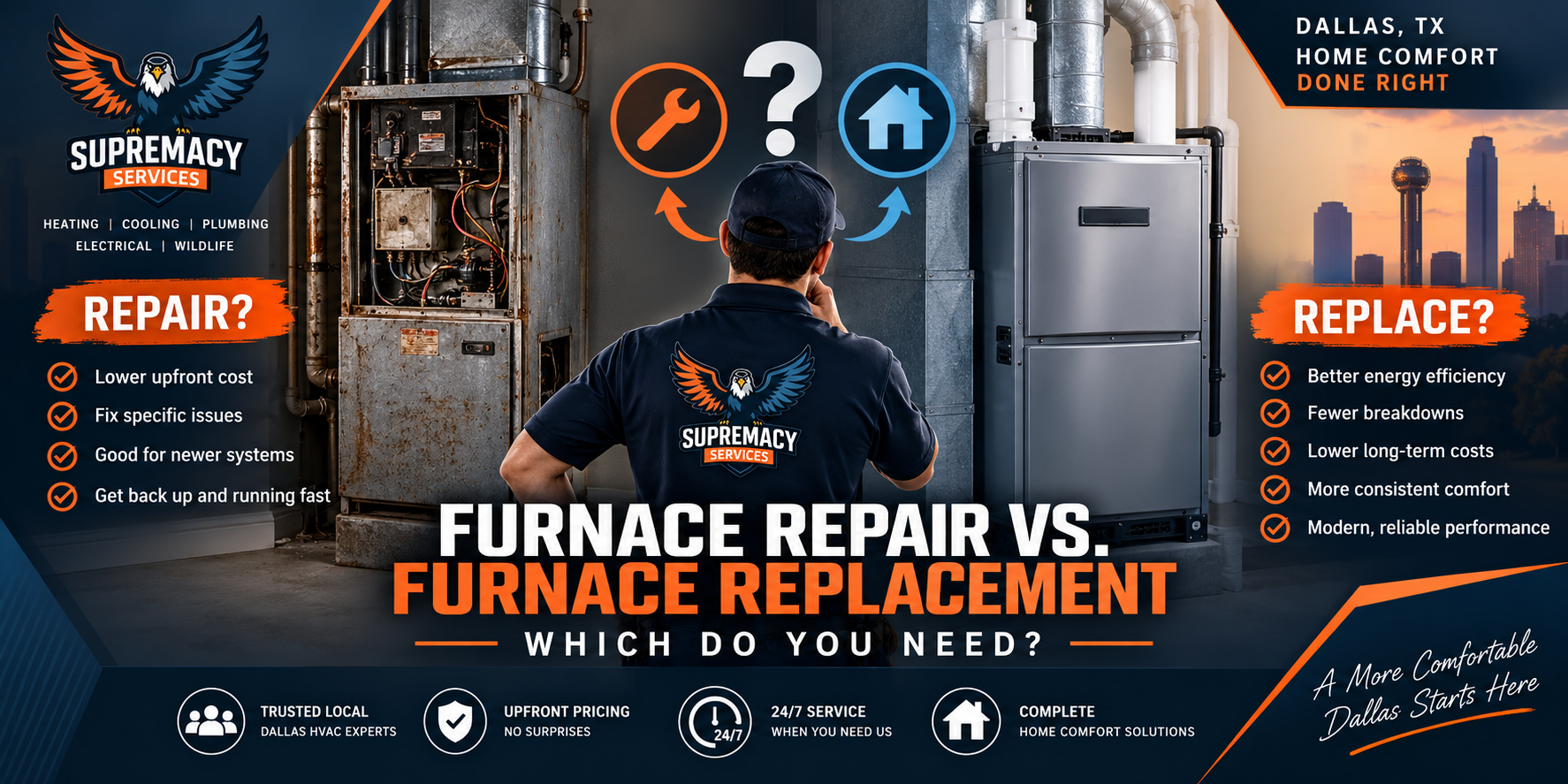
ENERGY STAR recommends considering furnace replacement when a furnace or boiler is more than 15 years old, particularly when the equipment also requires frequent repairs or energy bills are increasing.
At Supremacy Services, our goal isn’t simply to patch a heating problem. We diagnose the system, identify the underlying failure and help Dallas-area homeowners understand whether a professional furnace repair or furnace installation provides the stronger long-term value. Supremacy currently serves Dallas and surrounding DFW communities with 24/7 support and upfront estimates.
Quick Answer: Should You Repair or Replace Your Furnace?
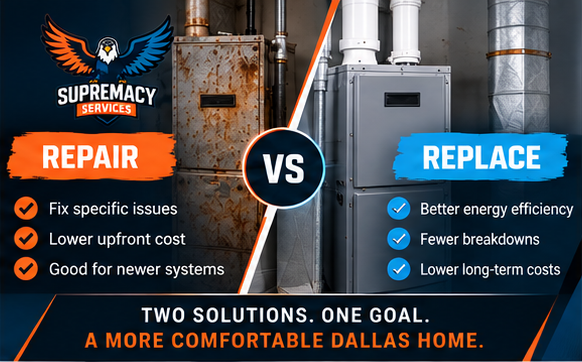
Repair your furnace when it is relatively young, the problem is isolated, the system has otherwise been reliable, heating costs remain reasonable, and the repair can safely restore dependable operation.
Consider furnace replacement when the equipment is around 15 years old or older, expensive failures are becoming frequent, heating bills keep climbing, comfort is deteriorating, or a major safety-related component has failed.
There is no single rule that applies to every furnace. A professional diagnostic inspection should come before a major repair-or-replace decision.
Furnace Repair vs. Replacement at a Glance
| Factor | Repair May Make More Sense | Replacement May Make More Sense |
|---|---|---|
| Furnace age | Relatively young system | Around 15+ years old |
| Repair history | First significant problem | Repeated breakdowns |
| Repair required | Minor or moderate component | Major/expensive component |
| Energy bills | Stable | Consistently increasing |
| Heating performance | Home normally heats evenly | Persistent comfort problems |
| Efficiency | Still performing efficiently | Older, inefficient equipment |
| Reliability | Generally dependable | Frequent service calls |
| Safety | Problem can be safely repaired | Serious combustion/heat-exchanger concerns |
| Long-term plans | Short-term repair remains economical | Long-term ownership favors upgrading |
7 Signs Furnace Repair Is Probably the Better Choice
Replacement isn’t automatically necessary whenever something goes wrong.
1. Your Furnace Is Still Relatively Young
Age should be considered alongside condition.
If a properly maintained furnace has many years of expected service remaining and develops one repairable problem, replacing the entire system could mean abandoning substantial remaining value.
A qualified technician should determine whether the failure is an isolated component problem or evidence of wider deterioration.
2. This Is the Furnace’s First Major Repair
One breakdown doesn’t necessarily mean your furnace is failing.
Components such as flame sensors, ignitors, thermostats and certain electrical controls can eventually require service even while the rest of the heating system remains in good condition.
Supremacy’s Dallas furnace service includes diagnostics of safety switches, combustion performance, flame sensors and heat exchangers rather than simply guessing which component needs replacing.
3. The Repair Cost Is Reasonable
Compare the repair expense with:
- the furnace’s age;
- its current condition;
- the price of replacement;
- its recent repair history; and
- how many useful years the repair could realistically provide.
A $600 repair on a healthy system and the same repair on a heavily deteriorated 18-year-old furnace are two very different investments.
4. Your Energy Bills Haven’t Increased Abnormally
If heating costs remain consistent and the system has performed efficiently, an isolated malfunction may not justify replacement.
However, increasing gas or electricity consumption alongside declining furnace performance can indicate that you’re spending more money to maintain the same level of comfort.
5. Your Home Normally Heats Evenly
A healthy furnace should be capable of maintaining comfortable temperatures throughout the home when the HVAC system, ductwork and building envelope are functioning correctly.
Persistent hot and cold areas warrant further investigation. ENERGY STAR notes that uneven temperatures can be related to equipment operation, duct problems or inadequate insulation—not necessarily the furnace alone.
6. Replacement Parts Are Readily Available
A repair becomes considerably more practical when compatible replacement components remain readily available.
Very old or discontinued equipment can present a different problem: even when a furnace is technically repairable, obsolete parts can make keeping it operational increasingly expensive.
7. A Technician Confirms the Furnace Is Still Safe
Safety takes priority over repair cost.
For a gas furnace, technicians should evaluate combustion-related components and investigate signs that could indicate unsafe operation. Supremacy’s furnace diagnostic process specifically includes combustion testing and heat-exchanger evaluation.
8 Signs It May Be Time to Replace Your Furnace
1. Your Furnace Is More Than 15 Years Old
Age alone doesn’t automatically condemn a furnace.
But once the equipment enters the 15+ year range, the economics of major repairs begin changing significantly.
ENERGY STAR specifically identifies a furnace or boiler older than 15 years as a reason homeowners should consider replacement.
If your older furnace also has efficiency, reliability or comfort problems, replacement deserves serious consideration.
2. You’re Paying for Furnace Repairs Again and Again
Think beyond today’s invoice.
One repair might be sensible. Multiple repairs over successive heating seasons can indicate that the furnace has entered a declining phase.
Consider how much you’ve spent on repairs during the last two or three years.
Repeatedly replacing aging components can create a cycle where you’re continually investing in equipment that still has a limited remaining lifespan.
For system-wide diagnostics, see Supremacy’s HVAC repair services in Dallas. Supremacy’s own guidance similarly considers frequent repairs and rising energy bills important factors in replacement decisions.
3. A Major Component Has Failed
Not all furnace repairs carry the same financial weight.
Replacing a relatively inexpensive sensor is fundamentally different from dealing with a major failure in an aging furnace.
When an expensive component fails, ask:
“How much useful life am I actually purchasing with this repair?”
Putting substantial money into an old furnace may restore operation today without addressing deterioration elsewhere in the system.
4. Your Heating Bills Keep Increasing
An aging furnace may continue operating while gradually losing economic value.
Longer run times, deteriorating components, poor combustion performance, airflow restrictions and older equipment efficiency can contribute to higher operating costs.
Modern furnace efficiency is commonly expressed as AFUE—Annual Fuel Utilization Efficiency. ENERGY STAR describes AFUE as, generally, the percentage of incoming fuel’s heat that becomes usable space heat rather than being lost.
For residential gas furnaces in the U.S. South—which includes Texas—current ENERGY STAR furnace criteria require qualifying models to achieve 95% AFUE or greater.
That doesn’t mean every Dallas homeowner needs a 95% AFUE furnace. Equipment selection should consider the property, installation requirements, climate, energy costs and budget.
5. Some Rooms Are Too Hot While Others Stay Cold
A furnace that can no longer maintain consistent temperatures deserves attention.
Before replacing it, however, have the entire heating system evaluated.
The actual problem could involve:
- leaking or damaged ductwork;
- inadequate return airflow;
- dirty filters;
- incorrect equipment sizing;
- poor insulation;
- thermostat problems; or
- furnace performance.
This is why proper diagnostics matter more than simply assuming that an uncomfortable house needs a bigger furnace.
6. Your Furnace Short-Cycles
Does your furnace start, run briefly, shut down and then start again?
Frequent short-cycling puts additional stress on system components and can be associated with issues such as airflow restrictions, overheating, thermostat problems or incorrect system sizing.
Supremacy identifies frequent cycling as one of the warning signs requiring professional furnace diagnosis.
If the underlying issue is repairable, repair may solve it. If an aging system suffers multiple associated failures, replacement can become the better long-term investment.
7. The Furnace Has Become Unusually Loud
A healthy furnace isn’t silent, but new sounds deserve attention.
Watch for:
- banging;
- scraping;
- grinding;
- squealing;
- rattling; or
- unusually loud blower operation.
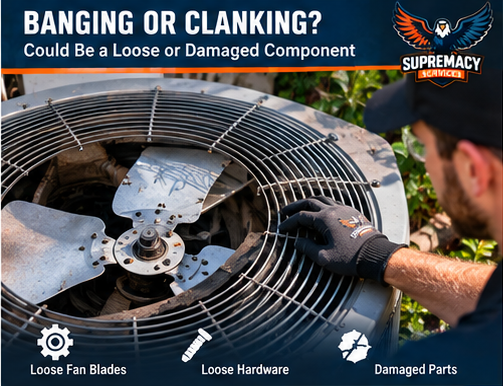
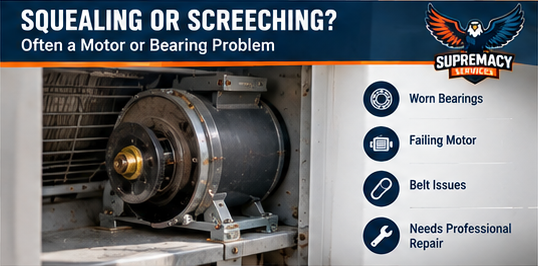
Supremacy notes that scraping and banging can indicate problems involving blower components, bearings or other mechanical issues.
Don’t wait for an abnormal noise to turn into a no-heat emergency.
8. There Are Serious Safety Concerns
This is the category where cost becomes secondary.
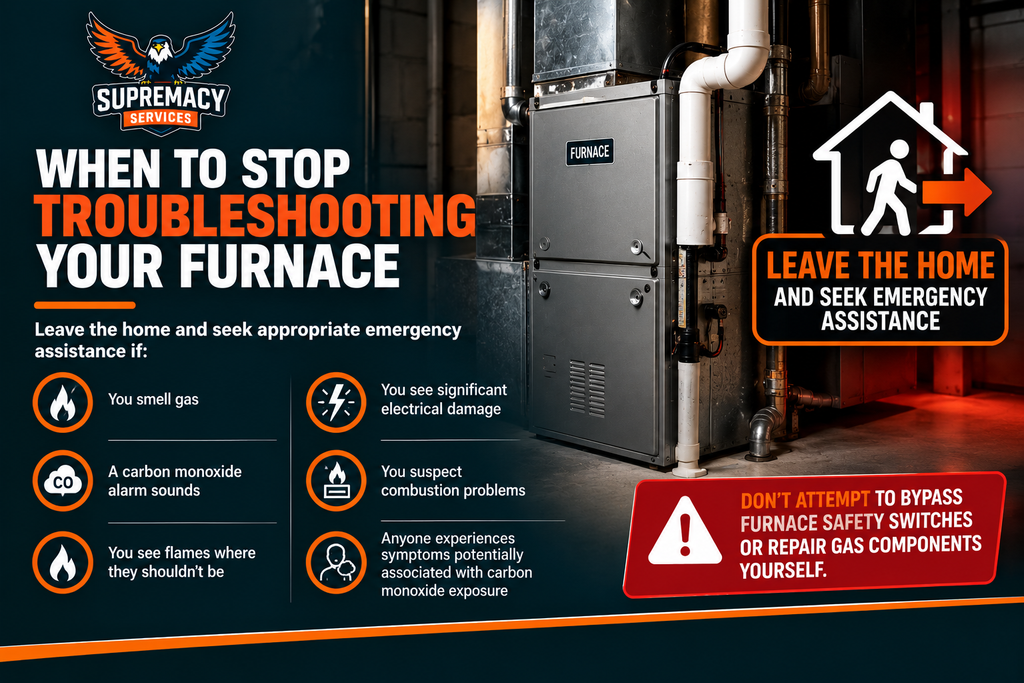
A gas furnace is a combustion appliance. Suspected gas leaks, combustion problems, carbon-monoxide concerns or potentially compromised heat exchangers need professional attention.
If a carbon-monoxide alarm activates, occupants feel unwell, or you suspect a gas leak, treat it as an emergency and follow the appropriate emergency and utility guidance rather than attempting a DIY furnace repair.
A furnace should never be kept operating simply because repairing or replacing it is inconvenient.
The Furnace Repair vs. Replacement Cost Question
Homeowners understandably want a simple dollar figure that tells them what to do.
Unfortunately, there isn’t a responsible universal cutoff.
Instead, compare repair cost + remaining life + operating cost + expected reliability against the total value of replacement.
Supremacy’s existing Dallas heating guidance says replacement is generally worth considering when a system is over 15 years old, needs frequent repairs or has increasing utility costs; its heating page also suggests considering replacement when a major repair approaches roughly 50% of the value of a new system.
That percentage should be treated as a decision aid, not an automatic rule.
Example
Suppose two homeowners receive the same furnace repair quote.
Homeowner A has an 8-year-old furnace with no previous major failures and good efficiency.
Repair could be an excellent investment.
Homeowner B has an 18-year-old furnace that has required several repairs and is producing higher utility bills.
The identical repair price could be poor value because additional failures may follow.
Same repair. Completely different decision.
Don’t Ignore the Hidden Cost of Keeping an Old Furnace
The price printed on a repair estimate isn’t the only cost involved.
An aging furnace may carry additional expenses through:
Higher operating costs. Lower effective efficiency means more energy may be required to maintain comfort.
Recurring repairs. One major repair can quickly become two or three.
Emergency breakdown risk. An unreliable furnace has an unfortunate habit of failing when demand is highest.
Comfort problems. Inconsistent temperatures have a real impact on everyday living.
Lost upgrade opportunity. Money repeatedly invested in old equipment can’t be invested in newer equipment with modern efficiency and controls.
This is why furnace replacement should be viewed as a long-term home-comfort investment, not simply a larger repair bill.
When Furnace Replacement Makes Financial Sense
Replacement becomes especially compelling when several warning signs occur simultaneously.
For example:
17-year-old furnace + recurring repairs + rising utility bills + declining comfort = strong replacement candidate.
Compare that with:
7-year-old furnace + first component failure + otherwise excellent performance = strong repair candidate.
A professional inspection provides the missing information between those two extremes.
For Dallas homeowners already considering an upgrade, explore Supremacy’s furnace installation services and broader heating installation services. Supremacy states that its furnace installations include a multi-point safety check and thermostat calibration before startup.
Benefits of Replacing an Aging Furnace
A correctly selected and professionally installed modern furnace can offer advantages beyond simply restoring heat.
Improved Energy Efficiency
Higher-efficiency equipment can reduce wasted fuel compared with older, less-efficient technology.
More Reliable Heating
A new system eliminates many age-related component concerns and reduces the likelihood that you’re immediately facing another old-component failure.
More Consistent Comfort
Properly sized equipment can help provide more stable indoor temperatures.
Quieter Operation
Modern blower and furnace technology can deliver noticeably quieter operation compared with worn equipment.
Modern Controls
Depending on the system selected, homeowners may gain compatibility with advanced thermostats, variable-speed blowers and other comfort-management technologies.
Manufacturer Warranty Protection
New equipment typically provides manufacturer warranty coverage subject to the manufacturer’s registration and maintenance requirements.
Why Proper Furnace Sizing Matters
One of the biggest mistakes in furnace replacement is assuming:
“Bigger furnace = warmer house.”
It doesn’t work that way.
An oversized furnace can reach the thermostat temperature too quickly and shut off repeatedly. An undersized furnace may struggle to satisfy heating demand.
Proper furnace selection should account for factors such as:
- home size and layout;
- insulation;
- windows and doors;
- ductwork;
- air leakage;
- building orientation; and
- heating load.
A professional HVAC contractor should evaluate the home rather than simply replacing an old furnace with whatever equipment happens to have a similar label.
Repairing Your Furnace? Don’t Skip the Root Cause
A quality furnace repair should answer two questions:
What failed?
And:
Why did it fail?
Replacing a failed component without investigating airflow, electrical, combustion or control issues can leave the underlying problem untouched.
Supremacy’s furnace-repair process is built around diagnostics before repair, including safety-switch testing, combustion evaluation and heat-exchanger inspection.
You can also review Supremacy’s broader heater repair services in Dallas for common heating problems including inconsistent heat, frequent cycling, unusual noises and thermostat failures.
Furnace Repair vs. Furnace Replacement Decision Checklist
Before making the final call, ask:
- How old is my furnace?
- How much will this repair cost?
- How many repairs has it needed recently?
- Are replacement parts readily available?
- Have my heating bills increased?
- Does the furnace heat my home consistently?
- Are there any safety concerns?
- What condition is the heat exchanger in?
- How many more years can I reasonably expect after this repair?
- Would replacement provide significantly better long-term value?
The more answers pointing toward age, inefficiency, recurring failures and safety concerns, the stronger the argument for replacement becomes.
Why Dallas Homeowners Choose Supremacy
Dallas heating systems face an unusual challenge: North Texas can spend long stretches relatively mild and then experience sudden periods of intense winter demand.
You need a furnace that works when you actually need it.
Supremacy provides professional furnace repair in Dallas, HVAC repair, furnace installation and heating installation across Dallas and surrounding DFW communities.
The company’s published service standards include upfront pricing, insured technicians and 24/7 support.
The objective is simple:
Repair what makes sense to repair. Replace what no longer makes financial or mechanical sense to keep.

Frequently Asked Questions
Is it better to repair or replace a furnace?
Repair generally makes more sense when the furnace is relatively young, reliable and suffering from an isolated repairable problem. Replacement becomes more attractive when the furnace is old, inefficient, frequently breaking down or facing an expensive major repair.
At what age should I replace my furnace?
There is no mandatory replacement age. However, ENERGY STAR recommends considering replacement when a furnace or boiler is more than 15 years old. Condition, efficiency and repair history should also influence the decision.
Is a 20-year-old furnace worth repairing?
Possibly for a small repair, but a 20-year-old furnace deserves a broader cost-benefit evaluation before an expensive repair. At that age, remaining life, efficiency, safety, parts availability and previous repair expenses become especially important.
Should I replace my furnace if it still works?
Not necessarily. A functioning furnace doesn’t need to be replaced simply because it has reached a particular birthday. But an older furnace with rising energy costs, recurring repairs or deteriorating performance can justify proactive replacement before an emergency failure.
Why is my furnace running but not heating my house?
Possible causes include thermostat problems, ignition failure, airflow restrictions, safety-switch issues, burner problems or other mechanical faults. Supremacy lists ignition problems, safety-switch faults and gas-valve issues among potential causes of a furnace producing cold or lukewarm air.
Can a new furnace lower my heating bills?
It can, particularly when replacing inefficient equipment, but actual savings depend on the old and new system efficiencies, fuel costs, installation quality, ductwork, thermostat settings, insulation and household heating habits.
How long does furnace replacement take?
Supremacy states that most standard residential heating replacements can typically be completed within one day, although the actual installation time depends on the home and scope of work.
Who should I call for furnace repair in Dallas, TX?
A qualified HVAC contractor should diagnose the system before major repair or replacement decisions are made. Supremacy provides furnace and heating repair services in Dallas and surrounding DFW communities, including 24/7 support.