10400 Clarence Drive, Frisco, TX 75033
Support 24/7: 945-777-3345
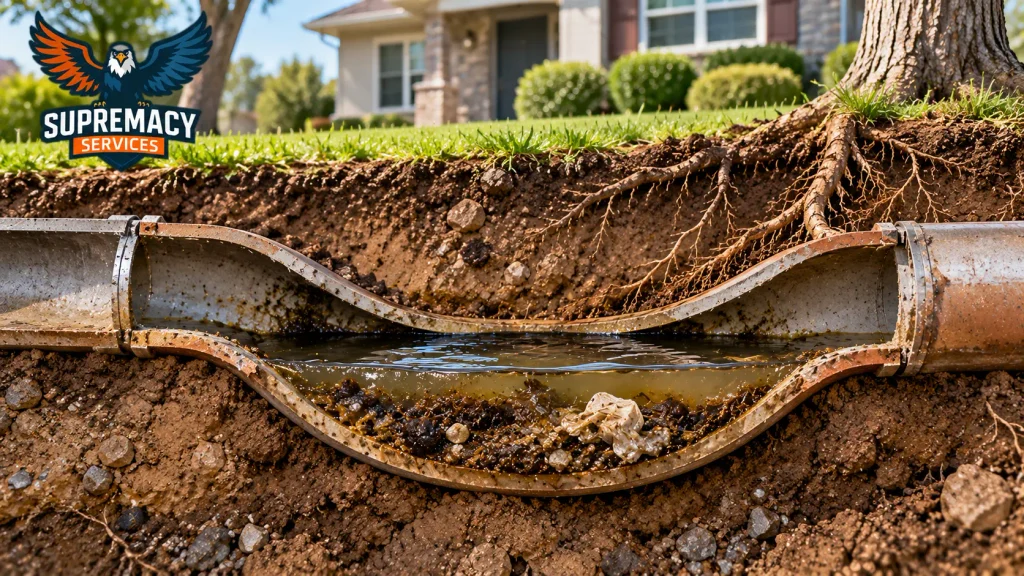
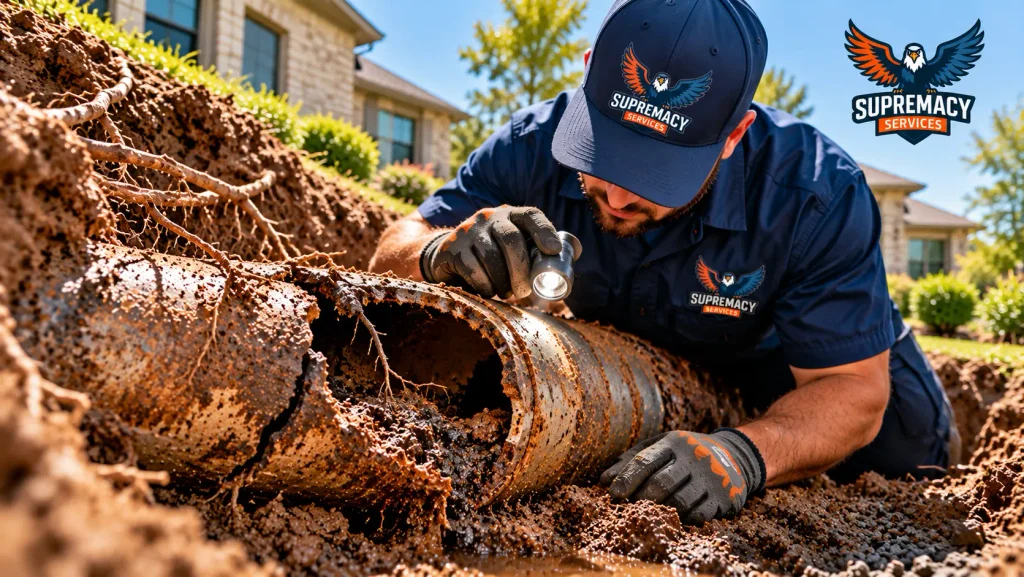
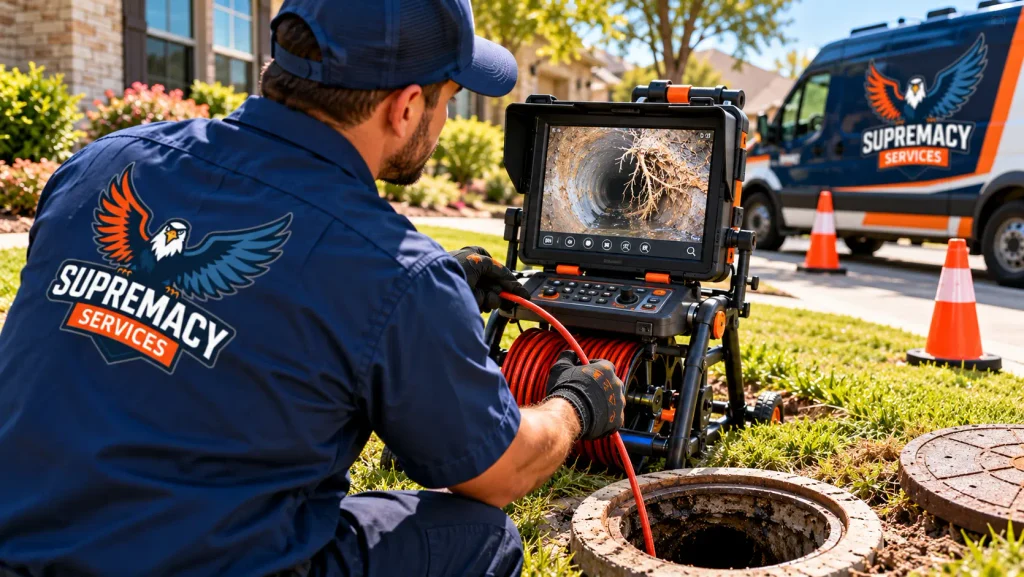
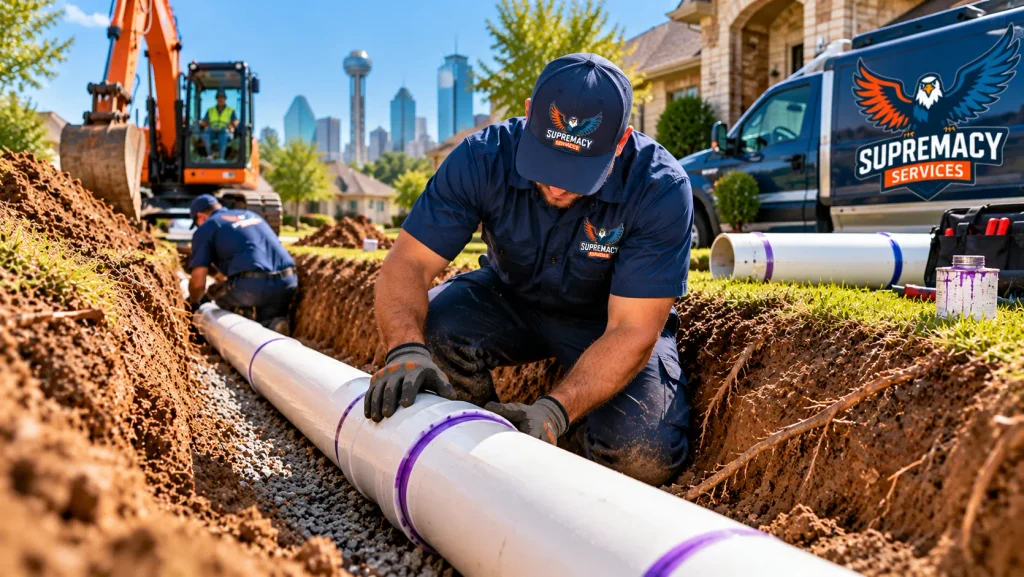
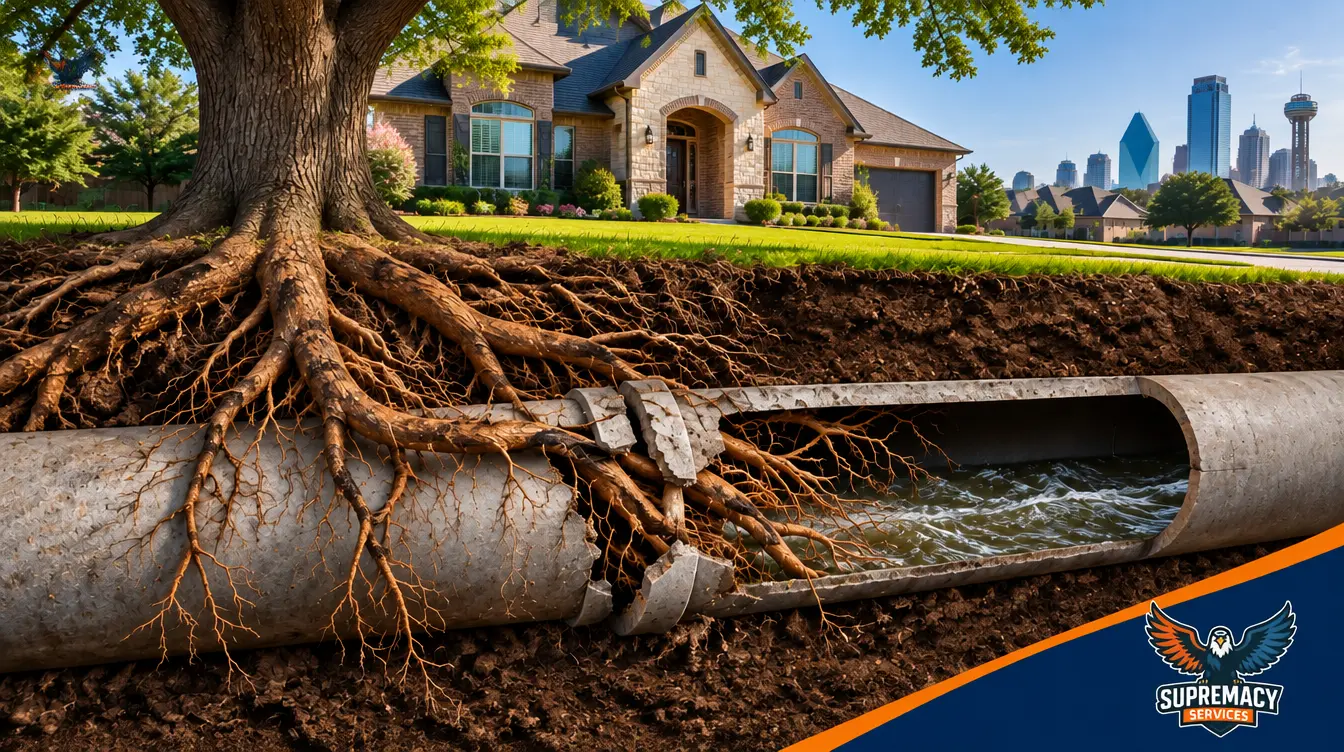
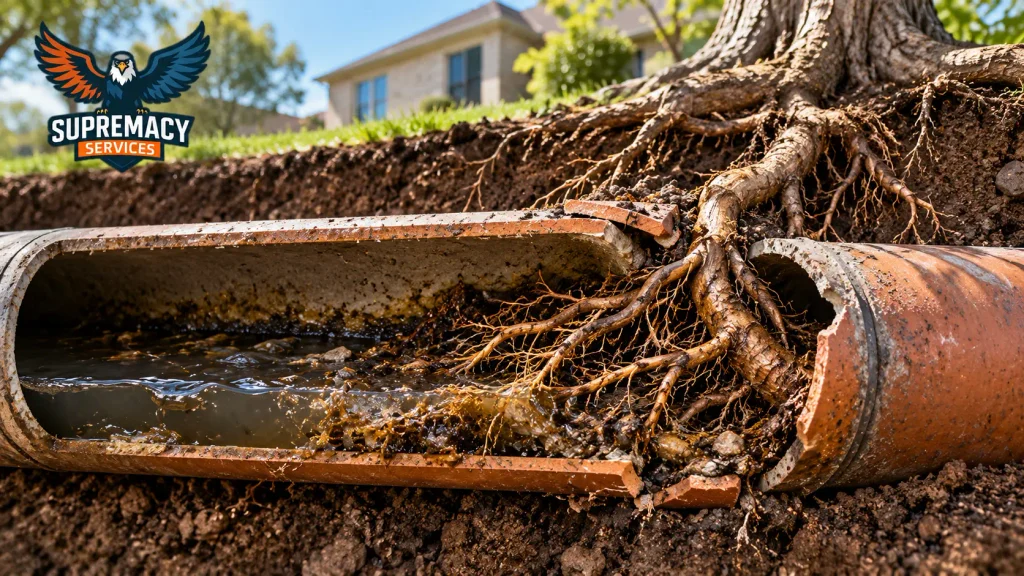
Tree roots entering a damaged underground sewer pipe beneath a Dallas home.

Tree Roots in Sewer Lines: Signs, Damage and Removal Options

Tree roots in sewer lines can cause recurring drain clogs, slow wastewater drainage, gurgling toilets, and sewage backups. Roots typically enter through cracks, separated pipe joints, or other openings, then grow inside the pipe and trap debris. Depending on the pipe’s condition, a plumber may recommend mechanical root cutting, hydro jetting, localized repair, trenchless rehabilitation, or sewer line replacement.

For Dallas and DFW homeowners, the important question isn’t simply how to remove the roots. It’s whether the underground pipe has an opening or structural problem that will allow them to return.

This guide explains how to recognize sewer root intrusion, what damage it can cause, how removal methods compare, and when a more permanent repair makes sense.

Table of Contents

  1. What Are Tree Roots in Sewer Lines?
  2. How Do Tree Roots Get Into Sewer Pipes?
  3. What Are the Signs of Tree Roots in a Sewer Line?
  4. Can Tree Roots Damage or Break Sewer Pipes?
  5. How Do Plumbers Detect Tree Roots?
  6. How Are Tree Roots Removed From Sewer Lines?
  7. Root Removal vs. Sewer Repair vs. Replacement
  8. How Much Does Sewer Root Removal Cost?
  9. Can You Remove Tree Roots Yourself?
  10. Why Is Root Intrusion a Concern in Dallas?
  11. How Can You Prevent Tree Roots From Returning?
  12. Frequently Asked Questions

What Are Tree Roots in Sewer Lines?

Tree root intrusion occurs when roots from nearby trees or shrubs enter an underground wastewater pipe through an opening in the pipe wall or at a connection.

Once inside, the roots can grow into a dense network that restricts wastewater flow.

A small root entering through a defective joint may initially cause no noticeable problems. As the root mass grows, however, it can trap toilet paper, grease, and other materials passing through the sewer.

Eventually, the obstruction may cause repeated clogs or sewage to back up into the home.

Root intrusion is different from an ordinary drain clog because the obstruction may be connected to a defect in the underground pipe itself.

Key point: Removing the roots may restore drainage, but it does not automatically repair the opening through which they entered.

How Do Tree Roots Get Into Sewer Pipes?

Tree roots generally enter sewer lines through existing openings, cracks, loose joints, or deteriorated pipe connections.
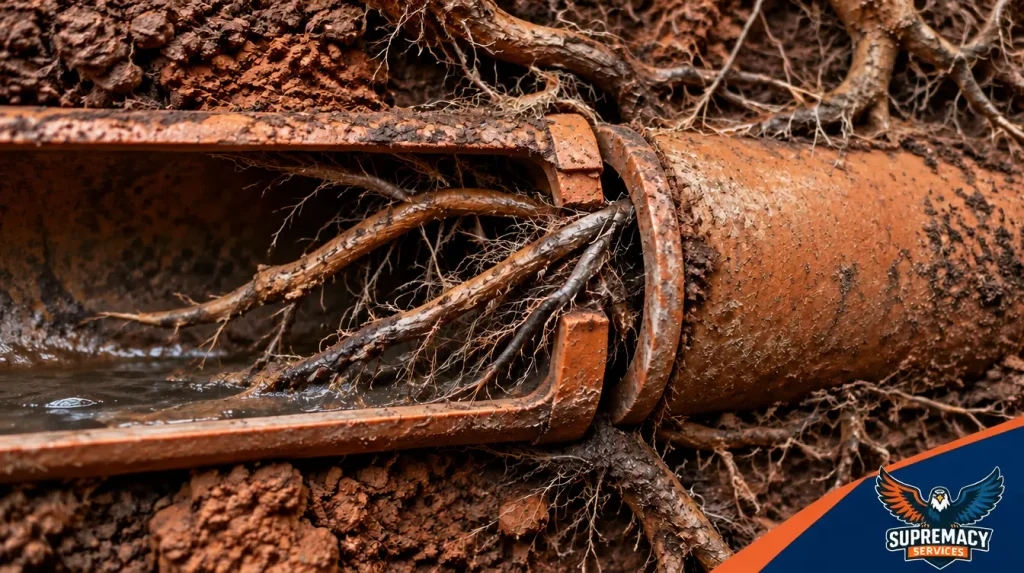
Tree roots penetrating a separated clay sewer pipe joint in underground North Texas soil.
Small openings in aging sewer pipes can allow tree roots to grow into the line and gradually restrict drainage.

1. Cracks and damaged pipe joints

Underground sewer lines can develop defects as they age or move.

A small opening may allow moisture to escape into surrounding soil. Roots growing nearby can exploit that opening and extend into the pipe.

The U.S. Environmental Protection Agency identifies tree roots entering through sewer defects or openings as a potential cause of wastewater blockages.

2. Aging sewer pipe materials

Some older homes have sewer lines constructed from clay or cast iron.

Clay pipes may have multiple joints, while older cast-iron pipes can experience corrosion and deterioration.

These conditions can create opportunities for root intrusion.

However, pipe age alone does not prove that roots are present. A newer PVC line with a damaged connection can also experience root intrusion.

3. Soil movement around underground pipes

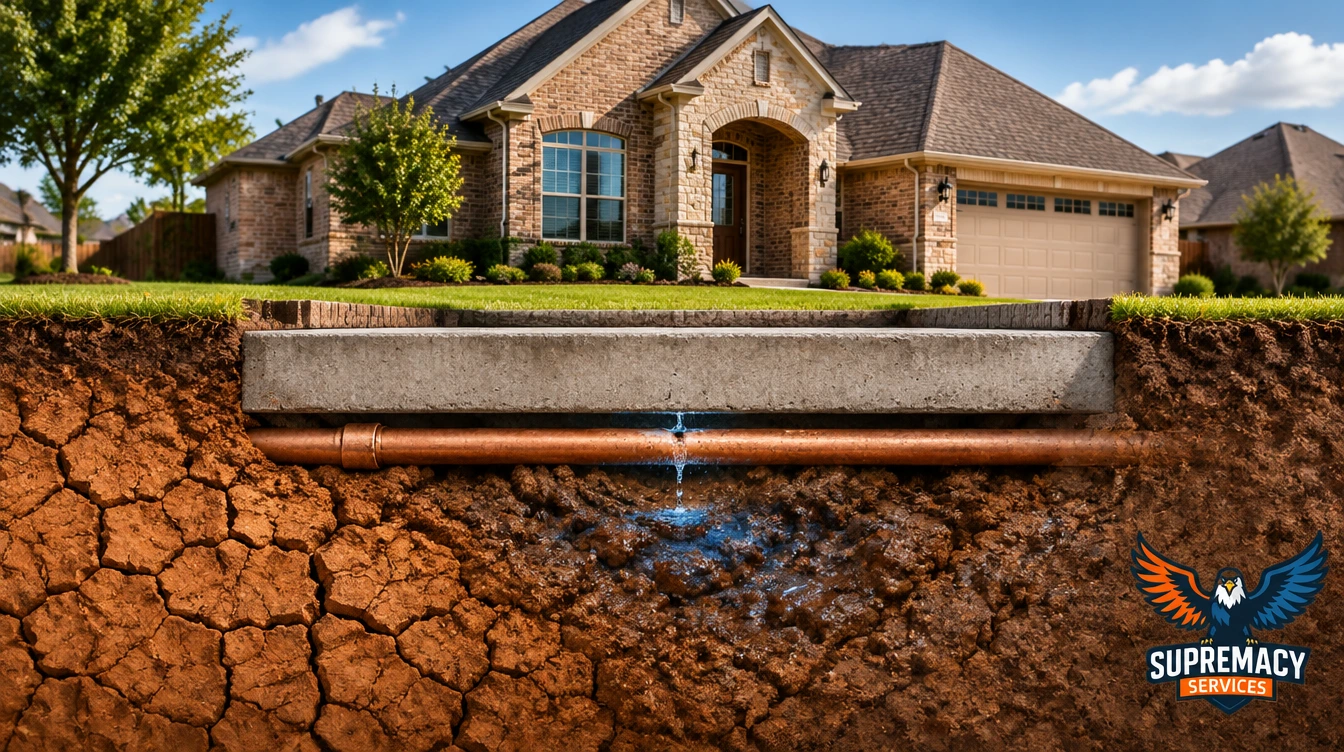
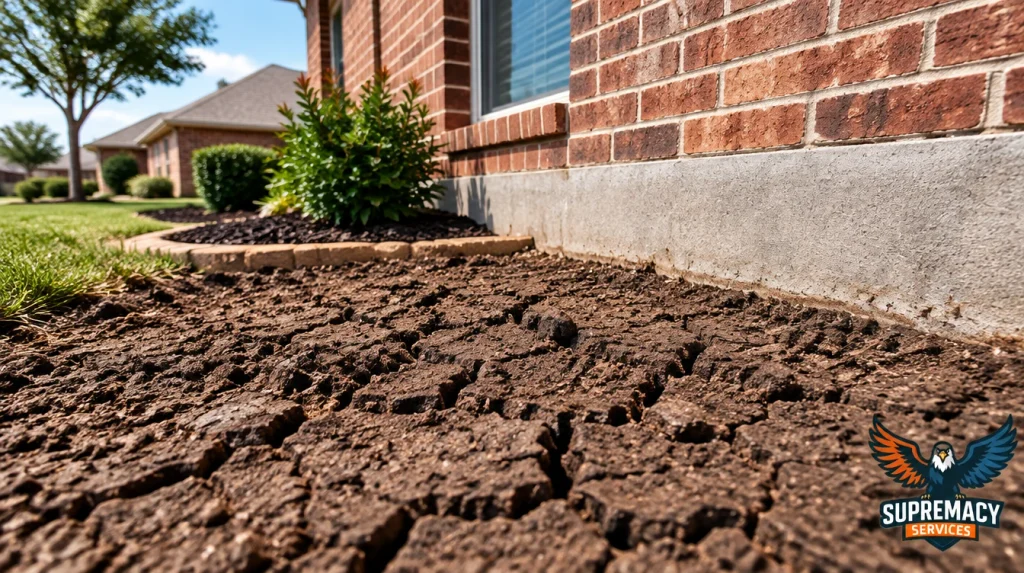
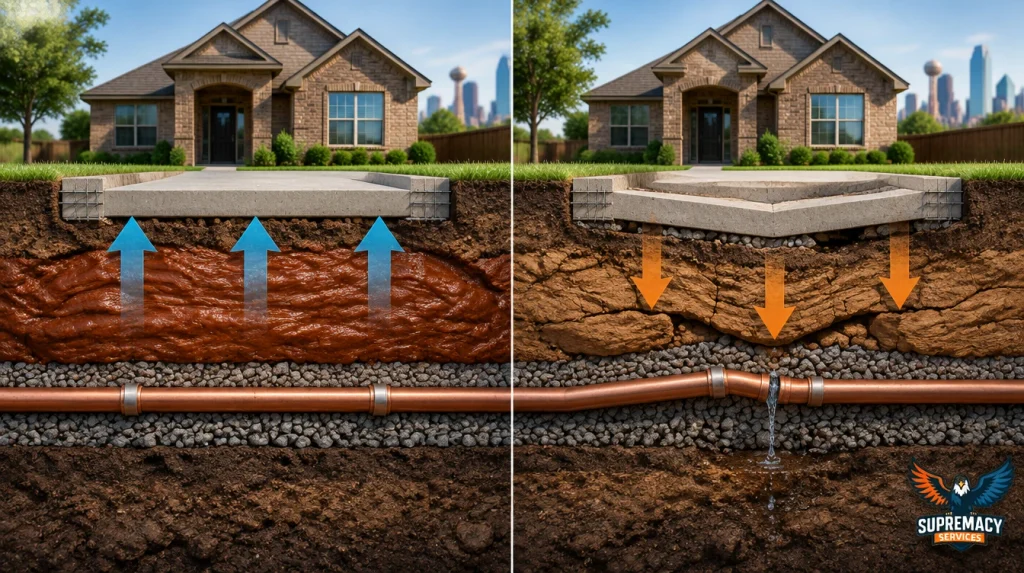
North Texas soils can expand and contract as moisture conditions change.

Where movement affects buried piping, joints may shift or separate, making it easier for roots to enter.

Soil movement does not automatically mean a sewer pipe is damaged, but it is one factor worth investigating when drainage problems keep returning.

4. Nearby trees and shrubs

Tree roots extend through soil in search of favorable growing conditions.

A tree does not have to stand directly above a sewer line for its roots to reach the pipe.

The actual risk depends on root spread, soil conditions, pipe location, and the presence of openings.

Important: A healthy, properly sealed sewer line is less vulnerable to root intrusion than a line with cracks or defective joints.

What Are the Signs of Tree Roots in a Sewer Line?

The most common signs of tree roots in sewer lines are recurring main-drain clogs, several slow drains, gurgling plumbing fixtures, and wastewater backups.

Dallas home bathroom showing a slow-draining bathtub and high toilet water level that may indicate a sewer blockage.
Slow drains, gurgling fixtures, and recurring wastewater backups may indicate an obstruction in the main sewer line.

These symptoms can have other causes, so a sewer camera inspection is generally needed to confirm root intrusion.

1. Recurring drain clogs

A drain that repeatedly clogs after being cleared may indicate a persistent obstruction.

For example, a homeowner might have a sewer line cleaned, experience normal drainage for several weeks, and then notice the same symptoms returning.

Roots may have been cut back without repairing the pipe opening.

2. Multiple slow drains

When several fixtures drain slowly at the same time, the restriction may be located in a shared sewer line.

Watch for combinations such as:

  • A slow bathtub and shower
  • Toilets flushing poorly
  • A kitchen sink draining slowly while other fixtures are affected
  • Water backing up when the washing machine empties

One slow sink is more likely to have a localized blockage. Several affected fixtures make a main-line restriction more concerning.

3. Gurgling toilets and drains

A toilet may gurgle when wastewater flowing through a restricted drainage system displaces air through another fixture.

You might hear bubbling after using the shower, draining a sink, or running the washing machine.

Gurgling alone does not prove that roots are present, but it deserves attention when accompanied by recurring clogs.

4. Sewage backing up into the house

A serious obstruction can prevent wastewater from leaving the home normally.

Wastewater may then emerge through a lower-level shower, bathtub, floor drain, or toilet.

If sewage is backing up, stop using water-producing fixtures and avoid contact with contaminated water. Arrange professional assistance promptly. Supremacy services

5. Unusual sewer odors

A damaged sewer pipe may release wastewater into surrounding soil.

Depending on the location and severity of the problem, homeowners might notice persistent sewage odors near the affected area.

An odor alone cannot identify the cause, but it can be another reason to investigate.

6. Wet or unusually green patches of lawn

A leaking sewer line may create an unusually damp area or encourage localized plant growth.

However, irrigation leaks, drainage problems, and other underground water sources can produce similar symptoms.

A wet patch should not be treated as proof of root intrusion without further inspection.

7. Problems that return after drain cleaning

This is one of the more useful warning signs.

A drain-cleaning machine may cut through a root mass and restore flow temporarily. But if the pipe remains cracked or separated, roots can enter again.

Repeatedly paying for drain cleaning without inspecting the pipe may leave the underlying problem unresolved.

When to call a plumber: If several fixtures are affected or the same main-line blockage keeps returning, consider a professional sewer line repair and replacement assessment rather than another temporary clearing.

Can Tree Roots Damage or Break Sewer Pipes?

Yes. Tree roots can contribute to sewer pipe damage, particularly when they grow through existing cracks or joints and expand within those openings.

However, the relationship between roots and pipe damage is not always straightforward.

Often, the pipe already has a defect that allows roots to enter. Growing roots may then worsen that defect or create increasingly severe obstructions.

Common types of root-related sewer damage

Type of damageWhat happensPotential consequence
Root blockageRoots grow across the pipe interiorSlow drains and backups
Joint intrusionRoots enter through separated jointsRecurring clogs and leakage
Cracked pipeRoots exploit or worsen an openingWastewater escaping into soil
Pipe displacementSections become misalignedPoor drainage and repeated blockages
Severe structural deteriorationThe pipe loses its ability to carry wastewater reliablyMajor repair or replacement

Can roots cause a complete sewer blockage?

Yes.

A dense root mass can restrict wastewater flow significantly. Toilet paper and other solids may become trapped, increasing the obstruction.

In severe cases, the sewer may stop draining normally.

Can tree roots damage a home’s foundation?

A damaged underground sewer pipe can contribute to moisture problems around a property.

Where leakage causes significant soil saturation or erosion, nearby structures may be affected.

However, foundation damage cannot be attributed to sewer roots without evaluating the actual conditions.

A plumber may need to coordinate with a foundation or structural specialist if substantial soil movement or structural damage is suspected.

How Do Plumbers Detect Tree Roots?
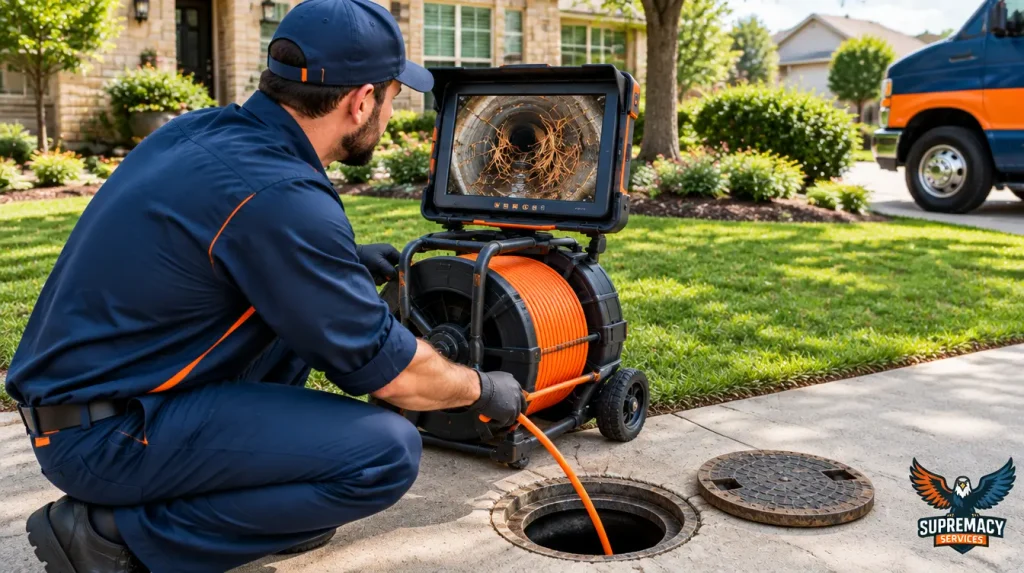
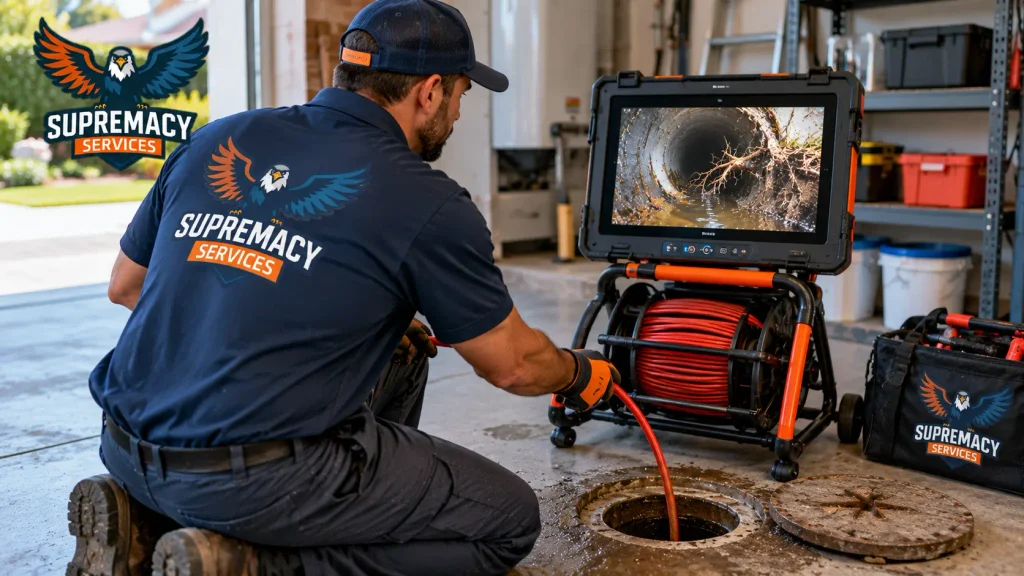
Professional plumber using sewer camera inspection equipment to identify tree roots inside a residential sewer line in Dallas.
A sewer camera inspection helps plumbers locate root intrusion, assess pipe damage, and recommend appropriate repairs.

A sewer camera inspection is one of the most useful methods for confirming root intrusion.

A plumber inserts a specialized waterproof camera into the sewer line, typically through an accessible cleanout.

The camera allows the technician to examine the pipe interior and identify visible obstructions or damage.

What a sewer camera can reveal

  • Root masses entering through joints
  • Cracks and openings in pipe walls
  • Misaligned pipe connections
  • Heavy buildup or other obstructions
  • Standing water in low sections
  • Visible signs of structural deterioration

If the pipe is heavily blocked, some cleaning may be necessary before the camera can inspect the full length.

What happens during a professional inspection?

Step 1: Review the symptoms. The plumber asks which fixtures are affected, when the problem began, and whether previous cleaning has helped.

Step 2: Access the sewer line. An existing cleanout is located, or another suitable access point is selected.

Step 3: Inspect the pipe. Camera footage helps identify visible roots and other defects.

Step 4: Locate the problem. Where equipment and site conditions permit, the technician may locate the affected section from above ground.

Step 5: Recommend a solution. The plumber explains whether cleaning, localized repair, rehabilitation, or replacement is appropriate.

Ask to see the relevant camera footage and understand the pipe’s condition before authorizing major repairs.

How Are Tree Roots Removed From Sewer Lines?
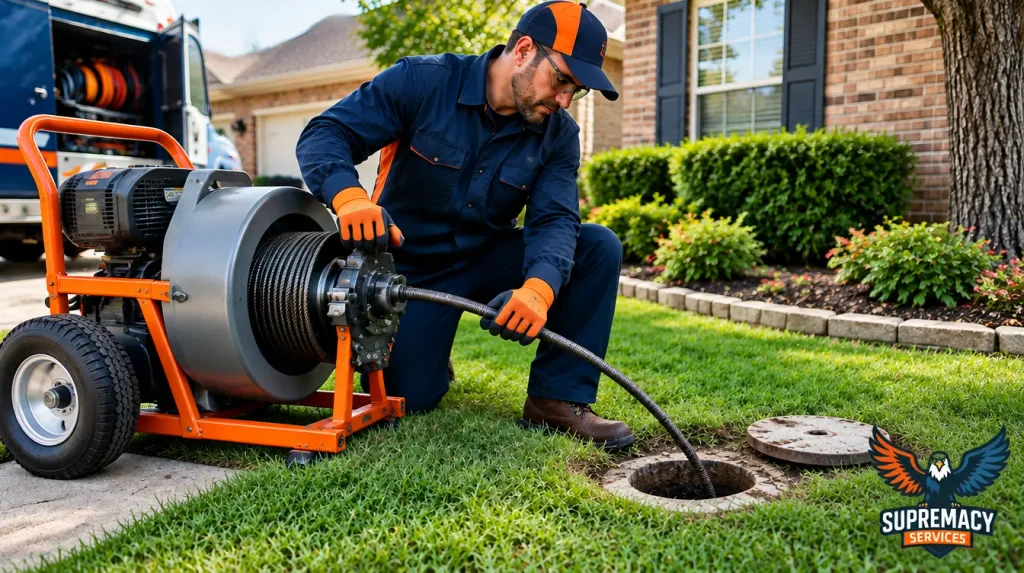
Dallas plumber using a mechanical sewer cleaning machine to remove tree roots obstructing a residential sewer line.
Professional mechanical cutting equipment can remove root obstructions, although damaged pipe joints may still require repair.

Professional tree-root removal typically involves mechanical cutting or hydro jetting. If the pipe is structurally damaged, repair or replacement may also be needed.

The correct approach depends on the extent of the root intrusion, pipe material, accessibility, and structural condition.

1. Mechanical root cutting

Mechanical root cutting uses a specialized drain-cleaning machine with an appropriate cutting attachment.

The rotating cutter breaks apart or trims roots inside the pipe.

Best suited for: Accessible root obstructions in pipes that can safely tolerate mechanical cleaning.

Advantages:

  • Can reopen a blocked sewer line
  • Often requires no excavation
  • May provide relatively quick relief

Limitations:

  • Roots can return through unrepaired openings
  • Cutting does not restore damaged joints
  • Fragile pipes may be unsuitable for aggressive mechanical cleaning

Mechanical cleaning should be selected according to the pipe’s condition rather than used indiscriminately.

2. Hydro jetting

Hydro jetting uses pressurized water delivered through specialized equipment to remove buildup and, with suitable tools and conditions, certain root obstructions.

It can also remove grease and debris that have accumulated around roots.

Best suited for: Pipes that are structurally sound enough for the selected equipment and pressure.

Advantages:

  • Can clean substantial buildup
  • Helps restore the pipe’s usable interior
  • May be useful after mechanical root cutting

Limitations:

  • Not every root mass can be removed by water pressure alone
  • Damaged or fragile pipes require careful evaluation
  • Does not seal cracks or defective joints

Hydro jetting should not be treated as a universal solution for root intrusion.

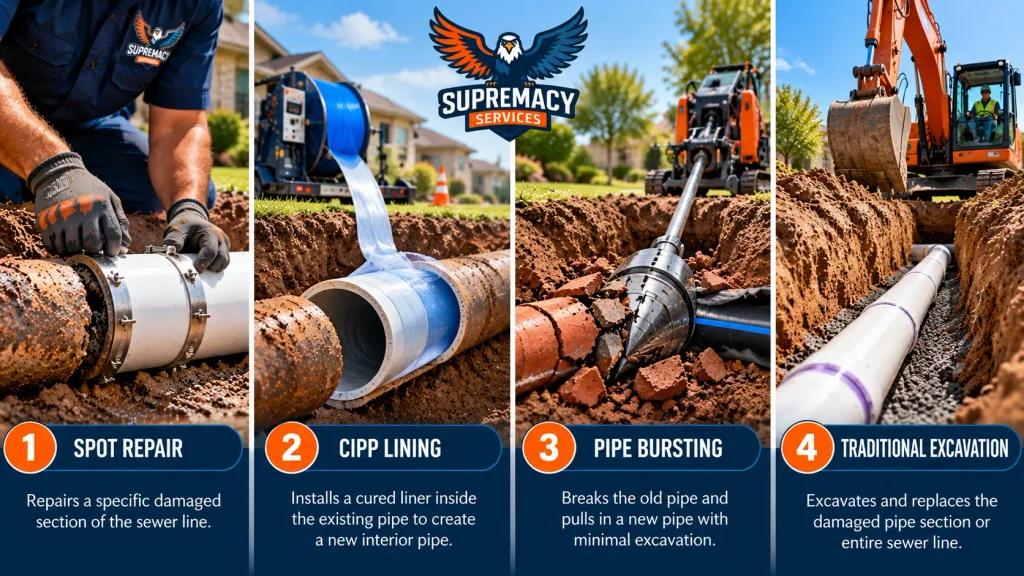
3. Localized sewer pipe repair

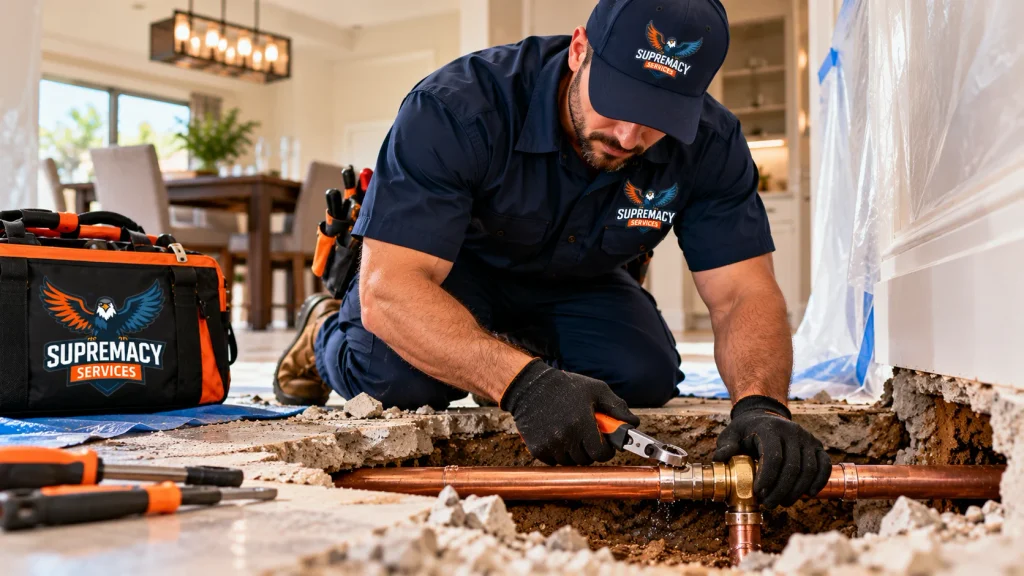
If a camera inspection reveals a damaged joint or a short section of broken pipe, localized repair may be appropriate.

A plumber may excavate the affected area and replace the damaged section with suitable piping and connections.

Best suited for: A limited defect with otherwise serviceable pipe on both sides.

The key advantage is that the repair addresses the actual entry point instead of merely removing roots.

4. Trenchless pipe lining

Cured-in-place pipe lining, commonly called CIPP, rehabilitates a suitable existing pipe by installing and curing a liner inside it.

The resulting liner creates a new interior pipe surface.

Best suited for: Certain damaged sewer lines that retain an appropriate shape and can be prepared for lining.

A contractor must evaluate the pipe’s structural condition, geometry, access, and suitability.

Lining may not be appropriate for a severely collapsed or badly displaced pipe.

5. Pipe bursting or replacement

Pipe bursting replaces an existing pipe by breaking or splitting it while pulling a new pipe through the route.

Other situations require conventional excavation and replacement.

Best suited for: Pipes that cannot be reliably restored through cleaning or localized repair, subject to site conditions and method suitability.

The best option depends on the existing pipe, utility conflicts, access, alignment, and local requirements.

Root Removal vs. Sewer Repair vs. Replacement
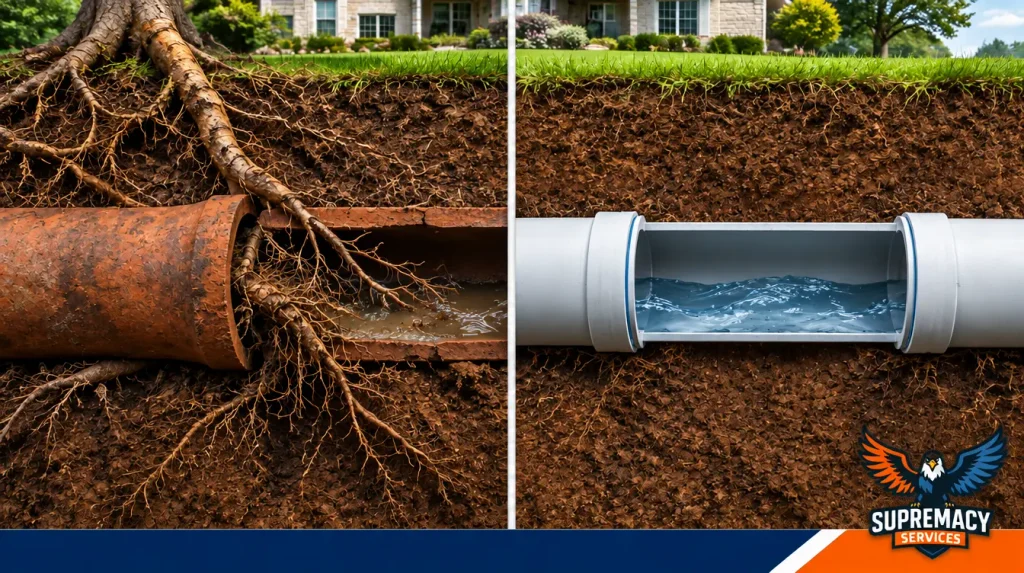
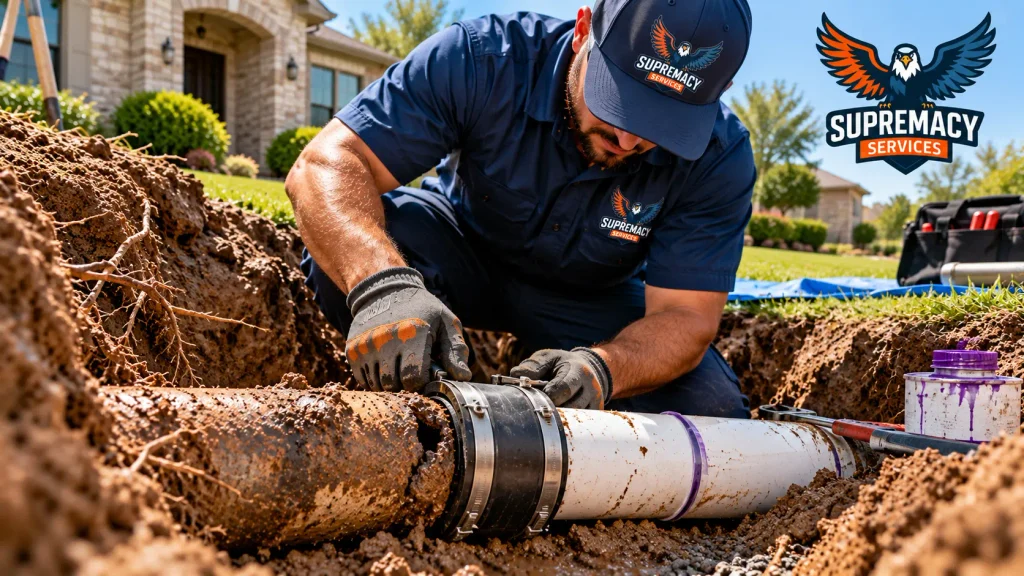
Underground comparison of a sewer pipe damaged by tree roots and a repaired PVC sewer pipe with sealed joints.
Clearing tree roots can restore drainage, but repairing damaged pipe sections may be necessary to prevent recurring intrusion.

Removing tree roots and repairing a sewer pipe are not the same thing.

Root removal addresses the obstruction. Repair addresses a defect. Replacement addresses piping that is no longer suitable for continued service.

SituationLikely option to evaluateMain consideration
Limited roots, pipe otherwise serviceableMechanical cleaning or hydro jettingRestore flow and assess recurrence risk
Roots at one damaged jointLocalized repairSeal or replace the entry point
Multiple defects in a suitable pipeTrenchless rehabilitationRestore pipe integrity
Extensive deterioration or collapseReplacementInstall a reliable sewer line
Repeated blockages with unknown causeCamera inspectionEstablish the actual condition first

Is cleaning enough?

Sometimes.

If the pipe remains structurally serviceable and the homeowner understands the recurrence risk, cleaning may be a reasonable management option.

However, recurring roots through a significant opening usually warrant a discussion about repairing that defect.

When is replacement the better choice?

Replacement may be appropriate when there are widespread defects, severe deterioration, major displacement, or collapse.

A single root intrusion does not automatically justify replacing an entire sewer line.

Need help deciding? Supremacy Services offers sewer line repair and replacement options in Dallas and DFW. A camera-based assessment can help determine whether clearing the roots is sufficient or whether the pipe itself needs attention.

How Much Does Sewer Root Removal Cost?

Sewer root removal costs depend on the cleaning method, pipe condition, obstruction severity, access, and whether structural repairs are required.

There is no reliable single price that applies to every Dallas property.

A relatively accessible root blockage may require only professional cleaning. A pipe with extensive damage may require excavation, rehabilitation, or replacement, which involves a substantially different scope of work.

Factors that affect the final cost

Severity of root intrusion: A small obstruction is different from a dense root mass extending through multiple joints.

Pipe condition: Fragile or deteriorated pipes may require additional precautions or repair.

Depth and location: Access beneath a driveway, patio, or other obstruction can complicate repairs.

Cleaning method: Mechanical cutting and hydro jetting involve different equipment and labor requirements.

Camera inspection: Diagnostic work may be included in a service package or quoted separately.

Structural damage: Cracks, separated joints, and collapse can change the project from cleaning to repair or replacement.

Restoration: Excavation may require restoring soil, paving, or landscaping.

What should a sewer root removal estimate include?

Ask whether the quote covers inspection, access, cleaning, removal of debris, post-cleaning camera footage, and any recommended repair.

If major work is proposed, request an explanation of the defect and why the recommended method is suitable.

Avoid comparing estimates based solely on their total price when the scopes of work differ.

Can You Remove Tree Roots Yourself?

Homeowners can recognize warning signs and reduce water use during a suspected blockage, but cutting roots inside an underground sewer line is generally better handled by a qualified plumbing professional.

Why chemical root killers require caution

Chemical products marketed for sewer roots vary in their active ingredients, instructions, and restrictions.

They should not be assumed safe for every pipe, plumbing system, or wastewater application.

Chemical treatment also cannot repair a cracked pipe or separated joint.

Do not mix drain-cleaning chemicals or pour unapproved substances into the sewer.

Why renting a drain auger may be risky

Professional drain-cleaning equipment can injure inexperienced users.

An incorrectly selected cutter or aggressive cleaning method may also damage deteriorated piping.

A homeowner who repeatedly forces a cutting tool through a fragile underground line may make the situation worse.

What homeowners can safely do

  • Stop using fixtures if sewage is backing up.
  • Keep children and pets away from wastewater.
  • Note which fixtures are affected.
  • Record when symptoms occur.
  • Gather previous sewer inspection or repair records.
  • Arrange professional diagnosis for recurring main-line problems.

If sewage has entered living spaces, avoid contact and arrange appropriate cleanup.

Why Is Root Intrusion a Concern in Dallas?

Dallas and surrounding DFW communities contain homes with a wide range of ages, landscaping styles, soil conditions, and sewer pipe materials.

Those differences matter when diagnosing underground drainage problems.

Mature trees near buried sewer laterals

Established trees may have extensive root systems that extend beyond the visible canopy.

Where a sewer lateral has a crack or defective joint within the root zone, roots may enter.

The presence of a large tree does not mean it should automatically be removed.

Repairing the sewer defect may be more appropriate than removing a healthy tree.

Soil movement and pipe alignment

North Texas properties can experience soil movement associated with changing moisture conditions.

Underground pipes may be affected when movement places stress on joints or changes their alignment.

A camera inspection can help determine whether root intrusion is accompanied by displacement or low sections.

Older sewer infrastructure

Some established Dallas neighborhoods have older underground plumbing.

Where clay, cast iron, or other aging pipe materials are present, deterioration and joint defects may increase the need for inspection.

Pipe material should be confirmed rather than assumed from the home’s age.

Who is responsible for sewer root damage?

Property owners are commonly responsible for maintaining their private sewer laterals, while municipal utilities maintain their designated public infrastructure.

However, the exact responsibility depends on the location of the problem and applicable utility rules.

City of Dallas materials identify private lateral maintenance as a homeowner responsibility. If the obstruction may be in the public main or near the connection, confirm the service boundary with Dallas Water Utilities before authorizing repairs.

How Can You Prevent Tree Roots From Returning?

The most effective long-term prevention is to address openings that allow roots into the sewer line.

Routine cleaning can help manage recurring obstructions, but it does not make a damaged pipe watertight.

1. Repair damaged joints and cracks

If camera footage reveals a clear entry point, discuss appropriate repair options.

Sealing or replacing defective pipe sections may reduce the likelihood of repeated intrusion.

2. Plan landscaping around underground utilities

Before planting new trees, identify the location of buried sewer lines and other utilities.

Choose planting locations based on the mature tree’s root spread and site conditions.

Texas811 provides guidance for locating underground utilities before excavation.

3. Avoid unnecessary tree removal

Removing a tree is not always required to solve a sewer-root problem.

A properly designed pipe repair may address the issue while preserving established landscaping.

Consult a qualified arborist when tree health or root management is part of the decision.

4. Schedule follow-up inspections when justified

Homes with previous root intrusion or known pipe defects may benefit from periodic evaluation.

The appropriate interval depends on the pipe’s condition and previous findings.

There is no single inspection schedule that fits every home.

5. Address recurring clogs promptly

Repeated drain problems should not become routine.

If a blockage returns after cleaning, request an explanation of why it keeps happening.

A camera inspection may reveal an underlying issue that conventional drain cleaning cannot resolve.


Frequently Asked Questions About Tree Roots in Sewer Lines

1. Can tree roots grow inside PVC sewer pipes?

Yes. Roots can enter PVC sewer pipes through damaged joints, cracks, or improperly sealed connections. Properly installed, intact piping is generally less vulnerable than piping with existing openings.

2. How long does it take for tree roots to clog a sewer line?

There is no fixed timeline. Root growth and blockage severity depend on the size of the opening, growing conditions, available moisture, and how much debris accumulates inside the pipe.

3. Will tree roots grow back after sewer cleaning?

They can. Mechanical cutting or hydro jetting may remove an obstruction without closing the entry point. If the pipe remains defective, roots may enter again.

4. Can hydro jetting remove tree roots completely?

Hydro jetting can remove certain root obstructions when appropriate equipment is used in a pipe suitable for the procedure. Dense roots may require mechanical cutting, and structural defects may still need repair.

5. Do I need to replace my sewer line if roots get inside?

Not always. Some root problems can be managed through cleaning or localized repair. Replacement is more likely to be considered when the pipe has extensive deterioration, multiple defects, or collapse.

6. Can tree roots enter a sewer line without breaking the pipe?

Yes. Roots may enter through an already separated joint or other existing opening. Root intrusion does not necessarily mean the roots caused the original defect.

7. Will removing the tree fix my sewer problem?

Not necessarily. Removing a tree does not repair cracks, defective joints, or other structural problems in the pipe. A sewer inspection should identify the underlying condition before major landscaping decisions are made.

8. How do I know if roots or grease are clogging my sewer?

Symptoms alone cannot reliably distinguish them. A sewer camera inspection, sometimes after preliminary cleaning, can help identify roots, grease buildup, or structural defects.

9. Is sewer root intrusion an emergency?

It can be. Active sewage backups, wastewater entering living spaces, or a completely blocked main sewer line require prompt attention. Minor recurring drainage symptoms should also be investigated before they become more serious.

10. Can tree roots damage a sewer line beneath a driveway?

Yes. Roots can enter defective underground piping regardless of whether the affected section lies beneath a lawn, driveway, or patio. Repair access and restoration requirements depend on the location and method selected.

Final Thoughts: Fix the Cause, Not Just the Clog

Tree roots in sewer lines are more than an inconvenience when they repeatedly restrict wastewater flow.

Mechanical root removal or hydro jetting may restore drainage, but recurring intrusion can indicate a pipe defect that deserves attention.

The most useful next step is to establish the condition of the sewer line before deciding whether cleaning, localized repair, trenchless rehabilitation, or replacement is appropriate.

For homeowners in Dallas, Plano, Frisco, Richardson, Allen, Fort Worth, and surrounding DFW communities, Supremacy Services provides sewer diagnostics and repair options.

Concerned about roots in your sewer line? Explore Supremacy Services’ sewer line repair and replacement services to arrange an assessment and understand the available solutions before another blockage occurs.
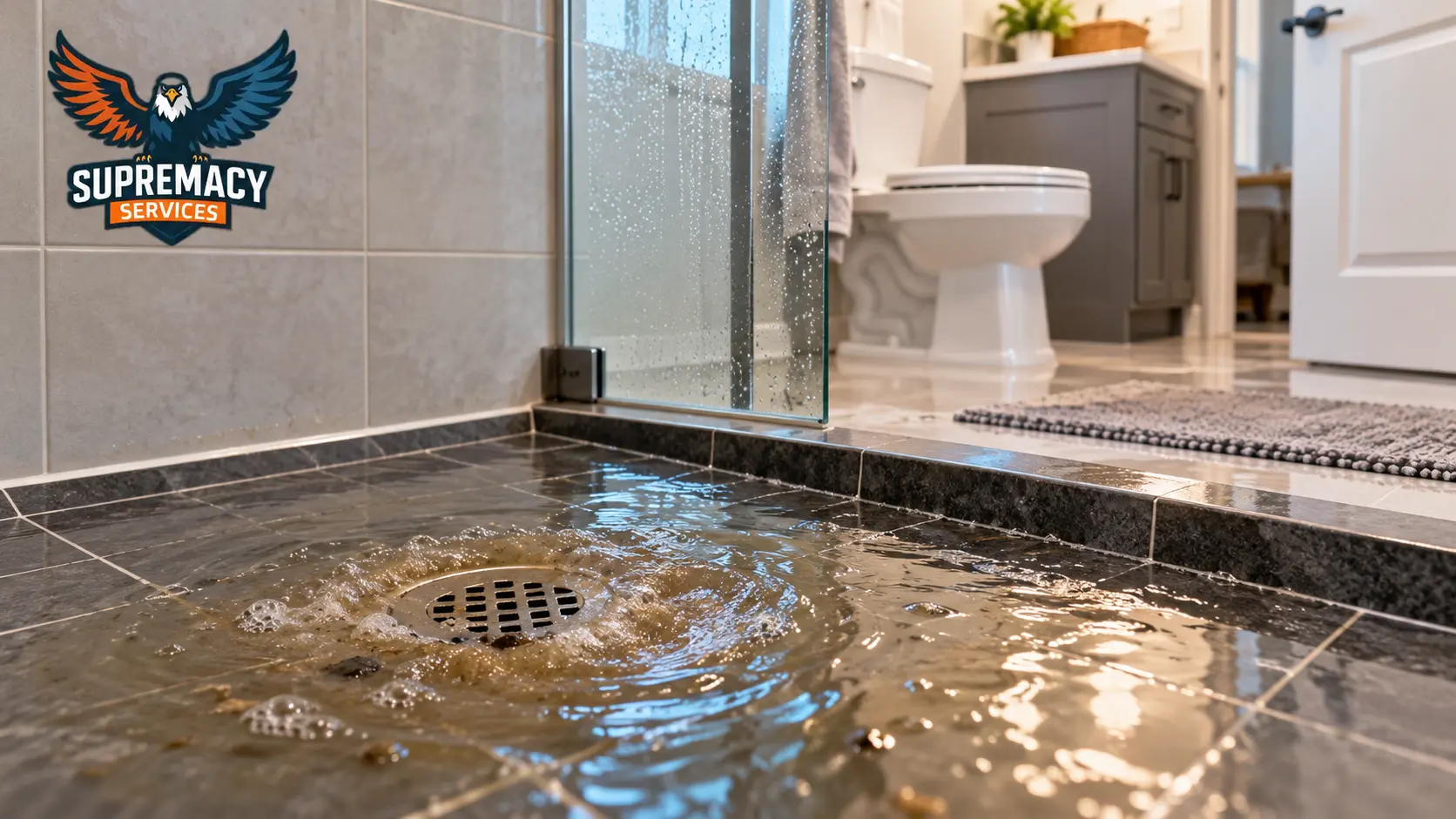
Sewage water backing up through a shower floor drain inside a Dallas home.

Why Does My Sewer Line Keep Backing Up?

Common question why does my sewer line keep backing up?, the problem may be more than an ordinary drain clog. Recurring sewer backups often happen because grease, debris, tree roots, or damaged underground pipes repeatedly restrict wastewater flow.

For Dallas homeowners, the frustrating part is that a drain may work normally immediately after cleaning, only to back up again days or weeks later.

The key is identifying why the blockage keeps returning—not simply clearing it again.

A professional sewer camera inspection can help distinguish a recurring buildup problem from root intrusion, a sagging pipe, or structural damage.

This guide explains the most common causes, how to recognize a main sewer line problem, what you can safely do, and when repair or replacement may be necessary.

Table of Contents

  1. What causes a sewer line to keep backing up?
  2. Why does my sewer back up after cleaning?
  3. How do I know if the main sewer line is blocked?
  4. What should I do when sewage backs up?
  5. Why are recurring backups a concern in Dallas?
  6. How do plumbers find the cause?
  7. How are recurring sewer backups fixed?
  8. How much does it cost to fix a recurring sewer backup?
  9. Can I fix a recurring sewer backup myself?
  10. How can I prevent future sewer backups?
  11. Frequently asked questions
  12. Get help with recurring sewer backups in Dallas

What Causes a Sewer Line to Keep Backing Up?

A sewer line repeatedly backs up when wastewater cannot move freely through the drainage system. The restriction may come from accumulated waste, an obstruction inside the pipe, structural damage, or a problem farther downstream.

The seven causes below are worth investigating.

1. Tree Roots Growing Into Sewer Pipes

Tree root intrusion is a common reason sewer lines experience repeated blockages.

Tree roots penetrating a cracked underground sewer pipe and restricting wastewater flow.
Tree roots can enter damaged sewer pipes and trap debris, causing repeated blockages even after cleaning.

Roots can enter through cracks, separated joints, and other openings in underground pipes. Once inside, they can grow and trap toilet paper, grease, and debris.

Over time, the obstruction becomes larger.

Signs that tree roots may be involved include:

  • Drain problems that gradually return after cleaning.
  • Repeated blockages in the same underground sewer line.
  • Older sewer pipes with joints or structural defects.
  • Roots visible during a sewer camera inspection.

Why cleaning may not solve it: Removing the roots restores flow temporarily, but roots can regrow if the entry point remains open.

A plumber may recommend root removal followed by targeted pipe repair, lining, or replacement, depending on the pipe’s condition.

2. Grease, Soap Residue, and Waste Buildup

Kitchen grease can cool and accumulate along the inside of drain and sewer pipes.

Over time, it combines with other waste and restricts the available space for wastewater to pass through.

Common contributors include cooking oil, food grease, wipes, paper products, and other materials that do not break down readily.

The U.S. Environmental Protection Agency identifies fats, oils, grease, and inappropriate flushed materials as contributors to sewer blockages and overflows.

Even products marketed as flushable can create problems in plumbing systems.

3. A Sagging Sewer Pipe or Pipe Belly

Sagging underground sewer pipe with standing wastewater and accumulated sediment in the low section.
A sewer pipe belly creates a low area where wastewater and debris can collect, contributing to repeated clogs.

A sewer pipe belly is a section of underground piping that has settled below its intended slope.

Instead of flowing continuously toward the municipal sewer, wastewater may collect in the low section.

Solids can accumulate in that area, gradually creating another obstruction.

How a sewer pipe belly traps wastewaterConceptual illustration, not to scale. A sagging section can collect wastewater and solids even after the line has been cleaned.

This problem cannot be permanently corrected by snaking the line.

A camera inspection may identify standing water, but additional evaluation can be necessary to confirm the pipe’s alignment and the extent of settlement.

4. Cracked, Offset, or Collapsed Sewer Pipes

Underground sewer pipes can deteriorate, crack, separate at joints, or collapse.

When the pipe loses its intended shape, wastewater may encounter a permanent restriction.

Possible defects include:

  • Cracked or fractured pipe walls.
  • Offset joints that catch debris.
  • Corroded or deteriorated cast-iron pipes.
  • Sections that have partially collapsed.
  • Pipes displaced by ground movement or other external forces.

If your sewer line keeps clogging in the same location, a structural defect may explain why cleaning provides only temporary relief.

For additional symptoms, see our guide to warning signs of sewer line damage in Dallas.

5. Flushing Wipes and Other Non-Flushable Products

Toilets are designed to handle human waste and toilet paper—not household trash.

Disposable wipes, paper towels, hygiene products, and similar materials can become trapped in bends, joints, or existing restrictions.

Even if these materials pass through the toilet, they may collect farther down the sewer line.

The safest practice is to dispose of wipes and hygiene products in the trash, regardless of marketing claims about flushability.

6. An Obstruction in the Municipal Sewer System

Not every sewer backup originates inside a homeowner’s private sewer line.

A blockage or capacity problem in the public sewer system may sometimes cause wastewater to back up toward connected properties.

Potential clues include multiple nearby properties experiencing problems or a backup associated with an identified public sewer incident.

However, these signs do not prove where the blockage is located.

If a public sewer problem is suspected, contact the appropriate municipal wastewater utility while arranging an assessment of the property’s drainage system. City of Dallas Water Utilities

7. An Incomplete or Incorrect Previous Cleaning

Sometimes the sewer pipe is structurally sound, but the original obstruction was not fully removed.

For example, a cable machine may create a passage through a blockage without removing all the material along the pipe walls.

Wastewater begins flowing again, but the remaining debris can quickly accumulate.

A professional should evaluate whether more thorough cleaning is appropriate and whether the pipe can safely tolerate the proposed method.

If recurring clogs are affecting multiple fixtures, Supremacy Services can help determine whether you need professional drain cleaning or a more detailed sewer inspection.

Why Does My Sewer Keep Backing Up After Cleaning?

If a sewer backs up shortly after snaking or drain cleaning, the original blockage may not have been completely removed, or an underlying pipe defect may still be present.

Cleaning can restore wastewater flow without correcting the condition that caused the obstruction.

For example:

Underlying problemWhy the backup returns
Tree rootsRoots remain or grow back through damaged pipe openings
Pipe bellyWastewater and solids collect in the low section
Grease accumulationResidual buildup traps additional waste
Offset pipe jointToilet paper and debris catch on the uneven connection
Partial pipe collapseThe restricted opening continues trapping solids
Incomplete cleaningRemaining material builds into another blockage

Does a Recurring Backup Mean I Need a New Sewer Line?

Not necessarily.

Some recurring blockages can be resolved through thorough cleaning or localized repairs.

Others require replacement of a damaged section or, in more extensive cases, the entire sewer lateral.

The decision should be based on the condition of the pipe, not simply the number of times it has clogged.

A sewer camera inspection helps identify the problem before an expensive repair decision is made.

How Do I Know If My Main Sewer Line Is Blocked?

A main sewer line blockage often affects more than one plumbing fixture, particularly fixtures at lower elevations in the home.

The strongest warning sign is wastewater backing up through one fixture when another fixture or appliance drains.

Common Warning Signs

  • Water backing up into a bathtub or shower when a toilet is flushed.
  • A toilet bubbling or gurgling when the washing machine drains.
  • Multiple sinks, toilets, or showers draining slowly.
  • Sewage appearing in a downstairs shower or floor drain.
  • Recurring unpleasant odors from several drains.
  • Wastewater backing up during heavy household water use.
  • The same main line blockage returning after previous cleaning.

Is It a Local Drain Clog or a Main Sewer Problem?

SymptomMore likely explanationRecommended response
Only one bathroom sink drains slowlyLocal fixture or branch drain clogCheck the affected fixture
Toilet backs up but nearby fixtures work normallyToilet trap or branch drain obstructionArrange targeted diagnosis
Shower fills when toilet flushesShared drain or main line restrictionStop using affected fixtures and seek inspection
Multiple fixtures back up togetherMain sewer or shared branch blockageProfessional assessment
Sewage enters the lowest floor drainDownstream restriction or sewer surchargeStop water use and seek urgent help
Backups return repeatedly after cleaningPersistent buildup or structural pipe problemCamera inspection and cause-specific repair

These are diagnostic clues, not definitive proof. Plumbing layout and fixture connections affect where symptoms appear.

What Should I Do When Sewage Backs Up Into My House?

Stop using water immediately, keep people and pets away from contaminated areas, and arrange professional help. Continued water use can push more wastewater into the home.

Step 1: Stop Using Plumbing Fixtures

Avoid flushing toilets, running sinks, showering, using the dishwasher, or operating the washing machine.

These activities add water to a drainage system that may already be blocked.

Step 2: Keep Away From Sewage

Untreated wastewater may contain harmful microorganisms.

Keep children and pets away from contaminated areas. Avoid touching sewage or contaminated materials without appropriate protective equipment.

If wastewater has reached electrical outlets, appliances, or energized equipment, do not enter the affected area until it has been made safe.

Step 3: Avoid Chemical Drain Cleaners

Chemical cleaners may fail to remove the underlying obstruction and can create additional hazards for anyone working on the line.

Do not combine drain cleaning products or add chemicals to standing sewage.

Step 4: Document the Damage

Take photographs of visible wastewater damage from a safe location.

Record when the backup started, which fixtures were affected, and whether the problem has occurred before.

This information can help with diagnosis and any insurance claim.

Step 5: Contact a Plumbing Professional

A plumber can investigate whether the problem originates in a branch drain, the private sewer lateral, or farther downstream.

If the public sewer main may be involved, the appropriate municipal utility should also be contacted.

Step 6: Arrange Safe Cleanup

Significant sewage contamination may require professional water damage restoration and disinfection.

Do not assume that removing visible wastewater makes contaminated materials safe.

Why Are Recurring Sewer Backups a Concern in Dallas Homes?

Dallas and North Texas properties can have several conditions that influence sewer pipe performance, including older plumbing materials, expansive clay soils, tree roots, and changes in ground moisture.

These factors do not mean every Dallas sewer backup is caused by the local environment. They help explain why underground pipe condition matters when diagnosing repeated blockages.

Older Sewer Pipe Materials

Some older Dallas-area homes have cast-iron or clay sewer piping.

Depending on age, installation quality, and exposure conditions, these pipes may develop corrosion, cracks, rough interior surfaces, or deteriorated joints.

A camera inspection can help determine whether the existing pipe remains serviceable.

Expansive North Texas Clay Soil

Expansive clay soils can shrink during dry conditions and swell when moisture increases.

Ground movement can place stress on buried infrastructure, particularly where pipes already have weak joints or inadequate support.

However, a recurring sewer backup alone does not establish that soil movement damaged the line.

Trees and Underground Root Systems

Mature trees are common in established Dallas neighborhoods.

Roots can exploit openings in underground sewer piping, especially where joints have deteriorated.

A nearby tree does not automatically mean roots are inside the sewer. Camera evidence is needed to confirm intrusion.

Heavy Rainfall and Sewer Backups

Some wastewater backups occur during periods of heavy rainfall, especially when public sewer systems experience excess inflow or infiltration.

If backups happen only during storms, it is worth investigating whether the issue involves the municipal sewer system, a private sewer defect, or an improper stormwater connection.

Do not assume that rainfall proves the city’s sewer main is responsible.

How Do Plumbers Find the Cause of Recurring Sewer Backups?

Professional diagnosis typically involves identifying which fixtures are affected, locating the restriction, and inspecting the condition of the sewer line.

A thorough assessment may include the following steps.

Step 1: Review the Backup History

The plumber asks when the problem started, which fixtures are affected, and whether the line has been cleaned previously.

Repeated blockages in the same location can help narrow the investigation.

Step 2: Locate and Assess the Sewer Cleanout

A sewer cleanout provides access to the drainage system for inspection and cleaning.

Its location varies by property.

Homeowners should not open a cleanout suspected of being under pressure or filled with backed-up wastewater.

Step 3: Clear the Obstruction When Necessary

If the pipe is blocked, the plumber may use an appropriate cable machine or another cleaning method to restore access.

The equipment should be selected according to the pipe’s condition.

Step 4: Perform a Sewer Camera Inspection

Plumbing technician inspecting a residential sewer line using a camera monitor and drain inspection equipment.
A professional sewer camera inspection can help identify tree roots, damaged joints, blockages, and other visible pipe defects.

A sewer camera can reveal visible defects such as roots, cracked pipe walls, offset joints, accumulated debris, and standing wastewater.

It can also help locate the affected section.

Camera inspection has limitations: it does not automatically establish the cause of every defect or the full structural condition of the surrounding soil.

Step 5: Recommend a Cause-Specific Solution

The plumber explains whether the issue is best addressed through cleaning, targeted repair, pipe rehabilitation, or replacement.

If your sewer has backed up more than once, ask Supremacy Services about a professional sewer line inspection and repair assessment before paying for another temporary clearing.

How Are Recurring Sewer Backups Fixed Permanently?

The most effective long-term solution depends on what is causing the sewer to back up.

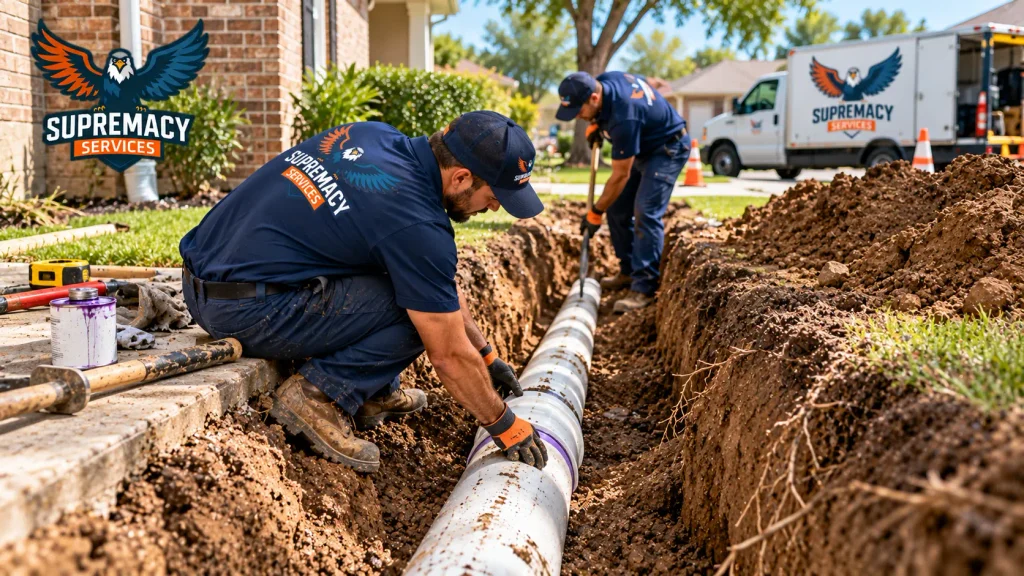
Plumbing technicians installing a replacement PVC sewer pipe in an excavated trench beside a residential home.
Damaged sewer lines may require targeted repairs or pipe replacement when cleaning cannot resolve the underlying problem.

There is no single repair method suitable for every recurring blockage.

TreatmentBest suited forImportant limitation
Mechanical drain cleaningLocalized debris and removable obstructionsDoes not repair damaged pipe
Hydro-jettingSuitable pipes with substantial buildupMay be inappropriate for fragile or badly damaged pipes
Root removalRoots obstructing wastewater flowRoots may return if pipe openings remain
Spot repairIsolated cracks, offsets, or damaged jointsDoes not address defects elsewhere
Trenchless pipe liningEligible pipes requiring rehabilitationRequires suitable existing pipe geometry and condition
Pipe burstingEligible sewer lines requiring replacementRequires access and site-specific feasibility
Excavation and replacementCollapsed, badly misaligned, or extensively damaged sectionsCan involve significant excavation and restoration

When Is Sewer Cleaning Enough?

Cleaning may be sufficient when the pipe is structurally sound and the blockage results from removable waste or accumulated buildup.

Homeowners should still correct the habits or conditions contributing to the clog.

When Is Sewer Repair Necessary?

Repair becomes more likely when inspection reveals a localized crack, root-entry point, offset joint, or another structural defect.

A targeted repair may preserve the remainder of a serviceable pipe.

When Should a Sewer Line Be Replaced?

Replacement may be appropriate when the line has extensive deterioration, repeated structural failures, severe misalignment, or collapsed sections that cannot be effectively rehabilitated.

For Dallas homeowners comparing their options, Supremacy Services provides sewer line repair and replacement services with traditional and trenchless approaches.

The appropriate method should be selected after inspecting the line.

How Much Does It Cost to Fix a Recurring Sewer Backup?

The cost of fixing a recurring sewer backup depends on whether the problem requires cleaning, diagnostic inspection, localized repair, or substantial pipe replacement.

A straightforward obstruction generally involves less work than a collapsed underground pipe requiring excavation.

What Affects the Final Cost?

Cost factorWhy it matters
Type of blockageGrease, roots, and structural defects require different solutions
Sewer line accessibilityDifficult access can increase labor and equipment requirements
Pipe depthDeeper repairs may require more extensive excavation and safety measures
Pipe materialMaterial and condition affect repair feasibility
Length of damaged pipeLarger repairs typically require more materials and labor
Driveways and landscapingRestoration can increase the overall project cost
Cleaning versus replacementStructural work is more involved than routine clearing
Inspection requirementsCamera diagnostics and additional testing may affect the scope

Should I Pay for Another Cleaning or Request an Inspection?

If the same sewer line has already been cleaned and the blockage returns, a camera inspection is often a more useful next step than repeatedly paying for the same temporary service.

Ask the plumber to explain:

  • Where the obstruction is located.
  • Whether the pipe shows visible structural defects.
  • Whether the cleaning removed the obstruction completely.
  • Which repair options are appropriate.
  • What is included in the written estimate.
  • Whether additional excavation or restoration may be required.

Pricing note: Supremacy’s drain cleaning page currently advertises a $299 drain cleaning service, but that should not be interpreted as the cost of every sewer backup diagnosis or repair. Confirm current pricing and inclusions directly before publishing a price claim.
Supremacy Services

Can I Fix a Recurring Sewer Backup Myself?

A homeowner may be able to resolve a minor clog affecting a single fixture, but repeated main sewer line backups generally require professional diagnosis.

Reasonable Homeowner Actions

  • Stop using water when sewage backs up.
  • Check whether the issue affects one fixture or several.
  • Record which activities trigger the backup.
  • Locate the sewer cleanout without opening it.
  • Stop flushing wipes and other inappropriate materials.
  • Contact the municipal utility if a public sewer problem is suspected.

What Should Be Left to a Professional?

Avoid attempting to clear a suspected main sewer blockage with improvised equipment, opening a pressurized cleanout, or using chemicals to dissolve a persistent obstruction.

Underground pipe repair, sewer camera diagnosis, and high-pressure cleaning require appropriate equipment and training.

If wastewater is actively entering your home, prioritize safety and professional assistance over DIY troubleshooting.

How Can I Prevent My Sewer Line From Backing Up Again?

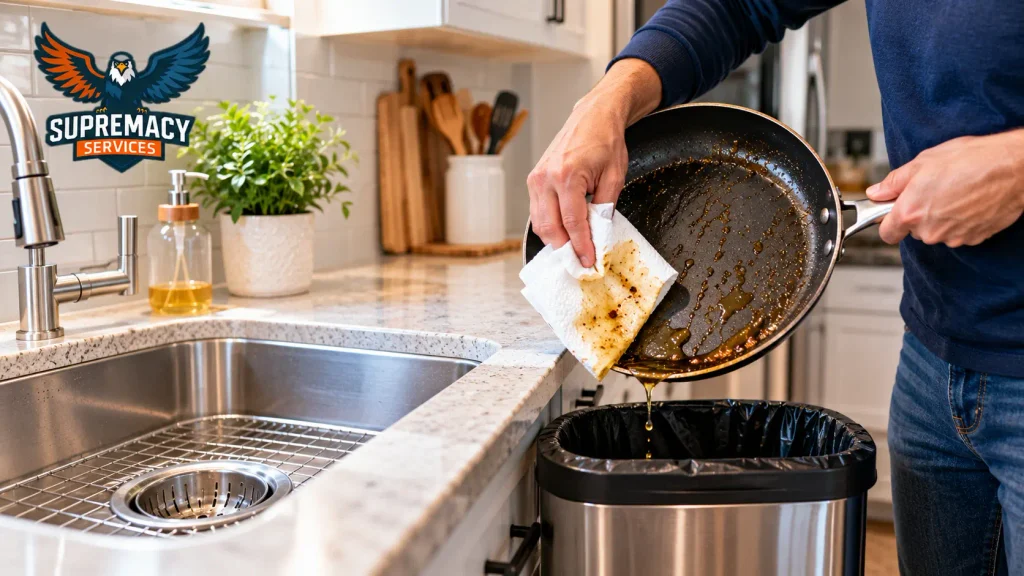
Homeowner wiping cooking grease from a frying pan into the trash instead of pouring it down the kitchen sink.
Keeping cooking grease, wipes, and other inappropriate materials out of drains helps reduce preventable sewer blockages.

Preventing recurring sewer backups starts with reducing avoidable blockages and correcting existing pipe defects.

Use this practical homeowner checklist:

  • Flush only human waste and toilet paper.
  • Dispose of cooking grease in the trash rather than the sink.
  • Keep wipes, hygiene products, and paper towels out of toilets.
  • Use drain strainers to reduce debris entering plumbing fixtures.
  • Address repeated slow drains before they become complete blockages.
  • Keep accessible sewer cleanouts clear of landscaping and debris.
  • Have confirmed root intrusion or damaged joints properly addressed.
  • Consider an inspection when backups recur after cleaning.
  • Ask a qualified plumber whether a backwater valve is appropriate for your property.
  • Follow any maintenance recommendations based on your actual pipe condition.

Should Dallas Homeowners Schedule Regular Sewer Cleaning?

Not every home needs routine sewer cleaning on a fixed schedule.

Maintenance frequency should depend on the pipe’s condition, previous blockage history, household use, and any known root intrusion or buildup problems.

A homeowner with repeated blockages may benefit from a condition-based maintenance plan, while another property with a sound, properly functioning sewer line may not need scheduled cleaning.


Frequently Asked Questions About Recurring Sewer Backups

1. Why does my sewer line keep backing up every few months?

Repeated backups can occur when grease, roots, debris, or a structural pipe defect continues restricting wastewater flow. If cleaning only provides temporary relief, a sewer camera inspection can help identify the underlying cause.

2. Can tree roots cause my sewer line to back up repeatedly?

Yes. Roots can enter through cracks or defective joints and trap wastewater debris. Removing the roots may restore flow, but repairing the opening may be necessary to prevent another intrusion.

3. Why does my sewer back up when I run the washing machine?

A washing machine discharges water relatively quickly. If a downstream drain or sewer line is restricted, the discharge may back up through a nearby lower fixture, such as a shower or floor drain.

4. Can a clogged sewer line cause toilets and showers to back up together?

Yes. Toilets, showers, and sinks may share drainage piping. When a common downstream section becomes blocked, wastewater from one fixture can emerge through another.

5. How do I know if my sewer line is collapsed?

Recurring backups, multiple slow drains, and repeated blockages may indicate structural damage, but they cannot confirm a collapse. A professional camera inspection and, when necessary, additional assessment can identify the affected section.

6. Will hydro-jetting stop recurring sewer backups?

Hydro-jetting can remove certain types of buildup and debris from suitable pipes. It cannot correct a collapsed pipe, severe misalignment, or other structural defects. A plumber should assess pipe condition before recommending high-pressure cleaning.

7. Does homeowners insurance cover sewer backups in Texas?

Coverage depends on the policy, the cause of the backup, and any applicable endorsements or exclusions. Some policies offer optional water or sewer backup coverage. Contact your insurer to review your specific protection.

8. Is the city responsible if my sewer line backs up?

Responsibility depends on where the problem occurs and the local utility’s rules. Private sewer laterals are commonly the property owner’s responsibility, while public sewer mains are generally maintained by the utility. The precise boundary should be confirmed with the municipality.

9. Can recurring sewer backups damage my foundation?

A leaking underground sewer pipe may contribute to soil moisture changes or erosion near a foundation. However, a backup does not automatically mean foundation damage is occurring. The pipe and any suspected structural effects should be evaluated separately.

10. Should I replace my sewer line if it keeps clogging?

Not automatically. A sewer line that repeatedly clogs may only need thorough cleaning or localized repair. Replacement is more appropriate when inspection confirms extensive deterioration, collapse, or defects that cannot be effectively repaired.

Get Help With Recurring Sewer Backups in Dallas and DFW

A sewer line that repeatedly backs up deserves more than another temporary fix.

Whether the underlying problem involves grease buildup, tree roots, a damaged joint, or a deteriorating underground pipe, the right solution begins with identifying the actual cause.

Supremacy Services provides plumbing, drain cleaning, sewer inspection, and sewer line repair services throughout Dallas and surrounding DFW communities, including Plano, Frisco, Richardson, McKinney, and Fort Worth.

If your drains keep backing up after previous cleaning, ask about a professional assessment to determine whether cleaning, targeted repair, or replacement is appropriate.

Schedule a Sewer Line Inspection or Repair Assessment With Supremacy Services

Call: 945-777-3345

Find the cause of the recurring backup and choose a solution based on the condition of your sewer line.

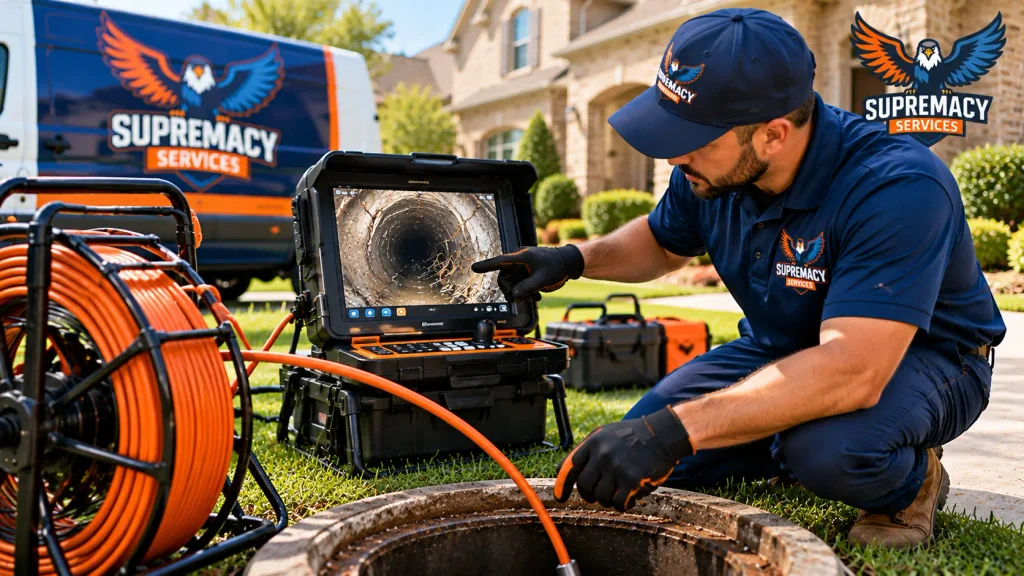
Supremacy Services technician inspecting an underground sewer line using a camera system outside a Dallas home.

How Much Does Trenchless Sewer Repair Cost in Dallas?

Trenchless sewer repair cost in Dallas typically approximates $80–$250 per linear foot as a broad 2026 planning estimate. Many residential pipe-lining and pipe-replacement projects cost several thousand dollars, with more extensive jobs reaching $15,000 or more.

The actual price depends on the length of damaged sewer pipe, the repair method, pipe condition, depth, and accessibility. A short section of deteriorated cast iron beneath a driveway may require a very different approach from a long sewer line with multiple collapsed sections.

For Dallas and DFW homeowners, the most important question isn’t simply how much trenchless sewer repair costs. It’s whether your existing sewer line is suitable for a trenchless method—and whether avoiding extensive excavation will reduce your total project expense.

This guide explains 2026 pricing, compares trenchless repair methods, identifies potential additional costs, and shows how to evaluate a professional estimate.

Table of Contents

  1. What Is Trenchless Sewer Repair?
  2. How Much Does Trenchless Sewer Repair Cost in Dallas in 2026?
  3. What Factors Affect Trenchless Sewer Repair Costs?
  4. Pipe Lining vs. Pipe Bursting: Which Costs Less?
  5. Trenchless vs. Traditional Sewer Repair Costs
  6. When Is Trenchless Sewer Repair Worth the Money?
  7. Signs Your Sewer Line May Need Repair
  8. What Happens During Trenchless Sewer Repair?
  9. Dallas-Specific Considerations
  10. How to Avoid Unnecessary Sewer Repair Costs
  11. Frequently Asked Questions
  12. Get a Trenchless Sewer Repair Estimate in Dallas

What Is Trenchless Sewer Repair?

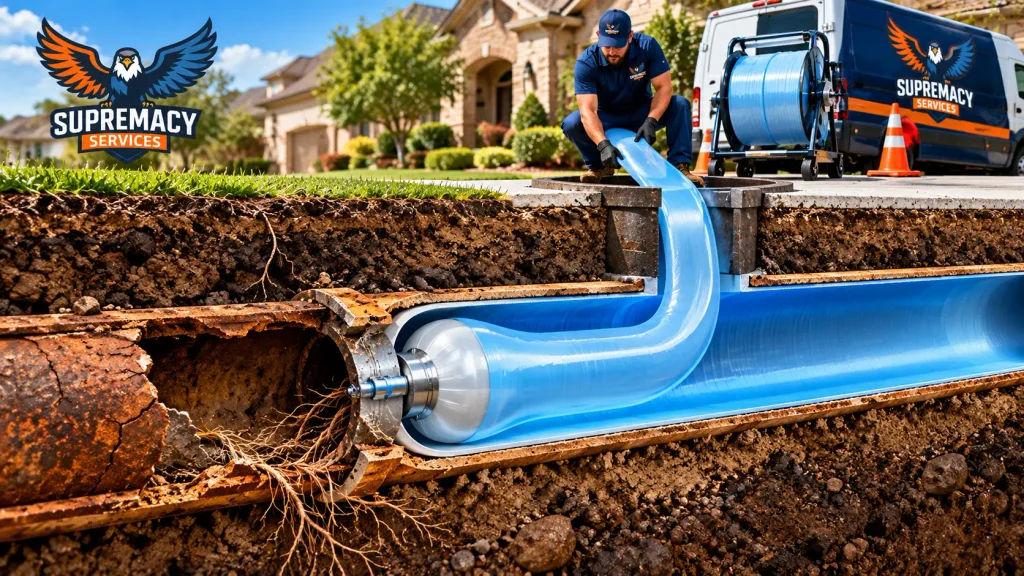
Underground cutaway illustrating a blue CIPP liner being installed inside an existing damaged sewer pipe.
Cured-in-place pipe lining rehabilitates suitable damaged sewer pipes without excavating the entire underground line.

Trenchless sewer repair is a method of repairing or replacing underground sewer pipes without digging a continuous trench along the entire damaged line.

Instead, plumbers typically use existing access points or excavate smaller access pits to repair or install piping underground.

Two common methods are:

  • Cured-in-place pipe lining (CIPP): A resin-impregnated liner is inserted into a suitable existing pipe and cured to create a new pipe structure inside it.
  • Pipe bursting: Specialized equipment fractures the existing pipe while pulling a replacement pipe through the same general alignment.

Both methods can reduce excavation, but neither is completely excavation-free in every situation.

Why Dallas Homeowners Consider Trenchless Repair

Traditional sewer replacement may involve digging through lawns, flower beds, sidewalks, driveways, or other improvements.

Trenchless methods can be especially attractive when a sewer line runs beneath:

  • Concrete driveways or patios
  • Established landscaping
  • Mature trees and their root zones
  • Walkways and other hardscaping
  • Areas with limited excavation access

However, trenchless repair is not automatically the best choice for every damaged sewer line.

A professional camera inspection is essential for identifying the actual problem and determining which repair methods are technically suitable. Supremacy services

How Much Does Trenchless Sewer Repair Cost in Dallas in 2026?

For budgeting purposes, published 2026 Texas and DFW pricing guides commonly place trenchless sewer work in the approximate range of $80–$250 per linear foot, although some Dallas estimates extend above this range.

A typical residential project may cost approximately $3,500–$15,000, while complicated or unusually long replacements can cost substantially more.

These figures are market-based planning estimates, not fixed prices or a quotation from Supremacy Services.

Estimated Cost by Repair Method

Sewer repair methodEstimated 2026 pricingTypical application
CIPP pipe lining$80–$250 per linear footDeteriorated but structurally suitable existing pipe
Pipe bursting$100–$250 per linear footReplacement of an existing pipe along a suitable route
Localized sewer repair$1,500–$4,000 per projectIsolated damage that can be accessed and repaired
Traditional excavationHighly project-dependentCollapsed, severely misaligned, or otherwise unsuitable lines

Sources: Texas Plumbing Directory’s 2026 repair-cost guide and Dallas-area contractor estimates. These ranges overlap and are not directly comparable for every job.

What Could Different Sewer Line Lengths Cost?

The following examples use a simple $80–$250-per-foot calculation.

Repair lengthIllustrative calculated range
20 feet$1,600–$5,000
30 feet$2,400–$7,500
40 feet$3,200–$10,000
50 feet$4,000–$12,500
75 feet$6,000–$18,750
100 feet$8,000–$25,000

Important: These are arithmetic examples, not actual project quotations. Short jobs may have minimum mobilization charges, and real estimates may include cleaning, access excavation, inspection, permits, restoration, and other work not captured by a per-foot calculation.

Is a $10,000 Trenchless Sewer Repair Quote Reasonable?

A $10,000 estimate may be reasonable for some Dallas sewer projects, particularly when the repair involves a long section, difficult access, or substantial preparation.

However, the total price alone does not establish whether a quote is fair.

A homeowner should ask:

  • How many feet of pipe are being repaired?
  • Which method is recommended?
  • What did the camera inspection reveal?
  • Does the price include pipe cleaning and preparation?
  • Are excavation and restoration included?
  • What testing and documentation will be provided?
  • What warranty applies to the specific work?

A written, itemized scope is more useful than comparing prices without knowing what each contractor intends to repair.

What Factors Affect Trenchless Sewer Repair Costs?

The biggest cost drivers are the amount of pipe being repaired, the condition of the existing sewer line, and the amount of access and preparation required.

1. Length of the Damaged Sewer Line

Longer sewer sections generally require more liner or replacement pipe, additional preparation, and potentially more labor.

However, repairing twice as much pipe does not necessarily double the project price because equipment setup and other fixed costs may be similar.

2. Existing Pipe Material and Condition

Older Dallas-area homes may have cast-iron or clay sewer pipes, while other properties use plastic piping.

Common problems include:

  • Corrosion and deterioration
  • Cracked pipe walls
  • Separated or offset joints
  • Root intrusion
  • Missing pipe sections
  • Partial or complete collapse

CIPP lining requires an existing pipe that can be properly prepared and can accommodate the liner. Extensive collapse, serious deformation, or major alignment problems may prevent successful lining.

3. Sewer Line Depth

Deep sewer lines can require more complicated access excavation.

Depth also affects how safely crews can expose the pipe and how much equipment or labor may be needed.

4. Access Beneath Driveways or Concrete

A sewer line beneath a driveway may make trenchless repair attractive because avoiding a long excavation can reduce demolition and reconstruction.

Even trenchless work, however, may require access pits or openings in paved areas.

5. Tree Roots and Existing Blockages

Roots can enter sewer pipes through damaged joints or cracks.

Before installing a liner, the contractor may need to remove roots, scale, grease, or other material.

Removing roots alone does not repair the opening that allowed them into the pipe.

6. Pipe Bellies and Poor Drainage Slope

A pipe belly is a low section where wastewater can collect because the line has settled or lost its intended slope.

Lining generally follows the existing pipe alignment. It does not automatically correct a significant belly or restore proper drainage slope.

This is one reason a camera inspection and appropriate slope assessment matter before selecting a repair method.

7. Permits, Inspections, and Site Restoration

Project requirements depend on the jurisdiction, location, and scope of work.

Ask whether the estimate includes applicable permits, inspections, access-pit restoration, and any work affecting sidewalks or public rights-of-way.

Considering sewer repair in Dallas? Explore Supremacy Services’ sewer line repair and replacement options to understand the available methods before requesting a project-specific estimate.

Pipe Lining vs. Pipe Bursting: Which Costs Less?

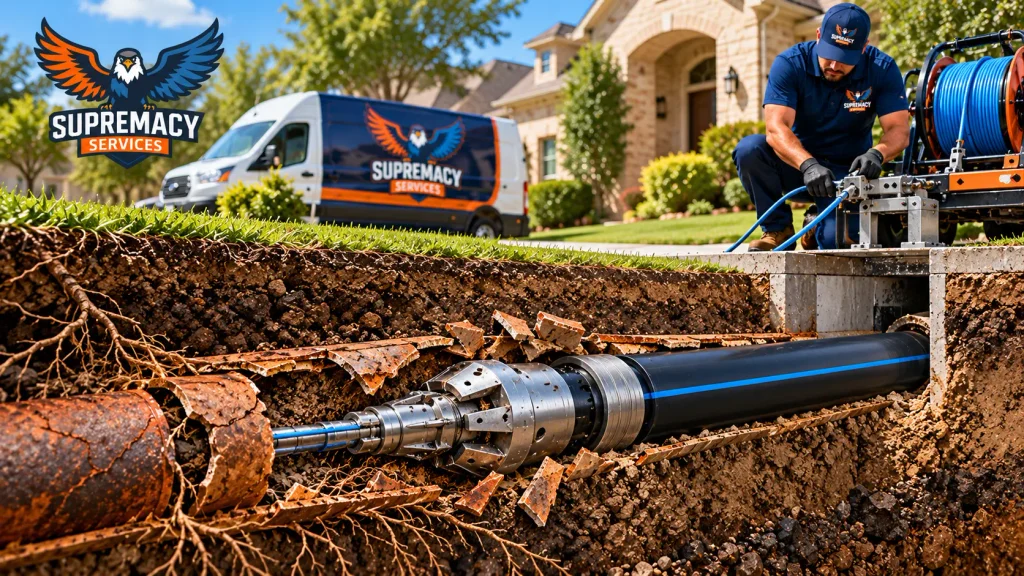
Pipe bursting equipment breaking an old underground sewer pipe while pulling a new black replacement pipe into position.
Pipe bursting replaces an existing underground sewer line by breaking the old pipe and pulling a new pipe through its alignment.

CIPP pipe lining can be less expensive than pipe bursting on some projects, but the cheapest suitable method depends on the existing pipe and site conditions.

FeatureCIPP pipe liningPipe bursting
Main purposeRenew the inside of an existing pipeReplace the existing pipe
Existing pipeMust be suitable for liningExisting pipe is fractured during replacement
ExcavationOften limitedTypically requires entry and exit access pits
Pipe alignmentGenerally follows existing alignmentGenerally follows existing alignment
Major pipe collapseOften unsuitableMay be possible in selected conditions
Severe pipe bellyGenerally not correctedMay still require excavation and grade correction
Typical pricing$80–$250/ft$100–$250/ft
Best advantageRehabilitates suitable existing pipeInstalls a new replacement pipe

When Is Pipe Lining the Better Option?

Pipe lining may be appropriate when the existing sewer line has cracks, joint deterioration, or other defects but still provides a suitable pathway for the liner.

It can reduce the need to remove the entire existing pipe.

When Is Pipe Bursting the Better Option?

Pipe bursting may be appropriate when replacement is necessary and the existing alignment, surrounding utilities, access conditions, and pipe material allow the method.

The technique still requires careful planning because it displaces the existing pipe outward.

Can Every Cast-Iron Sewer Pipe Be Lined?

No. Some cast-iron pipes can be rehabilitated, but severely deteriorated or collapsed pipes may not be suitable.

A contractor should evaluate the remaining pipe structure, alignment, internal dimensions, and cleaning requirements before recommending CIPP.

Trenchless vs. Traditional Sewer Repair: Which Is More Affordable?

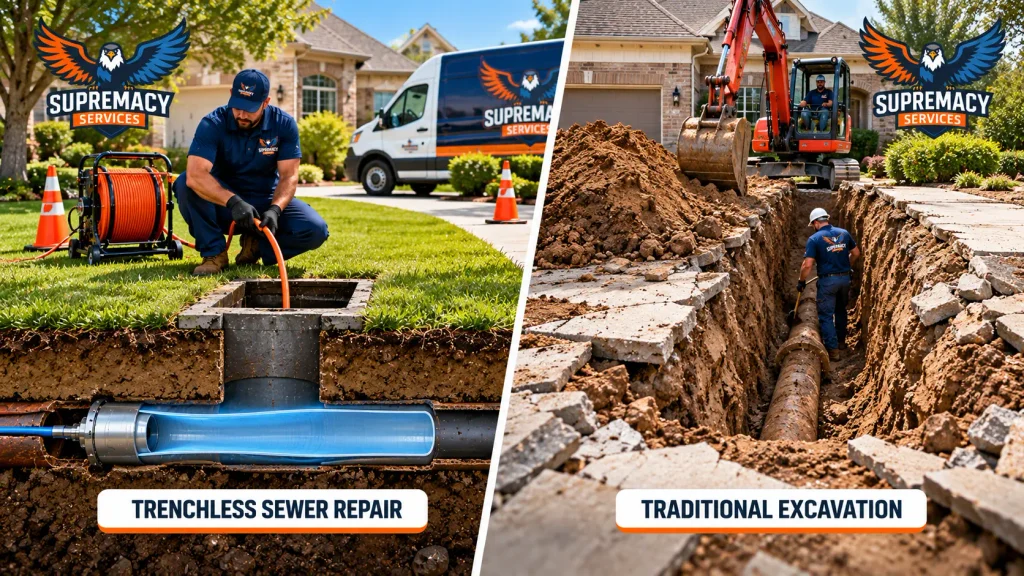
Side-by-side comparison of trenchless sewer repair with limited excavation and traditional sewer replacement using an open trench.
Trenchless sewer repair can reduce excavation and restoration work compared with traditional sewer line replacement.

Trenchless repair may have a higher direct installation cost than conventional excavation on some projects. However, the total cost can be lower when it avoids expensive demolition and restoration.

Cost considerationTrenchless repairTraditional excavation
Pipe installationSpecialized equipment and materialsConventional excavation and pipe installation
Yard disturbanceUsually reducedPotentially extensive
Driveway demolitionMay be avoidableMay be necessary
Landscaping restorationOften lessPotentially more
Access excavationStill may be requiredUsually substantial
Correcting pipe slopeLimited by methodAllows direct regrading
Total project costDepends on scope and avoided restorationDepends on excavation and restoration

Example: Sewer Line Beneath a Driveway

Imagine a Dallas homeowner with a damaged sewer line running beneath a concrete driveway.

A traditional replacement estimate might include excavation, pipe replacement, concrete removal, and driveway reconstruction.

A trenchless estimate might involve a higher pipe-installation price but substantially less concrete restoration.

In this situation, comparing only the plumbing portion of each quote would be misleading.

When Traditional Excavation Makes More Sense

Excavation may be necessary when:

  • The pipe has a severe belly requiring regrading.
  • Sections have collapsed or become disconnected.
  • The existing alignment cannot be reused safely.
  • A new sewer route is required.
  • Nearby utilities or site conditions make trenchless methods unsuitable.

The best method is the one that provides a technically sound repair at a reasonable total project cost—not necessarily the one requiring the least digging.

When Is Trenchless Sewer Repair Worth the Money?

Trenchless sewer repair is often worth considering when the damaged pipe runs beneath expensive or difficult-to-replace surfaces and the existing pipe conditions support the method.

It may offer particular value when homeowners want to preserve established landscaping or avoid extensive driveway demolition.

However, a shorter, easily accessible damaged section may be less expensive to repair conventionally.

Three Questions to Ask Before Approving Trenchless Repair

  1. Is the damage localized or widespread? A small defect may not justify full-line rehabilitation.
  2. Is the pipe structurally and hydraulically suitable? A liner cannot solve every collapse or slope problem.
  3. What is the total installed and restored cost? Compare all necessary work, not just the quoted price per foot.

If you’re comparing methods, Supremacy Services can evaluate the problem and discuss professional sewer repair and replacement options appropriate to the inspection findings.

Signs Your Sewer Line May Need Repair

Common warning signs include recurring backups, multiple slow drains, sewage odors, and wastewater appearing where it should not.

Multiple Fixtures Backing Up

If wastewater rises in a bathtub or shower when another fixture drains, the problem may involve a shared branch drain or the main sewer line.

Frequent Sewer Clogs

Repeated blockages after professional cleaning can indicate roots, damaged joints, pipe deterioration, or another persistent obstruction.

Sewage Odors Around the Property

Persistent sewer odors can result from damaged drainage piping, but they can also originate from dry traps, venting problems, or other plumbing defects.

Unusually Wet Areas in the Yard

An unexplained wet or foul-smelling patch near the sewer route may indicate a leak.

However, irrigation leaks, drainage problems, and water-supply pipe failures can produce similar symptoms.

Gurgling Toilets or Drains

Gurgling can indicate restricted drainage or venting problems. It does not prove that the underground sewer line needs replacement.

When to Stop Using the Plumbing

If sewage is actively backing up into the home, minimize water use and arrange professional assistance.

Avoid contact with contaminated water, keep children and pets away, and do not continue running appliances that discharge into the affected drain.

What Happens During Trenchless Sewer Repair?

A professional trenchless sewer repair typically involves diagnosing the damage, preparing the pipe, completing the selected repair, and verifying the results.

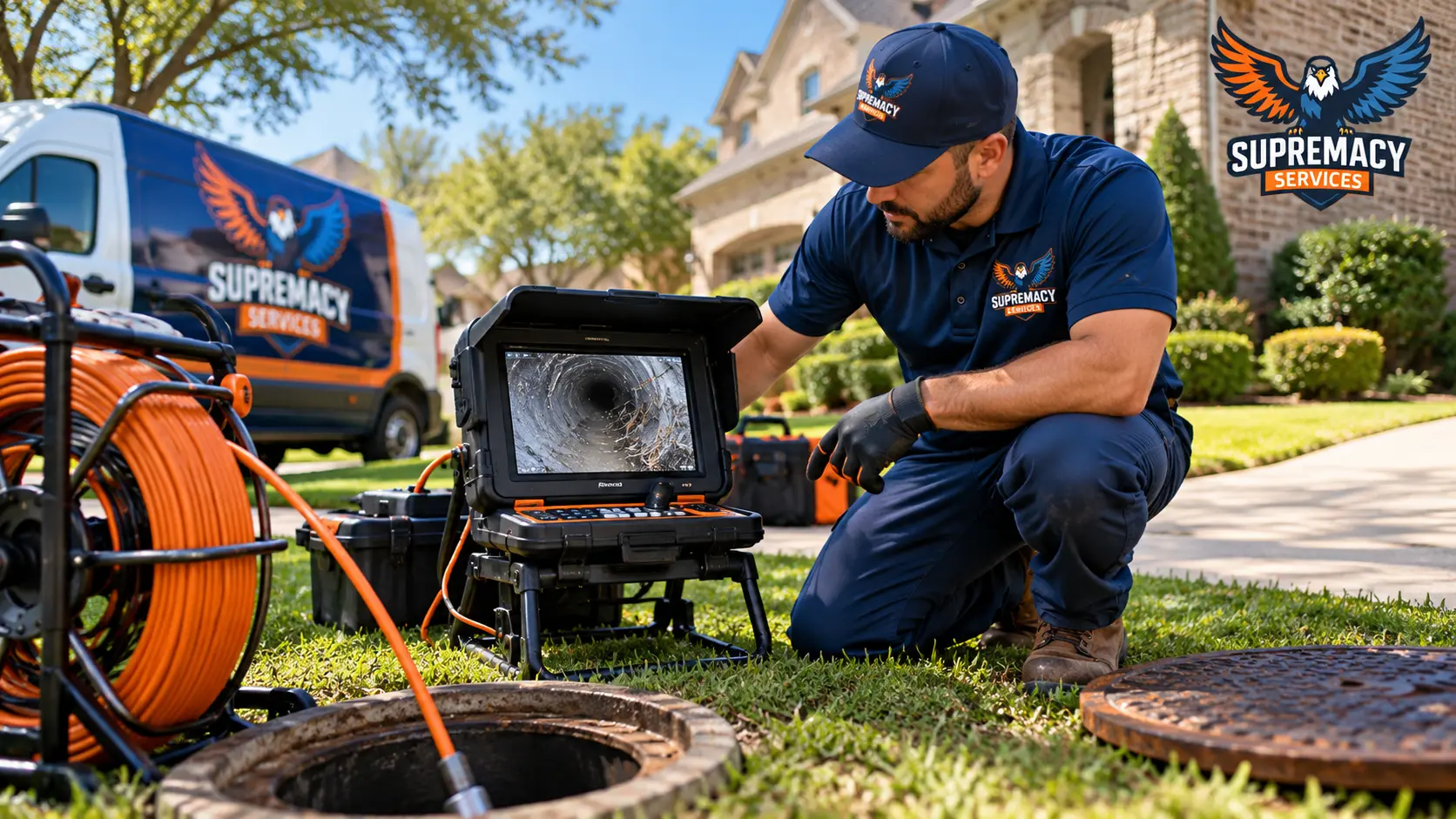
Supremacy Services plumber examining sewer pipe damage on a camera inspection monitor outside a residential property.
A sewer camera inspection helps identify cracks, root intrusion, blockages, and pipe deterioration before repair work begins.

Step 1: Sewer Camera Inspection

A plumber uses a sewer inspection camera to identify visible cracks, roots, blockages, joint separation, or collapse.

The camera findings help determine whether the line needs cleaning, localized repair, lining, or replacement.

Step 2: Locate the Damaged Section

The contractor identifies the relevant pipe route and access locations.

Additional locating or measurement work may be required to establish the repair boundaries and assess site constraints.

Step 3: Prepare the Existing Pipe

Depending on the method, preparation may involve cleaning, root removal, access excavation, or other work.

CIPP installation requires a properly prepared pipe interior and compliance with the selected liner system’s installation requirements.

Step 4: Complete the Repair

For pipe lining, the contractor installs and cures the liner according to the approved system and process.

For pipe bursting, equipment fractures the existing pipe while drawing a new pipe through the planned route.

Step 5: Inspect and Verify the Work

The contractor checks the completed work using appropriate inspection or testing methods.

Homeowners should ask for relevant post-repair documentation and clarification of any warranty terms.

Step 6: Restore Access Areas

Any necessary access pits, surface openings, or disturbed areas are restored according to the agreed project scope.

How Long Does Trenchless Sewer Repair Take?

Some straightforward residential trenchless projects can be completed in approximately one day, but larger or more complicated projects may take longer.

Cleaning requirements, access excavation, curing time, inspections, and restoration all influence the schedule.a>

Dallas-Specific Considerations That Can Affect Sewer Repair Costs

Dallas-area properties vary considerably in age, sewer-pipe material, landscaping, and accessibility.

These differences matter more to the final estimate than the city’s name alone.

Expansive Clay Soils in North Texas

Expansive clay soils occur across parts of North Texas and can shrink or swell as moisture conditions change.

Soil movement may contribute to changes in underground pipe support or alignment, although a camera inspection cannot by itself establish that soil movement caused a particular failure.

Older Homes With Cast-Iron Sewer Pipes

Some older Dallas neighborhoods contain homes with aging cast-iron sewer systems.

Corrosion, scale, and joint deterioration can complicate cleaning and rehabilitation.

A pipe’s age is useful background information, but replacement should be based on its actual condition.

Mature Trees and Root Intrusion

Established neighborhoods with mature landscaping may experience root intrusion where sewer pipes have openings or deteriorated joints.

Tree roots should be treated as a potential contributing factor rather than proof that the entire sewer line needs replacement.

Dallas Permits and Plumbing Requirements

The City of Dallas requires compliance with applicable building and plumbing codes. Whether a particular sewer repair needs a permit or inspection depends on the scope and circumstances.

Dallas also recognizes certain homeowner exemptions for work on qualifying homesteaded properties, but applicable permit, inspection, and code requirements still apply.

Before work begins, verify the relevant requirements with Dallas Building Inspection.

Who Is Responsible for the Sewer Line?

Responsibility depends on which portion of the sewer system is damaged, the utility’s rules, and the location of the connection.

Homeowners should not assume that the city will pay for every pipe located near the street—or that they personally own every section.

Contact the relevant wastewater utility to confirm responsibility when the damaged section approaches the public connection.

How to Avoid Unnecessary Sewer Repair Costs

The most effective way to avoid unnecessary spending is to obtain a clear diagnosis before approving extensive work.

Request Camera Evidence

Ask the contractor to show the location and condition of the damaged pipe.

A recurring blockage does not automatically mean the entire sewer line must be replaced.

Compare Repair Scopes, Not Just Prices

A useful written estimate should explain:

  • Which section will be repaired
  • Why the chosen method is appropriate
  • How access will be obtained
  • What preparation is included
  • Whether permits and inspections are included
  • What restoration is included
  • How the completed work will be verified
  • What warranty applies

Ask Whether a Localized Repair Is Possible

If most of the pipe is in good condition, repairing an isolated defect may be more economical than rehabilitating the entire line.

Avoid Treating Repeated Clogs as a Permanent Fix

Drain cleaning may restore flow temporarily without correcting broken joints, cracks, or deteriorated piping.

Prevent Future Sewer Problems

Homeowners can reduce avoidable drainage problems by keeping wipes, grease, and unsuitable materials out of the sewer system.

Where root intrusion has occurred, follow the plumber’s recommendations for repairing the entry point and managing the surrounding landscaping.

Can You Repair a Sewer Line Yourself?

Basic drain maintenance is different from repairing an underground sewer lateral.

Trenchless installation requires specialized equipment, technical assessment, and appropriate safety procedures.

For major underground repairs, professional evaluation is the practical choice. Any homeowner-performed work must still comply with applicable Texas and local requirements.


Frequently Asked Questions About Trenchless Sewer Repair in Dallas

1. What is the average cost of trenchless sewer repair in Dallas?

Published 2026 estimates commonly range from approximately $80 to $250 per linear foot, with many residential projects costing several thousand dollars. There is no single reliable average that applies to every Dallas home because project length, method, and access conditions vary.

2. Is trenchless sewer repair cheaper than digging?

Sometimes. Trenchless installation may cost more per foot, but it can reduce demolition and restoration expenses. The total price depends on the property and the condition of the sewer line.

3. How much does sewer pipe lining cost per foot?

Published Texas estimates commonly place CIPP pipe lining around $80–$250 per linear foot. Short projects, complicated preparation, and access work may produce a higher effective cost per foot.

4. Does trenchless sewer repair work on cast-iron pipes?

It can. Some deteriorated cast-iron sewer pipes are suitable for lining, while others need replacement. A professional inspection and pipe assessment determine whether rehabilitation is appropriate.

5. How long does trenchless sewer repair last?

Service life depends on the installed system, pipe conditions, installation quality, and operating environment. Some systems are designed for multi-decade performance, but homeowners should request manufacturer documentation and the contractor’s actual warranty rather than assume a universal lifespan.

6. Does homeowners insurance cover trenchless sewer repair?

Coverage depends on the policy, cause of damage, and any applicable endorsements. Ordinary wear, corrosion, and gradual deterioration may be excluded. Ask your insurer to review the specific loss and policy language.

7. Can trenchless sewer repair fix a collapsed pipe?

Not every collapsed pipe can be repaired trenchlessly. CIPP generally needs a suitable existing pathway, while pipe bursting may work in some replacement situations. Severe collapse or alignment problems can require excavation.

8. Do I need a sewer camera inspection before trenchless repair?

A camera inspection is an important part of assessing whether trenchless work is appropriate. It helps identify defects, locate damage, and determine whether cleaning, lining, bursting, or excavation should be considered.

9. Will trenchless sewer repair damage my driveway?

Trenchless methods can reduce driveway demolition, but they do not guarantee that no concrete will be disturbed. Access pits or other openings may still be required.

10. Is trenchless sewer repair worth it for an older Dallas home?

It may be worthwhile when the sewer line is suitable for trenchless work and avoiding excavation protects expensive landscaping or hardscaping. Pipe condition and total project cost should determine the decision.

Get a Trenchless Sewer Repair Estimate in Dallas

Supremacy Services plumbing technician discussing sewer repair options and an estimate with a Dallas homeowner.
A professional sewer assessment helps homeowners compare trenchless repair methods, project requirements, and expected costs.

Trenchless sewer repair can provide a practical alternative to extensive excavation, but the right solution begins with identifying the actual condition of your underground sewer line.

A reliable estimate should explain the damage, recommend a suitable repair method, and identify the work included in the final price.

Supremacy Services provides sewer line repair and replacement services for homeowners across Dallas and the DFW Metroplex, including evaluation of trenchless and traditional repair options.

Concerned about recurring sewer backups or a damaged underground pipe?

Request a professional sewer line repair assessment from Supremacy Services to discuss your options and obtain pricing based on your property’s actual conditions.

Sewer Line Repair vs. Replacement: How to Know Which You Need

Sewer line repair vs. replacement comes down to the condition of your existing pipe. If damage is limited to a short section and the surrounding pipe remains structurally sound, a targeted repair may be enough. If the sewer line has extensive deterioration, repeated failures, major misalignment, or collapsed sections, partial or complete replacement may be the better long-term solution.

For Dallas and DFW homeowners, the important first step is determining what is actually wrong underground. A sewer camera inspection can help distinguish an ordinary blockage from a damaged pipe—and prevent you from paying for replacement when a smaller repair would work.

This guide explains when each option makes sense, how repair methods compare, what affects cost, and what to ask a plumber before approving major sewer work.

Table of Contents

  1. Sewer Line Repair vs. Replacement: Key Differences
  2. When Can a Sewer Line Be Repaired?
  3. When Does a Sewer Line Need Replacement?
  4. Warning Signs to Watch For
  5. Sewer Repair and Replacement Methods
  6. Cost Factors in Dallas
  7. How Plumbers Determine the Right Solution
  8. North Texas Considerations
  9. DIY vs. Professional Repair
  10. How to Prevent Future Sewer Problems
  11. Frequently Asked Questions

Sewer Line Repair vs. Replacement: What’s the Difference?

Sewer line repair fixes a specific problem while preserving some or most of the existing pipe. Sewer line replacement installs new piping in place of a damaged section or an entire sewer run.

Both approaches can be appropriate. The correct choice depends on the extent of the damage, pipe condition, alignment, accessibility, and expected long-term performance.

FactorSewer line repairSewer line replacement
Main purposeCorrect a localized defectRenew a failed section or line
Best suited forIsolated cracks, joints, or damaged sectionsWidespread deterioration, collapse, or repeated failures
Existing pipeMostly retainedPartially or completely replaced
ExcavationSometimes limitedMay involve trenching or access pits
Initial costOften lower for a small repairOften higher for extensive work
Long-term valueGood when remaining pipe is soundBetter when much of the pipe is unreliable
Future problemsUnrepaired sections may still deteriorateReplaced sections eliminate existing defects in that portion

An important distinction: replacement does not necessarily mean excavating your entire yard. Certain trenchless techniques can install new piping with less surface disturbance than conventional trenching.

The U.S. Environmental Protection Agency documents both localized repairs and several sewer rehabilitation and replacement methods, each with different technical limitations.

When Can a Sewer Line Be Repaired Instead of Replaced?

Supremacy Services plumber connecting a replacement PVC sewer pipe section to an older underground pipe using a repair coupling.
A targeted sewer repair can correct an isolated damaged section without replacing the entire underground sewer line.

A sewer line can often be repaired when the damage is localized, the pipe retains sufficient structural integrity, and the remaining line can continue functioning reliably.

1. A Small Section of Pipe Is Cracked

A crack confined to one accessible section may be repaired by removing the damaged portion and installing new piping with appropriate connections.

The plumber should also investigate why the crack developed. A repair that ignores continuing movement or inadequate pipe support may not resolve the underlying problem.

2. One Pipe Joint Has Separated

Sewer pipes connect through joints that can deteriorate or shift.

If a single joint has become misaligned or separated, a targeted repair may restore the connection.

However, multiple displaced joints can suggest a larger alignment or ground-support problem requiring a more comprehensive solution.

3. Tree Roots Have Entered Through a Localized Opening

Tree roots can enter sewer lines through cracks or defective joints.

Professional root removal may restore wastewater flow, but clearing the roots does not necessarily seal the opening that allowed them inside.

If the pipe remains sound, a localized structural repair may address the defect. If roots have entered through multiple failing joints, broader rehabilitation or replacement may be warranted.

4. A Short Pipe Section Has Deteriorated

Sometimes most of a sewer line is in reasonable condition, but one section has become badly corroded or otherwise damaged.

Replacing only that section can be more practical than replacing the entire line.

The key is confirming that the remaining pipe has enough serviceable life to justify retaining it.

5. The Pipe Is Structurally Sound but Has a Repairable Defect

Some sewer pipes can be rehabilitated internally with approved lining systems.

However, lining is not suitable for every defect. The pipe must be evaluated for geometry, access, structural condition, cleaning requirements, and compatibility with the proposed lining method.

When to call a professional: If recurring clogs, root intrusion, or a suspected broken joint continue after drain cleaning, arrange a sewer camera inspection rather than repeatedly treating the symptoms.

For homeowners in Dallas and the surrounding Metroplex, Supremacy Services offers professional sewer line repair and replacement assessments to help determine which approach is appropriate.

When Does a Sewer Line Need to Be Replaced?

Plumbing technician inspecting a severely corroded underground sewer pipe with broken walls and tree root intrusion.
Extensive corrosion, structural damage, and root intrusion can make sewer line replacement more practical than repeated repairs.

Replacement becomes more appropriate when the pipe has extensive structural damage, cannot maintain proper wastewater flow, or is likely to continue failing despite localized repairs.

1. The Sewer Pipe Has Collapsed

A collapsed sewer pipe may no longer provide an open passage for wastewater.

When a section has lost its shape or structural support, cleaning alone cannot restore the pipe.

The damaged section generally needs replacement or another engineered solution suitable for the actual condition.

A collapsed portion does not automatically require replacing every foot of sewer line. The plumber should determine whether the failure is isolated or part of a larger pattern.

2. Multiple Sections Are Damaged

One cracked joint is different from a line containing numerous cracks, separations, and deteriorated sections.

When several areas require repair, the combined cost and disruption of multiple spot repairs may approach or exceed the value of replacing a longer section.

3. The Pipe Has Extensive Corrosion or Deterioration

Older metal sewer pipes may deteriorate internally over time.

If a camera inspection reveals extensive corrosion, weakened walls, or loss of structural integrity, patching one defect may leave other weak sections in place.

The decision should depend on actual pipe condition rather than age alone.

4. The Sewer Line Has a Serious Belly or Slope Problem

A sewer belly is a low section of pipe where wastewater and solids can accumulate because the line no longer maintains its intended slope.

Minor irregularities do not always require replacement. But a pronounced belly that repeatedly traps waste may need excavation, regrading, and replacement of the affected section.

A lining system generally follows the existing pipe alignment, so it cannot be assumed to correct an improper slope.

5. Repairs Keep Failing

If the same sewer line repeatedly develops problems after properly completed repairs, the remaining pipe may no longer be a reliable candidate for isolated fixes.

Before approving full replacement, request a current inspection showing where failures are occurring and why another spot repair would be insufficient.

6. The Existing Pipe Cannot Be Reliably Rehabilitated

Some pipes have severe deformation, large missing sections, extensive offsets, or other conditions that make certain trenchless lining methods unsuitable.

In those situations, a partial or full replacement may be necessary.

The EPA identifies conventional excavation and pipe bursting among the available lateral replacement techniques, while emphasizing that method suitability depends on the pipe and site conditions.

What Are the Warning Signs That Your Sewer Line May Need Replacement?

Four-panel infographic comparing sewer spot repair, cured-in-place pipe lining, pipe bursting, and traditional excavation.
Sewer repair options include spot repairs, CIPP lining, pipe bursting, and traditional excavation, depending on pipe condition and site requirements.

Recurring sewage backups, multiple slow drains, persistent sewer odors, and repeated blockages can indicate a serious sewer problem. However, symptoms alone cannot tell you whether repair or replacement is necessary.

Pay attention to the following:

  • Multiple sinks, showers, or toilets draining slowly at the same time.
  • Sewage backing up through a shower, tub, or floor drain.
  • Gurgling sounds when other fixtures are used.
  • Recurring clogs shortly after professional cleaning.
  • Persistent sewage odors inside or outside the home.
  • Wet, sunken, or foul-smelling areas in the yard.
  • Visible roots, displaced joints, deterioration, or collapse during a camera inspection.

These symptoms can have different causes. For example, one slow bathroom sink may simply have a localized blockage, while several fixtures backing up together can indicate a restriction farther downstream.

For a more detailed explanation, read our guide to the 10 warning signs of a damaged sewer line.

Does a Sewer Backup Always Mean the Pipe Is Broken?

No. A sewer backup can result from grease accumulation, foreign objects, root intrusion, or other blockages without complete structural failure.

A plumber may be able to clear the obstruction and confirm that the pipe remains serviceable.

If backups recur, further investigation is important because cleaning may only provide temporary relief when structural defects remain.

What Are the Different Sewer Repair and Replacement Methods?

Several methods are available, ranging from targeted excavation to trenchless rehabilitation. The best method depends on the damage rather than which technology sounds most convenient.

1. Spot Repair

A plumber excavates a limited area, removes the damaged pipe section, and installs replacement piping with suitable connections. Best for localized defects when the surrounding pipe remains sound.

2. Cured-in-Place Pipe (CIPP) Lining

A liner is installed inside a suitable existing pipe and cured to create a new interior pipe structure. This can reduce excavation, but the host pipe must meet the method’s requirements.

3. Pipe Bursting

Specialized equipment breaks or splits the old pipe while pulling new piping through its alignment. Access pits are still generally required, and nearby utilities and pipe geometry affect suitability.

4. Traditional Excavation and Replacement

The damaged sewer is exposed, removed, and replaced. Excavation may be necessary for severe offsets, slope correction, complex connections, or other conditions that trenchless methods cannot adequately address.

Is Trenchless Sewer Repair Always Better?

No. Trenchless methods can reduce disruption, particularly when a sewer runs beneath a driveway, patio, or established landscaping.

However, they are not universally appropriate. A pipe with significant alignment problems, severe deformation, or inadequate access may require conventional excavation.

A proper recommendation should compare the feasibility, total cost, expected performance, and site restoration requirements of each suitable method.

Sewer Line Repair vs. Replacement Cost in Dallas: What Affects the Price?

A localized sewer repair will often cost less than replacing a long section of underground pipe, but the actual price depends on the work required.

There is no reliable universal price for every Dallas sewer line because two properties with similar symptoms can have very different underground conditions.

Instead of presenting unsupported price ranges, the following table shows what influences an estimate.

Cost factorWhy it matters
Length of damaged pipeLonger replacement sections require more material and labor
Pipe depthDeeper excavation can increase complexity
Damage severityCollapse and major misalignment may limit repair options
Existing pipe materialMaterial condition affects removal and connection methods
AccessPipes beneath slabs, driveways, or structures can be harder to reach
Repair methodSpot repair, lining, pipe bursting, and excavation have different costs
Landscaping and hardscapeRestoration can add significant work
Permits and inspectionsRequirements depend on the municipality and scope
Nearby utilitiesUtility conflicts may require additional precautions
Multiple defectsSeveral repairs may make replacement more economical

Is Repair Always the Cheaper Option?

Not necessarily.

Consider two hypothetical situations.

Scenario A: One damaged joint

A sewer line is otherwise in good condition, but one accessible joint has separated. A targeted repair may resolve the issue without disturbing the rest of the line.

Scenario B: Multiple failing sections

An older sewer has numerous deteriorated joints, recurring blockages, and structural defects across much of its length. Repairing each problem separately could become expensive without providing dependable long-term performance.

The second situation may justify replacement even when individual spot repairs appear cheaper initially.

What Should Be Included in a Sewer Repair Quote?

Before accepting an estimate, ask for a written scope covering the damaged section, proposed repair method, materials, excavation, permits, inspections, backfilling, surface restoration, and warranty terms.

Clarify which items are included and which could create additional charges.

Considering a major sewer repair? Ask Supremacy Services about Dallas sewer repair and replacement options so you can compare an appropriate repair with a longer-term replacement solution.

How Do Plumbers Determine Whether to Repair or Replace a Sewer Line?

Supremacy Services technician using a sewer inspection camera and monitor to identify tree roots and damage inside a residential sewer pipe.
A sewer camera inspection helps plumbers identify hidden pipe damage and determine whether repair or replacement is appropriate.

A professional should determine the location, cause, and extent of damage before recommending major sewer work.

A typical evaluation includes the following steps.

Step 1: Review the symptoms

The plumber asks about backups, recurring clogs, affected fixtures, and previous repair history.

Step 2: Inspect the sewer with a camera

The technician checks for cracks, roots, offsets, deformation, deterioration, and blockages. Cleaning may be needed first to obtain a usable view.

Step 3: Locate and assess the defects

The technician identifies damaged sections and evaluates whether the problem is isolated or widespread.

Step 4: Compare suitable solutions

The plumber considers spot repair, partial replacement, lining, pipe bursting, or excavation based on the findings.

Step 5: Explain the recommendation and quote

The homeowner receives a proposed scope of work and can ask why the selected method is preferable to the alternatives.

Questions to Ask Before Approving Sewer Replacement

A homeowner should understand the reason for replacement before committing to the work.

Ask the plumber:

  1. Can I see the camera footage showing the damage?
  2. Is the problem limited to one section or spread throughout the line?
  3. Can the damaged section be repaired without replacing the entire sewer?
  4. Is trenchless rehabilitation or replacement technically suitable?
  5. Will the proposed method correct the underlying cause?
  6. What restoration, permits, and inspections are included?
  7. What warranty applies, and what are its exclusions?

If the explanation is unclear, requesting a second professional opinion can be reasonable for a major project.

What Should Dallas and DFW Homeowners Consider?

North Texas properties can present different sewer repair challenges depending on construction age, soil conditions, landscaping, and where the pipe is located.

Expansive Soil and Ground Movement

Some North Texas soils contain expansive clay that changes volume as moisture conditions change.

Ground movement can place stress on buried pipes and connections. However, soil conditions alone do not prove the cause of a sewer failure.

A plumber should evaluate the pipe’s actual condition and alignment rather than attributing every damaged sewer to shifting soil.

Older Sewer Materials

Some older Dallas-area homes have cast-iron or clay sewer piping, while other properties use different materials.

Older material does not automatically mean replacement is necessary. A well-supported pipe with limited defects may remain serviceable.

The inspection should establish whether deterioration is localized or extensive.

Trees and Landscaping

Established trees can complicate underground sewer work.

Roots may enter existing pipe defects, while excavation around large roots may affect landscaping and require additional planning.

Trenchless methods can sometimes reduce surface disturbance, but feasibility must be assessed.

Who Is Responsible for the Sewer Line?

In Dallas, the boundary between a private building lateral and the public wastewater service connection matters.

City documentation distinguishes homeowner and Dallas Water Utilities responsibilities around the property line. It is important to verify the actual location and ownership of a defect before authorizing work, particularly near the street or utility easement.

Other DFW municipalities can have different policies. For example, Carrollton publishes a specific sewer-stoppage policy addressing private lateral ownership and certain repairs in the public right-of-way.

Permits and Licensed Plumbing Work

Sewer replacement may require permits and inspections, depending on the scope and municipality.

Dallas Water Utilities’ published procedures include sewer-lateral permit and connection-inspection requirements.

Texas plumbing licensing is administered by the Texas State Board of Plumbing Examiners. Homeowners can use its licensed plumber lookup when verifying a plumbing professional.

Can You Repair a Sewer Line Yourself?

Homeowners can investigate simple fixture-level clogs and adopt preventive habits, but underground sewer repair is generally not a suitable DIY project.

The work may involve wastewater exposure, buried utilities, excavation hazards, structural pipe connections, and local permitting requirements.

You can safely take some preliminary steps:

  • Stop using fixtures if sewage is actively backing up.
  • Avoid flushing additional waste into a blocked system.
  • Keep children and pets away from contaminated areas.
  • Record when the symptoms occur and which fixtures are affected.
  • Arrange a professional evaluation when problems are widespread or recurring.

Avoid digging toward a suspected sewer line or attempting structural repairs without the necessary expertise and authorization.

Also avoid repeatedly using chemical drain cleaners when the underlying problem is unknown. They will not restore a collapsed pipe or fix a separated joint.

How Can You Prevent Future Sewer Line Problems?

Not every sewer failure is preventable, but sensible maintenance can reduce avoidable blockages and help identify developing problems.

Keep Grease and Food Waste Out of Drains

Do not pour cooking oil, grease, or fats into the sink. These materials can accumulate inside drainage systems.

Flush Only Toilet Paper and Human Waste

Wipes, hygiene products, paper towels, and similar materials can contribute to sewer blockages—even when marketed as flushable.

Address Recurring Clogs Promptly

A blockage that repeatedly returns may indicate roots, pipe deterioration, a low section, or another unresolved condition.

Be Careful With Tree Planting

Consider the location of underground sewer lines before planting trees with extensive root systems near buried plumbing.

Keep Inspection Records

If your sewer line has been inspected or repaired, retain camera footage, invoices, repair locations, and material information.

These records can help future plumbers identify recurring problems and avoid unnecessary repeat work.

Schedule Inspections When Symptoms Justify Them

Not every homeowner needs frequent sewer camera inspections. They are particularly useful when buying a property with uncertain plumbing history, investigating recurring backups, or evaluating known sewer damage.


Frequently Asked Questions

1. Is it better to repair or replace a sewer line?

Repair is often preferable for isolated damage when the remaining pipe is sound. Replacement may be more appropriate for extensive deterioration, repeated failures, collapse, or significant alignment problems. A camera inspection helps establish which option is justified.

2. Can you replace only part of a sewer line?

Yes. Partial sewer line replacement is possible when damage is limited to a defined section. The remaining pipe must be in suitable condition, and the new section must connect correctly to the existing system.

3. How do I know if my sewer pipe is beyond repair?

Extensive corrosion, multiple collapsed sections, severe deformation, widespread joint failure, or recurring structural problems may indicate that replacement is more practical. A professional inspection is needed to confirm the extent of damage.

4. Can trenchless sewer repair fix a collapsed pipe?

Not every trenchless method can. Lining may be unsuitable when a pipe has collapsed or lost its required shape. Pipe bursting may be an option for certain replacement projects, but site conditions, access, and existing pipe geometry must be evaluated.

5. How long does sewer line replacement take?

The timeline depends on the length and depth of the pipe, access, excavation requirements, permits, inspections, weather, and restoration. A short accessible section may take much less time than a complex replacement beneath hardscaping or structures.

6. Does homeowners insurance cover sewer line replacement in Texas?

Coverage depends on the policy and the cause of damage. Ordinary deterioration and maintenance-related failures are often excluded, while certain sudden damage or resulting losses may be treated differently. Review your policy and ask your insurer about service-line coverage or endorsements.

7. Will sewer line replacement damage my yard?

Traditional excavation can disturb lawns, landscaping, and hardscaping. Some trenchless techniques reduce surface disruption, although access pits and restoration may still be necessary.

8. Should I replace an old cast-iron sewer line?

Not solely because it is old. Replacement becomes more compelling when inspection reveals extensive corrosion, structural deterioration, repeated failures, or other conditions that make continued repairs unreliable.

9. Can tree roots be removed without replacing the sewer line?

Sometimes. Professional root removal may restore flow, but the opening that allowed roots to enter may remain. A camera inspection can determine whether cleaning, structural repair, or replacement is appropriate.

Get the Right Sewer Solution for Your Dallas Home

A damaged sewer line does not always require complete replacement. In some cases, a targeted repair can restore reliable wastewater flow. In others, replacing a deteriorated section or an entire sewer run may offer better long-term value.

The important decision is not simply which option costs less today. It is which solution properly addresses the damage without leaving avoidable problems behind.

Supremacy Services provides sewer line repair and replacement assessments throughout Dallas and the DFW Metroplex, including evaluation of traditional and trenchless options.

Explore Supremacy Services’ sewer repair and replacement solutions to request an assessment and understand the options for your property.

Dallas homeowner investigating an unexpectedly high water bill and possible hidden plumbing leak.

Can a Slab Leak Cause a Sudden Increase in Your Water Bill?

Yes, a slab leak can cause a sudden increase in your water bill, sometimes before you notice any visible water damage. When a pressurized water pipe beneath your home’s concrete foundation begins leaking, water can escape continuously—even when your faucets, showers, and appliances are turned off.

For Dallas and North Texas homeowners, an unexpectedly high water bill may be one of the earliest clues that something is wrong beneath the foundation.

However, not every water bill increase means you have a slab leak. Running toilets, irrigation problems, underground service-line leaks, seasonal water use, and billing adjustments can produce similar symptoms.

Understanding the differences can help you identify a potential problem before unnecessary water loss turns into expensive property damage.

Table of Contents

  1. How Does a Slab Leak Increase Your Water Bill?
  2. How Much Water Can a Slab Leak Waste?
  3. What Are the Warning Signs?
  4. How to Check for a Hidden Water Leak
  5. Could Something Else Be Causing Your High Bill?
  6. Why Slab Leaks Can Occur in North Texas
  7. How Professionals Detect Slab Leaks
  8. Repair Options and Costs
  9. Can Dallas Homeowners Get a Water Bill Adjustment?
  10. How to Prevent Future Water Loss
  11. Frequently Asked Questions

How Does a Slab Leak Increase Your Water Bill?

Cross-sectional illustration of a leaking copper water pipe beneath a concrete slab foundation, with water escaping into surrounding soil.
A damaged water supply pipe beneath a concrete foundation can continuously waste water without producing visible signs inside the home.

A slab leak increases your water bill when water escapes from a pressurized supply pipe located beneath or within your home’s concrete foundation.

Because the water passes through your utility meter before escaping, it generally counts toward your billed consumption—even though nobody in the house is using it.

Why the leak may continue around the clock

Unlike a dripping faucet that you can see or hear, a slab leak may remain hidden beneath flooring, soil, or concrete.

If the damaged pipe remains pressurized, water may escape continuously.

The result can be:

  • Higher-than-normal monthly water consumption.
  • A water meter that registers usage when fixtures are off.
  • Unexpected increases in utility charges.
  • Moisture beneath flooring or near the foundation.
  • Gradual damage to surrounding building materials.

A small leak may produce a gradual increase in usage. A larger pipe failure can cause a much more noticeable spike.

Why your water bill may increase before other symptoms appear

Water from a leaking pipe does not necessarily rise through the floor immediately.

Depending on the location of the leak, soil conditions, foundation construction, and drainage pathways, escaping water may travel beneath the slab or into surrounding soil.

This means your water bill could provide the first warning, even when your flooring appears completely dry.

When to consider professional help: If your water meter shows unexplained usage after ordinary plumbing fixtures and irrigation have been checked, professional leak detection may help identify whether the problem is beneath your foundation.

How Much Water Can a Slab Leak Waste?

The amount of water lost depends on the size of the damaged opening, water pressure, and how long the leak remains active.

Even a relatively modest continuous leak can waste thousands of gallons in one billing cycle.

Example: Water loss from a continuous leak

The following calculations are illustrative, not measurements of a particular slab leak.

Continuous leak rateWater lost per dayWater lost in 30 days
0.1 gallon/minute144 gallons4,320 gallons
0.25 gallon/minute360 gallons10,800 gallons
0.5 gallon/minute720 gallons21,600 gallons
1 gallon/minute1,440 gallons43,200 gallons

These examples show why a hidden plumbing leak can significantly affect household water consumption.

The actual increase in your bill depends on your utility’s rate structure, billing period, and other applicable charges.

The U.S. Environmental Protection Agency confirms that undetected household leaks can waste substantial amounts of water and increase utility bills.

Why a high bill doesn’t tell you the size of the leak

A large water bill does not automatically mean you have a large pipe rupture.

For example, a relatively small leak operating continuously for several weeks can waste more water than a larger leak discovered and repaired quickly.

The most useful information is often the change in water consumption compared with your household’s normal usage.

What Are the Warning Signs of a Slab Leak Besides a High Water Bill?

A sudden increase in water consumption becomes more concerning when it occurs alongside other signs of a hidden plumbing leak.

1. Your water meter moves when no water is being used

If the meter continues registering consumption after all water-using fixtures and appliances are off, water may be escaping somewhere in your plumbing system.

This indicates possible water loss, but it does not prove the leak is beneath the slab.

2. Warm or unusually damp areas appear on your floor

A leaking hot-water supply pipe can sometimes produce a warm spot on tile or other flooring.

Other leaks may cause damp carpet, moisture beneath flooring, or unexplained discoloration.

Not every slab leak produces these symptoms.

3. You hear running water when everything is turned off

Hissing, rushing, or running-water sounds may indicate a pressurized plumbing leak.

These sounds can be difficult to locate because water and sound travel through pipes, concrete, and building materials.

4. Water pressure suddenly decreases

A significant supply-line leak can affect water pressure at fixtures.

However, pressure problems may also result from faulty valves, municipal supply issues, or other plumbing defects.

5. Cracks or flooring changes appear

Persistent moisture beneath or around a foundation may contribute to changes in surrounding materials.

Warning signs can include loose flooring, damaged baseboards, or new moisture-related deterioration.

Foundation cracks alone are not reliable evidence of a slab leak. Expansive soil movement, structural settling, and other causes must also be considered.

6. You notice an unexplained musty smell

Moisture trapped beneath flooring or within nearby building materials may create conditions for microbial growth.

A persistent musty odor deserves investigation, especially when combined with rising water consumption.

Quick homeowner checklist

Signs you’ve noticed

0 of 6Unexpected increase in billed water consumptionMeter registers usage when all fixtures are offWarm or damp flooringUnexplained running-water soundsLower water pressureMusty odors or moisture damage

This checklist helps organize observations. It cannot diagnose a slab leak or determine severity. Copy my observations

If you notice several of these symptoms, particularly ongoing water consumption when fixtures are off, arrange a plumbing inspection rather than waiting for the next utility bill.

How Can You Check for a Hidden Water Leak Before Calling a Plumber?

Supremacy Services plumbing technician inspecting a residential water meter to investigate unexplained water consumption.
Checking your water meter when all fixtures are turned off can help identify unexpected water usage and possible hidden plumbing leaks.

You can perform several basic checks without breaking concrete, removing flooring, or opening plumbing lines.

These steps help establish whether water is being consumed unexpectedly. They cannot, by themselves, confirm the location of a leak.

Step 1: Compare your recent water bills

Look at your water consumption over the last several billing cycles.

Pay particular attention to:

  • Total water usage, not just the amount due.
  • Changes compared with the same month last year.
  • The length of each billing period.
  • Recent increases in lawn watering or household occupancy.
  • Whether the meter reading was actual or estimated.

Dallas Water Utilities explains that meter readings are sometimes estimated when meters cannot be accessed, with corrections made on subsequent bills.

Therefore, a sudden billing increase is a reason to investigate—not proof of a hidden pipe leak.

Step 2: Turn off water-using fixtures and appliances

Make sure nobody is using water inside or outside the house.

Check faucets, showers, washing machines, dishwashers, toilets, outdoor hose connections, and automatic irrigation systems.

Remember that appliances and irrigation controllers may activate without anyone manually turning them on.

Step 3: Check your water meter

Locate the water meter, which is commonly installed in a meter box near the street or property boundary.

Observe the reading or leak indicator if your meter has one.

For a more reliable comparison, record the reading and check it again after a period with no water use.

The EPA recommends comparing meter readings before and after two hours without water consumption. A changed reading suggests a possible leak.

Do not tamper with utility-owned equipment or force open a damaged meter box.

Step 4: Check your toilets for silent leaks

A leaking toilet can waste water without making an obvious sound.

Add a few drops of food coloring to the toilet tank and wait approximately 10 minutes without flushing.

If color appears in the bowl, water is escaping from the tank into the bowl.

This EPA-recommended test can help identify a faulty flapper or flush-valve seal.

Supremacy Services technician adding blue dye to a toilet tank to check for a silent water leak.
A simple toilet dye test can help homeowners rule out a running toilet as the cause of an unexpectedly high water bill.

Step 5: Inspect irrigation and outdoor plumbing

Look for unusually wet soil, leaking sprinkler heads, damaged irrigation valves, and water accumulating around outdoor plumbing connections.

Outdoor leaks can produce high water bills without creating any symptoms inside the house.

Step 6: Arrange professional testing if consumption remains unexplained

If the meter continues registering usage and ordinary causes have been ruled out, a plumber can test different parts of the water supply system.

Professional testing may distinguish a leak beneath the foundation from a damaged underground service line or another concealed plumbing problem.

If your Dallas home’s water meter continues moving with every fixture turned off, contact Supremacy Services to arrange professional leak detection before additional water is wasted.

Could Something Other Than a Slab Leak Be Causing Your High Water Bill?

Yes. Several common plumbing and household conditions can increase water consumption without involving the foundation.

Possible causeTypical clueWhat to check
Slab leakPersistent unexplained water usage, possibly with warm or damp flooringProfessional supply-line testing
Running toiletSilent tank-to-bowl water lossFood-coloring test
Irrigation leakWet landscaping or unexpected sprinkler activityIrrigation valves and schedule
Underground service-line leakWet yard or meter movement without indoor symptomsService-line isolation testing
Increased household usageMore occupants, guests, or appliance useBilling history
Seasonal wateringHigher outdoor use during hot weatherIrrigation records
Estimated meter readingSudden correction after an estimated billUtility billing details

Slab leak vs. underground water line leak

A slab leak generally involves a pipe located beneath or within the building’s concrete foundation.

An underground service-line leak usually involves the pipe supplying the house from the meter or other supply connection, outside the building footprint.

Both can increase water consumption, and both may remain hidden.

The repair methods can differ significantly, so identifying the correct pipe location matters before excavation or concrete removal.

What if your bill is high but the meter is not moving?

An inactive meter during a brief observation does not completely rule out intermittent leaks.

Check for irrigation schedules, appliances that cycle periodically, and changes in billing periods.

If current consumption appears normal, contact your water provider to review meter readings and billing history.

Why Can Slab Leaks Occur in North Texas Homes?

Many homes throughout Dallas, Plano, Frisco, Richardson, Garland, and surrounding communities are constructed on concrete slab foundations.

Several conditions can contribute to plumbing failures beneath these structures.

Expansive soil and foundation movement

Parts of North Texas contain clay-rich soils that change volume as moisture conditions change.

Soil movement can affect foundations and the plumbing connected to them.

However, soil movement is only one potential contributor. A plumber or foundation professional must assess the specific property before attributing a leak to foundation movement.

Aging or deteriorating pipes

Older plumbing materials may develop leaks due to corrosion, wear, or deterioration at joints and connections.

The condition of the pipe, rather than the age of the house alone, helps determine the appropriate repair.

Pipe movement and installation conditions

Poor pipe support, mechanical stress, abrasion, and installation defects can contribute to premature pipe damage.

A concealed pipe may develop a leak long before visible symptoms reach the surface.

Seasonal changes in water consumption

North Texas summers can increase outdoor water use, particularly for lawns and landscaping.

This can make it harder to distinguish ordinary seasonal consumption from water wasted by a hidden leak.

Comparing usage with similar months in previous years can provide a more meaningful baseline than comparing summer bills with winter bills.

How Do Plumbers Detect a Slab Leak Without Breaking Concrete?

Supremacy Services technician using electronic acoustic leak detection equipment on a tiled floor to investigate a concealed plumbing leak.
Professional leak detection equipment helps plumbers investigate hidden water leaks beneath concrete foundations without immediately removing flooring or breaking concrete.

Professional plumbers can often investigate a suspected slab leak using non-destructive testing methods before recommending access to the damaged pipe.

The goal is to establish whether a leak exists, identify the affected plumbing line, and narrow down its location.

Common detection methods

Pressure testing: A plumber isolates appropriate portions of the supply system and checks for pressure loss under controlled conditions.

Acoustic leak detection: Specialized listening equipment may help identify sounds associated with escaping pressurized water.

Thermal imaging: Temperature differences may help locate certain hot-water leaks, although thermal imaging alone does not establish the exact pipe location.

Pipe tracing and isolation: Identifying pipe routes and isolating plumbing branches can help determine which part of the system is leaking.

No single technique is appropriate for every house.

The combination of methods depends on the plumbing layout, pipe material, leak characteristics, and accessibility.

What should homeowners expect during an inspection?

A professional evaluation may include reviewing your symptoms and utility history, inspecting visible plumbing, testing water pressure, and investigating suspected concealed lines.

After identifying the likely problem, the plumber should explain the findings, available repair approaches, and what additional access may be necessary.

Where practical, ask for documentation of the diagnosis and an itemized repair estimate.

What Happens If a Slab Leak Is Confirmed?

Comparison showing a plumber accessing a leaking pipe beneath concrete for spot repair and replacement water pipes rerouted through wall framing.
Spot repair addresses a localized damaged pipe section, while pipe rerouting provides an alternative path that may avoid extensive foundation excavation.

The appropriate repair depends on the pipe’s condition, the leak location, accessibility, and whether the failure is isolated or part of a larger plumbing problem.

Common slab leak repair options

Repair approachWhen it may be consideredMain consideration
Spot repairA localized leak in otherwise serviceable pipingMay require opening concrete or flooring
Pipe reroutingAn accessible alternative route can bypass the damaged sectionMay avoid extensive slab excavation
Partial repipingSeveral damaged sections or recurring problemsAddresses more than one weak section
Broader repipingWidespread pipe deteriorationGreater project scope and disruption

How much does slab leak repair cost in Dallas?

There is no reliable single price for every slab leak repair.

The final cost depends on the detection work required, pipe location and material, repair method, access difficulty, extent of water damage, and restoration of affected surfaces.

A localized repair may involve less new piping but require concrete access. Rerouting may reduce slab disruption while requiring additional plumbing installation through walls or ceilings.

Rather than relying on an unverified local price range, homeowners should request an itemized estimate explaining detection, plumbing work, access, and restoration responsibilities.

If testing confirms a concealed supply-line leak, ask Supremacy Services about available slab leak repair options and whether spot repair or pipe rerouting makes sense for your property.

Can Dallas Homeowners Get a Water Bill Adjustment After a Slab Leak?

Possibly. Dallas Water Utilities has a leak adjustment process for qualifying customers who experience substantial water consumption increases because of a leak.

Under the city’s published leak adjustment request form, customers must complete repairs before an adjustment can be considered.

The form states that:

  • Requests should be submitted within 90 days of the repair date.
  • A repair receipt or paid-in-full invoice is required.
  • An approved adjustment can cover a maximum of three months.
  • Only one adjustment is available per 12-month period.
  • Approval is not guaranteed.

The city also states that customers remain responsible for repair costs and water loss, and that submitting a request does not suspend normal bill payment obligations.

What to do after repairing a slab leak

  1. Keep the plumber’s invoice and repair documentation.
  2. Record the date the repair was completed.
  3. Save copies of the unusually high water bills.
  4. Review Dallas Water Utilities’ current adjustment requirements.
  5. Submit the appropriate documentation within the stated deadline.

Homeowners in Plano, Frisco, Irving, McKinney, and other DFW communities should check with their own water utility, because adjustment policies vary.

How Can You Prevent Unexpected Water Bills From Hidden Leaks?

Not every slab leak can be prevented, but homeowners can reduce the risk of prolonged water loss by monitoring consumption and responding quickly to unusual changes.

Practical prevention measures

  • Review water consumption every month.
  • Compare usage with the same season in previous years.
  • Investigate unexpected meter activity.
  • Repair leaking fixtures promptly.
  • Check irrigation systems for hidden water loss.
  • Learn where your home’s main water shutoff valve is located.
  • Consider a water monitoring or leak detection device.
  • Arrange professional evaluation when unexplained water use persists.

The EPA notes that leak detection and flow-monitoring devices can identify irregular water use patterns, alert homeowners to leaks, and sometimes support automatic water shutoff.

These devices can provide earlier warnings, but they do not guarantee that every underground leak will be detected.

What should you do if you suspect an active slab leak?

If water is escaping rapidly or causing visible damage, shut off the private water supply valve if it is safe and accessible.

Avoid disturbing electrical equipment near standing water.

For suspected leaks involving utility-owned infrastructure, contact the appropriate water utility.

Dallas Water Utilities provides emergency assistance through 311 within Dallas or 214-670-3111 from outside the city limits.


Frequently Asked Questions About Slab Leaks and High Water Bills

1. Can a small slab leak cause a high water bill?

Yes. Even a relatively small leak can waste thousands of gallons if water escapes continuously for several weeks. The total loss depends on the leak rate and how long the problem remains undetected.

2. Will my water meter move if I have a slab leak?

Usually, an active leak in a metered supply line will register water consumption. However, meter movement alone cannot determine whether the leak is beneath the slab, outdoors, or elsewhere in the plumbing system.

3. Can you have a slab leak without seeing water?

Yes. Water can escape beneath the foundation without immediately reaching the floor surface. Unexplained meter activity or rising consumption may appear before visible moisture.

4. How quickly can a slab leak increase my water bill?

A substantial leak can increase consumption immediately, but the higher charge may not appear until the next billing statement. Smaller leaks may produce a gradual increase over several billing periods.

5. Can a running toilet cause the same symptoms as a slab leak?

Yes. A running toilet can waste substantial water without creating visible floor damage. A toilet dye test is a useful first step before assuming the leak is beneath your foundation.

6. Can a slab leak affect water pressure?

Yes, a sufficiently large supply-line leak can reduce pressure at fixtures. However, low water pressure has several other possible causes and is not a definitive slab leak symptom.

7. Does homeowners insurance cover a slab leak and the high water bill?

Coverage depends on the policy, cause of damage, and applicable exclusions. Some policies may cover certain resulting water damage while excluding pipe repairs or increased utility charges. Ask your insurer to review the specific circumstances and policy language.

8. Should I turn off my water if I suspect a slab leak?

If an active leak is causing significant water loss or damage, turning off your private water supply valve may help limit further damage. Do so only when the valve is safely accessible, and arrange professional evaluation.

9. Can Dallas Water Utilities reduce my bill after a slab leak?

Qualifying customers may request a leak adjustment after repairs are completed. Approval is not automatic, and supporting documentation and deadlines apply. Check the utility’s current requirements before submitting a request.

Don’t Ignore an Unexplained Increase in Your Water Bill

A sudden water bill increase does not automatically mean your home has a slab leak. But if your consumption remains unusually high, your meter registers water use when everything is off, or you notice moisture-related warning signs, the problem deserves attention.

Identifying a hidden leak early can help reduce unnecessary water loss and limit potential damage to flooring, building materials, and the surrounding foundation area.

For homeowners throughout Dallas and the DFW Metroplex, Supremacy Services can be contacted about professional plumbing evaluation, slab leak detection, and appropriate repair options.

Visit Supremacy Services to learn more about available plumbing services and request assistance.

Cutaway illustration of a Dallas home showing a leaking water supply pipe beneath a concrete slab foundation and an alternative pipe rerouting path.

Slab Leak Repair Methods: Spot Repair vs. Pipe Rerouting

A slab leak does not automatically mean you need to replace every water pipe beneath your home. Two common solutions are spot repair and pipe rerouting, but the better option depends on the condition of the plumbing, the location of the leak, and the amount of work needed to access the damaged pipe.

For Dallas homeowners, spot repair may be appropriate when a leak is isolated and the surrounding pipe is in good condition. Pipe rerouting may make more sense when an older water line has deteriorated, multiple leaks have developed, or reaching the damaged section would require extensive concrete demolition.

The main difference: Spot repair fixes the damaged section of an existing pipe. Rerouting installs a new pipe along a different path, allowing the problematic section to be disconnected and taken out of service.

Before choosing either method, a plumber should confirm the source of the leak and evaluate the affected plumbing line.

Table of Contents

  1. What Are the Main Slab Leak Repair Methods?
  2. What Is Spot Repair for a Slab Leak?
  3. What Is Pipe Rerouting?
  4. Spot Repair vs. Pipe Rerouting: Key Differences
  5. Which Slab Leak Repair Method Is Better?
  6. How Much Does Each Repair Method Cost?
  7. Can a Slab Leak Be Fixed Without Breaking Concrete?
  8. Why Do Slab Leaks Occur in North Texas?
  9. What Happens During Professional Slab Leak Repair?
  10. How Can You Prevent Future Slab Leaks?
  11. Frequently Asked Questions
  12. Get Help Choosing the Right Repair Method

What Are the Main Slab Leak Repair Methods?

The two repair methods homeowners most commonly compare are localized spot repair and pipe rerouting. Both can resolve a leaking water supply line beneath a concrete foundation, but they address different plumbing conditions.

Spot repair involves accessing the damaged section and replacing or repairing that portion of pipe.

Pipe rerouting involves installing a replacement water line through an alternative accessible path, such as an attic, wall cavity, or another approved route.

A third possibility is replacing a longer section of piping. Depending on the system, this may involve a combination of rerouting and selective pipe replacement.

The appropriate solution depends on whether the problem is limited to one damaged area or reflects a broader deterioration of the water supply system.

What Is Spot Repair for a Slab Leak?

Professional plumber repairing a damaged copper water supply pipe through a small opening in the concrete slab floor of a Dallas home.
Spot repair involves accessing and repairing a localized section of damaged plumbing beneath the concrete slab.

Spot repair is a localized plumbing repair that addresses a specific damaged section of pipe without replacing the entire line.

It is generally considered when leak detection identifies one accessible failure and the surrounding pipe remains suitable for continued service.

How does spot repair work?

A typical spot repair follows these steps:

  1. Locate the leak. A plumber uses appropriate diagnostic methods to identify the leaking water line and narrow down its location.
  2. Isolate the affected pipe. Water is shut off or isolated to allow safe repair.
  3. Access the damaged section. Depending on the location, this may involve removing flooring, carefully opening concrete, or accessing the pipe from another direction.
  4. Repair or replace the damaged pipe. The plumber removes the compromised section and installs suitable replacement piping and connections.
  5. Test the repair. The repaired line is checked for leaks and appropriate operation.
  6. Restore the affected area. The access opening is closed, with concrete and finish restoration handled according to the agreed scope.

Advantages of spot repair

  • Preserves most of the existing plumbing.
  • May require less new pipe material.
  • Can be cost-effective when the damage is genuinely isolated.
  • Avoids unnecessary replacement of otherwise serviceable piping.
  • May involve a smaller overall work area.

Disadvantages of spot repair

Spot repair does not correct deterioration elsewhere in the same pipe.

If an older copper line has extensive corrosion or repeated failures, repairing one section may leave other vulnerable areas in service.

Access can also be disruptive. A leak beneath tile, cabinets, or a finished living area may require significant demolition and restoration.

When is spot repair a good choice?

Spot repair is worth considering when:

  • Only one leak has been confirmed.
  • The pipe surrounding the failure appears sound.
  • There is no history suggesting widespread deterioration.
  • The damaged area can be accessed without disproportionate disruption.
  • The estimated cost of opening and restoring the slab is reasonable.

Important: A localized repair can be durable, but it does not guarantee that other portions of an aging pipe will never leak.

For homeowners who are unsure whether the leak is beneath the foundation or elsewhere in the water supply system, Supremacy Services provides water leak detection services in the Dallas area.

What Is Pipe Rerouting for a Slab Leak?

Cutaway diagram showing a replacement PEX water line rerouted through the walls and ceiling of a Dallas home to bypass a leaking under-slab pipe.
Pipe rerouting bypasses damaged under-slab plumbing by creating an alternative water supply path through accessible areas of the home.

Pipe rerouting is a repair method in which a plumber installs a new water supply line along a different route, bypassing a leaking section beneath the foundation.

Instead of opening the slab directly over the damaged pipe, the plumber identifies a suitable path for a new line and connects it to the existing plumbing at appropriate points.

The old leaking section is disconnected and properly taken out of service.

How does pipe rerouting work?

A plumber first identifies the affected water line, its connection points, and the fixtures it supplies.

The new pipe route may pass through:

  • Interior wall cavities
  • Accessible ceiling spaces
  • Attic areas, where appropriate
  • Other approved plumbing pathways

The plumber then installs new piping, makes the required connections, tests the line, and closes the access openings.

In North Texas, attic routing requires particular attention to temperature exposure and freeze protection. An attic is not automatically the best location simply because it avoids cutting concrete.

Advantages of pipe rerouting

1. Avoids opening the slab at the original leak location

A properly planned reroute can bypass the damaged under-slab pipe without cutting directly into the foundation above the leak.

2. Removes a problematic pipe section from service

If the affected section has deteriorated, rerouting can eliminate reliance on that particular portion of piping.

3. Can reduce future access difficulties

A replacement line installed in a suitable accessible location may be easier to inspect or repair later.

4. May reduce flooring disruption

Rerouting can be especially attractive when the original pipe runs beneath expensive tile, cabinetry, or finished living spaces.

Disadvantages of pipe rerouting

Rerouting is not necessarily the simplest or least expensive solution.

Potential drawbacks include:

  • Longer runs of replacement pipe
  • Opening drywall or ceilings
  • Additional plumbing connections
  • Insulation and freeze-protection requirements
  • Drywall, paint, and other finish restoration
  • Routing limitations caused by the home’s construction

A reroute also does not automatically replace every deteriorated water line in the house. The plumber must identify exactly which section is being bypassed.

When is rerouting the better option?

Pipe rerouting deserves serious consideration when:

  • Multiple leaks have developed in the same line.
  • The existing pipe shows widespread deterioration.
  • Accessing the leak would cause extensive slab or flooring damage.
  • The under-slab pipe follows a difficult or impractical route.
  • A suitable replacement route can be installed safely and in compliance with applicable requirements.

Homeowners considering a reroute should ask whether the proposal replaces one branch line, an entire hot-water run, or a larger section of the water supply system.

Spot Repair vs. Pipe Rerouting: Key Differences

Side-by-side illustration comparing localized copper pipe spot repair beneath a concrete slab with PEX water line rerouting through a Dallas home.
Spot repair addresses a specific damaged pipe section, while rerouting bypasses the affected under-slab water line.

Both methods can be effective when selected for the right conditions. Neither is automatically better for every slab leak.

FactorSpot repairPipe rerouting
Main objectiveFix a localized damaged sectionBypass the problematic pipe section
Original pipeMostly remains in serviceSelected section is taken out of service
Concrete accessMay require opening the slabOften avoids opening the slab at the leak
Wall or ceiling workUsually limited, depending on accessOften necessary
Best suited forIsolated damage and sound surrounding pipeRepeated leaks, deteriorated lines, or difficult slab access
New pipe requiredRelatively short sectionPotentially longer replacement run
Main cost concernExcavation and slab/floor restorationNew piping, routing labor, and wall/ceiling restoration
Future leak exposureRemaining original pipe may still failBypassed section no longer carries water
Long-term valueGood when the rest of the line is soundMay be better when the affected line is unreliable

Is rerouting always better than spot repair?

No. Replacing a long pipe run can be unnecessary when one small section has failed and the rest of the plumbing is in good condition.

Conversely, repeated spot repairs may become expensive if the underlying pipe is deteriorating throughout its length.

The right decision considers the complete cost of repair, the pipe’s condition, and the likelihood of further failures—not just the immediate plumbing bill.

Which Slab Leak Repair Method Is Better for Your Home?

Spot repair is often the more practical choice for one isolated leak in an otherwise sound pipe. Rerouting is often worth considering when the existing line has recurring problems or is unusually difficult to access.

Use the following questions to evaluate a plumber’s recommendation.

1. Has the home experienced previous slab leaks?

One isolated leak does not necessarily indicate a failing plumbing system.

However, multiple leaks along the same line can suggest a broader problem that deserves investigation.

2. What material is the existing pipe?

The condition of copper, PEX, or other piping depends on installation quality, age, operating conditions, and the nature of the damage.

Pipe material alone should not determine the repair method.

3. Where is the damaged section located?

A leak beneath an easily restored floor may be a reasonable spot-repair candidate.

A leak beneath custom cabinetry or extensive finished flooring may make an alternative pipe route more attractive.

4. Is the remaining pipe in good condition?

This is one of the most important questions.

Ask whether the plumber has observed corrosion, pitting, multiple failure points, or other evidence of deterioration.

5. What will the entire repair cost?

Compare more than the plumbing work.

A useful estimate should address concrete, flooring, drywall, painting, testing, and any necessary inspections.

6. Does the reroute create new risks?

A new route should be evaluated for temperature exposure, physical protection, accessibility, support, and suitability for the home’s construction.

Before approving a major repair, request a written explanation of why the recommended method is preferable for your specific pipe condition.

If the problem involves a broader water supply line rather than only a single under-slab branch, review Supremacy Services’ water line repair and replacement options.

How Much Does Spot Repair vs. Pipe Rerouting Cost in Dallas?

Spot repair may cost less when access is straightforward and the damaged section is small. Pipe rerouting may provide better overall value when accessing the original pipe would require extensive demolition or when repeated leaks make localized repairs impractical.

There is no reliable fixed price for either method without evaluating the property.

What affects spot repair cost?

  • Leak location and depth
  • Accessibility beneath the slab
  • Concrete cutting or excavation requirements
  • Type and condition of the pipe
  • Number of damaged sections
  • Flooring removal and replacement
  • Required testing and restoration

What affects pipe rerouting cost?

  • Total length of replacement piping
  • Number of fixtures or branches served
  • Pipe material and connection requirements
  • Accessibility of walls, ceilings, or attic spaces
  • Required insulation and protection
  • Drywall and painting work
  • Plumbing permits or inspections where applicable

Which method is cheaper over time?

Consider two possible situations.

Scenario A: One isolated pipe failure

A plumber confirms one small damaged section and finds no evidence of widespread deterioration. Spot repair may resolve the problem without the expense of installing a long replacement line.

Scenario B: Repeated failures in an older line

A homeowner has already repaired several leaks in the same pipe. Another spot repair may address the immediate failure, but rerouting the affected line could avoid further repairs to that section.

These examples illustrate how the decision changes; they are not guarantees of future performance.

What should a written estimate include?

Ask for an itemized scope showing:

  • Leak detection and diagnostic charges
  • Exact section of pipe being repaired or replaced
  • Plumbing labor and materials
  • Access openings and demolition
  • Testing and inspection responsibilities
  • Concrete, drywall, and flooring restoration
  • Warranty terms and exclusions
  • Conditions that could change the quoted price

A low initial quote may not represent the lowest total project cost if substantial restoration is excluded.

Can a Slab Leak Be Fixed Without Breaking Concrete?

Yes, some slab leaks can be repaired without cutting into the concrete directly above the leak. Pipe rerouting is one way to bypass a damaged under-slab water line.

However, avoiding concrete demolition does not necessarily mean avoiding all construction work.

Rerouting may still require opening walls, ceilings, or other accessible areas.

In some circumstances, a plumber may also be able to reach a pipe through an alternative access point. The feasibility depends on the foundation and plumbing layout.

Does trenchless water line repair work for every slab leak?

No.

Trenchless methods used for certain underground water lines should not automatically be assumed suitable for every pressurized pipe beneath a residential foundation.

The pipe’s material, diameter, location, connections, and condition all affect feasibility.

The correct approach is to diagnose the leak first, then determine which repair techniques are appropriate for that specific line.

Why Do Slab Leaks Occur in North Texas Homes?

Dallas-area slab leaks can result from pipe deterioration, installation problems, physical stress, or damage affecting an underground water line.

Some properties also experience soil movement that may contribute to stress on foundations and buried utilities.

Expansive clay soil

Certain North Texas soils contain clay minerals that expand when wet and shrink as they dry.

Changes in soil moisture can contribute to ground movement and affect structures or buried utilities.

However, expansive soil does not prove that soil movement caused a particular pipe leak. A proper diagnosis must consider the pipe and site conditions.

Aging or deteriorated plumbing

Older pipes may develop corrosion, weakened sections, or failures at joints and connections.

When deterioration affects a substantial portion of a line, rerouting or replacement may be more appropriate than repeated localized repairs.

Installation and physical stress

Poorly protected piping, unsuitable installation practices, abrasion, or stress at connections can contribute to failures.

A plumber should investigate the actual damage rather than assuming every slab leak has the same cause.

Dallas-area temperature considerations

Although North Texas experiences long warm seasons, winter freezing conditions can occur.

A pipe rerouted through an attic or other exposed space must be appropriately protected against freezing.

This is one reason the shortest or easiest-looking pipe route is not always the best long-term solution.

What Happens During Professional Slab Leak Repair?

A professional repair should begin with diagnosis, not immediate demolition. Supremacy services

Professional plumber using electronic acoustic leak detection equipment to investigate a suspected water leak beneath the tiled floor of a Dallas home.
Professional slab leak detection helps plumbers locate the affected water line before recommending a suitable repair method.

Step 1: Confirm the source of the water loss

The plumber evaluates symptoms such as an unexplained water bill increase, warm flooring, damp areas, or reduced water pressure.

These symptoms can also result from other plumbing problems.

Step 2: Identify the affected plumbing line

The plumber may use pressure testing, acoustic equipment, thermal imaging where useful, or other diagnostic techniques.

The objective is to determine which line is leaking and narrow down the location.

Step 3: Evaluate the existing pipe

The condition, material, accessibility, and history of the line help determine whether spot repair or rerouting is appropriate.

Step 4: Explain the available repair options

The homeowner should receive an explanation of the recommended method, expected disruption, estimated costs, and restoration requirements.

Step 5: Complete the plumbing repair

The plumber performs the agreed repair or reroute using suitable materials and methods.

Professional plumber installing a supported blue PEX replacement water supply line inside an open interior wall cavity of a Dallas home.
Installing a replacement water line through an accessible wall cavity can allow plumbers to bypass damaged underground piping.

Step 6: Test the repaired system

Testing helps confirm that the repaired or replacement line operates correctly and that the identified leak has been resolved.

Step 7: Restore and document the work

The final scope may include closing access openings, arranging restoration, and documenting the work performed.

Questions to ask before work begins:

  • How was the leak location confirmed?
  • Why is this repair method recommended?
  • What portion of the old pipe will remain in service?
  • Will concrete or finished surfaces need to be opened?
  • Who handles flooring and drywall restoration?
  • What testing will confirm the repair?
  • Are permits or inspections required for this particular scope?
  • What does the workmanship warranty cover?

Texas homeowners can verify plumbing credentials through the Texas State Board of Plumbing Examiners.

How Can You Reduce the Risk of Future Slab Leaks?

Not every slab leak is preventable, but homeowners can reduce the likelihood of overlooking developing plumbing problems.

Monitor unexpected water use

A sudden unexplained increase in water consumption may indicate a hidden leak.

If all fixtures and water-using appliances are off, unexpected meter activity may justify further investigation.

Investigate recurring plumbing problems

Repeated leaks, unexplained pressure changes, and recurring damp areas should not be dismissed as isolated inconveniences.

Address drainage problems

Keep roof runoff and surface drainage from concentrating water near the foundation.

Drainage improvements should be appropriate for the property rather than based on a generic foundation-watering rule.

Protect replacement piping

Any new pipe route should account for physical damage, freezing exposure, proper support, and applicable plumbing requirements.

Keep repair records

Save inspection findings, repair invoices, pipe material details, and diagrams showing the location of any rerouted lines.

This information can help with future maintenance, remodeling, and property transactions.


Frequently Asked Questions About Slab Leak Repair Methods

1. Is spot repair a permanent solution for a slab leak?

A properly completed spot repair can provide a durable solution for the specific damaged section. However, it does not prevent other portions of an aging or deteriorated pipe from leaking later.

2. Is pipe rerouting better than repairing a slab leak?

Rerouting may be preferable when a pipe has multiple failures, significant deterioration, or difficult access beneath the foundation. Spot repair may be sufficient for a single isolated failure in otherwise sound piping.

3. Can plumbers reroute water pipes through an attic?

Yes, where the home’s layout and applicable requirements allow it. Attic piping must be evaluated for temperature exposure, freeze protection, support, and other installation considerations.

4. Does pipe rerouting require breaking the foundation?

Not always. One advantage of rerouting is that it may bypass a leaking under-slab pipe without opening the concrete at the leak location. Other access openings may still be necessary.

5. Does rerouting a slab leak mean repiping the entire house?

No. A reroute may replace only one affected water line or branch. Whole-house repiping is a broader project that may be considered when deterioration affects much of the plumbing system.

6. How long does a slab leak spot repair take?

The timeline depends on leak location, access requirements, pipe condition, and restoration work. A straightforward plumbing repair may be completed sooner than a project requiring extensive concrete or flooring restoration.

7. Can a slab leak return after spot repair?

The repaired section may remain sound while another part of the original pipe develops a new leak. Recurring leaks warrant an assessment of the broader piping system.

8. Does homeowners insurance cover slab leak rerouting?

Coverage depends on the policy, the cause of the loss, exclusions, and the specific work being claimed. Damage caused by an accidental leak may be treated differently from replacing deteriorated plumbing. Review your policy and obtain clarification from your insurer.

9. Should I turn off the water if I suspect a slab leak?

If a leak is active or causing damage, shutting off the appropriate water supply can help limit further water loss while you arrange professional assistance. Avoid opening concrete or attempting concealed plumbing repairs yourself.

10. How do I know whether I need spot repair or rerouting?

A plumber should confirm the leaking line, evaluate its condition, and compare the total cost and disruption of each method. Repeated failures and widespread deterioration make replacement or rerouting more important to consider.

Need Help Choosing Between Spot Repair and Pipe Rerouting in Dallas?

The best slab leak repair is not necessarily the method with the smallest initial price or the least visible demolition.

It is the solution that addresses the confirmed problem, accounts for the condition of the remaining plumbing, and provides reasonable long-term value.

For homeowners in Dallas, Plano, Frisco, Allen, and surrounding DFW communities, Supremacy Services offers plumbing diagnostics and water line repair services.

If you suspect an under-slab leak, start with a professional assessment before deciding whether to open the concrete or reroute the affected line.

Explore Supremacy Services’ Dallas water line repair and replacement services to discuss your plumbing repair options.

The goal is simple: understand the damage, compare the available solutions, and make an informed repair decision before committing to major work.

Cutaway illustration of a North Texas home showing a leaking water pipe beneath the concrete slab foundation.

Why Are Slab Leaks Common in North Texas Homes?

Slab leaks are a particular concern for North Texas homeowners because the region’s expansive clay soils, seasonal moisture changes, and slab-on-grade construction can place stress on underground plumbing.

In Dallas and surrounding communities, clay-rich soil can swell when wet and shrink during dry conditions. As the soil and foundation move, pipes beneath or within a concrete slab may experience repeated stress. Over time, aging materials, corrosion, installation problems, or abrasion can contribute to leaks.

The key point: Clay soil does not automatically cause a slab leak. It is one environmental factor that can increase stress on vulnerable plumbing systems.

Understanding these risks can help homeowners recognize early warning signs, protect their foundations, and address plumbing problems before water damage becomes extensive.

Table of Contents

  1. What is a slab leak?
  2. Why are slab leaks a concern in North Texas?
  3. What causes slab leaks in Dallas homes?
  4. How does foundation movement damage pipes?
  5. Which homes may be more vulnerable?
  6. What are the warning signs?
  7. Could it be a different plumbing problem?
  8. How do plumbers find slab leaks?
  9. What are the repair options?
  10. How can homeowners reduce their risk?
  11. When should you call a professional?
  12. Frequently asked questions

What Is a Slab Leak?

A slab leak is a plumbing leak involving a water supply or drain pipe located beneath or within a home’s concrete slab foundation.

Unlike a leaking faucet or exposed pipe, a slab leak can remain hidden because the damaged plumbing is difficult to access.

Two broad categories are important:

  • Pressurized supply-line leaks: Water escapes from a hot- or cold-water line, potentially causing continuous water loss.
  • Drain or sewer-line leaks: Wastewater escapes from a damaged drainage pipe beneath the foundation, sometimes without producing an obvious increase in the water bill.

A slab leak can occur without a visible crack in the concrete. Likewise, a cracked floor does not necessarily indicate a plumbing leak.

Why Are Slab Leaks a Concern in North Texas?

This are some of the reasons why Slab Leaks Are Common in North Texas.The combination of expansive clay soils, changing moisture conditions, and underground plumbing makes slab leaks a meaningful risk for some North Texas properties.

1. North Texas has expansive clay soils

Dry, cracked expansive clay soil beside a brick home foundation in North Texas.
North Texas clay soil can shrink during dry weather and expand when moisture levels rise, contributing to foundation movement.

Much of the Dallas–Fort Worth region contains clay-rich soils with shrink-swell characteristics.

When moisture enters expansive clay, the soil can increase in volume. When moisture decreases, the soil can contract.

The U.S. Geological Survey explains that the amount of swelling or shrinking depends on clay mineral composition and changing moisture conditions.

This matters because underground pipes and foundations interact with the surrounding soil.

2. Wet and dry periods change soil conditions

North Texas can experience extended dry periods followed by significant rainfall.

During dry weather, clay-rich soil may shrink. When the soil becomes wet again, it can expand.

Repeated moisture changes can contribute to uneven soil movement, particularly where one area receives more water than another.

A house with poor drainage, a leaking irrigation system, or uneven soil moisture may experience different conditions around its foundation.

3. Slab foundations can conceal plumbing problems

Many Texas homes use reinforced slab-on-ground foundations, including foundations built over expansive soils or fill. The Texas Section of the American Society of Civil Engineers identifies this combination as an important foundation-design consideration.

When plumbing is routed beneath or through a concrete slab, identifying and accessing a damaged section can be more complicated than repairing an exposed pipe.

This does not mean slab foundations are inherently defective. Properly designed and maintained foundations can perform successfully for many years.

What Causes Slab Leaks in Dallas Homes?

Close-up of a damaged copper water pipe showing corrosion and a small pinhole leak.
Corrosion, aging plumbing, and physical stress can weaken copper water lines and contribute to leaks beneath slab foundations.

Slab leaks can develop through several mechanisms. The exact cause depends on the pipe material, installation, soil conditions, water chemistry, age, and history of the property.

1. Expansive clay soil movement

When surrounding soil expands or contracts unevenly, buried plumbing may experience movement or stress.

Rigid pipes, unsupported sections, and vulnerable connections may be particularly affected.

Repeated movement can contribute to cracking, joint separation, or leakage, although soil movement alone does not prove why a particular pipe failed.

2. Pipe corrosion and material deterioration

Metal pipes can deteriorate over time because of environmental conditions, water chemistry, or corrosion processes.

Copper is generally durable, but it is not immune to corrosion or localized damage.

Homeowners should avoid assuming that every copper pinhole leak is caused by hard water. The actual mechanism requires investigation.

3. Pipe abrasion against surrounding materials

Pipes may be damaged when they repeatedly contact rough materials, improperly positioned supports, or surrounding construction components.

Movement and vibration can increase wear at vulnerable contact points.

4. Aging plumbing components

As plumbing systems age, existing weaknesses can become more significant.

Older connections, deteriorated pipe sections, and previous repairs may deserve closer attention, particularly where leaks have occurred before.

However, the age of a house alone cannot predict whether it will develop a slab leak.

5. Installation and construction deficiencies

Poor pipe support, inadequate protection where pipes pass through concrete, excessive mechanical stress, or defective connections can contribute to premature failures.

The specific failure mechanism should be identified before recommending extensive pipe replacement.

6. Previous foundation movement or repair work

A home that has experienced significant differential movement may also have plumbing that has been subjected to stress.

Foundation repair work and plumbing work should be coordinated when necessary, but foundation movement and pipe leakage must be evaluated independently rather than assuming one caused the other.

Summary: Common slab leak risk factors

Risk factorHow it can affect plumbingHomeowner response
Expansive clayChanges soil volume and supportMaintain drainage and monitor movement
Seasonal moisture changesCan contribute to differential movementAddress water accumulation and unusual drying
CorrosionWeakens susceptible pipe sectionsInvestigate recurring leaks
Pipe abrasionCan wear vulnerable contact pointsRequest professional diagnosis
Aging plumbingMay increase vulnerability at weak pointsReview plumbing history
Installation defectsCan leave pipes under mechanical stressUse qualified plumbing professionals

How Does Foundation Movement Damage Pipes?

Cross-section showing wet and dry clay soil movement stressing copper water pipes beneath a concrete slab foundation.
Repeated soil expansion and contraction can place stress on buried plumbing, potentially contributing to pipe damage.

Foundation movement can damage pipes when different parts of the structure or surrounding soil shift by different amounts, placing stress on plumbing connections or pipe sections.

This process is often called differential movement.

How soil movement can contribute to a leakConceptual illustration only. Actual pipe movement and failures depend on site conditions, pipe installation, and materials.

Consider a pipe crossing an area where the soil or foundation has moved unevenly. If one part of the pipe remains relatively fixed while another section moves, stress may concentrate near a joint, bend, or other vulnerable location.

A leak can then change soil moisture conditions, potentially contributing to further movement.

That creates an important distinction:

Soil movement can contribute to a plumbing leak, and a plumbing leak can contribute to soil movement.

Determining which occurred first may require both plumbing diagnostics and a structural evaluation.

Which North Texas Homes May Be More Vulnerable?

No Dallas neighborhood or home age automatically determines slab leak risk.

However, certain property conditions justify closer attention.

Homes with a history of plumbing leaks

Repeated failures in an under-slab plumbing system may indicate a broader problem with the piping material, installation, or operating conditions.

Homes experiencing unexplained foundation movement

New floor elevation changes, widening cracks, or repeatedly sticking doors may warrant investigation, especially when accompanied by evidence of moisture.

These symptoms are not specific to slab leaks.

Homes with drainage problems

Standing water, leaking irrigation lines, or downspouts discharging beside the foundation can contribute to uneven soil moisture.

Homes with older or previously repaired piping

Aging plumbing is not necessarily unsafe, but previous leaks, corrosion, and recurring repairs can justify an assessment of the remaining system.

Homes with limited access to under-slab pipes

The harder the plumbing is to access, the more important accurate diagnosis becomes before removing flooring or opening concrete.

What Are the Warning Signs of a Slab Leak?

Common warning signs include unexplained water consumption, the sound of running water when fixtures are off, damp flooring, warm floor spots, and unexplained pressure changes.

Warning signWhat it may indicateWhat else could cause it
Unexpected water bill increaseHidden pressurized water leakToilet leak or irrigation problem
Water meter movement when fixtures are offWater flowing somewhere in the systemOutdoor line or appliance leak
Warm spot on the floorPossible hot-water line leakHeating or sun exposure
Damp carpet or flooringMoisture intrusionAppliance leak or surface water
Running-water soundHidden water flowRunning toilet or other fixture
Reduced water pressureSignificant supply-line problemValve, fixture, or municipal supply issue
Musty odorPersistent moistureCondensation or other water intrusion
New foundation distressPossible soil or structural movementDrainage, settlement, or other structural issues

No single symptom confirms a slab leak.

If several warning signs occur together, professional leak detection becomes more important.

If your Dallas-area home has unexplained water loss or damp flooring, contact Supremacy Services to discuss professional plumbing diagnostics before opening the concrete.

Could It Be a Different Plumbing Problem?

Not every hidden water leak is a slab leak.

Homeowners should distinguish between under-slab plumbing, exterior water service lines, drainage systems, and foundation-related moisture.

ProblemTypical locationUseful clue
Slab supply-line leakBeneath or within concrete foundationUnexplained water use, floor moisture
Underground main water line leakBetween meter and home or elsewhere along service lineWet yard, water loss, pressure changes
Sewer or drain leakUnderground drainage pipingDrain problems, wastewater odors, soil moisture
Irrigation leakOutdoor sprinkler pipingWet landscape or unusual irrigation consumption
Foundation drainage issueAround the structureMoisture after rain without plumbing evidence

A leaking underground service line may produce symptoms similar to an under-slab leak. The distinction matters because the repair method and excavation location may differ.

A qualified plumber can isolate sections of the system and identify the likely source before repairs begin.

How Do Plumbers Find Slab Leaks Without Breaking Concrete?

Professional plumber using acoustic leak detection equipment to locate a possible slab leak beneath a tiled floor.
Professional leak detection equipment can help plumbers locate hidden water leaks without immediately breaking through concrete.

Professional plumbers can often narrow down the location of a suspected slab leak using diagnostic tests before opening the floor.

The methods depend on whether the suspected problem involves a pressurized water line or a drain.

Step 1: Review the symptoms

The plumber may ask about water bills, flooring changes, previous leaks, plumbing age, and when the problem began.

Step 2: Check the water meter and plumbing system

A meter observation or isolation test can help determine whether water is moving through the system when no fixtures should be using it.

Step 3: Perform appropriate diagnostic tests

Depending on the suspected leak, the plumber may use pressure testing, acoustic listening equipment, thermal imaging, or drain-specific testing.

Each technique has limitations. Thermal imaging, for example, detects surface temperature patterns rather than directly seeing a pipe leak through concrete.

Step 4: Narrow down the affected area

The goal is to identify the likely damaged section and avoid unnecessary demolition.

Step 5: Explain repair options

Once the problem is identified, the plumber can recommend a repair strategy based on accessibility, pipe condition, and the extent of the damage.

What Are the Repair Options for a Slab Leak?

Slab leak repairs generally involve accessing and repairing the damaged section, rerouting a water line, or replacing a larger portion of the affected piping.

Repair methodWhen it may be consideredMain consideration
Localized repair through slabAccessible, isolated failureConcrete and flooring restoration
Pipe reroutingSuitable alternative pipe routeNew routing and finishing work
Partial repipingMultiple failures in one sectionCondition of remaining piping
More extensive repipingWidespread deterioration or recurring failuresHigher project scope and disruption
Under-slab drain repairConfirmed drain or sewer damageExcavation and structural considerations

How much does slab leak repair cost in Dallas?

The total cost depends on the leak location, diagnostic work, pipe material, accessibility, repair method, and restoration requirements.

A repair involving an easily accessible rerouted line may differ substantially from a project requiring concrete removal, floor restoration, and additional structural evaluation.

Rather than relying on a generic online price, homeowners should request a written estimate identifying the plumbing work and any separately required restoration.

If testing confirms an under-slab leak, ask Supremacy Services about repair options for your Dallas–Fort Worth property and what the proposed work includes.

How Can Homeowners Reduce Their Risk of Slab Leaks?

North Texas brick home with gutters and downspouts directing rainwater away from the concrete slab foundation.
Proper drainage and consistent foundation maintenance can help reduce excessive soil moisture changes around North Texas homes.

Homeowners cannot eliminate every slab leak risk, but they can address preventable moisture problems, monitor water consumption, and respond early to plumbing changes.

Maintain proper drainage

Keep gutters, downspouts, and surface drainage functioning so rainwater does not consistently collect beside the foundation.

Address irrigation leaks

Repair broken sprinkler heads, underground irrigation leaks, and watering problems that create unusually wet areas near the house.

Avoid extreme moisture imbalances

Follow site-appropriate foundation and landscape recommendations. Do not assume that adding more water around the foundation is always beneficial.

A structural or geotechnical professional can advise where unusual soil movement is suspected.

Monitor water bills

Compare water use across billing periods, accounting for seasonal irrigation and household changes.

Investigate recurring leaks

Multiple leaks may justify a broader evaluation of pipe condition rather than repeated isolated repairs.

Keep plumbing records

Document previous leak locations, repair methods, pipe replacements, and any foundation work.

These records can help future professionals diagnose recurring problems more efficiently.

When Should You Call a Professional?

Contact a qualified plumber when you suspect continuous hidden water loss, notice unexplained damp flooring, hear water running without an obvious source, or experience recurring under-slab plumbing problems.

If water is actively escaping, shut off the appropriate water supply when safe and arrange prompt assistance. Avoid electrical equipment in wet areas where electrical hazards may be present.

Homeowners can safely review bills, check for obvious fixture leaks, and observe the water meter. However, cutting concrete, pressure-testing plumbing, and repairing concealed piping should be left to qualified professionals.

When foundation movement is also suspected, a licensed professional engineer may be appropriate to assess structural concerns separately from the plumbing diagnosis.


Frequently Asked Questions

1. Does North Texas clay soil cause slab leaks?

Expansive clay can contribute to slab leaks by changing volume as soil moisture changes. This movement may stress vulnerable underground pipes, but corrosion, installation, and pipe condition also matter.

2. Are slab leaks more common during summer?

Dry weather can increase soil shrinkage in susceptible clay soils, but a leak can occur at any time. There is insufficient evidence to assume summer is the peak season for every Dallas property.

3. Can a new house develop a slab leak?

Yes. Newer plumbing can leak because of installation defects, damaged materials, unusual movement, or other problems. New construction does not eliminate the possibility.

4. Do copper pipes develop slab leaks?

Copper pipes can develop leaks through corrosion, mechanical damage, abrasion, or other failure mechanisms. A professional inspection is needed to identify the cause.

5. Can a slab leak damage a foundation?

Yes. A leak may change soil moisture beneath a foundation, potentially contributing to uneven swelling, loss of support, or other movement depending on soil conditions.

6. Can a slab leak happen without visible water?

Yes. Some leaks remain concealed beneath flooring or concrete. Unexplained water use or changes in plumbing performance may be the first clues.

7. Can homeowners detect a slab leak themselves?

Homeowners can look for warning signs and check for obvious water use. Confirming the location and cause of a concealed leak generally requires professional testing.

8. Does every slab leak require breaking concrete?

No. Some damaged water lines can be rerouted or repaired through alternative access points. The appropriate method depends on the plumbing layout and leak location.

9. Will fixing a slab leak stop foundation movement?

Fixing the leak removes one possible moisture source, but foundation movement may have other causes. A separate structural evaluation may be necessary if distress continues.

Protect Your North Texas Home With Early Leak Detection

North Texas clay soils, moisture changes, and under-slab plumbing can create challenging conditions for homeowners. Understanding those conditions is the first step toward recognizing problems early.

Not every foundation crack indicates a leak, and not every slab leak requires extensive demolition. Accurate diagnosis is what determines the appropriate response.

If you suspect a slab leak in Dallas, Plano, Frisco, Allen, or elsewhere in the DFW Metroplex, contact Supremacy Services to discuss your plumbing concerns and available diagnostic and repair options.

Contact Supremacy Services to request an assessment of a suspected slab leak in your North Texas home.

Supremacy Services plumber discussing a suspected slab leak with a Dallas homeowner outside a residential property.

Does Homeowners Insurance Cover Slab Leak Repairs in Texas?

Does Insurance Cover Slab Leaks in Texas? Yes, homeowners insurance may cover certain slab leak-related expenses in Texas, but it does not automatically pay to repair the leaking pipe. Coverage usually depends on whether the water damage was sudden and accidental, whether the policy includes foundation or slab protection, and which repairs are specifically covered.

For Dallas and DFW homeowners, the important question is not simply whether a slab leak exists. It is what caused the leak, what property was damaged, and what the insurance policy promises to pay.

According to the Texas Department of Insurance, most homeowners policies cover sudden and accidental water damage, while damage caused by gradual leaks is usually excluded.

This guide explains what may be covered, what homeowners often have to pay themselves, how to document a leak, and when to arrange professional plumbing detection.

Table of Contents

  1. Does homeowners insurance cover slab leaks?
  2. What slab leak expenses might insurance cover?
  3. When will insurance not cover a slab leak?
  4. Does insurance cover the pipe or foundation?
  5. How do you know whether you have a slab leak?
  6. How to file a slab leak insurance claim
  7. How much could you pay out of pocket?
  8. Why Dallas homeowners need to consider soil and foundations
  9. How plumbers detect and repair slab leaks
  10. How to reduce the risk of future leaks
  11. Frequently asked questions

Does Homeowners Insurance Cover Slab Leaks in Texas?

Cutaway illustration showing a damaged copper water pipe leaking beneath a concrete slab foundation.
A slab leak develops when water escapes from plumbing beneath or within a home’s concrete foundation.

Homeowners insurance in Texas may cover damage resulting from a slab leak if the loss meets the policy’s coverage requirements. However, coverage for damaged flooring, walls, or personal belongings does not necessarily mean the policy will pay to replace the failed pipe.

A slab leak occurs when a water supply pipe beneath or within a home’s concrete foundation develops a leak. Because the pipe is concealed, water may escape before the homeowner notices visible damage.

Insurance companies generally evaluate several questions:

  • Was the damage caused by a sudden, accidental event or by a long-term condition?
  • Does the policy cover the resulting water damage?
  • Is access to the damaged plumbing covered?
  • Does the homeowner have a foundation or slab endorsement?
  • Are exclusions, deductibles, or coverage limits applicable?

For example, a sudden pipe rupture that damages flooring may qualify for coverage of some resulting damage. A pipe that has been deteriorating and leaking gradually may produce a different insurance outcome.

The Texas Department of Insurance explains that sudden and accidental water damage is commonly covered, while gradual seepage generally is not. The exact policy language remains decisive.

What Slab Leak Expenses Might Homeowners Insurance Cover?

Insurance may cover some costs associated with a qualifying slab leak, including water-damaged building materials and certain restoration work. Other expenses, such as replacing the deteriorated pipe, may be excluded.

Supremacy Services technician measuring moisture near water-damaged flooring and baseboards inside a Dallas home.
Water damage from a slab leak may qualify for insurance coverage depending on the cause of the leak and policy terms.
ExpensePossible coverageImportant consideration
Water-damaged flooringOften possibleDepends on whether the cause is covered
Damaged drywall or baseboardsOften possibleSubject to policy terms
Water extraction and dryingPossibleUsually tied to a covered loss
Leak detectionPolicy-dependentMay depend on investigation or access provisions
Opening concrete to reach a pipePolicy-dependentAccess or tear-out language matters
Repairing the failed pipeOften excludedOrdinary deterioration is commonly excluded
Restoring opened concretePolicy-dependentMay depend on covered access and restoration provisions
Foundation damagePolicy-dependentA foundation/slab endorsement may be relevant
Mold remediationLimited or excludedSeparate coverage or endorsements may apply

These are general coverage possibilities, not guarantees. The declarations, policy form, endorsements, exclusions, and insurer’s written claim decision control.

Does homeowners insurance pay for slab leak detection?

It might. Some policies may provide for reasonable investigation or access expenses associated with covered damage. Others may not reimburse standalone leak-detection services.

Before arranging extensive testing, ask your insurer whether the investigation requires approval and whether a plumber’s diagnostic report can be considered as part of the claim.

Need to confirm whether the water is coming from beneath your slab? Supremacy Services offers professional water leak detection in Dallas and the DFW Metroplex to help locate concealed plumbing leaks and determine the next repair step.

When Will Homeowners Insurance Not Cover a Slab Leak?

Texas homeowners insurance generally does not cover every type of plumbing failure. Common coverage obstacles include gradual leakage, corrosion, wear and tear, and losses that fall within specific policy exclusions.

1. Gradual or continuous leaks

A slow leak that damages materials over an extended period may fall under a seepage or repeated-leak exclusion.

However, the fact that a leak was hidden does not, by itself, establish whether coverage applies. The actual policy wording and evidence of the loss must be reviewed.

2. Corroded or deteriorated pipes

Insurance is generally intended to protect against covered losses rather than pay for routine maintenance or replacement of aging plumbing systems.

A deteriorated pipe may need replacement even when the policy covers some resulting damage.

3. Poor maintenance or preventable deterioration

Insurers may investigate whether maintenance-related exclusions apply. A homeowner should not assume that an insurer can deny a claim solely because the plumbing system is old.

The decision must be supported by the policy and the facts of the loss.

4. Flooding and groundwater

A slab leak from an internal plumbing system is different from floodwater entering a property.

Standard homeowners insurance generally excludes flood damage. Separate flood insurance may be needed for qualifying external flooding events.

5. Foundation damage without appropriate coverage

Some Texas homeowners policies offer optional endorsements for damage to foundations or slabs.

TDI identifies foundation or slab damage as a coverage category that may be added through an endorsement. Homeowners should check whether such protection exists before assuming foundation repairs are included.

Does Homeowners Insurance Cover the Broken Pipe, Concrete Slab, or Foundation?

These are three different expenses, and the insurance company may treat them separately.

Repairing the broken pipe

The cost of repairing a pipe that failed because of deterioration, corrosion, or wear is often the homeowner’s responsibility.

A policy may cover resulting water damage without covering the defective pipe.

Breaking and restoring concrete

Some policies include access or tear-out provisions that may help pay to reach a damaged plumbing system when a covered loss occurs.
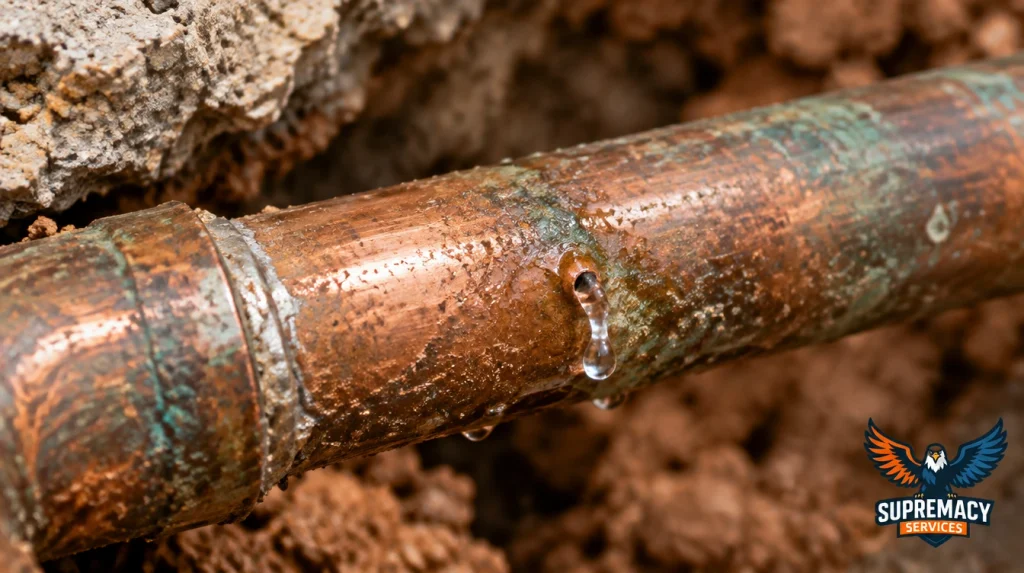
Coverage for opening concrete should not be assumed to include all plumbing work or foundation restoration. Ask the insurer to identify the relevant policy provision.

Repairing foundation damage

Foundation damage can be a separate coverage issue. A foundation endorsement may affect eligibility, but it is not an automatic guarantee of payment for settlement, cracking, or structural repair.

A plumber can identify a plumbing leak, while a qualified foundation or structural professional may be needed to assess structural movement.

What Are the Warning Signs of a Slab Leak?

Supremacy Services plumbing technician using acoustic leak detection equipment to investigate a hidden water leak beneath residential flooring.
Professional acoustic leak detection helps plumbers locate concealed water leaks before determining the appropriate repair method.

A slab leak may cause unexplained water use, warm flooring, damp areas, or changes in water pressure. None of these symptoms alone confirms an under-slab pipe failure.

Common warning signs include:

  • A water bill that rises without an obvious change in usage.
  • A water meter that indicates flow when all water fixtures are off.
  • Warm or damp patches on floors.
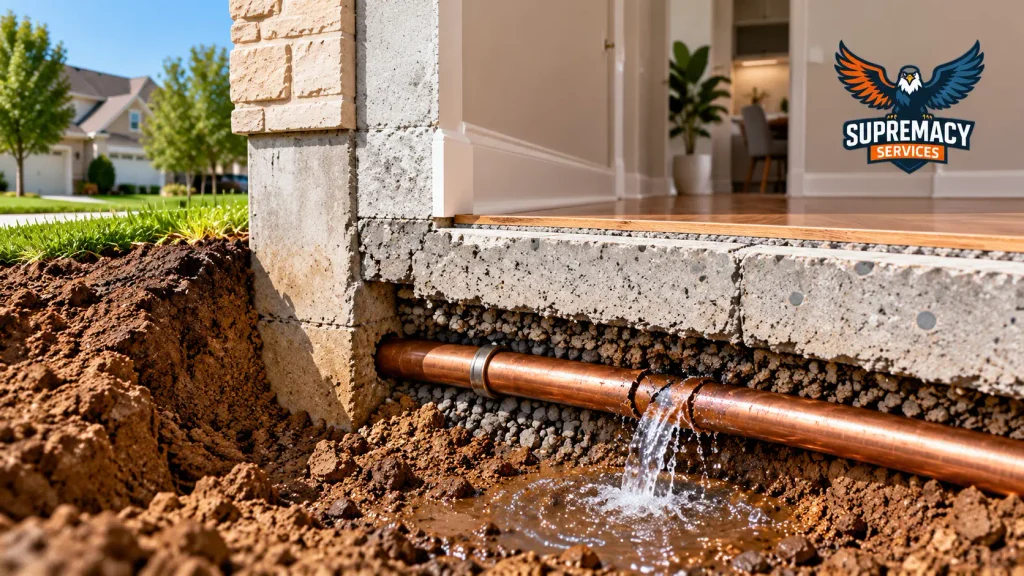
  • Unexplained moisture near baseboards.
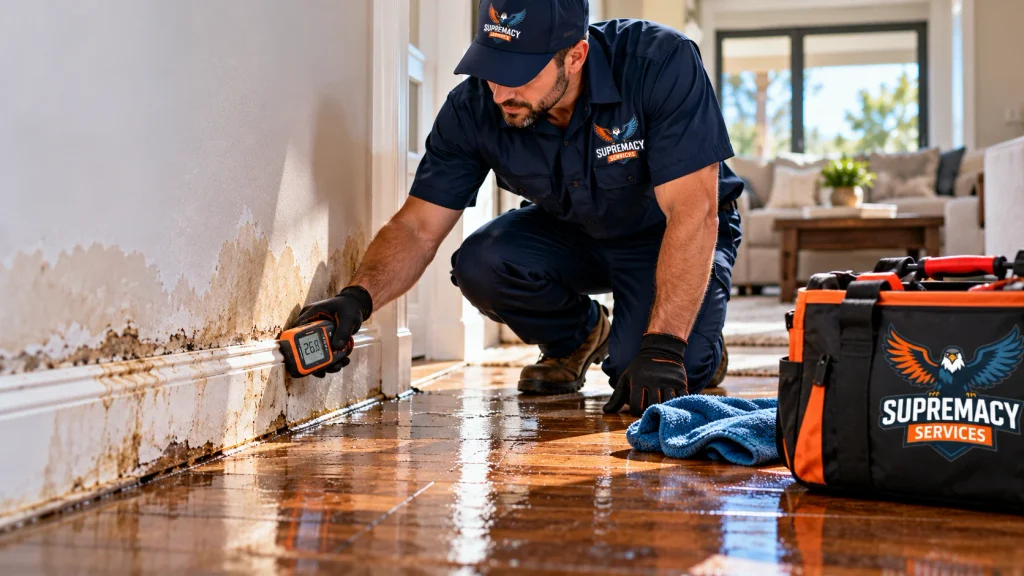
  • Reduced water pressure.
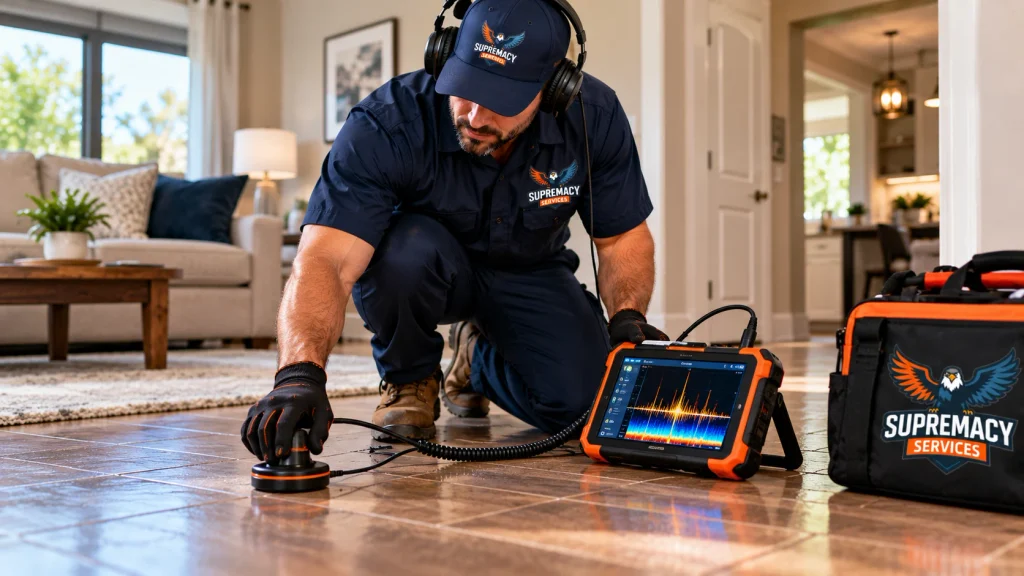
  • Sounds of running water when fixtures are closed.
  • Musty odors or recurring moisture problems.
  • New cracks or movement that may warrant a separate structural assessment.

Is it a slab leak or an underground water line leak?

A slab leak generally involves plumbing beneath or within the foundation. An underground service-line leak may occur outside the home between the meter and the building.

Both can increase water usage, but they may require different detection and repair approaches.

A professional plumber can test the plumbing system and help distinguish these conditions.

How Do You File a Slab Leak Insurance Claim in Texas?

Dallas homeowner reviewing homeowners insurance documents and water damage photographs with a Supremacy Services representative.
Plumbing reports, photographs, repair estimates, and insurance documents can help homeowners prepare a slab leak claim.

Start by limiting further damage, documenting what happened, and contacting your insurer. Professional leak detection can help establish the location and condition of the plumbing, but the insurance company determines coverage.

Step 1: Stop the water if it is safe

Shut off the appropriate water supply when an active leak is suspected. Avoid electrical hazards and arrange urgent help when necessary.

Step 2: Photograph and document the damage

Record visible moisture, damaged flooring, water meter readings, dates, and unusual water bills before cleanup or repair changes the scene.

Step 3: Contact your insurance company promptly

Ask how to report the loss, whether emergency mitigation is authorized, and whether the insurer wants to inspect the property before permanent repairs.

Step 4: Arrange professional leak detection

Request a written assessment documenting the leak location, relevant test findings, and recommended repair options. Avoid asking the plumber to speculate about insurance coverage.

Step 5: Obtain an itemized repair estimate

Separate diagnostic charges, pipe repair, concrete access, restoration, and any additional work so the insurer can evaluate the expenses individually.

Step 6: Review the claim decision

Compare the insurer’s explanation with your policy, endorsements, deductible, and estimate. Request written clarification of any denied or limited items.

Do not delay necessary emergency measures simply to preserve evidence. Take reasonable steps to prevent additional damage, keep receipts, and retain replaced materials where practical and safe until the insurer advises otherwise.

TDI emphasizes the importance of protecting the property after sudden water damage.

What documents should homeowners keep?

Slab leak claim documentation checklist

0 of 7Photos and videos of visible damageWater bills and relevant meter readingsPlumber’s written diagnostic findingsItemized repair estimates and invoicesReceipts for emergency mitigationInsurance policy and endorsementsClaim number and adjuster correspondence

Copy checklist

Concerned about the location or extent of a hidden leak? Schedule a Supremacy Services leak-detection assessment before choosing between a localized repair and a larger plumbing project.

How Much Does a Slab Leak Cost If Insurance Does Not Cover It?

Out-of-pocket costs depend on the pipe location, extent of damage, repair method, accessibility, and restoration requirements.

Without an on-site diagnosis, a precise Dallas slab leak repair price would be unreliable.

The main expenses may include:

Cost componentWhat affects the expense
Leak detectionTesting requirements and difficulty locating the leak
Localized pipe repairPipe material, access, and extent of failure
Concrete accessSlab thickness, location, and required opening
Pipe reroutingLength, routing complexity, and wall or ceiling access
Water mitigationAmount of water, affected materials, and drying needs
Floor restorationFlooring type and area requiring replacement
Structural assessmentEvidence of settlement or foundation movement

Example: How an insurance deductible affects payment

This illustration is not a Dallas repair-price estimate. It shows how an approved claim might work.

Illustrative claim calculator

Example onlyApproved covered damage

$8,000Policy deductible

$2,500Excluded repair expenses

$1,500

Illustrative insurer payment

$5,500

Illustrative homeowner share

$4,000

This simplified example excludes depreciation, limits, coinsurance, other policy adjustments, and additional expenses. Actual claim settlement may differ.

Before accepting a repair estimate, request a breakdown of covered damage, potentially excluded plumbing work, and restoration costs.

Why Do Dallas and North Texas Homeowners Need to Pay Attention to Slab Leaks?

Dallas-area homes may experience plumbing and foundation concerns influenced by soil conditions, construction characteristics, seasonal moisture changes, and the age or condition of the piping.

Expansive clay soils

Parts of North Texas contain clay-rich soils that expand or contract as moisture conditions change. Soil movement can affect foundations and buried infrastructure, although a particular slab leak cannot be attributed to soil movement without an appropriate investigation.

Concrete slab construction

When water pipes run beneath a concrete foundation, locating and accessing a failure may be more complicated than repairing an exposed pipe.

Hot-water supply lines

A warm floor can sometimes indicate leakage from a hot-water line beneath the slab. However, other conditions can produce warm flooring, so professional testing is necessary.

Dallas, Plano, Frisco, and surrounding communities

The appropriate repair method depends on the individual home and plumbing configuration, not simply its city or ZIP code.

Homeowners should also verify any applicable permit or inspection requirements with their local jurisdiction before significant plumbing alterations.

How Do Professional Plumbers Detect and Repair Slab Leaks?

Supremacy Services plumber repairing copper water supply piping through an opened concrete floor inside a residential property.
Slab leak repair may require accessing damaged pipes beneath concrete, depending on the leak location and plumbing condition.

Professional slab leak detection generally combines plumbing-system testing with methods intended to narrow down the leak location before opening walls or concrete.

Depending on the situation, a plumber may use pressure testing, acoustic equipment, thermal imaging, or other diagnostic techniques.

Supremacy Services describes acoustic detection and infrared thermography among its leak-location methods.

Supremacy Services

Common repair options

Repair methodWhen it may be considered
Localized pipe repairA single accessible failure in otherwise serviceable piping
Pipe reroutingWhen bypassing a damaged under-slab section is practical
Partial repipingWhen several sections have deteriorated
Larger system replacementWhen the existing plumbing has widespread defects

The least invasive repair is not automatically the best long-term solution. Pipe condition, access, material compatibility, and the likelihood of additional failures all matter.

Can you repair a slab leak yourself?

Homeowners can safely document visible conditions, check their water meter, and shut off the water supply when appropriate.

Opening a foundation, diagnosing concealed plumbing, or repairing pressurized pipes should be handled by qualified professionals. Incorrect work can create additional leaks, damage the property, or complicate insurance documentation.

How Can Homeowners Reduce the Risk of Future Slab Leaks?

Not every slab leak can be prevented, but regular plumbing attention can reduce the likelihood that hidden problems go unnoticed.

Check water bills for unexplained increases, investigate recurring damp areas, address abnormal water pressure, and avoid ignoring sounds of running water when fixtures are closed.

If a plumber identifies widespread pipe deterioration, ask whether repairing one leak or replacing a larger section offers better long-term value.

For homes with a previous under-slab leak, keeping diagnostic reports and repair records can also make future troubleshooting easier.


Frequently Asked Questions

1. Does State Farm or another Texas insurer cover slab leaks?

Coverage depends on the particular policy and endorsements, not just the insurance company’s name. Ask the insurer whether resulting water damage, pipe access, foundation damage, and pipe replacement are covered separately.

2. Does homeowners insurance cover a slab leak caused by old pipes?

The cost of replacing an old, deteriorated pipe is commonly excluded. Coverage for resulting water damage must be evaluated separately under the policy.

3. Will insurance pay to break concrete to repair a slab leak?

Possibly. Some policies contain access or tear-out provisions, but their scope varies. Ask the insurer whether opening and restoring the concrete qualifies under your policy.

4. Does insurance cover slab leak detection in Texas?

Sometimes. Diagnostic expenses may be considered in connection with a covered loss, but reimbursement is not automatic. Check with the insurer before extensive testing when practical.

5. Can a hidden slab leak be covered if it went unnoticed for months?

A hidden leak is not automatically covered or excluded based solely on when it was discovered. The insurer will consider the policy’s provisions concerning sudden damage, repeated seepage, and reporting requirements.

6. Does homeowners insurance cover foundation cracks caused by plumbing leaks?

It may, depending on the cause and the policy. Foundation or slab endorsements can be important, and structural damage may require a separate professional assessment.

7. Should I call a plumber or my insurance company first?

If water is actively escaping, take safe steps to stop the leak and prevent additional damage. Contact the insurer promptly and arrange professional plumbing help as needed. Do not postpone emergency mitigation while waiting for an adjuster.

8. Will filing a slab leak claim increase my insurance premium?

A claim may affect future premiums or renewal decisions, but the effect depends on the insurer, claims history, and other rating factors. Ask your insurance agent about potential implications.

9. What if my slab leak insurance claim is denied?

Request the insurer’s written explanation and the policy provisions supporting its decision. Provide any missing documentation and ask about reconsideration or available complaint and dispute procedures.

Final Thoughts: Confirm the Leak Before Choosing a Repair

Homeowners insurance may help with certain slab leak expenses in Texas, especially when a covered sudden and accidental event causes water damage. But coverage for the failed pipe, concrete access, foundation damage, and restoration can differ significantly.

For Dallas homeowners, the best next step is to identify the leak accurately, limit further damage, preserve documentation, and review the actual policy before assuming insurance will pay.

Suspect a slab leak beneath your Dallas-area home? Contact Supremacy Services for professional water leak detection or call 945-777-3345 to discuss diagnostic options and the next appropriate plumbing repair.

Supremacy Services can assess plumbing conditions and provide repair information; insurance coverage decisions remain with the insurer.

Cutaway illustration showing a slab leak beneath a home's concrete foundation and an underground water line leak in the yard.

Slab Leak vs. Underground Water Line Leak: How to Tell the Difference

A slab leak vs. underground water line leak can be difficult to distinguish because both problems may cause rising water bills, reduced water pressure, and moisture around your home. The biggest difference is where the damaged pipe is located.

A slab leak occurs in plumbing beneath or within a home’s concrete foundation. An underground water line leak generally refers to a damaged buried water supply pipe outside the home’s foundation, often between the water meter and the house.

For Dallas homeowners, the location of unexplained moisture provides an important clue. Warm flooring, damp interior surfaces, and moisture near the foundation may suggest a slab leak. Persistent wet spots in the yard, unusually green grass, or saturated soil along the service-line route may point toward an underground water line leak.

However, neither set of symptoms confirms the source. Water can travel through soil and building materials before becoming visible. A professional inspection may be necessary to distinguish between the two.

Table of Contents

  1. What Is the Difference Between a Slab Leak and an Underground Water Line Leak?
  2. What Are the Warning Signs of a Slab Leak?
  3. What Are the Signs of an Underground Water Line Leak?
  4. How Can You Tell Which Type of Leak You Have?
  5. What Causes These Underground Plumbing Leaks?
  6. How Do Plumbers Find Hidden Water Leaks?
  7. Slab Leak vs. Water Line Leak Repair Options
  8. Which Type of Leak Costs More to Repair?
  9. Why Dallas Soil and Foundations Matter
  10. What Other Plumbing Problems Look Similar?
  11. When Should You Call a Professional?
  12. How Can You Reduce the Risk of Hidden Leaks?
  13. Frequently Asked Questions

What Is the Difference Between a Slab Leak and an Underground Water Line Leak?

The main difference is location: a slab leak affects plumbing beneath or within the concrete foundation, while an underground water line leak affects buried piping outside the foundation.

Both can involve pressurized drinking-water pipes, and both can waste water without producing an obvious indoor puddle.

What is a slab leak?

A slab leak occurs when a water supply pipe beneath or embedded within a concrete slab foundation develops a leak.

In slab-on-grade homes, plumbing may run beneath the concrete floor before supplying bathrooms, kitchens, laundry rooms, and other fixtures.

When a pipe leaks, water can migrate through the surrounding soil, collect beneath flooring, or appear around the foundation perimeter.

Potential consequences include damaged flooring, persistent indoor moisture, and changes in soil moisture beneath the foundation.

What is an underground water line leak?

An underground water line leak occurs when a buried water supply pipe outside the home’s foundation becomes damaged.

One common location is the private service line connecting the water meter to the house.

These pipes may pass beneath lawns, landscaping, driveways, or walkways.

Depending on the location and severity, leaking water may saturate the surrounding soil, reduce available water pressure, or emerge at the surface.

Slab leak vs. underground water line leak: comparison table

FeatureSlab leakUnderground water line leak
Typical locationBeneath or within concrete foundationBuried pipe outside foundation
Common visible clueDamp flooring or moisture near interior wallsPersistent wet yard or soil
Warm floorPossible with hot-water slab leakGenerally not characteristic
Water bill increasePossiblePossible
Reduced water pressurePossiblePossible
Foundation moisturePossiblePossible, particularly near the house
DetectionPressure testing, acoustic methods, targeted diagnosticsMeter testing, isolation tests, acoustic locating
Typical repair accessFloor access or reroutingExcavation or suitable trenchless methods
Main concernInterior damage and foundation-area moistureUnderground water loss and landscape damage

Important: These are diagnostic clues, not definitive tests. A leaking service line can saturate soil near the foundation, while a slab leak can produce water outside the house.

What Are the Warning Signs of a Slab Leak?

Common slab leak warning signs include unexplained moisture on floors, warm spots, persistent sounds of running water, unexpected water consumption, and dampness near the foundation.

The symptoms depend on whether the damaged pipe carries hot or cold water and how water moves beneath the slab.

1. Warm spots on the floor

Damp tile flooring and moisture damage near a baseboard indicating a possible slab leak beneath a home's concrete foundation.
Persistent damp flooring, moisture near baseboards, and unexplained warm spots can indicate a hidden slab leak.

A localized warm area on tile or other flooring may indicate hot water escaping from a pipe beneath the slab.

This clue is more useful when the warmth persists without a known heating source.

However, warm flooring alone does not confirm a leak.

2. Damp carpet, tile, or flooring

Water moving upward or along the slab can affect floor coverings.

Possible signs include:

  • Persistent damp patches
  • Flooring that begins to lift or separate
  • Discoloration near baseboards
  • Moisture returning after cleaning and drying

Condensation, appliance leaks, and exterior water intrusion can produce similar symptoms.

3. Sounds of running water when fixtures are off

A pressurized pipe leak may produce a faint hissing or rushing sound.

If you hear water movement when no plumbing fixtures or appliances are operating, investigate further.

Sound alone cannot identify the exact pipe location.

4. Unexplained increases in water bills

A continuous slab leak may cause metered water use to increase even when household habits have not changed.

The U.S. Environmental Protection Agency recommends comparing water bills and checking the water meter during periods of no water use to identify possible leak

5. Moisture near interior walls or the foundation

Moisture may appear near baseboards, floor joints, or foundation edges.

Because water can move along the path of least resistance, the visible damp area may be some distance from the damaged pipe.

6. Foundation-related changes

Persistent water leakage beneath a slab can alter soil moisture conditions.

However, cracks, sticking doors, and uneven floors have many possible causes. They should not automatically be attributed to a plumbing leak.

A plumber can investigate the water system, while a qualified foundation professional may be appropriate if structural movement is suspected.

If you are seeing unexplained floor moisture or suspect a hidden plumbing leak, Supremacy Services offers professional water leak detection in Dallas and DFW to help identify the source before unnecessary demolition.

What Are the Signs of an Underground Water Line Leak?

The most recognizable signs of an underground water line leak are persistent wet patches outside, unexplained water use, and pressure problems affecting multiple fixtures.

Because the damaged pipe is buried, some leaks remain unnoticed until water reaches the surface or consumption increases.

1. A wet patch in the yard that will not dry

Wet grass and a muddy patch in a residential front yard showing possible signs of a leaking underground water supply pipe.
Persistent wet patches, soggy soil, and unusually green grass may indicate a leaking underground water line.

A continuously damp area may indicate that a buried pipe is leaking.

Check whether the moisture remains after several dry days and when irrigation has been turned off.

A single wet patch is not conclusive because drainage and irrigation problems can create similar conditions.

2. Unusually green or fast-growing grass

Grass above a leaking pipe may receive additional moisture and grow differently from the surrounding lawn.

However, variations in shade, fertilizer, irrigation coverage, and soil composition can produce the same appearance.

3. Reduced water pressure throughout the house

A substantial leak in the incoming service line can reduce the pressure or flow available to household fixtures.

If multiple fixtures are affected, the main water supply deserves investigation.

Other possibilities include municipal supply problems, partially closed valves, pressure regulators, or restrictions in the piping.

4. Water collecting near a driveway or walkway

Buried service lines sometimes pass beneath paved surfaces.

Water emerging along pavement joints or pooling beside a driveway may indicate a nearby underground leak.

Do not assume the visible exit point identifies the damaged pipe.

5. A water meter that registers usage when everything is off

Unexpected meter movement can indicate water escaping somewhere downstream of the meter.

The next step is determining whether the water loss occurs inside the house, in the buried service line, or in another connected system.

6. Soil erosion or localized ground settlement

A persistent underground leak can move soil particles or alter soil conditions.

Unusual depressions, washouts, or persistent soft ground deserve prompt investigation, particularly near foundations or paved surfaces.

How Can You Tell Which Type of Leak You Have?

Start by checking the water meter, ruling out obvious fixture leaks, and comparing indoor moisture with outdoor conditions. A controlled shutoff test may then help narrow the problem to the house or the incoming service line.

Quick homeowner leak-location guide

Unexplained water use or moisture?

Turn off all fixtures, appliances, and irrigation

Check the water meter

Is consumption still being registered?

No

No continuous flow detected

Check intermittent leaks, irrigation, drainage, and other moisture sources.

Yes

Possible metered leak

A plumber can isolate the house from the service line and test each section.

Leak on house side

Inspect fixtures, in-wall pipes, and under-slab plumbing.

Leak on supply side

Investigate the buried service line and connected branches.

Conceptual diagnostic guide only. Valve arrangements differ, and meter behavior cannot pinpoint a slab leak by itself.

Step 1: Turn off all water-using fixtures

Make sure faucets, showers, toilets, washing machines, dishwashers, and irrigation systems are not actively using water.

Remember that automatic ice makers, water softeners, and other equipment may operate without someone turning on a faucet.

Step 2: Check the water meter

Professional plumber using acoustic leak detection equipment on a tiled floor to investigate a suspected hidden water leak beneath a concrete slab.
Professional acoustic equipment can help locate suspected hidden plumbing leaks before unnecessary excavation or concrete removal.

Find your meter and observe its reading or leak indicator.

Record the reading, avoid using water, and check it again after an appropriate interval.

The EPA describes a two-hour no-use meter comparison as a practical way to identify possible household leaks.

If the reading changes, there may be a leak or another source of unaccounted-for water use.

Step 3: Check for common fixture leaks

Before assuming the problem is underground, inspect:

  • Toilets that refill without being flushed
  • Dripping faucets and outdoor hose bibbs
  • Water heater connections
  • Washing machine hoses
  • Irrigation valves and sprinkler heads

A leaking toilet can waste water continuously without creating a visible puddle.

Step 4: Compare indoor and outdoor clues

Look for damp floors, warm flooring, or moisture near interior walls.

Then inspect the yard, driveway, and visible service-line route.

Record where the moisture appears and whether it changes after irrigation or rainfall.

Step 5: Consider a controlled shutoff test

If your home has an accessible, clearly identified private main shutoff valve, a plumber can use it to isolate the house from the incoming supply line.

For example, if the valve isolates the house plumbing but the meter still registers flow, the leak may be between the meter and that valve or on another branch that remains supplied.

If the meter stops registering flow, the problem may be downstream of the valve.

This test depends on the plumbing layout. Some valves do not isolate irrigation systems, exterior branches, or all household piping. A closed valve also does not establish that a leak is specifically beneath the slab.

Do not force a seized valve or operate utility-owned equipment.

What Causes Slab Leaks and Underground Water Line Leaks?

Both types of leaks can result from pipe deterioration, movement, damaged connections, or external forces. The most likely cause depends on the pipe material, age, installation, surrounding conditions, and location.

Common causes of slab leaks

Pipe corrosion: Certain metallic pipes may deteriorate over time, depending on water chemistry, material, and installation conditions.

Pipe movement or abrasion: Movement and contact with surrounding materials can contribute to damage at vulnerable points.

Installation defects: Poor connections, inadequate protection, or improperly supported piping can create future problems.

Pressure-related stress: Excessive or fluctuating pressure may increase stress on pipes and fittings.

Common causes of underground service-line leaks

Aging materials: Pipes and fittings can deteriorate over their service lives.

Soil movement: Changing soil conditions may stress buried piping, particularly at joints or transitions.

Tree roots: Roots can exploit existing weaknesses and may contribute to damage or displacement in some situations.

Excavation damage: Landscaping, fencing, and construction work can accidentally damage buried lines.

Freezing conditions: Although North Texas has hot summers, winter freezes can still threaten inadequately protected plumbing.

The EPA identifies corrosion, aging piping, cold temperatures, irregular pressure, and installation problems among factors associated with household leaks.

How Do Plumbers Find Hidden Water Leaks Without Unnecessary Digging?

Professional leak detection uses testing and diagnostic equipment to narrow down the leaking section before deciding whether excavation or concrete access is necessary.

Water meter and isolation testing

The plumber determines whether the plumbing system is losing water and isolates sections where possible.

This can help distinguish a leaking service line from a leak in the home’s interior plumbing.

Pressure testing

A controlled pressure test can help determine whether an isolated section of piping is holding pressure.

A pressure loss suggests leakage, but further testing is required to establish the exact location.

The EPA’s WaterSense technical guidance includes pressure-loss testing as a method for checking water supply systems.

Acoustic leak detection

Specialized listening equipment can help identify sounds generated by water escaping from pressurized pipes.

Results depend on factors such as pipe material, leak size, water pressure, and surrounding noise.

Thermal imaging

Thermal imaging may help identify temperature differences associated with hot-water leaks.

It does not see through concrete or directly photograph the damaged pipe. The thermal pattern must be interpreted alongside other evidence.

Targeted excavation or concrete access

When diagnostic testing identifies a likely location, a plumber can recommend a targeted access method.

Not every leak can be located or repaired without disturbing concrete, soil, or finishes.

Not sure whether the problem is beneath your foundation or outside in the yard? Schedule hidden water leak detection with Supremacy Services before choosing a repair method.

Slab Leak vs. Water Line Leak Repair Options

The best repair method depends on the pipe’s condition, location, accessibility, and whether the damage is isolated or part of a larger deterioration problem.

Side-by-side comparison of a plumber repairing a pipe beneath a concrete floor and another repairing an underground water supply line in an excavated yard.
Slab leaks may require access through flooring or pipe rerouting, while underground water line repairs often involve excavation or suitable trenchless methods.

How are slab leaks repaired?

Localized pipe repair: A plumber accesses the damaged section and repairs or replaces it where appropriate. This may require opening part of the floor.

Pipe rerouting: A new supply line may be routed through an accessible wall, ceiling, or other approved pathway, avoiding the damaged under-slab section.

Partial or larger-scale repiping: When several sections are deteriorating, replacing more of the affected plumbing may be preferable to repeated spot repairs.

The choice should account for pipe condition, building layout, restoration work, and applicable plumbing requirements.

How are underground water line leaks repaired?

Spot repair: A localized defect may be repaired by excavating and replacing a short section of pipe.

Traditional replacement: The damaged line is exposed and replaced along the required route.

Trenchless replacement: Where site conditions and pipe configuration permit, methods such as pipe bursting or directional boring may reduce the amount of open trenching.

Trenchless work is not necessarily excavation-free. Entry and exit pits or other access points may still be required.

Supremacy Services describes traditional and trenchless approaches on its Dallas water line repair and replacement page.

Which repair option is better?

SituationRepair approach to evaluate
One accessible damaged sectionLocalized repair
Isolated under-slab leakTargeted access or rerouting
Repeated leaks in deteriorating pipesPartial or broader repiping
Long buried service line with multiple defectsService-line replacement
Water line beneath landscaping or pavementTrenchless feasibility assessment
Uncertain leak locationDiagnostic testing before repair

Avoid choosing a repair method based solely on a damp patch or an estimate made without locating the problem.

Which Costs More to Repair: a Slab Leak or an Underground Water Line Leak?

Neither type is automatically more expensive. Slab leak repairs may require flooring removal and restoration, while underground water line repairs may involve excavation, long pipe runs, landscaping, or pavement restoration.

The total cost depends more on the required work than the name of the leak.

Cost factorSlab leakUnderground water line leak
Leak detectionTesting beneath or around slabTesting buried service line
Access workConcrete or alternative reroutingExcavation or access pits
Pipe replacementLocalized repair or reroutingSpot repair or longer replacement
RestorationFlooring and interior finishesLandscaping, concrete, or pavement
ComplexityBuilding layout and pipe accessibilityDepth, length, utilities, obstructions

Why exact pricing requires an inspection

A small, accessible outdoor leak may be relatively straightforward to repair. A damaged service line beneath a driveway can require much more work.

Likewise, rerouting an accessible under-slab supply pipe may be less disruptive than removing and restoring extensive finished flooring.

For that reason, homeowners should request a written estimate that identifies the diagnosed defect, proposed repair method, access work, restoration responsibilities, and applicable warranties.

No unverified Dallas-specific price range is included here. Actual costs should be based on a current local quote rather than a generalized national average.

Why Dallas Soil and Foundations Matter When Investigating Water Leaks

Dallas-area homes can experience changing soil moisture conditions due to rainfall, dry periods, irrigation, and plumbing leaks.

Some North Texas soils contain expansive clays that change volume as moisture conditions change. This makes water management around foundations especially important.

A buried pipe leak can introduce water into soil that would otherwise remain relatively dry. A slab leak can create a similar localized moisture problem beneath the building.

However, a foundation crack does not prove that a slab leak exists. Structural movement can result from several factors, and the plumbing system should be tested before assigning the cause.

What should Dallas homeowners pay attention to?

  • Persistent moisture near a slab foundation during dry weather
  • Irrigation patterns that keep one area unusually wet
  • Water emerging along a driveway or foundation edge
  • New flooring moisture without an obvious indoor source
  • Water use that increases without corresponding household activity

These concerns apply across Dallas and surrounding communities such as Plano, Frisco, Richardson, Allen, McKinney, and Fort Worth, although soil conditions and plumbing layouts vary by property.

What if the leak is near the water meter?

If the problem appears to involve a municipal water main, meter, or utility-owned connection, contact the appropriate water utility.

Dallas Water Utilities provides emergency assistance for water main breaks, meter leaks, and emergency water shutoffs through Dallas 311.

The exact boundary between utility and customer responsibility should be verified with the local provider rather than assumed.

For City of Dallas water customers, a qualifying repaired leak may also be eligible for a billing adjustment. Eligibility is subject to review and is not guaranteed.

What Other Plumbing Problems Can Look Like a Slab or Underground Water Line Leak?

Several issues can produce symptoms similar to a hidden water supply leak.

Sewer line leaks

A damaged sewer pipe can cause damp soil, wastewater odors, slow drains, or recurring backups.

Unlike a pressurized supply-line leak, a gravity sewer leak may not cause continuous movement at the drinking-water meter.

Homeowners experiencing multiple drainage problems should consider sewer line inspection and repair.

Irrigation system leaks

Broken sprinkler pipes or malfunctioning valves can produce wet patches and unexplained water use.

An irrigation system connected downstream of the water meter may register water consumption even when household faucets are off.

HVAC condensate leaks

Air-conditioning systems remove moisture from indoor air.

Blocked condensate drains or leaking drain pans can create water near walls, closets, or mechanical equipment.

This can be mistaken for plumbing moisture.

Roof and exterior drainage problems

Rainwater entering through roofing, windows, exterior walls, or poor drainage can create damp floors and foundation-area moisture.

These problems may be especially noticeable after storms.

Leaking toilets and appliances

A toilet that runs intermittently, a refrigerator water connection, or a water heater leak may explain high water use without any damaged underground pipe.

Checking these possibilities first can prevent unnecessary excavation.

When Should You Call a Professional Plumber?

Call a plumber when you have evidence of unexplained water consumption, recurring moisture, or pressure problems that cannot be explained by visible fixtures or irrigation.

Prompt attention is particularly important when water is entering living spaces or collecting near the foundation. Supremacy services.

Warning signs that justify prompt service

  • Water continues registering at the meter when no known equipment is using it.
  • Flooring remains wet or begins to lift.
  • Water is pooling near the foundation or beneath pavement.
  • Multiple fixtures suddenly lose pressure.
  • A suspected leak is causing active property damage.
  • You cannot safely isolate the water supply.

If water is actively entering the house, use a safe, accessible private shutoff valve if you know how to operate it. Keep away from wet electrical equipment and obtain urgent assistance when necessary.

What should homeowners expect during professional service?

A systematic inspection generally involves:

  1. Reviewing the symptoms and water-use history.
  2. Inspecting accessible plumbing and irrigation connections.
  3. Testing or isolating sections of the supply system.
  4. Using appropriate leak-location equipment.
  5. Explaining the likely defect and diagnostic confidence.
  6. Comparing suitable repair methods.
  7. Providing a written scope and estimate.
  8. Testing the repaired system and documenting the results.

Ask whether the quoted price includes leak detection, excavation, restoration, testing, and any required permits.

How Can You Reduce the Risk of Hidden Water Leaks?

Not every underground leak is preventable, but regular monitoring and timely repairs can reduce the chance that a developing problem goes unnoticed.

Practical homeowner prevention checklist

Home water-leak prevention

0 of 8 completedReview water bills for unexplained changesLocate and identify the private main shutoff valveInspect toilets, faucets, hoses, and water heater connectionsCheck the yard for persistent wet spotsInspect irrigation systems for damaged heads or valvesConsider a water leak monitoring deviceHave recurring pressure or moisture problems investigatedKeep records of plumbing repairs and pipe replacements

Copy checklist

The EPA recommends routine fixture checks, bill monitoring, and leak detection or flow-monitoring devices as ways to reduce water waste and damage.


Frequently Asked Questions

1. Can a slab leak cause water to appear in the yard?

Yes. Water escaping beneath a slab can migrate through surrounding soil and emerge near the foundation or elsewhere outside. The visible wet area may not be directly above the damaged pipe.

2. Can an underground water line leak damage a foundation?

Yes. A leaking buried pipe near the house can change soil moisture conditions and potentially contribute to foundation-related problems. The extent of risk depends on soil, drainage, leak severity, and foundation conditions.

3. Does a high water bill mean I have a slab leak?

No. High water use can result from toilets, irrigation systems, appliances, underground service lines, or slab leaks. A meter test and systematic inspection can help identify the cause.

4. Can a plumber detect a slab leak without breaking concrete?

Often, plumbers can investigate a suspected slab leak using pressure testing, acoustic equipment, and other diagnostic methods before opening concrete. Some repairs still require physical access.

5. Is a wet yard always a sign of a broken underground water line?

No. Irrigation leaks, drainage problems, sewer defects, and recent rainfall can all cause wet soil. A water meter check and inspection help distinguish the possibilities.

6. Can a slab leak affect water pressure?

Yes. A sufficiently large leak in a pressurized supply pipe can reduce available pressure or flow. Smaller leaks may produce little noticeable change.

7. How do I know whether the leak is between the meter and my house?

A plumber can use meter readings and correctly positioned isolation valves to test the incoming service line separately from the house plumbing. The result depends on the property’s actual pipe and valve arrangement.

8. Is it better to repair or replace an underground water line?

A localized repair may be appropriate for an otherwise sound pipe. Replacement may be preferable when the line is deteriorating, has repeated failures, or contains extensive damage.

9. Should I turn off my water if I suspect a slab leak?

If there is active flooding or significant water loss, shutting off the supply at a safe, accessible private valve can help limit damage. For an uncertain or minor leak, contact a plumber promptly for guidance.

10. Can a slab leak and an underground water line leak happen at the same time?

Yes. A property can have more than one plumbing defect. If symptoms remain after one leak is repaired, further testing may be necessary.

Professional Leak Detection for Dallas and DFW Homeowners

When water is disappearing somewhere beneath your property, identifying the correct pipe matters more than guessing which repair will be necessary.

A slab leak and an underground water line leak can share many symptoms, but the access methods, repair options, and restoration requirements may be very different.

Supremacy Services provides plumbing and leak detection services throughout Dallas and the DFW Metroplex.

If you have unexplained water consumption, damp flooring, or persistent moisture around your foundation or yard, arrange a professional inspection before the problem causes further damage.

Schedule water leak detection with Supremacy Services

Cross-section of a Dallas home showing a leaking copper water pipe beneath the concrete slab foundation

How Long Can a Slab Leak Go Undetected?

Ever wonder how long can a slab leak go undetected! A slab leak can go undetected for weeks, months, or sometimes longer, depending on the size of the leak, where the damaged pipe is located, and how quickly warning signs become visible.

For Dallas homeowners, the challenge is that water leaking beneath a concrete foundation does not always appear on the floor. It may seep into the surrounding soil, travel along hidden pathways, or gradually affect flooring and building materials before anyone notices.

A small leak can remain hidden while continuously wasting water. A larger leak may reveal itself much sooner through unexpected water bills, warm flooring, damp spots, or a sudden loss of water pressure.

There is no guaranteed safe period for leaving a slab leak untreated. If you suspect a leak beneath your foundation, early investigation is the best way to limit unnecessary water loss and potential property damage.

Table of Contents

  1. How long can a slab leak remain hidden?
  2. Why do some slab leaks go unnoticed?
  3. What are the earliest warning signs?
  4. What happens when a slab leak is ignored?
  5. How much water can a hidden slab leak waste?
  6. How can you check for a possible slab leak?
  7. How do plumbers find hidden slab leaks?
  8. What causes slab leaks in Dallas homes?
  9. Can other plumbing problems look like slab leaks?
  10. What should you do if you suspect a leak?
  11. How can homeowners reduce their risk?
  12. Frequently asked questions

How Long Can a Slab Leak Remain Hidden?

A slab leak may remain unnoticed for a considerable period because the damaged pipe is concealed beneath the home’s concrete foundation.

The length of time depends on the leak’s flow rate, soil conditions, plumbing layout, and whether the homeowner regularly monitors water consumption.

There is no reliable universal detection timeline. The following examples describe possible patterns, not established averages.

Possible periodWhat a homeowner might notice
First hours or daysA major leak may cause a rapid pressure drop, audible running water, or visible moisture
Days to weeksAn ongoing leak may begin affecting water consumption or nearby materials
Weeks to monthsA smaller hidden leak may be discovered through recurring moisture, warm flooring, or unexplained utility bills
Several months or longerSome concealed leaks may remain unnoticed where water escapes into surrounding soil without obvious interior symptoms

A leak’s age cannot be accurately determined from symptoms alone. Even professional testing may establish where a leak is located without revealing exactly when it began.

Can a slab leak go undetected for months?

Yes. A slow leak beneath a foundation can remain unnoticed for months, particularly when the water escapes into the soil instead of reaching visible flooring.

However, the absence of visible water does not mean the leak is harmless.

The U.S. Environmental Protection Agency explains that undetected household leaks can waste substantial amounts of water and may damage homes.

Can a slab leak remain hidden for years?

It is possible for a small concealed leak to persist for a very long time, but there is no dependable timeframe that applies to every home.

Pipe deterioration, changes in water pressure, or additional movement around the pipe can also cause an existing leak to worsen.

Homeowners should not assume a leak is minor simply because they have not noticed significant damage.

Why Do Some Slab Leaks Go Unnoticed?

Underground copper water pipe leaking into clay soil beneath a concrete slab without visible water on the floor.
Water from a slow slab leak may spread through the soil beneath a foundation before homeowners notice surface damage.

A slab leak occurs when a water supply pipe running beneath or within a concrete foundation develops a leak.

Unlike an exposed pipe beneath a sink, a leaking underground line may have no obvious visible outlet.

1. Water escapes into the soil

Water can spread into soil beneath or beside the foundation instead of immediately appearing indoors.

The soil’s composition, moisture content, drainage conditions, and the leak’s location influence where the water travels.

2. Small leaks may not noticeably reduce water pressure

A minor opening in a pressurized pipe may release water continuously without creating a pressure change that the homeowner can easily detect.

A normal-feeling shower does not rule out a hidden plumbing leak.

3. Flooring can conceal moisture

Tile, vinyl, carpet, and other flooring materials may conceal early moisture problems.

Some flooring materials may show discoloration, separation, or damage only after prolonged exposure.

4. Homeowners may overlook gradual changes in water bills

A slow increase in water consumption can be mistaken for seasonal usage, irrigation, guests, or ordinary household changes.

Comparing bills with the same period in previous years can help reveal unusual patterns.

5. Symptoms may resemble other household problems

Musty odors, flooring changes, and interior cracks can have several causes.

A homeowner may initially suspect condensation, roof leakage, drainage problems, or ordinary foundation movement.

When to seek help: If you notice unexplained water use together with persistent flooring moisture or warm spots, consider scheduling a professional plumbing inspection through Supremacy Services rather than waiting for visible flooding.

What Are the Earliest Warning Signs of an Undetected Slab Leak?

Dallas home interior showing damp floor tiles, discolored grout, and moisture damage near a baseboard.
Damp flooring, discolored grout, and moisture around baseboards may indicate a hidden plumbing leak.

The earliest signs of a slab leak often involve changes in water consumption, floor temperature, moisture, or plumbing performance.

One symptom alone does not confirm a slab leak, but several symptoms appearing together warrant investigation.

1. An unexplained increase in your water bill

A rising water bill without a corresponding change in household water use is an important warning sign.

Compare current usage with earlier billing periods, especially when irrigation and occupancy have remained consistent.

2. Warm spots on the floor

A leak in a hot-water line beneath a slab may produce a localized warm area.

Warm flooring can also result from sunlight, heating systems, or nearby appliances, so temperature alone is not conclusive.

3. Damp flooring or unexplained moisture

Moisture may appear beneath carpet, along flooring seams, or near baseboards.

Persistent dampness should be investigated even when the source is not obvious.

4. The sound of running water when fixtures are off

A hissing or rushing sound may indicate water movement inside a pressurized pipe.

First rule out toilets, water-using appliances, and other fixtures.

5. Reduced water pressure

A substantial supply-line leak may reduce water pressure.

However, pressure changes can also result from fixture restrictions, valves, utility work, or other plumbing problems.

6. Musty odors or recurring mold

Persistent moisture can create conditions favorable to microbial growth.

A musty smell does not prove a slab leak, but it indicates a moisture problem worth investigating.

7. Flooring changes or cracks

Loose tiles, buckling flooring, and new cracks can accompany moisture-related movement or damage.

They are not specific to slab leaks and should not be treated as proof of foundation failure.

Quick homeowner warning-sign checklist

Signs observed at home

0 of 6Unexpected increase in water consumptionWarm spot on tile or another floor surfacePersistent dampness or musty odorWater movement audible when fixtures are offUnexplained reduction in water pressureNew or worsening flooring damage

Use this checklist to identify symptoms worth monitoring.Clear checklist

What Happens If a Slab Leak Goes Undetected?

An untreated slab leak can lead to water waste, damage to building materials, and changes in soil moisture around the foundation.

The severity depends on how much water escapes, where it travels, and how long the condition continues.

Persistent water loss

A hidden leak may release water continuously, including overnight and when no fixtures are being used.

Moisture damage to flooring and interior finishes

Water reaching the interior can damage flooring adhesives, carpet, baseboards, and other moisture-sensitive materials.

Mold and indoor moisture concerns

Prolonged dampness can contribute to mold growth when conditions are favorable.

Changes in soil conditions beneath the foundation

Some North Texas soils contain clay that changes volume with moisture.

Water escaping near a foundation can contribute to uneven soil moisture, potentially affecting support conditions. However, foundation damage cannot be attributed to a slab leak without an appropriate assessment.

Higher repair costs

Cross-section of a Dallas concrete slab foundation showing an underground pipe leak and moisture spreading through clay soil.
Underground plumbing leaks can change moisture conditions in North Texas clay soil, potentially contributing to foundation movement.

A leak discovered early may require a more limited intervention than one accompanied by extensive flooring or moisture damage.

That does not mean every delayed repair becomes expensive. The actual work depends on the pipe’s condition, leak location, accessibility, and the damage present.

How Much Water Can a Hidden Slab Leak Waste?

Even a relatively small continuous leak can waste substantial amounts of water over time.

The following calculator illustrates water loss at a hypothetical constant flow rate. It is not a measurement of a particular home’s leak.

Illustrative hidden-leak water lossLeak rate

0.10 gal/min

Duration

30 days

Hypothetical flow rateTime undetected

7 days30 days90 days

Estimated water lost

4,320 gallons

Assumes continuous, unchanged flow 24 hours per day

For example, a continuous leak releasing 0.1 gallon per minute would waste approximately 4,320 gallons in 30 days.

This is a mathematical illustration, not a typical slab leak flow rate. Actual leakage may vary with pressure, pipe condition, and water use.

The EPA recommends checking water meters and comparing utility bills to identify potential household leaks.

How Can You Check for a Possible Slab Leak Before Calling a Plumber?

Homeowner checking an outdoor residential water meter in Dallas to investigate possible hidden water consumption.
Checking your water meter when all household water fixtures are off can help identify possible hidden plumbing leaks.

Homeowners can perform several noninvasive checks before scheduling professional leak detection.

These steps can establish whether there may be unwanted water use, but they cannot reliably pinpoint a leak beneath concrete.

Step 1: Turn off water-using fixtures and appliances

Make sure faucets, showers, dishwashers, washing machines, and irrigation systems are not operating.

Step 2: Check the water meter

Locate the home’s water meter and record the reading.

Do not tamper with utility-owned equipment or enter an unsafe meter box.

Step 3: Repeat the reading after two hours

Avoid using water during the test.

If the meter reading changes, there may be a leak or another source of unintended water consumption.

The EPA describes this two-hour water meter test in its household leak-detection guidance.

Step 4: Rule out common fixture leaks

Check toilets, faucets, outdoor hose connections, and irrigation systems.

A leaking toilet can waste water without making an obvious sound.

Step 5: Document unusual conditions

Record any warm spots, damp areas, unusual sounds, or changes in water pressure.

Photographs, utility bills, and notes about when symptoms began may help the plumber investigate.

Step 6: Arrange professional testing when necessary

If the meter suggests unwanted water use and no ordinary fixture leak is found, arrange an assessment.

Do not break flooring or cut into concrete based only on a suspected leak location.

How Do Professional Plumbers Detect Slab Leaks Without Breaking Concrete?

Professional plumber using electronic acoustic leak detection equipment on tile flooring inside a Dallas home.
Professional plumbers can use specialized acoustic detection equipment to help locate concealed water leaks beneath concrete foundations.

Professional plumbers generally begin with non-destructive diagnostic methods to narrow down the source of a suspected leak.

The appropriate methods depend on the plumbing system and the symptoms observed.

Pressure testing

A plumber may isolate sections of the plumbing system and test whether they maintain pressure.

A pressure loss can indicate leakage within the tested section, although further investigation may be needed.

Acoustic leak detection

Specialized listening equipment may help identify sounds produced by pressurized water escaping from a pipe.

The effectiveness depends on the pipe material, leak characteristics, background noise, and site conditions.

Thermal imaging

Infrared imaging may help identify temperature differences associated with some hot-water leaks.

It does not directly see through concrete or prove the presence of a leak.

Plumbing system isolation

Separating individual branches or systems can help determine whether the problem involves hot-water piping, cold-water piping, or another source.

Targeted confirmation and repair planning

After narrowing the likely location, the plumber can discuss repair options.

Depending on the situation, these may include accessing the damaged pipe, rerouting a water line, or replacing deteriorated piping.

Need help identifying a concealed leak? Supremacy Services can be contacted for an assessment of suspected plumbing leaks in the Dallas area. Ask which diagnostic methods are appropriate for your home’s plumbing configuration before authorizing invasive work.

What Causes Slab Leaks in Dallas and North Texas Homes?

Several conditions can contribute to water line deterioration or failure beneath a slab foundation.

Pipe aging and corrosion

Older pipes may deteriorate because of material condition, water chemistry, installation characteristics, and long-term exposure.

Pipe movement and mechanical stress

Movement in surrounding materials can place stress on pipe joints and connections.

Soil moisture changes

North Texas includes areas with clay-rich soils that can expand or contract as moisture conditions change.

This makes proper moisture management around foundations important, although not every Dallas property has identical soil conditions.

Installation-related problems

Improper pipe support, damaged materials, stressed connections, or other installation defects can contribute to future leakage.

Water pressure and operating conditions

Excessive or fluctuating pressure can place additional stress on plumbing components.

A plumber can assess pressure and determine whether corrective measures are warranted.

Can Other Plumbing Problems Be Mistaken for a Slab Leak?

Yes. Several problems can produce symptoms similar to a leak beneath a foundation.

ProblemSimilar symptomsHelpful distinction
Leaking toiletHigher water billToilet leak testing may identify the source
Irrigation leakUnexplained water use, wet soilOften associated with irrigation operation or piping
Main water service line leakMeter movement, wet groundMay occur between the meter and house rather than beneath the slab
Drain or sewer leakOdors, moisture, drainage issuesRequires different diagnostic methods
Roof or exterior water intrusionDamp walls or flooringOften related to rainfall or drainage
HVAC condensate problemDamp flooring, musty odorMay be associated with cooling equipment
Slab supply-line leakContinuous water use, warm spots, hidden moistureRequires plumbing isolation and leak-location testing

A changing water meter reading can indicate water loss, but it cannot by itself distinguish a slab leak from a leaking toilet, irrigation pipe, or another supply-line problem.

What Should You Do If You Suspect an Undetected Slab Leak?

The best response is to investigate promptly while avoiding unnecessary demolition or unsafe repairs.

  1. Check for active water damage. If water is spreading rapidly, consider shutting off the home’s water supply at an accessible homeowner-operated valve.
  2. Avoid electrical hazards. Keep away from wet electrical equipment or outlets and contact an appropriate professional if there is a safety concern.
  3. Document the symptoms. Save water bills and photograph visible damage.
  4. Arrange professional diagnosis. Ask the plumber to identify the likely source before proposing repairs.
  5. Request a written repair scope. Confirm what testing, access, repairs, and restoration are included.
  6. Keep repair records. They may be useful for insurance questions or utility billing adjustments.

Can Dallas homeowners request a water bill adjustment after repairing a leak?

Dallas Water Utilities has a leak adjustment request process for qualifying customers.

Its published form states that a qualifying adjustment may be limited to three months, that requests should be submitted within 90 days of repair, and that supporting repair documentation is required. Approval is not guaranteed.

Homeowners should review the current requirements directly with Dallas Water Utilities.

What affects the cost of repairing a hidden slab leak?

The cost depends on the circumstances of the repair, including:

  • The location and accessibility of the damaged pipe
  • Whether the problem involves one section or multiple deteriorated sections
  • The pipe material and plumbing configuration
  • The chosen repair method
  • Required flooring, concrete, or finish restoration
  • Any separate moisture remediation or foundation evaluation

A repair estimate should distinguish diagnostic charges, plumbing work, and restoration costs.

There is no responsible way to assign a fixed repair price without knowing the leak location and repair scope.

How Can Dallas Homeowners Reduce the Risk of Undetected Slab Leaks?

Not every pipe failure is preventable, but regular monitoring can help homeowners discover leaks earlier.

Monitor water consumption

Compare water bills regularly and investigate unexplained increases.

Learn where the main shutoff valve is located

Knowing how to stop water flow can help limit damage during an active plumbing emergency.

Address recurring plumbing problems

Repeated leaks, corrosion, or pressure irregularities may indicate a broader plumbing issue.

Consider a water monitoring device

Leak-detection and flow-monitoring systems can identify unusual water use or moisture patterns and alert homeowners.

The EPA provides guidance on choosing these systems and understanding their limitations.

Maintain appropriate drainage around the home

Keep gutters and drainage pathways functioning properly to reduce unnecessary moisture accumulation near the foundation.

Drainage maintenance is useful for general foundation care, but it does not guarantee prevention of plumbing leaks.

Investigate unusual symptoms promptly

A persistent warm floor, unexplained water usage, or recurring moisture should not be ignored simply because the home appears otherwise normal.


Frequently Asked Questions About Hidden Slab Leaks

1. Can you have a slab leak without seeing water?

Yes. Water may escape into soil beneath the foundation without reaching the visible floor. Unusual water consumption, warm spots, or professional pressure testing may reveal a hidden problem.

2. How long does it take for a slab leak to cause damage?

There is no fixed timeline. Damage depends on the leak rate, water movement, soil conditions, and materials exposed. Some leaks cause noticeable problems quickly, while others remain concealed.

3. Will a slab leak always increase my water bill?

Not necessarily. A small leak may be difficult to distinguish from normal usage changes. Some leaks may also occur in systems or locations that are not reflected in the household’s usual metered water consumption.

4. Can a slab leak stop on its own?

A damaged pressurized pipe should not be expected to repair itself. Flow may change or temporarily diminish, but the underlying defect generally requires evaluation and repair.

5. Can a slab leak damage a home’s foundation?

Yes, in some circumstances. Escaping water may change soil moisture and support conditions beneath or near the slab. However, not every slab leak causes structural damage.

6. Can a plumber find a slab leak without digging?

Often, a plumber can narrow down a suspected leak using pressure testing, acoustic equipment, thermal imaging, or system isolation before invasive work. Some situations still require physical access for confirmation or repair.

7. Does homeowners insurance cover an undetected slab leak?

Coverage depends on the policy, the cause of the loss, exclusions, and whether damage occurred suddenly or gradually. Homeowners should review their policy and ask their insurer about the specific circumstances.

8. Should I turn off my water if I suspect a slab leak?

If there is substantial active leakage or spreading water, shutting off the water at a safe, accessible valve may help limit damage. For uncertain symptoms without active flooding, contact a plumber for guidance.

9. How can I tell whether my slab leak is getting worse?

Increasing water use, spreading moisture, new flooring damage, or changes in water pressure may indicate a worsening problem. These symptoms are not precise measurements of leak severity, so professional testing is important.

Final Thoughts: Don’t Wait for Visible Water Damage

A slab leak can remain undetected for weeks or months, and sometimes longer. Unfortunately, visible flooding is not required for a hidden leak to waste water or affect a home.

For Dallas and DFW homeowners, the most useful early clues are unexplained water consumption, persistent warm or damp flooring, unusual plumbing sounds, and moisture problems without a clear source.

If you suspect a leak beneath your foundation, contact Supremacy Services to discuss professional plumbing diagnosis and the appropriate next steps. Identifying the source early can help you make a more informed repair decision and avoid unnecessary work.