
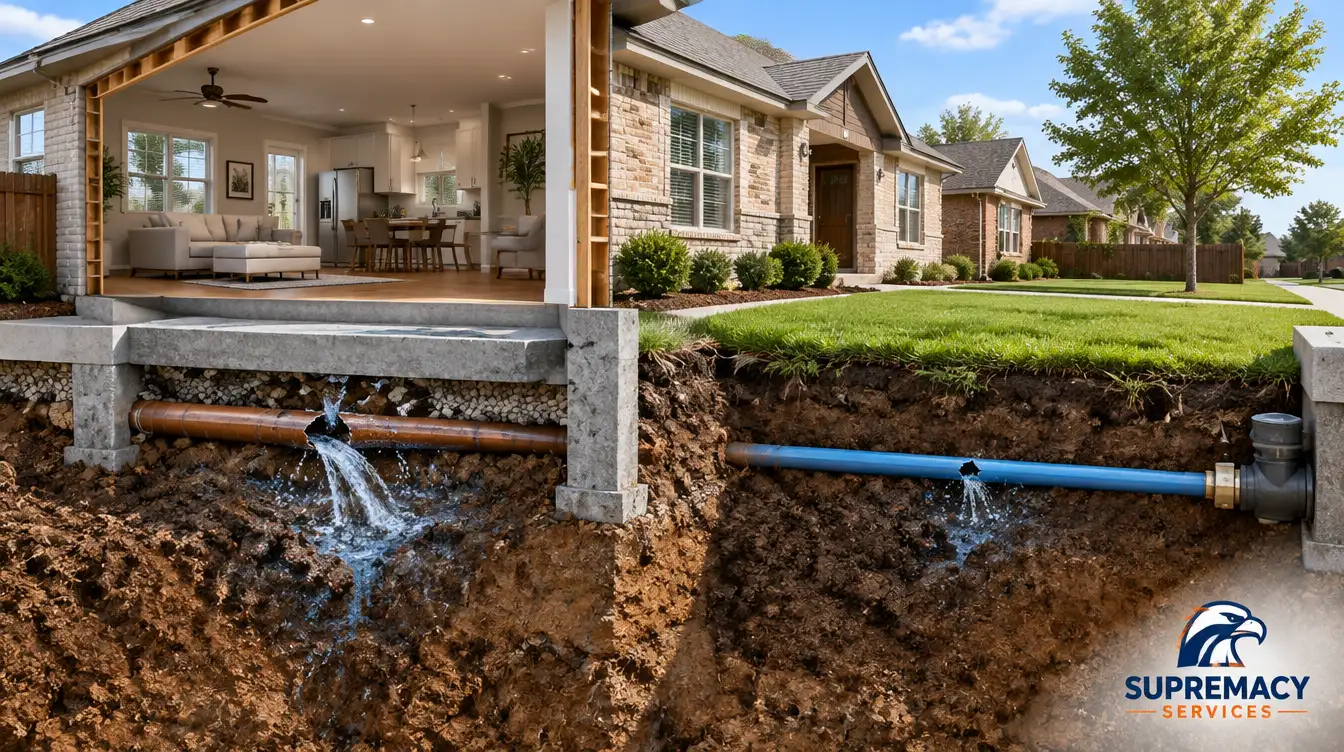
A slab leak vs. underground water line leak can be difficult to distinguish because both problems may cause rising water bills, reduced water pressure, and moisture around your home. The biggest difference is where the damaged pipe is located.
A slab leak occurs in plumbing beneath or within a home’s concrete foundation. An underground water line leak generally refers to a damaged buried water supply pipe outside the home’s foundation, often between the water meter and the house.
For Dallas homeowners, the location of unexplained moisture provides an important clue. Warm flooring, damp interior surfaces, and moisture near the foundation may suggest a slab leak. Persistent wet spots in the yard, unusually green grass, or saturated soil along the service-line route may point toward an underground water line leak.
However, neither set of symptoms confirms the source. Water can travel through soil and building materials before becoming visible. A professional inspection may be necessary to distinguish between the two.
Table of Contents
- What Is the Difference Between a Slab Leak and an Underground Water Line Leak?
- What Are the Warning Signs of a Slab Leak?
- What Are the Signs of an Underground Water Line Leak?
- How Can You Tell Which Type of Leak You Have?
- What Causes These Underground Plumbing Leaks?
- How Do Plumbers Find Hidden Water Leaks?
- Slab Leak vs. Water Line Leak Repair Options
- Which Type of Leak Costs More to Repair?
- Why Dallas Soil and Foundations Matter
- What Other Plumbing Problems Look Similar?
- When Should You Call a Professional?
- How Can You Reduce the Risk of Hidden Leaks?
- Frequently Asked Questions
What Is the Difference Between a Slab Leak and an Underground Water Line Leak?
The main difference is location: a slab leak affects plumbing beneath or within the concrete foundation, while an underground water line leak affects buried piping outside the foundation.
Both can involve pressurized drinking-water pipes, and both can waste water without producing an obvious indoor puddle.
What is a slab leak?
A slab leak occurs when a water supply pipe beneath or embedded within a concrete slab foundation develops a leak.
In slab-on-grade homes, plumbing may run beneath the concrete floor before supplying bathrooms, kitchens, laundry rooms, and other fixtures.
When a pipe leaks, water can migrate through the surrounding soil, collect beneath flooring, or appear around the foundation perimeter.
Potential consequences include damaged flooring, persistent indoor moisture, and changes in soil moisture beneath the foundation.
What is an underground water line leak?
An underground water line leak occurs when a buried water supply pipe outside the home’s foundation becomes damaged.
One common location is the private service line connecting the water meter to the house.
These pipes may pass beneath lawns, landscaping, driveways, or walkways.
Depending on the location and severity, leaking water may saturate the surrounding soil, reduce available water pressure, or emerge at the surface.
Slab leak vs. underground water line leak: comparison table
| Feature | Slab leak | Underground water line leak |
|---|---|---|
| Typical location | Beneath or within concrete foundation | Buried pipe outside foundation |
| Common visible clue | Damp flooring or moisture near interior walls | Persistent wet yard or soil |
| Warm floor | Possible with hot-water slab leak | Generally not characteristic |
| Water bill increase | Possible | Possible |
| Reduced water pressure | Possible | Possible |
| Foundation moisture | Possible | Possible, particularly near the house |
| Detection | Pressure testing, acoustic methods, targeted diagnostics | Meter testing, isolation tests, acoustic locating |
| Typical repair access | Floor access or rerouting | Excavation or suitable trenchless methods |
| Main concern | Interior damage and foundation-area moisture | Underground water loss and landscape damage |
Important: These are diagnostic clues, not definitive tests. A leaking service line can saturate soil near the foundation, while a slab leak can produce water outside the house.
What Are the Warning Signs of a Slab Leak?
Common slab leak warning signs include unexplained moisture on floors, warm spots, persistent sounds of running water, unexpected water consumption, and dampness near the foundation.
The symptoms depend on whether the damaged pipe carries hot or cold water and how water moves beneath the slab.
1. Warm spots on the floor
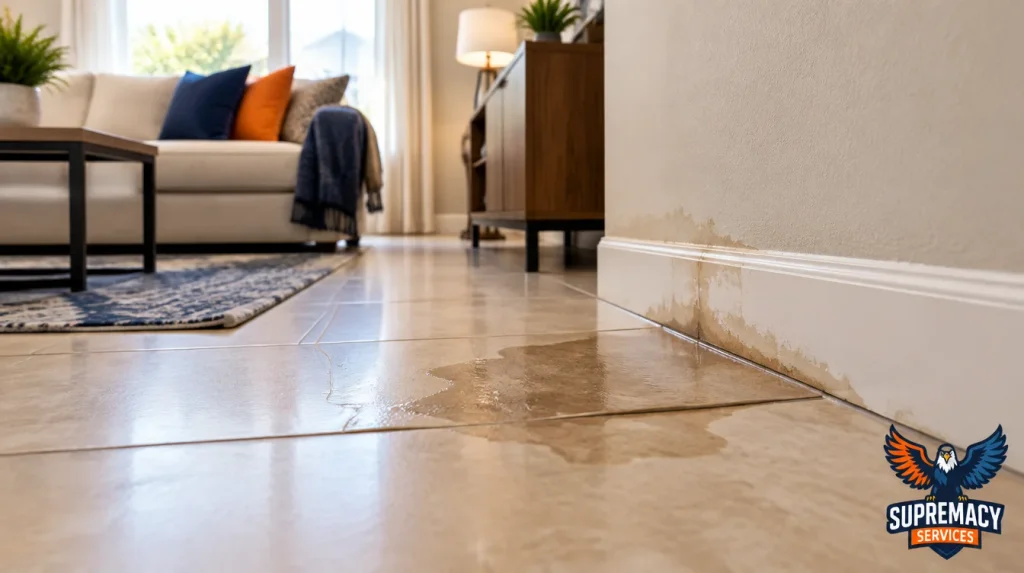
A localized warm area on tile or other flooring may indicate hot water escaping from a pipe beneath the slab.
This clue is more useful when the warmth persists without a known heating source.
However, warm flooring alone does not confirm a leak.
2. Damp carpet, tile, or flooring
Water moving upward or along the slab can affect floor coverings.
Possible signs include:
- Persistent damp patches
- Flooring that begins to lift or separate
- Discoloration near baseboards
- Moisture returning after cleaning and drying
Condensation, appliance leaks, and exterior water intrusion can produce similar symptoms.
3. Sounds of running water when fixtures are off
A pressurized pipe leak may produce a faint hissing or rushing sound.
If you hear water movement when no plumbing fixtures or appliances are operating, investigate further.
Sound alone cannot identify the exact pipe location.
4. Unexplained increases in water bills
A continuous slab leak may cause metered water use to increase even when household habits have not changed.
The U.S. Environmental Protection Agency recommends comparing water bills and checking the water meter during periods of no water use to identify possible leak
5. Moisture near interior walls or the foundation
Moisture may appear near baseboards, floor joints, or foundation edges.
Because water can move along the path of least resistance, the visible damp area may be some distance from the damaged pipe.
6. Foundation-related changes
Persistent water leakage beneath a slab can alter soil moisture conditions.
However, cracks, sticking doors, and uneven floors have many possible causes. They should not automatically be attributed to a plumbing leak.
A plumber can investigate the water system, while a qualified foundation professional may be appropriate if structural movement is suspected.
If you are seeing unexplained floor moisture or suspect a hidden plumbing leak, Supremacy Services offers professional water leak detection in Dallas and DFW to help identify the source before unnecessary demolition.
What Are the Signs of an Underground Water Line Leak?
The most recognizable signs of an underground water line leak are persistent wet patches outside, unexplained water use, and pressure problems affecting multiple fixtures.
Because the damaged pipe is buried, some leaks remain unnoticed until water reaches the surface or consumption increases.
1. A wet patch in the yard that will not dry
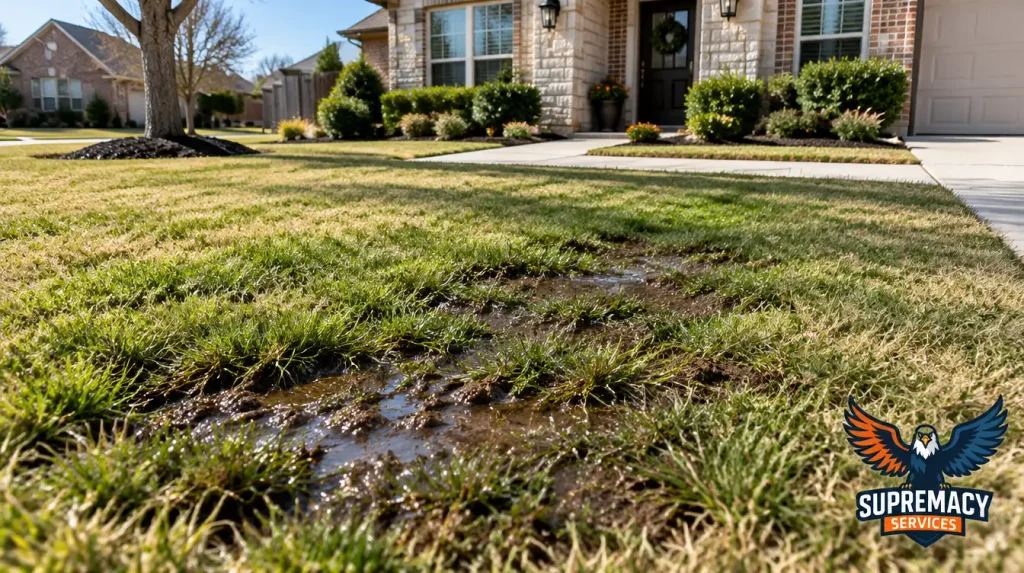
A continuously damp area may indicate that a buried pipe is leaking.
Check whether the moisture remains after several dry days and when irrigation has been turned off.
A single wet patch is not conclusive because drainage and irrigation problems can create similar conditions.
2. Unusually green or fast-growing grass
Grass above a leaking pipe may receive additional moisture and grow differently from the surrounding lawn.
However, variations in shade, fertilizer, irrigation coverage, and soil composition can produce the same appearance.
3. Reduced water pressure throughout the house
A substantial leak in the incoming service line can reduce the pressure or flow available to household fixtures.
If multiple fixtures are affected, the main water supply deserves investigation.
Other possibilities include municipal supply problems, partially closed valves, pressure regulators, or restrictions in the piping.
4. Water collecting near a driveway or walkway
Buried service lines sometimes pass beneath paved surfaces.
Water emerging along pavement joints or pooling beside a driveway may indicate a nearby underground leak.
Do not assume the visible exit point identifies the damaged pipe.
5. A water meter that registers usage when everything is off
Unexpected meter movement can indicate water escaping somewhere downstream of the meter.
The next step is determining whether the water loss occurs inside the house, in the buried service line, or in another connected system.
6. Soil erosion or localized ground settlement
A persistent underground leak can move soil particles or alter soil conditions.
Unusual depressions, washouts, or persistent soft ground deserve prompt investigation, particularly near foundations or paved surfaces.
How Can You Tell Which Type of Leak You Have?
Start by checking the water meter, ruling out obvious fixture leaks, and comparing indoor moisture with outdoor conditions. A controlled shutoff test may then help narrow the problem to the house or the incoming service line.
Quick homeowner leak-location guide
Unexplained water use or moisture?
Turn off all fixtures, appliances, and irrigation
Check the water meter
Is consumption still being registered?
No
No continuous flow detected
Check intermittent leaks, irrigation, drainage, and other moisture sources.
Yes
Possible metered leak
A plumber can isolate the house from the service line and test each section.
Leak on house side
Inspect fixtures, in-wall pipes, and under-slab plumbing.
Leak on supply side
Investigate the buried service line and connected branches.
Conceptual diagnostic guide only. Valve arrangements differ, and meter behavior cannot pinpoint a slab leak by itself.
Step 1: Turn off all water-using fixtures
Make sure faucets, showers, toilets, washing machines, dishwashers, and irrigation systems are not actively using water.
Remember that automatic ice makers, water softeners, and other equipment may operate without someone turning on a faucet.
Step 2: Check the water meter
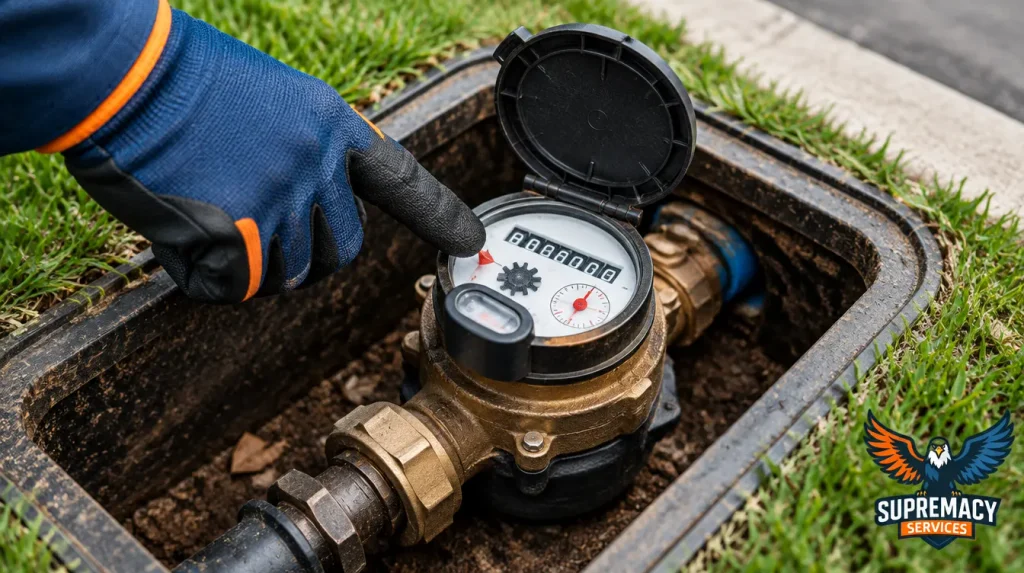
Find your meter and observe its reading or leak indicator.
Record the reading, avoid using water, and check it again after an appropriate interval.
The EPA describes a two-hour no-use meter comparison as a practical way to identify possible household leaks.
If the reading changes, there may be a leak or another source of unaccounted-for water use.
Step 3: Check for common fixture leaks
Before assuming the problem is underground, inspect:
- Toilets that refill without being flushed
- Dripping faucets and outdoor hose bibbs
- Water heater connections
- Washing machine hoses
- Irrigation valves and sprinkler heads
A leaking toilet can waste water continuously without creating a visible puddle.
Step 4: Compare indoor and outdoor clues
Look for damp floors, warm flooring, or moisture near interior walls.
Then inspect the yard, driveway, and visible service-line route.
Record where the moisture appears and whether it changes after irrigation or rainfall.
Step 5: Consider a controlled shutoff test
If your home has an accessible, clearly identified private main shutoff valve, a plumber can use it to isolate the house from the incoming supply line.
For example, if the valve isolates the house plumbing but the meter still registers flow, the leak may be between the meter and that valve or on another branch that remains supplied.
If the meter stops registering flow, the problem may be downstream of the valve.
This test depends on the plumbing layout. Some valves do not isolate irrigation systems, exterior branches, or all household piping. A closed valve also does not establish that a leak is specifically beneath the slab.
Do not force a seized valve or operate utility-owned equipment.
What Causes Slab Leaks and Underground Water Line Leaks?
Both types of leaks can result from pipe deterioration, movement, damaged connections, or external forces. The most likely cause depends on the pipe material, age, installation, surrounding conditions, and location.
Common causes of slab leaks
Pipe corrosion: Certain metallic pipes may deteriorate over time, depending on water chemistry, material, and installation conditions.
Pipe movement or abrasion: Movement and contact with surrounding materials can contribute to damage at vulnerable points.
Installation defects: Poor connections, inadequate protection, or improperly supported piping can create future problems.
Pressure-related stress: Excessive or fluctuating pressure may increase stress on pipes and fittings.
Common causes of underground service-line leaks
Aging materials: Pipes and fittings can deteriorate over their service lives.
Soil movement: Changing soil conditions may stress buried piping, particularly at joints or transitions.
Tree roots: Roots can exploit existing weaknesses and may contribute to damage or displacement in some situations.
Excavation damage: Landscaping, fencing, and construction work can accidentally damage buried lines.
Freezing conditions: Although North Texas has hot summers, winter freezes can still threaten inadequately protected plumbing.
The EPA identifies corrosion, aging piping, cold temperatures, irregular pressure, and installation problems among factors associated with household leaks.
How Do Plumbers Find Hidden Water Leaks Without Unnecessary Digging?
Professional leak detection uses testing and diagnostic equipment to narrow down the leaking section before deciding whether excavation or concrete access is necessary.
Water meter and isolation testing
The plumber determines whether the plumbing system is losing water and isolates sections where possible.
This can help distinguish a leaking service line from a leak in the home’s interior plumbing.
Pressure testing
A controlled pressure test can help determine whether an isolated section of piping is holding pressure.
A pressure loss suggests leakage, but further testing is required to establish the exact location.
The EPA’s WaterSense technical guidance includes pressure-loss testing as a method for checking water supply systems.
Acoustic leak detection
Specialized listening equipment can help identify sounds generated by water escaping from pressurized pipes.
Results depend on factors such as pipe material, leak size, water pressure, and surrounding noise.
Thermal imaging
Thermal imaging may help identify temperature differences associated with hot-water leaks.
It does not see through concrete or directly photograph the damaged pipe. The thermal pattern must be interpreted alongside other evidence.
Targeted excavation or concrete access
When diagnostic testing identifies a likely location, a plumber can recommend a targeted access method.
Not every leak can be located or repaired without disturbing concrete, soil, or finishes.
Not sure whether the problem is beneath your foundation or outside in the yard? Schedule hidden water leak detection with Supremacy Services before choosing a repair method.
Slab Leak vs. Water Line Leak Repair Options
The best repair method depends on the pipe’s condition, location, accessibility, and whether the damage is isolated or part of a larger deterioration problem.
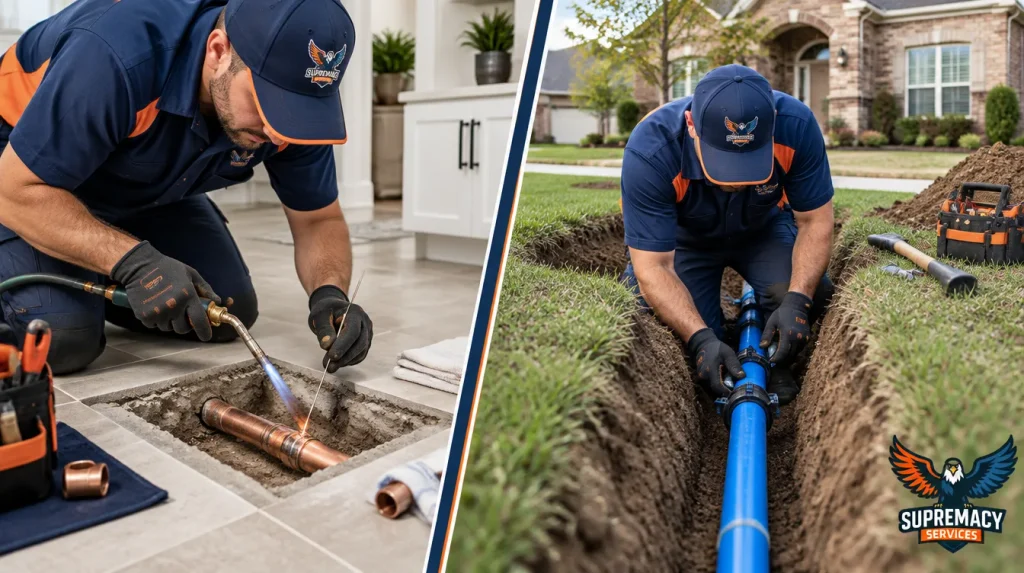
How are slab leaks repaired?
Localized pipe repair: A plumber accesses the damaged section and repairs or replaces it where appropriate. This may require opening part of the floor.
Pipe rerouting: A new supply line may be routed through an accessible wall, ceiling, or other approved pathway, avoiding the damaged under-slab section.
Partial or larger-scale repiping: When several sections are deteriorating, replacing more of the affected plumbing may be preferable to repeated spot repairs.
The choice should account for pipe condition, building layout, restoration work, and applicable plumbing requirements.
How are underground water line leaks repaired?
Spot repair: A localized defect may be repaired by excavating and replacing a short section of pipe.
Traditional replacement: The damaged line is exposed and replaced along the required route.
Trenchless replacement: Where site conditions and pipe configuration permit, methods such as pipe bursting or directional boring may reduce the amount of open trenching.
Trenchless work is not necessarily excavation-free. Entry and exit pits or other access points may still be required.
Supremacy Services describes traditional and trenchless approaches on its Dallas water line repair and replacement page.
Which repair option is better?
| Situation | Repair approach to evaluate |
|---|---|
| One accessible damaged section | Localized repair |
| Isolated under-slab leak | Targeted access or rerouting |
| Repeated leaks in deteriorating pipes | Partial or broader repiping |
| Long buried service line with multiple defects | Service-line replacement |
| Water line beneath landscaping or pavement | Trenchless feasibility assessment |
| Uncertain leak location | Diagnostic testing before repair |
Avoid choosing a repair method based solely on a damp patch or an estimate made without locating the problem.
Which Costs More to Repair: a Slab Leak or an Underground Water Line Leak?
Neither type is automatically more expensive. Slab leak repairs may require flooring removal and restoration, while underground water line repairs may involve excavation, long pipe runs, landscaping, or pavement restoration.
The total cost depends more on the required work than the name of the leak.
| Cost factor | Slab leak | Underground water line leak |
|---|---|---|
| Leak detection | Testing beneath or around slab | Testing buried service line |
| Access work | Concrete or alternative rerouting | Excavation or access pits |
| Pipe replacement | Localized repair or rerouting | Spot repair or longer replacement |
| Restoration | Flooring and interior finishes | Landscaping, concrete, or pavement |
| Complexity | Building layout and pipe accessibility | Depth, length, utilities, obstructions |
Why exact pricing requires an inspection
A small, accessible outdoor leak may be relatively straightforward to repair. A damaged service line beneath a driveway can require much more work.
Likewise, rerouting an accessible under-slab supply pipe may be less disruptive than removing and restoring extensive finished flooring.
For that reason, homeowners should request a written estimate that identifies the diagnosed defect, proposed repair method, access work, restoration responsibilities, and applicable warranties.
No unverified Dallas-specific price range is included here. Actual costs should be based on a current local quote rather than a generalized national average.
Why Dallas Soil and Foundations Matter When Investigating Water Leaks
Dallas-area homes can experience changing soil moisture conditions due to rainfall, dry periods, irrigation, and plumbing leaks.
Some North Texas soils contain expansive clays that change volume as moisture conditions change. This makes water management around foundations especially important.
A buried pipe leak can introduce water into soil that would otherwise remain relatively dry. A slab leak can create a similar localized moisture problem beneath the building.
However, a foundation crack does not prove that a slab leak exists. Structural movement can result from several factors, and the plumbing system should be tested before assigning the cause.
What should Dallas homeowners pay attention to?
- Persistent moisture near a slab foundation during dry weather
- Irrigation patterns that keep one area unusually wet
- Water emerging along a driveway or foundation edge
- New flooring moisture without an obvious indoor source
- Water use that increases without corresponding household activity
These concerns apply across Dallas and surrounding communities such as Plano, Frisco, Richardson, Allen, McKinney, and Fort Worth, although soil conditions and plumbing layouts vary by property.
What if the leak is near the water meter?
If the problem appears to involve a municipal water main, meter, or utility-owned connection, contact the appropriate water utility.
Dallas Water Utilities provides emergency assistance for water main breaks, meter leaks, and emergency water shutoffs through Dallas 311.
The exact boundary between utility and customer responsibility should be verified with the local provider rather than assumed.
For City of Dallas water customers, a qualifying repaired leak may also be eligible for a billing adjustment. Eligibility is subject to review and is not guaranteed.
What Other Plumbing Problems Can Look Like a Slab or Underground Water Line Leak?
Several issues can produce symptoms similar to a hidden water supply leak.
Sewer line leaks
A damaged sewer pipe can cause damp soil, wastewater odors, slow drains, or recurring backups.
Unlike a pressurized supply-line leak, a gravity sewer leak may not cause continuous movement at the drinking-water meter.
Homeowners experiencing multiple drainage problems should consider sewer line inspection and repair.
Irrigation system leaks
Broken sprinkler pipes or malfunctioning valves can produce wet patches and unexplained water use.
An irrigation system connected downstream of the water meter may register water consumption even when household faucets are off.
HVAC condensate leaks
Air-conditioning systems remove moisture from indoor air.
Blocked condensate drains or leaking drain pans can create water near walls, closets, or mechanical equipment.
This can be mistaken for plumbing moisture.
Roof and exterior drainage problems
Rainwater entering through roofing, windows, exterior walls, or poor drainage can create damp floors and foundation-area moisture.
These problems may be especially noticeable after storms.
Leaking toilets and appliances
A toilet that runs intermittently, a refrigerator water connection, or a water heater leak may explain high water use without any damaged underground pipe.
Checking these possibilities first can prevent unnecessary excavation.
When Should You Call a Professional Plumber?
Call a plumber when you have evidence of unexplained water consumption, recurring moisture, or pressure problems that cannot be explained by visible fixtures or irrigation.
Prompt attention is particularly important when water is entering living spaces or collecting near the foundation. Supremacy services.
Warning signs that justify prompt service
- Water continues registering at the meter when no known equipment is using it.
- Flooring remains wet or begins to lift.
- Water is pooling near the foundation or beneath pavement.
- Multiple fixtures suddenly lose pressure.
- A suspected leak is causing active property damage.
- You cannot safely isolate the water supply.
If water is actively entering the house, use a safe, accessible private shutoff valve if you know how to operate it. Keep away from wet electrical equipment and obtain urgent assistance when necessary.
What should homeowners expect during professional service?
A systematic inspection generally involves:
- Reviewing the symptoms and water-use history.
- Inspecting accessible plumbing and irrigation connections.
- Testing or isolating sections of the supply system.
- Using appropriate leak-location equipment.
- Explaining the likely defect and diagnostic confidence.
- Comparing suitable repair methods.
- Providing a written scope and estimate.
- Testing the repaired system and documenting the results.
Ask whether the quoted price includes leak detection, excavation, restoration, testing, and any required permits.
How Can You Reduce the Risk of Hidden Water Leaks?
Not every underground leak is preventable, but regular monitoring and timely repairs can reduce the chance that a developing problem goes unnoticed.
Practical homeowner prevention checklist
Home water-leak prevention
0 of 8 completedReview water bills for unexplained changesLocate and identify the private main shutoff valveInspect toilets, faucets, hoses, and water heater connectionsCheck the yard for persistent wet spotsInspect irrigation systems for damaged heads or valvesConsider a water leak monitoring deviceHave recurring pressure or moisture problems investigatedKeep records of plumbing repairs and pipe replacements
Copy checklist
The EPA recommends routine fixture checks, bill monitoring, and leak detection or flow-monitoring devices as ways to reduce water waste and damage.
Frequently Asked Questions
1. Can a slab leak cause water to appear in the yard?
Yes. Water escaping beneath a slab can migrate through surrounding soil and emerge near the foundation or elsewhere outside. The visible wet area may not be directly above the damaged pipe.
2. Can an underground water line leak damage a foundation?
Yes. A leaking buried pipe near the house can change soil moisture conditions and potentially contribute to foundation-related problems. The extent of risk depends on soil, drainage, leak severity, and foundation conditions.
3. Does a high water bill mean I have a slab leak?
No. High water use can result from toilets, irrigation systems, appliances, underground service lines, or slab leaks. A meter test and systematic inspection can help identify the cause.
4. Can a plumber detect a slab leak without breaking concrete?
Often, plumbers can investigate a suspected slab leak using pressure testing, acoustic equipment, and other diagnostic methods before opening concrete. Some repairs still require physical access.
5. Is a wet yard always a sign of a broken underground water line?
No. Irrigation leaks, drainage problems, sewer defects, and recent rainfall can all cause wet soil. A water meter check and inspection help distinguish the possibilities.
6. Can a slab leak affect water pressure?
Yes. A sufficiently large leak in a pressurized supply pipe can reduce available pressure or flow. Smaller leaks may produce little noticeable change.
7. How do I know whether the leak is between the meter and my house?
A plumber can use meter readings and correctly positioned isolation valves to test the incoming service line separately from the house plumbing. The result depends on the property’s actual pipe and valve arrangement.
8. Is it better to repair or replace an underground water line?
A localized repair may be appropriate for an otherwise sound pipe. Replacement may be preferable when the line is deteriorating, has repeated failures, or contains extensive damage.
9. Should I turn off my water if I suspect a slab leak?
If there is active flooding or significant water loss, shutting off the supply at a safe, accessible private valve can help limit damage. For an uncertain or minor leak, contact a plumber promptly for guidance.
10. Can a slab leak and an underground water line leak happen at the same time?
Yes. A property can have more than one plumbing defect. If symptoms remain after one leak is repaired, further testing may be necessary.
Professional Leak Detection for Dallas and DFW Homeowners
When water is disappearing somewhere beneath your property, identifying the correct pipe matters more than guessing which repair will be necessary.
A slab leak and an underground water line leak can share many symptoms, but the access methods, repair options, and restoration requirements may be very different.
Supremacy Services provides plumbing and leak detection services throughout Dallas and the DFW Metroplex.
If you have unexplained water consumption, damp flooring, or persistent moisture around your foundation or yard, arrange a professional inspection before the problem causes further damage.

