
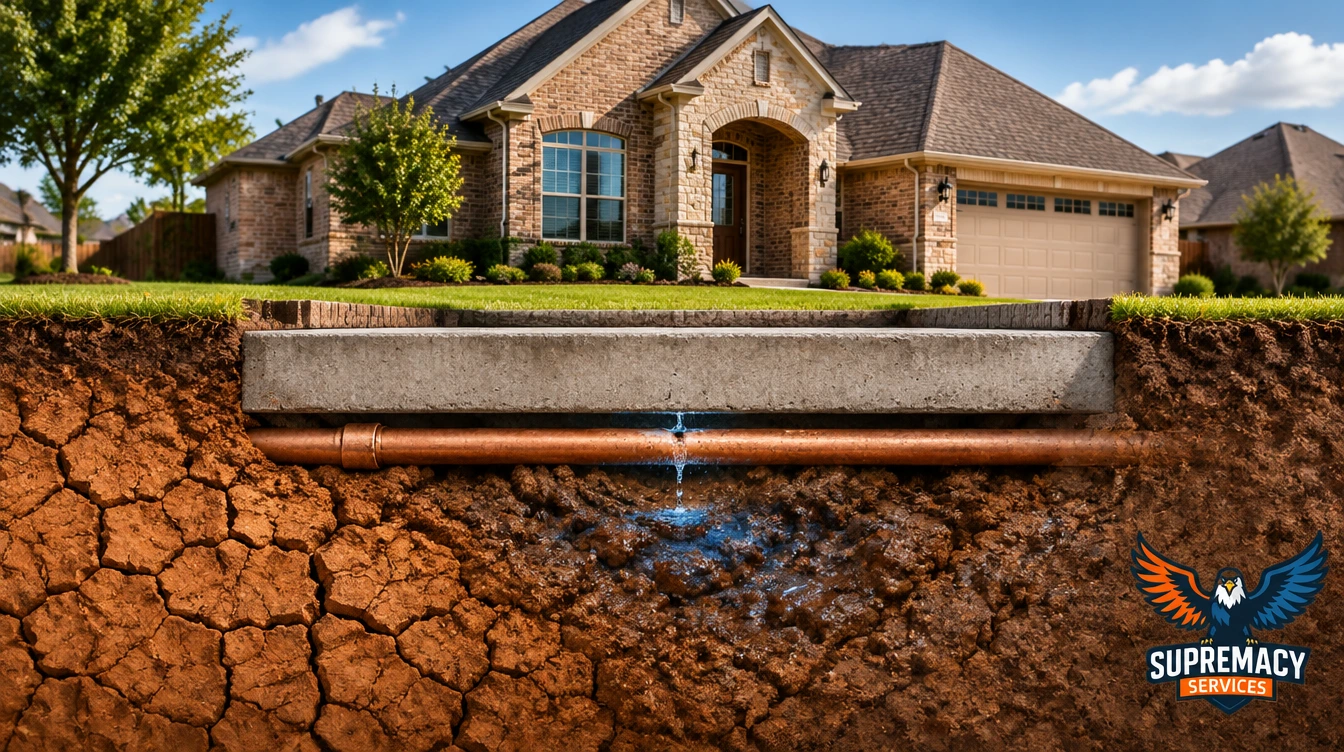
Slab leaks are a particular concern for North Texas homeowners because the region’s expansive clay soils, seasonal moisture changes, and slab-on-grade construction can place stress on underground plumbing.
In Dallas and surrounding communities, clay-rich soil can swell when wet and shrink during dry conditions. As the soil and foundation move, pipes beneath or within a concrete slab may experience repeated stress. Over time, aging materials, corrosion, installation problems, or abrasion can contribute to leaks.
The key point: Clay soil does not automatically cause a slab leak. It is one environmental factor that can increase stress on vulnerable plumbing systems.
Understanding these risks can help homeowners recognize early warning signs, protect their foundations, and address plumbing problems before water damage becomes extensive.
Table of Contents
- What is a slab leak?
- Why are slab leaks a concern in North Texas?
- What causes slab leaks in Dallas homes?
- How does foundation movement damage pipes?
- Which homes may be more vulnerable?
- What are the warning signs?
- Could it be a different plumbing problem?
- How do plumbers find slab leaks?
- What are the repair options?
- How can homeowners reduce their risk?
- When should you call a professional?
- Frequently asked questions
What Is a Slab Leak?
A slab leak is a plumbing leak involving a water supply or drain pipe located beneath or within a home’s concrete slab foundation.
Unlike a leaking faucet or exposed pipe, a slab leak can remain hidden because the damaged plumbing is difficult to access.
Two broad categories are important:
- Pressurized supply-line leaks: Water escapes from a hot- or cold-water line, potentially causing continuous water loss.
- Drain or sewer-line leaks: Wastewater escapes from a damaged drainage pipe beneath the foundation, sometimes without producing an obvious increase in the water bill.
A slab leak can occur without a visible crack in the concrete. Likewise, a cracked floor does not necessarily indicate a plumbing leak.
Why Are Slab Leaks a Concern in North Texas?
This are some of the reasons why Slab Leaks Are Common in North Texas.The combination of expansive clay soils, changing moisture conditions, and underground plumbing makes slab leaks a meaningful risk for some North Texas properties.
1. North Texas has expansive clay soils
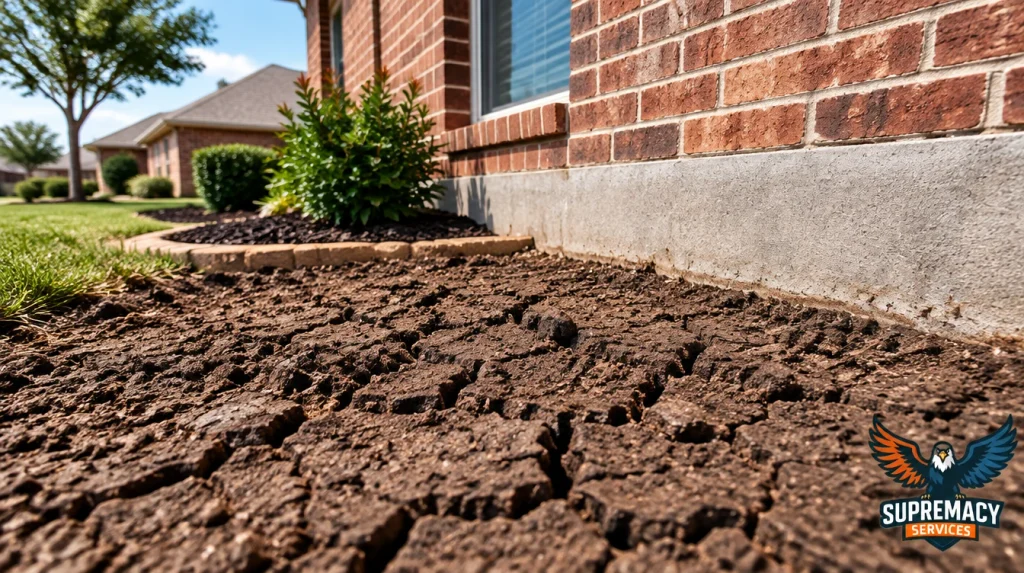
Much of the Dallas–Fort Worth region contains clay-rich soils with shrink-swell characteristics.
When moisture enters expansive clay, the soil can increase in volume. When moisture decreases, the soil can contract.
The U.S. Geological Survey explains that the amount of swelling or shrinking depends on clay mineral composition and changing moisture conditions.
This matters because underground pipes and foundations interact with the surrounding soil.
2. Wet and dry periods change soil conditions
North Texas can experience extended dry periods followed by significant rainfall.
During dry weather, clay-rich soil may shrink. When the soil becomes wet again, it can expand.
Repeated moisture changes can contribute to uneven soil movement, particularly where one area receives more water than another.
A house with poor drainage, a leaking irrigation system, or uneven soil moisture may experience different conditions around its foundation.
3. Slab foundations can conceal plumbing problems
Many Texas homes use reinforced slab-on-ground foundations, including foundations built over expansive soils or fill. The Texas Section of the American Society of Civil Engineers identifies this combination as an important foundation-design consideration.
When plumbing is routed beneath or through a concrete slab, identifying and accessing a damaged section can be more complicated than repairing an exposed pipe.
This does not mean slab foundations are inherently defective. Properly designed and maintained foundations can perform successfully for many years.
What Causes Slab Leaks in Dallas Homes?
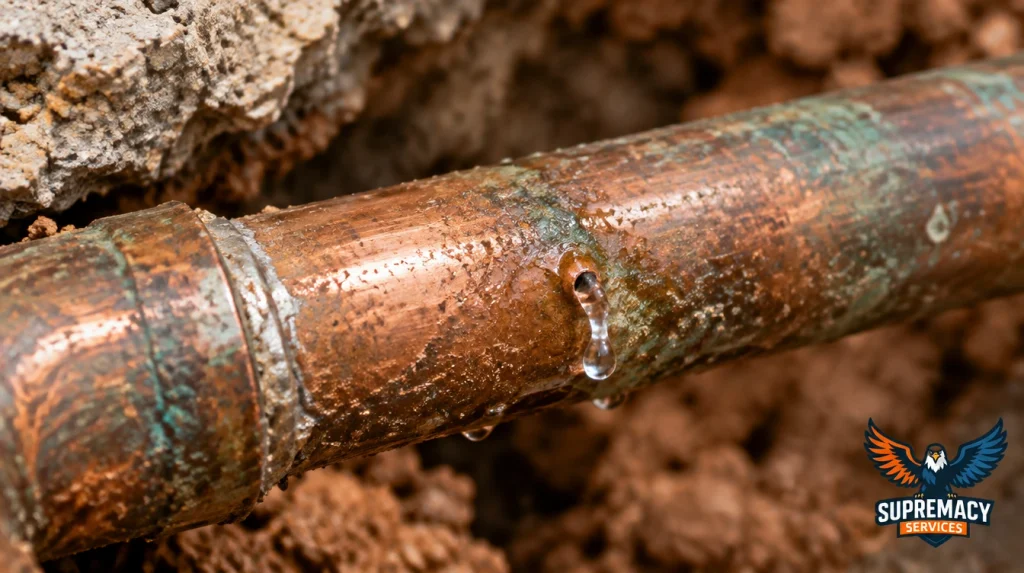
Slab leaks can develop through several mechanisms. The exact cause depends on the pipe material, installation, soil conditions, water chemistry, age, and history of the property.
1. Expansive clay soil movement
When surrounding soil expands or contracts unevenly, buried plumbing may experience movement or stress.
Rigid pipes, unsupported sections, and vulnerable connections may be particularly affected.
Repeated movement can contribute to cracking, joint separation, or leakage, although soil movement alone does not prove why a particular pipe failed.
2. Pipe corrosion and material deterioration
Metal pipes can deteriorate over time because of environmental conditions, water chemistry, or corrosion processes.
Copper is generally durable, but it is not immune to corrosion or localized damage.
Homeowners should avoid assuming that every copper pinhole leak is caused by hard water. The actual mechanism requires investigation.
3. Pipe abrasion against surrounding materials
Pipes may be damaged when they repeatedly contact rough materials, improperly positioned supports, or surrounding construction components.
Movement and vibration can increase wear at vulnerable contact points.
4. Aging plumbing components
As plumbing systems age, existing weaknesses can become more significant.
Older connections, deteriorated pipe sections, and previous repairs may deserve closer attention, particularly where leaks have occurred before.
However, the age of a house alone cannot predict whether it will develop a slab leak.
5. Installation and construction deficiencies
Poor pipe support, inadequate protection where pipes pass through concrete, excessive mechanical stress, or defective connections can contribute to premature failures.
The specific failure mechanism should be identified before recommending extensive pipe replacement.
6. Previous foundation movement or repair work
A home that has experienced significant differential movement may also have plumbing that has been subjected to stress.
Foundation repair work and plumbing work should be coordinated when necessary, but foundation movement and pipe leakage must be evaluated independently rather than assuming one caused the other.
Summary: Common slab leak risk factors
| Risk factor | How it can affect plumbing | Homeowner response |
|---|---|---|
| Expansive clay | Changes soil volume and support | Maintain drainage and monitor movement |
| Seasonal moisture changes | Can contribute to differential movement | Address water accumulation and unusual drying |
| Corrosion | Weakens susceptible pipe sections | Investigate recurring leaks |
| Pipe abrasion | Can wear vulnerable contact points | Request professional diagnosis |
| Aging plumbing | May increase vulnerability at weak points | Review plumbing history |
| Installation defects | Can leave pipes under mechanical stress | Use qualified plumbing professionals |
How Does Foundation Movement Damage Pipes?
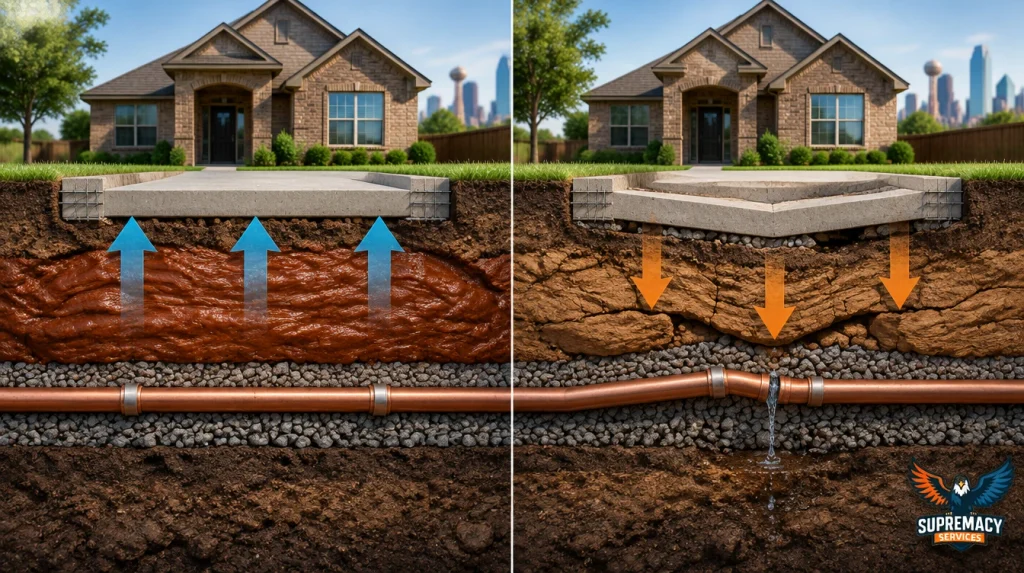
Foundation movement can damage pipes when different parts of the structure or surrounding soil shift by different amounts, placing stress on plumbing connections or pipe sections.
This process is often called differential movement.
How soil movement can contribute to a leakConceptual illustration only. Actual pipe movement and failures depend on site conditions, pipe installation, and materials.
Consider a pipe crossing an area where the soil or foundation has moved unevenly. If one part of the pipe remains relatively fixed while another section moves, stress may concentrate near a joint, bend, or other vulnerable location.
A leak can then change soil moisture conditions, potentially contributing to further movement.
That creates an important distinction:
Soil movement can contribute to a plumbing leak, and a plumbing leak can contribute to soil movement.
Determining which occurred first may require both plumbing diagnostics and a structural evaluation.
Which North Texas Homes May Be More Vulnerable?
No Dallas neighborhood or home age automatically determines slab leak risk.
However, certain property conditions justify closer attention.
Homes with a history of plumbing leaks
Repeated failures in an under-slab plumbing system may indicate a broader problem with the piping material, installation, or operating conditions.
Homes experiencing unexplained foundation movement
New floor elevation changes, widening cracks, or repeatedly sticking doors may warrant investigation, especially when accompanied by evidence of moisture.
These symptoms are not specific to slab leaks.
Homes with drainage problems
Standing water, leaking irrigation lines, or downspouts discharging beside the foundation can contribute to uneven soil moisture.
Homes with older or previously repaired piping
Aging plumbing is not necessarily unsafe, but previous leaks, corrosion, and recurring repairs can justify an assessment of the remaining system.
Homes with limited access to under-slab pipes
The harder the plumbing is to access, the more important accurate diagnosis becomes before removing flooring or opening concrete.
What Are the Warning Signs of a Slab Leak?
Common warning signs include unexplained water consumption, the sound of running water when fixtures are off, damp flooring, warm floor spots, and unexplained pressure changes.
| Warning sign | What it may indicate | What else could cause it |
|---|---|---|
| Unexpected water bill increase | Hidden pressurized water leak | Toilet leak or irrigation problem |
| Water meter movement when fixtures are off | Water flowing somewhere in the system | Outdoor line or appliance leak |
| Warm spot on the floor | Possible hot-water line leak | Heating or sun exposure |
| Damp carpet or flooring | Moisture intrusion | Appliance leak or surface water |
| Running-water sound | Hidden water flow | Running toilet or other fixture |
| Reduced water pressure | Significant supply-line problem | Valve, fixture, or municipal supply issue |
| Musty odor | Persistent moisture | Condensation or other water intrusion |
| New foundation distress | Possible soil or structural movement | Drainage, settlement, or other structural issues |
No single symptom confirms a slab leak.
If several warning signs occur together, professional leak detection becomes more important.
If your Dallas-area home has unexplained water loss or damp flooring, contact Supremacy Services to discuss professional plumbing diagnostics before opening the concrete.
Could It Be a Different Plumbing Problem?
Not every hidden water leak is a slab leak.
Homeowners should distinguish between under-slab plumbing, exterior water service lines, drainage systems, and foundation-related moisture.
| Problem | Typical location | Useful clue |
|---|---|---|
| Slab supply-line leak | Beneath or within concrete foundation | Unexplained water use, floor moisture |
| Underground main water line leak | Between meter and home or elsewhere along service line | Wet yard, water loss, pressure changes |
| Sewer or drain leak | Underground drainage piping | Drain problems, wastewater odors, soil moisture |
| Irrigation leak | Outdoor sprinkler piping | Wet landscape or unusual irrigation consumption |
| Foundation drainage issue | Around the structure | Moisture after rain without plumbing evidence |
A leaking underground service line may produce symptoms similar to an under-slab leak. The distinction matters because the repair method and excavation location may differ.
A qualified plumber can isolate sections of the system and identify the likely source before repairs begin.
How Do Plumbers Find Slab Leaks Without Breaking Concrete?

Professional plumbers can often narrow down the location of a suspected slab leak using diagnostic tests before opening the floor.
The methods depend on whether the suspected problem involves a pressurized water line or a drain.
Step 1: Review the symptoms
The plumber may ask about water bills, flooring changes, previous leaks, plumbing age, and when the problem began.
Step 2: Check the water meter and plumbing system
A meter observation or isolation test can help determine whether water is moving through the system when no fixtures should be using it.
Step 3: Perform appropriate diagnostic tests
Depending on the suspected leak, the plumber may use pressure testing, acoustic listening equipment, thermal imaging, or drain-specific testing.
Each technique has limitations. Thermal imaging, for example, detects surface temperature patterns rather than directly seeing a pipe leak through concrete.
Step 4: Narrow down the affected area
The goal is to identify the likely damaged section and avoid unnecessary demolition.
Step 5: Explain repair options
Once the problem is identified, the plumber can recommend a repair strategy based on accessibility, pipe condition, and the extent of the damage.
What Are the Repair Options for a Slab Leak?
Slab leak repairs generally involve accessing and repairing the damaged section, rerouting a water line, or replacing a larger portion of the affected piping.
| Repair method | When it may be considered | Main consideration |
|---|---|---|
| Localized repair through slab | Accessible, isolated failure | Concrete and flooring restoration |
| Pipe rerouting | Suitable alternative pipe route | New routing and finishing work |
| Partial repiping | Multiple failures in one section | Condition of remaining piping |
| More extensive repiping | Widespread deterioration or recurring failures | Higher project scope and disruption |
| Under-slab drain repair | Confirmed drain or sewer damage | Excavation and structural considerations |
How much does slab leak repair cost in Dallas?
The total cost depends on the leak location, diagnostic work, pipe material, accessibility, repair method, and restoration requirements.
A repair involving an easily accessible rerouted line may differ substantially from a project requiring concrete removal, floor restoration, and additional structural evaluation.
Rather than relying on a generic online price, homeowners should request a written estimate identifying the plumbing work and any separately required restoration.
If testing confirms an under-slab leak, ask Supremacy Services about repair options for your Dallas–Fort Worth property and what the proposed work includes.
How Can Homeowners Reduce Their Risk of Slab Leaks?

Homeowners cannot eliminate every slab leak risk, but they can address preventable moisture problems, monitor water consumption, and respond early to plumbing changes.
Maintain proper drainage
Keep gutters, downspouts, and surface drainage functioning so rainwater does not consistently collect beside the foundation.
Address irrigation leaks
Repair broken sprinkler heads, underground irrigation leaks, and watering problems that create unusually wet areas near the house.
Avoid extreme moisture imbalances
Follow site-appropriate foundation and landscape recommendations. Do not assume that adding more water around the foundation is always beneficial.
A structural or geotechnical professional can advise where unusual soil movement is suspected.
Monitor water bills
Compare water use across billing periods, accounting for seasonal irrigation and household changes.
Investigate recurring leaks
Multiple leaks may justify a broader evaluation of pipe condition rather than repeated isolated repairs.
Keep plumbing records
Document previous leak locations, repair methods, pipe replacements, and any foundation work.
These records can help future professionals diagnose recurring problems more efficiently.
When Should You Call a Professional?
Contact a qualified plumber when you suspect continuous hidden water loss, notice unexplained damp flooring, hear water running without an obvious source, or experience recurring under-slab plumbing problems.
If water is actively escaping, shut off the appropriate water supply when safe and arrange prompt assistance. Avoid electrical equipment in wet areas where electrical hazards may be present.
Homeowners can safely review bills, check for obvious fixture leaks, and observe the water meter. However, cutting concrete, pressure-testing plumbing, and repairing concealed piping should be left to qualified professionals.
When foundation movement is also suspected, a licensed professional engineer may be appropriate to assess structural concerns separately from the plumbing diagnosis.
Frequently Asked Questions
1. Does North Texas clay soil cause slab leaks?
Expansive clay can contribute to slab leaks by changing volume as soil moisture changes. This movement may stress vulnerable underground pipes, but corrosion, installation, and pipe condition also matter.
2. Are slab leaks more common during summer?
Dry weather can increase soil shrinkage in susceptible clay soils, but a leak can occur at any time. There is insufficient evidence to assume summer is the peak season for every Dallas property.
3. Can a new house develop a slab leak?
Yes. Newer plumbing can leak because of installation defects, damaged materials, unusual movement, or other problems. New construction does not eliminate the possibility.
4. Do copper pipes develop slab leaks?
Copper pipes can develop leaks through corrosion, mechanical damage, abrasion, or other failure mechanisms. A professional inspection is needed to identify the cause.
5. Can a slab leak damage a foundation?
Yes. A leak may change soil moisture beneath a foundation, potentially contributing to uneven swelling, loss of support, or other movement depending on soil conditions.
6. Can a slab leak happen without visible water?
Yes. Some leaks remain concealed beneath flooring or concrete. Unexplained water use or changes in plumbing performance may be the first clues.
7. Can homeowners detect a slab leak themselves?
Homeowners can look for warning signs and check for obvious water use. Confirming the location and cause of a concealed leak generally requires professional testing.
8. Does every slab leak require breaking concrete?
No. Some damaged water lines can be rerouted or repaired through alternative access points. The appropriate method depends on the plumbing layout and leak location.
9. Will fixing a slab leak stop foundation movement?
Fixing the leak removes one possible moisture source, but foundation movement may have other causes. A separate structural evaluation may be necessary if distress continues.
Protect Your North Texas Home With Early Leak Detection
North Texas clay soils, moisture changes, and under-slab plumbing can create challenging conditions for homeowners. Understanding those conditions is the first step toward recognizing problems early.
Not every foundation crack indicates a leak, and not every slab leak requires extensive demolition. Accurate diagnosis is what determines the appropriate response.
If you suspect a slab leak in Dallas, Plano, Frisco, Allen, or elsewhere in the DFW Metroplex, contact Supremacy Services to discuss your plumbing concerns and available diagnostic and repair options.
Contact Supremacy Services to request an assessment of a suspected slab leak in your North Texas home.

