
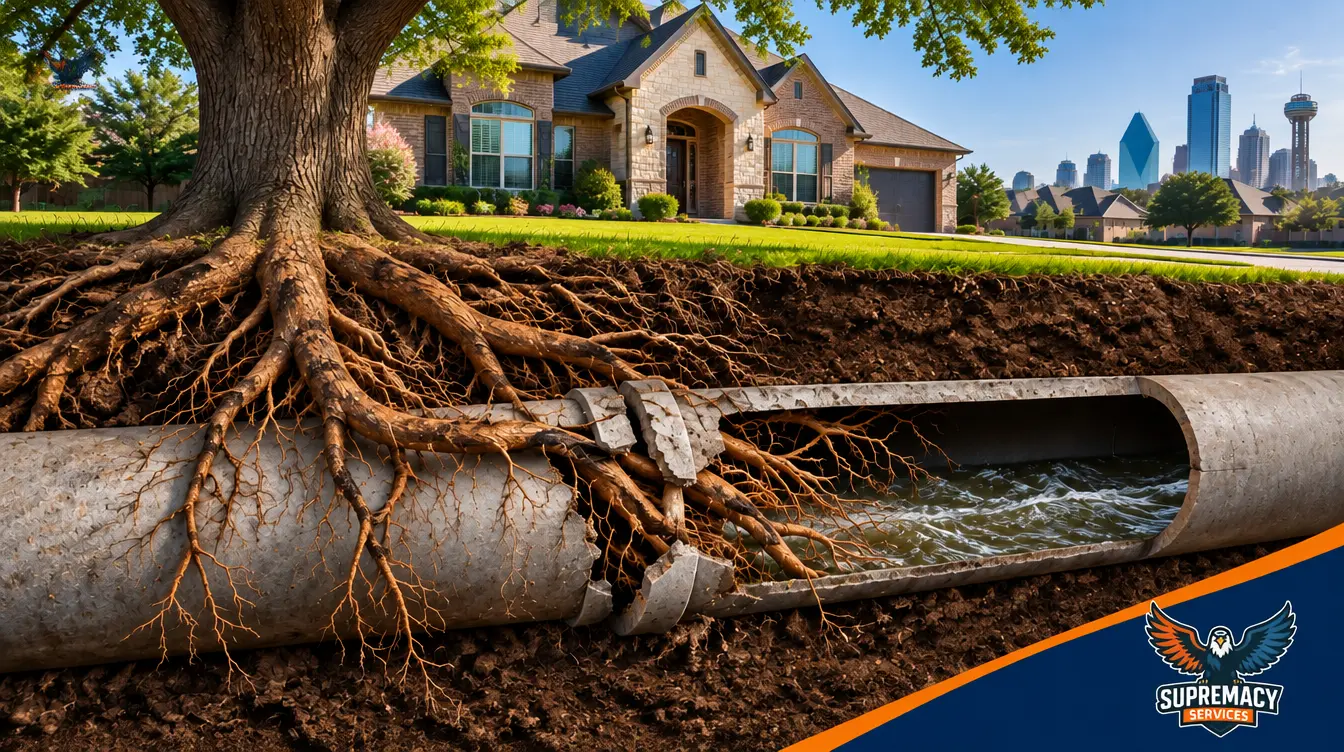
Tree roots in sewer lines can cause recurring drain clogs, slow wastewater drainage, gurgling toilets, and sewage backups. Roots typically enter through cracks, separated pipe joints, or other openings, then grow inside the pipe and trap debris. Depending on the pipe’s condition, a plumber may recommend mechanical root cutting, hydro jetting, localized repair, trenchless rehabilitation, or sewer line replacement.
For Dallas and DFW homeowners, the important question isn’t simply how to remove the roots. It’s whether the underground pipe has an opening or structural problem that will allow them to return.
This guide explains how to recognize sewer root intrusion, what damage it can cause, how removal methods compare, and when a more permanent repair makes sense.
Table of Contents
- What Are Tree Roots in Sewer Lines?
- How Do Tree Roots Get Into Sewer Pipes?
- What Are the Signs of Tree Roots in a Sewer Line?
- Can Tree Roots Damage or Break Sewer Pipes?
- How Do Plumbers Detect Tree Roots?
- How Are Tree Roots Removed From Sewer Lines?
- Root Removal vs. Sewer Repair vs. Replacement
- How Much Does Sewer Root Removal Cost?
- Can You Remove Tree Roots Yourself?
- Why Is Root Intrusion a Concern in Dallas?
- How Can You Prevent Tree Roots From Returning?
- Frequently Asked Questions
What Are Tree Roots in Sewer Lines?
Tree root intrusion occurs when roots from nearby trees or shrubs enter an underground wastewater pipe through an opening in the pipe wall or at a connection.
Once inside, the roots can grow into a dense network that restricts wastewater flow.
A small root entering through a defective joint may initially cause no noticeable problems. As the root mass grows, however, it can trap toilet paper, grease, and other materials passing through the sewer.
Eventually, the obstruction may cause repeated clogs or sewage to back up into the home.
Root intrusion is different from an ordinary drain clog because the obstruction may be connected to a defect in the underground pipe itself.
Key point: Removing the roots may restore drainage, but it does not automatically repair the opening through which they entered.
How Do Tree Roots Get Into Sewer Pipes?
Tree roots generally enter sewer lines through existing openings, cracks, loose joints, or deteriorated pipe connections.
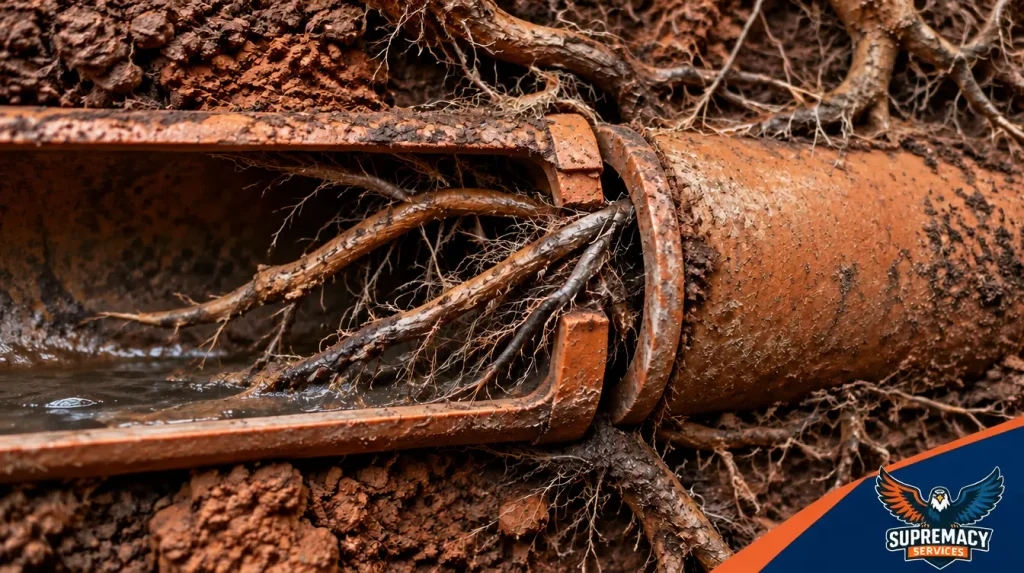
1. Cracks and damaged pipe joints
Underground sewer lines can develop defects as they age or move.
A small opening may allow moisture to escape into surrounding soil. Roots growing nearby can exploit that opening and extend into the pipe.
The U.S. Environmental Protection Agency identifies tree roots entering through sewer defects or openings as a potential cause of wastewater blockages.
2. Aging sewer pipe materials
Some older homes have sewer lines constructed from clay or cast iron.
Clay pipes may have multiple joints, while older cast-iron pipes can experience corrosion and deterioration.
These conditions can create opportunities for root intrusion.
However, pipe age alone does not prove that roots are present. A newer PVC line with a damaged connection can also experience root intrusion.
3. Soil movement around underground pipes
North Texas soils can expand and contract as moisture conditions change.
Where movement affects buried piping, joints may shift or separate, making it easier for roots to enter.
Soil movement does not automatically mean a sewer pipe is damaged, but it is one factor worth investigating when drainage problems keep returning.
4. Nearby trees and shrubs
Tree roots extend through soil in search of favorable growing conditions.
A tree does not have to stand directly above a sewer line for its roots to reach the pipe.
The actual risk depends on root spread, soil conditions, pipe location, and the presence of openings.
Important: A healthy, properly sealed sewer line is less vulnerable to root intrusion than a line with cracks or defective joints.
What Are the Signs of Tree Roots in a Sewer Line?
The most common signs of tree roots in sewer lines are recurring main-drain clogs, several slow drains, gurgling plumbing fixtures, and wastewater backups.

These symptoms can have other causes, so a sewer camera inspection is generally needed to confirm root intrusion.
1. Recurring drain clogs
A drain that repeatedly clogs after being cleared may indicate a persistent obstruction.
For example, a homeowner might have a sewer line cleaned, experience normal drainage for several weeks, and then notice the same symptoms returning.
Roots may have been cut back without repairing the pipe opening.
2. Multiple slow drains
When several fixtures drain slowly at the same time, the restriction may be located in a shared sewer line.
Watch for combinations such as:
- A slow bathtub and shower
- Toilets flushing poorly
- A kitchen sink draining slowly while other fixtures are affected
- Water backing up when the washing machine empties
One slow sink is more likely to have a localized blockage. Several affected fixtures make a main-line restriction more concerning.
3. Gurgling toilets and drains
A toilet may gurgle when wastewater flowing through a restricted drainage system displaces air through another fixture.
You might hear bubbling after using the shower, draining a sink, or running the washing machine.
Gurgling alone does not prove that roots are present, but it deserves attention when accompanied by recurring clogs.
4. Sewage backing up into the house
A serious obstruction can prevent wastewater from leaving the home normally.
Wastewater may then emerge through a lower-level shower, bathtub, floor drain, or toilet.
If sewage is backing up, stop using water-producing fixtures and avoid contact with contaminated water. Arrange professional assistance promptly. Supremacy services
5. Unusual sewer odors
A damaged sewer pipe may release wastewater into surrounding soil.
Depending on the location and severity of the problem, homeowners might notice persistent sewage odors near the affected area.
An odor alone cannot identify the cause, but it can be another reason to investigate.
6. Wet or unusually green patches of lawn
A leaking sewer line may create an unusually damp area or encourage localized plant growth.
However, irrigation leaks, drainage problems, and other underground water sources can produce similar symptoms.
A wet patch should not be treated as proof of root intrusion without further inspection.
7. Problems that return after drain cleaning
This is one of the more useful warning signs.
A drain-cleaning machine may cut through a root mass and restore flow temporarily. But if the pipe remains cracked or separated, roots can enter again.
Repeatedly paying for drain cleaning without inspecting the pipe may leave the underlying problem unresolved.
When to call a plumber: If several fixtures are affected or the same main-line blockage keeps returning, consider a professional sewer line repair and replacement assessment rather than another temporary clearing.
Can Tree Roots Damage or Break Sewer Pipes?
Yes. Tree roots can contribute to sewer pipe damage, particularly when they grow through existing cracks or joints and expand within those openings.
However, the relationship between roots and pipe damage is not always straightforward.
Often, the pipe already has a defect that allows roots to enter. Growing roots may then worsen that defect or create increasingly severe obstructions.
Common types of root-related sewer damage
| Type of damage | What happens | Potential consequence |
|---|---|---|
| Root blockage | Roots grow across the pipe interior | Slow drains and backups |
| Joint intrusion | Roots enter through separated joints | Recurring clogs and leakage |
| Cracked pipe | Roots exploit or worsen an opening | Wastewater escaping into soil |
| Pipe displacement | Sections become misaligned | Poor drainage and repeated blockages |
| Severe structural deterioration | The pipe loses its ability to carry wastewater reliably | Major repair or replacement |
Can roots cause a complete sewer blockage?
Yes.
A dense root mass can restrict wastewater flow significantly. Toilet paper and other solids may become trapped, increasing the obstruction.
In severe cases, the sewer may stop draining normally.
Can tree roots damage a home’s foundation?
A damaged underground sewer pipe can contribute to moisture problems around a property.
Where leakage causes significant soil saturation or erosion, nearby structures may be affected.
However, foundation damage cannot be attributed to sewer roots without evaluating the actual conditions.
A plumber may need to coordinate with a foundation or structural specialist if substantial soil movement or structural damage is suspected.
How Do Plumbers Detect Tree Roots?
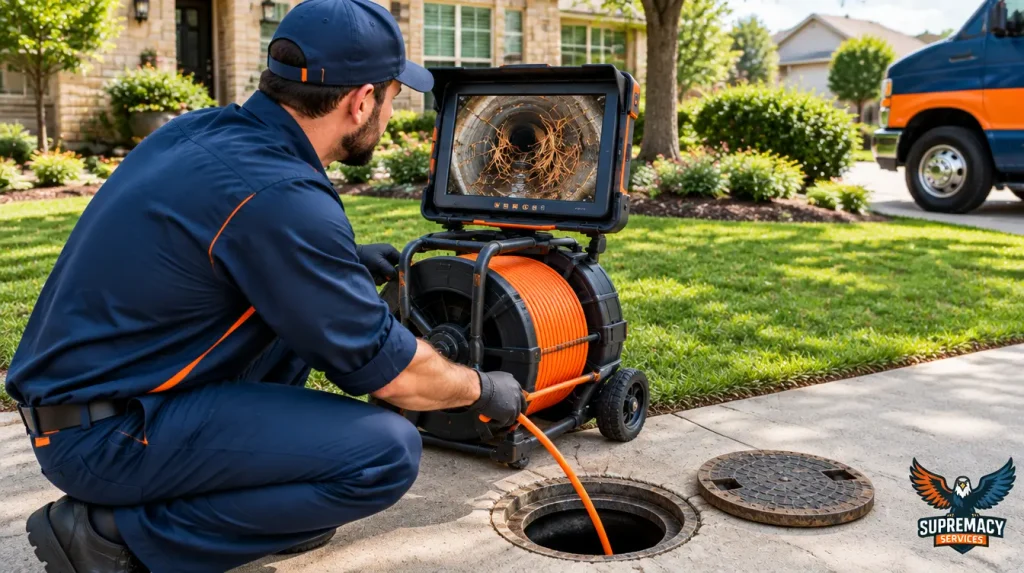
A sewer camera inspection is one of the most useful methods for confirming root intrusion.
A plumber inserts a specialized waterproof camera into the sewer line, typically through an accessible cleanout.
The camera allows the technician to examine the pipe interior and identify visible obstructions or damage.
What a sewer camera can reveal
- Root masses entering through joints
- Cracks and openings in pipe walls
- Misaligned pipe connections
- Heavy buildup or other obstructions
- Standing water in low sections
- Visible signs of structural deterioration
If the pipe is heavily blocked, some cleaning may be necessary before the camera can inspect the full length.
What happens during a professional inspection?
Step 1: Review the symptoms. The plumber asks which fixtures are affected, when the problem began, and whether previous cleaning has helped.
Step 2: Access the sewer line. An existing cleanout is located, or another suitable access point is selected.
Step 3: Inspect the pipe. Camera footage helps identify visible roots and other defects.
Step 4: Locate the problem. Where equipment and site conditions permit, the technician may locate the affected section from above ground.
Step 5: Recommend a solution. The plumber explains whether cleaning, localized repair, rehabilitation, or replacement is appropriate.
Ask to see the relevant camera footage and understand the pipe’s condition before authorizing major repairs.
How Are Tree Roots Removed From Sewer Lines?
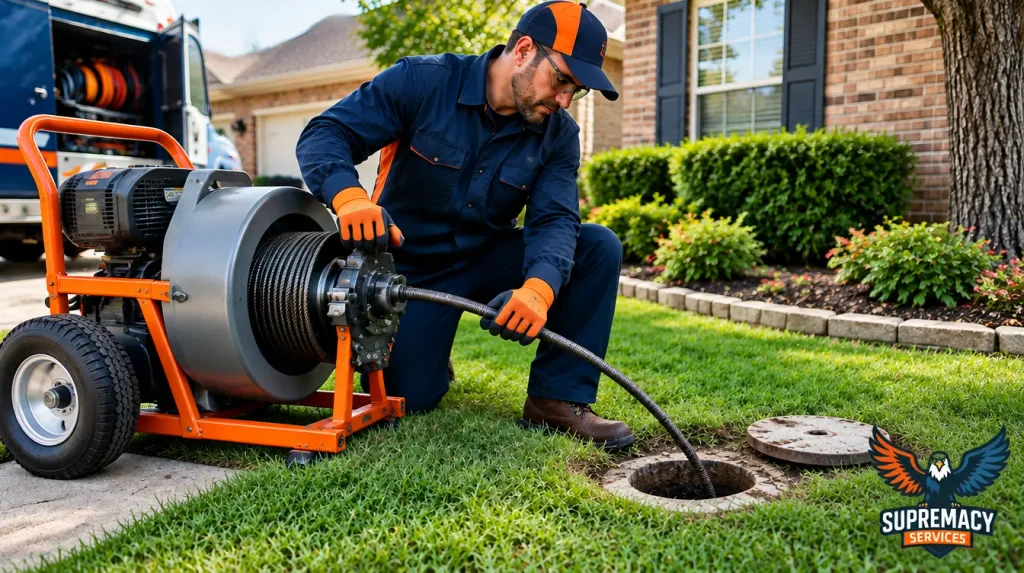
Professional tree-root removal typically involves mechanical cutting or hydro jetting. If the pipe is structurally damaged, repair or replacement may also be needed.
The correct approach depends on the extent of the root intrusion, pipe material, accessibility, and structural condition.
1. Mechanical root cutting
Mechanical root cutting uses a specialized drain-cleaning machine with an appropriate cutting attachment.
The rotating cutter breaks apart or trims roots inside the pipe.
Best suited for: Accessible root obstructions in pipes that can safely tolerate mechanical cleaning.
Advantages:
- Can reopen a blocked sewer line
- Often requires no excavation
- May provide relatively quick relief
Limitations:
- Roots can return through unrepaired openings
- Cutting does not restore damaged joints
- Fragile pipes may be unsuitable for aggressive mechanical cleaning
Mechanical cleaning should be selected according to the pipe’s condition rather than used indiscriminately.
2. Hydro jetting
Hydro jetting uses pressurized water delivered through specialized equipment to remove buildup and, with suitable tools and conditions, certain root obstructions.
It can also remove grease and debris that have accumulated around roots.
Best suited for: Pipes that are structurally sound enough for the selected equipment and pressure.
Advantages:
- Can clean substantial buildup
- Helps restore the pipe’s usable interior
- May be useful after mechanical root cutting
Limitations:
- Not every root mass can be removed by water pressure alone
- Damaged or fragile pipes require careful evaluation
- Does not seal cracks or defective joints
Hydro jetting should not be treated as a universal solution for root intrusion.
3. Localized sewer pipe repair
If a camera inspection reveals a damaged joint or a short section of broken pipe, localized repair may be appropriate.
A plumber may excavate the affected area and replace the damaged section with suitable piping and connections.
Best suited for: A limited defect with otherwise serviceable pipe on both sides.
The key advantage is that the repair addresses the actual entry point instead of merely removing roots.
4. Trenchless pipe lining
Cured-in-place pipe lining, commonly called CIPP, rehabilitates a suitable existing pipe by installing and curing a liner inside it.
The resulting liner creates a new interior pipe surface.
Best suited for: Certain damaged sewer lines that retain an appropriate shape and can be prepared for lining.
A contractor must evaluate the pipe’s structural condition, geometry, access, and suitability.
Lining may not be appropriate for a severely collapsed or badly displaced pipe.
5. Pipe bursting or replacement
Pipe bursting replaces an existing pipe by breaking or splitting it while pulling a new pipe through the route.
Other situations require conventional excavation and replacement.
Best suited for: Pipes that cannot be reliably restored through cleaning or localized repair, subject to site conditions and method suitability.
The best option depends on the existing pipe, utility conflicts, access, alignment, and local requirements.
Root Removal vs. Sewer Repair vs. Replacement
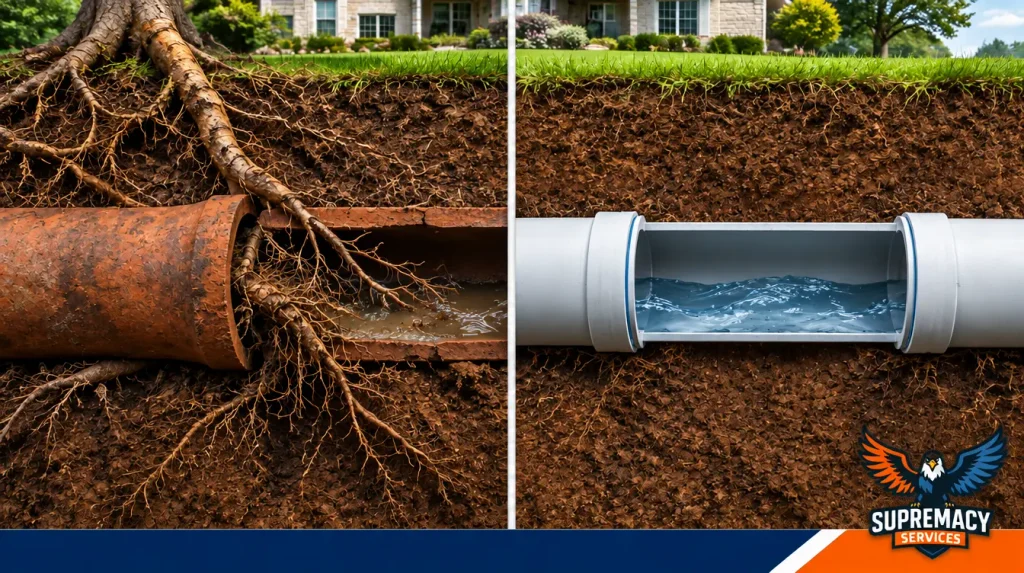
Removing tree roots and repairing a sewer pipe are not the same thing.
Root removal addresses the obstruction. Repair addresses a defect. Replacement addresses piping that is no longer suitable for continued service.
| Situation | Likely option to evaluate | Main consideration |
|---|---|---|
| Limited roots, pipe otherwise serviceable | Mechanical cleaning or hydro jetting | Restore flow and assess recurrence risk |
| Roots at one damaged joint | Localized repair | Seal or replace the entry point |
| Multiple defects in a suitable pipe | Trenchless rehabilitation | Restore pipe integrity |
| Extensive deterioration or collapse | Replacement | Install a reliable sewer line |
| Repeated blockages with unknown cause | Camera inspection | Establish the actual condition first |
Is cleaning enough?
Sometimes.
If the pipe remains structurally serviceable and the homeowner understands the recurrence risk, cleaning may be a reasonable management option.
However, recurring roots through a significant opening usually warrant a discussion about repairing that defect.
When is replacement the better choice?
Replacement may be appropriate when there are widespread defects, severe deterioration, major displacement, or collapse.
A single root intrusion does not automatically justify replacing an entire sewer line.
Need help deciding? Supremacy Services offers sewer line repair and replacement options in Dallas and DFW. A camera-based assessment can help determine whether clearing the roots is sufficient or whether the pipe itself needs attention.
How Much Does Sewer Root Removal Cost?
Sewer root removal costs depend on the cleaning method, pipe condition, obstruction severity, access, and whether structural repairs are required.
There is no reliable single price that applies to every Dallas property.
A relatively accessible root blockage may require only professional cleaning. A pipe with extensive damage may require excavation, rehabilitation, or replacement, which involves a substantially different scope of work.
Factors that affect the final cost
Severity of root intrusion: A small obstruction is different from a dense root mass extending through multiple joints.
Pipe condition: Fragile or deteriorated pipes may require additional precautions or repair.
Depth and location: Access beneath a driveway, patio, or other obstruction can complicate repairs.
Cleaning method: Mechanical cutting and hydro jetting involve different equipment and labor requirements.
Camera inspection: Diagnostic work may be included in a service package or quoted separately.
Structural damage: Cracks, separated joints, and collapse can change the project from cleaning to repair or replacement.
Restoration: Excavation may require restoring soil, paving, or landscaping.
What should a sewer root removal estimate include?
Ask whether the quote covers inspection, access, cleaning, removal of debris, post-cleaning camera footage, and any recommended repair.
If major work is proposed, request an explanation of the defect and why the recommended method is suitable.
Avoid comparing estimates based solely on their total price when the scopes of work differ.
Can You Remove Tree Roots Yourself?
Homeowners can recognize warning signs and reduce water use during a suspected blockage, but cutting roots inside an underground sewer line is generally better handled by a qualified plumbing professional.
Why chemical root killers require caution
Chemical products marketed for sewer roots vary in their active ingredients, instructions, and restrictions.
They should not be assumed safe for every pipe, plumbing system, or wastewater application.
Chemical treatment also cannot repair a cracked pipe or separated joint.
Do not mix drain-cleaning chemicals or pour unapproved substances into the sewer.
Why renting a drain auger may be risky
Professional drain-cleaning equipment can injure inexperienced users.
An incorrectly selected cutter or aggressive cleaning method may also damage deteriorated piping.
A homeowner who repeatedly forces a cutting tool through a fragile underground line may make the situation worse.
What homeowners can safely do
- Stop using fixtures if sewage is backing up.
- Keep children and pets away from wastewater.
- Note which fixtures are affected.
- Record when symptoms occur.
- Gather previous sewer inspection or repair records.
- Arrange professional diagnosis for recurring main-line problems.
If sewage has entered living spaces, avoid contact and arrange appropriate cleanup.
Why Is Root Intrusion a Concern in Dallas?
Dallas and surrounding DFW communities contain homes with a wide range of ages, landscaping styles, soil conditions, and sewer pipe materials.
Those differences matter when diagnosing underground drainage problems.
Mature trees near buried sewer laterals
Established trees may have extensive root systems that extend beyond the visible canopy.
Where a sewer lateral has a crack or defective joint within the root zone, roots may enter.
The presence of a large tree does not mean it should automatically be removed.
Repairing the sewer defect may be more appropriate than removing a healthy tree.
Soil movement and pipe alignment
North Texas properties can experience soil movement associated with changing moisture conditions.
Underground pipes may be affected when movement places stress on joints or changes their alignment.
A camera inspection can help determine whether root intrusion is accompanied by displacement or low sections.
Older sewer infrastructure
Some established Dallas neighborhoods have older underground plumbing.
Where clay, cast iron, or other aging pipe materials are present, deterioration and joint defects may increase the need for inspection.
Pipe material should be confirmed rather than assumed from the home’s age.
Who is responsible for sewer root damage?
Property owners are commonly responsible for maintaining their private sewer laterals, while municipal utilities maintain their designated public infrastructure.
However, the exact responsibility depends on the location of the problem and applicable utility rules.
City of Dallas materials identify private lateral maintenance as a homeowner responsibility. If the obstruction may be in the public main or near the connection, confirm the service boundary with Dallas Water Utilities before authorizing repairs.
How Can You Prevent Tree Roots From Returning?
The most effective long-term prevention is to address openings that allow roots into the sewer line.
Routine cleaning can help manage recurring obstructions, but it does not make a damaged pipe watertight.
1. Repair damaged joints and cracks
If camera footage reveals a clear entry point, discuss appropriate repair options.
Sealing or replacing defective pipe sections may reduce the likelihood of repeated intrusion.
2. Plan landscaping around underground utilities
Before planting new trees, identify the location of buried sewer lines and other utilities.
Choose planting locations based on the mature tree’s root spread and site conditions.
Texas811 provides guidance for locating underground utilities before excavation.
3. Avoid unnecessary tree removal
Removing a tree is not always required to solve a sewer-root problem.
A properly designed pipe repair may address the issue while preserving established landscaping.
Consult a qualified arborist when tree health or root management is part of the decision.
4. Schedule follow-up inspections when justified
Homes with previous root intrusion or known pipe defects may benefit from periodic evaluation.
The appropriate interval depends on the pipe’s condition and previous findings.
There is no single inspection schedule that fits every home.
5. Address recurring clogs promptly
Repeated drain problems should not become routine.
If a blockage returns after cleaning, request an explanation of why it keeps happening.
A camera inspection may reveal an underlying issue that conventional drain cleaning cannot resolve.
Frequently Asked Questions About Tree Roots in Sewer Lines
1. Can tree roots grow inside PVC sewer pipes?
Yes. Roots can enter PVC sewer pipes through damaged joints, cracks, or improperly sealed connections. Properly installed, intact piping is generally less vulnerable than piping with existing openings.
2. How long does it take for tree roots to clog a sewer line?
There is no fixed timeline. Root growth and blockage severity depend on the size of the opening, growing conditions, available moisture, and how much debris accumulates inside the pipe.
3. Will tree roots grow back after sewer cleaning?
They can. Mechanical cutting or hydro jetting may remove an obstruction without closing the entry point. If the pipe remains defective, roots may enter again.
4. Can hydro jetting remove tree roots completely?
Hydro jetting can remove certain root obstructions when appropriate equipment is used in a pipe suitable for the procedure. Dense roots may require mechanical cutting, and structural defects may still need repair.
5. Do I need to replace my sewer line if roots get inside?
Not always. Some root problems can be managed through cleaning or localized repair. Replacement is more likely to be considered when the pipe has extensive deterioration, multiple defects, or collapse.
6. Can tree roots enter a sewer line without breaking the pipe?
Yes. Roots may enter through an already separated joint or other existing opening. Root intrusion does not necessarily mean the roots caused the original defect.
7. Will removing the tree fix my sewer problem?
Not necessarily. Removing a tree does not repair cracks, defective joints, or other structural problems in the pipe. A sewer inspection should identify the underlying condition before major landscaping decisions are made.
8. How do I know if roots or grease are clogging my sewer?
Symptoms alone cannot reliably distinguish them. A sewer camera inspection, sometimes after preliminary cleaning, can help identify roots, grease buildup, or structural defects.
9. Is sewer root intrusion an emergency?
It can be. Active sewage backups, wastewater entering living spaces, or a completely blocked main sewer line require prompt attention. Minor recurring drainage symptoms should also be investigated before they become more serious.
10. Can tree roots damage a sewer line beneath a driveway?
Yes. Roots can enter defective underground piping regardless of whether the affected section lies beneath a lawn, driveway, or patio. Repair access and restoration requirements depend on the location and method selected.
Final Thoughts: Fix the Cause, Not Just the Clog
Tree roots in sewer lines are more than an inconvenience when they repeatedly restrict wastewater flow.
Mechanical root removal or hydro jetting may restore drainage, but recurring intrusion can indicate a pipe defect that deserves attention.
The most useful next step is to establish the condition of the sewer line before deciding whether cleaning, localized repair, trenchless rehabilitation, or replacement is appropriate.
For homeowners in Dallas, Plano, Frisco, Richardson, Allen, Fort Worth, and surrounding DFW communities, Supremacy Services provides sewer diagnostics and repair options.
Concerned about roots in your sewer line? Explore Supremacy Services’ sewer line repair and replacement services to arrange an assessment and understand the available solutions before another blockage occurs.

