10400 Clarence Drive, Frisco, TX 75033
Support 24/7: 945-777-3345
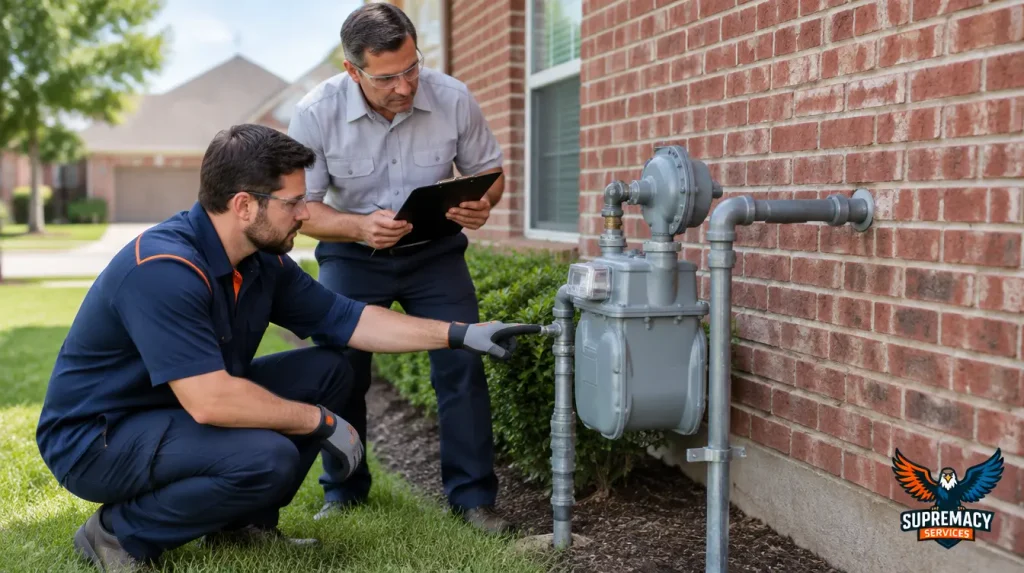
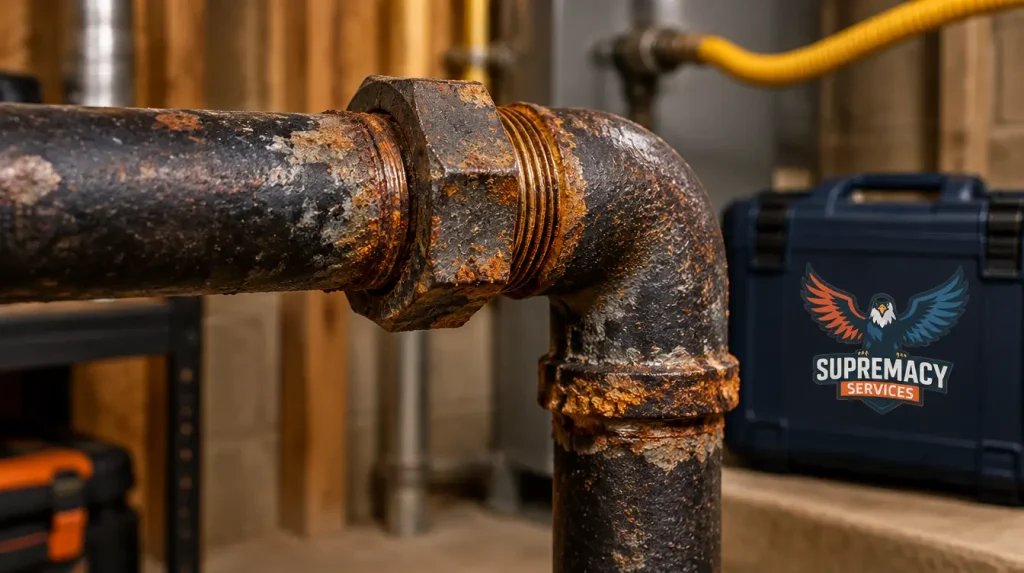
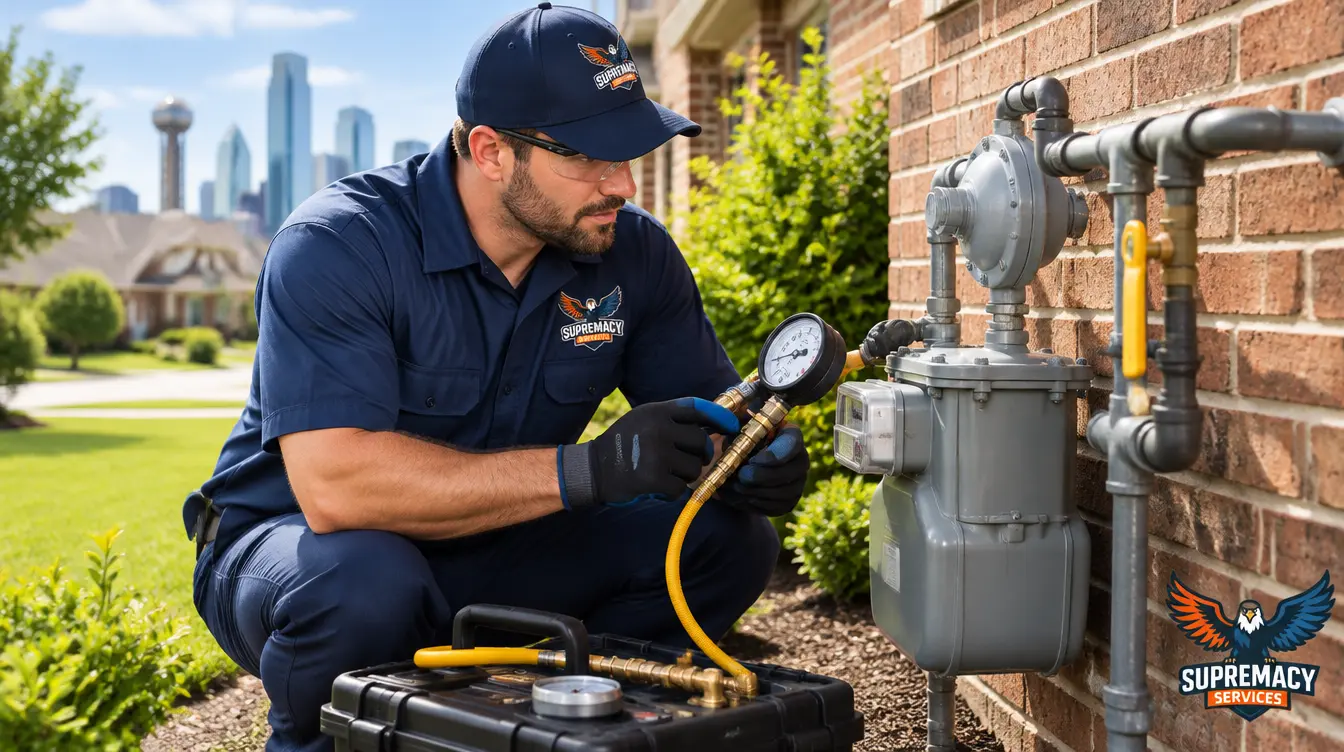
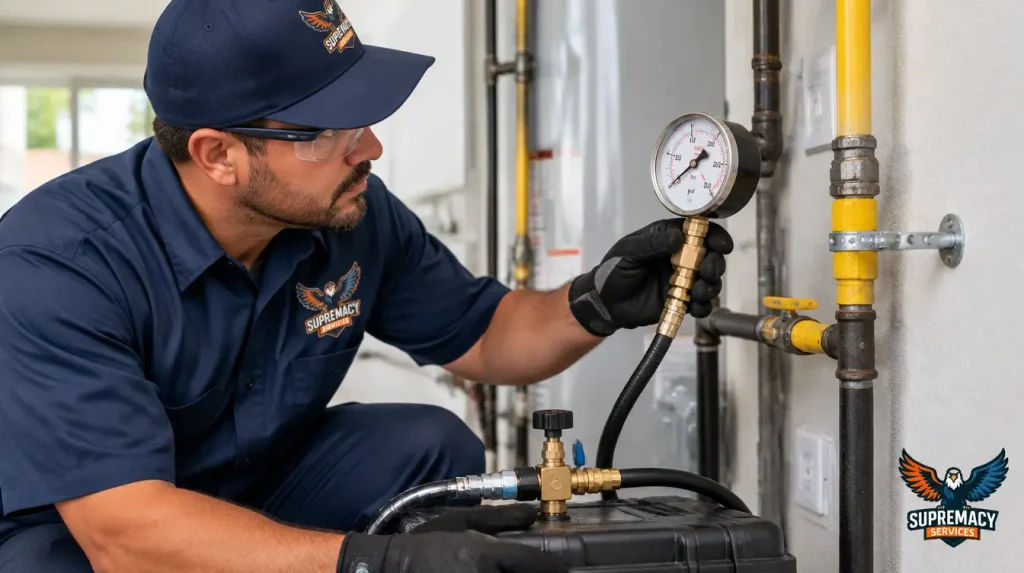
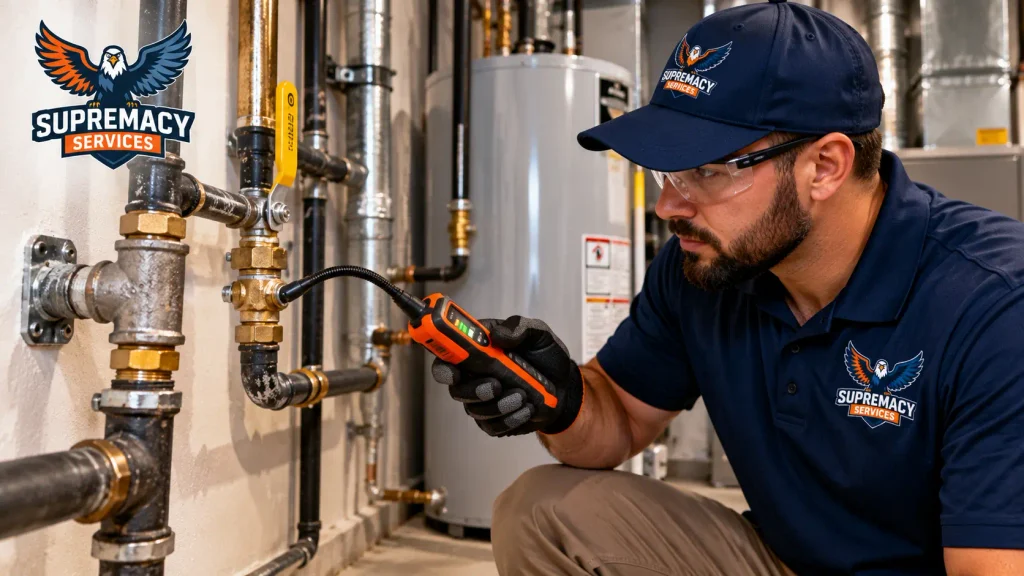
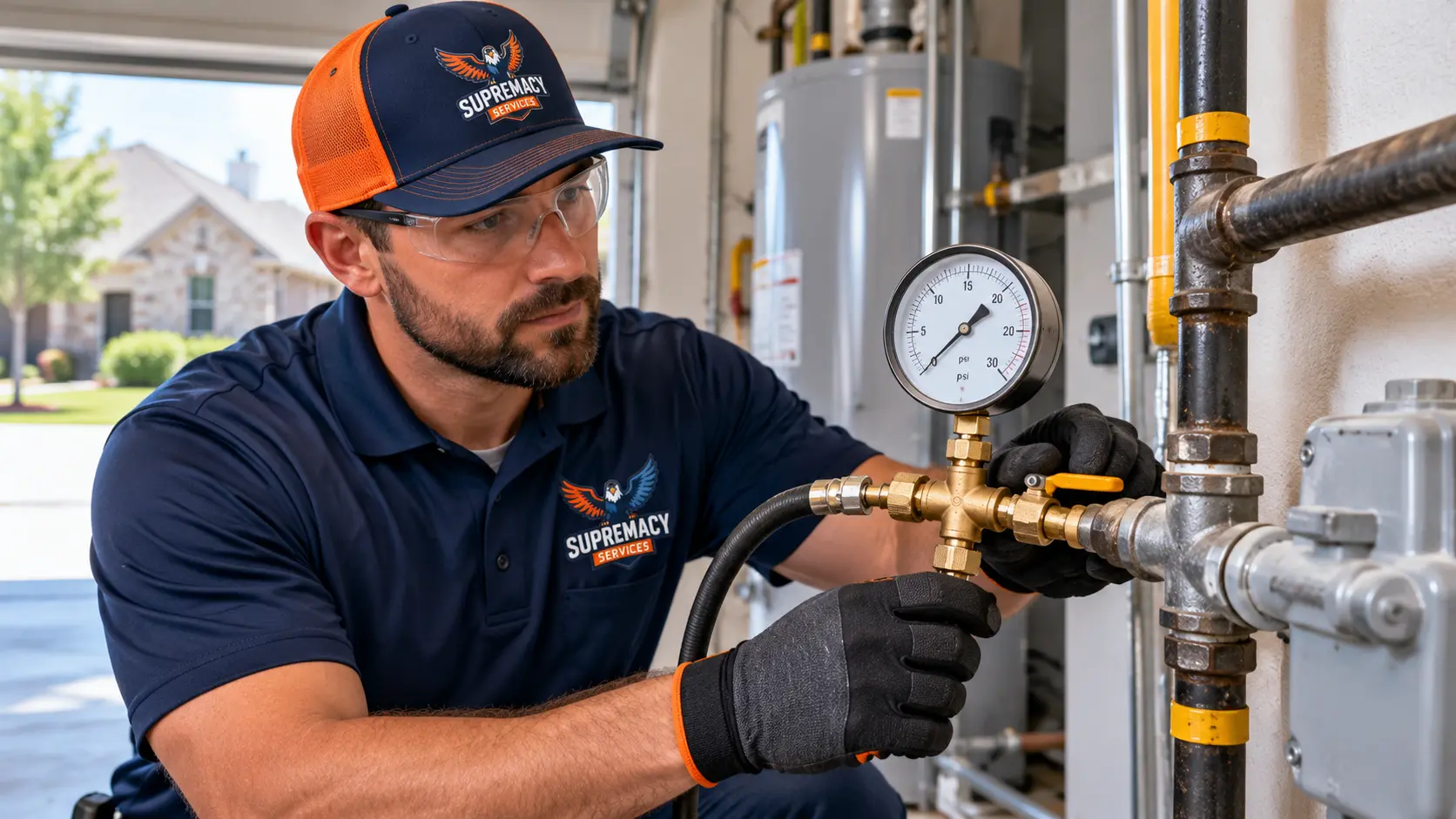
Technician in Supremacy Services workwear checking a pressure gauge connected to residential gas piping.

Gas Line Pressure Testing: What Homeowners Should Know

Gas line pressure testing is a safety procedure used to check whether a home’s gas piping system can hold a specified pressure without leaking. For Dallas homeowners, a pressure test may be necessary after gas line installation or repairs, before certain inspections, or when gas service needs to be restored.

A qualified plumbing professional conducts the test using appropriate equipment, isolates sensitive appliances, monitors the system for pressure loss, and determines whether repairs or further inspection are needed.

If your gas service has been disconnected, passing the required inspection may be necessary before your utility will restore service.

This guide explains when gas pressure testing is needed, how it works, what Dallas requires, and what homeowners should expect.

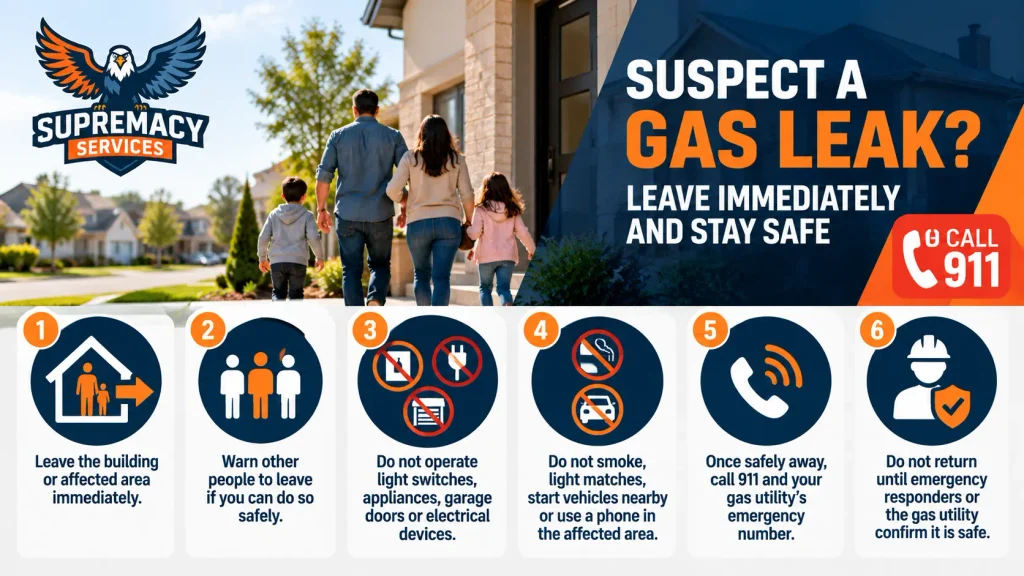
Important safety warning: If you smell gas, hear a hissing sound near gas piping, or suspect an active gas leak, leave the building immediately. Do not operate electrical switches, use a phone inside, start equipment, or attempt a pressure test. From a safe location, call 911 and your gas utility’s emergency number.

Table of Contents

  1. What Is Gas Line Pressure Testing?
  2. When Is a Gas Line Pressure Test Required?
  3. How Does a Professional Gas Pressure Test Work?
  4. Dallas Gas Pressure Testing Requirements
  5. How Long Does a Gas Pressure Test Take?
  6. What Happens If a Gas Line Fails?
  7. How Much Does Gas Pressure Testing Cost?
  8. Gas Pressure Testing vs. Gas Leak Detection
  9. Can Homeowners Pressure Test Their Own Gas Lines?
  10. Preparing for a Gas Line Inspection
  11. Frequently Asked Questions
  12. Schedule Professional Gas Line Assistance

What Is Gas Line Pressure Testing?

Gas line pressure testing is a procedure that checks the integrity of a gas piping system by applying an approved test medium at a specified pressure and observing whether that pressure remains stable for the required period.

The purpose is to identify piping systems that may have leaks, defective connections, or other problems before they are placed into service or returned to operation.

A typical residential gas system may supply several appliances, including:

  • Gas furnaces and heating systems
  • Water heaters
  • Gas ranges and cooktops
  • Clothes dryers
  • Fireplaces
  • Outdoor grills and kitchen appliances

The piping and fittings connecting these appliances must be properly installed and maintained.

Why is pressure testing important?

A gas piping leak can create a serious fire or explosion hazard. Pressure testing provides a controlled way to evaluate the piping system before gas is introduced or service resumes.

A successful pressure test helps demonstrate that the tested piping held pressure under the test conditions. However, it does not replace appliance safety checks, operating-pressure verification, or any other inspections required by the authority having jurisdiction.

A pressure test is not a guarantee that a gas system will remain leak-free indefinitely.

When Is a Gas Line Pressure Test Required?

Gas line pressure testing is commonly associated with new piping installations, alterations, repairs, inspections, and certain gas service restoration situations.

Not every gas service interruption automatically requires a full pressure test. The specific requirements depend on why service was interrupted, the condition of the piping, and the rules of the local inspection authority and gas utility.

1. After installing new gas piping
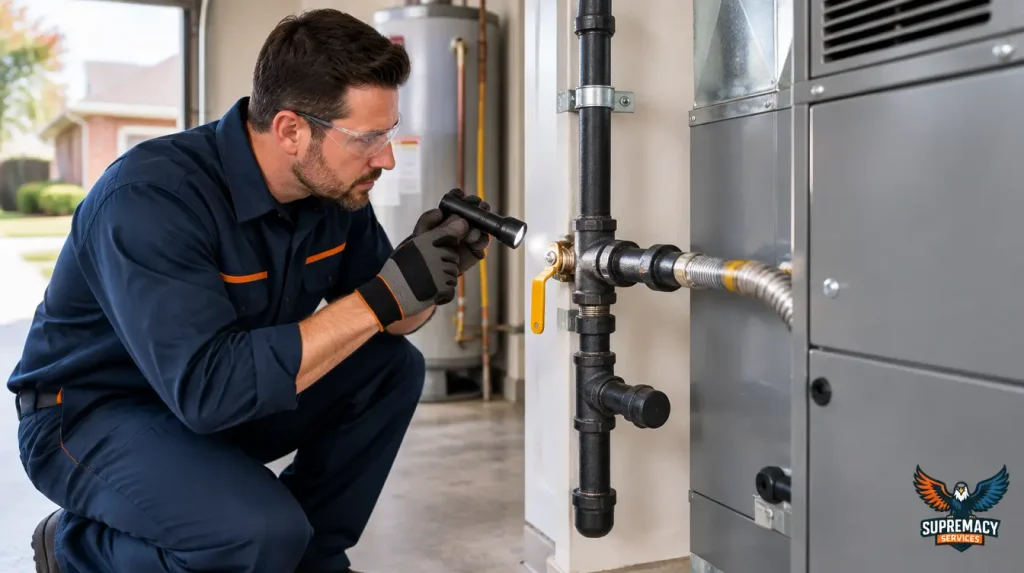
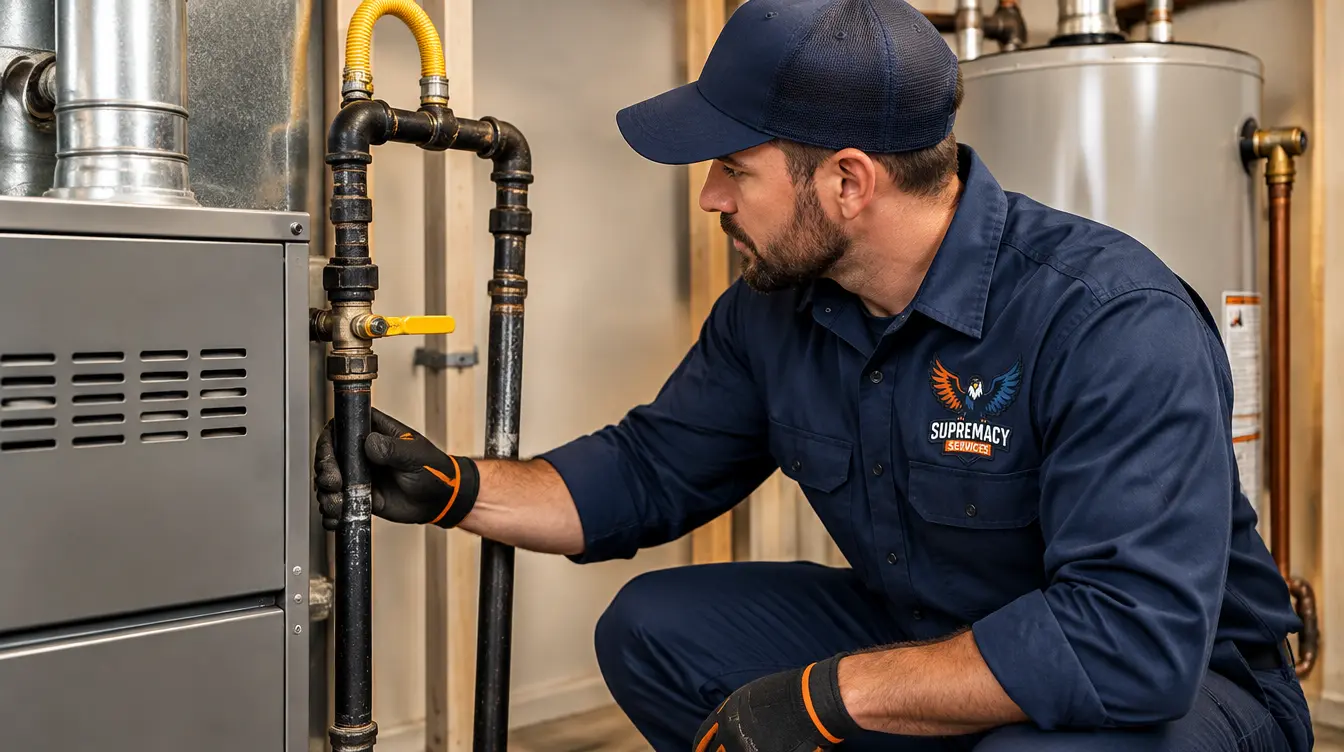
Plumber using a flashlight to inspect gas pipe connections beside a residential furnace.
A technician examines accessible gas piping and connections beside a home heating system.

If you install a new gas line for a stove, water heater, furnace, fireplace, or outdoor kitchen, the new piping generally requires testing as part of the applicable installation and inspection process.

The test helps verify that the installed piping and its connections meet the relevant requirements before use.

2. Following gas line repairs or modifications

When a gas line is repaired, extended, or altered, testing may be required to verify the integrity of the affected piping.

The scope of testing depends on the work performed and applicable requirements.

For homeowners considering repairs, Supremacy Services provides gas line repair and diagnostic services in Dallas, including pressure testing and leak inspections.

3. Before restoring disconnected gas service

A gas utility may require inspection approval before restoring service after certain disconnections.

In Dallas, a plumbing permit and inspection may be required depending on the circumstances surrounding the interruption.

Examples that warrant checking the requirements include:

  • Service disconnected because of a suspected gas leak
  • Gas piping damaged during renovation
  • Piping altered while a property was vacant
  • Service restoration delayed pending a safety inspection
  • A utility requiring clearance before reconnection

Contact the utility and Dallas Planning & Development to establish the exact requirements for your property.

4. During a home renovation

Projects involving relocated gas appliances or new piping can trigger testing and inspection requirements.

For example, converting an electric range to gas may involve installing a new gas supply line. Similarly, an outdoor kitchen project may require a new branch line, correctly sized piping, and inspection.

5. When a gas system has a suspected problem

A professional may recommend pressure testing when evaluating a suspected piping leak.

However, if there is an active gas odor or other immediate danger, emergency procedures take priority over scheduling a routine test.

How Does a Professional Gas Pressure Test Work?

A professional gas pressure test involves preparing the system, isolating equipment that must not be exposed to test pressure, applying the appropriate test medium, monitoring the gauge, and evaluating the result.

The precise method depends on the piping system, applicable code, and inspection requirements.

Step 1: Review the gas piping system

The plumber identifies the piping sections involved, checks accessible connections, and determines which appliances and components must be isolated.

The inspection may include visible signs of corrosion, damage, improper connections, or previous alterations.

Step 2: Isolate appliances and sensitive equipment

Gas appliances, regulators, and other components may not be designed to withstand the pressure used to test the piping.

The technician must isolate or disconnect these components as required by the applicable code and equipment instructions.

This is one reason homeowners should not attempt to pressurize their own gas piping.

Step 3: Connect approved testing equipment
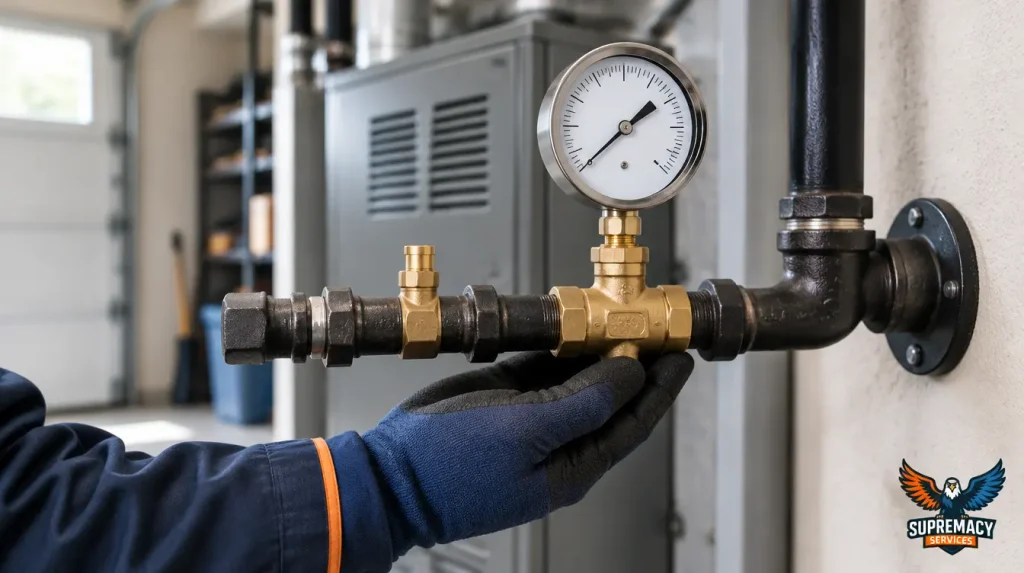
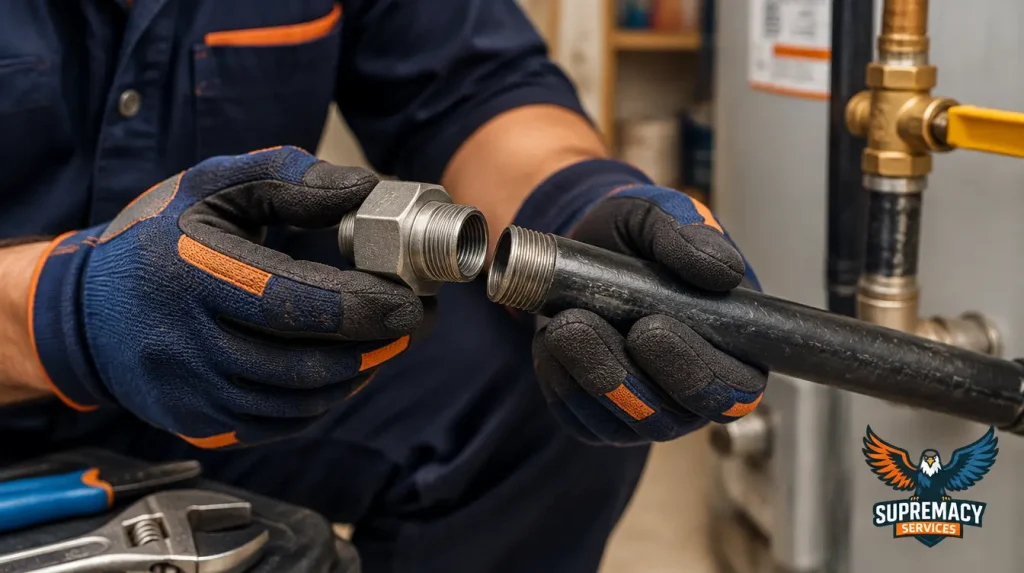
Close-up of a pressure test gauge and brass fittings attached to black iron gas piping.
A closer look at the pressure gauge and fittings in a residential gas piping test setup.

The technician connects suitable pressure-measuring equipment to the isolated piping system.

The test medium and pressure must comply with the applicable requirements. Professional fuel gas piping tests commonly use air or an approved inert medium rather than natural gas.

Oxygen must not be used as a pressure-testing medium.

Step 4: Monitor the pressure

After the system is properly prepared and pressurized, the technician observes the measuring instrument for the required test duration.

The pressure reading is evaluated according to the applicable procedure, including any necessary consideration of environmental conditions.

A pressure loss may indicate leakage or another condition requiring investigation.

Step 5: Investigate any failed test

If the system does not hold pressure as required, the plumber investigates the cause.

The problem may involve a defective fitting, damaged piping, an improperly sealed connection, or another issue.

The affected components must be corrected and the required testing repeated.

Step 6: Complete the inspection and restoration process

Where an official inspection is required, the appropriate inspector must witness or approve the test according to local procedures.

The contractor and utility then coordinate any remaining steps necessary before service can safely resume.

A passing test alone does not authorize a homeowner to reconnect gas service or bypass a utility lockout.

Dallas Gas Pressure Testing Requirements

The City of Dallas publishes specific guidelines for gas testing associated with establishing or re-establishing fuel gas service.

Its November 13, 2025 Gas Test Guidelines identify several important requirements for qualifying residential and commercial situations.

What does Dallas require?

For the gas tests covered by the published guidelines:

RequirementCity of Dallas guidance
Test pressure3 psig
Minimum witnessed test duration15 minutes
Measuring equipmentApproved diaphragm test gauge
InspectorCity of Dallas plumbing inspector
Piping scopeFuel gas piping beginning at the meter, including yard service and structures on the property
Appliance accessInspector requires access to gas-supplied appliances
PermitPlumbing permit required for the covered circumstances
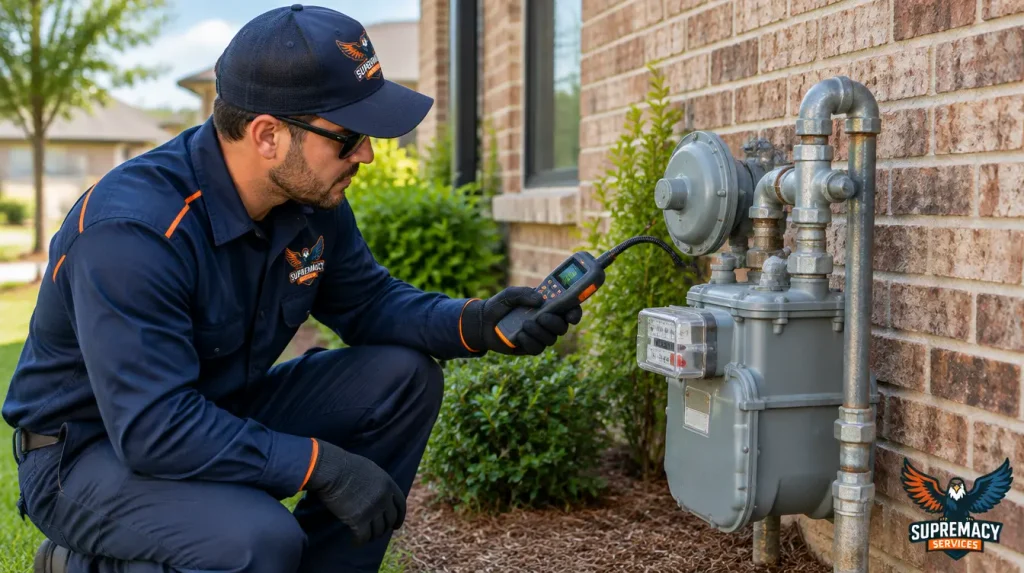
Two plumbing professionals examining an exterior gas meter and piping beside a brick house.
An exterior inspection scene showing the gas meter, accessible piping and inspection paperwork.

These are the requirements described in the City’s gas-service restoration guidance, not a universal testing procedure for every type of gas piping work.

The City also identifies qualifying conditions under which an owner-occupant may obtain a homeowner plumbing permit. A homeowner permit does not waive compliance with plumbing codes.

For complete details, review the City of Dallas Gas Test Guidelines.

Do Plano, Frisco, Allen, and other DFW cities follow the same rules?

Not necessarily.

Although many North Texas jurisdictions use related model plumbing and fuel gas codes, individual cities may have different adopted editions, amendments, permit procedures, inspection requirements, and utility coordination processes.

Homeowners in Plano, Frisco, Allen, Richardson, Garland, Irving, and surrounding communities should confirm the rules with their own municipality before scheduling work.

What about Texas licensing?

Texas regulates the plumbing trade through the Texas State Board of Plumbing Examiners.

Before hiring a plumbing contractor, homeowners can verify the contractor’s plumbing license and insurance information.

For natural gas piping, use professionals authorized to perform the work. Propane systems may be subject to additional licensing and safety requirements administered by the Railroad Commission of Texas.

How Long Does a Gas Pressure Test Take?

The required pressure-holding period may be relatively short, but the complete appointment often takes longer because the system must be prepared, isolated, tested, inspected, and returned to the appropriate condition.

For the situations covered by Dallas’s published gas test guidelines, the city inspector witnesses a minimum 15-minute test.

That does not mean the entire service appointment takes only 15 minutes.

Additional time may be needed for:

  • Accessing the meter and piping
  • Isolating gas appliances
  • Setting up approved testing equipment
  • Identifying and correcting leaks
  • Coordinating the city inspection
  • Completing utility restoration requirements

If a system fails, repair and retesting can extend the process.

Homeowners should ask whether the appointment includes only the initial test or also diagnostics, repairs, inspection coordination, and follow-up testing. Supremacy services

What Happens If a Gas Line Fails a Pressure Test?

A failed gas pressure test means the system did not satisfy the required test conditions. The piping must be investigated and any defects corrected before it can pass the required testing.
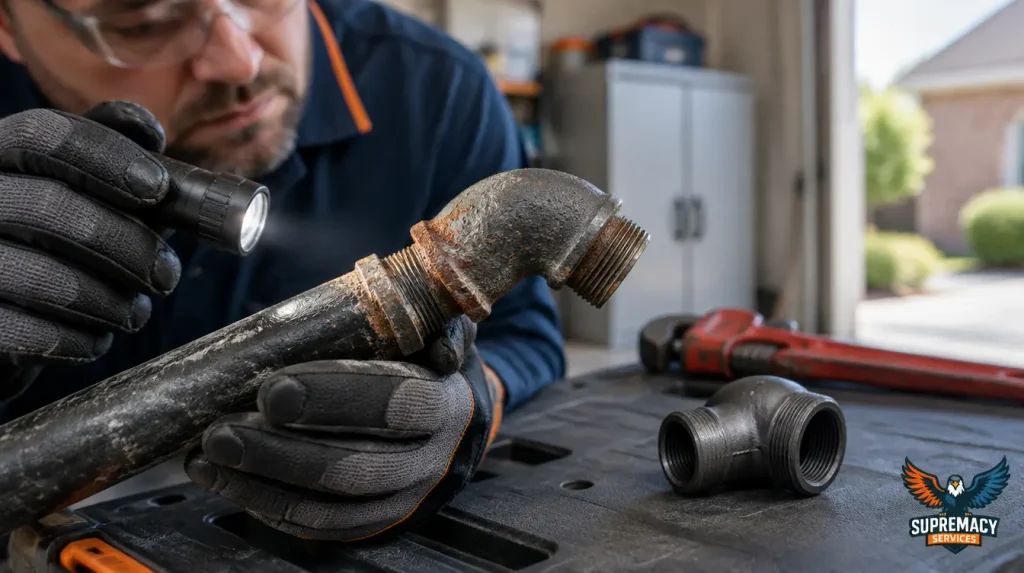
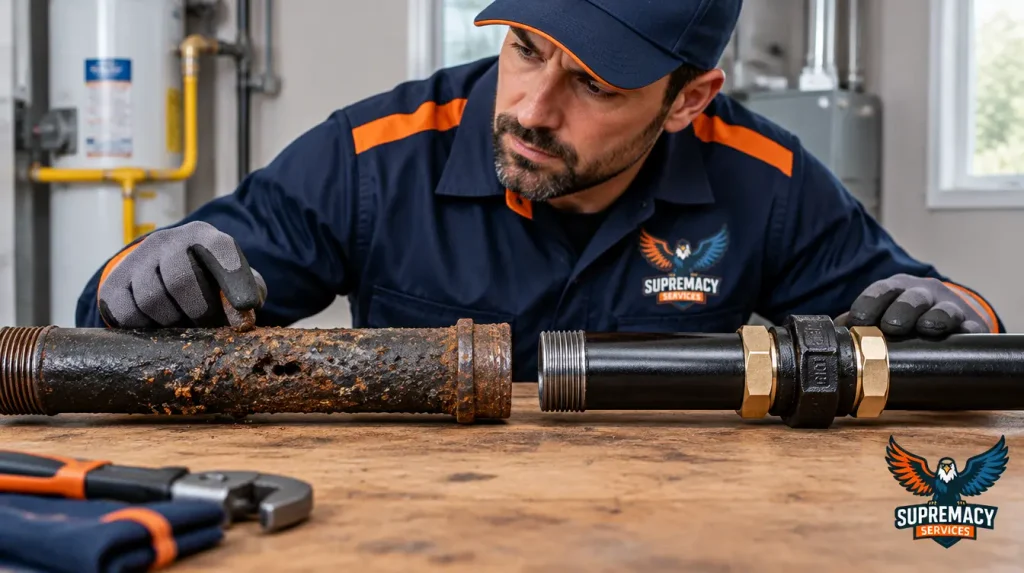
Gloved technician examining a corroded threaded pipe fitting with a flashlight above a workbench.
A removed pipe fitting is examined during a repair assessment.

A failed result does not automatically mean every gas pipe in the house needs replacement.

Common reasons a gas pressure test may fail

Loose or defective connections

Threaded joints, fittings, and other connections can develop leaks because of damage, improper installation, or deterioration.

Corroded piping

Metal piping may deteriorate over time, particularly where corrosion protection is inadequate or moisture exposure occurs.

Damaged gas lines

Construction, excavation, remodeling, or accidental impact can damage piping.

Problems with previous modifications

Improperly installed branches, incompatible components, or defective connections can create leak points.

Test setup problems

Incorrect isolation, unsuitable equipment, or another procedural issue may affect the result and must be ruled out by the professional conducting the test.

Does a failed pressure test mean the entire gas line must be replaced?

No. The necessary repair depends on the condition and extent of the problem.

FindingPotential professional response
Isolated leaking fittingRepair or replace the affected fitting
Damaged pipe sectionReplace the damaged section
Multiple deteriorated sectionsEvaluate partial or more extensive replacement
Defective recent alterationCorrect the installation and retest
Unclear source of pressure lossPerform further diagnostics

After the repair, the system must undergo the required testing and approval process.

If you have been told your property failed a gas pressure test, Supremacy Services can help evaluate the piping and discuss gas line repair options.

How Much Does Gas Pressure Testing Cost in Dallas?

Gas line pressure testing costs depend on the system, the reason for testing, the required inspection, and whether repairs are necessary.

There is no single reliable flat price that applies to every Dallas home.

Factors affecting the cost

Cost factorWhy it matters
Number of gas piping branchesMore connections and sections may require additional preparation
AccessibilityConcealed or difficult-to-reach piping can complicate diagnostics
Test scopeA limited section and a whole-property test involve different work
Appliance isolationAdditional appliances may require more preparation
Permit and inspectionMunicipal fees and coordination can affect the total
Failed testLeak detection, repairs, and retesting may add costs
Service restorationUtility requirements may involve additional coordination

Questions to ask before accepting a quote

  • Does the price include the initial pressure test?
  • Is leak diagnosis included if the test fails?
  • Are repairs quoted separately?
  • Are permit and inspection fees included?
  • Does the contractor coordinate with the city or gas utility?
  • Will retesting cost extra?
  • What documentation will I receive?

The Texas State Board of Plumbing Examiners recommends obtaining clear written estimates and understanding the scope of work before hiring a plumbing contractor.

Avoid relying on an advertised test price without knowing whether it includes inspection, leak repairs, and any required follow-up visit.

Gas Pressure Testing vs. Gas Leak Detection

Gas pressure testing and gas leak detection are related services, but they answer different questions.

Pressure testing evaluates whether a piping system holds pressure under defined conditions. Leak detection helps identify where gas may be escaping.

FeaturePressure testingLeak detection
Main purposeEvaluate piping integrityLocate a suspected leak
Typical equipmentPressure gauge and approved test setupGas detection instruments, approved leak-detection methods
Common situationNew installation, repair verification, service restorationGas odor, suspected leak, failed test
Identifies exact leak location?Not necessarilyIntended to locate the source
May require city inspection?Yes, in applicable circumstancesDepends on the work and circumstances

A plumber may use both approaches during the same project.

For example, a pressure test may reveal that the piping cannot hold pressure. The technician then performs additional diagnostics to identify the defective connection or damaged section.

After the problem is corrected, the required testing is repeated.

What if your gas appliance is not working?

A furnace that fails to ignite or a stove burner that does not light does not necessarily mean the home’s piping has a leak.

Possible explanations include an appliance malfunction, an interrupted gas supply, a closed valve, an ignition problem, or another equipment issue.

Professional diagnosis helps distinguish appliance problems from piping problems without exposing the homeowner to unnecessary risks.

Can Homeowners Pressure Test Their Own Gas Lines?

Gas pressure testing is not a recommended DIY project.

Although Dallas has a limited homeowner-permit pathway for qualifying residential properties, that does not make gas pressure testing a suitable task for an untrained homeowner.

Improper testing can damage components, produce misleading results, or create dangerous conditions.

Why professional testing matters

A qualified professional understands:

  • Applicable fuel gas code requirements
  • Appropriate test pressure and duration
  • Proper appliance and regulator isolation
  • Suitable test instruments and media
  • How to evaluate pressure readings
  • Required repair and retesting procedures
  • Permit and inspection coordination

Homeowners should never use oxygen to pressure-test gas piping, attempt to defeat a meter lock, or reconnect service that the utility has disconnected for safety reasons.

If you suspect an active gas leak, evacuate and contact emergency services rather than attempting to locate or test the leak yourself.

Preparing for a Gas Line Inspection

Homeowners can help make a scheduled inspection more efficient without handling the gas piping themselves.

Homeowner preparation checklist

  • Confirm whether the property needs a permit or city inspection.
  • Ask the contractor which parts of the gas system will be tested.
  • Provide access to the gas meter and accessible piping.
  • Make gas appliances accessible for inspection.
  • Tell the plumber about recent renovations or appliance replacements.
  • Share any notice received from the gas utility.
  • Ask who will coordinate inspection approval and service restoration.
  • Request written documentation of the findings and repairs.

Do not disconnect appliances, remove caps, adjust regulators, or manipulate gas valves in preparation for the appointment.

What should you receive after testing?

Depending on the work performed, useful documentation may include the test result, repair details, permit or inspection status, and instructions for any remaining utility coordination.

If a defect is found, request an explanation of the problem and a written estimate before authorizing non-emergency repairs.

Plumber and homeowner reviewing gas piping inspection paperwork together at a kitchen island.
Discuss the inspection findings, proposed work and remaining steps with your contractor.

Frequently Asked Questions

1. Is gas line pressure testing required in Dallas?

It is required in certain circumstances, including gas service establishment or restoration situations covered by the City’s published guidelines. Other installations, alterations, or repairs may have their own testing and inspection requirements.

2. What pressure is used for a residential gas test in Dallas?

Dallas’s November 2025 gas-service testing guidelines specify 3 psig for the tests they cover, witnessed by a city plumbing inspector for at least 15 minutes. Different testing circumstances may be governed by other requirements.

3. Can a gas line pass a pressure test and still have a problem?

Yes. A pressure test evaluates the tested piping under specific conditions. It does not replace appliance inspections, combustion safety checks, or all other gas system diagnostics.

4. Does a gas pressure test find the exact location of a leak?

Not necessarily. A failed test indicates a problem with the system or test conditions. Additional leak-detection procedures may be needed to identify the exact source.

5. Can gas be turned back on immediately after a passing test?

Not always. If a city inspection or utility authorization is required, those steps must be completed before service restoration. A passing test does not override a utility disconnection.

6. Can a gas pressure test damage a furnace or water heater?

Improper testing can damage components that are not rated for the test pressure. Professionals isolate or disconnect appliances and sensitive equipment according to applicable requirements.

7. Does every gas appliance replacement require a whole-house pressure test?

Not necessarily. Requirements depend on whether piping is altered, the nature of the work, local codes, and utility requirements. Ask the permitting authority and qualified contractor what applies to your project.

8. What should I do if my house fails a gas pressure test?

Have a qualified professional identify the cause, correct the defect, and perform the required retest. Do not restore gas service until applicable inspection and utility requirements have been satisfied.

9. Do I need gas pressure testing for an outdoor kitchen?

New gas piping installed for an outdoor grill or kitchen generally requires appropriate testing and may require permits and inspections. Confirm the requirements before construction.

Schedule Professional Gas Line Assistance in Dallas

Gas line pressure testing is an important part of evaluating piping safety after installations, repairs, and certain service interruptions. For Dallas homeowners, understanding the inspection process can help prevent delays and unexpected costs.

Whether you are replacing a gas appliance, dealing with a failed inspection, or trying to restore disconnected service, the first step is identifying the testing and repair requirements that apply to your property.

Supremacy Services provides gas line diagnostics, pressure testing, and repair services for Dallas and the DFW Metroplex.

If your property needs professional gas piping evaluation, visit our Dallas gas line repair and testing service or call 945-777-3345 to discuss your situation.

For suspected active gas leaks, evacuate and contact emergency services and your gas utility first.

Luxury outdoor kitchen with built-in natural gas grill and stone countertops in a Dallas backyard.

Can You Run a New Gas Line to an Outdoor Kitchen in Dallas?

Yes, you can run a new natural gas line to an outdoor kitchen in Dallas, provided the installation is properly designed, permitted, inspected, and completed in accordance with applicable gas and plumbing codes.

Whether you’re installing a built-in grill, outdoor pizza oven, or complete backyard cooking station, a permanent natural gas connection can eliminate the need to regularly replace propane cylinders.

However, outdoor kitchen gas line installation in Dallas involves more than connecting a pipe to your existing gas supply. The available gas capacity, appliance requirements, underground utilities, piping materials, and local permitting requirements all influence how the project should be completed.

Here’s what Dallas homeowners should understand before adding a gas line to their outdoor kitchen.

Table of Contents

  1. Can You Connect an Outdoor Kitchen to Your Home’s Gas Supply?
  2. Do You Need a Permit in Dallas?
  3. How Is an Outdoor Gas Line Installed?
  4. How Much Does Installation Cost?
  5. What Type of Gas Piping Can Be Used?
  6. Natural Gas vs. Propane
  7. Can Your Existing Gas System Handle Another Appliance?
  8. Can You Install an Outdoor Gas Line Yourself?
  9. Common Installation Problems and Warning Signs
  10. What Should Dallas Homeowners Consider?
  11. How to Prepare for Installation
  12. Frequently Asked Questions

Can You Connect an Outdoor Kitchen to Your Home’s Existing Gas Supply?

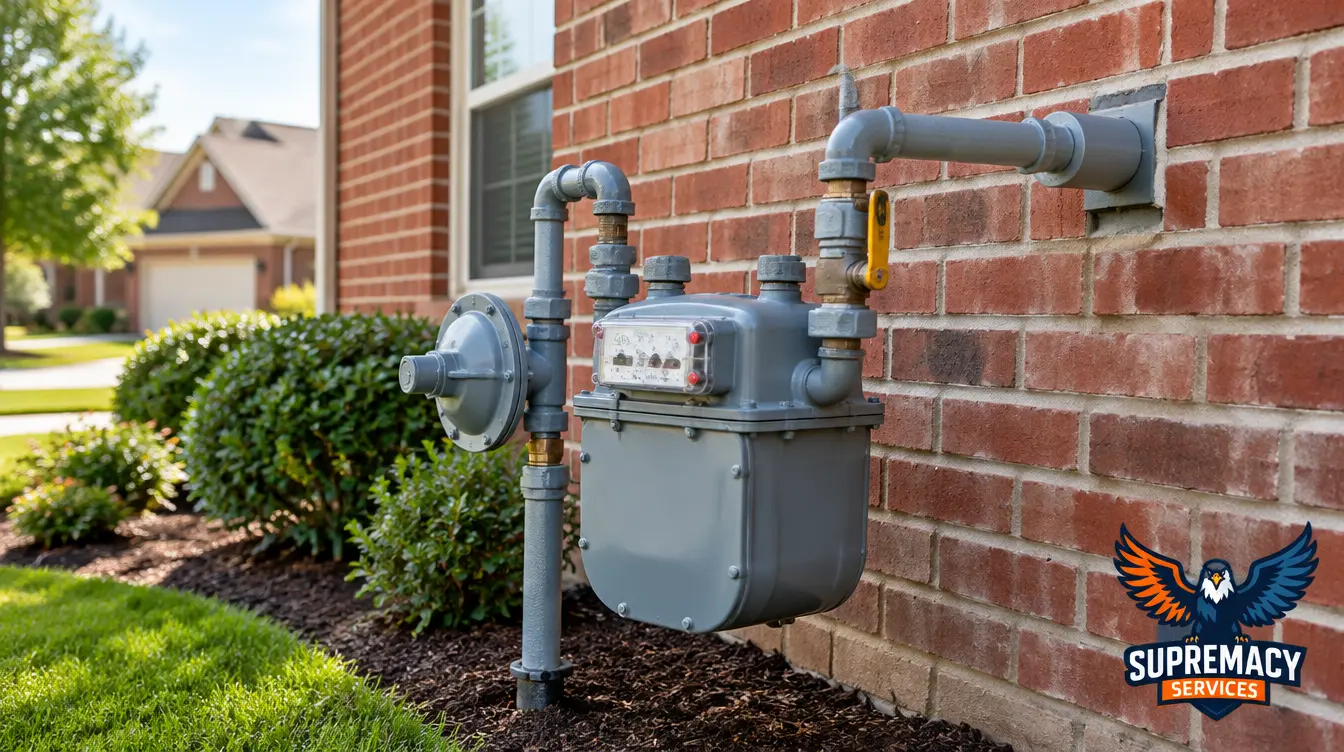
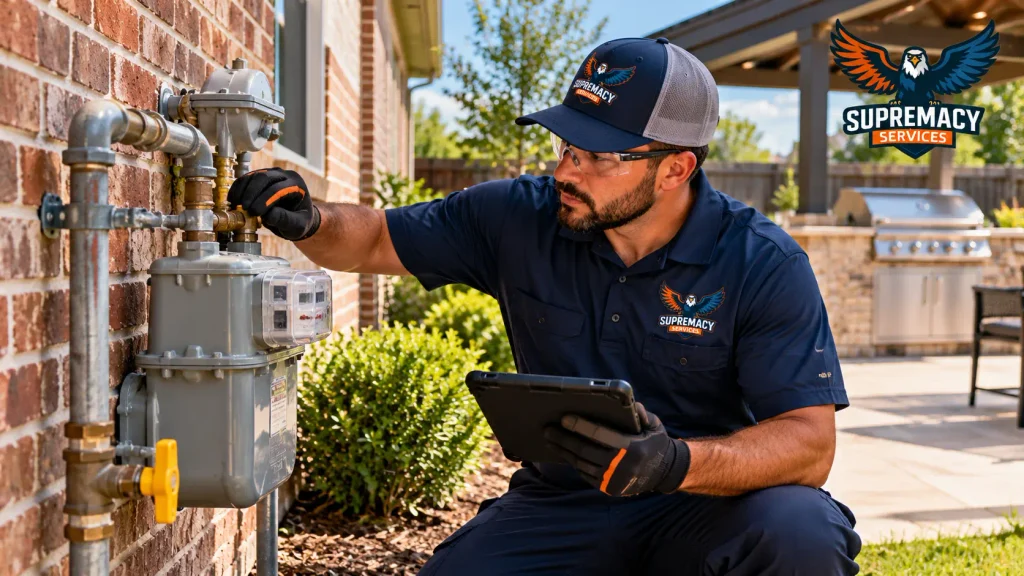
Supremacy Services technician inspecting a residential natural gas meter and piping before an outdoor kitchen installation.
Evaluating the existing gas supply helps determine whether a Dallas home can accommodate additional outdoor cooking appliances.

In many Dallas homes, an outdoor kitchen can be supplied by extending the existing natural gas distribution system. Whether this is feasible depends on the gas system’s capacity, the outdoor appliances being installed, and the proposed piping route.

A professional must determine whether the current installation can support the additional gas demand without affecting other appliances.

Outdoor appliances that may use natural gas

Common examples include:

  • Built-in natural gas grills
  • Outdoor pizza ovens designed for natural gas
  • Side burners and outdoor cooktops
  • Natural gas fire pits
  • Outdoor fireplaces
  • Specialty cooking appliances approved for natural gas

Not every outdoor appliance is compatible with natural gas. Some are designed exclusively for propane, while others require a manufacturer-approved conversion kit.

Always verify the appliance’s fuel type and installation requirements before purchasing equipment or planning the gas line.

Where does the new gas line connect?

Depending on the existing system, a qualified installer may determine that a new branch can connect to an appropriately sized section of the home’s gas piping.

In other situations, the project may require larger piping, a different connection point, or coordination with the gas utility.

The correct connection point cannot be determined solely by identifying the nearest existing gas pipe.

Considering a permanent natural gas connection for your backyard kitchen? Supremacy Services can be contacted to discuss gas-line service availability and an assessment of your proposed outdoor installation.

Do You Need a Permit to Run a Gas Line to an Outdoor Kitchen in Dallas?

Yes, a new permanent fuel-gas piping installation in Dallas generally requires a plumbing permit and applicable inspections. Homeowners should confirm the exact requirements with the City of Dallas before work begins.

The City of Dallas identifies gas piping as part of plumbing work subject to its permitting framework. Its plumbing plan-review checklist also calls for information about the layout, size, and materials of underground yard gas piping where applicable.

What does the City of Dallas require?

Depending on the scope, the project may involve:

  1. Reviewing the outdoor kitchen layout and proposed gas-pipe route.
  2. Identifying applicable plumbing permits and any additional construction approvals.
  3. Having the appropriate authorized person obtain the permit.
  4. Installing the piping according to approved requirements.
  5. Completing required testing and inspections before the gas line is placed into service.

Dallas has specific rules concerning who may obtain plumbing permits. The city’s guidance also describes limited homeowner-permit circumstances, so homeowners should not assume that every gas-piping project is eligible for DIY permitting.

What about Plano, Frisco, Allen, and other DFW cities?

Requirements may differ between municipalities.

A homeowner in Frisco should confirm requirements with Frisco’s building department rather than assuming the City of Dallas process applies. The same principle applies to Plano, Allen, McKinney, Richardson, and other North Texas communities.

Why do permits and inspections matter?

Gas-line inspections help establish that the installation satisfies applicable safety and code requirements before operation.

An unpermitted installation may create complications during property sales, insurance reviews, or future renovations, in addition to presenting safety concerns.

How Is a New Gas Line Installed for an Outdoor Kitchen?

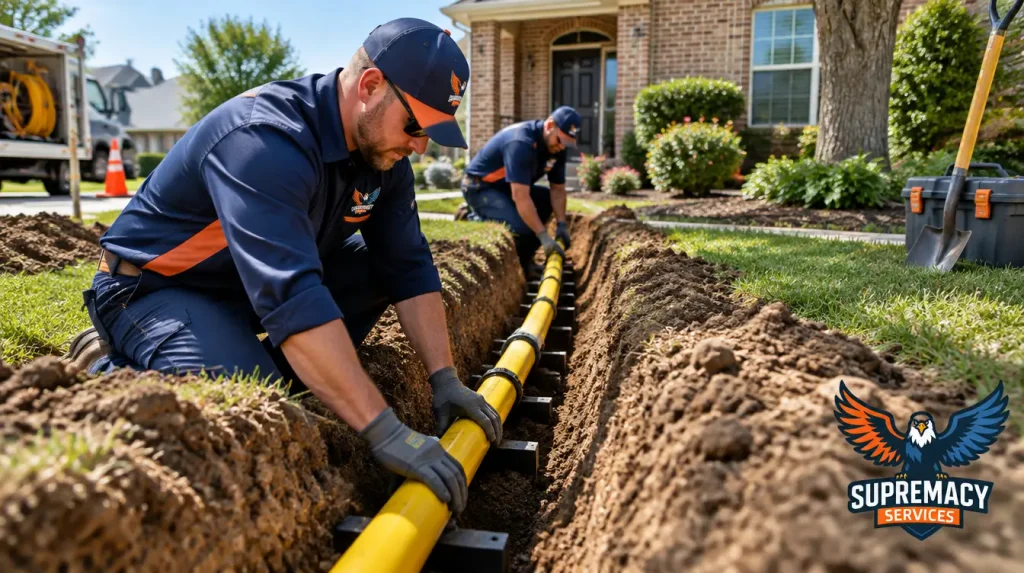
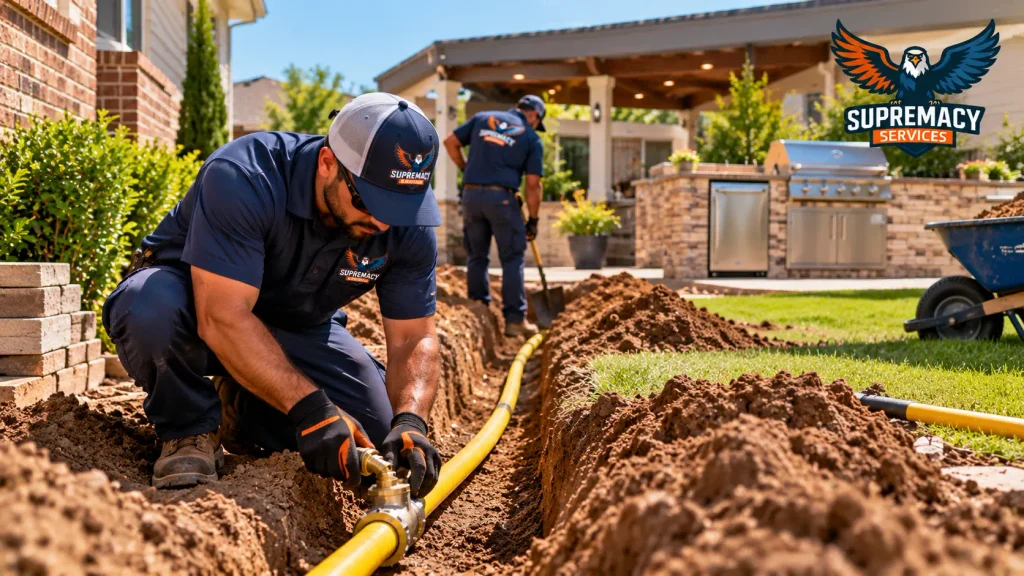
Supremacy Services technicians installing underground gas piping in a backyard trench leading toward an outdoor kitchen.
Underground gas line installation requires proper planning, approved piping materials, utility locating, and applicable inspections.

Professional outdoor gas line installation typically begins with a site assessment and system design, followed by permitting, piping installation, required testing, and final appliance connection.

Step 1: Evaluate the existing gas supply

The installer reviews the gas meter, existing piping, connected appliances, and additional demand from the outdoor kitchen.

Step 2: Plan the piping route

The proposed route is assessed for distance, obstacles, underground utilities, property features, and the location of outdoor appliances.

Step 3: Obtain required permits

The authorized installer or eligible permit applicant arranges the applicable approvals before beginning regulated work.

Step 4: Install the gas piping

Approved materials and installation methods are used. Underground installations may require excavation, appropriate protection, and inspections before trenches are backfilled.

Step 5: Test and inspect the system

The installation undergoes the required pressure testing and inspections. The testing procedure is determined by the applicable code and inspection authority.

Step 6: Connect and commission appliances

Approved connections, shutoff provisions, and appliance checks are completed before the outdoor kitchen is put into operation.

Does the gas line have to be buried?

Not necessarily.

The appropriate installation depends on the route, site conditions, permitted piping method, and appliance location.

A gas line running across an open yard may be designed as an underground installation. Other projects may allow properly protected aboveground piping.

The installer must determine the applicable requirements for burial depth, corrosion protection, supports, transitions, and physical protection. Homeowners should not select a trench depth or piping material without a code-compliant design.

How Much Does It Cost to Install an Outdoor Kitchen Gas Line in Dallas?

The cost depends on the distance from the existing gas supply, available capacity, installation method, excavation requirements, appliance connections, and permit or inspection costs.

A short, accessible extension can involve substantially less work than a buried line crossing a finished backyard.

Because verified Dallas-specific installation quotes were not available for this article, assigning a fixed dollar range would risk misleading homeowners.

Factors that influence installation costs

Cost factorWhy it matters
Distance to outdoor kitchenLonger runs generally require more materials and labor
Underground trenchingExcavation and restoration increase project scope
Concrete or paved surfacesRouting around or restoring hardscaping can add complexity
Existing gas-pipe capacityUndersized piping may require additional work
Number of appliancesMultiple appliances increase the total gas demand
Permit and inspection requirementsAdministrative and inspection work affects the project
Appliance compatibilityRegulators, connectors, or approved conversion components may be needed
Yard accessibilityRestricted access can complicate installation

Is it cheaper to install a gas line before building the outdoor kitchen?

Often, yes.

Coordinating gas piping before installing patio finishes, masonry counters, or outdoor kitchen cabinetry can reduce the need to remove completed construction.

For homeowners planning a larger backyard renovation, the gas-line design should be coordinated with the outdoor kitchen contractor before the final layout is built.

How can homeowners get an accurate estimate?

Request a site-specific assessment that identifies the proposed connection point, pipe route, appliances, required permits, testing, and any anticipated surface restoration.

Planning an outdoor kitchen in Dallas or the surrounding DFW area? Contact Supremacy Services to discuss your gas-line installation needs and request information about available assessment and installation services.

What Type of Gas Piping Can Be Used for an Outdoor Kitchen?

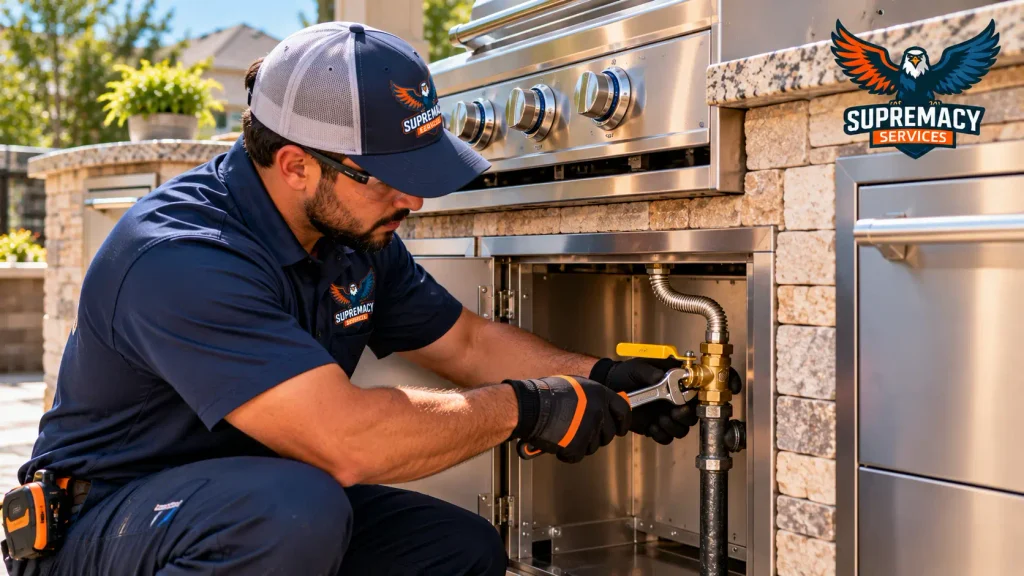
Supremacy Services plumber inspecting a gas shutoff valve and piping connection beneath a built-in outdoor grill.
Proper gas connections, accessible shutoff valves, and appliance compatibility are important parts of a safe outdoor kitchen installation.

Gas piping must be approved for the particular fuel, pressure, location, and installation method.

Different products have different limitations, and not every material suitable for indoor gas distribution is appropriate for direct burial or outdoor exposure.

Piping materialPotential applicationImportant consideration
Black steel pipeCertain aboveground gas piping installationsCorrosion protection and exposure requirements must be addressed
Polyethylene gas pipeApproved underground gas distribution applicationsRequires approved transitions and appropriate installation methods
Corrugated stainless steel tubing (CSST)Certain gas distribution systemsMust follow listing, bonding, protection, and manufacturer requirements
Other approved gas pipingApplications permitted by local codeSuitability depends on the specific product and installation

Homeowners should not substitute ordinary water piping, garden hoses, or unapproved flexible connectors for permanent fuel-gas piping.

Can you use a flexible gas hose for an outdoor grill?

An approved appliance connector may be suitable for a specific connection when the appliance instructions and applicable code allow it.

However, an appliance connector is not automatically approved as a substitute for permanent gas piping across a yard or through a building structure.

The connection method should be selected by the qualified installer.

Natural Gas vs. Propane: Which Is Better for an Outdoor Kitchen?

Side-by-side comparison of a built-in natural gas outdoor kitchen grill and a portable propane grill with a fuel cylinder.
Natural gas is often convenient for permanent outdoor kitchens, while propane offers flexibility for portable grilling equipment.

Natural gas can be convenient for a permanent outdoor kitchen connected to an existing utility supply. Propane may be more practical for portable grills or locations without an available natural gas connection.

FeatureNatural gasPropane
Fuel supplyConnected to gas utility infrastructureStored in a cylinder or tank
Cylinder replacementNot normally requiredRequired when fuel is depleted
InstallationMay require permanent gas piping and permitsDepends on appliance and tank arrangement
PortabilityUsually associated with fixed appliancesCommon for portable grills
Appliance compatibilityRequires natural-gas-rated equipmentRequires propane-rated equipment
Best suited forPermanent outdoor kitchensPortable or independently supplied equipment

Can a propane grill be converted to natural gas?

Only if the manufacturer expressly approves the conversion for that exact appliance model and provides an appropriate conversion procedure or kit.

Natural gas and propane appliances may use different regulators, orifices, and operating pressures. Simply connecting a propane grill to a natural gas line is unsafe.

For a new built-in outdoor kitchen, choosing the fuel type before purchasing appliances can prevent compatibility problems.

Can Your Existing Gas System Handle an Outdoor Grill and Kitchen?

Not always. Even when a home already has natural gas service, the existing system may not have sufficient capacity for additional outdoor appliances.

A professional evaluates the combined appliance demand and determines whether the meter, regulator arrangement, and piping can supply the required gas flow.

Why appliance BTU ratings matter

Gas appliances are commonly rated by their maximum fuel input in British thermal units per hour (BTU/h).

An outdoor kitchen containing a grill, side burner, and pizza oven may have a greater combined gas demand than a single grill.

The installer considers the rated input of each appliance, existing connected loads, pipe lengths, allowable pressure drop, and other relevant design requirements.

What happens if the gas line is too small?

An inadequately sized gas supply can contribute to performance problems such as:

  • Reduced burner performance
  • Inconsistent appliance operation
  • Problems when several gas appliances operate simultaneously
  • Failure to maintain required appliance inlet pressure

These symptoms are not proof of undersized piping. Regulators, appliance components, and other system conditions may produce similar problems.

A qualified professional should diagnose the actual cause.

Can You Install an Outdoor Kitchen Gas Line Yourself?

Permanent gas piping is not a suitable trial-and-error DIY project. In Dallas, homeowners should use appropriately qualified professionals and confirm the applicable permit requirements before beginning work.

The Texas State Board of Plumbing Examiners regulates plumbing licenses and registrations in Texas. The board distinguishes between the work authorized for different license and registration categories.

What homeowners can safely handle during planning

Homeowners can help prepare by choosing the outdoor kitchen location, collecting appliance specifications, identifying preferred equipment, and coordinating the construction schedule.

Actual gas-piping design, regulated installation, pressure testing, and commissioning should be handled by qualified personnel operating within applicable licensing and permit requirements.

Why professional installation matters

Improper gas piping can lead to leaks, fire hazards, unreliable appliance operation, and costly corrective work.

Professional installation also provides a process for checking code compliance, coordinating inspections, and confirming that the system is appropriate for the intended appliances.

Common Outdoor Gas Line Problems and Warning Signs

Outdoor gas systems face conditions that differ from those inside a home. Exposure, physical damage, shifting surfaces, and poorly protected components can create problems over time.

Common issues to watch for

  • Visible corrosion or deterioration of exposed piping
  • Physical damage to gas lines, valves, or connectors
  • Loose or damaged appliance connections
  • Burners that repeatedly fail to operate properly
  • Unusual appliance shutdowns
  • Signs of damage after landscaping or excavation work

Some problems are related to the appliance rather than the gas line. A clogged burner or faulty ignition component, for example, is different from a gas-supply leak.

What should you do if you smell gas near your outdoor kitchen?

Stop using the equipment immediately. Do not operate switches, use flames, attempt repairs, or investigate the leak yourself.

Move people away from the affected area and contact your gas utility’s emergency service or 911 from a safe location. Do not resume use until the system has been evaluated and cleared by the appropriate professionals.

Do not rely on smell alone to determine whether a gas system is safe.

What Should Dallas and North Texas Homeowners Consider Before Installation?

Dallas-area outdoor kitchens may be affected by backyard layouts, underground infrastructure, expansive soils, outdoor exposure, and seasonal weather conditions.

1. Expansive North Texas soils

Some North Texas properties contain expansive clay soils that change volume as moisture conditions vary.

For buried piping, the installer should account for site conditions and use appropriate installation methods and materials. Soil characteristics alone do not establish that a particular gas line is damaged.

2. Existing underground utilities

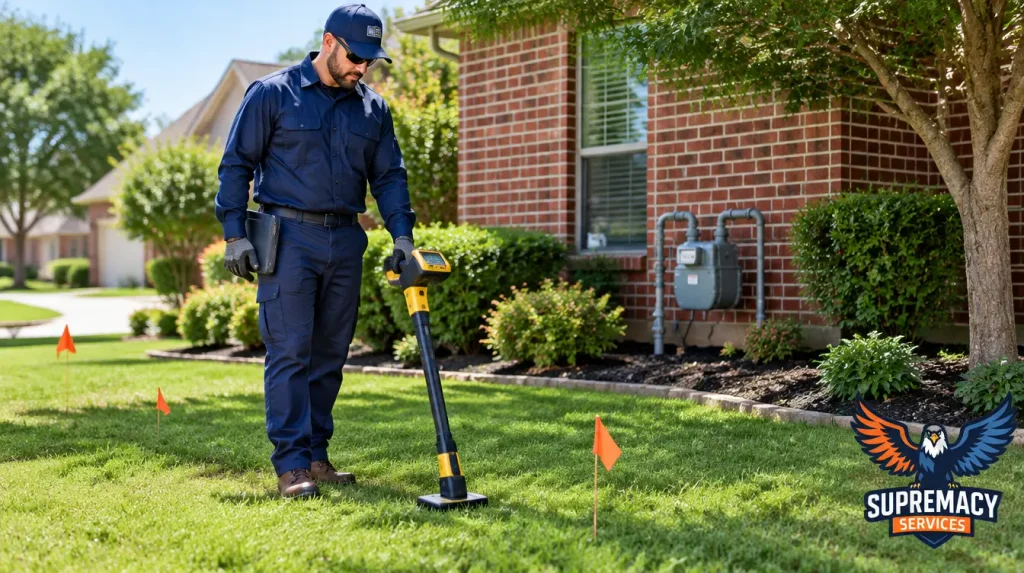
Backyards may contain buried electrical lines, irrigation systems, communication cables, and other infrastructure.

Before excavation, the project should include appropriate utility-locating procedures. Texas homeowners and contractors can use Texas 811 for utility locate requests, while recognizing that some privately owned lines may require separate locating.

3. Patios, concrete, and landscaping

An outdoor kitchen built on an existing patio may require a different piping route than a new kitchen installed before hardscaping.

Early coordination can help reduce disruption to landscaping and completed surfaces.

4. Outdoor appliance placement

The gas line should be planned alongside the grill’s required clearances, ventilation, cabinet construction, and manufacturer installation instructions.

Outdoor kitchens with roofs, partial enclosures, or adjacent structures require particular attention to appliance suitability and placement.

5. Future outdoor kitchen expansion

If you expect to add a pizza oven, side burner, or other gas appliance later, discuss those plans during the initial design.

Future equipment should not simply be connected without confirming the system’s capacity and code requirements.

How to Prepare for an Outdoor Kitchen Gas Line Installation

Before contacting a gas-line professional, collect the information that will make the assessment more useful.

Homeowner planning checklist

0 of 7 completedChoose the proposed outdoor kitchen locationList every planned natural gas applianceCollect appliance model numbers and BTU input ratingsIdentify whether the patio or outdoor kitchen is already builtNote concrete, landscaping, or other obstacles along possible routesAsk about permitting, inspections, and utility coordinationRequest a written scope covering piping, connections, testing, and restoration

Having these details ready can help the installer assess the project, explain possible routing options, and provide a more complete estimate.


Frequently Asked Questions About Outdoor Kitchen Gas Lines in Dallas

1. Can I run a natural gas line from my house to an outdoor grill?

Yes, a qualified professional can evaluate whether a new branch can be added to your home’s gas system. The installation must have adequate capacity and meet applicable permitting, piping, and inspection requirements.

2. Do I need a permit for an outdoor gas grill hookup in Dallas?

A new permanent gas-piping installation generally requires a plumbing permit and applicable inspection. Confirm the precise requirements with the City of Dallas, particularly when the project includes additional outdoor structures.

3. How deep does an outdoor gas line need to be buried in Texas?

The required cover depends on the adopted code, approved piping system, location, and installation conditions. A qualified installer should confirm the applicable depth rather than relying on a universal measurement.

4. Can I connect multiple appliances to one outdoor gas line?

Potentially, yes. A properly designed gas system can supply multiple appliances if the piping and available gas capacity meet their combined requirements.

5. Is natural gas cheaper than propane for an outdoor kitchen?

Operating costs depend on local fuel prices, equipment efficiency, and consumption. Natural gas eliminates routine cylinder exchanges, but the upfront cost of installing permanent piping must also be considered.

6. Can an outdoor gas line be installed under a concrete patio?

Depending on the site and applicable code, a compliant piping route may be possible beneath or around a patio. The installer must evaluate protection, access, construction methods, and inspection requirements.

7. How long does outdoor kitchen gas line installation take?

The schedule depends on permitting, route complexity, excavation, inspection availability, and whether other contractors are involved. Ask for a project-specific timeline rather than assuming every installation can be completed in one day.

8. Can I use my existing propane grill with a new natural gas line?

Only if the manufacturer approves conversion of that exact model and the conversion is performed using the required components and procedures. Many propane grills are not convertible.

9. Do I need a larger gas meter for an outdoor kitchen?

Not necessarily. A professional must evaluate the additional appliance demand and existing system capacity. If utility-side changes are needed, coordination with the gas provider may be required.

10. Who should install a gas line for an outdoor kitchen in Dallas?

Use a properly qualified gas-piping professional working within Texas licensing requirements and the applicable municipal permitting process. Confirm the contractor’s credentials and project scope before authorizing work.

Plan Your Outdoor Kitchen Gas Line With Supremacy Services

Supremacy Services technician reviewing outdoor kitchen gas line installation plans with a homeowner beside a built-in grill.
Planning an outdoor kitchen’s gas supply before construction helps homeowners coordinate appliance requirements, piping routes, and installation work.

A permanent natural gas connection can make a Dallas outdoor kitchen more convenient, especially when the design includes a built-in grill or multiple gas appliances.

The most important step is planning the gas supply before construction is finalized.

Pipe sizing, appliance compatibility, routing, permits, and inspections should all be addressed before the new system is put into service.

Ready to plan a natural gas connection for your outdoor kitchen?

Contact Supremacy Services to discuss your project, confirm available gas-line services in your area, and request information about the next steps for a professional assessment.

Professional plumber inspecting residential natural gas pipes inside a Dallas, Texas home.

How Long Do Residential Gas Lines Last? A Dallas Homeowner’s Guide

How long do residential gas lines last?
Residential gas lines can remain in service for several decades, but there is no universal expiration date for household gas piping. How long residential gas lines last depends on the pipe material, installation quality, exposure to moisture and corrosion, soil conditions, and maintenance history.

For Dallas homeowners, a gas line that is 30, 40, or even 50 years old is not automatically unsafe. However, an older pipe should not be assumed safe simply because the stove, furnace, or water heater still operates.

The most reliable way to determine whether aging gas lines need repair or replacement is through an appropriate professional inspection.

This guide explains how different gas pipe materials age, the warning signs to watch for, and when North Texas homeowners should consider replacing existing piping.

Table of Contents

  1. How many years do residential gas lines last?
  2. How long do different gas pipe materials last?
  3. What causes residential gas lines to deteriorate?
  4. Signs your gas lines may be deteriorating
  5. Do old gas lines need to be replaced?
  6. How are residential gas lines inspected?
  7. What does gas line replacement cost?
  8. How can homeowners extend gas line life?
  9. Dallas-specific considerations
  10. Frequently asked questions

How Many Years Do Residential Gas Lines Last?

Residential natural gas piping can last for decades when properly installed and protected. However, its useful service life cannot be determined accurately from age alone.

Unlike equipment such as a water heater, which has a manufacturer-defined expected service life, a residential gas piping system contains materials and components that can age differently.

For example, a protected indoor steel pipe may remain in satisfactory condition while an underground steel section installed around the same time develops corrosion.

The important question is not simply how old the pipe is. It is whether the piping remains structurally sound, leak-free, appropriately supported, and compliant with applicable safety requirements.

Does a 30-year-old gas line need replacement?

Not necessarily. A 30-year-old gas line may still be serviceable if it is in good condition and passes the appropriate professional evaluation.

However, age becomes more important when combined with:

  • Visible corrosion or physical deterioration
  • A history of leaks or repeated repairs
  • Unknown installation methods or pipe materials
  • Underground piping with uncertain corrosion protection
  • Structural movement or damage near the piping
  • Planned renovations that will affect the gas system

An inspection is generally more useful than replacing an entire gas line solely because it has reached a particular age.

How Long Do Different Gas Pipe Materials Last?

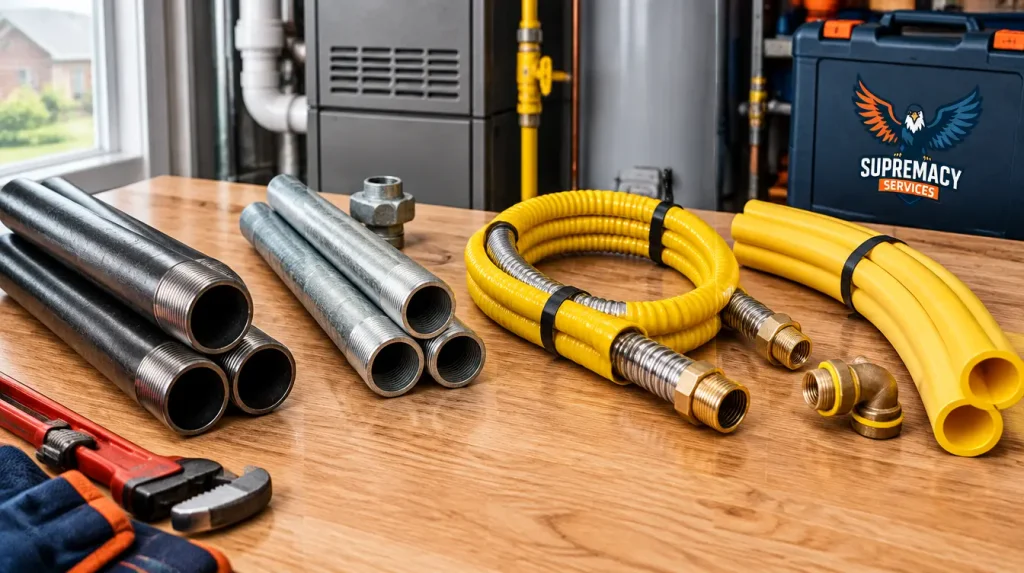
Black steel, galvanized steel, flexible CSST, and polyethylene residential gas pipe materials.
Different gas piping materials have different durability characteristics, installation requirements, and maintenance considerations.

Gas pipe lifespan varies by material and installation environment. Steel, stainless steel tubing, and polyethylene piping have different vulnerabilities and installation requirements.

Gas pipe materialCommon residential applicationMain factors affecting service life
Black steel or black ironInterior gas distribution and appliance branchesCorrosion, moisture, joint condition, mechanical damage
Galvanized steelSome older installations, where permittedCorrosion, coating deterioration, installation history
Corrugated stainless steel tubing (CSST)Approved interior gas piping systemsPhysical damage, proper bonding, installation compliance
Polyethylene (PE)Approved underground gas pipingInstallation damage, external loading, UV exposure where prohibited
Copper tubingCertain approved applicationsLocal code requirements, gas composition, joint compatibility, physical damage

These materials do not have one universally applicable replacement age. Suitability and installation requirements depend on the specific product and applicable codes.

1. Black iron and steel gas pipes

Black steel piping is common in residential natural gas systems, particularly in older homes.

Properly installed steel piping can provide many years of service. However, corrosion becomes a concern when the metal is exposed to moisture or deteriorating environmental conditions.

A homeowner may notice rust on an exposed section of piping, but visible rust alone does not establish the condition of the entire system.

Surface discoloration and serious metal loss are different conditions. A qualified plumber should evaluate corrosion before determining whether a section requires replacement.

2. Galvanized steel gas pipes

Galvanized steel has a protective zinc coating intended to reduce corrosion.

Some older residential systems may contain galvanized piping. Its acceptability for new work depends on applicable codes and installation requirements.

The presence of galvanized piping does not automatically mean a gas line has failed. However, aging coatings, corroded connections, and uncertain installation history justify professional evaluation.

3. Corrugated stainless steel tubing (CSST)

CSST is a flexible metallic gas piping system used in approved residential installations.

Its flexibility can make installation easier in certain building layouts, but CSST must be installed according to the manufacturer’s instructions and applicable codes.

Particular attention should be paid to bonding requirements, physical protection, compatible fittings, and possible damage from electrical events.

CSST should not be treated as a maintenance-free or universally permanent product.

4. Underground polyethylene gas pipes

Polyethylene gas piping is used in approved underground applications because it resists the electrochemical corrosion that affects buried steel.

However, polyethylene piping can still be damaged by excavation equipment, excessive loading, improper installation, or environmental exposure outside its approved application.

The Pipeline and Hazardous Materials Safety Administration (PHMSA) identifies plastic materials as commonly used in natural gas distribution systems because of their resistance to corrosion.

Polyethylene’s corrosion resistance does not mean it can be used anywhere in a residential gas system. Underground transitions and connections require approved methods.

What Causes Residential Gas Lines to Deteriorate?

Several conditions can shorten the useful life of gas piping, even when the material itself is designed for long-term service.

Rust and corrosion around an older residential steel gas pipe connection.
Visible corrosion on residential gas piping can indicate deterioration that requires professional evaluation.

1. Corrosion and moisture exposure

Corrosion is an important concern for metallic gas pipes.

It can occur when metal is exposed to conditions that promote deterioration, particularly where protective coatings have failed or where moisture remains against the pipe.

PHMSA recognizes corrosion as a pipeline integrity hazard and describes protective coatings and cathodic protection as methods used to control corrosion in applicable pipeline systems.

These industrial and utility practices should not be interpreted as proof that every residential gas line requires the same protection system.

2. Soil movement and shifting foundations

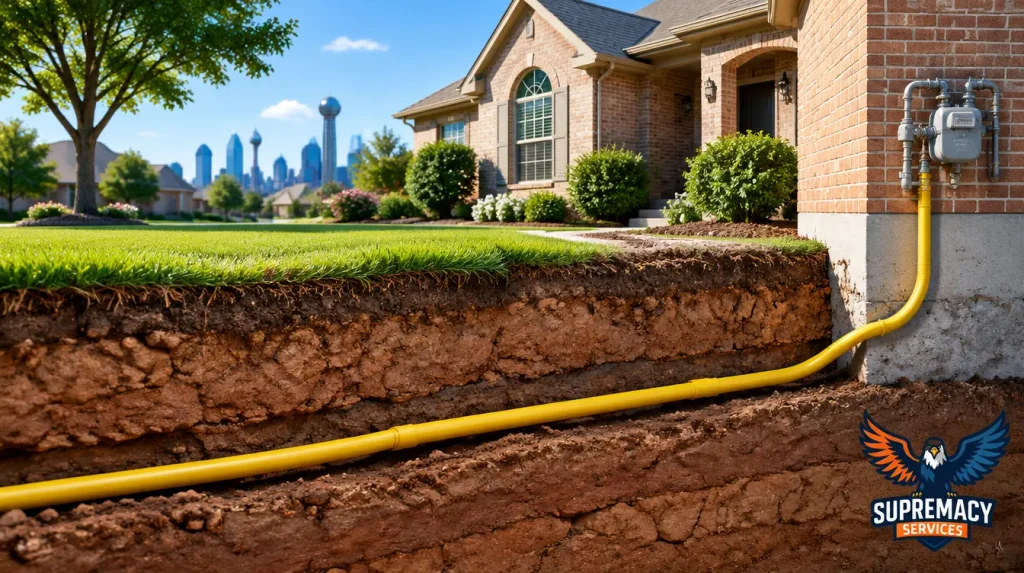
Cross-section of an underground natural gas pipe beneath a North Texas home's yard.
Expansive clay soils, ground movement, and excavation can affect underground gas piping in North Texas.

North Texas is known for areas with expansive clay soils.

When moisture conditions change, expansive soils can swell or shrink. This can contribute to movement around foundations and buried utilities.

A buried gas line may experience stress if the surrounding soil or connected structures move.

This does not mean every Dallas gas line is damaged by clay soil. Installation design, pipe material, flexibility, burial conditions, and site drainage all influence the actual risk.

3. Poor installation or unsupported piping

Gas lines can experience problems when piping is improperly supported, connections are incorrectly assembled, or materials are used outside their approved applications.

An installation defect may cause a problem long before the pipe material reaches the end of its potential service life.

4. Excavation and accidental damage

Fence installations, landscaping, driveway work, and other excavation activities can damage buried gas lines.

Even relatively shallow digging can create a serious hazard when the location of underground utilities is unknown.

Homeowners should contact 811 before digging and follow Texas notification requirements. Utility markings may not identify every privately owned line.

5. Repeated alterations and appliance upgrades

A home may undergo several renovations during the life of its gas piping system.

New gas ranges, tankless water heaters, fireplaces, and heating equipment may require different gas loads or piping configurations.

Existing piping may be structurally sound but improperly sized for the home’s updated equipment.

A qualified plumber can determine whether the current system remains suitable.

What Are the Warning Signs of Aging Gas Lines?

An aging gas line may show visible deterioration, but some dangerous conditions cannot be detected through appearance alone.

Important gas leak safety warning

If you smell gas, hear unexplained hissing near gas equipment, or otherwise suspect a gas leak, leave the area immediately. Do not operate electrical switches, use flames, investigate the source, or attempt a repair. From a safe location, call 911 and your gas utility’s emergency number. For Atmos Energy customers, the emergency number is 866-322-8667.

Signs that warrant attention

Warning signWhat it may indicateRecommended response
Rotten-egg or sulfur-like odorPossible natural gas leakEvacuate and contact emergency services and the gas utility
Hissing near gas pipingPossible escaping gasLeave immediately and report it
Significant rust or flaking metalPotential corrosionArrange professional evaluation when safe
Damaged or unsupported pipingMechanical stress or installation defectHave a qualified professional assess it
Repeated gas leaksPotential wider piping deteriorationRequest a comprehensive system evaluation
Damaged gas meter or exposed underground pipingPossible impact or utility damageStay clear and contact the utility
Unexplained appliance performance problemsPossible appliance, regulator, supply, or piping issueRequest professional diagnosis

Not every appliance problem is caused by aging gas pipes.

For example, a furnace that fails to heat may have an ignition, electrical, control, or ventilation problem rather than a damaged gas supply line.

A professional assessment helps avoid unnecessary pipe replacement.

If you are concerned about corrosion or the condition of older gas piping, Supremacy Services provides gas line repair and diagnostic services in Dallas. An evaluation can help determine whether a specific section needs repair or a broader replacement is appropriate.

Do Old Gas Lines Need to Be Replaced?

Not every aging gas line needs replacement. The decision depends on its condition, the extent of any damage, the piping material, and the results of a professional assessment.

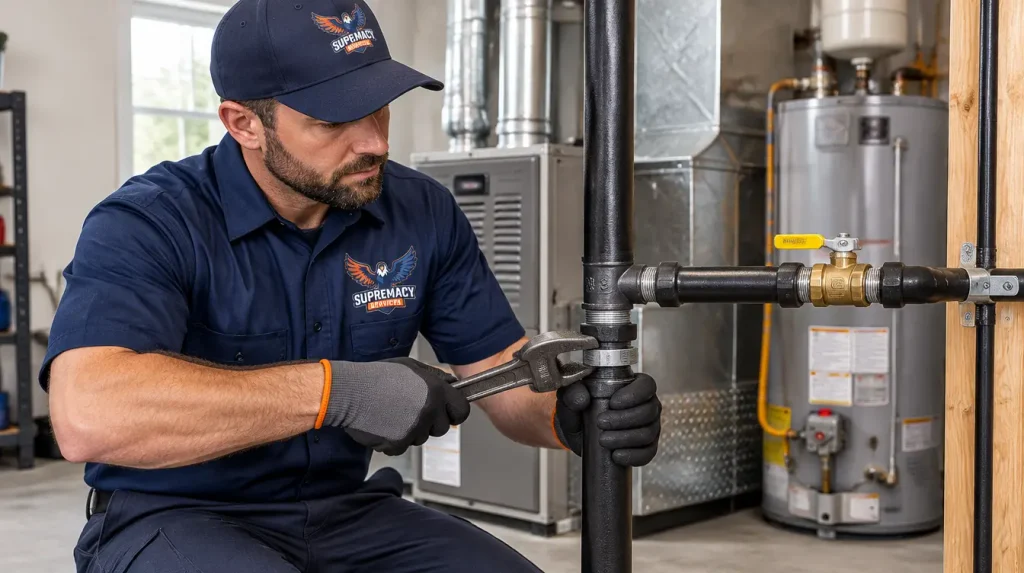
Professional plumber installing replacement natural gas piping inside a Dallas, Texas home.
Gas line replacement may be recommended when existing piping has extensive corrosion, physical damage, or recurring leaks.

When repair may be appropriate

A localized repair may be considered when a qualified professional determines that:

  • The problem is limited to an identifiable section or component.
  • The remaining piping is in satisfactory condition.
  • The repair method is permitted for the piping system.
  • The repaired system can meet applicable testing and inspection requirements.

When replacement may be more appropriate

Replacement may be recommended when:

  • Corrosion is widespread or severe.
  • Multiple sections have developed leaks.
  • The piping is physically damaged or improperly installed.
  • Existing materials or connections cannot be safely retained.
  • A renovation requires extensive piping changes.
  • The system cannot meet applicable requirements without substantial reconstruction.

Repair vs. replacement comparison

ConsiderationRepairReplacement
Localized damaged sectionOften worth evaluatingMay be unnecessary
Widespread corrosionMay not resolve underlying conditionMore likely to be considered
Multiple recurring leaksRequires careful assessmentMay provide a more comprehensive solution
Major remodelingPossible for limited modificationsMay be appropriate for substantial redesign
Upfront costOften lower for a limited repairTypically higher for extensive work
Long-term suitabilityDepends on remaining piping conditionDepends on design, materials, and installation

The lowest initial quote is not always the best long-term decision. The appropriate solution should address the underlying problem rather than simply the most visible symptom.

For a more detailed comparison, see our related guide on Gas Line Repair vs. Replacement: When Is Each Necessary?

How Are Residential Gas Lines Inspected?

A residential gas line inspection evaluates the condition and safety of the piping system using methods appropriate to the installation and the suspected problem.

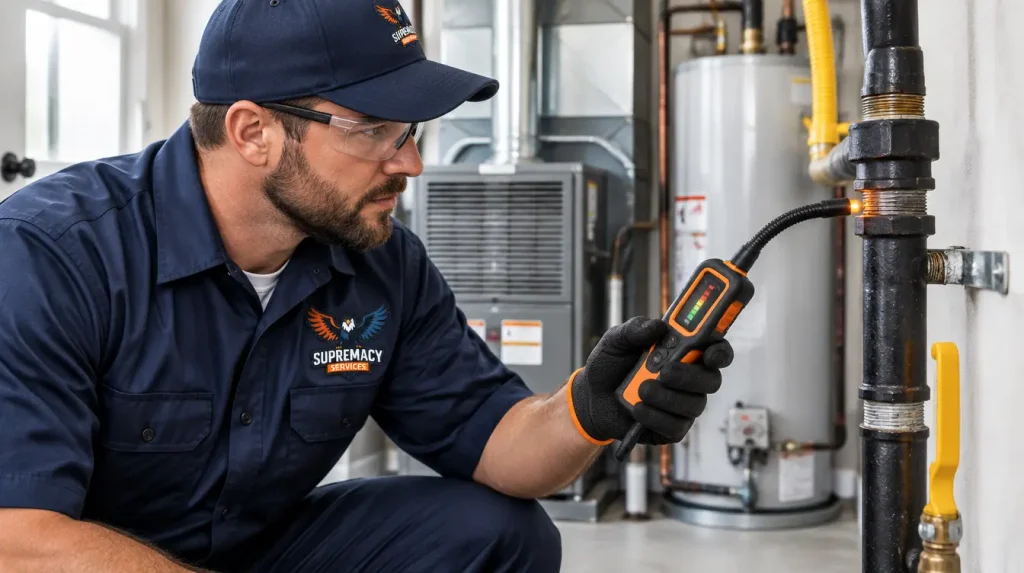
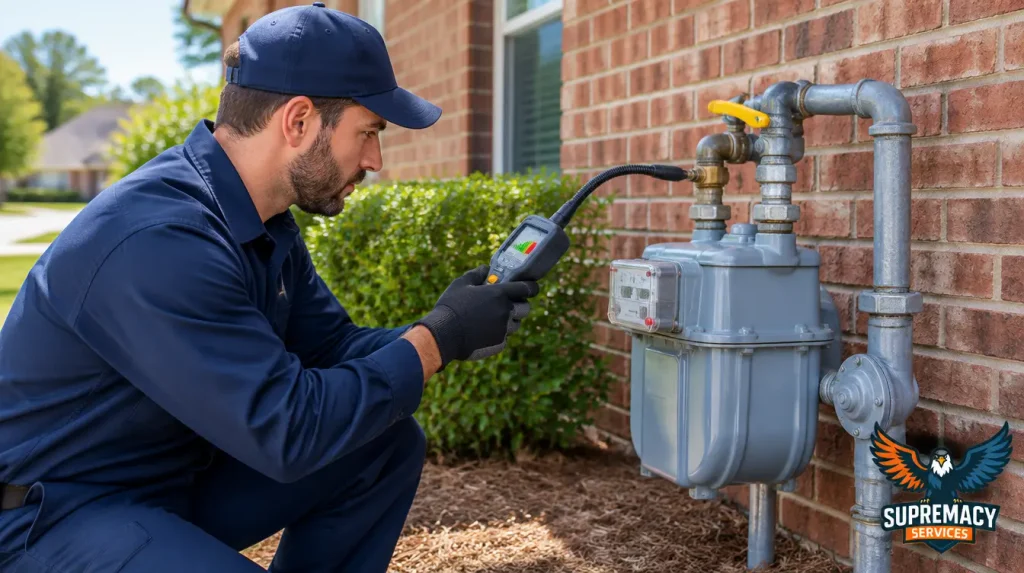
Plumbing technician using electronic gas leak detection equipment to inspect residential gas piping in Dallas.
Professional gas leak detection helps identify potential leaks and assess the condition of aging residential gas lines.

Step 1: Review the system history

The professional may ask about the home’s age, past gas repairs, appliance upgrades, and previous utility shutoffs.

This helps identify areas that may need closer evaluation.

Step 2: Examine accessible piping

Accessible piping may be checked for corrosion, mechanical damage, inadequate support, inappropriate connections, or visible installation concerns.

Buried or concealed sections generally require a different assessment approach.

Step 3: Conduct appropriate leak detection and testing

A qualified professional may use approved gas detection equipment and pressure testing where appropriate.

Testing must follow applicable procedures, including safe isolation of equipment when required.

Homeowners should not attempt to pressure-test gas piping themselves.

Step 4: Determine repair or replacement options

The professional should explain the findings and recommend whether the system requires localized repair, replacement, additional investigation, or no immediate corrective work.

Step 5: Complete required verification

Where work is performed, applicable permits, inspections, testing, and utility coordination may be required before the system is returned to service.

Texas regulates plumbing work through the Texas State Board of Plumbing Examiners, which identifies the licensing framework and scope of permitted work.

Concerned about the age of your home’s gas piping? Request a professional gas line evaluation from Supremacy Services to understand the condition of your system and the available repair or replacement options.

How Much Does Residential Gas Line Replacement Cost?

Residential gas line replacement costs vary considerably depending on the length and location of the piping, accessibility, materials, excavation needs, and applicable inspection requirements.

A short, accessible interior pipe replacement is a different project from replacing an underground gas line beneath a driveway.

Main cost factors

Cost factorWhy it matters
Pipe length and diameterAffect material quantities, sizing, and labor
Interior vs. underground locationBuried lines may require excavation and restoration
AccessibilityConcealed piping may require opening finished surfaces
Pipe materialApproved materials and fittings have different installation requirements
System complexityMultiple appliance branches and connections increase work
Permits and inspectionsRequirements vary by jurisdiction and scope
Surface restorationLandscaping, concrete, drywall, or flooring may need repair
Utility coordinationCertain work requires scheduling with the gas provider

Rather than relying on a broad national price range, Dallas homeowners should request an itemized quote based on the actual piping configuration.

Ask whether the quote includes required testing, permits, inspection coordination, and restoration work.

Can homeowners replace gas lines themselves?

Gas line replacement is not an appropriate DIY project.

Improper connections, inadequate sizing, unapproved materials, or unsafe testing can create fire and explosion hazards.

Gas piping work should be performed by appropriately licensed professionals operating within their authorized scope and following applicable local requirements.

How Can Homeowners Help Extend the Life of Gas Lines?

Homeowners cannot prevent every type of gas pipe deterioration, but several practical measures can reduce avoidable damage.

  1. Arrange periodic professional inspections. Pay particular attention to older metallic piping and previously repaired sections.
  2. Address water intrusion. Repair leaks or drainage problems that expose accessible metallic piping to persistent moisture.
  3. Protect exposed piping. Avoid using gas pipes as supports for stored items or equipment.
  4. Call 811 before digging. Confirm the location of buried utilities and arrange private-line locating when needed.
  5. Document renovations. Keep records of gas line modifications, permits, and inspections.
  6. Have appliance changes evaluated. New gas equipment may require different piping capacity.
  7. Respond promptly to damage. Do not ignore corrosion, displaced supports, or damaged connections.

Atmos Energy specifically recommends periodic leak inspections of customer-owned piping and corrosion inspections for metallic piping.

atmosphere.atmosenergy.com

These measures support safer long-term operation, but they do not establish or guarantee a specific pipe lifespan.

What Should Dallas and DFW Homeowners Know About Aging Gas Lines?

Dallas-area homeowners should consider the age of their property, underground conditions, previous renovations, and local permitting requirements when evaluating gas piping.

Older Dallas homes

Homes that have undergone decades of additions or remodeling may contain piping installed at different times.

For example, the original furnace connection may be much older than a recently installed gas range line.

Each part of the system may need to be evaluated according to its material, condition, and installation history.

North Texas soil movement

Expansive clay soils in parts of North Texas can contribute to ground movement as moisture conditions change.

Gas lines affected by foundation repairs, substantial ground movement, or excavation may deserve closer attention.

However, soil type alone does not establish that a particular gas line is damaged.

Storms and utility damage

Severe storms, fallen trees, and shifting ground can affect gas meters and underground utilities.

Atmos Energy has specifically warned that uprooted trees and shifted foundations can damage underground natural gas lines.

After storm damage, homeowners should avoid exposed or damaged gas infrastructure and contact the utility when appropriate.

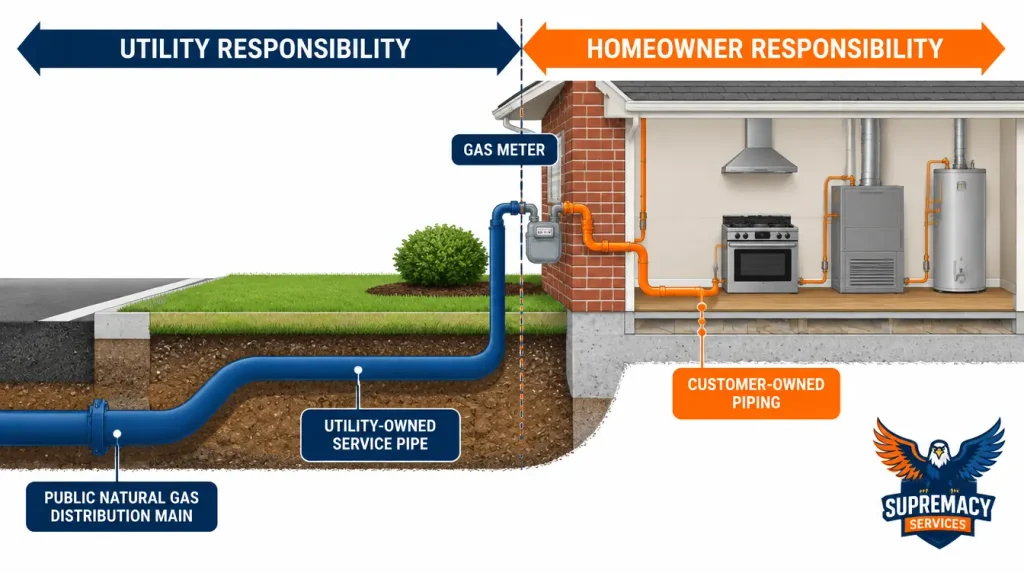
Utility-owned vs. customer-owned piping

The responsibility for a gas line depends on the utility’s service boundary and the location of the piping.

Atmos Energy explains that customers are responsible for certain gas piping and appliances, which should receive periodic professional inspections.

Homeowners should confirm the precise responsibility boundary with their gas utility rather than assuming that every buried line belongs to the utility.

For more information, see the related article Who Is Responsible for Gas Line Repairs in Texas? once its published URL is available.


Frequently Asked Questions About Residential Gas Line Lifespan

1. Can residential gas lines last 50 years?

Yes, some gas piping can remain serviceable after 50 years. However, age alone cannot establish safety. Pipe material, corrosion, installation quality, and testing results determine whether an older line can remain in use.

2. How long does black iron gas pipe last?

Black iron or black steel gas pipe can provide decades of service when properly installed and protected. Moisture exposure, corrosion, damaged joints, and installation conditions can shorten its useful life.

3. Do underground gas lines wear out faster?

Not necessarily. Underground performance depends on the pipe material, corrosion protection where applicable, soil conditions, and installation quality. Approved polyethylene piping resists corrosion, while unprotected buried metallic piping can be vulnerable.

4. Should I replace the gas lines in a 40-year-old house?

Not automatically. A 40-year-old house may have gas piping in satisfactory condition, but unknown installation history, corrosion, previous leaks, or major renovations can justify professional evaluation.

5. Can gas pipes leak without a noticeable smell?

Yes. Homeowners should not rely solely on odor to identify a leak. Natural gas odor may be difficult to detect in certain circumstances, and other warning signs can include hissing, blowing dust, or damaged vegetation near a buried line.

6. Does homeowners insurance cover old gas line replacement?

Coverage depends on the policy, the cause of damage, exclusions, and whether the work is considered maintenance or a covered loss. Routine replacement of deteriorating pipes is often treated differently from damage caused by a covered event. Ask your insurer to review the specific circumstances.

7. How often should residential gas lines be inspected?

There is no single inspection interval appropriate for every residential gas piping system. Homeowners should follow applicable utility, manufacturer, and professional guidance, particularly for older metallic piping or systems with a history of problems.

8. Is CSST better than black iron gas pipe?

Neither material is universally better. CSST offers installation flexibility in approved applications, while rigid steel has different durability and protection characteristics. The correct choice depends on system design, installation conditions, manufacturer requirements, and applicable codes.

9. Can I inspect my own gas lines?

Homeowners can observe accessible piping for obvious damage without touching or disturbing it. However, leak testing, repairs, and safety determinations should be handled by qualified professionals. If a leak is suspected, leave immediately rather than investigating.

10. How do I know whether I need gas line repair or replacement?

Final Thoughts: Age Matters, but Condition Matters More

Residential gas lines do not come with a universal replacement deadline. Some remain serviceable for decades, while others develop problems much earlier because of corrosion, physical damage, installation defects, or changing site conditions.

For Dallas homeowners, the most useful approach is to understand the materials in the home, watch for signs of deterioration, and arrange appropriate professional evaluation when concerns arise.

Replacing a gas line unnecessarily can be expensive. Ignoring a deteriorating line can create serious safety risks.

Need Help Evaluating Older Gas Lines in Dallas?

If your home has aging gas piping, visible corrosion, or a history of gas line problems, Supremacy Services can help assess the system and explain the appropriate next steps.

Schedule gas line inspection, repair, or replacement service with Supremacy Services, serving Dallas and surrounding DFW communities.

For a suspected active gas leak, evacuate and contact emergency services and your gas utility first. Do not use a routine service booking as an emergency response.
Professional plumber inspecting residential gas piping outside a Dallas, Texas home to assess repair or replacement needs.

Gas Line Repair vs. Replacement: When Is Each Necessary?

Gas line repair is usually appropriate when damage is limited to a specific section of piping and the remaining system is in good condition. Gas line replacement becomes the better option when pipes have widespread corrosion, multiple leaks, extensive deterioration, or other conditions that make isolated repairs unreliable.

For Dallas homeowners, choosing between gas line repair vs. replacement requires more than identifying where a leak occurs. A qualified plumber must evaluate the condition of the piping, determine whether the problem is isolated, and verify that the proposed work meets applicable safety requirements.

The right decision depends on the extent of damage, the pipe material, accessibility, inspection findings, and long-term reliability.

This guide explains how to compare both options, recognize warning signs, understand potential costs, and prepare for professional gas piping work in the Dallas–Fort Worth Metroplex.

Table of Contents

  1. What Is the Difference Between Gas Line Repair and Replacement?
  2. When Is Gas Line Repair Enough?
  3. When Should a Gas Line Be Replaced?
  4. What Warning Signs Require Immediate Attention?
  5. What Causes Residential Gas Lines to Fail?
  6. How Much Does Repair vs. Replacement Cost in Dallas?
  7. How Do Plumbers Decide Between Repair and Replacement?
  8. Do Gas Line Repairs Require Permits in Dallas?
  9. What Should Dallas Homeowners Consider?
  10. Can You Repair a Gas Line Yourself?
  11. How Can You Prevent Gas Line Problems?
  12. Frequently Asked Questions
  13. Schedule a Professional Gas Line Assessment

What Is the Difference Between Gas Line Repair and Replacement?

Gas line repair corrects a specific defect in an existing piping system. Gas line replacement involves removing, abandoning where permitted, or bypassing defective piping and installing new piping.

The distinction matters because a localized repair may restore the integrity of an otherwise serviceable system, while replacing a deteriorated section can reduce the likelihood of recurring problems. Supremacy services

Gas line repair vs. replacement comparison

FactorGas line repairGas line replacement
Primary purposeCorrect a localized problemReplace defective or unsuitable piping
Best suited forIsolated leaks or damaged fittingsExtensive corrosion, recurring leaks, widespread damage
Work involvedRepair or replace an affected component or sectionInstall a new section, branch or piping run
DisruptionOften more limitedMay require greater access or excavation
Upfront costOften lower for accessible, isolated defectsOften higher for longer or complex projects
Long-term outcomeDepends on the condition of remaining pipingProvides new piping in the replaced portion
InspectionTesting and applicable approvalsTesting and applicable approvals
Main considerationIs the remaining pipe sound?How much piping must be replaced?

Important: Replacing one damaged section does not necessarily mean replacing the entire home’s gas piping system.

The scope should be determined by inspection results rather than an assumption that every older gas line needs replacement.

When Is Gas Line Repair Enough?

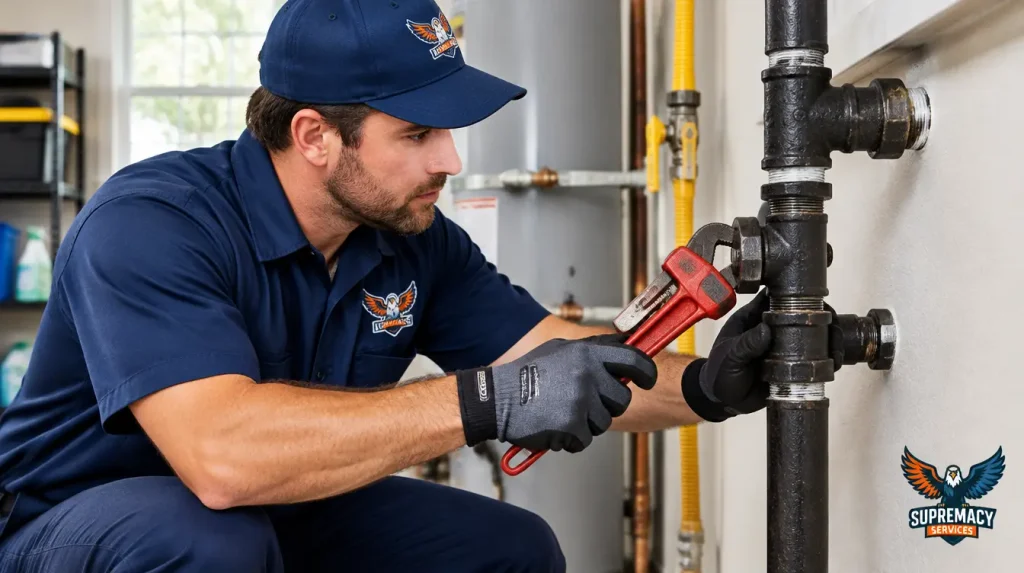
Close-up of a professional plumber inspecting a threaded residential gas pipe fitting to determine whether a localized repair is appropriate.
Isolated damage to a gas pipe fitting may be repairable when the surrounding piping remains in good condition.

Gas line repair may be sufficient when a licensed professional identifies an isolated defect and determines that the remaining piping can continue operating safely.

The decision depends on the type of damage, the piping material, and whether an approved repair can restore the system’s integrity.

1. A leak is isolated to one fitting or connection

Gas piping systems contain joints, fittings, valves and connections.

A defect may be confined to one accessible connection rather than the entire line.

In that situation, a plumber may be able to correct the connection or replace the affected component without installing a completely new piping run.

The repair must be appropriate for the piping system and verified through required testing.

2. A short section of pipe is damaged

Localized damage can occur during construction, remodeling or excavation.

If inspection confirms that the damage is confined to a small section and the surrounding pipe remains suitable for service, replacing only the affected section may be reasonable.

For example, a contractor working near an underground gas line might damage a limited portion of piping.

The repair scope should still account for any additional damage discovered during excavation.

3. A valve or fitting has failed

Sometimes the problem involves a component rather than the pipe itself.

A qualified plumber may recommend replacing a defective valve, fitting or approved connector, depending on its location and condition.

However, homeowners should not assume that every gas odor near an appliance originates from the building’s gas piping.

The appliance and its connections may require separate evaluation.

4. The surrounding piping is in acceptable condition

The strongest argument for a localized repair is evidence that the rest of the affected system remains serviceable.

A plumber should consider the pipe’s condition, material, installation, accessibility and test results before recommending repair.

A successful repair is not simply one that stops an immediately detectable leak. It must restore a safe, code-compliant installation.

Need a professional assessment? Supremacy Services offers gas line repair and diagnostic services in Dallas to help homeowners identify the affected piping and discuss appropriate repair or replacement options.

When Should a Gas Line Be Replaced?

Gas line replacement is generally worth considering when damage extends beyond one isolated defect, when corrosion affects the reliability of existing piping, or when an appropriate localized repair cannot be made.

Comparison of heavily corroded residential steel gas piping and new replacement piping showing when gas line replacement may be necessary.
Extensive corrosion can weaken gas piping and may make replacement a safer long-term solution than repeated repairs.

Replacement can involve a short section, an underground run, an appliance branch or a larger portion of the system.

1. Extensive corrosion affects the piping

Corrosion can weaken metallic piping over time.

The condition is particularly important when deterioration affects multiple sections, connections or locations that are difficult to inspect.

Visible surface rust does not automatically mean a gas line must be replaced. A professional must distinguish cosmetic corrosion from deterioration that compromises the pipe.

If the piping has lost structural integrity or shows widespread damage, replacement may be preferable to repeatedly repairing individual locations.

2. Multiple leaks have developed

A single isolated leak may support a repair recommendation.

Multiple leaks across different sections raise concerns about the overall condition of the piping.

If a plumber discovers repeated failures in the same run, replacing the affected run may be more practical than performing several separate repairs.

3. Underground piping has deteriorated

Buried gas lines can be affected by corrosion, physical damage and ground movement.

An underground leak may require excavation or another approved access method to locate and evaluate the defective section.

Replacement may be recommended when the existing buried pipe is unsuitable for continued use or when its condition makes a durable localized repair impractical.

4. The piping is unsuitable for the intended installation

A gas piping system may need modification when a homeowner adds appliances, relocates equipment or changes the layout of the home.

For example, a remodeled kitchen may require a different piping route or a professionally designed extension.

However, installing a new appliance does not automatically require replacing existing gas piping.

A qualified professional must determine whether the current system is appropriately sized, configured and compliant for the proposed appliance load.

5. Repeated repairs are becoming impractical

Recurring repairs can create additional costs and disruption.

If the same piping run develops problems repeatedly, homeowners should request a broader condition assessment instead of continuing to address each defect independently.

The decision should compare the scope of necessary repairs with the expected reliability of the remaining system.

Quick decision checklist

Questions to discuss with your plumberIs the damage limited to one fitting or pipe section?Does the surrounding piping show significant corrosion?Have leaks occurred in multiple locations?Is the damaged section accessible for an approved repair?Would replacement address a recurring failure?Have the required tests and approvals been identified?

0 of 6 reviewedReset

This checklist helps prepare for an assessment. It cannot determine whether a gas line is safe.

What Warning Signs Require Immediate Attention?

A rotten-egg or sulfur-like odor, hissing near gas equipment, or evidence of a damaged gas line can indicate a potentially dangerous leak.

Qualified gas technician using electronic leak detection equipment to inspect residential natural gas piping near an outdoor gas meter.
Professional gas leak detection helps identify potentially hazardous piping problems before the appropriate repair or replacement is determined.

If you suspect an active gas leak:

  1. Leave the building or affected area immediately.
  2. Do not operate electrical switches, appliances, phones or vehicles near the suspected leak.
  3. Once you are safely away, call 911 or your gas utility’s emergency number.
  4. Keep others away and do not return until emergency responders or the gas utility confirm it is safe.

These precautions are consistent with Texas811 gas leak safety guidance.

Do not attempt to find the leak yourself or remain inside to arrange a routine plumbing appointment.

Other symptoms that deserve investigation

Some problems are less obvious and do not necessarily prove that a gas line is leaking.

ObservationPossible explanationAppropriate action
Unexpectedly high gas billIncreased consumption, billing changes or possible leakageReview usage and request professional evaluation
Repeated gas service interruptionsUtility issue, appliance fault or piping concernContact the utility or qualified professional
Visible pipe corrosionSurface deterioration or potentially more serious corrosionArrange a professional inspection
Appliance ignition problemsAppliance, regulator, supply or combustion issueHave the equipment professionally assessed
Recent excavation near gas pipingPotential physical damageStop work and contact the utility if damage is suspected

A yellow burner flame or poor appliance performance does not, by itself, establish that a gas line needs replacement.

Appliance combustion problems and gas piping defects require different diagnostic approaches.

What Causes Residential Gas Lines to Fail?

Residential gas piping problems can result from corrosion, accidental damage, defective connections, installation deficiencies and movement affecting the piping system.

Understanding the cause helps determine whether the issue is isolated or likely to affect a larger section.

Corrosion and environmental exposure

Metallic gas piping may deteriorate when exposed to conditions that promote corrosion.

The severity depends on the pipe material, protective measures, installation and environment.

Buried metallic piping deserves particular attention because its condition may not be visible without investigation.

Accidental excavation damage

Landscaping, fence installation, trenching and construction can damage buried gas lines.

Texas homeowners are required to contact 811 before digging, including on private residential property.

The Railroad Commission of Texas specifies contacting 811 at least two business days before excavation, excluding weekends and holidays.

Movement and inadequate support

Ground movement or movement within a building can place stress on piping and connections.

The effect depends on how the piping was installed, supported and protected.

Movement alone does not prove that a gas line is damaged, but it can be relevant when a professional investigates a leak.

Installation or connection problems

Improperly installed or unsuitable fittings, inadequate support and other installation deficiencies may contribute to failures.

A qualified plumber should identify the underlying defect rather than merely address the visible symptom.

How Much Does Gas Line Repair vs. Replacement Cost in Dallas?

Professional plumbing technicians installing new underground residential gas piping in an excavated trench outside a Dallas home.
Underground gas line replacement may involve excavation, new piping installation, inspections, and landscape restoration.

Gas line repair is often less expensive than replacement when the defect is small and accessible. However, an underground repair requiring excavation can cost more than replacing a short, accessible section of piping.

There is no reliable universal price for gas line repair or replacement in Dallas because the work varies significantly from one property to another.

A professional estimate should identify the required work before assigning a final price.

Factors affecting the cost

Cost factorWhy it matters
Length of pipingLonger replacements generally require more materials and labor
Pipe locationBuried, concealed or difficult-to-reach piping requires additional access work
Extent of damageMultiple defects can increase the scope of repairs
Pipe materialApproved materials and connection methods vary by installation
ExcavationUnderground work may require digging and site restoration
Permits and inspectionsApplicable local requirements affect scheduling and project costs
Appliance connectionsReconnecting or modifying multiple branches adds complexity
Property restorationLandscaping, pavement or finished surfaces may need restoration

Example: Comparing two possible situations

Scenario A: An isolated accessible fitting defect

A plumber identifies one defective connection, confirms the surrounding piping is suitable and determines that an approved localized repair is possible.

The homeowner may avoid replacing a longer piping run.

Scenario B: A deteriorated underground piping run

An inspection identifies multiple defects along an underground line, with corrosion affecting a substantial portion.

Replacing the affected run may be more practical than excavating and repairing each defect separately.

These examples illustrate how scope influences cost. They are not project estimates.

How to compare repair and replacement quotes

Ask whether each written estimate includes:

  • The exact piping section being repaired or replaced
  • Materials and installation labor
  • Required access or excavation
  • Permits and inspections, where applicable
  • Pressure testing and service restoration coordination
  • Restoration of disturbed areas
  • Warranty terms and exclusions

The lowest upfront price is not always the best value if it leaves known defects unresolved.

Considering replacement because repairs keep recurring? Request a professional gas piping assessment from Supremacy Services and compare the recommended scope before authorizing work.

How Do Plumbers Decide Between Gas Line Repair and Replacement?

A qualified plumber determines the appropriate solution by evaluating the piping system, identifying defects and deciding whether an approved repair can restore safe operation.

A typical assessment may include the following stages.

Step 1: Identify the affected piping

The plumber determines which portion of the system requires evaluation.

This may involve an appliance branch, exposed interior piping, concealed piping or an underground run.

If the problem involves utility-owned infrastructure, the gas provider may need to handle the issue.

Step 2: Locate and evaluate defects

Professionals may use appropriate gas detection instruments, visual inspection and approved testing procedures.

Testing methods depend on the situation and applicable code requirements.

Homeowners should not attempt pressure testing or leak localization themselves.

Step 3: Assess the condition of the remaining pipe

Finding one leak does not establish whether the surrounding piping is sound.

The plumber should evaluate relevant factors such as corrosion, material condition, previous repairs and accessibility.

Step 4: Recommend the repair scope

The professional may recommend:

  • Correcting an approved connection or component
  • Replacing a short defective section
  • Replacing an affected branch
  • Installing a new piping run
  • Replacing a larger system section when justified

Step 5: Complete required testing and approvals

Following authorized work, the system must undergo the testing and inspection required for that installation.

Gas service should only be restored through the appropriate process.

Do Gas Line Repairs or Replacements Require Permits in Dallas?

Yes, many gas piping repairs and replacements in Dallas require a permit, inspection and gas-service release. The exact requirements depend on the work and circumstances.

The City of Dallas Gas Test Guidelines identify repairs involving gas piping replacement, new installations, alterations and certain gas-service restoration situations as requiring inspection and release procedures.

The city’s published guidance also specifies requirements for permitted gas pressure testing and coordination with the gas provider.

Homeowners should not assume that a minor repair is automatically exempt.

What about Frisco, Plano and other DFW cities?

Permitting and inspection requirements are administered by the applicable local jurisdiction.

A Dallas permit procedure should not be assumed to apply identically in Frisco, Plano, Allen, McKinney or Fort Worth.

Before authorizing work, confirm who will obtain permits, arrange inspections and coordinate service restoration.

Who is responsible for the gas line?

Responsibility depends on the location of the defect, the gas utility’s service boundary and the ownership of the piping.

The utility generally handles its own infrastructure, while customer-owned piping is typically the property owner’s responsibility.

The precise boundary should be confirmed with the gas provider rather than assumed solely from the location of the meter.

What Should Dallas and DFW Homeowners Consider?

Local property conditions can influence how gas piping is inspected, accessed and repaired.

Older homes and existing piping

An older home may contain piping installed under previous code editions or using materials different from those selected for modern installations.

Age alone does not prove that a gas line is unsafe.

A professional should assess the actual material, installation condition and applicable requirements.

North Texas soil movement

Parts of North Texas contain expansive clay soils that can shrink and swell as moisture conditions change.

Where buried piping is exposed to ground movement, the installation’s design, support and protection can matter.

However, soil movement should not be assumed to be the cause of a gas leak without evidence.

Landscaping and outdoor improvements

Fence installation, irrigation work, tree planting and yard renovations can bring excavation equipment close to buried utilities.

Request utility locating before digging and make sure the contractor understands that private customer-owned lines may require separate locating arrangements.

Remodeling and appliance upgrades

Adding a gas range, furnace, water heater or outdoor appliance can require changes to piping layout or capacity.

A licensed professional should evaluate the system before a new gas load is connected.

Can You Repair a Gas Line Yourself?

Gas line repair and replacement should be handled by a properly qualified professional. Mistakes can create fire, explosion and serious injury hazards.

Gas piping work involves more than tightening a connection or installing a new section of pipe. It may require approved materials, proper joining methods, pressure testing, permits and inspections.

Although Dallas provides a limited homeowner permitting pathway under specified conditions, that does not make gas piping a suitable DIY repair project.

Do not attempt to seal an active leak with tape, adhesive, putty or an improvised fitting.

Homeowners can help by documenting previous repairs, gathering property information and requesting clear written estimates after the site has been declared safe.

How Can You Prevent Gas Line Problems?

Not every gas piping failure can be prevented, but homeowners can reduce avoidable damage and improve their awareness of potential problems.

  1. Contact 811 before excavation or landscaping work.
  2. Protect exposed piping from accidental impacts.
  3. Avoid hanging objects or placing unnecessary loads on gas piping.
  4. Arrange professional evaluation when corrosion, damage or recurring problems are noticed.
  5. Keep records of gas piping modifications and previous repairs.
  6. Have gas appliance installation and piping changes performed by qualified professionals.
  7. Follow manufacturer instructions for appliance maintenance and inspections.

Prevention does not eliminate the need for prompt action when a gas leak is suspected.


Frequently Asked Questions About Gas Line Repair vs. Replacement

1. Can a leaking gas line be repaired instead of replaced?

Yes, some leaking gas lines can be repaired when the defect is isolated and the remaining piping is suitable for continued service. A qualified plumber must determine whether an approved repair is appropriate.

2. How do I know if my gas line needs replacing?

Replacement may be necessary when piping has extensive corrosion, multiple leaks, serious physical damage or other conditions that make localized repairs unreliable. Professional inspection is required to determine the scope.

3. Do old gas lines always need to be replaced?

No. Pipe age alone does not establish that replacement is necessary. Material condition, corrosion, installation quality and inspection findings are more important.

4. Can only part of a gas line be replaced?

Yes. A plumber may replace a defective section, appliance branch or individual piping run without replacing the entire home’s system, provided the remaining installation is suitable.

5. Is gas line replacement more expensive than repair?

Replacement often costs more when it involves additional piping, labor and excavation. However, difficult repairs or repeated failures can change the comparison. Obtain written estimates based on the actual scope.

6. Can underground gas pipes be repaired?

Some underground gas piping defects can be repaired using approved methods. Replacement may be recommended when the pipe has extensive damage or deterioration.

7. Do I need a permit to replace a gas line in Dallas?

Many gas piping replacements require a plumbing permit, inspection and applicable gas-service release. Confirm requirements with the City of Dallas and the contractor performing the work.

8. How long does gas line replacement take?

The duration depends on pipe length, accessibility, excavation, permits, inspections and utility coordination. A small accessible replacement may be relatively straightforward, while an underground project may take longer.

9. Can I continue using gas appliances if a leak is suspected?

No. If you suspect an active gas leak, evacuate immediately and contact 911 or the gas utility from a safe location. Do not operate appliances or return until authorized.

10. Should I replace my gas line when installing a new appliance?

Not necessarily. A new appliance may require a capacity assessment, new branch or piping modification, but complete replacement is not automatically necessary.

Schedule a Professional Gas Line Assessment in Dallas

Choosing between gas line repair and replacement starts with understanding the condition of the piping—not assuming that the cheapest repair or largest replacement is automatically the right solution.

A qualified professional can identify the affected section, evaluate whether surrounding piping remains suitable, and explain the work required to restore safe operation.

Supremacy Services provides residential gas line diagnostics, repair and replacement services for homeowners throughout Dallas and the DFW Metroplex.

If you are dealing with recurring gas piping problems, damaged lines or concerns about aging piping, visit Supremacy Services’ Dallas gas line repair page to request a professional assessment.

Call: 945-777-3345

If you suspect an active gas leak, evacuate first and contact emergency services or your gas utility from a safe location.

Natural gas meter and exterior gas piping installed beside a brick residential home in Dallas, Texas.

Who Is Responsible for Gas Line Repairs in Texas?

Ever wonder who is responsible for gas line repairs in Texas. Well in Texas, the natural gas utility generally handles its distribution system and service piping up to the gas meter, while the property owner is usually responsible for gas piping after the meter. For Dallas homeowners, that can include underground pipes running through the yard, gas lines inside the house, and connections supplying outdoor gas appliances.

The exact responsibility depends on the utility’s service arrangement, the location of the damage, and whether the property is owned or rented.

If you’re dealing with a suspected gas leak, safety comes before determining who pays. Leave the area immediately, avoid operating electrical switches or anything that could create a spark, and contact your gas utility’s emergency number or 911 from a safe location.

Here’s how to determine which gas lines belong to the utility, which repairs fall to the homeowner, and what Dallas residents should know before arranging professional service.

Table of Contents

  1. Who owns the gas lines on your property?
  2. Where does utility responsibility end?
  3. Who pays for underground gas line repairs?
  4. Who is responsible for gas leaks in rental properties?
  5. What should you do if you suspect a gas leak?
  6. Does Dallas require permits for gas line repairs?
  7. How much do gas line repairs cost?
  8. What happens during a professional gas line repair?
  9. How can homeowners prevent gas line damage?
  10. Frequently asked questions

Who Owns the Gas Lines on Your Property?

Diagram illustrating typical utility-owned and homeowner-owned natural gas piping connections at a Texas residential property.
Gas line repair responsibility generally depends on ownership and the location of the affected piping, with the meter often serving as an important reference point.

The gas utility generally owns and maintains the infrastructure that delivers natural gas to the meter. The homeowner normally maintains the piping that distributes gas from the meter to the home’s appliances.

This distinction is important because a gas line can be buried beneath your yard without belonging to you. Conversely, a pipe running underground on private property may be entirely the homeowner’s responsibility.

Gas Line Ownership and Repair Responsibility

Gas system componentTypical responsibilityWho to contact
Gas distribution main beneath the streetGas utilityGas utility
Utility-owned service line leading to the meterGas utilityGas utility
Gas meter and utility-owned equipmentGas utilityGas utility
Gas piping after the meterProperty ownerLicensed plumbing contractor
Underground gas pipe supplying a detached garageProperty ownerLicensed plumbing contractor
Gas line supplying an outdoor kitchen or pool heaterProperty ownerLicensed plumbing contractor
Interior piping supplying a furnace, stove, or water heaterProperty ownerLicensed plumbing contractor
Gas appliance maintenanceProperty owner, subject to lease arrangementsQualified appliance professional

These are typical arrangements, not a universal determination of ownership. Confirm unusual meter locations, shared services, or disputed connections with the gas utility.

Atmos Energy’s customer-owned piping guidance confirms that gas piping extending from its meter to the building and appliances is generally the customer’s responsibility.

What Does Customer-Owned Gas Piping Mean?

Customer-owned gas piping is the network of pipes and fittings that carries natural gas from the utility’s delivery point to the appliances using it.

In a Dallas home, this may include connections serving:

  • Gas furnaces and water heaters
  • Kitchen ranges and ovens
  • Gas fireplaces
  • Outdoor grills and kitchens
  • Pool and spa heaters
  • Detached buildings with gas appliances

A homeowner may be responsible for these lines even if they were installed before the property was purchased.

Need help with a gas pipe located after your meter? Supremacy Services provides professional gas line repair in Dallas to help identify and address problems with customer-owned piping.

Where Does Utility Responsibility End?

For a typical Atmos Energy residential installation, utility responsibility generally ends at the gas meter, and customer responsibility begins with the piping downstream of that meter.

However, homeowners should not assume that every visible fitting or pipe belongs to the same party.

What Is the Gas Company’s Responsibility?

The utility generally maintains its own distribution network, service lines, meters, and related utility equipment.

Its responsibilities may include investigating suspected leaks, isolating hazardous conditions, and repairing utility-owned infrastructure.

A gas company can also interrupt service when it identifies a dangerous condition in customer-owned piping. That does not necessarily mean it must repair the customer’s pipes.

What Is the Homeowner’s Responsibility?

The homeowner is typically responsible for maintaining customer-owned piping in safe condition and arranging qualified repairs when defects are discovered.

Examples include:

  • A leaking gas pipe inside a wall
  • Corrosion in an underground line serving an outdoor appliance
  • Damaged fittings downstream of the meter
  • Deteriorated piping supplying a gas furnace
  • An improperly installed gas appliance branch line

The homeowner may also need to arrange required inspections and obtain approval before gas service can be restored.
Supremacy services

What If the Gas Meter Is Far From the House?

A meter located near the street or property boundary can create a longer customer-owned underground gas line.

For example, a homeowner in Frisco may have a meter near the front property boundary and a buried pipe extending toward the house. If the damaged pipe is downstream of the meter, the repair will generally be the homeowner’s responsibility.

The distance between the meter and the building does not automatically transfer responsibility to the utility.

Who Pays for Underground Gas Line Repairs?

The owner of the damaged gas piping generally arranges and pays for repairs, unless another party is legally or contractually responsible.

Three situations are particularly common.

1. The Underground Pipe Belongs to the Utility

If the damaged section is part of the utility’s distribution or service system, contact the utility.

Do not hire a private contractor to alter utility-owned gas equipment without the utility’s authorization.

2. The Underground Pipe Belongs to the Homeowner

If the pipe runs from the meter to the house, outdoor kitchen, pool heater, or another appliance, the property owner generally arranges professional inspection and repair.

The work may involve locating the buried pipe, exposing the damaged section, repairing or replacing the affected piping, and completing required tests and inspections.

3. A Contractor Damages the Gas Line

If a contractor damages a gas pipe while excavating, financial responsibility may depend on ownership, required utility-locate procedures, contractual terms, and the circumstances of the damage.

Do not assume the utility will cover the cost simply because the pipe was underground.

Why Texas 811 Matters

Utility locator using professional equipment to identify underground gas lines in the front yard of a Dallas, Texas home.
Contacting Texas 811 before excavation helps identify participating utilities’ underground lines and reduces the risk of accidental gas line damage.

Before planned excavation, contact Texas 811 to request utility locating.

Texas 811 notifies participating utility operators, but privately owned gas lines may not be marked by those utilities. A separate private locating service may be necessary.

This matters when installing fences, digging trenches, landscaping, or building outdoor kitchens in Dallas-area properties.

Who Is Responsible for Gas Leaks in Rental Properties?

In many Texas rental situations, the landlord is responsible for arranging repairs to unsafe gas piping that is part of the rental property, subject to the Texas Property Code and the circumstances of the damage.

A gas leak can materially affect a tenant’s physical health or safety.

Under Texas Property Code Section 92.052, landlords generally have repair obligations when statutory conditions are satisfied. Exceptions and procedures apply, including circumstances involving tenant-caused damage.

What Should Tenants Do?

If there is a suspected gas leak, evacuate immediately and contact emergency services or the gas utility from a safe location.

After the immediate danger has been addressed:

  1. Notify the landlord or property manager.
  2. Document the issue and any utility instructions.
  3. Request qualified inspection and repair.
  4. Keep copies of notices and communications.
  5. Do not attempt to reconnect or repair the gas system.

Tenants should not withhold rent or arrange deductions without understanding the applicable legal requirements.

What About Condominiums and HOAs?

Responsibility may depend on the location of the damaged pipe, the condominium declaration, governing documents, and whether the system is shared.

A pipe serving several units may have different ownership arrangements from a branch line serving one residence.

The property manager, utility, and qualified contractor can help establish the physical boundaries before the governing documents are reviewed.

What Should You Do If You Suspect a Gas Leak?

Leave the property immediately, avoid ignition sources, and report the suspected leak from a safe location. Do not wait to determine who owns the pipe.

Common Warning Signs

Professional plumber using an electronic gas leak detector to inspect exterior natural gas piping at a Dallas home.
Professional gas leak inspections help identify potential leaks and determine which gas piping components require attention.

Possible signs of a natural gas leak include:

  • A rotten-egg or sulfur-like odor
  • Hissing or unusual escaping-gas sounds
  • Bubbling water or disturbed soil near buried gas piping
  • Unexplained dead vegetation near a gas line
  • A gas utility warning or failed pressure test

These signs do not prove that a leak exists, and some leaks may have no obvious warning.

What Not to Do

Do not:

  • Turn lights or electrical switches on or off
  • Operate appliances or use a phone near the suspected leak
  • Light matches, smoke, or create sparks
  • Attempt to locate a leak using a flame
  • Dig around a suspected underground leak
  • Open, adjust, or repair the gas meter
  • Re-enter the property until authorized to do so

Once safely outside, contact the gas utility’s emergency number or 911.

What Happens After the Utility Responds?

The utility may inspect its facilities, investigate the reported hazard, and isolate or interrupt service.

If the problem is in customer-owned piping, the homeowner may be instructed to arrange repairs through a qualified contractor.

Depending on the circumstances, service may remain disconnected until the piping has been repaired, tested, inspected, and released for reconnection.

If your utility has identified a leak in customer-owned piping, Supremacy Services can assist with gas line diagnostics and repair options in Dallas and surrounding DFW communities.

Does Dallas Require Permits for Gas Line Repairs?

Yes. The City of Dallas identifies gas leak repairs, gas piping replacement, new gas installations, and certain modifications as work requiring permits, inspections, or gas-service release procedures.

The requirements depend on the work and circumstances of the service interruption.

When Is a Gas Inspection Required?

According to the City of Dallas Gas Test Guidelines, a gas release and inspection may be required for:

  • New fuel gas installations
  • Repairs to leaking gas piping
  • Replacement of gas piping
  • Changes or additions to existing fuel gas systems
  • Certain gas meter removals and service interruptions
  • Conditions where the utility requires a city release before restoring service

The city provides procedures for qualified homeowner permits in certain residential circumstances and for registered plumbing contractors.

How Is Gas Service Restored?

Professional plumbing technician checking a pressure gauge during a residential natural gas piping pressure test in Dallas, Texas.
Gas piping pressure testing may be required to verify system integrity before gas service is restored.

A typical process may involve:

  1. The utility identifies an unsafe condition and isolates service.
  2. A qualified contractor determines the necessary repair.
  3. The required permit is obtained.
  4. The gas piping is repaired or replaced.
  5. Required testing and inspection are completed.
  6. The city issues the necessary gas release.
  7. The utility authorizes and performs reconnection.

Not every interruption requires the same procedure. For example, certain routine service restorations may be handled differently when no piping deficiency exists.

Dallas, Plano, Frisco, and Fort Worth have separate municipal processes. Homeowners should confirm the applicable requirements for their property rather than assuming Dallas rules apply throughout DFW.

How Much Do Gas Line Repairs Cost in Texas?

Gas line repair costs depend on the damaged component, pipe accessibility, materials, labor, testing, and required restoration.

There is no single reliable price for every Texas property, and responsibility for the repair does not establish the repair price.

What Affects the Cost?

Cost factorWhy it matters
Leak locationBuried and concealed piping may require additional access work
Pipe conditionExtensive corrosion may justify replacement rather than a localized repair
Pipe lengthLonger replacement sections generally require more materials and labor
ExcavationLandscaping, concrete, and buried obstacles can complicate access
Permits and inspectionsRequired approvals affect project scope and scheduling
System configurationMultiple appliance branches can increase testing and repair complexity
RestorationReplacing disturbed paving or landscaping may add expense

Will Homeowners Insurance Pay?

Coverage depends on the policy, the cause of damage, applicable exclusions, and any relevant endorsements.

Some sudden accidental damage may be covered, while gradual deterioration or routine maintenance may not be.

Ask your insurer whether the policy covers the damaged gas piping, resulting property damage, excavation, and restoration.

Should You Repair or Replace the Gas Line?

A localized repair may be appropriate when the defect is isolated and the remaining piping is serviceable.

Replacement may be preferable when the pipe has widespread deterioration, repeated leaks, or other conditions that make individual repairs impractical.

A professional assessment should establish the cause and extent of the problem before the homeowner commits to either option.

What Happens During a Professional Gas Line Repair?

Professional gas line work involves identifying the affected piping, establishing a safe repair plan, completing authorized work, and verifying that the system meets applicable requirements before returning it to service.

Professional plumber inspecting and repairing residential natural gas piping and fittings inside a Dallas, Texas home.
Customer-owned gas piping repairs should be handled by appropriately licensed professionals following applicable safety codes and inspection requirements.

Step 1: Determine Ownership and Scope

The utility and contractor establish whether the affected piping is utility-owned or customer-owned.

Step 2: Diagnose the Problem

Qualified personnel use appropriate testing and detection equipment to investigate the reported issue.

The exact methods depend on the pipe location, system condition, and whether service has been isolated.

Step 3: Explain Repair Options

The contractor evaluates whether the problem can be corrected through localized repair or requires replacement.

Homeowners should receive a written explanation of the proposed scope and price.

Step 4: Complete the Authorized Work

The contractor repairs or replaces the affected piping in accordance with applicable requirements.

If excavation is necessary, underground utility locating and safe digging procedures are essential.

Step 5: Test, Inspect, and Restore Service

Required pressure testing, inspections, and approvals are completed before service is restored.

Only the gas utility or another authorized party should operate utility-controlled equipment.

Why DIY Gas Line Repair Is Risky

Gas piping is not a suitable project for trial-and-error repairs.

Incorrect fittings, unapproved materials, inadequate testing, and unauthorized meter operation can create serious fire or explosion hazards.

Even where a qualifying homeowner may obtain certain permits, that does not eliminate the technical risks or applicable inspection requirements.

For most homeowners, hiring an appropriately licensed and qualified plumbing contractor is the safer choice.

How Can Homeowners Prevent Gas Line Damage?

Preventive maintenance cannot eliminate every gas piping failure, but it can reduce avoidable risks.

Homeowner Gas Line Safety Checklist

  • Arrange qualified inspections of buried customer-owned gas piping as appropriate.
  • Contact Texas 811 before planned excavation.
  • Arrange private utility locating where customer-owned lines may be present.
  • Protect exposed piping from accidental impact.
  • Have deteriorated or damaged components assessed promptly.
  • Use qualified professionals when adding gas appliances.
  • Follow appliance manufacturer maintenance instructions.
  • Keep records of repairs, inspections, and gas piping modifications.

Dallas and North Texas Considerations

Dallas-area properties vary considerably in age, layout, and gas system configuration.

Some homes have short gas piping runs from an exterior meter to indoor appliances. Others have extensive underground branches supplying detached garages, outdoor kitchens, or pool equipment.

North Texas soil movement can also be relevant when evaluating buried infrastructure, but a particular gas line failure should not be attributed to soil conditions without evidence.

For homeowners planning outdoor improvements, knowing where customer-owned gas lines run is especially important.


Frequently Asked Questions

1. Does Atmos Energy repair gas lines after the meter?

Generally, no. Atmos Energy states that customers are responsible for maintaining natural gas piping downstream of its meter. A licensed plumber or qualified contractor can inspect and repair customer-owned piping.

2. Who pays for a gas line leak in a Dallas yard?

The owner of the damaged pipe generally pays. If the leak is on customer-owned piping after the meter, the homeowner typically arranges the repair. Utility-owned lines are generally handled by the gas utility.

3. Is the gas meter the homeowner’s property?

The meter itself is generally utility-owned equipment. Homeowners should not remove, modify, or operate utility-controlled components without authorization.

4. Can the gas company shut off my gas because of a leak?

Yes. A utility may interrupt service when it identifies an unsafe condition. Repairs and required approvals may be necessary before service is restored.

5. Does a landlord have to repair a gas leak in Texas?

A landlord generally has obligations to address qualifying conditions that materially affect tenant health or safety, subject to statutory requirements and exceptions. Tenants should report the problem promptly after reaching safety.

6. Do I need a permit to repair a gas line in Dallas?

The City of Dallas identifies gas leak repairs and gas piping replacement among work requiring permits and inspection or release procedures. Confirm the requirements for the specific project with the city.

7. Does Texas 811 mark gas lines in my backyard?

Texas 811 coordinates marking by participating utility operators. Customer-owned private gas lines may not be included and may require a separate private locating service.

8. Can I repair my own gas line in Texas?

Certain qualifying homeowners may be eligible for specific permit arrangements, but gas piping work must comply with applicable requirements. Because of the safety risks, professional service is strongly recommended.

9. Will homeowners insurance cover underground gas line replacement?

Possibly, depending on the cause of the damage, the policy terms, and any applicable exclusions or endorsements. Check with your insurance provider before assuming the repair is covered.

10. Who reconnects gas service after a repair?

The gas utility generally controls reconnection of its service. Required repairs, testing, municipal inspections, and release procedures may need to be completed first.
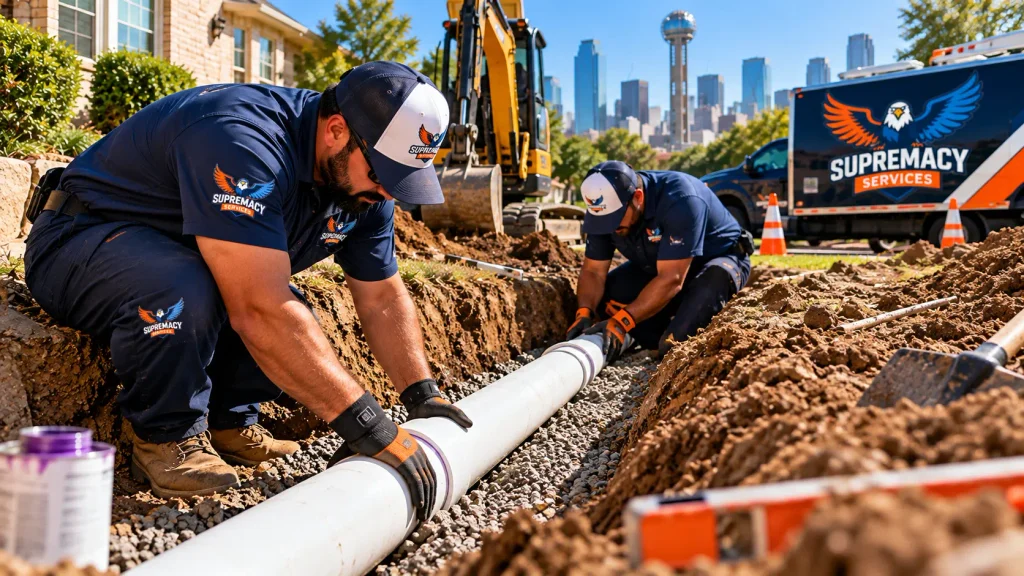
Need Help With a Customer-Owned Gas Line in Dallas?

Understanding where gas utility responsibility ends is the first step toward arranging the right repair.

If the damaged piping belongs to your home, Supremacy Services provides gas line diagnostics, repairs, and replacement services for Dallas and surrounding DFW communities, including Frisco, Plano, Allen, and McKinney.

Our team can help assess the condition of your gas piping, explain available repair options, and coordinate applicable inspection requirements.

Schedule Gas Line Repair With Supremacy Services

Call 945-777-3345 to discuss your service needs.

Important: If you suspect an active gas leak, evacuate first and contact the gas utility’s emergency line or 911 from a safe location. Do not remain inside to schedule a plumbing appointment.

Residential natural gas meter and exterior gas piping beside a brick home in Dallas, Texas.

What Are the Warning Signs of a Gas Line Leak in Your Home?

The most recognizable signs of a gas leak in your home include a rotten-egg smell, hissing near gas piping, unexplained dead vegetation near an underground line, and unusual gas usage. Some leaks, however, may produce no noticeable odor or sound.

For homeowners in Dallas and across the DFW Metroplex, recognizing these warning signs is important because escaping natural gas can create a serious fire or explosion hazard.

If you suspect a gas leak right now, leave the building immediately. Do not operate electrical switches, use your phone inside, start a vehicle nearby, or attempt to locate the leak. Once you are a safe distance away, call 911 and your gas utility’s emergency number. Do not return until emergency responders or the utility confirm it is safe.

This emergency guidance is consistent with the U.S. Pipeline and Hazardous Materials Safety Administration (PHMSA).

This guide explains nine potential warning signs, how natural gas leaks differ from other household problems, what to do if you suspect a leak, and when professional gas line repair may be necessary.

Table of Contents

  1. What are the nine warning signs of a gas leak?
  2. Can you have a gas leak without smelling gas?
  3. What should you do if you suspect a gas leak?
  4. What causes gas lines to leak?
  5. Gas leak vs. carbon monoxide: What’s the difference?
  6. How do professionals detect gas line leaks?
  7. How much does gas line repair cost in Dallas?
  8. How can homeowners prevent gas line problems?
  9. Gas line safety considerations for Dallas homes
  10. Frequently asked questions

What Are the 9 Warning Signs of a Gas Leak in Your Home?

A natural gas leak may produce a noticeable odor, unusual noise, changes around underground piping, or unexplained gas consumption. No single sign is present in every leak, and some symptoms can have unrelated causes.

The following warning signs deserve attention.

1. A rotten-egg or sulfur-like smell

One of the most recognizable warning signs of a natural gas leak is an odor resembling rotten eggs or sulfur.

Natural gas is naturally odorless. Gas suppliers add odorants, commonly sulfur-containing compounds, to help people recognize escaping gas.

You may notice an unusual smell around a gas stove, furnace, water heater, fireplace, gas meter, or other gas-powered equipment.

However, a gas odor does not establish which component is leaking.

What to do: Leave immediately and report the suspected leak from a safe location. Do not follow the odor around your home to locate its source.

2. Hissing or whistling sounds near gas pipes

Supremacy Services technician inspecting residential gas pipe fittings and valves with electronic detection equipment.
Damaged gas pipe connections and fittings can create safety hazards that require professional inspection.

A hissing, whistling, or rushing sound can indicate pressurized gas escaping through a damaged pipe, fitting, valve, or connection.

These sounds may be noticeable around gas appliances or outdoor utility equipment.

Not every hissing sound indicates a gas leak. Water pipes, HVAC components, and operating appliances can make similar noises.

Nevertheless, if you suspect the noise involves gas equipment, treat it as a possible leak rather than trying to investigate.

3. Unexplained dead grass or vegetation

Supremacy Services technician examining a patch of dead grass surrounded by healthy lawn at a North Texas home.
Unexplained patches of dead vegetation may indicate underground utility problems, including a possible gas line leak.

An underground gas leak can sometimes affect nearby vegetation.

Potential warning signs include:

  • An unusual patch of dying grass near a gas service line.
  • Plants deteriorating while nearby vegetation remains healthy.
  • Changes in soil or landscaping around underground utility infrastructure.

These conditions are not proof of a gas leak. Drought, irrigation problems, pests, and soil conditions can produce similar patterns.

If you suspect an underground gas leak, stay away from the affected area and report it. Do not dig into the ground to investigate.

4. An unusual increase in your gas bill

A gas bill that increases unexpectedly may indicate higher gas consumption, a billing change, or a possible leak.

Before attributing the increase to a damaged gas line, consider whether household usage has changed.

For example, colder weather may increase furnace consumption, while additional hot-water usage can increase demand on a gas water heater.

A persistent increase that cannot be explained by usage, weather, or billing changes deserves professional attention.

Important: A high gas bill alone does not confirm a leak, and a normal bill does not rule one out. If there are any other signs of escaping gas, follow emergency procedures rather than waiting for the next bill.

5. Unusual bubbling in wet ground

Gas escaping from underground infrastructure can sometimes produce bubbling in standing water or saturated soil.

This is particularly concerning if bubbling occurs near a known underground gas line.

However, underground water leaks, drainage issues, and naturally occurring soil gases can create similar appearances.

Do not approach a suspected gas release to examine bubbling, and never use an open flame to test whether gas is present.

6. Unexplained physical symptoms

Some people report dizziness, headaches, nausea, or lightheadedness during suspected gas-related incidents.

These symptoms are nonspecific and may have many causes.

At high concentrations, natural gas can displace oxygen in an enclosed space. Separately, malfunctioning gas appliances can produce carbon monoxide through incomplete combustion.

Natural gas exposure and carbon monoxide poisoning are not the same thing.

If someone experiences unexplained symptoms around gas equipment, move to fresh air, seek emergency assistance, and tell responders about the possible gas-related exposure.

7. Damaged or deteriorating gas piping

Visible deterioration around gas equipment may indicate a condition requiring professional inspection.

Examples include corrosion on exposed piping, damaged appliance connectors, loose supports, or evidence of physical impact.

Not every rusted surface is actively leaking, and many dangerous leaks have no visible damage.

Do not touch, tighten, disconnect, or attempt to repair suspicious gas connections.

8. Unusual appliance flame behavior

Gas appliances that are not burning properly may display irregular flames, repeated ignition failures, soot accumulation, or other signs of malfunction.

These symptoms can result from burner contamination, ventilation problems, incorrect gas pressure, or appliance defects.

A yellow flame is not automatically evidence of a gas line leak. Some appliances are designed to produce yellow flames, while others normally burn blue.

Persistent changes in appliance operation require qualified assessment.

If you smell gas or otherwise suspect a leak, evacuate instead of inspecting the appliance.

9. A damaged gas meter or exposed outdoor gas line

Gas meters and exposed service piping can be damaged by vehicle impacts, construction activity, severe weather, or accidental excavation.

Potential concerns include visibly displaced piping, damaged fittings, or an unusual sound near utility equipment.

Do not attempt to straighten, reposition, or operate damaged equipment.

Keep people away and contact emergency responders and the gas utility from a safe location.

Quick comparison: Gas leak warning signs

Warning signPossible explanationRecommended response
Rotten-egg odorOdorized natural gas releaseEvacuate and report immediately
Hissing near gas equipmentPressurized gas escapingEvacuate and report immediately
Dead vegetationPossible underground leak or landscaping issueKeep away; report suspected gas leak
Rising gas billUsage change, billing issue, or leakArrange assessment if unexplained
Bubbling in wet groundPossible underground gas releaseStay away and report
Dizziness or nauseaMultiple possible causes, including hazardous exposureFresh air and emergency medical help when indicated
Corroded pipingDeterioration or maintenance issueProfessional inspection; evacuate if leak suspected
Abnormal burner behaviorCombustion or appliance malfunctionQualified appliance assessment
Damaged gas meterImpact or mechanical damageStay away and contact utility/emergency responders

Can You Have a Gas Leak Without Smelling Gas?

Yes. A natural gas leak can occur without a noticeable rotten-egg odor. The absence of a smell should never be used as proof that a gas system is safe.

Odor may be difficult to recognize because of reduced sense of smell, competing household odors, airflow, or a phenomenon known as odor fade, in which the odorant becomes less detectable.

A leak may also occur outdoors or in a location where the gas does not readily reach someone who could smell it.

This is why professional leak detection relies on suitable instruments and testing procedures rather than smell alone.

Homeowners should not deliberately approach gas piping or appliances to smell for leaks.

What Should You Do If You Suspect a Gas Leak?

Supremacy Services gas leak safety infographic showing evacuation, avoiding ignition sources, calling 911, and waiting for official clearance.
If you suspect a natural gas leak, leave immediately, avoid ignition sources, and contact emergency services and your gas utility from a safe location.

If you suspect a natural gas leak, the safest response is to leave immediately, avoid ignition sources, and contact emergency services from a safe distance.

Emergency gas leak safety checklist

These are instructions for responding to a suspected leak, not steps for locating or repairing one.Leave the building or affected outdoor area immediately.Warn other people to leave if you can do so safely.Do not operate light switches, appliances, garage doors, or electrical devices.Do not smoke, light matches, start vehicles nearby, or use a phone in the affected area.Once safely away, call 911 and your gas utility’s emergency number.Do not return or restore gas service until authorized by emergency responders or the utility.

Do not attempt to find the source of the leak, open windows as a substitute for evacuation, operate gas valves, or perform repairs.

PHMSA’s pipeline leak recognition and emergency guidance supports leaving the area and contacting emergency services rather than investigating the release.

Who should Dallas homeowners call first?

For a suspected active gas leak:

  1. Call 911 from a safe location.
  2. Contact the emergency number for your natural gas utility.
  3. Once the situation is controlled and the appropriate authority has confirmed that it is safe to proceed, arrange any necessary private-side gas piping or appliance repairs.

For non-emergency repairs after the area has been declared safe, Supremacy Services provides professional gas line repair services in Dallas and DFW.

What Causes Gas Lines to Leak in Residential Homes?

Gas leaks can result from damaged piping, deteriorating connections, accidental excavation, equipment failure, or improper installation.

Aging and corrosion

Metal piping and fittings can deteriorate over time, particularly where moisture, soil conditions, or other environmental factors contribute to corrosion.

Age alone does not establish that a gas line is unsafe, but damaged or deteriorating piping may require replacement.

Accidental excavation

Digging for landscaping, fences, drainage improvements, or construction can damage buried gas lines.

Even relatively small excavation projects may involve underground utilities.

Damaged appliance connections

Gas appliances connect to a fuel supply through approved piping, valves, and sometimes flexible connectors.

Improperly installed, damaged, or disturbed connections can create leakage risks.

Ground movement and physical stress

Changes in soil conditions, settlement, or external forces can place stress on buried infrastructure.

In North Texas, expansive clay soils and seasonal moisture changes are relevant considerations for underground utilities, although these conditions do not automatically mean a particular gas line has been damaged.

Installation or repair defects

Incorrect fittings, unsuitable materials, or improper installation practices can create unsafe conditions.

Gas piping work should be performed by appropriately qualified professionals and inspected where required.

Gas Leak vs. Carbon Monoxide: What’s the Difference?

A natural gas leak and carbon monoxide exposure are different hazards, although both can involve gas-powered household equipment.

FeatureNatural gas leakCarbon monoxide problem
Primary concernEscaping fuel gasToxic gas produced by incomplete combustion
SmellOften odorized to smell like rotten eggsOdorless
Main dangerFire, explosion, oxygen displacementPoisoning
Typical sourceLeaking gas piping or connectionsFaulty or improperly vented fuel-burning equipment
DetectionProfessional combustible-gas detectionApproved carbon monoxide alarms and professional testing
Immediate responseEvacuate and call emergency servicesMove to fresh air and seek emergency assistance

Carbon monoxide alarms do not necessarily detect natural gas, and natural gas detectors do not necessarily detect carbon monoxide.

Homeowners should select devices specifically listed for the gas they are intended to detect and follow the manufacturer’s installation instructions.

Do not use a carbon monoxide alarm as proof that a suspected natural gas leak is harmless.

How Do Professionals Detect and Repair Gas Line Leaks?

Qualified professionals may use combustible-gas detection instruments, pressure-testing equipment, visual inspection, and approved diagnostic procedures to identify gas system problems.

The precise process depends on whether the problem involves utility-owned infrastructure, customer-owned piping, or a gas appliance.

Step 1: Emergency response and making the area safe

Emergency responders and the gas utility assess the reported hazard and determine what immediate protective measures are needed.

The gas supply may need to be isolated by authorized personnel.

Step 2: Gas piping inspection

Once the situation is safe, an appropriately qualified professional may inspect accessible piping, fittings, valves, and appliance connections.

Step 3: Instrument-based testing

Supremacy Services technician using an electronic gas detector to inspect an outdoor residential gas meter in Dallas.
Professional gas leak detection uses specialized instruments to help identify potentially unsafe gas piping conditions.

Depending on the circumstances, testing may involve electronic combustible-gas detectors or approved pressure-testing procedures.

A gas system should not be returned to service until required testing and safety checks have been completed.

Step 4: Repair or replacement

The appropriate repair depends on the damaged component, piping material, location, and overall condition of the installation.

A localized defect may be repairable, while extensive deterioration or multiple failures may justify replacement.

Step 5: Verification and return to service

After repairs, required inspections, leak testing, and utility coordination may be necessary before the system can safely operate again.

Supremacy Services describes pressure testing, electronic detection, and coordination with gas utilities as part of its gas line repair offering.

Supremacy Services

Need a gas line repair after an emergency has been made safe? Contact Supremacy Services’ gas line repair team to discuss professional inspection and repair options in the Dallas–Fort Worth area.

How Much Does Gas Line Repair Cost in Dallas?

Gas line repair costs vary according to the location of the damage, the length and material of piping involved, access requirements, and whether excavation or replacement is necessary.

An accurate estimate generally requires identifying the affected portion of the system and determining the required work.

Cost factorWhy it matters
Location of the leakAccessible indoor piping may require different work than buried piping
Pipe conditionWidespread deterioration can make replacement more appropriate
Repair scopeA single damaged connection differs from a full line replacement
ExcavationUnderground access and restoration can increase project complexity
Permits and inspectionsRequirements depend on the jurisdiction and work performed
Utility coordinationSome repairs require coordination before service restoration

No universal Dallas repair price applies to every situation. Rather than publishing an unsupported price range, the article should encourage homeowners to request an itemized estimate after the emergency has been resolved.

How Can Homeowners Prevent Gas Line Problems?

Not every gas leak is preventable, but homeowners can reduce avoidable risks through safe installation practices, appropriate maintenance, and care around underground utilities.

  • Arrange qualified inspections when piping is damaged, disturbed, or showing signs of deterioration.
  • Have gas appliances installed and serviced by appropriately qualified professionals.
  • Avoid using or storing equipment in ways that could damage exposed gas piping.
  • Never move or disconnect gas appliances without following the applicable installation and safety requirements.
  • Contact Texas 811 before excavation and follow utility-marking instructions.
  • Keep access to gas meters and utility equipment unobstructed.
  • Install and maintain appropriate carbon monoxide alarms and, where desired, listed combustible-gas alarms.

Do not perform homemade leak tests or attempt to tighten a suspected leaking fitting.

Gas Line Safety Considerations for Dallas and DFW Homes

Gas piping conditions and repair responsibilities can vary between properties throughout Dallas, Plano, Frisco, Allen, McKinney, Richardson, and Fort Worth.

Older and renovated properties

Homes that have undergone appliance upgrades, kitchen remodeling, or heating-system changes may contain a combination of older and newer gas piping.

These modifications make proper installation records and qualified inspection particularly useful.

Underground piping and North Texas soil

Seasonal soil movement, landscaping projects, and construction can affect underground infrastructure.

However, visible foundation movement or dry soil does not by itself establish that a gas line is leaking.

Utility responsibility vs. homeowner responsibility

The boundary between utility-owned and customer-owned gas infrastructure depends on the utility’s service rules and the installation.

Homeowners should confirm responsibility with their gas provider rather than assuming that every line near the meter belongs to the utility.

Texas safety oversight

The Railroad Commission of Texas pipeline safety program oversees important aspects of pipeline safety in Texas.

Local permit and inspection requirements can also apply to residential gas piping work. Confirm requirements with the relevant city and qualified contractor rather than assuming one set of rules applies across the entire DFW Metroplex.


Frequently Asked Questions About Gas Leaks

1. What is the first sign of a gas leak in a house?

A rotten-egg or sulfur-like smell is one of the most recognizable signs. However, some leaks produce no noticeable odor. Hissing sounds or signs of damage may also indicate a problem.

2. Can a gas leak happen without a smell?

Yes. Odor fade, airflow, location, or a person’s reduced sense of smell can make a leak difficult to detect. Professional instruments are needed to investigate suspected leaks safely.

3. Is a small gas leak dangerous?

Yes. A leak should never be considered safe simply because the odor seems faint or the suspected release appears small. Evacuate and report any suspected active leak.

4. Can a gas leak cause headaches or dizziness?

Potentially. High concentrations of natural gas can displace oxygen, while malfunctioning gas appliances may create carbon monoxide hazards. These symptoms have many possible causes and require appropriate medical evaluation.

5. Should I open windows if I smell gas?

Do not delay evacuation to open windows or ventilate the building. Leave immediately, avoid electrical switches and other ignition sources, and contact emergency services from a safe location.

6. Can I use a gas detector to check for a leak myself?

Residential gas alarms may provide an additional warning, but they are not a substitute for professional leak investigation. Never remain in a suspected leak area to use a handheld detector.

7. Does a high gas bill always mean there is a leak?

No. Weather, appliance use, rates, and billing periods can affect charges. However, unexplained consumption may justify professional assessment once any immediate safety concern has been addressed.

8. Who is responsible for fixing a gas leak in Dallas?

Responsibility depends on whether the leak involves utility-owned infrastructure, customer-owned piping, or an appliance. Contact the gas utility for emergency response and responsibility guidance.

9. Can I stay in my house if I only smell a little gas?

No. Do not use odor strength to judge the severity of a suspected gas leak. Leave the affected area immediately and wait for clearance from emergency responders or the gas utility.

Protect Your Dallas Home With Professional Gas Line Service

Supremacy Services plumbing technician working on exterior residential gas piping beside a gas meter at a Dallas home.
Qualified gas line professionals can assess damaged piping and perform necessary repairs after the immediate hazard has been addressed.

Knowing the warning signs of a gas leak can help you recognize a dangerous situation before it becomes worse.

A rotten-egg smell, unexplained hissing, damaged gas piping, or suspicious outdoor conditions should never be ignored. The first priority is always personal safety: evacuate, contact emergency services and your gas utility, and do not return until the area has been declared safe.

After the immediate hazard has been addressed, qualified inspection and repair can help determine what work is needed before gas service is restored.

Supremacy Services provides gas line inspection and repair services for Dallas and DFW homeowners.

For non-emergency repair arrangements after the property has been cleared, call or visit Supremacy’s gas line repair page to request service.

Supremacy Services plumber inspecting a sagging underground sewer pipe in a Dallas residential yard.

Sewer Line Belly: What It Is and How Plumbers Fix It

A sewer line belly is a low or sagging section of underground sewer pipe where wastewater collects instead of flowing steadily toward the municipal sewer main. In Dallas homes, this can contribute to recurring drain clogs, slow drainage, sewage backups, and repeated plumbing problems.

A sewer belly often develops when the ground beneath a pipe settles, the original pipe bedding fails, or a sewer line was installed without adequate support or slope.

Can plumbers fix a sewer line belly? Yes. A plumber can identify the affected section using a sewer camera inspection and, when necessary, excavate and reposition or replace the pipe to restore proper drainage. Minor bellies that do not cause drainage problems may only require monitoring.

Understanding the difference between a harmless low spot and a sewer defect requiring repair can help Dallas–Fort Worth homeowners avoid unnecessary work while addressing problems before they become more disruptive.

Table of Contents

  1. What Is a Sewer Line Belly?
  2. What Causes a Belly in a Sewer Line?
  3. What Are the Warning Signs?
  4. How Do Plumbers Diagnose a Sewer Belly?
  5. How Do Plumbers Fix a Sewer Line Belly?
  6. Can Trenchless Repair Fix a Sewer Belly?
  7. How Much Does Repair Cost?
  8. Does Every Sewer Belly Need Repair?
  9. Sewer Belly vs. Other Sewer Problems
  10. Dallas and North Texas Considerations
  11. Can You Prevent a Sewer Belly?
  12. When Should You Call a Plumber?
  13. Frequently Asked Questions

What Is a Sewer Line Belly?

Comparison of a properly sloped sewer pipe and a sagging sewer line with standing wastewater and sediment.
A properly sloped sewer line allows wastewater to drain, while a sewer belly creates a low section where water and debris can accumulate.

A sewer line belly, also called a sewer pipe sag, is a section of drainage pipe that dips below its intended downward slope. The low area can hold standing wastewater after the rest of the line has drained.

Most residential sewer laterals rely on gravity to carry wastewater away from the house. To function properly, the pipe needs a suitable downward grade toward its destination.

When part of the pipe sinks, water and waste can accumulate in the depression.

How a sewer belly changes wastewater flowConceptual illustration, not to scale. A belly creates a depression where wastewater and solids may collect.

The pipe may remain intact, but its shape interferes with efficient drainage.

Why standing water matters

A properly graded sewer pipe allows wastewater to carry toilet paper and other solids downstream.

In a sagging section, water slows and solids may settle. Over time, accumulated material can restrict the pipe and contribute to recurring blockages.

A sewer belly is not necessarily a complete obstruction. Wastewater may still pass through the pipe, especially when a large volume of water enters the system.

That explains why some homeowners experience intermittent drainage problems rather than a constant backup.

Dallas Water Utilities’ published design guidance recognizes the importance of appropriate wastewater lateral grades, including a preferred 2% slope and minimum 1% grade in the referenced utility design context. Those figures should not be applied indiscriminately to every existing private residential drain, since applicable requirements depend on pipe configuration and governing code.

What Causes a Belly in a Sewer Line?

A sewer belly usually develops when a section of pipe loses its original support or was installed with an improper slope.

Several conditions can contribute.

1. Soil settlement beneath the pipe

Underground sewer pipes depend on the surrounding soil and bedding material for support.

If the supporting material settles unevenly, part of the pipe can drop below its original position.

In North Texas, changes in soil moisture and ground movement make the quality of underground pipe support particularly important.

However, soil movement alone does not prove that a sewer belly has developed.

2. Improper pipe installation

A sewer line installed without consistent grading or adequate bedding can develop drainage problems even when the pipe itself is relatively new.

Possible installation-related issues include:

  • Inconsistent pipe slope
  • Poorly compacted backfill
  • Inadequate bedding material
  • Unsupported pipe sections
  • Movement at pipe connections

A newer PVC sewer line can develop a belly if the installation or underlying support is inadequate.

3. Soil erosion and loss of support

Water escaping from a damaged pipe joint, another underground leak, or drainage problems near the sewer trench may wash away supporting soil.

As the ground beneath the pipe loses stability, the line can settle.

In these situations, simply replacing the visible sagging section without addressing the cause of soil loss may leave the repair vulnerable to future movement.

4. Aging sewer systems and deteriorating connections

Older Dallas homes may have cast iron or clay sewer piping.

These materials can experience corrosion, cracking, joint movement, or other age-related deterioration.

A sewer belly is a grading problem, not a specific pipe-material defect. However, aging pipes and unstable joints can complicate an existing sag.

5. Ground disturbance and construction

Excavation, utility work, or changes to surrounding ground conditions can affect underground pipe support.

The significance depends on the location, depth, bedding, and nature of the disturbance.

What Are the Warning Signs of a Sewer Line Belly?

The most common warning sign is a sewer line that repeatedly clogs or backs up, even after professional drain cleaning.

Other symptoms may include:

  • Multiple drains becoming slow around the same time
  • Toilets gurgling when other plumbing fixtures are used
  • Wastewater backing up into a shower or floor drain
  • Recurring sewage odors
  • Frequent need for sewer cleaning
  • Standing water visible during a sewer camera inspection

These symptoms do not confirm a sewer belly. Tree roots, grease buildup, damaged pipe joints, and other blockages can produce similar problems.

Why does the same sewer clog keep returning?

A drain-cleaning machine or hydro jetting service may remove accumulated waste from a sagging pipe.

However, cleaning does not restore the pipe’s original slope.

If the low area continues collecting solids, the blockage may return.

This distinction matters when homeowners have already paid for several drain-cleaning visits without resolving the underlying problem.

For additional symptoms, read Supremacy Services’ guide to warning signs of sewer-line damage in Dallas.

How Do Plumbers Diagnose a Sewer Line Belly?

Supremacy Services technician reviewing sewer camera footage showing standing water and sediment inside a sewer pipe.
A sewer camera inspection helps plumbers identify standing water, pipe damage, and possible low spots in underground sewer lines.

Plumbers commonly use a sewer camera inspection to identify standing water, inspect the pipe’s condition, and locate a suspected belly.

A camera inspection is particularly useful because the affected pipe is usually buried beneath a yard, driveway, or other surface.

Step 1: Access the sewer line

The plumber locates a suitable cleanout or other approved access point.

A flexible camera cable is inserted into the sewer line.

Step 2: Inspect the pipe interior

The camera moves through the pipe, allowing the technician to look for:

  • Standing wastewater
  • Accumulated debris
  • Cracks or broken sections
  • Offset or separated joints
  • Root intrusion
  • Corrosion or deterioration

When the camera reaches a significant belly, the water level may rise across the lens.

As the camera moves beyond the depression, visibility may improve again.

Step 3: Locate the affected section

A compatible camera transmitter and surface locator can help identify where the suspected defect lies underground.

The technician may estimate its position and depth before planning further investigation or excavation.

Step 4: Confirm the actual problem

Standing water does not always mean the pipe has a belly.

A downstream blockage can also cause wastewater to accumulate upstream.

For this reason, a reliable diagnosis may require clearing obstructions, repeating the camera inspection, and evaluating pipe grade where necessary.

Ask for a copy of the camera footage and an explanation of the suspected belly’s location, length, and severity before approving major excavation.

If recurring sewer problems are affecting your home, Supremacy Services offers sewer inspections and repair assessments in Dallas to help identify the underlying issue before choosing a repair method.

How Do Plumbers Fix a Sewer Line Belly?

Supremacy Services plumbing technicians installing a properly graded PVC sewer pipe inside a residential excavation trench.
Correcting a significant sewer belly may require excavation, stable pipe bedding, and installation at the proper drainage slope.

The most direct way to permanently correct a significant sewer belly is to expose the affected section and restore the proper pipe slope and support.

The appropriate repair depends on the length and severity of the sag, the pipe’s condition, available access, and surrounding site conditions.

Option 1: Excavation and pipe regrading

For a localized belly, a plumber may excavate the affected section and reposition or replace the pipe at the required grade.

The general process involves:

  1. Locating the affected pipe section.
  2. Identifying nearby utilities and arranging required excavation precautions.
  3. Excavating to expose the pipe.
  4. Removing or adjusting the defective section.
  5. Preparing stable pipe bedding.
  6. Installing the pipe at the correct slope.
  7. Testing and inspecting the repaired line.
  8. Backfilling and restoring the disturbed area.

Correct bedding and compaction matter because the repaired section must remain adequately supported.

Option 2: Partial sewer line replacement

If the pipe has deteriorated or the sagging section cannot be reliably repositioned, replacing the affected length may be the better option.

Partial replacement can be appropriate when the surrounding pipe remains serviceable.

The plumber should inspect adjacent sections to avoid connecting new piping to severely deteriorated material.

Option 3: Larger sewer line replacement

A more extensive replacement may be recommended when multiple sections have lost grade or the line also contains significant structural defects.

This can be particularly relevant when several problems exist together, such as:

  • Multiple sewer bellies
  • Extensive pipe deterioration
  • Repeated joint separation
  • Severe corrosion
  • Collapsed sections

Replacing an entire sewer line is not automatically necessary because one belly has been discovered.

The decision should follow an assessment of the whole affected line.

Option 4: Cleaning and monitoring

Not every belly needs immediate excavation.

If a low spot is shallow, the pipe remains structurally sound, and wastewater flows adequately, a plumber may recommend monitoring.

Periodic cleaning may help manage accumulated debris, but it does not correct the pipe’s grade.

The distinction is between maintaining a functional pipe and permanently correcting its geometry.

Can Trenchless Sewer Repair Fix a Belly?

Comparison diagram showing trenchless pipe lining following an existing sewer belly and excavation restoring the proper pipe slope.
Trenchless pipe lining generally follows the existing pipe shape, while excavation and regrading can correct a sewer belly by restoring proper drainage slope.

Standard cured-in-place pipe lining generally cannot correct a sewer belly because the liner follows the existing pipe’s shape.

Trenchless repair methods are valuable for certain types of pipe damage, but not every underground sewer problem can be corrected without excavation.

Repair methodCorrects pipe slope?Typical role
Hydro jettingNoRemoves debris and buildup
Drain snakingNoClears certain obstructions
CIPP pipe liningGenerally noRehabilitates suitable existing pipes
Pipe burstingNot inherentlyReplaces pipe along an existing route; grade must be assessed
Excavation and regradingYesCorrects an improperly graded section
Excavation and replacementYes, when properly installedReplaces damaged or sagging pipe at the required grade

A new liner can improve the condition of a suitable host pipe without changing the low point that causes wastewater to pool.

Likewise, pipe bursting does not automatically solve a grading problem simply because it installs a new pipe.

When a sewer belly is responsible for recurring backups, homeowners should ask whether the proposed repair actually restores positive drainage slope.

Considering sewer repair in Dallas? Supremacy Services evaluates both traditional and trenchless options. A professional assessment can help determine whether your line needs localized regrading, replacement, or another appropriate solution.

How Much Does Sewer Line Belly Repair Cost in Dallas?

Sewer line belly repair costs depend primarily on how much pipe needs to be exposed, how deep it is buried, and what must be restored after the work.

There is no reliable flat price for every sewer belly. A short section beneath an accessible lawn is a different project from a deep sewer lateral beneath a concrete driveway.

Because no sufficiently verified current Dallas-specific pricing dataset was established for this article, a fixed dollar range is intentionally omitted.

Factors affecting the final cost

Cost factorWhy it matters
Length of sagging pipeLonger sections generally require more materials and excavation
Burial depthDeep trenches may require additional excavation and safety measures
Pipe materialConnections and replacement methods differ by material
Surface above the lineConcrete, paving, and landscaping can increase restoration work
Additional pipe defectsCracks, roots, and deterioration may expand the repair scope
Utility conflictsNearby underground utilities may complicate access
Permits and inspectionsApplicable requirements can affect scheduling and costs
Site accessibilityEquipment access can influence labor and excavation methods

What should a sewer belly repair estimate include?

Before approving work, request a written estimate explaining the diagnosis, proposed repair length, excavation requirements, replacement materials, testing, backfill, and surface restoration.

Ask whether permit costs and any unexpected repairs are included or handled separately.

A camera inspection and properly documented repair plan are more useful than an estimate based only on symptoms.

For Dallas homeowners comparing repair options, Supremacy Services’ sewer line repair and replacement service is the relevant starting point for an assessment.

Does Every Sewer Line Belly Need to Be Repaired?

No. A minor sewer belly does not necessarily require immediate repair if the pipe remains structurally sound and wastewater continues flowing without recurring problems.

The decision depends on the defect’s severity, symptoms, and overall pipe condition.

Inspection findingReasonable next step
Small low spot, no symptomsDocument and monitor
Minor belly with occasional buildupEvaluate cleaning and monitoring
Repeated clogs at the same locationInvestigate corrective repair
Significant standing water and solids accumulationAssess regrading or replacement
Belly with cracks or separated jointsEvaluate structural repair needs
Active sewage backupPrompt professional attention

A camera report should be interpreted alongside the home’s drainage history.

For example, a shallow sag discovered during a home purchase inspection may justify further evaluation without automatically requiring full replacement.

Conversely, a significant belly that repeatedly collects sewage and causes backups is more difficult to manage through cleaning alone.

Sewer Line Belly vs. Other Sewer Problems

A sewer belly can be confused with several other underground plumbing defects.

ProblemWhat happensMain distinction
Sewer bellyPipe develops a low sectionWastewater pools because of lost grade
Tree root intrusionRoots enter through openingsRoots physically obstruct the line
Collapsed sewer pipePipe structure failsThe opening becomes damaged or restricted
Offset jointConnected pipe sections shiftMisaligned edges can catch debris
Grease blockageWaste accumulates inside pipeObstruction may exist without a slope defect
Back-pitched sewer linePipe slopes in the wrong directionWastewater must move uphill across the affected section

A sewer camera inspection can help distinguish these conditions, although additional investigation may be needed when visibility is limited.

The distinction is important because a cleaning service, structural repair, and grading correction address different causes.

Why Sewer Line Bellies Matter in Dallas and North Texas

Dallas homeowners should consider local soil conditions, the age of underground plumbing, and the location of the sewer lateral when evaluating a suspected belly.

Expansive soils and ground movement

Parts of North Texas contain clay-rich soils that change volume as moisture conditions change.

Such movement can affect underground infrastructure, particularly where pipe support, bedding, or drainage conditions are inadequate.

However, a sewer belly cannot be attributed to expansive clay without investigating the actual site.

Older Dallas housing and sewer materials

Some older homes have sewer systems built with materials and installation practices different from those used today.

A plumber inspecting an older line should consider pipe material, joint condition, corrosion, prior repairs, and existing grade.

Replacing a small section without evaluating adjacent deterioration may not address all contributing problems.

Who is responsible for a sewer lateral in Dallas?

Responsibility depends on the location of the affected pipe and the applicable utility arrangement.

Dallas Water Utilities’ design manual illustrates a division between homeowner and utility responsibility for wastewater service connections. The exact boundary should be confirmed for the property rather than assumed.

If a suspected belly is near the street, property boundary, or public connection, confirm the relevant responsibilities before arranging excavation.

Permits and excavation

Sewer replacement work may require permits, inspections, utility coordination, or other approvals depending on the jurisdiction and project scope.

Dallas, Plano, Frisco, Allen, Fort Worth, and surrounding municipalities may have different administrative requirements.

A licensed plumbing professional should confirm the applicable requirements before starting work.

Can You Prevent a Sewer Line Belly?

Homeowners cannot prevent every instance of underground soil movement, but proper installation and early attention to drainage problems can reduce avoidable risks.

Practical precautions include:

  • Ensure replacement sewer lines are installed with appropriate grading and bedding.
  • Address known underground leaks and soil erosion.
  • Avoid allowing stormwater to wash away soil around exposed utility trenches.
  • Investigate repeated sewer backups instead of relying indefinitely on cleaning.
  • Keep inspection footage and records of previous sewer repairs.
  • Have underground pipe conditions evaluated before major landscaping or construction near the sewer route.

Avoid flushing wipes, grease, and other materials that can contribute to blockages. Although these materials do not create a belly, they can make a sagging pipe more troublesome.

Can homeowners repair a sewer belly themselves?

Diagnosing and correcting a buried sewer belly is generally not a suitable DIY project.

The work can involve excavation hazards, underground utilities, sewage exposure, pipe grading, and plumbing-code requirements.

Homeowners can document symptoms, reduce unnecessary water use during a backup, and arrange an inspection.

The actual underground repair should be handled by appropriately qualified professionals.

When Should You Call a Dallas Sewer Repair Professional?

Supremacy Services plumber explaining sewer camera inspection findings and repair options to a Dallas homeowner.
Reviewing sewer camera findings with a professional plumber helps homeowners understand whether a sewer belly needs monitoring, regrading, or replacement.

Schedule a professional sewer evaluation if multiple drains are backing up, the same blockage keeps returning, or an inspection has identified a significant low section in the sewer line.

Seek prompt assistance if sewage is entering the home, wastewater is overflowing, or an underground leak is suspected.

A professional assessment should explain:

  1. Whether the problem is truly a sewer belly.
  2. Where the affected pipe is located.
  3. Whether other defects are present.
  4. Whether monitoring is reasonable.
  5. Which repair methods can restore reliable drainage.
  6. What excavation, testing, and restoration may involve.

Get the right diagnosis before replacing your sewer line

A sewer belly does not automatically mean you need a completely new sewer system.

The right repair depends on what the camera inspection reveals and whether the existing pipe can continue functioning reliably.

Supremacy Services provides sewer line repair and replacement services for Dallas and the surrounding DFW Metroplex, including camera-based assessments and evaluations of traditional and trenchless repair options.

If your sewer line repeatedly backs up or a previous inspection identified a sagging section, visit Supremacy Services’ sewer repair and replacement page to discuss the next steps.


Frequently Asked Questions About Sewer Line Bellies

1. Is a belly in a sewer line a serious problem?

It can be. A shallow belly without drainage symptoms may only require monitoring. A deeper sag that repeatedly traps waste can cause clogs and backups and may need corrective repair.

2. Can a sewer belly fix itself?

No. A buried sewer pipe generally will not return to its intended slope on its own. The symptoms may temporarily improve after cleaning, but the underlying low spot remains.

3. Can hydro jetting fix a sewer belly?

Hydro jetting can remove accumulated waste and restore flow, but it cannot lift or regrade a sagging pipe. It is a cleaning method rather than a permanent correction for lost slope.

4. Can a sewer line belly cause a backup?

Yes. Standing water in the low section can encourage solids to settle, eventually restricting flow and causing wastewater to back up into household drains.

5. Can a sewer camera detect a belly?

A sewer camera can reveal standing water and other evidence of a suspected belly. Additional investigation may be necessary to confirm the pipe’s grade and distinguish a sag from downstream obstruction.

6. Can a new PVC sewer pipe develop a belly?

Yes. Even a relatively new PVC line can sag if its bedding is inadequate, backfill settles, or the pipe was installed with an improper slope.

7. Will sewer pipe lining repair a belly?

Standard CIPP lining generally does not correct the slope of a sagging pipe. It follows the existing pipe’s path, so a significant low spot can remain after lining.

8. How long does sewer belly repair take?

The timeline depends on the depth, length, access, permitting, and surface restoration involved. A localized repair may be less extensive than replacing a long sewer lateral, but the contractor should provide a project-specific schedule.

9. Should I buy a house with a sewer line belly?

Not necessarily a reason to reject the property. Request the full camera inspection, evaluate the belly’s severity and drainage history, and obtain a repair opinion or estimate before deciding.

10. Does homeowners insurance cover sewer belly repair?

Coverage depends on the policy and cause of damage. Gradual settlement, wear, or poor installation may be excluded, while certain resulting damage may be treated differently. Review the policy and ask the insurer about the specific circumstances.

Professional plumber inspecting an aging cast iron sewer pipe outside an older Dallas home.

Cast Iron Sewer Pipes in Older Dallas Homes: Common Problems

Cast iron sewer pipes in older Dallas homes can develop corrosion, heavy internal scaling, cracks, leaking joints, and recurring blockages as they age. These problems may cause slow drains, sewer odors, wastewater backups, or hidden leaks beneath a home’s foundation.

However, having cast iron pipes does not automatically mean they need to be replaced. Their condition depends on age, installation quality, corrosion exposure, past repairs, and whether the pipe still has enough structural integrity to function safely.

For homeowners in Dallas and the surrounding DFW Metroplex, understanding the warning signs and arranging an appropriate sewer inspection can help distinguish an ordinary clog from a deteriorating pipe.

Table of Contents

  1. What are cast iron sewer pipes?
  2. Why do cast iron sewer pipes deteriorate?
  3. Common problems in older Dallas homes
  4. Warning signs of failing cast iron pipes
  5. How long do cast iron sewer pipes last?
  6. How plumbers inspect old cast iron pipes
  7. Repair vs. replacement options
  8. What affects repair and replacement costs?
  9. Dallas and North Texas considerations
  10. What homeowners can do
  11. Frequently asked questions
  12. When to contact Supremacy Services

What Are Cast Iron Sewer Pipes?

Cast iron sewer pipes are rigid metal pipes used to carry wastewater from toilets, sinks, showers, and other plumbing fixtures toward a municipal sewer connection or private wastewater system.

They were commonly installed in residential plumbing before plastic drain materials became widely adopted.

In older homes, cast iron may be present in several locations:

  • Vertical drain stacks inside walls.
  • Horizontal drain lines beneath floors.
  • Underground building drains beneath concrete slabs.
  • Sections of the sewer lateral connecting the home to the public sewer.

Cast iron was valued for its strength, durability, and sound-dampening characteristics. Its primary long-term weakness is susceptibility to corrosion.

Unlike a plastic pipe, cast iron can gradually lose material from its walls as chemical and environmental conditions affect the metal.

How cast iron differs from modern plastic sewer pipes

FeatureCast ironPVC sewer pipe
MaterialIron-based metalPolyvinyl chloride
CorrosionSusceptible to corrosionDoes not rust
WeightHeavyLightweight
Internal surfaceCan become rough from corrosionGenerally remains smoother
Noise transmissionGood sound-dampening propertiesTypically transmits more drainage noise
Common concernScaling, corrosion, wall deteriorationJoint defects, deformation, damage, or improper installation

Both materials can fail when improperly installed or exposed to unsuitable conditions.

Why Do Cast Iron Sewer Pipes Deteriorate?

Close-up of a deteriorated cast iron sewer pipe showing heavy internal rust deposits and restricted wastewater flow.
Internal corrosion and rust buildup can narrow cast iron sewer pipes, increasing the risk of recurring clogs and slow drainage.

Cast iron sewer pipes deteriorate primarily because corrosion gradually changes the condition of the metal. The process may affect the inside of the pipe, its exterior, or both.

The U.S. Environmental Protection Agency identifies internal corrosion, external pitting, joint failure, and fractures among the recognized defects affecting iron-based wastewater infrastructure.

Internal corrosion from wastewater

Wastewater contains organic material, dissolved substances, and microorganisms. Under certain conditions, biological activity can produce corrosive compounds.

Hydrogen sulfide produced in wastewater environments can contribute to sulfuric acid formation where oxygen and suitable microorganisms are present. This can accelerate corrosion in susceptible sewer environments.

The severity varies with wastewater chemistry, ventilation, flow patterns, and other conditions. Not every residential sewer experiences the same exposure.

Rust buildup and internal scaling

As cast iron corrodes, deposits can form on its interior surface.

These rough deposits, sometimes called tuberculation or scaling, can reduce the usable opening and make it easier for grease, paper, and other debris to collect.

A pipe may therefore experience repeated drainage problems even without a complete collapse.

Exterior corrosion

Soil moisture, chemical conditions, and prolonged contact with corrosive environments may contribute to exterior pipe deterioration.

Underground corrosion is not necessarily visible during an internal camera inspection. This is one reason a camera image alone cannot always establish the remaining wall thickness or full structural condition.

Aging joints and connections

Older cast iron drainage systems may contain traditional bell-and-spigot joints or other connection types.

Over time, joint movement, deterioration, or changes in surrounding support can contribute to leakage and misalignment.

7 Common Problems With Cast Iron Sewer Pipes in Older Dallas Homes

The following problems may occur individually or together. A professional inspection is needed to determine which defects are actually present.

1. Internal rust and corrosion

Corrosion can gradually roughen the interior surface of a cast iron pipe.

As deposits accumulate, wastewater may flow less efficiently and solid waste may become trapped.

Common clues: recurring clogs, slow drainage, and heavy deposits observed during camera inspection.

2. Pipe wall thinning and deterioration

Corrosion does more than create surface rust. In advanced cases, it can reduce the amount of sound metal remaining in the pipe wall.
Severe deterioration may eventually produce holes, fractures, or loss of structural strength.

An important distinction is that a pipe may look obstructed because of deposits, while another pipe may be physically weakened beneath those deposits.

The appropriate treatment can differ significantly.

3. Cracks and longitudinal splits

Cast iron is strong but relatively brittle compared with many modern plastic piping materials.

Changes in support, external loading, corrosion, and other stresses can contribute to fractures.

A crack may allow wastewater to escape or soil and roots to enter.

4. Recurring sewer blockages

Aging cast iron may develop a rough, restricted interior that repeatedly catches waste.

A plumber may clear the immediate obstruction, but the underlying problem can remain if corrosion deposits or damaged pipe walls continue to interfere with flow.

This is why repeated drain cleaning without identifying the cause may provide only temporary relief.

5. Leaking pipe joints

Damaged or misaligned joints can allow wastewater to escape into surrounding soil or building materials.

Depending on the location, this may contribute to odors, moisture damage, or ground movement around the line.

6. Tree root intrusion

Severely corroded underground cast iron sewer pipe with a large crack and tree roots growing through the damaged section.
Tree roots can enter damaged cast iron sewer pipes through cracks and defective joints, contributing to blockages and sewer backups.

Tree roots can enter a sewer through an existing crack or defective joint where conditions allow.

Once inside, roots may grow and collect waste, increasing the likelihood of a blockage.

Roots are not proof that the entire cast iron line has failed, but their presence warrants evaluation of the entry point.
7. Pipe collapse or severe structural failure
In advanced cases, deteriorated pipe walls or unsupported sections can lose their ability to maintain an open passage.

A collapsed sewer section may cause major drainage restrictions or sewage backups.

A severely collapsed pipe usually requires structural repair or replacement rather than ordinary cleaning.

What Are the Warning Signs of Failing Cast Iron Sewer Pipes?

The most common warning signs are recurring drain clogs, multiple slow fixtures, sewer odors, wastewater backups, and unexplained moisture near drain piping.

Warning signPossible explanationRecommended action
Multiple drains running slowlyMain drain restriction or pipe scalingInspect the main drainage system
Repeated sewer backupsPersistent obstruction or damaged lineArrange prompt professional diagnosis
Gurgling toiletsDrainage or venting problemCheck for a system-wide issue
Sewer odorsDrain trap, vent, joint, or sewer defectIdentify the odor source
Damp areas near drain pipingPossible wastewater leakInvestigate promptly
Frequent clogs after cleaningRecurring buildup or structural defectConsider a sewer camera inspection
Visible corrosion on exposed pipeSurface or more advanced deteriorationEvaluate the affected section

These symptoms are not exclusive to cast iron corrosion.

For example, a gurgling toilet can also result from a venting issue, and a slow sink may have an ordinary localized clog.

The most useful clue is often the pattern of symptoms across the home, rather than a single fixture behaving unusually.

When is the situation urgent?

Arrange prompt plumbing assistance if wastewater is backing up into the home, several fixtures stop draining, or sewage is escaping from a damaged pipe.

Avoid using affected plumbing fixtures until the cause is understood.

If sewage has entered living spaces, limit contact with contaminated water and arrange appropriate cleanup.

For homeowners experiencing repeated problems, Supremacy Services offers professional sewer line repair and replacement in Dallas to help identify and address damaged sewer piping.

How Long Do Cast Iron Sewer Pipes Last?

Cast iron sewer pipes can remain functional for many decades, but there is no single lifespan that accurately predicts when every pipe will fail.

Condition is more important than age alone.

Some older cast iron pipes continue functioning with limited deterioration. Others experience substantial corrosion or leakage earlier because of wastewater conditions, soil exposure, installation defects, or maintenance history.

What affects the lifespan of cast iron?

  • Internal and external corrosion exposure.
  • Installation quality and pipe support.
  • Wastewater chemistry and flow conditions.
  • Previous repairs and alterations.
  • Ground movement or settlement.
  • History of blockages, leaks, and root intrusion.

For a home built several decades ago, the most practical question is not simply how old the pipe is.

It is whether the existing drainage system remains structurally sound and performs reliably.

Should you replace cast iron pipes just because they are old?

Not necessarily. Age should prompt closer evaluation, especially when there are symptoms or a major renovation is planned, but replacement should be based on the pipe’s condition and the risks associated with keeping it in service.

How Do Plumbers Inspect Old Cast Iron Sewer Pipes?

A sewer camera inspection allows a plumber to view accessible portions of the pipe interior and identify visible obstructions, cracks, joint defects, corrosion deposits, and other problems.

It is an important diagnostic tool, but it does not directly measure every aspect of structural strength.

Step 1: Review the symptoms

The plumber asks which fixtures are affected, when the problem began, and whether previous drain cleaning has been performed.

This helps determine whether the likely problem is local or associated with the main sewer line.

Step 2: Identify access points

The technician locates a suitable cleanout or another appropriate access point.

Some older homes may have limited or inconvenient access.

Step 3: Inspect the pipe interior

Supremacy Services plumbing technician using a sewer inspection camera to examine an older cast iron drain line at a Dallas home.
Professional sewer camera inspections help identify visible corrosion, cracks, root intrusion, and obstructions inside aging cast iron sewer pipes.

A specialized camera is advanced through accessible piping where conditions permit.

The inspection may reveal:

  • Heavy scaling and corrosion deposits.
  • Standing water or a pipe belly.
  • Root intrusion.
  • Visible cracks or openings.
  • Misaligned joints.
  • Obstructions and collapsed sections.

Heavy deposits or standing water can limit visibility and camera access. Cleaning or another diagnostic approach may be needed.

Step 4: Locate the defect

When appropriate, locating equipment can help identify the approximate position and depth of a camera-observed problem.

Step 5: Explain repair options

The plumber should explain what the inspection shows, what remains uncertain, and which repair approaches are technically suitable.

Homeowners can ask for recorded footage, defect locations, and a written explanation before approving major work.

Important: An interior camera cannot reliably determine external corrosion or remaining pipe wall thickness. Excavation or additional assessment may be necessary when structural integrity remains uncertain.

Can Cast Iron Sewer Pipes Be Repaired, or Do They Need Replacement?

Cast iron sewer pipes can sometimes be repaired, cleaned, or rehabilitated. Replacement becomes more appropriate when deterioration is extensive, the pipe has collapsed, or its condition makes a durable repair impractical.

Side-by-side comparison of a heavily corroded cast iron sewer pipe and a clean new PVC sewer replacement pipe.
Comparing deteriorated cast iron with new PVC sewer piping highlights differences in corrosion resistance and internal pipe condition.

The best option depends on the location, extent, and severity of damage.

Comparing the main options

MethodWhen it may be suitableMain limitation
Professional drain cleaningDeposits or removable obstructionsDoes not restore lost pipe wall strength
Localized pipe repairIsolated defect in otherwise serviceable pipingDoes not address deterioration elsewhere
CIPP pipe liningSuitable existing pipe with adequate geometry and accessNot appropriate for every collapsed or severely distorted pipe
Pipe burstingReplacement where site conditions permitRequires access and may be restricted by surrounding utilities or site conditions
Excavation and replacementExtensive deterioration, collapse, or unsuitable existing pipeGreater potential for excavation and restoration work

The EPA’s wastewater rehabilitation research describes inspection and rehabilitation approaches, including trenchless methods, while emphasizing that suitability depends on actual pipe conditions.

Can hydro jetting damage old cast iron pipes?

Hydro jetting uses pressurized water to remove deposits and obstructions.

It can be useful in some drainage systems, but heavily deteriorated cast iron requires particular caution.

The plumber should assess the pipe’s condition and select a cleaning method appropriate to the risk. Aggressive cleaning is not automatically suitable for fragile or structurally compromised piping.

Is pipe lining always an alternative to replacement?

No. CIPP lining may be suitable for some deteriorated pipes, but not every pipe is a candidate.

Major collapse, significant deformation, access limitations, or other structural defects can prevent successful installation.

Lining also does not automatically correct improper slope or every alignment problem.

When replacement is the better choice

Replacement deserves serious consideration when inspection identifies widespread wall loss, multiple structural failures, substantial collapse, or repeated defects that make localized repairs uneconomical.

Homeowners should request an explanation of why the recommended method addresses the actual defects, rather than relying on pipe age alone.

If an inspection confirms structural deterioration, Supremacy Services’ sewer repair and replacement options can provide a starting point for discussing conventional and trenchless solutions.

What Affects Cast Iron Sewer Pipe Repair Costs?

Cast iron sewer repair costs depend primarily on how much piping is damaged, where it is located, how accessible it is, and which repair method is appropriate.

A minor accessible repair and a complete under-slab sewer replacement are fundamentally different projects.

Major cost factors

Cost factorWhy it matters
Length of damaged pipeMore material and labor may be required
LocationPipes beneath concrete or finished rooms may require additional access work
Pipe depthDeep excavation may increase labor and safety requirements
Repair methodCleaning, spot repair, lining, and replacement involve different equipment and work
Access limitationsDifficult cleanout access or confined work areas may increase complexity
Surface restorationConcrete, flooring, landscaping, or other finishes may need restoration
Permits and inspectionsRequirements vary by jurisdiction and scope
Additional defectsMultiple failures may expand the necessary work

Is cast iron sewer replacement expensive?

It can be, especially when extensive pipe replacement or slab access is required.

However, publishing a single average price without knowing the pipe length, location, condition, and repair method can mislead homeowners.

An accurate estimate should follow diagnosis and a defined scope of work.

Ask for a written proposal identifying the affected sections, proposed materials, access method, exclusions, restoration responsibilities, and any applicable warranty terms.

Why Older Dallas Homes Need Special Attention

Older Dallas homes may contain original cast iron drains, mixed pipe materials, previous repairs, and sewer sections installed under slabs or landscaped areas.

These conditions can complicate diagnosis and repair planning.

Older plumbing layouts

Some homes have cast iron beneath the slab while portions of the above-ground plumbing have already been replaced with PVC or other materials.

A visible modern drain pipe does not prove that the entire underground system has been updated.

North Texas clay soils

Parts of North Texas contain expansive clay soils that can shrink and swell as moisture conditions change.

Soil movement may affect buried utilities and the support surrounding underground pipes. However, it should not automatically be blamed for every cast iron sewer defect.

Corrosion, installation conditions, and structural movement are separate issues that may occur together.

Slab foundations

Supremacy Services plumber inspecting corroded cast iron sewer pipes exposed beneath a concrete slab inside an older Dallas home.
Aging cast iron sewer pipes beneath concrete slabs may require careful inspection and repair planning when corrosion or structural damage develops.

When a damaged drain runs beneath a concrete foundation, identifying its location is particularly important.

A professional may need to evaluate access, excavation, rerouting, or rehabilitation options.

A sewer leak beneath a slab is also different from a pressurized water supply leak. The symptoms and testing methods may differ.

Dallas-area sewer responsibilities

Homeowners should not assume the city will pay for repairs simply because the damaged sewer line is underground or near the street.

Responsibility depends on the applicable municipality, the location of the defect, and local rules.

For example, the City of Carrollton publishes specific policies distinguishing sewer lateral maintenance from certain structural repairs in the public right-of-way. Those rules should not be assumed to apply unchanged in Dallas, Plano, Frisco, or other DFW cities.

Before work near a property boundary or public utility connection, confirm responsibilities and permit requirements with the appropriate local authority.

How to Protect Aging Cast Iron Sewer Pipes

Homeowners cannot completely prevent the aging of cast iron, but they can reduce avoidable drainage problems and identify developing defects sooner.

Practical homeowner checklist

Cast Iron Pipe Care Checklist

0 of 7 reviewedKeep cooking grease and fats out of drains.Avoid flushing wipes, hygiene products, and other unsuitable materials.Investigate repeated blockages instead of relying on frequent temporary clearing.Avoid using aggressive chemical drain cleaners as routine maintenance.Have visible leaks and damaged drain connections evaluated.Keep records of past sewer inspections and repairs.Consider a condition assessment before major remodeling or purchasing an older home.

What should homeowners avoid doing themselves?

Avoid attempting to excavate a sewer line, cut heavily corroded cast iron, or use high-pressure cleaning equipment without appropriate training.

Older pipes can be fragile, and excavation introduces additional hazards from buried utilities, soil instability, and potentially contaminated wastewater.

Simple homeowner steps, such as limiting fixture use during a backup and documenting symptoms, are safer than attempting major structural repairs.


Frequently Asked Questions

1. Are cast iron sewer pipes common in older Dallas homes?

Yes. Cast iron was used extensively in older residential drainage systems. Some Dallas homes still have original cast iron pipes beneath slabs, in walls, or in underground drain sections, even if other plumbing has been updated.

2. How can I tell whether my sewer pipes are cast iron?

Exposed cast iron is typically dark, rigid, heavy metal piping with recognizable fittings or joints. Underground pipe material may be identified through records, accessible connections, or professional investigation.

3. Can cast iron sewer pipes rust from the inside?

Yes. Internal corrosion can roughen pipe walls, create deposits, and eventually contribute to wall deterioration. The extent depends on exposure conditions and the pipe’s overall history.

4. Do cast iron sewer pipes always need to be replaced after 50 years?

No. A pipe’s age alone does not determine whether replacement is necessary. Inspection findings, structural condition, leakage, and recurring problems are more useful in deciding what work is justified.

5. Can cast iron sewer pipes be repaired without digging?

Sometimes. Trenchless rehabilitation may be appropriate when pipe condition, access, alignment, and other site factors permit. A collapsed or severely distorted pipe may require another method.

6. Can tree roots grow into cast iron sewer pipes?

Yes. Roots may enter through defective joints, cracks, or other openings. Removing roots does not necessarily repair the opening that allowed them to enter.

7. Can a sewer camera detect cast iron corrosion?

A camera can reveal visible interior scaling, corrosion deposits, cracks, and other defects. It cannot directly measure every area of wall thinning or exterior corrosion.

8. Does homeowners insurance cover cast iron sewer pipe replacement?

Coverage depends on the policy, the cause of damage, and applicable exclusions or endorsements. Gradual deterioration and sudden covered damage may be treated differently. Review the policy and consult the insurer before assuming coverage.

9. Should I replace cast iron sewer pipes before remodeling?

A condition assessment is worth considering before a major renovation, especially if the project involves opening floors or replacing plumbing fixtures. Discovering failing under-slab piping after new finishes are installed can complicate repairs.

Professional Cast Iron Sewer Pipe Help in Dallas

Cast iron sewer pipes can remain functional for decades, but corrosion, repeated blockages, leaking joints, and structural damage should not be ignored.

The most useful first step is to determine whether the problem is a removable obstruction, a localized defect, or deterioration affecting a larger portion of the drainage system.

Supremacy Services provides sewer line inspection, repair, and replacement services for homeowners across Dallas and the DFW Metroplex.

If your older home has recurring sewer backups, persistent drain problems, or suspected cast iron deterioration, visit Supremacy Services’ Dallas sewer line repair and replacement service to request an evaluation and discuss appropriate repair options.

Identify the actual pipe problem before committing to a major replacement.

Professional plumber performing a sewer camera inspection outside a Dallas, TX home using specialized pipe inspection equipment.

Sewer Camera Inspection: What Does It Reveal and When Do You Need One?

A sewer camera inspection allows a plumber to examine the inside of your sewer line using a small waterproof camera attached to a flexible cable. It can reveal tree roots, cracked pipes, separated joints, stubborn blockages, corrosion and other problems hidden beneath your Dallas home or yard.

For homeowners experiencing recurring drain clogs, sewage backups or unexplained plumbing problems, an inspection can help determine whether the sewer line needs cleaning, targeted repair or further investigation.

But a sewer camera has limitations. It cannot see through pipe walls, confirm every underground leak or automatically determine whether an entire line needs replacement.

Understanding what the camera actually shows can help you make better decisions before committing to expensive sewer work.

Table of Contents

  1. What Is a Sewer Camera Inspection?
  2. What Does a Sewer Camera Inspection Reveal?
  3. What Can’t a Sewer Camera Detect?
  4. When Do You Need a Sewer Camera Inspection?
  5. How Does the Inspection Process Work?
  6. How Much Does a Sewer Camera Inspection Cost?
  7. Camera Inspection vs. Drain Cleaning
  8. Why Sewer Inspections Matter in North Texas
  9. What Happens After the Inspection?
  10. How to Prevent Future Sewer Problems
  11. Frequently Asked Questions
  12. Professional Sewer Diagnostics in Dallas

What Is a Sewer Camera Inspection?

Waterproof sewer inspection camera with flexible cable, inspection reel and video monitor used to examine underground sewer pipes.
Sewer inspection cameras use flexible cables and video monitors to help plumbers see inside underground drainage pipes.

A sewer camera inspection, sometimes called a sewer scope or CCTV sewer inspection, is a non-excavation method of examining the inside of an accessible drain or sewer pipe.

Instead of digging up the yard to investigate a suspected problem, a plumber inserts a specialized waterproof camera through an appropriate access point, often an existing sewer cleanout.

The camera sends live video to a monitor, allowing the technician to evaluate visible pipe conditions.

A typical inspection system includes a camera head, flexible push cable, lighting, video monitor and often a distance counter. Some systems can also be used with locating equipment to help identify a defect’s approximate position underground.

This technology is especially useful because sewer pipes are usually concealed beneath foundations, driveways, lawns and landscaping.

A sewer camera inspection is diagnostic. It does not, by itself, remove a blockage or repair damaged plumbing.

What Does a Sewer Camera Inspection Reveal?

A sewer camera can reveal visible internal defects and obstructions that help explain drainage problems. The most useful findings include root intrusion, cracked or displaced pipes, corrosion, buildup, standing water and partial collapse.

1. Tree Roots Growing Inside Sewer Pipes

Tree roots entering an underground sewer pipe through a damaged joint and partially blocking wastewater flow.
Tree roots can enter sewer pipes through cracks or damaged joints, creating blockages and potentially damaging the sewer line.

Tree roots can enter a sewer pipe through cracks, loose joints or other openings.

Once inside, roots may grow into larger masses that trap toilet paper and debris, gradually restricting wastewater flow.

A camera inspection helps determine whether roots are present, where they are concentrated and whether there is visible damage at the entry point.

Removing the roots may restore flow, but it does not necessarily repair the defective joint or opening.

2. Cracked or Broken Sewer Pipes

Underground sewer pipes can develop cracks due to deterioration, movement, external loading or other stresses.

A camera may reveal:

  • Longitudinal cracks running along the pipe
  • Circumferential cracks around its interior
  • Broken or missing pipe sections
  • Open joints where wastewater may escape

Not every crack requires complete sewer replacement.

The appropriate solution depends on the pipe material, defect severity, accessibility and condition of the surrounding sections.

3. Pipe Bellies and Standing Wastewater

A sewer belly is a section of pipe that has developed a low spot where water can collect.

Because most residential sewer laterals rely on gravity, an improperly sloped section may retain wastewater and solids.

A camera may show persistent standing water, sediment accumulation or repeated debris buildup.

However, standing water alone does not conclusively establish the precise pipe slope. A professional may need additional locating, elevation measurements or other assessment methods.

4. Separated or Offset Pipe Joints

Pipe joints can become displaced when connected sections move out of alignment.

The camera may show a visible gap, ledge or offset where two pipe sections meet.

These irregularities can catch debris, restrict the camera’s passage or create opportunities for root intrusion.

The severity of the displacement helps determine whether cleaning, monitoring or structural repair is appropriate.

5. Corrosion and Pipe Deterioration

Some older North Texas homes contain cast-iron drain or sewer piping.

Over time, cast iron may develop corrosion, rough internal surfaces, scaling and loss of wall material.

A camera can show visible deterioration and restrictions, although it cannot accurately measure the remaining wall thickness simply from video footage.

Where substantial corrosion is suspected, additional evaluation may be necessary before choosing a repair method.

6. Grease, Debris and Other Obstructions

A camera can reveal material restricting wastewater flow, including grease deposits, accumulated debris and objects lodged in the pipe.

Some obstructions can be removed through professional drain cleaning without replacing the pipe.

Others may be associated with damaged pipe surfaces or structural defects that cause recurring clogs.

7. Partial or Complete Pipe Collapse

A severely damaged pipe may become deformed or collapse.

Camera footage can show crushed sections, displaced fragments or areas where the camera cannot safely advance.

If the pipe is completely obstructed, the camera may not reveal the condition beyond the obstruction.

Further investigation may be required to determine the full extent of damage.

Common sewer camera findings and their implications

Underground sewer pipe comparison showing a cracked pipe joint and a sagging sewer belly where wastewater and sediment collect.
Sewer camera inspections can reveal structural pipe damage and low sections where standing wastewater or sediment may accumulate.
Camera findingWhat it may indicatePossible next step
Tree rootsOpen joint or pipe defectRoot removal and structural evaluation
Heavy grease buildupAccumulated waste restricting flowAppropriate drain cleaning
Cracked pipe wallStructural deterioration or movementAssess localized repair
Offset jointPipe displacementDetermine severity and repair options
Standing wastewaterRestriction or low pipe sectionEvaluate slope and downstream conditions
Internal corrosionAging or deteriorating pipeAssess remaining serviceability
Collapsed sectionSignificant structural failureLocate damage and plan repair

The important distinction is that a camera inspection provides evidence for a repair decision. It does not mean every visible defect requires excavation.

What Can’t a Sewer Camera Detect?

A sewer camera is an excellent visual diagnostic tool, but it does not provide a complete picture of everything happening underground.

Its main limitations include:

  • Hidden leaks: A camera may show a crack or opening, but cannot always establish whether wastewater is actively escaping into the soil.
  • Exterior pipe damage: The camera sees the interior, not the surrounding soil or exterior pipe wall.
  • Exact pipe slope: Standing water can suggest a grading problem, but accurate slope evaluation may require additional measurements.
  • Wall thickness: Video cannot reliably measure how much metal remains in a corroded cast-iron pipe.
  • Damage beyond a blockage: Roots, debris, standing water or collapse may prevent the camera from reaching downstream sections.
  • Structural conditions beneath the foundation: A camera cannot independently determine whether a sewer defect has caused foundation movement.

For some problems, a plumber may recommend complementary testing, such as a properly performed isolation or leak test, line locating, or additional evaluation.

The U.S. Environmental Protection Agency discusses the capabilities and limitations of sewer condition-assessment technologies in its wastewater collection system condition-assessment guidance.

Homeowner takeaway: A camera inspection is most useful when its findings are interpreted alongside your plumbing symptoms, pipe history and other diagnostic evidence.

When Do You Need a Sewer Camera Inspection?

A sewer camera inspection is worth considering when drainage problems keep returning, several fixtures are affected or there is reason to suspect hidden pipe damage.

1. Your Drains Keep Clogging

A drain that repeatedly clogs after professional cleaning may have an underlying problem.

Possible causes include root intrusion, pipe deformation, a damaged joint or persistent buildup.

A camera can help distinguish a recurring obstruction from structural damage.

2. Multiple Fixtures Drain Slowly

When a single bathroom sink drains slowly, the problem may be limited to that fixture.

When toilets, showers and sinks throughout the house begin draining slowly, a restriction in a shared drain or main sewer line becomes more concerning.

3. Sewage Backs Up Into Your Home

Wastewater appearing in a shower, bathtub, floor drain or toilet can indicate a serious drainage restriction.

Stop using affected plumbing fixtures and arrange prompt professional assistance.

If wastewater is entering the home, prioritize safe containment and avoiding exposure rather than attempting to push a camera through the blockage yourself.

4. You Are Buying an Older Home

A sewer scope may be a useful addition to a home inspection, particularly when the property has older underground plumbing, large nearby trees or a history of sewer repairs.

A general home inspection does not necessarily include a camera examination of the buried sewer lateral.

Ask what portion of the line will be inspected, whether the video will be saved and how any inaccessible sections will be documented.

5. You Suspect Tree-Root Intrusion

Properties with trees near buried sewer lines may benefit from an inspection when recurring drainage symptoms suggest root intrusion.

The presence of trees alone does not prove that roots have entered the sewer.

6. You Want to Verify a Sewer Repair

Camera footage can help document the visible condition of a repaired pipe section.

It may also help identify remaining defects that were not part of the original repair.

However, a post-repair camera inspection does not replace other testing required for a particular repair.

When to request an inspection

SituationPriorityReason
Active sewage backupUrgentRestore safe drainage and identify the cause
Repeated main-line clogsHighInvestigate underlying defects
Several slow drainsHighPossible shared-line restriction
Older home purchaseBefore closing, when practicalAssess concealed sewer condition
Single isolated sink clogUsually lowerLocal drain troubleshooting may be sufficient
Recent sewer repairAs part of verificationDocument visible repair condition
No symptoms or known riskCase-dependentRoutine scoping is not universally necessary

If repeated clogs or backups suggest a problem beyond ordinary drain cleaning, explore Supremacy Services’ sewer line repair and replacement options in Dallas to understand how camera findings can guide the next step.

How Does the Sewer Camera Inspection Process Work?

A professional sewer inspection typically follows a straightforward sequence.

Step 1: Review the plumbing symptoms

The technician asks about backups, slow drains, previous repairs and whether multiple fixtures are affected.

Step 2: Locate a suitable access point

An existing cleanout may provide access to the sewer lateral. If none is available, the technician discusses other safe access options.

Step 3: Examine the pipe interior

The camera advances through accessible sections while the technician watches for obstructions, damage and unusual conditions.

Step 4: Document and locate defects

Where equipment and access allow, the technician records footage, estimates distance and locates significant defects.

Step 5: Explain the findings

The homeowner reviews the results, including limitations and whether cleaning, repair or further testing is recommended.

Dallas plumber inserting a flexible sewer inspection camera cable through an outdoor sewer cleanout to inspect an underground pipe.
During a sewer camera inspection, a plumber may insert a specialized camera through an accessible sewer cleanout to examine the pipe’s interior.

How Long Does a Sewer Camera Inspection Take?

The duration depends on the length and accessibility of the line, the number of problem areas, the amount of debris present and whether cleaning is necessary before the camera can advance.

A relatively accessible line may be inspected during a routine plumbing visit. Complicated blockages, multiple access points or additional testing can make the process longer.

Ask whether the appointment includes reviewing the footage and receiving a written summary.

Will the Plumber Need to Dig Up Your Yard?

Usually not for the initial camera inspection when a suitable cleanout is available.

Excavation may become necessary if the line is inaccessible, an access point must be installed or the findings indicate that physical repair is required.

How Much Does a Sewer Camera Inspection Cost?

The cost of a sewer camera inspection in Dallas depends on whether it is a standalone diagnostic visit, part of drain cleaning or included in a larger sewer repair assessment.

There is no single reliable citywide price that applies to every property.

Factors that may affect the quote include:

  • Length and accessibility of the sewer line
  • Whether a usable cleanout exists
  • Severity of the blockage
  • Whether drain cleaning must occur first
  • Number of sections requiring inspection
  • Need for underground locating
  • Video recording and reporting requirements
  • Additional testing or follow-up visits

Supremacy’s published drain-cleaning service page currently advertises a $299 drain-cleaning package that includes HD camera inspection. Its sewer repair page also describes camera inspection as included in its repair process. These are published service-package details, not verified standalone sewer-scope prices. Confirm current inclusions and pricing before booking.

Supremacy Services

Questions to Ask Before Paying for an Inspection

Ask the plumbing company whether the quoted price includes a complete accessible-line inspection, a copy of the video, defect location, a written explanation and any necessary drain clearing.

Also ask what happens if the camera cannot pass through a blockage.

A lower initial inspection price may not represent the total diagnostic cost if additional access or cleaning is required.

Sewer Camera Inspection vs. Drain Cleaning: What’s the Difference?

A sewer camera inspection identifies visible conditions inside the pipe. Drain cleaning removes obstructions to restore wastewater flow.

These services often complement each other, but they solve different problems.

FeatureCamera inspectionDrain cleaning
Primary purposeDiagnose visible pipe conditionsRemove restrictions
Detects rootsCan identify visible rootsMay remove roots with suitable equipment
Identifies cracksOften, if visibleNot its primary function
Removes greaseNoYes, using appropriate methods
Confirms pipe conditionProvides visual evidenceDoes not independently establish condition
Repairs structural damageNoNo
Useful for recurring clogsYesOften, alongside diagnosis

For example, a plumber may clear a root blockage to restore drainage and then inspect the pipe to determine whether a defective joint needs repair.

Alternatively, camera footage may reveal a straightforward obstruction in an otherwise serviceable pipe.

The right sequence depends on the actual condition of the system.

If your sewer line needs clearing before a complete camera evaluation, learn about Supremacy’s professional drain-cleaning service in Dallas and DFW.

Why Sewer Camera Inspections Matter for North Texas Homes

Dallas-area homes vary widely in age, sewer materials, foundation design and landscaping.

These differences can influence which problems a plumber investigates.

Older Sewer Materials

Some established Dallas neighborhoods contain older cast-iron or clay sewer piping.

The age and condition of the material may influence the likelihood of corrosion, joint deterioration or root intrusion.

However, pipe age alone is not enough to determine whether replacement is necessary.

Expansive Clay Soils

Parts of North Texas contain expansive clay soils that change volume with moisture conditions.

Soil movement is one potential contributor to stress on buried infrastructure, but a camera inspection cannot establish that soil movement caused a specific pipe defect.

Visible joint displacement or pipe deformation should be assessed alongside site conditions and plumbing history.

Trees and Landscaping

Mature trees can create root-intrusion concerns where sewer pipes have openings.

A camera can help distinguish actual roots inside the sewer from a blockage caused by grease or other material.

Who Is Responsible for the Sewer Line in Dallas?

Responsibility depends on the location of the defect and the applicable utility rules.

Dallas Water Utilities’ published design documentation distinguishes portions of wastewater service connections associated with utility and homeowner responsibilities. Other DFW cities may use different rules.

For a suspected public wastewater main blockage or overflow in Dallas, the city’s Water Utilities contact page directs residents to report emergencies through 311, or 214-670-3111 when calling from outside city limits.

Do not assume that a defect beneath a sidewalk or street automatically belongs to the city. Confirm the precise responsibility boundary with the relevant municipality.

What Happens After a Sewer Camera Inspection?

Professional plumber reviewing sewer camera inspection footage with a Dallas homeowner and explaining visible sewer pipe damage.
Reviewing sewer camera footage with a plumbing professional helps homeowners understand sewer line problems and available repair options.

The next step depends on what the camera reveals, how severe the problem is and whether wastewater can flow properly.

Option 1: No Immediate Repair

If the line is accessible, draining correctly and shows no concerning defects, the plumber may recommend routine maintenance or monitoring.

Option 2: Professional Drain Cleaning

If the camera identifies grease, roots or debris without significant structural failure, appropriate cleaning may restore flow.

Some lines require follow-up inspection after cleaning to evaluate previously obscured sections.

Option 3: Localized Sewer Repair

An isolated crack, damaged joint or broken section may be suitable for targeted repair.

The plumber should explain the location of the defect, proposed repair method and why a limited repair is appropriate.

Option 4: Trenchless Sewer Rehabilitation

Some damaged lines may be candidates for cured-in-place pipe lining or pipe bursting.

Suitability depends on pipe condition, alignment, access, geometry and the selected method.

A severely deformed or collapsed line may not be suitable for every trenchless technique.

Option 5: Sewer Line Replacement

Replacement may be necessary where substantial portions of the pipe are structurally compromised or other repair methods are unsuitable.

A camera inspection can provide important evidence, but the recommendation should also consider the full condition and accessibility of the line.

What to Request From Your Plumber

Before approving major work, request an explanation of the visible defects, their approximate locations, any uninspected sections and the reasoning behind the proposed repair.

Where available, obtain the inspection footage and a written estimate describing the recommended work.

How to Prevent Future Sewer Problems

A sewer camera inspection can identify existing problems, but daily habits and appropriate maintenance also matter.

Practical steps include:

  • Keep fats, oils and grease out of drains.
  • Flush only human waste and toilet paper.
  • Address recurring drainage problems rather than repeatedly treating symptoms.
  • Avoid planting new trees directly over known sewer routes when alternatives are available.
  • Keep sewer cleanouts accessible.
  • Retain documentation of previous sewer repairs and inspections.
  • Arrange professional assessment when multiple fixtures develop recurring problems.

The San Francisco Public Utilities Commission’s sewer lateral maintenance guidance similarly emphasizes avoiding grease and inappropriate materials in sewer lines.

There is no universal requirement for every Dallas homeowner to schedule an annual sewer camera inspection.

Inspection frequency should reflect the home’s history, known pipe condition and recurring symptoms.

Frequently Asked Questions

1. Is a sewer camera inspection worth it?

Yes, when recurring clogs, sewage backups, older piping or a property purchase justify investigating the buried sewer line. It can provide useful evidence before expensive repairs, although the camera may not reveal every defect.

2. Can a sewer camera detect a leak?

A camera can reveal cracks, openings and separated joints that may allow wastewater to escape. It cannot reliably confirm every active leak or measure leakage into surrounding soil. Additional testing may be required.

3. Can a sewer camera see tree roots?

Yes. A sewer camera can show visible roots growing through cracks or joints, as long as the camera can reach the affected section and the view is sufficiently clear.

4. Should I get a sewer camera inspection before buying a house?

It is worth considering, particularly for an older home or one with mature trees, previous sewer repairs or unexplained drainage symptoms. Ask for the video and documentation of any inaccessible pipe sections.

5. Can a sewer camera find a collapsed pipe?

It can identify visible deformation, broken pipe sections or a collapsed area that obstructs the camera. A complete collapse may prevent inspection of the pipe beyond that point.

6. Does a sewer camera inspection require digging?

Usually not when an appropriate cleanout is accessible. Additional access work may be needed if the line cannot be entered safely or a defect requires excavation.

7. Can I rent a sewer camera and inspect the pipe myself?

Rental equipment may be available, but interpreting pipe defects accurately can be difficult. Homeowners also risk damaging equipment or encountering sewage hazards. Professional evaluation is preferable when structural damage or recurring backups are suspected.

8. Will a sewer camera inspection tell me if I need a new sewer line?

It can provide important evidence, but replacement decisions should consider the pipe’s overall condition, repair feasibility and any necessary additional testing. One isolated defect does not automatically justify replacing the entire line.

9. How often should sewer lines be camera inspected?

There is no universal inspection interval for all homes. Consider an inspection when problems recur, before purchasing a property with relevant risk factors, or when a plumber recommends one based on documented pipe conditions.

Professional Sewer Diagnostics in Dallas and the DFW Metroplex

A recurring sewer problem should be investigated before major repair work is approved.

A properly performed camera inspection can help identify visible defects, distinguish obstructions from structural damage and support a more informed repair decision.

Supremacy Services offers sewer repair and replacement services throughout Dallas and the surrounding DFW Metroplex. Its published process includes HD camera inspection and assessment of both traditional and trenchless repair options.

If your home has repeated sewer backups, root intrusion or suspected underground pipe damage, start with a clear diagnosis.

Explore Supremacy Services’ sewer line repair and replacement services to discuss the next appropriate step for your Dallas-area home.

Underground residential sewer line beneath a Dallas, Texas home showing sewer pipe placement in North Texas soil.

How Long Does a Sewer Line Last in North Texas?

Wonder how long does a sewer line last?
A residential sewer line can last several decades, and some properly installed pipes remain functional for 75–100 years or longer. However, how long a sewer line lasts depends on its material, installation quality, soil conditions, corrosion exposure, and maintenance history.

For Dallas and North Texas homeowners, the age of the house is only one part of the picture. An older clay sewer line may still function well, while a newer pipe with poor support, defective joints, or significant ground movement can develop problems much earlier.

Cast iron, clay, and PVC sewer pipes also age differently. Knowing which material is buried beneath your property can help you decide when an inspection makes sense and whether repairs are likely to be needed.

This guide explains the expected lifespan of common sewer pipe materials, the conditions that shorten their useful life, warning signs to watch for, and how to determine whether an aging sewer line needs repair or replacement.

Table of Contents

  1. How long do different sewer pipe materials last?
  2. Why do sewer lines deteriorate in North Texas?
  3. What are the signs of an aging sewer line?
  4. How can you tell how old your sewer line is?
  5. When should an older sewer line be inspected?
  6. Can an old sewer line be repaired instead of replaced?
  7. How much does sewer line replacement cost?
  8. How can you extend the life of your sewer line?
  9. Who is responsible for the sewer line in Dallas?
  10. Frequently asked questions

How Long Do Different Sewer Pipe Materials Last?

The material is one of the most important factors affecting sewer line lifespan. Cast iron, vitrified clay, and PVC have different strengths, weaknesses, and deterioration mechanisms.

There is no universally guaranteed lifespan for residential sewer pipes. The following ranges are broad planning estimates, not replacement deadlines or predictions for a specific property.

Sewer pipe materialBroad planning lifespanMain concerns
Cast ironApproximately 50–75 yearsCorrosion, internal scaling, wall deterioration
Vitrified clayOften 75–100+ yearsBrittle sections, damaged joints, root intrusion
PVCOften 50–100+ yearsInstallation defects, ground movement, joint failure
Orangeburg (bituminous fiber)Often substantially shorter than modern materialsDeformation, delamination, collapse
Comparison of cast iron, clay, and PVC sewer pipes commonly found in older and newer North Texas homes.
Cast iron, clay, and PVC sewer pipes have different expected lifespans and maintenance requirements.

These are approximate industry planning ranges, not verified North Texas averages. EPA engineering materials show that service-life assumptions vary considerably by pipe material and modeling methodology. A camera inspection is more useful than a lifespan chart when evaluating an individual line.

How long do cast iron sewer pipes last?

Cast iron sewer pipes are often discussed in terms of a 50–75-year service life, although individual installations can perform for longer or fail sooner.

Cast iron is strong, but it is vulnerable to corrosion. Over time, corrosion and deposits can narrow the inside of the pipe, while deterioration of the pipe wall can eventually lead to leaks or structural weakness.

The EPA identifies oxidation and corrosive sewer environments as important concerns for iron piping.

For homeowners with older cast iron sewer lines, recurring blockages, visible deterioration, and inspection findings matter more than the installation date alone.

A 60-year-old cast iron pipe with significant wall loss may justify replacement. Another pipe of similar age may still be serviceable.

How long do clay sewer pipes last?

Vitrified clay sewer pipes can remain functional for 75–100 years or longer when properly installed and supported.

Clay is highly resistant to many forms of chemical corrosion, which is one reason older clay sewers can remain in service for decades.

However, clay is relatively brittle, and its joints can become vulnerable to separation, leakage, or root intrusion.

EPA sewer rehabilitation guidance describes both the chemical resistance of vitrified clay and the importance of joint and handling conditions.

For an older Dallas property, the condition of the joints may be just as important as the condition of the clay pipe itself.

How long do PVC sewer pipes last?

Properly installed PVC sewer pipes are generally designed for long service life, often measured in many decades.

PVC does not rust like cast iron and is resistant to many chemical conditions encountered in ordinary sanitary sewer service.

However, PVC is not immune to problems.

Poor bedding, inadequate backfill, incorrect slope, damaged connections, or substantial ground movement can create problems even when the pipe material itself remains sound.

The most important distinction is that a durable material does not compensate for poor installation.

What about Orangeburg sewer pipes?

Orangeburg is an older bituminous-fiber pipe material that can be encountered in some legacy sewer installations.

Unlike rigid clay or modern PVC, aging Orangeburg can soften, deform, or lose its structural shape.

If an inspection identifies Orangeburg, the homeowner should discuss the pipe’s actual condition and long-term repair options with a qualified plumber rather than relying on an assumed remaining lifespan.

The material should not be presumed present simply because a Dallas home is old.

Why Do Sewer Lines Deteriorate in North Texas?

North Texas sewer lines face a combination of aging materials, soil movement, tree roots, and installation-related stresses.

These factors do not affect every property equally. Two neighboring homes can have very different underground pipe conditions.

1. Expansive clay soil and ground movement

Underground sewer pipe affected by expanding and shrinking clay soil beneath a residential property in Dallas, Texas.
North Texas clay soil expands and contracts with moisture changes, potentially placing stress on underground sewer pipes and joints.

Many areas of North Texas contain expansive clay soils that change volume as their moisture content changes.

During prolonged dry periods, certain clay soils can shrink. When they absorb moisture, they can swell.

Movement of the soil surrounding a buried sewer pipe can contribute to joint displacement, changes in support, and stress on vulnerable sections.

A properly installed sewer system is designed with underground conditions in mind, but aging joints and previously damaged sections may be more susceptible to movement.

Not every sewer problem in Dallas is caused by expansive soil. A professional inspection is necessary to distinguish ground movement from other defects.

2. Tree roots entering damaged joints

Tree roots are another important concern for buried sewer lines.

Roots can exploit cracks, loose joints, and other openings where moisture and nutrients are available.

Once inside, they can expand and trap debris, gradually restricting wastewater flow.

A pipe with repeated root intrusion may have an underlying joint or structural defect that cleaning alone cannot permanently correct.

Tree roots penetrating a damaged clay sewer pipe joint underground and restricting wastewater flow in a North Texas home.
Tree roots can enter sewer pipes through existing cracks or separated joints, eventually contributing to blockages and pipe damage.

3. Corrosion inside older pipes

Corrosion is particularly relevant to older metal sewer lines.

Over time, deterioration can weaken pipe walls or contribute to rough interior surfaces where debris accumulates.

A camera inspection can identify many visible signs of deterioration, although additional evaluation may be needed to establish remaining structural strength.

4. Poor installation or inadequate slope

Residential sewer lines generally depend on gravity to carry wastewater away from the home.

If the pipe has insufficient slope, excessive sagging, or an improperly supported section, solids may collect instead of moving freely.

Dallas Water Utilities’ wastewater design guidance emphasizes appropriate lateral slope and installation conditions.

A low section of sewer pipe is often called a pipe belly. Repeated clogs caused by a belly are not necessarily resolved by ordinary drain cleaning.

5. Grease, wipes, and other inappropriate materials

A sewer line does not have to be old to develop a blockage.

Cooking grease, paper towels, hygiene products, and wipes can accumulate inside pipes or become trapped on existing defects.

These materials may accelerate drainage problems in an already compromised sewer line.

The practical prevention rule is simple: keep grease out of drains and flush only human waste and toilet paper.

What Are the Signs of an Aging Sewer Line?

An aging sewer line may show recurring drainage problems, sewage odors, or visible defects during a camera inspection. However, these symptoms do not automatically mean the entire line needs replacement.

The most useful warning signs include:

  1. Multiple drains becoming slow around the same time.
  2. Repeated blockages after professional drain cleaning.
  3. Toilets gurgling when other fixtures drain.
  4. Wastewater backing up into tubs, showers, or floor drains.
  5. Persistent sewage odors near the house or yard.
  6. Unexplained wet or sunken ground along the sewer route.
  7. Root intrusion discovered during cleaning or inspection.
  8. Cracks, displaced joints, corrosion, or collapse visible on sewer-camera footage.

Does a slow drain mean the sewer line is failing?

Not necessarily.

A single slow bathroom sink often has a localized obstruction. Several fixtures draining poorly at the same time raise greater concern about a shared drain or main sewer line.

Similarly, a sewer backup can result from a removable obstruction rather than structural deterioration.

For a more detailed explanation, see Supremacy Services’ guide to 10 warning signs of sewer line damage in Dallas.

If your older home has recurring drainage problems, Supremacy Services can help evaluate the condition of your sewer line. Explore our sewer inspection, repair, and replacement options before assuming the entire pipe needs replacing.

How Can You Tell How Old Your Sewer Line Is?

The age of the house provides a starting point, but it does not establish the age of the sewer pipe.

A previous homeowner may have replaced all or part of the line during renovations, foundation work, or earlier plumbing repairs.

To investigate the age of your sewer system:

  1. Review property records. Look for plumbing permits, renovation documentation, and sewer replacement invoices.
  2. Ask previous owners when possible. Find out whether underground plumbing was repaired or replaced.
  3. Check accessible piping. A plumber may be able to identify material at accessible cleanouts or exposed sections.
  4. Arrange a sewer camera inspection. This can help identify material transitions, deterioration, and defects.
  5. Compare findings with available records. Use the evidence to establish whether the line is original, partially replaced, or substantially newer.

A sewer camera generally cannot determine the exact installation year from the pipe’s appearance alone.

Does a 50-year-old house need a new sewer line?

No. A 50-year-old house does not automatically need sewer replacement.

The sewer line may have been replaced previously, and even original piping can remain serviceable if its condition is good.

A better question is whether the existing line has significant deterioration, recurring problems, or defects that threaten reliable operation.

When Should an Older Sewer Line Be Inspected?

A professional sewer inspection is particularly valuable when a home has an older or undocumented sewer system, recurring drainage problems, or an upcoming property transaction.

There is no universal age at which every residential sewer line must be inspected or replaced.

Consider an inspection in the following situations:

SituationRecommended action
Older home with no sewer replacement recordsConsider a baseline camera inspection
Repeated whole-house drain blockagesInvestigate promptly
Roots repeatedly removed from the main lineInspect joints and structural condition
Buying an older Dallas propertyConsider a sewer scope before purchase
Active sewage backupStop unnecessary water use and seek prompt assistance
Previous inspection showed developing defectsFollow a condition-based monitoring plan

What happens during a professional sewer camera inspection?

Professional plumber using a sewer inspection camera and monitor to evaluate an underground residential sewer line in Dallas, Texas.
A sewer camera inspection can help identify cracks, root intrusion, corrosion, and other conditions affecting the remaining life of a sewer line.

A typical evaluation involves reviewing the symptoms, accessing the drainage system through an appropriate cleanout, and using a sewer camera to inspect accessible sections.

The technician may identify:

  • Pipe material and visible condition.
  • Cracks or separated joints.
  • Root intrusion and internal obstructions.
  • Corrosion, deformation, or collapse.
  • Low sections where wastewater accumulates.
  • Transitions between different pipe materials.

If a significant defect is found, locating equipment can help determine its position underground.

The inspection findings should guide the next decision rather than automatically triggering a replacement recommendation.

Supremacy Services describes HD camera reconnaissance as the first step in its published sewer repair process.
Supremacy Services

Can an Old Sewer Line Be Repaired Instead of Replaced?

Comparison of localized sewer pipe repair, trenchless pipe lining, and complete sewer line replacement for North Texas homes.
The appropriate sewer repair method depends on pipe condition, structural damage, accessibility, and the extent of deterioration.

Yes. An older sewer line can sometimes be repaired without replacing the entire system.

The appropriate solution depends on the extent of damage, remaining pipe integrity, alignment, and whether the underlying problem is structural or simply a blockage.

ConditionPotential approachImportant consideration
Isolated obstruction in sound pipingDrain cleaningDoes not correct structural defects
Localized crack or damaged jointSectional repairRemaining pipe must be serviceable
Suitable deteriorated pipe with adequate shapeTrenchless liningRequires appropriate host-pipe conditions
Extensive deterioration or multiple failuresReplacementMay offer a more reliable long-term solution
Severe collapse or significant loss of gradeExcavation or engineered replacementLining may not correct the problem

When does localized repair make sense?

Localized repair can be appropriate when the damage affects a limited section and the surrounding pipe remains structurally sound.

For example, a short section with a failed joint may be repairable without replacing an otherwise healthy sewer lateral.

When is full sewer replacement more appropriate?

Replacement becomes a stronger consideration when a pipe has widespread deterioration, repeated structural failures, significant deformation, or extensive collapse.

If several sections are failing, repeatedly repairing individual locations may be less economical over time than replacing the deteriorated line.

Can trenchless repair extend sewer line life?

Trenchless rehabilitation can be an option for certain sewer defects.

Cured-in-place pipe lining creates a new liner inside a suitable existing pipe. Pipe bursting replaces a line by breaking apart the existing pipe while pulling a replacement into place.

Neither technique is appropriate for every situation. Pipe condition, grade, access, utility conflicts, and site conditions determine feasibility.

Supremacy Services lists both traditional excavation and trenchless methods among its sewer repair and replacement capabilities.

Supremacy Services

Not sure whether your aging sewer line needs a small repair or complete replacement? Review Supremacy Services’ Dallas–Fort Worth sewer repair and replacement services to understand the available options.

How Much Does It Cost to Replace an Aging Sewer Line in Dallas?

Sewer line replacement costs vary significantly because the work required at one property may be very different from another.

A short, accessible repair is not equivalent to replacing a deep sewer lateral beneath a driveway or other finished surface.

Without a site-specific assessment, it would be misleading to present one price as a reliable Dallas replacement cost.

What affects sewer replacement costs?

Cost factorWhy it matters
Pipe lengthLonger replacements require more materials and labor
Burial depthDeeper excavation can require additional safety measures and equipment
AccessibilityDriveways, landscaping, and structures can complicate access
Existing pipe conditionCollapse or deformation can affect available methods
Repair methodTraditional excavation, lining, and pipe bursting have different requirements
Permits and inspectionsApplicable local requirements affect project scope
Surface restorationConcrete, paving, and landscaping may need restoration

Is trenchless sewer replacement always cheaper?

No. Trenchless methods can reduce surface disruption in suitable conditions, but they are not automatically the least expensive option.

The comparison should consider the complete project, including access work, installation, permits, and restoration.

For an accurate estimate, homeowners should request a written proposal based on inspection findings and the actual condition of the pipe.

How Can You Extend the Life of Your Sewer Line?

You cannot prevent every underground plumbing failure, but good habits can reduce avoidable blockages and help identify problems before they become emergencies.

Sewer line maintenance checklist

Homeowner maintenance checklist

0 of 8Keep cooking grease and oils out of drainsAvoid flushing wipes, paper towels, and hygiene productsAddress recurring drainage problems instead of repeatedly using chemical cleanersKeep sewer cleanouts accessibleRetain camera inspection footage and plumbing repair recordsInvestigate recurring root intrusion rather than relying only on cleaningArrange professional evaluation when multiple fixtures back upAsk about pipe condition before undertaking major landscaping near the sewer route

Copy checklist

Should you use chemical drain cleaners on old pipes?

Frequent reliance on chemical drain cleaners is not a good maintenance strategy for a deteriorating sewer system.

These products do not repair cracked joints, corrosion, root intrusion, or a collapsed section.

For persistent drainage problems, identifying the cause is more useful than repeatedly attempting to dissolve the blockage.

Does hydro-jetting extend sewer pipe life?

Hydro-jetting can remove certain accumulations and restore flow, but it does not reverse corrosion or repair structural damage.

A plumber should evaluate the pipe’s condition before selecting high-pressure cleaning, particularly when older or compromised materials are involved.

Who Is Responsible for an Aging Sewer Line in Dallas?

Homeowners are generally responsible for the private portion of the sewer lateral serving their property, while the municipal wastewater system is managed by the appropriate utility.

However, responsibility can depend on the precise location of the problem, property configuration, and applicable utility rules.

Dallas Water Utilities’ published design guidance distinguishes between homeowner and utility responsibility for different portions of a typical wastewater lateral.

What if the problem is in the city sewer main?

If you suspect a clogged or overflowing public wastewater main in Dallas, the city directs residents to report it through 311 or 214-670-3111 when calling from outside city limits.

If the problem appears to involve your private building sewer, a licensed plumbing professional can help determine where the blockage or damage is located.

For significant sewer replacement work, confirm applicable permitting and inspection requirements before beginning construction. Dallas maintains residential permitting resources and wastewater connection guidance.

Frequently Asked Questions About Sewer Line Lifespan

1. Can a sewer line last 100 years?

Yes. Some sewer lines, particularly well-installed vitrified clay systems, can remain functional for 100 years or longer. However, age alone cannot establish the remaining life of an individual pipe.

2. How long does a main sewer line last?

A main residential sewer lateral can last several decades, with service life depending on material, installation, ground conditions, and maintenance. PVC, cast iron, and clay have different deterioration characteristics.

3. Should I replace a 50-year-old sewer line?

Not automatically. A 50-year-old pipe may still be serviceable. Replacement decisions should be based on structural condition, recurring failures, and inspection results.

4. How long do cast iron sewer pipes last in Texas?

Cast iron sewer pipes are commonly discussed in terms of approximately 50–75 years, but actual service life varies. Corrosion exposure and pipe condition are more important than a fixed age.

5. Are clay sewer pipes better than PVC?

Neither material is universally better. Clay offers strong chemical resistance and potentially long service life, while PVC resists rust and uses modern jointing systems. Installation quality and site conditions are critical for both.

6. Can tree roots shorten sewer line lifespan?

Yes. Roots entering through cracks or defective joints can contribute to blockages and damage. Repeated root intrusion may indicate a defect that needs more than routine cleaning.

7. Can a sewer camera tell how much life a pipe has left?

A camera can reveal visible defects and help assess condition, but it cannot reliably predict an exact remaining lifespan. It provides evidence for repair, monitoring, or replacement decisions.

8. Does homeowners insurance cover old sewer pipe replacement?

Coverage depends on the policy and the cause of damage. Gradual deterioration and ordinary wear are often treated differently from sudden covered events. Homeowners should review their policy and any sewer-line endorsements with their insurer.

9. Should I inspect the sewer line before buying an older Dallas home?

A sewer camera inspection can be a worthwhile part of due diligence, especially when the property has older piping or an unknown replacement history. A standard home inspection may not establish the condition of the buried sewer lateral.

Protect Your North Texas Home by Understanding Your Sewer Line’s Condition

A sewer line does not need replacement simply because it is old.

Many clay, cast iron, and PVC sewer systems remain functional for decades. The more important question is whether the existing pipe is structurally sound and capable of carrying wastewater reliably.

For Dallas and DFW homeowners, soil movement, aging joints, root intrusion, corrosion, and installation conditions can all influence sewer performance.

If your home has recurring drainage problems, unexplained sewage odors, or an older sewer system with no documented inspection history, evaluating the pipe can help you make a more informed decision.

Supremacy Services provides sewer line repair and replacement throughout Dallas and the DFW Metroplex, including camera-based evaluation and traditional or trenchless repair options where appropriate.

Explore your options and request a professional assessment before deciding whether an aging sewer line needs cleaning, repair, or replacement.