
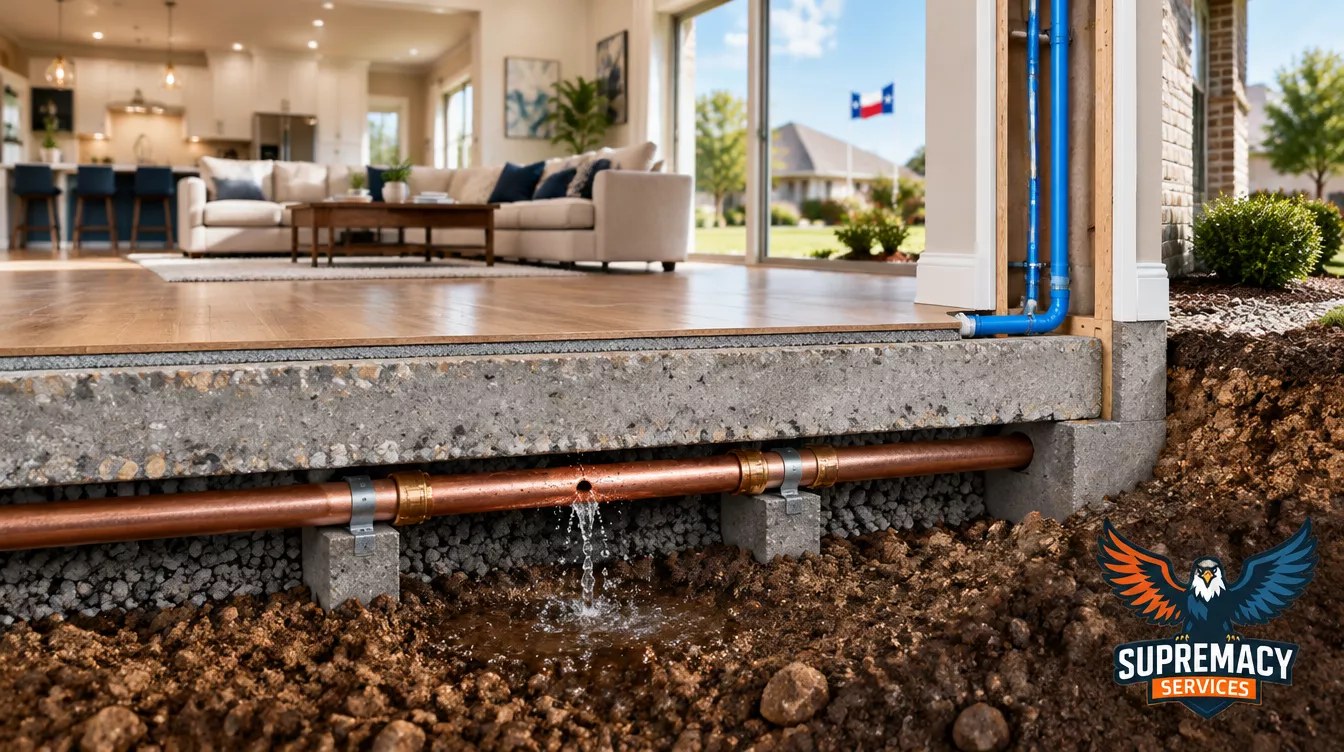
A slab leak does not automatically mean you need to replace every water pipe beneath your home. Two common solutions are spot repair and pipe rerouting, but the better option depends on the condition of the plumbing, the location of the leak, and the amount of work needed to access the damaged pipe.
For Dallas homeowners, spot repair may be appropriate when a leak is isolated and the surrounding pipe is in good condition. Pipe rerouting may make more sense when an older water line has deteriorated, multiple leaks have developed, or reaching the damaged section would require extensive concrete demolition.
The main difference: Spot repair fixes the damaged section of an existing pipe. Rerouting installs a new pipe along a different path, allowing the problematic section to be disconnected and taken out of service.
Before choosing either method, a plumber should confirm the source of the leak and evaluate the affected plumbing line.
Table of Contents
- What Are the Main Slab Leak Repair Methods?
- What Is Spot Repair for a Slab Leak?
- What Is Pipe Rerouting?
- Spot Repair vs. Pipe Rerouting: Key Differences
- Which Slab Leak Repair Method Is Better?
- How Much Does Each Repair Method Cost?
- Can a Slab Leak Be Fixed Without Breaking Concrete?
- Why Do Slab Leaks Occur in North Texas?
- What Happens During Professional Slab Leak Repair?
- How Can You Prevent Future Slab Leaks?
- Frequently Asked Questions
- Get Help Choosing the Right Repair Method
What Are the Main Slab Leak Repair Methods?
The two repair methods homeowners most commonly compare are localized spot repair and pipe rerouting. Both can resolve a leaking water supply line beneath a concrete foundation, but they address different plumbing conditions.
Spot repair involves accessing the damaged section and replacing or repairing that portion of pipe.
Pipe rerouting involves installing a replacement water line through an alternative accessible path, such as an attic, wall cavity, or another approved route.
A third possibility is replacing a longer section of piping. Depending on the system, this may involve a combination of rerouting and selective pipe replacement.
The appropriate solution depends on whether the problem is limited to one damaged area or reflects a broader deterioration of the water supply system.
What Is Spot Repair for a Slab Leak?
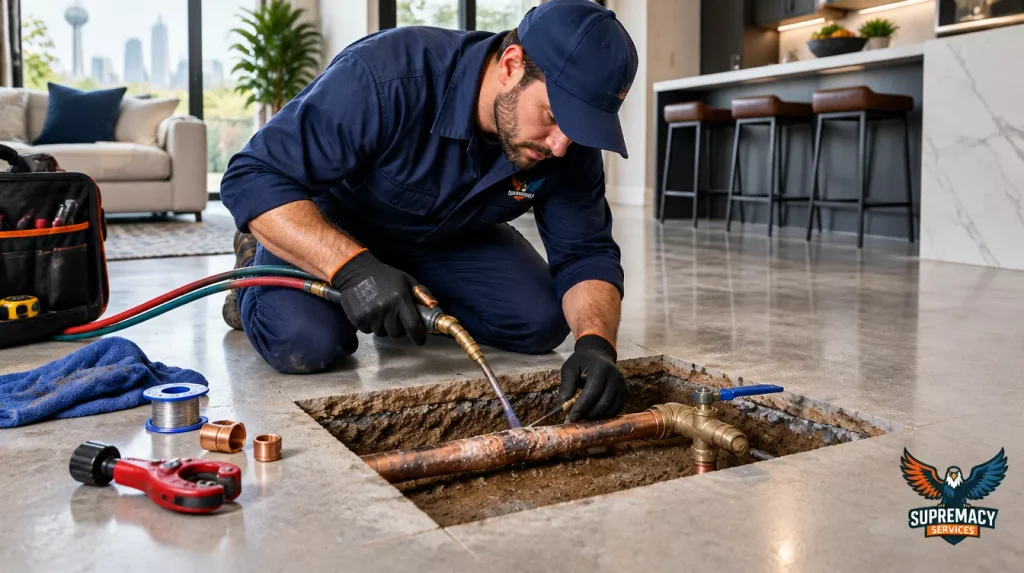
Spot repair is a localized plumbing repair that addresses a specific damaged section of pipe without replacing the entire line.
It is generally considered when leak detection identifies one accessible failure and the surrounding pipe remains suitable for continued service.
How does spot repair work?
A typical spot repair follows these steps:
- Locate the leak. A plumber uses appropriate diagnostic methods to identify the leaking water line and narrow down its location.
- Isolate the affected pipe. Water is shut off or isolated to allow safe repair.
- Access the damaged section. Depending on the location, this may involve removing flooring, carefully opening concrete, or accessing the pipe from another direction.
- Repair or replace the damaged pipe. The plumber removes the compromised section and installs suitable replacement piping and connections.
- Test the repair. The repaired line is checked for leaks and appropriate operation.
- Restore the affected area. The access opening is closed, with concrete and finish restoration handled according to the agreed scope.
Advantages of spot repair
- Preserves most of the existing plumbing.
- May require less new pipe material.
- Can be cost-effective when the damage is genuinely isolated.
- Avoids unnecessary replacement of otherwise serviceable piping.
- May involve a smaller overall work area.
Disadvantages of spot repair
Spot repair does not correct deterioration elsewhere in the same pipe.
If an older copper line has extensive corrosion or repeated failures, repairing one section may leave other vulnerable areas in service.
Access can also be disruptive. A leak beneath tile, cabinets, or a finished living area may require significant demolition and restoration.
When is spot repair a good choice?
Spot repair is worth considering when:
- Only one leak has been confirmed.
- The pipe surrounding the failure appears sound.
- There is no history suggesting widespread deterioration.
- The damaged area can be accessed without disproportionate disruption.
- The estimated cost of opening and restoring the slab is reasonable.
Important: A localized repair can be durable, but it does not guarantee that other portions of an aging pipe will never leak.
For homeowners who are unsure whether the leak is beneath the foundation or elsewhere in the water supply system, Supremacy Services provides water leak detection services in the Dallas area.
What Is Pipe Rerouting for a Slab Leak?
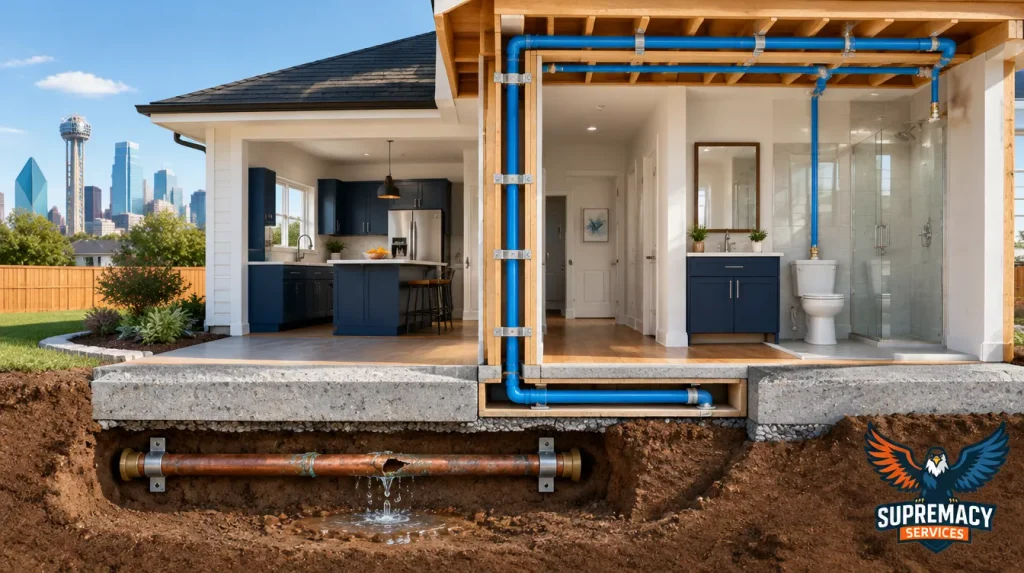
Pipe rerouting is a repair method in which a plumber installs a new water supply line along a different route, bypassing a leaking section beneath the foundation.
Instead of opening the slab directly over the damaged pipe, the plumber identifies a suitable path for a new line and connects it to the existing plumbing at appropriate points.
The old leaking section is disconnected and properly taken out of service.
How does pipe rerouting work?
A plumber first identifies the affected water line, its connection points, and the fixtures it supplies.
The new pipe route may pass through:
- Interior wall cavities
- Accessible ceiling spaces
- Attic areas, where appropriate
- Other approved plumbing pathways
The plumber then installs new piping, makes the required connections, tests the line, and closes the access openings.
In North Texas, attic routing requires particular attention to temperature exposure and freeze protection. An attic is not automatically the best location simply because it avoids cutting concrete.
Advantages of pipe rerouting
1. Avoids opening the slab at the original leak location
A properly planned reroute can bypass the damaged under-slab pipe without cutting directly into the foundation above the leak.
2. Removes a problematic pipe section from service
If the affected section has deteriorated, rerouting can eliminate reliance on that particular portion of piping.
3. Can reduce future access difficulties
A replacement line installed in a suitable accessible location may be easier to inspect or repair later.
4. May reduce flooring disruption
Rerouting can be especially attractive when the original pipe runs beneath expensive tile, cabinetry, or finished living spaces.
Disadvantages of pipe rerouting
Rerouting is not necessarily the simplest or least expensive solution.
Potential drawbacks include:
- Longer runs of replacement pipe
- Opening drywall or ceilings
- Additional plumbing connections
- Insulation and freeze-protection requirements
- Drywall, paint, and other finish restoration
- Routing limitations caused by the home’s construction
A reroute also does not automatically replace every deteriorated water line in the house. The plumber must identify exactly which section is being bypassed.
When is rerouting the better option?
Pipe rerouting deserves serious consideration when:
- Multiple leaks have developed in the same line.
- The existing pipe shows widespread deterioration.
- Accessing the leak would cause extensive slab or flooring damage.
- The under-slab pipe follows a difficult or impractical route.
- A suitable replacement route can be installed safely and in compliance with applicable requirements.
Homeowners considering a reroute should ask whether the proposal replaces one branch line, an entire hot-water run, or a larger section of the water supply system.
Spot Repair vs. Pipe Rerouting: Key Differences
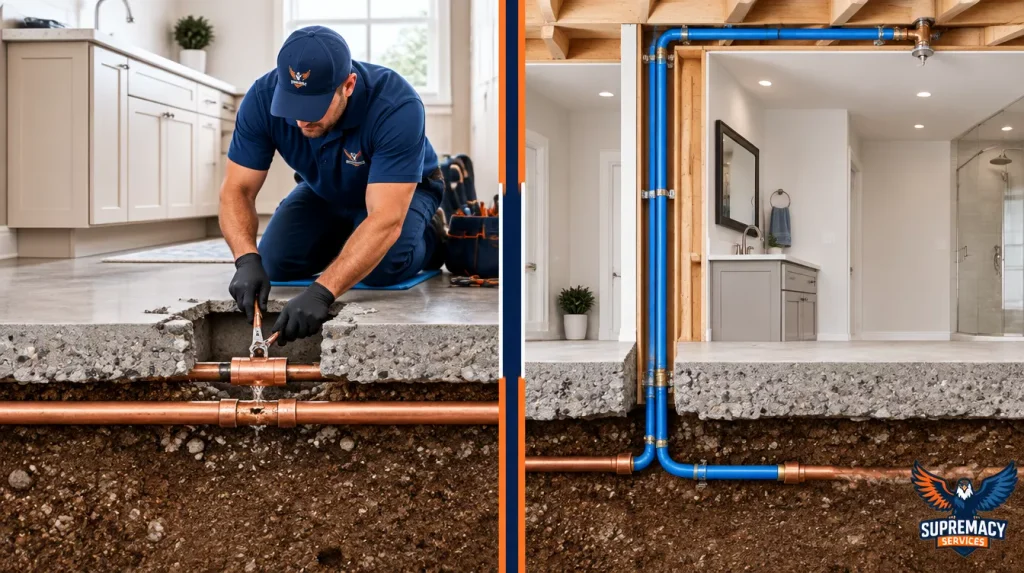
Both methods can be effective when selected for the right conditions. Neither is automatically better for every slab leak.
| Factor | Spot repair | Pipe rerouting |
|---|---|---|
| Main objective | Fix a localized damaged section | Bypass the problematic pipe section |
| Original pipe | Mostly remains in service | Selected section is taken out of service |
| Concrete access | May require opening the slab | Often avoids opening the slab at the leak |
| Wall or ceiling work | Usually limited, depending on access | Often necessary |
| Best suited for | Isolated damage and sound surrounding pipe | Repeated leaks, deteriorated lines, or difficult slab access |
| New pipe required | Relatively short section | Potentially longer replacement run |
| Main cost concern | Excavation and slab/floor restoration | New piping, routing labor, and wall/ceiling restoration |
| Future leak exposure | Remaining original pipe may still fail | Bypassed section no longer carries water |
| Long-term value | Good when the rest of the line is sound | May be better when the affected line is unreliable |
Is rerouting always better than spot repair?
No. Replacing a long pipe run can be unnecessary when one small section has failed and the rest of the plumbing is in good condition.
Conversely, repeated spot repairs may become expensive if the underlying pipe is deteriorating throughout its length.
The right decision considers the complete cost of repair, the pipe’s condition, and the likelihood of further failures—not just the immediate plumbing bill.
Which Slab Leak Repair Method Is Better for Your Home?
Spot repair is often the more practical choice for one isolated leak in an otherwise sound pipe. Rerouting is often worth considering when the existing line has recurring problems or is unusually difficult to access.
Use the following questions to evaluate a plumber’s recommendation.
1. Has the home experienced previous slab leaks?
One isolated leak does not necessarily indicate a failing plumbing system.
However, multiple leaks along the same line can suggest a broader problem that deserves investigation.
2. What material is the existing pipe?
The condition of copper, PEX, or other piping depends on installation quality, age, operating conditions, and the nature of the damage.
Pipe material alone should not determine the repair method.
3. Where is the damaged section located?
A leak beneath an easily restored floor may be a reasonable spot-repair candidate.
A leak beneath custom cabinetry or extensive finished flooring may make an alternative pipe route more attractive.
4. Is the remaining pipe in good condition?
This is one of the most important questions.
Ask whether the plumber has observed corrosion, pitting, multiple failure points, or other evidence of deterioration.
5. What will the entire repair cost?
Compare more than the plumbing work.
A useful estimate should address concrete, flooring, drywall, painting, testing, and any necessary inspections.
6. Does the reroute create new risks?
A new route should be evaluated for temperature exposure, physical protection, accessibility, support, and suitability for the home’s construction.
Before approving a major repair, request a written explanation of why the recommended method is preferable for your specific pipe condition.
If the problem involves a broader water supply line rather than only a single under-slab branch, review Supremacy Services’ water line repair and replacement options.
How Much Does Spot Repair vs. Pipe Rerouting Cost in Dallas?
Spot repair may cost less when access is straightforward and the damaged section is small. Pipe rerouting may provide better overall value when accessing the original pipe would require extensive demolition or when repeated leaks make localized repairs impractical.
There is no reliable fixed price for either method without evaluating the property.
What affects spot repair cost?
- Leak location and depth
- Accessibility beneath the slab
- Concrete cutting or excavation requirements
- Type and condition of the pipe
- Number of damaged sections
- Flooring removal and replacement
- Required testing and restoration
What affects pipe rerouting cost?
- Total length of replacement piping
- Number of fixtures or branches served
- Pipe material and connection requirements
- Accessibility of walls, ceilings, or attic spaces
- Required insulation and protection
- Drywall and painting work
- Plumbing permits or inspections where applicable
Which method is cheaper over time?
Consider two possible situations.
Scenario A: One isolated pipe failure
A plumber confirms one small damaged section and finds no evidence of widespread deterioration. Spot repair may resolve the problem without the expense of installing a long replacement line.
Scenario B: Repeated failures in an older line
A homeowner has already repaired several leaks in the same pipe. Another spot repair may address the immediate failure, but rerouting the affected line could avoid further repairs to that section.
These examples illustrate how the decision changes; they are not guarantees of future performance.
What should a written estimate include?
Ask for an itemized scope showing:
- Leak detection and diagnostic charges
- Exact section of pipe being repaired or replaced
- Plumbing labor and materials
- Access openings and demolition
- Testing and inspection responsibilities
- Concrete, drywall, and flooring restoration
- Warranty terms and exclusions
- Conditions that could change the quoted price
A low initial quote may not represent the lowest total project cost if substantial restoration is excluded.
Can a Slab Leak Be Fixed Without Breaking Concrete?
Yes, some slab leaks can be repaired without cutting into the concrete directly above the leak. Pipe rerouting is one way to bypass a damaged under-slab water line.
However, avoiding concrete demolition does not necessarily mean avoiding all construction work.
Rerouting may still require opening walls, ceilings, or other accessible areas.
In some circumstances, a plumber may also be able to reach a pipe through an alternative access point. The feasibility depends on the foundation and plumbing layout.
Does trenchless water line repair work for every slab leak?
No.
Trenchless methods used for certain underground water lines should not automatically be assumed suitable for every pressurized pipe beneath a residential foundation.
The pipe’s material, diameter, location, connections, and condition all affect feasibility.
The correct approach is to diagnose the leak first, then determine which repair techniques are appropriate for that specific line.
Why Do Slab Leaks Occur in North Texas Homes?
Dallas-area slab leaks can result from pipe deterioration, installation problems, physical stress, or damage affecting an underground water line.
Some properties also experience soil movement that may contribute to stress on foundations and buried utilities.
Expansive clay soil
Certain North Texas soils contain clay minerals that expand when wet and shrink as they dry.
Changes in soil moisture can contribute to ground movement and affect structures or buried utilities.
However, expansive soil does not prove that soil movement caused a particular pipe leak. A proper diagnosis must consider the pipe and site conditions.
Aging or deteriorated plumbing
Older pipes may develop corrosion, weakened sections, or failures at joints and connections.
When deterioration affects a substantial portion of a line, rerouting or replacement may be more appropriate than repeated localized repairs.
Installation and physical stress
Poorly protected piping, unsuitable installation practices, abrasion, or stress at connections can contribute to failures.
A plumber should investigate the actual damage rather than assuming every slab leak has the same cause.
Dallas-area temperature considerations
Although North Texas experiences long warm seasons, winter freezing conditions can occur.
A pipe rerouted through an attic or other exposed space must be appropriately protected against freezing.
This is one reason the shortest or easiest-looking pipe route is not always the best long-term solution.
What Happens During Professional Slab Leak Repair?
A professional repair should begin with diagnosis, not immediate demolition. Supremacy services
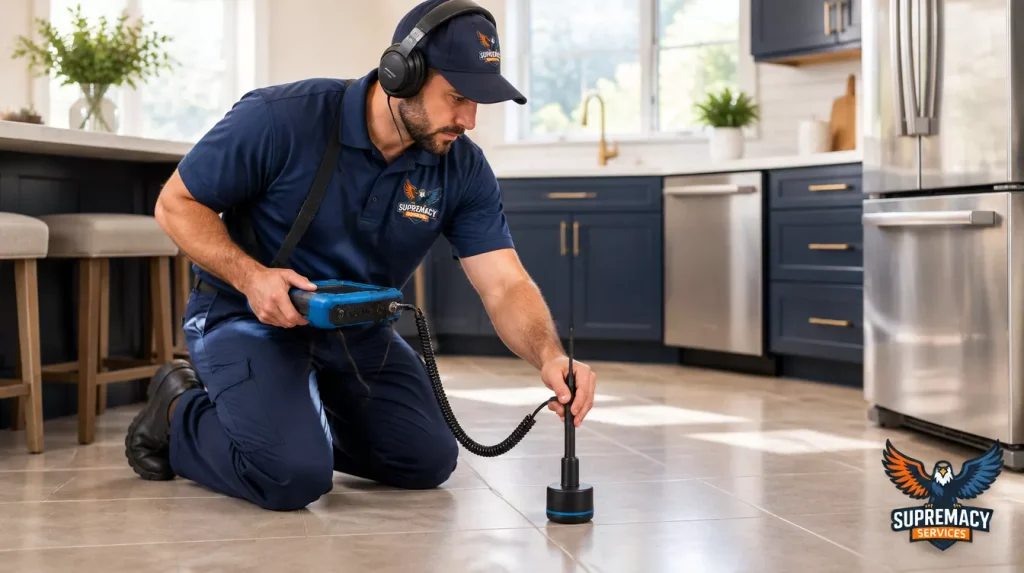
Step 1: Confirm the source of the water loss
The plumber evaluates symptoms such as an unexplained water bill increase, warm flooring, damp areas, or reduced water pressure.
These symptoms can also result from other plumbing problems.
Step 2: Identify the affected plumbing line
The plumber may use pressure testing, acoustic equipment, thermal imaging where useful, or other diagnostic techniques.
The objective is to determine which line is leaking and narrow down the location.
Step 3: Evaluate the existing pipe
The condition, material, accessibility, and history of the line help determine whether spot repair or rerouting is appropriate.
Step 4: Explain the available repair options
The homeowner should receive an explanation of the recommended method, expected disruption, estimated costs, and restoration requirements.
Step 5: Complete the plumbing repair
The plumber performs the agreed repair or reroute using suitable materials and methods.
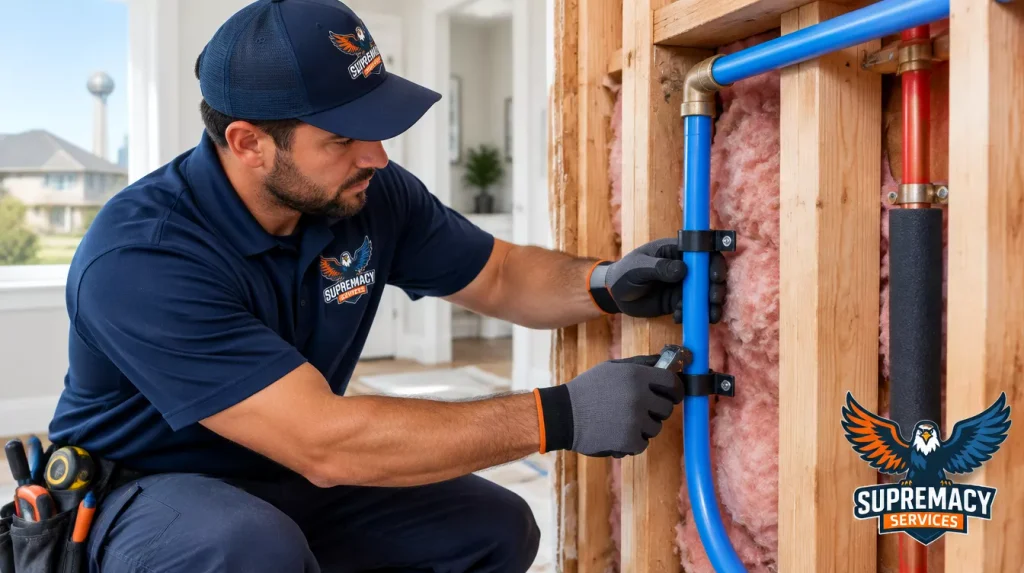
Step 6: Test the repaired system
Testing helps confirm that the repaired or replacement line operates correctly and that the identified leak has been resolved.
Step 7: Restore and document the work
The final scope may include closing access openings, arranging restoration, and documenting the work performed.
Questions to ask before work begins:
- How was the leak location confirmed?
- Why is this repair method recommended?
- What portion of the old pipe will remain in service?
- Will concrete or finished surfaces need to be opened?
- Who handles flooring and drywall restoration?
- What testing will confirm the repair?
- Are permits or inspections required for this particular scope?
- What does the workmanship warranty cover?
Texas homeowners can verify plumbing credentials through the Texas State Board of Plumbing Examiners.
How Can You Reduce the Risk of Future Slab Leaks?
Not every slab leak is preventable, but homeowners can reduce the likelihood of overlooking developing plumbing problems.
Monitor unexpected water use
A sudden unexplained increase in water consumption may indicate a hidden leak.
If all fixtures and water-using appliances are off, unexpected meter activity may justify further investigation.
Investigate recurring plumbing problems
Repeated leaks, unexplained pressure changes, and recurring damp areas should not be dismissed as isolated inconveniences.
Address drainage problems
Keep roof runoff and surface drainage from concentrating water near the foundation.
Drainage improvements should be appropriate for the property rather than based on a generic foundation-watering rule.
Protect replacement piping
Any new pipe route should account for physical damage, freezing exposure, proper support, and applicable plumbing requirements.
Keep repair records
Save inspection findings, repair invoices, pipe material details, and diagrams showing the location of any rerouted lines.
This information can help with future maintenance, remodeling, and property transactions.
Frequently Asked Questions About Slab Leak Repair Methods
1. Is spot repair a permanent solution for a slab leak?
A properly completed spot repair can provide a durable solution for the specific damaged section. However, it does not prevent other portions of an aging or deteriorated pipe from leaking later.
2. Is pipe rerouting better than repairing a slab leak?
Rerouting may be preferable when a pipe has multiple failures, significant deterioration, or difficult access beneath the foundation. Spot repair may be sufficient for a single isolated failure in otherwise sound piping.
3. Can plumbers reroute water pipes through an attic?
Yes, where the home’s layout and applicable requirements allow it. Attic piping must be evaluated for temperature exposure, freeze protection, support, and other installation considerations.
4. Does pipe rerouting require breaking the foundation?
Not always. One advantage of rerouting is that it may bypass a leaking under-slab pipe without opening the concrete at the leak location. Other access openings may still be necessary.
5. Does rerouting a slab leak mean repiping the entire house?
No. A reroute may replace only one affected water line or branch. Whole-house repiping is a broader project that may be considered when deterioration affects much of the plumbing system.
6. How long does a slab leak spot repair take?
The timeline depends on leak location, access requirements, pipe condition, and restoration work. A straightforward plumbing repair may be completed sooner than a project requiring extensive concrete or flooring restoration.
7. Can a slab leak return after spot repair?
The repaired section may remain sound while another part of the original pipe develops a new leak. Recurring leaks warrant an assessment of the broader piping system.
8. Does homeowners insurance cover slab leak rerouting?
Coverage depends on the policy, the cause of the loss, exclusions, and the specific work being claimed. Damage caused by an accidental leak may be treated differently from replacing deteriorated plumbing. Review your policy and obtain clarification from your insurer.
9. Should I turn off the water if I suspect a slab leak?
If a leak is active or causing damage, shutting off the appropriate water supply can help limit further water loss while you arrange professional assistance. Avoid opening concrete or attempting concealed plumbing repairs yourself.
10. How do I know whether I need spot repair or rerouting?
A plumber should confirm the leaking line, evaluate its condition, and compare the total cost and disruption of each method. Repeated failures and widespread deterioration make replacement or rerouting more important to consider.
Need Help Choosing Between Spot Repair and Pipe Rerouting in Dallas?
The best slab leak repair is not necessarily the method with the smallest initial price or the least visible demolition.
It is the solution that addresses the confirmed problem, accounts for the condition of the remaining plumbing, and provides reasonable long-term value.
For homeowners in Dallas, Plano, Frisco, Allen, and surrounding DFW communities, Supremacy Services offers plumbing diagnostics and water line repair services.
If you suspect an under-slab leak, start with a professional assessment before deciding whether to open the concrete or reroute the affected line.
Explore Supremacy Services’ Dallas water line repair and replacement services to discuss your plumbing repair options.
The goal is simple: understand the damage, compare the available solutions, and make an informed repair decision before committing to major work.

