10400 Clarence Drive, Frisco, TX 75033
Support 24/7: 945-777-3345
Dallas brick home with a visible concrete slab foundation and a small foundation crack.

Can a Slab Leak Damage Your Home’s Foundation?

Yes, a slab leak can damage your home’s foundation. When a plumbing pipe leaks beneath a concrete slab, escaping water can change the moisture content of the supporting soil, contribute to uneven foundation movement, and damage flooring and other building materials.

For Dallas homeowners, the concern is especially relevant because some North Texas properties sit on expansive clay soils that swell when wet and shrink when dry. A persistent underground leak can create uneven moisture conditions beneath the home.

However, not every slab leak causes structural damage, and not every foundation crack means you have a slab leak. The severity depends on the leak’s location, duration, soil conditions, foundation design, and whether the underlying plumbing problem is corrected promptly.

Understanding the warning signs can help you decide when to call a plumber, when a structural evaluation may be necessary, and how to prevent additional damage.

Table of Contents

  1. What Is a Slab Leak?
  2. How Can a Slab Leak Damage Your Foundation?
  3. What Are the Warning Signs?
  4. Why Are Dallas Foundations Vulnerable?
  5. How Quickly Can Damage Develop?
  6. Slab Leak or Foundation Problem?
  7. What Should You Do?
  8. How Do Professionals Detect Slab Leaks?
  9. Can Foundation Damage Be Repaired?
  10. What Does Repair Cost?
  11. How Can You Prevent Damage?
  12. Frequently Asked Questions

What Is a Slab Leak?

A slab leak is a plumbing leak that develops in a pipe located beneath or within a home’s concrete slab foundation.

Many slab-on-grade homes have water supply or drainage piping routed beneath the floor. When one of these pipes develops a crack, corrosion-related opening, failed connection, or other defect, water can escape into the surrounding soil or building materials.

Because the damaged pipe is concealed, homeowners may not immediately notice the problem.

Common causes of slab leaks

Slab leaks can develop for several reasons:

  • Pipe corrosion: Certain metal pipes deteriorate over time, depending on their material, installation, and exposure conditions.
  • Pipe movement: Soil movement or structural displacement can place stress on buried plumbing.
  • Installation defects: Improper pipe support, damaged fittings, or inadequate protection can contribute to premature failure.
  • Abrasion: Pipes that rub against concrete, rocks, or other hard surfaces may eventually develop wear.
  • Aging plumbing systems: Older pipes may become more susceptible to deterioration and leakage.

A slab leak may involve a pressurized supply line or a drainage pipe. The symptoms and appropriate testing methods can differ considerably.

How Can a Slab Leak Damage Your Foundation?
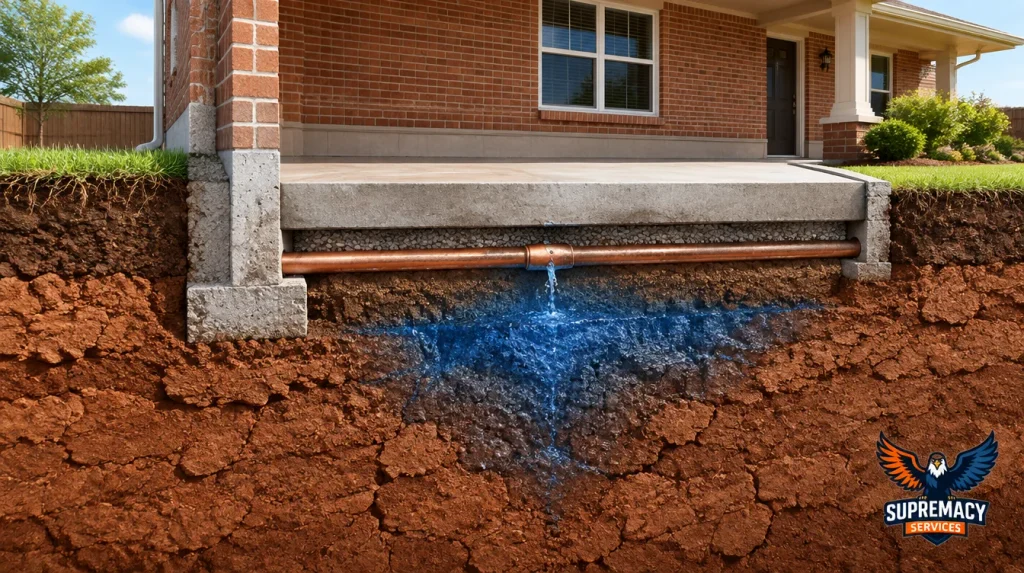
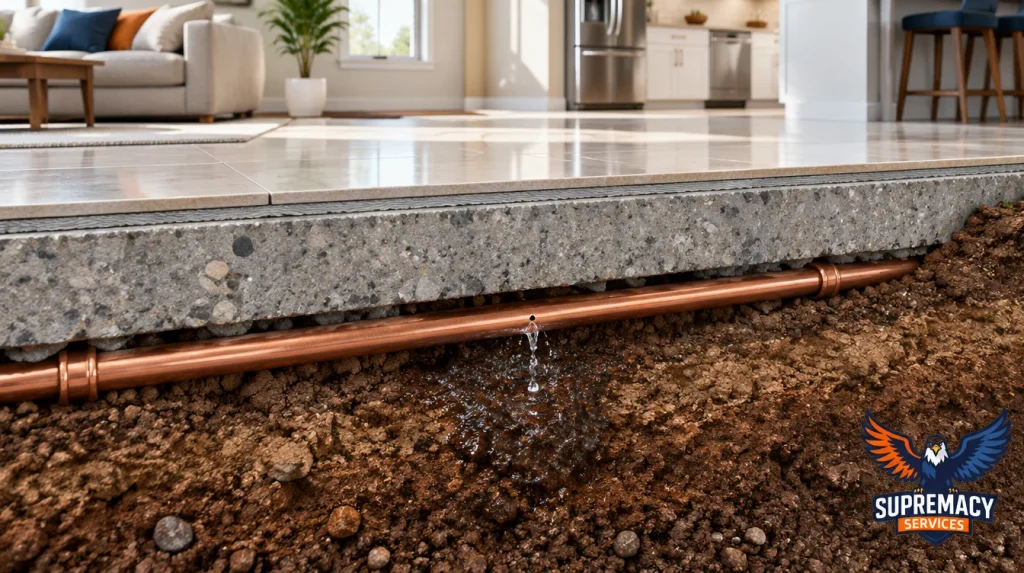
Cross-section illustration showing water leaking from an underground pipe into soil beneath a concrete slab foundation.
Water escaping from a pipe beneath a concrete slab can saturate surrounding soil and contribute to uneven foundation movement.

A slab leak can affect a foundation by changing the moisture conditions and support characteristics of the soil beneath it. In some cases, the result is uneven movement that creates cracks or distortion in the foundation and surrounding building materials.

1. Expansive soil can swell beneath the foundation

Some North Texas clay soils expand as they absorb water.

If a pipe leaks beneath one part of a home, the surrounding soil may become wetter than soil beneath other areas.

This uneven moisture distribution can cause differential soil expansion, potentially pushing one section of the foundation upward relative to another.

Engineers refer to upward movement associated with swelling soil as heave.

2. Soil erosion or loss of support can contribute to settlement

Under certain conditions, flowing water can transport loose soil particles or contribute to void formation.

Where soil support is lost, portions of a foundation may settle or become unevenly supported.

This mechanism depends heavily on the soil composition, drainage pathways, and leak characteristics. It should not be assumed that every underground leak washes away supporting soil.

3. Uneven movement can produce cracks

When different sections of a foundation move by different amounts, stress can develop in the slab and the structure above it.

Possible symptoms include:

  • Cracks in concrete flooring
  • Cracks in interior drywall
  • Separation around doors and windows
  • Changes in floor level
  • Gaps between walls and trim

A crack alone does not establish that plumbing is responsible. Concrete shrinkage, thermal effects, construction details, and ordinary soil movement can also produce cracks.

4. Persistent moisture can damage interior materials

Even when a leak does not cause measurable structural movement, moisture migrating through or around the slab can damage flooring, adhesives, baseboards, and other moisture-sensitive materials.

The U.S. Environmental Protection Agency identifies plumbing leaks and moisture intrusion as important building-maintenance concerns.

Homeowner takeaway: The foundation itself may remain structurally sound while flooring or interior finishes suffer water damage. Both situations warrant investigation, but they do not necessarily require the same repairs.

What Are the Warning Signs of Slab Leak Foundation Damage?
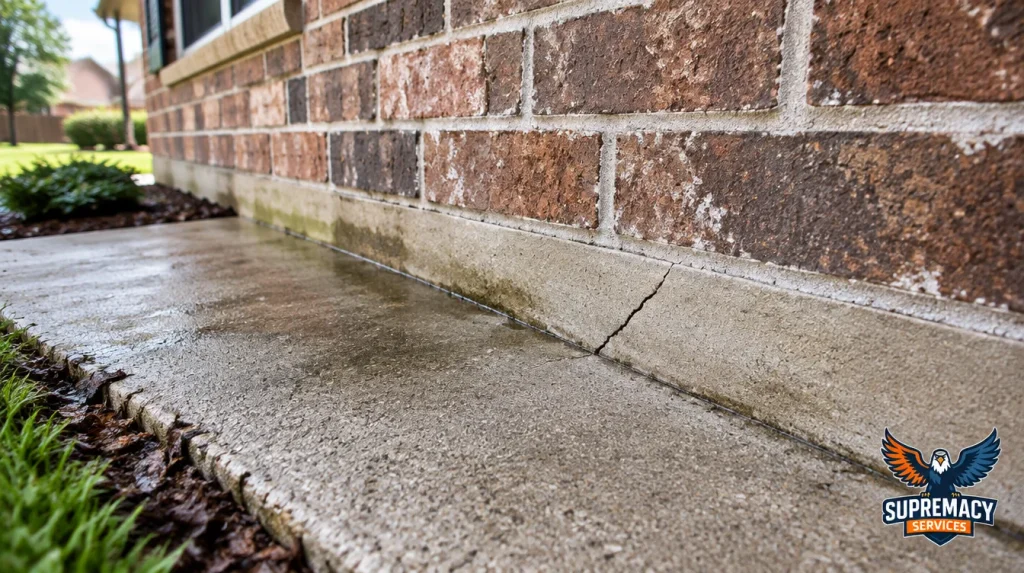
Close-up of a small crack along the concrete slab foundation of a brick home in Dallas, Texas.
New or widening foundation cracks can indicate movement, although they do not necessarily mean a slab leak is present.

The strongest warning signs are combinations of unexplained plumbing symptoms and new moisture or structural changes.

Warning signWhat it may indicateWhat to do
Unexplained increase in water usagePossible pressurized supply-line leakCheck the meter and arrange leak testing
Warm patch on the floorPossible leaking hot-water lineRequest plumbing diagnostics
Damp carpet or discolored flooringMoisture entering the floor assemblyInvestigate the moisture source promptly
New or widening foundation cracksPossible structural movementDocument changes and seek an evaluation
Doors suddenly stickingPossible movement or distortionCheck for other movement indicators
Persistent musty odorMoisture trapped in building materialsFind and correct the source
Running-water sound when fixtures are offPossible concealed supply leakCheck water usage and plumbing
Unexplained low water pressurePossible leak or another supply issueHave the water system assessed

Which symptoms deserve the most attention?

A sudden increase in water usage combined with damp flooring or an unexplained warm area is a particularly useful reason to investigate the plumbing system.

If those symptoms occur alongside new cracks, uneven floors, or sticking doors, it is sensible to investigate both the plumbing and the foundation.

However, foundation movement can also occur without a plumbing leak.

Noticing unexplained moisture or rising water usage? Supremacy Services provides water leak detection in Dallas and Fort Worth to help identify hidden plumbing problems before deciding on repairs.

Why Are Dallas Foundations Vulnerable to Slab Leaks?
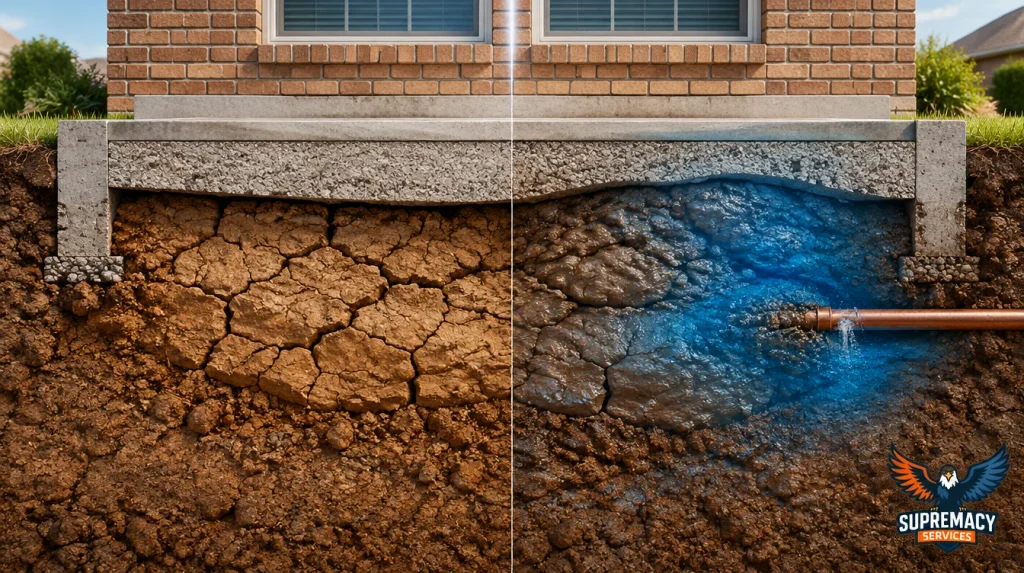
Side-by-side cross-section comparing dry, shrinking clay soil and wet, expanding clay beneath a concrete slab foundation.
North Texas clay soils can shrink during dry conditions and swell when saturated, creating changing support conditions beneath foundations.

Dallas-area foundations can be sensitive to changes in soil moisture, particularly where expansive clay is present.

Expansive clay and changing moisture conditions

Clay-rich soils can swell when moisture increases and shrink when moisture decreases.

This means the moisture conditions beneath a foundation can affect its movement over time.

A plumbing leak can create a localized source of additional water, while dry weather may reduce moisture elsewhere around the foundation.

The resulting difference in soil moisture can contribute to uneven movement.

Texas government hazard-planning materials recognize expansive soils as a source of structural damage and explain that differential soil expansion is especially important.

Seasonal conditions in North Texas

North Texas experiences periods of hot, dry weather as well as heavy rainfall.

Those changes can influence soil moisture, especially near foundation edges, drainage areas, and landscaping.

A persistent underground leak may introduce a separate moisture problem that continues regardless of rainfall.

Foundation design matters

Not every Dallas-area home has the same foundation design or soil conditions.

The potential consequences depend on factors including:

  • Soil type and depth
  • Foundation engineering and reinforcement
  • Plumbing layout
  • Drainage around the property
  • Previous soil movement
  • Location and duration of the leak

Homes in Dallas, Plano, Frisco, Allen, Richardson, and surrounding communities should be evaluated according to their actual site conditions rather than assumptions based only on their ZIP code.

How Quickly Can a Slab Leak Damage a Foundation?

There is no reliable universal timeline for foundation damage caused by a slab leak.

A large leak may produce noticeable water damage quickly, while a smaller leak may remain concealed for an extended period.

Structural movement can develop gradually, and some leaks never cause significant foundation movement.

What determines how quickly damage develops?

The most important variables include the rate of water loss, soil type, drainage conditions, foundation design, and the leak’s location.

For example, a leak beneath moisture-sensitive clay may create a different risk from a similar leak beneath well-draining soil.

It is also important to distinguish between water damage and structural damage.

Moisture-sensitive flooring can deteriorate before any measurable foundation movement occurs.

The EPA recommends drying water-damaged materials promptly, generally within 24–48 hours, to reduce the likelihood of mold growth. This is moisture-control guidance, not a prediction of when structural damage will occur.

Do not wait for a foundation crack before investigating a suspected slab leak. Early plumbing diagnosis may reduce the amount of water entering the property.

Slab Leak or Foundation Problem: How to Tell the Difference

A slab leak and a foundation problem can produce overlapping symptoms, but they are not the same condition.

A slab leak is a plumbing failure. Foundation movement is a structural or geotechnical issue that may have several causes.

IndicatorPossible slab leakPossible non-plumbing foundation issue
Unexplained water meter movementMore suggestive of a supply leakNot typical
Warm floor areaPossible hot-water pipe leakNot typical
Damp flooringPossibleMay also have other moisture causes
Wall cracksPossible secondary symptomCommon possible symptom
Sticking doorsPossible secondary symptomCommon possible symptom
Movement following seasonal dryingNot specific to a leakMay suggest soil-moisture effects
Pressure test confirms pipe leakageStrong evidenceDoes not by itself establish structural damage

Can foundation movement cause a slab leak instead?

Yes. The relationship can work in both directions.

Foundation or soil movement can stress buried plumbing, potentially contributing to pipe failure.

A plumbing leak can then alter surrounding moisture conditions and potentially worsen movement.

This is why determining the sequence of events matters.

Other problems that can resemble a slab leak

Homeowners may mistake several issues for under-slab plumbing leaks:

  • Leaking irrigation pipes near the foundation
  • Poor yard drainage
  • Roof runoff collecting near the house
  • Air-conditioning condensate leaks
  • Failed shower waterproofing
  • Sewer or drain-line leakage
  • Moisture entering through an exterior opening

If wastewater symptoms, repeated drain backups, or sewer odors are present, the investigation may involve the home’s drainage system rather than a pressurized water line.

Supremacy Services also offers sewer line repair and replacement for problems involving damaged sewer piping.

What Should You Do If You Suspect a Slab Leak?

If you suspect a slab leak, the priority is to identify the source of the water, limit further damage, and arrange the appropriate inspection.

Step 1: Check for unexplained water usage

Turn off water-using fixtures and appliances.

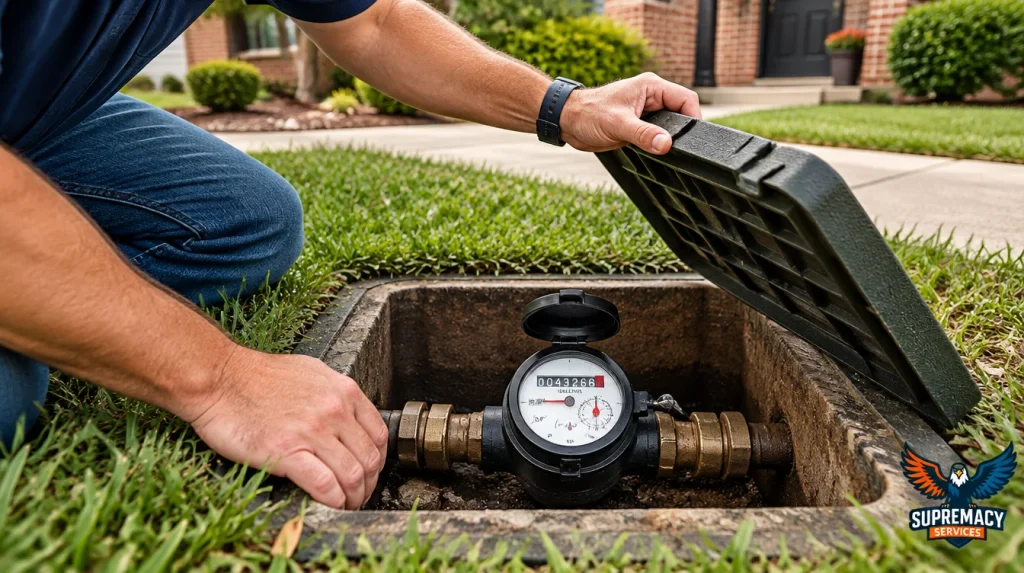
Observe your water meter to see whether usage continues when no water should be flowing.

A meter that continues registering flow can indicate a leak, although it does not identify where the leak is located.

The EPA provides homeowner guidance on checking water meters and identifying hidden leaks.

Step 2: Look for moisture and flooring changes

Check for damp areas, discolored flooring, unusual warmth, or persistent musty odors.

Document what you find, including dates and photographs.

Avoid removing flooring or breaking concrete before the source has been investigated.

Step 3: Limit water loss when appropriate

If you identify an active water-supply leak and can safely operate the appropriate shutoff valve, turning off the water can help limit further damage.

Be aware that shutting off the main supply may interrupt water service to the entire home.

Do not operate unfamiliar valves or disturb electrical equipment in wet areas.

Step 4: Arrange professional leak detection

A plumber can investigate whether a concealed supply or drainage pipe is leaking.

Depending on the system, this may involve pressure testing, acoustic detection, thermal imaging, or drainage-system inspection.

Step 5: Arrange a structural evaluation if necessary

If the home has significant new cracking, visible displacement, or other indications of structural movement, consult an appropriately qualified structural engineer.

A plumber can diagnose and repair plumbing. A structural engineer can assess whether the foundation itself has been damaged and recommend structural remediation where needed.

Quick homeowner checklistCheck the water meter with fixtures offPhotograph new cracks and moisture damageLocate the main water shutoffKeep people away from unsafe wet or damaged areasSchedule plumbing leak detectionRequest structural evaluation if significant movement is visible

0 of 6 completed Copy checklist

How Do Professionals Detect Slab Leaks?
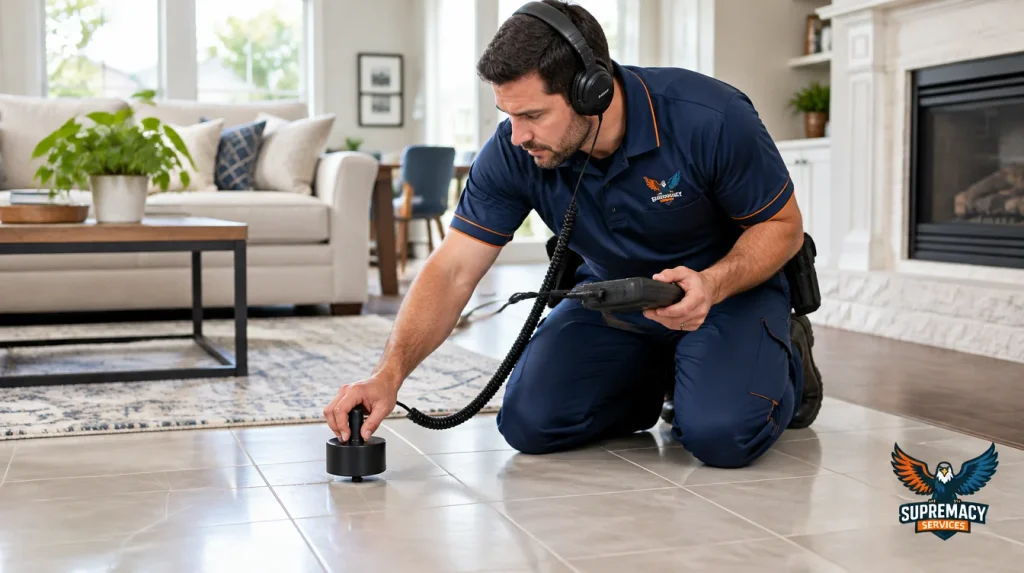
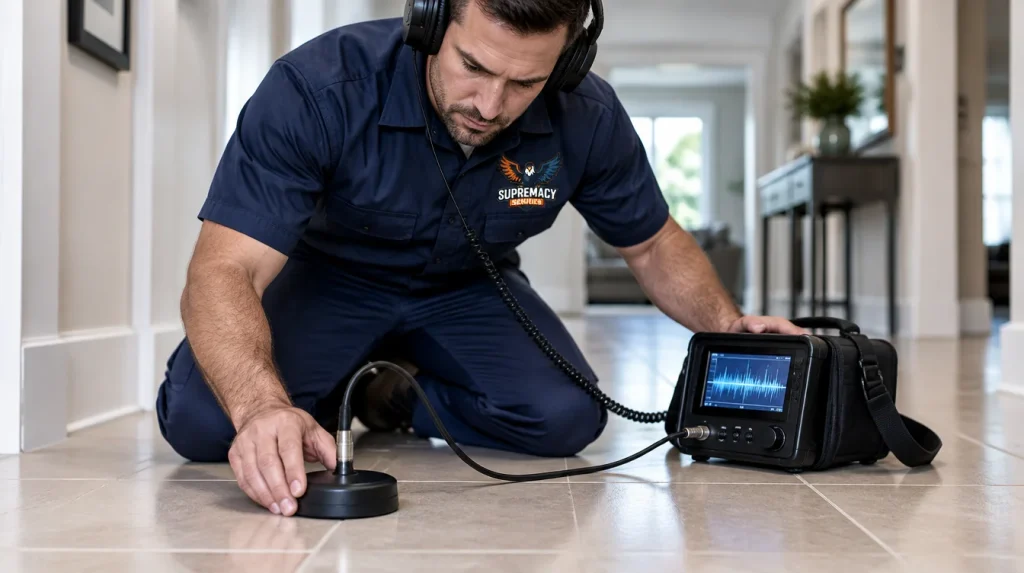
Plumbing technician using acoustic leak detection equipment on a tile floor to locate a possible slab leak in a Dallas home.
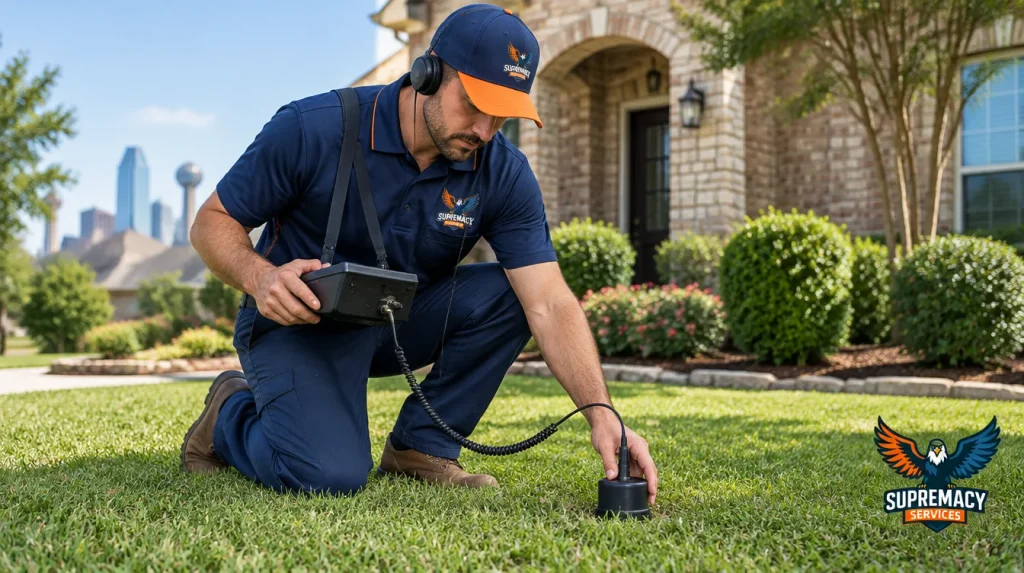
Professional plumbers can use specialized acoustic equipment to help locate concealed water leaks without immediately opening the concrete slab.

Professional slab leak detection typically starts with confirming that a plumbing leak exists before attempting to pinpoint its location.

1. Plumbing system assessment

The plumber reviews symptoms, water usage, pipe routing, and accessible plumbing components.

This helps narrow down the affected system.

2. Pressure testing

Pressure testing can help determine whether a water supply line or isolated portion of the plumbing system is losing pressure.

Results must be interpreted alongside the system configuration and other observations.

3. Acoustic leak detection

Specialized listening equipment can sometimes detect sounds generated by water escaping from a pressurized pipe.

Its effectiveness depends on pipe material, pressure, surrounding noise, and other conditions.

4. Thermal imaging

Thermal cameras can identify temperature differences that may help locate certain hot-water leaks.

They detect surface temperature patterns, not water directly. A thermal image alone does not confirm a leak.

5. Drain-line inspection

Where a drainage leak is suspected, plumbers may use appropriate camera inspection and testing methods.

A drain camera does not ordinarily locate a concealed pressurized supply-line leak through solid concrete.

Will plumbers have to break the concrete?

Not necessarily.

Many diagnostic methods can be performed without initially opening the slab.

However, some repairs require access through concrete or other building materials. The most suitable approach depends on the location of the damaged pipe and the repair method.

Suspect water is escaping beneath your floor? Explore Supremacy Services’ plumbing and leak-detection services to arrange an assessment of the problem and discuss the next steps.

Can Foundation Damage From a Slab Leak Be Repaired?

Yes, foundation damage associated with a slab leak may be repairable, but fixing the plumbing does not automatically correct structural movement that has already occurred.
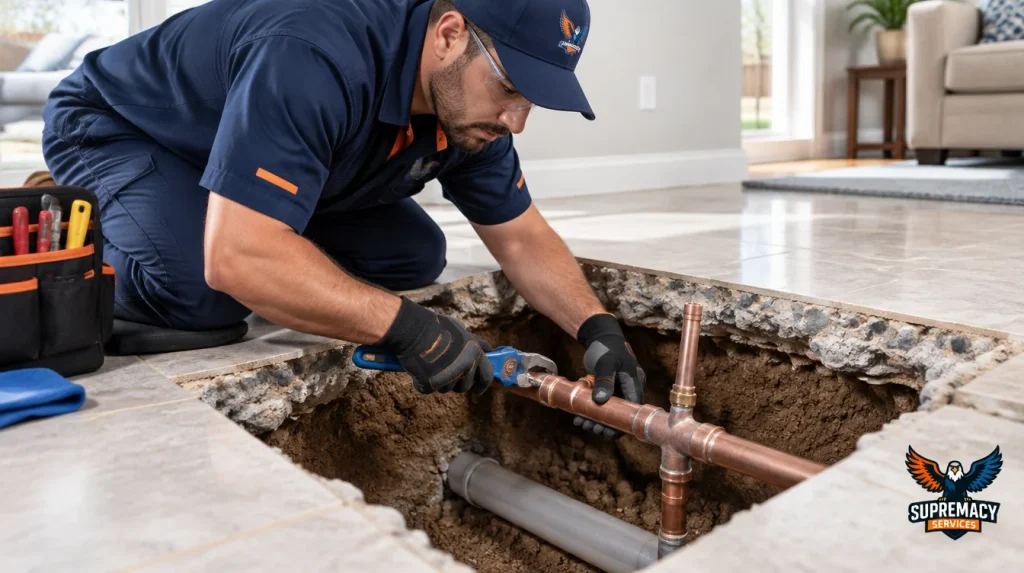
Professional plumber repairing an exposed copper water pipe through a localized opening in a residential concrete slab floor.
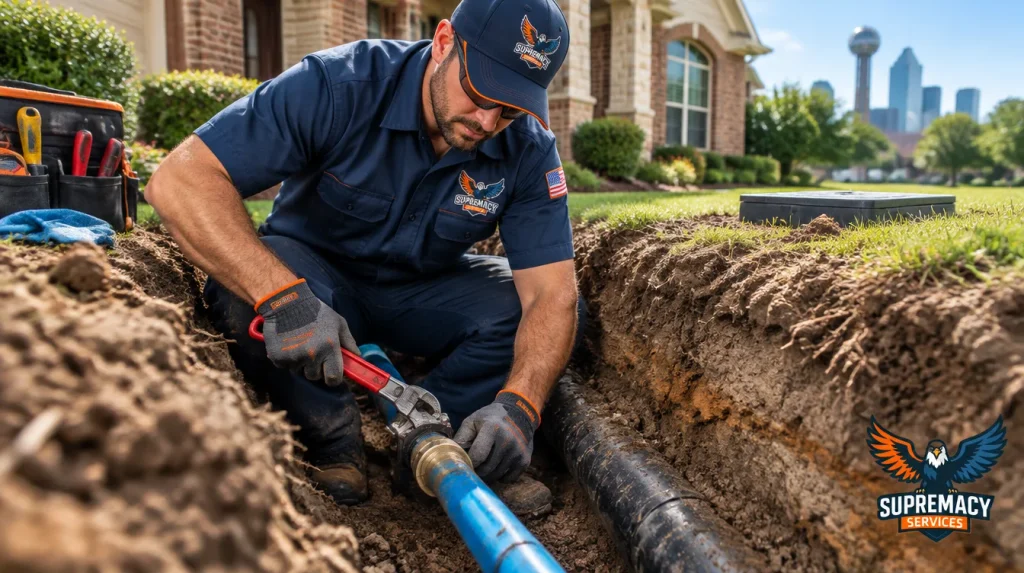
Some slab leaks require localized access to damaged underground pipes, while other situations may be better suited to rerouting or alternative repair methods.

The appropriate solution depends on whether the home has experienced moisture damage, foundation displacement, loss of soil support, or a combination of problems.

First: Repair the plumbing leak

Depending on the pipe’s condition and accessibility, possible repairs include:

  • Direct repair of an accessible damaged pipe section
  • Replacement of the affected pipe
  • Rerouting a water supply line around the slab
  • Repiping a larger portion of the plumbing system
  • Other appropriately engineered access or replacement methods

The right method depends on the specific piping system.

Second: Evaluate the foundation

If there are signs of structural damage, a qualified structural engineer can assess whether the foundation needs stabilization or another form of repair.

Potential recommendations may involve monitoring, moisture management, soil-related work, or engineered structural repairs.

Not every crack requires foundation underpinning or extensive reconstruction.

Third: Restore damaged building materials

Once the leak has been stopped and moisture conditions addressed, damaged flooring, drywall, insulation, and other materials can be evaluated for drying, cleaning, or replacement.

Restoration should not conceal an unresolved moisture source.

What Does Slab Leak and Foundation Repair Cost?

The cost depends on the scope of the plumbing problem and whether any separate structural or restoration work is necessary.

There is no dependable single price for a combined slab leak and foundation repair without inspecting the property.

Cost componentMain factors affecting cost
Leak detectionTesting required, pipe accessibility, diagnostic complexity
Plumbing repairPipe material, leak location, access method
Pipe rerouting or repipingLength of new piping, routing, wall and ceiling access
Concrete or flooring restorationArea opened, finish materials, repair complexity
Moisture remediationAmount of affected material, drying and removal requirements
Structural engineeringInspection scope, testing, reporting needs
Foundation repairType and extent of confirmed structural problems

Is repairing the leak cheaper than repairing the foundation?

A plumbing repair and a structural repair address different problems, so their costs are not directly interchangeable.

A relatively localized pipe repair may be less extensive than major engineered foundation remediation, but this cannot be assumed for every home.

The important financial consideration is that delaying a confirmed leak can increase the amount of water damage and potentially complicate restoration.

What should a repair estimate include?

Ask for a written explanation of the diagnosed problem, proposed repair method, access requirements, restoration exclusions, and any additional evaluation needed.

If structural work is recommended, request a separate engineering-based assessment rather than assuming the plumbing contractor’s estimate covers foundation stabilization.

Homeowners should also review their insurance policy and discuss coverage questions with their insurer. Coverage depends on policy wording, cause of loss, and other circumstances.

How Can You Prevent Slab Leak Foundation Damage?

Not every underground pipe failure is preventable, but early detection and good moisture management can reduce the risk of an unnoticed leak causing extensive damage.

Monitor water usage

Review your water bills for unexplained changes.

If your water utility offers unusual-usage alerts, consider enabling them.

Address leaks promptly

Do not ignore persistent warm floor areas, damp flooring, or sounds of running water when fixtures are off.

Maintain drainage around the foundation

Keep gutters, downspouts, and surface drainage functioning so water is not unnecessarily concentrated near the house.

The EPA recommends checking exterior drainage and monitoring foundation areas for moisture problems.

Investigate recurring foundation movement

If cracks or floor-level changes continue developing, consider an independent structural assessment.

Where plumbing leakage is suspected, arrange appropriate leak testing as part of the investigation.

Keep maintenance records

Save photographs, inspection reports, plumbing repair invoices, and previous foundation evaluations.

These records can help professionals distinguish longstanding conditions from recent changes.


Frequently Asked Questions About Slab Leaks and Foundation Damage

1. Can a slab leak cause cracks in your foundation?

Yes. A slab leak can change soil moisture beneath a foundation and contribute to uneven movement that produces cracks. However, cracks can also result from soil shrinkage, concrete behavior, or other structural conditions. Plumbing testing and structural assessment may be needed to establish the cause.

2. Can a slab leak make your house sink?

A slab leak can contribute to settlement under certain soil and drainage conditions, particularly if soil support is lost. In expansive clay, increased moisture can instead contribute to upward movement. The actual response depends on the site and foundation.

3. Will fixing a slab leak stop foundation movement?

Repairing the leak removes a source of unwanted water, but it does not guarantee that existing foundation movement will stop or reverse. Soil moisture may continue adjusting, and structural repairs may still be necessary.

4. Can a slab leak cause a house to become unsafe?

Severe structural damage can create safety concerns, but a slab leak does not automatically make a home unsafe. Significant displacement, sudden structural changes, or other apparent hazards warrant prompt professional assessment.

5. Can a slab leak happen without visible water?

Yes. Water may remain beneath the slab or migrate through soil without immediately appearing on the floor. Unexplained water usage, pressure loss, or other plumbing symptoms may be the first clues.

6. Can a slab leak cause mold under flooring?

Yes. Moisture reaching susceptible flooring materials can create conditions favorable to mold growth. The risk depends on the materials, duration of wetting, and environmental conditions.

7. Is a slab leak always an emergency?

Not every suspected slab leak requires emergency structural work, but an active leak should be investigated promptly. Rapid water loss, significant flooding, or apparent safety hazards call for more urgent action.

8. Can homeowners detect a slab leak themselves?

Homeowners can identify warning signs and check for unexplained water usage. However, locating the precise damaged pipe generally requires professional diagnostic methods.

9. Should I call a plumber or a foundation specialist first?

If there are clear plumbing symptoms, such as unexplained water usage or warm flooring, start with a plumber. If there is significant cracking, displacement, or structural concern, a qualified structural engineer should also evaluate the property. Both may be needed.


Protect Your Dallas Home From Hidden Slab Leak Damage

A slab leak can be more than a plumbing inconvenience. When water escapes beneath a foundation, it can change surrounding soil conditions, damage interior materials, and sometimes contribute to structural movement.

The most effective response is to identify the water source, repair the damaged plumbing, and assess any resulting foundation concerns separately.

If you have noticed unexplained water usage, damp flooring, or other signs of a concealed leak, Supremacy Services can help investigate the plumbing problem.

Schedule a plumbing inspection with Supremacy Services or call 945-777-3345 to discuss suspected slab leaks in Dallas and the DFW Metroplex.

Professional plumber using electronic acoustic leak detection equipment to locate a suspected water leak beneath a tiled floor in a Dallas home.

How Do Plumbers Detect a Slab Leak Without Breaking Concrete?

Plumbers can often detect a slab leak without breaking concrete by using acoustic listening devices, electronic leak detectors, infrared thermal cameras, and pressure testing. These tools help identify leaking pipes beneath a home’s foundation before deciding whether any concrete needs to be opened for repairs.

For Dallas homeowners, this means a suspected leak under a kitchen, bathroom, or living room floor does not automatically require tearing up the foundation just to find the problem.

The important distinction is between locating a leak and repairing it. Modern diagnostic equipment can often identify the likely source without demolition, but some repairs may still require access through the slab.

Here is how professional slab leak detection works, what each tool can reveal, and what to expect when a plumber investigates a hidden leak beneath your North Texas home.

Table of Contents

  1. What Is a Slab Leak?
  2. How Do Plumbers Find Slab Leaks Without Breaking Concrete?
  3. Which Slab Leak Detection Method Works Best?
  4. What Happens During a Professional Slab Leak Inspection?
  5. What Are the Warning Signs of a Slab Leak?
  6. What Causes Slab Leaks in Dallas Homes?
  7. Can Homeowners Check for Slab Leaks Themselves?
  8. How Much Does Slab Leak Detection Cost?
  9. What Happens After a Slab Leak Is Found?
  10. Can Slab Leaks Be Prevented?
  11. Frequently Asked Questions

What Is a Slab Leak?

Cross-section illustration showing water escaping from a damaged underground copper pipe beneath a residential concrete slab foundation.
A damaged water supply pipe beneath a concrete foundation can release water into surrounding soil before visible symptoms appear inside the home.

A slab leak is a water leak involving plumbing beneath or within a home’s concrete slab foundation.

Many slab-on-grade houses have water supply lines routed beneath the foundation. If one of these pipes develops a hole, crack, or failed connection, water can escape into the surrounding soil or beneath the concrete.

Slab leaks can involve either hot or cold water supply lines. Drainage pipes beneath a foundation can also fail, although plumbers use different diagnostic methods to investigate those problems.

A slab leak may remain hidden because the damaged pipe is not directly visible. Water can travel through soil, follow pipe trenches, or migrate through flooring materials before signs appear inside the house.

That means the location of a damp floor is not always the location of the leaking pipe.

Why detecting a slab leak early matters

An undetected leak may lead to:

  • Higher water bills from continuous water loss
  • Damp flooring, carpet, or baseboards
  • Damage to interior finishes
  • Moisture-related mold problems
  • Soil erosion or changes in moisture conditions beneath the foundation
  • Additional plumbing damage if the underlying pipe problem continues

A plumbing leak does not automatically mean a foundation has suffered structural damage. However, prolonged water movement beneath a slab warrants prompt investigation.

How Do Plumbers Find Slab Leaks Without Breaking Concrete?

Professional plumbers typically combine several diagnostic methods rather than relying on one tool.

The process begins by confirming whether the plumbing system is losing water. The plumber then isolates sections of piping and uses specialized equipment to narrow down the suspected leak location.

1. Acoustic Leak Detection: Listening for Water Escaping Underground

Plumber using an electronic acoustic ground microphone to investigate a hidden water leak beneath the tile flooring of a residential home.
Acoustic listening equipment helps plumbers detect vibrations and sounds associated with water escaping from pressurized pipes beneath concrete.

Acoustic leak detection is one of the most useful methods for locating leaks in pressurized pipes beneath concrete.

When water escapes through a crack or opening, it can produce vibrations and sound. Specialized listening equipment amplifies these signals so a trained technician can investigate areas where the leak may be occurring.

How it works:

  1. The plumber confirms that the suspected water line is pressurized.
  2. Sensitive microphones or acoustic sensors are positioned at accessible locations.
  3. The technician listens for sounds associated with escaping water.
  4. Readings are compared at different points along the suspected pipe route.
  5. The plumber narrows the investigation to the most likely leak area.

Acoustic equipment is particularly useful when a pressurized supply pipe produces a detectable leak sound.

However, detection conditions vary. Small leaks, low water pressure, thick concrete, surrounding soil, and background noise can make acoustic signals difficult to interpret.

Important: The loudest detected sound does not always identify the exact point of the leak because sound can travel through pipes and structural materials.

2. Infrared Thermal Imaging: Identifying Temperature Differences

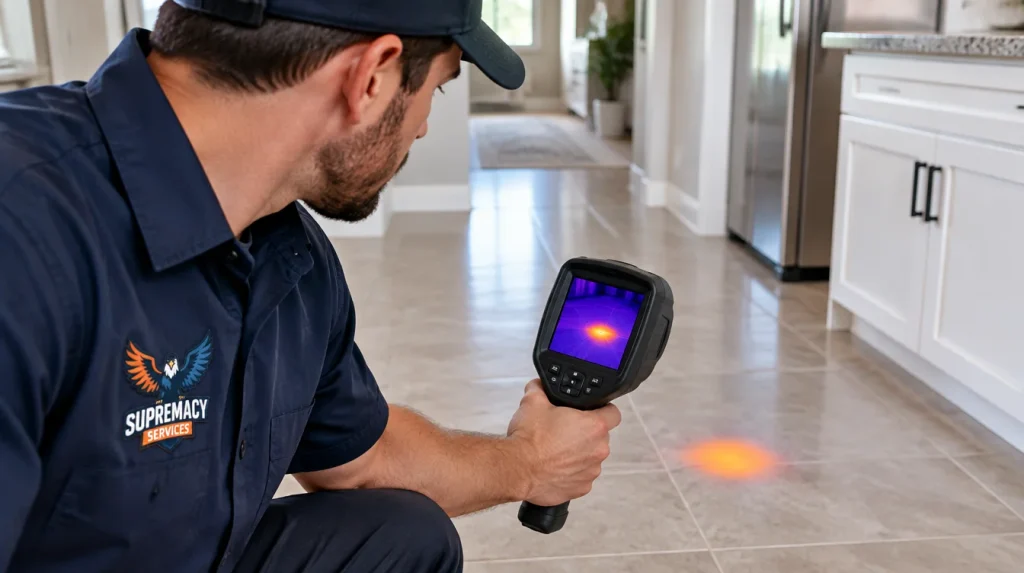
Plumbing technician scanning a residential tile floor with an infrared thermal camera to investigate unusual temperatures associated with a suspected hot-water slab leak.
Infrared thermal cameras reveal surface temperature differences that may help plumbers identify suspected hot-water leaks beneath flooring.

Infrared cameras help plumbers identify temperature variations across floors and other building surfaces.

They are especially useful when investigating a suspected hot-water leak beneath a slab.

If heated water escapes from a pipe, it may warm surrounding materials. A thermal camera can reveal unusual temperature patterns that suggest where further testing is needed.

What a plumber looks for:

  • Unexpected warm areas on tile or other flooring
  • Temperature patterns following a possible pipe route
  • Differences between adjacent floor surfaces
  • Thermal changes that appear when hot water is flowing

Thermal imaging does not allow a plumber to see directly through concrete or photograph a pipe hidden underground.

Instead, it measures surface infrared radiation and displays temperature differences.

A warm floor can also result from sunlight, heating equipment, or normal hot-water piping. Therefore, thermal imaging findings should be confirmed with additional tests.

3. Electronic Leak Detection: Amplifying Hidden Leak Signals

Electronic leak detection systems use sensitive sensors and signal processing to help identify sounds or vibrations associated with water escaping from a pipe.

Depending on the equipment, the technician may use ground microphones, contact sensors, or other listening devices.

The equipment helps distinguish possible leak sounds from ordinary household noise.

For example, a technician may compare readings near a kitchen floor, hallway, and bathroom to determine where the strongest consistent leak signal appears.

Electronic listening equipment is often part of an acoustic detection system rather than an entirely separate diagnostic technology.

It is most useful when combined with knowledge of the plumbing layout and pressure-test results.

4. Pressure Testing: Confirming That a Pipe Is Leaking

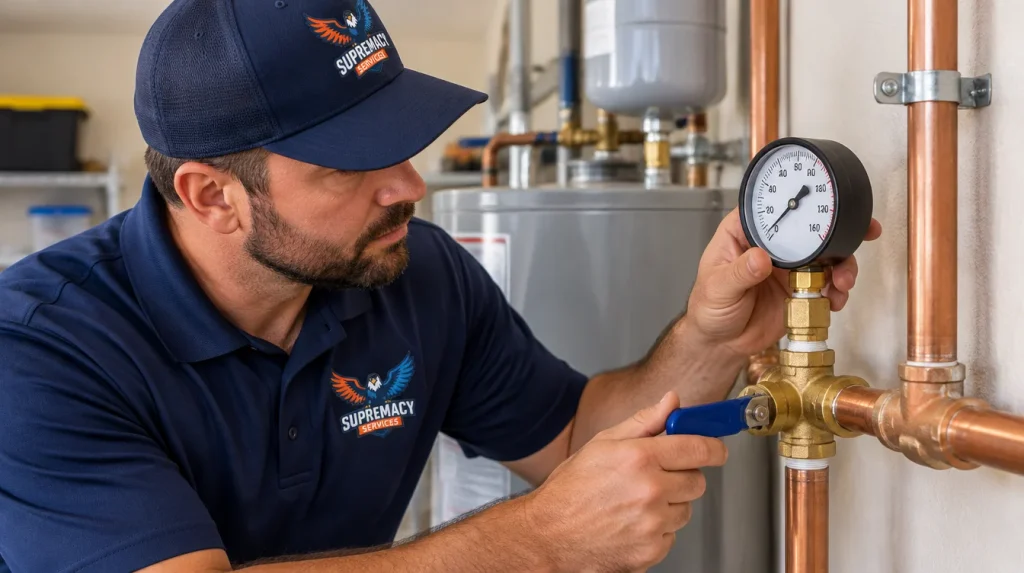
Professional plumber monitoring a pressure gauge connected to a residential water supply line while investigating a suspected hidden plumbing leak.
Pressure testing helps plumbers determine whether an isolated section of a home’s water supply system is losing pressure.

Pressure testing helps determine whether a section of plumbing can maintain pressure when isolated under controlled conditions.

A plumber may connect a suitable pressure gauge, isolate a plumbing section, and monitor the readings using an appropriate testing procedure.

A pressure drop can indicate leakage, although temperature changes, trapped air, and other testing conditions must be considered.

Pressure testing answers an important question: Is this plumbing section losing pressure?

It does not, by itself, reveal the exact location of the damaged pipe.

For that reason, plumbers often use pressure testing before acoustic or thermal investigation.

Different procedures apply to potable water supply piping and drainage systems. A hydrostatic drain test should not be confused with pressure testing a pressurized water supply line.

5. Moisture Mapping and Pipe Tracing

Sometimes the first clue is not a sound or temperature change but an unusual moisture pattern.

A plumber may use moisture meters to examine flooring, baseboards, or other accessible materials.

Moisture readings help identify affected areas and document the extent of water migration.

Pipe tracing may also help identify the likely route of concealed plumbing when suitable access and equipment are available.

These techniques are useful supporting methods, but moisture alone cannot prove that a slab leak exists.

For example, water from a leaking appliance connection can spread across a floor and resemble moisture from beneath the foundation.

Suspect a hidden leak beneath your foundation? Supremacy Services offers professional water leak detection in Dallas and the DFW Metroplex, including acoustic and infrared diagnostic methods designed to reduce unnecessary disruption.

Which Slab Leak Detection Method Works Best?

There is no single detection method that works best for every home.

The appropriate equipment depends on the pipe material, leak size, water pressure, floor construction, and whether the suspected leak involves a hot-water line, cold-water line, or drain.

Detection methodPrimary purposeMain limitation
Acoustic listeningLocate sounds from escaping pressurized waterBackground noise and weak signals
Infrared thermal imagingIdentify unusual surface temperature patternsCannot directly see through concrete
Electronic acoustic sensorsAmplify and analyze leak-related soundsRequires interpretation and confirmation
Pressure testingConfirm leakage in an isolated plumbing sectionDoes not locate the leak by itself
Moisture mappingIdentify and document affected materialsMoisture may originate elsewhere
Pipe tracingHelp establish concealed pipe routesDoes not independently confirm leakage

Can plumbers detect every slab leak without opening the floor?

No. Non-invasive equipment can often identify a suspected leak location, but it cannot guarantee a conclusive diagnosis in every situation.

Some leaks are too small or quiet for reliable acoustic detection. Others occur in complicated pipe layouts or beneath materials that interfere with readings.

When testing is inconclusive, a plumber may recommend additional investigation or limited access to confirm the source.

The goal is to minimize unnecessary demolition, not promise that concrete will never need to be opened.

What Happens During a Professional Slab Leak Inspection?

Supremacy Services plumber reviewing suspected slab leak inspection findings and possible plumbing repair options with a homeowner in Dallas, Texas.
After investigating a suspected slab leak, a plumber can explain the diagnostic findings and discuss appropriate repair options before invasive work begins.

A professional inspection generally follows a structured process.

Step 1: Discuss symptoms and inspect accessible plumbing

The plumber asks when the problem started and whether you have noticed rising water bills, damp flooring, unusual sounds, or changes in water pressure.

Accessible fixtures, toilets, appliance connections, and water heater components may be checked first.

This helps rule out simpler explanations before investigating the foundation.

Step 2: Check the water meter and isolate plumbing sections

With all water-using fixtures off, the plumber may examine the water meter for evidence of ongoing flow.

Isolation valves can help determine whether the suspected leak is inside the building’s plumbing system, along the incoming service line, or associated with another connected system.

Step 3: Test the suspected water line

The technician selects an appropriate test based on whether the suspected problem involves pressurized supply piping or drainage piping.

Pressure or other system-specific tests help confirm whether the suspected section is leaking.

Step 4: Use acoustic and thermal equipment

After narrowing the investigation, the plumber scans likely pipe routes and affected areas.

Acoustic readings, thermal patterns, and moisture measurements may be compared to improve confidence in the suspected location.

Step 5: Mark the suspected leak area

If the evidence is sufficiently consistent, the plumber may mark the likely leak location on the floor or document it in an inspection report.

The marked location represents the best-supported finding from the available tests, not necessarily an exact measurement of the pipe opening.

Step 6: Explain the findings and repair options

The homeowner should receive an explanation of:

  • Which plumbing section appears to be leaking
  • Which tests were performed
  • How confidently the leak has been located
  • Whether further investigation is needed
  • Which repair approaches may be feasible
  • Whether concrete removal or other access is expected

Ask for a written estimate before authorizing invasive repair work.

What Are the Warning Signs of a Slab Leak?

The most common warning signs include unexplained water consumption, warm or damp floors, and the sound of running water when fixtures are turned off.

Watch for the following symptoms.

An unexplained increase in your water bill

A continuous supply-line leak can waste water even when nobody is using a faucet.

Compare recent bills with your normal usage and investigate sudden changes that cannot be explained by irrigation, guests, or other activities.

Warm spots on the floor

An unusual warm area may indicate a leaking hot-water line beneath the slab.

However, normal hot-water piping and sunlight can also warm flooring, so this symptom is not definitive.

Damp flooring or recurring moisture

Moisture beneath carpet, loose flooring, or persistent dampness near baseboards can indicate a hidden leak.

Other possible causes include appliance leaks, condensation, exterior water intrusion, and drainage problems.

Running-water sounds when fixtures are off

A continuous hissing or rushing sound may suggest that water is moving through a pipe unexpectedly.

A plumber can investigate whether the sound comes from a leak, running toilet, or another plumbing component.

Reduced water pressure

A significant leak may contribute to pressure loss, but low pressure can also result from clogged fixtures, pressure-regulating valve problems, or municipal supply conditions.

Cracks or movement in flooring

Cracks and uneven floors deserve attention, but they do not prove a slab leak.

Foundation movement can have several causes, including soil moisture changes and structural conditions unrelated to plumbing.

If you notice multiple warning signs, arrange a plumbing inspection rather than assuming the foundation must be excavated.

What Causes Slab Leaks in Dallas Homes?

Slab leaks can develop for several reasons, including pipe deterioration, mechanical damage, installation problems, and movement around buried plumbing.

Pipe corrosion and deterioration

Some older homes contain metallic water lines that may deteriorate over time.

The rate of deterioration depends on factors such as pipe material, water chemistry, installation conditions, and exposure to surrounding materials.

Foundation and soil movement

Expansive clay soils occur in parts of North Texas.

These soils can shrink or swell as moisture conditions change. Movement around a foundation or buried pipe can place additional stress on plumbing, especially where piping lacks sufficient flexibility or protection.

Not every Dallas slab leak is caused by expansive soil, and soil movement alone does not establish why a particular pipe failed.

Installation-related problems

Pipes may be vulnerable when they are improperly supported, damaged during construction, or installed in contact with abrasive materials.

Stress at joints and bends can also contribute to failures.

Water pressure and repeated stress

Excessive water pressure or repeated pressure fluctuations can place additional stress on plumbing components.

A professional can measure household pressure and determine whether corrective equipment or adjustments are needed.

Can Homeowners Check for Slab Leaks Themselves?

Homeowners can perform basic checks to identify possible hidden water loss, but locating a leak beneath concrete usually requires professional equipment and interpretation.

A simple water meter check

  1. Turn off faucets, showers, and water-using appliances.
  2. Make sure toilets are not refilling and irrigation is off.
  3. Check the water meter for ongoing movement.
  4. Record the reading.
  5. Avoid using water for a suitable observation period.
  6. Check the meter again.

If the reading changes while no water is intentionally being used, investigate further.

The EPA recommends checking the meter during a period without water use and comparing readings after two hours.

A changing meter reading suggests water loss but does not identify whether the leak is beneath the slab, in an irrigation system, or elsewhere.

What homeowners should avoid

Do not break concrete based only on a warm floor, a damp patch, or a single meter observation.

Avoid operating unfamiliar valves, disconnecting pressurized plumbing, or conducting improvised pressure tests.

If water is actively flooding the home, use the main shutoff valve if it is safe and accessible, and arrange urgent plumbing assistance.

If water is approaching electrical equipment, stay clear of the affected area and seek appropriate emergency assistance.

How Much Does Slab Leak Detection Cost?

Slab leak detection costs vary based on the complexity of the plumbing system, the tests required, the property’s accessibility, and whether the investigation involves one suspected pipe or several possible sources.

There is no universal fixed price for every Dallas property.

A straightforward investigation of an accessible residential water supply system may require less work than a complex diagnosis involving multiple plumbing zones or uncertain moisture sources.

Factors that affect the price

Cost factorWhy it matters
Size and layout of the homeLarger properties may require more investigation
Number of suspected pipe sectionsAdditional isolation and testing may be necessary
Type of plumbingSupply lines and drains require different tests
Flooring and foundation constructionSome materials make readings harder to interpret
AccessibilityConcealed valves or pipe routes complicate testing
Diagnostic equipment requiredMultiple methods may be necessary
Emergency schedulingUrgent service may have different pricing
Documentation requirementsDetailed reports may involve additional work

Before booking, ask whether the quoted diagnostic fee includes pressure testing, acoustic investigation, thermal imaging, written findings, and any follow-up visit.

Also confirm whether the detection charge is separate from repair costs.

Does insurance cover slab leak detection?

Coverage depends on your specific insurance policy, the cause of the damage, and the terms applying to leak detection, access, and repairs.

Some policies may distinguish between damage caused by escaping water and the cost of repairing the failed pipe itself.

Contact your insurer and review the policy before assuming any particular expense will be reimbursed.

If your water meter indicates ongoing water loss but you cannot find a visible leak, consider scheduling a professional hidden water leak inspection before authorizing concrete removal.

What Happens After a Slab Leak Is Found?

Finding the leak is only the first stage. The next decision is how to repair or replace the affected plumbing.

The appropriate approach depends on the pipe’s condition, location, accessibility, and whether other sections are likely to fail.

Option 1: Localized slab access and pipe repair

The plumber may recommend opening a limited section of flooring and concrete to reach the damaged pipe.

This can be appropriate when the leak is well located and the surrounding piping is otherwise suitable for repair.

Concrete removal, plumbing work, and restoration should be planned carefully.

Option 2: Rerouting the water line

In some homes, a new water line can be routed through an accessible wall, ceiling, or other suitable pathway rather than reopening the slab.

This may avoid some foundation disturbance but can require work on interior finishes.

Option 3: Replacing a larger section of piping

If several pipes have deteriorated or repeated leaks have occurred, replacing a larger section of the plumbing system may be more practical than repeatedly repairing individual failures.

The decision should follow an assessment of pipe condition and installation requirements.

For additional information about repair approaches, see Supremacy Services’ water line repair and replacement services in Dallas.

Does the concrete always need to be broken for repairs?

No. Some repairs can be completed by rerouting or replacing plumbing through another accessible path.

However, other repairs require localized slab access.

A non-invasive diagnosis does not guarantee a non-invasive repair.

Can Slab Leaks Be Prevented?

Not every slab leak can be prevented, particularly when pipes are aging or concealed beneath an existing foundation.

However, homeowners can reduce avoidable risks and identify developing problems sooner.

  • Monitor monthly water consumption for unexplained changes.
  • Repair visible plumbing leaks promptly.
  • Have unusual water pressure evaluated.
  • Investigate recurring dampness rather than covering it with new flooring.
  • Maintain appropriate drainage around the home.
  • Avoid major, uncontrolled changes to soil moisture around the foundation.
  • Consider water-use monitoring or automatic shutoff devices where appropriate.
  • Have repeated leaks assessed for broader pipe deterioration.

The EPA notes that leak detection and flow monitoring devices can identify unusual water use and help reduce water waste and damage.

A note about Dallas-area foundation conditions

Homes throughout Dallas, Plano, Frisco, Richardson, Allen, and surrounding communities can have different foundation designs, plumbing materials, and soil conditions.

Avoid assuming that every floor crack indicates a water leak or that every slab leak is caused by foundation movement.

A plumbing diagnosis should establish whether a pipe is leaking. A separate foundation assessment may be appropriate when there is evidence of structural movement.


Frequently Asked Questions

1. Can plumbers find a slab leak without digging?

Yes. Plumbers can often locate a suspected slab leak using acoustic equipment, pressure testing, thermal imaging, and other diagnostic tools without digging or breaking concrete. Some cases still require limited access for confirmation or repair.

2. Can a thermal camera see water leaking through concrete?

No. A thermal camera measures surface temperature differences. It may identify patterns associated with a hot-water leak, but it cannot directly see water or pipes through solid concrete.

3. How accurate is electronic slab leak detection?

Accuracy depends on the leak, pipe material, pressure, building construction, background noise, and technician interpretation. Combining electronic listening with other diagnostic tests generally provides stronger evidence than relying on one reading.

4. Can a slab leak cause a high water bill?

Yes. A leak in a pressurized water supply line may cause continuous water loss. However, running toilets, irrigation leaks, and other plumbing problems can also increase water consumption.

5. Can you have a slab leak without visible water?

Yes. Water may escape into soil beneath the foundation without immediately reaching the interior floor. An unexplained meter reading or running-water sound may be an earlier clue.

6. How long does it take to detect a slab leak?

The time varies with the home’s plumbing layout, accessibility, leak characteristics, and number of tests required. A simple diagnosis may be completed in one visit, while complex cases can require additional investigation.

7. Is slab leak detection the same as slab leak repair?

No. Detection establishes whether and where a leak is likely occurring. Repair involves accessing, rerouting, or replacing the affected plumbing.

8. Can a slab leak be mistaken for another plumbing problem?

Yes. Leaking appliances, toilets, irrigation lines, drainage pipes, condensation, and exterior water intrusion can produce similar symptoms. Proper diagnosis helps distinguish these issues.

9. Should I turn off my water if I suspect a slab leak?

If water is actively escaping or causing damage, shutting off the main water supply may help limit further loss when it is safe to do so. For less obvious symptoms, contact a plumber for guidance and avoid disturbing unfamiliar plumbing equipment.

10. Who should inspect a suspected slab leak in Dallas?

A properly licensed plumbing professional with suitable leak detection equipment should evaluate suspected under-slab plumbing leaks. Ask about the testing process, written findings, and whether the provider handles both detection and repair.


Get Professional Slab Leak Detection in Dallas and DFW

A suspected slab leak does not mean your entire floor needs to be demolished.

Acoustic listening equipment, infrared thermal imaging, and appropriate plumbing tests can often help locate a hidden water leak before invasive work begins.

The best approach is to confirm that a leak exists, narrow down its location, and understand the available repair options before making changes to the foundation.

Supremacy Services provides professional water leak detection for homeowners across Dallas and the surrounding DFW Metroplex.

Schedule Water Leak Detection With Supremacy Services

Find out what is happening beneath your floor and which next step makes sense for your home.

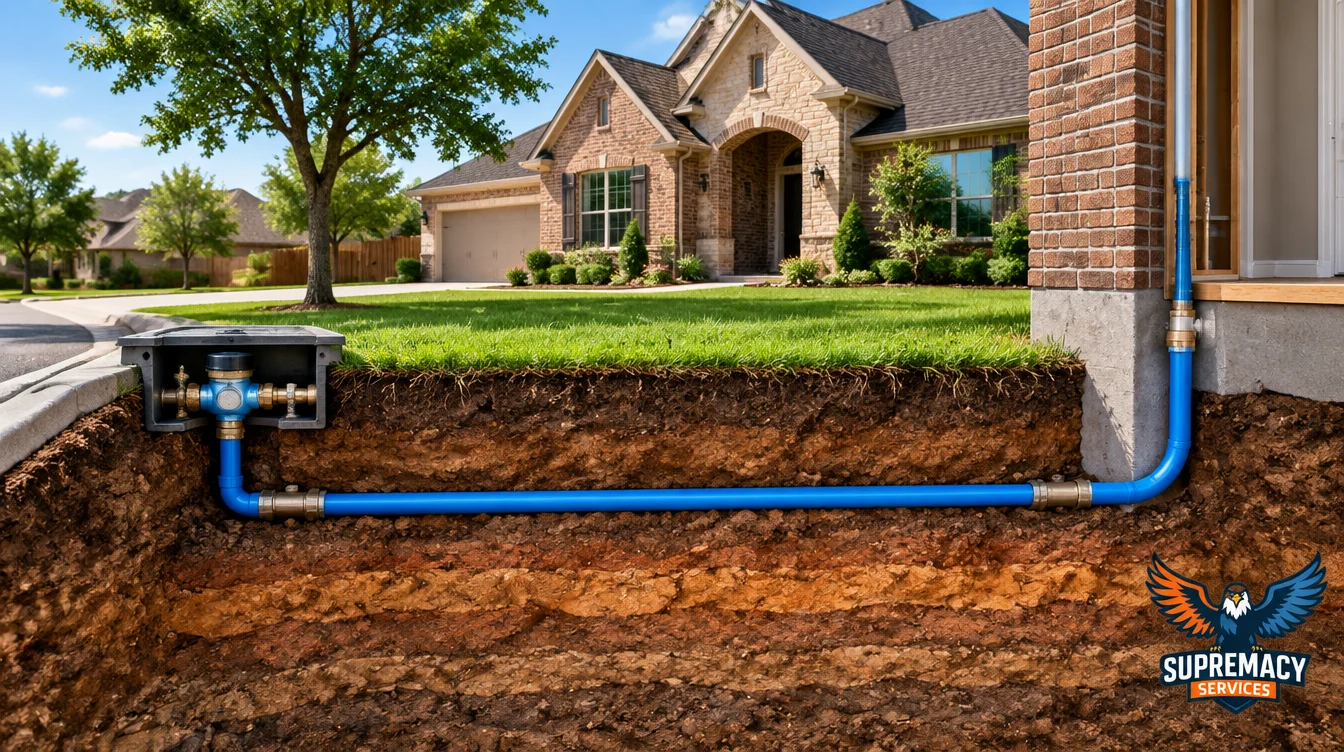
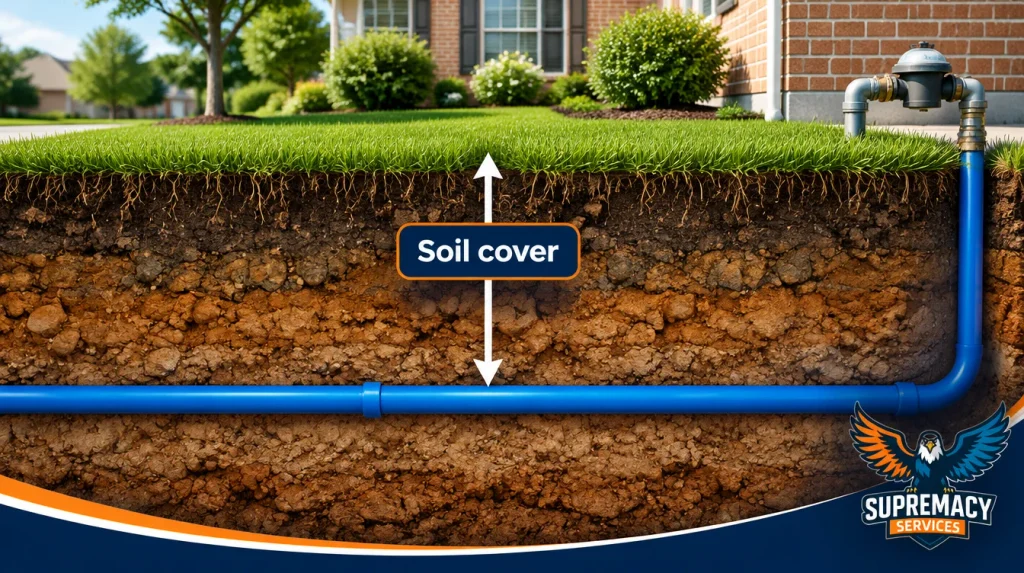
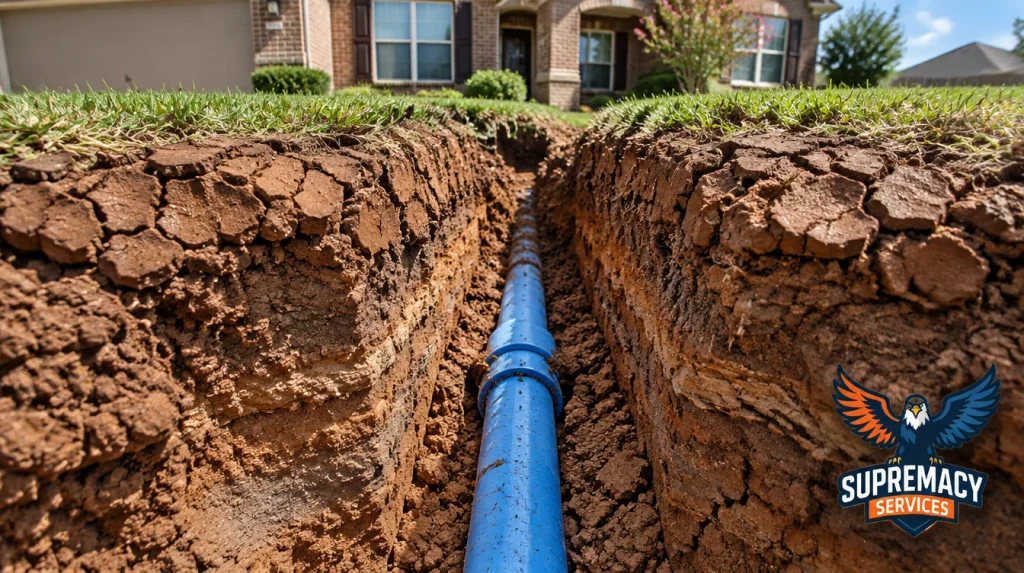
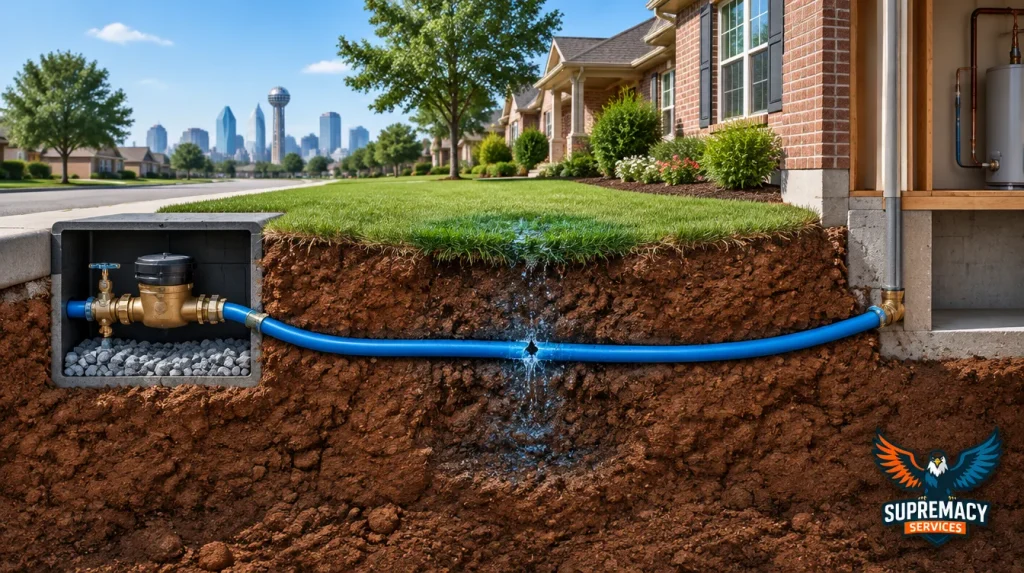
Cross-sectional view of an underground residential water supply line beneath a Dallas, Texas home.

How Long Do Underground Water Lines Last in Texas?

How Long Do Underground Water Lines Last?
Underground water lines in Texas can last several decades, but their actual lifespan depends on the pipe material, installation quality, soil conditions, water chemistry, and exposure to physical damage. Some properly installed copper and modern plastic water lines can remain serviceable for 50 years or longer, while older galvanized steel pipes may deteriorate much sooner.

For homeowners in Dallas and the DFW Metroplex, knowing the age and condition of an underground water line can help prevent unexpected leaks, property damage, and costly emergency repairs.

A pipe that has been underground for 40 years is not automatically defective. Likewise, a relatively new pipe can fail prematurely because of poor installation, shifting soil, or damaged connections.

The important question is not simply how old your water line is, but whether it is still structurally sound and delivering water reliably.

Table of Contents

  1. How Long Do Different Underground Water Pipes Last?
  2. What Affects Underground Water Line Lifespan in Texas?
  3. How Can You Tell If an Underground Water Line Is Aging?
  4. Do Underground Water Lines Last Longer Than Indoor Plumbing?
  5. Should You Repair or Replace an Aging Water Line?
  6. How Much Does Underground Water Line Replacement Cost?
  7. How Do Plumbers Evaluate an Aging Underground Water Line?
  8. How Can You Extend the Life of Your Underground Water Line?
  9. When Should Dallas Homeowners Consider Replacement?
  10. Frequently Asked Questions

How Long Do Different Underground Water Pipes Last?

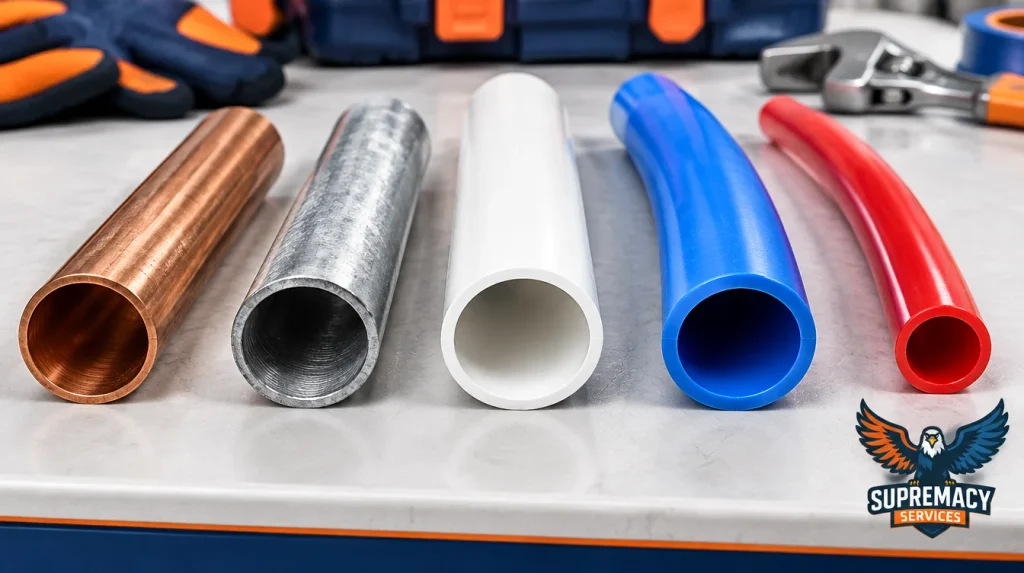
Comparison of copper, galvanized steel, PVC, HDPE, and PEX water pipes used in residential plumbing.
Different underground water pipe materials have different expected service lives, maintenance needs, and vulnerabilities.

The lifespan of an underground water line varies considerably by material. Copper, galvanized steel, PVC, polyethylene, and PEX each have different strengths, limitations, and installation requirements.

The following comparison provides general planning guidance rather than a prediction for any individual home.

Pipe materialGeneral longevity guidanceMain concern
CopperOften 50–75+ yearsCorrosion, pinhole leaks, soil and water chemistry
Galvanized steelApproximately 40 years in historical EPA guidanceInternal rust, restricted flow, external corrosion
PVCCommonly designed for multi-decade service; 50+ years is a planning benchmark for suitable productsJoint failures, impact, installation damage
HDPE / PEDesigned for long-term buried service; often planned around 50+ yearsImproper connections, installation damage, unsuitable operating conditions
PEXCommonly associated with decades of service, but underground suitability depends on the specific product and installationDamaged fittings, improper burial, installation conditions
PolybutyleneVariable; failure history warrants additional scrutinyMaterial and connection reliability

These are broad reference ranges, not universal manufacturer warranties. The EPA has documented copper service-line longevity commonly exceeding 75 years and historical galvanized service-line life around 40 years. Actual performance can differ substantially.

Copper underground water lines

Copper is a durable plumbing material used in residential water systems for many decades.

Its advantages include resistance to many forms of deterioration, mechanical strength, and a long history of use in potable water systems.

However, copper is not immune to failure.

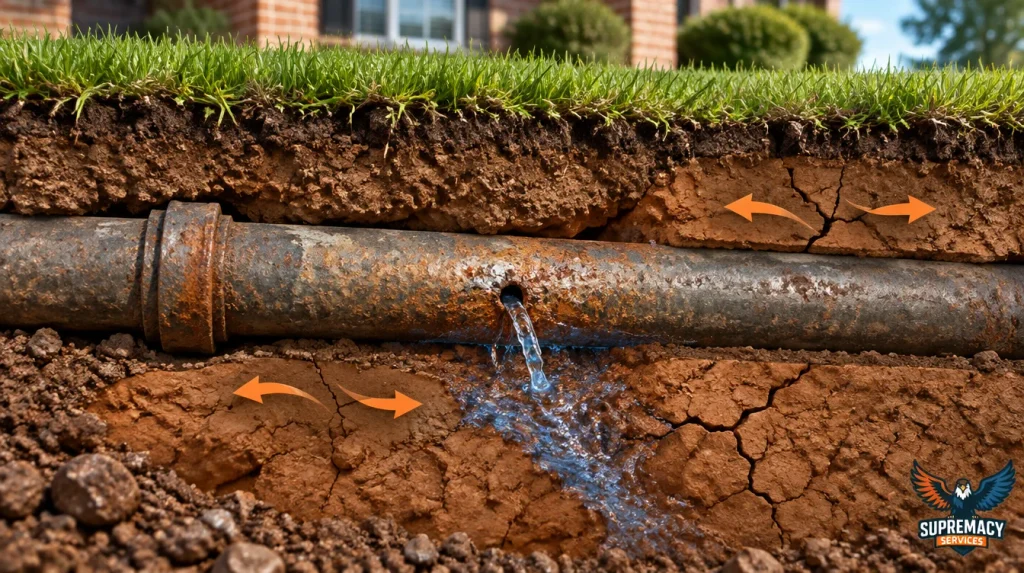
Corrosion can develop because of aggressive water chemistry, certain soil conditions, electrical influences, or installation problems. Over time, localized deterioration may produce pinhole leaks.

For Dallas homeowners with older copper service lines, the presence of repeated leaks matters more than age alone.

A copper pipe installed several decades ago may still perform well if its condition is sound.

Galvanized steel underground water lines

Galvanized steel pipes have a protective zinc coating intended to reduce corrosion.

As the coating deteriorates, the underlying steel becomes vulnerable to rust.

Corrosion may develop both inside and outside the pipe, eventually reducing the available flow area or weakening the pipe wall.

Common symptoms include declining water pressure, discolored water, and recurring leaks.

Older galvanized underground water lines deserve particular attention because internal corrosion may be extensive even when the exposed sections appear acceptable.

PVC underground water lines

PVC is a corrosion-resistant plastic pipe material used in suitable underground water applications.

Unlike steel, PVC does not rust. However, it can still fail because of impact damage, unsuitable pressure conditions, poor bedding, improper joints, or ground movement.

Not every PVC product is approved for pressurized potable water service.

The correct pipe specification, pressure rating, joining method, and local code requirements matter.

HDPE and polyethylene water lines

High-density polyethylene, commonly called HDPE, is used in many buried water applications.

Its flexibility and resistance to corrosion can be useful where underground conditions create movement or installation challenges.

The reliability of an HDPE water line depends on proper material selection, compatible fittings, and installation techniques.

A flexible pipe can tolerate some movement, but it is not immune to damage from excavation, poor installation, or excessive stress.

PEX underground water lines

PEX is widely used in residential plumbing, but not every PEX product or installation method is appropriate for direct burial.

Homeowners should not assume that any PEX pipe purchased for indoor plumbing can be buried outdoors.

The product’s listing, manufacturer instructions, protection requirements, fittings, and applicable plumbing code must be checked.

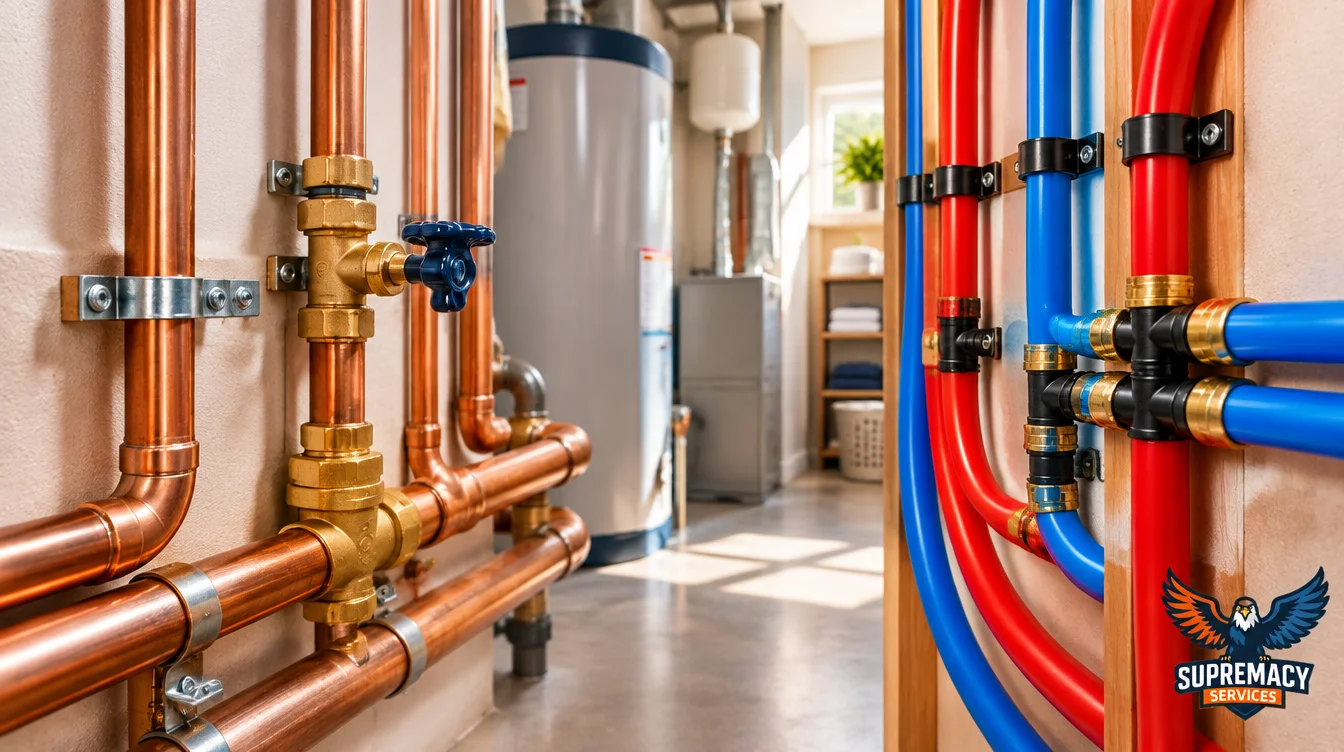
For a more detailed comparison of material choices, homeowners can also explore copper versus PEX piping and how each performs in different applications.

What Affects Underground Water Line Lifespan in Texas?

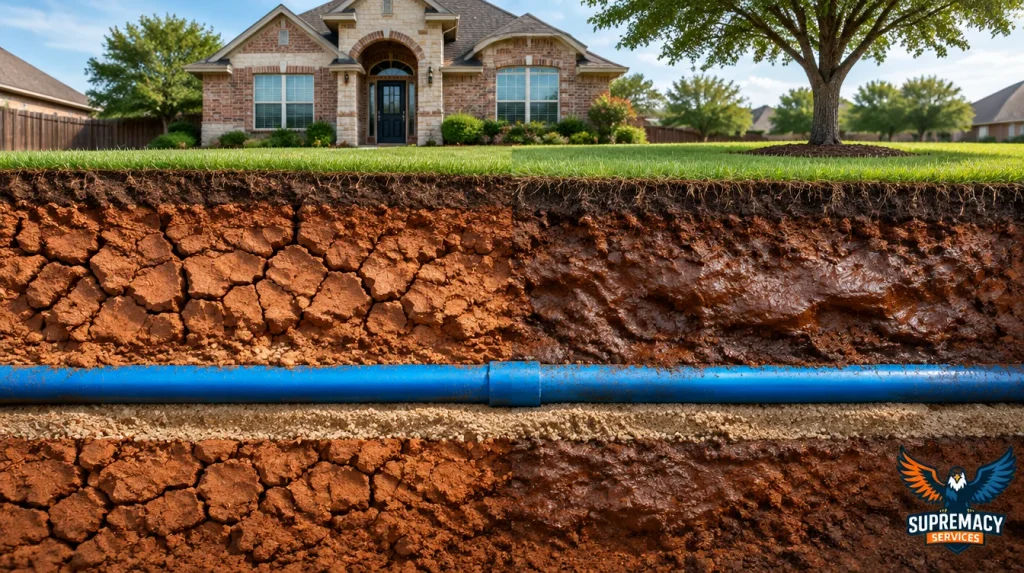
Underground residential water pipe surrounded by expansive clay soil beneath a North Texas home.
North Texas clay soil expands when wet and shrinks during dry conditions, potentially placing stress on buried water lines.

The most important factors are pipe material, soil conditions, water chemistry, installation quality, operating pressure, and exposure to external damage.

Dallas-area properties can have different underground conditions even within the same neighborhood.

1. Expansive clay soil and ground movement

Parts of North Texas have expansive clay soils that change volume as moisture conditions change.

During wet periods, clay may swell. During prolonged dry periods, it can shrink.

This movement can place stress on underground structures, including water pipes and their connections.

The actual risk depends on the property’s soil characteristics, pipe depth, bedding, material, and installation.

A properly installed water line may accommodate ordinary ground movement without problems, while a poorly supported connection may be more vulnerable.

2. Corrosion and water chemistry

Metal pipes can deteriorate because of reactions involving water chemistry or the surrounding environment.

Corrosion does not affect every property equally.

Factors can include water composition, pipe material, temperature, soil moisture, and electrical conditions.

This is one reason two homes with similarly aged copper lines may experience very different results.

3. Installation quality

Even a high-quality pipe can fail prematurely when installed incorrectly.

Potential installation problems include:

  • Inadequate pipe bedding or support
  • Improper fittings or connections
  • Sharp rocks pressing against the pipe
  • Incorrect burial depth
  • Excessive bending or mechanical stress
  • Failure to follow manufacturer requirements

The quality of the original installation can be as important as the pipe material itself.

4. Water pressure and pressure changes

Excessive water pressure can increase stress on pipes, valves, and fittings.

Pressure fluctuations may also contribute to plumbing problems, particularly where components are already weakened.

A plumber can measure the home’s operating pressure and determine whether pressure regulation or further testing is appropriate.

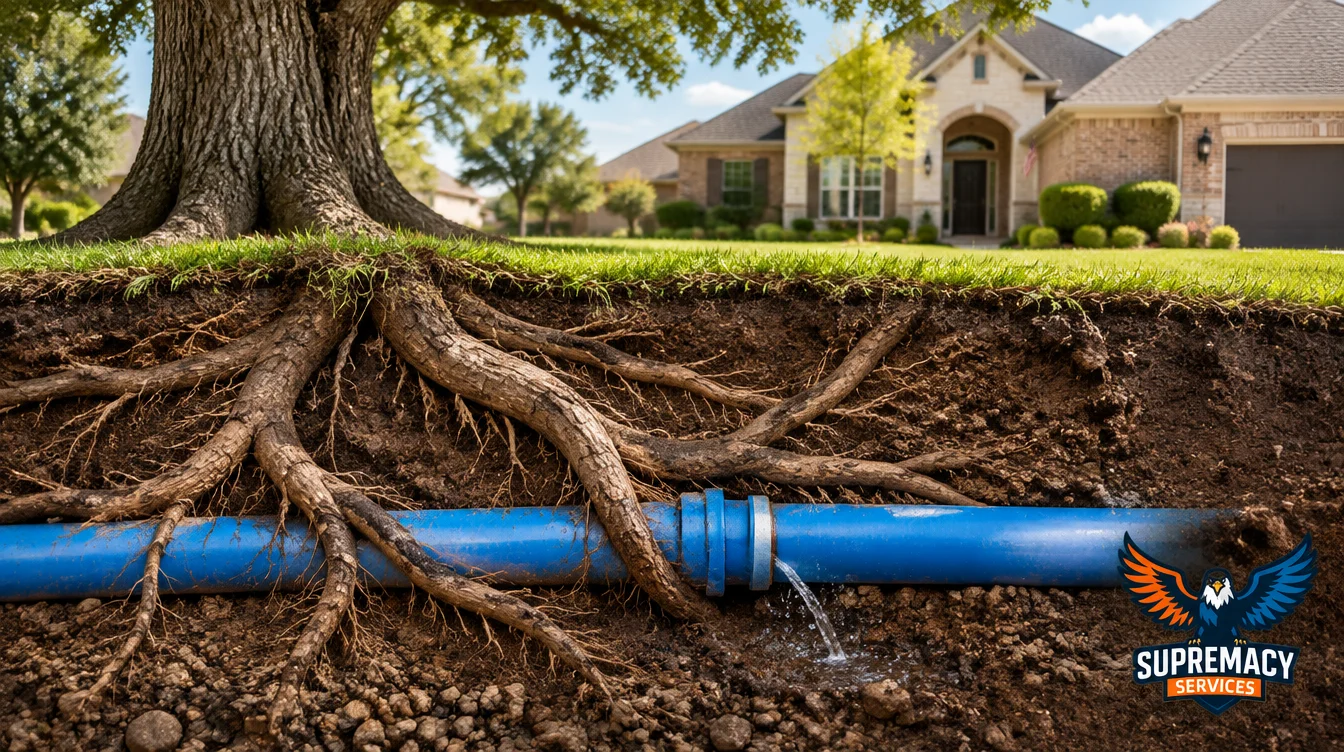
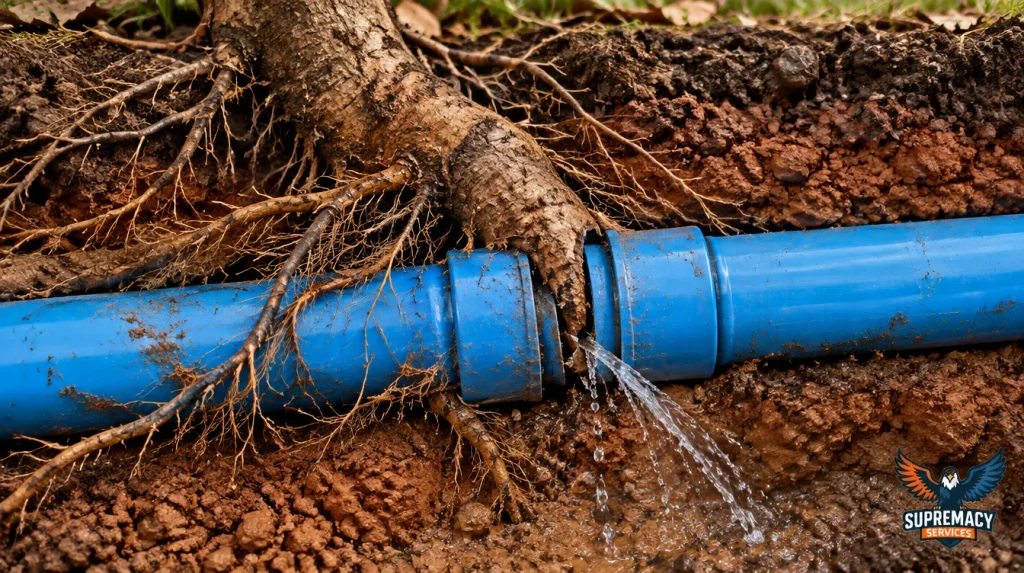
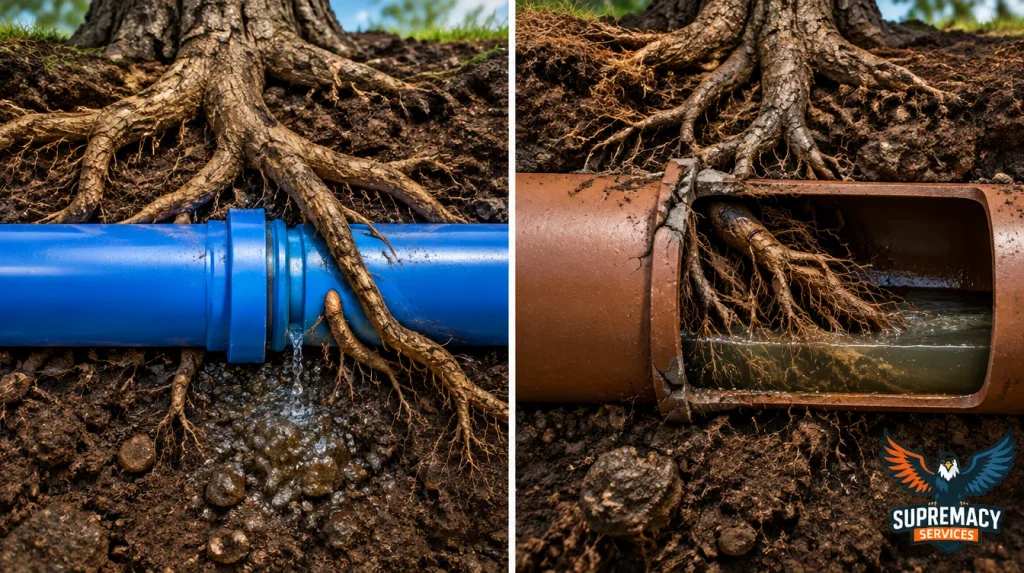
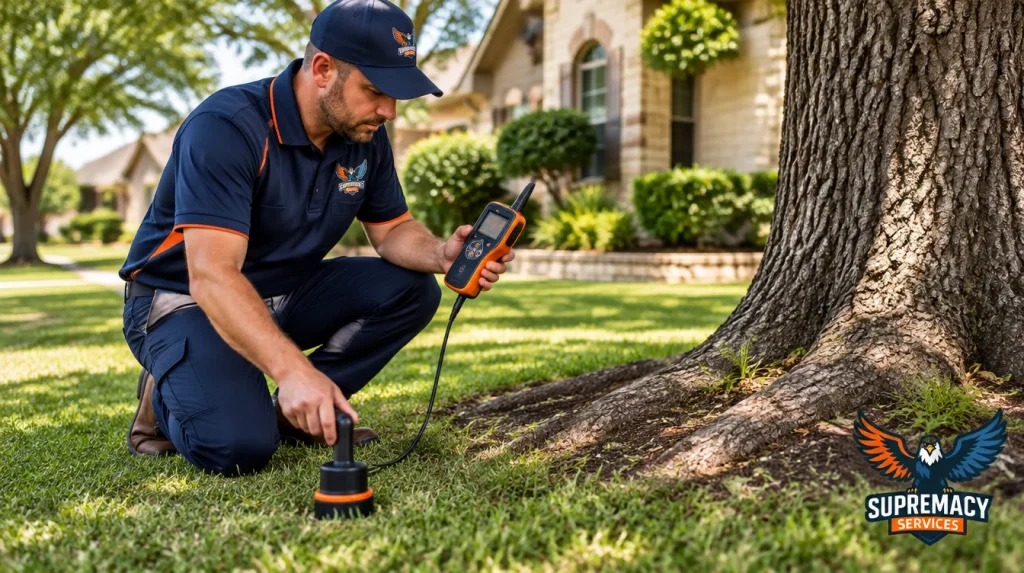
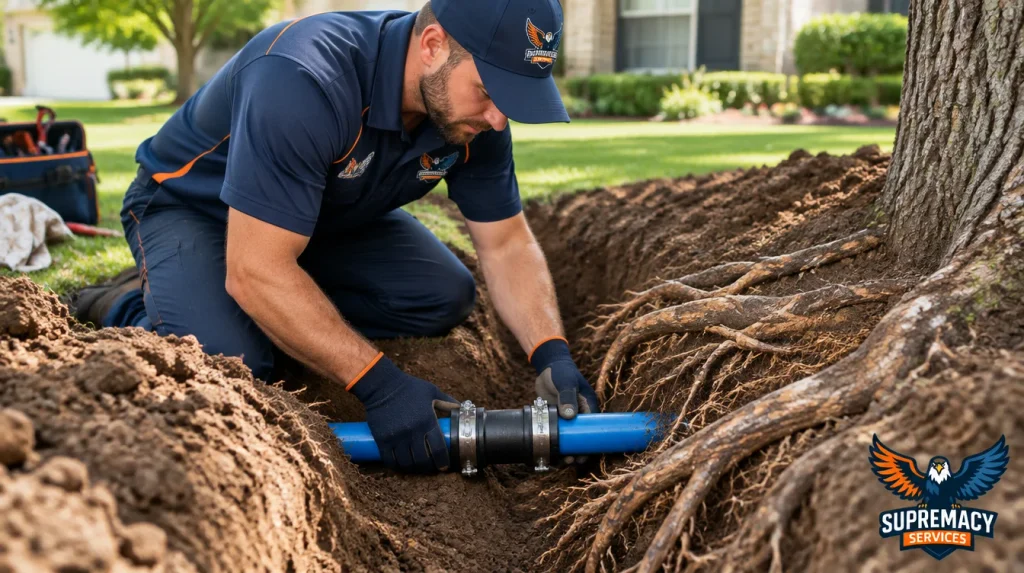
5. Tree roots and nearby vegetation

Tree roots generally do not penetrate sound, intact pressure pipes simply because water is flowing inside them.

However, roots can exploit existing openings or damaged connections, and growing roots can contribute to movement or mechanical stress around underground infrastructure.

A water line near mature trees should be evaluated based on its condition, location, and surrounding environment.

6. Accidental excavation damage

Underground water lines can be damaged during landscaping, fence installation, driveway work, or other excavation.

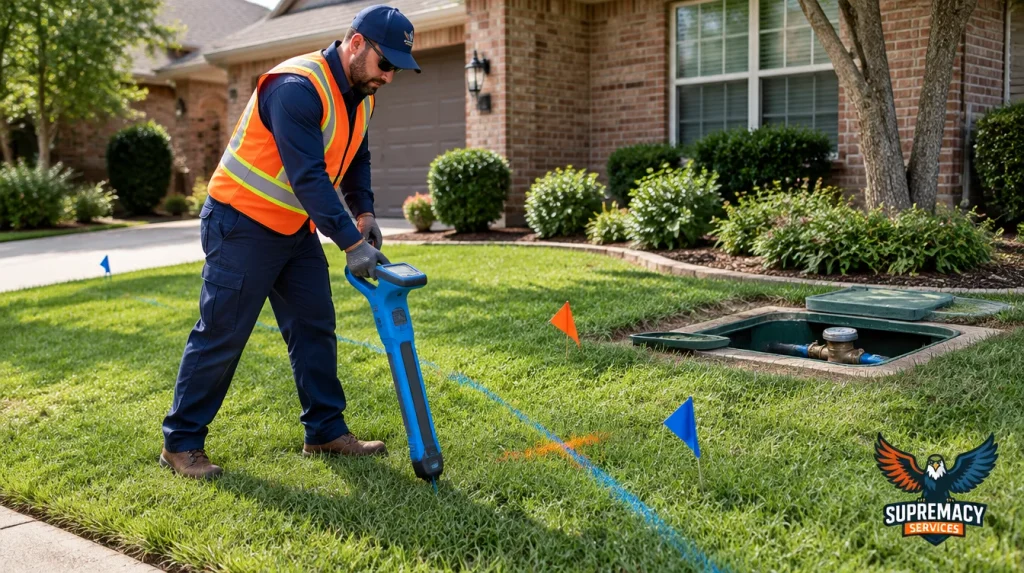
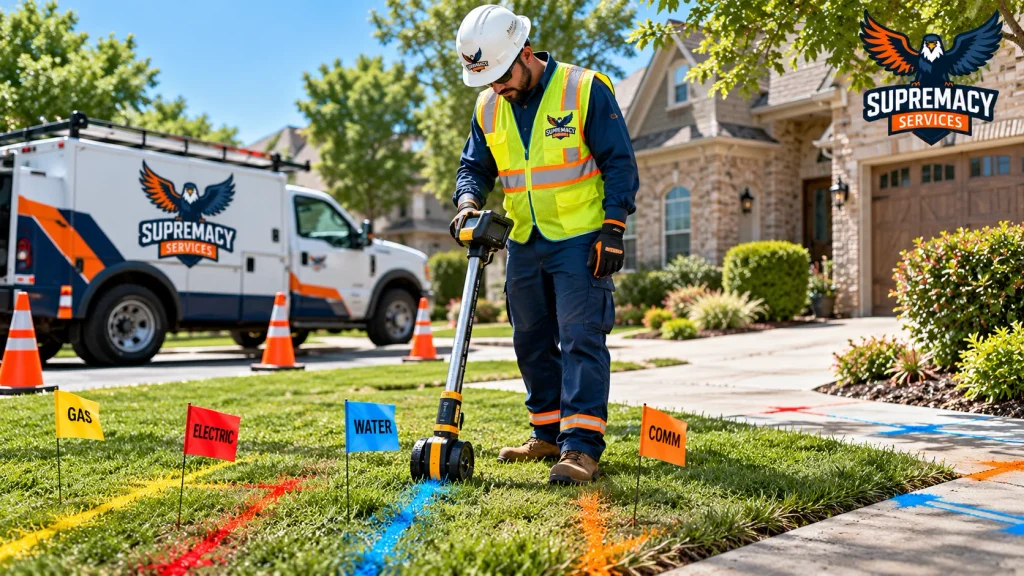
In Texas, homeowners and contractors are required to contact 811 before digging. Texas811 states that notice generally must be given at least two business days in advance, excluding weekends and holidays.

Private lines may require separate locating arrangements.

How Can You Tell If an Underground Water Line Is Aging?

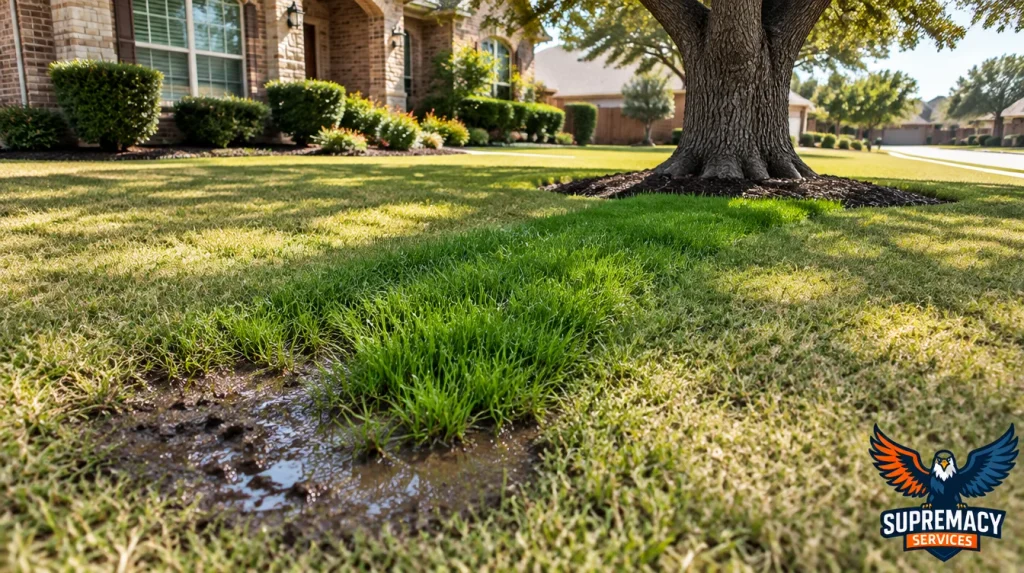
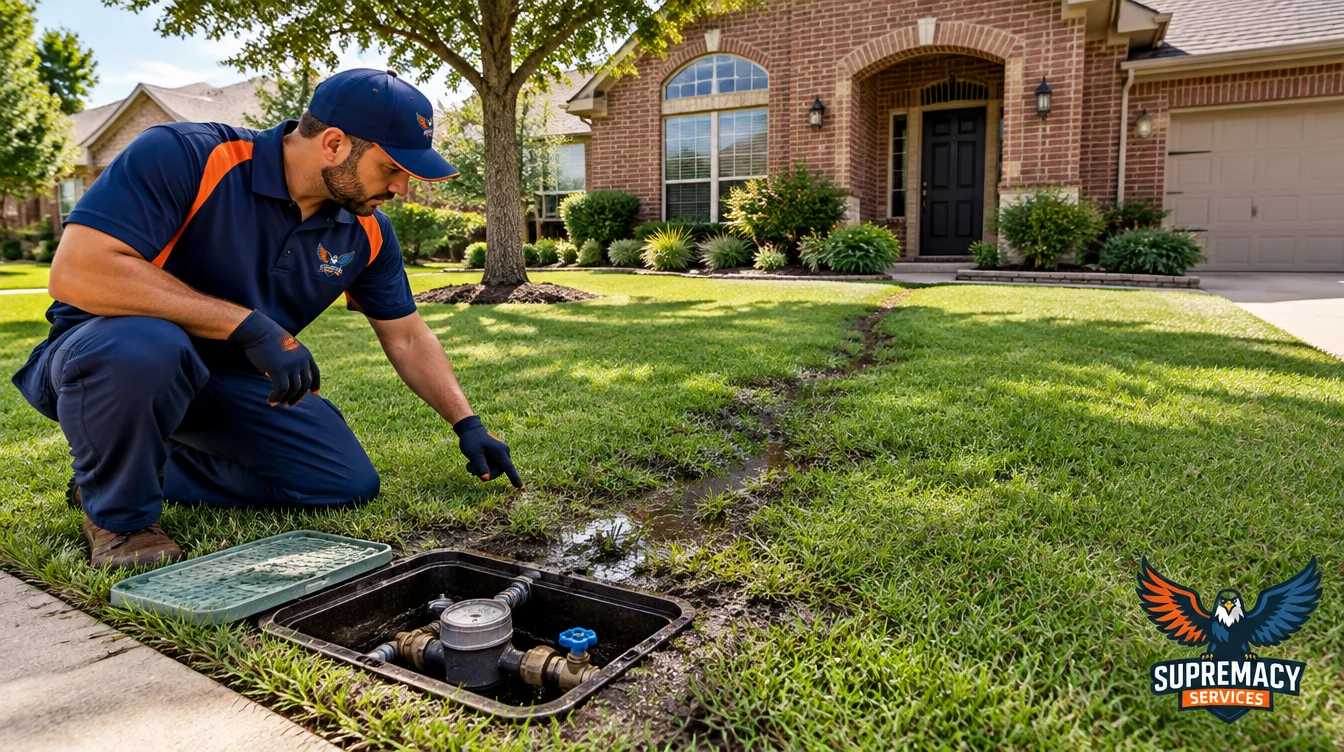
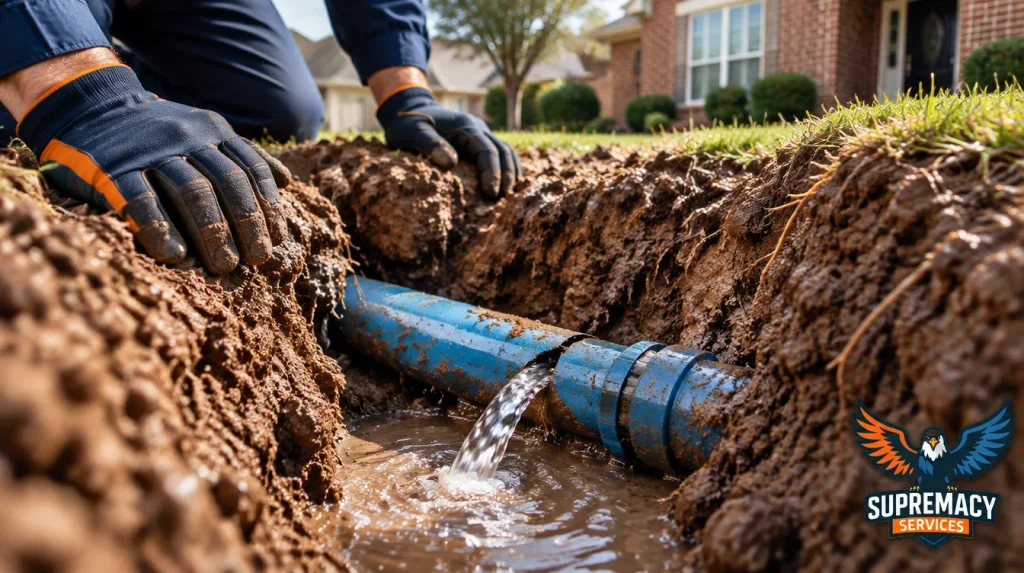
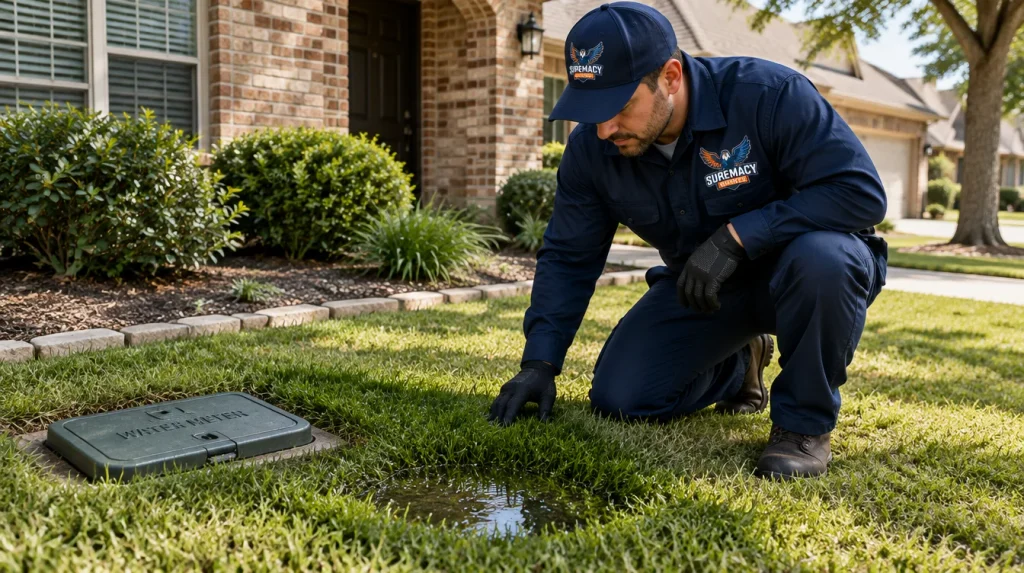
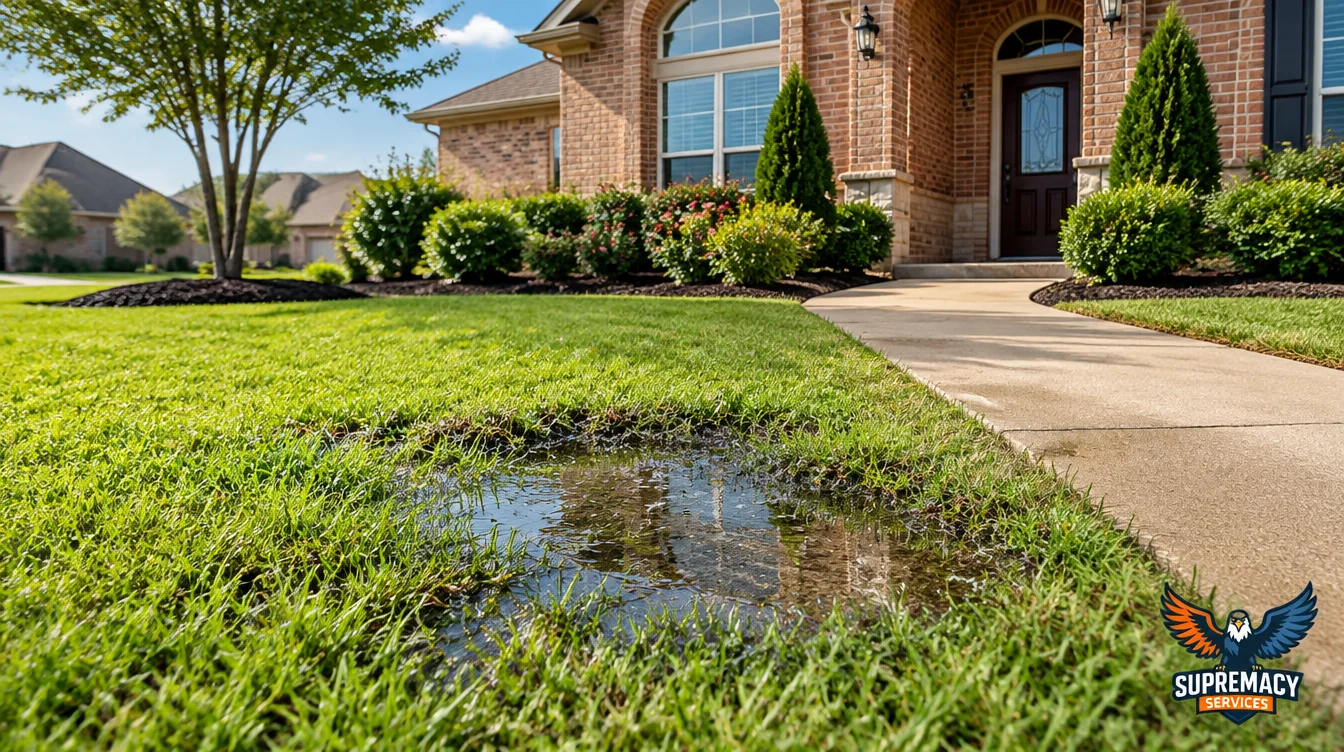
Leaking underground residential water pipe causing wet soil and a damp patch on a Dallas home's lawn.
Unexplained wet spots in your yard may indicate a leaking underground water supply line that needs professional inspection.

An aging underground water line may show signs of deterioration before a major break occurs. However, age alone cannot confirm that a pipe is failing.

Warning signs worth investigating

  • Unexplained increases in water bills
  • Water pressure that has gradually declined
  • Wet or unusually soft areas of the yard
  • Repeated underground water leaks
  • Discolored water from plumbing fixtures
  • Water meter movement when all water uses are off
  • Unusual sounds of running water
  • Previous repairs along the same underground line

Unexplained increases in water bills

A water bill that rises without an obvious increase in usage can indicate a hidden leak.

However, billing changes, irrigation usage, running toilets, and other plumbing problems should be ruled out before assuming the underground service line is responsible.

Low water pressure

An aging galvanized pipe may develop internal corrosion that restricts flow.

Alternatively, low pressure may be caused by a failing pressure regulator, partially closed valve, utility supply issue, or a leak.

The cause should be diagnosed before replacing a pipe.

Wet spots in the yard

A persistent wet patch between the water meter and the house may indicate an underground leak.

Other possible causes include irrigation failures, drainage problems, and rainfall accumulation.

If the area remains wet during dry weather, professional leak detection may be appropriate.

Repeated leaks

One isolated leak does not necessarily mean the entire line needs replacing.

However, multiple leaks along an older pipe can suggest broader deterioration.

In those circumstances, repeated spot repairs may become less economical than replacing the affected line.

Concerned about an aging underground water line? Supremacy Services provides water line repair and replacement services in Dallas to help homeowners evaluate leaks, damaged pipes, and replacement options.

Do Underground Water Lines Last Longer Than Indoor Plumbing?

Not necessarily. Underground pipes and indoor plumbing operate under different environmental conditions.

Buried water lines are protected from sunlight and some forms of accidental contact, but they can be exposed to soil movement, moisture, external corrosion, and excavation damage.

Indoor plumbing is generally easier to inspect and repair, although it can still deteriorate because of water chemistry, pressure, temperature, or installation defects.

FactorUnderground water linesIndoor water pipes
VisibilityUsually concealed by soilOften partially accessible
Ground movementPotential concernUsually less direct exposure
CorrosionInternal and potentially externalPrimarily dependent on material and surrounding conditions
Leak detectionMay require specialized equipmentOften easier to identify
Repair accessExcavation or specialized access may be neededWalls, floors or ceilings may need opening
Replacement planningRoute, utilities and landscaping matterBuilding access and interior restoration matter

Neither location automatically guarantees a longer lifespan.

Should You Repair or Replace an Aging Underground Water Line?

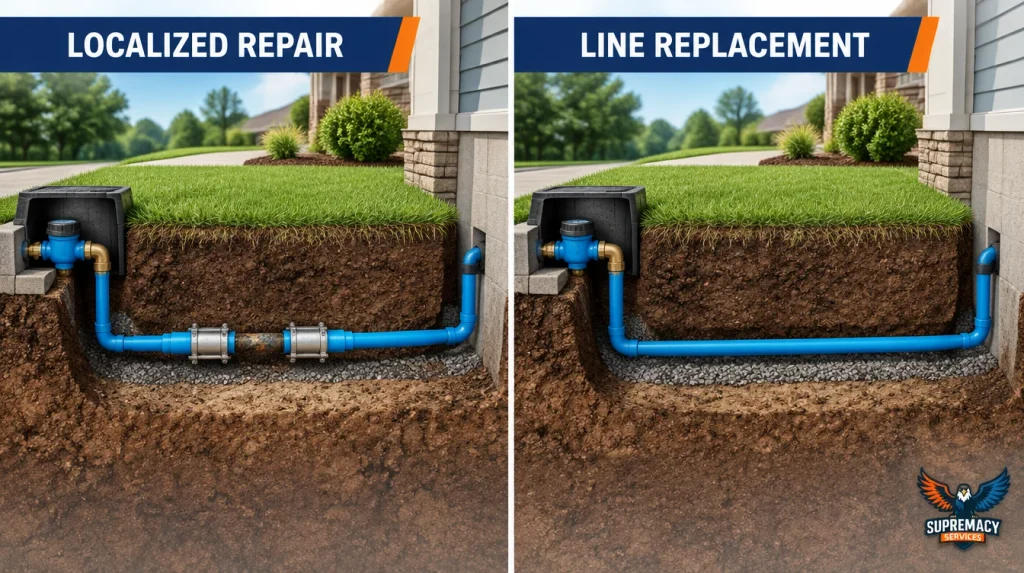
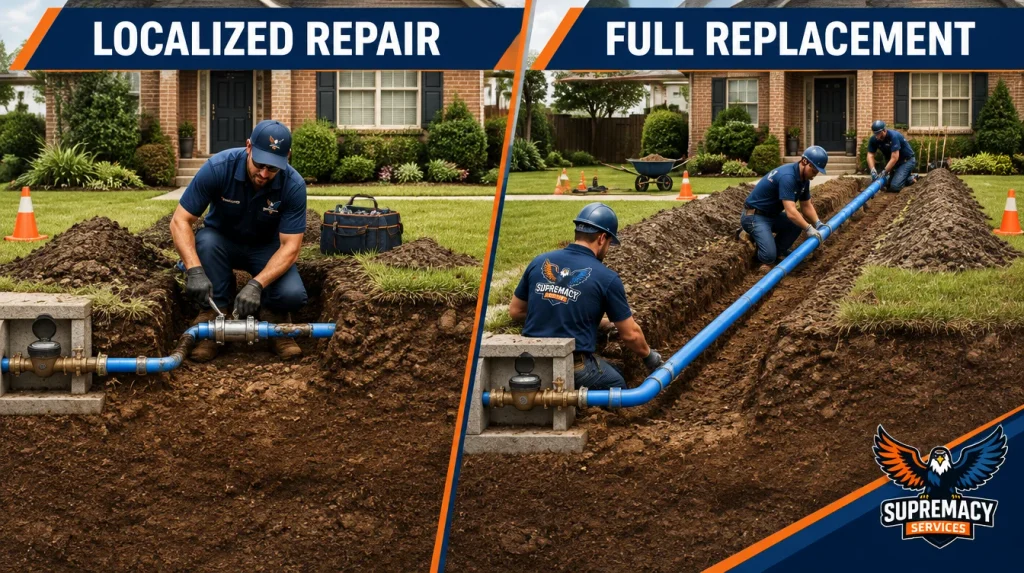
Side-by-side comparison of a localized underground water pipe repair and full residential water line replacement
A localized repair may address isolated damage, while extensive deterioration or recurring leaks may make full water line replacement more practical.

A localized repair may be appropriate when the rest of the pipe is in good condition. Replacement becomes more attractive when the line has widespread corrosion, recurring failures, unsuitable materials, or extensive damage.

When a repair may make sense

A repair may be reasonable when:

  • The pipe has one clearly identified damaged section.
  • The surrounding material remains structurally sound.
  • The line has not experienced repeated failures.
  • A compatible, code-compliant repair can be completed safely.
  • The repair cost is reasonable relative to the line’s expected remaining service life.

When replacement may be the better investment

Replacement deserves consideration when:

  • Multiple leaks have occurred along the same line.
  • Galvanized piping has significant corrosion.
  • The pipe has deteriorated across a substantial length.
  • The existing material or connections have a known reliability problem.
  • Excavation and repeated repairs have become disruptive or expensive.
  • A qualified plumber determines that another isolated repair is unlikely to provide a durable solution.

Repair versus replacement comparison

ConsiderationSpot repairFull replacement
Initial scopeLocalized damaged sectionEntire affected service line
Upfront expenseOften lowerOften higher
Best applicationIsolated defectWidespread deterioration
Remaining old pipeYesGenerally removed or abandoned appropriately
Future leak riskDepends on remaining pipe conditionReduces risks associated with the replaced material
Property disruptionOften localizedDepends on route and installation method

Replacing a line does not eliminate every possible future plumbing problem, but it can address deterioration that a localized repair would leave behind.

For older properties, a professional assessment should compare both options before work begins.

How Much Does Underground Water Line Replacement Cost in Dallas?

The cost of replacing an underground water line depends on its length, depth, pipe material, access conditions, installation method, and the amount of property restoration required.

There is no single reliable price for every Dallas home.

Factors that influence replacement cost

Length of the service line: A longer distance between the meter and the home generally requires more material and installation work.

Burial depth: Deeper lines can require additional excavation, equipment, and safety precautions.

Pipe material: Copper, HDPE, and other approved materials have different material and installation costs.

Driveways and landscaping: Work beneath pavement, patios, mature landscaping, or retaining walls may require additional planning.

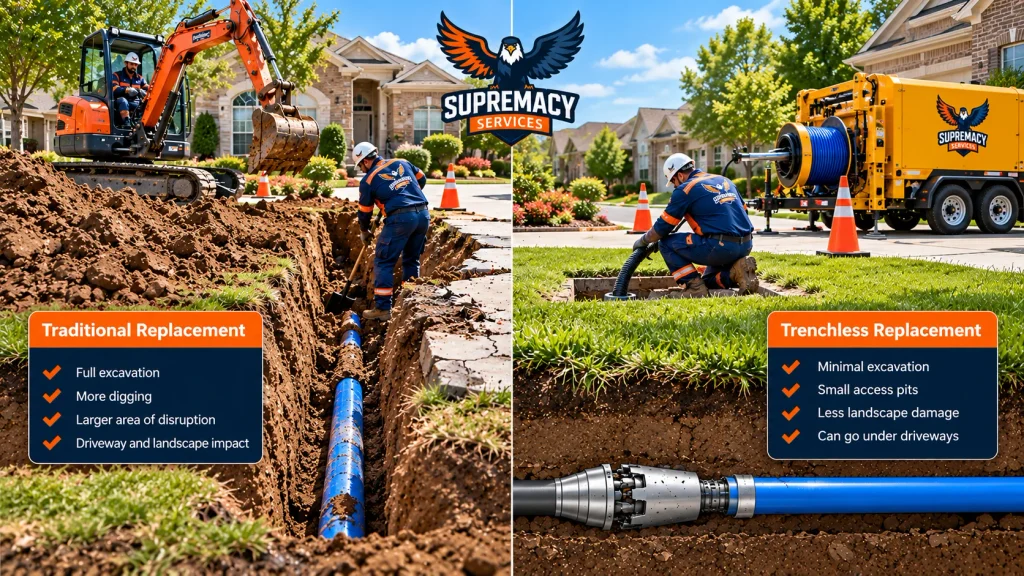
Installation method: Conventional trenching and suitable trenchless methods have different equipment and access requirements.

Permits and inspections: Applicable requirements vary by municipality and project scope.

Emergency conditions: An urgent water service failure may affect scheduling and project logistics.

Homeowners should request a written estimate that identifies the proposed material, scope of work, access method, restoration responsibilities, and any exclusions.

If an older line has already developed multiple leaks, consider having Supremacy Services evaluate whether repairing or replacing the underground water line offers better long-term value.

How Do Plumbers Evaluate an Aging Underground Water Line?

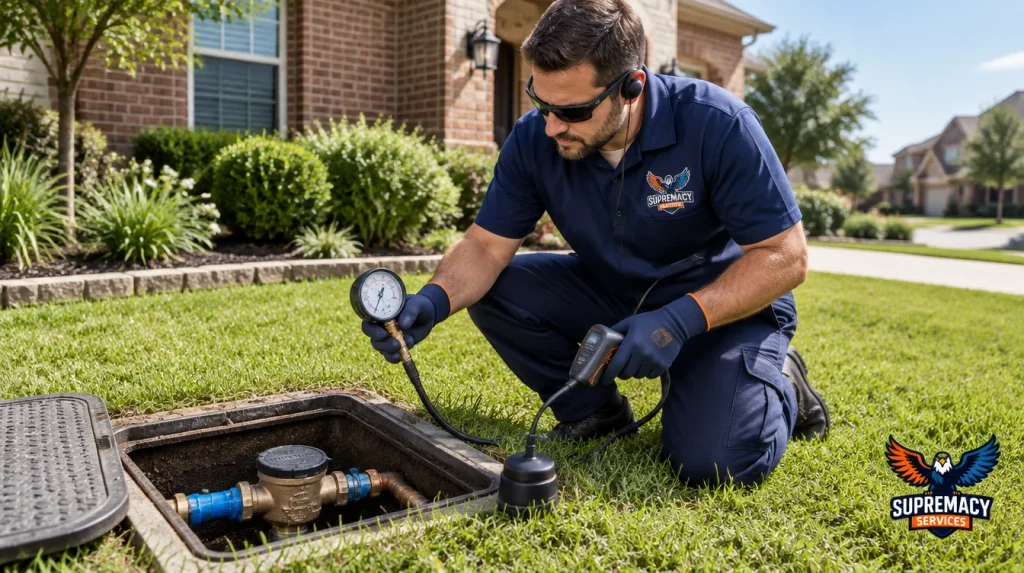
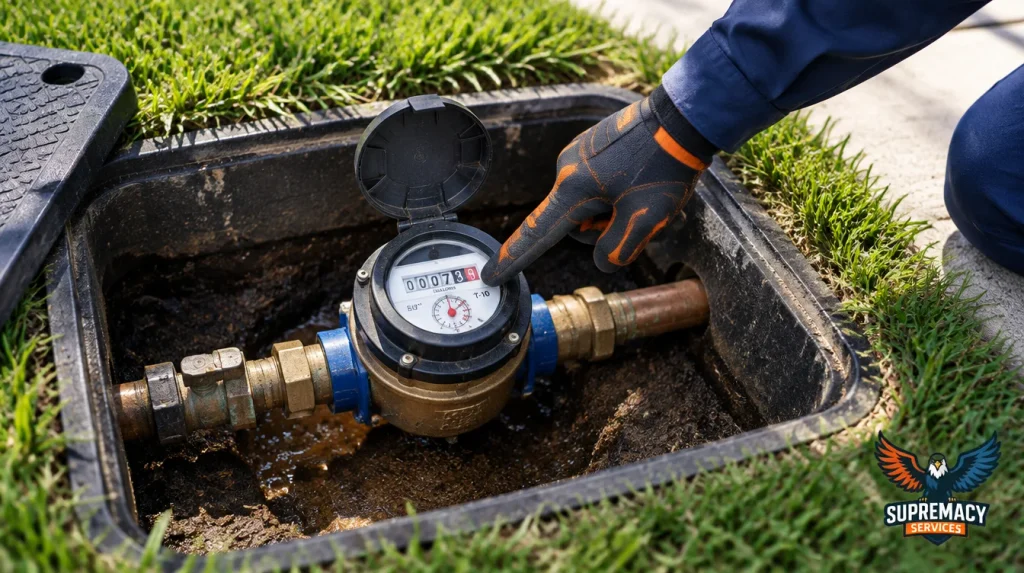
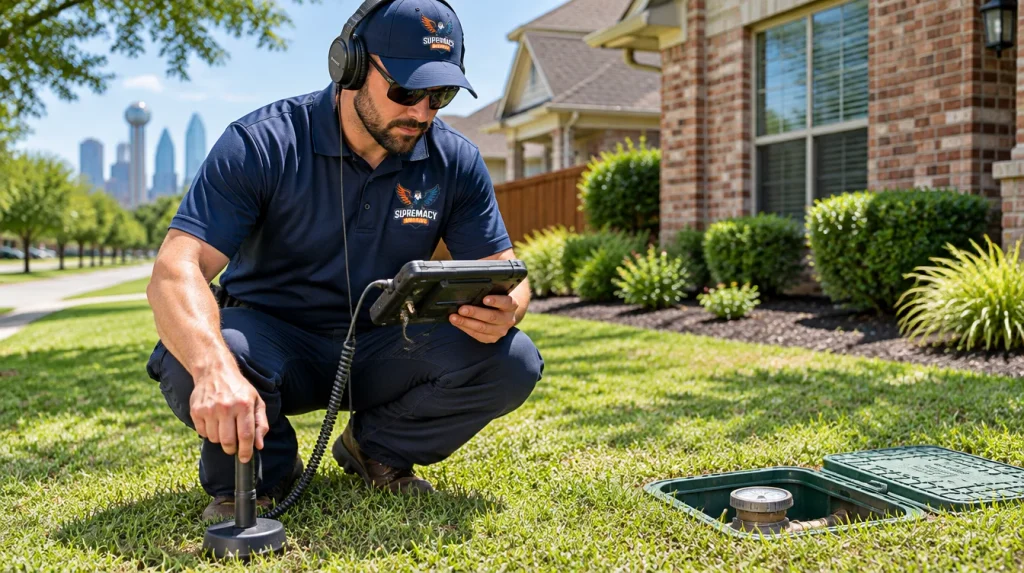
Professional plumber inspecting a residential water meter and using leak detection equipment outside a Dallas home.
Professional water line inspections can help identify leaks, pressure problems, and potential signs of deterioration before major damage occurs.

A professional assessment typically begins with the home’s symptoms, service-line history, and available information about the existing pipe.

The exact testing process depends on the property and suspected problem.

Step 1: Review the plumbing history

The plumber may ask about previous leaks, repairs, water pressure changes, pipe materials, and the approximate installation date.

Step 2: Check the water meter and pressure

Meter observations and pressure testing can help determine whether water is being lost and whether abnormal pressure conditions may be involved.

Step 3: Locate the suspected leak

Depending on conditions, professionals may use acoustic equipment, specialized leak detection methods, or controlled testing to narrow down the problem.

Step 4: Evaluate the pipe material

Visible sections, records, and appropriately accessed portions of the line can help identify the material.

Not every underground pipe can be identified accurately without additional investigation.

Step 5: Compare repair and replacement options

The plumber should explain whether the problem appears isolated or suggests more extensive deterioration.

A useful evaluation should address the condition of the line, not simply recommend replacement based on the home’s age.

Step 6: Explain installation and restoration

If replacement is appropriate, the contractor should discuss the route, excavation requirements, pipe material, connections, inspections, and property restoration.

For certain projects, trenchless techniques may reduce surface disturbance, although feasibility depends on the existing pipe and site conditions.

How Can You Extend the Life of Your Underground Water Line?

You cannot prevent every underground pipe failure, but several practical steps can reduce avoidable damage and help detect problems earlier.

Monitor your water usage

Review monthly water bills and investigate unexplained increases.

A consistent rise in usage may reveal a developing leak before major property damage occurs.

Address pressure problems

If your home experiences unusually high or fluctuating water pressure, have the system evaluated.

Proper pressure control helps protect plumbing components throughout the home.

Protect underground utilities during landscaping

Avoid assuming you know exactly where buried utilities are located.

Contact Texas811 before excavation and arrange appropriate private-line locating where necessary.

Investigate recurring wet spots

A persistent wet area should not be ignored, especially if it appears when irrigation is off and rainfall has been absent.

Keep plumbing records

Save invoices, repair records, installation details, and information about pipe materials.

These records can help future plumbers assess the line and may be useful when selling the property.

Consider inspections when symptoms appear

An underground line does not necessarily need annual excavation or intrusive testing.

However, a home with recurring leaks, unexplained pressure loss, or an aging galvanized service line may benefit from a targeted professional assessment.

When Should Dallas Homeowners Consider Replacing an Underground Water Line?

Homeowners should consider replacement when the pipe’s condition, failure history, or material-related risks indicate that continued repairs may no longer be practical.

The age of the home can help establish the likely age of the water line, but it is not definitive. A service line may have been replaced independently of the rest of the plumbing.

Older Dallas homes

Homes with original galvanized water service lines may require closer attention because corrosion can reduce both pipe integrity and water flow.

Older properties may also have incomplete plumbing records, making material identification important.

Homes in expanding DFW communities

Properties in Frisco, Plano, Allen, and other growing North Texas communities can also experience underground leaks.

Newer construction does not eliminate risks from poor connections, excavation damage, or ground movement.

Homes with repeated underground leaks

When several repairs have been performed on the same service line, homeowners should ask whether the failures indicate a broader material problem.

Homes with potentially lead-containing service lines

Lead presents a separate drinking-water concern that should not be evaluated using ordinary pipe-lifespan estimates.

The EPA recommends identifying service-line materials and replacing lead service lines to reduce lead exposure.

If the material is unknown, homeowners can consult their water utility’s service-line inventory or a qualified plumber.

What Should You Do If Your Underground Water Line Is Leaking?

If you suspect a buried water supply line is leaking, act promptly to limit potential damage.

  1. Check whether irrigation, fixtures, or other normal water uses explain the symptoms.
  2. Observe the water meter with all known water uses turned off, if it is safe and accessible.
  3. Avoid digging into the suspected leak area.
  4. If there is an active major leak, shut off the appropriate accessible water valve when safe to do so.
  5. Contact your water utility if the leak may involve utility-owned infrastructure.
  6. Arrange professional leak detection and repair if the problem appears to involve the property’s service line.

Do not excavate near underground utilities without appropriate locating and safety precautions. Supremacy services


Frequently Asked Questions

1. Can an underground water line last 100 years?

Some water lines may remain in service for exceptionally long periods, but 100 years should not be treated as a standard expectation. Material, corrosion, installation quality, operating conditions, and maintenance history all affect service life.

2. How long do copper water lines last underground?

Copper service lines can last more than 50 years, and EPA technical research has documented average expectations exceeding 75 years in some applications. Local corrosion conditions can shorten that lifespan considerably.

3. Do PVC underground water pipes deteriorate?

Yes. PVC does not rust like steel, but it can experience damage from poor installation, excessive stress, unsuitable operating conditions, or failed joints.

4. Should I replace a 40-year-old underground water line?

Not automatically. A 40-year-old line that is performing reliably may not require immediate replacement. Its material, condition, repair history, and any signs of deterioration should guide the decision.

5. Can tree roots break underground water lines?

Roots can contribute to mechanical stress or exploit existing defects, but an intact pressure pipe is not automatically vulnerable simply because roots grow nearby. The risk depends on the pipe and surrounding conditions.

6. How do I know what material my underground water line is made from?

Plumbing records, utility inventories, and accessible pipe sections may provide clues. A qualified plumber can help identify the material when records are incomplete.

7. Does homeowners insurance cover an aging underground water line?

Coverage depends on the policy, the cause of damage, and any applicable service-line endorsements. Ordinary deterioration may be excluded. Homeowners should review their policy and contact their insurer for a coverage determination.

8. Is trenchless replacement better for older water lines?

Trenchless replacement can reduce excavation in suitable circumstances, but it is not appropriate for every pipe, route, or property. The existing line’s condition and the installation method must be evaluated.

9. How often should underground water lines be inspected?

There is no universal inspection interval for every residential service line. Targeted evaluation is appropriate when leaks, pressure changes, recurring repairs, or material-related concerns arise.

10. Is an underground water line the same as a sewer line?

No. A water service line delivers pressurized potable water to the property. A sewer line carries wastewater away. Both may be buried, but their materials, failure symptoms, inspection methods, and repair approaches differ.

Final Thoughts: Know the Condition of Your Water Line, Not Just Its Age

Underground water lines in Texas can provide decades of reliable service, but no material lasts indefinitely.

Copper, PVC, HDPE, PEX, and galvanized steel have different performance characteristics. Soil movement, corrosion, installation quality, and accidental damage can all influence when a line begins to fail.

For Dallas homeowners, the most useful approach is to monitor changes in water usage, pressure, and property conditions while keeping records of previous repairs.

Aging pipes do not always require replacement. Repeated leaks, widespread corrosion, and persistent water service problems deserve professional attention.

Need help evaluating an aging underground water line in Dallas or the DFW Metroplex?

Contact Supremacy Services for water line inspection, repair, and replacement options. A professional assessment can help determine whether a targeted repair or full replacement makes the most sense for your property.

Copper and red and blue PEX water pipes compared for residential plumbing in Dallas, Texas.

Copper vs. PEX Water Pipes: Which Is Better for North Texas Homes?

PEX is often the more practical choice for North Texas homeowners who want flexible, cost-conscious water supply piping, while copper remains a strong option for those who prefer rigid metal plumbing and have suitable water conditions. Neither material is automatically better for every Dallas home.

When comparing copper vs. PEX water pipes, the right decision depends on where the pipes will be installed, the condition of your existing plumbing, water chemistry, exposure to sunlight, freeze protection, and the total cost of installation.

For homes throughout Dallas, Plano, Frisco, Allen, Richardson, Garland, and the surrounding DFW Metroplex, understanding these differences can help homeowners avoid unnecessary replacements and choose a piping system suited to their property.

Table of Contents

  1. What Are Copper and PEX Water Pipes?
  2. Copper vs. PEX: Side-by-Side Comparison
  3. Which Material Lasts Longer?
  4. Which Is Better for North Texas Weather?
  5. Which Is Better for Slab Foundations?
  6. Copper vs. PEX Installation Costs
  7. Are Copper and PEX Safe for Drinking Water?
  8. When Should You Replace Existing Pipes?
  9. Can You Replace Copper Pipes With PEX?
  10. Dallas Plumbing Codes and Requirements
  11. Which Material Should You Choose?
  12. Frequently Asked Questions

What Are Copper and PEX Water Pipes?

Copper plumbing pipes and fittings compared with flexible red and blue PEX tubing and connectors.
Copper uses rigid metal tubing, while PEX offers flexible piping that can simplify routing through residential plumbing systems.

Copper and PEX are two commonly used materials for residential potable-water supply lines. Both can carry hot and cold water when the specific product is rated and installed for that purpose, but they differ in flexibility, connection methods, and installation requirements.

What are copper water pipes?

Copper water pipes are rigid or flexible metal tubes used to distribute drinking water throughout a home.

Residential copper tubing is commonly identified by types such as K, L, and M, which differ in wall thickness and intended applications.

Copper offers several practical advantages:

  • Rigid construction and dimensional stability
  • Good resistance to ultraviolet light compared with PEX
  • A long history of residential plumbing use
  • Compatibility with appropriately selected soldered or mechanical connections
  • Suitability for exposed installations where approved

However, copper is not immune to corrosion, freezing damage, or installation defects.

Water chemistry, pipe condition, installation practices, and environmental exposure can influence its service life.

What are PEX water pipes?

PEX stands for cross-linked polyethylene. It is a flexible plastic piping material widely used for residential hot and cold water distribution.

Unlike rigid copper, PEX can bend around many obstacles, reducing the number of elbows required in some plumbing layouts.

Its advantages include:

  • Flexible routing through walls and ceilings
  • Fewer fittings in some installations
  • Typically lower material and installation costs
  • Resistance to corrosion associated with metal piping
  • Some ability to expand during freezing conditions
  • Compatibility with approved crimp, clamp, or expansion connection systems

PEX must be protected from inappropriate UV exposure and installed according to its product-specific requirements.

The NSF guidance on residential plumbing materials identifies both copper and PEX as residential plumbing options and explains the importance of selecting products certified for drinking-water contact.

Copper vs. PEX: Side-by-Side Comparison

Both materials can provide reliable residential plumbing when properly selected and installed. Their differences become more important when considering repairs, remodeling, and whole-home repiping.

FeatureCopperPEX
MaterialMetalCross-linked polyethylene
FlexibilityMostly rigidFlexible
Typical installation costHigherLower
CorrosionCan corrodeDoes not undergo metal corrosion
Freeze resistanceCan split when frozenMore forgiving, but can still fail
UV resistanceGoodRequires UV protection
FittingsSoldered or approved mechanicalCrimp, clamp, expansion or other approved systems
Installation in tight spacesMore joints may be requiredOften easier to route
Water quality considerationsSusceptible to certain water chemistry conditionsRequires certified potable-water products
Long-term reliabilityDepends on conditions and installationDepends on conditions and installation

Quick takeaway: PEX is frequently attractive for whole-home repiping and difficult-to-access interior runs. Copper can be preferable where exposed metal piping is appropriate or where a particular installation calls for a rigid material.

Neither option should be selected solely because it is marketed as longer-lasting.

Which Material Lasts Longer: Copper or PEX?

Both copper and PEX can remain in service for decades, but there is no universally reliable lifespan that applies to every installation.

How long do copper pipes last?

Copper piping has an extensive history of use in residential plumbing. However, service life varies according to water chemistry, pipe wall thickness, flow conditions, workmanship, and exposure to corrosive environments.

Copper pipes may deteriorate prematurely when corrosion produces localized pitting or pinhole leaks.

How long do PEX pipes last?

PEX is designed for long-term water distribution when operated within its temperature and pressure ratings.

Its durability depends on the tubing formulation, compatibility with water-treatment chemicals, installation conditions, and protection from UV exposure and physical damage.

Which is the better long-term investment?

A properly installed PEX system may be a better investment when reducing installation complexity and avoiding copper corrosion are priorities.

Copper may make sense when its physical properties better suit the installation and the water conditions are appropriate.

A professional assessment is especially useful when an older home has already developed repeated leaks.

Which Is Better for North Texas Weather?

Insulated copper and PEX water pipes in a North Texas attic showing protection against winter freezing.
Both copper and PEX water lines need appropriate freeze protection in exposed areas of North Texas homes.

PEX generally offers an advantage in flexibility during freezing conditions, but neither copper nor PEX should be considered freeze-proof.

Dallas homeowners should pay attention to occasional winter freezes, particularly where plumbing runs through attics, exterior walls, garages, or other inadequately heated areas.

How does copper handle freezing temperatures?

When water freezes inside a copper pipe, expanding ice can create pressure that damages the pipe or its connections.

The resulting leak may not become visible until the ice thaws and water begins flowing again.

Can PEX pipes freeze and burst?

Yes. PEX can freeze, and its fittings or tubing can still be damaged.

PEX tubing is more flexible than copper and may tolerate some expansion, but that does not eliminate the risk of a burst pipe.

Proper insulation, routing, and protection from freezing conditions remain essential.

What about extreme Texas summer heat?

Both materials must be used within their applicable temperature and pressure ratings.

PEX should not be installed where prolonged direct sunlight or excessive heat exposure violates the manufacturer’s instructions.

For attic installations, a plumber should consider expected temperatures, insulation, support, and routing.

Homeowner tip: If your water lines are installed in an unconditioned attic, their location and insulation may matter more for freeze protection than whether the pipes are copper or PEX.

Which Is Better for Slab Foundations in Dallas Homes?

Cutaway of a Dallas home slab foundation showing underground copper water lines and alternative PEX pipe routing.
Slab foundations can make buried water lines difficult to access, making pipe condition and replacement routes important considerations.

PEX can be advantageous when rerouting water supply lines around or above a slab foundation because its flexibility allows long runs with fewer directional fittings.

However, the best solution depends on the existing plumbing layout, access, and applicable installation requirements.

Why slab foundations affect pipe replacement

Many Dallas-area homes are built on concrete slab foundations.

Some have water supply lines routed beneath or through the slab. When an underground pipe develops a leak, reaching it may require specialized leak detection, excavation, or an alternative pipe route.

Possible options include:

  • Repairing an accessible damaged section
  • Rerouting an affected line through walls or ceilings
  • Replacing a deteriorated piping system
  • Using an approved alternative route to avoid unnecessary slab demolition

Is PEX better for rerouting water lines?

PEX is often practical for rerouting because it bends around obstacles and can reduce the number of fittings required.

That does not mean every under-slab application should automatically use PEX.

The correct tubing, fittings, sleeves, protection, and installation details must match the site conditions and applicable code.

Can copper pipes cause slab leaks?

Copper does not inherently cause slab leaks, but copper piping can develop leaks from corrosion, damage, poor installation, or other site-specific factors.

Homeowners should investigate unexplained water use, damp flooring, warm spots, or reduced water pressure rather than assuming the pipe material is responsible.

If your Dallas home has recurring underground leaks, Supremacy Services can help you evaluate whether a targeted repair or a more extensive water line replacement is appropriate. A professional assessment can help avoid replacing functional piping unnecessarily.

Copper vs. PEX Installation Costs in Dallas

PEX is generally less expensive to install than copper in many residential projects, particularly when a plumber can take advantage of its flexibility and reduced fitting requirements.

However, the total cost of a project depends on far more than the pipe material.

Why does copper usually cost more?

Copper typically involves higher material costs and can require additional labor for cutting, routing, joining, and securing rigid sections.

Projects with numerous turns or difficult access may involve more fittings and installation time.

Why can PEX be more affordable?

PEX tubing is flexible and often easier to route through existing building cavities.

For certain layouts, this reduces the number of fittings and the time needed to complete the installation.

However, PEX projects still require appropriate tools, compatible connections, proper supports, testing, and code compliance.

What affects the total cost of repiping?

Cost factorWhy it matters
Home sizeLarger homes generally require more piping
Number of bathroomsMore fixtures increase piping complexity
Pipe materialCopper and PEX have different material and installation costs
AccessibilityFinished walls and tight spaces increase labor
Existing damageCorrosion, leaks, or damaged fittings can expand the scope
Pipe routingAttic, wall, and slab routes have different requirements
Drywall restorationAccess openings may require repairs
Permits and inspectionsRequirements depend on the jurisdiction and project
Fixture and valve conditionAdditional components may need replacement

How much does PEX repiping cost in Dallas?

A dependable quote requires an inspection or sufficiently detailed project information. Published national price ranges should not be treated as verified Dallas contractor pricing.

For a meaningful comparison, request written estimates that specify the same work scope, including pipe material, fitting system, access, testing, permits where applicable, and restoration.

Planning a plumbing upgrade? Contact Supremacy Services to discuss your home’s water line condition and compare repair, rerouting, and replacement options before choosing a pipe material.

Are Copper and PEX Safe for Drinking Water?

Both copper and PEX can be suitable for drinking-water systems when the products are certified for potable-water contact and installed correctly.

Neither material guarantees good water quality by itself.

Copper pipes and drinking-water quality

Copper can enter drinking water through corrosion of plumbing materials.

According to the U.S. Environmental Protection Agency, water chemistry and plumbing conditions affect the release of metals into drinking water.

Blue-green staining, unusual taste, or recurring pinhole leaks may justify additional investigation, although these signs alone do not establish unsafe copper levels.

PEX pipes and drinking-water quality

PEX does not release copper through metal corrosion, but potable-water PEX products must still meet applicable drinking-water safety requirements.

Homeowners should look for recognized certification, including NSF/ANSI/CAN 61 where applicable, and use tubing and fittings approved for the intended installation.

Which material is healthier?

There is no sound basis for declaring all copper systems healthier than all PEX systems, or vice versa.

The specific product, certification, installation quality, water chemistry, and maintenance matter more than broad material claims.

When Should You Replace Existing Copper or PEX Pipes?

Professional plumber installing red and blue PEX water supply lines inside a Dallas home's wall framing.
PEX tubing can simplify some residential repiping projects because it can bend around obstacles and requires fewer directional fittings.

You do not need to replace functioning pipes simply because a different material is available.

Replacement becomes more reasonable when there is evidence of widespread deterioration, repeated leaks, or significant system defects.

Warning signs that deserve professional attention

  • Recurring pinhole leaks in copper lines
  • Visible corrosion or damaged fittings
  • Unexplained increases in water consumption
  • Persistent low water pressure
  • Water stains on ceilings, walls, or flooring
  • Multiple repairs in a short period
  • Known freezing damage
  • Deteriorating or incompatible plumbing connections

These symptoms can also result from a failed valve, hidden fixture leak, pressure problem, or damaged service line.

Repair or replace?

A single isolated leak may justify a localized repair.

Repeated failures throughout the system may make partial or complete replacement more economical over time.

Before committing to repiping, identify whether the problem affects an individual pipe, a group of lines, or the entire distribution system.

Can You Replace Copper Pipes With PEX?

Yes. Existing copper water supply pipes can often be replaced with PEX, provided the selected material and installation method comply with applicable codes and manufacturer requirements.

A complete replacement is not always necessary.

What does professional repiping involve?

A typical project may include:

  1. Inspecting the existing plumbing and identifying problem areas.
  2. Reviewing pipe routes, fixture locations, and access limitations.
  3. Selecting approved pipe sizes, materials, and fitting systems.
  4. Confirming applicable permit and inspection requirements.
  5. Isolating and draining the affected water lines.
  6. Installing the new piping and approved connections.
  7. Supporting and protecting the piping as required.
  8. Pressure-testing and checking for leaks.
  9. Flushing the system and restoring service.
  10. Completing required inspections and arranging any necessary surface restoration.

Can homeowners install PEX themselves?

PEX may appear easier to install than copper, but potable-water plumbing still involves sizing, compatible connections, pressure testing, and code requirements.

Incorrectly assembled fittings, inadequate supports, or poor routing can create concealed leaks.

For substantial repiping, concealed connections, or work involving permits, using a properly licensed plumbing professional is the safer approach.

Dallas Plumbing Codes and Requirements

Homeowners should verify local plumbing requirements before choosing a material or beginning a repiping project.

The City of Dallas identifies the 2021 International Plumbing Code and International Residential Code, with local amendments, among its adopted construction codes.

Specific requirements depend on the installation and the jurisdiction.

A property in Dallas may be subject to different administrative procedures than one in Plano, Frisco, Allen, or another DFW municipality.

Important questions include:

  • Is the chosen pipe approved for this application?
  • Are the fittings and connections compatible?
  • Does the work require a permit or inspection?
  • Are there special requirements for concealed or underground piping?
  • Does the proposed route meet support, protection, and accessibility requirements?

Do not assume that an installation method accepted in one North Texas city is automatically acceptable throughout the Metroplex.

Which Material Should You Choose for Your North Texas Home?

Professional plumber helping a Dallas homeowner compare copper and PEX water pipes for residential plumbing.
A professional plumbing assessment can help homeowners choose suitable piping based on their home’s condition, installation requirements, and budget.

For many interior residential repiping projects, PEX is a practical first option to evaluate because of its flexibility, installation efficiency, and resistance to metal corrosion.

Copper remains a reasonable choice when the installation benefits from rigid metal piping, the water chemistry is suitable, and the higher installation cost is justified.

Choose PEX when:

  • You are considering whole-home interior repiping.
  • Existing pipe routes are difficult to access.
  • Reducing unnecessary fittings is beneficial.
  • Copper corrosion has been a recurring problem.
  • The installation can be protected from UV and other prohibited exposures.

Choose copper when:

  • Exposed rigid piping is desirable.
  • The project has specific material or installation requirements.
  • Water conditions are suitable for copper.
  • The budget accommodates the installation method.
  • The plumber determines copper is appropriate for the location.

Consider a combination of materials when:

Certain projects may use copper in one area and PEX in another, with approved transition fittings.

This can be appropriate when repairing part of an existing system rather than replacing every water line.

The decision should follow the home’s actual conditions rather than a one-size-fits-all preference.

Final recommendation for Dallas homeowners

Before replacing your pipes, determine why the existing system is failing.

If the problem is isolated, repair may be sufficient. If deterioration affects multiple locations, rerouting or repiping may offer better long-term value.

Concerned about aging copper pipes, recurring water leaks, or the cost of switching to PEX? Contact Supremacy Services to discuss professional water line inspection, repair, and replacement options for your Dallas or DFW home. Get guidance based on your plumbing system before making a major investment.


Frequently Asked Questions

1. Is PEX better than copper for Texas homes?

PEX is often a practical choice for interior repiping because it is flexible, generally less expensive to install, and resistant to metal corrosion. Copper may be preferable for certain exposed or specialized applications.

2. Does PEX last longer than copper?

Neither material has a guaranteed longer service life in every home. Copper can be affected by corrosion, while PEX durability depends on temperature, water chemistry, UV protection, and installation quality.

3. Is PEX cheaper than copper?

Generally, yes. PEX usually has lower material costs and can require less labor in many residential installations. Actual savings depend on access, pipe routing, fittings, and restoration work.

4. Can PEX pipes burst during a Texas freeze?

Yes. PEX is more flexible than copper and may tolerate some freezing-related expansion, but it can still rupture or develop damaged connections. Both materials require proper freeze protection.

5. Can PEX be used under a concrete slab?

Certain PEX systems can be used in approved concealed or concrete-related installations, subject to applicable code and manufacturer instructions. The specific routing, joints, sleeves, and protection must be evaluated.

6. Should I replace all my copper pipes with PEX?

Not necessarily. If copper pipes are functioning properly, replacement may offer little immediate benefit. Repeated leaks, extensive corrosion, or a major renovation may justify evaluating repiping.

7. Does PEX affect drinking-water taste?

Some homeowners report temporary taste or odor changes with new plumbing materials. Potable-water-certified products and proper installation are important. Persistent concerns should be evaluated through appropriate water testing.

8. Is copper better for hot water lines?

Both appropriately rated copper and PEX can carry residential hot water. The choice depends on the specific product ratings, operating conditions, installation location, and plumbing design.

9. Can copper and PEX pipes be connected together?

Yes. Approved transition fittings can connect copper and PEX. The connection method must be compatible with both materials and installed according to manufacturer instructions.

10. Do I need a permit to replace water pipes in Dallas?

Permit requirements depend on the nature and scope of the work. Homeowners should confirm current requirements with Dallas Planning and Development or the relevant municipality before starting a repiping project.

Underground tree roots growing near a residential water supply pipe beneath a Dallas home.

Can Tree Roots Damage Underground Water Lines?

Yes, tree roots can damage underground water lines. In Dallas and across North Texas, growing roots can place pressure on buried water pipes, contribute to joint movement, or worsen cracks in already weakened plumbing. Over time, that damage may lead to underground leaks, reduced water pressure, and costly repairs.

However, finding tree roots near a leaking pipe does not automatically mean the roots caused the leak. Pipe deterioration, shifting soil, improper installation, and existing cracks may also be responsible.

For Dallas homeowners, understanding how tree roots interact with underground water pipes can help identify warning signs early and avoid unnecessary excavation or tree removal.

Table of Contents

  1. How Do Tree Roots Damage Underground Water Lines?
  2. Signs Tree Roots May Be Damaging Your Water Line
  3. Can Tree Roots Break PVC, Copper, or Other Water Pipes?
  4. Why Tree Roots and Underground Pipes Are a Concern in Dallas
  5. How to Tell Whether Tree Roots or Another Problem Caused a Leak
  6. What Should You Do if Tree Roots Damage Your Water Line?
  7. How Professionals Repair Root-Damaged Water Lines
  8. How Much Does Tree Root Water Line Repair Cost?
  9. Who Is Responsible for Underground Water Line Repairs in Dallas?
  10. How to Prevent Tree Root Damage
  11. Frequently Asked Questions

How Can Tree Roots Damage Underground Water Lines?

Close-up underground illustration showing tree roots pressing against a buried water pipe joint.
Growing roots can exert pressure on underground pipes, particularly around vulnerable joints and connections.

Tree roots damage underground water lines primarily through physical pressure, soil displacement, and the enlargement of existing pipe defects.

Roots do not ordinarily drill through a sound, properly installed water pipe. Instead, they may grow around it, exploit an existing weakness, or gradually shift the surrounding soil as they increase in diameter.

1. Growing Roots Put Pressure on Buried Pipes

As trees mature, their roots increase in thickness.

A root growing directly against an underground pipe may gradually exert pressure on the pipe or its connections.

Depending on the pipe material, installation, surrounding soil, and root size, this pressure can contribute to:

  • Pipe displacement
  • Stressed fittings or connections
  • Cracking or deformation
  • Joint separation
  • Damage to already weakened sections

This process generally develops over time rather than causing an immediate pipe failure.

2. Roots Can Worsen Existing Cracks and Leaks

An underground water pipe may already have a small leak because of corrosion, ground movement, aging fittings, or installation defects.

Moist soil surrounding that leak can support root growth.

As roots grow around the damaged area, they may enlarge existing openings or place additional stress on the pipe.

Important: A root found near a leak may be a contributing factor rather than the original cause. A professional inspection is needed to distinguish the two.

3. Tree Roots Can Shift Soil Around Water Lines

Underground pipes rely on proper bedding and stable surrounding soil.

Growing roots can displace soil, while changing moisture conditions can contribute to movement in susceptible soils.

If a water line is already poorly supported, this movement may place additional stress on the pipe.

4. Roots Can Affect Pipe Joints

Pipe connections may be more vulnerable than uninterrupted sections of pipe, particularly when joints are deteriorated, poorly supported, or already misaligned.

Root growth and soil movement can contribute to stress at these locations.

Once a pressurized water line begins leaking, water may escape continuously until the supply is isolated or the defect is repaired.

Signs Tree Roots May Be Damaging Your Water Line

Wet grass and muddy soil near a mature tree in a Dallas residential yard, suggesting a possible underground water line leak.
Persistent wet patches or unusually green grass may indicate an underground water leak that needs professional inspection.

Common warning signs include unexplained wet patches in the yard, unusually high water bills, reduced water pressure, and water meter activity when household water use has stopped.

These symptoms can indicate an underground leak, but they do not prove tree roots are responsible.

1. Persistent Wet Spots Near Trees

A section of lawn that remains damp when nearby soil is dry may indicate water escaping underground.

Pay particular attention to wet ground located between the water meter and the house, especially if it follows the suspected route of the water service line.

Possible clues include:

  • Muddy soil during otherwise dry conditions
  • A patch of unusually vigorous grass growth
  • Water collecting in a low area
  • Soil that remains soft without recent irrigation

An irrigation leak or drainage problem can produce similar conditions.

2. An Unexpected Increase in Your Water Bill

A hidden water line leak can cause water consumption to increase without any noticeable change in household habits.

Compare several recent bills rather than relying on a single month.

If usage rises unexpectedly, check for running toilets, irrigation problems, and other common sources of water loss before assuming the main supply line is damaged.

3. Reduced Water Pressure Throughout the House

A substantial underground leak can reduce available water pressure or flow.

If several fixtures experience weaker water flow at the same time, the problem may involve the main supply system.

However, pressure changes can also result from municipal supply conditions, pressure-regulating valves, internal plumbing restrictions, or other faults.

4. Water Meter Movement When No Water Is Being Used

A water meter may reveal continuous water consumption.

To perform a basic check:

  1. Turn off faucets, showers, and water-using appliances.
  2. Confirm that irrigation is not running.
  3. Check that toilets are not refilling.
  4. Observe the meter’s leak indicator or usage display.
  5. If the meter indicates continued use, investigate further.

Meter movement alone does not identify where the leak is located. A plumber may need to isolate individual systems to determine whether the problem is underground.

5. Unexplained Soil Settlement

A persistent underground leak can saturate or wash away surrounding soil.

In some cases, homeowners may notice localized depressions or changes in the ground surface.

Avoid walking on unstable areas or attempting to excavate a suspected leak without professional guidance.

Concerned about a possible underground leak? Supremacy Services provides water line repair and replacement in Dallas and Fort Worth, including diagnostic evaluation of buried residential supply lines.

Can Tree Roots Break PVC, Copper, or Other Water Pipes?

Yes. Tree root pressure can contribute to damage involving several pipe materials, although the risk depends on the pipe’s condition, installation, joint design, and surrounding soil.

Pipe materialPossible vulnerabilityImportant consideration
PVCCracking, joint stress, displacementProper bedding and installation matter
CopperDeformation, corrosion-related weakness, stressed connectionsRoot pressure may worsen an existing defect
Galvanized steelCorrosion, deterioration, joint problemsOlder deteriorated piping may be especially vulnerable
PEXMovement or damage at connectionsFlexibility does not eliminate every installation-related risk
HDPEDamage under excessive external stress or at defective connectionsSuitable installation and joining remain important

No pipe material should be considered completely immune to underground movement or external damage.

Can Roots Grow Inside a Water Supply Pipe?

Root growth inside a pressurized drinking-water supply pipe is considerably less typical than root intrusion into a sewer line.

A functioning water service line is designed to remain sealed and under pressure. If it develops a defect, water normally escapes outward.

By comparison, a sewer pipe carries wastewater by gravity. Roots can enter through cracks or defective joints and grow inside the pipe, restricting drainage.

This distinction is important because the appropriate diagnostic tools and repairs differ.

Why Tree Roots and Underground Pipes Are a Concern in Dallas

Dallas homeowners should consider tree growth alongside local soil conditions, landscape irrigation, and the age of their underground plumbing.

Expansive Clay Soils

Parts of North Texas contain expansive clay soils that change volume as moisture conditions change.

Soil movement can place stress on underground infrastructure, particularly where pipes are poorly supported or cross areas experiencing different moisture conditions.

Tree roots may influence local soil moisture, but they are only one possible contributor to underground pipe movement.

Mature Trees Near Residential Plumbing

Established residential neighborhoods may contain mature trees with extensive root systems.

A large tree does not automatically threaten a water line. Risk depends on where roots are growing relative to the pipe, the condition of the plumbing, and how the line was installed.

The most useful question is not simply whether a tree is close to the house, but whether the underground water line crosses an area where root growth and pipe vulnerabilities overlap.

Irrigation and Changing Moisture Conditions

Landscape irrigation, rainfall, and underground leaks can create differences in soil moisture across a property.

Roots often proliferate where growing conditions are favorable.

A leaking pipe may therefore attract additional root growth to the surrounding moist soil, even when roots did not cause the original leak.

Older Underground Plumbing

Older water service lines may have experienced decades of soil movement, material deterioration, or previous repairs.

Where an older pipe is already weakened, nearby root growth may contribute to further damage.

The actual pipe condition matters more than its age alone.

How to Tell Whether Tree Roots or Another Problem Caused a Leak

The presence of a tree near a leaking water line is not enough to establish root damage. A plumber should determine where water is escaping and inspect the damaged pipe before assigning a cause.

Several underground plumbing problems produce similar symptoms.

Possible causeCommon cluesHow to investigate
Root-related pipe stressLeak near substantial roots or stressed jointsLocate and expose the defect where appropriate
CorrosionDeteriorated metal piping, multiple weak sectionsInspect pipe material and damaged area
Soil movementDisplaced or stressed pipingEvaluate pipe alignment and support
Irrigation leakWet yard, possibly linked to sprinkler operationIsolate and test irrigation system
Sewer line damageSlow drains, backups, sewage odorsDrainage inspection and sewer camera
Underground supply leakMeter activity, wet ground, possible pressure lossWater-line isolation and leak detection

Water Line Damage vs. Sewer Root Intrusion

Underground comparison showing tree roots pressing against a water supply pipe and entering a cracked sewer pipe.
Tree roots generally affect pressurized water lines differently from sewer pipes, where roots can enter through existing openings.

A water supply line delivers potable water into the house under pressure.

A sewer line carries wastewater away from the property.

If roots enter a sewer pipe, homeowners may experience recurring drain blockages or wastewater backups.

If roots contribute to water supply line damage, the more relevant symptoms are usually leakage, water loss, and possibly pressure problems.

A sewer camera inspection is useful for examining accessible drainage pipes. It should not be assumed that the same camera can simply be inserted into a pressurized drinking-water service line.

For underground water lines, plumbers may use pressure testing, acoustic detection, isolation testing, and targeted excavation.

What Should You Do if Tree Roots Damage Your Water Line?

If you suspect root-related damage, first determine whether an active leak exists. Avoid cutting roots or digging around underground utilities before the pipe has been located.

Step 1: Check for Signs of Water Loss

Look for wet ground, unusual meter activity, changes in pressure, and unexplained consumption.

Record what you observe, including the location and when symptoms began.

Step 2: Rule Out Common Household Leaks

Running toilets and irrigation faults can waste substantial amounts of water.

Checking these systems first may help avoid unnecessary excavation.

Step 3: Shut Off the Water if the Leak Is Serious

If water is escaping rapidly or threatening the property, use an accessible homeowner shutoff valve if it is safe to do so.

Do not force a stuck valve or operate utility-owned equipment without authorization.

Step 4: Arrange Professional Leak Detection

A plumber can assess whether the leak is on the private service line, within the home, or elsewhere.

Finding the actual defect is essential before deciding whether tree roots need to be addressed.

Step 5: Avoid Cutting Large Roots Yourself

Removing major structural roots can destabilize or damage a tree.

Where significant roots must be disturbed, coordinate with a qualified arborist and plumbing professional.

Step 6: Compare Repair Options

Once the damaged section has been identified, determine whether localized repair, partial replacement, or rerouting is the most appropriate solution.

How Professionals Repair Root-Damaged Water Lines

Plumbing technician using acoustic leak detection equipment to investigate a suspected underground water line leak in a Dallas yard.
Professional leak detection equipment can help locate hidden water line problems before excavation begins.

Repair depends on whether the pipe has a localized defect, multiple damaged sections, or an installation route that remains exposed to future problems.

A professional repair typically begins with diagnosis rather than immediate excavation.

1. Underground Leak Detection

The plumber evaluates water loss and attempts to locate the damaged section.

Depending on the circumstances, this may involve:

  • Water meter observations
  • Isolation testing
  • Pressure testing
  • Acoustic leak detection
  • Pipe locating equipment
  • Limited exploratory excavation

The diagnostic method depends on pipe material, accessibility, and site conditions.

2. Localized Pipe Repair

If the defect is limited to a short section and the surrounding pipe is sound, the plumber may be able to replace the damaged portion.

This can be appropriate where the remaining water line is in good condition.

3. Partial or Complete Water Line Replacement

Replacement becomes more reasonable when multiple sections are deteriorated, previous repairs have failed, or the existing pipe is unsuitable for another localized repair.

The replacement route should be evaluated for future access, underground utilities, landscaping, and tree roots.

4. Trenchless Water Line Replacement

Some properties may qualify for trenchless replacement techniques, including pipe bursting.

However, trenchless methods are not suitable for every pipe, soil condition, or site layout.

Access pits may still be required, and the contractor must evaluate existing utilities and root systems.

5. Rerouting the Water Line

Where an existing pipe runs through a heavily rooted area, a different alignment may reduce future conflicts.

Rerouting requires careful consideration of underground utilities, the property’s layout, tree protection, installation requirements, and overall cost.

Repair vs. Replacement: Which Is Better?

ConditionRepair may be suitableReplacement may be preferable
One isolated defectYesNot always necessary
Multiple leaksLess attractiveOften worth evaluating
Pipe in otherwise good conditionOftenDepends on circumstances
Extensive deteriorationUsually less suitableOften
Repeated failures near rootsMay be temporaryConsider replacement or rerouting
Significant landscape obstaclesDepends on accessCompare trenchless and alternative routes

Need to decide between repairing and replacing a buried pipe? Request a diagnostic assessment from Supremacy Services’ water line repair team before committing to major excavation or replacement.

How Much Does Tree Root Water Line Repair Cost?

The cost of repairing root-related underground water line damage depends on the location of the leak, pipe material, excavation requirements, and whether a short repair or larger replacement is necessary.

There is no reliable universal price for this specific situation.

What Affects the Final Cost?

Location and depth: A pipe buried deep underground or beneath hardscaping can be more difficult to access.

Extent of damage: A single failed connection generally requires a different scope of work from a long section of deteriorated pipe.

Pipe material: Replacement materials, joining methods, and compatibility with existing plumbing affect labor and material costs.

Tree root removal: Working around large roots may require additional care or arborist involvement.

Excavation and restoration: Repairing a pipe beneath a driveway, walkway, patio, or established landscape can increase project complexity.

Repair method: Traditional excavation, trenchless replacement, and rerouting involve different equipment and site requirements.

Permits and inspections: Applicable local requirements may affect scheduling and the final project scope.

What Should a Written Estimate Include?

Ask the plumbing contractor to explain:

  • How the leak was located
  • Which section of pipe is damaged
  • Whether roots are confirmed as a contributing factor
  • The proposed repair or replacement method
  • Pipe materials and fittings
  • Excavation and restoration responsibilities
  • Applicable permits and inspections
  • Warranty terms and exclusions
  • The total quoted price

A properly scoped estimate is more useful than an unsupported average price because underground conditions vary substantially from one property to another.

Who Is Responsible for Underground Water Line Repairs in Dallas?

For properties served by Dallas Water Utilities, the private water service line between the meter and the house is generally the property owner’s responsibility.

Dallas Water Utilities distinguishes between the public portion of the service connection, the meter, and the privately maintained portion.

If a root-related leak occurs on the homeowner’s side of the meter, the owner will generally be responsible for arranging repairs.

If the problem involves the utility-maintained portion, contact Dallas Water Utilities.

Responsibility may differ in other DFW municipalities or special utility districts, so homeowners outside Dallas should verify the applicable local rules.

Could You Qualify for a Water Bill Adjustment?

Dallas municipal rules provide a process for certain hidden-leak water bill adjustments after qualifying repairs.

Eligibility is subject to the city’s requirements and is not automatic.

Keep documentation showing the leak location, the repair performed, and the date the problem was corrected.

How to Prevent Tree Root Damage

Preventing damage begins with thoughtful tree placement, properly installed plumbing, and early investigation of underground leaks.

1. Plan Tree Placement Around Buried Utilities

Before planting large trees, determine where underground water and sewer lines are located.

Consider the tree’s expected mature size and root characteristics rather than only its current size.

2. Choose Suitable Trees for the Property

A qualified arborist or local horticultural professional can help evaluate species, mature growth, and planting locations.

No tree should be described as completely root-proof or universally safe near buried pipes.

3. Repair Small Underground Leaks Promptly

Moist soil around a leaking pipe can encourage root growth.

Addressing leaks promptly helps prevent continued water loss and further deterioration.

4. Maintain Appropriate Landscape Irrigation

Avoid excessive irrigation and investigate persistently saturated areas.

The objective is balanced soil moisture, not depriving established trees of water.

5. Protect Trees During Plumbing Repairs

Excavation can damage important tree roots.

Where work must occur near a mature tree, ask whether alternative routes, careful excavation, or arborist supervision are appropriate.

6. Contact Texas811 Before Digging

Texas811 advises contacting its service at least two working days before excavation, excluding holidays.

Be aware that privately owned lines between the meter and house may not be marked by participating utilities. Additional private locating may be necessary.

Never assume that an unmarked area is free of buried pipes or cables.

When Should You Call a Dallas Water Line Repair Professional?

Arrange professional evaluation when you notice unexplained meter activity, persistent wet ground, a significant increase in water consumption, or suspected damage to a buried water supply pipe.

Seek prompt assistance if water is escaping rapidly, undermining soil, or threatening the house or nearby structures.

Professional diagnosis is especially valuable when a suspected leak occurs near mature trees, because the repair may need to protect both the plumbing and the tree.


Frequently Asked Questions

1. Can tree roots break underground water pipes?

Yes. Large roots can place pressure on buried pipes or contribute to movement around joints. Roots can also worsen existing defects. However, nearby roots do not automatically establish the cause of a leak.

2. Can tree roots grow through PVC water pipes?

Roots generally do not penetrate intact PVC pipe walls simply by seeking water. They may exploit existing defects or contribute to damage through pressure, displacement, or joint stress.

3. How do I know if roots are damaging my water line?

Look for unexplained water loss, persistent wet areas, or reduced pressure. A plumber must locate and inspect the damaged section to determine whether roots are involved.

4. Can tree roots cause low water pressure?

Indirectly, yes. If root-related damage causes a substantial leak, available pressure or flow may decrease. Roots do not normally form an internal blockage inside a sealed pressurized water line.

5. Do I need to remove a tree to repair a water line?

Not necessarily. Localized repair, rerouting, or another installation method may avoid removing the tree. A qualified arborist can assess risks associated with disturbing major roots.

6. Can a plumber repair a water line without digging up the whole yard?

Sometimes. Localized excavation or suitable trenchless replacement methods may limit disturbance. The appropriate approach depends on the pipe’s condition, location, and surrounding utilities.

7. Are tree roots more likely to damage sewer lines or water supply lines?

Root intrusion into sewer lines is more commonly associated with internal blockages. Water supply lines are pressurized, so root-related problems more often involve external stress, damaged joints, or leaks.

8. Who pays for a tree-damaged water line in Dallas?

The property owner generally maintains the private service line from the meter to the home. The utility maintains its designated public infrastructure. Confirm the exact boundary with the water provider when uncertain.

9. Can tree roots damage a newly installed water line?

It is possible, particularly where the pipe is improperly supported, poorly joined, or subjected to significant external movement. Correct material selection and installation reduce avoidable risks.

10. Will cutting the roots permanently fix a leaking pipe?

No. Removing nearby roots does not repair a cracked or leaking pipe. The plumbing defect must be addressed, and cutting major roots may damage the tree.

Protect Your Underground Water Line Before a Small Leak Becomes a Larger Problem

Professional plumber repairing a buried residential water supply pipe near tree roots in a Dallas front yard.
Targeted excavation and appropriate pipe repairs can address underground water line damage while limiting unnecessary landscaping disturbance.

Tree roots can contribute to underground water line damage, but they are not responsible for every leak near a tree.

The most effective approach is to identify the leak, determine the actual cause, evaluate the condition of the pipe, and choose a repair that addresses the underlying problem.

For Dallas homeowners, that may mean a localized pipe repair, replacement of a deteriorated section, or a new route that avoids future conflicts with established trees.

Suspect tree roots are damaging your underground water line?

Supremacy Services provides professional water line repair and replacement throughout Dallas and the DFW Metroplex.

Schedule an inspection to identify the source of the problem and review the most appropriate repair options for your property. Supremacy services

Residential water meter in the front yard of a Dallas home with signs of a possible underground water line leak.

Who Is Responsible for a Water Line Leak Between the Meter and the House?

Water Line Leak Between Meter and House? In Dallas, Texas, the homeowner is generally responsible for repairing a water line leak between the meter and the house. Dallas Water Utilities maintains the public water main, the service connection leading to the meter, and the meter itself. The property owner is responsible for the private service line running from the meter toward the home.

This distinction matters because a leak in your front yard can still be your responsibility, even if the pipe is underground and close to the street.

According to Dallas Water Utilities’ service line guidance, the private portion of the water service line belongs to the property owner’s maintenance responsibility.

However, if water is leaking directly from the meter, its connections, or the public side of the system, contact Dallas Water Utilities before arranging private repairs. The exact leak location should be confirmed before deciding who pays.

Table of Contents

  1. Who Is Responsible for the Water Line From the Meter to the House?
  2. Where Does the City’s Responsibility End?
  3. How Can You Tell Which Side of the Meter Is Leaking?
  4. What Are the Warning Signs of an Underground Water Line Leak?
  5. What Causes Water Lines to Leak Between the Meter and House?
  6. What Should You Do If You Discover a Leak?
  7. How Much Does It Cost to Repair a Water Line Leak?
  8. Will Dallas Water Utilities Adjust Your Water Bill?
  9. Should You Repair or Replace the Water Line?
  10. How Can You Prevent Future Water Line Leaks?
  11. Frequently Asked Questions
  12. Get Professional Water Line Help in Dallas

Who Is Responsible for the Water Line From the Meter to the House?

Diagram illustrating the public water main, residential water meter, and private water service line connecting the meter to a house.
Dallas Water Utilities generally maintains the public water connection and meter, while homeowners maintain the private water line leading to their homes.

The property owner is generally responsible for the water service line running from the customer side of the meter to the home. The water utility is responsible for its public infrastructure, including the meter and the public-side service connection.

For Dallas Water Utilities customers, this division is described in Dallas City Code Section 49-24, which establishes the city’s responsibility for maintaining the water service connection from the main to the meter.

Water line responsibility at a glance

Water system componentGenerally responsible party
Public water main beneath the streetWater utility
Service connection from main to meterWater utility
Water meter itselfWater utility
Private service line from meter to houseProperty owner
Household plumbing after the service line enters the homeProperty owner
Leak at an uncertain meter connectionUtility should inspect and determine responsibility

These rules apply to Dallas Water Utilities customers. Other DFW municipalities and water districts may have different policies, so homeowners in Plano, Frisco, Allen, Irving and surrounding communities should confirm the responsibility boundary with their water provider.

Does the homeowner own the water line even if it is underground?

Generally, yes.

Being underground does not automatically make a pipe the city’s responsibility.

The relevant questions are who owns the section of pipe, where it connects to the water system, and which side of the service boundary contains the leak.

For example, if a buried pipe breaks halfway between your front-yard meter and your foundation, that pipe is ordinarily part of the private service line.

The homeowner would generally arrange and pay for the repair.

Where Does the City’s Responsibility End?

For Dallas Water Utilities customers, the water meter is the primary dividing point between public and private water service responsibilities.

The city maintains the public-side connection and meter, while the homeowner maintains the private-side service line.

What if the leak is inside the water meter box?

A leak inside the meter box does not automatically establish responsibility.

The leak could originate from:

  • The water meter itself.
  • A connection on the utility side.
  • A customer-side connection.
  • A damaged private pipe immediately after the meter.

Because these components are close together, water can accumulate in the same meter box regardless of which part has failed.

If you notice standing water, bubbling or continuous flow inside the meter box, report the problem to Dallas Water Utilities before attempting repairs.

Dallas residents can report meter leaks, water main breaks and emergency water shutoff requests through 311, or 214-670-3111 when calling from outside city limits.

What if the leak is near the sidewalk or street?

Location alone does not determine ownership.

A private service line may cross a yard, sidewalk area or another section of property before reaching the home.

Similarly, a public service connection may be located near the property’s frontage.

The correct approach is to establish where the leak originates in relation to the meter and applicable utility ownership boundary.

Do not excavate near the meter or public infrastructure without appropriate utility coordination.

How Can You Tell Which Side of the Meter Is Leaking?

Plumbing technician inspecting a residential water meter and pipe connections for signs of an underground water leak
Checking your water meter for unexplained consumption can help identify a possible leak in your home’s water supply system.

A homeowner can perform a basic water meter observation to identify unexplained water use. However, a meter test alone cannot always determine whether the leak is in the yard, inside the house or at a particular connection.

Step 1: Turn off water-consuming fixtures

Make sure nobody is using water.

Check faucets, toilets, washing machines, dishwashers, irrigation systems and other connected equipment.

Step 2: Observe the water meter

If the meter is safely accessible, check whether its leak indicator or consumption display shows water use while everything is turned off.

Continued registered consumption may indicate a leak downstream of the meter.

Different meter models display flow differently, so consult the utility’s instructions if the reading is unclear.

Step 3: Isolate the house plumbing, if possible

If your property has an accessible, functioning house-side shutoff valve, turn it off without forcing it.

Observe the meter again.

If consumption continues while the house plumbing is isolated, a leak may exist between the meter and that shutoff valve, or on another connected branch that remains supplied.

This test is not conclusive if the shutoff valve leaks internally, irrigation branches remain connected, or the plumbing layout is unusual.

Step 4: Check the ground along the service-line route

Look for:

  • Persistent wet patches when it has not rained.
  • Unusual puddles near the front yard.
  • Soft or sinking soil.
  • Water surfacing around the meter box.
  • Unexpectedly green areas of grass.
  • Erosion around the driveway or walkway.

These symptoms can help narrow the investigation, but they do not confirm the exact location.

Step 5: Arrange professional leak detection

A qualified plumber can evaluate the water meter observations, isolate parts of the plumbing system, perform appropriate pressure or flow tests and locate the likely leak before excavation.

If the problem appears to be on the private service line, Supremacy Services provides water line repair and replacement services in Dallas and Fort Worth.

An accurate diagnosis helps avoid paying for excavation in the wrong location.

What Are the Warning Signs of an Underground Water Line Leak?

Wet soil, pooling water, and unusually green grass in the front yard of a Dallas home, potentially indicating an underground water line leak.
Persistent wet patches, unexplained puddles, and unusually green grass can be warning signs of a leaking underground water service line.

Underground service-line leaks may remain hidden until water loss becomes substantial or damage appears above ground.

Common warning signs include:

Warning signWhat it may indicate
Unexplained increase in water billContinuous water loss somewhere in the metered system
Water meter registering usage with fixtures offPossible downstream leak
Wet soil in the front yardBuried pipe, irrigation or drainage problem
Low water pressure throughout the homePossible supply-line leak, restriction or utility pressure issue
Unusual water sounds near plumbingWater flowing unexpectedly
Soil erosion or sinking groundWater movement beneath the surface
Repeated wet areas near the meterMeter connection or nearby service-line issue

Could the problem be something other than the main water line?

Yes. Not every wet yard or high water bill is caused by a damaged main water service line.

Possible alternatives include irrigation-system leaks, running toilets, outdoor faucet leaks, drainage problems, rainwater accumulation and plumbing leaks beneath the slab.

A sewer leak can also create wet ground, but sewage odors, recurring drain backups and slow fixtures suggest a different problem.

Identifying the source first prevents unnecessary repairs.

What Causes Water Lines to Leak Between the Meter and House?

Water service lines can deteriorate or become damaged for several reasons.

Aging or deteriorating pipe materials

Older piping may develop corrosion, weak joints or material-related deterioration.

The condition depends on the pipe material, installation quality, water chemistry and surrounding environment.

Soil movement and changing moisture conditions

North Texas properties can experience significant soil moisture changes.

Expansive clay soils, where present, may shrink or swell as moisture conditions change. Movement around buried piping can place additional stress on vulnerable joints or poorly supported pipe sections.

Soil movement alone does not prove the cause of a leak; the damaged pipe must be examined.

Tree roots and nearby landscaping

Tree roots can exploit existing pipe defects or place pressure on vulnerable connections.

Landscaping excavation can also damage underground lines.

Accidental digging damage

Fence installation, landscaping, trenching and other construction work can damage buried utilities.

Texas811 requires advance notification before excavation so participating utility operators can mark their underground facilities.

Private lines may require additional locating services.

Excessive pressure or installation problems

Pressure fluctuations, unsupported pipe sections, inadequate joint connections and improper installation can contribute to service-line failures.

A plumber should investigate the cause rather than assuming every leak is the result of pipe age.

What Should You Do If You Discover a Leak?

If you suspect a leak between the water meter and your Dallas home, take the following steps.

1. Reduce water use and assess the urgency.

If water is actively flooding the property, approaching electrical equipment or undermining a structure, keep people away from the affected area.

2. Use an accessible private shutoff if appropriate.

If you can safely isolate the affected plumbing using your own shutoff valve, do so. Avoid forcing damaged valves or operating utility-owned equipment without authorization.

3. Determine whether the leak may involve the meter.

If the meter itself, public connection or utility-owned equipment appears to be leaking, contact Dallas Water Utilities.

4. Document the evidence.

Take photographs of visible water, meter readings and damaged areas. Keep copies of unusually high bills.

5. Arrange professional diagnosis if the leak appears private.

Ask a qualified plumber to identify the leak location and recommend a suitable repair.

6. Confirm utility locations before excavation.

Texas811 states that the person responsible for excavation must submit a locate request at least two business days before digging, excluding weekends and holidays.

When a contractor performs the excavation, the contractor is responsible for the required notification.

7. Retain repair documentation.

Keep invoices, photographs, work descriptions and dates. These may be needed for insurance inquiries or a water-bill adjustment request.

When should you call the city instead of a plumber?

Contact Dallas Water Utilities first if the water meter itself appears damaged, water is flowing from a public main, or the source appears to be on the utility side.

For a suspected leak in the private service line between the meter and house, contact a qualified plumber.

When the location is uncertain, the utility can help determine whether its equipment requires inspection.

How Much Does It Cost to Repair a Water Line Leak?

The cost of repairing a water line between the meter and house depends on the leak location, pipe condition, accessibility and repair method.

There is no single reliable price that applies to every Dallas property.

A small, accessible pipe repair may require much less work than replacing a long service line beneath landscaping or concrete.

Factors that affect the repair cost

Cost factorWhy it matters
Leak locationA leak near an accessible connection may require less excavation
Pipe depthDeeper lines can require additional labor and excavation precautions
Pipe materialDifferent materials require different repair methods
Length of damaged pipeExtensive deterioration may favor replacement
Concrete or driveway accessSurface removal and restoration can increase cost
Utility conflictsNearby buried infrastructure can complicate excavation
Permit requirementsRequirements vary by municipality and work scope
Landscaping restorationSod, planting beds and hardscaping may need repair
Emergency conditionsUrgent work can affect scheduling and overall project cost

Does homeowners insurance cover underground water line repairs?

Standard homeowners insurance does not automatically cover the cost of repairing or replacing a buried service line.

Some policies may cover certain resulting damage, while optional service-line coverage may apply to eligible underground pipe failures.

Coverage depends on policy wording, exclusions, the cause of damage and any endorsements.

Before authorizing extensive repairs, ask your insurance provider whether service-line coverage is included.

Can you get a quote before digging?

A plumber can usually begin with an inspection and explain the diagnostic work needed.

Depending on the evidence, additional locating or limited excavation may be necessary before a final repair scope can be established.

Homeowners should request a written estimate identifying the work included, excavation requirements, restoration responsibilities and any permit-related items.

For homeowners facing a suspected private water line failure, Supremacy Services’ Dallas water line repair team can assess repair and replacement options.

Will Dallas Water Utilities Adjust Your Water Bill?

Dallas Water Utilities has a leak adjustment process for qualifying hidden leaks that cause a substantial increase in water consumption.

However, a water bill adjustment is not the same as reimbursement for the plumbing repair.

Under Dallas City Code Section 49-9, qualifying adjustments require documentation showing that the leak was not reasonably detectable from the surface, that it has been repaired, and what repairs were performed.

Dallas Water Utilities’ published leak adjustment form also specifies:

  • Repairs must be completed before an adjustment is considered.
  • Requests should be submitted within 90 days of the repair date.
  • An approved adjustment may cover a maximum of three months.
  • Generally, only one adjustment is available within a 12-month period.
  • Approval is not guaranteed.

The city’s form states that repair expenses and water loss remain the customer’s responsibility.

Homeowners should retain a paid invoice or repair receipt and review the official Dallas Water Utilities leak adjustment request.

Do not assume that every visible or underground leak qualifies for an adjustment.

Should You Repair or Replace the Water Line?

Side-by-side cutaway illustration comparing a localized underground water pipe repair with a complete residential water service line replacement.
Localized repairs may be suitable for isolated damage, while extensive deterioration or recurring leaks may require water line replacement.

Repair is often worth considering when the damaged section is limited and the remaining pipe is in satisfactory condition.

Replacement may be more appropriate when the line has extensive deterioration, repeated failures or multiple weak sections.

ConsiderationLocalized repairWater line replacement
Single isolated defectOften suitableMay be unnecessary
Multiple recurring leaksMay provide only temporary reliefOften worth evaluating
Extensive corrosionMay leave other weak areasMay be more appropriate
Pipe in otherwise good conditionOften practicalNot always justified
Long-term reliability concernsDepends on overall pipe conditionAddresses the replaced section
Excavation needsOften localizedDepends on route and installation method

What does professional water line repair involve?

Professional plumber inspecting an exposed underground residential water supply pipe during a water line repair in Dallas, Texas.
Professional water line inspection helps identify the source of underground leaks and determine whether a localized repair or replacement is necessary.

A professional service typically includes:

  1. Reviewing the symptoms and water consumption history.
  2. Determining whether the issue is likely on the private or public side.
  3. Isolating and testing the affected plumbing.
  4. Locating the suspected leak.
  5. Assessing the pipe material and condition.
  6. Explaining repair versus replacement options.
  7. Coordinating utility locating and required permits.
  8. Completing the approved repair.
  9. Testing the system and restoring water service.
  10. Documenting the work and identifying any restoration needs.

Some properties may be candidates for trenchless replacement methods, while others require traditional excavation.

The correct method depends on pipe material, layout, access and site conditions.

How Can You Prevent Future Water Line Leaks?

Not every underground leak is preventable, but homeowners can reduce avoidable risks.

  • Monitor water consumption. Investigate unexplained changes rather than waiting for visible flooding.
  • Check the meter when water use is unexpectedly high. An unusual reading can provide an early warning.
  • Know where the private service line runs. Keep available plumbing records and installation drawings.
  • Request utility locating before digging. Do not rely on assumptions about pipe depth or position.
  • Address pressure concerns. Have persistent or unusual pressure problems evaluated.
  • Investigate repeated wet spots. Avoid assuming that moisture is always caused by irrigation or rainfall.
  • Keep repair records. Document pipe materials, past failures and replaced sections.

Homeowners in Dallas and surrounding North Texas communities should pay particular attention to underground utilities when planning landscaping, fence installation or major yard renovations.


Frequently Asked Questions

1. Who pays for a water line leak between the meter and house in Dallas?

The property owner generally pays for repairs to the private water service line between the meter and house. Dallas Water Utilities maintains the public-side connection and meter. Responsibility should be confirmed when the leak is at the meter boundary.

2. Is the city responsible for a water line leak in my front yard?

Not necessarily. A water line in your front yard may be privately owned. Responsibility depends on which section of the water system is leaking, not simply whether the pipe is underground or near the street.

3. What if water is leaking inside the meter box?

Contact your water utility. The leak could involve the meter, a public-side connection or the customer’s private connection. An inspection may be necessary to establish responsibility.

4. Can a water leak between the meter and house increase my bill?

Yes. Water escaping from a metered private service line can register as consumption and increase your bill, even if the water never reaches the house.

5. How do I know if my underground water line is leaking?

Warning signs include unexplained water consumption, wet ground, reduced water pressure and meter activity when fixtures are off. Professional testing may be necessary to confirm the location.

6. Does Dallas Water Utilities pay for private water line repairs?

Generally, no. The property owner is responsible for maintaining the private service line. A qualifying hidden leak may be eligible for a water bill adjustment, but that does not mean the city pays for the pipe repair.

7. Can I repair the water line myself?

Minor above-ground plumbing tasks may be manageable for some homeowners, but underground service-line repairs can involve excavation hazards, utility conflicts, code requirements and water-system connections. A qualified plumber is generally the safer choice.

8. How long does it take to repair a water line between the meter and house?

Not necessarily. Texas811 notifies participating utility operators to mark their facilities. Privately owned lines may require a separate private utility locator. Contact Texas811 before excavation and confirm whether additional locating is needed.

10. Does the same water line responsibility rule apply in Plano, Frisco and Allen?

Many water utilities distinguish between public-side and customer-side service lines, but exact ownership and maintenance rules can differ. Homeowners should verify their specific municipality’s or water district’s policy.

Get Professional Water Line Help in Dallas

If you suspect a water line leak between the meter and your home, the first priority is identifying the leak’s location and determining whether the affected pipe is privately owned.

For Dallas Water Utilities customers, a leak on the private side of the meter is generally the homeowner’s responsibility.

If the source is uncertain or appears to involve the meter, contact the utility first.

If the problem is confirmed on your private service line, Supremacy Services provides water line diagnostics, repair and replacement services throughout Dallas and the DFW Metroplex.

Schedule a water line inspection with Supremacy Services to discuss the cause, available repair methods and next steps before the problem causes further damage.

Underground residential water supply line exposed beneath the front yard of a Dallas, Texas home.

How Deep Are Residential Water Lines Buried in North Texas?

Residential water lines in Dallas and North Texas are often buried relatively shallow compared with water pipes in colder parts of the country. However, there is no single burial depth homeowners can safely assume for every property. The correct depth depends on the applicable plumbing code, the type of water line, the installation location, soil cover, and local requirements.

Some City of Dallas residential rehabilitation specifications call for water service lines to be installed between 12 and 18 inches below finished grade. That is a project-specific specification, not a universal rule governing every residential water line in Dallas.

If you’re planning landscaping, installing a fence, investigating a water leak, or replacing an underground pipe, the safest approach is to verify the line’s location and applicable requirements before excavation.

Table of Contents

  1. How deep are residential water lines buried?
  2. What determines water line burial depth?
  3. What are Dallas plumbing code requirements?
  4. Why does proper burial depth matter?
  5. How can you find your underground water line?
  6. What happens if a water line is too shallow?
  7. How much does it cost to expose or rebury a water line?
  8. Can homeowners dig around water lines themselves?
  9. What happens during professional water line work?
  10. Frequently asked questions
  11. When to contact Supremacy Services

How Deep Are Residential Water Lines Typically Buried in North Texas?

Cross-section diagram showing a residential water supply pipe buried below the lawn with soil cover measured from ground level.
Water line burial depth is commonly evaluated by measuring the soil cover between the finished ground surface and the top of the pipe.

For residential properties in North Texas, a shallow service line may be found around 12–18 inches underground, but this should be treated as a possible installation depth rather than a verified regional average or guaranteed code requirement.

Other installations may be deeper because of the municipality, construction design, changes in ground elevation, utility crossings, or the property’s history.

The only reliable way to determine the depth of an existing line is to consult relevant records and have the line properly located or exposed by qualified personnel.

Water service lines vs. municipal water mains

Not every underground water pipe serves the same purpose.

Type of water linePurposeDepth consideration
Municipal water mainSupplies water to multiple propertiesGoverned by utility engineering and construction standards
Residential water service lineConnects the utility supply to the homeDepends on adopted codes and approved installation
Private yard water lineSupplies an outdoor fixture or detached structureDepends on pipe use, installation and applicable code
Irrigation pipingSupplies lawn and landscape irrigationSeparate system with its own installation requirements

A city water main running beneath a roadway may be considerably deeper than the smaller service pipe entering your house.

This distinction matters because the depth of a municipal main cannot be used to predict how deep your residential service line is buried.

What Determines How Deep a Residential Water Line Is Buried?

Several factors influence the burial depth of underground water pipes in Dallas and surrounding communities.

1. Local plumbing code and installation standards

Plumbing codes establish requirements for safe installation, including protection from freezing, physical damage, and unsuitable conditions.

The applicable rules depend on the city or jurisdiction and the type of installation. A homeowner in Dallas should not automatically assume that an installation requirement in Frisco, Plano, or another nearby municipality is identical.

2. Frost protection and cold weather

North Texas generally experiences milder winters than northern states, but freezing weather still occurs.

Buried water pipes receive some protection from the surrounding soil. A line that is inadequately covered, exposed near a foundation, or connected to unprotected above-ground plumbing may be more vulnerable during prolonged freezing conditions.

Burial depth is only one part of freeze protection. Pipe exposure, insulation, installation design, and local code requirements also matter.

3. North Texas clay soil

Residential underground water pipe surrounded by dense clay soil in an excavated North Texas yard.
Expansive clay soils common in parts of North Texas can shrink and swell as moisture conditions change, potentially stressing buried plumbing.

Many Dallas-area properties have expansive clay soils that shrink as they dry and swell as they absorb moisture.

These changes can contribute to ground movement around buried utilities. Depending on pipe material, joints, installation conditions, and soil movement, underground water lines may experience additional stress.

A deeper installation does not automatically eliminate soil-related damage. Proper bedding, backfill, and pipe selection are also important.

4. Landscaping and changes in ground elevation

A water line originally installed with adequate cover may have less soil above it after landscaping or grading work.

Potential changes include:

  • Removing soil to level a yard.
  • Excavating for a retaining wall.
  • Regrading around a driveway.
  • Installing a drainage channel.
  • Erosion around an exposed section of pipe.

The depth of cover is measured from the current finished ground surface to the relevant point on the pipe, not simply from the ground elevation when the home was built.

5. Underground utility crossings

Water service lines may need to cross or run near sewer pipes, drainage systems, electrical conduits, gas lines, and other buried infrastructure.

Required separation and protection can influence their route and elevation.

When homeowners should consider professional help: If a water line has become exposed, has inadequate cover, or may have been damaged during excavation, a plumbing professional can assess its condition and determine whether repair, protection, or replacement is appropriate.

What Are the Water Line Burial Depth Requirements in Dallas?

Dallas uses adopted construction and plumbing codes with local amendments. The City identifies the 2021 International Plumbing Code and its Dallas amendments among its adopted construction standards, effective May 12, 2023.

That does not mean every existing residential service pipe must be exactly the same depth.

A useful example appears in the City of Dallas’ residential rehabilitation construction specifications, which identify a 12–18-inch depth range for service lines and valves. Those specifications apply to their stated construction program and should not be substituted for the general plumbing code or a project’s approved plans.

How to verify the required depth for your property

Before installing or replacing a residential water service line:

  1. Identify the municipality and permitting jurisdiction.
  2. Confirm which plumbing or residential code applies.
  3. Ask whether local amendments specify minimum cover or frost protection.
  4. Determine whether the work involves a private service line or utility-owned infrastructure.
  5. Have the planned installation reviewed by a qualified plumbing contractor.

For current code information, consult the City of Dallas construction codes and ordinances.

Do not confuse an 811 excavation-notification threshold with a required water-line burial depth. They address different issues.

Why Does Proper Water Line Burial Depth Matter?

Correct installation depth helps protect a residential water supply line from avoidable damage and supports long-term reliability.

Protection against accidental excavation

Shallow pipes can be struck by landscaping equipment, fence-post digging, or other yard improvements.

Even relatively small projects can damage underground utilities if their locations are unknown.

Protection from freezing

Soil cover moderates temperature changes around buried piping. Inadequate cover can increase exposure during freezing conditions, particularly near transitions from underground to above-ground plumbing.

Protection from physical loads

Properly installed and backfilled piping is better protected from some surface activities. Where a line passes under a driveway or another load-bearing area, its installation must account for the applicable design requirements.

Protection from soil movement

In expansive soil, proper pipe bedding, backfill, and routing help manage the conditions surrounding the water line.

Burial depth alone does not determine whether a pipe will resist soil movement or leakage.

How Can You Find an Underground Water Line Before Digging?

Utility locating technician using electronic detection equipment to identify buried water lines in a Dallas residential yard.
Underground utility locating helps identify buried infrastructure before excavation and reduces the risk of accidental damage.

The safest starting point is to contact Texas811 before excavation and determine whether the specific water line is covered by utility locating services.

Texas811 coordinates notification to participating utility owners. It does not guarantee that privately owned lines, including some sections between a meter and a home, will be marked. Private locating may be necessary.

Step-by-step: Finding a buried water service line

Step 1 — Identify the water meter and service entry

Locate the meter box and where the water service enters the building. These provide useful reference points, but the pipe may not follow a straight route.

Step 2 — Submit a Texas811 request

Contact Texas811 at least two working days before excavation and wait for the required responses and markings.

Step 3 — Arrange private utility locating when needed

Ask whether the residential service line is privately owned and whether a separate locator is required.

Step 4 — Confirm actual depth safely

Utility markings identify approximate horizontal locations, not reliable burial depths. Qualified personnel may need to use careful exposure methods to establish the pipe’s depth.

Texas811 advises homeowners to request utility locations even for shallow digging or hand excavation. Its service is free for participating utility notifications, although private line locating can involve additional charges.

Important: Never assume a pipe is safe to dig over because you believe it is buried 18 inches or deeper.

What Happens if a Residential Water Line Is Buried Too Shallow?

Damaged underground residential water supply pipe leaking water into exposed clay soil in a Dallas yard.
Underground water line damage may cause hidden leaks, saturated soil, reduced water pressure, or unexpectedly high water bills.

A shallow water line is not automatically defective. The concern is whether the line meets applicable requirements and is adequately protected for its location and use.

Potential warning signs include:

  • Pipe becoming visible after erosion or landscaping.
  • Repeated leaks in the same underground section.
  • Water appearing in the yard when irrigation is off.
  • Unexplained water meter movement while fixtures are shut off.
  • Low water pressure or unexpected pressure changes.
  • Damage discovered after fence, driveway, or landscape work.

These symptoms do not prove the line is too shallow. They may indicate a leaking joint, deteriorated pipe, underground break, irrigation problem, or another plumbing issue.

Can a shallow water line be repaired without replacing it?

Sometimes. If the pipe is in good condition and the problem is limited to a small damaged section, a localized repair may be sufficient.

If the line has repeated failures, widespread deterioration, unsuitable materials, or an installation that cannot be adequately protected, replacement or rerouting may be more practical.

The decision should follow inspection rather than depth alone.

If you suspect an underground leak or damaged water supply pipe, contact Supremacy Services to discuss professional water line inspection and repair options in Dallas and the DFW Metroplex.

How Much Does It Cost to Expose or Rebury a Water Line in Dallas?

The cost depends on the length and depth of the excavation, pipe condition, site accessibility, utility conflicts, and whether the line needs repair or replacement.

There is no reliable flat price for simply making a residential water line deeper. A plumber first needs to determine whether additional cover is required and whether the existing pipe can remain in place.

Cost factorWhy it matters
Burial depthDeeper excavation may require more labor, equipment, and safety precautions
Length of exposed pipeLonger work areas generally require more excavation and restoration
Soil conditionsDense or difficult soils can affect excavation methods
Driveways and sidewalksConcrete removal and restoration can add substantial work
Underground utilitiesNearby gas, electrical, sewer, and communications lines complicate excavation
Pipe conditionDamaged or deteriorated pipe may need replacement
Permits and inspectionsRequirements depend on the municipality and scope of work
Landscaping restorationSod, irrigation, paving, and planted areas may need restoration

Is it cheaper to repair a shallow line or replace it?

Repair may be less disruptive when the problem is isolated and the remaining pipe is sound.

Replacement becomes worth comparing when the line has widespread deterioration, recurring failures, or an installation that needs substantial correction.

Some properties may be suitable for trenchless replacement, which can reduce surface excavation. However, trenchless methods still require proper utility clearance, installation design, and sometimes access pits.

Supremacy Services describes both traditional excavation and trenchless options on its Dallas water line repair and replacement page.

Planning to repair, relocate, or replace an underground water line? Request an assessment from Supremacy Services to understand the condition of your existing pipe and the available repair methods before excavation begins.

Can Homeowners Dig Around Buried Water Lines Themselves?

Homeowners may perform some landscaping or excavation work themselves, but they should never rely on a guessed water-line depth.

Texas811 recommends contacting the service before every digging project, including shallow excavation and hand digging. A locate request does not eliminate the need to work carefully near marked utilities.

Texas 811

Before digging, check the following

  • Submit a Texas811 locate request.
  • Allow the required waiting period and confirm utility responses.
  • Identify whether private utility locating is needed.
  • Review the marked utility routes.
  • Avoid using mechanical excavation near marked utilities without appropriate precautions.
  • Determine whether the project requires a plumbing permit or licensed contractor.
  • Know how to shut off the water supply if a line is damaged.

What should you do if you accidentally hit a water line?

Stop digging immediately. Keep people away from unstable or flooded excavation areas and do not attempt to repair an unknown utility line.

If it is safe and accessible, shut off the appropriate water supply valve. Contact the water utility if its infrastructure may be involved, and arrange qualified repair of damaged private plumbing.

If gas or electrical infrastructure might also have been damaged, leave the area and contact the appropriate emergency service or utility.

What Happens During Professional Underground Water Line Work?

Professional plumber installing an underground residential water supply line in an excavated yard in Dallas, Texas.
Professional residential water line installation involves evaluating site conditions, following applicable plumbing requirements, and testing the completed connection.

A professional assessment should establish what is wrong with the water line before recommending excavation or replacement.

The process generally includes:

1. Reviewing the symptoms

The plumber asks about water pressure, meter readings, unexplained moisture, previous repairs, and recent landscaping or excavation.

2. Locating the affected line

Available records, utility locating, appropriate leak-detection equipment, and controlled exposure may be used to identify the pipe route and problem area.

3. Assessing depth and condition

The plumber determines whether the line has adequate cover, whether the pipe itself is damaged, and which local requirements apply.

4. Selecting a repair method

Options may include a localized repair, rerouting, conventional excavation and replacement, or a suitable trenchless technique.

5. Completing testing and restoration

Following the applicable installation requirements, the contractor tests the repaired or newly installed water line, completes required inspections, and restores the excavation area according to the agreed scope.

The goal is not simply to bury the pipe deeper. It is to establish a reliable water supply line installed and protected appropriately for the property.


Frequently Asked Questions About Buried Water Lines in Texas

1. How deep are water lines buried in Dallas, Texas?

Some Dallas residential construction specifications identify a 12–18-inch depth range, but this is not a universal standard for all homes. Actual water-line depth depends on the installation, applicable codes, and site conditions.

2. Are residential water lines always buried at least 18 inches deep?

No. Homeowners should not assume every existing service line has at least 18 inches of cover. Verify the actual installation and current local requirements before excavation.

3. Can a water line freeze underground in North Texas?

Yes. Underground pipes can freeze under sufficiently cold conditions, especially where cover is inadequate or the line is exposed. Burial depth, weather duration, insulation, and installation details affect the risk.

4. How do I know where my water line runs through my yard?

Start by identifying the meter and service entry, then contact Texas811. A private utility locator may be needed for the service line on your property. Never assume the pipe follows a straight path.

5. Does Texas811 tell you how deep water pipes are buried?

No. Utility markings generally identify approximate horizontal locations, not exact burial depth. Actual depth must be established through appropriate investigation.

6. Can I plant a tree above an underground water line?

Avoid planting trees directly over known underground utilities. Root growth, future excavation, and access for maintenance can create problems. Verify utility locations and select planting locations accordingly.

7. Can I install a fence over a buried water line?

Fence posts can damage underground utilities. Contact Texas811, determine whether private locating is necessary, and confirm the proposed post locations before digging.

8. Who is responsible for the water line between the meter and my house?

Responsibility often falls to the property owner for the private service line, but the exact boundary depends on the utility provider’s rules and the service arrangement. Check with your local water utility.

9. Should I replace a water line because it is buried too shallow?

Not automatically. A professional should first establish whether the line meets applicable requirements, whether it can be adequately protected, and whether its condition justifies repair or replacement.

Need Help With an Underground Water Line in Dallas?

Understanding how deep residential water lines are buried is useful when planning home improvements, investigating leaks, or considering water service replacement.

But knowing a typical depth is not the same as knowing the condition of your home’s actual water line.

If you’re experiencing unexplained wet areas, pressure problems, recurring underground leaks, or concerns about a shallow or exposed pipe, professional assessment can help identify the cause and the appropriate solution.

Supremacy Services provides water line repair and replacement for homeowners throughout Dallas and the DFW Metroplex. Its published services include underground leak diagnostics, traditional excavation, and trenchless replacement options where suitable.
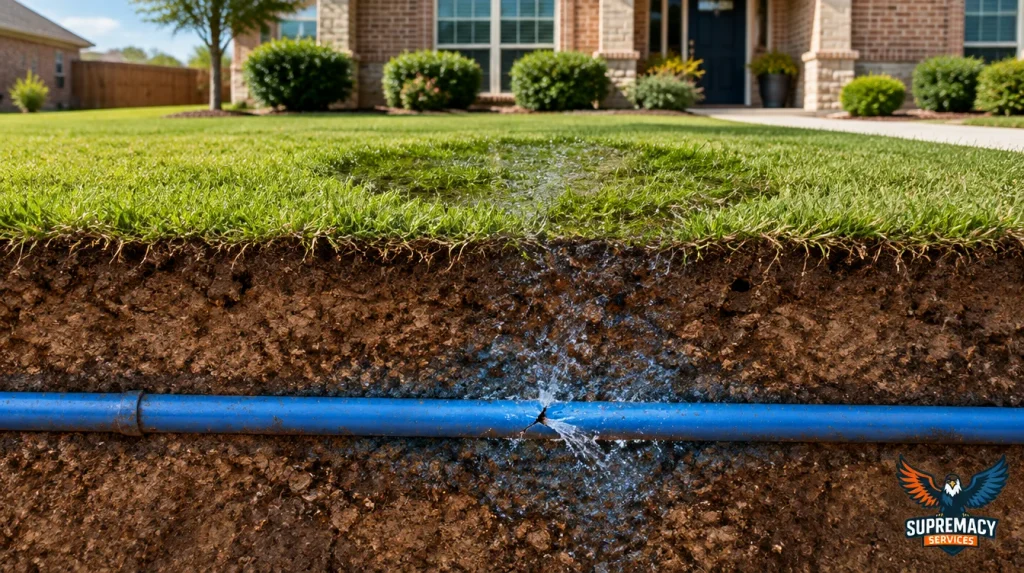
Supremacy Services

Explore Supremacy Services’ Water Line Repair and Replacement Options

Side-by-side comparison of traditional excavation and trenchless water line replacement at a Dallas home.

Trenchless vs. Traditional Water Line Replacement: Which Is Better?

Trenchless vs. traditional water line replacement: which is better for a Dallas home? Trenchless replacement is often worth considering when you need a new underground water line but want to limit damage to your driveway, lawn, or landscaping. Traditional excavation may be the better choice when the pipe is shallow, easy to access, severely obstructed, or requires multiple exposed connections.

Neither method is automatically cheaper or more reliable. The right choice depends on the existing pipe, its route, nearby utilities, ground conditions, and the amount of surface restoration required.

For Dallas and DFW homeowners, the most useful comparison is not simply how much digging each method involves. It is the total cost of installing a suitable new water line safely, including excavation, connections, testing, and restoring the property afterward.

Table of Contents

  1. What is trenchless water line replacement?
  2. What is traditional water line replacement?
  3. Trenchless vs. traditional: key differences
  4. Which method costs less in Dallas?
  5. Which method causes less property damage?
  6. When is trenchless replacement not possible?
  7. Dallas soil and underground utility considerations
  8. Does your water line need repair or replacement?
  9. What happens during water line replacement?
  10. How to choose the right replacement method
  11. Frequently asked questions
  12. Get professional water line replacement help

What Is Trenchless Water Line Replacement?

Underground cross-section showing a pipe-bursting head breaking an old water line while pulling a new HDPE pipe into place.
Pipe bursting uses specialized equipment to break apart an existing underground pipe while pulling a replacement pipe along the same route.

Trenchless water line replacement is a method of installing a new underground water pipe without excavating a continuous trench along the entire pipe route. Instead, contractors use specialized equipment and limited access excavations to install the replacement line.

It is sometimes described as water line replacement without digging, although that description is not entirely accurate. Most trenchless installations still require access pits or excavation at connection points.

The U.S. Environmental Protection Agency recognizes several trenchless approaches to water infrastructure replacement, including pipe bursting and horizontal directional drilling.

Pipe bursting

Pipe bursting replaces an existing underground pipe by pulling a specialized tool through it.

As the tool advances, it breaks or splits the existing pipe and moves the surrounding material outward while drawing the new pipe into position.

Underground cutaway illustration showing a pipe-bursting head breaking an old water line while a new blue HDPE pipe is installed.
Trenchless pipe bursting replaces an existing underground water line by breaking apart the old pipe and pulling a new HDPE pipe into its place, reducing the need for continuous excavation.

Illustration of the pipe-bursting process. The old pipe is displaced as a new pipe is pulled into its route.

Pipe bursting can be useful when the existing water line follows a suitable route and the surrounding conditions allow the equipment to operate safely.

However, nearby utility lines, incompatible pipe materials, existing repair fittings, or inadequate clearance can make the method unsuitable.

Horizontal directional drilling

Horizontal directional drilling, often abbreviated as HDD, installs a new pipe along a planned underground route using specialized drilling equipment.

Unlike pipe bursting, it does not necessarily follow or destroy the existing water line.

This method may be considered when a replacement line needs to pass beneath an established driveway, landscaped area, or other obstruction.

A contractor must first assess the underground utility layout, available working space, drilling route, and appropriate installation depth.

Is trenchless replacement completely excavation-free?

No. Even trenchless projects commonly need excavation where the new line connects to the water supply and the home’s plumbing.

The main advantage is reducing the amount of continuous excavation between those points.

That distinction matters when comparing estimates. A trenchless proposal should explain exactly where digging will occur and what surfaces will need restoration.

Considering replacement but unsure whether trenchless installation is possible? Supremacy Services provides water line repair and replacement services in Dallas, including trenchless and traditional approaches. A site assessment can help determine which method is appropriate for your property.

What Is Traditional Water Line Replacement?

Plumbing technician installing a blue underground water supply pipe inside an excavated trench at a residential property.
Traditional water line replacement involves excavating along the pipe route to provide direct access for removing and installing underground plumbing.

Traditional water line replacement, also called open-trench or open-cut replacement, involves excavating along the pipe route to expose and replace the underground water line.

A contractor typically identifies the affected route, arranges utility locating, excavates the necessary area, removes or disconnects the old pipe, and installs a suitable replacement.

After the new line is connected and tested, the excavation is backfilled and the disturbed surfaces are restored according to the project scope

Advantages of traditional replacement

Traditional excavation provides direct access to the existing pipe and surrounding soil.

That access can be particularly valuable when:

  • The old water line contains several damaged sections.
  • Multiple fittings or connections require replacement.
  • The pipe route must be changed.
  • The existing line is shallow and easy to reach.
  • Underground obstructions make trenchless installation impractical.
  • The contractor needs to inspect or correct pipe bedding and surrounding conditions.

Traditional replacement may also be economical for a short, accessible pipe section where little landscaping or pavement needs to be disturbed.

Disadvantages of traditional replacement

The biggest disadvantage is the amount of excavation.

Depending on the pipe route, work may affect grass, planting beds, irrigation lines, walkways, patios, or driveway surfaces.

Traditional excavation can also involve more soil removal, backfilling, and surface restoration.

For homeowners with extensive landscaping or finished outdoor spaces, restoration may become a substantial part of the overall project.

Trenchless vs. Traditional Water Line Replacement: Key Differences

Both methods can install a new water line. Their main differences involve how the pipe is accessed, what equipment is used, and how much surrounding property is disturbed.

ComparisonTrenchless replacementTraditional replacement
ExcavationLimited access pits or entry/exit pointsExcavation along the required pipe route
Landscaping impactUsually less surface disturbanceOften more extensive disturbance
Driveway disruptionMay avoid cutting across the drivewayMay require cutting and restoring pavement
EquipmentSpecialized pulling or drilling equipmentExcavation and conventional pipe-installation equipment
Pipe accessLimited direct access along the routeDirect access to the exposed pipe
ObstructionsSome conditions can prevent installationMore flexibility to expose and remove obstacles
CostHigher specialized equipment cost may be offset by reduced restorationExcavation may cost less initially but restoration can add expense
SuitabilityDepends heavily on pipe and site conditionsOften suitable when direct access is needed
RestorationUsually concentrated around access pointsMay extend along much of the pipe route

Which method is better overall?

Trenchless replacement is generally more attractive when preserving existing surfaces is a priority and the site is technically suitable.

Traditional replacement can be more practical when the water line is readily accessible or when the existing underground conditions require extensive direct excavation.

The EPA notes that trenchless replacement is particularly effective for longer uninterrupted pipe runs, while connections and fittings can require additional excavation.

Which Method Costs Less in Dallas?

Comparison showing a large excavation trench beside a lawn with smaller access pits used for trenchless water pipe installation.
Trenchless installation can preserve more of a property’s lawn and landscaping, while traditional replacement generally requires more extensive excavation.

Neither trenchless nor traditional water line replacement is consistently cheaper.

Trenchless replacement can reduce excavation and surface restoration costs, but it requires specialized equipment and expertise. Traditional replacement may have a lower installation cost on an accessible route, but digging and restoring finished surfaces can increase the final bill.

For Dallas homeowners, a meaningful estimate should include the entire project rather than only the cost of installing the new pipe.

What affects water line replacement cost?

Cost factorWhy it matters
Pipe lengthLonger runs generally require more materials and labor
Pipe depthDeeper lines can complicate excavation and access
Existing pipe materialMay affect removal or pipe-bursting feasibility
Soil conditionsCan influence excavation, drilling, and pipe installation
Underground utilitiesMay require additional locating and protective measures
Driveways and patiosDemolition and restoration can increase costs
Replacement pipe materialMaterial and connection requirements affect pricing
Permits and inspectionsApplicable local requirements must be included
Site accessRestricted working space may require specialized equipment
RestorationLawn, irrigation, paving, and landscaping repairs affect total cost

Example: comparing two replacement estimates

Consider a Dallas home with a leaking water line running beneath a landscaped front yard and part of a concrete driveway.

A traditional replacement quote might involve excavating the affected route, removing part of the driveway, installing the new pipe, and restoring the concrete and lawn.

A trenchless quote might require specialized drilling or pulling equipment but avoid cutting a continuous path through the driveway.

The trenchless installation could have higher specialized labor or equipment costs while requiring less surface restoration.

The better value depends on the actual estimates and what each contractor includes.

What should a water line replacement quote include?

Ask for an itemized written estimate that identifies:

  • Replacement method and proposed pipe route
  • Pipe material, diameter, and approximate length
  • Excavation and access locations
  • Existing pipe abandonment or removal plan
  • Required connections and fittings
  • Utility locating and any private-line locating
  • Permits and inspections where applicable
  • Pressure testing and commissioning
  • Backfilling and surface restoration
  • Exclusions, warranty terms, and possible change-order conditions

Do not assume the cheapest initial quote represents the lowest final project cost.

The Texas State Board of Plumbing Examiners recommends obtaining multiple written estimates and confirming what work and warranty terms are included.

Texas State Board of Plumbing Examiners

Need help comparing replacement options? Request a water line assessment from Supremacy Services and ask which installation method fits your property’s conditions.

Which Method Causes Less Property Damage?

Trenchless replacement generally causes less surface disturbance because it avoids excavating the full length of the replacement route.

This can be especially valuable when an underground water line runs beneath an established lawn, concrete driveway, paved walkway, or landscaped garden.

Landscaping and lawns

Traditional excavation can require removing grass, plants, and soil along the pipe route.

Trenchless work may preserve more of the landscaping, although access pits and equipment placement can still affect parts of the yard.

Concrete driveways and walkways

If a water line crosses beneath a driveway, trenchless installation may avoid cutting through the pavement.

However, the contractor must verify that the installation route and underground clearances are suitable.

Foundations and nearby structures

Neither method should be selected solely because it appears less invasive.

Pipe bursting can create outward ground displacement, and drilling requires careful route planning. Nearby foundations, buried utilities, and soil conditions must be evaluated before work begins.

The EPA identifies ground movement and nearby underground infrastructure as important limitations of some trenchless techniques.

When Is Trenchless Water Line Replacement Not Possible?

Trenchless replacement may not be appropriate when the existing pipe or surrounding ground conditions prevent safe installation.

Common limitations include:

1. Closely spaced underground utilities

Gas lines, electrical conduits, telecommunications cables, sewer pipes, and irrigation systems may occupy nearby underground space.

Some trenchless techniques require enough clearance to avoid damaging those systems.

2. Incompatible existing pipe materials

Certain existing pipe materials are more difficult to burst or otherwise replace using a particular trenchless technique.

A contractor must identify the material before choosing the equipment and installation method.

3. Significant bends or obstructions

A pipe route with sharp changes in direction, restrictive fittings, or obstructions may prevent successful pipe bursting.

Directional drilling may offer an alternative in some situations, but it requires a suitable new route.

4. Limited access for equipment

Trenchless installation still requires room for equipment, new pipe handling, and access excavations.

Small yards, confined side passages, and obstructed work areas may limit available options.

5. Unsuitable ground conditions

Soil movement, nearby structures, hard obstructions, and the condition of the existing pipe corridor can affect trenchless feasibility.

6. Multiple connections requiring excavation

Where a replacement route includes several connections or fittings, the amount of necessary excavation may reduce the practical advantages of trenchless work.

A contractor should explain the specific technical reason when recommending against trenchless replacement rather than simply saying it cannot be done.

Dallas Soil and Underground Utility Considerations

Utility locating technician scanning a Dallas residential lawn with marked underground gas, electric, water, and communication lines.
Locating buried utilities before excavation helps contractors plan water line replacement and reduce the risk of damaging nearby infrastructure.

Dallas-area water line replacement requires attention to local ground conditions, existing construction, and the location of underground infrastructure.

Expansive clay soils

Expansive clay is a relevant consideration in parts of North Texas because changes in soil moisture can cause swelling and shrinking.

These changes may contribute to movement around buried structures and utilities.

However, soil conditions vary across the DFW Metroplex. A particular home’s soil composition, pipe depth, and installation conditions should be evaluated rather than assuming every water line failure is caused by clay movement.

Older homes and previous plumbing repairs

In established Dallas neighborhoods, a water service line may have undergone repairs or modifications over time.

Previous couplings, changes in pipe material, and undocumented routing can complicate replacement planning.

Identifying the existing pipe material and tracing the route are important steps before selecting a method.

Underground utility locating

Before excavation, underground utilities must be identified.

Texas811 states that excavation requests must be made at least two business days before digging, excluding weekends and holidays. Contractors should also account for private utilities that may not be marked through the standard public utility locating process.

Permits and plumbing requirements

Permit and inspection requirements can vary by municipality and project scope.

Homeowners in Dallas, Plano, Frisco, Allen, and other DFW communities should confirm the requirements that apply to their address and the proposed work.

The Texas State Board of Plumbing Examiners recommends verifying the responsible plumber’s credentials and checking local permit and inspection requirements before hiring.

Does Your Water Line Need Repair or Replacement?

Not every underground water line leak requires replacing the entire pipe.

A localized repair may be appropriate when the damaged area is limited and the remaining pipe is in suitable condition.

Full replacement becomes more attractive when the pipe has repeated leaks, widespread deterioration, or conditions that make additional failures likely.

Warning signs of an underground water line problem

Watch for:

  • An unexplained increase in water usage
  • Reduced water pressure throughout the home
  • Persistently wet ground during otherwise dry weather
  • Water pooling in the yard
  • A water meter showing usage when all fixtures are off
  • Repeated leaks along the same water line
  • Unusual sounds of running water when fixtures are closed

These symptoms do not prove that the underground supply line is damaged. Indoor plumbing leaks, irrigation problems, pressure regulators, and other plumbing faults can produce similar symptoms.

Repair vs. replacement decision

SituationPotential next step
One isolated leak, otherwise sound pipeConsider localized repair
Multiple leaks along the same aging pipeEvaluate full replacement
Damaged pipe beneath a drivewayCompare trenchless and excavation options
Severe corrosion or widespread deteriorationReplacement may be preferable
Low pressure without a confirmed leakDiagnose pressure and supply issues first
Wet yard near an irrigation lineInspect irrigation before assuming a main water line leak

If the problem has not been diagnosed, begin with professional leak detection rather than selecting a replacement method prematurely.

What Happens During Water Line Replacement?

Plumbing technician checking a connection on a newly installed blue underground water pipe inside a residential excavation trench.
Professional water line replacement includes installing appropriate pipe connections, inspecting the work, and completing required testing before restoration.

A professional water line replacement generally follows a structured process, although the exact steps depend on the chosen installation method.

Step 1: Inspect and diagnose

Confirm the leak location, assess the existing pipe, and determine whether repair or replacement is appropriate.

Step 2: Plan the replacement route

Identify underground utilities, assess soil and access conditions, and choose a suitable pipe material and installation method.

Step 3: Prepare the work area

Complete required notifications, permits, and utility locating. Arrange water shutoff and excavate access points or the required trench.

Step 4: Install the replacement pipe

Install the new line using the selected method and complete the necessary water supply and building connections.

Step 5: Test and restore service

Perform required pressure and leak testing, complete applicable flushing or other commissioning procedures, and restore water service.

Step 6: Backfill and restore the property

Complete required inspections, backfill excavations, and restore the affected surfaces according to the agreed scope.

How long does water line replacement take?

The duration depends on the pipe length, excavation requirements, utility clearances, inspections, and complexity of the installation.

A straightforward residential project may be completed much faster than a replacement involving extensive driveway excavation or difficult underground conditions.

Trenchless methods can reduce excavation and restoration work, but they are not automatically faster in every situation.

Ask the contractor for a project-specific schedule, including how long the home’s water supply is expected to be interrupted.

How to Choose the Right Replacement Method

The best replacement method is the one that safely installs an appropriate new pipe while accounting for the property’s actual conditions and total project cost.

Use the following checklist when comparing contractor recommendations.

Water line replacement decision checklist

0 of 7 checkedHas the contractor confirmed that full replacement is necessary?Has the existing pipe material and route been identified?Have underground utilities and private lines been considered?Are both trenchless and traditional options technically feasible?Does the estimate include all excavation and restoration?Are pipe materials, connections, and testing specified?Are permits, inspections, and warranty terms explained?

Copy checklist

Can you replace a water line yourself?

Underground water line replacement is generally not a suitable DIY project.

The work may involve pressurized potable water connections, underground utilities, excavation safety, approved plumbing materials, and local permit requirements.

A homeowner can document symptoms, review water bills, identify visible wet areas, and obtain estimates. Actual underground replacement should be evaluated and performed by appropriately qualified professionals in accordance with applicable requirements.

How can homeowners reduce future water line problems?

Although no maintenance routine can prevent every underground pipe failure, homeowners can take sensible precautions.

Monitor unusual water usage, investigate persistent pressure changes, repair known leaks promptly, and keep records of previous water line repairs.

Before major landscaping, fencing, or driveway projects, identify the locations of buried utilities. Avoid assuming underground lines follow a straight or predictable path.


Frequently Asked Questions

1. Is trenchless water line replacement better than digging?

Trenchless replacement is often better when preserving landscaping, driveways, or paved areas is important. Traditional excavation may be preferable when direct pipe access is necessary or trenchless installation is technically unsuitable.

2. Is trenchless water line replacement more expensive?

Not always. Trenchless work may require more specialized equipment, but reduced excavation and restoration can offset those costs. Compare complete written estimates rather than installation costs alone.

3. Can a water line be replaced without digging up the yard?

Often, much of the yard can remain undisturbed. However, trenchless installation typically requires some excavation for access pits and pipe connections.

4. Can trenchless replacement work beneath a concrete driveway?

It may be possible to install a replacement water line beneath a driveway using a suitable trenchless method. Feasibility depends on the route, nearby utilities, pipe depth, and site conditions.

5. Does pipe bursting work on every type of water pipe?

No. Pipe material, fittings, bends, existing obstructions, and surrounding ground conditions affect whether pipe bursting is suitable.

6. How long does a new underground water line last?

Service life depends on the pipe material, installation quality, operating conditions, and surrounding environment. A contractor should explain the proposed material and applicable manufacturer information rather than promising a universal lifespan.

7. Will homeowners lose water during replacement?

Water service generally must be interrupted during at least part of the replacement and connection process. The contractor should explain the expected outage and whether temporary service arrangements are practical.

8. Does Dallas require a permit for water line replacement?

Permit requirements depend on the property, work scope, and applicable local rules. Confirm current requirements with the relevant municipal authority before beginning replacement.

9. Can a leaking water line be repaired instead of replaced?

Yes, some localized leaks can be repaired. Replacement may be more appropriate when the existing pipe has repeated failures, extensive deterioration, or other serious defects.

10. How do I know whether trenchless replacement will work at my home?

A qualified contractor should evaluate the pipe material, route, condition, depth, nearby utilities, soil, and access points. Those findings determine which methods are feasible.


Get Professional Water Line Replacement Help in Dallas

Choosing between trenchless and traditional water line replacement should begin with an accurate diagnosis, not a preference for one installation method.

A method that preserves your landscaping may offer excellent value when conditions are suitable. In other situations, conventional excavation provides the access needed to complete the work properly.

Supremacy Services provides water line repair and replacement services for Dallas and the DFW Metroplex, with trenchless and traditional options described on its service page.

If you are dealing with an underground water leak, repeated water line failures, or a replacement recommendation, request a professional assessment before committing to major excavation.

Explore water line repair and replacement options with Supremacy Services to discuss the condition of your water line and the installation approach that may fit your property.

Professional plumber inspecting an exposed underground main water line outside a residential home in Dallas, Texas.

How Long Does It Take to Repair a Main Water Line in Dallas?

A main water line repair in Dallas may take a few hours of on-site work for an accessible, localized leak, while a more complicated underground repair can take a full day or longer. If the entire water service line needs replacement, the project may require several days once utility locating, approvals, excavation, installation, testing, and restoration are considered.

The important distinction is between the time spent physically repairing the pipe and the total time required to complete the project. Your household’s water may be turned off for only part of that process.

For Dallas and DFW homeowners dealing with unexplained low water pressure, soggy landscaping, or a suspected underground leak, understanding the repair timeline can make it easier to plan and prevent further damage.

Table of Contents

  1. How long does a main water line repair usually take?
  2. What affects the repair timeline?
  3. What happens during a professional water line repair?
  4. How long will your water be shut off?
  5. Repair vs. replacement: Which takes longer?
  6. What can delay repairs in Dallas?
  7. How much does repair time affect the cost?
  8. What should homeowners do while waiting?
  9. Can homeowners repair the line themselves?
  10. How can you prevent future problems?
  11. Frequently asked questions
  12. Schedule a water line inspection in Dallas

How Long Does Main Water Line Repair Take?

Illustrated stages of underground main water line repair, from leak detection and excavation to pipe replacement, testing, and restoration.
Main water line repairs typically involve locating the leak, accessing the damaged pipe, completing repairs, testing, and restoring the affected area.

For planning purposes, a straightforward repair may be completed within a working day after the necessary preparations are finished. Extensive excavation, difficult access, or full-line replacement can make the process substantially longer.

The following ranges are illustrative, not published local averages or firm contractor commitments.

Type of workIllustrative on-site work timeWhat homeowners should know
Accessible connection or fitting repair2–4 hoursAssumes the problem is located and readily accessible
Localized underground pipe repair4–8 hoursExcavation and safe access may add time
Difficult or extensive underground repair1–2 days or moreObstacles, multiple leaks, and testing affect completion
Full service-line replacement1–3 days or morePreparation, approvals, and restoration may extend the overall project
Repair beneath concrete or a drivewayHighly variableSurface removal and restoration may require additional visits

These are broad scheduling examples rather than guaranteed repair durations. A plumber can give a more meaningful estimate after locating the damaged section and assessing site conditions.

Why a small leak can still take several days to resolve

A small crack in a buried water line might take relatively little time to repair once exposed. However, the work may require underground utility marking, coordination with the water provider, excavation, and testing.

For planned excavation, Texas811 requires notification at least two business days before digging, excluding weekends and holidays. That preparation can affect the overall schedule even when the actual pipe repair is relatively quick.

Need help estimating your repair timeline? Supremacy Services offers water line repair and replacement services in Dallas and Fort Worth. A professional inspection can establish what needs repairing and whether excavation or replacement is necessary.

What Factors Affect How Long a Main Water Line Repair Takes?

The biggest factors are the leak’s location, the condition of the pipe, accessibility, and whether the damaged section can be repaired independently.

1. Where the damaged pipe is located

A leak near an accessible connection is usually easier to reach than one buried beneath a driveway, patio, or landscaped area.

A buried line may require careful excavation, especially when electrical cables, gas lines, or other utilities are nearby.

2. The pipe material and condition

Copper, PVC, PEX, and older metallic pipes require different repair techniques and compatible fittings.

A single damaged connection may be suitable for a localized repair. A pipe with widespread deterioration or repeated failures may require a more extensive solution.

3. The severity of the leak

A localized leak and a severely damaged line do not necessarily require the same repair.

A plumber must determine whether the affected pipe can safely remain in service after repair or whether replacement is the more reliable option.

4. Soil and ground conditions

North Texas has areas with expansive clay soils. Changes in soil moisture can cause movement that affects buried infrastructure and foundations.

However, soil movement should not automatically be blamed for every water line leak. Pipe age, installation quality, corrosion, accidental damage, and connection failures may also contribute.

Wet, unstable, or obstructed excavation conditions can slow access to the damaged line.

5. The number of damaged sections

A repair that initially appears localized may reveal additional deterioration once the pipe is exposed.

When several weak sections are discovered, the plumber may recommend replacing a longer section rather than making multiple isolated repairs.

6. Utility locating and permits

Underground work may require utility locating, permits, inspections, or coordination with the water provider, depending on the location and scope.

The Texas State Board of Plumbing Examiners recommends checking with the municipal plumbing inspection department to establish applicable permit and inspection requirements.

7. Availability of parts and equipment

The required pipe size, fittings, excavation equipment, and access arrangements may affect scheduling.

Ask whether all materials and equipment will be available before the work begins.

What Happens During a Professional Main Water Line Repair?

Plumbing technician using electronic leak detection equipment to locate an underground residential water line leak in Dallas.
Professional leak detection helps plumbers identify underground water line problems before excavation begins.

A professional repair generally follows six stages, although the exact sequence depends on the property and the damaged pipe.

Step 1: Inspection and leak diagnosis

The plumber reviews symptoms, checks accessible plumbing, and uses appropriate testing methods to identify the likely source of water loss.

Step 2: Locate the damaged section

Leak detection, pipe tracing, or targeted inspection helps narrow the repair area. The technician also evaluates nearby utilities and site access.

Step 3: Prepare and expose the pipe

After the required utility locating and authorizations, the damaged area is accessed using a suitable excavation or other approved method.

Step 4: Repair or replace the pipe

The damaged fitting or pipe section is repaired or replaced using materials appropriate for the water supply system.

Step 5: Test the completed work

The repaired system is checked for leakage and appropriate operation. Required flushing, disinfection, or inspection procedures are completed before normal use.

Step 6: Backfill and restore the work area

The excavation is closed after required checks. Landscaping, concrete, or other surface restoration may follow separately.

Does leak detection require digging?

Not always. Specialized leak detection can help narrow the suspected location before excavation.

However, detecting a leak and physically repairing it are different tasks. An underground pipe may still need to be exposed or accessed through an appropriate replacement method.

What should the plumber explain before starting?

Homeowners should understand the proposed repair method, expected water shutoff, anticipated duration, utility-locating requirements, restoration scope, and what might cause the estimate to change.

How Long Will Your Water Be Shut Off During a Main Line Repair?

Professional plumber replacing a damaged section of underground residential water supply pipe in an excavated trench in Dallas, Texas.
Localized main water line repairs may involve replacing a damaged pipe section after the water supply has been safely shut off.

Your water may be off for several hours during a localized repair, but longer interruptions are possible if the work is complicated. The shutoff period is not necessarily the same as the total project duration.

A plumber may be able to complete preparatory tasks while the water remains available. The service is typically isolated when the damaged section must be opened, removed, or connected.

Can you use your toilets and faucets during the repair?

If the main supply is shut off, faucets, showers, washing machines, and other fixtures cannot receive their normal incoming water supply.

Some toilets may have one remaining tank flush, but homeowners should not depend on normal plumbing operation while the service is disconnected.

Before work begins, ask the plumber:

  • When will the water be turned off?
  • Is the entire house affected?
  • When is service expected to return?
  • Will the water need flushing before normal use?
  • Could a second shutoff be necessary for testing?

Can you stay in your house during the repair?

Often, yes. A residential water line repair does not automatically require moving out.

However, a prolonged water interruption, extensive excavation, unsafe site conditions, or limited access to essential facilities may affect whether staying is practical.

Main Water Line Repair vs. Replacement: Which Takes Longer?

Side-by-side illustration comparing localized underground water line repair with complete residential main water line replacement.
Repairing a single damaged section of pipe may require less excavation than replacing an entire underground water service line.

A localized repair is generally faster when the rest of the pipe is in good condition. Full replacement involves more work but may be preferable when deterioration extends beyond one isolated section.

ConsiderationLocalized repairFull replacement
Typical scopeOne damaged areaMost or all of the affected service line
Work durationUsually shorterUsually longer
ExcavationOften limitedDepends on installation method
Material requirementsRepair section and fittingsNew pipe and connections
Best suited forIsolated, repairable damageExtensive deterioration or recurring leaks
Future reliabilityDepends on remaining pipe conditionRemoves more of the deteriorated pipe

Is trenchless water line replacement faster?

It can be, particularly when it reduces the need for extensive surface excavation. However, trenchless installation is not suitable for every property.

Pipe alignment, material, access points, nearby utilities, and the chosen installation method determine feasibility.

Trenchless installation should not be confused with a guaranteed no-dig or same-day repair.

When does replacement make more sense?

Replacement deserves consideration when the line has multiple leaks, widespread deterioration, recurring failures, or pipe materials that require special treatment.

If an older line may contain lead, the decision involves drinking-water safety as well as repair convenience. The EPA provides guidance on planning and conducting lead service line replacement and cautions against routine partial lead service line replacement.

Not sure whether your pipe needs repair or replacement? Request an evaluation through Supremacy Services’ Dallas-area underground water line repair and replacement service before committing to extensive excavation.

What Can Delay a Main Water Line Repair in Dallas?

Several circumstances can extend the timeline beyond the physical pipe repair.

Utility marking before excavation

Texas811 requires advance notification for planned digging. The normal two-business-day notice period excludes weekends and holidays, and affected utility operators must respond before excavation proceeds.

Emergency procedures may differ, but an urgent leak does not mean homeowners should bypass safe excavation requirements.

A leak near the meter or municipal connection

A leak near the water meter may involve a different responsibility or shutoff procedure than a leak on the private service line.

Do not assume that every pipe between the street and house is homeowner-owned. Ask the applicable water provider to identify the responsibility boundary.

Water beneath a driveway or sidewalk

Concrete removal, excavation, repair, backfilling, and surface restoration may require separate work stages.

A homeowner might have running water again before the concrete or landscaping is fully restored.

Heavy rainfall or difficult excavation conditions

Wet soil, standing water, and unstable excavations can slow work and introduce safety concerns.

Additional damage discovered during excavation

A technician may uncover corroded fittings, multiple damaged sections, or a pipe that is unsuitable for a localized repair.

These findings can change both the repair scope and completion estimate.

Permit or inspection scheduling

Requirements vary by jurisdiction and project scope. Work in Dallas, Plano, Frisco, and other DFW municipalities should be evaluated against the applicable local rules rather than assuming one regional process.

How Much Does Repair Time Affect the Cost of a Main Water Line Repair?

Labor time is one part of the total cost, but excavation, materials, equipment, access conditions, permits, and restoration can have a greater impact than the number of hours spent joining the pipe.

A straightforward accessible repair and a damaged line beneath a concrete driveway may have very different costs even when the pipe defect itself is similar.

What can increase the final bill?

Cost factorWhy it matters
Leak detectionLocating a hidden failure may require additional diagnostic work
ExcavationDepth, soil conditions, and obstacles affect labor and equipment
Pipe materialPipe type, diameter, and fittings affect material requirements
Repair extentMultiple failures may require longer replacement sections
Emergency schedulingAfter-hours availability may affect pricing
RestorationConcrete, paving, and landscaping may need separate work
Permits and inspectionsApplicable requirements vary by municipality

There is no reliable fixed price for every Dallas water line repair. An on-site assessment and written estimate are more useful than a generic online price range.

The Texas State Board of Plumbing Examiners recommends obtaining written estimates that explain the work, payment arrangements, and applicable warranties.

What Should You Do While Waiting for Main Water Line Repair?

Wet patch and standing water on a Dallas home's front lawn indicating a possible underground main water line leak.
Unexplained wet spots, soggy grass, and pooling water can indicate a leaking underground residential water supply line.

If you suspect a broken underground water supply line, the priority is to limit water loss and prevent additional property damage.

Signs that justify prompt investigation

  • An unexplained drop in water pressure across multiple fixtures
  • A persistent wet patch in the yard during dry weather
  • Water flowing or pooling near the meter
  • A water meter indicating usage when all known fixtures are off
  • A sudden, unexplained increase in water consumption
  • Unusual sounds of running water when no fixtures are being used

These symptoms do not prove that the main water service line is leaking. Irrigation problems, interior plumbing leaks, and municipal supply issues can produce similar symptoms.

Homeowner checklist

Before the repair begins

0 of 7 completedCheck whether the problem affects one fixture or the entire house.Look for visible water pooling without digging.If safe and accessible, shut off the homeowner-controlled main valve when an active leak is suspected.Keep people away from saturated ground, open excavations, and electrical hazards.Contact a plumbing professional or the water utility, as appropriate.Document visible damage and keep relevant billing information.Ask about the expected shutoff period and restoration plan.

Reset checklist

Do not operate a utility-owned meter valve, break a meter seal, or enter an unsafe excavation. Contact the water provider when utility-side isolation is needed.

Can Homeowners Repair a Main Water Line Themselves?

Simple observations, such as checking fixtures, monitoring the water meter, or locating an accessible homeowner shutoff valve, may help identify a suspected leak.

However, excavating and repairing a buried pressurized drinking-water line is substantially more complex.

Incorrect repairs can lead to renewed leakage, contamination risks, damage to adjacent utilities, or unsafe excavation conditions.

For buried supply-line repairs, homeowners should use appropriately licensed plumbing professionals and confirm local permit requirements.

You can consult the Texas State Board of Plumbing Examiners’ consumer guidance to learn how to verify plumbing credentials.

How Can Dallas Homeowners Reduce the Risk of Future Water Line Problems?

Not every underground pipe failure is preventable, but homeowners can reduce the likelihood of an unnoticed leak becoming a larger problem.

Monitor water consumption. Review utility bills and investigate unexplained changes rather than waiting for visible flooding.

Address recurring pressure problems. Have unusual or persistently high water pressure evaluated by a professional.

Protect underground utilities. Request utility marking before excavation and make sure private lines are identified where necessary.

Keep records of previous repairs. Pipe material, installation dates, repair locations, and past leaks can help a plumber assess future problems.

Investigate recurring wet spots. Do not assume unexplained moisture is caused by irrigation or rainfall.

Evaluate aging plumbing when repairs become frequent. Repeated leaks may justify a broader assessment of the service line’s condition.


Frequently Asked Questions About Main Water Line Repair in Dallas

1. Can a main water line be repaired in one day?

Yes. A localized repair may be completed in one day when the leak is identified, the damaged section is accessible, and required preparations are complete. Complicated underground repairs may take longer.

2. How long does it take to locate an underground water leak?

The time varies with pipe location, property conditions, and the available testing methods. Some leaks can be narrowed down during an initial visit; others require more extensive investigation.

3. Will my water be shut off for the entire repair?

Not necessarily. Water service may remain available during parts of the diagnostic and preparation process. The plumber should explain when the supply must be isolated and when it is expected to return.

4. Can a broken water line be fixed without digging up the entire yard?

Sometimes. Targeted excavation or suitable trenchless replacement methods may reduce disruption. The available options depend on the line’s condition, location, and configuration.

5. How long does a complete main water line replacement take?

The physical installation may take one or more working days, while the overall project can take longer because of utility locating, approvals, inspections, and restoration.

6. Does homeowners insurance cover main water line repairs?

Coverage depends on the policy, cause of damage, and whether optional service-line coverage applies. Homeowners should review their policy and ask their insurer about applicable exclusions and deductibles.

7. Who is responsible for a leaking water line near the meter?

Responsibility depends on the water provider’s service boundary and the location of the damaged pipe. Contact the applicable utility before assuming the leak is entirely a homeowner responsibility.

8. Can a water line leak damage my foundation?

A persistent underground leak can saturate surrounding soil and contribute to moisture-related property problems. Whether it has affected a particular foundation requires an assessment of the site and damage.

9. What should I do if my main water line breaks at night?

If safe, shut off the homeowner-controlled main valve to limit water loss. Avoid flooded areas with electrical hazards, and contact an emergency plumbing service or water utility as appropriate.

10. Is it better to repair or replace an old main water line?

A localized repair may be appropriate for an otherwise sound pipe. Repeated leaks, extensive corrosion, or widespread deterioration may make replacement a better long-term option.


Schedule a Main Water Line Inspection in Dallas

A leaking main water line can interrupt daily routines, waste water, and create expensive property problems when left unresolved.

The fastest practical solution begins with an accurate diagnosis—not automatically digging up the yard or replacing the entire pipe.

Supremacy Services provides water line inspection, leak detection, repair, and replacement services for Dallas and the DFW Metroplex.
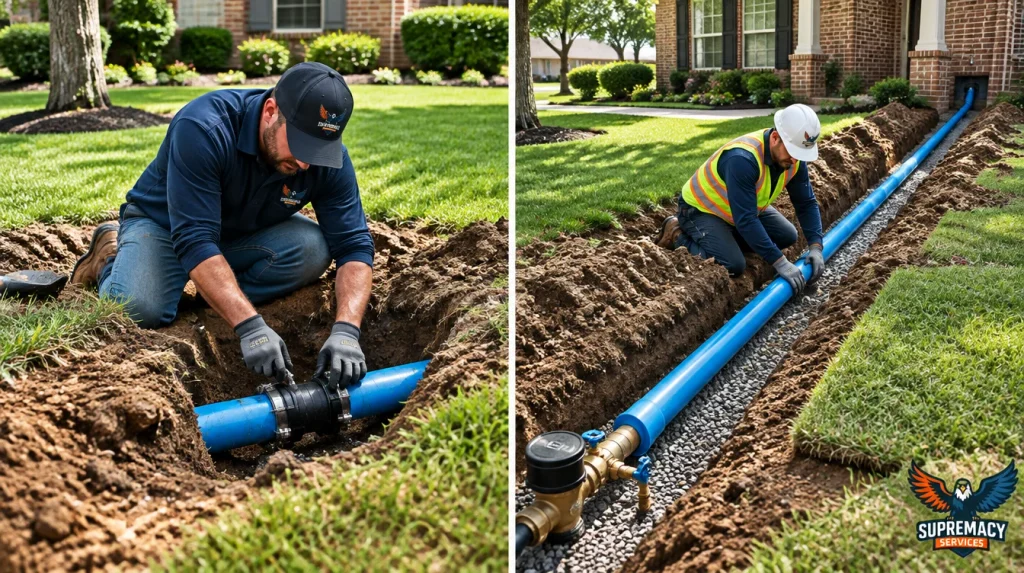
If you have noticed unexplained water loss, reduced pressure throughout your home, or persistent wet areas around your property, arrange an inspection before the damage becomes more extensive.
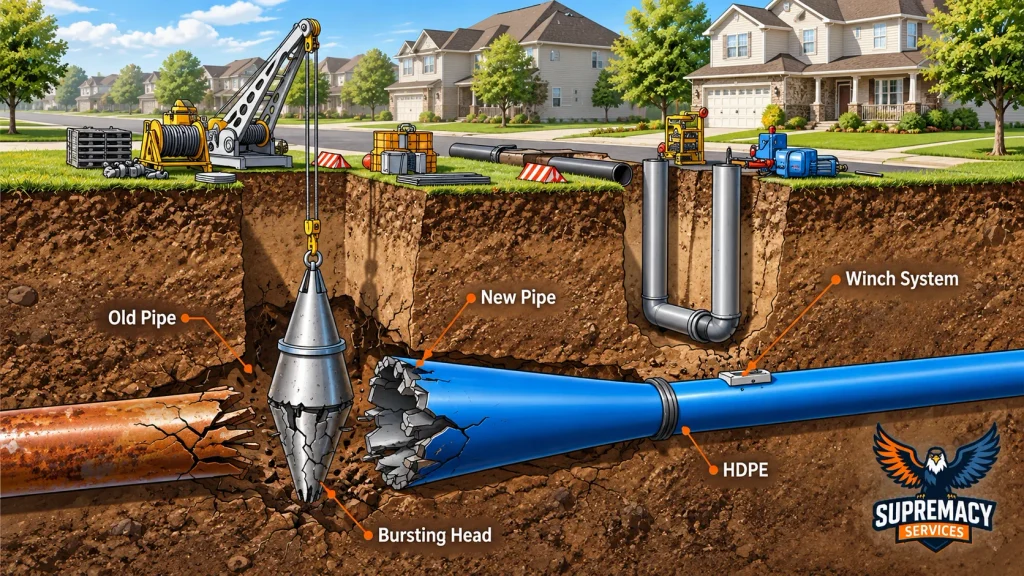
Schedule your Dallas water line repair consultation with Supremacy Services

Wet front lawn outside a Dallas home showing possible signs of an underground main water line leak.

Why Is My Main Water Line Leaking? Common Causes in Dallas Homes

A main water line leaking in your Dallas home is often caused by aging pipes, corrosion, shifting soil, damaged fittings, excessive water pressure, or accidental damage to an underground supply pipe. Sometimes, several factors contribute to the same leak.

Because the main water line carries water from the municipal supply connection toward your house, damage can occur underground without an obvious broken pipe in sight.

You might first notice an unusually wet patch of grass, a higher water bill, reduced water pressure, or water collecting near your driveway.

In Dallas and the surrounding DFW Metroplex, changing soil moisture and underground pipe conditions are additional factors worth investigating. However, the only reliable way to identify the cause is to locate the leak and evaluate the damaged section.

This guide explains the most common causes of main water line leaks, how to recognize warning signs, what you can safely check yourself, and when professional repairs are necessary.

Table of Contents

  1. What Is a Main Water Line Leak?
  2. What Causes a Main Water Line to Leak?
  3. What Are the Warning Signs?
  4. How Can You Check for a Leak?
  5. Why Are Underground Leaks a Concern in Dallas?
  6. Main Water Line Leak vs. Other Plumbing Problems
  7. What Should You Do If Your Main Water Line Is Leaking?
  8. How Do Plumbers Find and Repair Underground Leaks?
  9. Should You Repair or Replace the Water Line?
  10. What Affects the Cost of Repair?
  11. How Can You Prevent Future Leaks?
  12. Frequently Asked Questions
  13. When to Contact Supremacy Services

What Is a Main Water Line Leak?

Underground cross-section showing a residential water meter, buried main water supply line, and leaking pipe beneath a Dallas home's front yard.
A home’s main water service line typically runs underground from the water meter toward the house.

A main water line leak occurs when the pressurized pipe supplying water to a property develops a crack, hole, failed joint, or other opening that allows water to escape.

For most single-family homes, the private water service line runs underground between the municipal water connection or meter area and the home’s plumbing system.

Basic layout of a residential water service line, showing a possible underground leak between the meter and the house.

A leak may develop in the buried pipe, a fitting, a connection, or near the point where the service line enters the building.

Because the pipe is underground, water may travel through soil before appearing at the surface. The wettest area in your yard is not necessarily directly above the damaged pipe.

Why it matters: A persistent leak can waste treated water, increase utility bills, erode soil, and contribute to moisture problems near foundations or paved areas.

If you suspect damage to the underground supply pipe, Supremacy Services offers water line repair and replacement in Dallas for homeowners who need the problem professionally evaluated.

What Causes a Main Water Line to Leak?

Underground corroded water supply pipe leaking into clay soil, illustrating possible causes of main water line damage in Dallas.
Pipe corrosion and shifting clay soil can contribute to underground water line damage in North Texas.

The most common causes of underground water line leaks are pipe deterioration, corrosion, ground movement, pressure-related stress, damaged joints, root-related movement, freezing conditions, and accidental excavation damage.

1. Aging or deteriorating water pipes

Water supply pipes do not last indefinitely.

Over time, some pipe materials become more vulnerable to deterioration, particularly when exposed to unfavorable soil conditions, repeated movement, or previous repairs.

Older properties may have galvanized steel or other materials that have been in service for decades. Newer homes may use copper or approved plastic piping.

Age alone does not prove that a pipe needs replacement. A plumber should consider its material, condition, leak history, and whether the failure is isolated.

2. Corrosion of underground pipes

Metal water lines can corrode under certain conditions.

Corrosion may weaken the pipe wall until a small opening develops. Depending on the material and surrounding environment, corrosion can occur externally or internally.

Possible indicators include:

  • Repeated leaks along an older metal line.
  • Visible rust or deterioration on exposed sections.
  • Discolored water associated with deteriorating metallic plumbing.
  • Pinhole leaks or weakened fittings.

Corrosion is one reason repeated patch repairs may become less economical than replacing a deteriorated section.

3. Soil movement and changing moisture levels

Soil movement is particularly relevant to underground plumbing in parts of North Texas.

Clay-rich soils can change volume as their moisture content changes. During dry conditions, some soils shrink; when moisture returns, they may swell.

These changes can place stress on buried pipes, joints, and connections, especially where the pipe passes between areas that move differently.

Soil movement does not automatically mean a water line will fail. Pipe flexibility, installation depth, bedding, joint design, and existing condition all influence how well it tolerates movement.

For a Dallas homeowner, the important question is whether ground movement contributed to the actual pipe damage—not simply whether the yard contains clay soil.

4. Excessive water pressure or pressure fluctuations

Water lines are designed to operate within suitable pressure conditions.

Excessive pressure can increase stress on plumbing components, while sudden changes in flow can create pressure surges.

Over time, vulnerable fittings, joints, and weakened pipe sections may fail.

A plumber can measure water pressure and evaluate whether a pressure-regulating valve or another system issue needs attention.

A leak should not automatically be attributed to high pressure without testing.

5. Damaged pipe joints and fittings

Not every underground water leak comes from a crack in the pipe itself.

Leaks can develop where two pipe sections connect.

Potential causes include improper assembly, movement at the joint, aging seals, unsuitable fittings, or mechanical stress.

A failed fitting may produce symptoms similar to a ruptured pipe, including wet soil and declining pressure.

6. Tree roots and nearby vegetation

Tree roots naturally grow toward areas where water and oxygen are available.

Roots may grow around underground plumbing, and expanding roots can sometimes contribute to pipe displacement or stress.

However, roots are not proof that a sound pressurized water line was punctured. Roots may also exploit soil moisture from a leak that already exists.

A professional inspection helps distinguish root-related displacement from corrosion, a defective joint, or another failure.

7. Freezing temperatures and sudden weather changes

Although Dallas generally experiences milder winters than northern states, freezing weather can still damage inadequately protected water piping.

Water that freezes inside a vulnerable pipe section expands and can create enough stress to split the pipe or damage a fitting.

Buried service lines are often better protected than exposed pipes, but shallow or exposed sections may be vulnerable during severe cold.

After a freeze, watch for unexplained wet areas or pressure changes once temperatures rise.

8. Accidental excavation or installation damage

Underground pipes may be damaged during landscaping, fence installation, driveway work, or other excavation.

Sometimes damage is immediate. In other cases, a pipe is weakened and develops a leak later.

Poor bedding, inadequate support, or unsuitable connections may also contribute to premature failures.

Before excavation, arrange utility locating through Texas 811 and confirm how privately owned lines will be identified.

What Are the Warning Signs of a Leaking Main Water Line?

Common warning signs include unexplained wet spots, unusual water consumption, lower water pressure, water pooling in the yard, and persistent moisture near the house.

Warning signWhat it could indicateWhat to check
Wet patch in the yardUnderground supply leak or irrigation issueWhether the area remains wet without watering or rain
Unexpected water bill increaseContinuous water lossCompare meter readings and recent usage
Low pressure throughout the houseSupply restriction, leak, or utility issueWhether multiple fixtures are affected
Water pooling near drivewayUnderground water escaping toward the surfaceLocation, timing, and nearby irrigation
Unusually green strip of grassLocalized excess moistureWhether it follows a buried pipe route
Sound of running waterWater moving through a leaking or operating pipeWhether all fixtures and equipment are off
Soil erosion or settlingEscaping water affecting surrounding soilWhether the area is becoming unstable

Can a main water line leak without visible water?

Yes. An underground leak can remain hidden when water disperses into surrounding soil or drains away before reaching the surface.

This is why water meter readings can be useful even when the yard appears dry.

The U.S. Environmental Protection Agency recommends checking the water meter during a period when no water is being used. A changing reading may indicate a leak somewhere in the property’s water system.

How Can You Check for a Main Water Line Leak?

You can perform a basic water meter check to determine whether water is being recorded while your home is not intentionally using it.

Homeowner inspecting an outdoor residential water meter to check for possible underground water line leaks in Dallas.
Checking your water meter while all household water fixtures are off may help identify an unexplained water loss.

Homeowner leak-check checklist

EPA-style meter check

0 of 6 completedTurn off faucets, showers, appliances, and irrigation systems.Check that toilets are not continuously refilling.Record the water meter reading or photograph it.Avoid using water for approximately two hours.Read the meter again and compare the readings.If consumption is recorded, arrange further investigation.

Reset checklist

A changing meter reading suggests water is passing through the meter, but it does not identify the exact location.

To help narrow the problem, a plumber may compare readings with the home’s main shutoff valve closed, where the plumbing arrangement permits that test.

If the meter continues registering flow with the home’s plumbing isolated, the service line between the meter and the shutoff becomes a possible source. This is not conclusive because valve condition and plumbing layout vary.

Do not open or operate utility-controlled equipment, force a stuck valve, or dig around the meter.

Why Are Underground Water Line Leaks a Concern in Dallas?

Underground leaks in Dallas deserve attention because prolonged water escape can affect the soil around foundations, landscaping, driveways, and other structures.

Clay soils and foundation movement

Some Dallas-area properties have expansive clay soils that respond to changes in moisture.

An underground leak may create an unusually wet area next to drier surrounding soil. This moisture imbalance can contribute to movement under certain conditions.

However, a foundation crack does not automatically establish that a water line is leaking. Structural movement has multiple possible causes.

Hot summers and concealed water loss

During warm weather, a homeowner may initially mistake a damp lawn for an irrigation problem.

Conversely, dry surface soil does not rule out a buried leak.

The best approach is to compare water use, check the meter, and evaluate whether the wet area is associated with the service line, irrigation system, drainage, or another source.

Municipal water infrastructure and private service lines

A leak near the street may involve municipal infrastructure, the water meter assembly, or the property’s private water service line.

Responsibility depends on the actual location and applicable utility rules.

For suspected Dallas utility-side leaks or water main breaks, the City of Dallas directs residents to use 311 for reporting.

Homeowners elsewhere in DFW should contact their own municipal water utility.

Main Water Line Leak vs. Other Plumbing Problems

Several plumbing issues can produce similar symptoms, but the appropriate repair depends on which system is affected.

ProblemTypical cluesKey distinction
Main water line leakWet yard, unexplained metered use, possible low pressurePressurized water supply between the utility connection and home
Irrigation leakWet lawn near sprinklers or irrigation pipingMay occur during scheduled watering or from a leaking irrigation valve
Sewer line leakWastewater odors, drainage issues, soggy groundInvolves wastewater rather than the pressurized potable supply
Slab leakMoisture under flooring, warm spots with hot-water leaks, unexplained water useUsually involves plumbing beneath or within the foundation
Indoor fixture leakRunning toilet, dripping faucet, damp cabinetWater loss occurs at or near a fixture

A wet lawn alone cannot distinguish these problems.

For example, a leaking irrigation line and a damaged water service line can both create localized wet soil. The difference becomes clearer when a plumber isolates individual systems and tests them.

What Should You Do If Your Main Water Line Is Leaking?

If you suspect an active main water line leak, prioritize stopping unnecessary water loss and preventing property damage.

  1. Assess the severity. Rapidly accumulating water, ground erosion, or flooding near electrical equipment requires immediate attention.
  2. Shut off the property’s water supply if safe. Use the homeowner-accessible shutoff valve. Avoid forcing damaged valves or operating utility equipment without authorization.
  3. Keep people away from unstable ground. Saturated soil near excavations, retaining walls, or pavement may be unsafe.
  4. Document the problem. Photograph wet areas, visible damage, and unusual meter readings.
  5. Contact the water utility if the leak may be on its side. Report suspected municipal water main or meter problems through the appropriate utility.
  6. Arrange professional leak detection. A plumber can determine whether the service line is leaking and identify suitable repair options.

Avoid digging to expose a suspected leak without proper utility locating and excavation precautions.

If the source is not visible, Supremacy Services offers professional water leak detection to help locate concealed plumbing leaks before unnecessary excavation.

How Do Plumbers Find and Repair Underground Water Line Leaks?

Plumbing technician using acoustic leak detection equipment to investigate a suspected underground water line leak outside a Dallas home.
Professional leak detection equipment can help plumbers narrow down the location of a hidden underground water leak.

Professional diagnosis typically combines an assessment of the property’s plumbing layout, water meter observations, pressure testing where appropriate, and leak-location equipment.

Step 1: Evaluate the symptoms

The plumber asks when the issue started, whether the water bill changed, whether pressure has dropped, and where moisture appears.

Step 2: Identify the affected pipe

The technician determines whether the problem involves the private service line, irrigation, interior plumbing, or utility infrastructure.

Step 3: Locate the leak

Depending on pipe material and site conditions, acoustic leak detection, electronic equipment, pressure testing, or other appropriate methods may help narrow the leak location.

No single detection method works equally well on every property.

Step 4: Expose the damaged area

If excavation is required, the work area is planned around buried utilities, access limitations, and property features.

Step 5: Repair or replace the pipe

The plumber selects an approved repair method and suitable materials based on the pipe’s condition and the location of the failure.

Step 6: Test and restore

After repairs, the system should be checked for leakage and proper operation. Excavated areas are then restored according to the agreed scope.

The goal is to identify the actual failure rather than repeatedly repairing symptoms without addressing the cause.

Should You Repair or Replace a Leaking Main Water Line?

Professional plumbing technician repairing an exposed underground residential water supply pipe in the front yard of a Dallas home.
Depending on the pipe’s condition and extent of damage, a leaking main water line may require a targeted repair or replacement.

An isolated leak in an otherwise sound pipe may be suitable for repair. Replacement becomes more attractive when the pipe is extensively corroded, repeatedly leaking, or structurally deteriorated.

ConsiderationRepair may make senseReplacement may make sense
Pipe conditionGenerally soundWidespread deterioration
Number of leaksOne localized failureMultiple or recurring failures
Pipe materialSuitable for durable repairMaterial or condition creates ongoing concerns
AccessibilityDamaged area can be reachedRepeated excavation would be disruptive
Long-term outlookRemaining pipe is reliableMore failures are reasonably anticipated

Some properties may qualify for trenchless replacement methods, but feasibility depends on pipe routing, material, condition, and site access.

A plumber should explain why a localized repair or broader replacement is recommended.

What Affects the Cost of Main Water Line Leak Repair in Dallas?

The cost depends on the leak’s location, the amount of excavation required, pipe material, length of damaged piping, and whether repair or replacement is necessary.

Other important factors include:

  • Whether the pipe runs beneath a driveway, sidewalk, or landscaping.
  • The depth of the water service line.
  • Underground utility conflicts.
  • Whether a small section can be repaired.
  • Required permits, inspections, and restoration.
  • Emergency work or difficult site access.

A small accessible repair and a complete service-line replacement are different projects and should not be compared using a single advertised price.

Ask for a written estimate identifying the proposed repair, materials, excavation, restoration, and any exclusions.

The Texas State Board of Plumbing Examiners recommends obtaining written estimates and verifying plumbing credentials.

For an assessment of a suspected underground leak, contact Supremacy Services through its Dallas water line repair and replacement page.

Can a Dallas water bill be adjusted after a leak?

Possibly.

Dallas Water Utilities has a leak-adjustment request process for qualifying situations. Its published form says requests should be submitted within 90 days of the repair, with a repair receipt or paid invoice. Approval is not guaranteed, and other eligibility limits apply.

dallas.gov

Keep your repair documentation and contact the utility for current requirements.

How Can You Prevent Future Main Water Line Leaks?

Not every underground pipe failure is preventable, but homeowners can reduce avoidable risks and detect problems earlier.

  • Monitor water consumption. Unexpected changes may reveal a hidden leak.
  • Investigate persistent wet spots. Do not assume unexplained moisture is harmless.
  • Address pressure problems. Have unusual water pressure or recurring pressure surges evaluated.
  • Protect buried utilities during landscaping. Arrange utility locating before digging.
  • Maintain irrigation systems. Broken sprinkler lines can waste water and complicate leak diagnosis.
  • Keep records of previous repairs. Recurring failures can help identify a deteriorating pipe.
  • Consider water-use monitoring. Leak detection and flow monitoring devices may provide early warnings of unusual consumption.

EPA WaterSense explains that monitoring devices can help homeowners identify abnormal water use and reduce damage from undetected leaks.


Frequently Asked Questions

1. Why is my main water line leaking underground?

Common causes include corrosion, deteriorated pipes, soil movement, damaged fittings, pressure-related stress, freezing, and excavation damage. A plumber must inspect or test the system to identify the actual cause.

2. Can a main water line leak without affecting water pressure?

Yes. A small underground leak may not noticeably reduce pressure at your faucets. An unexpected water bill increase or changing meter reading may be the first warning.

3. Why is my yard wet when it hasn’t rained?

A wet yard may result from a leaking water supply line, damaged irrigation piping, drainage problems, or another underground water source. A meter check and system isolation can help narrow the cause.

4. Can tree roots cause a main water line leak?

Roots can contribute to movement or stress around underground piping, but they may also grow toward moisture from an existing leak. Finding roots near a pipe does not establish the original cause.

5. Can a leaking water line damage my foundation?

A persistent underground leak may alter soil moisture near the foundation and contribute to erosion or movement under certain conditions. However, foundation damage has many possible causes and requires proper evaluation.

6. Who is responsible for a leaking water line near the street in Dallas?

Responsibility depends on whether the leak affects utility-owned infrastructure, the meter assembly, or the private service line. Contact Dallas Water Utilities for suspected public-side leaks and verify the applicable service boundary.

7. How long can an underground water line leak go unnoticed?

A small leak may remain hidden for an extended period, particularly when water drains into the surrounding soil. Regular water meter and billing checks improve the chances of early detection.

8. Can I repair an underground main water line myself?

Checking the meter and identifying visible symptoms are reasonable homeowner steps. Excavation and pressurized potable-water pipe repairs should be handled by appropriately licensed plumbing professionals, with required permits and inspections.

9. Does a leaking main water line always need replacement?

No. A localized failure in an otherwise serviceable pipe may be repairable. Replacement may be more appropriate for extensive deterioration, repeated leaks, or unsuitable existing materials.

10. Is a main water line leak an emergency?

It can be. Rapid water loss, flooding, soil erosion, loss of water service, or water near electrical equipment warrants urgent attention. Small concealed leaks also need prompt investigation to limit damage and waste.


When to Contact Supremacy Services

If your Dallas-area home has unexplained wet ground, a sudden increase in water consumption, or signs of an underground supply pipe failure, the next step is to identify the source before choosing a repair.

Supremacy Services provides water leak detection and water line repair and replacement services for Dallas and surrounding DFW communities.

A professional assessment can help determine whether the problem is an isolated pipe failure, a damaged fitting, or deterioration that calls for a broader solution.

Concerned about a leaking underground water line? Visit Supremacy Services’ water line repair and replacement service to request an assessment and discuss the appropriate next steps for your home.