Sewer Line Problems Can Become Serious Faster Than You Think
Sewer Line Repair in Dallas: 10 Warning Signs Your Sewer Line Is Damaged is an important guide for homeowners who want to recognize underground plumbing problems before they develop into sewage backups, property damage, or a major sewer replacement.
Your home’s main sewer line carries wastewater from toilets, sinks, showers, tubs, washing machines, and other plumbing fixtures away from the property. Because most of this line is buried, deterioration can develop out of sight. A cracked pipe, root intrusion, separated joint, belly, severe buildup, or partial collapse may initially produce symptoms that look like an ordinary drain clog.
The difference matters. Clearing a clogged bathroom sink may solve a localized drain problem, but repeatedly clearing drains will not repair a broken underground sewer pipe. Supremacy Services’ Dallas sewer service specifically uses HD camera inspection to identify conditions such as cracks, roots, bellies, and collapsed sections before recommending repair or replacement.
That is why recognizing the early warning signs of sewer line damage can help Dallas homeowners act before a relatively manageable problem becomes an emergency.
10 Warning Signs You May Need Sewer Line Repair in Dallas
1. Multiple Drains Are Slow at the Same Time

One slow sink does not automatically mean your main sewer line is damaged. Hair, soap residue, grease, or debris can create a blockage in an individual fixture’s drain.
The situation becomes more concerning when several fixtures begin draining slowly at roughly the same time.
You might notice:
- The kitchen sink draining slowly
- Water remaining in the bathtub longer than normal
- Toilets becoming sluggish
- Shower water pooling around your feet
- Floor drains taking longer to clear
Because these fixtures eventually connect to the home’s main drainage system, widespread slow drainage can indicate a restriction farther downstream.
This distinction is important for homeowners searching for sewer line repair in Dallas. Supremacy’s drain-cleaning process includes camera inspection specifically to identify blockages and assess pipe condition rather than simply assuming every slow drain is an isolated clog
2. Your Drains Keep Clogging After Being Cleared
A clog that disappears after professional cleaning and stays gone was probably an obstruction.
A clog that repeatedly returns deserves more investigation.
Recurring blockages can develop when there is an underlying structural problem such as root intrusion, a damaged joint, severe pipe deterioration, a low section of pipe that retains waste, or a partially collapsed sewer line.
Imagine clearing debris from a damaged pipe without fixing the damaged section itself. Wastewater may flow better temporarily, but the condition that helped create the obstruction is still present.
This is one reason a sewer camera inspection can be valuable when the same drainage problem keeps returning. Supremacy’s sewer repair process uses HD camera inspection to locate roots, cracks, bellies, and collapses.
3. Toilets, Sinks or Showers Make Gurgling Sounds
That strange glug-glug coming from a toilet should not always be dismissed as normal plumbing noise.
Your drainage system relies on both wastewater flow and proper air movement. When wastewater encounters a significant restriction, air can become displaced through nearby fixtures.
For example, you might:
- Flush a toilet and hear the bathtub gurgle.
- Drain a sink and hear bubbling from the toilet.
- Run the washing machine and hear noises from another drain.
An isolated sound does not prove that a sewer pipe is broken. However, persistent gurgling combined with slow drains, recurring clogs, or backups makes a main-line problem more plausible.
The EPA also identifies gurgling plumbing, slow fixtures, and wastewater backups among signs associated with malfunctioning wastewater systems.
4. Sewage Is Backing Up Into Your Home
This is one of the most serious sewer warning signs.
Wastewater should travel in one direction—away from your home. When sewage begins coming back through a toilet, bathtub, shower, or floor drain, wastewater is being prevented from moving normally downstream.
You may notice dirty water appearing in a bathtub when another fixture is used or wastewater rising through the lowest drain in the home.
A major backup can create more than an inconvenience. EPA states that sanitary sewer overflows can cause property damage and threaten public health.
If sewage has entered your home, avoid unnecessary contact with it. Wastewater can contain disease-causing microorganisms. EPA and CDC guidance recommends treating sewage contamination as a potential health hazard.
Do not repeatedly flush toilets or run large amounts of water when an active main-line backup is occurring.
Arrange professional diagnosis as quickly as possible.
5. You Smell Sewer Odors Inside or Outside Your Home
Your home’s drainage system is designed to keep sewer gases separated from occupied spaces.
Persistent sewage-like odors therefore deserve attention.
The smell may occur:
- Around a bathroom
- Near a floor drain
- In a basement or utility area
- Around an exterior cleanout
- Near a particular section of the yard
Not every sewer odor means the underground sewer line is broken. Dry drain traps, venting problems, damaged seals, and fixture-related issues can also cause unpleasant smells.
However, persistent outdoor sewer odors combined with soggy soil, unusually green vegetation, slow drainage, or recurring backups can indicate wastewater escaping underground.
A qualified plumber can determine whether the source is a fixture, vent, drain, or main sewer line rather than relying on odor alone.
6. Your Yard Has Unexplained Wet or Soggy Areas
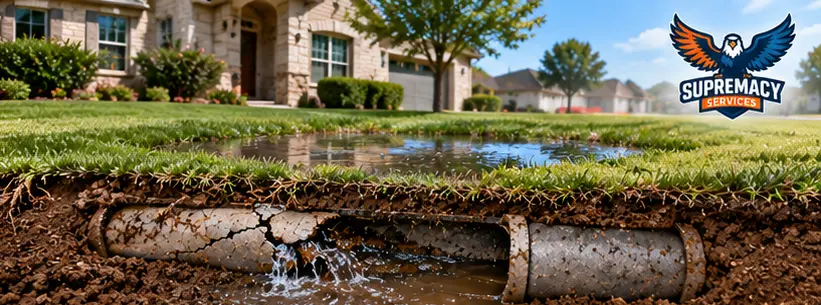
A buried sewer pipe can leak wastewater into the surrounding soil when it develops a crack, separated connection, or significant structural failure.
That can sometimes create an area of the yard that remains unusually:
Soft, wet, muddy, sunken, or foul-smelling.
The location can be particularly significant when the wet area appears close to the path of the building sewer.
Don’t automatically assume every soggy lawn means sewer damage. Irrigation leaks, grading problems, rainfall, and water-service leaks can produce similar symptoms.
If you are also experiencing plumbing problems inside the house, however, a sewer inspection becomes considerably more important.
Sewer leak or water-line leak?
This is an important distinction.
A damaged water service line carries clean, pressurized water toward your home. A sewer line carries wastewater away from it.
Water-line leaks are more commonly associated with unexplained water loss, pressure problems, or persistently wet ground without sewage characteristics. Sewer problems are more likely to accompany drain backups, foul odors, gurgling, or wastewater-related drainage issues.
7. One Area of Your Lawn Is Suddenly Greener Than Everything Else
An unusually lush patch of grass can look like good news.
Sometimes it isn’t.
Wastewater leaking from a buried line can alter moisture and nutrient conditions around the affected soil. Consequently, vegetation directly above or near the leak may sometimes become noticeably greener or grow faster than surrounding grass.
This sign becomes more significant when the same area is also:
- Soft or saturated
- Developing a sewage odor
- Beginning to sink
- Located along the sewer route
- Accompanied by slow drains or backups inside the house
Do not diagnose a broken sewer from greener grass alone. Irrigation coverage and drainage patterns should also be considered.
The goal is to look for multiple symptoms pointing toward the same underground problem.
8. You Notice Sinkholes, Depressions or Soil Movement
An underground leak can gradually disturb surrounding soil.
If wastewater continually escapes from a damaged pipe, soil can become saturated or eroded. Over time, homeowners may notice depressions, unusually soft ground, or changes to the surface above the affected area.
These conditions deserve professional evaluation, particularly when accompanied by sewer symptoms elsewhere.
Dallas homeowners should also be aware that underground private laterals are exposed to environmental stresses. City documentation discussing service lines specifically identifies factors such as ground shifting, tree-root penetration, corrosion, and temperature fluctuations as challenges affecting buried lines.
Never enter or attempt to excavate a sinkhole or unstable area yourself.
9. Tree Roots Are Affecting the Sewer Line
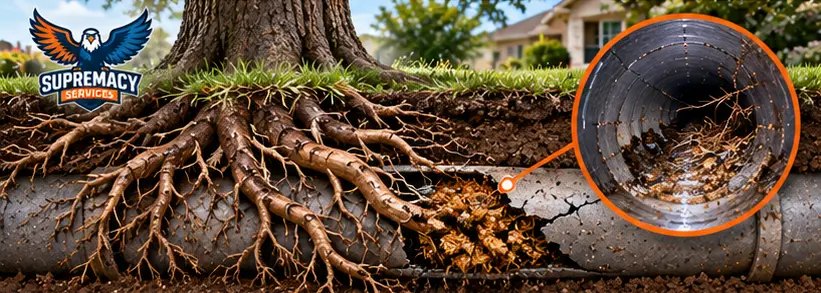
Trees are an important part of Dallas landscaping, but roots and sewer pipes can become a bad combination.
Roots naturally grow toward areas where moisture is available. If an older sewer pipe has a crack, loose joint, or other opening, fine roots may enter that opening and continue growing inside the pipe.
Over time, the root mass can catch toilet paper, grease, wipes, and other debris, progressively restricting wastewater flow.
EPA specifically identifies tree roots entering sewer defects or openings as one potential cause of sewer blockages.
Typical symptoms can include:
- Repeated main-line clogs
- Slow drainage
- Gurgling fixtures
- Backups
- Problems returning after conventional drain clearing
Removing roots can restore flow in some circumstances, but root removal does not necessarily repair the opening that allowed the roots into the pipe. A camera inspection can determine whether cleaning is sufficient or whether structural sewer repair should follow.
10. Your Sewer Camera Inspection Shows Cracks, Bellies or Collapse
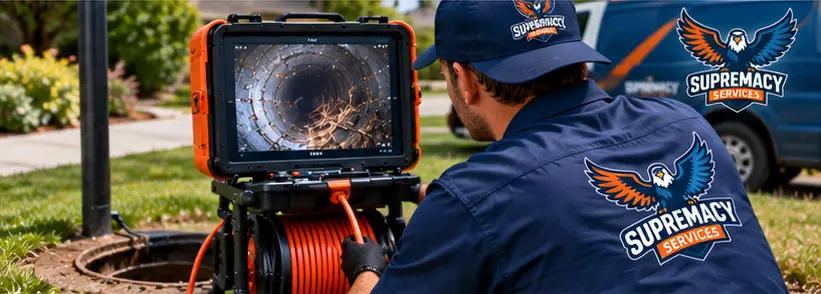
Some of the most important sewer problems cannot be diagnosed from symptoms alone.
A professional sewer camera can provide direct visual evidence of the pipe’s interior.
A technician may discover:
Cracks: openings in the pipe wall that can allow leakage or root intrusion.
Separated joints: connections that have shifted apart.
Root intrusion: roots growing through openings and restricting flow.
Pipe bellies: low sections where wastewater and solids can collect rather than maintaining proper gravity flow.
Corrosion or deterioration: weakening of older pipe materials.
Partial or complete collapse: significant structural failure that prevents normal flow.
This is where professional diagnosis becomes particularly valuable. Supremacy Services describes HD camera reconnaissance as the first stage of its sewer repair process before determining whether traditional excavation, pipe bursting, CIPP lining, or another approach is appropriate.
What Causes Sewer Line Damage in Dallas?
Recognizing the symptoms is only half the diagnosis. Determining why the sewer is failing helps determine whether the solution should be cleaning, localized repair, trenchless rehabilitation, or replacement.
Tree Root Intrusion
Roots usually do not need to crush a perfectly sealed modern pipe to cause trouble. Instead, they can exploit existing cracks, defective joints, or openings.
Once roots enter, they can expand and trap waste until flow becomes severely restricted. EPA recognizes root intrusion through sewer defects as a cause of sewer blockage.
Soil Movement and Pipe Shifting
Buried sewer lines depend on stable support and proper slope.
Movement of the surrounding soil can change pipe alignment, place stress on connections, or contribute to separations and low spots. Dallas documentation discussing underground laterals specifically notes ground shifting among the conditions that can affect these buried lines.
Aging or Deteriorating Pipes
Sewer materials do not remain in perfect condition indefinitely.
Older systems may become increasingly vulnerable to corrosion, joint deterioration, cracking, deformation, or root intrusion depending on pipe material and installation conditions.
Age alone does not automatically mean replacement is necessary. Actual pipe condition should drive the decision.
Improper Installation or Poor Slope
Gravity sewer systems need proper alignment and slope to move solids and wastewater effectively.
Dallas Water Utilities’ design guidance specifies minimum grades for wastewater service laterals, illustrating how important slope is to proper wastewater movement.
Improperly supported or poorly graded piping can create areas where solids repeatedly accumulate.
Grease, Wipes and Foreign Materials
Not every main sewer blockage begins with structural damage.
Fats, oils, grease, wipes, hygiene products, and inappropriate household materials can contribute to serious sewer restrictions. EPA specifically lists fats, oils, grease and various wipes and hygiene products among materials capable of contributing to blockages.
A good household rule remains simple:
Toilets are for human waste and toilet paper—not wipes, paper towels, hygiene products, grease, or household trash.
Clogged Drain vs. Damaged Sewer Line: What’s the Difference?
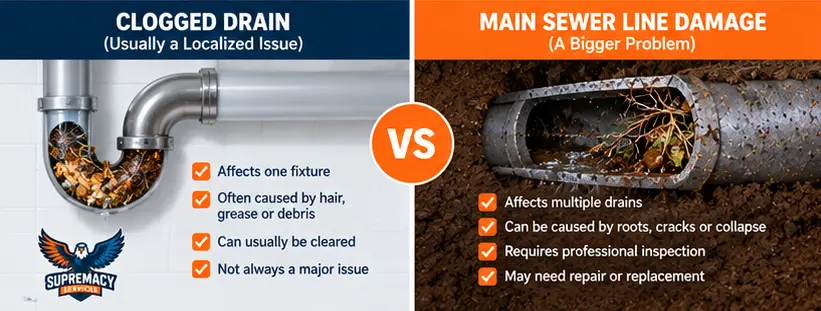
This section is important for both readers and SEO because homeowners often confuse drain cleaning with sewer line repair.
| Symptom | Local Drain Clog | Main Sewer Problem |
|---|---|---|
| One sink drains slowly | More likely | Less likely |
| Several drains slow together | Less likely | More concerning |
| Toilet affects bathtub/shower | Unusual | Concerning |
| Recurring whole-home clogs | Less likely | More concerning |
| Sewage at lowest drain | Unlikely | Strong warning sign |
| Soggy, foul-smelling yard | No | Possible |
| Roots/cracks on camera | No | Yes |
| Structural pipe collapse | No | Yes |
A drain clog usually involves an obstruction within a fixture or branch drain.
A sewer-line problem occurs farther downstream and may affect several fixtures because they share the same main drainage route.
This is why repeatedly snaking individual fixtures is not a substitute for investigating persistent whole-house drainage problems.
Sewer Line vs. Water Line Problems
These two systems perform opposite jobs:
Water line → brings clean water into the property.
Sewer line → carries wastewater away from the property.
A water-line problem may produce low pressure, unexplained water loss, or clean water accumulating in the yard.
A sewer problem is more closely associated with slow drains, wastewater backups, gurgling, sewage odors, recurring clogs, or sewer-camera evidence of structural damage.
This distinction prevents homeowners from pursuing the wrong repair.
How Professionals Diagnose a Damaged Sewer Line
Modern sewer diagnosis should be based on evidence—not guesswork.
Step 1: Evaluate the Symptoms
A plumber first determines whether the problem affects a single fixture, one branch, or multiple fixtures throughout the home.
Step 2: Access and Test the Drainage System
The technician may use an accessible cleanout to investigate the main sewer line.
Step 3: Perform a Sewer Camera Inspection
A specialized camera travels through the pipe so the technician can examine its interior and identify blockages, cracks, roots, bellies, separations, or collapsed areas.
Step 4: Locate the Problem
When structural damage is found, locating equipment can help establish where the defect sits underground. This can help reduce unnecessary excavation.
Step 5: Recommend the Appropriate Repair
The findings should determine the solution—not the other way around.
Supremacy’s published process includes HD camera reconnaissance followed by assessment of traditional and trenchless approaches before precision repair or replacement.
Sewer Line Repair vs. Replacement: Which Do You Need?
A damaged sewer does not automatically require complete replacement.
Sewer Line Repair May Be Appropriate When:
Damage is isolated to a relatively small section, the remaining pipe is structurally sound, and correcting the affected area can provide a durable solution.
Sewer Line Replacement May Be Better When:
The pipe has extensive deterioration, widespread defects, severe deformation, multiple failed sections, or significant collapse.
Trenchless Sewer Repair May Be an Option
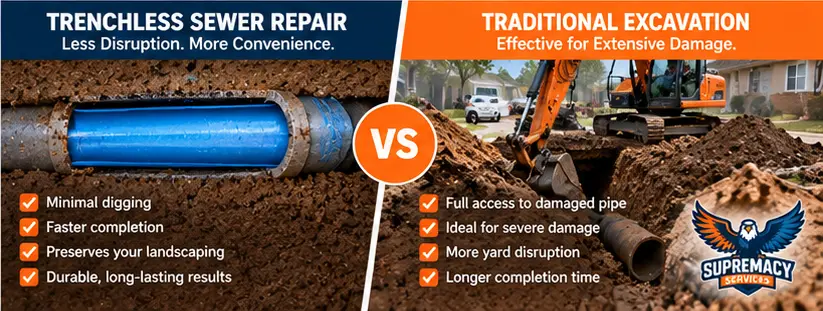
Depending on the pipe’s condition and site, trenchless techniques may reduce the amount of conventional excavation required.
Supremacy currently lists both CIPP lining and pipe bursting, in addition to traditional repair/replacement methods, among its Dallas-Fort Worth sewer options.
The right method should therefore be selected after inspection, rather than assuming every damaged sewer needs the same treatment.
What Should You Do If Sewage Is Backing Up Right Now?
Treat an active sewage backup differently from an ordinary slow drain.
Stop unnecessary water use so you are not sending additional wastewater toward the blockage. Keep children and pets away from contaminated areas and avoid direct contact with sewage.
EPA notes that raw sewage can carry bacteria, viruses, parasites, and other organisms capable of causing illness.
If there is reason to believe the problem involves the municipal wastewater main rather than your private sewer lateral, Dallas Water Utilities instructs residents to report clogged or overflowing wastewater mains through 3-1-1, or 214-670-3111 from outside Dallas city limits.
For a suspected private building-sewer problem, arrange professional inspection.
Why Early Sewer Line Repair Matters
Delaying diagnosis rarely makes structural sewer damage disappear.
A developing defect can contribute to increasingly frequent clogs, wastewater leakage, sewage backups, landscape damage, or more extensive pipe deterioration.
EPA notes that sewer overflows can cause property damage and create public-health concerns.
Early inspection also gives homeowners something extremely valuable: options.
A smaller localized defect may provide more repair possibilities than a pipe that has progressed to major structural failure.
Professional Sewer Line Repair in Dallas, TX
When several of these warning signs appear together, the next step should be diagnosis rather than guesswork.
Supremacy Services provides sewer line repair and replacement throughout Dallas and the DFW Metroplex, with HD sewer camera inspection and both traditional and trenchless repair approaches.
Whether the underlying problem is root intrusion, recurring blockage, a cracked sewer pipe, a belly, separated joint, or collapsed section, identifying the actual defect makes it possible to recommend a repair based on the condition of the line.
Frequently Asked Questions About Sewer Line Repair in Dallas
How do I know if my main sewer line is damaged?
Multiple slow drains, recurring whole-home clogs, gurgling fixtures, sewage backups, foul outdoor odors, unusual wet areas in the yard, and abnormalities discovered during a camera inspection can all justify further investigation. No single symptom proves structural damage, so professional diagnosis is important.
Does a slow drain mean I need sewer line repair?
Not necessarily. One slow fixture often indicates a localized clog. Several fixtures slowing simultaneously—or recurring problems after cleaning—make a main sewer restriction or structural issue more concerning.
Can tree roots damage a sewer line?
Roots can enter through existing openings, cracks, or defective joints and create significant blockages. EPA specifically identifies tree-root intrusion through sewer defects as a potential sewer-overflow cause.
Can a sewer camera tell if my pipe is broken?
A camera inspection can visually reveal many problems, including cracks, root intrusion, joint separation, deformation, buildup, and collapsed sections. Supremacy uses HD camera inspection as part of its sewer-line diagnostic process.
Can a damaged sewer line be repaired without digging up my entire yard?
Sometimes. Trenchless techniques such as CIPP lining or pipe bursting may be suitable depending on the type, location, and severity of damage. Supremacy lists both trenchless and traditional methods among its sewer repair options.
Is a sewer backup dangerous?
Potentially, yes. Untreated sewage can contain harmful microorganisms, which is why EPA and CDC recommend avoiding unnecessary contact with sewage-contaminated wa