10400 Clarence Drive, Frisco, TX 75033
Support 24/7: 945-777-3345
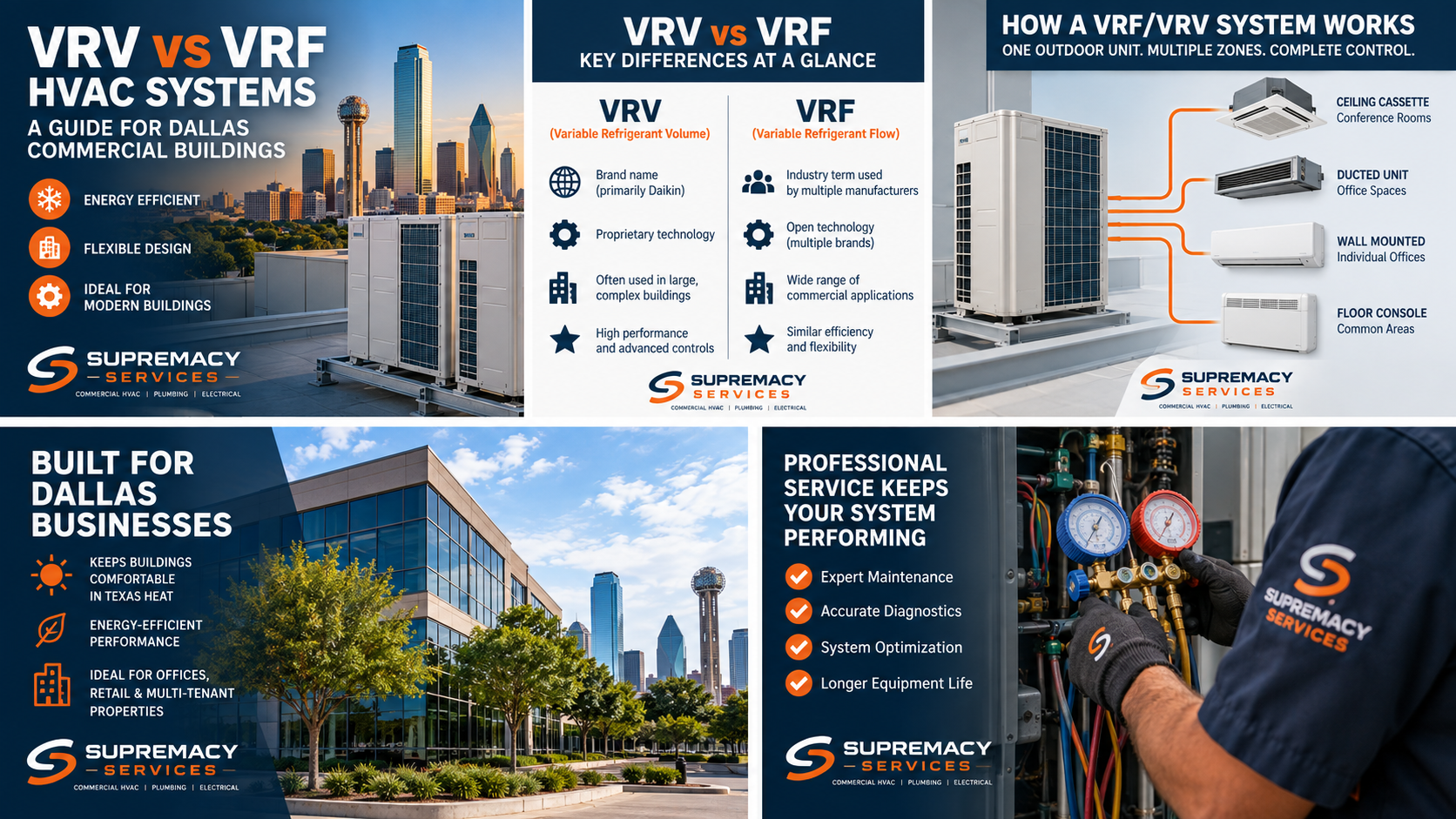
VRV and VRF HVAC systems on a Dallas commercial building rooftop

VRV vs VRF HVAC Systems: Dallas Commercial Building Guide

VRV vs VRF HVAC systems are essentially the same type of variable-refrigerant technology. VRF, or Variable Refrigerant Flow, is the generic industry term. VRV, or Variable Refrigerant Volume, is Daikin’s trademarked name for its version of the technology.

For Dallas commercial property owners, facility managers and developers, the more important question is therefore not simply VRV vs VRF. It is whether variable-refrigerant technology is appropriate for the building, and if so, whether the project requires a heat-pump, heat-recovery or other VRF configuration.

A properly designed VRF system can provide individual zone control, modulate capacity as building loads change and reduce the amount of conventional ductwork required. But VRF is not automatically the best HVAC system for every commercial building. Ventilation, humidity management, refrigerant requirements, controls, piping layout, serviceability and lifecycle cost all need to be considered before equipment is selected.

This guide explains what Dallas/DFW commercial property decision-makers should know.

VRV vs VRF: What Is the Difference?
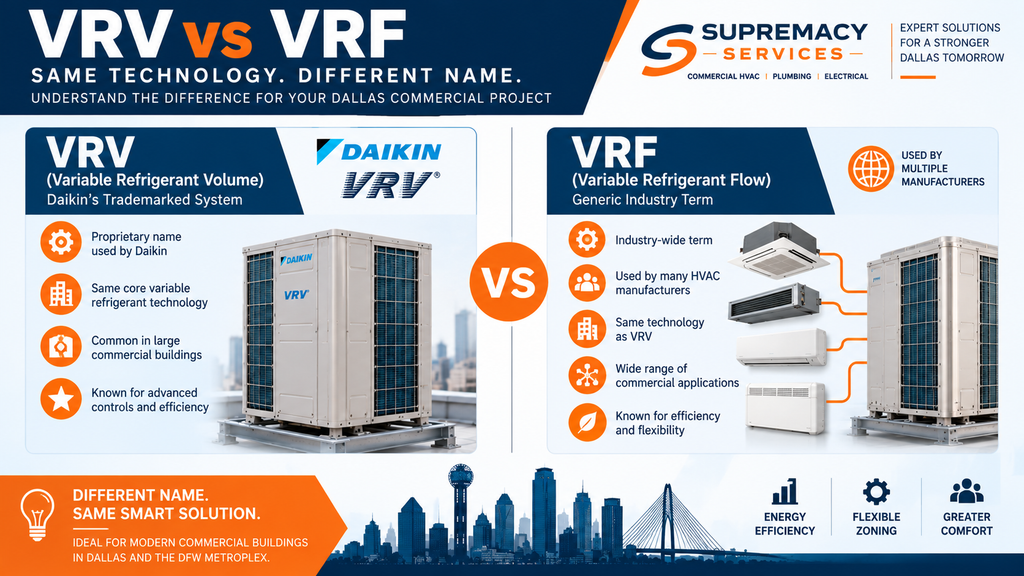
VRV vs VRF comparison explaining Daikin VRV terminology and the general VRF HVAC category
VRV and VRF use the same core variable-refrigerant technology; VRV is Daikin’s trademarked terminology, while VRF is the general industry term.

The simplest answer is:

VRF is the generic technology. VRV is Daikin’s trademarked terminology for its variable refrigerant system.

TermMeaningWhat You Should Know
VRFVariable Refrigerant FlowGeneric industry term
VRVVariable Refrigerant VolumeDaikin trademark
Basic technologyVariable-capacity, multi-zone direct-expansion HVACBoth regulate refrigerant according to zone demand
Commercial applicationsOffices, hotels, retail, multifamily, education and other multi-zone buildingsSuitability depends on project design
Main decisionNot simply VRV versus VRFCompare system configuration, manufacturer, controls, ventilation, service support and lifecycle requirements

The U.S. Department of Energy defines commercial VRF equipment as split-system equipment using one or more outdoor units, variable-capacity compressors and multiple individually controlled indoor fan-coil units connected through common refrigerant piping and controls.

In practical terms, the outdoor equipment does not simply operate at full capacity and stop whenever a thermostat is satisfied. The system can adjust capacity as individual zones require more or less heating or cooling.

That modulation is one of the fundamental differences between VRF technology and many conventional constant-capacity HVAC arrangements.


How Does a VRF HVAC System Work?

A Variable Refrigerant Flow HVAC system controls how much refrigerant is delivered to multiple indoor zones according to their individual heating or cooling loads.

Commercial VRF HVAC system diagram showing outdoor unit, refrigerant piping and multiple indoor comfort zones
A VRF/VRV system varies refrigerant flow to serve multiple indoor zones from shared outdoor equipment.

A typical commercial system contains:

  • one or more outdoor units;
  • inverter-driven or variable-capacity compressors;
  • refrigerant piping;
  • multiple indoor fan-coil units;
  • electronic expansion/control devices;
  • individual zone controls;
  • a communications network; and
  • centralized controls or building-management integration where specified.

Each indoor zone communicates its demand to the system.

Instead of conditioning every part of the building identically, the system adjusts its output according to the load being experienced by individual spaces.

Consider a Dallas office building at 3 p.m. The west-facing conference room may experience a substantial solar load while an interior office has much less cooling demand. A properly designed variable-refrigerant system can respond differently to those zones instead of treating the entire floor as one thermal space.

That is why VRF is particularly relevant to buildings with varying occupancy, exposures and operating schedules.

VRF Heat Pump vs Heat Recovery: An Important Distinction
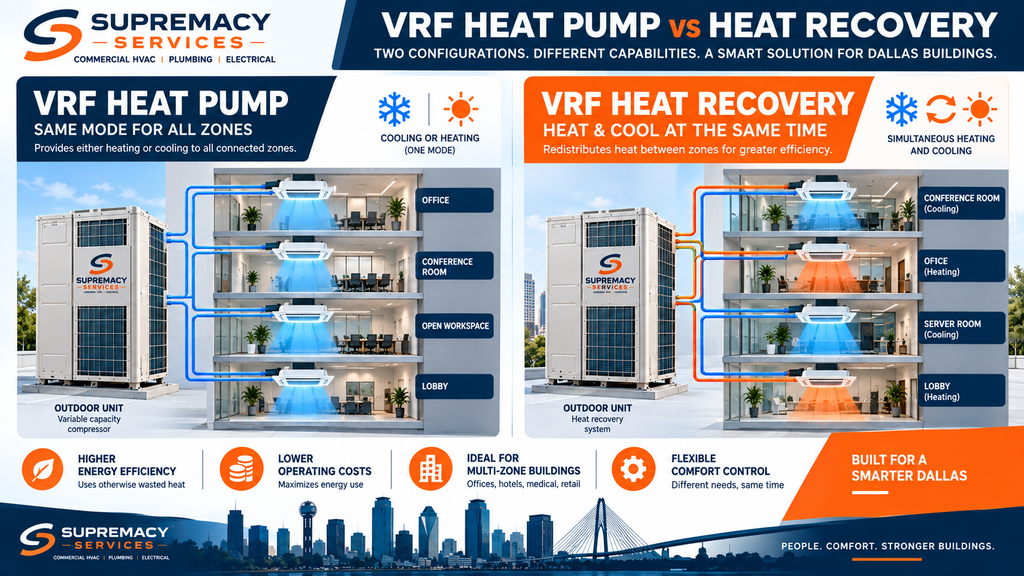
VRF heat pump vs heat recovery system showing single-mode and simultaneous heating and cooling zones
VRF heat-pump systems generally serve connected zones in one operating mode, while heat-recovery configurations can support simultaneous heating and cooling.

There are two major configurations commercial building owners frequently encounter.

VRF Heat Pump Systems

A VRF heat-pump system provides both heating and cooling, but connected zones generally operate in the same overall mode.

It can make sense for buildings where thermal requirements across the connected zones are relatively similar.

VRF Heat Recovery Systems

A heat-recovery VRF system can allow some zones to cool while other zones heat at the same time, depending on the system design.

Rather than simply rejecting all heat removed from a cooling zone outdoors, heat-recovery technology can redistribute useful heat to another zone that requires heating.

This can be particularly valuable in buildings with very different simultaneous loads, including:

  • offices with perimeter and interior zones;
  • hotels;
  • medical and professional buildings;
  • mixed-use facilities;
  • multifamily buildings;
  • educational buildings; and
  • properties with different solar exposures.

For example, a south- or west-facing office may require cooling while an interior or shaded zone requires heat. Heat-recovery technology can accommodate those competing requirements when the system is designed for simultaneous operation.

VRF vs Traditional Commercial HVAC

There is no universal winner. The right technology depends on the building.

ConsiderationVRF/VRVConventional Rooftop or Ducted System
Zone controlHighly granularDepends on zoning design
Capacity controlVariable/modulatingDepends on equipment
DuctworkOften reducedUsually more extensive
Refrigerant pipingMore extensiveGenerally more centralized
Simultaneous heating/coolingAvailable with heat-recovery configurationsDepends on system design
Individual tenant controlStrong potentialVaries
VentilationOften requires separate designFrequently integrated into air system
ControlsCan be sophisticatedVaries widely
InstallationRequires VRF-specific design and commissioning expertiseMore familiar to many contractors
Best applicationMulti-zone buildings with diverse loadsBroad range of commercial buildings

VRF should therefore be treated as one HVAC architecture among several, not as an automatic upgrade from conventional equipment.

A rooftop-unit system, split system, heat pump, chilled-water system or another commercial HVAC design may be more appropriate depending on building size, ventilation load, redundancy requirements, budget and existing infrastructure.


Why Dallas Commercial Buildings May Consider VRF

Dallas and the broader DFW Metroplex contain a wide range of commercial properties: office buildings, medical suites, restaurants, retail centers, hotels, schools, multifamily properties and tenant-improvement projects.

Several characteristics of these buildings can make zone-level HVAC control attractive.

1. Different Solar Loads

A building’s east, south, west and interior zones do not experience identical loads throughout the day.

Variable-capacity zoning allows the HVAC system to respond to those differences more precisely.

2. Long Cooling Seasons

Cooling performance is a major design consideration in North Texas.

That makes equipment sizing, part-load performance, heat rejection, refrigerant piping and controls particularly important when evaluating a VRF application.

3. Changing Occupancy

Conference rooms, private offices, lobbies, retail areas and other spaces can have very different occupancy schedules.

A system capable of responding independently to zone demand can help avoid treating an entire building as if every space has the same load.

4. Tenant Finish-Outs

Commercial tenant spaces may need independent comfort control while available ceiling and mechanical space is limited.

The smaller duct distribution requirements possible with VRF can make the technology worth evaluating during certain renovations and tenant improvements.

5. Mixed Thermal Loads

Perimeter zones exposed to outdoor conditions can behave very differently from interior zones.

Buildings with simultaneous heating and cooling demands may therefore be candidates for heat-recovery VRF.

Where Does VRF Work Best?

VRF tends to deserve serious consideration where independent zones, changing loads, limited duct space or simultaneous heating and cooling are important project requirements.

Potential applications include:

Office Buildings

Different floors, departments, conference rooms and perimeter offices can receive independent temperature control.

Hotels and Hospitality

Guest rooms naturally form individual HVAC zones with highly variable occupancy.

Medical and Professional Offices

Individual rooms may have different loads and operating schedules, although ventilation, filtration, pressurization and applicable healthcare requirements must be evaluated separately.

Retail and Mixed-Use Buildings

Different tenants can have substantially different operating schedules and internal loads.

Multifamily Buildings

Individual unit control makes variable-refrigerant systems a design option for certain multifamily projects.

Historic or Retrofit Buildings

Where large new duct shafts are impractical, smaller refrigerant piping can provide an architectural advantage.

That does not eliminate the need for ventilation air.

VRF Does Not Replace Proper Ventilation

This is one of the most important points for commercial building owners to understand.

Heating and cooling a room is not the same as ventilating it.

VRF indoor units primarily handle zone heating and cooling. Commercial buildings still require a ventilation strategy appropriate to occupancy, building use and applicable codes.

Depending on the project, designers may pair VRF with a Dedicated Outdoor Air System (DOAS) or another ventilation arrangement.

The ventilation system may need to address:

  • outdoor-air delivery;
  • filtration;
  • humidity;
  • exhaust;
  • building pressure; and
  • latent loads.

Treating VRF equipment and ventilation as a complete engineered system rather than isolated equipment selections is particularly important in commercial construction.

What Are the Advantages of VRF HVAC?

Individual Zone Control

Occupants or building controls can maintain different setpoints across different areas.

Variable Capacity

Inverter-driven compressors allow system output to respond to changing demand instead of relying solely on simple full-output cycling.

Heat Recovery

Appropriately configured systems can move heat between zones requiring cooling and zones requiring heating.

Reduced Ductwork

VRF still requires airflow at indoor units and usually a separate ventilation strategy, but extensive central supply and return duct networks may be reduced.

Flexible Indoor Units

Depending on the manufacturer and system, options can include:

  • ceiling cassettes;
  • concealed ducted units;
  • wall-mounted units;
  • floor-mounted units; and
  • other specialty configurations.
Centralized Controls

Commercial VRF systems can support centralized scheduling and monitoring and, where designed for it, integration with building automation systems.

What Are the Disadvantages of VRF?

VRF has significant advantages, but commercial buyers should also understand its limitations.

Higher Design Complexity

Refrigerant piping lengths, elevation differences, branch devices, equipment combinations and system controls must remain within manufacturer requirements.

This is not equipment that should be selected solely by matching a nominal tonnage to the building.

Ventilation Requires Separate Attention

A building can maintain the desired thermostat temperature and still have an inadequate ventilation or humidity-control strategy.

Refrigerant Management Matters

VRF places a distributed refrigerant network throughout a building. Refrigerant charge, occupied-space requirements, leak considerations and applicable codes therefore need to be addressed during design.

Specialized Service Knowledge

Troubleshooting can involve refrigerant circuits, electronic expansion valves, inverter technology, sensors, communications networks and proprietary controls.

Service capability should be evaluated before choosing a manufacturer—not after the building is occupied.

Controls Can Become a Weak Point

A sophisticated HVAC system with poorly configured controls can still perform poorly.

Commissioning, control sequences, sensor placement and operator training matter.


VRF System Cost in Dallas: What Determines the Price?

There is no responsible flat per-square-foot price for a commercial VRF project without knowing the building and scope.

Two Dallas buildings with the same floor area can require very different systems.

Important cost variables include:

Cost FactorWhy It Matters
Building cooling/heating loadsDetermines required equipment capacity
Number of zonesAffects indoor units and controls
Heat pump vs heat recoveryChanges equipment and piping architecture
Building size/layoutInfluences piping and installation complexity
Outdoor-unit locationAffects structural, electrical and access requirements
Indoor-unit typeCassettes, concealed ducted and other units have different installation needs
Ventilation systemDOAS or other outdoor-air equipment can materially affect project scope
Controls/BAS integrationAdds controls engineering and commissioning
Electrical workExisting service may require modifications
Existing HVAC removalDemolition can add labor and logistics
Crane/roof accessMay affect equipment-setting costs
Permits and inspectionsDepend on project and municipality
Refrigerant requirementsAffect equipment selection and design
Construction phasingOccupied buildings can require staged work

For that reason, a credible commercial proposal should begin with the building—not with an advertised equipment price.

What Should a Commercial VRF Assessment Include?

Before approving a VRF installation, owners should expect a qualified team to evaluate more than equipment tonnage.

1. Building Load Analysis

Heating and cooling loads should be determined by zone.

2. Zoning Strategy

The designer should identify which spaces genuinely require independent control and which can reasonably operate together.

3. Heat Pump vs Heat Recovery

Buildings with frequent simultaneous heating and cooling may justify heat-recovery architecture.

4. Ventilation and Humidity Strategy

The project must determine how outdoor air and latent loads will be handled.

5. Refrigerant Piping Design

Pipe lengths, elevations, branch locations and manufacturer limitations should be checked.

6. Refrigerant Safety Review

System charge and occupied-space considerations must be evaluated under applicable codes and manufacturer requirements.

7. Electrical Requirements

Outdoor units, indoor units, branch devices, controls and ventilation equipment all need coordinated electrical service.

8. Controls

Determine whether the property needs local controllers, centralized controls, scheduling, energy monitoring or BAS integration.

9. Service Access

Equipment should remain accessible for filter service, condensate maintenance, electrical diagnostics and refrigerant-system work.

10. Commissioning

Startup should verify refrigerant-system integrity, addressing, controls, airflow, drainage and operating performance.


What Dallas Building Owners Should Know About Permits and Licensing

Commercial HVAC work in Texas is regulated.

The Texas Department of Licensing and Regulation regulates air-conditioning and refrigeration contractors, and contractor license class affects the size of equipment on which a contractor can work.

For commercial projects, this distinction can matter considerably because TDLR states that a Class A license permits work on equipment of any size, while Class B is subject to capacity limits.

Dallas also has mechanical permitting and inspection requirements for commercial work.

A commercial VRF project may therefore involve coordination among the HVAC contractor, mechanical engineer, electrical contractor, general contractor, architect and local permitting authority depending on project scope.

Building owners should confirm the applicable requirements for the actual municipality in which the property is located. Dallas, Frisco, Plano, Fort Worth and other DFW jurisdictions do not necessarily have identical administrative procedures.

2026 Refrigerant Rules Make Equipment Selection More Important

Commercial HVAC refrigerants are undergoing an important regulatory transition.

Under the federal AIM Act framework, the EPA is restricting higher-global-warming-potential refrigerants across several HVAC equipment categories.

For variable refrigerant flow systems, EPA currently lists a 700 GWP limit with a January 1, 2027 installation compliance date, subject to specific provisions and transition conditions.

That makes refrigerant strategy an important part of a new VRF project in 2026.

Owners planning a long-lived commercial installation should ask:

  • Which refrigerant does the proposed equipment use?
  • What EPA transition rules apply to this project?
  • Are any transition provisions being relied upon?
  • How does the refrigerant affect equipment selection?
  • What safety requirements apply?
  • Are technicians trained for the refrigerant used?
  • What will long-term service support look like?

Equipment should not be selected from an old specification without confirming that it remains appropriate for the project’s procurement and installation timeline.

VRF vs Mini-Split: Are They the Same?

No.

Both technologies use direct-expansion refrigerant systems and inverter technology is common to both, but the terms are not interchangeable.

A ductless mini-split commonly connects one outdoor unit with one or a relatively small number of indoor units.

Commercial VRF is designed as a larger, integrated multi-zone system with sophisticated refrigerant management, controls and system architecture.

Think of VRF as a building-level multi-zone HVAC platform rather than simply a collection of wall-mounted mini-splits.

VRF vs Rooftop Units

VRF HVAC vs rooftop unit comparison for Dallas commercial buildings
VRF and rooftop HVAC systems serve different commercial-building needs, making zoning, ductwork, controls, installation and building layout important comparison factors.

Dallas commercial properties frequently use packaged rooftop units, or RTUs.

RTUs remain practical for many buildings because they consolidate major HVAC components into packaged equipment and can serve ducted zones efficiently.

VRF may become more attractive where:

  • many independent zones are required;
  • duct space is constrained;
  • tenant schedules vary significantly;
  • part-load operation is important; or
  • simultaneous heating and cooling is desirable.

RTUs may remain attractive where:

  • large open spaces dominate;
  • the existing duct system is suitable;
  • straightforward serviceability is a priority;
  • first-cost considerations favor packaged equipment; or
  • the building does not require extensive individual zoning.

A proper comparison should be based on the actual building rather than technology preference.

VRF vs Chilled-Water Systems

Chilled-water systems and VRF approach building conditioning differently.

A chiller creates chilled water that is circulated through a hydronic distribution system. VRF moves refrigerant through the building to indoor units.

Large facilities, campuses and buildings with substantial central-plant infrastructure may continue to favor chilled water.

VRF can be particularly attractive for smaller and midsize multi-zone buildings or projects where decentralized zone control and reduced ductwork are priorities.

The decision should consider first cost, energy modeling, maintenance capabilities, redundancy, refrigerant management, expected building life and future expansion.

Warning Signs an Existing VRF System Needs Professional Attention

Commercial VRF troubleshooting should be handled by technicians familiar with the particular equipment and controls.

Potential warning signs include:

  • repeated system fault codes;
  • multiple zones failing simultaneously;
  • one or more zones unable to maintain setpoint;
  • unexpected heating/cooling mode conflicts;
  • recurring condensate problems;
  • unusual compressor or outdoor-unit noise;
  • communication errors;
  • unexplained energy-use changes;
  • repeated refrigerant-related service issues; or
  • frequent resets required to restore operation.

Because multiple indoor units can share common outdoor equipment and communications, a problem visible in one room does not always originate at that indoor unit.

Can Building Staff Maintain a VRF System?

Building staff can handle certain routine facility-management tasks where permitted by the manufacturer and site procedures.

Examples may include monitoring alarms, keeping air paths unobstructed and arranging routine filter maintenance.

Refrigerant work, electrical diagnostics, inverter faults, compressor problems, leak diagnosis and system commissioning should be handled by appropriately qualified professionals.

In Texas, HVAC contracting and technician activities are subject to TDLR licensing and registration requirements.

How Should VRF Systems Be Maintained?

Maintenance requirements vary by manufacturer and application, but a commercial maintenance program may address:

  • indoor-unit filters;
  • coils;
  • condensate drains and pumps;
  • outdoor coils;
  • electrical connections;
  • refrigerant-system condition;
  • controls and communications;
  • sensors;
  • fault histories;
  • operating temperatures and pressures where appropriate;
  • ventilation equipment; and
  • overall system performance.

Maintenance should also account for the building’s operating environment.

A restaurant, medical office, hotel and conventional office building do not necessarily require identical maintenance strategies even when they use similar HVAC technology.

How to Decide Whether VRF Is Right for Your Dallas Building

Before selecting equipment, answer these questions:

How many genuinely independent zones does the building need?

If most spaces have identical loads and schedules, highly granular zoning may provide less value.

Do different areas frequently need heating and cooling at the same time?

If yes, heat recovery deserves evaluation.

How will outdoor ventilation air be delivered and conditioned?

VRF should not be specified without answering this.

Is ceiling or shaft space limited?

Reduced duct requirements can become a major design advantage.

Does the building have an existing BAS?

Confirm integration requirements before selecting controls.

Who will maintain the equipment?

Local technical support and parts availability matter over the life of the system.

What refrigerant does the proposed system use?

Verify current regulatory and safety implications.

What is the total lifecycle cost?

Compare installation, electrical work, ventilation equipment, controls, commissioning, energy consumption, maintenance and expected replacement requirements—not just outdoor-unit pricing.

What to Expect From a Professional Commercial HVAC Evaluation

A serious VRF evaluation should begin with questions rather than an immediate equipment recommendation.

The process may include:

  1. reviewing building plans and existing mechanical systems;
  2. documenting current comfort or operating problems;
  3. identifying occupancy schedules and tenant requirements;
  4. evaluating zone-by-zone loads;
  5. reviewing available electrical capacity;
  6. examining roof, mechanical and ceiling-space constraints;
  7. determining ventilation requirements;
  8. evaluating heat-pump versus heat-recovery configurations;
  9. coordinating refrigerant and condensate piping;
  10. reviewing controls/BAS requirements;
  11. considering applicable codes and permits; and
  12. developing an installation and commissioning plan.

For an existing occupied property, project phasing should also be considered so HVAC work does not unnecessarily disrupt tenants or business operations.

The Bottom Line: VRV vs VRF HVAC Systems

VRV and VRF do not represent two fundamentally different HVAC technologies. VRF is the generic term for Variable Refrigerant Flow, while VRV is Daikin’s trademarked Variable Refrigerant Volume terminology.

For Dallas commercial buildings, the bigger decision is whether variable-refrigerant technology fits the property’s loads, zoning, ventilation requirements, architecture, controls and long-term operating strategy.

VRF can be an excellent solution where a commercial building needs precise zone control, variable capacity, flexible equipment placement or simultaneous heating and cooling. But those advantages depend heavily on proper engineering, refrigerant piping, ventilation design, controls, installation and commissioning.

Before choosing equipment, evaluate the whole building system.

Planning a Commercial HVAC Project in Dallas–Fort Worth?

Supremacy Services can evaluate your commercial property’s HVAC requirements alongside the broader mechanical and building infrastructure involved in the project.

For a new construction project, tenant improvement, major HVAC replacement or multi-zone system evaluation, begin with a building-specific assessment rather than selecting equipment solely from nominal capacity.

Request a commercial HVAC assessment from Supremacy Services to discuss your Dallas/DFW project requirements.


Frequently Asked Questions

Is VRV better than VRF?

VRV and VRF are not competing technology categories. VRF is the generic term for Variable Refrigerant Flow, while VRV is Daikin’s trademarked terminology for its Variable Refrigerant Volume systems. Compare specific equipment, system architecture, controls, serviceability and project suitability instead.

What does VRF stand for in HVAC?

VRF stands for Variable Refrigerant Flow. The system varies refrigerant flow to multiple indoor units according to individual zone heating or cooling demand.

What does VRV stand for?

VRV stands for Variable Refrigerant Volume. It is terminology associated with Daikin’s variable-refrigerant HVAC technology and is a Daikin trademark.

Can VRF heat and cool at the same time?

Heat-recovery VRF systems can be designed to provide simultaneous heating and cooling to different zones. Standard heat-pump VRF configurations generally operate connected zones in the same heating or cooling mode.

Does VRF provide fresh air?

VRF indoor units should not automatically be assumed to satisfy a commercial building’s ventilation requirements. Projects often use separate outdoor-air equipment, such as a DOAS, depending on building design and code requirements.

Is VRF good for commercial buildings?

It can be. VRF is particularly worth evaluating for multi-zone buildings with varying loads, limited duct space, individual tenant requirements or simultaneous heating and cooling demands.

Is VRF the same as a mini-split?

No. The technologies share some principles, but commercial VRF systems typically serve substantially more zones and use more sophisticated refrigerant distribution, communications and centralized controls.

How much does a commercial VRF system cost in Dallas?

There is no reliable universal price without evaluating the project. Capacity, number of zones, ventilation equipment, heat-recovery requirements, piping, controls, electrical work, demolition, roof access, permitting and construction phasing can all materially change the installed cost.

Do VRF systems need ductwork?

Some VRF indoor units are ductless, while others use short duct runs. Separate ductwork may also be required for outdoor ventilation air. The answer depends on the indoor-unit and ventilation design.

Who can install a VRF system in Texas?

Texas regulates air-conditioning and refrigeration contracting through the Texas Department of Licensing and Regulation. Commercial property owners should verify that contractors have the licensing appropriate to the scope and equipment involved and comply with applicable local permitting requirements.

Furnace blowing cold air in a Dallas home as a homeowner checks a floor vent for heat

Furnace Blowing Cold Air in Dallas? Causes & Solutions

If your furnace is blowing cold air in Dallas, first check the thermostat, air filter and whether the system has had enough time to complete a heating cycle. If cold air continues, the problem may involve restricted airflow, ignition failure, a dirty flame sensor, a tripped safety control, duct leakage or another furnace component that requires professional diagnosis.

Some causes are simple enough for a homeowner to check safely. Others—especially problems involving gas, combustion, electrical components or repeated furnace shutdowns—should be left to a qualified HVAC professional.

Here is how to tell the difference.

Why Is My Furnace Blowing Cold Air?

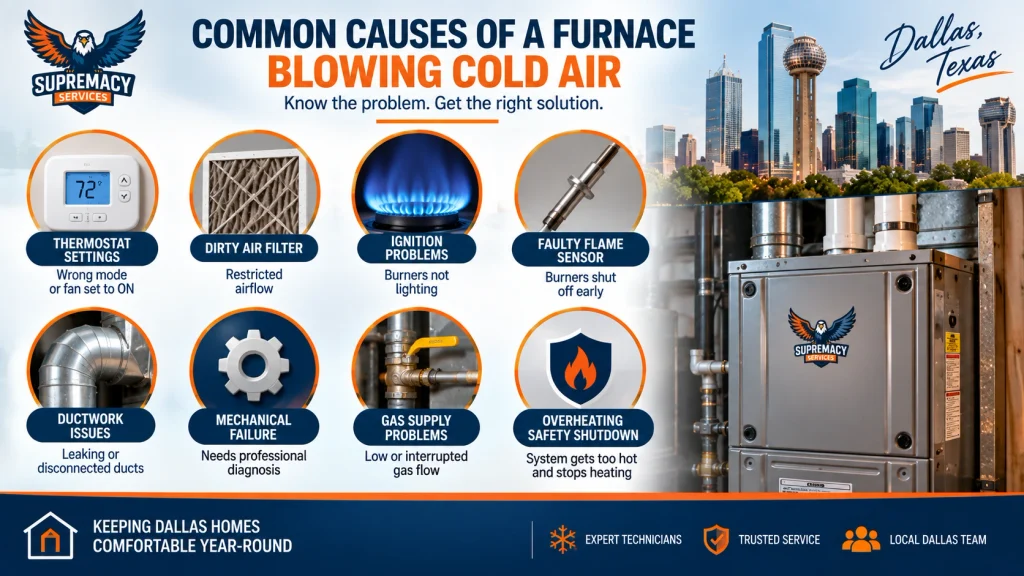
Common causes of a furnace blowing cold air including thermostat, dirty filter, ignition, flame sensor and ductwork problems
A furnace can blow cold air because of thermostat settings, restricted airflow, ignition failure, flame-sensor problems, duct issues or other system faults.

A furnace can blow cold or lukewarm air when the blower is moving air but the system is not successfully producing or delivering heat.

The most common possibilities include:

Possible causeWhat you may noticeHomeowner action
Thermostat set to ON instead of AUTOFan runs even between heating cyclesChange fan setting to AUTO
Dirty/restricted air filterWeak airflow, long cycles or shutdownsInspect and replace if appropriate
Furnace has just startedBrief cool airflow before heat arrivesWait for the heating cycle
Ignition problemFurnace attempts to start but does not heatProfessional diagnosis
Dirty/failing flame sensorBurners ignite, then shut offProfessional service
Gas/fuel supply issueFurnace cannot establish heatStop troubleshooting and seek service
Overheating/safety shutdownFurnace repeatedly starts and stopsCheck filter; schedule diagnosis if persistent
Duct leakageSome rooms or vents feel much colderDuct/HVAC inspection
Heat pump operationAir may feel less hot than gas-furnace airVerify operating mode
Mechanical/electrical failureBlower operates but heating does notProfessional furnace repair

Start with the simplest checks before assuming the furnace itself has failed.

1. Check Your Thermostat First

Thermostat fan ON versus AUTO settings showing how AUTO supports normal furnace heating cycles
If the thermostat fan is set to ON, the blower can circulate room-temperature air between heating cycles. AUTO generally runs the fan with system calls for heating or cooling.

A thermostat setting is one of the easiest explanations for a furnace that appears to be blowing cold air.

Look at two settings:

Set the system to HEAT

Confirm that the thermostat is actually in HEAT mode and that the temperature setting is above the current indoor temperature.

Set the fan to AUTO

If the fan is set to ON, the blower may operate continuously—even when the furnace is not actively heating.

That means warm air may come through the vents during the heating cycle and cooler room-temperature air may follow after the burners shut off.

Changing the fan setting from ON to AUTO allows the blower to operate primarily when the HVAC system calls for it.

If the thermostat settings are correct but the vents continue delivering cold air throughout the heating cycle, move to the next checks.

2. The Furnace May Simply Be Starting Its Heating Cycle

Cold air for a very short period at startup does not automatically mean something is wrong.

Depending on the equipment and control sequence, the blower and heating components do not necessarily begin operating at exactly the same moment. Likewise, some systems continue moving air briefly after the heating portion of a cycle ends.

The important distinction is duration.

Brief cool airflow can be normal. Continuous cold air while the thermostat is calling for heat is not.

If your home temperature continues falling despite repeated furnace cycles, troubleshooting is warranted.

3. A Dirty Air Filter May Be Restricting Airflow

Clean furnace filter compared with a dirty clogged filter restricting HVAC airflow
A heavily clogged furnace filter can restrict airflow and contribute to heating-system performance problems. Check the filter as one of your first troubleshooting steps.

A severely dirty filter can reduce airflow through a forced-air heating system.

The U.S. Department of Energy notes that a clogged filter can substantially reduce airflow, increase furnace runtime and increase stress on the blower motor.

Restricted airflow can also contribute to furnace operating problems because heat needs to move away from the furnace and into the duct system properly.

What Dallas homeowners can check

Locate your HVAC filter and inspect it according to the equipment manufacturer’s instructions.

Replace it if it is visibly dirty and your system uses a replaceable filter.

Do not automatically install the highest-MERV filter you can find. Your HVAC system needs a filter compatible with its airflow requirements.

If replacing a dirty filter restores normal operation, continue monitoring the furnace. If the system repeatedly overheats, shuts down or returns to blowing cold air, professional diagnosis is appropriate.

4. The Furnace May Have an Ignition Problem

HVAC technician inspecting furnace ignitor, flame sensor, burners and gas valve during furnace diagnosis
Ignition and flame-sensing problems can interrupt the heating sequence even while the furnace blower continues operating.

Modern gas furnaces need a reliable ignition sequence before heat can be produced.

Depending on the furnace design, that sequence can involve components such as:

  • an inducer motor;
  • pressure switches;
  • an electronic ignitor;
  • gas controls;
  • burners;
  • a flame sensor;
  • temperature and safety controls.

If part of that sequence fails, the blower may still operate even though the furnace never establishes normal combustion.

A homeowner might notice the furnace repeatedly attempting to start, starting and stopping quickly, or running the fan without producing heat.

Can you fix furnace ignition problems yourself?

Generally, internal gas-furnace ignition troubleshooting should be left to a qualified professional.

Do not bypass a safety switch, manually manipulate gas controls or repeatedly reset a furnace that refuses to stay operating. Safety controls shut systems down for a reason.

5. A Dirty or Faulty Flame Sensor Can Shut the Burners Down

The flame sensor is an important safety component in many gas furnaces.

Its job is to confirm that a flame is present after ignition. If the furnace’s controls do not receive the expected flame signal, the system can shut off the gas supply.

One possible symptom is:

the burners ignite, operate briefly and then shut off while the blower continues moving air.

That can make it seem as though the furnace suddenly begins blowing cold air.

A dirty flame sensor is only one possible explanation for this behavior, however. Ignition components, wiring, controls, gas supply and other safety devices can produce similar symptoms.

This is why diagnosis is preferable to replacing parts based only on symptoms.

Contextual CTA: If your furnace repeatedly lights and shuts down or the blower runs without producing heat, schedule a professional [furnace repair in Dallas] rather than repeatedly resetting the system.

6. The Furnace May Be Overheating and Triggering a Safety Limit

It sounds contradictory, but a furnace that gets too hot can eventually result in cold air coming from the vents.

Forced-air furnaces need adequate airflow to carry heat away from the equipment.

When airflow becomes restricted or another operating problem causes excessive temperature, safety controls can interrupt heating operation. The blower may continue running as the system attempts to remove heat.

Potential contributors can include:

  • a severely restricted filter;
  • blocked or restricted airflow;
  • blower problems;
  • closed or obstructed registers;
  • internal furnace problems.

If the furnace repeatedly heats, shuts its burners off and continues running the blower, do not assume the safety switch itself is the problem. The control may be responding correctly to an underlying condition.

Repeated overheating needs professional diagnosis.

7. There Could Be a Gas-Supply or Combustion Problem

A gas furnace cannot heat your home if it cannot safely establish and maintain combustion.

Possible problems may involve the appliance’s gas controls, ignition system, burners or fuel supply.

This is not an appropriate area for DIY experimentation.

Stop and get help if you smell gas

If you suspect a gas leak, do not continue furnace troubleshooting or attempt to repair the appliance yourself. Leave the affected area and follow your gas utility’s emergency instructions.

Likewise, a carbon-monoxide alarm should never be treated as a furnace troubleshooting notification.

If a CO alarm sounds, move outside to fresh air and contact emergency services. Do not re-enter the home until authorities say it is safe.

Carbon monoxide is colorless and odorless, so smell cannot be used to determine whether CO is present.

8. Leaking or Damaged Ductwork Can Make Heated Air Feel Cold

Sometimes the furnace is producing heat correctly but the problem occurs after the air leaves the equipment.

Leaks, disconnected duct sections or inadequate duct insulation can affect the temperature and volume of air reaching living spaces.

This is particularly worth investigating when:

  • one part of the house heats normally while another remains cold;
  • airflow is noticeably weaker from certain registers;
  • the furnace appears to operate normally;
  • temperature differences are concentrated in specific rooms.

A duct inspection can help separate an air-distribution problem from a furnace combustion or mechanical problem.

9. Make Sure You Actually Have a Furnace Problem

Not every Dallas home uses a conventional gas furnace as its only source of heat.

Homes equipped with heat pumps operate differently.

A heat pump normally supplies air that may feel less intensely hot at the register than air from a gas furnace. During colder weather, some systems also use auxiliary or backup heat.

That means air that feels merely warm—or cooler than you expect—doesn’t necessarily indicate a failed system.

The better questions are:

Is the home reaching the thermostat setpoint? Is the indoor temperature rising? Is the system operating continuously without catching up?

If the house is getting colder while the equipment runs, diagnosis is warranted.


Furnace Blowing Cold Air: What Can You Safely Check Yourself?

DIY furnace checks compared with professional furnace repair for persistent cold air and ignition problems
Homeowners can safely check basic items such as thermostat settings, filters and blocked vents. Persistent cold air, ignition failures and internal furnace problems warrant professional diagnosis.

Before scheduling service, Dallas homeowners can perform several simple checks without opening or modifying the furnace.

Quick homeowner checklist

  1. Confirm the thermostat is set to HEAT.
  2. Set the blower fan to AUTO.
  3. Raise the thermostat above current room temperature.
  4. Give the system enough time to begin a complete heating cycle.
  5. Inspect the HVAC filter.
  6. Make sure normal supply and return vents are not unintentionally obstructed.
  7. Check whether the thermostat displays a warning or low-battery indication.
  8. Observe whether the furnace starts, stops or repeatedly attempts ignition.
  9. Check whether other rooms have the same problem.
  10. If you have a heat pump, confirm you are not mistaking normal heat-pump supply temperatures for furnace failure.

Stop there if those steps do not identify the issue.

Removing burner components, bypassing switches, manipulating gas valves or performing internal electrical tests turns a basic homeowner check into furnace repair.

When Should You Call a Furnace Repair Professional?

Call for professional furnace service when cold air continues after basic thermostat and filter checks, the furnace repeatedly shuts down, ignition fails, the system cannot maintain temperature or you suspect a mechanical, electrical or combustion problem.

Professional attention is particularly appropriate when you notice:

  • no heat despite a thermostat call;
  • repeated ignition attempts;
  • frequent short cycling;
  • burners that will not remain operating;
  • unusual burning odors;
  • electrical or mechanical noises;
  • weak airflow throughout the house;
  • furnace fault codes that return after following manufacturer instructions;
  • repeated safety shutdowns;
  • a home that continues getting colder while the furnace runs.

For gas odors or an activated carbon-monoxide alarm, treat the situation as a safety issue rather than an ordinary HVAC service call.

What Does a Professional Furnace Diagnostic Include?

The exact procedure depends on the equipment and symptoms, but a qualified HVAC technician may evaluate:

  • thermostat operation and heating demand;
  • air-filter and airflow conditions;
  • blower operation;
  • ignition sequence;
  • ignitor condition;
  • flame-sensing operation;
  • burners and combustion-related components;
  • safety switches and limits;
  • electrical connections and controls;
  • gas-furnace operating sequence;
  • venting where applicable;
  • duct or airflow issues;
  • manufacturer fault codes.

The objective should be to identify why the furnace is producing cold air before recommending parts or replacement.

In Texas, contractors who install, repair or maintain heating and air-conditioning systems are regulated through the Texas Department of Licensing and Regulation.

Mid-article CTA: If the thermostat and filter checks do not restore heat, Supremacy Services can diagnose the heating system and determine whether the problem requires a repair, airflow correction or another solution. See our Dallas furnace repair services for professional diagnosis.

Does a Furnace Blowing Cold Air Need Repair or Replacement?

Cold air by itself does not mean you need a new furnace.

Many no-heat problems can result from individual components, airflow conditions or controls that can potentially be repaired.

Replacement becomes a separate discussion when diagnosis reveals more extensive problems or when repeated repairs make continued investment in the existing equipment less practical.

Consider the entire situation:

Repair may make sense whenReplacement deserves consideration when
Problem is isolated and repairableMajor component/system problems are present
Furnace otherwise operates reliablyBreakdowns are becoming frequent
Heating performance was previously satisfactoryComfort problems persist despite repairs
Parts/service solution is reasonableNecessary repairs become disproportionately extensive
System suits the home’s heating needsExisting equipment no longer suits the home’s needs

Do not decide based solely on furnace age or a generic internet price chart. A proper diagnosis gives you something concrete to compare.

How Much Does It Cost to Fix a Furnace Blowing Cold Air in Dallas?

There is no responsible single price for “furnace blowing cold air” because cold air is a symptom, not a diagnosis.

A thermostat-setting issue and an internal furnace component failure can produce a similar homeowner complaint while requiring completely different solutions.

Repair cost can depend on:

  • the diagnosed failure;
  • furnace type;
  • replacement component required;
  • equipment accessibility;
  • diagnostic labor;
  • whether additional safety or airflow problems are discovered;
  • manufacturer and parts availability;
  • whether repair or replacement is ultimately appropriate.

For that reason, Supremacy should avoid publishing a blanket repair price unless it is based on the company’s current actual pricing.

A diagnostic visit should identify the failure first, followed by an estimate for the appropriate repair.

Dallas Weather Makes Reliable Heating More Important Than It May Seem

Dallas is known for air-conditioning demand, but North Texas still experiences freezing weather.

National Weather Service climate normals for Dallas/Fort Worth show an average of 29 freezes per season during the 1991–2020 normal period.

The practical issue for homeowners is that a heating system may spend long stretches lightly used and then suddenly be expected to operate during a cold front.

That makes preseason operation checks and routine HVAC maintenance useful. Discovering an ignition, airflow or thermostat problem before the first significant cold spell is much easier than discovering it when indoor temperatures are already dropping.

How Can You Reduce the Chance of a No-Heat Furnace Problem?

No maintenance routine can prevent every component failure, but basic heating-system care can help identify problems earlier.

Before heating season

Run the heating system before you urgently need it.

Confirm that:

  • the thermostat calls for heat;
  • the furnace completes normal cycles;
  • airflow is present at the registers;
  • unusual sounds or odors are investigated;
  • the filter is in serviceable condition;
  • smoke and carbon-monoxide alarms are operating according to manufacturer instructions.

During heating season

Pay attention to changes rather than waiting for total failure.

A furnace that suddenly runs much longer, cycles repeatedly, produces inconsistent temperatures or struggles to reach the thermostat setting may be telling you something has changed.

Early diagnosis can sometimes prevent a minor operating issue from becoming a no-heat call during colder weather.

Furnace Problem or Duct Problem?

One useful way to narrow the issue is to look at where the symptoms occur.

If every register produces cold air, the problem is more likely to involve the heating system, thermostat or a system-wide control/airflow condition.

If only one or two rooms are affected while others heat normally, distribution issues such as ductwork, dampers or airflow deserve more attention.

This distinction is not a substitute for diagnosis, but it gives the technician useful information before testing begins.

Furnace Problem or Heat-Pump Behaviour?

This is another common source of confusion.

A gas furnace produces heat through combustion. A heat pump transfers heat and commonly supplies air at a lower temperature than people expect from a furnace.

Therefore:

Air that doesn’t feel extremely hot is not enough to diagnose a heat-pump failure.

Watch indoor temperature instead. If the heat pump runs and the home gradually reaches the thermostat setting, it may be operating normally. If the house steadily loses temperature, auxiliary heat does not operate as expected or the system shows faults, schedule service.


Frequently Asked Questions

Why is my furnace running but blowing cold air?

The blower can run without active heating if the thermostat fan is set to ON, the heating cycle has ended, ignition fails, a safety control interrupts heating or another furnace problem prevents heat production. Start by checking the thermostat and filter.

Why does my furnace blow hot air and then cold air?

A brief change at the beginning or end of a heating cycle can be normal. If the furnace heats only briefly before repeatedly switching to cold air, it may be shutting the burners down because of an ignition, flame-sensing, airflow or safety-control problem.

Can a dirty furnace filter cause cold air?

A heavily restricted filter can reduce HVAC airflow and contribute to operating problems. Inspect the filter first because it is one of the simplest homeowner checks. Persistent shutdowns after replacing a dirty filter should be professionally diagnosed.

Why does my furnace ignite and then shut off?

Several faults can interrupt the furnace’s ignition or combustion sequence. A flame-sensing problem is one possibility, but safety controls, airflow conditions, ignition components and other issues can cause similar behavior. Diagnosis is needed before replacing components.

Should I turn my furnace off if it is blowing cold air?

If the thermostat and filter checks do not explain the problem and the furnace repeatedly fails to heat, turning the system off until it can be evaluated may prevent repeated unsuccessful cycles. If you smell gas or a CO alarm activates, leave the area and follow emergency safety procedures.

Why is only one room getting cold air?

When most of the home heats normally but one room does not, duct leakage, airflow restrictions, registers or balancing issues may be more likely than a complete furnace failure.

Can I clean a furnace flame sensor myself?

Although online tutorials often describe flame-sensor cleaning, it requires accessing internal furnace components. Homeowners who are not trained and familiar with the equipment should leave internal gas-furnace diagnosis and servicing to qualified HVAC professionals.

Who should repair a furnace in Texas?

Texas regulates contractors performing heating and air-conditioning installation, repair and maintenance through the Texas Department of Licensing and Regulation. Homeowners can verify contractor licensing through TDLR.

Is furnace cold air an emergency?

Not always. A thermostat setting or normal startup period can explain temporary cool airflow. Treat the situation more urgently when the home cannot maintain a safe temperature, the furnace repeatedly fails, you smell gas, or a carbon-monoxide alarm activates.


Still Getting Cold Air From Your Furnace?

Start with the thermostat and filter. If those checks don’t solve the problem, don’t keep resetting a furnace that cannot complete a normal heating cycle.

A professional diagnostic can determine whether you’re dealing with an ignition problem, airflow restriction, failed component, duct issue or another heating-system fault.

Final CTA: Furnace still blowing cold air? Schedule Dallas furnace repair with Supremacy Services to have the system professionally diagnosed and get the right repair recommendation.

Perimeter pest control cost in Dallas with Supremacy Services technician treating the exterior of a Dallas home

Perimeter Pest Control Cost in Dallas: What Homeowners Should Expect in 2026

Perimeter pest control cost in Dallas depends on the size of your home, the pests being targeted, the severity of activity around the property, the type of treatment required and whether you choose a one-time service or an ongoing pest-prevention plan.

For Dallas homeowners, the important question is not simply, “How much does pest control cost?” It is also what the service includes, how long the protection is expected to last and whether the treatment addresses the conditions allowing pests to reach the home in the first place.

A professional perimeter pest control service is designed to create a defensive treatment zone around the exterior of a property, targeting common entry areas before ants, cockroaches, spiders and other crawling pests establish themselves indoors.

That prevention-first approach is consistent with Integrated Pest Management (IPM). The U.S. Environmental Protection Agency describes IPM as combining monitoring, prevention and appropriate control methods rather than relying on pesticide application alone.

For Dallas-area homeowners comparing their options, this guide explains what influences perimeter pest control pricing, what professional service should include, when recurring protection may make sense and how to determine whether you are receiving good value.

How Much Does Perimeter Pest Control Cost in Dallas?

There is no single price that accurately represents every Dallas property.

As a general market reference, current third-party pricing data from Angi reports that pest control in Dallas averages approximately $152, with many general pest-control jobs falling around $88 to $216. More complicated infestations and specialized services can cost substantially more.

Those figures should be treated as a general Dallas pest-control benchmark rather than a quote for perimeter pest control specifically.

Your actual price can vary according to:

  • property and foundation size;
  • type of pest being controlled;
  • severity of existing pest activity;
  • number of exterior entry points;
  • treatment products and methods;
  • whether interior treatment is also required;
  • landscaping and environmental conditions;
  • one-time versus recurring service;
  • follow-up or re-treatment coverage; and
  • specialized services needed in addition to general perimeter protection.

A smaller Dallas home with routine preventive service will typically require a different treatment plan than a large property with heavy vegetation, numerous exterior penetrations and established cockroach or ant activity.

For that reason, homeowners should compare scope of service, not simply the lowest advertised price.

What Is Perimeter Pest Control?

Common Dallas pests targeted by perimeter pest control including ants, cockroaches, spiders, earwigs, silverfish and centipedes
Ants, cockroaches, spiders and other crawling pests are among the common invaders that exterior pest management can help control around Dallas homes.

Perimeter pest control focuses primarily on the exterior of your home.

Instead of waiting for pests to become established inside, treatment is concentrated around the areas they commonly use to approach or enter a structure.

Depending on the property and pest problem, that may include areas around:

  • the foundation;
  • doors and thresholds;
  • windows;
  • utility penetrations;
  • plumbing penetrations;
  • cracks and crevices;
  • weep holes;
  • garages;
  • patios;
  • exterior walls;
  • eaves;
  • landscaping adjacent to the structure; and
  • other identified pest-entry points.

The goal is to reduce pest pressure before outdoor pests become indoor infestations.

This approach closely follows the EPA’s broader pest-prevention guidance. The agency recommends reducing access to food, water and shelter and closing potential pest entryways as important parts of household pest management.

For homeowners dealing with recurring pest pressure, learn more about professional pest control services in Dallas and the DFW Metroplex and the exterior protection options available through Supremacy Services.

Why Perimeter Pest Control Makes Sense in Dallas

Dallas-area properties can experience pest activity during much of the year.

Warm periods encourage insect activity, while weather changes, moisture conditions and available shelter can push pests toward homes.

A house can also provide exactly what many pests need:

food + moisture + shelter + protected entry points.

That is why effective pest management should extend beyond spraying insects after they appear.

The EPA’s Integrated Pest Management principles emphasize identification, monitoring, prevention and appropriate control. Preventing pests from becoming established is considered a first line of defense.

For Dallas homeowners, perimeter protection can therefore serve as one layer of a broader pest-management strategy.

What Affects Perimeter Pest Control Cost in Dallas?

Factors affecting perimeter pest control cost in Dallas including home size, pest type, infestation severity, service frequency and treatment method
Home size, pest pressure, treatment method, landscaping and service frequency can all influence perimeter pest control pricing in Dallas.

1. Size and Perimeter of Your Home

A larger structure generally has more exterior surface area to inspect and protect.

The technician may need to treat additional foundation length, doorways, utility penetrations, landscaping interfaces and other vulnerable areas.

A compact home and a large multi-story property should therefore not automatically be expected to carry identical treatment requirements.

2. Type of Pest

Different pests behave differently.

General perimeter protection may be appropriate for common crawling insects such as:

  • ants;
  • cockroaches;
  • spiders;
  • earwigs;
  • silverfish;
  • centipedes; and
  • certain other seasonal invaders.

But specialized problems may require different methods.

Termites, rodents, mosquitoes, bed bugs and wildlife, for example, should not automatically be treated as interchangeable with routine perimeter insects.

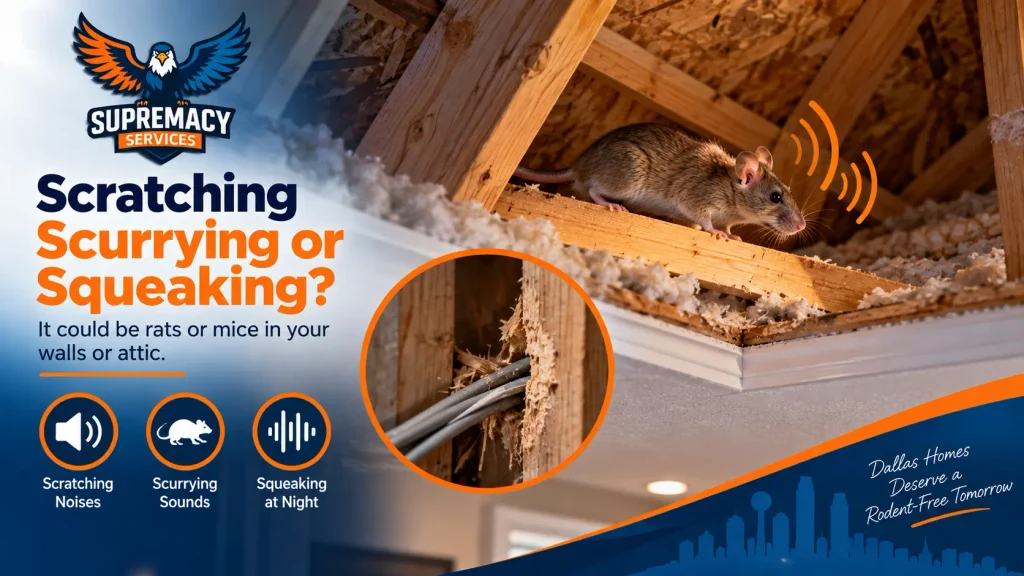
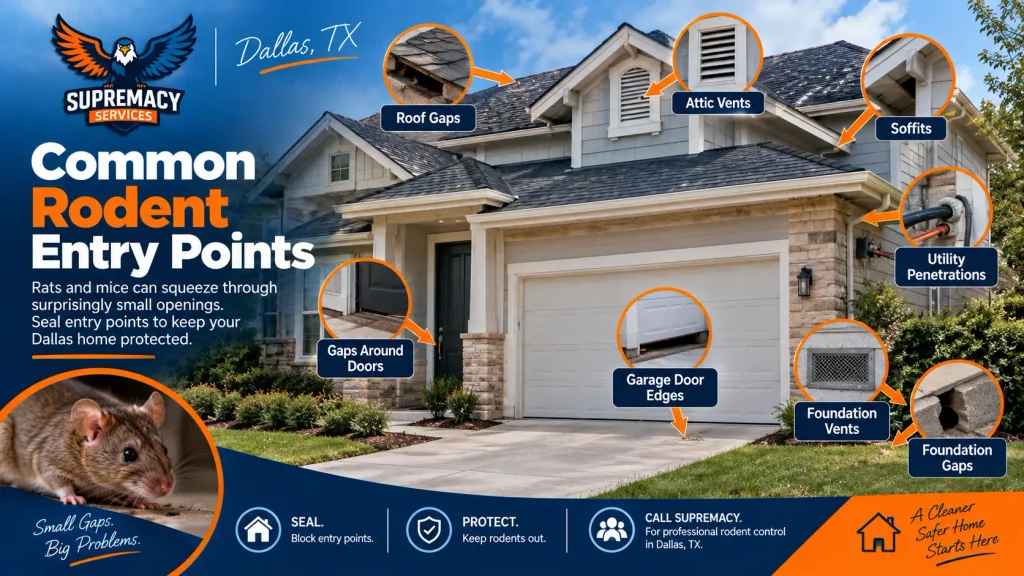
If scratching, droppings or gnawing indicate mice or rats rather than insects, see Supremacy’s rodent control and exclusion services instead of relying solely on general perimeter treatment.

3. Existing Infestation vs. Preventive Treatment

Prevention and active infestation control are different jobs.

A home with minimal activity may primarily need:

inspection → prevention → targeted exterior treatment → monitoring.

A property with established indoor pest activity may require:

inspection → pest identification → source identification → interior and/or exterior treatment → follow-up → prevention.

More extensive pest activity can therefore increase the amount of labor, materials and follow-up required.

4. One-Time vs. Recurring Pest Control

One-time service can make sense when dealing with an isolated problem.

However, properties that experience recurring pest pressure may benefit from scheduled exterior service.

Supremacy’s current pest-control program describes quarterly perimeter re-applications as part of its exterior protection approach.

Recurring service should not simply mean automatically spraying the same areas indefinitely. A quality pest-management program should continue to monitor pest activity and adjust treatment according to what is actually happening around the property.

5. Landscaping Around the Home

Landscaping can substantially affect pest pressure.

Dense vegetation touching exterior walls, accumulated leaves, standing moisture and sheltered areas near the foundation can create favorable conditions for insects.

Reducing those conditions can improve the effectiveness of a perimeter pest-management program.

6. Entry Points and Structural Conditions

Pests do not need an open front door.

Potential entry routes can exist around:

  • utility lines;
  • plumbing penetrations;
  • damaged weather stripping;
  • foundation gaps;
  • vents;
  • door frames;
  • windows; and
  • other structural openings.

A comprehensive inspection helps identify these vulnerabilities.

The EPA specifically recommends closing pest entry points as part of household pest prevention rather than depending solely on pesticide treatments.

What Should Professional Perimeter Pest Control Include?

Dallas perimeter pest control service including exterior inspection, foundation treatment, entry point protection and targeted pest control
Professional perimeter pest control combines inspection, targeted exterior treatment and prevention around vulnerable areas of the home.

Price becomes much easier to evaluate when homeowners understand what they are purchasing.

A professional service should begin with inspection and identification.

Exterior Inspection

The technician should assess where pests are active, where they may be entering and which environmental conditions are encouraging them.

Pest Identification

Correct identification matters.

An ant problem, cockroach problem, termite problem and rodent problem should not receive exactly the same response.

EPA Integrated Pest Management guidance emphasizes accurate monitoring and identification so unnecessary or inappropriate pesticide use can be avoided.

Web and Nest Removal Where Appropriate

Spider webs, accessible nests and other exterior pest evidence may need physical removal as part of service.

Targeted Exterior Treatment

Treatment can then focus on areas where pest activity and entry risk justify it rather than indiscriminately treating every surface.

Entry-Point Assessment

A strong pest-management program should identify structural gaps and other openings that allow pests to enter.

Homeowner Recommendations

Sometimes the most valuable recommendation has nothing to do with adding more pesticide.

You may be advised to:

  • repair a leak;
  • remove standing water;
  • trim vegetation;
  • move firewood;
  • seal an opening;
  • improve food storage;
  • remove debris; or
  • correct a moisture problem.

These preventive measures align with EPA recommendations for reducing pests’ access to food, water and shelter.

Perimeter Pest Control vs. Indoor Pest Control

Perimeter treatment and indoor treatment solve related but different problems.

Perimeter pest control concentrates on intercepting pests around the exterior and reducing the likelihood that they enter.

Indoor pest control addresses pest activity that has already reached interior areas.

For preventive maintenance, an exterior-first strategy can reduce the need for unnecessary indoor applications.

But if cockroaches, ants or other pests are already established indoors, an exterior barrier by itself may not solve the entire infestation.

The treatment should match the pest and the conditions found during inspection.

Is Quarterly Pest Control Worth It in Dallas?

One-time vs quarterly perimeter pest control in Dallas comparison for homeowners choosing an exterior pest prevention plan
One-time pest treatment may address isolated problems, while recurring perimeter service can provide ongoing monitoring and preventive protection.

For homes experiencing repeated pest pressure, quarterly service can provide several advantages.

It allows a professional to:

  • monitor changing pest activity;
  • refresh appropriate exterior treatments;
  • identify new entry points;
  • detect conditions encouraging pests;
  • address seasonal changes; and
  • intervene before minor activity becomes a larger indoor infestation.

The value depends on the property.

A home with persistent ant, roach and spider activity may benefit more from recurring prevention than a property experiencing a single isolated pest incident.

The better question is therefore:

“Does my property have enough recurring pest pressure to justify ongoing preventive service?”

A professional inspection can help answer that.

Is Perimeter Pest Control Safe for Children and Pets?

Pesticide safety depends on the product, application method and adherence to its label.

The EPA advises consumers to use pesticides properly, keep children and pets away from treated areas as directed and always follow product-label instructions.

Professional application does not eliminate the importance of pesticide safety.

Texas also regulates structural pest-control businesses and professionals. The Texas Department of Agriculture Structural Pest Control Service licenses and regulates professionals who perform pest-control work in and around structures.

Homeowners hiring a company should verify appropriate licensing and ask what products are being used, where they will be applied and what precautions are required.

DIY Perimeter Pest Control vs. Professional Service

DIY pest-control products can be useful for limited problems, but purchasing a container of pesticide is not equivalent to a professional pest-management plan.

The largest difference is often diagnosis.

A homeowner may see insects near a door and treat the visible area.

A trained technician should be looking for:

What pest is this?
Where is it coming from?
Why is it here?
Where is it entering?
What conditions are supporting it?
What is the least disruptive effective control?

The EPA explicitly recommends learning about the pest and trying preventive measures first. It also cautions against assuming that applying more pesticide produces better results.

Professional service becomes especially valuable when:

  • the pest cannot be identified;
  • activity keeps returning;
  • pests are established indoors;
  • multiple areas of the home are affected;
  • children or pets complicate treatment decisions;
  • the infestation requires specialized products or equipment; or
  • structural exclusion is required.

When Perimeter Pest Control Is Not Enough

Perimeter pest control is powerful, but it is not the correct standalone solution for every pest.

Rodents

Mice and rats generally require trapping plus exclusion of structural openings.

See Rodent Control & Exclusion in DFW.

Termites

Termites require specialized inspection, monitoring and treatment strategies.

Learn about Termite Vault Security in Dallas.

Mosquitoes

Mosquito management requires attention to breeding sites, standing water and outdoor resting areas.

See Mosquito Barrier Misting in Dallas.

Fleas and Ticks

Outdoor flea and tick pressure may require treatment of lawns, shaded areas and other locations where these parasites develop.

See Flea & Tick Defense in DFW.

The best pest-control strategy is the one designed around the pest actually present.

How to Lower Pest-Control Costs Over Time

Prevention can help reduce the conditions that allow infestations to become established.

Homeowners can:

Seal Pest Entry Points

Inspect openings around pipes, doors, windows, utility penetrations and other exterior gaps.

Eliminate Standing Water

Repair leaks and remove unnecessary water sources.

Keep Vegetation Away From the Structure

Trim shrubs and branches that contact exterior walls or the roof.

Store Food Properly

Use sealed containers and clean food residue promptly.

Manage Garbage

Use closed containers and avoid leaving food waste accessible.

Reduce Clutter

Cardboard, debris and other clutter can provide shelter for pests.

These practices closely follow EPA recommendations to remove pest access to food, water and shelter.

How to Choose a Perimeter Pest Control Company in Dallas

Price matters, but homeowners should evaluate more than the quote.

Ask:

Is the company licensed to perform structural pest control in Texas?

The Texas Department of Agriculture states that businesses performing structural pest-control services require appropriate licensing.

Does the company inspect before treating?

Treatment should follow identification rather than guesswork.

What pests are included?

Ask specifically which pests the plan covers and which require separate services.

What does the quoted price include?

Clarify inspection, exterior treatment, interior treatment when needed, follow-up and re-service policies.

What happens if pests return?

Understand the terms of any re-treatment or service guarantee.

What products will be used?

A professional should be able to explain the treatment and relevant safety instructions.

Does the company address prevention?

A good pest-management program should look beyond simply killing the insects visible today.

Why Dallas Homeowners Should Think in Terms of Prevention, Not Just Extermination

The most effective long-term pest-control strategy is often the one that makes the property less attractive and accessible to pests.

That means combining:

inspection + identification + exclusion + sanitation + moisture management + targeted treatment + monitoring.

That is fundamentally different from repeatedly spraying visible insects without determining why they are there.

The EPA defines Integrated Pest Management as an approach using pest information and multiple appropriate control methods to manage problems economically while reducing unnecessary risks to people, property and the environment.

For homeowners, that translates into a simple principle:

Stop the conditions that support pests while controlling the pests that are already present.

Get a Perimeter Pest Control Quote in Dallas

So, how much should you expect to pay for perimeter pest control in Dallas?

The answer depends on your home.

Property size, pest species, existing activity, landscaping, treatment requirements and service frequency all affect the final price.

Rather than choosing a pest-control company based solely on the cheapest advertised number, compare:

what is inspected, what is treated, which pests are covered, how recurrence is handled and what preventive measures are included.

Supremacy Services provides pest-control solutions across Dallas and surrounding DFW communities, including exterior perimeter protection designed to stop common Texas household pests before they establish themselves inside.

Explore Supremacy Services Pest Control to learn about perimeter protection and request an assessment for your property.


Frequently Asked Questions About Perimeter Pest Control Cost in Dallas

How much does perimeter pest control cost in Dallas?

Pricing varies according to property size, pest type, infestation severity, treatment scope and service frequency. Current third-party Dallas market data places general pest-control services around $152 on average, with many jobs approximately $88–$216, but specialized or extensive treatments may cost significantly more. Homeowners should request a property-specific quote.

Is quarterly pest control worth it in Dallas?

It can be worthwhile for homes experiencing recurring pest pressure. Scheduled service allows the property to be monitored and exterior protection maintained rather than waiting for a new indoor infestation before responding.

What does perimeter pest control include?

Depending on the service plan, it can include exterior inspection, pest identification, removal of accessible webs or nests, targeted foundation and entry-point treatment, monitoring and recommendations for reducing pest-friendly conditions.

Does perimeter pest control keep bugs from coming inside?

That is its primary purpose, but no treatment can guarantee that every pest will always remain outdoors. Results depend on pest pressure, structural openings, moisture, sanitation, landscaping and the specific pest involved.

What pests does perimeter pest control target?

Common programs may target ants, cockroaches, spiders and other crawling or seasonal household pests. Termites, mosquitoes, rodents, bed bugs and wildlife often require specialized services.

Is exterior pest control better than spraying inside?

For preventive pest management, reducing pest pressure outside can limit the need for routine indoor applications. However, an established indoor infestation may still require targeted interior treatment.

How often should perimeter pest control be performed?

There is no universal schedule for every property. Treatment frequency should reflect pest pressure, products used, environmental conditions and professional monitoring. Supremacy’s current exterior program includes quarterly perimeter re-applications.

Should I hire a licensed pest-control company in Texas?

Yes. Texas regulates structural pest-control businesses and professionals. Homeowners can use the Texas Department of Agriculture’s Structural Pest Control Service resources to learn about licensing and consumer protections.

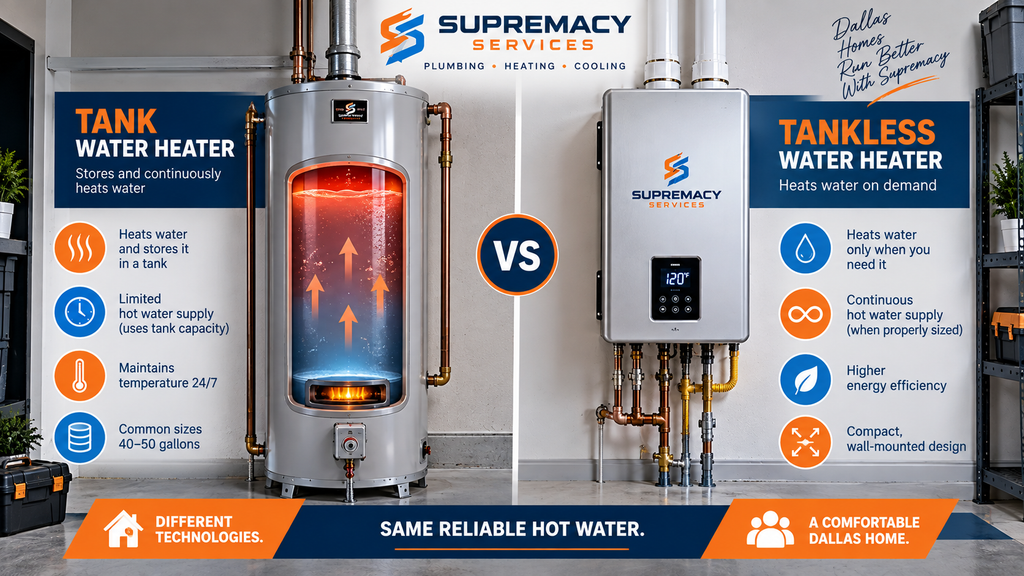
Tank vs tankless water heater in Dallas comparison by Supremacy Services.

Tank vs. Tankless Water Heater in Dallas: Cost, Lifespan & Which Is Better?

If you’re comparing a tank vs. tankless water heater in Dallas, the right choice depends on much more than the purchase price. Your household’s hot-water demand, available space, existing gas or electrical system, installation requirements, maintenance expectations, and how long you plan to stay in the home can all affect which system provides better long-term value.

Tank vs. tankless water heater cost comparison in Dallas TX
Water-heater installation costs depend on the equipment, existing infrastructure and complexity of the installation.

Traditional tank water heaters remain popular because they are generally straightforward to install and cost less upfront. Tankless water heaters, meanwhile, heat water on demand, take up significantly less space, and can offer greater efficiency and a longer service life when properly installed and maintained.

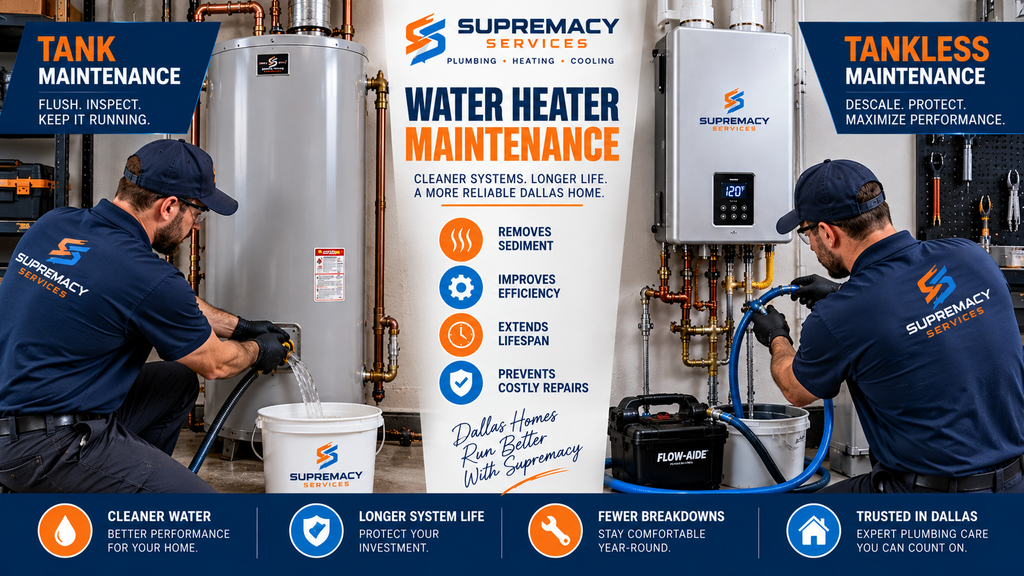
For Dallas homeowners, there is another consideration: mineral buildup. Water-heating equipment can accumulate sediment or scale over time, making routine flushing or descaling an important part of protecting efficiency and equipment life.

This guide compares tank vs. tankless water heaters in Dallas, including installation costs, expected lifespan, efficiency, hot-water capacity, maintenance, and the situations where each option makes the most sense.

If your current system is already leaking, producing inconsistent hot water, or nearing the end of its service life, Supremacy Services provides professional water heater replacement and installation throughout Dallas–Fort Worth.

Tank vs. Tankless Water Heater: Quick Comparison

FeatureTraditional Tank Water HeaterTankless Water Heater
How it worksStores and continuously maintains heated waterHeats water as it flows through the unit
Upfront installationUsually lowerUsually higher
Hot-water supplyLimited by tank capacityContinuous when properly sized
Typical service lifeOften around 8–12 yearsOften around 15–20+ years
Energy efficiencyCan experience standby heat lossAvoids most storage-related standby losses
Space requirementsRequires floor spaceCompact, usually wall-mounted
MaintenancePeriodic flushing and inspectionPeriodic descaling and inspection
Best advantageLower initial investmentEfficiency, longevity and space savings
Main disadvantageLimited stored hot waterHigher installation cost
Best suited forBudget-conscious homeowners and straightforward replacementsLong-term owners and households prioritizing efficiency

Actual equipment life varies significantly with installation quality, usage, water conditions, equipment quality and maintenance

What Is a Tank Water Heater?

A traditional storage water heater heats water and keeps it inside an insulated tank until the household needs it.

Residential tanks commonly come in capacities such as 40 or 50 gallons, although other sizes are available. When someone opens a hot-water faucet, heated water leaves the tank while cold replacement water enters and begins heating.

The primary advantage is simplicity.

Tank systems are familiar to homeowners and plumbers, replacement can often be relatively straightforward when replacing a similar unit, and their upfront price is generally lower than converting a home to tankless.

The trade-off is capacity.

Once a household consumes most of the heated water stored in the tank, the system needs time to recover. That can become noticeable in households where multiple showers, washing machines and dishwashers operate within a short period.

Storage systems can also lose some energy by maintaining hot water even when nobody is using it.

What Is a Tankless Water Heater?

How tank and tankless water heaters work in Dallas homes
Tank water heaters store heated water, while tankless systems heat water on demand.

A tankless water heater, sometimes called an on-demand water heater, does not maintain a large reservoir of heated water.

Instead, opening a hot-water fixture causes cold water to move through the unit. A flow sensor detects demand and activates the burner or heating element. Water passes through a heat exchanger and is heated before traveling to the fixture.

ENERGY STAR explains that this approach reduces the energy associated with continuously maintaining a tank of hot water.

This creates one of the biggest attractions of tankless technology:

Continuous hot water.

A correctly sized system can continue heating water for as long as demand remains within the unit’s rated capacity.

However, “endless hot water” does not mean unlimited simultaneous water flow.

Every tankless unit has a maximum gallons-per-minute (GPM) capacity. If several showers and appliances demand more hot water than the system can produce simultaneously, water temperature or flow performance may decline.

That is why professional sizing matters.

Tank vs. Tankless Water Heater Cost in Dallas

For many Dallas homeowners, price is the first major difference.

A conventional tank system generally requires a smaller initial investment, particularly when the replacement unit uses the same fuel, location, venting and plumbing configuration.

Tankless installations can cost considerably more because converting an existing home may require additional work.

Possible upgrades include:

  • Larger gas supply piping
  • New venting
  • Condensate drainage for condensing models
  • Electrical upgrades
  • New water connections
  • Equipment relocation
  • Code-related modifications
  • Removal of the old water heater

Recent Dallas-specific consumer cost reporting also notes that existing natural-gas infrastructure can influence the practicality and final price of a tankless conversion.

Why Online Water-Heater Prices Can Be Misleading

The retail price of the appliance is only part of the actual replacement cost.

A homeowner may see a tankless water heater advertised online and assume that price represents the entire project. It doesn’t account for labor or potential modifications required to safely operate the new equipment.

For example, a high-input gas tankless system can have substantially different gas and venting requirements from the storage water heater it replaces.

That means two Dallas homes installing the exact same water heater could receive different installation prices.

A professional estimate should therefore evaluate the entire installation, not merely the appliance.

Supremacy Services offers water-heater diagnostics and replacement services throughout DFW


Which Water Heater Lasts Longer?

Tank vs. tankless water heater lifespan comparison for Dallas homeowners
Traditional tank water heaters often last around 8–12 years, while properly maintained tankless systems can potentially serve a home considerably longer.

Lifespan is one of the strongest arguments for considering tankless technology.

Traditional storage water heaters commonly provide roughly 8–12 years of service, although well-maintained systems can sometimes last longer.

Tankless equipment can frequently reach 15–20 years or more with appropriate installation and maintenance.

ENERGY STAR lists a 20-year life expectancy for whole-home gas tankless water heaters.

But lifespan should never be interpreted as a guarantee.

Several factors can shorten the life of either system:

Water quality

Mineral deposits can accumulate inside storage tanks and tankless heat exchangers.

Maintenance

Ignoring sediment or scale allows deposits to interfere with heat transfer and system operation.

Installation quality

Improper gas sizing, venting, drainage or electrical connections can create performance and reliability problems.

Household demand

Equipment that routinely operates near or beyond its intended capacity can experience additional stress.

Equipment quality

Construction, components and manufacturer specifications vary considerably between models.

A quality system that is properly sized, professionally installed and regularly maintained has the best opportunity to reach its expected service life.

Tankless vs. Tank Water Heater Energy Efficiency

Tankless vs. tank water heater energy efficiency comparison in Dallas
Tankless systems heat water on demand, helping reduce the standby heat losses associated with storing hot water.

This is another area where tankless systems can have an advantage.

Storage water heaters must maintain the temperature of the water sitting inside the tank. Even with modern insulation, maintaining stored hot water can result in standby energy losses.

Tankless systems largely avoid this issue because they heat water only when hot water is requested.

ENERGY STAR currently requires qualifying gas-fired instantaneous water heaters to achieve a Uniform Energy Factor (UEF) of at least 0.95. UEF is a standardized measure used to compare overall water-heater efficiency—the higher the UEF, the more efficient the equipment.

ENERGY STAR also estimates that an ENERGY STAR-certified gas tankless water heater can save a family of four approximately $95 per year in gas costs compared with a standard gas storage model, based on its national assumptions. Actual Dallas household savings will vary according to usage, utility rates, system efficiency and installation.

Important: Don’t Choose a Water Heater Based on Efficiency Alone

A highly efficient water heater isn’t automatically the least expensive overall option.

Homeowners should compare:

Purchase price + installation + estimated operating expenses + maintenance + expected lifespan.

This gives a much more useful picture of lifetime ownership cost.


Hot-Water Performance: Which One Wins for Large Families?

Tankless water heater supplying multiple fixtures in a Dallas home with proper GPM sizing
Proper tankless water-heater sizing helps maintain reliable hot water when multiple fixtures operate simultaneously.

This depends on sizing.

A tank system has a defined volume of hot water.

Suppose several family members take showers consecutively while the dishwasher is operating. Eventually, the stored hot water can be depleted faster than the system can recover.

Tankless systems solve the storage problem, but introduce another limitation: flow rate.

Imagine simultaneously running:

  • Two showers
  • A dishwasher
  • A bathroom faucet

The tankless system must produce enough heated water per minute to satisfy all of those fixtures.

This is why homeowners should never select tankless equipment simply by choosing the biggest-looking model or comparing BTU ratings.

A plumber should calculate anticipated peak simultaneous hot-water demand and the required temperature rise before selecting the unit.

ENERGY STAR’s current certification criteria, for example, require qualifying gas-fired instantaneous systems to provide at least 2.8 GPM over a 67°F temperature rise, but individual residential applications can require substantially greater capacity.


Dallas Water Conditions and Water-Heater Maintenance

Technicians performing tank flushing and tankless water heater maintenance in Dallas TX
Routine flushing and descaling can help protect water-heater efficiency, performance and service life.

Maintenance matters for both technologies.

Tank Water Heater Maintenance

Minerals and debris can settle at the bottom of a storage tank over time.

Excessive sediment may:

  • Reduce heat-transfer efficiency
  • Contribute to popping or rumbling sounds
  • Increase heating time
  • Place additional stress on the system

Periodic inspection and flushing can help manage sediment accumulation.

Tank systems may also use a sacrificial anode rod, designed to corrode instead of the steel tank. Checking this component as recommended by the manufacturer can help protect the tank.

Supremacy’s current water-heater service process specifically includes checking sediment buildup, anode-rod condition, burner efficiency and tank integrity during system diagnostics.

Tankless Water Heater Maintenance

Tankless equipment does not have a large storage tank, but minerals can accumulate inside its heat exchanger.

Over time, scale can restrict water passages and interfere with heat transfer.

Depending on manufacturer requirements and local water conditions, periodic professional descaling or flushing may therefore be recommended.

Always follow the maintenance interval specified for your particular water heater.

Space: Tankless Has a Major Advantage

Dallas homes come in everything from older properties with dedicated utility rooms to newer homes where every square foot matters.

Traditional tanks require a substantial physical footprint.

Tankless water heaters are generally mounted on a wall, potentially freeing valuable garage, closet or utility-room space.

ENERGY STAR specifically identifies reduced space requirements as one advantage of whole-home gas tankless systems.

For smaller homes or remodeling projects where usable space is valuable, this difference can be significant.

What About the Risk of Water Damage?

Storage tanks contain dozens of gallons of water.

If the tank itself eventually corrodes and fails, that stored water can escape rapidly and potentially damage nearby flooring, walls or belongings.

Tankless systems eliminate the risk of a large storage tank rupturing, although their pipes, valves and internal components can still leak.

Regardless of system type, homeowners should investigate signs such as:

  • Water pooling around the unit
  • Rust or corrosion
  • Moisture around fittings
  • Unexplained pressure changes
  • Visible pipe deterioration

Problems elsewhere in the home’s supply piping may require professional water line repair or replacement rather than water-heater replacement.


Can You Replace a Tank Water Heater With Tankless?

Usually, yes—but it isn’t always a direct swap.

A plumber should first evaluate:

Gas capacity

High-output gas tankless systems may require greater fuel delivery than the existing storage unit.

Venting

The new heater may require a completely different venting configuration.

Electrical requirements

Even gas tankless systems commonly require electrical power for controls, ignition and other components.

Condensate management

High-efficiency condensing units can produce condensate that must be appropriately drained.

Installation location

Clearances and manufacturer requirements have to be considered.

Hot-water demand

The system must be sized according to expected simultaneous fixture use.

This evaluation explains why the cost of converting from tank to tankless can be significantly different from replacing one conventional tank with another.


Gas vs. Electric Tankless Water Heaters

Tankless isn’t one single technology.

Homeowners may encounter both gas-fired and electric tankless water heaters.

Gas systems are frequently selected for whole-home applications because they can provide high heating capacity.

Whole-home electric tankless equipment can place a substantial demand on a home’s electrical system. Depending on the model and existing electrical infrastructure, additional circuits or electrical upgrades may be necessary.

Before purchasing either type, determine whether the home’s gas supply or electrical service can support the manufacturer’s requirements.

Tank Water Heater: Pros and Cons

Advantages

Lower upfront investment:
A standard tank replacement is often less expensive than converting to tankless.

Straightforward replacement:
Replacing a tank with a similar tank can require fewer infrastructure modifications.

Familiar technology:
Parts, technicians and service procedures are widely available.

Strong short-term value:
Tank systems can make financial sense when initial budget is the primary consideration.

Disadvantages

Limited hot-water storage:
Heavy consecutive use can temporarily exhaust the available hot water.

Larger footprint:
The tank occupies valuable floor or closet space.

Standby energy losses:
Energy is required to maintain stored water temperature.

Generally shorter service life:
Storage tanks usually don’t last as long as properly maintained tankless systems.


Tankless Water Heater: Pros and Cons

Advantages

Continuous hot water:
A properly sized unit can continue producing hot water without waiting for a storage tank to refill.

Higher efficiency potential:
Water is heated when required rather than continuously stored.

Long service life:
Quality tankless systems can often operate for 15–20 years or longer with appropriate maintenance.

Compact installation:
Wall-mounted equipment saves considerable floor space.

No large tank to rupture:
Eliminating a large reservoir reduces one source of catastrophic water-heater leakage.

Disadvantages

Higher upfront cost:
Equipment and installation generally cost more.

Possible infrastructure upgrades:
Gas, venting, drainage or electrical modifications can increase conversion costs.

Flow-rate limits:
An undersized system can struggle when many fixtures require hot water simultaneously.

Maintenance remains necessary:
Tankless does not mean maintenance-free; scale accumulation must still be managed.

Tank vs. Tankless Water Heater: Which Is Better for Dallas Homes?

There isn’t one system that is automatically better for every Dallas homeowner.

A traditional tank water heater may make more sense when:

  • Keeping the initial replacement cost low is important.
  • The existing system can be replaced without extensive modifications.
  • Household hot-water demand is predictable.
  • You prefer simple, familiar equipment.
  • You expect to move before the longer tankless lifespan provides substantial value.

A tankless water heater may make more sense when:

  • You plan to remain in the home for many years.
  • Energy efficiency is a priority.
  • Your household frequently uses large amounts of hot water.
  • You want to reclaim utility-room or garage space.
  • You are comfortable with periodic descaling and professional maintenance.
  • Your home’s gas/electrical infrastructure can support the selected equipment.

For many homeowners, the most useful question isn’t simply “Which water heater is better?”

It’s:

“Which properly sized system gives my household the best combination of installation cost, operating expense, hot-water performance and expected service life?”

How to Choose the Right Water Heater Size

Correct sizing is critical regardless of technology.

For a storage water heater, professionals consider factors including:

  • Household size
  • Peak hot-water demand
  • Tank capacity
  • First Hour Rating (FHR)
  • Fuel type

For tankless equipment, important factors include:

  • Required gallons per minute
  • Number of simultaneous fixtures
  • Incoming water temperature
  • Required temperature rise
  • Burner or heating capacity

ENERGY STAR defines First Hour Rating as an estimate of how much hot water a storage heater can provide during an hour beginning with a fully heated tank. For instantaneous systems, GPM represents how much hot water the unit can continuously supply at a specified temperature rise.

A larger unit isn’t automatically the correct unit.

Professional load and demand calculations are preferable to guessing.


Signs It May Be Time to Replace Your Water Heater

Regardless of whether you ultimately choose tank or tankless, consider having your current system inspected if you notice:

  • Hot water running out unusually quickly
  • Inconsistent water temperatures
  • Rust-colored or discolored hot water
  • Water around the heater
  • Corrosion around the tank or connections
  • Unusual popping or rumbling noises
  • Repeated repairs
  • Increasing energy consumption without an obvious explanation
  • An aging storage tank approaching or exceeding its expected service life

A leaking tank deserves especially prompt attention because deterioration of the tank itself usually cannot be permanently repaired.

Professional Water Heater Installation in Dallas, TX

Professional tankless water heater installation in Dallas TX by Supremacy Services
Professional installation helps ensure your water heater is properly sized, safely connected and configured for reliable performance.

Water-heater performance depends heavily on installation.

A professional installation should account for equipment sizing, plumbing connections, fuel supply, venting, drainage, electrical requirements, manufacturer clearances and applicable codes.

Dallas property standards also require water-heating equipment to remain operational, require pressure-relief valves with approved drain lines, and require fuel-fired equipment to be appropriately vented under applicable construction codes.

Supremacy Services provides water heater replacement and installation in Dallas and throughout the DFW area, including system diagnostics and replacement recommendations based on the home’s existing equipment and requirements.


Frequently Asked Questions

Is a tankless water heater worth it in Dallas?

It can be, particularly for homeowners who expect to stay in their property long enough to benefit from the system’s longer potential lifespan, improved efficiency and space savings. However, installation requirements and household hot-water demand should be evaluated before deciding.

How long does a tank water heater last?

A conventional storage water heater commonly lasts approximately 8–12 years, although maintenance, water conditions, usage and installation quality can significantly affect its actual lifespan.

How long does a tankless water heater last?

Many properly maintained tankless water heaters can operate for approximately 15–20 years or longer. ENERGY STAR cites a 20-year life expectancy for qualifying whole-home gas tankless systems.

Does a tankless water heater really provide unlimited hot water?

It provides continuous hot water rather than a fixed stored quantity, but it still has a maximum flow capacity. Exceeding the unit’s rated GPM can affect performance.

Are tankless water heaters cheaper to operate?

They can use less energy than conventional storage systems because they avoid continuously maintaining a large volume of heated water. Actual savings depend on fuel prices, usage, equipment efficiency and installation.

Do tankless water heaters require maintenance?

Yes. Mineral scale can develop inside the heat exchanger, so periodic flushing or descaling may be required according to manufacturer recommendations and local water conditions.

Can I replace my 50-gallon water heater with a tankless unit?

Potentially. The appropriate tankless model should be selected according to peak flow demand and required temperature rise rather than simply converting tank capacity into an equivalent tankless size. Gas supply, venting and electrical requirements must also be evaluated.

Is a 40- or 50-gallon water heater enough for my Dallas home?

It depends on household demand rather than household size alone. First Hour Rating, fixture usage and how frequently hot-water demands overlap should all be considered.

Should I repair or replace my old water heater?

Minor component problems may be repairable. Replacement becomes increasingly worth considering when an older unit develops tank corrosion or leakage, requires repeated repairs, or no longer reliably satisfies household hot-water demand.


Final Takeaway: Compare Lifetime Value, Not Just Purchase Price

When comparing a tank vs. tankless water heater in Dallas, don’t make the decision solely on the appliance’s sticker price.

A traditional tank water heater generally offers the lower initial investment and a straightforward replacement path.

A tankless water heater usually costs more to install but can provide a longer expected service life, reduced space requirements, continuous hot water within its rated flow capacity, and potentially lower energy consumption.

The best system ultimately depends on your home’s infrastructure, household demand, budget and long-term plans.

Before replacing your water heater, have the existing plumbing, gas or electrical capacity and peak hot-water demand professionally evaluated. Proper sizing and installation can matter just as much as choosing between tank and tankless.

Need help choosing?

Supremacy Services provides professional water heater installation and replacement in Dallas–Fort Worth, helping homeowners compare options and select equipment appropriate for their property.

Signs of rats or mice in a Dallas home, including droppings, gnaw marks, tracks and nesting activity

Signs of Rats or Mice in Your Dallas Home: 10 Warning Signs & How to Get Rid of Them

Hearing scratching inside the walls after dark? Finding small black droppings underneath the kitchen sink? Noticing food packages that suddenly have tiny holes in them?

These may be signs of rats or mice in your Dallas home, and the sooner you identify the problem, the easier it usually is to prevent rodents from becoming established inside attics, walls, garages, kitchens, and other hidden spaces.

Rats and mice are more than an unpleasant surprise. They can contaminate food and surfaces, damage insulation and stored belongings, and gnaw on building materials and electrical wiring. Texas A&M AgriLife notes that rats and mice can damage property by chewing wiring, pipes, hoses, doors, walls, flooring, furniture, and other materials.

The CDC also warns that wild rodents can carry diseases capable of spreading directly or indirectly to people, including through contact with urine, droppings, saliva, bites, or contaminated materials.

The challenge is that you may have rodents before you ever see one.

Here are the warning signs Dallas homeowners should know—and what to do when they appear.

1. Rat or Mouse Droppings Around Your Home

Mouse droppings vs rat droppings identification guide for Dallas homeowners
Rodent droppings can provide important clues about whether mice or rats are active inside your home.

Droppings are among the most recognizable signs of rodent activity.

Check areas such as:

  • Kitchen cabinets and drawers
  • Under sinks
  • Behind refrigerators and stoves
  • Pantries
  • Garages
  • Attics
  • Utility rooms
  • Storage areas
  • Along walls and baseboards

The EPA specifically identifies droppings around food packages, cupboards, drawers and underneath sinks as common evidence of rodent infestation.

Mouse Droppings vs. Rat Droppings

Mouse droppings are generally much smaller than rat droppings. Rat droppings are larger and can indicate that a substantially larger rodent is moving through the structure.

Avoid relying on size alone to identify the species. Dropping location, tracks, nesting areas, gnaw marks and other evidence can help determine whether you are dealing with mice, roof rats or Norway rats.

Texas A&M identifies the house mouse, roof rat and Norway rat as three important rodents associated with human structures.

Important: Never casually sweep or vacuum dry rodent droppings. CDC cleanup guidance recommends wetting contaminated material with an appropriate disinfectant before wiping it up because sweeping or vacuuming can cause contaminated particles to become airborne.


2. Scratching, Scurrying or Squeaking Inside Walls and Ceilings

Mouse in a Dallas attic causing scratching and scurrying sounds at night
Scratching, scurrying and squeaking after dark can indicate rodents moving through an attic or wall cavity.

Your house becomes quiet at night.

Rodents become active.

That is why one of the first indications of an infestation may be a scratching, running or scurrying sound coming from somewhere you cannot see.

Listen around:

  • Attic ceilings
  • Interior walls
  • Behind kitchen cabinets
  • Above garages
  • Crawlspaces
  • Storage rooms
  • HVAC or utility penetrations

Texas A&M notes that rodent activity increases after dark and identifies running and squealing noises among the indicators homeowners can use when investigating an infestation.

Repeated nighttime noises should therefore not automatically be dismissed as the house “settling.”

Is It a Rodent or a Larger Animal?

Heavy thumping, loud movement or significant disturbance in an attic could potentially involve a larger wildlife species rather than mice.

Supremacy also provides wildlife trapping and removal in Dallas for animals such as raccoons, squirrels, opossums and skunks.


3. Gnaw Marks on Wood, Food Packaging or Wiring

Rat or mouse gnaw damage on electrical wiring inside a Dallas home
Rodent gnawing can damage electrical wiring and other building materials inside the home.

Rodents gnaw constantly.

You may discover damage on:

  • Cardboard food boxes
  • Plastic containers
  • Wooden trim
  • Cabinets
  • Attic materials
  • Stored belongings
  • Pipes
  • Electrical wiring
  • Wall penetrations

The CDC identifies gnaw marks as one of the primary signs of rodent activity.

Electrical damage deserves particular attention. Texas A&M specifically warns that rodents can damage property by chewing electrical wiring and notes that such damage can contribute to fires.

If you discover damaged electrical wiring, avoid treating it solely as a pest-control problem. The rodent infestation must be addressed, but compromised wiring may also require inspection and repair by a qualified electrical professional.


4. Shredded Paper, Fabric or Insulation

Mice and rats need protected nesting locations.

Materials around the home can become convenient nesting material, including:

  • Paper
  • Cardboard
  • Fabric
  • Insulation
  • Packing materials
  • Dried vegetation
  • Soft stored materials

The EPA specifically lists shredded paper, fabric and dried plant matter among the nesting materials that can indicate rodents are present.

Finding shredded material by itself does not always confirm an active infestation. Finding it alongside droppings, gnawing, odors or nighttime sounds makes rodent activity considerably more suspicious.


5. Greasy Rub Marks Along Walls and Rafters

Rodents often follow established routes instead of wandering randomly through open rooms.

Over time, repeated movement can leave visible smears along surfaces.

Texas A&M describes greasy smears where rodent bodies repeatedly contact walls or rafters as one of the signs used to identify rat and mouse activity.

Look closely along:

  • Baseboards
  • Wall edges
  • Attic rafters
  • Pipes
  • Garage walls
  • Structural edges

A frequently used pathway may also contain droppings or nearby gnaw marks.


6. A Persistent Musty or Stale Odor

A strange odor that cannot be explained by plumbing, garbage, moisture or spoiled food can sometimes originate from rodents.

Urine, nesting material and accumulated contamination can create persistent odors, especially in enclosed spaces.

The EPA identifies stale smells coming from hidden areas as another potential sign of rodent infestation.

Pay attention when the odor seems strongest around a particular:

  • Cabinet
  • Wall
  • Attic section
  • Pantry
  • Garage corner
  • Storage area

A strong odor combined with droppings or scratching noises warrants further inspection.


7. Chewed or Contaminated Food

Rodents are attracted to accessible food.

Watch for:

  • Small holes in food packaging
  • Torn pet-food bags
  • Scattered crumbs
  • Gnawed cardboard boxes
  • Damaged grain containers
  • Food debris appearing overnight

Rodents can both consume and contaminate human and animal food.

Discard food that may have been contaminated rather than simply removing the damaged portion.

Store dry food and pet food in durable containers with secure lids, and promptly clean spills and crumbs.


8. Rodent Tracks, Runways or Burrows

Sometimes the best evidence is not the rodent itself but the path it repeatedly follows.

Texas A&M lists tracks, runways and burrows among the clues used to identify infestations.

Outside your Dallas home, inspect areas around:

  • Foundations
  • Garages
  • Storage sheds
  • Dense landscaping
  • Trash areas
  • Fences
  • Utility penetrations

Indoors, look for repeated movement patterns along walls and behind appliances.

Norway rats are particularly associated with burrowing, while roof rats are more likely to occupy elevated spaces such as walls and attics.


9. Your Pets Suddenly Become Interested in One Wall or Cabinet

Dogs and cats may notice movement, scent or sound before homeowners do.

You might see a pet repeatedly:

  • Staring at a wall
  • Pawing underneath an appliance
  • Sniffing a cabinet
  • Watching the ceiling
  • Becoming unusually alert at night

Pet behavior alone does not prove that rats or mice are present.

But when the behaviour repeatedly occurs in the same area and is accompanied by droppings, gnawing, scratching or nesting material, inspect the location carefully.


10. Seeing a Live or Dead Rat or Mouse

Finally, you may actually see the animal.

A single sighting deserves investigation because the rodent had to enter the structure somehow.

Finding and removing one mouse without identifying its entry route can leave the underlying problem unresolved.

That is why effective rodent control in Dallas should focus on two separate questions:

How do we remove the rodents already inside?

and

How did they enter in the first place?

Supremacy’s [Rodent Control & Exclusion service] addresses both sides of the problem through targeted removal followed by exterior exclusion of gaps, vents, roofline openings and other potential access points.


Rats vs. Mice: What Is in Your Dallas Home?

House mouse, roof rat and Norway rat identification guide for Dallas homes
House mice, roof rats and Norway rats differ in size, behavior and the areas where they commonly establish activity.

Knowing what you are dealing with can help determine where to inspect and how to control the infestation.

House Mice

House mice are small rodents that can nest in surprisingly confined locations. Texas A&M notes that mouse nests may occur underneath stored materials, inside upholstered furniture and even in cabinet drawers.

Roof Rats

Roof rats are agile climbers.

Texas A&M notes that they commonly nest in walls and attics rather than underground.

For Dallas homeowners hearing repeated movement above ceilings or around attic spaces, roof-level entry points should therefore be part of the inspection.

Norway Rats

Norway rats are larger, heavier-bodied rodents and are more strongly associated with ground-level activity and burrowing.

Texas A&M reports that Norway rats commonly burrow underneath foundations, floors and stored materials.

A professional inspection can use droppings, tracks, nesting areas, gnawing, runways and structural entry points to help determine what is actually present.


Why Rats and Mice Enter Dallas Homes

Rodents are primarily looking for three things:

Food. Water. Shelter.

A house can provide all three.

Common attractants include:

  • Pet food left accessible overnight
  • Open garbage containers
  • Bird seed
  • Pantry spills
  • Standing water
  • Clutter
  • Dense vegetation
  • Stored cardboard
  • Accessible attic spaces
  • Gaps around utility lines
  • Openings around doors and garages

The CDC recommends reducing food, water and shelter as fundamental parts of rodent prevention.


Where Are Rats and Mice Getting Into Your House?

Common rodent entry points in a Dallas home, including roof gaps, attic vents, soffits, utility openings, garage doors and foundation gaps.
Rats and mice can enter through small openings around roofs, vents, doors, utilities and foundations. Finding and sealing these entry points is essential for long-term rodent prevention.

This is the question homeowners often miss.

Catching rodents without correcting their access points can leave the house vulnerable to another infestation.

Potential entry areas include:

  • Foundation gaps
  • Garage-door edges
  • Roofline gaps
  • Soffits
  • Roof vents
  • Plumbing penetrations
  • Utility penetrations
  • Damaged screens
  • Gaps around doors
  • Openings into attic spaces

Supremacy’s rodent-control process includes inspection of rooflines, chimney areas, foundation vents, garage doors and attic spaces to locate potential entry and nesting locations.


How to Get Rid of Rats and Mice in Your Dallas Home

Successful rodent control is not simply about putting down a trap.

A comprehensive strategy combines inspection, removal, sanitation, food-source reduction and exclusion.

Step 1: Inspect the Entire Property

Determine:

  • What type of rodent is present?
  • Where is activity concentrated?
  • Where are they nesting?
  • What are they eating?
  • How are they entering?
  • Is there contamination or property damage?

Inspect from the foundation to the roofline—not only the room where droppings were discovered.

Step 2: Remove Accessible Food and Water

Keep food sealed.

Clean crumbs and spills promptly.

Store pet food securely.

Use garbage cans with tight-fitting lids.

Eliminate unnecessary standing water.

Both the CDC and EPA emphasize removing food, water and shelter as central components of rodent prevention.

Step 3: Use Appropriate Trapping

For homeowners attempting limited DIY control, CDC guidance recommends traditional snap traps and advises placing traps along walls and in areas showing rodent activity. Different traps are designed for rats and mice.

Always keep traps and baits inaccessible to children and pets.

The CDC also advises against glue traps and live traps in its household rodent-control guidance.

Step 4: Seal Rodent Entry Points

This is rodent exclusion, and it is one of the most important steps for long-term prevention.

Texas A&M recommends rodent-proofing and describes sealing openings with rodent-resistant materials such as metal, hardware cloth or other durable materials.

Supremacy’s [Dallas Rodent Control & Exclusion] service similarly focuses on sealing exterior gaps using steel mesh, metal materials and structural sealants after addressing active rodents.

Rodent exclusion professional sealing entry points around a Dallas home
Professional rodent exclusion targets the openings rats and mice use to enter your home.
Step 5: Clean Contaminated Areas Safely

Rodent cleanup needs to be handled differently from ordinary dust and dirt.

Do not sweep or vacuum dry droppings.

CDC guidance recommends:

  1. Wearing rubber or plastic gloves.
  2. Thoroughly wetting droppings and urine with an appropriate disinfectant.
  3. Allowing the disinfectant to work according to its directions.
  4. Wiping contaminated material up with paper towels.
  5. Disinfecting surrounding hard surfaces.
  6. Washing hands after removing gloves.

Heavy infestations can require additional precautions.


Why Killing Rodents Alone May Not Solve the Problem

This distinction is important.

Rodent removal solves:

The animals currently inside.

Rodent exclusion solves:

How rodents keep entering.

A home with accessible roof gaps, utility penetrations or foundation openings remains vulnerable even after the current rodents are removed.

That is why Supremacy describes its rodent service as a two-stage approach: removing active rodents and then sealing exterior entry points to reduce the chance of another invasion.


When Should You Call a Dallas Rodent-Control Professional?

Professional inspection becomes particularly valuable when:

  • Droppings keep returning
  • You hear repeated attic or wall activity
  • Multiple rooms show evidence
  • You find damaged electrical wiring
  • You cannot identify the entry point
  • Rodents continue despite trapping
  • Contamination is extensive
  • Activity occurs in inaccessible walls or attic spaces
  • You suspect multiple rodents
  • The infestation keeps returning

A recurring infestation usually requires more than repeatedly replacing traps.

The objective should be to determine why the property continues supporting rodent activity.


How to Prevent Rats and Mice From Coming Back

How to keep rats and mice out of your Dallas home with rodent prevention and exclusion
Food storage, sanitation, exclusion, landscaping and routine monitoring can make your property less attractive to rodents.

Once the infestation is controlled, make your property less attractive and less accessible.

Seal exterior openings

Inspect around utility penetrations, rooflines, vents, doors and foundations.

Secure food

Use durable containers for pantry goods and pet food.

Control garbage

Keep trash containers closed and clean.

Reduce outdoor shelter

Remove unnecessary clutter, leaf piles and excessive nesting material around the structure.

Maintain vegetation

Avoid creating dense, protected pathways directly against the house.

Monitor previously active areas

Continue checking attics, garages, cabinets and utility areas for fresh droppings or gnawing.

The EPA similarly recommends preventing rodent access, eliminating nesting locations, and controlling food and water sources.

Dallas Rodent Control: Remove Them—and Close the Door Behind Them

Rats and mice are excellent at remaining hidden.

That means droppings, scratching sounds, gnaw marks, damaged food packages, nesting material, odors, rub marks and tracks may tell you there is a problem long before you see an actual rodent.

Ignoring those warning signs can give an infestation additional time to spread through attics, walls and storage areas.

If you suspect rats or mice have moved into your Dallas-area home, start by determining where they are active and how they are entering.

For an established or recurring problem, Supremacy Services offers professional Rodent Control & Exclusion in DFW, combining targeted rodent removal with structural exclusion designed to close potential entry points.


Frequently Asked Questions

What are the first signs of rats or mice in a house?

Droppings, gnaw marks, scratching noises, damaged food packages, nesting material, tracks and unusual odors are common early indicators. The CDC specifically identifies droppings and gnaw marks as important evidence of rodent activity.

Why do I hear scratching in my walls at night?

Rats and mice are often more active after dark. Repeated nighttime scratching or scurrying can indicate rodents moving through wall cavities, ceilings or attic spaces, although other wildlife can produce similar sounds.

Should I vacuum mouse droppings?

No. CDC guidance says not to vacuum or sweep rodent urine, droppings or nesting materials because doing so can send contaminated particles into the air. Wet contaminated material thoroughly with an appropriate disinfectant and follow CDC cleanup procedures.

Will traps permanently solve a mouse problem?

Traps can remove rodents already inside, but they do not automatically prevent additional rodents from entering. Long-term control also involves identifying and sealing access points and reducing food, water and shelter.

What is rodent exclusion?

Rodent exclusion is the process of identifying and physically sealing openings that rats and mice use to enter a structure. Supremacy’s rodent service combines removal with exterior sealing using rodent-resistant materials.

Should I call pest control if I see only one mouse?

One sighting is enough to justify inspecting the property. Even if only one animal is present, determining how it entered can help prevent additional rodents from using the same opening.

Electrical panel upgrade cost Dallas 2026 guide showing a Supremacy Services electrician inspecting a residential breaker panel.

How Much Does an Electrical Panel Upgrade Cost in Dallas? 2026 Homeowner Guide

If you are wondering how much an electrical panel upgrade costs in Dallas, a reasonable 2026 planning range is roughly $1,500 to $5,000 for many residential projects, although a straightforward panel replacement can cost less and complicated service upgrades can cost considerably more.

The biggest reason for the wide range is that an electrical panel replacement and a complete electrical service upgrade are not necessarily the same project.

Replacing an existing breaker box with a similar-capacity panel can be relatively straightforward. Upgrading an older 100-amp electrical service to 200 amps may require a new panel, breakers, service conductors, grounding and bonding improvements, meter equipment, utility coordination, permits, inspections, and potentially other work needed to bring the installation into compliance.

For Dallas homeowners, understanding these differences is the key to comparing electrical estimates accurately and avoiding unexpected costs.

Electrical Panel Upgrade Cost in Dallas: 2026 Quick Answer

Published 2026 Dallas estimates show just how much project scope affects pricing. Angi reports an average of approximately $1,650 for Dallas panel upgrades, with many projects falling around $1,237–$2,062. Other DFW estimates place 200-amp upgrades closer to $2,500–$5,000 when the project involves a more substantial service upgrade.

For budgeting purposes, homeowners can use the following broad ranges:

Electrical ProjectTypical Planning Range
Minor breaker/panel-related work$500–$1,500+
Basic 100–150A panel replacement$1,500–$3,000+
Typical 200A panel/service upgrade$2,500–$5,000+
Panel plus substantial service modifications$4,000–$8,000+
Large 320A/400A or highly complex project$8,000+

These figures are planning estimates rather than Supremacy Services quotes. Your actual electrical panel upgrade cost depends on your home’s existing electrical system, desired capacity, panel location, utility requirements, code-related improvements, and the amount of labor required.

What Is an Electrical Panel Upgrade?

Your electrical panel—also commonly called a breaker box, breaker panel, service panel, or load center—is the distribution point for electricity entering your home.

Electricity is divided from the panel into individual circuits serving equipment and areas such as:

  • Air-conditioning and heating systems
  • Kitchens and major appliances
  • Bedrooms and living spaces
  • Lighting
  • Laundry equipment
  • Water heaters
  • Garages and workshops
  • Pools and outdoor equipment
  • EV chargers

Circuit breakers are designed to interrupt a circuit when electrical conditions exceed safe limits.

An electrical panel upgrade replaces or expands this distribution equipment and, when necessary, increases the electrical service capacity available to the home.

For homeowners who need professional evaluation, Supremacy Services provides dedicated electrical panel upgrade services in Dallas as part of its residential electrical services.

Panel Replacement vs. Service Upgrade: Why the Difference Matters

This is one of the most important distinctions when comparing electrical quotes.

Panel Replacement

A panel replacement generally means removing an existing panel and installing a new one while maintaining roughly the same electrical service capacity.

For example:

125-amp panel → new 125-amp panel

If the existing service equipment, meter, conductors, grounding and panel location are suitable, this can be comparatively straightforward.

Electrical Service Upgrade

A service upgrade increases the amount of electricity the home’s electrical system is designed to accommodate.

For example:

100 amps → 200 amps

That project can involve considerably more than replacing the breaker box. Depending on the existing installation, electricians may need to address service conductors, grounding and bonding, the meter assembly, exterior disconnect equipment, utility requirements and other components.

That is why one homeowner might receive a $2,000 estimate while another receives a $5,000+ estimate for what both initially describe as a “panel upgrade.”

How Much Does a 200-Amp Panel Upgrade Cost in Dallas?

Electrical panel upgrade cost Dallas breakdown showing panel, breakers, labor, permits, inspections and service equipment.
The cost of a Dallas electrical panel upgrade can depend on the new panel, breakers, labor, permits, inspections, service equipment and additional electrical work.

For many Dallas homes, 200 amps is a common modern residential service capacity, particularly when homeowners are adding major electrical loads.

A 200-amp upgrade may commonly fall around:

$2,500–$5,000+

However, the final price depends heavily on whether you are replacing only the panel or upgrading the entire electrical service.

A relatively accessible panel with compatible existing infrastructure can remain toward the lower end.

Costs can rise when the electrician must also modify:

  • Meter equipment
  • Service entrance conductors
  • Grounding electrodes
  • Bonding
  • Service mast
  • Main disconnect
  • Exterior equipment
  • Branch circuits
  • Panel location

A professional load calculation should determine the appropriate service capacity rather than choosing amperage based solely on the size of the house.

What Determines Electrical Panel Upgrade Cost in Dallas?

1. Existing and Required Amperage

Old 100-amp electrical panel compared with a new 200-amp electrical panel upgrade for a Dallas home.
Upgrading from an older 100-amp panel to a modern 200-amp electrical service can provide additional capacity for today’s household electrical demands.

The size of the electrical service is one of the largest pricing factors.

A homeowner replacing a functional 150-amp panel with another 150-amp panel may require considerably less work than someone converting an older 100-amp service to a modern 200-amp configuration.

Higher-capacity equipment also generally costs more.

2. Panel Size and Number of Circuits

Two 200-amp panels do not necessarily provide identical circuit capacity.

Panels contain a specific number of spaces for circuit breakers. Homes with numerous dedicated circuits—for HVAC systems, kitchen appliances, workshops, pools, EV charging or other equipment—may need a larger load center.

Choosing adequate space also leaves room for reasonable future expansion.

3. Condition of Existing Wiring

Installing a new panel does not automatically correct defects elsewhere in the electrical system.

During evaluation, an electrician may discover damaged conductors, deteriorated insulation, improper connections, outdated wiring methods or other conditions requiring attention.

These repairs can increase the project cost but may be important for electrical safety and code compliance.

4. Grounding and Bonding Improvements

Modern electrical systems depend on properly designed grounding and bonding.

An older Dallas home may require modifications to its grounding electrode system or bonding arrangements when major service equipment is replaced.

Because every existing installation is different, these improvements should be identified during the electrical inspection rather than assumed from a generic online price.

5. Meter and Service Equipment

A 100-to-200-amp conversion may extend beyond the breaker panel.

Depending on the property and utility requirements, the project may involve modifications to the meter enclosure, service entrance equipment, overhead service mast or other service components.

This is one reason a full 200-amp service upgrade generally costs more than a simple breaker-box replacement.

6. Panel Location and Accessibility

An easily accessible panel usually requires less labor.

Projects become more complicated when equipment is located in an unsuitable location, access is restricted, wiring must be extended, or the panel must be relocated.

Relocation can turn a relatively routine replacement into a much larger electrical project.

7. Breaker Requirements

Breakers themselves contribute to project cost.

Depending on the circuits and applicable code requirements, a new installation may require conventional breakers as well as specialized AFCI or GFCI protection.

A panel containing numerous specialized breakers will generally cost more than a basic panel populated primarily with standard breakers.

8. Permits and Inspection

Major electrical work can involve local permitting and inspection requirements.
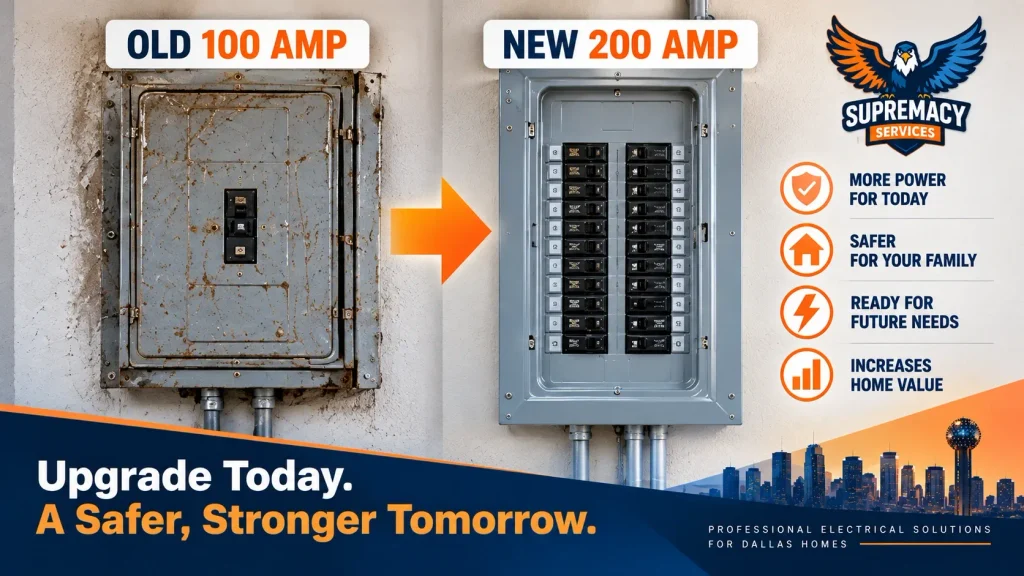
Texas currently uses the 2023 National Electrical Code as the state-adopted electrical standard, while local authorities may administer permitting and inspection requirements.

Permit handling, inspection coordination and related administrative work therefore need to be considered when evaluating a complete panel-upgrade estimate.

9. Utility Coordination

Some electrical service upgrades require coordination with the electric utility or transmission/distribution provider for disconnection, meter-related work or reconnection.

The electrician should determine whether utility coordination is required and incorporate it into project scheduling.

Signs Your Dallas Home May Need an Electrical Panel Upgrade

Signs a Dallas home may need an electrical panel upgrade, including tripping breakers, flickering lights, heat and limited circuit space.
Frequent breaker trips, flickering lights, unusual heat or burning odors, and insufficient circuit space are reasons to have your electrical system professionally evaluated.

Age alone does not prove that an electrical panel must be replaced. Its condition, design, capacity and ability to safely serve the home’s electrical demand matter more.

However, homeowners should consider professional evaluation when they notice the following conditions.

Breakers Frequently Trip

A circuit breaker that repeatedly trips may indicate an overloaded circuit, short circuit, ground fault, defective breaker or another electrical problem.

Do not simply install a larger breaker. Breaker sizing must correspond to the circuit and conductors it protects.

Supremacy Services also provides breaker installation and replacement in Dallas when the problem is isolated to breaker equipment rather than requiring a complete panel replacement.

Flickering or Dimming Lights

Lights that repeatedly flicker or dim when major equipment starts can indicate voltage fluctuations, overloaded circuits or electrical connection problems.

Because several different faults can cause these symptoms, professional diagnosis is more useful than assuming the panel itself is defective.

Burning Odor or Scorching

A burning smell, discoloration, soot, melted components or unusual heat around an electrical panel warrants prompt professional attention.

If you observe smoke, active arcing or fire, keep away from the equipment and contact emergency services when appropriate.

Rust or Corrosion

Moisture and electrical equipment are a dangerous combination.

Visible rust or corrosion inside or around a breaker panel can compromise connections and components and should be inspected by a qualified electrician.

Your Panel Has No Space for New Circuits

A completely full panel can become an obstacle when adding equipment such as:

  • EV chargers
  • New HVAC equipment
  • Electric ranges
  • Hot tubs
  • Workshops
  • Pool equipment
  • Home additions

A load calculation and panel evaluation can determine whether additional circuits, a subpanel or a larger service is appropriate.

You Still Have a Fuse Box

Some older Dallas homes still use fuse-based electrical distribution.

A fuse box is not automatically unsafe simply because it uses fuses, but older systems may lack the capacity, circuit configuration or protective features expected for modern household electrical loads.

Professional evaluation can determine whether replacement is appropriate.

Do You Need a 200-Amp Electrical Panel?

Modern Dallas home electrical demands including EV chargers, HVAC systems, kitchen appliances and smart home technology.
EV chargers, HVAC equipment, major appliances, home additions and smart-home systems can significantly increase a home’s electrical demand.

Not every house needs 200-amp service.

The correct electrical service size depends on the home’s calculated electrical load—not merely how many appliances the homeowner owns.

A licensed electrician should consider major loads such as:

  • Air conditioning
  • Electric heating
  • Water heating
  • Cooking equipment
  • Clothes dryers
  • EV charging
  • Pool and spa equipment
  • Workshops
  • Additional dwelling areas

A smaller home with natural-gas appliances may have very different electrical requirements from an all-electric property with multiple HVAC systems and EV chargers.

Electrical Panel Upgrades for EV Chargers

Electric vehicles are one of the reasons many homeowners begin investigating their electrical capacity.

A Level 2 charger can represent a significant continuous electrical load. Before installation, an electrician should determine whether the existing service and panel can accommodate the charger safely.

However, buying an EV does not automatically mean you need a new electrical panel.

Depending on the home’s existing load and equipment, alternatives may include appropriate circuit design or load-management technology. A proper electrical load assessment should come before deciding on a service upgrade.

Electrical Panel Upgrades and New HVAC Systems

Electrician servicing a modern upgraded electrical panel designed for increased capacity and future electrical needs.
A properly planned electrical panel upgrade can provide the circuit capacity and infrastructure needed for current and future household electrical loads.

Dallas air-conditioning systems can represent one of the largest electrical loads in a home.

When replacing HVAC equipment, particularly when electrifying heating or installing equipment with different electrical requirements, homeowners should verify that the electrical system can support the new load.

Supremacy’s combined HVAC and electrical capabilities make internal linking between your Dallas electrical services and relevant HVAC services particularly useful here.

Can a Subpanel Save Money?

Sometimes—but a subpanel does not increase the total electrical service capacity supplied to the home.

A subpanel primarily provides additional circuit spaces and distributes power to another location.

It may be appropriate when the existing service has sufficient capacity but additional breaker spaces are required.

If the home already demands more electricity than its service can safely provide, installing a subpanel alone does not solve that underlying capacity issue.

How Long Does an Electrical Panel Upgrade Take?

Many straightforward residential panel replacements can be physically completed within approximately one working day.

Complex service upgrades may take longer because the project can involve:

  • Utility coordination
  • Permitting
  • Inspection
  • Meter/service modifications
  • Grounding improvements
  • Panel relocation
  • Additional wiring repairs

The home will normally experience a period without electricity while service equipment is being replaced.

Your electrician should explain the anticipated outage and project sequence before work begins.

Should You Upgrade Before Remodeling?

Planning the electrical system before a major renovation can prevent expensive changes later.

Consider having the panel evaluated before projects involving:

  • Kitchen remodels
  • Home additions
  • Garage conversions
  • New HVAC equipment
  • Electric water heaters
  • EV chargers
  • Hot tubs or pools
  • Workshops
  • Major appliance electrification

If additional capacity is needed, coordinating the electrical upgrade with the renovation can make the overall project more efficient.

Can You Upgrade an Electrical Panel Yourself in Texas?

Electrical service equipment presents serious shock, arc-flash and fire hazards.

Texas generally requires people performing non-exempt electrical work to be appropriately licensed and for that work to be performed through a licensed electrical contractor, although state law contains specific exemptions, including certain work by homeowners on dwellings they own and occupy.

A homeowner exemption should not be confused with the work being simple or risk-free. Local permit and inspection requirements may still apply.

Electrical panel and service work involves equipment connected directly to the home’s incoming power supply, making professional installation the prudent approach for most homeowners.

What Should a Dallas Electrical Panel Upgrade Quote Include?

Do not compare electrical estimates based on the final price alone.

Ask whether the written estimate includes:

  • New panel/load center
  • Main breaker
  • Required branch breakers
  • Removal of old equipment
  • Service entrance modifications
  • Meter-related work, when necessary
  • Grounding and bonding
  • Surge protection, when included
  • Permit handling
  • Inspection coordination
  • Utility coordination
  • Cleanup and disposal
  • Equipment warranty
  • Labor/workmanship warranty

Two contractors can quote very different amounts because they are actually proposing different scopes of work.

The Texas Department of Licensing and Regulation also recommends obtaining multiple bids and verifying the contractor’s licensing information before hiring an electrical contractor.

Why Professional Panel Installation Matters

Supremacy Services electrician performing professional electrical panel installation and breaker work in a Dallas home.
Professional electrical panel installation helps ensure that breakers, conductors, grounding, bonding and service equipment are installed according to applicable requirements.

An electrical panel is the central distribution point of the home’s electrical system. Errors at this location can affect virtually every downstream circuit.

Professional panel work should address more than simply making the lights turn back on.

A properly planned project considers electrical load, conductor sizing, overcurrent protection, grounding and bonding, manufacturer specifications, service requirements and applicable electrical codes.

Texas electrical contractors must operate under state licensing requirements, and Texas has adopted the 2023 National Electrical Code.

How to Keep Your Electrical Panel Upgrade From Becoming More Expensive Than Expected

Electrical panel upgrade checklist for Dallas homeowners covering inspection, estimates, permits, code requirements and future electrical needs.
Before upgrading your electrical panel, evaluate your home’s needs, schedule an inspection, compare detailed estimates, confirm permit requirements and plan for future electrical demand.

The best approach is to define the scope before installation begins.

Ask your electrician to determine:

  1. Your existing service amperage.
  2. The calculated electrical load.
  3. Whether you actually need increased service capacity.
  4. Whether the meter/service equipment must change.
  5. Whether grounding or bonding requires improvement.
  6. Whether the existing panel location is acceptable.
  7. What permits and inspections are required.
  8. Whether utility coordination is necessary.
  9. Which breakers and safety devices are included.
  10. Whether future circuits should be planned now.

A detailed assessment makes it much easier to compare estimates on an apples-to-apples basis.

Is an Electrical Panel Upgrade Worth It?

An electrical panel upgrade is primarily an infrastructure and safety investment, not a cosmetic renovation.

It may make sense when the existing equipment is damaged, deteriorated, undersized for the home’s calculated electrical demand, unable to accommodate necessary circuits, or requires replacement as part of a larger electrical project.

It can also prepare a home for additional electrical demand from EV charging, HVAC upgrades, renovations and other major equipment.

The important point is that homeowners should upgrade based on the condition and electrical requirements of their property—not simply because someone says every older panel needs to be replaced.

Get an Electrical Panel Evaluation in Dallas, TX

If your breakers frequently trip, your electrical panel is damaged, you are running out of circuit space, or you are planning major new electrical loads, Supremacy Services can evaluate your existing electrical system and determine whether repair, breaker replacement, a subpanel or a complete panel upgrade is appropriate.

Explore Supremacy’s Electrical Panel Upgrade services in Dallas or its broader Dallas Electrical Services to schedule a professional assessment.

A proper evaluation gives you something much more useful than an online average: a scope and price based on your actual home.

Frequently Asked Questions

How much does it cost to upgrade an electrical panel in Dallas in 2026?

For planning purposes, many residential Dallas projects can fall roughly between $1,500 and $5,000, while complex service upgrades can exceed that range. Published estimates vary because some prices describe a panel-only replacement while others include a complete service-capacity upgrade.

How much does it cost to upgrade from 100 amps to 200 amps in Dallas?

A 100-to-200-amp upgrade can commonly fall around $2,500–$5,000 or more, depending on the meter equipment, service conductors, grounding, utility work, panel location, permits and other required modifications.

Is 200 amps enough for a house?

200-amp service is common in modern homes, but the correct service size should be determined through an electrical load calculation. Large homes or properties with substantial electric heating, EV charging, pools or other heavy loads can require different solutions.

Does an EV charger require a 200-amp panel?

Not necessarily. The electrician should calculate the home’s existing electrical demand and the proposed charger load. Some homes have adequate capacity without upgrading the service, while others may require an upgrade or an approved load-management solution.

Can I replace only the electrical panel without upgrading the service?

Sometimes. If the existing service capacity remains adequate and the surrounding service equipment is suitable, a panel may be replaced without increasing amperage. An electrician should inspect the system before determining the scope.

Does an electrical panel upgrade require a permit in Dallas?

Major panel and service work is generally subject to local permitting and inspection requirements. The exact requirements depend on the project’s scope and jurisdiction, so they should be confirmed for the property before work begins.

How long does a 200-amp panel upgrade take?

Straightforward installations are often physically completed in approximately a day, but complicated projects can take longer. Permitting, inspections and utility scheduling can also affect the overall project timeline.

Should I replace my electrical panel just because it is old?

Not necessarily. Age is one consideration, but condition, capacity, equipment type, available circuit space, damage and the home’s electrical demand provide better reasons for determining whether replacement is necessary.

Final Takeaway

So, how much does an electrical panel upgrade cost in Dallas in 2026?

A useful planning budget is approximately $1,500–$5,000 for many residential projects, with simple panel replacements potentially costing less and extensive 200-amp service upgrades, relocations or high-capacity installations costing substantially more.

Rather than focusing only on the headline price, determine exactly what the quote includes.

The most accurate estimate comes from evaluating your home’s existing service capacity, electrical load, panel condition, meter and service equipment, grounding system, required permits and plans for future electrical demand.

That gives Dallas homeowners a safer—and much more accurate—basis for deciding what their electrical system actually needs.

AC Not Cooling in Dallas? 9 Common Causes & What to Do Before Calling an HVAC Pro

AC Not Cooling in Dallas? Start Here

AC not cooling in Dallas? When your air conditioner is running but your home still feels hot, the problem can range from something as simple as an incorrect thermostat setting or dirty air filter to a frozen evaporator coil, refrigerant leak, electrical failure, or compressor problem.

During periods of heavy cooling demand, an AC problem can quickly turn from an inconvenience into an uncomfortable home. The important thing is knowing what you can safely check yourself and which problems require professional HVAC diagnosis.

The U.S. Department of Energy identifies dirty filters, thermostat problems, refrigerant issues, drainage problems, electrical control failures, and ductwork problems among common reasons an air conditioner may fail to cool properly.

Supremacy Services provides professional AC repair and HVAC diagnostics throughout Dallas and surrounding DFW communities, including troubleshooting warm-air complaints, frozen coils, airflow problems, electrical faults, refrigerant pressures, and duct integrity.

This guide explains nine common reasons your AC isn’t cooling, what you can check before requesting service, and the warning signs that mean it is time to bring in an HVAC professional.

9 Common Reasons Your AC Is Not Cooling in Dallas

1. Your Thermostat Is Set Incorrectly or Malfunctioning

Home thermostat set to cooling mode while troubleshooting an AC not cooling in Dallas
Before requesting AC repair, confirm that your thermostat is set to COOL and below the current room temperature.

Before assuming something major has failed, check the thermostat.

It sounds simple, but an incorrect thermostat setting can make a perfectly functional AC appear broken.

What to check

Make sure:

  • The thermostat is set to COOL, not HEAT or OFF.
  • The desired temperature is below the current indoor temperature.
  • The fan setting is on AUTO rather than continuously ON.
  • The display is functioning normally.
  • Battery-powered thermostats have good batteries.
  • A schedule or smart-home setting hasn’t changed the desired temperature.

When the thermostat fan is set to ON, the blower can continue circulating room-temperature air even when the compressor is not actively cooling. That may make air coming from the vents occasionally feel warmer.

The Department of Energy specifically recommends checking that the thermostat is correctly set when an AC isn’t cooling properly.

When to call a professional

If the thermostat is calling for cooling but the outdoor equipment never starts—or the system repeatedly starts and stops—you could have a control, wiring, electrical, or equipment problem.

2. A Dirty Air Filter Is Restricting Airflow

Dirty AC air filter restricting airflow and causing poor cooling in a Dallas home
A clogged HVAC filter can restrict airflow and reduce your air conditioner’s cooling performance.

A clogged HVAC filter is one of the first things Dallas homeowners should inspect when their AC isn’t cooling properly.

Your air conditioner needs a steady volume of air passing across its evaporator coil. As a filter becomes loaded with dust and debris, resistance increases and airflow can fall.

That can cause:

  • Weak airflow from supply vents
  • Longer cooling cycles
  • Poor indoor comfort
  • Higher energy consumption
  • Excessive system strain
  • Evaporator-coil icing in some circumstances

The Department of Energy reports that replacing or cleaning dirty filters can reduce an air conditioner’s energy consumption by roughly 5% to 15%.

ENERGY STAR recommends checking the filter monthly during periods of heavy heating or cooling use and replacing it when dirty; at minimum, its general guidance calls for replacement about every three months, although the appropriate interval depends on the home and equipment.

What to do

Locate your return-air filter and inspect it.

If it is visibly packed with dirt, replace it with the correct size and filter type recommended for your HVAC system.

Don’t automatically install the highest-MERV filter available. Filters that create excessive pressure drop can reduce airflow in systems that weren’t designed for them. DOE technical guidance notes that excessive filter resistance can contribute to reduced AC efficiency and, in some systems, frozen coils.

3. The Outdoor Condenser Is Dirty or Blocked

Dallas outdoor AC condenser blocked by leaves and debris reducing cooling performance
Leaves, vegetation and debris around an outdoor condenser can interfere with proper airflow and heat rejection.

Your indoor AC equipment absorbs heat from the house. The outdoor condenser then has to release that heat outside.

Leaves, grass clippings, dirt and other debris around the condenser can interfere with airflow and heat rejection.

ENERGY STAR specifically recommends cleaning evaporator and condenser coils because dirty coils reduce cooling capability, increase operating time and energy costs, and can shorten equipment life.

What homeowners can safely do

Turn the system off and visually inspect the outdoor unit.

Remove loose vegetation, leaves and obvious debris from around the condenser, and make sure landscaping isn’t crowding it.

Avoid opening electrical panels, bending coil fins, using aggressive pressure washing, or attempting internal repairs yourself.

If the coil itself is heavily contaminated, professional cleaning is safer.

4. The Evaporator Coil Is Frozen

Frozen AC evaporator coil causing air conditioner cooling problems in Dallas
Ice on an evaporator coil is a warning sign that the system needs attention—not a problem to ignore.

Ice on an air conditioner during a Dallas summer may seem strange, but a frozen evaporator coil can prevent an AC from cooling the house effectively.

The evaporator coil needs adequate warm indoor airflow passing across it. If airflow becomes severely restricted—or another system condition causes coil temperatures to drop too far—moisture can freeze on the coil.

Common contributing problems include:

  • Dirty air filters
  • Restricted airflow
  • Dirty evaporator coils
  • Blower problems
  • Duct restrictions
  • Improper refrigerant charge

DOE technical guidance identifies filters, cooling-coil restrictions, duct restrictions and blower conditions as factors affecting airflow.

Warning signs

You may notice:

  • Weak airflow
  • AC running for long periods without cooling
  • Ice on refrigerant tubing
  • Water around the indoor unit after the ice melts
  • Supply air becoming progressively warmer

What to do

Do not continue forcing the AC to cool while the coil is frozen.

Turn cooling off and check the filter. Allow the system to thaw naturally.

If it freezes again after restoring normal airflow, schedule an HVAC diagnostic. Repeated icing is a symptom of an underlying problem, not something that should simply be thawed repeatedly.

5. The System Is Low on Refrigerant or Has a Refrigerant Leak

Dallas HVAC technician checking AC refrigerant pressures during professional cooling diagnosis
Refrigerant problems require proper HVAC testing rather than simply adding more refrigerant.

Your AC does not consume refrigerant like a vehicle consumes fuel.

Refrigerant circulates through a closed system, carrying heat from inside your home to the outdoor equipment. A low charge therefore needs proper diagnosis rather than automatically adding refrigerant.

Potential symptoms can include:

  • AC running but not cooling adequately
  • Longer cooling cycles
  • Ice around the evaporator or refrigerant line
  • Reduced cooling capacity
  • Unusual hissing near refrigerant components

The Department of Energy lists low or leaking refrigerant as a potential reason an AC isn’t cooling and recommends having a trained technician address the leak and charge.

Refrigerant servicing is also not a good DIY project. EPA rules govern the handling and recovery of refrigerants from stationary air-conditioning equipment.

What to do

If refrigerant loss is suspected, have an HVAC professional diagnose why the charge is incorrect rather than assuming the system simply needs a refill.

6. The Capacitor, Contactor or Another Electrical Component Has Failed

HVAC technician testing an AC capacitor and electrical components during Dallas AC repair
Failed capacitors and other electrical faults can prevent the outdoor AC equipment from operating correctly.

Air conditioners depend on multiple electrical components to start and operate their compressor and motors.

A failed capacitor, damaged contactor, loose electrical connection, tripped protective device, control-board fault, or motor problem can leave you with a system that appears partially operational but produces little or no cooling.

For example, you might hear the indoor blower running while the outdoor condenser remains off.

Supremacy’s Dallas AC repair page specifically lists failed capacitors among possible causes of an AC blowing warm air and describes electrical diagnostics as part of its repair process.

Check this first

Homeowners can check whether a normal household breaker has tripped.

However, if it trips again after being reset, do not repeatedly reset it. A recurring trip can indicate an electrical or equipment fault that needs diagnosis.

Never open the condenser’s electrical compartment or handle capacitors yourself. Capacitors can retain an electrical charge even after equipment has been switched off.

7. Your Ductwork Is Leaking, Crushed or Poorly Balanced

Damaged attic ductwork leaking conditioned air and causing uneven cooling in a Dallas home
Leaky or damaged ducts can prevent conditioned air from reaching the rooms that need it.

Sometimes the air conditioner itself is producing cold air—the problem is getting that conditioned air to the rooms where you need it.

Damaged ductwork can cause cooling to be lost in attics or other unconditioned spaces before it reaches the supply registers.

Possible warning signs include:

  • One room staying significantly hotter than another
  • Weak airflow at particular registers
  • A sudden change in airflow
  • Visible disconnected or damaged accessible ducts
  • Excessively long AC cycles

DOE guidance notes that duct leakage and inadequate return-air arrangements can increase heating and cooling loads and impair comfort, humidity control and indoor air quality.

This is especially important when an AC appears to be operating normally but certain parts of the house never get comfortable.

Supremacy offers dedicated Dallas ductwork services for issues involving leaky, poorly sized and improperly routed ducts.

8. The Condensate Drain Is Clogged

Your AC does more than lower temperature. As warm indoor air moves over the cold evaporator coil, moisture condenses and must drain away.

If that drainage system becomes clogged, water can back up.

Some HVAC installations include a float switch or safety device designed to shut cooling equipment down when condensate reaches an unsafe level. Consequently, a drainage problem can sometimes look like an AC failure.

ENERGY STAR notes that a plugged drain can cause water damage and affect indoor humidity.

Look for

  • Water around the indoor HVAC equipment
  • An overflowing drain pan
  • Unexpected AC shutdown
  • Excess indoor humidity
  • Repeated drainage problems

A small amount of accessible drain maintenance may be straightforward, but recurring backups or water around electrical/HVAC equipment warrant professional inspection.

9. The Compressor, Fan Motor or Another Major Component Is Failing

If you’ve checked the thermostat, filter and obvious external conditions and the AC still isn’t cooling, the problem may be deeper inside the system.

The compressor is central to the refrigeration cycle, while condenser and blower motors maintain the airflow needed to transfer heat.

Potential signs of a major mechanical or electrical problem include:

  • Outdoor unit won’t start
  • Indoor blower works but outdoor unit doesn’t
  • Loud buzzing, grinding or clicking
  • Breaker repeatedly trips
  • System starts and stops frequently
  • Warm air continues despite a cooling call
  • AC runs almost continuously without reaching the thermostat setting

These problems require proper testing rather than parts swapping.

Supremacy’s Dallas HVAC repair service lists refrigerant leaks, failed capacitors, frozen coils, airflow restrictions, thermostat faults and ductwork problems among the issues its technicians diagnose and repair.

AC Running but Not Cooling? Use This Quick Checklist

Before calling for AC repair in Dallas, homeowners can safely check several basics:

CheckWhat You’re Looking ForDIY or Professional?
ThermostatCOOL mode and sensible temperature settingDIY
Air filterExcessive dust or blockageDIY
Supply ventsOpen and unobstructedDIY
Outdoor condenserLeaves or obvious exterior obstructionBasic DIY
BreakerOne-time tripped breakerBasic DIY
Evaporator/refrigerant lineVisible iceStop cooling; diagnose cause
Drain areaStanding or leaking waterProfessional if recurring
RefrigerantLow charge/leakProfessional
Capacitor/electrical componentsElectrical failureProfessional
CompressorMechanical/electrical failureProfessional

Why Is My AC Running but Not Cooling?

There is an important difference between “my AC won’t turn on” and “my AC is running but not cooling.”

When the system runs without producing adequate cooling, the problem often involves either airflow or heat transfer.

An air conditioner works by absorbing heat from indoor air at the evaporator and rejecting that heat outdoors through the condenser.

Anything that significantly interferes with that process—restricted airflow, dirty coils, incorrect refrigerant charge, compressor trouble or poor duct delivery—can reduce cooling performance.

That’s why replacing random components without diagnosing the entire refrigeration and airflow system can waste money.

Why Dallas AC Systems Need Special Attention During Heavy Cooling Season

Dallas-area cooling systems can face prolonged periods of high cooling demand. During extended operation, existing weaknesses such as dirty coils, airflow restrictions, weak electrical components or refrigerant problems can become much more noticeable.

Supremacy specifically identifies extended summer run times, restricted airflow, and electrical stress among common contributors to Dallas AC problems.

Preventive maintenance becomes particularly valuable before peak cooling demand.

ENERGY STAR recommends annual HVAC tune-ups and monthly filter inspections during heavy-use periods.

When Should You Call an HVAC Professional?

Some troubleshooting should stop at the thermostat and filter.

Schedule professional Dallas AC repair when you notice:

  • Refrigerant-line or evaporator-coil ice that returns
  • Suspected refrigerant leakage
  • Burning or electrical odors
  • Repeated breaker trips
  • Buzzing or grinding equipment
  • Outdoor unit not operating
  • Water repeatedly accumulating around HVAC equipment
  • Very weak airflow despite a clean filter
  • AC running continuously without cooling
  • Major temperature differences between rooms
  • System repeatedly turning on and off
  • Thermostat calling for cooling but equipment not responding

If there is smoke, sparking, an obvious electrical hazard, or another immediate safety concern, shut the equipment down when it is safe to do so and seek appropriate emergency assistance.

Professional AC Repair in Dallas, TX

When basic troubleshooting doesn’t solve the problem, professional diagnosis can determine whether you’re dealing with airflow restriction, refrigerant trouble, electrical failure, duct leakage, thermostat problems or a mechanical component failure.

Supremacy Services advertises professional air-conditioning diagnostics and repair in Dallas, including refrigerant-pressure checks, electrical diagnostics, airflow issues, frozen coils and duct-integrity evaluation.

Recommended CTA

Still dealing with an AC that’s running but not cooling?

Have the system properly diagnosed instead of guessing which part has failed.

How to Help Prevent Your AC From Stopping Cooling

Not every breakdown is preventable, but routine maintenance can reduce avoidable performance problems.

Homeowners should:

  • Check filters regularly.
  • Replace dirty filters with the correct type.
  • Keep outdoor equipment clear of leaves and vegetation.
  • Keep supply and return registers unobstructed.
  • Watch for water around indoor HVAC equipment.
  • Pay attention to unusual noises or cycling behavior.
  • Address declining cooling performance before complete failure.
  • Schedule periodic professional HVAC maintenance.

ENERGY STAR identifies dirt and neglect as major contributors to HVAC failure and inefficiency and recommends annual pre-season checkups along with regular filter inspection.

Repair or Replace an AC That Isn’t Cooling?

An AC that stops cooling doesn’t automatically need replacement.

Many no-cooling problems can result from repairable conditions such as a dirty coil, failed capacitor, thermostat issue, airflow restriction or other component failure.

Replacement becomes a broader consideration when an older system experiences repeated breakdowns, declining efficiency, expensive major-component failures or ongoing comfort problems.

The decision should be based on the actual diagnosis, equipment condition, repair cost, efficiency, system sizing and expected remaining service life, rather than age alone.

For homeowners considering replacement, Supremacy also provides air-conditioner installation services in Dallas.

Frequently Asked Questions About an AC Not Cooling in Dallas

Why is my AC running but not cooling my house?

Possible causes include a dirty air filter, dirty coils, restricted airflow, frozen evaporator coil, refrigerant problem, electrical component failure, duct leakage or compressor trouble. Start with the thermostat and filter before moving to professional diagnostics.

Why is my AC blowing warm air?

First verify that your thermostat is set to COOL and that the outdoor condenser is operating. A dirty filter, electrical failure, refrigerant problem, frozen coil or compressor-related problem can also result in inadequate cooling.

Can a dirty filter cause my AC not to cool?

Yes. A heavily clogged filter restricts airflow, which reduces cooling performance and can contribute to coil icing under certain conditions.

Should I turn my AC off if the coil is frozen?

Yes. Continuing to demand cooling while the evaporator is covered in ice won’t solve the underlying airflow or refrigeration problem. Allow the system to thaw and have the cause investigated if the icing returns.

Does low refrigerant mean my AC just needs to be recharged?

Not necessarily. Low refrigerant can indicate leakage. Refrigerant problems should be diagnosed by a qualified HVAC professional, and refrigerant handling is subject to EPA requirements.

Why is my AC cooling some rooms but not others?

Uneven cooling can result from duct leakage, crushed or restricted ductwork, airflow balancing problems, closed registers, insulation/heat-gain differences or HVAC design issues. DOE technical guidance confirms that duct restrictions and leakage can interfere with HVAC airflow and comfort.

How often should I change my AC filter in Dallas?

There isn’t one interval that fits every home. ENERGY STAR recommends inspecting the filter monthly during heavy-use seasons, replacing it when dirty, and at minimum following its general three-month replacement guidance. Homes with pets, substantial dust or heavy system use may need more frequent changes.

Who should I call when my AC isn’t cooling in Dallas?

For problems beyond basic thermostat, filter and exterior-obstruction checks, use a qualified HVAC technician capable of checking airflow, electrical operation, coils, refrigerant conditions and ductwork. Supremacy provides AC and HVAC repair services in Dallas and surrounding DFW communities.

Sewer Line Repair in Dallas technician inspecting a damaged underground sewer line.

Sewer Line Repair in Dallas: 10 Warning Signs Your Sewer Line Is Damaged

Sewer Line Problems Can Become Serious Faster Than You Think

Sewer Line Repair in Dallas: 10 Warning Signs Your Sewer Line Is Damaged is an important guide for homeowners who want to recognize underground plumbing problems before they develop into sewage backups, property damage, or a major sewer replacement.

Your home’s main sewer line carries wastewater from toilets, sinks, showers, tubs, washing machines, and other plumbing fixtures away from the property. Because most of this line is buried, deterioration can develop out of sight. A cracked pipe, root intrusion, separated joint, belly, severe buildup, or partial collapse may initially produce symptoms that look like an ordinary drain clog.

The difference matters. Clearing a clogged bathroom sink may solve a localized drain problem, but repeatedly clearing drains will not repair a broken underground sewer pipe. Supremacy Services’ Dallas sewer service specifically uses HD camera inspection to identify conditions such as cracks, roots, bellies, and collapsed sections before recommending repair or replacement.

That is why recognizing the early warning signs of sewer line damage can help Dallas homeowners act before a relatively manageable problem becomes an emergency.

10 Warning Signs You May Need Sewer Line Repair in Dallas

1. Multiple Drains Are Slow at the Same Time

Multiple slow drains indicating a possible damaged sewer line in Dallas.
Several slow drains at once can indicate a restriction farther down the home’s drainage system.

One slow sink does not automatically mean your main sewer line is damaged. Hair, soap residue, grease, or debris can create a blockage in an individual fixture’s drain.

The situation becomes more concerning when several fixtures begin draining slowly at roughly the same time.

You might notice:

  • The kitchen sink draining slowly
  • Water remaining in the bathtub longer than normal
  • Toilets becoming sluggish
  • Shower water pooling around your feet
  • Floor drains taking longer to clear

Because these fixtures eventually connect to the home’s main drainage system, widespread slow drainage can indicate a restriction farther downstream.

This distinction is important for homeowners searching for sewer line repair in Dallas. Supremacy’s drain-cleaning process includes camera inspection specifically to identify blockages and assess pipe condition rather than simply assuming every slow drain is an isolated clog

2. Your Drains Keep Clogging After Being Cleared

A clog that disappears after professional cleaning and stays gone was probably an obstruction.

A clog that repeatedly returns deserves more investigation.

Recurring blockages can develop when there is an underlying structural problem such as root intrusion, a damaged joint, severe pipe deterioration, a low section of pipe that retains waste, or a partially collapsed sewer line.

Imagine clearing debris from a damaged pipe without fixing the damaged section itself. Wastewater may flow better temporarily, but the condition that helped create the obstruction is still present.

This is one reason a sewer camera inspection can be valuable when the same drainage problem keeps returning. Supremacy’s sewer repair process uses HD camera inspection to locate roots, cracks, bellies, and collapses.

3. Toilets, Sinks or Showers Make Gurgling Sounds

That strange glug-glug coming from a toilet should not always be dismissed as normal plumbing noise.

Your drainage system relies on both wastewater flow and proper air movement. When wastewater encounters a significant restriction, air can become displaced through nearby fixtures.

For example, you might:

  • Flush a toilet and hear the bathtub gurgle.
  • Drain a sink and hear bubbling from the toilet.
  • Run the washing machine and hear noises from another drain.

An isolated sound does not prove that a sewer pipe is broken. However, persistent gurgling combined with slow drains, recurring clogs, or backups makes a main-line problem more plausible.

The EPA also identifies gurgling plumbing, slow fixtures, and wastewater backups among signs associated with malfunctioning wastewater systems.

4. Sewage Is Backing Up Into Your Home

This is one of the most serious sewer warning signs.

Wastewater should travel in one direction—away from your home. When sewage begins coming back through a toilet, bathtub, shower, or floor drain, wastewater is being prevented from moving normally downstream.

You may notice dirty water appearing in a bathtub when another fixture is used or wastewater rising through the lowest drain in the home.

A major backup can create more than an inconvenience. EPA states that sanitary sewer overflows can cause property damage and threaten public health.

If sewage has entered your home, avoid unnecessary contact with it. Wastewater can contain disease-causing microorganisms. EPA and CDC guidance recommends treating sewage contamination as a potential health hazard.

Do not repeatedly flush toilets or run large amounts of water when an active main-line backup is occurring.

Arrange professional diagnosis as quickly as possible.

5. You Smell Sewer Odors Inside or Outside Your Home

Your home’s drainage system is designed to keep sewer gases separated from occupied spaces.

Persistent sewage-like odors therefore deserve attention.

The smell may occur:

  • Around a bathroom
  • Near a floor drain
  • In a basement or utility area
  • Around an exterior cleanout
  • Near a particular section of the yard

Not every sewer odor means the underground sewer line is broken. Dry drain traps, venting problems, damaged seals, and fixture-related issues can also cause unpleasant smells.

However, persistent outdoor sewer odors combined with soggy soil, unusually green vegetation, slow drainage, or recurring backups can indicate wastewater escaping underground.

A qualified plumber can determine whether the source is a fixture, vent, drain, or main sewer line rather than relying on odor alone.

6. Your Yard Has Unexplained Wet or Soggy Areas

Cracked sewer line causing a wet yard at a Dallas home.
Persistent wet or foul-smelling areas above the sewer route deserve professional investigation.

A buried sewer pipe can leak wastewater into the surrounding soil when it develops a crack, separated connection, or significant structural failure.

That can sometimes create an area of the yard that remains unusually:

Soft, wet, muddy, sunken, or foul-smelling.

The location can be particularly significant when the wet area appears close to the path of the building sewer.

Don’t automatically assume every soggy lawn means sewer damage. Irrigation leaks, grading problems, rainfall, and water-service leaks can produce similar symptoms.

If you are also experiencing plumbing problems inside the house, however, a sewer inspection becomes considerably more important.

Sewer leak or water-line leak?

This is an important distinction.

A damaged water service line carries clean, pressurized water toward your home. A sewer line carries wastewater away from it.

Water-line leaks are more commonly associated with unexplained water loss, pressure problems, or persistently wet ground without sewage characteristics. Sewer problems are more likely to accompany drain backups, foul odors, gurgling, or wastewater-related drainage issues.

7. One Area of Your Lawn Is Suddenly Greener Than Everything Else

An unusually lush patch of grass can look like good news.

Sometimes it isn’t.

Wastewater leaking from a buried line can alter moisture and nutrient conditions around the affected soil. Consequently, vegetation directly above or near the leak may sometimes become noticeably greener or grow faster than surrounding grass.

This sign becomes more significant when the same area is also:

  • Soft or saturated
  • Developing a sewage odor
  • Beginning to sink
  • Located along the sewer route
  • Accompanied by slow drains or backups inside the house

Do not diagnose a broken sewer from greener grass alone. Irrigation coverage and drainage patterns should also be considered.

The goal is to look for multiple symptoms pointing toward the same underground problem.

8. You Notice Sinkholes, Depressions or Soil Movement

An underground leak can gradually disturb surrounding soil.

If wastewater continually escapes from a damaged pipe, soil can become saturated or eroded. Over time, homeowners may notice depressions, unusually soft ground, or changes to the surface above the affected area.

These conditions deserve professional evaluation, particularly when accompanied by sewer symptoms elsewhere.

Dallas homeowners should also be aware that underground private laterals are exposed to environmental stresses. City documentation discussing service lines specifically identifies factors such as ground shifting, tree-root penetration, corrosion, and temperature fluctuations as challenges affecting buried lines.

Never enter or attempt to excavate a sinkhole or unstable area yourself.

9. Tree Roots Are Affecting the Sewer Line

Tree root intrusion causing sewer line damage in Dallas TX.
Roots can enter sewer pipes through cracks and defective joints, restricting wastewater flow.

Trees are an important part of Dallas landscaping, but roots and sewer pipes can become a bad combination.

Roots naturally grow toward areas where moisture is available. If an older sewer pipe has a crack, loose joint, or other opening, fine roots may enter that opening and continue growing inside the pipe.

Over time, the root mass can catch toilet paper, grease, wipes, and other debris, progressively restricting wastewater flow.

EPA specifically identifies tree roots entering sewer defects or openings as one potential cause of sewer blockages.

Typical symptoms can include:

  • Repeated main-line clogs
  • Slow drainage
  • Gurgling fixtures
  • Backups
  • Problems returning after conventional drain clearing

Removing roots can restore flow in some circumstances, but root removal does not necessarily repair the opening that allowed the roots into the pipe. A camera inspection can determine whether cleaning is sufficient or whether structural sewer repair should follow.

10. Your Sewer Camera Inspection Shows Cracks, Bellies or Collapse

Sewer camera inspection identifying damaged sewer pipe in Dallas.
Camera inspection helps identify the location and condition of hidden sewer-line defects.

Some of the most important sewer problems cannot be diagnosed from symptoms alone.

A professional sewer camera can provide direct visual evidence of the pipe’s interior.

A technician may discover:

Cracks: openings in the pipe wall that can allow leakage or root intrusion.

Separated joints: connections that have shifted apart.

Root intrusion: roots growing through openings and restricting flow.

Pipe bellies: low sections where wastewater and solids can collect rather than maintaining proper gravity flow.

Corrosion or deterioration: weakening of older pipe materials.

Partial or complete collapse: significant structural failure that prevents normal flow.

This is where professional diagnosis becomes particularly valuable. Supremacy Services describes HD camera reconnaissance as the first stage of its sewer repair process before determining whether traditional excavation, pipe bursting, CIPP lining, or another approach is appropriate.

What Causes Sewer Line Damage in Dallas?

Recognizing the symptoms is only half the diagnosis. Determining why the sewer is failing helps determine whether the solution should be cleaning, localized repair, trenchless rehabilitation, or replacement.

Tree Root Intrusion

Roots usually do not need to crush a perfectly sealed modern pipe to cause trouble. Instead, they can exploit existing cracks, defective joints, or openings.

Once roots enter, they can expand and trap waste until flow becomes severely restricted. EPA recognizes root intrusion through sewer defects as a cause of sewer blockage.

Soil Movement and Pipe Shifting

Buried sewer lines depend on stable support and proper slope.

Movement of the surrounding soil can change pipe alignment, place stress on connections, or contribute to separations and low spots. Dallas documentation discussing underground laterals specifically notes ground shifting among the conditions that can affect these buried lines.

Aging or Deteriorating Pipes

Sewer materials do not remain in perfect condition indefinitely.

Older systems may become increasingly vulnerable to corrosion, joint deterioration, cracking, deformation, or root intrusion depending on pipe material and installation conditions.

Age alone does not automatically mean replacement is necessary. Actual pipe condition should drive the decision.

Improper Installation or Poor Slope

Gravity sewer systems need proper alignment and slope to move solids and wastewater effectively.

Dallas Water Utilities’ design guidance specifies minimum grades for wastewater service laterals, illustrating how important slope is to proper wastewater movement.

Improperly supported or poorly graded piping can create areas where solids repeatedly accumulate.

Grease, Wipes and Foreign Materials

Not every main sewer blockage begins with structural damage.

Fats, oils, grease, wipes, hygiene products, and inappropriate household materials can contribute to serious sewer restrictions. EPA specifically lists fats, oils, grease and various wipes and hygiene products among materials capable of contributing to blockages.

A good household rule remains simple:

Toilets are for human waste and toilet paper—not wipes, paper towels, hygiene products, grease, or household trash.

Clogged Drain vs. Damaged Sewer Line: What’s the Difference?

Clogged drain vs damaged sewer line comparison for Dallas homeowners.
A single slow fixture often points to a local clog, while multiple affected fixtures can indicate a main-line problem.

This section is important for both readers and SEO because homeowners often confuse drain cleaning with sewer line repair.

SymptomLocal Drain ClogMain Sewer Problem
One sink drains slowlyMore likelyLess likely
Several drains slow togetherLess likelyMore concerning
Toilet affects bathtub/showerUnusualConcerning
Recurring whole-home clogsLess likelyMore concerning
Sewage at lowest drainUnlikelyStrong warning sign
Soggy, foul-smelling yardNoPossible
Roots/cracks on cameraNoYes
Structural pipe collapseNoYes

A drain clog usually involves an obstruction within a fixture or branch drain.

A sewer-line problem occurs farther downstream and may affect several fixtures because they share the same main drainage route.

This is why repeatedly snaking individual fixtures is not a substitute for investigating persistent whole-house drainage problems.

Sewer Line vs. Water Line Problems

These two systems perform opposite jobs:

Water line → brings clean water into the property.
Sewer line → carries wastewater away from the property.

A water-line problem may produce low pressure, unexplained water loss, or clean water accumulating in the yard.

A sewer problem is more closely associated with slow drains, wastewater backups, gurgling, sewage odors, recurring clogs, or sewer-camera evidence of structural damage.

This distinction prevents homeowners from pursuing the wrong repair.

How Professionals Diagnose a Damaged Sewer Line

Modern sewer diagnosis should be based on evidence—not guesswork.

Step 1: Evaluate the Symptoms

A plumber first determines whether the problem affects a single fixture, one branch, or multiple fixtures throughout the home.

Step 2: Access and Test the Drainage System

The technician may use an accessible cleanout to investigate the main sewer line.

Step 3: Perform a Sewer Camera Inspection

A specialized camera travels through the pipe so the technician can examine its interior and identify blockages, cracks, roots, bellies, separations, or collapsed areas.

Step 4: Locate the Problem

When structural damage is found, locating equipment can help establish where the defect sits underground. This can help reduce unnecessary excavation.

Step 5: Recommend the Appropriate Repair

The findings should determine the solution—not the other way around.

Supremacy’s published process includes HD camera reconnaissance followed by assessment of traditional and trenchless approaches before precision repair or replacement.

Sewer Line Repair vs. Replacement: Which Do You Need?

Trenchless sewer line repair versus traditional sewer excavation in Dallas.
The condition and location of sewer damage determine which repair approach is appropriate.

A damaged sewer does not automatically require complete replacement.

Sewer Line Repair May Be Appropriate When:

Damage is isolated to a relatively small section, the remaining pipe is structurally sound, and correcting the affected area can provide a durable solution.

Sewer Line Replacement May Be Better When:

The pipe has extensive deterioration, widespread defects, severe deformation, multiple failed sections, or significant collapse.

Trenchless Sewer Repair May Be an Option

Depending on the pipe’s condition and site, trenchless techniques may reduce the amount of conventional excavation required.

Supremacy currently lists both CIPP lining and pipe bursting, in addition to traditional repair/replacement methods, among its Dallas-Fort Worth sewer options.

The right method should therefore be selected after inspection, rather than assuming every damaged sewer needs the same treatment.

What Should You Do If Sewage Is Backing Up Right Now?

Treat an active sewage backup differently from an ordinary slow drain.

Stop unnecessary water use so you are not sending additional wastewater toward the blockage. Keep children and pets away from contaminated areas and avoid direct contact with sewage.

EPA notes that raw sewage can carry bacteria, viruses, parasites, and other organisms capable of causing illness.

If there is reason to believe the problem involves the municipal wastewater main rather than your private sewer lateral, Dallas Water Utilities instructs residents to report clogged or overflowing wastewater mains through 3-1-1, or 214-670-3111 from outside Dallas city limits.

For a suspected private building-sewer problem, arrange professional inspection.

Why Early Sewer Line Repair Matters

Delaying diagnosis rarely makes structural sewer damage disappear.

A developing defect can contribute to increasingly frequent clogs, wastewater leakage, sewage backups, landscape damage, or more extensive pipe deterioration.

EPA notes that sewer overflows can cause property damage and create public-health concerns.

Early inspection also gives homeowners something extremely valuable: options.

A smaller localized defect may provide more repair possibilities than a pipe that has progressed to major structural failure.

Professional Sewer Line Repair in Dallas, TX

When several of these warning signs appear together, the next step should be diagnosis rather than guesswork.

Supremacy Services provides sewer line repair and replacement throughout Dallas and the DFW Metroplex, with HD sewer camera inspection and both traditional and trenchless repair approaches.

Whether the underlying problem is root intrusion, recurring blockage, a cracked sewer pipe, a belly, separated joint, or collapsed section, identifying the actual defect makes it possible to recommend a repair based on the condition of the line.

Frequently Asked Questions About Sewer Line Repair in Dallas

How do I know if my main sewer line is damaged?

Multiple slow drains, recurring whole-home clogs, gurgling fixtures, sewage backups, foul outdoor odors, unusual wet areas in the yard, and abnormalities discovered during a camera inspection can all justify further investigation. No single symptom proves structural damage, so professional diagnosis is important.

Does a slow drain mean I need sewer line repair?

Not necessarily. One slow fixture often indicates a localized clog. Several fixtures slowing simultaneously—or recurring problems after cleaning—make a main sewer restriction or structural issue more concerning.

Can tree roots damage a sewer line?

Roots can enter through existing openings, cracks, or defective joints and create significant blockages. EPA specifically identifies tree-root intrusion through sewer defects as a potential sewer-overflow cause.

Can a sewer camera tell if my pipe is broken?

A camera inspection can visually reveal many problems, including cracks, root intrusion, joint separation, deformation, buildup, and collapsed sections. Supremacy uses HD camera inspection as part of its sewer-line diagnostic process.

Can a damaged sewer line be repaired without digging up my entire yard?

Sometimes. Trenchless techniques such as CIPP lining or pipe bursting may be suitable depending on the type, location, and severity of damage. Supremacy lists both trenchless and traditional methods among its sewer repair options.

Is a sewer backup dangerous?

Potentially, yes. Untreated sewage can contain harmful microorganisms, which is why EPA and CDC recommend avoiding unnecessary contact with sewage-contaminated wa

Water line repair Dallas technician inspecting a damaged underground pipe for Supremacy Services

How to Know If You Need a Water Line Repair in Dallas: 9 Warning Signs

Dallas Water Line Replacement starts with recognizing the early symptoms of an underground plumbing problem before it causes extensive damage. Your home’s main water line delivers fresh water from the municipal supply to your plumbing system, and because much of this line is buried, leaks can remain hidden for weeks or even months. Knowing what to watch for—such as higher water bills, low water pressure, wet spots in your yard, or unexplained water usage—can help Dallas homeowners identify a potential water line problem early and arrange professional repairs before the damage becomes more serious.

Even a small underground water line leak can lead to higher water bills, wasted water, soggy landscaping, reduced water pressure, and moisture-related property damage if it is not addressed promptly.

According to the EPA, household leaks can waste thousands of gallons of water annually, while aging pipes, corrosion, and irregular water pressure can contribute to plumbing leaks.

For Dallas homeowners, recognizing the warning signs of a damaged water line early can help prevent a relatively manageable plumbing repair from developing into a much larger and more expensive problem.

If you notice unexplained water usage, wet areas in your yard, low water pressure, or other signs of a hidden leak, consider professional water line repair and replacement in Dallas from Supremacy Services. Professional pressure testing and leak-detection methods can help locate the problem and determine whether the damaged section should be repaired or replaced.

9 Signs You May Need Water Line Repair in Dallas

1. Your Water Bill Suddenly Increases
Water meter showing signs of a possible hidden water line leak in Dallas
An unexplained increase in water usage may be an early warning sign of a hidden water line leak.

An unexplained increase in water consumption is one of the most useful clues that water may be escaping somewhere in your plumbing system.

If your household routines have remained relatively consistent but your water consumption has increased considerably, don’t automatically assume the utility rate is responsible. Compare the actual amount of water used from one billing period to another.

The EPA specifically recommends comparing water bills with the same period from the previous year because unexpectedly high consumption can indicate an unidentified household leak.

Try the water-meter test

Turn off faucets, showers, irrigation systems, washing machines, dishwashers and other water-using appliances.

Record the water-meter reading and avoid using water for approximately two hours. Check the meter again.

If the reading has changed, the EPA says you probably have a leak somewhere in the home or plumbing system.

A professional inspection can then determine whether that leak is in a fixture, interior pipe, irrigation system or main water line.

2. You Have Unexplained Wet or Soggy Areas in Your Yard

One part of your lawn remains wet even though it hasn’t rained recently.

Soggy Dallas lawn caused by a possible underground water line leak
Persistent wet spots or unusually soggy areas in your Dallas yard may indicate a leaking underground water line.

That deserves attention.

Because your main water service line typically travels underground between the utility connection and your house, a leaking pipe can release water into the surrounding soil.

Watch for:

  • Persistently soggy soil
  • Puddles without an obvious source
  • Muddy areas during dry weather
  • Unusually lush or fast-growing patches of grass
  • Soil erosion or soft ground

Supremacy Services specifically identifies persistently wet or mushy lawn areas as a common symptom of an underground water-line problem.

3. Water Pressure Has Dropped Throughout Your House
Low faucet pressure caused by a possible damaged main water line
Persistent wet spots or unusually soggy areas in your Dallas yard may indicate a leaking underground water line.

A single weak faucet often points to a localized fixture problem.

When multiple faucets, showers and fixtures suddenly experience low pressure, however, the problem may be farther upstream.

Possible causes include:

  • A leaking main water line
  • Partially obstructed piping
  • Corrosion or mineral buildup
  • A pressure-regulation problem
  • A damaged supply line

Supremacy identifies low pressure throughout the home as one of the common problems associated with a leak, partial blockage or failing main line.

A plumber can perform pressure testing and additional diagnostics rather than relying on symptoms alone.

4. You Hear Water Running When Everything Is Off

Your house should generally become quiet when every water fixture and appliance is off.

If you continue hearing:

hissing, dripping, rushing or running water, investigate.

First check toilets, faucets, outdoor hose bibs, irrigation equipment, water heaters and appliances.

If you cannot find an obvious source, there could be a concealed leak.

Supremacy’s Dallas leak-detection service uses methods including acoustic detection and infrared thermography to locate hidden leaks while reducing unnecessary disruption to the property.

5. Your Water Looks Rusty, Cloudy or Discolored

Changes in water appearance deserve investigation, although discoloration alone does not automatically mean your underground water line is broken.

Corroding plumbing, sediment, disturbances to the municipal supply and other plumbing problems can affect water appearance.

If discoloration persists, particularly when combined with low pressure, leaks or aging metal plumbing, arrange a professional inspection rather than assuming the source.

A plumber can determine whether deterioration within your home’s piping is contributing to the problem.

6. Cracks, Stains or Unexplained Moisture Are Appearing

Water doesn’t always surface outside.

Leaks beneath or near a building can sometimes produce signs such as:

  • Damp flooring
  • Unexplained moisture
  • Water stains
  • Musty odors
  • Mold or mildew
  • Damaged drywall
  • Warped materials

Supremacy’s water-line service information identifies water stains, mold or mildew and slab leaks among the plumbing problems its technicians investigate.

These symptoms should be diagnosed rather than used alone to conclude that the main water line has failed, because several other plumbing and building-envelope problems can cause similar damage.

7. Your Pipes Are Older or Corroded
Aging corroded residential water pipe requiring professional inspection
Aging and corrosion can gradually weaken certain water lines, increasing the risk of leaks and eventual pipe failure.

Pipe age matters.

Older plumbing materials can gradually deteriorate because of corrosion, soil conditions, pressure stresses and previous repairs.

A single isolated failure doesn’t necessarily justify replacing the entire service line. But recurring leaks along an aging or heavily deteriorated pipe can change the economics.

Supremacy’s current service guidance recommends evaluating repair versus replacement based on the extent and condition of the line: localized damage may be repairable, whereas aging, corroded piping with multiple failures may make replacement the better long-term solution.

8. You Keep Having Water-Line Leaks
Supremacy Services technician performing professional water leak detection in Dallas
Professional water leak detection helps locate hidden plumbing leaks and determine the appropriate repair before unnecessary excavation begins.

One leak can be an isolated failure.

Repeated leaks are different.

If sections of the same water line have already been repaired several times, repeatedly excavating and patching individual weak spots may become less economical than addressing the deteriorating line itself.

This is where a comprehensive inspection becomes important.

A qualified plumber should consider the pipe’s:

material + age + condition + repair history + location + number of failures

before recommending another spot repair or complete replacement.

9. Your Water Meter Keeps Moving When No Water Is Being Used

This is one of the simplest homeowner checks.

Turn everything off and watch the meter.

If water consumption continues despite no intentional water use, investigate the cause.

The EPA recommends this meter-based method for identifying possible household leaks.

Remember, though, that the test tells you a leak may exist—it doesn’t tell you where it is.

That’s where professional leak detection becomes valuable.

Water Line vs. Sewer Line Problems: How Can You Tell the Difference?

Water line and sewer line problems can sometimes produce similar warning signs around a Dallas property, but they involve two very different plumbing systems.

Your main water line brings clean, pressurized water into your home, while your sewer line carries wastewater away from toilets, sinks, showers, tubs, and appliances. Understanding this distinction can help you recognize which system may need professional attention.

Signs That Point More Toward a Water Line Problem

A damaged main water line commonly affects the incoming water supply. Warning signs can include:

  • Unexplained increases in water usage
  • Low water pressure throughout the house
  • A water meter that moves when fixtures are off
  • Wet or unusually green areas in the yard
  • Sounds of running water when no water is intentionally being used
  • Water surfacing from the ground near the service-line route

Because a water service line operates under pressure, a significant break can continue releasing water even when nobody inside the home is using a faucet.

If these symptoms are present, professional water leak detection can help determine whether the leak originates from the main water line or another part of the plumbing system.

Signs That Point More Toward a Sewer Line Problem

A sewer problem generally affects wastewater drainage rather than incoming water pressure.

Common warning signs can include:

  • Multiple drains backing up
  • Toilets that repeatedly back up or drain poorly
  • Gurgling from drains or toilets
  • Wastewater backing up into tubs or showers
  • Sewage odors inside or outside the home
  • Recurring drainage problems affecting several fixtures
  • Soggy areas associated with a damaged underground sewer line

A particularly important clue is multiple fixtures having drainage problems at the same time. If a toilet, bathtub, and other low-level drains are backing up together, the problem may extend beyond a single fixture or branch drain.

In these circumstances, the home’s main sewer line may require professional inspection.

Water Line vs. Sewer Line: A Simple Way to Remember

Water line = water coming into your home.
Sewer line = wastewater leaving your home.

If your problem involves water pressure, unexplained water consumption, or clean water appearing where it shouldn’t, investigate the water-supply system.

If the problem involves slow drainage, sewage odors, wastewater backups, or several drains malfunctioning simultaneously, investigate the drainage and sewer system.

Some underground symptoms can overlap, so professional diagnosis is important before excavation or major repair begins.

Clogged Drain vs. Main Water Line Problem: What’s the Difference?

A clogged drain and a damaged main water line can both create plumbing concerns, but they occur on opposite sides of your plumbing system.

A water line supplies clean water to your fixtures. A drain carries used water away.

That difference produces very different symptoms.

Signs You Probably Have a Clogged Drain

A localized drain clog typically affects how quickly wastewater leaves a particular fixture.

You may notice:

  • A kitchen or bathroom sink draining slowly
  • Standing water in a shower or bathtub
  • Water taking longer than normal to disappear
  • Gurgling around a drain
  • Recurring blockage in the same fixture
  • Unpleasant odors coming from a drain

For example, if your kitchen faucet has normal pressure but the sink takes several minutes to empty, the problem is much more likely to be on the drainage side than the main water-supply side.

Minor clogs may occur because of accumulated hair, soap residue, grease, food debris, or other material inside the drain.

Persistent or recurring blockages should be professionally evaluated rather than repeatedly treated without determining the underlying cause.

Signs the Problem May Be Your Main Water Line

A damaged supply line behaves differently because it can interfere with the water entering the property.

Look for symptoms such as:

  • Low water pressure affecting several fixtures
  • Unexplained increases in water consumption
  • A water meter registering usage when everything is off
  • Persistent wet or soggy areas outside
  • Running-water sounds with fixtures turned off
  • Evidence of an underground clean-water leak

A clogged sink generally won’t make your water meter continue recording consumption when all fixtures are off. Likewise, a damaged supply line typically won’t cause food debris to make a kitchen sink drain slowly.

That distinction is useful when narrowing down the problem.


What If Several Drains Are Clogged at Once?

This deserves its own consideration.

One slow drain may indicate a localized clog, but several drains backing up together can point to a larger drainage or sewer-line problem.

For example, if flushing a toilet causes water to appear in a nearby tub or multiple fixtures suddenly stop draining normally, the issue may be deeper in the home’s drainage system.

That doesn’t automatically prove the main sewer line is damaged. A significant obstruction or another drainage problem can produce similar symptoms, which is why diagnosis matters before choosing a repair.


Quick Comparison: Water Line, Sewer Line or Clogged Drain?

Warning SignWater Line ProblemSewer Line ProblemLocal Drain Clog
Low water pressure throughout home✓——
Water meter moves when fixtures are off✓——
Unexplained high water usage✓——
Clean-water wet spot in yard✓——
One sink or tub drains slowly——✓
Multiple drains back up—✓Sometimes
Sewage odor—✓Possible
Wastewater backs up into fixtures—✓Possible
Gurgling toilets and multiple drains—✓Sometimes
Water enters normally but won’t drain—✓✓

Important: This table is a symptom guide rather than a diagnosis. Underground leaks, drainage obstructions, sewer damage, irrigation problems, and other plumbing conditions can produce overlapping symptoms.

What Causes Main Water Line Damage in Dallas?

Main water line damage in Dallas rarely happens for just one reason. A buried water service line is constantly exposed to internal water pressure, surrounding soil, moisture, temperature changes, and the natural aging of the pipe material. Over time, these stresses can weaken pipes, fittings, and joints until a small defect develops into an underground leak or complete line failure.

The EPA identifies factors including pipe age and material, corrosion, pressure, joining methods, external loads, soil conditions, vibration, and improper installation as contributors to water-line leaks and main breaks.

Understanding the underlying cause is important because it helps determine whether a Dallas homeowner needs a localized water line repair or whether deterioration is extensive enough to justify water line replacement.

A professional diagnosis may uncover:

Aging Pipes

Aging pipes are one of the most important factors to investigate when a main water line begins developing problems. A water service line does not necessarily fail simply because it reaches a particular age, but years of exposure to pressure, soil conditions, corrosion, ground loading, and normal wear can progressively reduce its structural reliability.

The actual service life varies considerably depending on the pipe material, installation quality, surrounding soil, water chemistry, operating pressure, and previous repairs. For that reason, homeowners should avoid assuming that every older pipe automatically needs replacement.

Instead, professionals evaluate the condition of the pipe rather than age alone.

As a water line deteriorates, homeowners may begin experiencing:

  • Recurring underground leaks
  • Reduced water pressure
  • Increasing repair frequency
  • Corroded or weakened pipe walls
  • Deteriorating joints and connections
  • Unexplained increases in water consumption

EPA technical guidance identifies pipe age, pipe material, pressure, joining methods and external conditions among the factors associated with leaks.

From a repair perspective, a single damaged section in an otherwise sound line may be a good candidate for a localized repair. If inspections reveal widespread deterioration or repeated failures along the same aging line, however, replacement may provide better long-term reliability than continuing to repair individual weak points.

Professional takeaway: The important question isn’t simply “How old is my water line?” It is “What condition is the entire line in now?”

Soil Movement

Soil movement can place significant mechanical stress on an underground water line. Because the pipe is buried, it relies partly on properly prepared bedding and surrounding soil for support.

When that support changes, different sections of the pipe can experience forces they were not originally designed to carry.

For example, soil movement or loss of support can cause a buried line to:

shift → bend → place stress on joints → develop cracks or joint separation → begin leaking.

EPA infrastructure guidance identifies poor support, loss of bedding, excessive external loads and joint movement among conditions associated with structural pipe failures.

The problem can also become self-reinforcing.

Once a pipe starts leaking, escaping water can disturb or wash away some of the soil supporting the line. That loss of bedding may increase movement and stress around the damaged section, potentially worsening an existing failure. EPA guidance specifically recognizes leakage-related loss of bedding as a contributor to pipe distress.

For homeowners, possible surface clues include unusually soft ground, persistent wet spots, soil erosion, depressions in the lawn, or areas that remain greener than surrounding landscaping.

However, these symptoms cannot establish the cause by themselves. Professional leak location and inspection are needed to determine whether the problem involves the water service line and what type of repair is appropriate.

Excessive or Irregular Water Pressure

Your water line is designed to operate under pressure, but excessively high pressure and sudden pressure changes can increase stress on pipes, fittings, valves, and connections.

Think of water pressure as a continuous mechanical load inside the plumbing system. When pressure repeatedly exceeds an appropriate operating range, vulnerable sections of the system may experience accelerated wear.

The EPA states that household fixtures generally perform best when incoming service pressure is approximately 45–60 psi. It advises that unusually high pressure may warrant professional adjustment or installation of a pressure-regulating valve.

Another concern is a pressure transient, commonly associated with water hammer.

A rapid change in water velocity—such as a valve closing suddenly or a pump starting or stopping—can produce a short-duration pressure change within the system. EPA technical guidance recognizes valve operation, pump start/stop cycles and other sudden hydraulic changes as potential sources of pressure transients.

Repeated pressure stress can be especially concerning when a water line already has:

  • Corrosion
  • Weak joints
  • Aging fittings
  • Reduced wall thickness
  • Previous repairs
  • Installation defects

In these cases, pressure may not be the sole cause of failure. Instead, it can become the additional stress that exposes an already vulnerable section.

What homeowners may notice

Possible indicators of a pressure-related plumbing problem include unusually forceful flow, banging pipes, frequently leaking fixtures or noticeable changes in pressure.

Conversely, low pressure throughout the house can sometimes indicate that water is escaping through a leak. The EPA recommends investigating a possible leak when incoming service pressure is significantly below its expected range.

A plumber can measure static and operating pressure and evaluate the pressure-regulating equipment before concluding that the underground water line itself is damaged.

Corrosion

Corrosion is a gradual deterioration process that can weaken metallic water lines from the inside or outside.

The EPA defines corrosion in water systems as an electrochemical interaction between the metal surface and water. Depending on the pipe material and conditions, corrosion can occur relatively uniformly or become concentrated in small areas.

Localized corrosion is particularly important because it can create pitting—small areas where the pipe wall progressively becomes thinner.

Eventually:

corrosion → wall thinning → pitting → pinhole leak → larger leak or structural failure.

External corrosion can also occur where buried metallic pipe interacts with surrounding soil, groundwater, other structures or electrical conditions. EPA guidance recognizes aggressive soils, stray electrical currents and contact with other structures among external conditions that can contribute to leakage.

Corrosion is not controlled by one factor alone. EPA research identifies variables such as water chemistry, pipe material, temperature, flow rate, pH, alkalinity and dissolved solids as factors that can influence corrosion behavior.

This is why homeowners should be cautious about diagnosing corrosion solely from symptoms.

For example, discolored water can be associated with corrosion—EPA guidance notes reddish-brown water can result from iron-pipe corrosion—but discoloration can have other causes and therefore warrants investigation rather than an automatic diagnosis.

Where corrosion has created one isolated defect, repair may sometimes be possible. If inspection shows extensive deterioration and significant loss of pipe-wall integrity, replacement may be the more dependable long-term approach.

Installation Problems

Even a high-quality pipe can experience premature problems when it was not installed correctly.

Underground water lines need appropriate materials, proper joint connections, suitable bedding and support, correct alignment, and installation practices appropriate for the pipe type and site conditions.

EPA guidance specifically identifies defective pipes, improper installation and insufficient strength for pressure surges as potential causes of pipe failures.

Installation-related problems can include poor pipe support, improperly made connections, unsuitable material combinations, excessive mechanical stress at joints, or inadequate protection from surrounding loads.

For copper piping specifically, EPA leak-prevention guidance notes that improper support can cause tubing to sag and create unwanted stress that may eventually contribute to broken lines or fittings.

Material compatibility matters as well. Connecting dissimilar metals improperly can encourage galvanic corrosion under certain conditions. EPA corrosion guidance identifies inappropriate material selection, coupling of dissimilar metals, poor installation and incorrect system design as potential contributors to corrosion problems.

This becomes particularly relevant when a water line has been repaired multiple times over its life. A professional should examine not only where the current leak is located, but also the condition of previous connections and the surrounding pipe.

Water Line Repair vs. Replacement: Which Do You Need?

Supremacy Services plumber repairing an underground residential water line in Dallas TX
Supremacy Services provides professional water line repair in Dallas to address damaged underground supply lines and restore reliable water service.

Not every leaking water line needs complete replacement.

Water Line Repair May Be Appropriate When:

The damage is isolated, the remaining pipe is structurally sound, there is a clearly identifiable leak, and the line hasn’t experienced repeated failures.

Water Line Replacement May Make More Sense When:

The pipe is severely deteriorated, corrosion affects substantial sections, there are multiple leaks, previous repairs keep failing, or the overall condition makes another localized repair poor long-term value.

Supremacy Services offers traditional replacement as well as trenchless options where site and pipe conditions allow. Its current water-line service describes pipe bursting and slip lining among the methods available for qualifying situations.

Can a Water Line Be Repaired Without Digging Up the Entire Yard?

In some situations, yes.

Modern trenchless technologies can significantly reduce excavation compared with conventional open-trench replacement.

Supremacy currently offers trenchless options including pipe bursting and slip lining where appropriate, along with traditional replacement and hydro-excavation when conditions require other approaches.

However, trenchless repair isn’t automatically suitable for every property.

The existing pipe’s condition, location, material and type of failure must first be evaluated.

Why You Shouldn’t Ignore a Suspected Water Line Leak

Waiting for an underground leak to become obvious can be expensive.

An unresolved leak can continue wasting treated water and may contribute to:

higher utility bills → saturated soil → landscaping damage → moisture problems → increasingly extensive repairs

The EPA reports that household leaks collectively waste nearly 1 trillion gallons of water annually nationwide, demonstrating how significant apparently small plumbing leaks can become.

Early detection is usually preferable to waiting for a complete pipe failure.

How Supremacy Services Diagnoses Water Line Problems in Dallas

Guessing where an underground pipe is leaking can lead to unnecessary excavation.

Supremacy’s water-line service describes a diagnostic process that includes pressure testing and leak location, while its dedicated leak-detection service uses non-invasive technologies such as acoustic detection and infrared thermography.

Once the source and condition of the pipe are understood, the technician can determine whether localized repair or a more extensive replacement is appropriate.

That diagnosis-first approach is especially valuable when a homeowner knows water is disappearing but can’t see where it’s going.

Why Choose Supremacy Services for Water Line Repair in Dallas?

Your main water line is fundamental to virtually every water-using fixture and appliance in your home.

Supremacy Services provides water-line repair and replacement throughout Dallas and the wider DFW area and currently offers traditional and trenchless solutions depending on property conditions.

The company’s water-line service highlights:

Advanced diagnostics to locate underground problems accurately.

Repair and replacement options based on actual pipe condition.

Trenchless solutions for qualifying water lines.

Upfront pricing before repair work begins.

Dallas/DFW service coverage for residential water-line problems.

Don’t Wait Until a Small Leak Becomes a Major Repair

If you’re experiencing unexplained high water consumption, low pressure, wet areas in your lawn or other warning signs, have the system professionally inspected.

Frequently Asked Questions About Water Line Repair in Dallas

How do I know if my main water line is leaking?

Common warning signs include unexplained increases in water consumption, low pressure throughout the house, continuously moving water-meter readings and persistent wet areas outdoors. A professional leak-detection test is the best way to identify the actual source.

Can I check for a water leak myself?

Yes. Turn off all water-consuming fixtures and appliances and record your water meter. Check it again after a period without water use. The EPA recommends a two-hour comparison; movement can indicate a leak.

Does low water pressure always mean my water line is broken?

No. Low pressure can have several causes. If pressure drops throughout the entire house, however, the main supply system should be investigated.

Should I repair or replace my water line?

Localized damage to an otherwise healthy pipe may only require repair. Multiple failures, widespread corrosion or significant deterioration may make replacement more sensible. Supremacy recommends making the decision based on the pipe’s condition and extent of damage.

Can Supremacy repair water lines without digging up my entire yard?

In qualifying situations, Supremacy offers trenchless techniques including pipe bursting and slip lining, although traditional excavation may still be necessary depending on the condition and configuration of the line.

Perimeter pest control Dallas TX treatment protecting a home’s foundation from common pests.

What Is Perimeter Pest Control & Does It Work in Dallas, TX?

“What Is Perimeter Pest Control and Does It Work in Dallas, TX?” This is a common question in many households, however seeing a few ants near the foundation or a spider around the patio may not seem like a serious pest problem. But many household pest problems begin outside long before homeowners notice insects crawling through kitchens, bathrooms, garages, or living spaces.

That is where perimeter pest control comes in.

Rather than waiting for pests to establish themselves indoors, perimeter pest control focuses on creating a strategically treated zone around the exterior of your property. The objective is simple: control common pests where they travel, hide, nest, and attempt to enter your home.

For homeowners in Dallas and across the DFW Metroplex, an exterior-focused pest management strategy can be particularly valuable because ants, cockroaches, spiders, wasps, silverfish and other pests can remain a concern during substantial portions of the year.

But how does perimeter pest control actually work? What does a professional treatment include? And is an exterior barrier enough to keep a Dallas home pest-free?

Here is what homeowners should know.

What Is Perimeter Pest Control?

Perimeter pest control is a preventive exterior pest-management strategy designed to reduce the number of pests living around a structure and intercept pests attempting to enter it.

A professional technician evaluates areas where pests are likely to travel, shelter or gain access to the home. Depending on the property, pest species and treatment plan, attention may be given to areas such as:

  • The home’s foundation
  • Exterior doors and thresholds
  • Window frames
  • Weep holes
  • Utility and plumbing penetrations
  • Cracks and gaps
  • Eaves and overhangs
  • Garage entry points
  • Patios and porches
  • Areas where pest activity has been identified

The purpose isn’t simply to spray a continuous line around a house. Effective pest management involves identifying what pest is present, why it is there and how it is entering the structure, then choosing appropriate control measures.

Texas A&M AgriLife’s pest-management resources emphasize the importance of pest identification and integrated approaches rather than assuming every pest problem can be solved with the same treatment.

How Does Perimeter Pest Control Work?

A professional perimeter treatment generally works through several layers of protection.

1. Inspecting the Property

Good pest control starts with inspection.

A technician should look for pest activity, conducive conditions and possible entry points around the property.

That may include checking for:

  • Ant trails
  • Spider webs
  • Cockroach harborages
  • Wasp activity
  • Moisture problems
  • Foundation gaps
  • Openings around utility lines
  • Damaged seals
  • Vegetation touching the structure
  • Pest-friendly debris or hiding places

This inspection helps determine where treatment will provide the greatest value.

2. Targeting Pest Entry Points

Ants, cockroaches, spiders and other pests often enter through surprisingly small openings. Technicians pay particular attention to doors, windows, foundation gaps, weep holes, utility penetrations, vents and garage areas. Treating these high-traffic entry zones—and recommending sealing where appropriate—helps create a stronger line of defense between outdoor pest activity and your living space.

3. Treating High-Risk Exterior Areas

Once problem areas have been identified, appropriate exterior treatments can be applied to foundations and other pest activity or travel zones, according to product-label directions. Instead of simply spraying everywhere, professional pest control targets locations where pests are most likely to hide, travel or attempt to enter the home. This makes perimeter protection a more strategic approach to preventing common Dallas household pests.

4. Addressing Harborage Conditions

Effective perimeter pest control goes beyond applying products. Standing water, excessive moisture, leaf buildup, clutter, dense vegetation and other sheltered areas can make a property more attractive to pests. Identifying and correcting these conditions helps remove the food, water and shelter pests need, supporting better long-term control around the home.

5. Monitoring and Maintaining the Defense

Perimeter pest control works best as an ongoing prevention strategy rather than a one-time treatment. Weather, irrigation, landscaping and seasonal pest activity can change conditions around a Dallas property over time. Regular monitoring allows technicians to identify new activity, reassess vulnerable areas and provide appropriate follow-up treatment before minor pest pressure develops into a larger indoor problem.

Does Perimeter Pest Control Really Work in Dallas?

What Is Perimeter Pest Control
Ants, cockroaches, spiders, wasps and other pests can create persistent pest pressure around Dallas properties.

Yes—perimeter pest control can be an effective component of a Dallas pest-management program when the treatment is correctly selected, professionally applied and combined with inspection, sanitation and exclusion.

The key phrase is component of a pest-management program.

A perimeter treatment should not be viewed as an invisible force field that guarantees no pest will ever cross the property.

Instead, it helps reduce pest populations and intercept common invaders before they establish themselves inside.

Dallas also has access to Texas A&M AgriLife’s research and Extension resources, including Integrated Pest Management programs. Integrated Pest Management, or IPM, emphasizes using multiple appropriate control strategies instead of relying exclusively on pesticide applications.

For homeowners, that can mean combining:

inspection + identification + exterior treatment + exclusion + sanitation + monitoring.

That approach generally provides a stronger long-term strategy than repeatedly treating visible insects without addressing the reason they are present.

What Pests Can Perimeter Pest Control Help Prevent in Dallas?

Common Dallas household pests including ants, cockroaches, spiders and wasps
Ants, cockroaches, spiders, wasps and other pests can create persistent pest pressure around Dallas properties.

The appropriate treatment depends on the pest species, but exterior pest-management programs are commonly designed to help control everyday household invaders.

Supremacy’s standard perimeter protection specifically identifies common Texas pests including ants, roaches, spiders, earwigs, silverfish, centipedes, scorpions and paper wasps.

Ants

Ants are among the most common reasons homeowners seek exterior pest protection.

They may nest outdoors and enter homes while searching for food, moisture or shelter.

Importantly, simply killing the worker ants you can see may not eliminate the colony. Texas A&M AgriLife notes that successful ant management depends on identifying the species and locating or controlling the colony.

Cockroaches

Some cockroach species can originate outdoors or around moist exterior environments and eventually move inside.

Managing conducive conditions, reducing entry points and using targeted treatments can help reduce this pressure.

A serious established indoor cockroach infestation, however, may require a more intensive interior treatment strategy.

Spiders

Reducing insects around a home’s exterior can also make the area less attractive to spiders because insects are their food source.

Web removal and targeted treatment of appropriate exterior areas can form part of a broader spider-management program.

Earwigs, Silverfish and Centipedes

These pests often favor damp environments.

If they repeatedly appear around a house, pest control should be paired with investigation of excessive moisture, drainage, irrigation or other conditions that may be supporting them.

Wasps

Exterior inspections can identify wasp activity around eaves, overhangs and other sheltered areas.

Established nests may require direct, pest-specific treatment rather than relying solely on a general perimeter application.

What Perimeter Pest Control Does NOT Solve by Itself

This is one of the most important distinctions for Dallas homeowners.

Not every pest should be treated using the same perimeter program.

Termites

Termites can cause structural damage and require dedicated inspection and termite-control methods.

A routine general-pest perimeter treatment should not be considered a substitute for professional termite protection.

Rodents

Mice and rats require a different approach involving inspection, trapping or other control methods and, critically, exclusion of structural entry points.
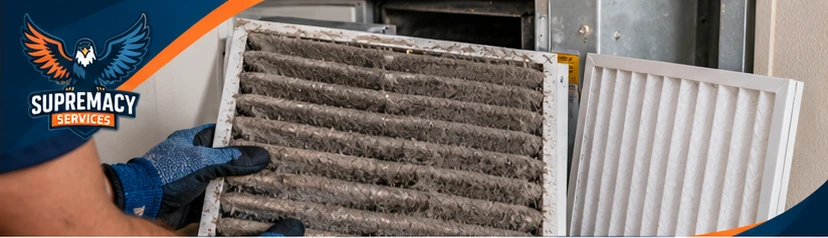
If you’re dealing with scratching noises, droppings or other signs of rodents, see Supremacy’s Rodent Control & Exclusion service rather than relying on general perimeter treatment.

Mosquitoes

Mosquito management focuses heavily on breeding areas, standing water and outdoor resting sites. A dedicated mosquito-management program is therefore different from a standard foundation-focused pest treatment.

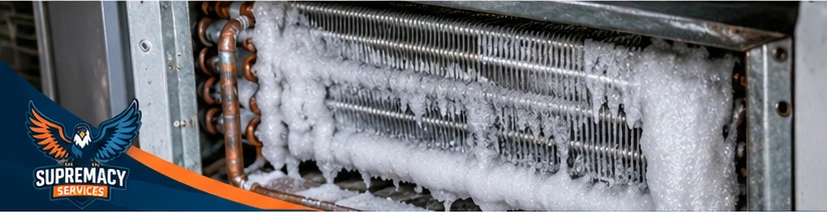
Bed Bugs

Bed bugs are primarily an indoor pest problem and require specialized inspection and treatment.

Bottom line: Correct pest identification should come before selecting the treatment.

Perimeter Pest Control vs. Indoor Pest Control

Exterior perimeter pest control helping prevent pests from entering a Dallas home
Stopping pest pressure outside can reduce the chances of unwanted insects finding their way into your living space.

One of the major advantages of a prevention-focused program is that much of the routine pest-management work can occur outside.

Perimeter Pest ControlIndoor Pest Control
Primarily preventiveOften corrective or targeted
Focuses on exterior pest pressureFocuses on pests already indoors
Targets entry and activity zonesTargets indoor harborages/activity
Can reduce reliance on routine indoor applicationsMay be necessary for established infestations
Works well with exclusion and sanitationOften complements exterior protection

This doesn’t mean indoor treatments should never be used.

When pests have already established themselves inside a home, targeted interior treatment may be appropriate. The goal should be to use the right treatment in the right place based on inspection findings.

How Often Should a Dallas Home Receive Perimeter Pest Control?

There is no responsible one-size-fits-all interval for every property.

Treatment frequency can depend on:

Pest control technician applying professional exterior treatment around a Dallas home
Professional pest control combines inspection, targeted treatment and ongoing monitoring for more effective exterior protection.
  • Pest species
  • Pest pressure
  • Product label requirements
  • Weather exposure
  • Landscaping
  • Irrigation
  • Property construction
  • Previous infestations
  • Seasonal activity

Supremacy currently structures its standard exterior protection around scheduled quarterly service, with exterior servicing designed to reduce disruption to homeowners.

However, a technician should adjust recommendations according to the actual conditions found at the property.

Can Rain Wash Away Perimeter Pest Control?

Exterior pest protection around a Dallas home during rainy weather
Weather, rainfall and environmental conditions can influence pest activity and exterior treatment performance.

Dallas homeowners often assume that any rainfall immediately makes an exterior pest treatment useless.

The reality is more nuanced.

Treatment performance depends on the specific product, application surface, drying period, rainfall timing and label instructions. Some professionally applied products are designed for exterior residual use once properly applied and dried.

Heavy rain or unusual weather conditions can still influence pest activity and may affect some treatments.

That is another reason pest control should be treated as an ongoing management program rather than a single application.

Is Perimeter Pest Control Safe for Children and Pets?

Sealing gaps, trimming vegetation and managing moisture around a Dallas home
Sealing gaps, controlling moisture and maintaining vegetation can strengthen your home’s overall pest-prevention strategy.

Pesticide safety depends on what product is being used and whether it is applied according to its label.

Homeowners should tell their pest-control provider about children, pets, sensitive areas and any other concerns before treatment.

Professional technicians should follow product-label directions concerning application locations, rates, drying times, re-entry instructions and other safety requirements.

Never assume that because a product is sold for household pest control it can be applied anywhere or at any concentration.

7 Ways Dallas Homeowners Can Make Perimeter Pest Control More Effective

Sealing gaps, trimming vegetation and managing moisture around a Dallas home
Sealing gaps, controlling moisture and maintaining vegetation can strengthen your home’s overall pest-prevention strategy.

Professional treatment performs best when homeowners also remove the conditions pests need to thrive.

1. Seal Exterior Gaps

Even small cracks can provide easy access for ants, cockroaches, spiders and other pests. Inspect the foundation, siding, utility penetrations and areas around pipes or cables, and seal unnecessary openings to strengthen your home’s exterior pest defense.

2. Repair Damaged Screens and Door Sweeps

Torn window screens, worn weather stripping and gaps beneath exterior doors can become direct pest entry points. Repair damaged screens and replace ineffective door sweeps to help keep crawling and flying pests outside.

3. Manage Moisture

Many pests are attracted to damp environments because they need water to survive. Repair leaks, improve drainage and avoid excessive moisture around the foundation, especially near faucets, gutters, irrigation systems and air-conditioning equipment.

4. Keep Vegetation Away From the Structure

Shrubs, tree branches and dense landscaping touching the house can provide pests with shelter and convenient pathways toward the structure. Regular trimming creates separation between vegetation and your home while making exterior areas easier to inspect and treat.

5. Remove Pest Harborage

Leaves, wood piles, cardboard, yard debris and clutter can create protected places where insects and other pests hide or reproduce. Keep the area around your foundation clean and organized to reduce potential pest harborage close to the home.

6. Manage Outdoor Food Sources

Garbage, pet food, fallen fruit, outdoor cooking residue and poorly sealed trash containers can attract pests to your property. Keep outdoor food areas clean and garbage containers securely closed so pests have fewer reasons to remain near your home.

7. Respond Early

Don’t wait for occasional pest sightings to develop into a larger infestation. Watch for recurring ants, cockroaches, spider webs, nests, droppings or other signs of activity and address the problem early. Prompt action can make pest problems easier to identify, control and prevent from spreading indoors.

Identifying the pest early is usually preferable to waiting until activity becomes widespread.

DIY vs. Professional Perimeter Pest Control

DIY products can sometimes help with minor pest activity, but professional service provides several advantages.

The biggest is diagnosis.

A trained pest professional can determine whether you’re dealing with an ant colony, outdoor cockroach activity, a moisture-related pest problem, termites, rodents or something else entirely.

Professional Dallas pest control inspection compared with DIY pest control products
Professional pest management adds proper inspection, pest identification and targeted treatment to your home’s defense strategy.

Professional service can also provide:

  • Property-specific inspection
  • Correct pest identification
  • Appropriate product selection
  • Targeted application
  • Entry-point recommendations
  • Ongoing monitoring
  • Pest-specific escalation when perimeter treatment isn’t enough

Treating the wrong pest—or applying the wrong product in the wrong location—can waste time while the underlying problem continues.

Why Choose Supremacy for Perimeter Pest Control in Dallas?

Supremacy Pest Defense provides pest-control services for homeowners throughout Dallas and surrounding DFW communities.

Our pest-control program is built around exterior protection, targeted eradication and pest-specific solutions rather than treating every infestation the same way.

Depending on the pest problem, Supremacy offers services including:

  • Perimeter pest control
  • WallShield™ in-wall systems
  • Termite protection
  • Mosquito management
  • Flea and tick defense
  • Fire ant treatment
  • Wasp and hornet removal
  • Rodent control and exclusion
  • Bed bug treatments
  • Wildlife removal
  • Commercial pest solutions

Frequently Asked Questions About Perimeter Pest Control in Dallas

Is perimeter pest control worth it in Dallas?

For homes that experience recurring ants, roaches, spiders and other exterior-origin pests, professional perimeter pest management can be a valuable preventive strategy. Results depend on correct pest identification, treatment, property conditions and ongoing maintenance.

Does perimeter pest control keep bugs out of the house?

It can substantially reduce pest pressure and help intercept pests around likely entry areas, but no responsible pest-control provider should suggest that a single exterior application makes a property permanently pest-proof.

How long does perimeter pest treatment last?

There is no universal duration. Residual performance depends on the product, application site, weather, pest pressure and other environmental factors. Follow the service interval recommended for your specific treatment program.

Should pest control be sprayed inside the house too?

Not automatically. Preventive exterior management can reduce the need for routine indoor treatment. When an established infestation exists indoors, targeted interior treatment may be appropriate after inspection.

What pests require more than perimeter treatment?

Termites, rodents, mosquitoes, bed bugs and some established indoor infestations generally require specialized management strategies.

Can I do perimeter pest control myself?

Homeowners can improve pest prevention considerably through sanitation, moisture management and exclusion. Pesticides should only be used according to their labels. Persistent or unidentified pest problems are good reasons to involve a professional.