If your furnace is blowing cold air in Dallas, first check the thermostat, air filter and whether the system has had enough time to complete a heating cycle. If cold air continues, the problem may involve restricted airflow, ignition failure, a dirty flame sensor, a tripped safety control, duct leakage or another furnace component that requires professional diagnosis.
Some causes are simple enough for a homeowner to check safely. Others—especially problems involving gas, combustion, electrical components or repeated furnace shutdowns—should be left to a qualified HVAC professional.
Here is how to tell the difference.
Why Is My Furnace Blowing Cold Air?
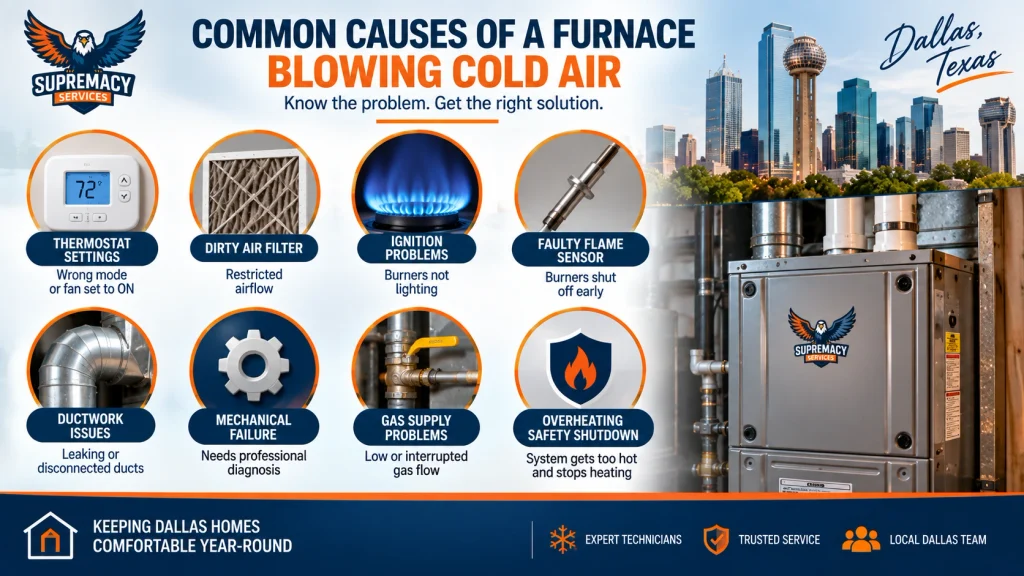
A furnace can blow cold or lukewarm air when the blower is moving air but the system is not successfully producing or delivering heat.
The most common possibilities include:
| Possible cause | What you may notice | Homeowner action |
|---|---|---|
| Thermostat set to ON instead of AUTO | Fan runs even between heating cycles | Change fan setting to AUTO |
| Dirty/restricted air filter | Weak airflow, long cycles or shutdowns | Inspect and replace if appropriate |
| Furnace has just started | Brief cool airflow before heat arrives | Wait for the heating cycle |
| Ignition problem | Furnace attempts to start but does not heat | Professional diagnosis |
| Dirty/failing flame sensor | Burners ignite, then shut off | Professional service |
| Gas/fuel supply issue | Furnace cannot establish heat | Stop troubleshooting and seek service |
| Overheating/safety shutdown | Furnace repeatedly starts and stops | Check filter; schedule diagnosis if persistent |
| Duct leakage | Some rooms or vents feel much colder | Duct/HVAC inspection |
| Heat pump operation | Air may feel less hot than gas-furnace air | Verify operating mode |
| Mechanical/electrical failure | Blower operates but heating does not | Professional furnace repair |
Start with the simplest checks before assuming the furnace itself has failed.
1. Check Your Thermostat First
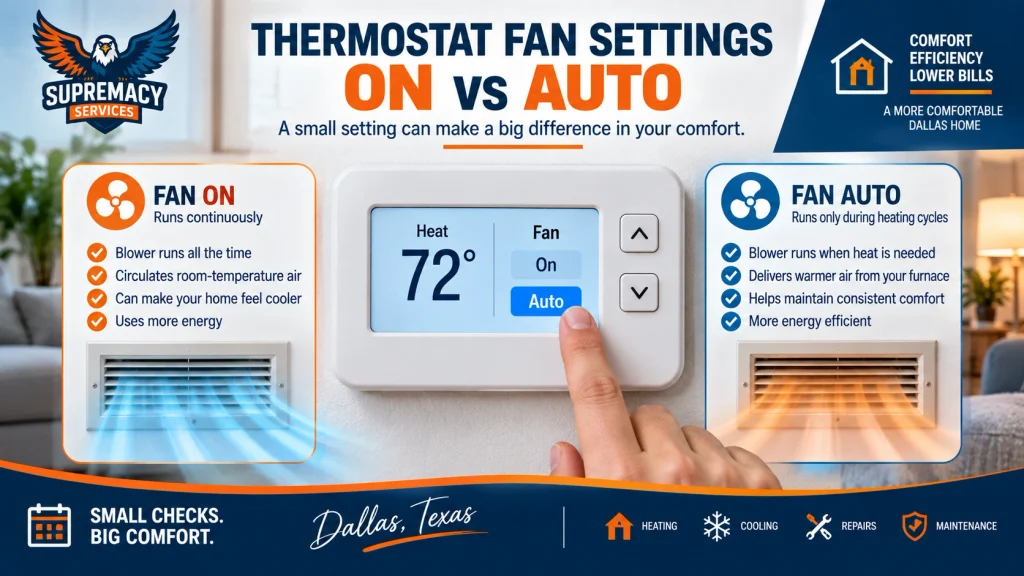
A thermostat setting is one of the easiest explanations for a furnace that appears to be blowing cold air.
Look at two settings:
Set the system to HEAT
Confirm that the thermostat is actually in HEAT mode and that the temperature setting is above the current indoor temperature.
Set the fan to AUTO
If the fan is set to ON, the blower may operate continuously—even when the furnace is not actively heating.
That means warm air may come through the vents during the heating cycle and cooler room-temperature air may follow after the burners shut off.
Changing the fan setting from ON to AUTO allows the blower to operate primarily when the HVAC system calls for it.
If the thermostat settings are correct but the vents continue delivering cold air throughout the heating cycle, move to the next checks.
2. The Furnace May Simply Be Starting Its Heating Cycle
Cold air for a very short period at startup does not automatically mean something is wrong.
Depending on the equipment and control sequence, the blower and heating components do not necessarily begin operating at exactly the same moment. Likewise, some systems continue moving air briefly after the heating portion of a cycle ends.
The important distinction is duration.
Brief cool airflow can be normal. Continuous cold air while the thermostat is calling for heat is not.
If your home temperature continues falling despite repeated furnace cycles, troubleshooting is warranted.
3. A Dirty Air Filter May Be Restricting Airflow
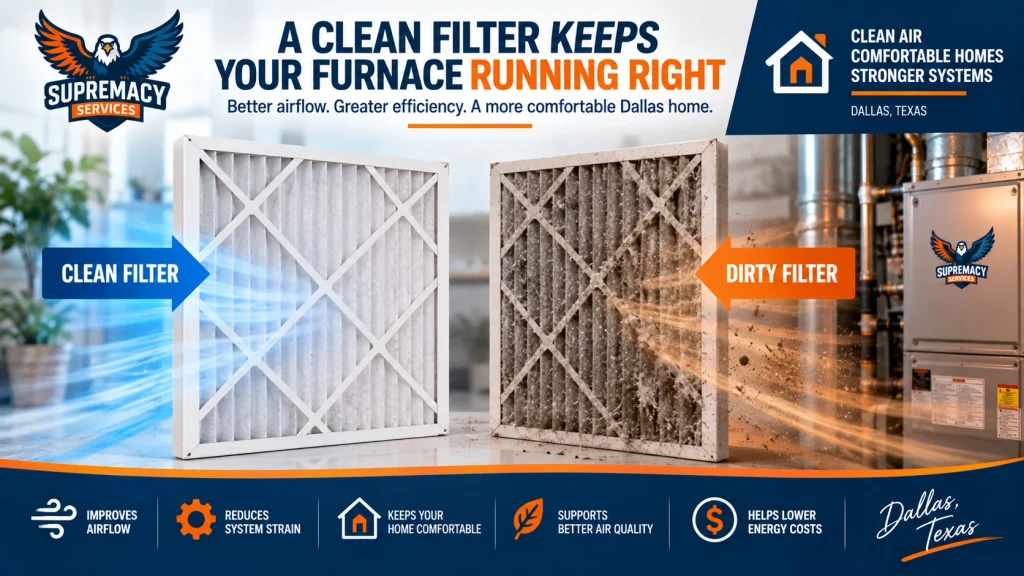
A severely dirty filter can reduce airflow through a forced-air heating system.
The U.S. Department of Energy notes that a clogged filter can substantially reduce airflow, increase furnace runtime and increase stress on the blower motor.
Restricted airflow can also contribute to furnace operating problems because heat needs to move away from the furnace and into the duct system properly.
What Dallas homeowners can check
Locate your HVAC filter and inspect it according to the equipment manufacturer’s instructions.
Replace it if it is visibly dirty and your system uses a replaceable filter.
Do not automatically install the highest-MERV filter you can find. Your HVAC system needs a filter compatible with its airflow requirements.
If replacing a dirty filter restores normal operation, continue monitoring the furnace. If the system repeatedly overheats, shuts down or returns to blowing cold air, professional diagnosis is appropriate.
4. The Furnace May Have an Ignition Problem
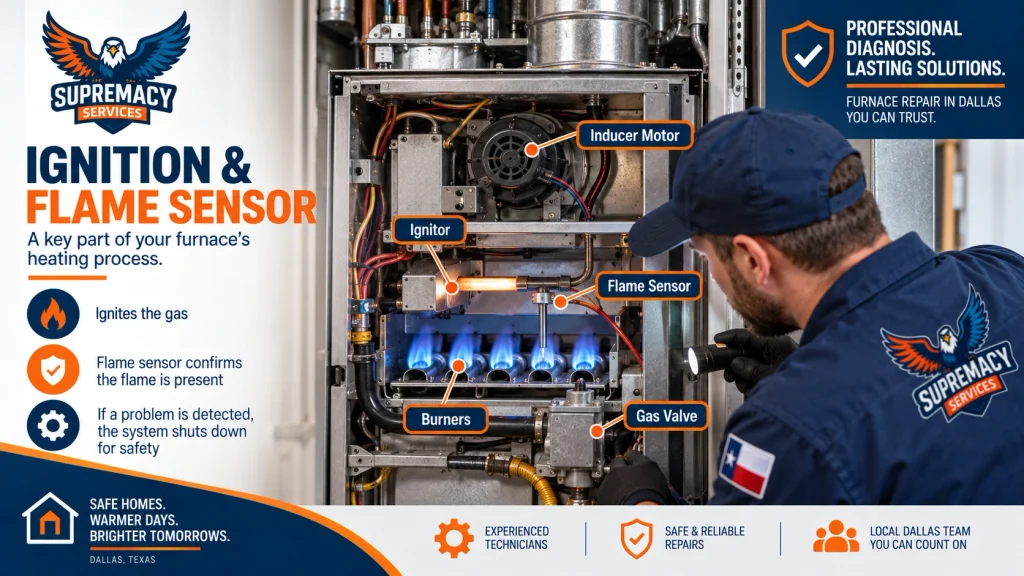
Modern gas furnaces need a reliable ignition sequence before heat can be produced.
Depending on the furnace design, that sequence can involve components such as:
- an inducer motor;
- pressure switches;
- an electronic ignitor;
- gas controls;
- burners;
- a flame sensor;
- temperature and safety controls.
If part of that sequence fails, the blower may still operate even though the furnace never establishes normal combustion.
A homeowner might notice the furnace repeatedly attempting to start, starting and stopping quickly, or running the fan without producing heat.
Can you fix furnace ignition problems yourself?
Generally, internal gas-furnace ignition troubleshooting should be left to a qualified professional.
Do not bypass a safety switch, manually manipulate gas controls or repeatedly reset a furnace that refuses to stay operating. Safety controls shut systems down for a reason.
5. A Dirty or Faulty Flame Sensor Can Shut the Burners Down
The flame sensor is an important safety component in many gas furnaces.
Its job is to confirm that a flame is present after ignition. If the furnace’s controls do not receive the expected flame signal, the system can shut off the gas supply.
One possible symptom is:
the burners ignite, operate briefly and then shut off while the blower continues moving air.
That can make it seem as though the furnace suddenly begins blowing cold air.
A dirty flame sensor is only one possible explanation for this behavior, however. Ignition components, wiring, controls, gas supply and other safety devices can produce similar symptoms.
This is why diagnosis is preferable to replacing parts based only on symptoms.
Contextual CTA: If your furnace repeatedly lights and shuts down or the blower runs without producing heat, schedule a professional [furnace repair in Dallas] rather than repeatedly resetting the system.
6. The Furnace May Be Overheating and Triggering a Safety Limit
It sounds contradictory, but a furnace that gets too hot can eventually result in cold air coming from the vents.
Forced-air furnaces need adequate airflow to carry heat away from the equipment.
When airflow becomes restricted or another operating problem causes excessive temperature, safety controls can interrupt heating operation. The blower may continue running as the system attempts to remove heat.
Potential contributors can include:
- a severely restricted filter;
- blocked or restricted airflow;
- blower problems;
- closed or obstructed registers;
- internal furnace problems.
If the furnace repeatedly heats, shuts its burners off and continues running the blower, do not assume the safety switch itself is the problem. The control may be responding correctly to an underlying condition.
Repeated overheating needs professional diagnosis.
7. There Could Be a Gas-Supply or Combustion Problem
A gas furnace cannot heat your home if it cannot safely establish and maintain combustion.
Possible problems may involve the appliance’s gas controls, ignition system, burners or fuel supply.
This is not an appropriate area for DIY experimentation.
Stop and get help if you smell gas
If you suspect a gas leak, do not continue furnace troubleshooting or attempt to repair the appliance yourself. Leave the affected area and follow your gas utility’s emergency instructions.
Likewise, a carbon-monoxide alarm should never be treated as a furnace troubleshooting notification.
If a CO alarm sounds, move outside to fresh air and contact emergency services. Do not re-enter the home until authorities say it is safe.
Carbon monoxide is colorless and odorless, so smell cannot be used to determine whether CO is present.
8. Leaking or Damaged Ductwork Can Make Heated Air Feel Cold
Sometimes the furnace is producing heat correctly but the problem occurs after the air leaves the equipment.
Leaks, disconnected duct sections or inadequate duct insulation can affect the temperature and volume of air reaching living spaces.
This is particularly worth investigating when:
- one part of the house heats normally while another remains cold;
- airflow is noticeably weaker from certain registers;
- the furnace appears to operate normally;
- temperature differences are concentrated in specific rooms.
A duct inspection can help separate an air-distribution problem from a furnace combustion or mechanical problem.
9. Make Sure You Actually Have a Furnace Problem
Not every Dallas home uses a conventional gas furnace as its only source of heat.
Homes equipped with heat pumps operate differently.
A heat pump normally supplies air that may feel less intensely hot at the register than air from a gas furnace. During colder weather, some systems also use auxiliary or backup heat.
That means air that feels merely warm—or cooler than you expect—doesn’t necessarily indicate a failed system.
The better questions are:
Is the home reaching the thermostat setpoint? Is the indoor temperature rising? Is the system operating continuously without catching up?
If the house is getting colder while the equipment runs, diagnosis is warranted.
Furnace Blowing Cold Air: What Can You Safely Check Yourself?
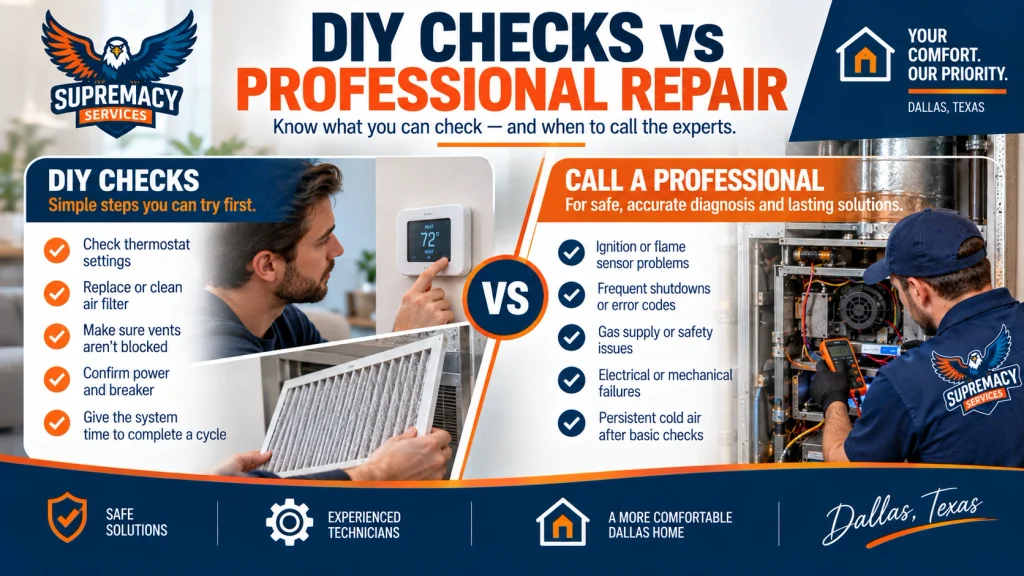
Before scheduling service, Dallas homeowners can perform several simple checks without opening or modifying the furnace.
Quick homeowner checklist
- Confirm the thermostat is set to HEAT.
- Set the blower fan to AUTO.
- Raise the thermostat above current room temperature.
- Give the system enough time to begin a complete heating cycle.
- Inspect the HVAC filter.
- Make sure normal supply and return vents are not unintentionally obstructed.
- Check whether the thermostat displays a warning or low-battery indication.
- Observe whether the furnace starts, stops or repeatedly attempts ignition.
- Check whether other rooms have the same problem.
- If you have a heat pump, confirm you are not mistaking normal heat-pump supply temperatures for furnace failure.
Stop there if those steps do not identify the issue.
Removing burner components, bypassing switches, manipulating gas valves or performing internal electrical tests turns a basic homeowner check into furnace repair.
When Should You Call a Furnace Repair Professional?
Call for professional furnace service when cold air continues after basic thermostat and filter checks, the furnace repeatedly shuts down, ignition fails, the system cannot maintain temperature or you suspect a mechanical, electrical or combustion problem.
Professional attention is particularly appropriate when you notice:
- no heat despite a thermostat call;
- repeated ignition attempts;
- frequent short cycling;
- burners that will not remain operating;
- unusual burning odors;
- electrical or mechanical noises;
- weak airflow throughout the house;
- furnace fault codes that return after following manufacturer instructions;
- repeated safety shutdowns;
- a home that continues getting colder while the furnace runs.
For gas odors or an activated carbon-monoxide alarm, treat the situation as a safety issue rather than an ordinary HVAC service call.
What Does a Professional Furnace Diagnostic Include?
The exact procedure depends on the equipment and symptoms, but a qualified HVAC technician may evaluate:
- thermostat operation and heating demand;
- air-filter and airflow conditions;
- blower operation;
- ignition sequence;
- ignitor condition;
- flame-sensing operation;
- burners and combustion-related components;
- safety switches and limits;
- electrical connections and controls;
- gas-furnace operating sequence;
- venting where applicable;
- duct or airflow issues;
- manufacturer fault codes.
The objective should be to identify why the furnace is producing cold air before recommending parts or replacement.
In Texas, contractors who install, repair or maintain heating and air-conditioning systems are regulated through the Texas Department of Licensing and Regulation.
Mid-article CTA: If the thermostat and filter checks do not restore heat, Supremacy Services can diagnose the heating system and determine whether the problem requires a repair, airflow correction or another solution. See our Dallas furnace repair services for professional diagnosis.
Does a Furnace Blowing Cold Air Need Repair or Replacement?
Cold air by itself does not mean you need a new furnace.
Many no-heat problems can result from individual components, airflow conditions or controls that can potentially be repaired.
Replacement becomes a separate discussion when diagnosis reveals more extensive problems or when repeated repairs make continued investment in the existing equipment less practical.
Consider the entire situation:
| Repair may make sense when | Replacement deserves consideration when |
|---|---|
| Problem is isolated and repairable | Major component/system problems are present |
| Furnace otherwise operates reliably | Breakdowns are becoming frequent |
| Heating performance was previously satisfactory | Comfort problems persist despite repairs |
| Parts/service solution is reasonable | Necessary repairs become disproportionately extensive |
| System suits the home’s heating needs | Existing equipment no longer suits the home’s needs |
Do not decide based solely on furnace age or a generic internet price chart. A proper diagnosis gives you something concrete to compare.
How Much Does It Cost to Fix a Furnace Blowing Cold Air in Dallas?
There is no responsible single price for “furnace blowing cold air” because cold air is a symptom, not a diagnosis.
A thermostat-setting issue and an internal furnace component failure can produce a similar homeowner complaint while requiring completely different solutions.
Repair cost can depend on:
- the diagnosed failure;
- furnace type;
- replacement component required;
- equipment accessibility;
- diagnostic labor;
- whether additional safety or airflow problems are discovered;
- manufacturer and parts availability;
- whether repair or replacement is ultimately appropriate.
For that reason, Supremacy should avoid publishing a blanket repair price unless it is based on the company’s current actual pricing.
A diagnostic visit should identify the failure first, followed by an estimate for the appropriate repair.
Dallas Weather Makes Reliable Heating More Important Than It May Seem
Dallas is known for air-conditioning demand, but North Texas still experiences freezing weather.
National Weather Service climate normals for Dallas/Fort Worth show an average of 29 freezes per season during the 1991–2020 normal period.
The practical issue for homeowners is that a heating system may spend long stretches lightly used and then suddenly be expected to operate during a cold front.
That makes preseason operation checks and routine HVAC maintenance useful. Discovering an ignition, airflow or thermostat problem before the first significant cold spell is much easier than discovering it when indoor temperatures are already dropping.
How Can You Reduce the Chance of a No-Heat Furnace Problem?
No maintenance routine can prevent every component failure, but basic heating-system care can help identify problems earlier.
Before heating season
Run the heating system before you urgently need it.
Confirm that:
- the thermostat calls for heat;
- the furnace completes normal cycles;
- airflow is present at the registers;
- unusual sounds or odors are investigated;
- the filter is in serviceable condition;
- smoke and carbon-monoxide alarms are operating according to manufacturer instructions.
During heating season
Pay attention to changes rather than waiting for total failure.
A furnace that suddenly runs much longer, cycles repeatedly, produces inconsistent temperatures or struggles to reach the thermostat setting may be telling you something has changed.
Early diagnosis can sometimes prevent a minor operating issue from becoming a no-heat call during colder weather.
Furnace Problem or Duct Problem?
One useful way to narrow the issue is to look at where the symptoms occur.
If every register produces cold air, the problem is more likely to involve the heating system, thermostat or a system-wide control/airflow condition.
If only one or two rooms are affected while others heat normally, distribution issues such as ductwork, dampers or airflow deserve more attention.
This distinction is not a substitute for diagnosis, but it gives the technician useful information before testing begins.
Furnace Problem or Heat-Pump Behaviour?
This is another common source of confusion.
A gas furnace produces heat through combustion. A heat pump transfers heat and commonly supplies air at a lower temperature than people expect from a furnace.
Therefore:
Air that doesn’t feel extremely hot is not enough to diagnose a heat-pump failure.
Watch indoor temperature instead. If the heat pump runs and the home gradually reaches the thermostat setting, it may be operating normally. If the house steadily loses temperature, auxiliary heat does not operate as expected or the system shows faults, schedule service.
Frequently Asked Questions
Why is my furnace running but blowing cold air?
The blower can run without active heating if the thermostat fan is set to ON, the heating cycle has ended, ignition fails, a safety control interrupts heating or another furnace problem prevents heat production. Start by checking the thermostat and filter.
Why does my furnace blow hot air and then cold air?
A brief change at the beginning or end of a heating cycle can be normal. If the furnace heats only briefly before repeatedly switching to cold air, it may be shutting the burners down because of an ignition, flame-sensing, airflow or safety-control problem.
Can a dirty furnace filter cause cold air?
A heavily restricted filter can reduce HVAC airflow and contribute to operating problems. Inspect the filter first because it is one of the simplest homeowner checks. Persistent shutdowns after replacing a dirty filter should be professionally diagnosed.
Why does my furnace ignite and then shut off?
Several faults can interrupt the furnace’s ignition or combustion sequence. A flame-sensing problem is one possibility, but safety controls, airflow conditions, ignition components and other issues can cause similar behavior. Diagnosis is needed before replacing components.
Should I turn my furnace off if it is blowing cold air?
If the thermostat and filter checks do not explain the problem and the furnace repeatedly fails to heat, turning the system off until it can be evaluated may prevent repeated unsuccessful cycles. If you smell gas or a CO alarm activates, leave the area and follow emergency safety procedures.
Why is only one room getting cold air?
When most of the home heats normally but one room does not, duct leakage, airflow restrictions, registers or balancing issues may be more likely than a complete furnace failure.
Can I clean a furnace flame sensor myself?
Although online tutorials often describe flame-sensor cleaning, it requires accessing internal furnace components. Homeowners who are not trained and familiar with the equipment should leave internal gas-furnace diagnosis and servicing to qualified HVAC professionals.
Who should repair a furnace in Texas?
Texas regulates contractors performing heating and air-conditioning installation, repair and maintenance through the Texas Department of Licensing and Regulation. Homeowners can verify contractor licensing through TDLR.
Is furnace cold air an emergency?
Not always. A thermostat setting or normal startup period can explain temporary cool airflow. Treat the situation more urgently when the home cannot maintain a safe temperature, the furnace repeatedly fails, you smell gas, or a carbon-monoxide alarm activates.
Still Getting Cold Air From Your Furnace?
Start with the thermostat and filter. If those checks don’t solve the problem, don’t keep resetting a furnace that cannot complete a normal heating cycle.
A professional diagnostic can determine whether you’re dealing with an ignition problem, airflow restriction, failed component, duct issue or another heating-system fault.
Final CTA: Furnace still blowing cold air? Schedule Dallas furnace repair with Supremacy Services to have the system professionally diagnosed and get the right repair recommendation.