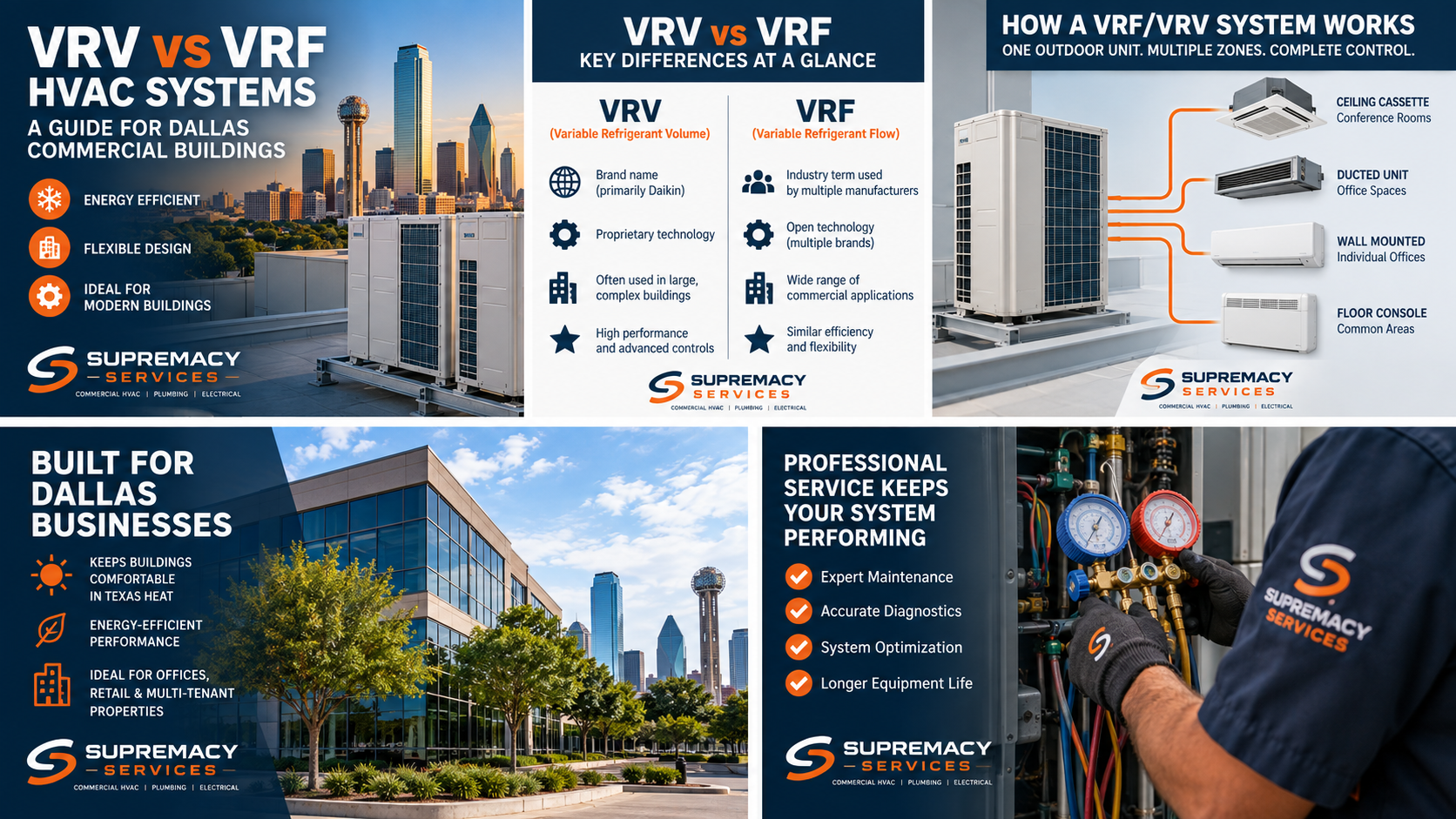
VRV vs VRF HVAC systems are essentially the same type of variable-refrigerant technology. VRF, or Variable Refrigerant Flow, is the generic industry term. VRV, or Variable Refrigerant Volume, is Daikin’s trademarked name for its version of the technology.
For Dallas commercial property owners, facility managers and developers, the more important question is therefore not simply VRV vs VRF. It is whether variable-refrigerant technology is appropriate for the building, and if so, whether the project requires a heat-pump, heat-recovery or other VRF configuration.
A properly designed VRF system can provide individual zone control, modulate capacity as building loads change and reduce the amount of conventional ductwork required. But VRF is not automatically the best HVAC system for every commercial building. Ventilation, humidity management, refrigerant requirements, controls, piping layout, serviceability and lifecycle cost all need to be considered before equipment is selected.
This guide explains what Dallas/DFW commercial property decision-makers should know.
VRV vs VRF: What Is the Difference?
The simplest answer is:
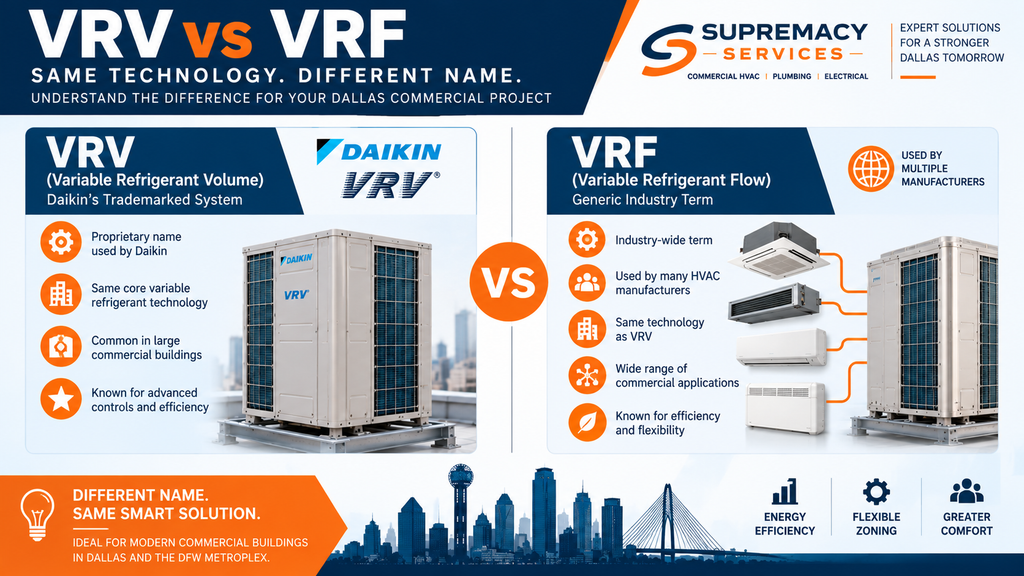
VRF is the generic technology. VRV is Daikin’s trademarked terminology for its variable refrigerant system.
| Term | Meaning | What You Should Know |
|---|---|---|
| VRF | Variable Refrigerant Flow | Generic industry term |
| VRV | Variable Refrigerant Volume | Daikin trademark |
| Basic technology | Variable-capacity, multi-zone direct-expansion HVAC | Both regulate refrigerant according to zone demand |
| Commercial applications | Offices, hotels, retail, multifamily, education and other multi-zone buildings | Suitability depends on project design |
| Main decision | Not simply VRV versus VRF | Compare system configuration, manufacturer, controls, ventilation, service support and lifecycle requirements |
The U.S. Department of Energy defines commercial VRF equipment as split-system equipment using one or more outdoor units, variable-capacity compressors and multiple individually controlled indoor fan-coil units connected through common refrigerant piping and controls.
In practical terms, the outdoor equipment does not simply operate at full capacity and stop whenever a thermostat is satisfied. The system can adjust capacity as individual zones require more or less heating or cooling.
That modulation is one of the fundamental differences between VRF technology and many conventional constant-capacity HVAC arrangements.
How Does a VRF HVAC System Work?
A Variable Refrigerant Flow HVAC system controls how much refrigerant is delivered to multiple indoor zones according to their individual heating or cooling loads.
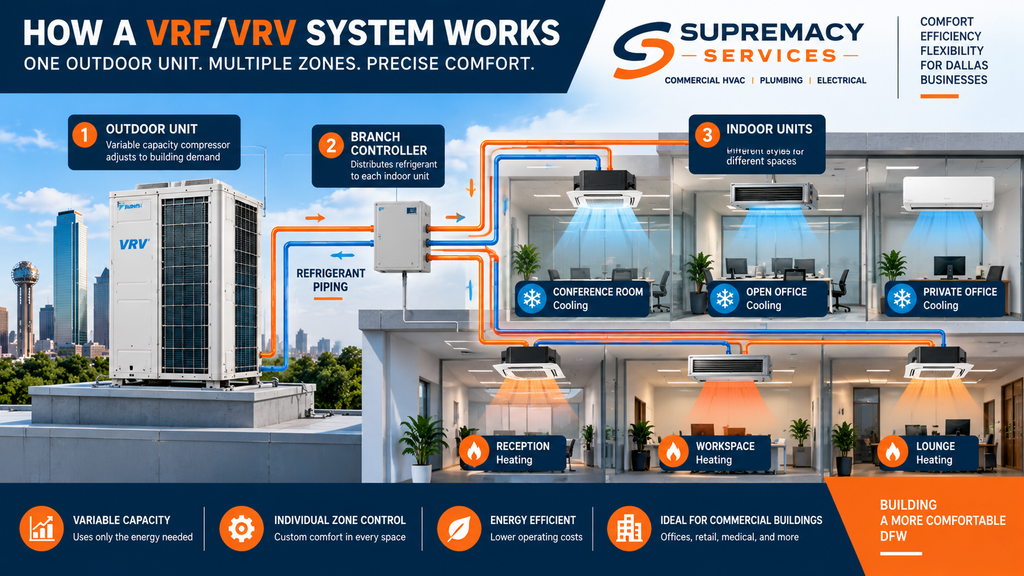
A typical commercial system contains:
- one or more outdoor units;
- inverter-driven or variable-capacity compressors;
- refrigerant piping;
- multiple indoor fan-coil units;
- electronic expansion/control devices;
- individual zone controls;
- a communications network; and
- centralized controls or building-management integration where specified.
Each indoor zone communicates its demand to the system.
Instead of conditioning every part of the building identically, the system adjusts its output according to the load being experienced by individual spaces.
Consider a Dallas office building at 3 p.m. The west-facing conference room may experience a substantial solar load while an interior office has much less cooling demand. A properly designed variable-refrigerant system can respond differently to those zones instead of treating the entire floor as one thermal space.
That is why VRF is particularly relevant to buildings with varying occupancy, exposures and operating schedules.
VRF Heat Pump vs Heat Recovery: An Important Distinction
There are two major configurations commercial building owners frequently encounter.
VRF Heat Pump Systems
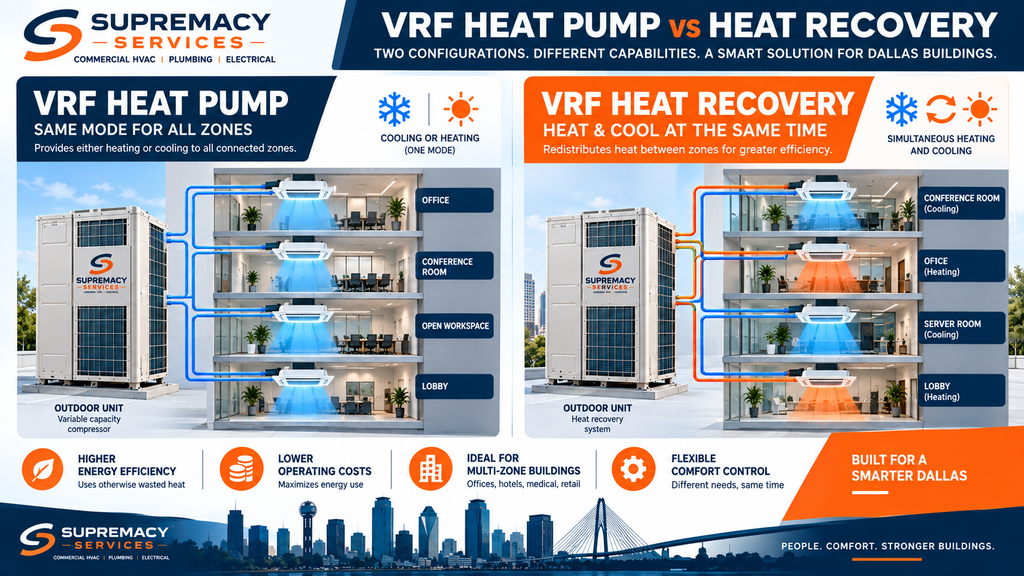
A VRF heat-pump system provides both heating and cooling, but connected zones generally operate in the same overall mode.
It can make sense for buildings where thermal requirements across the connected zones are relatively similar.
VRF Heat Recovery Systems
A heat-recovery VRF system can allow some zones to cool while other zones heat at the same time, depending on the system design.
Rather than simply rejecting all heat removed from a cooling zone outdoors, heat-recovery technology can redistribute useful heat to another zone that requires heating.
This can be particularly valuable in buildings with very different simultaneous loads, including:
- offices with perimeter and interior zones;
- hotels;
- medical and professional buildings;
- mixed-use facilities;
- multifamily buildings;
- educational buildings; and
- properties with different solar exposures.
For example, a south- or west-facing office may require cooling while an interior or shaded zone requires heat. Heat-recovery technology can accommodate those competing requirements when the system is designed for simultaneous operation.
VRF vs Traditional Commercial HVAC
There is no universal winner. The right technology depends on the building.
| Consideration | VRF/VRV | Conventional Rooftop or Ducted System |
|---|---|---|
| Zone control | Highly granular | Depends on zoning design |
| Capacity control | Variable/modulating | Depends on equipment |
| Ductwork | Often reduced | Usually more extensive |
| Refrigerant piping | More extensive | Generally more centralized |
| Simultaneous heating/cooling | Available with heat-recovery configurations | Depends on system design |
| Individual tenant control | Strong potential | Varies |
| Ventilation | Often requires separate design | Frequently integrated into air system |
| Controls | Can be sophisticated | Varies widely |
| Installation | Requires VRF-specific design and commissioning expertise | More familiar to many contractors |
| Best application | Multi-zone buildings with diverse loads | Broad range of commercial buildings |
VRF should therefore be treated as one HVAC architecture among several, not as an automatic upgrade from conventional equipment.
A rooftop-unit system, split system, heat pump, chilled-water system or another commercial HVAC design may be more appropriate depending on building size, ventilation load, redundancy requirements, budget and existing infrastructure.
Why Dallas Commercial Buildings May Consider VRF
Dallas and the broader DFW Metroplex contain a wide range of commercial properties: office buildings, medical suites, restaurants, retail centers, hotels, schools, multifamily properties and tenant-improvement projects.
Several characteristics of these buildings can make zone-level HVAC control attractive.
1. Different Solar Loads
A building’s east, south, west and interior zones do not experience identical loads throughout the day.
Variable-capacity zoning allows the HVAC system to respond to those differences more precisely.
2. Long Cooling Seasons
Cooling performance is a major design consideration in North Texas.
That makes equipment sizing, part-load performance, heat rejection, refrigerant piping and controls particularly important when evaluating a VRF application.
3. Changing Occupancy
Conference rooms, private offices, lobbies, retail areas and other spaces can have very different occupancy schedules.
A system capable of responding independently to zone demand can help avoid treating an entire building as if every space has the same load.
4. Tenant Finish-Outs
Commercial tenant spaces may need independent comfort control while available ceiling and mechanical space is limited.
The smaller duct distribution requirements possible with VRF can make the technology worth evaluating during certain renovations and tenant improvements.
5. Mixed Thermal Loads
Perimeter zones exposed to outdoor conditions can behave very differently from interior zones.
Buildings with simultaneous heating and cooling demands may therefore be candidates for heat-recovery VRF.
Where Does VRF Work Best?
VRF tends to deserve serious consideration where independent zones, changing loads, limited duct space or simultaneous heating and cooling are important project requirements.
Potential applications include:
Office Buildings
Different floors, departments, conference rooms and perimeter offices can receive independent temperature control.
Hotels and Hospitality
Guest rooms naturally form individual HVAC zones with highly variable occupancy.
Medical and Professional Offices
Individual rooms may have different loads and operating schedules, although ventilation, filtration, pressurization and applicable healthcare requirements must be evaluated separately.
Retail and Mixed-Use Buildings
Different tenants can have substantially different operating schedules and internal loads.
Multifamily Buildings
Individual unit control makes variable-refrigerant systems a design option for certain multifamily projects.
Historic or Retrofit Buildings
Where large new duct shafts are impractical, smaller refrigerant piping can provide an architectural advantage.
That does not eliminate the need for ventilation air.
VRF Does Not Replace Proper Ventilation
This is one of the most important points for commercial building owners to understand.
Heating and cooling a room is not the same as ventilating it.
VRF indoor units primarily handle zone heating and cooling. Commercial buildings still require a ventilation strategy appropriate to occupancy, building use and applicable codes.
Depending on the project, designers may pair VRF with a Dedicated Outdoor Air System (DOAS) or another ventilation arrangement.
The ventilation system may need to address:
- outdoor-air delivery;
- filtration;
- humidity;
- exhaust;
- building pressure; and
- latent loads.
Treating VRF equipment and ventilation as a complete engineered system rather than isolated equipment selections is particularly important in commercial construction.
What Are the Advantages of VRF HVAC?
Individual Zone Control
Occupants or building controls can maintain different setpoints across different areas.
Variable Capacity
Inverter-driven compressors allow system output to respond to changing demand instead of relying solely on simple full-output cycling.
Heat Recovery
Appropriately configured systems can move heat between zones requiring cooling and zones requiring heating.
Reduced Ductwork
VRF still requires airflow at indoor units and usually a separate ventilation strategy, but extensive central supply and return duct networks may be reduced.
Flexible Indoor Units
Depending on the manufacturer and system, options can include:
- ceiling cassettes;
- concealed ducted units;
- wall-mounted units;
- floor-mounted units; and
- other specialty configurations.
Centralized Controls
Commercial VRF systems can support centralized scheduling and monitoring and, where designed for it, integration with building automation systems.
What Are the Disadvantages of VRF?
VRF has significant advantages, but commercial buyers should also understand its limitations.
Higher Design Complexity
Refrigerant piping lengths, elevation differences, branch devices, equipment combinations and system controls must remain within manufacturer requirements.
This is not equipment that should be selected solely by matching a nominal tonnage to the building.
Ventilation Requires Separate Attention
A building can maintain the desired thermostat temperature and still have an inadequate ventilation or humidity-control strategy.
Refrigerant Management Matters
VRF places a distributed refrigerant network throughout a building. Refrigerant charge, occupied-space requirements, leak considerations and applicable codes therefore need to be addressed during design.
Specialized Service Knowledge
Troubleshooting can involve refrigerant circuits, electronic expansion valves, inverter technology, sensors, communications networks and proprietary controls.
Service capability should be evaluated before choosing a manufacturer—not after the building is occupied.
Controls Can Become a Weak Point
A sophisticated HVAC system with poorly configured controls can still perform poorly.
Commissioning, control sequences, sensor placement and operator training matter.
VRF System Cost in Dallas: What Determines the Price?
There is no responsible flat per-square-foot price for a commercial VRF project without knowing the building and scope.
Two Dallas buildings with the same floor area can require very different systems.
Important cost variables include:
| Cost Factor | Why It Matters |
|---|---|
| Building cooling/heating loads | Determines required equipment capacity |
| Number of zones | Affects indoor units and controls |
| Heat pump vs heat recovery | Changes equipment and piping architecture |
| Building size/layout | Influences piping and installation complexity |
| Outdoor-unit location | Affects structural, electrical and access requirements |
| Indoor-unit type | Cassettes, concealed ducted and other units have different installation needs |
| Ventilation system | DOAS or other outdoor-air equipment can materially affect project scope |
| Controls/BAS integration | Adds controls engineering and commissioning |
| Electrical work | Existing service may require modifications |
| Existing HVAC removal | Demolition can add labor and logistics |
| Crane/roof access | May affect equipment-setting costs |
| Permits and inspections | Depend on project and municipality |
| Refrigerant requirements | Affect equipment selection and design |
| Construction phasing | Occupied buildings can require staged work |
For that reason, a credible commercial proposal should begin with the building—not with an advertised equipment price.
What Should a Commercial VRF Assessment Include?
Before approving a VRF installation, owners should expect a qualified team to evaluate more than equipment tonnage.
1. Building Load Analysis
Heating and cooling loads should be determined by zone.
2. Zoning Strategy
The designer should identify which spaces genuinely require independent control and which can reasonably operate together.
3. Heat Pump vs Heat Recovery
Buildings with frequent simultaneous heating and cooling may justify heat-recovery architecture.
4. Ventilation and Humidity Strategy
The project must determine how outdoor air and latent loads will be handled.
5. Refrigerant Piping Design
Pipe lengths, elevations, branch locations and manufacturer limitations should be checked.
6. Refrigerant Safety Review
System charge and occupied-space considerations must be evaluated under applicable codes and manufacturer requirements.
7. Electrical Requirements
Outdoor units, indoor units, branch devices, controls and ventilation equipment all need coordinated electrical service.
8. Controls
Determine whether the property needs local controllers, centralized controls, scheduling, energy monitoring or BAS integration.
9. Service Access
Equipment should remain accessible for filter service, condensate maintenance, electrical diagnostics and refrigerant-system work.
10. Commissioning
Startup should verify refrigerant-system integrity, addressing, controls, airflow, drainage and operating performance.
What Dallas Building Owners Should Know About Permits and Licensing
Commercial HVAC work in Texas is regulated.
The Texas Department of Licensing and Regulation regulates air-conditioning and refrigeration contractors, and contractor license class affects the size of equipment on which a contractor can work.
For commercial projects, this distinction can matter considerably because TDLR states that a Class A license permits work on equipment of any size, while Class B is subject to capacity limits.
Dallas also has mechanical permitting and inspection requirements for commercial work.
A commercial VRF project may therefore involve coordination among the HVAC contractor, mechanical engineer, electrical contractor, general contractor, architect and local permitting authority depending on project scope.
Building owners should confirm the applicable requirements for the actual municipality in which the property is located. Dallas, Frisco, Plano, Fort Worth and other DFW jurisdictions do not necessarily have identical administrative procedures.
2026 Refrigerant Rules Make Equipment Selection More Important
Commercial HVAC refrigerants are undergoing an important regulatory transition.
Under the federal AIM Act framework, the EPA is restricting higher-global-warming-potential refrigerants across several HVAC equipment categories.
For variable refrigerant flow systems, EPA currently lists a 700 GWP limit with a January 1, 2027 installation compliance date, subject to specific provisions and transition conditions.
That makes refrigerant strategy an important part of a new VRF project in 2026.
Owners planning a long-lived commercial installation should ask:
- Which refrigerant does the proposed equipment use?
- What EPA transition rules apply to this project?
- Are any transition provisions being relied upon?
- How does the refrigerant affect equipment selection?
- What safety requirements apply?
- Are technicians trained for the refrigerant used?
- What will long-term service support look like?
Equipment should not be selected from an old specification without confirming that it remains appropriate for the project’s procurement and installation timeline.
VRF vs Mini-Split: Are They the Same?
No.
Both technologies use direct-expansion refrigerant systems and inverter technology is common to both, but the terms are not interchangeable.
A ductless mini-split commonly connects one outdoor unit with one or a relatively small number of indoor units.
Commercial VRF is designed as a larger, integrated multi-zone system with sophisticated refrigerant management, controls and system architecture.
Think of VRF as a building-level multi-zone HVAC platform rather than simply a collection of wall-mounted mini-splits.
VRF vs Rooftop Units
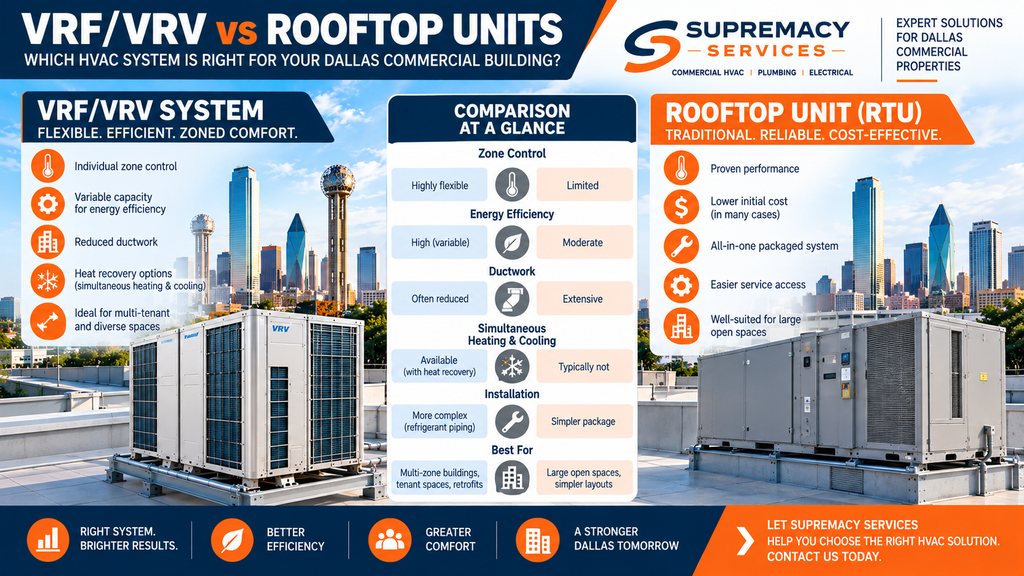
Dallas commercial properties frequently use packaged rooftop units, or RTUs.
RTUs remain practical for many buildings because they consolidate major HVAC components into packaged equipment and can serve ducted zones efficiently.
VRF may become more attractive where:
- many independent zones are required;
- duct space is constrained;
- tenant schedules vary significantly;
- part-load operation is important; or
- simultaneous heating and cooling is desirable.
RTUs may remain attractive where:
- large open spaces dominate;
- the existing duct system is suitable;
- straightforward serviceability is a priority;
- first-cost considerations favor packaged equipment; or
- the building does not require extensive individual zoning.
A proper comparison should be based on the actual building rather than technology preference.
VRF vs Chilled-Water Systems
Chilled-water systems and VRF approach building conditioning differently.
A chiller creates chilled water that is circulated through a hydronic distribution system. VRF moves refrigerant through the building to indoor units.
Large facilities, campuses and buildings with substantial central-plant infrastructure may continue to favor chilled water.
VRF can be particularly attractive for smaller and midsize multi-zone buildings or projects where decentralized zone control and reduced ductwork are priorities.
The decision should consider first cost, energy modeling, maintenance capabilities, redundancy, refrigerant management, expected building life and future expansion.
Warning Signs an Existing VRF System Needs Professional Attention
Commercial VRF troubleshooting should be handled by technicians familiar with the particular equipment and controls.
Potential warning signs include:
- repeated system fault codes;
- multiple zones failing simultaneously;
- one or more zones unable to maintain setpoint;
- unexpected heating/cooling mode conflicts;
- recurring condensate problems;
- unusual compressor or outdoor-unit noise;
- communication errors;
- unexplained energy-use changes;
- repeated refrigerant-related service issues; or
- frequent resets required to restore operation.
Because multiple indoor units can share common outdoor equipment and communications, a problem visible in one room does not always originate at that indoor unit.
Can Building Staff Maintain a VRF System?
Building staff can handle certain routine facility-management tasks where permitted by the manufacturer and site procedures.
Examples may include monitoring alarms, keeping air paths unobstructed and arranging routine filter maintenance.
Refrigerant work, electrical diagnostics, inverter faults, compressor problems, leak diagnosis and system commissioning should be handled by appropriately qualified professionals.
In Texas, HVAC contracting and technician activities are subject to TDLR licensing and registration requirements.
How Should VRF Systems Be Maintained?
Maintenance requirements vary by manufacturer and application, but a commercial maintenance program may address:
- indoor-unit filters;
- coils;
- condensate drains and pumps;
- outdoor coils;
- electrical connections;
- refrigerant-system condition;
- controls and communications;
- sensors;
- fault histories;
- operating temperatures and pressures where appropriate;
- ventilation equipment; and
- overall system performance.
Maintenance should also account for the building’s operating environment.
A restaurant, medical office, hotel and conventional office building do not necessarily require identical maintenance strategies even when they use similar HVAC technology.
How to Decide Whether VRF Is Right for Your Dallas Building
Before selecting equipment, answer these questions:
How many genuinely independent zones does the building need?
If most spaces have identical loads and schedules, highly granular zoning may provide less value.
Do different areas frequently need heating and cooling at the same time?
If yes, heat recovery deserves evaluation.
How will outdoor ventilation air be delivered and conditioned?
VRF should not be specified without answering this.
Is ceiling or shaft space limited?
Reduced duct requirements can become a major design advantage.
Does the building have an existing BAS?
Confirm integration requirements before selecting controls.
Who will maintain the equipment?
Local technical support and parts availability matter over the life of the system.
What refrigerant does the proposed system use?
Verify current regulatory and safety implications.
What is the total lifecycle cost?
Compare installation, electrical work, ventilation equipment, controls, commissioning, energy consumption, maintenance and expected replacement requirements—not just outdoor-unit pricing.
What to Expect From a Professional Commercial HVAC Evaluation
A serious VRF evaluation should begin with questions rather than an immediate equipment recommendation.
The process may include:
- reviewing building plans and existing mechanical systems;
- documenting current comfort or operating problems;
- identifying occupancy schedules and tenant requirements;
- evaluating zone-by-zone loads;
- reviewing available electrical capacity;
- examining roof, mechanical and ceiling-space constraints;
- determining ventilation requirements;
- evaluating heat-pump versus heat-recovery configurations;
- coordinating refrigerant and condensate piping;
- reviewing controls/BAS requirements;
- considering applicable codes and permits; and
- developing an installation and commissioning plan.
For an existing occupied property, project phasing should also be considered so HVAC work does not unnecessarily disrupt tenants or business operations.
The Bottom Line: VRV vs VRF HVAC Systems
VRV and VRF do not represent two fundamentally different HVAC technologies. VRF is the generic term for Variable Refrigerant Flow, while VRV is Daikin’s trademarked Variable Refrigerant Volume terminology.
For Dallas commercial buildings, the bigger decision is whether variable-refrigerant technology fits the property’s loads, zoning, ventilation requirements, architecture, controls and long-term operating strategy.
VRF can be an excellent solution where a commercial building needs precise zone control, variable capacity, flexible equipment placement or simultaneous heating and cooling. But those advantages depend heavily on proper engineering, refrigerant piping, ventilation design, controls, installation and commissioning.
Before choosing equipment, evaluate the whole building system.
Planning a Commercial HVAC Project in Dallas–Fort Worth?
Supremacy Services can evaluate your commercial property’s HVAC requirements alongside the broader mechanical and building infrastructure involved in the project.
For a new construction project, tenant improvement, major HVAC replacement or multi-zone system evaluation, begin with a building-specific assessment rather than selecting equipment solely from nominal capacity.
Request a commercial HVAC assessment from Supremacy Services to discuss your Dallas/DFW project requirements.
Frequently Asked Questions
Is VRV better than VRF?
VRV and VRF are not competing technology categories. VRF is the generic term for Variable Refrigerant Flow, while VRV is Daikin’s trademarked terminology for its Variable Refrigerant Volume systems. Compare specific equipment, system architecture, controls, serviceability and project suitability instead.
What does VRF stand for in HVAC?
VRF stands for Variable Refrigerant Flow. The system varies refrigerant flow to multiple indoor units according to individual zone heating or cooling demand.
What does VRV stand for?
VRV stands for Variable Refrigerant Volume. It is terminology associated with Daikin’s variable-refrigerant HVAC technology and is a Daikin trademark.
Can VRF heat and cool at the same time?
Heat-recovery VRF systems can be designed to provide simultaneous heating and cooling to different zones. Standard heat-pump VRF configurations generally operate connected zones in the same heating or cooling mode.
Does VRF provide fresh air?
VRF indoor units should not automatically be assumed to satisfy a commercial building’s ventilation requirements. Projects often use separate outdoor-air equipment, such as a DOAS, depending on building design and code requirements.
Is VRF good for commercial buildings?
It can be. VRF is particularly worth evaluating for multi-zone buildings with varying loads, limited duct space, individual tenant requirements or simultaneous heating and cooling demands.
Is VRF the same as a mini-split?
No. The technologies share some principles, but commercial VRF systems typically serve substantially more zones and use more sophisticated refrigerant distribution, communications and centralized controls.
How much does a commercial VRF system cost in Dallas?
There is no reliable universal price without evaluating the project. Capacity, number of zones, ventilation equipment, heat-recovery requirements, piping, controls, electrical work, demolition, roof access, permitting and construction phasing can all materially change the installed cost.
Do VRF systems need ductwork?
Some VRF indoor units are ductless, while others use short duct runs. Separate ductwork may also be required for outdoor ventilation air. The answer depends on the indoor-unit and ventilation design.
Who can install a VRF system in Texas?
Texas regulates air-conditioning and refrigeration contracting through the Texas Department of Licensing and Regulation. Commercial property owners should verify that contractors have the licensing appropriate to the scope and equipment involved and comply with applicable local permitting requirements.