
A VRF system that stops cooling properly does not automatically need replacement. Many VRF problems can be traced to a specific component, zone, sensor, communication circuit, refrigerant issue or control fault. The challenge is identifying the real cause before replacing expensive parts.
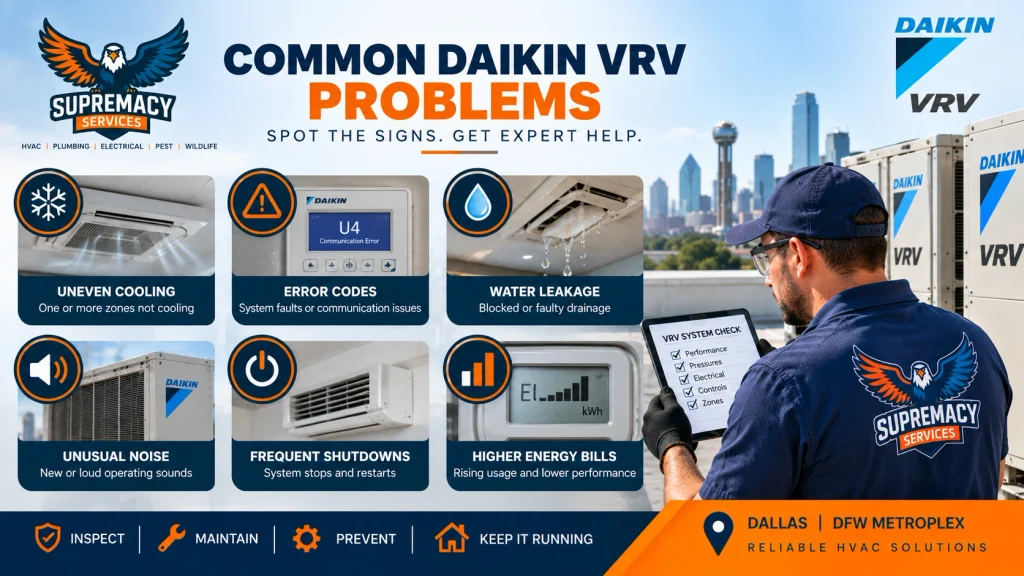
For Dallas and DFW property owners, common reasons to schedule VRF HVAC repair include rooms that no longer reach temperature, repeated error codes, one or more indoor units going offline, water leaks, unusual compressor or fan noise, unexpected shutdowns and declining cooling performance.
Because VRF systems connect multiple indoor units to inverter-driven outdoor equipment through a shared refrigerant and controls network, troubleshooting them is different from diagnosing a conventional single-stage air conditioner.
Here is what to watch for, what repairs may involve and when professional diagnosis becomes important.
What Is a VRF HVAC System?
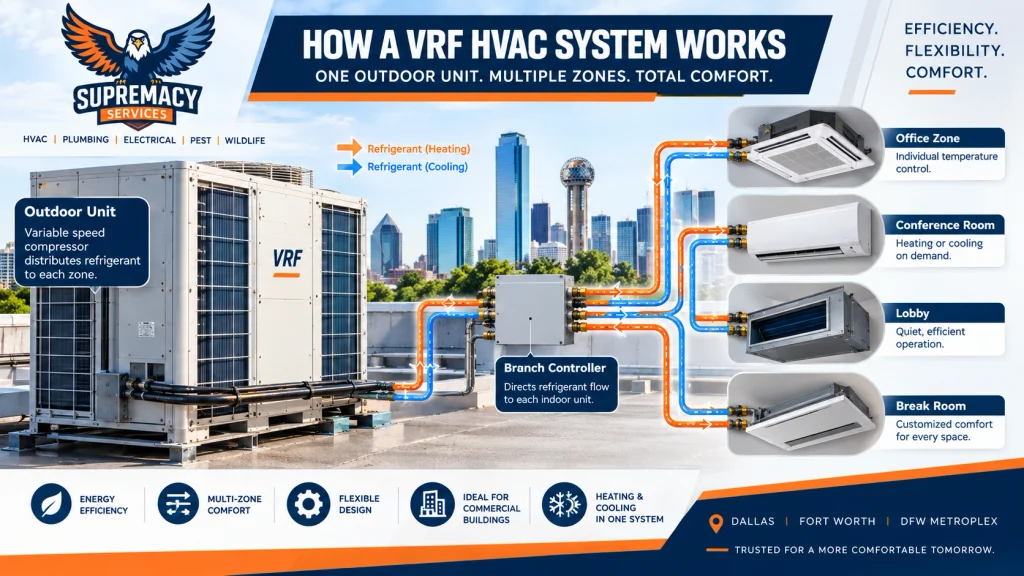
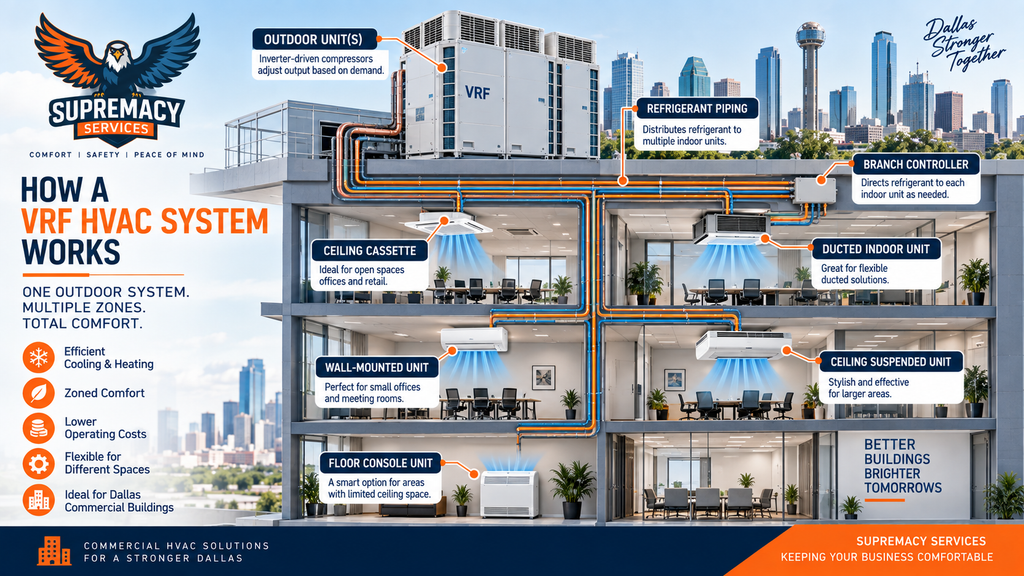
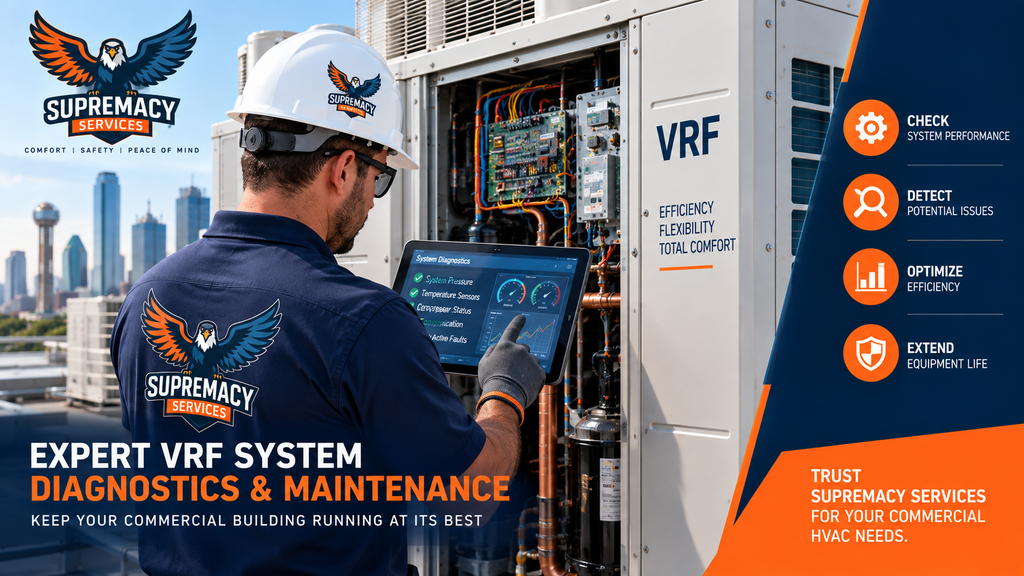
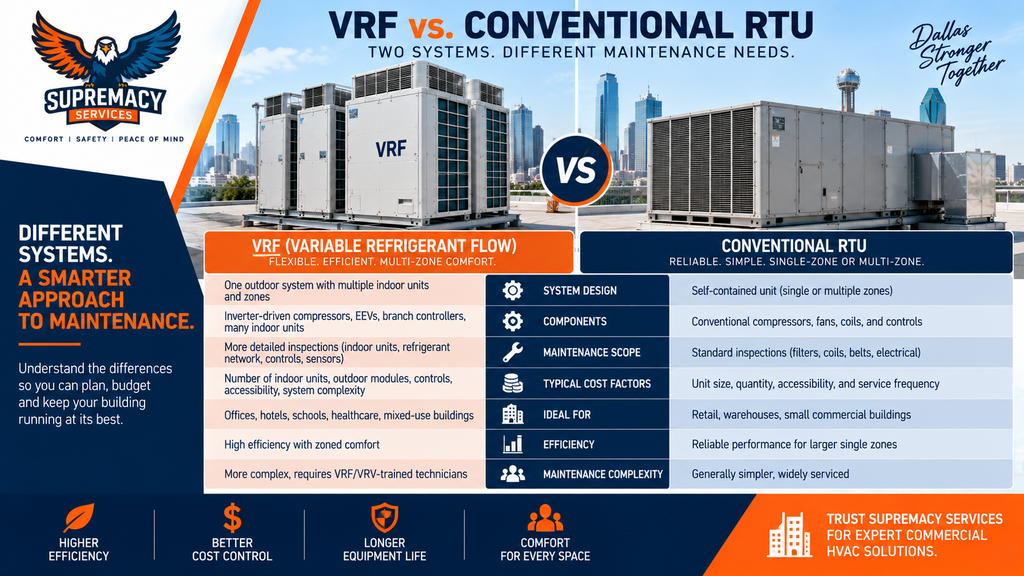
VRF, or Variable Refrigerant Flow, is an HVAC technology that varies refrigerant flow to multiple indoor zones according to their individual heating or cooling demands.
Instead of simply cycling the entire system fully on and off, VRF equipment commonly uses inverter-driven compressors and electronic controls to modulate capacity.
You may also see the term VRV, or Variable Refrigerant Volume. VRV is Daikin’s terminology, while VRF is the broader industry term.
That distinction matters when looking for service because a Dallas building may contain Daikin VRV equipment or a VRF platform from another manufacturer, and diagnostic procedures, error codes, controls and replacement components can be manufacturer-specific.
What Are the Most Common VRF HVAC Problems?
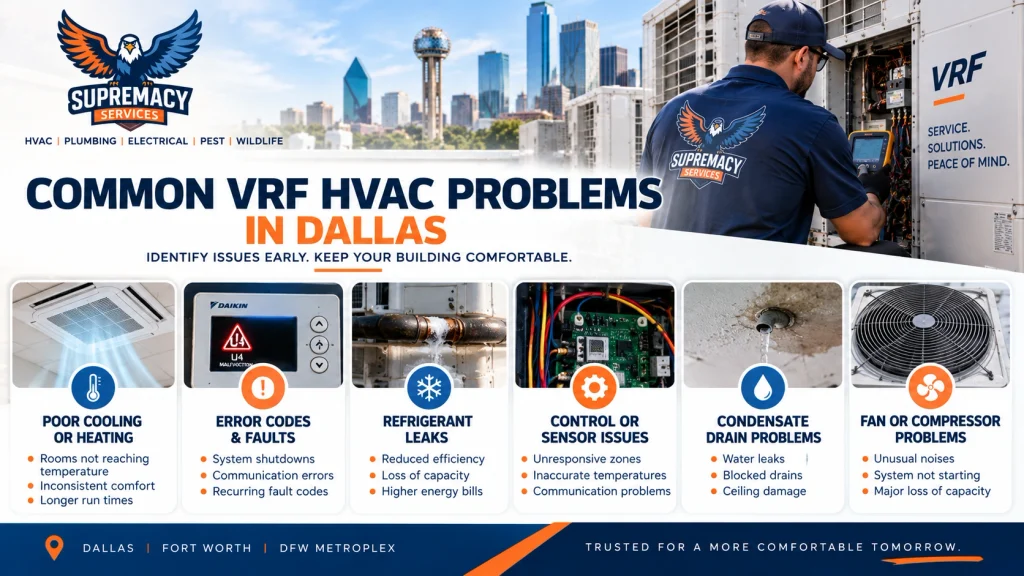
The most common VRF problems generally fall into several categories: refrigerant-system faults, communication and control failures, sensor problems, airflow restrictions, condensate problems, fan or motor failures, and compressor/inverter faults.
| Problem | What you may notice | Possible areas to investigate | Urgency |
|---|---|---|---|
| Refrigerant problem | Weak cooling, poor heating, fault code | Leak, charge, piping, valve | High |
| Communication fault | One/multiple zones offline | Wiring, address, PCB, controller | Medium–High |
| Sensor/thermistor fault | Erratic temperatures | Sensor, connection, control logic | Medium |
| Dirty/restricted coil | Reduced capacity, long run times | Indoor/outdoor heat exchanger | Medium |
| EEV problem | Zone temperature problems | Electronic expansion valve/control | High |
| Condensate problem | Water leaking indoors | Drain, pump, pan, blockage | High |
| Fan/motor problem | Low airflow or unusual noise | Motor, fan assembly, PCB | Medium–High |
| Compressor/inverter fault | Major capacity loss/shutdown | Compressor, inverter, electrical system | High |
1. Refrigerant Leaks or Refrigerant-Circuit Problems
A refrigerant problem can reduce the amount of heating or cooling available to the building.
Possible symptoms include:
- declining cooling capacity;
- zones that struggle during high-load periods;
- unusually long operating cycles;
- repeated refrigerant-related fault codes; or
- a system that works under light loads but struggles as demand increases.
Low refrigerant should not simply be treated as a reason to continually “top off” the system. The cause of refrigerant loss needs to be diagnosed.
VRF refrigerant circuits can include long piping networks and numerous connections, so finding the source of a leak can require systematic testing.
Work that opens or otherwise affects the refrigerant circuit should be left to appropriately qualified professionals. EPA Section 608 rules require certification for technicians performing work that could release regulated refrigerants.
2. Communication and Control Faults
A major difference between VRF equipment and many conventional systems is the amount of communication occurring between components.
Indoor units, outdoor equipment, controllers, sensors and other components exchange information through the system’s control network.
A communication problem may cause:
- an indoor unit to disappear from the controller;
- several zones to stop responding;
- intermittent operation;
- repeated communication error codes;
- commands that do not reach a particular zone; or
- equipment that powers up but will not operate normally.
The fault could involve wiring, connections, addressing, a controller or an electronic board rather than the refrigeration system itself.
That is one reason replacing components before performing proper diagnostics can become expensive
3. Sensor or Thermistor Problems
VRF systems depend heavily on temperature and system-condition sensors.
If a thermistor or related sensor produces inaccurate information, the control system may make the wrong operating decision even though the major mechanical components remain functional.
Possible symptoms include inconsistent room temperatures, premature cycling, abnormal operating behavior or sensor-related error codes.
Diagnosis may require comparing sensor readings with manufacturer specifications rather than simply assuming that poor cooling means the system needs refrigerant.
4. Electronic Expansion Valve Problems
Electronic expansion valves help regulate refrigerant flow through a VRF system.
A malfunctioning EEV, actuator or related control problem can interfere with refrigerant distribution to an individual indoor unit or part of the system.
Symptoms can overlap with several other faults, including:
- poor cooling;
- poor heating;
- unstable temperatures;
- unusual refrigerant conditions; and
- zone-specific performance problems.
Because these symptoms can also result from sensors, refrigerant charge or control faults, the valve should be tested before replacement is recommended.
5. Dirty Indoor or Outdoor Coils
Sometimes a performance problem has a much simpler cause.
Accumulated debris on heat-transfer surfaces can interfere with airflow and heat exchange. Filters and indoor airflow should also be checked when a zone is struggling.
Outdoor equipment in North Texas operates under significant summer cooling loads. Dallas/Fort Worth’s 1991–2020 climate normals put normal July and August daily highs at approximately 95.6°F and 95.8°F, respectively.
Keeping heat exchangers clean becomes particularly important when the system is being asked to reject heat during prolonged hot weather.
6. Condensate Drain or Pump Problems
If water is dripping from a ceiling cassette or another indoor VRF unit, shut down the affected unit when necessary to protect the building and investigate promptly.
Possible causes include:
- a blocked condensate drain;
- failed condensate pump;
- damaged drain connection;
- drain-pan problem; or
- abnormal condensation associated with another operating issue.
A water leak is not always a refrigerant problem.
That distinction can prevent unnecessary refrigeration work while also reducing the risk of damage to ceilings, walls, flooring or furnishings.
7. Indoor or Outdoor Fan Problems
Fan problems can produce reduced airflow, unusual noises or loss of capacity.
Depending on the system, diagnosis may involve checking the fan assembly, motor, electrical connections, controls and related components.
A failing motor can sometimes produce intermittent symptoms before stopping completely, so new grinding, rattling or abnormal operating noises should not simply be ignored.
8. Compressor or Inverter Problems
The inverter compressor is one of the most important—and potentially expensive—parts of a VRF system.
However, a compressor-related error does not automatically prove that the compressor itself needs replacement.
Before condemning a major component, a technician may need to investigate electrical supply, inverter electronics, system pressures and temperatures, refrigerant conditions, wiring, sensors and manufacturer diagnostic information.
That diagnostic step is especially important because VRF systems continuously adjust their operation instead of behaving like simple fixed-capacity equipment.
What Are the Warning Signs That a VRF System Needs Repair?
A VRF system should be professionally evaluated when it develops persistent error codes, repeated shutdowns, unexplained loss of capacity, water leakage, abnormal noise, multiple failed zones or significant temperature-control problems.
Watch particularly for these warning signs:
- One room suddenly stops heating or cooling.
- Multiple indoor units go offline simultaneously.
- The controller displays a recurring fault code.
- The system repeatedly resets or shuts down.
- Cooling capacity has noticeably declined.
- Some zones work while others cannot reach setpoint.
- Water appears around a cassette or indoor unit.
- The outdoor unit develops a new or unusually loud noise.
- The system runs but provides little heating or cooling.
- The same fault returns shortly after being reset.
One Failed Zone vs. Multiple Failed Zones
This distinction can help during diagnosis.
If one zone has a problem while the rest of the system operates normally, the fault may be localized around that indoor unit, its sensor, airflow, drain, expansion valve, controls or communication connection.
If many zones fail together, technicians may investigate shared components and systems such as the outdoor unit, electrical supply, communication network, refrigerant circuit or central controls.
It is not a diagnosis by itself, but it is useful information to give your HVAC contractor.
What Does a VRF Error Code Mean?
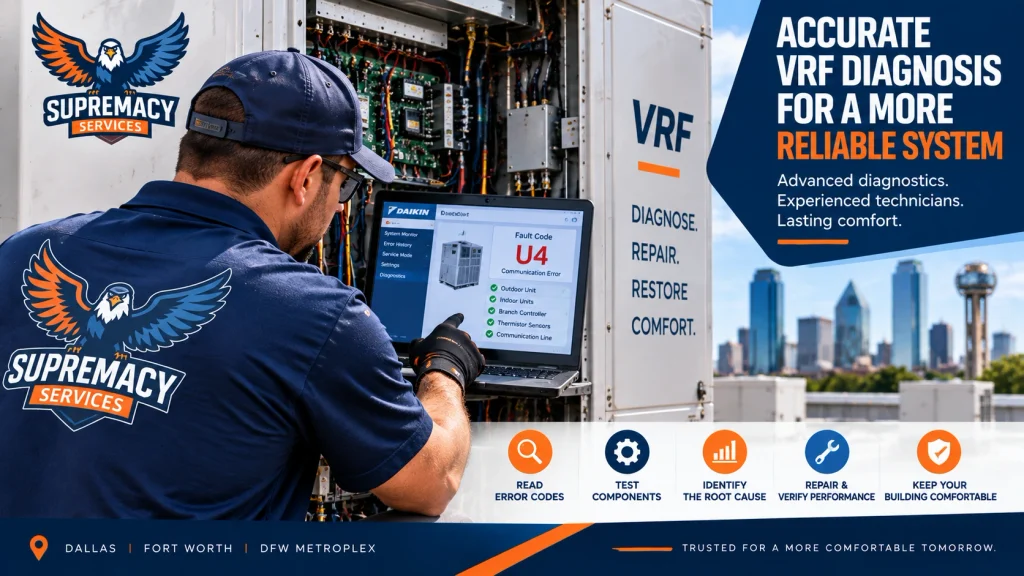
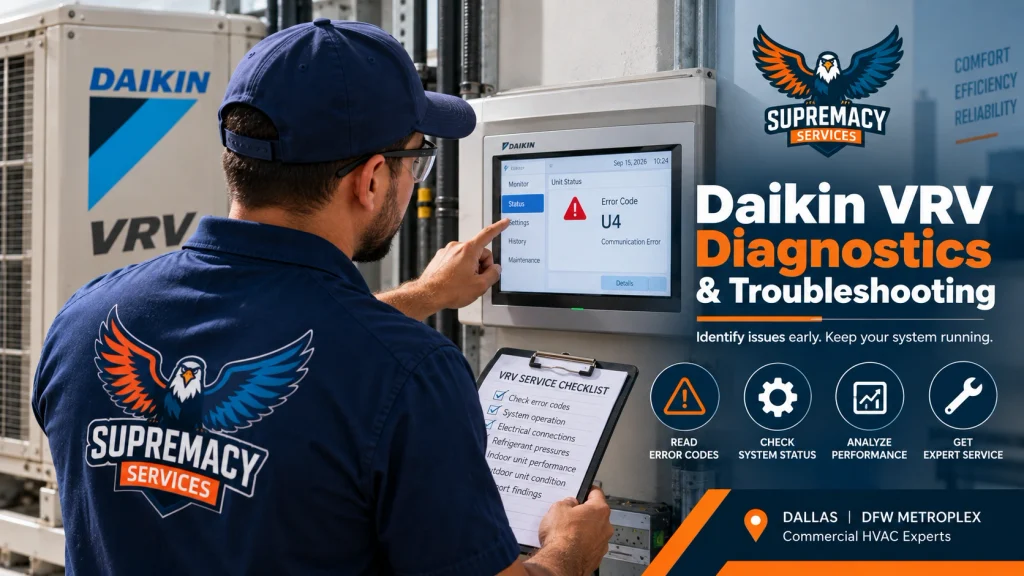
A VRF error code identifies a condition detected by the system’s controls; it does not necessarily identify the exact component that must be replaced.
Daikin, for example, provides an official error-code lookup resource and its VRV technical documentation contains troubleshooting procedures based on main and sub-codes.
Record the complete code before resetting equipment.
Also note:
- which indoor units are affected;
- whether the problem occurs in heating or cooling;
- approximately when it started;
- whether there was a power interruption;
- whether maintenance or construction recently occurred; and
- whether the fault immediately returns after reset.
That information can shorten the diagnostic process.
Do not repeatedly reset a system that immediately returns a serious fault. The underlying condition should be investigated.
How Much Does VRF HVAC Repair Cost in Dallas?
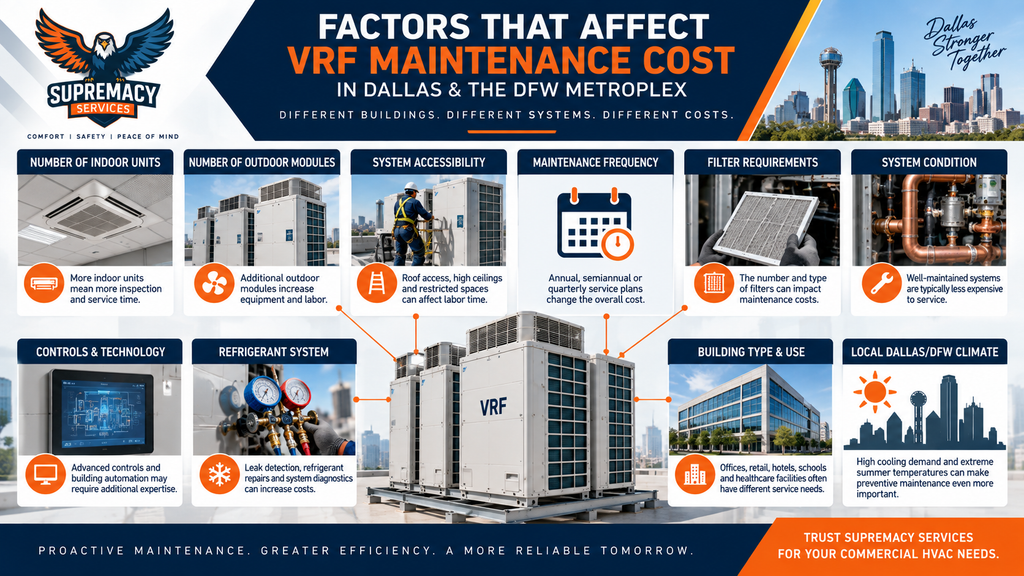
There is no reliable flat price for VRF repair because the final cost depends on the fault, system size, brand, accessibility, refrigerant work, replacement parts and diagnostic complexity.
Published Dallas HVAC pricing provides useful context but should not be treated as a VRF-specific quote. Angi’s 2026 Dallas HVAC cost data reports an overall HVAC repair average of about $361, with a broad reported range of approximately $134–$2,062. Complex commercial or VRF repairs can fall outside ordinary residential HVAC ranges.
For that reason, this article should not claim that a compressor, inverter board or refrigerant repair will cost a particular amount without inspecting the actual system.
What Affects VRF Repair Cost?
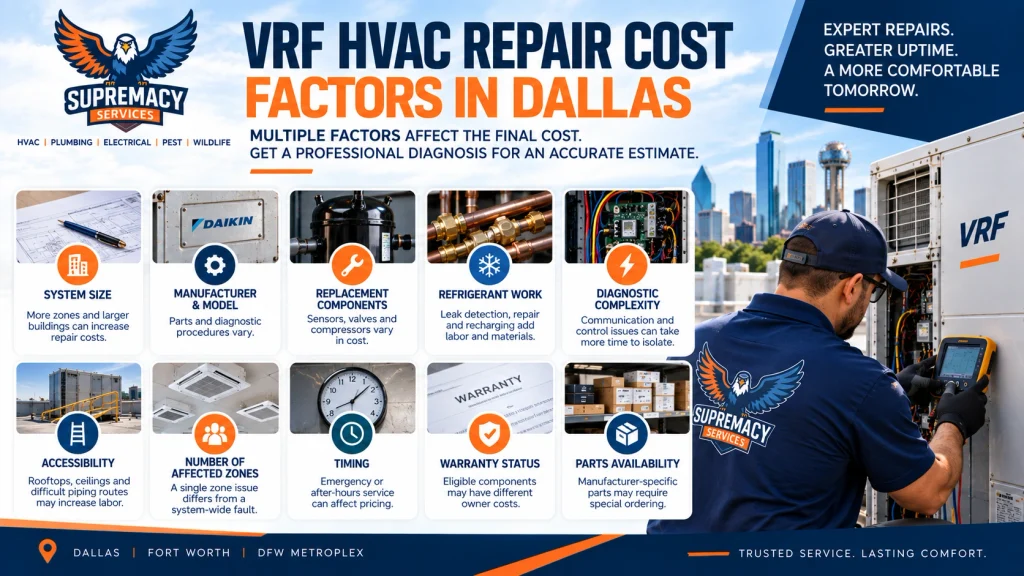
| Cost factor | Why it matters |
|---|---|
| Diagnostic complexity | Intermittent communication/control problems may take longer to isolate |
| System size | Larger networks contain more indoor units, piping and controls |
| Manufacturer/model | Parts and diagnostic procedures vary |
| Replacement component | Sensors and drains differ greatly from compressors or inverter electronics |
| Refrigerant work | Leak detection, repair, evacuation and charging add labor and material requirements |
| Accessibility | Rooftops, ceilings and difficult piping routes may increase labor |
| Number of affected zones | A local problem differs from a network-wide failure |
| Emergency timing | After-hours service can be priced differently |
| Warranty status | Eligible components may have different owner costs |
| Parts availability | Manufacturer-specific components may require ordering |
Ask for Diagnosis Before Approving Major Parts
For a costly VRF repair, ask the contractor to explain:
- the fault code;
- what tests were performed;
- which component failed;
- whether another condition caused that failure;
- the proposed repair;
- parts and labor included in the quote;
- applicable manufacturer warranty coverage; and
- what testing will be performed after the repair.
That is more useful than comparing quotes based only on a symptom such as “VRF not cooling.”
Can You Troubleshoot a VRF System Yourself?
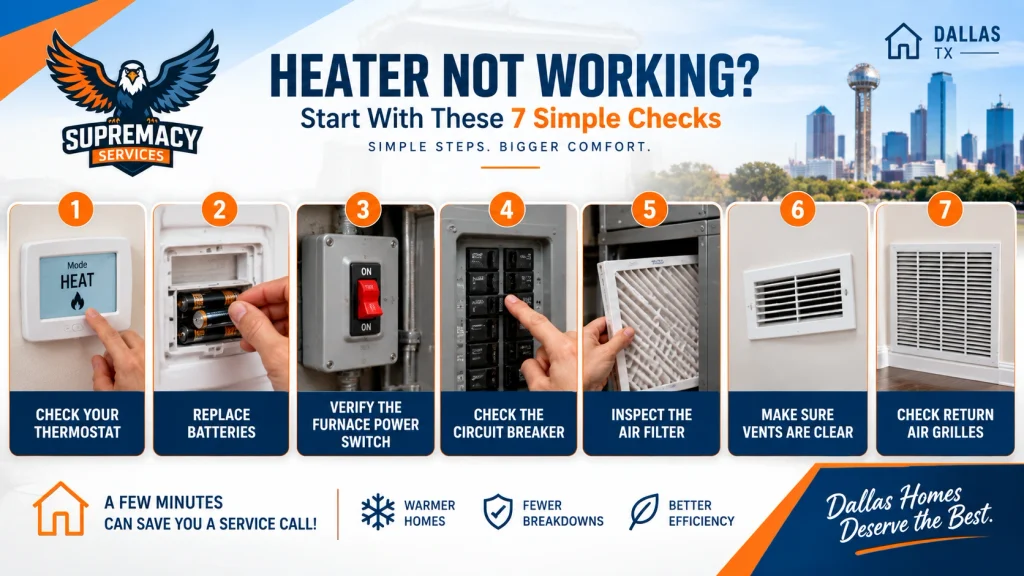
There are a few safe observations a property owner or facility manager can make without opening electrical panels or refrigerant circuits.
Things You Can Check
- Confirm the controller is powered.
- Record the complete error code.
- Determine exactly which zones are affected.
- Check whether filters are visibly dirty.
- Look for blocked supply or return airflow.
- Note visible water around indoor units.
- Check whether a breaker has tripped, without repeatedly resetting it.
- Record unusual sounds and when they occur.
- Note whether the problem began after a power interruption or other building work.
What Should Be Left to a Professional?
Do not attempt to:
- open or charge the refrigerant circuit;
- bypass electrical protection;
- replace inverter or high-voltage components;
- alter VRF communication wiring without proper technical knowledge;
- replace electronic expansion valves based only on symptoms; or
- repeatedly reset equipment that trips again.
Texas regulates air-conditioning and refrigeration contracting. TDLR states that contractors who install, repair or maintain air-conditioning, refrigeration or heating systems must meet the state’s licensing requirements.
Federal refrigerant rules apply as well. EPA requires Section 608 certification for technicians performing service or repair activities that could release refrigerant.
What Should Professional VRF Diagnosis Include?
A proper VRF repair visit should begin with diagnosis—not guessing from the symptom.
Depending on the equipment and fault, the process may include:
1. Fault-Code and Operating-History Review
The technician checks current faults and available operating information and identifies which components or zones are involved.
2. Visual Inspection
The system is checked for obvious problems involving wiring, piping, coils, drains, fans, connections and equipment condition.
3. Electrical and Communication Testing
If the symptoms suggest a controls problem, testing may involve power supply, wiring, communication circuits, controllers and electronic components.
4. Temperature and Sensor Testing
Sensor readings can be compared against expected operating conditions or manufacturer specifications.
5. Refrigerant-System Evaluation
When justified by the symptoms and fault data, the refrigerant circuit can be evaluated for abnormal operating conditions or leakage.
6. Component-Level Diagnosis
The technician then narrows the fault to the relevant component or system rather than replacing parts by trial and error.
7. Repair and Verification
After the repair, affected zones should be tested again to confirm that the fault is cleared and normal operation has returned.
If your system is showing recurring faults or multiple zones are failing, Supremacy’s VRV system service and maintenance in Dallas page explains the company’s dedicated diagnostic and service offering for these systems.
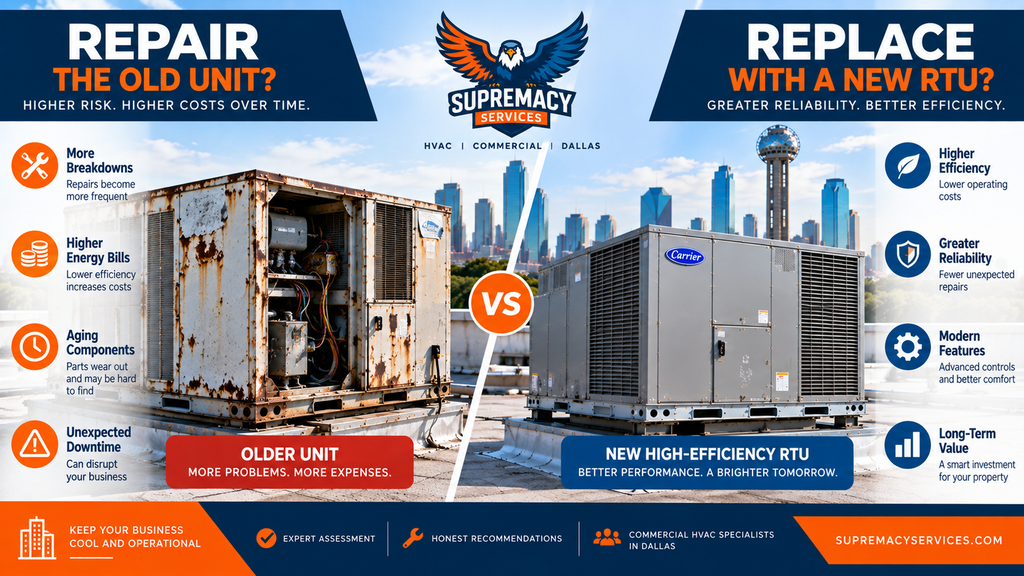
Repair or Replace: When Does a VRF Problem Become a Bigger Decision?
One failure does not automatically justify replacing an entire VRF system.
Repair generally deserves consideration when the fault is isolated, the system is otherwise performing properly, parts remain available and the repair makes economic sense.
Replacement or a broader modernization discussion becomes more relevant when:
- major failures are becoming repetitive;
- several expensive components require attention;
- parts have become difficult to obtain;
- the system has persistent performance problems;
- building requirements have changed substantially; or
- repair costs need to be weighed against a planned system upgrade.
The decision should consider the entire installation rather than simply its age.
For properties evaluating a new system, Supremacy’s VRV system installation in Dallas page covers the installation side of the decision separately.
Why Dallas Conditions Matter for VRF Systems
Dallas doesn’t require a unique kind of VRF technology, but local operating conditions influence how heavily cooling equipment is used.
National Weather Service climate normals show normal DFW high temperatures of about 91.5°F in June, 95.6°F in July and 95.8°F in August.
That sustained cooling demand makes problems such as reduced airflow, dirty heat exchangers, failing components or poor system performance particularly noticeable during summer.
For commercial properties, a small degradation may also affect several occupied zones at once.
A sensible maintenance strategy therefore focuses on finding developing problems before the building reaches its highest cooling demand.
How Can You Reduce the Risk of VRF Breakdowns?
No maintenance program can eliminate every component failure, but routine inspection can identify conditions before they develop into larger problems.
Useful preventive steps include:
- maintaining clean filters and airflow;
- inspecting indoor and outdoor heat exchangers;
- keeping outdoor equipment clear of debris;
- checking condensate drainage;
- investigating recurring error codes instead of repeatedly resetting them;
- monitoring unusual temperature differences between zones;
- documenting previous faults and repairs;
- checking electrical and communication connections as appropriate;
- following manufacturer maintenance requirements; and
- arranging professional inspection before peak cooling season.
The goal is not simply to make the equipment look clean. It is to identify changes in system operation early.
VRF Problem or Something Else?
Not every comfort complaint is caused by a major VRF failure.
| Symptom | Possible VRF issue | Other possibility |
|---|---|---|
| One room is warm | Sensor, EEV, indoor unit | Airflow obstruction or load change |
| Several rooms are warm | Outdoor/refrigerant/control fault | Building load or control schedule |
| Water at cassette | Drain/pump issue | Condensation from another source |
| System won’t start | Communication/electrical fault | Power supply or controller setting |
| Weak airflow | Fan/coil/filter problem | Blocked grille/filter |
| High energy use | System operating problem | Schedule or building-load change |
| Error code | Detected system fault | Requires code-specific diagnosis |
This is why symptom-based parts replacement is a poor strategy for sophisticated multi-zone equipment.
When Should You Call for VRF HVAC Repair in Dallas?
Schedule professional diagnosis when the system has a recurring error code, loses cooling or heating across one or more zones, leaks water, repeatedly shuts down or develops unusual electrical, compressor or fan behavior.
For a commercial building, earlier diagnosis can also help prevent a localized fault from becoming a larger comfort or operational problem.
Supremacy Services provides VRV/VRF system diagnostics, service and maintenance for properties across Dallas and the DFW Metroplex. If your system is currently showing a fault, schedule a VRF/VRV diagnostic visit so the problem can be identified before major components are replaced unnecessarily.
Frequently Asked Questions
What is the most common problem with a VRF system?
There is no single universal failure. Common service categories include communication faults, sensor problems, refrigerant-system issues, airflow restrictions, condensate problems, electronic expansion-valve faults and electrical or inverter-related problems.
Why is only one VRF zone not cooling?
A single-zone problem can involve the indoor unit, airflow, sensor, electronic expansion valve, controls, drain or communication connection. The fact that other zones work normally can help narrow the diagnostic process.
Why are several VRF indoor units offline?
When several zones fail together, the problem may involve something they share, such as communication wiring, controls, electrical supply, the outdoor system or another common component.
Can I reset a VRF error code?
A reset may clear a temporary condition, but a fault that immediately returns should be diagnosed. Record the full error code before resetting the equipment.
Does a VRF error code mean a component has failed?
Not necessarily. Error codes identify detected abnormal conditions. Technicians use the code along with system measurements and manufacturer troubleshooting information to determine the actual cause.
Can I add refrigerant to my own VRF system?
Refrigerant-circuit work should not be treated as DIY maintenance. EPA Section 608 requirements apply to technicians performing activities that could release refrigerants from stationary HVAC equipment.
How much does VRF repair cost in Dallas?
The cost depends on the diagnosis, equipment, parts, refrigerant work, system size and accessibility. Conventional Dallas HVAC cost averages can provide context, but complex VRF systems should be quoted after system-specific diagnosis.
Is VRF repair different from ordinary AC repair?
Yes. VRF systems combine variable-capacity refrigeration with multiple indoor units and sophisticated electronic controls and communications. Technicians may therefore need manufacturer-specific diagnostic information and VRF experience.
Should I repair or replace an older VRF system?
Consider the actual failure, repair history, parts availability, system performance, warranty status and cost of the proposed repair. Age alone does not determine whether replacement is necessary.