
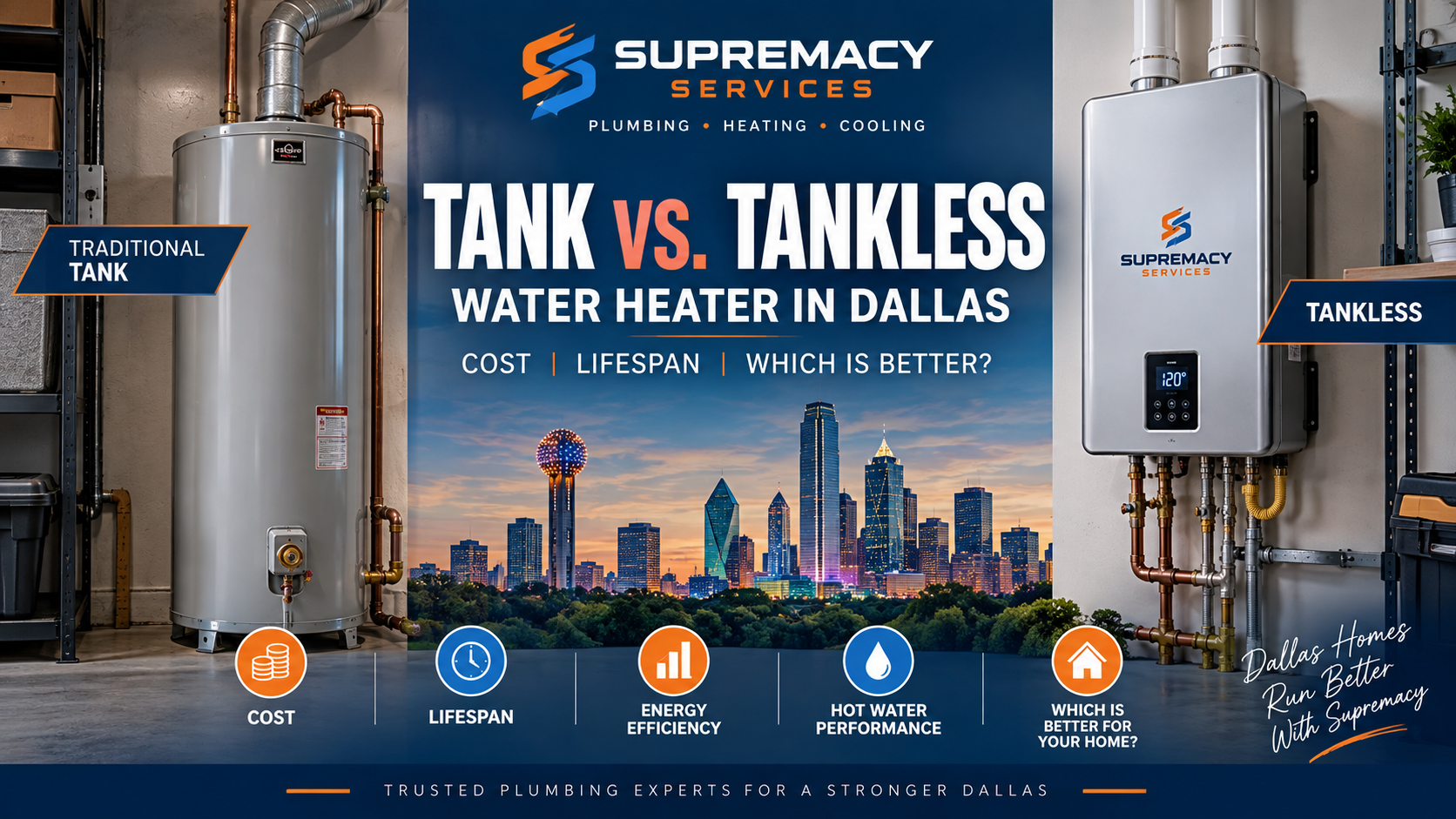
If you’re comparing a tank vs. tankless water heater in Dallas, the right choice depends on much more than the purchase price. Your household’s hot-water demand, available space, existing gas or electrical system, installation requirements, maintenance expectations, and how long you plan to stay in the home can all affect which system provides better long-term value.
Traditional tank water heaters remain popular because they are generally straightforward to install and cost less upfront. Tankless water heaters, meanwhile, heat water on demand, take up significantly less space, and can offer greater efficiency and a longer service life when properly installed and maintained.
For Dallas homeowners, there is another consideration: mineral buildup. Water-heating equipment can accumulate sediment or scale over time, making routine flushing or descaling an important part of protecting efficiency and equipment life.
This guide compares tank vs. tankless water heaters in Dallas, including installation costs, expected lifespan, efficiency, hot-water capacity, maintenance, and the situations where each option makes the most sense.
If your current system is already leaking, producing inconsistent hot water, or nearing the end of its service life, Supremacy Services provides professional water heater replacement and installation throughout Dallas–Fort Worth.
Tank vs. Tankless Water Heater: Quick Comparison
| Feature | Traditional Tank Water Heater | Tankless Water Heater |
|---|---|---|
| How it works | Stores and continuously maintains heated water | Heats water as it flows through the unit |
| Upfront installation | Usually lower | Usually higher |
| Hot-water supply | Limited by tank capacity | Continuous when properly sized |
| Typical service life | Often around 8–12 years | Often around 15–20+ years |
| Energy efficiency | Can experience standby heat loss | Avoids most storage-related standby losses |
| Space requirements | Requires floor space | Compact, usually wall-mounted |
| Maintenance | Periodic flushing and inspection | Periodic descaling and inspection |
| Best advantage | Lower initial investment | Efficiency, longevity and space savings |
| Main disadvantage | Limited stored hot water | Higher installation cost |
| Best suited for | Budget-conscious homeowners and straightforward replacements | Long-term owners and households prioritizing efficiency |
Actual equipment life varies significantly with installation quality, usage, water conditions, equipment quality and maintenance
What Is a Tank Water Heater?
A traditional storage water heater heats water and keeps it inside an insulated tank until the household needs it.
Residential tanks commonly come in capacities such as 40 or 50 gallons, although other sizes are available. When someone opens a hot-water faucet, heated water leaves the tank while cold replacement water enters and begins heating.
The primary advantage is simplicity.
Tank systems are familiar to homeowners and plumbers, replacement can often be relatively straightforward when replacing a similar unit, and their upfront price is generally lower than converting a home to tankless.
The trade-off is capacity.
Once a household consumes most of the heated water stored in the tank, the system needs time to recover. That can become noticeable in households where multiple showers, washing machines and dishwashers operate within a short period.
Storage systems can also lose some energy by maintaining hot water even when nobody is using it.
What Is a Tankless Water Heater?
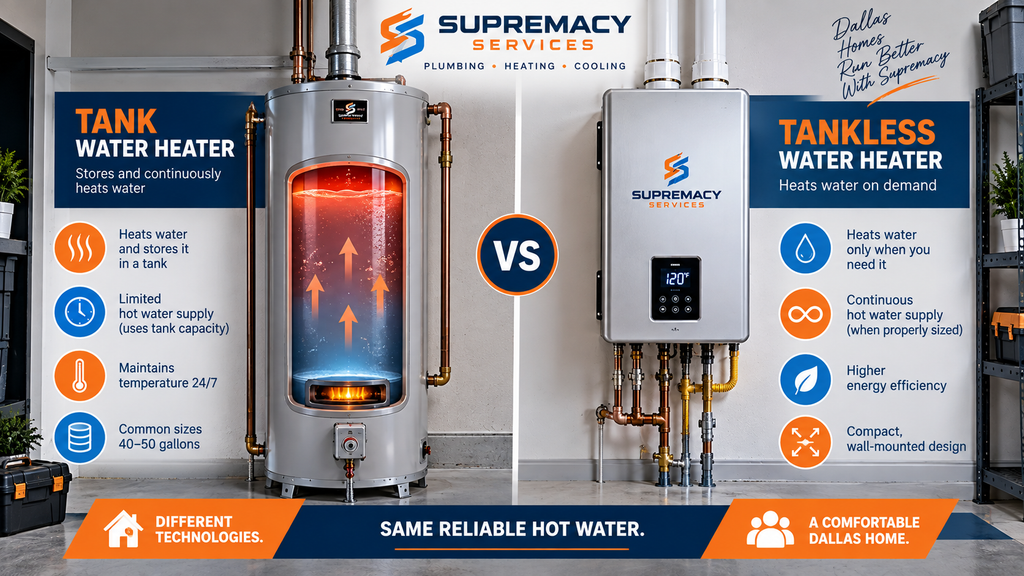
A tankless water heater, sometimes called an on-demand water heater, does not maintain a large reservoir of heated water.
Instead, opening a hot-water fixture causes cold water to move through the unit. A flow sensor detects demand and activates the burner or heating element. Water passes through a heat exchanger and is heated before traveling to the fixture.
ENERGY STAR explains that this approach reduces the energy associated with continuously maintaining a tank of hot water.
This creates one of the biggest attractions of tankless technology:
Continuous hot water.
A correctly sized system can continue heating water for as long as demand remains within the unit’s rated capacity.
However, “endless hot water” does not mean unlimited simultaneous water flow.
Every tankless unit has a maximum gallons-per-minute (GPM) capacity. If several showers and appliances demand more hot water than the system can produce simultaneously, water temperature or flow performance may decline.
That is why professional sizing matters.
Tank vs. Tankless Water Heater Cost in Dallas
For many Dallas homeowners, price is the first major difference.
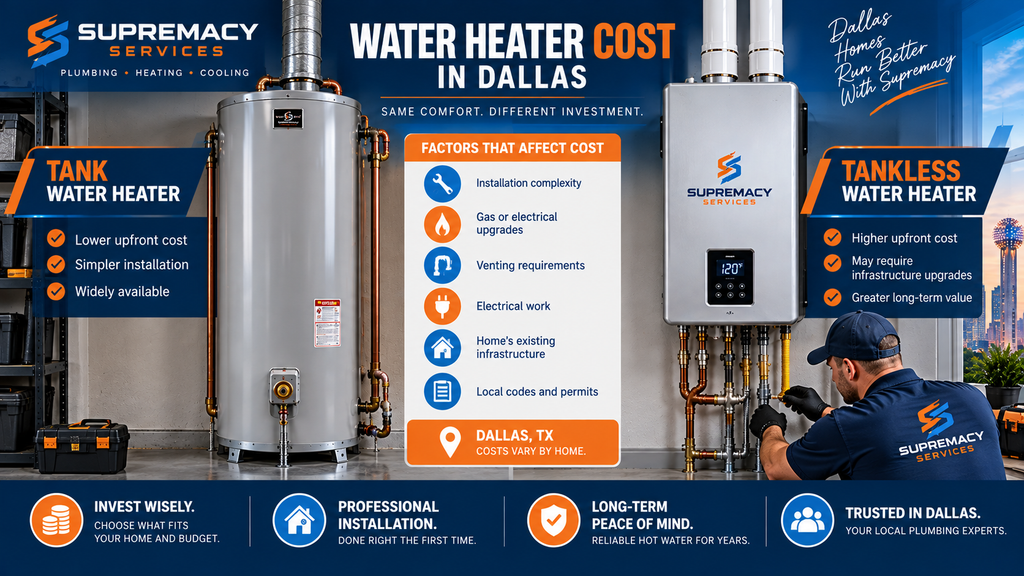
A conventional tank system generally requires a smaller initial investment, particularly when the replacement unit uses the same fuel, location, venting and plumbing configuration.
Tankless installations can cost considerably more because converting an existing home may require additional work.
Possible upgrades include:
- Larger gas supply piping
- New venting
- Condensate drainage for condensing models
- Electrical upgrades
- New water connections
- Equipment relocation
- Code-related modifications
- Removal of the old water heater
Recent Dallas-specific consumer cost reporting also notes that existing natural-gas infrastructure can influence the practicality and final price of a tankless conversion.
Why Online Water-Heater Prices Can Be Misleading
The retail price of the appliance is only part of the actual replacement cost.
A homeowner may see a tankless water heater advertised online and assume that price represents the entire project. It doesn’t account for labor or potential modifications required to safely operate the new equipment.
For example, a high-input gas tankless system can have substantially different gas and venting requirements from the storage water heater it replaces.
That means two Dallas homes installing the exact same water heater could receive different installation prices.
A professional estimate should therefore evaluate the entire installation, not merely the appliance.
Supremacy Services offers water-heater diagnostics and replacement services throughout DFW
Which Water Heater Lasts Longer?
Lifespan is one of the strongest arguments for considering tankless technology.
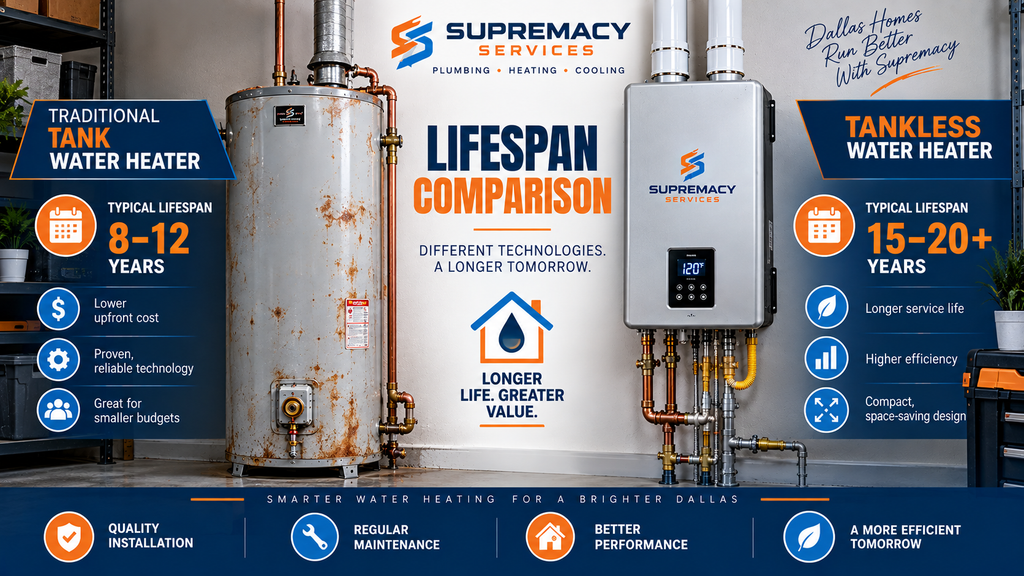
Traditional storage water heaters commonly provide roughly 8–12 years of service, although well-maintained systems can sometimes last longer.
Tankless equipment can frequently reach 15–20 years or more with appropriate installation and maintenance.
ENERGY STAR lists a 20-year life expectancy for whole-home gas tankless water heaters.
But lifespan should never be interpreted as a guarantee.
Several factors can shorten the life of either system:
Water quality
Mineral deposits can accumulate inside storage tanks and tankless heat exchangers.
Maintenance
Ignoring sediment or scale allows deposits to interfere with heat transfer and system operation.
Installation quality
Improper gas sizing, venting, drainage or electrical connections can create performance and reliability problems.
Household demand
Equipment that routinely operates near or beyond its intended capacity can experience additional stress.
Equipment quality
Construction, components and manufacturer specifications vary considerably between models.
A quality system that is properly sized, professionally installed and regularly maintained has the best opportunity to reach its expected service life.
Tankless vs. Tank Water Heater Energy Efficiency
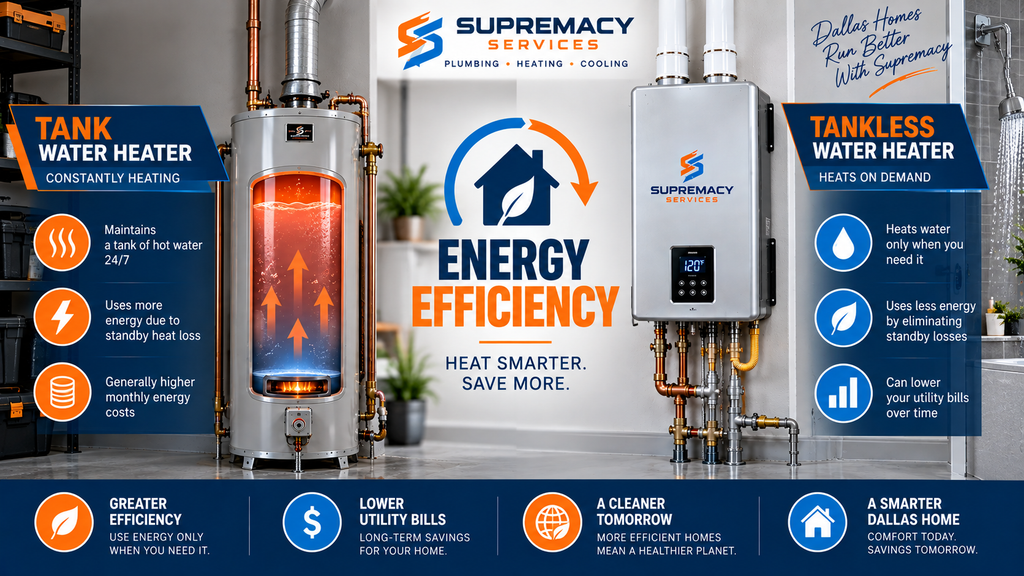
This is another area where tankless systems can have an advantage.
Storage water heaters must maintain the temperature of the water sitting inside the tank. Even with modern insulation, maintaining stored hot water can result in standby energy losses.
Tankless systems largely avoid this issue because they heat water only when hot water is requested.
ENERGY STAR currently requires qualifying gas-fired instantaneous water heaters to achieve a Uniform Energy Factor (UEF) of at least 0.95. UEF is a standardized measure used to compare overall water-heater efficiency—the higher the UEF, the more efficient the equipment.
ENERGY STAR also estimates that an ENERGY STAR-certified gas tankless water heater can save a family of four approximately $95 per year in gas costs compared with a standard gas storage model, based on its national assumptions. Actual Dallas household savings will vary according to usage, utility rates, system efficiency and installation.
Important: Don’t Choose a Water Heater Based on Efficiency Alone
A highly efficient water heater isn’t automatically the least expensive overall option.
Homeowners should compare:
Purchase price + installation + estimated operating expenses + maintenance + expected lifespan.
This gives a much more useful picture of lifetime ownership cost.
Hot-Water Performance: Which One Wins for Large Families?
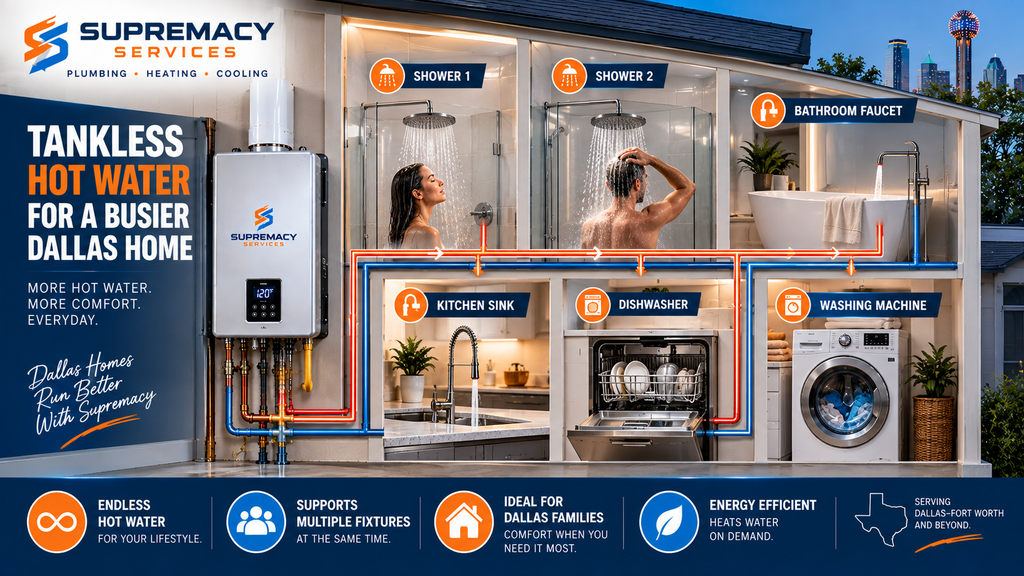
This depends on sizing.
A tank system has a defined volume of hot water.
Suppose several family members take showers consecutively while the dishwasher is operating. Eventually, the stored hot water can be depleted faster than the system can recover.
Tankless systems solve the storage problem, but introduce another limitation: flow rate.
Imagine simultaneously running:
- Two showers
- A dishwasher
- A bathroom faucet
The tankless system must produce enough heated water per minute to satisfy all of those fixtures.
This is why homeowners should never select tankless equipment simply by choosing the biggest-looking model or comparing BTU ratings.
A plumber should calculate anticipated peak simultaneous hot-water demand and the required temperature rise before selecting the unit.
ENERGY STAR’s current certification criteria, for example, require qualifying gas-fired instantaneous systems to provide at least 2.8 GPM over a 67°F temperature rise, but individual residential applications can require substantially greater capacity.
Dallas Water Conditions and Water-Heater Maintenance
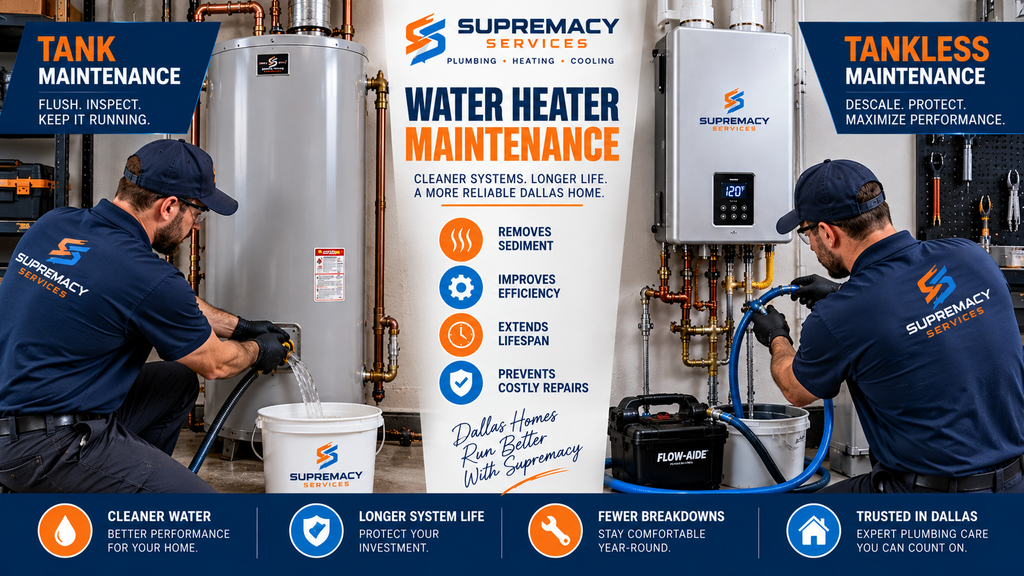
Maintenance matters for both technologies.
Tank Water Heater Maintenance
Minerals and debris can settle at the bottom of a storage tank over time.
Excessive sediment may:
- Reduce heat-transfer efficiency
- Contribute to popping or rumbling sounds
- Increase heating time
- Place additional stress on the system
Periodic inspection and flushing can help manage sediment accumulation.
Tank systems may also use a sacrificial anode rod, designed to corrode instead of the steel tank. Checking this component as recommended by the manufacturer can help protect the tank.
Supremacy’s current water-heater service process specifically includes checking sediment buildup, anode-rod condition, burner efficiency and tank integrity during system diagnostics.
Tankless Water Heater Maintenance
Tankless equipment does not have a large storage tank, but minerals can accumulate inside its heat exchanger.
Over time, scale can restrict water passages and interfere with heat transfer.
Depending on manufacturer requirements and local water conditions, periodic professional descaling or flushing may therefore be recommended.
Always follow the maintenance interval specified for your particular water heater.
Space: Tankless Has a Major Advantage
Dallas homes come in everything from older properties with dedicated utility rooms to newer homes where every square foot matters.
Traditional tanks require a substantial physical footprint.
Tankless water heaters are generally mounted on a wall, potentially freeing valuable garage, closet or utility-room space.
ENERGY STAR specifically identifies reduced space requirements as one advantage of whole-home gas tankless systems.
For smaller homes or remodeling projects where usable space is valuable, this difference can be significant.
What About the Risk of Water Damage?
Storage tanks contain dozens of gallons of water.
If the tank itself eventually corrodes and fails, that stored water can escape rapidly and potentially damage nearby flooring, walls or belongings.
Tankless systems eliminate the risk of a large storage tank rupturing, although their pipes, valves and internal components can still leak.
Regardless of system type, homeowners should investigate signs such as:
- Water pooling around the unit
- Rust or corrosion
- Moisture around fittings
- Unexplained pressure changes
- Visible pipe deterioration
Problems elsewhere in the home’s supply piping may require professional water line repair or replacement rather than water-heater replacement.
Can You Replace a Tank Water Heater With Tankless?
Usually, yes—but it isn’t always a direct swap.
A plumber should first evaluate:
Gas capacity
High-output gas tankless systems may require greater fuel delivery than the existing storage unit.
Venting
The new heater may require a completely different venting configuration.
Electrical requirements
Even gas tankless systems commonly require electrical power for controls, ignition and other components.
Condensate management
High-efficiency condensing units can produce condensate that must be appropriately drained.
Installation location
Clearances and manufacturer requirements have to be considered.
Hot-water demand
The system must be sized according to expected simultaneous fixture use.
This evaluation explains why the cost of converting from tank to tankless can be significantly different from replacing one conventional tank with another.
Gas vs. Electric Tankless Water Heaters
Tankless isn’t one single technology.
Homeowners may encounter both gas-fired and electric tankless water heaters.
Gas systems are frequently selected for whole-home applications because they can provide high heating capacity.
Whole-home electric tankless equipment can place a substantial demand on a home’s electrical system. Depending on the model and existing electrical infrastructure, additional circuits or electrical upgrades may be necessary.
Before purchasing either type, determine whether the home’s gas supply or electrical service can support the manufacturer’s requirements.
Tank Water Heater: Pros and Cons
Advantages
Lower upfront investment:
A standard tank replacement is often less expensive than converting to tankless.
Straightforward replacement:
Replacing a tank with a similar tank can require fewer infrastructure modifications.
Familiar technology:
Parts, technicians and service procedures are widely available.
Strong short-term value:
Tank systems can make financial sense when initial budget is the primary consideration.
Disadvantages
Limited hot-water storage:
Heavy consecutive use can temporarily exhaust the available hot water.
Larger footprint:
The tank occupies valuable floor or closet space.
Standby energy losses:
Energy is required to maintain stored water temperature.
Generally shorter service life:
Storage tanks usually don’t last as long as properly maintained tankless systems.
Tankless Water Heater: Pros and Cons
Advantages
Continuous hot water:
A properly sized unit can continue producing hot water without waiting for a storage tank to refill.
Higher efficiency potential:
Water is heated when required rather than continuously stored.
Long service life:
Quality tankless systems can often operate for 15–20 years or longer with appropriate maintenance.
Compact installation:
Wall-mounted equipment saves considerable floor space.
No large tank to rupture:
Eliminating a large reservoir reduces one source of catastrophic water-heater leakage.
Disadvantages
Higher upfront cost:
Equipment and installation generally cost more.
Possible infrastructure upgrades:
Gas, venting, drainage or electrical modifications can increase conversion costs.
Flow-rate limits:
An undersized system can struggle when many fixtures require hot water simultaneously.
Maintenance remains necessary:
Tankless does not mean maintenance-free; scale accumulation must still be managed.
Tank vs. Tankless Water Heater: Which Is Better for Dallas Homes?
There isn’t one system that is automatically better for every Dallas homeowner.
A traditional tank water heater may make more sense when:
- Keeping the initial replacement cost low is important.
- The existing system can be replaced without extensive modifications.
- Household hot-water demand is predictable.
- You prefer simple, familiar equipment.
- You expect to move before the longer tankless lifespan provides substantial value.
A tankless water heater may make more sense when:
- You plan to remain in the home for many years.
- Energy efficiency is a priority.
- Your household frequently uses large amounts of hot water.
- You want to reclaim utility-room or garage space.
- You are comfortable with periodic descaling and professional maintenance.
- Your home’s gas/electrical infrastructure can support the selected equipment.
For many homeowners, the most useful question isn’t simply “Which water heater is better?”
It’s:
“Which properly sized system gives my household the best combination of installation cost, operating expense, hot-water performance and expected service life?”
How to Choose the Right Water Heater Size
Correct sizing is critical regardless of technology.
For a storage water heater, professionals consider factors including:
- Household size
- Peak hot-water demand
- Tank capacity
- First Hour Rating (FHR)
- Fuel type
For tankless equipment, important factors include:
- Required gallons per minute
- Number of simultaneous fixtures
- Incoming water temperature
- Required temperature rise
- Burner or heating capacity
ENERGY STAR defines First Hour Rating as an estimate of how much hot water a storage heater can provide during an hour beginning with a fully heated tank. For instantaneous systems, GPM represents how much hot water the unit can continuously supply at a specified temperature rise.
A larger unit isn’t automatically the correct unit.
Professional load and demand calculations are preferable to guessing.
Signs It May Be Time to Replace Your Water Heater
Regardless of whether you ultimately choose tank or tankless, consider having your current system inspected if you notice:
- Hot water running out unusually quickly
- Inconsistent water temperatures
- Rust-colored or discolored hot water
- Water around the heater
- Corrosion around the tank or connections
- Unusual popping or rumbling noises
- Repeated repairs
- Increasing energy consumption without an obvious explanation
- An aging storage tank approaching or exceeding its expected service life
A leaking tank deserves especially prompt attention because deterioration of the tank itself usually cannot be permanently repaired.
Professional Water Heater Installation in Dallas, TX
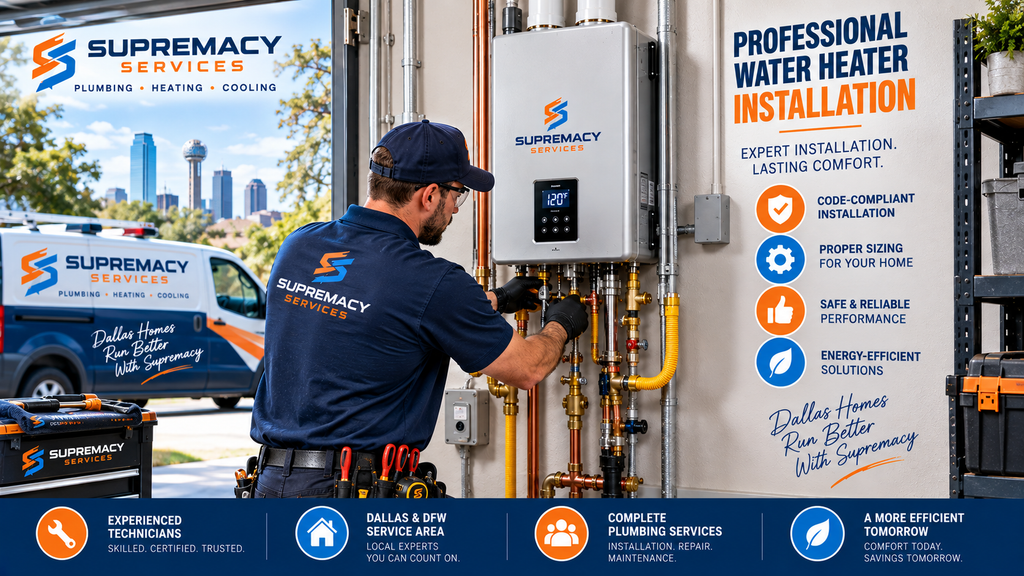
Water-heater performance depends heavily on installation.
A professional installation should account for equipment sizing, plumbing connections, fuel supply, venting, drainage, electrical requirements, manufacturer clearances and applicable codes.
Dallas property standards also require water-heating equipment to remain operational, require pressure-relief valves with approved drain lines, and require fuel-fired equipment to be appropriately vented under applicable construction codes.
Supremacy Services provides water heater replacement and installation in Dallas and throughout the DFW area, including system diagnostics and replacement recommendations based on the home’s existing equipment and requirements.
Frequently Asked Questions
Is a tankless water heater worth it in Dallas?
It can be, particularly for homeowners who expect to stay in their property long enough to benefit from the system’s longer potential lifespan, improved efficiency and space savings. However, installation requirements and household hot-water demand should be evaluated before deciding.
How long does a tank water heater last?
A conventional storage water heater commonly lasts approximately 8–12 years, although maintenance, water conditions, usage and installation quality can significantly affect its actual lifespan.
How long does a tankless water heater last?
Many properly maintained tankless water heaters can operate for approximately 15–20 years or longer. ENERGY STAR cites a 20-year life expectancy for qualifying whole-home gas tankless systems.
Does a tankless water heater really provide unlimited hot water?
It provides continuous hot water rather than a fixed stored quantity, but it still has a maximum flow capacity. Exceeding the unit’s rated GPM can affect performance.
Are tankless water heaters cheaper to operate?
They can use less energy than conventional storage systems because they avoid continuously maintaining a large volume of heated water. Actual savings depend on fuel prices, usage, equipment efficiency and installation.
Do tankless water heaters require maintenance?
Yes. Mineral scale can develop inside the heat exchanger, so periodic flushing or descaling may be required according to manufacturer recommendations and local water conditions.
Can I replace my 50-gallon water heater with a tankless unit?
Potentially. The appropriate tankless model should be selected according to peak flow demand and required temperature rise rather than simply converting tank capacity into an equivalent tankless size. Gas supply, venting and electrical requirements must also be evaluated.
Is a 40- or 50-gallon water heater enough for my Dallas home?
It depends on household demand rather than household size alone. First Hour Rating, fixture usage and how frequently hot-water demands overlap should all be considered.
Should I repair or replace my old water heater?
Minor component problems may be repairable. Replacement becomes increasingly worth considering when an older unit develops tank corrosion or leakage, requires repeated repairs, or no longer reliably satisfies household hot-water demand.
Final Takeaway: Compare Lifetime Value, Not Just Purchase Price
When comparing a tank vs. tankless water heater in Dallas, don’t make the decision solely on the appliance’s sticker price.
A traditional tank water heater generally offers the lower initial investment and a straightforward replacement path.
A tankless water heater usually costs more to install but can provide a longer expected service life, reduced space requirements, continuous hot water within its rated flow capacity, and potentially lower energy consumption.
The best system ultimately depends on your home’s infrastructure, household demand, budget and long-term plans.
Before replacing your water heater, have the existing plumbing, gas or electrical capacity and peak hot-water demand professionally evaluated. Proper sizing and installation can matter just as much as choosing between tank and tankless.
Need help choosing?
Supremacy Services provides professional water heater installation and replacement in Dallas–Fort Worth, helping homeowners compare options and select equipment appropriate for their property.

