Dallas Water Line Replacement starts with recognizing the early symptoms of an underground plumbing problem before it causes extensive damage. Your home’s main water line delivers fresh water from the municipal supply to your plumbing system, and because much of this line is buried, leaks can remain hidden for weeks or even months. Knowing what to watch for—such as higher water bills, low water pressure, wet spots in your yard, or unexplained water usage—can help Dallas homeowners identify a potential water line problem early and arrange professional repairs before the damage becomes more serious.
Even a small underground water line leak can lead to higher water bills, wasted water, soggy landscaping, reduced water pressure, and moisture-related property damage if it is not addressed promptly.
According to the EPA, household leaks can waste thousands of gallons of water annually, while aging pipes, corrosion, and irregular water pressure can contribute to plumbing leaks.
For Dallas homeowners, recognizing the warning signs of a damaged water line early can help prevent a relatively manageable plumbing repair from developing into a much larger and more expensive problem.
If you notice unexplained water usage, wet areas in your yard, low water pressure, or other signs of a hidden leak, consider professional water line repair and replacement in Dallas from Supremacy Services. Professional pressure testing and leak-detection methods can help locate the problem and determine whether the damaged section should be repaired or replaced.
9 Signs You May Need Water Line Repair in Dallas
1. Your Water Bill Suddenly Increases
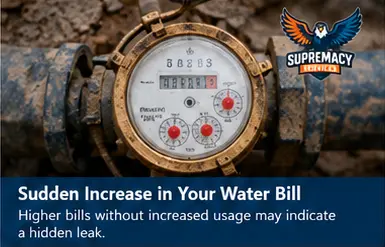
An unexplained increase in water consumption is one of the most useful clues that water may be escaping somewhere in your plumbing system.
If your household routines have remained relatively consistent but your water consumption has increased considerably, don’t automatically assume the utility rate is responsible. Compare the actual amount of water used from one billing period to another.
The EPA specifically recommends comparing water bills with the same period from the previous year because unexpectedly high consumption can indicate an unidentified household leak.
Try the water-meter test
Turn off faucets, showers, irrigation systems, washing machines, dishwashers and other water-using appliances.
Record the water-meter reading and avoid using water for approximately two hours. Check the meter again.
If the reading has changed, the EPA says you probably have a leak somewhere in the home or plumbing system.
A professional inspection can then determine whether that leak is in a fixture, interior pipe, irrigation system or main water line.
2. You Have Unexplained Wet or Soggy Areas in Your Yard
One part of your lawn remains wet even though it hasn’t rained recently.
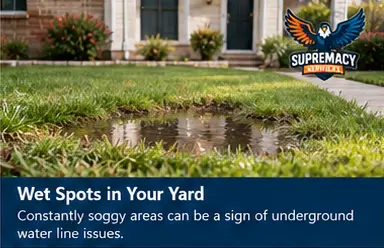
That deserves attention.
Because your main water service line typically travels underground between the utility connection and your house, a leaking pipe can release water into the surrounding soil.
Watch for:
- Persistently soggy soil
- Puddles without an obvious source
- Muddy areas during dry weather
- Unusually lush or fast-growing patches of grass
- Soil erosion or soft ground
Supremacy Services specifically identifies persistently wet or mushy lawn areas as a common symptom of an underground water-line problem.
3. Water Pressure Has Dropped Throughout Your House
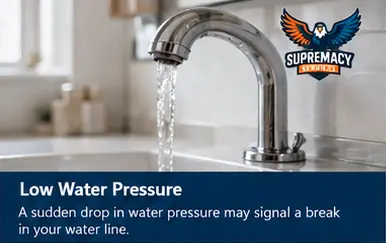
A single weak faucet often points to a localized fixture problem.
When multiple faucets, showers and fixtures suddenly experience low pressure, however, the problem may be farther upstream.
Possible causes include:
- A leaking main water line
- Partially obstructed piping
- Corrosion or mineral buildup
- A pressure-regulation problem
- A damaged supply line
Supremacy identifies low pressure throughout the home as one of the common problems associated with a leak, partial blockage or failing main line.
A plumber can perform pressure testing and additional diagnostics rather than relying on symptoms alone.
4. You Hear Water Running When Everything Is Off
Your house should generally become quiet when every water fixture and appliance is off.
If you continue hearing:
hissing, dripping, rushing or running water, investigate.
First check toilets, faucets, outdoor hose bibs, irrigation equipment, water heaters and appliances.
If you cannot find an obvious source, there could be a concealed leak.
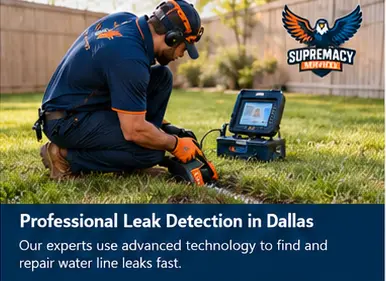
Supremacy’s Dallas leak-detection service uses methods including acoustic detection and infrared thermography to locate hidden leaks while reducing unnecessary disruption to the property.
5. Your Water Looks Rusty, Cloudy or Discolored
Changes in water appearance deserve investigation, although discoloration alone does not automatically mean your underground water line is broken.
Corroding plumbing, sediment, disturbances to the municipal supply and other plumbing problems can affect water appearance.
If discoloration persists, particularly when combined with low pressure, leaks or aging metal plumbing, arrange a professional inspection rather than assuming the source.
A plumber can determine whether deterioration within your home’s piping is contributing to the problem.
6. Cracks, Stains or Unexplained Moisture Are Appearing
Water doesn’t always surface outside.
Leaks beneath or near a building can sometimes produce signs such as:
- Damp flooring
- Unexplained moisture
- Water stains
- Musty odors
- Mold or mildew
- Damaged drywall
- Warped materials
Supremacy’s water-line service information identifies water stains, mold or mildew and slab leaks among the plumbing problems its technicians investigate.
These symptoms should be diagnosed rather than used alone to conclude that the main water line has failed, because several other plumbing and building-envelope problems can cause similar damage.
7. Your Pipes Are Older or Corroded
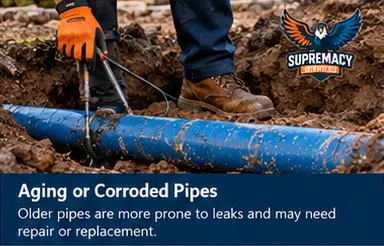
Pipe age matters.
Older plumbing materials can gradually deteriorate because of corrosion, soil conditions, pressure stresses and previous repairs.
A single isolated failure doesn’t necessarily justify replacing the entire service line. But recurring leaks along an aging or heavily deteriorated pipe can change the economics.
Supremacy’s current service guidance recommends evaluating repair versus replacement based on the extent and condition of the line: localized damage may be repairable, whereas aging, corroded piping with multiple failures may make replacement the better long-term solution.
8. You Keep Having Water-Line Leaks
One leak can be an isolated failure.
Repeated leaks are different.
If sections of the same water line have already been repaired several times, repeatedly excavating and patching individual weak spots may become less economical than addressing the deteriorating line itself.
This is where a comprehensive inspection becomes important.
A qualified plumber should consider the pipe’s:
material + age + condition + repair history + location + number of failures
before recommending another spot repair or complete replacement.
9. Your Water Meter Keeps Moving When No Water Is Being Used
This is one of the simplest homeowner checks.
Turn everything off and watch the meter.
If water consumption continues despite no intentional water use, investigate the cause.
The EPA recommends this meter-based method for identifying possible household leaks.
Remember, though, that the test tells you a leak may exist—it doesn’t tell you where it is.
That’s where professional leak detection becomes valuable.
Water Line vs. Sewer Line Problems: How Can You Tell the Difference?
Water line and sewer line problems can sometimes produce similar warning signs around a Dallas property, but they involve two very different plumbing systems.
Your main water line brings clean, pressurized water into your home, while your sewer line carries wastewater away from toilets, sinks, showers, tubs, and appliances. Understanding this distinction can help you recognize which system may need professional attention.
Signs That Point More Toward a Water Line Problem
A damaged main water line commonly affects the incoming water supply. Warning signs can include:
- Unexplained increases in water usage
- Low water pressure throughout the house
- A water meter that moves when fixtures are off
- Wet or unusually green areas in the yard
- Sounds of running water when no water is intentionally being used
- Water surfacing from the ground near the service-line route
Because a water service line operates under pressure, a significant break can continue releasing water even when nobody inside the home is using a faucet.
If these symptoms are present, professional water leak detection can help determine whether the leak originates from the main water line or another part of the plumbing system.
Signs That Point More Toward a Sewer Line Problem
A sewer problem generally affects wastewater drainage rather than incoming water pressure.
Common warning signs can include:
- Multiple drains backing up
- Toilets that repeatedly back up or drain poorly
- Gurgling from drains or toilets
- Wastewater backing up into tubs or showers
- Sewage odors inside or outside the home
- Recurring drainage problems affecting several fixtures
- Soggy areas associated with a damaged underground sewer line
A particularly important clue is multiple fixtures having drainage problems at the same time. If a toilet, bathtub, and other low-level drains are backing up together, the problem may extend beyond a single fixture or branch drain.
In these circumstances, the home’s main sewer line may require professional inspection.
Water Line vs. Sewer Line: A Simple Way to Remember
Water line = water coming into your home.
Sewer line = wastewater leaving your home.
If your problem involves water pressure, unexplained water consumption, or clean water appearing where it shouldn’t, investigate the water-supply system.
If the problem involves slow drainage, sewage odors, wastewater backups, or several drains malfunctioning simultaneously, investigate the drainage and sewer system.
Some underground symptoms can overlap, so professional diagnosis is important before excavation or major repair begins.
Clogged Drain vs. Main Water Line Problem: What’s the Difference?
A clogged drain and a damaged main water line can both create plumbing concerns, but they occur on opposite sides of your plumbing system.
A water line supplies clean water to your fixtures. A drain carries used water away.
That difference produces very different symptoms.
Signs You Probably Have a Clogged Drain
A localized drain clog typically affects how quickly wastewater leaves a particular fixture.
You may notice:
- A kitchen or bathroom sink draining slowly
- Standing water in a shower or bathtub
- Water taking longer than normal to disappear
- Gurgling around a drain
- Recurring blockage in the same fixture
- Unpleasant odors coming from a drain
For example, if your kitchen faucet has normal pressure but the sink takes several minutes to empty, the problem is much more likely to be on the drainage side than the main water-supply side.
Minor clogs may occur because of accumulated hair, soap residue, grease, food debris, or other material inside the drain.
Persistent or recurring blockages should be professionally evaluated rather than repeatedly treated without determining the underlying cause.
Signs the Problem May Be Your Main Water Line
A damaged supply line behaves differently because it can interfere with the water entering the property.
Look for symptoms such as:
- Low water pressure affecting several fixtures
- Unexplained increases in water consumption
- A water meter registering usage when everything is off
- Persistent wet or soggy areas outside
- Running-water sounds with fixtures turned off
- Evidence of an underground clean-water leak
A clogged sink generally won’t make your water meter continue recording consumption when all fixtures are off. Likewise, a damaged supply line typically won’t cause food debris to make a kitchen sink drain slowly.
That distinction is useful when narrowing down the problem.
What If Several Drains Are Clogged at Once?
This deserves its own consideration.
One slow drain may indicate a localized clog, but several drains backing up together can point to a larger drainage or sewer-line problem.
For example, if flushing a toilet causes water to appear in a nearby tub or multiple fixtures suddenly stop draining normally, the issue may be deeper in the home’s drainage system.
That doesn’t automatically prove the main sewer line is damaged. A significant obstruction or another drainage problem can produce similar symptoms, which is why diagnosis matters before choosing a repair.
Quick Comparison: Water Line, Sewer Line or Clogged Drain?
| Warning Sign | Water Line Problem | Sewer Line Problem | Local Drain Clog |
|---|---|---|---|
| Low water pressure throughout home | ✓ | — | — |
| Water meter moves when fixtures are off | ✓ | — | — |
| Unexplained high water usage | ✓ | — | — |
| Clean-water wet spot in yard | ✓ | — | — |
| One sink or tub drains slowly | — | — | ✓ |
| Multiple drains back up | — | ✓ | Sometimes |
| Sewage odor | — | ✓ | Possible |
| Wastewater backs up into fixtures | — | ✓ | Possible |
| Gurgling toilets and multiple drains | — | ✓ | Sometimes |
| Water enters normally but won’t drain | — | ✓ | ✓ |
Important: This table is a symptom guide rather than a diagnosis. Underground leaks, drainage obstructions, sewer damage, irrigation problems, and other plumbing conditions can produce overlapping symptoms.
What Causes Main Water Line Damage in Dallas?
Main water line damage in Dallas rarely happens for just one reason. A buried water service line is constantly exposed to internal water pressure, surrounding soil, moisture, temperature changes, and the natural aging of the pipe material. Over time, these stresses can weaken pipes, fittings, and joints until a small defect develops into an underground leak or complete line failure.
The EPA identifies factors including pipe age and material, corrosion, pressure, joining methods, external loads, soil conditions, vibration, and improper installation as contributors to water-line leaks and main breaks.
Understanding the underlying cause is important because it helps determine whether a Dallas homeowner needs a localized water line repair or whether deterioration is extensive enough to justify water line replacement.
A professional diagnosis may uncover:
Aging Pipes
Aging pipes are one of the most important factors to investigate when a main water line begins developing problems. A water service line does not necessarily fail simply because it reaches a particular age, but years of exposure to pressure, soil conditions, corrosion, ground loading, and normal wear can progressively reduce its structural reliability.
The actual service life varies considerably depending on the pipe material, installation quality, surrounding soil, water chemistry, operating pressure, and previous repairs. For that reason, homeowners should avoid assuming that every older pipe automatically needs replacement.
Instead, professionals evaluate the condition of the pipe rather than age alone.
As a water line deteriorates, homeowners may begin experiencing:
- Recurring underground leaks
- Reduced water pressure
- Increasing repair frequency
- Corroded or weakened pipe walls
- Deteriorating joints and connections
- Unexplained increases in water consumption
EPA technical guidance identifies pipe age, pipe material, pressure, joining methods and external conditions among the factors associated with leaks.
From a repair perspective, a single damaged section in an otherwise sound line may be a good candidate for a localized repair. If inspections reveal widespread deterioration or repeated failures along the same aging line, however, replacement may provide better long-term reliability than continuing to repair individual weak points.
Professional takeaway: The important question isn’t simply “How old is my water line?” It is “What condition is the entire line in now?”
Soil Movement
Soil movement can place significant mechanical stress on an underground water line. Because the pipe is buried, it relies partly on properly prepared bedding and surrounding soil for support.
When that support changes, different sections of the pipe can experience forces they were not originally designed to carry.
For example, soil movement or loss of support can cause a buried line to:
shift → bend → place stress on joints → develop cracks or joint separation → begin leaking.
EPA infrastructure guidance identifies poor support, loss of bedding, excessive external loads and joint movement among conditions associated with structural pipe failures.
The problem can also become self-reinforcing.
Once a pipe starts leaking, escaping water can disturb or wash away some of the soil supporting the line. That loss of bedding may increase movement and stress around the damaged section, potentially worsening an existing failure. EPA guidance specifically recognizes leakage-related loss of bedding as a contributor to pipe distress.
For homeowners, possible surface clues include unusually soft ground, persistent wet spots, soil erosion, depressions in the lawn, or areas that remain greener than surrounding landscaping.
However, these symptoms cannot establish the cause by themselves. Professional leak location and inspection are needed to determine whether the problem involves the water service line and what type of repair is appropriate.
Excessive or Irregular Water Pressure
Your water line is designed to operate under pressure, but excessively high pressure and sudden pressure changes can increase stress on pipes, fittings, valves, and connections.
Think of water pressure as a continuous mechanical load inside the plumbing system. When pressure repeatedly exceeds an appropriate operating range, vulnerable sections of the system may experience accelerated wear.
The EPA states that household fixtures generally perform best when incoming service pressure is approximately 45–60 psi. It advises that unusually high pressure may warrant professional adjustment or installation of a pressure-regulating valve.
Another concern is a pressure transient, commonly associated with water hammer.
A rapid change in water velocity—such as a valve closing suddenly or a pump starting or stopping—can produce a short-duration pressure change within the system. EPA technical guidance recognizes valve operation, pump start/stop cycles and other sudden hydraulic changes as potential sources of pressure transients.
Repeated pressure stress can be especially concerning when a water line already has:
- Corrosion
- Weak joints
- Aging fittings
- Reduced wall thickness
- Previous repairs
- Installation defects
In these cases, pressure may not be the sole cause of failure. Instead, it can become the additional stress that exposes an already vulnerable section.
What homeowners may notice
Possible indicators of a pressure-related plumbing problem include unusually forceful flow, banging pipes, frequently leaking fixtures or noticeable changes in pressure.
Conversely, low pressure throughout the house can sometimes indicate that water is escaping through a leak. The EPA recommends investigating a possible leak when incoming service pressure is significantly below its expected range.
A plumber can measure static and operating pressure and evaluate the pressure-regulating equipment before concluding that the underground water line itself is damaged.
Corrosion
Corrosion is a gradual deterioration process that can weaken metallic water lines from the inside or outside.
The EPA defines corrosion in water systems as an electrochemical interaction between the metal surface and water. Depending on the pipe material and conditions, corrosion can occur relatively uniformly or become concentrated in small areas.
Localized corrosion is particularly important because it can create pitting—small areas where the pipe wall progressively becomes thinner.
Eventually:
corrosion → wall thinning → pitting → pinhole leak → larger leak or structural failure.
External corrosion can also occur where buried metallic pipe interacts with surrounding soil, groundwater, other structures or electrical conditions. EPA guidance recognizes aggressive soils, stray electrical currents and contact with other structures among external conditions that can contribute to leakage.
Corrosion is not controlled by one factor alone. EPA research identifies variables such as water chemistry, pipe material, temperature, flow rate, pH, alkalinity and dissolved solids as factors that can influence corrosion behavior.
This is why homeowners should be cautious about diagnosing corrosion solely from symptoms.
For example, discolored water can be associated with corrosion—EPA guidance notes reddish-brown water can result from iron-pipe corrosion—but discoloration can have other causes and therefore warrants investigation rather than an automatic diagnosis.
Where corrosion has created one isolated defect, repair may sometimes be possible. If inspection shows extensive deterioration and significant loss of pipe-wall integrity, replacement may be the more dependable long-term approach.
Installation Problems
Even a high-quality pipe can experience premature problems when it was not installed correctly.
Underground water lines need appropriate materials, proper joint connections, suitable bedding and support, correct alignment, and installation practices appropriate for the pipe type and site conditions.
EPA guidance specifically identifies defective pipes, improper installation and insufficient strength for pressure surges as potential causes of pipe failures.
Installation-related problems can include poor pipe support, improperly made connections, unsuitable material combinations, excessive mechanical stress at joints, or inadequate protection from surrounding loads.
For copper piping specifically, EPA leak-prevention guidance notes that improper support can cause tubing to sag and create unwanted stress that may eventually contribute to broken lines or fittings.
Material compatibility matters as well. Connecting dissimilar metals improperly can encourage galvanic corrosion under certain conditions. EPA corrosion guidance identifies inappropriate material selection, coupling of dissimilar metals, poor installation and incorrect system design as potential contributors to corrosion problems.
This becomes particularly relevant when a water line has been repaired multiple times over its life. A professional should examine not only where the current leak is located, but also the condition of previous connections and the surrounding pipe.
Water Line Repair vs. Replacement: Which Do You Need?
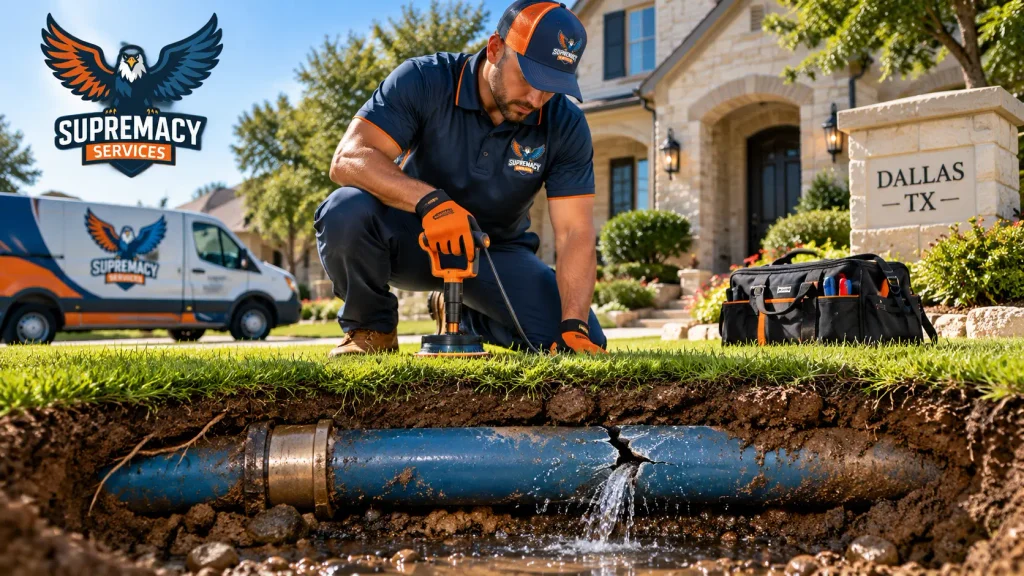
Not every leaking water line needs complete replacement.
Water Line Repair May Be Appropriate When:
The damage is isolated, the remaining pipe is structurally sound, there is a clearly identifiable leak, and the line hasn’t experienced repeated failures.
Water Line Replacement May Make More Sense When:
The pipe is severely deteriorated, corrosion affects substantial sections, there are multiple leaks, previous repairs keep failing, or the overall condition makes another localized repair poor long-term value.
Supremacy Services offers traditional replacement as well as trenchless options where site and pipe conditions allow. Its current water-line service describes pipe bursting and slip lining among the methods available for qualifying situations.
Can a Water Line Be Repaired Without Digging Up the Entire Yard?
In some situations, yes.
Modern trenchless technologies can significantly reduce excavation compared with conventional open-trench replacement.
Supremacy currently offers trenchless options including pipe bursting and slip lining where appropriate, along with traditional replacement and hydro-excavation when conditions require other approaches.
However, trenchless repair isn’t automatically suitable for every property.
The existing pipe’s condition, location, material and type of failure must first be evaluated.
Why You Shouldn’t Ignore a Suspected Water Line Leak
Waiting for an underground leak to become obvious can be expensive.
An unresolved leak can continue wasting treated water and may contribute to:
higher utility bills → saturated soil → landscaping damage → moisture problems → increasingly extensive repairs
The EPA reports that household leaks collectively waste nearly 1 trillion gallons of water annually nationwide, demonstrating how significant apparently small plumbing leaks can become.
Early detection is usually preferable to waiting for a complete pipe failure.
How Supremacy Services Diagnoses Water Line Problems in Dallas
Guessing where an underground pipe is leaking can lead to unnecessary excavation.
Supremacy’s water-line service describes a diagnostic process that includes pressure testing and leak location, while its dedicated leak-detection service uses non-invasive technologies such as acoustic detection and infrared thermography.
Once the source and condition of the pipe are understood, the technician can determine whether localized repair or a more extensive replacement is appropriate.
That diagnosis-first approach is especially valuable when a homeowner knows water is disappearing but can’t see where it’s going.
Why Choose Supremacy Services for Water Line Repair in Dallas?
Your main water line is fundamental to virtually every water-using fixture and appliance in your home.
Supremacy Services provides water-line repair and replacement throughout Dallas and the wider DFW area and currently offers traditional and trenchless solutions depending on property conditions.
The company’s water-line service highlights:
Advanced diagnostics to locate underground problems accurately.
Repair and replacement options based on actual pipe condition.
Trenchless solutions for qualifying water lines.
Upfront pricing before repair work begins.
Dallas/DFW service coverage for residential water-line problems.
Don’t Wait Until a Small Leak Becomes a Major Repair
If you’re experiencing unexplained high water consumption, low pressure, wet areas in your lawn or other warning signs, have the system professionally inspected.
Frequently Asked Questions About Water Line Repair in Dallas
How do I know if my main water line is leaking?
Common warning signs include unexplained increases in water consumption, low pressure throughout the house, continuously moving water-meter readings and persistent wet areas outdoors. A professional leak-detection test is the best way to identify the actual source.
Can I check for a water leak myself?
Yes. Turn off all water-consuming fixtures and appliances and record your water meter. Check it again after a period without water use. The EPA recommends a two-hour comparison; movement can indicate a leak.
Does low water pressure always mean my water line is broken?
No. Low pressure can have several causes. If pressure drops throughout the entire house, however, the main supply system should be investigated.
Should I repair or replace my water line?
Localized damage to an otherwise healthy pipe may only require repair. Multiple failures, widespread corrosion or significant deterioration may make replacement more sensible. Supremacy recommends making the decision based on the pipe’s condition and extent of damage.
Can Supremacy repair water lines without digging up my entire yard?
In qualifying situations, Supremacy offers trenchless techniques including pipe bursting and slip lining, although traditional excavation may still be necessary depending on the condition and configuration of the line.