

Hearing scratching inside the walls after dark? Finding small black droppings underneath the kitchen sink? Noticing food packages that suddenly have tiny holes in them?
These may be signs of rats or mice in your Dallas home, and the sooner you identify the problem, the easier it usually is to prevent rodents from becoming established inside attics, walls, garages, kitchens, and other hidden spaces.
Rats and mice are more than an unpleasant surprise. They can contaminate food and surfaces, damage insulation and stored belongings, and gnaw on building materials and electrical wiring. Texas A&M AgriLife notes that rats and mice can damage property by chewing wiring, pipes, hoses, doors, walls, flooring, furniture, and other materials.
The CDC also warns that wild rodents can carry diseases capable of spreading directly or indirectly to people, including through contact with urine, droppings, saliva, bites, or contaminated materials.
The challenge is that you may have rodents before you ever see one.
Here are the warning signs Dallas homeowners should know—and what to do when they appear.
1. Rat or Mouse Droppings Around Your Home
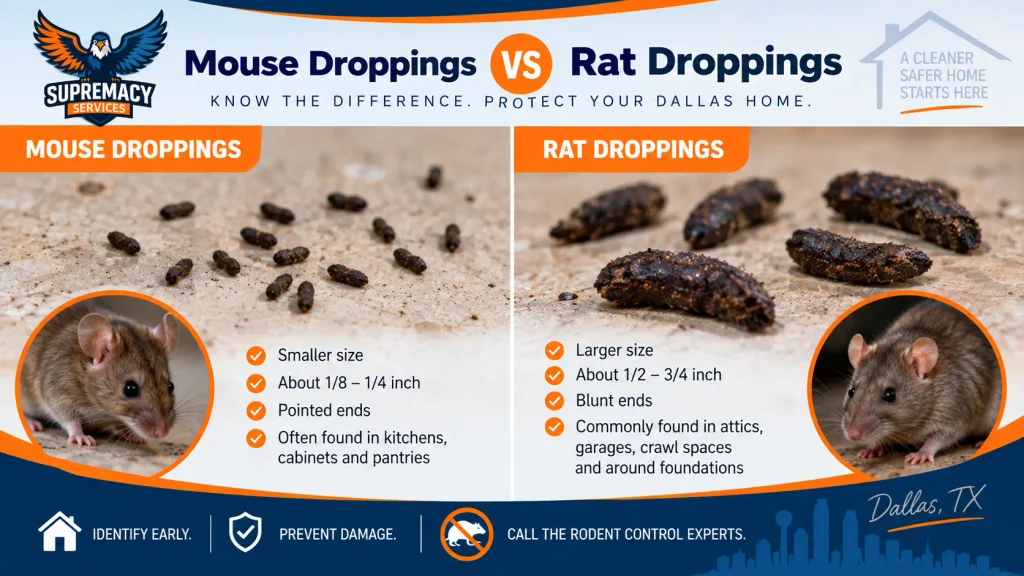
Droppings are among the most recognizable signs of rodent activity.
Check areas such as:
- Kitchen cabinets and drawers
- Under sinks
- Behind refrigerators and stoves
- Pantries
- Garages
- Attics
- Utility rooms
- Storage areas
- Along walls and baseboards
The EPA specifically identifies droppings around food packages, cupboards, drawers and underneath sinks as common evidence of rodent infestation.
Mouse Droppings vs. Rat Droppings
Mouse droppings are generally much smaller than rat droppings. Rat droppings are larger and can indicate that a substantially larger rodent is moving through the structure.
Avoid relying on size alone to identify the species. Dropping location, tracks, nesting areas, gnaw marks and other evidence can help determine whether you are dealing with mice, roof rats or Norway rats.
Texas A&M identifies the house mouse, roof rat and Norway rat as three important rodents associated with human structures.
Important: Never casually sweep or vacuum dry rodent droppings. CDC cleanup guidance recommends wetting contaminated material with an appropriate disinfectant before wiping it up because sweeping or vacuuming can cause contaminated particles to become airborne.
2. Scratching, Scurrying or Squeaking Inside Walls and Ceilings
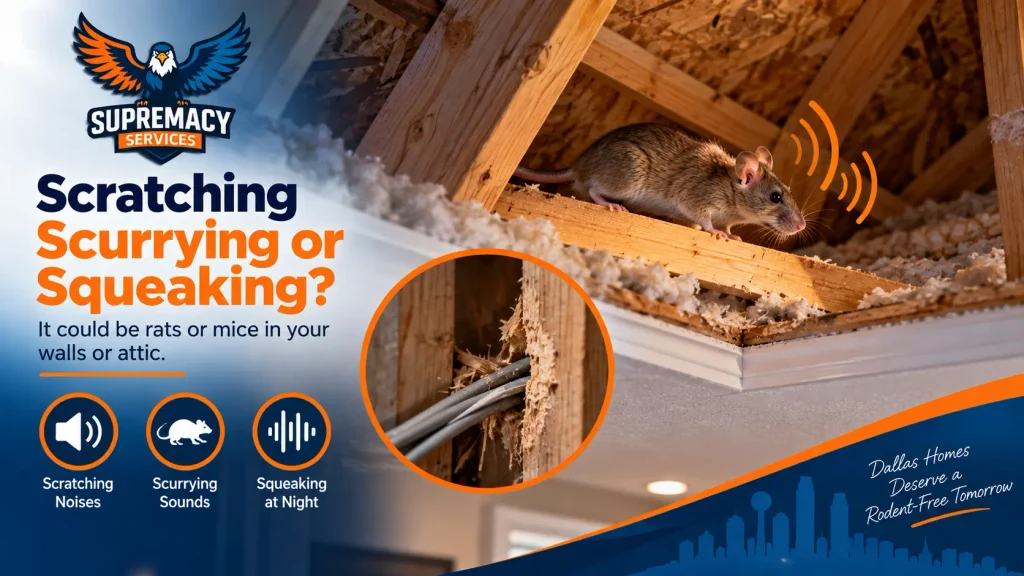
Your house becomes quiet at night.
Rodents become active.
That is why one of the first indications of an infestation may be a scratching, running or scurrying sound coming from somewhere you cannot see.
Listen around:
- Attic ceilings
- Interior walls
- Behind kitchen cabinets
- Above garages
- Crawlspaces
- Storage rooms
- HVAC or utility penetrations
Texas A&M notes that rodent activity increases after dark and identifies running and squealing noises among the indicators homeowners can use when investigating an infestation.
Repeated nighttime noises should therefore not automatically be dismissed as the house “settling.”
Is It a Rodent or a Larger Animal?
Heavy thumping, loud movement or significant disturbance in an attic could potentially involve a larger wildlife species rather than mice.
Supremacy also provides wildlife trapping and removal in Dallas for animals such as raccoons, squirrels, opossums and skunks.
3. Gnaw Marks on Wood, Food Packaging or Wiring

Rodents gnaw constantly.
You may discover damage on:
- Cardboard food boxes
- Plastic containers
- Wooden trim
- Cabinets
- Attic materials
- Stored belongings
- Pipes
- Electrical wiring
- Wall penetrations
The CDC identifies gnaw marks as one of the primary signs of rodent activity.
Electrical damage deserves particular attention. Texas A&M specifically warns that rodents can damage property by chewing electrical wiring and notes that such damage can contribute to fires.
If you discover damaged electrical wiring, avoid treating it solely as a pest-control problem. The rodent infestation must be addressed, but compromised wiring may also require inspection and repair by a qualified electrical professional.
4. Shredded Paper, Fabric or Insulation
Mice and rats need protected nesting locations.
Materials around the home can become convenient nesting material, including:
- Paper
- Cardboard
- Fabric
- Insulation
- Packing materials
- Dried vegetation
- Soft stored materials
The EPA specifically lists shredded paper, fabric and dried plant matter among the nesting materials that can indicate rodents are present.
Finding shredded material by itself does not always confirm an active infestation. Finding it alongside droppings, gnawing, odors or nighttime sounds makes rodent activity considerably more suspicious.
5. Greasy Rub Marks Along Walls and Rafters
Rodents often follow established routes instead of wandering randomly through open rooms.
Over time, repeated movement can leave visible smears along surfaces.
Texas A&M describes greasy smears where rodent bodies repeatedly contact walls or rafters as one of the signs used to identify rat and mouse activity.
Look closely along:
- Baseboards
- Wall edges
- Attic rafters
- Pipes
- Garage walls
- Structural edges
A frequently used pathway may also contain droppings or nearby gnaw marks.
6. A Persistent Musty or Stale Odor
A strange odor that cannot be explained by plumbing, garbage, moisture or spoiled food can sometimes originate from rodents.
Urine, nesting material and accumulated contamination can create persistent odors, especially in enclosed spaces.
The EPA identifies stale smells coming from hidden areas as another potential sign of rodent infestation.
Pay attention when the odor seems strongest around a particular:
- Cabinet
- Wall
- Attic section
- Pantry
- Garage corner
- Storage area
A strong odor combined with droppings or scratching noises warrants further inspection.
7. Chewed or Contaminated Food
Rodents are attracted to accessible food.
Watch for:
- Small holes in food packaging
- Torn pet-food bags
- Scattered crumbs
- Gnawed cardboard boxes
- Damaged grain containers
- Food debris appearing overnight
Rodents can both consume and contaminate human and animal food.
Discard food that may have been contaminated rather than simply removing the damaged portion.
Store dry food and pet food in durable containers with secure lids, and promptly clean spills and crumbs.
8. Rodent Tracks, Runways or Burrows
Sometimes the best evidence is not the rodent itself but the path it repeatedly follows.
Texas A&M lists tracks, runways and burrows among the clues used to identify infestations.
Outside your Dallas home, inspect areas around:
- Foundations
- Garages
- Storage sheds
- Dense landscaping
- Trash areas
- Fences
- Utility penetrations
Indoors, look for repeated movement patterns along walls and behind appliances.
Norway rats are particularly associated with burrowing, while roof rats are more likely to occupy elevated spaces such as walls and attics.
9. Your Pets Suddenly Become Interested in One Wall or Cabinet
Dogs and cats may notice movement, scent or sound before homeowners do.
You might see a pet repeatedly:
- Staring at a wall
- Pawing underneath an appliance
- Sniffing a cabinet
- Watching the ceiling
- Becoming unusually alert at night
Pet behavior alone does not prove that rats or mice are present.
But when the behaviour repeatedly occurs in the same area and is accompanied by droppings, gnawing, scratching or nesting material, inspect the location carefully.
10. Seeing a Live or Dead Rat or Mouse
Finally, you may actually see the animal.
A single sighting deserves investigation because the rodent had to enter the structure somehow.
Finding and removing one mouse without identifying its entry route can leave the underlying problem unresolved.
That is why effective rodent control in Dallas should focus on two separate questions:
How do we remove the rodents already inside?
and
How did they enter in the first place?
Supremacy’s [Rodent Control & Exclusion service] addresses both sides of the problem through targeted removal followed by exterior exclusion of gaps, vents, roofline openings and other potential access points.
Rats vs. Mice: What Is in Your Dallas Home?

Knowing what you are dealing with can help determine where to inspect and how to control the infestation.
House Mice
House mice are small rodents that can nest in surprisingly confined locations. Texas A&M notes that mouse nests may occur underneath stored materials, inside upholstered furniture and even in cabinet drawers.
Roof Rats
Roof rats are agile climbers.
Texas A&M notes that they commonly nest in walls and attics rather than underground.
For Dallas homeowners hearing repeated movement above ceilings or around attic spaces, roof-level entry points should therefore be part of the inspection.
Norway Rats
Norway rats are larger, heavier-bodied rodents and are more strongly associated with ground-level activity and burrowing.
Texas A&M reports that Norway rats commonly burrow underneath foundations, floors and stored materials.
A professional inspection can use droppings, tracks, nesting areas, gnawing, runways and structural entry points to help determine what is actually present.
Why Rats and Mice Enter Dallas Homes
Rodents are primarily looking for three things:
Food. Water. Shelter.
A house can provide all three.
Common attractants include:
- Pet food left accessible overnight
- Open garbage containers
- Bird seed
- Pantry spills
- Standing water
- Clutter
- Dense vegetation
- Stored cardboard
- Accessible attic spaces
- Gaps around utility lines
- Openings around doors and garages
The CDC recommends reducing food, water and shelter as fundamental parts of rodent prevention.
Where Are Rats and Mice Getting Into Your House?
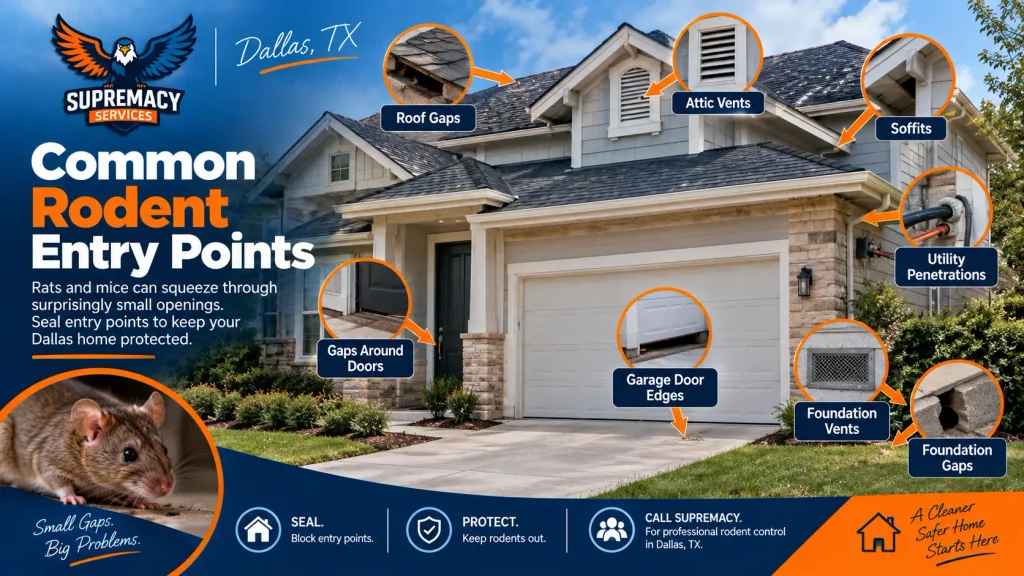
This is the question homeowners often miss.
Catching rodents without correcting their access points can leave the house vulnerable to another infestation.
Potential entry areas include:
- Foundation gaps
- Garage-door edges
- Roofline gaps
- Soffits
- Roof vents
- Plumbing penetrations
- Utility penetrations
- Damaged screens
- Gaps around doors
- Openings into attic spaces
Supremacy’s rodent-control process includes inspection of rooflines, chimney areas, foundation vents, garage doors and attic spaces to locate potential entry and nesting locations.
How to Get Rid of Rats and Mice in Your Dallas Home
Successful rodent control is not simply about putting down a trap.
A comprehensive strategy combines inspection, removal, sanitation, food-source reduction and exclusion.
Step 1: Inspect the Entire Property
Determine:
- What type of rodent is present?
- Where is activity concentrated?
- Where are they nesting?
- What are they eating?
- How are they entering?
- Is there contamination or property damage?
Inspect from the foundation to the roofline—not only the room where droppings were discovered.
Step 2: Remove Accessible Food and Water
Keep food sealed.
Clean crumbs and spills promptly.
Store pet food securely.
Use garbage cans with tight-fitting lids.
Eliminate unnecessary standing water.
Both the CDC and EPA emphasize removing food, water and shelter as central components of rodent prevention.
Step 3: Use Appropriate Trapping
For homeowners attempting limited DIY control, CDC guidance recommends traditional snap traps and advises placing traps along walls and in areas showing rodent activity. Different traps are designed for rats and mice.
Always keep traps and baits inaccessible to children and pets.
The CDC also advises against glue traps and live traps in its household rodent-control guidance.
Step 4: Seal Rodent Entry Points
This is rodent exclusion, and it is one of the most important steps for long-term prevention.
Texas A&M recommends rodent-proofing and describes sealing openings with rodent-resistant materials such as metal, hardware cloth or other durable materials.
Supremacy’s [Dallas Rodent Control & Exclusion] service similarly focuses on sealing exterior gaps using steel mesh, metal materials and structural sealants after addressing active rodents.

Step 5: Clean Contaminated Areas Safely
Rodent cleanup needs to be handled differently from ordinary dust and dirt.
Do not sweep or vacuum dry droppings.
- Wearing rubber or plastic gloves.
- Thoroughly wetting droppings and urine with an appropriate disinfectant.
- Allowing the disinfectant to work according to its directions.
- Wiping contaminated material up with paper towels.
- Disinfecting surrounding hard surfaces.
- Washing hands after removing gloves.
Heavy infestations can require additional precautions.
Why Killing Rodents Alone May Not Solve the Problem
This distinction is important.
Rodent removal solves:
The animals currently inside.
Rodent exclusion solves:
How rodents keep entering.
A home with accessible roof gaps, utility penetrations or foundation openings remains vulnerable even after the current rodents are removed.
That is why Supremacy describes its rodent service as a two-stage approach: removing active rodents and then sealing exterior entry points to reduce the chance of another invasion.
When Should You Call a Dallas Rodent-Control Professional?
Professional inspection becomes particularly valuable when:
- Droppings keep returning
- You hear repeated attic or wall activity
- Multiple rooms show evidence
- You find damaged electrical wiring
- You cannot identify the entry point
- Rodents continue despite trapping
- Contamination is extensive
- Activity occurs in inaccessible walls or attic spaces
- You suspect multiple rodents
- The infestation keeps returning
A recurring infestation usually requires more than repeatedly replacing traps.
The objective should be to determine why the property continues supporting rodent activity.
How to Prevent Rats and Mice From Coming Back

Once the infestation is controlled, make your property less attractive and less accessible.
Seal exterior openings
Inspect around utility penetrations, rooflines, vents, doors and foundations.
Secure food
Use durable containers for pantry goods and pet food.
Control garbage
Keep trash containers closed and clean.
Reduce outdoor shelter
Remove unnecessary clutter, leaf piles and excessive nesting material around the structure.
Maintain vegetation
Avoid creating dense, protected pathways directly against the house.
Monitor previously active areas
Continue checking attics, garages, cabinets and utility areas for fresh droppings or gnawing.
The EPA similarly recommends preventing rodent access, eliminating nesting locations, and controlling food and water sources.
Dallas Rodent Control: Remove Them—and Close the Door Behind Them
Rats and mice are excellent at remaining hidden.
That means droppings, scratching sounds, gnaw marks, damaged food packages, nesting material, odors, rub marks and tracks may tell you there is a problem long before you see an actual rodent.
Ignoring those warning signs can give an infestation additional time to spread through attics, walls and storage areas.
If you suspect rats or mice have moved into your Dallas-area home, start by determining where they are active and how they are entering.
For an established or recurring problem, Supremacy Services offers professional Rodent Control & Exclusion in DFW, combining targeted rodent removal with structural exclusion designed to close potential entry points.
Frequently Asked Questions
What are the first signs of rats or mice in a house?
Droppings, gnaw marks, scratching noises, damaged food packages, nesting material, tracks and unusual odors are common early indicators. The CDC specifically identifies droppings and gnaw marks as important evidence of rodent activity.
Why do I hear scratching in my walls at night?
Rats and mice are often more active after dark. Repeated nighttime scratching or scurrying can indicate rodents moving through wall cavities, ceilings or attic spaces, although other wildlife can produce similar sounds.
Should I vacuum mouse droppings?
No. CDC guidance says not to vacuum or sweep rodent urine, droppings or nesting materials because doing so can send contaminated particles into the air. Wet contaminated material thoroughly with an appropriate disinfectant and follow CDC cleanup procedures.
Will traps permanently solve a mouse problem?
Traps can remove rodents already inside, but they do not automatically prevent additional rodents from entering. Long-term control also involves identifying and sealing access points and reducing food, water and shelter.
What is rodent exclusion?
Rodent exclusion is the process of identifying and physically sealing openings that rats and mice use to enter a structure. Supremacy’s rodent service combines removal with exterior sealing using rodent-resistant materials.
Should I call pest control if I see only one mouse?
One sighting is enough to justify inspecting the property. Even if only one animal is present, determining how it entered can help prevent additional rodents from using the same opening.

