
Perimeter pest control cost in Dallas depends on the size of your home, the pests being targeted, the severity of activity around the property, the type of treatment required and whether you choose a one-time service or an ongoing pest-prevention plan.
For Dallas homeowners, the important question is not simply, “How much does pest control cost?” It is also what the service includes, how long the protection is expected to last and whether the treatment addresses the conditions allowing pests to reach the home in the first place.
A professional perimeter pest control service is designed to create a defensive treatment zone around the exterior of a property, targeting common entry areas before ants, cockroaches, spiders and other crawling pests establish themselves indoors.
That prevention-first approach is consistent with Integrated Pest Management (IPM). The U.S. Environmental Protection Agency describes IPM as combining monitoring, prevention and appropriate control methods rather than relying on pesticide application alone.
For Dallas-area homeowners comparing their options, this guide explains what influences perimeter pest control pricing, what professional service should include, when recurring protection may make sense and how to determine whether you are receiving good value.
How Much Does Perimeter Pest Control Cost in Dallas?
There is no single price that accurately represents every Dallas property.
As a general market reference, current third-party pricing data from Angi reports that pest control in Dallas averages approximately $152, with many general pest-control jobs falling around $88 to $216. More complicated infestations and specialized services can cost substantially more.
Those figures should be treated as a general Dallas pest-control benchmark rather than a quote for perimeter pest control specifically.
Your actual price can vary according to:
- property and foundation size;
- type of pest being controlled;
- severity of existing pest activity;
- number of exterior entry points;
- treatment products and methods;
- whether interior treatment is also required;
- landscaping and environmental conditions;
- one-time versus recurring service;
- follow-up or re-treatment coverage; and
- specialized services needed in addition to general perimeter protection.
A smaller Dallas home with routine preventive service will typically require a different treatment plan than a large property with heavy vegetation, numerous exterior penetrations and established cockroach or ant activity.
For that reason, homeowners should compare scope of service, not simply the lowest advertised price.
What Is Perimeter Pest Control?
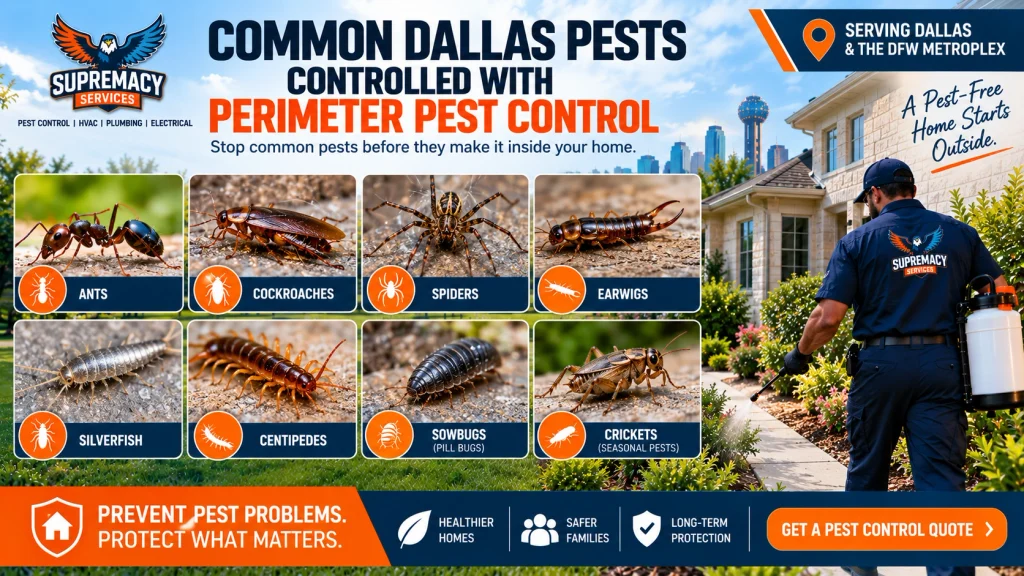
Perimeter pest control focuses primarily on the exterior of your home.
Instead of waiting for pests to become established inside, treatment is concentrated around the areas they commonly use to approach or enter a structure.
Depending on the property and pest problem, that may include areas around:
- the foundation;
- doors and thresholds;
- windows;
- utility penetrations;
- plumbing penetrations;
- cracks and crevices;
- weep holes;
- garages;
- patios;
- exterior walls;
- eaves;
- landscaping adjacent to the structure; and
- other identified pest-entry points.
The goal is to reduce pest pressure before outdoor pests become indoor infestations.
This approach closely follows the EPA’s broader pest-prevention guidance. The agency recommends reducing access to food, water and shelter and closing potential pest entryways as important parts of household pest management.
For homeowners dealing with recurring pest pressure, learn more about professional pest control services in Dallas and the DFW Metroplex and the exterior protection options available through Supremacy Services.
Why Perimeter Pest Control Makes Sense in Dallas
Dallas-area properties can experience pest activity during much of the year.
Warm periods encourage insect activity, while weather changes, moisture conditions and available shelter can push pests toward homes.
A house can also provide exactly what many pests need:
food + moisture + shelter + protected entry points.
That is why effective pest management should extend beyond spraying insects after they appear.
The EPA’s Integrated Pest Management principles emphasize identification, monitoring, prevention and appropriate control. Preventing pests from becoming established is considered a first line of defense.
For Dallas homeowners, perimeter protection can therefore serve as one layer of a broader pest-management strategy.
What Affects Perimeter Pest Control Cost in Dallas?
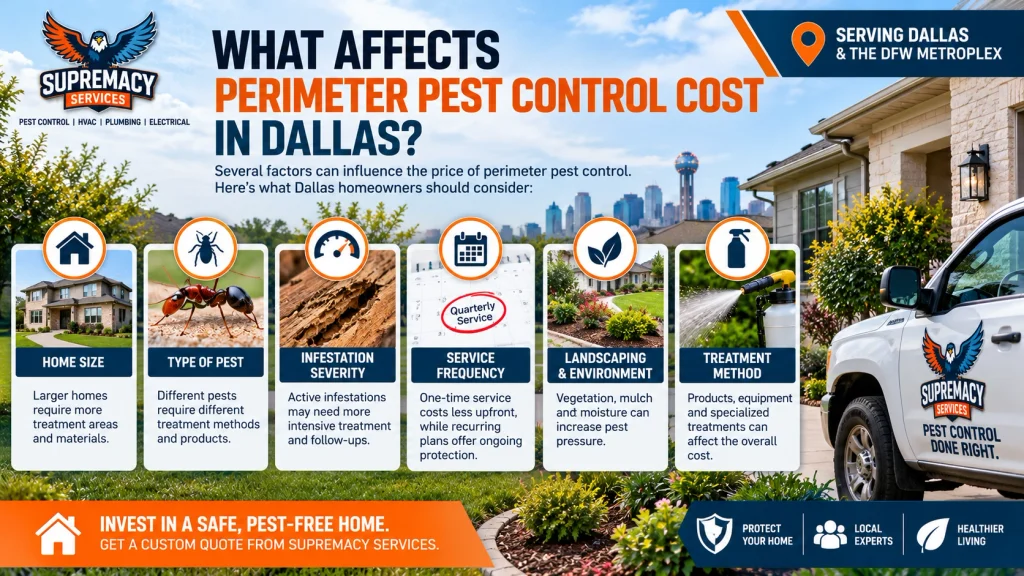
1. Size and Perimeter of Your Home
A larger structure generally has more exterior surface area to inspect and protect.
The technician may need to treat additional foundation length, doorways, utility penetrations, landscaping interfaces and other vulnerable areas.
A compact home and a large multi-story property should therefore not automatically be expected to carry identical treatment requirements.
2. Type of Pest
Different pests behave differently.
General perimeter protection may be appropriate for common crawling insects such as:
- ants;
- cockroaches;
- spiders;
- earwigs;
- silverfish;
- centipedes; and
- certain other seasonal invaders.
But specialized problems may require different methods.
Termites, rodents, mosquitoes, bed bugs and wildlife, for example, should not automatically be treated as interchangeable with routine perimeter insects.
If scratching, droppings or gnawing indicate mice or rats rather than insects, see Supremacy’s rodent control and exclusion services instead of relying solely on general perimeter treatment.
3. Existing Infestation vs. Preventive Treatment
Prevention and active infestation control are different jobs.
A home with minimal activity may primarily need:
inspection → prevention → targeted exterior treatment → monitoring.
A property with established indoor pest activity may require:
inspection → pest identification → source identification → interior and/or exterior treatment → follow-up → prevention.
More extensive pest activity can therefore increase the amount of labor, materials and follow-up required.
4. One-Time vs. Recurring Pest Control
One-time service can make sense when dealing with an isolated problem.
However, properties that experience recurring pest pressure may benefit from scheduled exterior service.
Supremacy’s current pest-control program describes quarterly perimeter re-applications as part of its exterior protection approach.
Recurring service should not simply mean automatically spraying the same areas indefinitely. A quality pest-management program should continue to monitor pest activity and adjust treatment according to what is actually happening around the property.
5. Landscaping Around the Home
Landscaping can substantially affect pest pressure.
Dense vegetation touching exterior walls, accumulated leaves, standing moisture and sheltered areas near the foundation can create favorable conditions for insects.
Reducing those conditions can improve the effectiveness of a perimeter pest-management program.
6. Entry Points and Structural Conditions
Pests do not need an open front door.
Potential entry routes can exist around:
- utility lines;
- plumbing penetrations;
- damaged weather stripping;
- foundation gaps;
- vents;
- door frames;
- windows; and
- other structural openings.
A comprehensive inspection helps identify these vulnerabilities.
The EPA specifically recommends closing pest entry points as part of household pest prevention rather than depending solely on pesticide treatments.
What Should Professional Perimeter Pest Control Include?
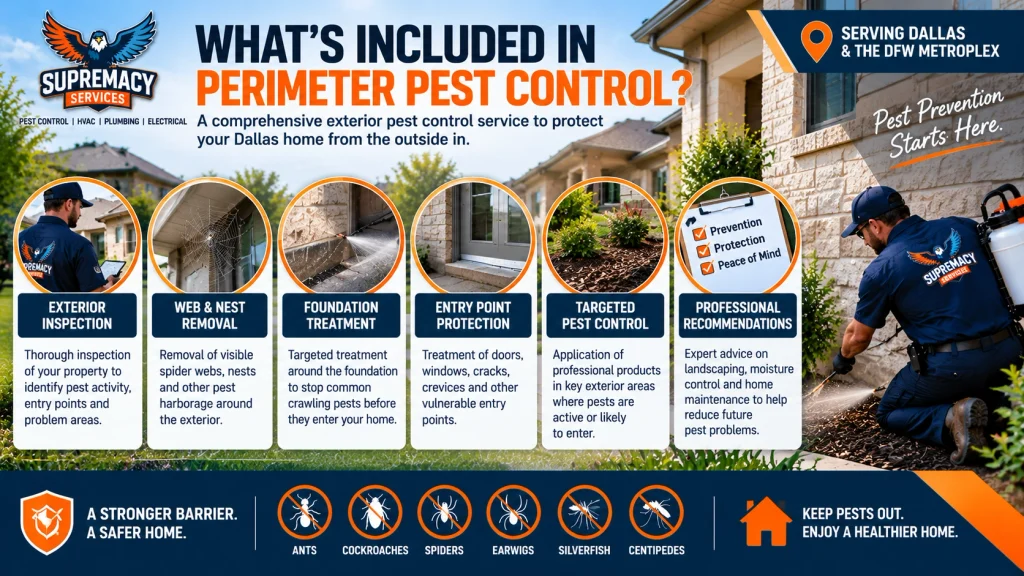
Price becomes much easier to evaluate when homeowners understand what they are purchasing.
A professional service should begin with inspection and identification.
Exterior Inspection
The technician should assess where pests are active, where they may be entering and which environmental conditions are encouraging them.
Pest Identification
Correct identification matters.
An ant problem, cockroach problem, termite problem and rodent problem should not receive exactly the same response.
EPA Integrated Pest Management guidance emphasizes accurate monitoring and identification so unnecessary or inappropriate pesticide use can be avoided.
Web and Nest Removal Where Appropriate
Spider webs, accessible nests and other exterior pest evidence may need physical removal as part of service.
Targeted Exterior Treatment
Treatment can then focus on areas where pest activity and entry risk justify it rather than indiscriminately treating every surface.
Entry-Point Assessment
A strong pest-management program should identify structural gaps and other openings that allow pests to enter.
Homeowner Recommendations
Sometimes the most valuable recommendation has nothing to do with adding more pesticide.
You may be advised to:
- repair a leak;
- remove standing water;
- trim vegetation;
- move firewood;
- seal an opening;
- improve food storage;
- remove debris; or
- correct a moisture problem.
These preventive measures align with EPA recommendations for reducing pests’ access to food, water and shelter.
Perimeter Pest Control vs. Indoor Pest Control
Perimeter treatment and indoor treatment solve related but different problems.
Perimeter pest control concentrates on intercepting pests around the exterior and reducing the likelihood that they enter.
Indoor pest control addresses pest activity that has already reached interior areas.
For preventive maintenance, an exterior-first strategy can reduce the need for unnecessary indoor applications.
But if cockroaches, ants or other pests are already established indoors, an exterior barrier by itself may not solve the entire infestation.
The treatment should match the pest and the conditions found during inspection.
Is Quarterly Pest Control Worth It in Dallas?
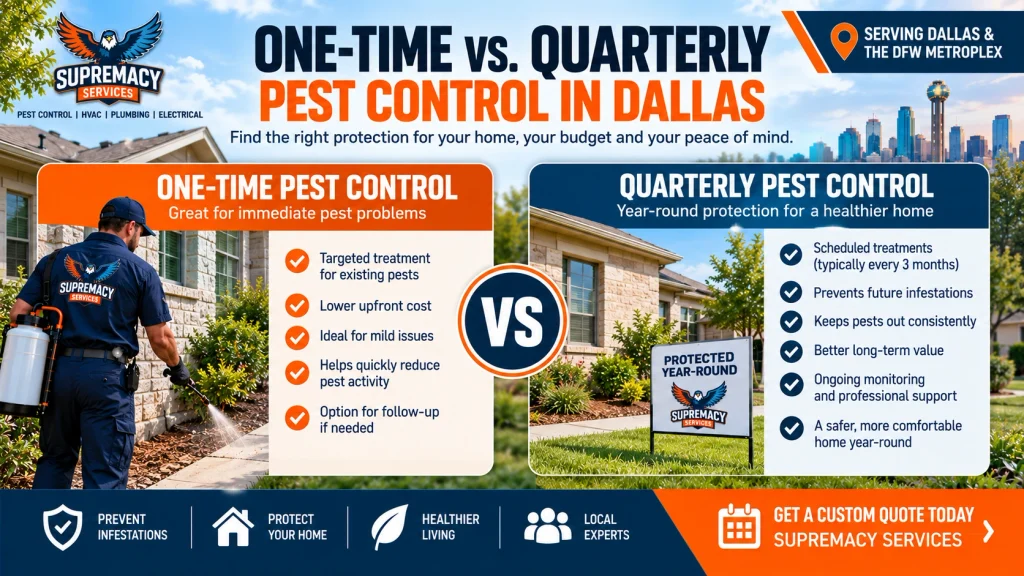
For homes experiencing repeated pest pressure, quarterly service can provide several advantages.
It allows a professional to:
- monitor changing pest activity;
- refresh appropriate exterior treatments;
- identify new entry points;
- detect conditions encouraging pests;
- address seasonal changes; and
- intervene before minor activity becomes a larger indoor infestation.
The value depends on the property.
A home with persistent ant, roach and spider activity may benefit more from recurring prevention than a property experiencing a single isolated pest incident.
The better question is therefore:
“Does my property have enough recurring pest pressure to justify ongoing preventive service?”
A professional inspection can help answer that.
Is Perimeter Pest Control Safe for Children and Pets?
Pesticide safety depends on the product, application method and adherence to its label.
The EPA advises consumers to use pesticides properly, keep children and pets away from treated areas as directed and always follow product-label instructions.
Professional application does not eliminate the importance of pesticide safety.
Texas also regulates structural pest-control businesses and professionals. The Texas Department of Agriculture Structural Pest Control Service licenses and regulates professionals who perform pest-control work in and around structures.
Homeowners hiring a company should verify appropriate licensing and ask what products are being used, where they will be applied and what precautions are required.
DIY Perimeter Pest Control vs. Professional Service
DIY pest-control products can be useful for limited problems, but purchasing a container of pesticide is not equivalent to a professional pest-management plan.
The largest difference is often diagnosis.
A homeowner may see insects near a door and treat the visible area.
A trained technician should be looking for:
What pest is this?
Where is it coming from?
Why is it here?
Where is it entering?
What conditions are supporting it?
What is the least disruptive effective control?
The EPA explicitly recommends learning about the pest and trying preventive measures first. It also cautions against assuming that applying more pesticide produces better results.
Professional service becomes especially valuable when:
- the pest cannot be identified;
- activity keeps returning;
- pests are established indoors;
- multiple areas of the home are affected;
- children or pets complicate treatment decisions;
- the infestation requires specialized products or equipment; or
- structural exclusion is required.
When Perimeter Pest Control Is Not Enough
Perimeter pest control is powerful, but it is not the correct standalone solution for every pest.
Rodents
Mice and rats generally require trapping plus exclusion of structural openings.
See Rodent Control & Exclusion in DFW.
Termites
Termites require specialized inspection, monitoring and treatment strategies.
Learn about Termite Vault Security in Dallas.
Mosquitoes
Mosquito management requires attention to breeding sites, standing water and outdoor resting areas.
See Mosquito Barrier Misting in Dallas.
Fleas and Ticks
Outdoor flea and tick pressure may require treatment of lawns, shaded areas and other locations where these parasites develop.
See Flea & Tick Defense in DFW.
The best pest-control strategy is the one designed around the pest actually present.
How to Lower Pest-Control Costs Over Time
Prevention can help reduce the conditions that allow infestations to become established.
Homeowners can:
Seal Pest Entry Points
Inspect openings around pipes, doors, windows, utility penetrations and other exterior gaps.
Eliminate Standing Water
Repair leaks and remove unnecessary water sources.
Keep Vegetation Away From the Structure
Trim shrubs and branches that contact exterior walls or the roof.
Store Food Properly
Use sealed containers and clean food residue promptly.
Manage Garbage
Use closed containers and avoid leaving food waste accessible.
Reduce Clutter
Cardboard, debris and other clutter can provide shelter for pests.
These practices closely follow EPA recommendations to remove pest access to food, water and shelter.
How to Choose a Perimeter Pest Control Company in Dallas
Price matters, but homeowners should evaluate more than the quote.
Ask:
Is the company licensed to perform structural pest control in Texas?
The Texas Department of Agriculture states that businesses performing structural pest-control services require appropriate licensing.
Does the company inspect before treating?
Treatment should follow identification rather than guesswork.
What pests are included?
Ask specifically which pests the plan covers and which require separate services.
What does the quoted price include?
Clarify inspection, exterior treatment, interior treatment when needed, follow-up and re-service policies.
What happens if pests return?
Understand the terms of any re-treatment or service guarantee.
What products will be used?
A professional should be able to explain the treatment and relevant safety instructions.
Does the company address prevention?
A good pest-management program should look beyond simply killing the insects visible today.
Why Dallas Homeowners Should Think in Terms of Prevention, Not Just Extermination
The most effective long-term pest-control strategy is often the one that makes the property less attractive and accessible to pests.
That means combining:
inspection + identification + exclusion + sanitation + moisture management + targeted treatment + monitoring.
That is fundamentally different from repeatedly spraying visible insects without determining why they are there.
The EPA defines Integrated Pest Management as an approach using pest information and multiple appropriate control methods to manage problems economically while reducing unnecessary risks to people, property and the environment.
For homeowners, that translates into a simple principle:
Stop the conditions that support pests while controlling the pests that are already present.
Get a Perimeter Pest Control Quote in Dallas
So, how much should you expect to pay for perimeter pest control in Dallas?
The answer depends on your home.
Property size, pest species, existing activity, landscaping, treatment requirements and service frequency all affect the final price.
Rather than choosing a pest-control company based solely on the cheapest advertised number, compare:
what is inspected, what is treated, which pests are covered, how recurrence is handled and what preventive measures are included.
Supremacy Services provides pest-control solutions across Dallas and surrounding DFW communities, including exterior perimeter protection designed to stop common Texas household pests before they establish themselves inside.
Explore Supremacy Services Pest Control to learn about perimeter protection and request an assessment for your property.
Frequently Asked Questions About Perimeter Pest Control Cost in Dallas
How much does perimeter pest control cost in Dallas?
Pricing varies according to property size, pest type, infestation severity, treatment scope and service frequency. Current third-party Dallas market data places general pest-control services around $152 on average, with many jobs approximately $88–$216, but specialized or extensive treatments may cost significantly more. Homeowners should request a property-specific quote.
Is quarterly pest control worth it in Dallas?
It can be worthwhile for homes experiencing recurring pest pressure. Scheduled service allows the property to be monitored and exterior protection maintained rather than waiting for a new indoor infestation before responding.
What does perimeter pest control include?
Depending on the service plan, it can include exterior inspection, pest identification, removal of accessible webs or nests, targeted foundation and entry-point treatment, monitoring and recommendations for reducing pest-friendly conditions.
Does perimeter pest control keep bugs from coming inside?
That is its primary purpose, but no treatment can guarantee that every pest will always remain outdoors. Results depend on pest pressure, structural openings, moisture, sanitation, landscaping and the specific pest involved.
What pests does perimeter pest control target?
Common programs may target ants, cockroaches, spiders and other crawling or seasonal household pests. Termites, mosquitoes, rodents, bed bugs and wildlife often require specialized services.
Is exterior pest control better than spraying inside?
For preventive pest management, reducing pest pressure outside can limit the need for routine indoor applications. However, an established indoor infestation may still require targeted interior treatment.
How often should perimeter pest control be performed?
There is no universal schedule for every property. Treatment frequency should reflect pest pressure, products used, environmental conditions and professional monitoring. Supremacy’s current exterior program includes quarterly perimeter re-applications.
Should I hire a licensed pest-control company in Texas?
Yes. Texas regulates structural pest-control businesses and professionals. Homeowners can use the Texas Department of Agriculture’s Structural Pest Control Service resources to learn about licensing and consumer protections.

