10400 Clarence Drive, Frisco, TX 75033
Support 24/7: 945-777-3345
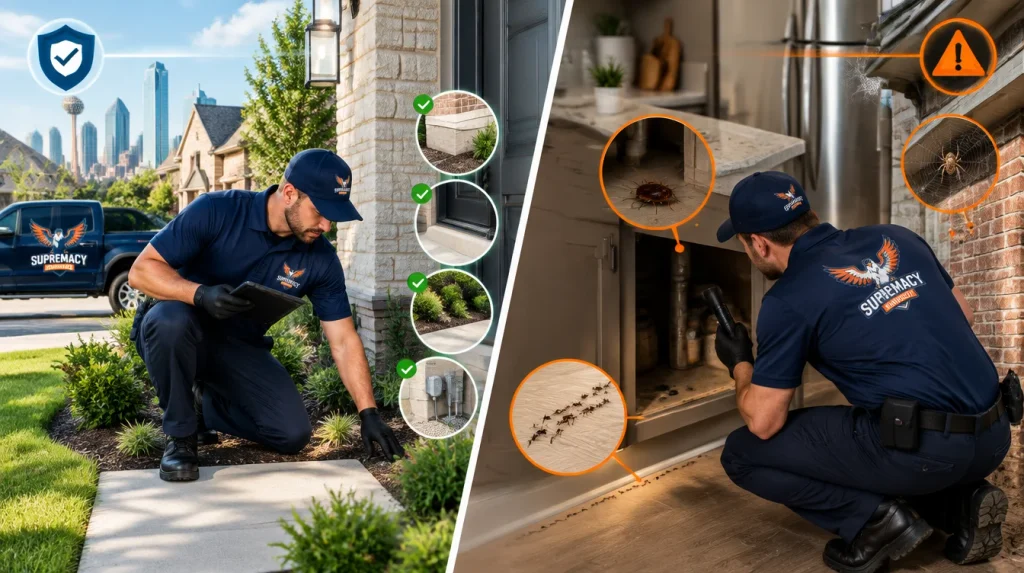
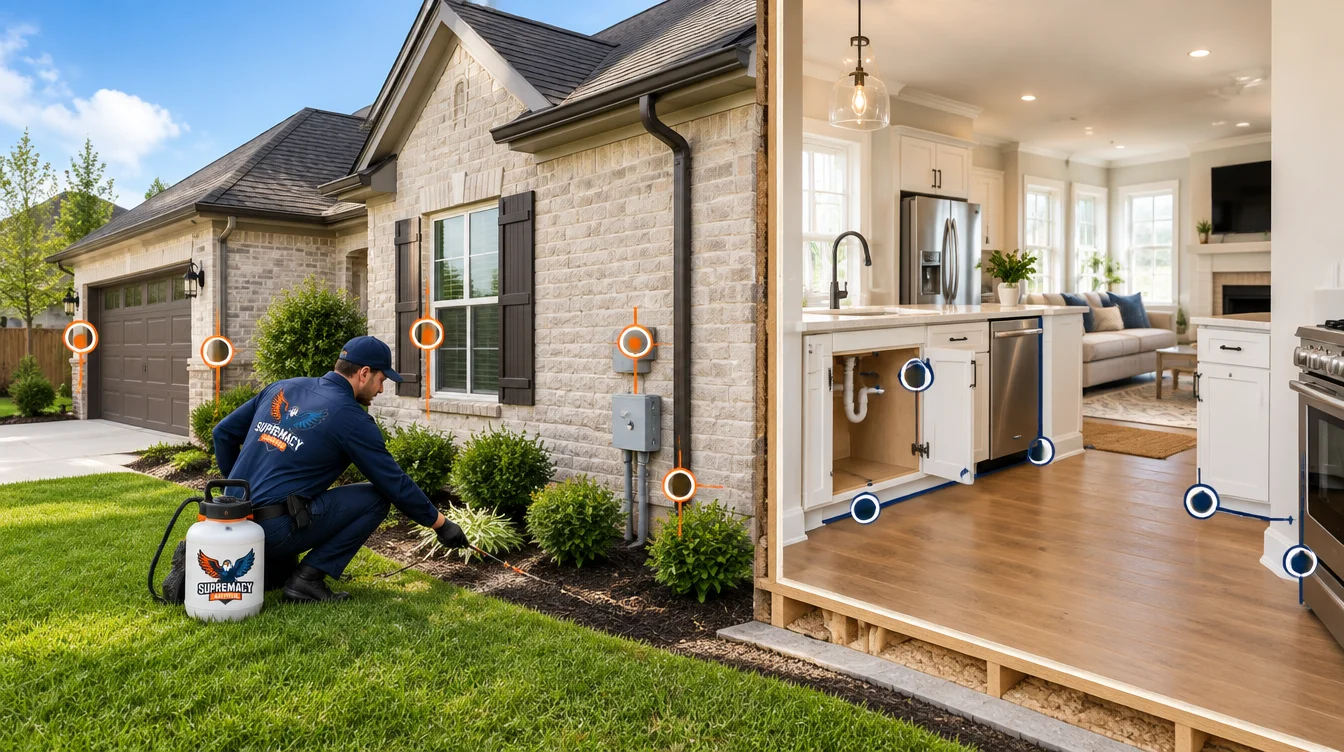
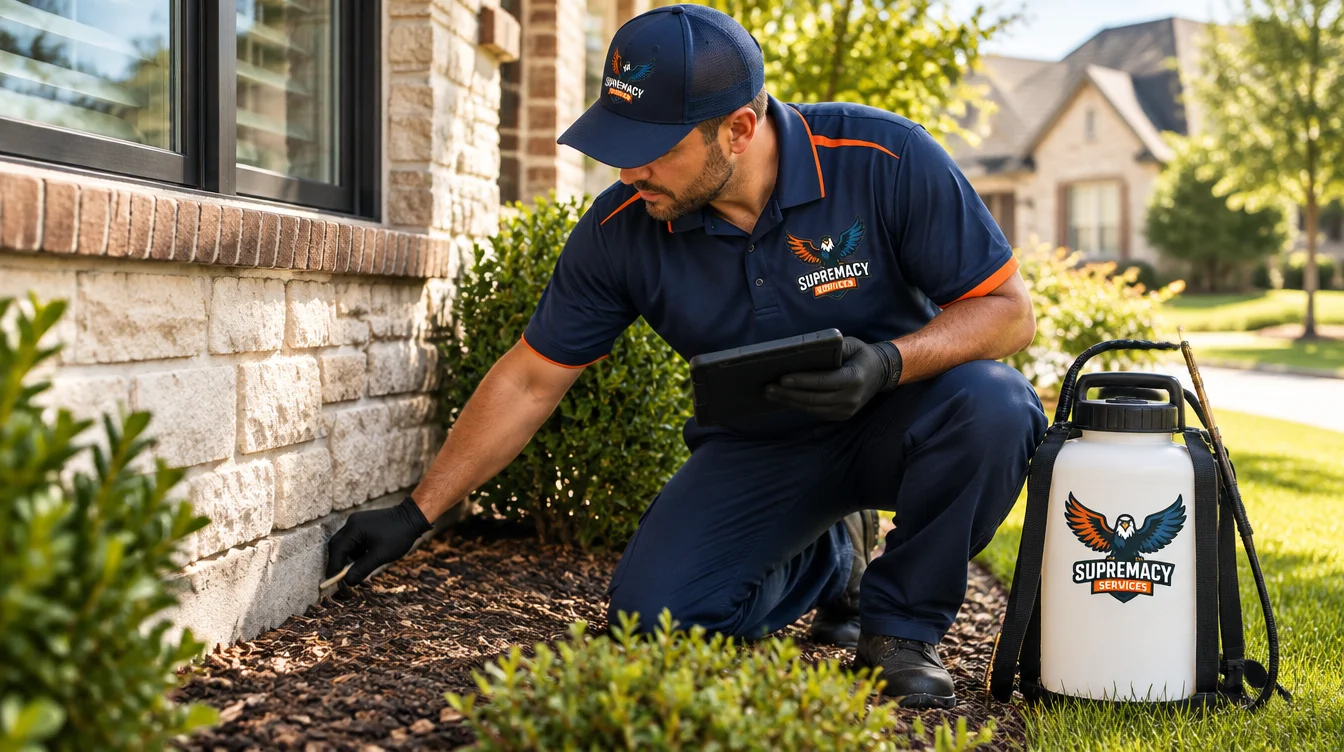
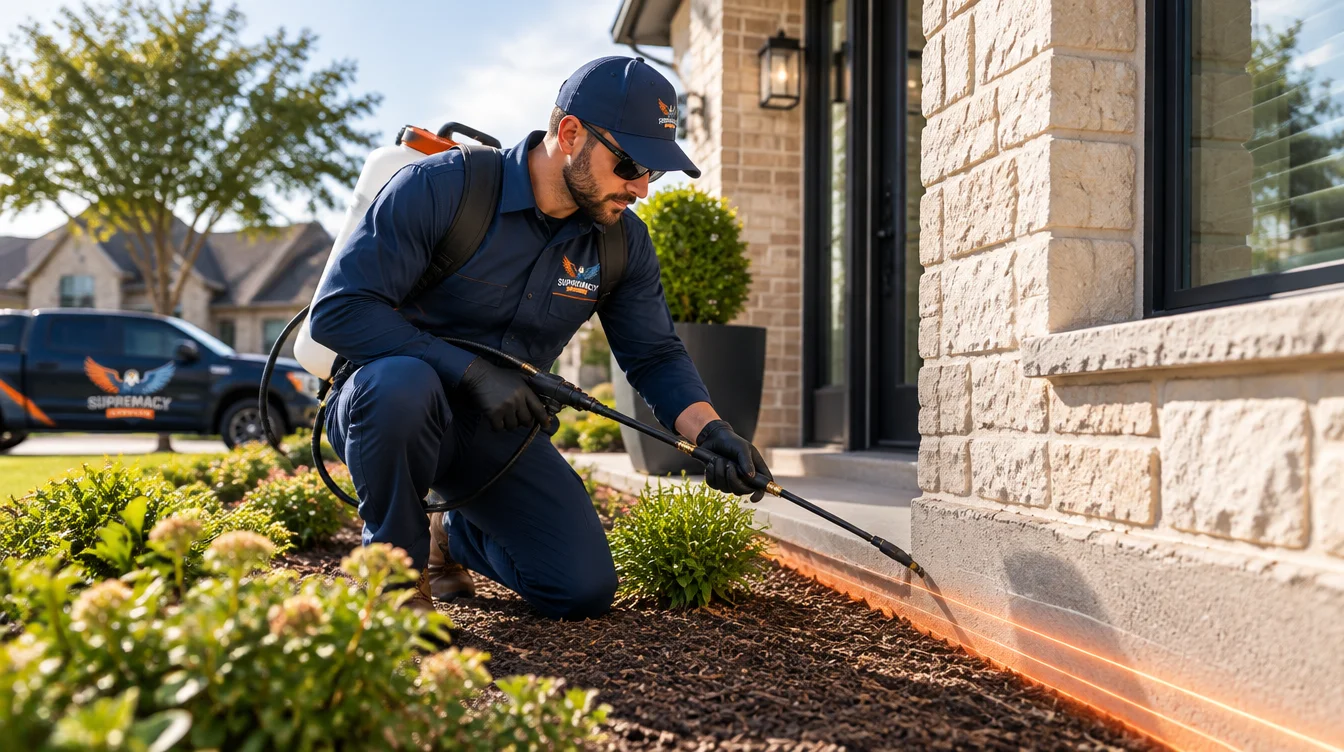
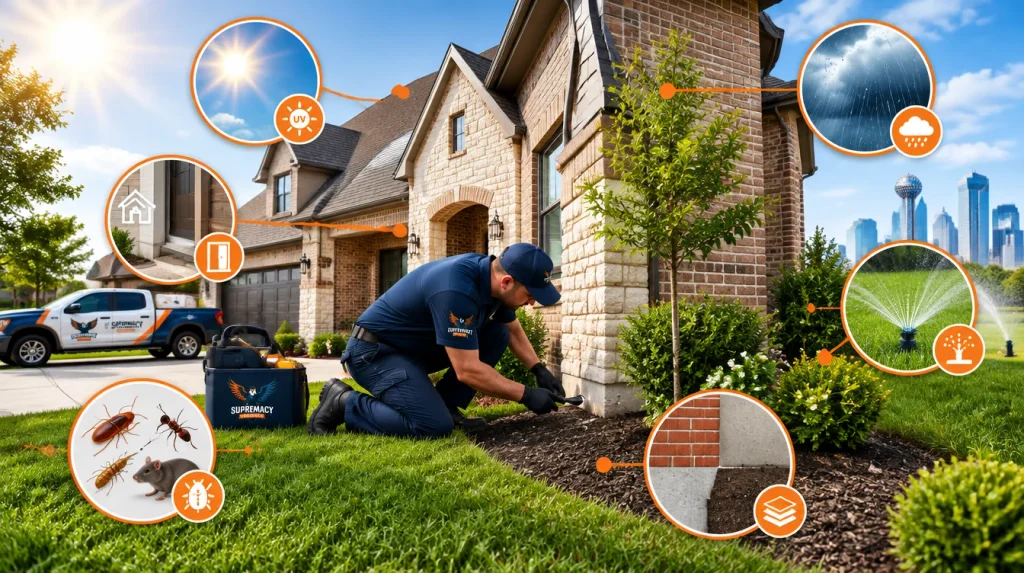
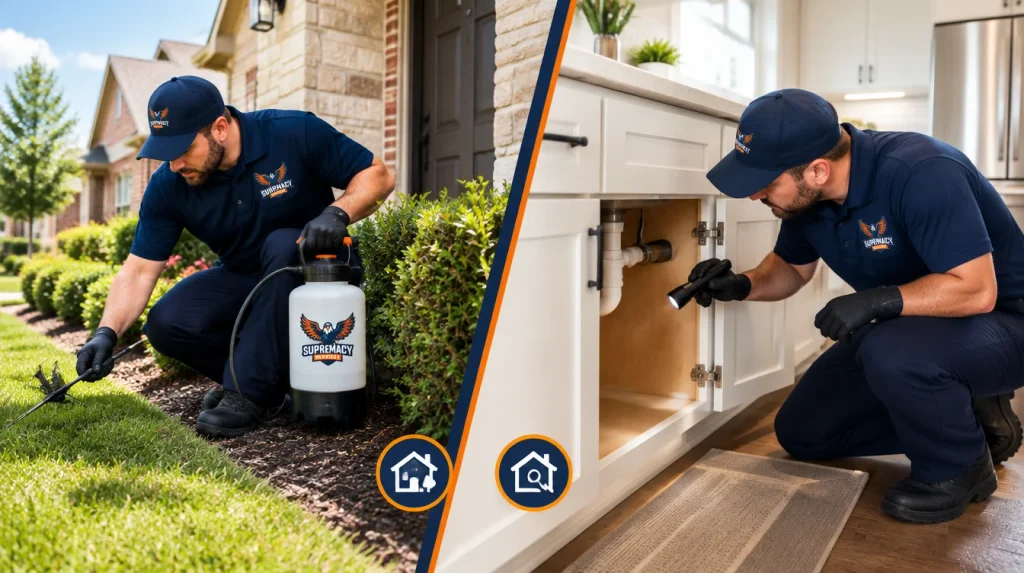
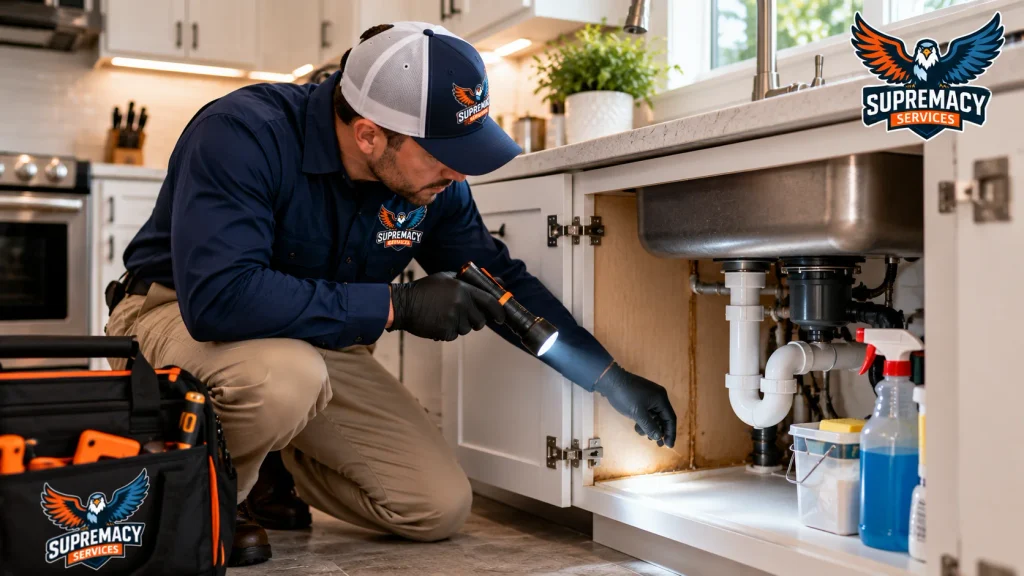
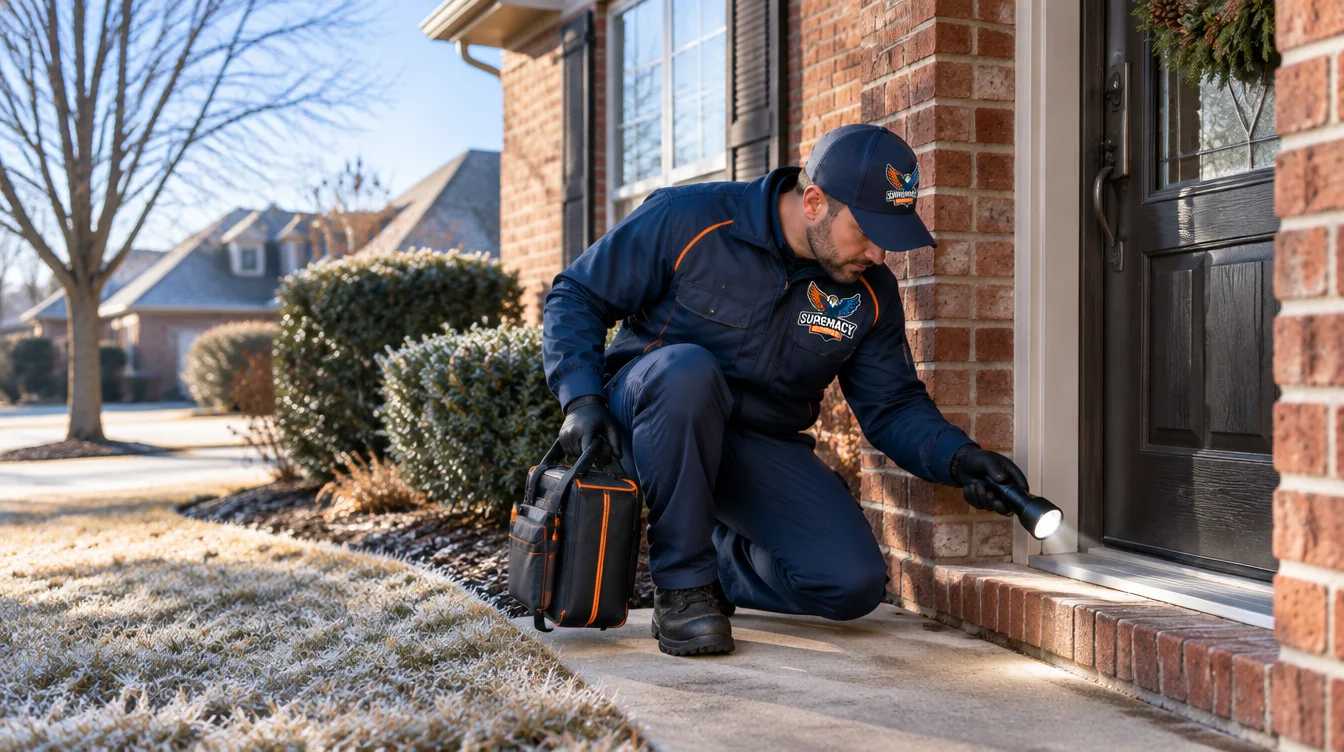
Supremacy Services pest control technician inspecting the exterior of a Dallas home during winter.

Does Perimeter Pest Control Work in Winter? North Texas Guide

Does Perimeter Pest Control Work in Winter? Yes, including during the colder months in Dallas and North Texas. Exterior treatments can help reduce certain insects around a home’s foundation and entry points, even when outdoor pest activity slows down. However, effectiveness depends on the pest species, product label, weather conditions, and whether pests are already living inside the house.

Winter treatment is not simply about spraying for bugs that are visible outside. It is about identifying pest activity, maintaining appropriate preventive measures, and reducing the opportunities pests have to enter a warm, sheltered home.

For Dallas homeowners, the important question is not whether winter pest control works at all, but when exterior treatment is useful and when other prevention methods are more effective.

Table of contents

  1. Does perimeter pest control still work in cold weather?
  2. Why winter pest control matters in North Texas
  3. Which pests can perimeter treatment help control?
  4. Does freezing weather affect exterior treatments?
  5. Should you continue perimeter pest control during winter?
  6. What does professional winter pest control include?
  7. Winter perimeter treatment vs. indoor pest control
  8. How to protect your home from winter pests
  9. When should you call a pest control professional?
  10. Frequently asked questions

Does Perimeter Pest Control Still Work in Cold Weather?

Perimeter pest control can remain useful in cold weather because properly selected exterior treatments may continue controlling susceptible insects that contact treated areas. Cold temperatures do not automatically make an existing treatment ineffective.

However, many insects become less active as temperatures fall, so they may contact treated surfaces less frequently.

How perimeter pest control works
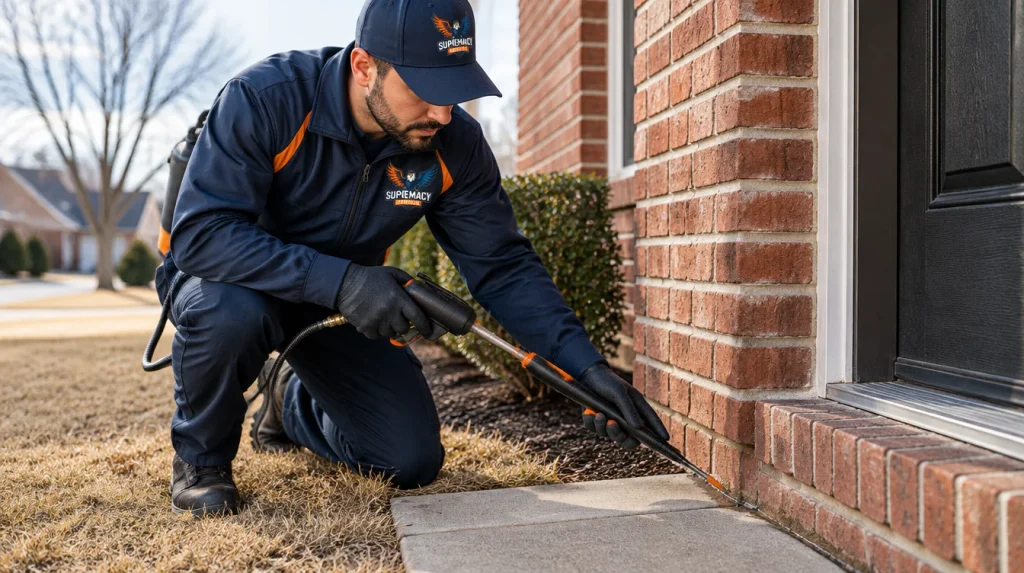
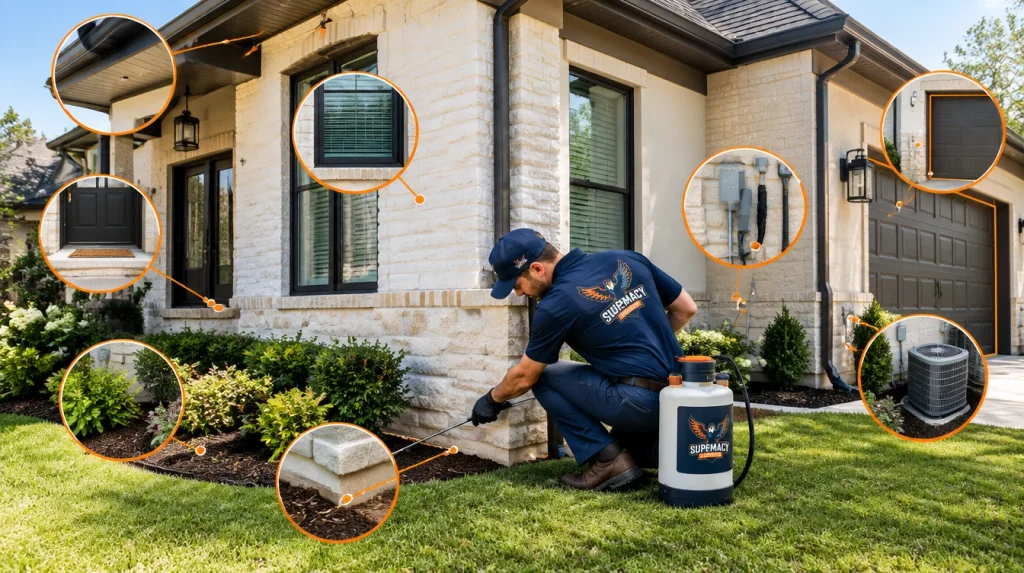
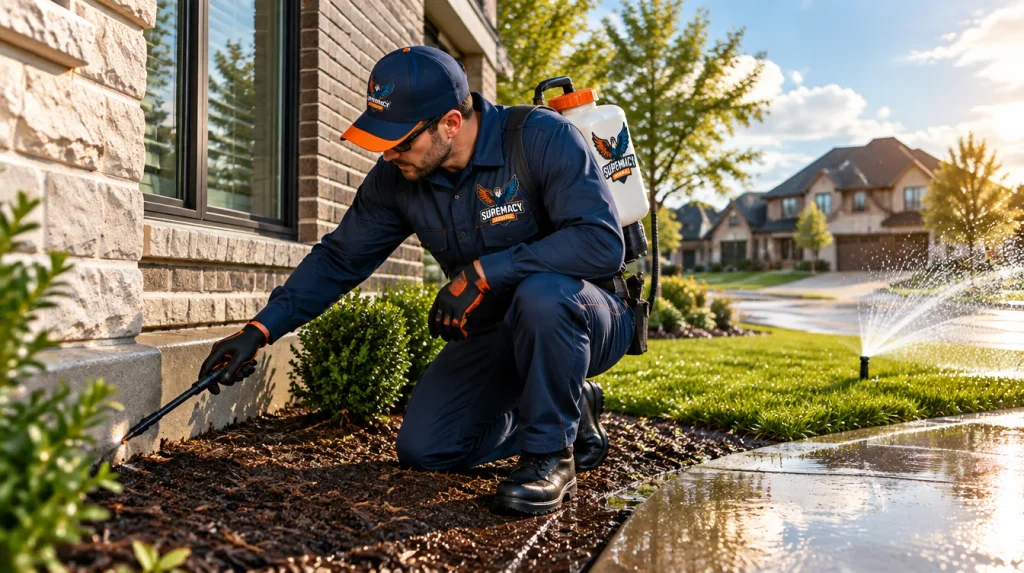
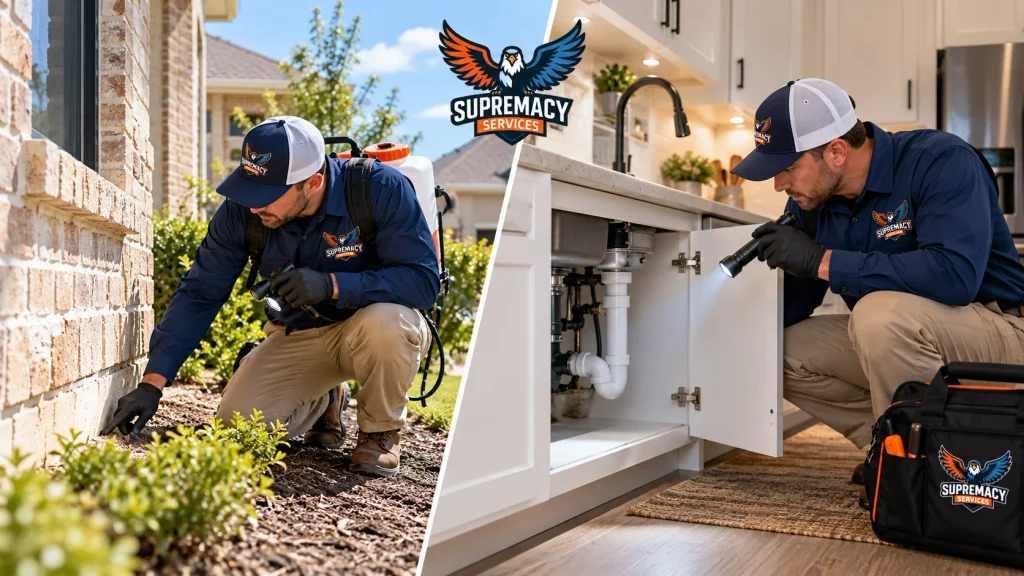
Pest control technician applying targeted exterior perimeter treatment along a brick foundation at a Dallas home.
Properly applied perimeter treatments target areas where pests may enter North Texas homes.

Perimeter pest control involves inspecting and, where appropriate, treating selected exterior areas around a building to reduce pest movement toward the structure.

Depending on the pest, treatment may involve:

  • Targeted applications around foundation entry points.
  • Treatment of labeled exterior cracks and crevices.
  • Managing pest activity near doors, windows, and utility penetrations.
  • Removing conditions that encourage insects to shelter near the home.
  • Monitoring pest activity and recommending exclusion repairs.

A residual insecticide is a product designed to remain effective on treated surfaces for a period specified by its formulation, label, and environmental conditions.

When a susceptible insect contacts an appropriately treated area, exposure may help control it. But an exterior treatment does not create an impenetrable barrier.

Why treatment results can look different in winter

During warmer months, insects may move frequently across foundations, landscaping, and exterior walls.

In winter, many species reduce their movement or shelter in protected areas. Consequently, homeowners may notice fewer insects even without treatment.

That does not necessarily mean every pest population has disappeared.

The goal of winter perimeter pest control is to manage relevant pest risks, not to guarantee that no insect will enter the house.

Why Winter Pest Control Matters in North Texas

North Texas winters can include mild afternoons, wet periods, and occasional hard freezes. These changing conditions influence where insects shelter and when they become active.

1. Some pests remain active during mild winter weather

Insects do not all respond to cold temperatures in the same way.

Some remain active during warmer periods, while others retreat into protected spaces, soil, landscaping, or structures.

In Dallas, Plano, Frisco, and surrounding communities, homeowners may notice insects during a warm spell after several colder days.

This activity does not automatically mean an earlier treatment has failed.

2. Homes provide shelter from outdoor conditions

Exterior walls, garages, crawl spaces, utility openings, and attic spaces can provide protected environments.

Pests may enter through:

  • Gaps beneath exterior doors.
  • Openings around plumbing or electrical lines.
  • Damaged weatherstripping.
  • Cracks around siding or foundation transitions.
  • Unscreened ventilation openings.
  • Gaps around garage doors.

Once pests are established indoors, treating the exterior alone may not resolve the problem.

3. Moisture and landscaping can create protected habitats

Wet mulch, leaf accumulation, clogged drainage areas, and objects stored against exterior walls can provide shelter for insects and other pests.

Homes with dense landscaping immediately against the foundation may have more protected hiding places that require inspection.

The best winter prevention plan therefore combines exterior pest management with moisture control and maintenance.

Which Pests Can Perimeter Treatment Help Control?
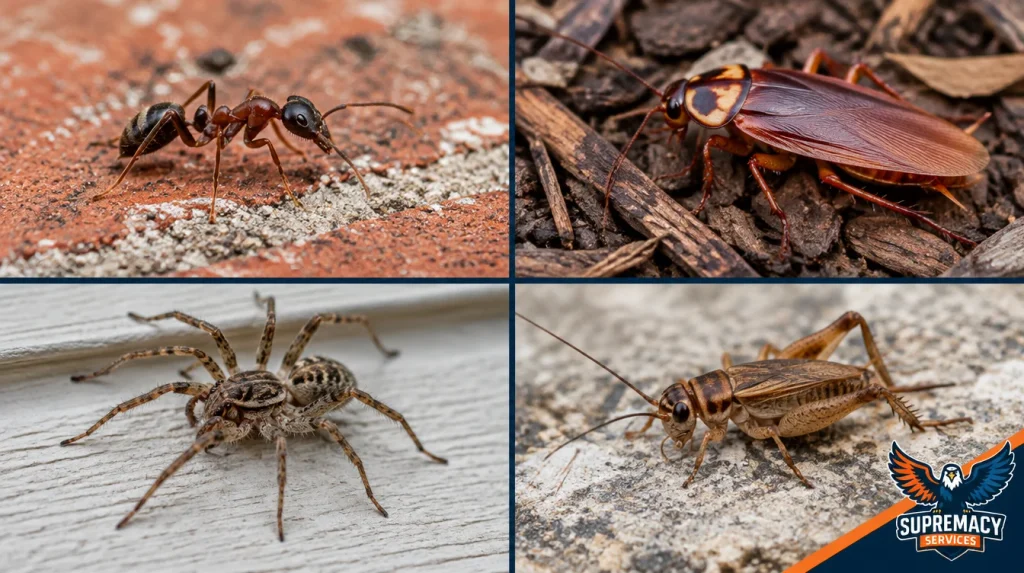
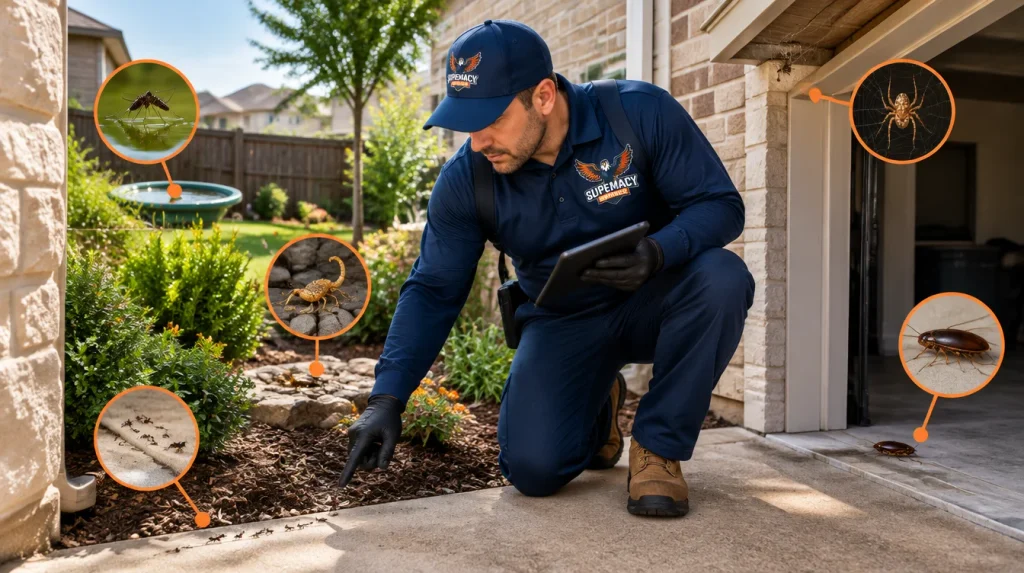
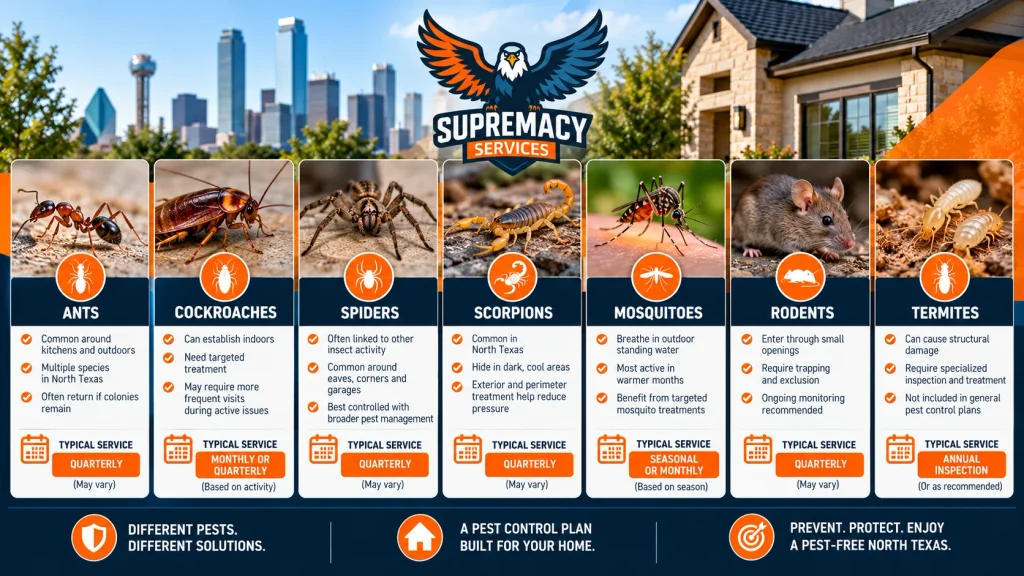
Close-up comparison of ants, American cockroaches, house spiders, and crickets commonly found around North Texas homes.
Ants, cockroaches, spiders, and crickets may remain active or seek sheltered areas around Dallas homes during winter.

Winter perimeter treatment is most relevant to insects that move across exterior surfaces or use areas around the foundation.

It is less useful as a stand-alone solution for pests already nesting inside a building.

PestWinter behaviorRole of perimeter treatment
AntsActivity may slow outdoors, but colonies can remain shelteredMay help with selected exterior entry routes; baiting or colony-focused control may be needed
American cockroachesMay shelter in drains, moist areas, and protected spacesCan help around suitable exterior harborage and entry points
SpidersSome remain in protected corners and sheltered areasTargeted treatment may help, alongside web removal and insect-prey management
CricketsSeasonal activity varies; some shelter around structuresMay help when outdoor movement continues
Occasional invading insectsSome shelter in wall voids or protected building spacesPrevention and exclusion are often more useful than spraying alone
Rats and miceMay use buildings for food, shelter, and nestingConventional insect perimeter sprays do not control rodents; exclusion and rodent-specific management are required

Ants during winter

Ant colonies may remain protected in soil, landscaping, or structural spaces during cold weather.

On warmer days, foraging activity may resume.

If ants are entering the home, the most effective approach depends on identifying the species, locating the source, and selecting an appropriate treatment.

Repeatedly spraying visible ants may fail to address the colony. Supremacy services

Cockroaches and moisture-related pests

Cockroaches may use damp, protected areas around homes, garages, utility spaces, and drainage systems.

Exterior management may help reduce entry from surrounding habitats, but an established indoor infestation usually requires a more targeted approach.

For example, German cockroaches typically require indoor inspection and control measures rather than reliance on an outdoor perimeter spray. Supremacy services

Spiders and other occasional invaders

Spiders may shelter in garages, around exterior lighting, beneath eaves, or inside storage areas.

Reducing insect prey, removing webs, controlling clutter, and sealing openings can be important components of prevention.

A perimeter application alone may not eliminate spiders already inside the house.

What about rodents?

Rodents require a different strategy.

Texas A&M AgriLife Extension identifies rodent-proofing as an important long-term control measure, including closing accessible openings with resistant materials.

Conventional insecticide perimeter treatments should not be presented as rodent control.

For further guidance, see the Texas A&M AgriLife guide to managing rats and mice.

Need help identifying winter pest activity? A professional inspection can determine whether the problem involves outdoor insects, indoor nesting, or structural entry points. Contact Supremacy Services to discuss pest control options for your Dallas-area home.


Does Freezing Weather Affect Exterior Treatments?
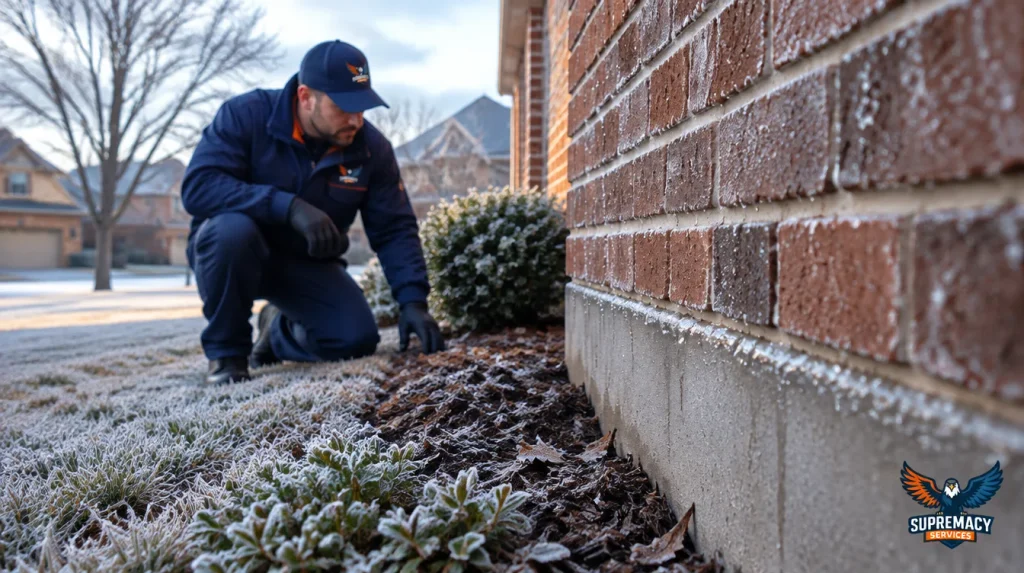
Dallas home foundation with light winter frost and moisture as a pest control technician inspects exterior treatment conditions.
Temperature, moisture, and surface conditions can influence when and how exterior pest control products should be applied.

Yes. Freezing temperatures, rainfall, surface conditions, and product-specific application requirements can affect when and how an exterior pest treatment should be applied.

Not every product is suitable for every winter condition.

Cold temperatures and insect activity

Most insects are cold-blooded, so their activity and development are influenced by environmental temperatures.

When temperatures fall, many insects move less frequently.

A residual treatment may still be present, but fewer insects may contact the treated surfaces.

This distinction matters: reduced insect activity is not the same thing as reduced pesticide potency.

Rain and moisture

Rainfall can influence exterior treatment performance depending on the formulation, treated surface, and whether the product has dried or bonded as required.

Homeowners should not assume that every rain event removes an existing treatment.

Likewise, they should not assume that every application remains effective indefinitely.

Frozen, wet, or unsuitable surfaces

A pest control professional should evaluate the weather and product label before applying pesticides outdoors.

Some application conditions may be unsuitable because of label restrictions, runoff concerns, or reduced treatment performance.

The appropriate response may be to delay treatment, use another approved method, or focus on inspection and exclusion.

Should pest control be applied right before a freeze?

Not automatically.

The correct decision depends on the product, expected weather, pest activity, and treatment location.

Applying more pesticide before a cold front is not necessarily better than choosing a suitable treatment window.

Homeowners should follow the product label rather than relying on a universal temperature rule.

Should You Continue Perimeter Pest Control During Winter?

For some North Texas homes, continuing a winter pest management plan makes sense. For others, a seasonal inspection and preventive maintenance may be more appropriate than repeating a broad exterior spray.

The decision should be based on actual pest pressure and the property’s risk factors.

When continued winter service makes sense

Winter service may be useful when:

  • The home has a history of recurring insect activity.
  • Ants or cockroaches are still appearing during mild weather.
  • The property has landscaping or moisture conditions that encourage pests.
  • Pest entry points remain unresolved.
  • The existing treatment plan includes scheduled winter inspections.
  • The homeowner wants year-round monitoring of recurring problems.

When treatment may need to change

A winter service visit does not always need to involve the same pesticide application used in summer.

A technician may recommend a targeted treatment, monitoring, sealing entry points, correcting moisture conditions, or scheduling an application when conditions are more suitable.

This is an important distinction between year-round pest management and year-round spraying.

Winter vs. summer perimeter pest control

ConsiderationWinterSummer
Outdoor insect activityOften lower, but varies by species and weatherOften higher for many species
Primary focusShelter sites, entry points, monitoring, targeted controlActive foraging, breeding sites, exterior activity
Weather considerationsCold snaps, freezes, rain, variable temperaturesHeat, rainfall, sunlight, irrigation
Treatment frequencyBased on risk, monitoring, and product requirementsBased on risk, monitoring, and product requirements
Nonchemical preventionEspecially importantEqually important

There is no universal rule requiring every Dallas home to receive the same treatment every three months.

The appropriate interval depends on the pest, site conditions, product label, and service plan.

What Does Professional Winter Pest Control Include?
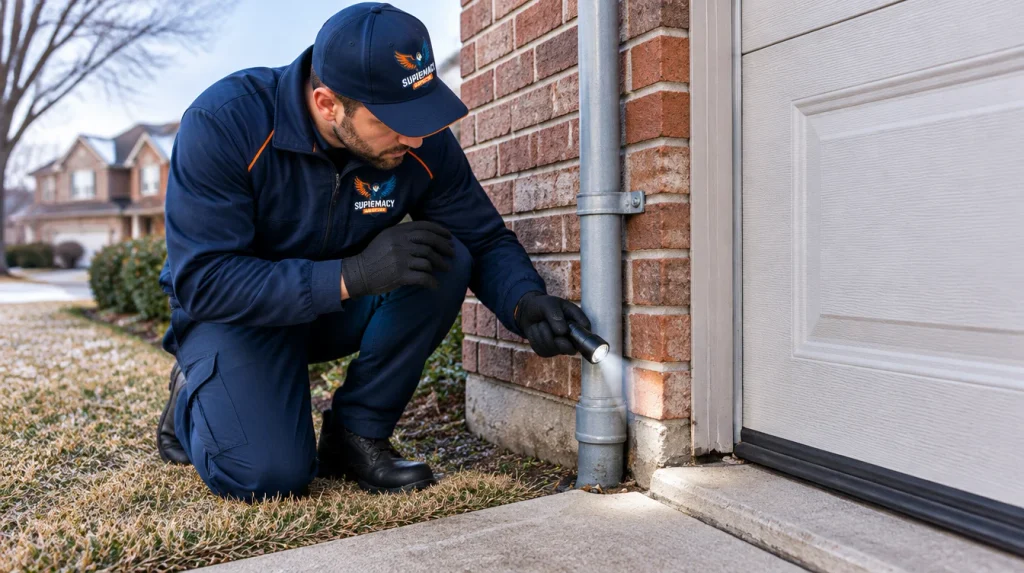
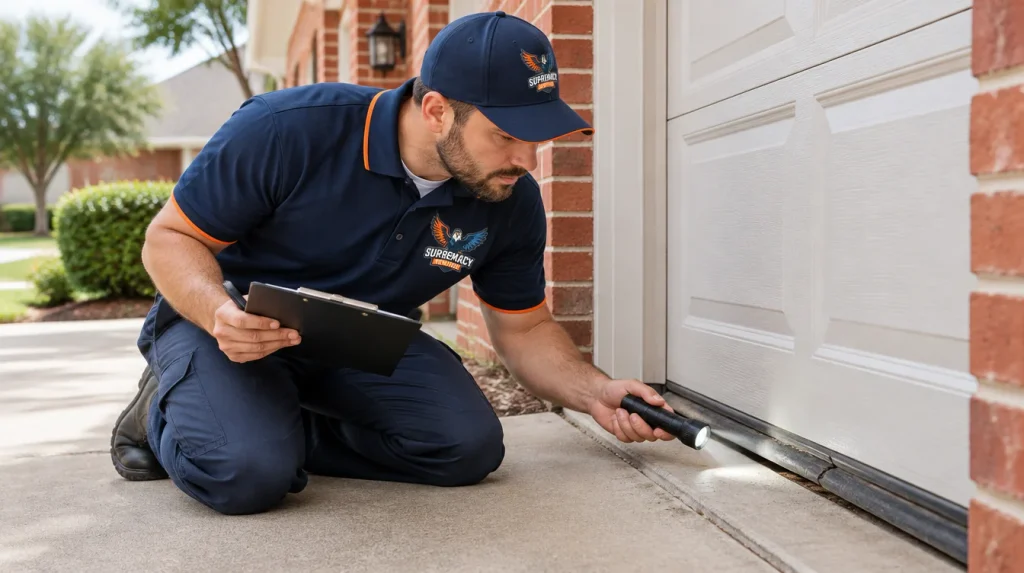
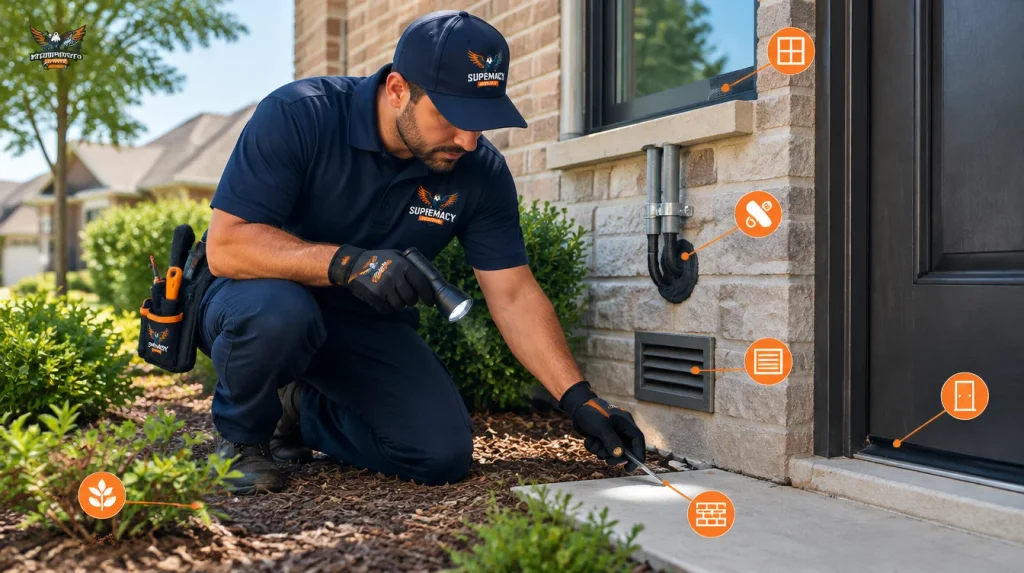
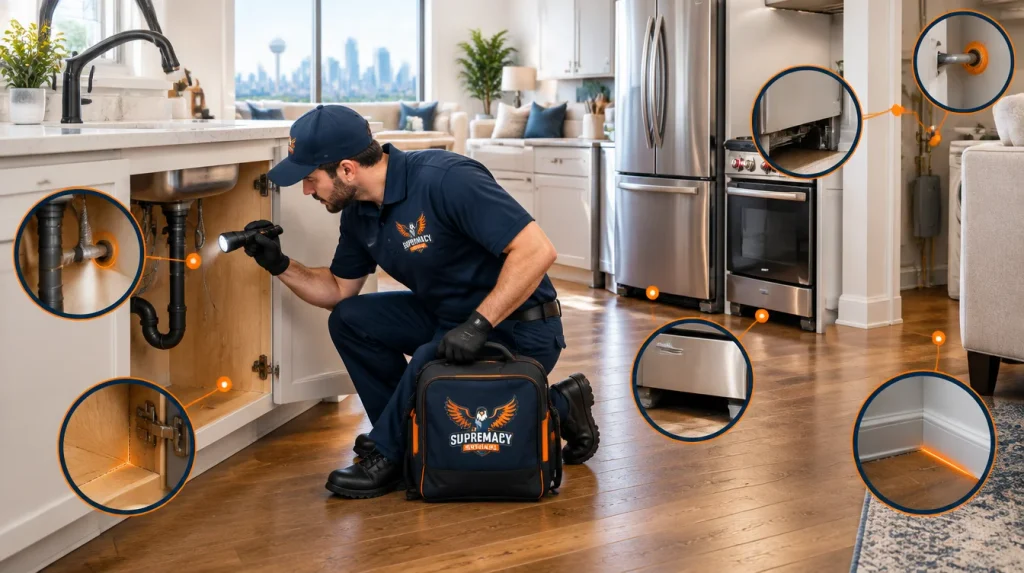
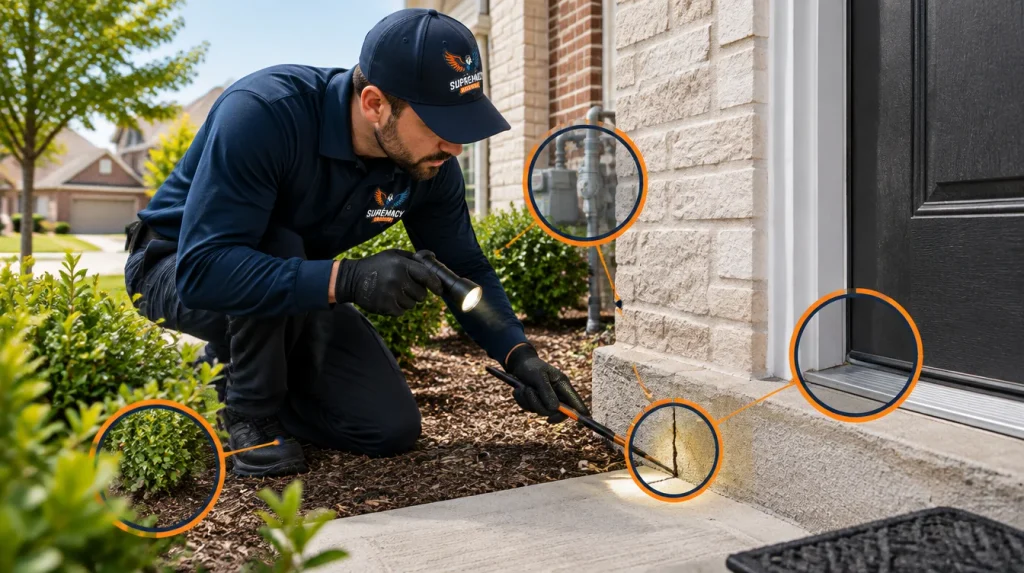
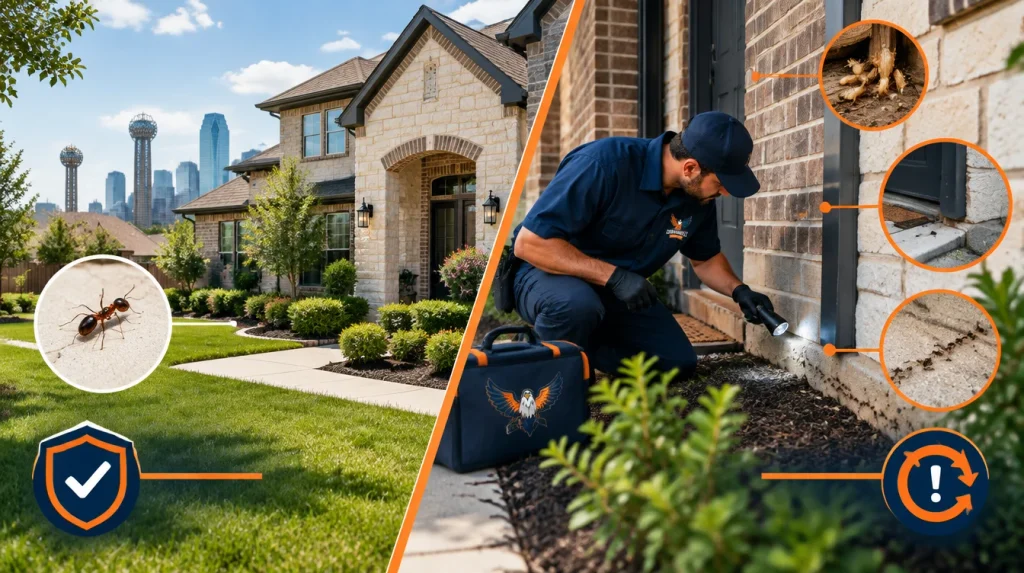
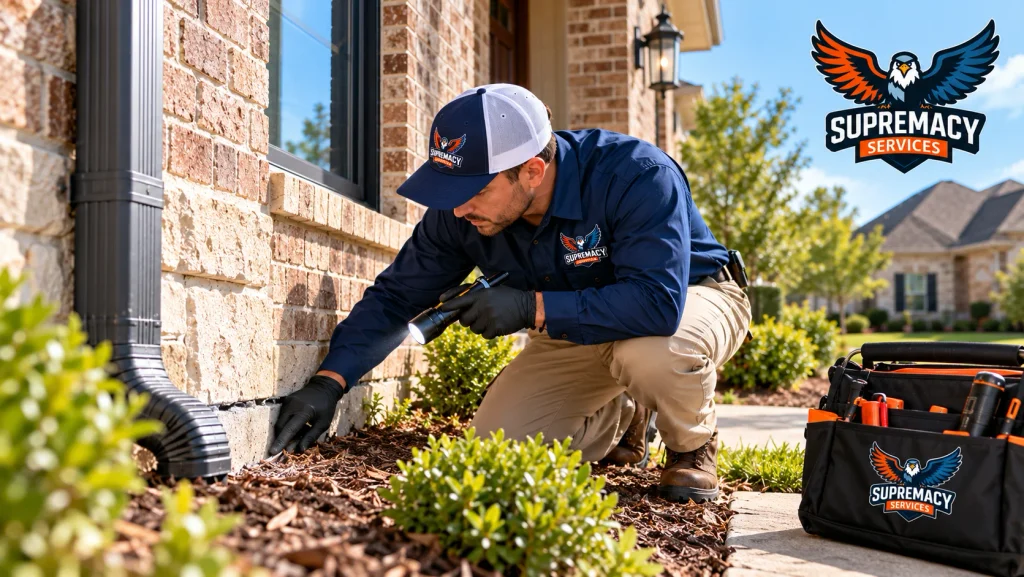
Supremacy Services technician inspecting utility openings and garage door seals for pest entry points at a Dallas home.
Professional winter pest inspections help identify foundation gaps, utility openings, and other potential pest entry points.

A professional winter pest control visit should begin with identifying the pests and conditions that actually need attention.

Depending on the property and service agreement, the process may include the following steps.

Step 1: Exterior property inspection

The technician checks accessible areas such as the foundation, garage perimeter, door thresholds, landscaping, and exterior utility penetrations.

The objective is to identify pest activity, potential shelter sites, and access points.

Step 2: Pest identification and risk assessment

Different pests require different control methods.

Ants, cockroaches, spiders, and rodents should not automatically receive the same treatment.

Accurate identification helps avoid unnecessary applications.

Step 3: Targeted exterior treatment when appropriate

If treatment is warranted, the technician selects a product and application method suitable for the target pest, property, and current conditions.

All pesticide applications must follow applicable label directions.

Step 4: Exclusion and prevention recommendations

The technician may identify gaps that should be sealed, damaged weatherstripping, moisture problems, or landscaping conditions that need attention.

Some repairs may be separate from the pest control service.

Step 5: Monitoring and follow-up planning

The homeowner should understand what was treated, what improvements to expect, what precautions apply, and when follow-up is necessary.

For homes experiencing recurring winter pest activity, Supremacy Services can help homeowners evaluate whether a targeted treatment or a broader preventive plan is appropriate.

Winter Perimeter Treatment vs. Indoor Pest Control

Exterior and interior pest control serve different purposes.

Perimeter treatment primarily addresses selected pest activity outside the home and around entry points. Indoor treatment targets pests already present within the building.

Neither approach should automatically replace the other.

SituationMore appropriate starting point
Occasional insects entering from outsideExterior inspection, exclusion, targeted perimeter control
Ant trails inside the kitchenSpecies identification, source investigation, appropriate targeted treatment
German cockroaches inside cabinetsIndoor inspection and species-specific control
Rodent droppings in the atticRodent inspection, exclusion, trapping or other approved control
Spiders around exterior doorsEntry-point sealing, web removal, prey reduction, targeted control if needed
No current pest activityInspection and preventive maintenance may be sufficient

A homeowner seeing insects indoors during winter should not automatically assume that an exterior pesticide application is the solution.

The source of the infestation matters more than the season.

How to Protect Your Home From Winter Pests

A few practical maintenance steps can reduce pest access and shelter around a North Texas home.
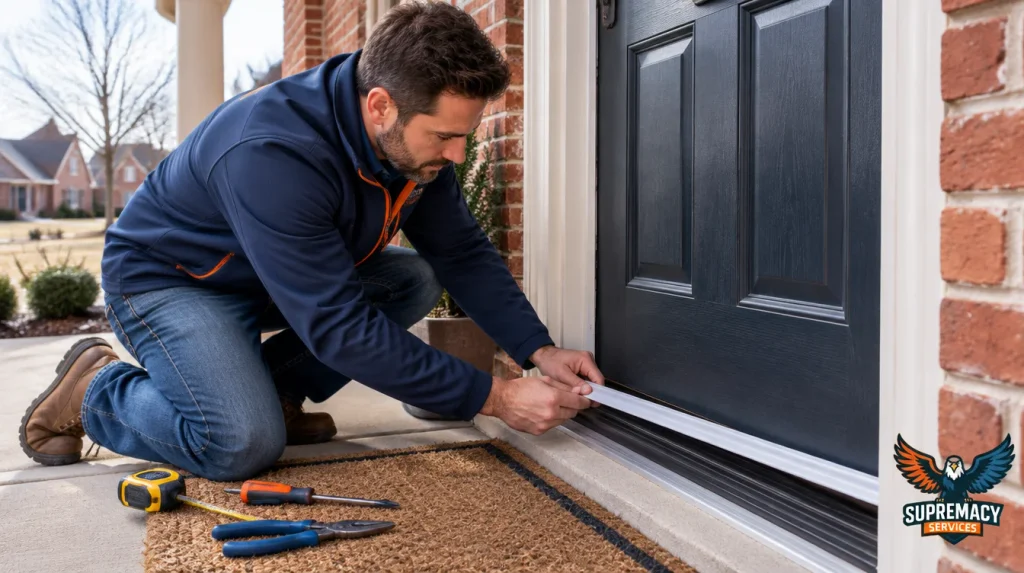
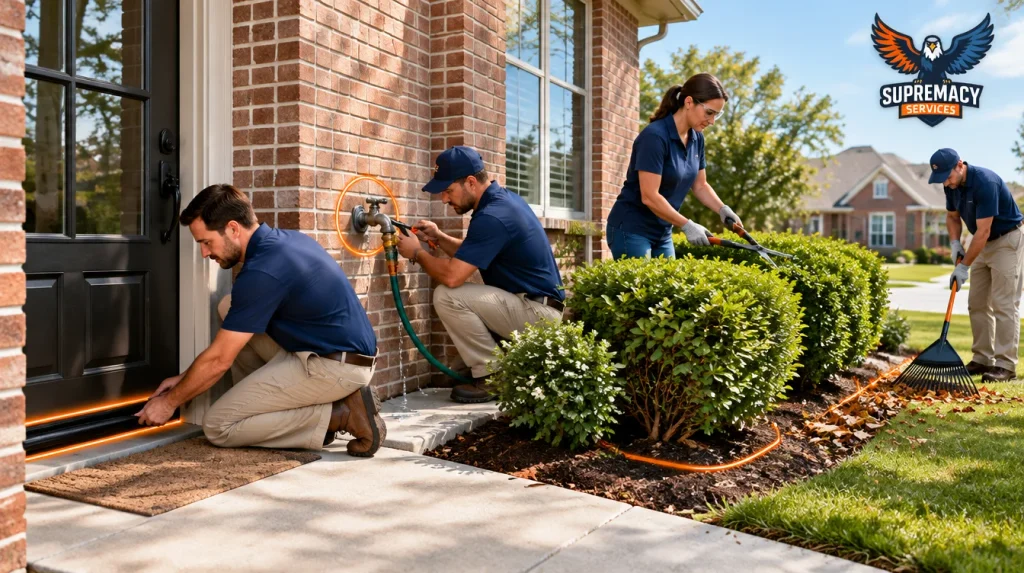
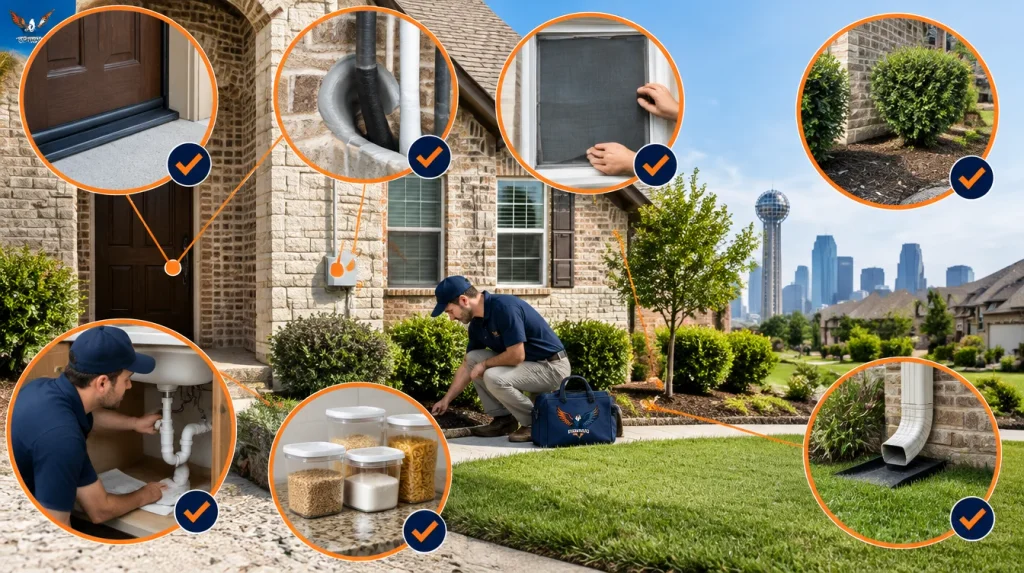
North Texas homeowner installing weatherstripping along an exterior door to seal gaps and help prevent winter pest entry.
Sealing exterior gaps and maintaining door weatherstripping can help reduce pest entry during colder months.

Winter pest prevention checklist

  • Inspect weatherstripping around exterior doors.
  • Check garage door seals for gaps.
  • Seal appropriate openings around plumbing and utility penetrations.
  • Repair damaged window screens and vent covers.
  • Remove accumulated leaves and debris near the foundation.
  • Avoid storing firewood or unnecessary clutter directly against exterior walls.
  • Correct leaking outdoor faucets and drainage problems.
  • Store pet food and other attractants in secure containers.
  • Inspect garages, storage spaces, and accessible attics for pest evidence.
  • Review recurring pest activity before scheduling additional treatment.

Homeowners can complete many of these tasks without pesticides.

For pest-specific treatment, particularly when the species is uncertain or an infestation persists, professional assessment is often more effective than repeated trial-and-error spraying.

When Should You Call a Pest Control Professional?

Professional pest control is worth considering when pest activity persists, the source cannot be identified, or the problem involves areas that are difficult to inspect safely.

Warning signs include:

  • Repeated ant trails indoors during winter.
  • Cockroaches appearing in kitchens, bathrooms, or garages.
  • Recurring insect activity around foundation gaps.
  • Rodent droppings, gnaw marks, or scratching sounds.
  • Pest activity that continues after reasonable prevention measures.
  • Uncertainty about whether an insect is a harmless occasional invader or a more serious pest.

A professional can help distinguish a seasonal nuisance from an infestation requiring targeted treatment.

Is winter pest control worth the cost?

Winter pest control may be worth the cost when it addresses an identified problem, prevents recurring entry, or forms part of a useful year-round management plan.

However, the cost should reflect the actual service needed.

A routine exterior inspection, targeted insect treatment, rodent exclusion work, and a significant indoor infestation are different scopes of work.

Pricing may depend on property size, pest species, infestation severity, access, treatment method, and follow-up requirements.

Rather than relying on a generic winter treatment price, homeowners should request a quote that explains what is included.


Frequently Asked Questions

1. Does perimeter pest control work when it is freezing outside?

It can remain effective against susceptible insects, but freezing weather may reduce insect movement and limit when certain products can be applied. Existing treatment performance and new application suitability depend on the product label and conditions.

2. Is it worth spraying for bugs in winter?

Sometimes. Targeted spraying can help when there is relevant insect activity, but inspection, sealing gaps, and reducing shelter sites may provide greater value when outdoor pest pressure is low.

3. Do pests die during winter in Dallas?

Some insects die, while others survive in protected habitats, different life stages, or sheltered building spaces. Winter temperatures do not eliminate every pest population.

4. Can rain wash away winter perimeter pest control?

Rain can affect some exterior applications, but the impact depends on the product, surface, timing, and label directions. Not every rainfall requires immediate retreatment.

5. Should I cancel pest control service during winter?

Not necessarily. If your property has recurring pest problems, an inspection or targeted winter service may still be useful. Discuss seasonal adjustments with your provider before canceling an existing plan.

6. How often should perimeter pest control be applied in winter?

There is no universal winter interval. Application frequency depends on the target pest, product label, property conditions, monitoring results, and the service agreement.

7. Will exterior pest control stop mice from entering my house?

No. Conventional exterior insecticide treatments do not provide rodent exclusion. Mice require rodent-specific management, including identifying and sealing accessible entry points.

8. Can I do my own winter perimeter pest control?

Homeowners can reduce pest risks by sealing gaps, removing debris, managing moisture, and storing food properly. If using pesticides, choose products labeled for the pest and application site and follow every label instruction.

9. Is interior pest control necessary during winter?

Not always. Indoor treatment may be appropriate when pests are already established inside the home. An exterior-only plan may be sufficient for some occasional invaders, but it will not resolve every indoor infestation.


Keep Your North Texas Home Protected Through Winter

Perimeter pest control can remain effective during winter, but the most successful approach is based on the pests present, the condition of the property, and suitable treatment methods.

For Dallas and DFW homeowners, winter is an opportunity to inspect exterior entry points, correct moisture problems, identify sheltered pest activity, and prepare for seasonal changes.

Supremacy Services helps homeowners address pest concerns with solutions suited to their property and the problem at hand.

If you are noticing winter pest activity or want to review your home’s preventive pest control needs, visit Supremacy Services to explore available services and request assistance.
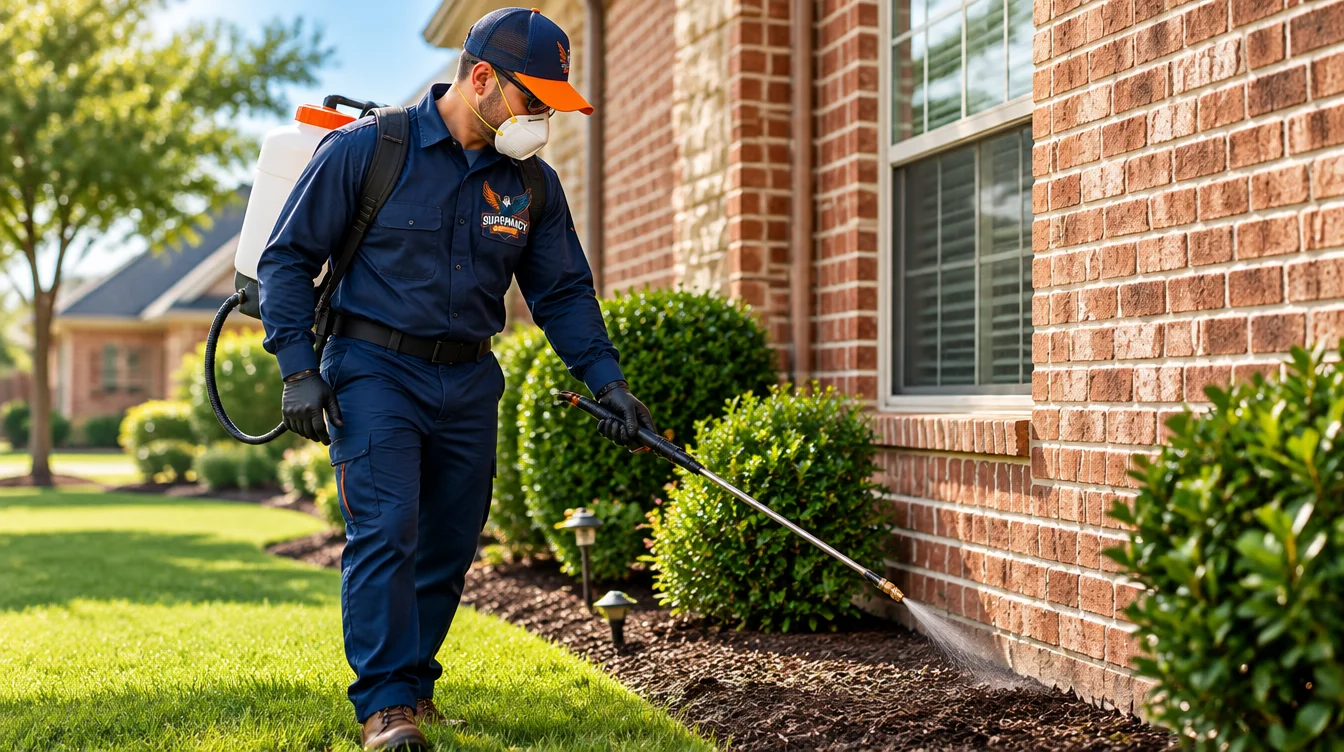
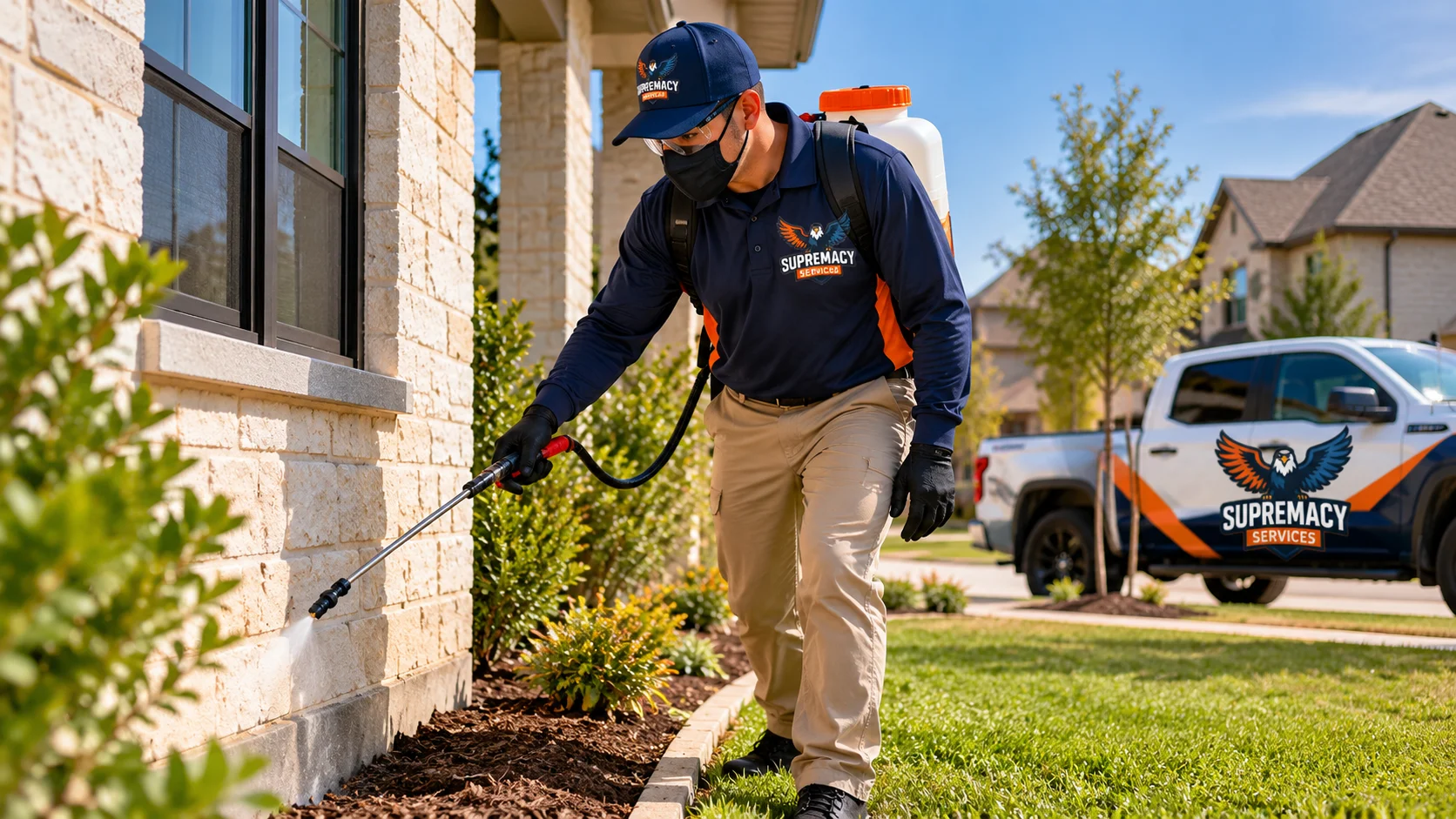
Pest control technician applying exterior perimeter treatment along the foundation of a brick home in Dallas, Texas.

How Often Should Perimeter Pest Control Be Applied in North Texas?

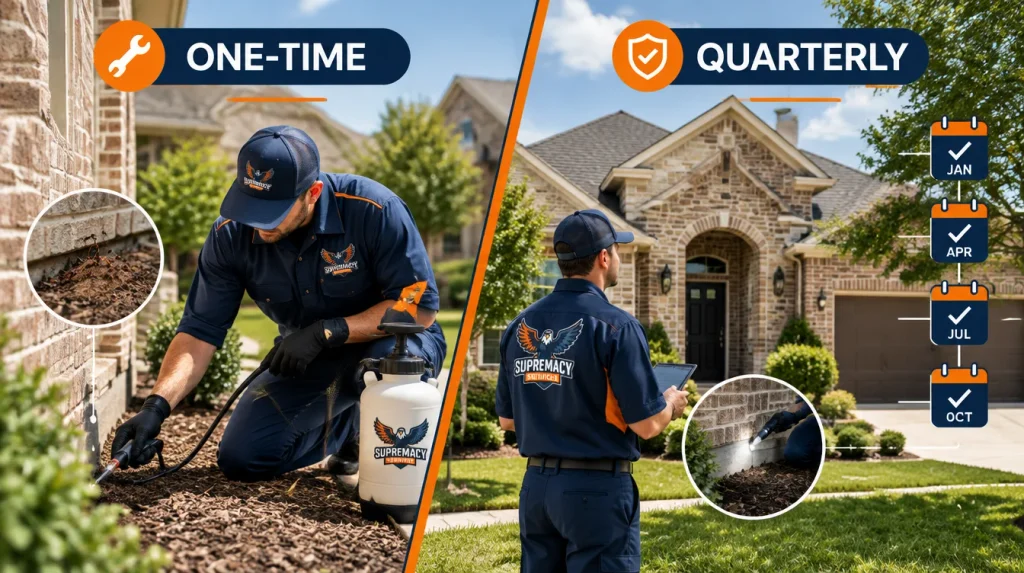
For many North Texas homes, quarterly perimeter pest control is a reasonable starting schedule, but treatments do not automatically last three months. Some properties need more frequent monitoring or targeted follow-up, while others may require fewer pesticide applications when pest activity is low.

The right interval depends on the pest species, the product’s approved application schedule, weather exposure, conditions around the foundation and whether pests are already entering the house.

For homeowners in Dallas, Plano, Frisco, Allen and surrounding DFW communities, the goal isn’t to spray as often as possible. It’s to maintain effective exterior protection without unnecessary pesticide use.

Table of Contents

  1. How often should perimeter pest control be applied?
  2. Why does treatment frequency vary?
  3. How long does perimeter pest control last?
  4. Does rain affect perimeter pest control?
  5. When should North Texas homes be treated?
  6. What signs indicate retreatment is needed?
  7. Is quarterly perimeter pest control enough?
  8. DIY vs. professional perimeter pest control
  9. What does professional perimeter pest control include?
  10. How can homeowners make treatments more effective?
  11. Frequently asked questions

How Often Should Perimeter Pest Control Be Applied?

For routine prevention, many homeowners begin with a professional inspection and consider an approximately three-month service review cycle. However, the appropriate pesticide application interval must follow the specific product label and actual pest conditions.

A quarterly service visit does not necessarily mean every area needs to be sprayed again.

The following table provides a practical planning framework, not a universal pesticide application schedule.

Property conditionSuggested approach
Low pest activity, well-sealed homeInspect periodically; treat when justified
Typical recurring exterior pest activityConsider quarterly service reviews
Persistent ants, cockroaches or other invadersIdentify the pest and arrange targeted follow-up
Recent treatment with renewed activityReassess entry points and treatment effectiveness
Severe or established infestationUse a pest-specific treatment and monitoring plan

Why isn’t one schedule suitable for every home?

A Dallas property with recurring ant trails, foundation gaps and heavy landscaping may require a different approach from a well-maintained home with little pest activity.

Likewise, an exterior treatment targeting occasional crawling insects is not the same as a termite management program, mosquito treatment or indoor German cockroach control.

The best treatment frequency is based on inspection findings, not the calendar alone.

Homeowners who repeatedly notice insects entering around doors, windows or foundation gaps may benefit from a professional assessment of their home’s exterior pest protection.

Explore Supremacy Services’ professional pest control options to determine whether routine exterior maintenance is appropriate for your property.

What Factors Determine How Often Perimeter Pest Control Is Needed?

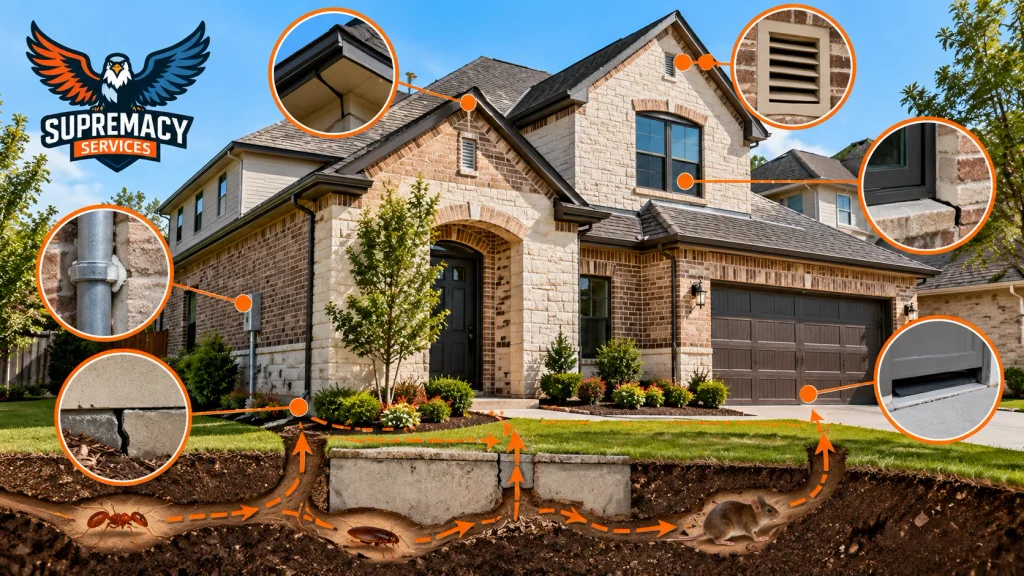
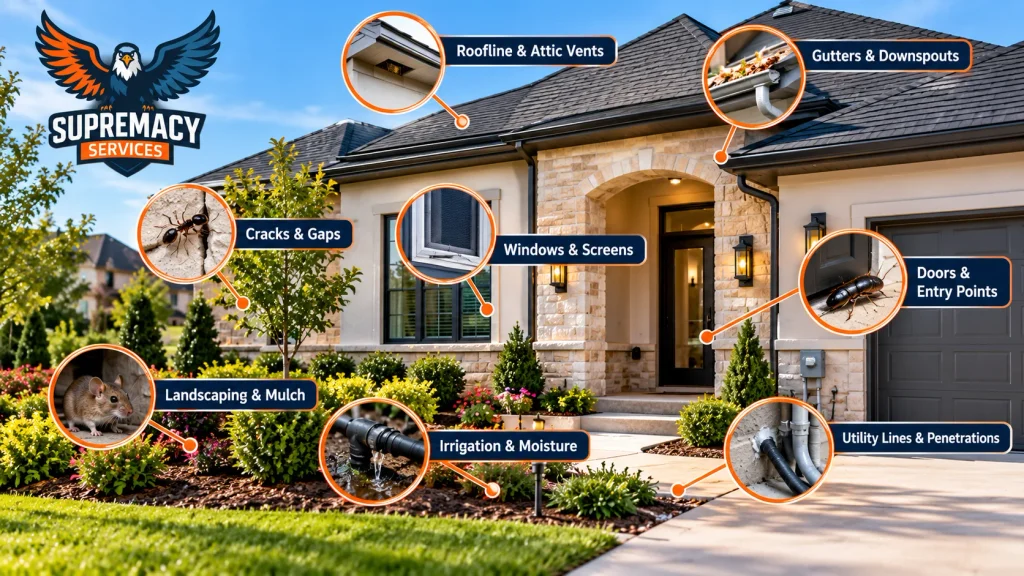
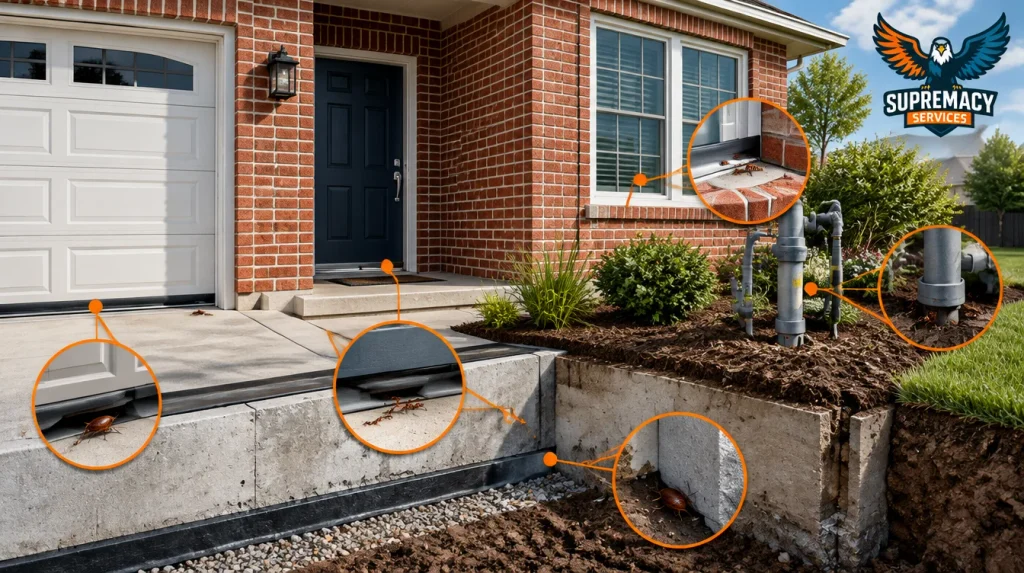
Architectural illustration highlighting pest entry points around a Dallas home's foundation, doors, windows and utility openings.
Foundation gaps, poorly sealed doors and utility penetrations can create pathways for pests to enter North Texas homes.

Several conditions influence how quickly a property may need follow-up attention.

1. The type of pest

Different pests respond to different control methods.

Ants may require colony-focused baiting or targeted treatments. Cockroaches can exploit moisture and gaps around utility penetrations. Spiders may continue appearing where other insects provide a food source.

An outdoor perimeter treatment alone may not resolve every pest problem.

2. Landscaping near the foundation

Dense vegetation, mulch, stored materials and debris can provide shelter for insects close to exterior walls.

Where landscaping creates favorable pest conditions, removing harborage may be more valuable than simply increasing spray frequency.

3. Moisture and drainage

Leaking outdoor faucets, poorly directed downspouts and persistently damp soil can make areas around a home more attractive to certain pests.

Correcting the moisture problem can reduce the need for repeated treatments.

4. Building entry points

Small gaps around pipes, weatherstripping, door thresholds, vents and siding can allow pests to enter even when an exterior pesticide treatment has been applied.

Homes with recurring entry problems should be evaluated for exclusion work.

5. Previous pest activity

A property with a history of repeated infestations may need closer monitoring than a home with occasional seasonal insects.

The appropriate response depends on whether the pests are entering from outdoors or already established inside.

How Long Does Perimeter Pest Control Last?

Perimeter pest control can provide residual activity after application, but there is no universal duration that applies to every product or property.

Effectiveness depends on the active ingredient, formulation, treated surface, environmental exposure, target pest and whether the application was performed according to the label.

A product may remain present on a surface without providing the same level of control against every insect.

Why can insects return before the next scheduled visit?

Pests may reappear because:

  • New insects enter from surrounding areas.
  • Untreated entry points remain accessible.
  • Outdoor moisture or shelter continues attracting pests.
  • The original treatment did not target the actual source.
  • Environmental conditions or surface changes affect residual performance.
Seeing a single insect does not automatically mean an entire treatment has failed. Repeated activity in the same location is more useful evidence that follow-up is needed.

Does Rain Affect Perimeter Pest Control Treatments?

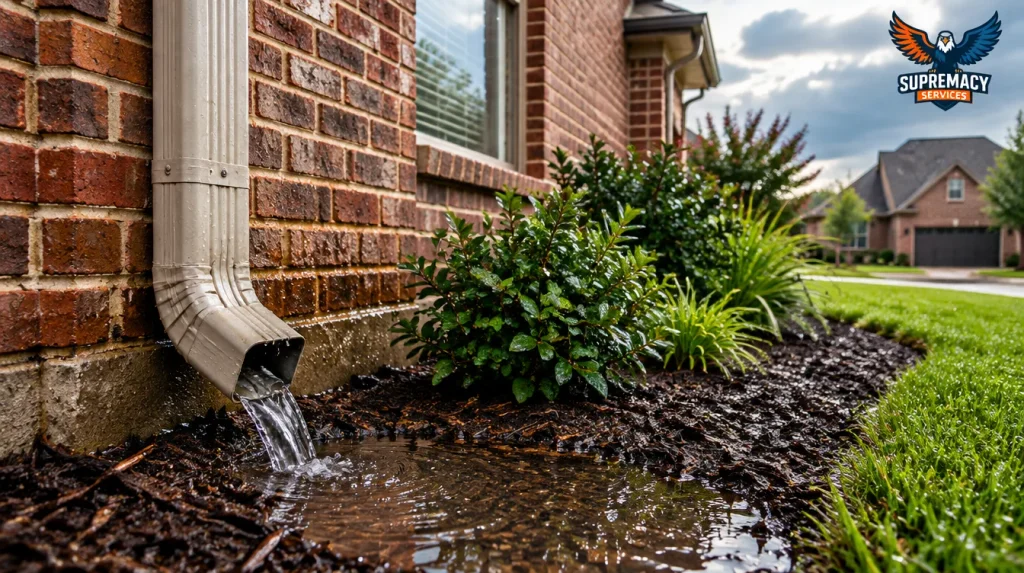
Wet brick foundation, downspout drainage and damp landscaping around a Dallas home after rainfall.
Heavy rainfall, standing water and damp landscaping can affect pest activity and influence exterior pest control decisions.

Yes. Rain can affect some outdoor pesticide applications, particularly when a product has not had sufficient time to dry or when runoff occurs. However, the effect depends on the product and its labeling.

The U.S. Environmental Protection Agency provides outdoor pesticide labeling guidance intended to reduce runoff into storm drains, drainage systems and surface waters.

Should homeowners reapply perimeter pest control after rain?

Not automatically. A rainy day does not mean the perimeter needs another full application.

Instead:

  1. Check whether the application occurred before or during the rain.
  2. Review the product’s rain-related label instructions.
  3. Monitor whether the original pest problem returns.
  4. Contact the applicator if significant activity continues.
  5. Avoid applying additional pesticide before the label permits retreatment.

Some products require watering after application, while others restrict treatment when rain is expected. Always follow the directions for the particular product.

What about North Texas thunderstorms?

Dallas-area storms can produce heavy rainfall and temporary drainage problems around homes.

After significant rain, inspect foundation drainage, standing water, wet mulch and damaged weatherstripping. Addressing these conditions can help prevent future pest problems without immediately adding more pesticide.

When Should North Texas Homes Receive Perimeter Pest Control?

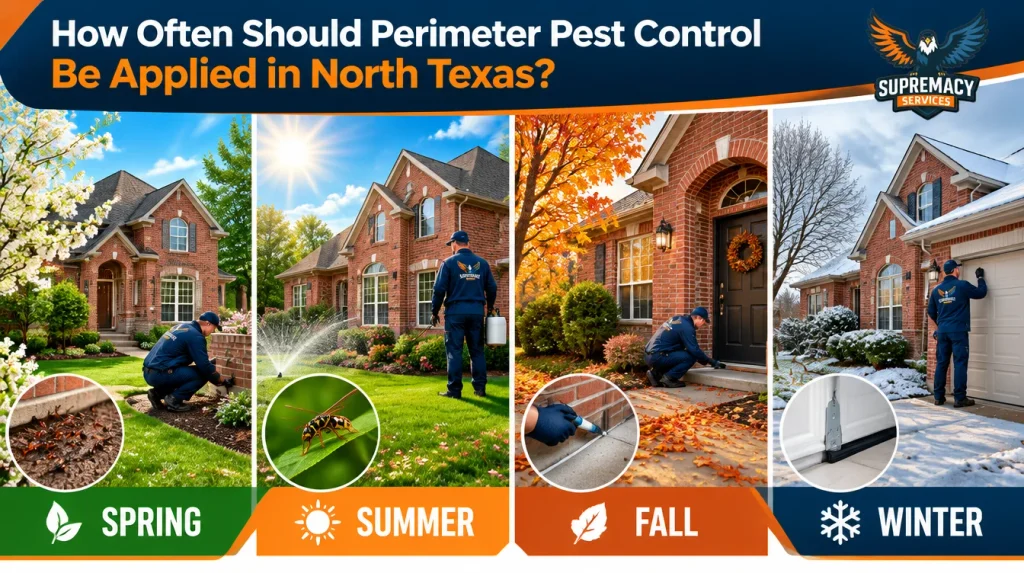
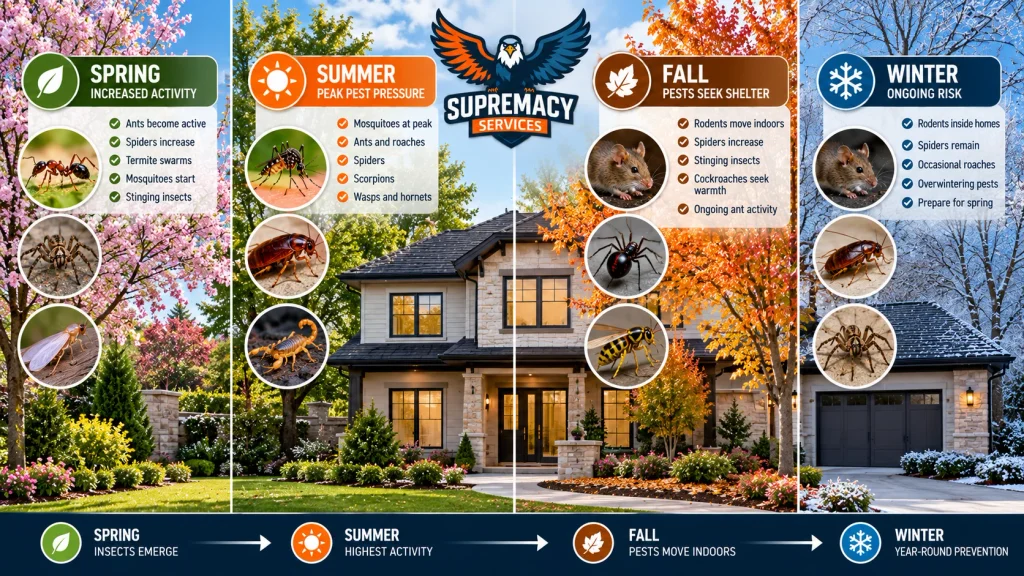
Four-season illustration showing spring, summer, fall and winter pest prevention considerations for North Texas homes.
Seasonal weather changes and pest activity can influence when perimeter pest control treatments are needed in North Texas.

North Texas homeowners should assess exterior pest conditions throughout the year rather than assuming every season requires the same treatment.

Seasonal planning guide

SeasonWhat to inspectRecommended approach
SpringAnt trails, moisture, foundation openingsInspect and address emerging activity
SummerOutdoor insect activity, irrigation leaks, shaded harborageMonitor high-activity areas and use targeted control
FallDoor gaps, utility penetrations, pests seeking shelterPrioritize exclusion and exterior inspection
WinterProtected areas, garages, stored materialsMonitor activity; treat only where needed

Spring: Watch for increasing insect activity

As conditions warm, homeowners may notice more ants and other insects around foundations, patios and landscaping.

Inspect for moisture and emerging entry points before pest activity becomes established indoors.

Summer: Pay attention to irrigation and shelter

Hot weather and outdoor watering can create damp areas around foundations.

Check irrigation leaks, landscaping near exterior walls and areas where insects are repeatedly observed.

Fall: Focus on entry prevention

Changing weather conditions can influence where pests seek shelter.

Inspect garage-door seals, door sweeps, window gaps and utility openings. Exterior exclusion can help reduce indoor pest problems.

Winter: Continue monitoring

Pest activity does not necessarily stop during a North Texas winter.

Some insects remain active in protected areas, while others become less visible outdoors. Winter is a useful time to correct structural entry points and inspect storage areas.

What Signs Mean Your Home May Need Another Perimeter Treatment?

A retreatment assessment is appropriate when pests repeatedly appear in the same locations or when the original problem continues despite corrective measures.

Common warning signs include:

  • Recurring ant trails near exterior doors or foundations.
  • Cockroaches repeatedly appearing around garage or utility entrances.
  • Increased crawling insects around patio doors and windows.
  • Persistent pest activity after a previous treatment.
  • Visible gaps or damaged exterior seals.
  • Pest activity associated with moisture or debris near the home.

When should you call before your next scheduled visit?

Contact a pest control professional when activity is persistent, spreading or occurring indoors despite an existing prevention plan.

The next step may involve identifying the pest, repairing an entry point, using a baiting strategy or applying a targeted treatment.

If insects keep returning between scheduled visits, request a perimeter pest inspection from Supremacy Services to identify what may be allowing them back inside.

Is Quarterly Perimeter Pest Control Enough for North Texas Homes?

Quarterly pest control can be a practical maintenance framework for some Dallas-area homes, but it is not automatically sufficient or necessary for every property.

The value of a quarterly plan depends on whether each visit includes inspection, monitoring and adjustments based on current pest activity.

Quarterly vs. more frequent monitoring

ConsiderationQuarterly service reviewMore frequent follow-up
Best suited forRoutine preventive maintenancePersistent or unresolved pest problems
Main objectiveMonitor conditions and maintain controlIdentify and correct ongoing activity
Treatment approachBased on findings and product labelPest-specific, targeted intervention
Homeowner involvementReport changes between visitsTrack activity and follow instructions
Potential limitationProblems may develop between visitsMore visits may increase cost without solving the cause

Is monthly perimeter spraying better?

Not necessarily.

More frequent pesticide application does not guarantee better results. Some infestations require specialized treatment, while other problems can be reduced through exclusion, sanitation or moisture management.

A monthly service arrangement may involve inspections and monitoring rather than monthly application of the same pesticide.

Does quarterly service cost less?

The total cost depends on the property’s size, infestation severity, service scope, products, number of visits and whether additional pest-specific work is needed.

Rather than assuming a quarterly contract is always the least expensive choice, homeowners should compare what each plan includes and whether follow-up visits are covered.

DIY vs. Professional Perimeter Pest Control: Which Is Better?

Homeowners can perform many useful prevention tasks themselves. However, pesticide applications require careful product selection, identification of the target pest and compliance with label directions.

DIY preventionProfessional pest control
Seal accessible gapsIdentify recurring pest entry patterns
Repair leaking faucetsEvaluate pest species and infestation sources
Remove debris near foundationsSelect appropriate control methods
Maintain landscapingApply registered products according to their labels
Monitor pest activityDevelop a follow-up and maintenance plan

When is DIY prevention enough?

If pest activity is occasional and no infestation is established, start with basic maintenance:

  • Repair damaged weatherstripping.
  • Seal accessible openings using suitable materials.
  • Reduce excess moisture.
  • Remove outdoor clutter.
  • Keep food waste properly contained.

If using a consumer pesticide, select one labeled for the specific pest and application location. Follow all directions, including retreatment intervals, precautions and restrictions.

When should you hire a professional?

Professional assessment is appropriate when insects repeatedly enter the home, an infestation persists, the pest cannot be identified, or a previous treatment has not resolved the problem.

Texas regulates structural pest control businesses and professionals through the Texas Department of Agriculture.

What Does Professional Perimeter Pest Control Include?

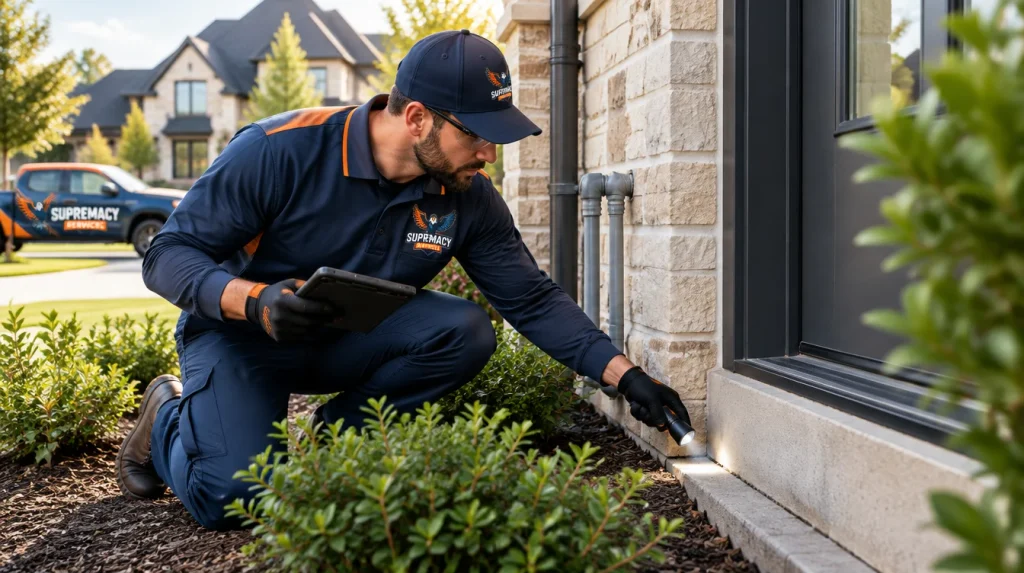
Pest control technician inspecting garage door seals and foundation gaps for potential pest entry points at a Dallas home.
Professional inspections help identify pest entry points, structural vulnerabilities and areas that may require additional treatment.

A professional exterior pest control visit should begin with understanding the problem, not automatically spraying every accessible surface.

Depending on the pest and service scope, the process may include:

  1. Exterior inspection: Examine foundation areas, door thresholds, window openings, landscaping and other potential entry locations.
  2. Pest identification: Determine which insects are present and whether exterior treatment is appropriate.
  3. Risk assessment: Review drainage, moisture, outdoor storage and conditions supporting pest activity.
  4. Targeted treatment: Apply suitable products only where authorized and needed, following label restrictions.
  5. Prevention recommendations: Identify sealing, sanitation and moisture-control improvements.
  6. Follow-up planning: Establish monitoring and reassessment based on activity and treatment instructions.

Before hiring a company, ask what pests are included, which areas will be inspected, whether additional visits cost extra and how treatment decisions are made.

A service plan should clearly distinguish scheduled visits from pesticide application frequency.

How Can Homeowners Make Perimeter Pest Control More Effective?

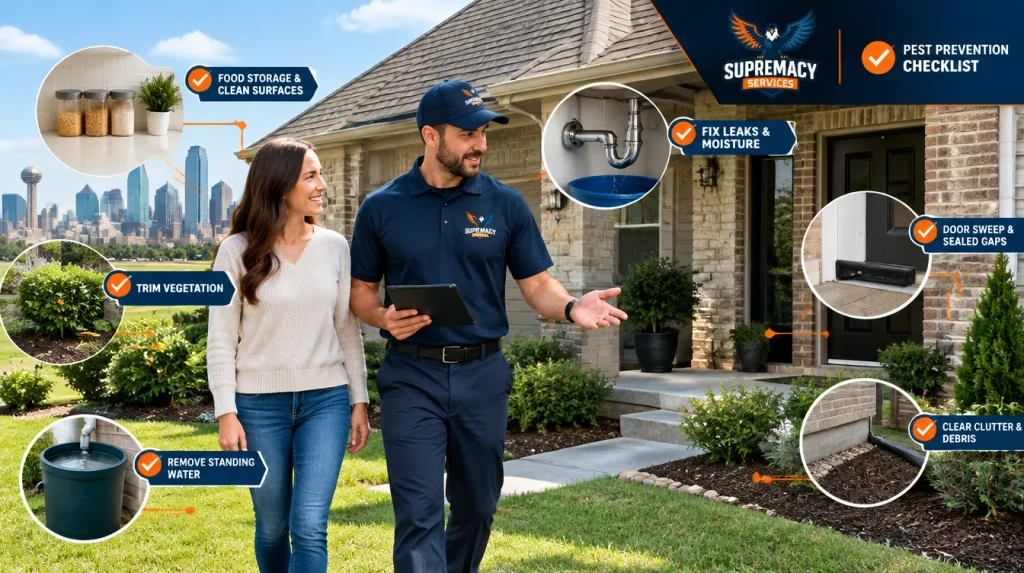
North Texas home showing pest prevention measures including sealing door gaps, fixing water leaks, trimming shrubs and clearing debris
Sealing entry points, reducing moisture and maintaining landscaping can support a more effective perimeter pest prevention plan.

Perimeter treatments generally work best as part of a broader pest management strategy.

Exterior pest prevention checklist

Home maintenance checklist

0 of 8 completeInspect door sweeps and garage-door sealsRepair leaking outdoor faucets and irrigation linesKeep mulch and vegetation from covering foundation inspection areasRemove leaf litter and unnecessary storage against exterior wallsSeal accessible gaps around utility penetrationsKeep trash containers closed and cleanCheck exterior drainage after heavy rainfallRecord recurring pest activity and its location

Reset checklist

These steps help reduce the conditions that attract pests and create opportunities for insects to enter the home.

Why prevention matters more than repeated spraying

A pesticide treatment may control exposed pests without correcting the underlying reason they are present.

For example, if cockroaches repeatedly enter through a damaged door sweep near a damp garage, addressing the gap and moisture can be an important part of long-term control.

This combined approach is consistent with integrated pest management principles.


Frequently Asked Questions

1. How often should you spray the outside of your house for bugs?

There is no universal spraying interval. Quarterly service reviews are common as a planning approach, but actual pesticide applications should depend on pest activity, the product label and property conditions.

2. Is perimeter pest control needed every month?

Not for every home. Monthly monitoring may be useful for persistent problems, but monthly pesticide application is not automatically necessary or permitted for every product.

3. Can perimeter pest control last three months?

Some treatments may provide residual control over an extended period, but performance varies. Three months should not be treated as a guaranteed duration.

4. Should I spray again after heavy rain?

Not automatically. Review the product’s rain-related instructions and monitor pest activity. Contact the applicator before arranging retreatment if you are uncertain.

5. What time of year is best for perimeter pest control in Dallas?

The best timing depends on pest activity. Spring and summer often warrant attention to outdoor insects, while fall is a useful time to inspect entry points. Prevention and monitoring are valuable year-round.

6. Does perimeter pest control prevent all insects from entering?

No. It can help manage certain pests, but insects may still enter through gaps, untreated areas or other routes. Exclusion and moisture control remain important.

7. Is exterior-only pest control enough?

Sometimes, particularly for occasional outdoor invaders. Established indoor infestations, such as German cockroaches, generally require a different pest-specific approach.

8. How do I know if my perimeter treatment has stopped working?

Repeated pest activity, especially in the same entry locations, can indicate that the control strategy needs reassessment. A single insect does not necessarily mean the treatment failed.

9. Is quarterly pest control worth the cost?

It may be worthwhile for homes with recurring seasonal pest pressure, provided visits include meaningful inspection and appropriate prevention measures. Compare the actual services and follow-up terms rather than visit frequency alone.


Keep Your North Texas Home Protected With the Right Treatment Schedule

For many Dallas-area homeowners, quarterly pest control service reviews offer a useful starting point. However, the right maintenance plan depends on the pests involved, the home’s condition and the results of previous treatments.

A professional assessment can help determine whether your property needs regular exterior maintenance, targeted treatment or improvements to pest entry points.

Contact Supremacy Services to discuss perimeter pest control for your Dallas or DFW home and develop a maintenance approach based on your property’s needs.

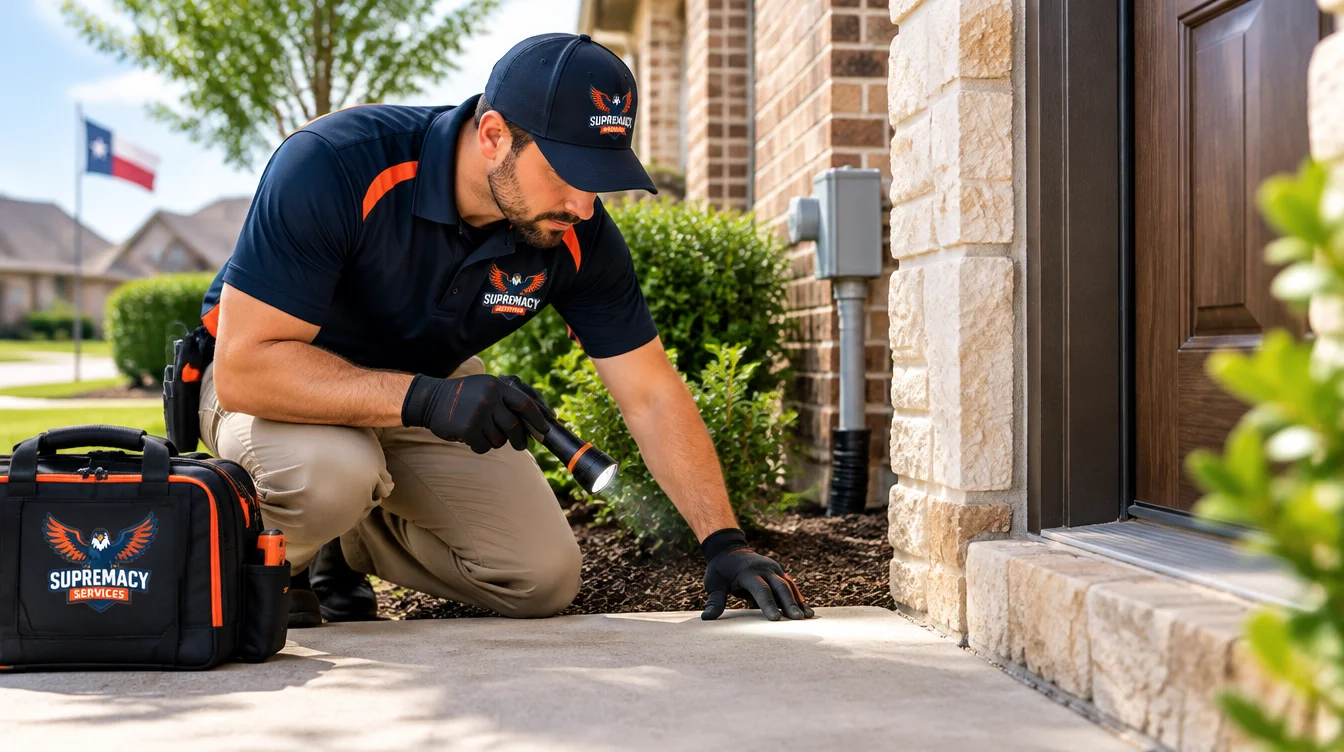
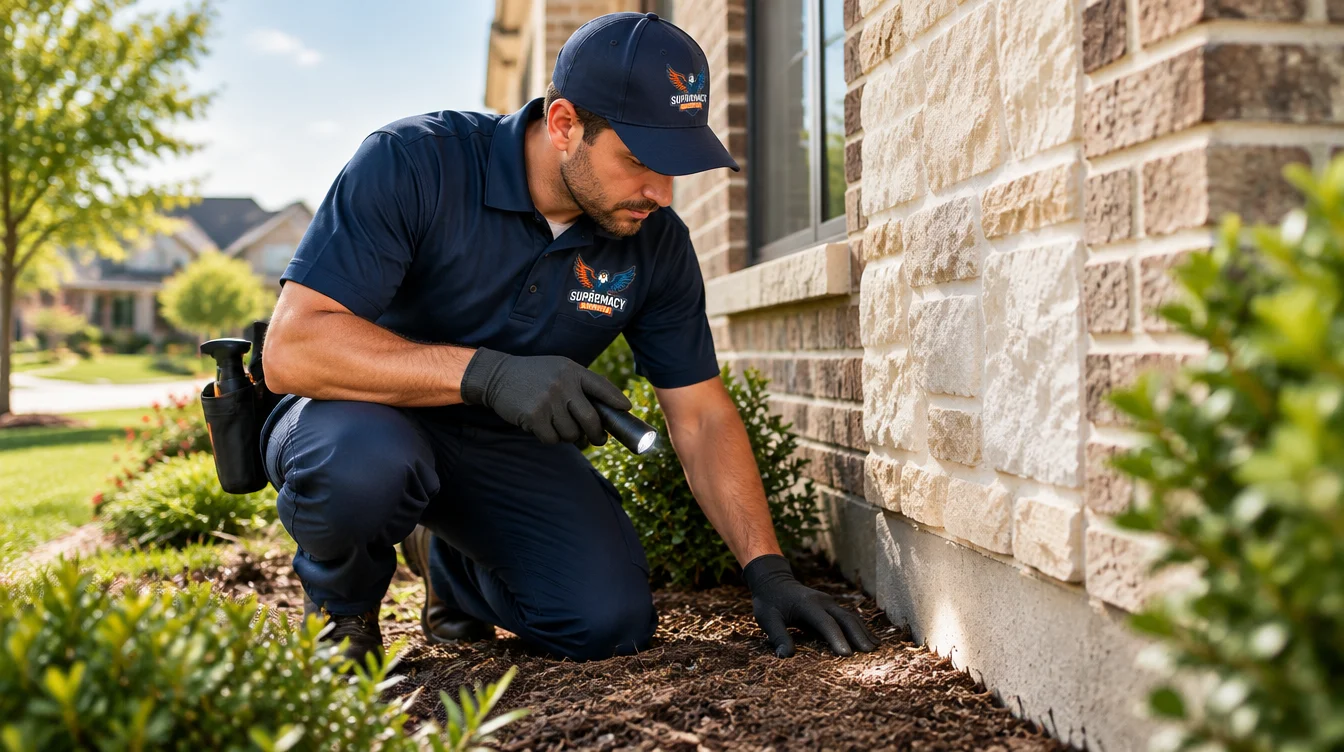
Supremacy Services technician applying exterior perimeter pest control around the foundation of a Dallas home

How Does Perimeter Pest Control Work Around a House?

Perimeter pest control works by targeting the exterior areas where crawling insects live, travel or attempt to enter a house. Instead of waiting until ants, cockroaches, spiders and other occasional invaders appear indoors, the treatment focuses on the foundation, structural openings and other exterior transition points.

For Dallas-Fort Worth homeowners, the important point is that perimeter pest control is more than simply “spraying around the house.” An effective program starts with identifying pest pressure and entry points, then combines appropriately labeled exterior treatments with practical prevention such as sealing gaps, reducing moisture and correcting conditions that give pests food, water or shelter.

That approach is consistent with Integrated Pest Management, or IPM: identify the pest, reduce the conditions supporting it, block access where practical and use targeted control methods when needed.

Table of Contents

  1. What is perimeter pest control?
  2. How does perimeter pest control work?
  3. Where is perimeter pest control applied?
  4. What happens when insects cross the treatment?
  5. What pests can perimeter pest control help control?
  6. What perimeter treatment cannot solve
  7. Does the entire yard need to be sprayed?
  8. What should a professional perimeter service include?
  9. DIY vs. professional perimeter pest control
  10. How North Texas homeowners can improve exterior pest prevention
  11. Frequently asked questions

What Is Perimeter Pest Control?

Perimeter pest control is an exterior pest-management strategy that targets pest activity around a building’s foundation, entry points and other exterior areas where insects can approach or enter the structure.

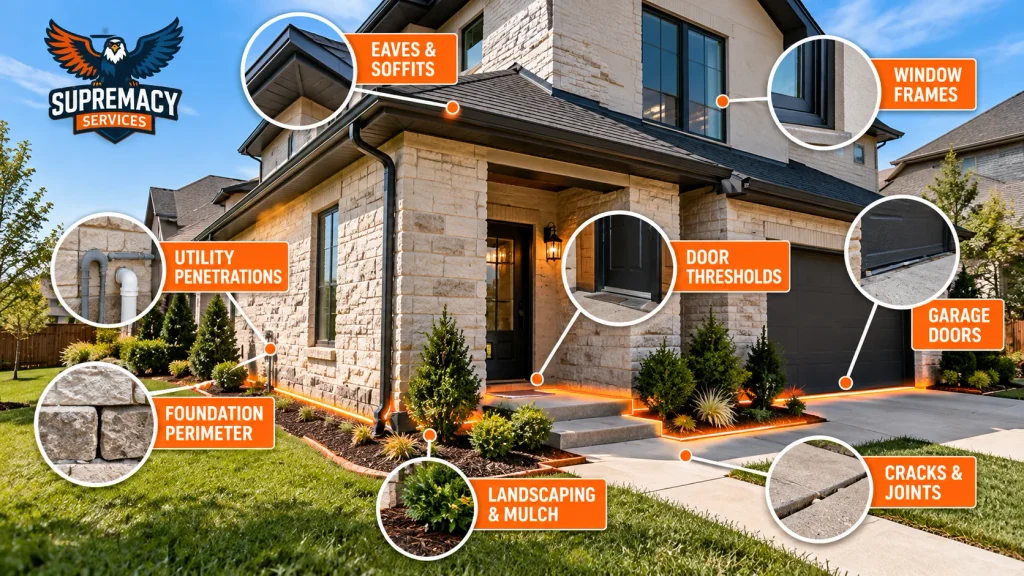
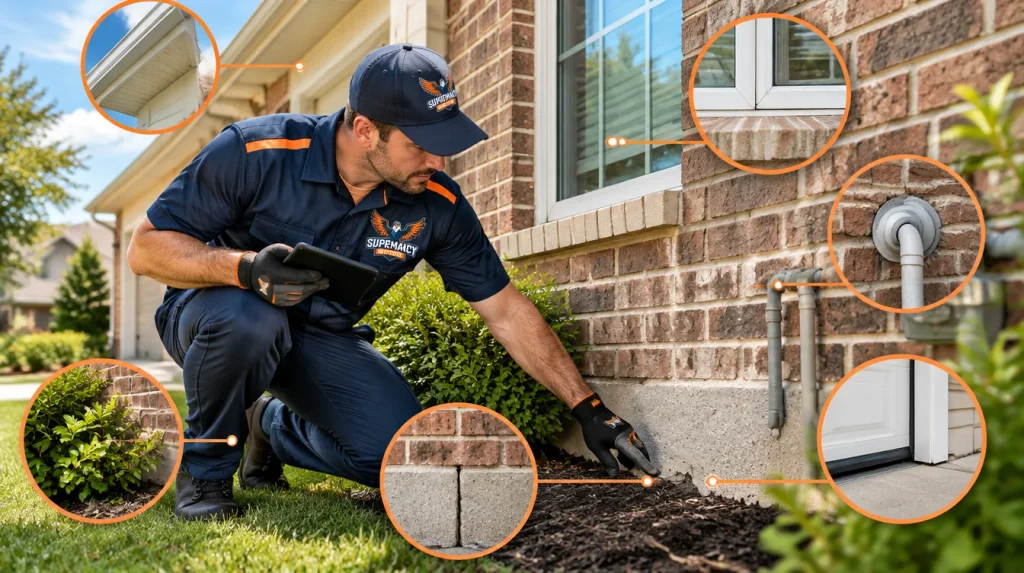
Illustrated Dallas home highlighting foundation perimeters, doors, windows, utility openings and other exterior pest treatment areas.
Perimeter pest-control inspections focus on foundations, door thresholds, window frames, utility penetrations and other areas where pests may enter a house.

The objective is preventive: reduce pest pressure before insects establish themselves inside the living space.

Depending on the pest, property and pesticide label, treatment may involve selected areas around:

  • the foundation;
  • doors and thresholds;
  • window frames;
  • garage entrances;
  • utility penetrations;
  • cracks and joints;
  • eaves and sheltered exterior locations;
  • landscaping immediately adjacent to the structure.

But treatment is only one part of prevention.

If a leaking hose bib keeps an area damp, vegetation touches the house, a door sweep has failed or insects can enter through an unsealed penetration, correcting those conditions can be just as important as applying a pesticide.

EPA’s Integrated Pest Management principles support this broader approach: understand the pest and use an appropriate combination of prevention, monitoring and control rather than depending automatically on pesticides alone.


How Does Perimeter Pest Control Work?

Perimeter pest control works by intercepting pest activity at the exterior of the structure while reducing the conditions and openings that allow pests to reach the interior.

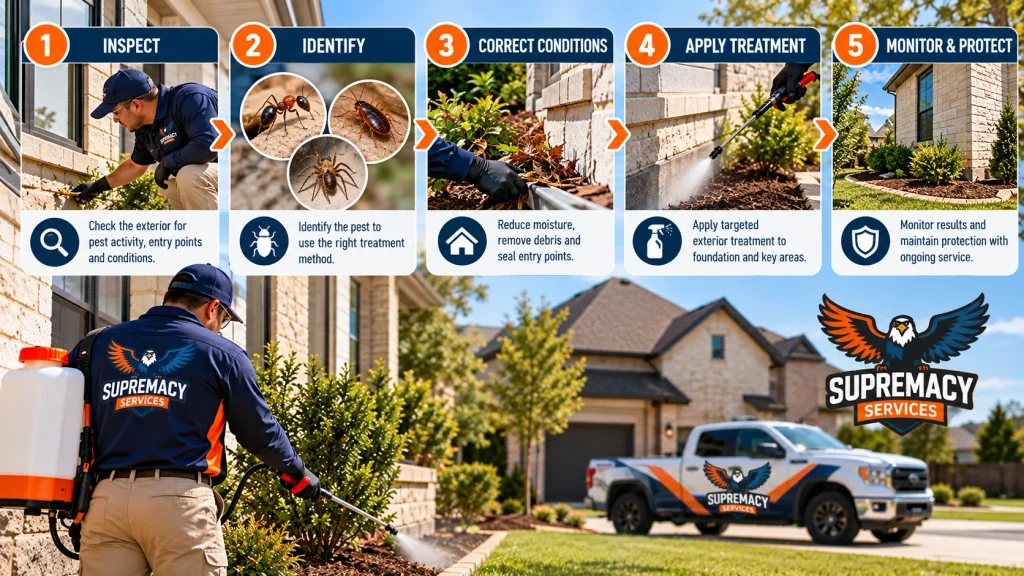
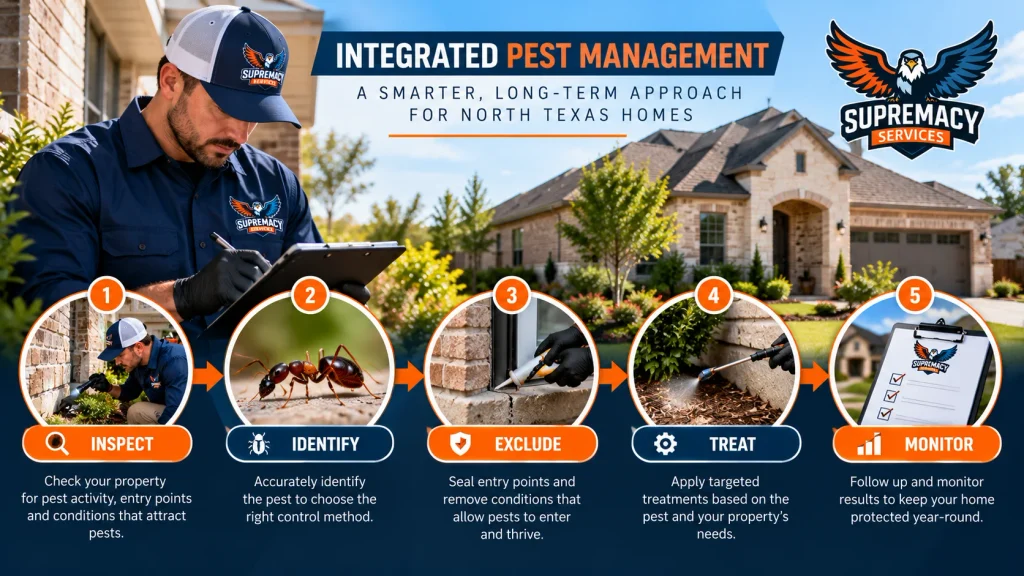
Five-step perimeter pest-control process showing inspection, pest identification, prevention, targeted treatment and monitoring.
Effective perimeter pest management follows five key steps: inspect, identify, correct contributing conditions, apply appropriate treatment and monitor results.

A professional program can be understood as five steps.

1. Inspect the exterior

The technician first needs to determine where pests are active and how the structure may be contributing to the problem.

That can mean looking at:

  • foundation transitions;
  • cracks and gaps;
  • doors;
  • windows;
  • garages;
  • utility lines;
  • plumbing penetrations;
  • exterior moisture;
  • vegetation;
  • mulch and debris;
  • eaves;
  • sheltered pest harborages.

Finding ten ants beside a driveway is different from finding a concentrated trail disappearing through a utility penetration.

The second observation gives the technician information about the route pests may actually be using.

2. Identify the pest

Identification matters because “bugs around the house” is not a diagnosis.

Ants, cockroaches, spiders, termites, fleas, mosquitoes and other pests behave differently and may require completely different control methods.

For example, some cockroach species commonly establish indoor infestations, while others primarily live outdoors and occasionally enter structures.

Likewise, ordinary perimeter insect treatment should never be assumed to substitute for a termite-control program.

3. Find pest routes and contributing conditions

Next comes the question: why are pests concentrating here?

A technician may find:

  • moisture beside the foundation;
  • vegetation contacting the building;
  • damaged weather stripping;
  • gaps beneath exterior doors;
  • plumbing or utility openings;
  • clutter or debris;
  • protected landscaping;
  • food sources;
  • exterior lighting attracting insects;
  • cracks or construction joints.

Correcting these conditions helps reduce future pressure rather than continually treating the symptoms.

4. Apply appropriate targeted exterior treatment

Where pesticide treatment is justified, the product must be labeled for the pest, location and application method.

Treatment can then be directed toward appropriate foundation zones and pest travel or entry areas.

This is why homeowners should be cautious about treating “perimeter spray” as one universal technique.

The legal treatment area, application rate, surfaces that may be treated, weather restrictions and environmental precautions depend on the actual pesticide label.

5. Monitor and adjust

Pest management should not end when the application is finished.

Recurring activity can indicate:

  • an untreated source;
  • an entry point;
  • moisture or sanitation problems;
  • incorrect pest identification;
  • an established indoor infestation;
  • a pest requiring a different treatment strategy.

The objective is not simply to spray the same locations indefinitely. It is to determine whether pest pressure is actually declining and why.


Where Is Perimeter Pest Control Applied?

Professional perimeter treatment is normally concentrated around pest-prone exterior areas rather than indiscriminately spraying every exterior surface.

Common inspection and potential treatment zones include:

AreaWhy it matters
Foundation perimeterCrawling insects often travel near the structure
Door thresholdsCommon transition point between outdoors and indoors
Window areasGaps and sheltered edges can provide access
Garage doorsLarge openings and worn seals can admit pests
Utility penetrationsPipes, cables and conduit can leave structural gaps
Cracks and jointsSmall openings can become insect pathways
Eaves/sheltered areasMay support spiders, webs or other pest activity
Landscaping near houseMoisture and shelter can support insects
Patio/porch transitionsStructural joints may become pest routes

The exact application must follow the label of the product being used.

Is there always a continuous chemical band around the house?

Not necessarily.

“Perimeter barrier” is useful homeowner terminology, but it should not be interpreted as permission to soak every surface surrounding a home.

EPA pesticide labeling can restrict outdoor applications on hard surfaces and near drains or areas where runoff could occur.

A professional should therefore select treatment areas according to the product label, pest pressure and conditions at the property.


What Happens When Insects Cross the Treatment?

This depends on the active ingredient, formulation, pest and application method.

Some exterior insecticides leave a residual deposit on treated surfaces. Susceptible insects may contact the treatment while crawling across or resting on those areas.

But homeowners should avoid assuming that every product:

  • works immediately;
  • repels insects;
  • transfers through a colony;
  • lasts the same amount of time;
  • survives every weather condition equally;
  • controls every insect.

Those claims are product-specific.

The correct question is therefore not simply, “What did you spray?”

Ask:

What pest are you targeting, where is the product being applied, and why is that treatment appropriate for this pest and location?

That question produces much more useful information.


Does Perimeter Pest Control Keep Bugs From Coming Inside?

It can significantly reduce exterior pest pressure and help prevent many crawling pests from entering, but no perimeter treatment should be presented as a physical force field around a house.

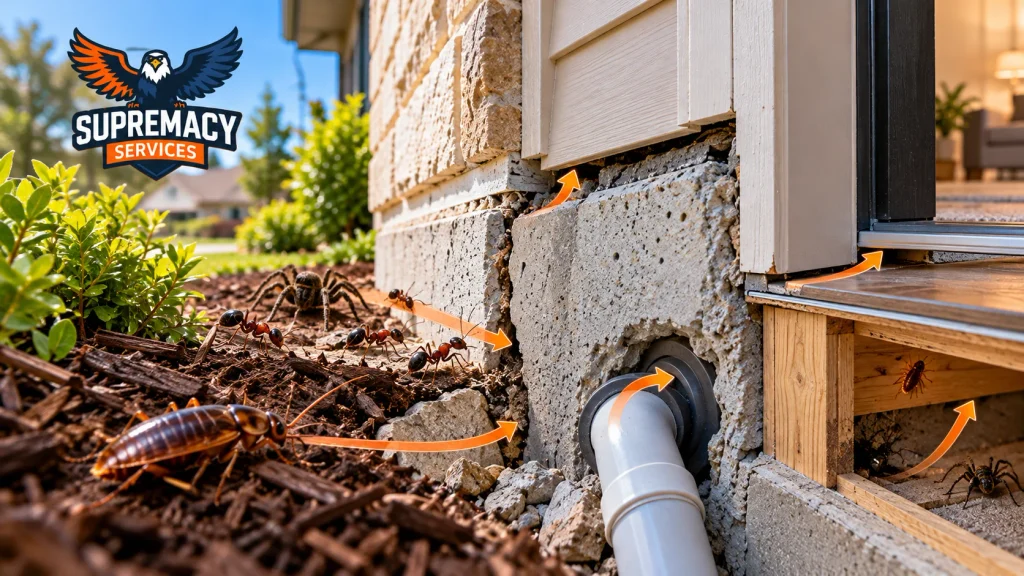
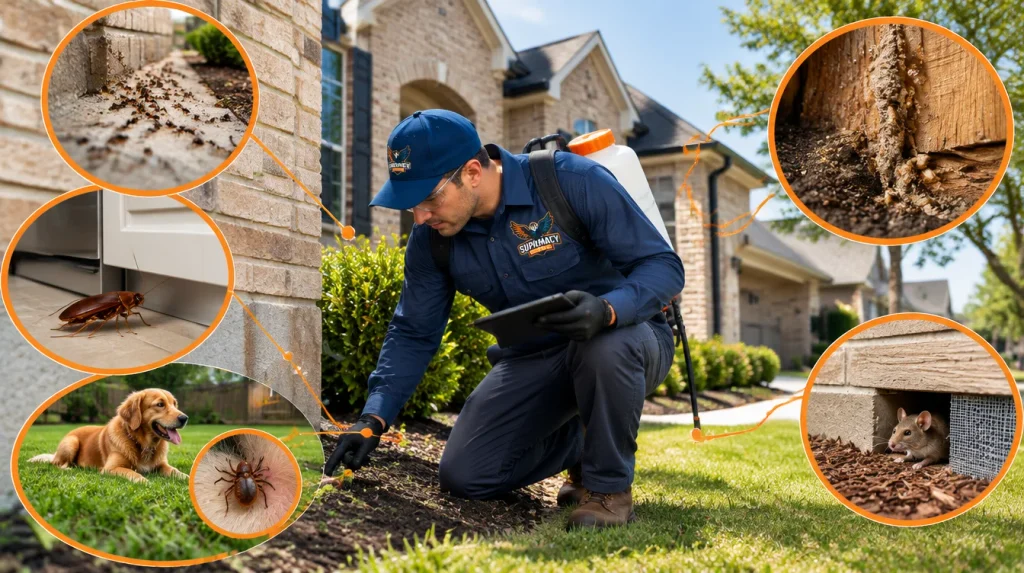
Ants, cockroaches and spiders approaching cracks, utility pipe openings and gaps around a home's foundation.
Crawling insects can use foundation cracks, utility penetrations and gaps around doors to move from exterior landscaping into a house.

Pests can still exploit untreated or accessible routes.

Imagine a home with excellent foundation treatment but:

  • a large gap beneath the garage door;
  • tree branches touching the roof;
  • standing water;
  • an open plumbing penetration;
  • torn screens;
  • piles of debris beside the foundation.

The pesticide is addressing only part of the problem.

That is why the strongest approach combines treatment with exclusion and habitat modification.

Seeing ants, cockroaches or spiders repeatedly moving toward your home? Supremacy’s perimeter pest-control service targets exterior pest pressure around foundations and common structural entry areas before it becomes an indoor problem.


What Pests Can Perimeter Pest Control Help Control?

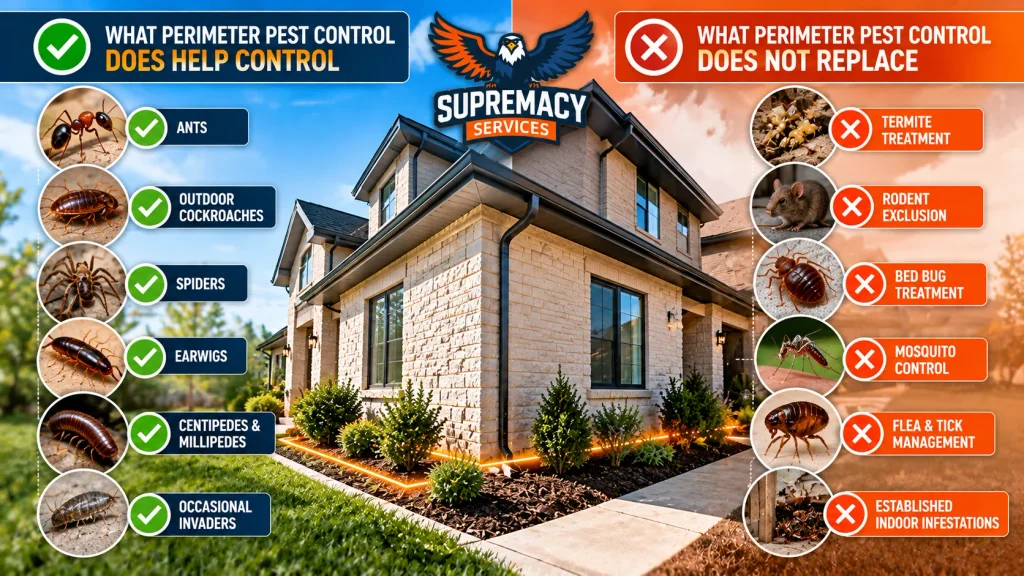
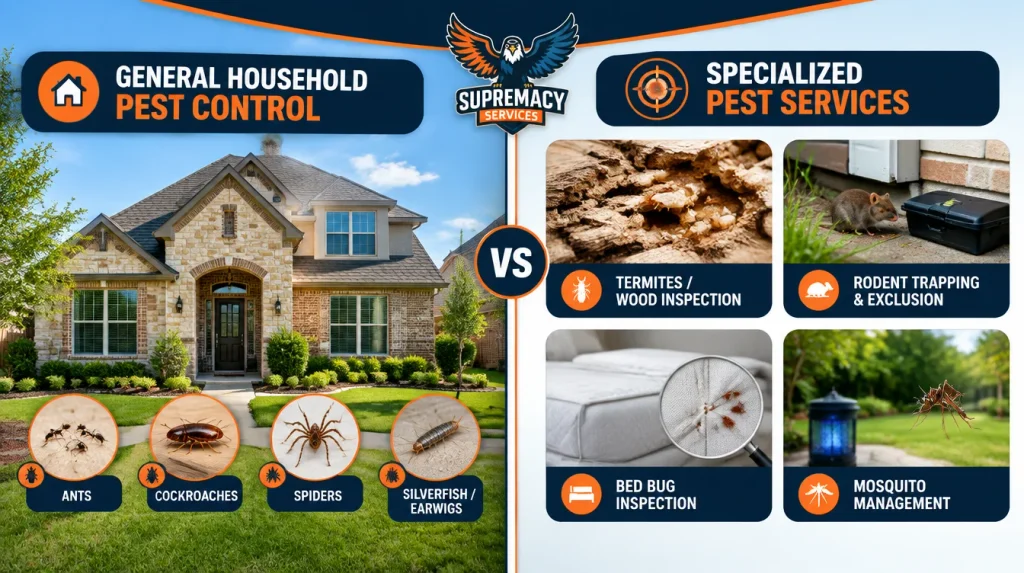
Comparison infographic showing crawling pests perimeter treatment may help control and pests requiring specialized management.
Exterior perimeter treatments may help manage ants, outdoor cockroaches and other crawling pests, but termites, rodents, bed bugs and mosquitoes often require different control strategies.

Exterior perimeter management is most relevant to pests that live outdoors or travel from outdoor areas toward a structure.

Depending on identification and the product being used, examples may include:

PestRole of perimeter management
AntsCan reduce trails and movement toward structural openings
Outdoor cockroachesHelps target exterior activity and entry routes
SpidersExterior management can reduce activity around sheltered structural areas
EarwigsCan help reduce occasional migration indoors
Centipedes/millipedesMay help where outdoor populations move toward structures
Some occasional invadersExterior prevention can reduce entry pressure

Correct identification still matters.

For example, an established indoor cockroach infestation may require sanitation, monitoring, baits and targeted interior treatment rather than relying on the exterior alone.


What Perimeter Pest Control Does Not Replace

This distinction is particularly important for homeowners comparing pest-control services.

Termite treatment

Ordinary perimeter pest control is not the same as termite treatment.

Subterranean termite management is a specialized structural pest-control category with different inspection, treatment and regulatory considerations.

If you see mud tubes, swarmers, suspicious wood damage or other potential termite evidence, request a termite evaluation rather than assuming routine exterior pest service will address it.

Rodent exclusion

Spraying around the foundation will not seal a roof gap used by rats or mice. Supremacy services

Rodent problems can require:

  • inspection;
  • trapping or other control;
  • monitoring;
  • sanitation;
  • structural exclusion.

Bed bugs

Bed bugs are primarily associated with sleeping and resting areas and require a completely different inspection and management strategy.

Mosquitoes

Mosquito management often focuses on breeding habitat, standing water, vegetation and other outdoor resting areas. It should not be treated as interchangeable with ordinary foundation-perimeter service. Supremacy services

Fleas and ticks

Outdoor flea and tick activity can involve lawns, shaded areas, wildlife or pets and may require a more specific yard-management strategy. Supremacy services

Established indoor infestations

If pests are already breeding indoors, exterior prevention alone may not correct the existing population.

This is especially important when activity occurs repeatedly in kitchens, bathrooms, wall voids or multiple rooms.


Does the Entire Yard Need to Be Sprayed?

No. A foundation-oriented perimeter treatment and a full-yard pest treatment are not automatically the same service.

Treatment should correspond to the target pest and the pesticide label.

Blanket application is not inherently better.

EPA recommends minimizing unnecessary pesticide use as part of IPM, and outdoor pesticide labels may contain restrictions designed to prevent runoff into storm drains, drainage ditches, gutters and surface water.

That matters in residential neighborhoods where driveways, sidewalks and curb systems can move water away from the property.

A homeowner should expect the applicator to know:

  • which surfaces may legally be treated;
  • where runoff could occur;
  • applicable weather restrictions;
  • the pest being targeted;
  • the label application rate;
  • whether spot, crack-and-crevice or broader treatment is permitted.

Does Rain Wash Away Perimeter Pest Control?

There is no accurate universal yes-or-no answer.

Rain restrictions and weather resistance depend on the product label, formulation, application surface and timing.

Some pesticide labels specifically prohibit application during rain or where runoff may occur.

EPA also advises consumers to prevent pesticides from entering storm drains, gutters, drainage ditches and surface waters.

For homeowners, the practical takeaway is simple:

Don’t judge an exterior treatment solely by whether it “looks waterproof.” Ask whether weather conditions and application timing comply with the product label.


How Long Does Perimeter Pest Control Last?

There is no universal lifespan for every perimeter pest treatment.

Residual performance can vary with:

  • active ingredient;
  • formulation;
  • treated surface;
  • sunlight;
  • rainfall and irrigation;
  • pest species;
  • environmental conditions;
  • label requirements.

Recurring service schedules should therefore not be interpreted as proof that every pesticide lasts exactly that long.

The treatment plan should reflect the product being used, pest pressure and what the technician observes at subsequent visits.

Supremacy’s existing perimeter service is structured around recurring exterior protection. Homeowners considering that program can review the dedicated Perimeter Pest Control in Dallas service page for the company’s current service scope.


Why Exterior Pest Pressure Matters in North Texas

North Texas homes can experience pest pressure around the structure throughout different parts of the year, but the conditions vary property by property.

A home with dense landscaping and frequent irrigation may present different conditions from a property with a dry, open perimeter.

Useful factors to inspect include:

Moisture

Look for:

  • leaking outdoor faucets;
  • irrigation overspray;
  • poor drainage;
  • damp mulch;
  • standing water;
  • plumbing leaks.

Many pests benefit from reliable moisture.

Vegetation

Shrubs, grass and tree branches touching the structure can provide shelter or routes toward the house.

Texas A&M’s homeowner ant guidance recommends keeping plants and grass away from foundations, repairing leaks, sealing cracks and trimming vegetation away from buildings.

Mulch, leaf litter and debris

Protected, damp organic material can create insect habitat immediately beside a house.

Exterior openings

North Texas homeowners should periodically inspect:

  • door sweeps;
  • window screens;
  • garage seals;
  • utility penetrations;
  • plumbing openings;
  • foundation cracks;
  • vents and other accessible openings.

A pest problem can sometimes be reduced more effectively by correcting an entry route than repeatedly treating insects after they cross it.


What Should a Professional Perimeter Pest-Control Service Include?

A good professional service should begin with inspection and pest identification rather than automatically applying the same treatment to every property.

A useful process looks like this:

1. Property inspection

Identify current pest activity, entry routes and contributing conditions.

2. Pest identification

Determine what is actually present before selecting a control method.

3. Exterior pest-pressure assessment

Inspect the foundation, doors, windows, garage, utilities, vegetation and other relevant areas.

4. Web or nest management where appropriate

Exterior webs or accessible pest harborages may be addressed as part of some service plans.

5. Targeted treatment

Apply appropriately labeled products to locations relevant to the identified pest.

6. Prevention recommendations

Explain moisture, sanitation, vegetation or exclusion changes that could reduce recurrence.
7. Service documentation

Homeowners should know what was observed, what was treated and what follow-up is recommended.

8. Monitoring and follow-up

Recurring sightings should trigger investigation rather than simply repeating treatment without determining why activity continues.

If your home repeatedly develops exterior ants, cockroaches, spiders or other crawling-pest activity, request a perimeter pest assessment from Supremacy Services to determine where pests are approaching the structure and what treatment scope is appropriate.


DIY vs. Professional Perimeter Pest Control

Homeowners can perform many important parts of exterior pest prevention themselves.

DIY prevention makes sense for:

  • replacing damaged door sweeps;
  • repairing screens;
  • sealing appropriate structural gaps;
  • trimming vegetation;
  • removing debris;
  • correcting moisture problems;
  • improving food and garbage storage;
  • monitoring where pests appear.

If homeowners use pesticides themselves, EPA advises them to read the label first and follow all directions, precautions and restrictions.

Do not assume that using more pesticide improves control.

Professional service becomes more useful when:

  • pests repeatedly return;
  • you cannot identify the insect;
  • activity is widespread;
  • several entry routes are involved;
  • indoor activity continues despite exterior prevention;
  • specialized pests are suspected;
  • pesticide use requires knowledge you do not have;
  • previous DIY treatments have not solved the problem.

Texas regulates structural pest control performed for compensation, and pest-control businesses and applicable professionals performing this work must meet state licensing requirements. Supremacy services


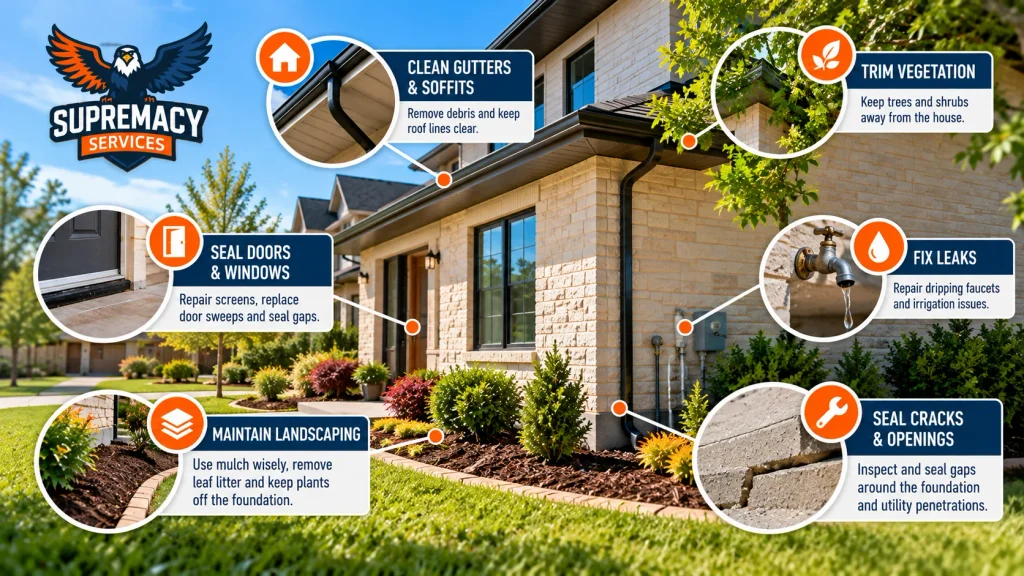
How North Texas Homeowners Can Improve Perimeter Pest Prevention

North Texas home exterior pest-prevention infographic showing vegetation trimming, leak repairs, sealed doors and foundation maintenance.
Simple home maintenance steps, including sealing gaps, controlling moisture and trimming vegetation, can improve the effectiveness of perimeter pest prevention.

Treatment works best when the home itself is made less attractive and accessible to pests.

Use this exterior checklist:

Around the foundation

  • Remove unnecessary debris.
  • Inspect cracks and openings.
  • Check utility penetrations.
  • Avoid allowing vegetation to press against the structure.

  • Investigate persistently damp areas.
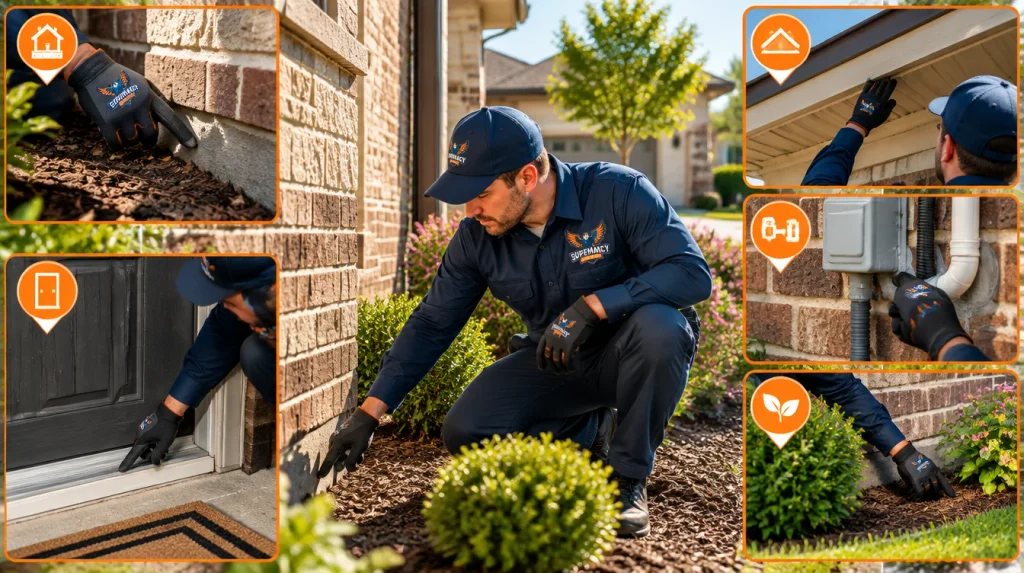
Doors and windows

  • Replace damaged screens.
  • Check weather stripping.
  • Inspect door sweeps.
  • Look for daylight beneath exterior doors.
  • Seal appropriate gaps.

Landscaping

  • Trim vegetation away from the house where practical.
  • Remove unnecessary leaf litter.
  • Avoid creating consistently damp shelter beside the foundation.
  • Correct irrigation that continually wets the building perimeter.

Water and sanitation

  • Repair leaks.
  • Remove unnecessary standing water.
  • Keep garbage containers closed.
  • Clean food spills.
  • Avoid leaving pet food accessible overnight.

Monitor activity

Note:

  • what pest you see;
  • where you see it;
  • time of day;
  • whether it appears indoors or outdoors;
  • where trails disappear;
  • whether sightings increase after rain or irrigation.

Those observations can make a professional inspection substantially more useful.


Perimeter Pest Control vs. Indoor Pest Control

The two strategies solve different problems.

Perimeter/exterior controlInterior control
Focuses on pest pressure outsideFocuses on pests already inside
Targets approach and entry areasTargets indoor activity zones
Strong preventive roleOften corrective
Works well with exclusionMay require sanitation and monitoring
Can reduce need for routine indoor treatmentMay be necessary for established infestations

The best approach is not automatically “inside” or “outside.”

It depends on where the pest is living and how it is entering.

A few outdoor cockroaches moving through a damaged garage seal present a different problem from an established German cockroach population reproducing inside a kitchen.

Treatment should follow the evidence.


How Is Perimeter Pest Control Different From Preventive Pest Control?

Perimeter pest control is a method or treatment zone.

Preventive pest control is a broader strategy.

Preventive pest management can include:

  • exterior treatment;
  • inspection;
  • monitoring;
  • exclusion;
  • sanitation;
  • moisture correction;
  • vegetation management;
  • recurring evaluation.

That distinction matters because pesticide application alone cannot correct every condition responsible for pest activity.


Is Perimeter Pest Control Worth It?

Perimeter pest control can be worthwhile when a house experiences recurring exterior pest pressure from ants, outdoor cockroaches, spiders or other crawling insects that approach the structure.

Its value is highest when the service is based on inspection and combined with prevention.

It is less likely to solve the problem by itself when:

  • pests are already breeding indoors;
  • rodents are entering through structural openings;
  • termites are involved;
  • bed bugs are present;
  • mosquitoes are the main concern;
  • moisture or sanitation problems remain uncorrected.

The question isn’t simply, “Should my house be sprayed?”

A better question is:

Where are the pests coming from, and what combination of treatment and prevention will interrupt that route?


Frequently Asked Questions

How does perimeter pest control work around a house?

It targets pest activity around the exterior foundation and common entry areas so crawling insects are less likely to move indoors. Effective programs also address entry points, moisture, vegetation and other conditions supporting pests.

Where do pest-control technicians spray outside a house?

Treatment locations depend on the pest and pesticide label but may include permitted areas around foundations, cracks, door and window transitions, utility penetrations and other exterior pest routes.

Does perimeter pest control stop all bugs?

No. Different pests require different strategies. Termites, bed bugs, rodents, mosquitoes and established indoor infestations may require specialized treatment rather than ordinary perimeter control.

Do I still need indoor pest control if the outside is treated?

Not necessarily. Exterior prevention may be sufficient where the problem originates outside and no established indoor infestation exists. Active indoor infestations may require additional inspection and targeted treatment.

Can I spray my own house perimeter?

Homeowners can use consumer pesticide products where legally permitted, but the product must be labeled for the pest, location and intended application. Read and follow the complete label rather than copying a professional application method.

Does rain wash away exterior pest control?

It depends on the product, surface and timing. Some labels prohibit application during rain or where runoff can occur. Always follow the specific pesticide label.

How often should perimeter pest control be applied?

There is no universal interval that applies to every product and property. Frequency should reflect the pesticide label, pest pressure, environmental conditions and treatment plan.

Is perimeter pest control the same as termite treatment?

No. Termite management is a specialized category involving different inspection and treatment methods. Routine general perimeter pest service should not be assumed to provide termite protection.

What can I do between professional treatments?

Reduce moisture, repair screens and door sweeps, seal appropriate openings, trim vegetation away from the structure, remove debris and monitor where pests are appearing.


Protect the House by Understanding the Route In

Perimeter pest control works best when it is treated as part of a pest-management system rather than simply a line of pesticide around a house.

Start by identifying the pest.

Find where it is living and traveling.

Correct the moisture, shelter or structural opening that supports the problem.

Then use targeted treatment where appropriate.

That combination gives Dallas-Fort Worth homeowners a more sustainable approach to preventing pests from moving from the yard and exterior environment into the home.

Seeing recurring ants, cockroaches, spiders or other crawling pests around your Dallas-Fort Worth home? Explore Supremacy Services’ Perimeter Pest Control program or request an exterior pest assessment to identify entry areas and build the right prevention plan for your property.

Supremacy Services technician performing preventive pest control inspection at a North Texas home

What Is Preventive Pest Control and Is It Worth It in North Texas?

Preventive pest control is a proactive approach to keeping pests from becoming established in or around your home. Instead of waiting until ants cover a countertop, cockroaches appear in the kitchen or rodents reach the attic, prevention focuses on identifying pest pressure, reducing food, water and shelter, blocking entry points, monitoring activity and using targeted treatments when appropriate.

For many North Texas homes, preventive pest control can be worthwhile when pest activity repeatedly develops around the property. But it does not mean every home needs constant indoor spraying or that every pest should be treated the same way.

The better approach is property-specific prevention: understand which pests are present, determine why they are there and intervene appropriately before a small problem becomes harder to manage.

That principle closely follows Integrated Pest Management, or IPM. The EPA describes IPM as an approach that combines information about pests with appropriate management methods while considering effectiveness, cost and risks to people, property and the environment.

Table of Contents

  1. What Is Preventive Pest Control?
  2. How Does Preventive Pest Control Work?
  3. Preventive vs. Reactive Pest Control
  4. Is Preventive Pest Control Worth It in North Texas?
  5. Which Pests Can Prevention Help With?
  6. What Does Professional Preventive Pest Control Include?
  7. How Often Is Preventive Pest Control Needed?
  8. DIY vs. Professional Prevention
  9. How Much Does Preventive Pest Control Cost?
  10. When Prevention Is Not Enough
  11. North Texas Pest-Prevention Checklist
  12. Frequently Asked Questions

What Is Preventive Pest Control?

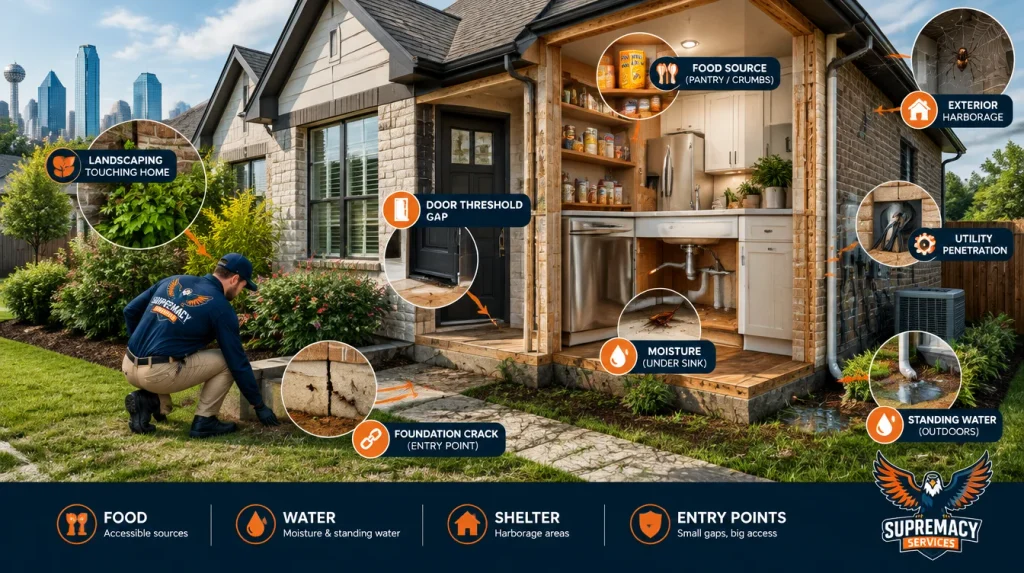
North Texas home showing common pest entry points, food, moisture and shelter conditions
Preventive pest control targets the conditions that attract pests, including food, water, shelter and entry points.

Preventive pest control means reducing the conditions that allow pests to enter, survive and reproduce around a property before a significant infestation develops.

It is broader than simply applying pesticide around a house.

A sound preventive strategy can combine:

  • inspection and pest identification;
  • monitoring;
  • sealing appropriate entry points;
  • correcting moisture problems;
  • reducing food and shelter;
  • managing exterior conditions;
  • removing webs or nests where appropriate;
  • targeted exterior or interior treatment when justified; and
  • follow-up to determine whether pest activity is changing.

The EPA specifically recommends denying pests the food, water and shelter they need and closing entryways they can use to enter a building.

That distinction matters.

A homeowner who repeatedly sprays every visible insect is practicing reactive control. A homeowner who discovers why pests are entering, removes favorable conditions and addresses the entry route is working preventively.

Preventive pest control is not necessarily “spray everywhere”

Effective prevention should be based on the pest and property.

For example, prevention might involve repairing a leak beneath a sink, sealing an appropriate gap around a plumbing penetration, changing how food is stored, removing harborage near the foundation or treating a specific exterior area where pest activity has been identified.

The objective is not to maximize pesticide use. It is to minimize the conditions that allow a pest problem to develop.

How Does Preventive Pest Control Work?

Preventive pest management generally follows five principles:

1. Identify the pest

Treatment begins with knowing what you are dealing with.

An ant problem is not automatically managed the same way as cockroaches, spiders, termites, rodents or mosquitoes.

Correct identification helps determine where the pest lives, what attracts it and which control methods are appropriate.

2. Find what is supporting the activity

Pests generally need some combination of food, moisture, shelter and access.

A preventive inspection may therefore look beyond the insects themselves.

Possible contributing conditions include:

  • plumbing leaks;
  • food residue;
  • improperly stored food;
  • pet food left accessible;
  • standing water;
  • clutter;
  • vegetation contacting the structure;
  • debris around exterior walls;
  • damaged door seals;
  • openings around utilities; and
  • protected hiding or nesting locations.

EPA guidance similarly recommends eliminating food and water sources, reducing shelter and closing pest entry points.

3. Reduce access

A pest cannot establish itself indoors if it cannot reach suitable indoor conditions.

Depending on the pest and construction, prevention can include inspecting:

  • doors;
  • windows;
  • garages;
  • utility penetrations;
  • plumbing openings;
  • vents;
  • foundation areas;
  • rooflines; and
  • other structural gaps.

Exclusion is especially important because repeatedly killing pests after they enter does not necessarily address how new pests are getting inside.

4. Target active or high-risk areas

Where treatment is justified, the application should match the pest, location and product label.

For many crawling pests originating outdoors, exterior management around likely entry areas can form part of the strategy.

This is also why preventive pest control and perimeter pest control overlap without meaning exactly the same thing.

Perimeter treatment is one tool.

Preventive pest management is the broader strategy.

5. Monitor what happens afterward

Good pest management asks another question after treatment:

Did the problem actually improve?

Monitoring helps determine whether pest activity is declining, moving or returning.

That information can reveal whether additional treatment, exclusion, sanitation changes or a different strategy is needed.

Preventive vs. Reactive Pest Control

Preventive pest control compared with reactive pest treatment at North Texas homes
Preventive pest control addresses vulnerabilities before pests become established, while reactive treatment responds to an existing problem.

The biggest difference is when and why action occurs.

Preventive pest controlReactive pest control
Begins before a major infestation developsBegins after noticeable pest activity
Focuses on risk conditions and entry pointsFocuses primarily on an existing problem
Includes monitoringUsually begins with visible evidence
May use exclusion and sanitationMay require corrective treatment
Can include targeted exterior treatmentMay require interior and exterior treatment
Designed to reduce recurring problemsDesigned to eliminate/control current activity
Often ongoingMay be one-time or multi-visit

Neither approach is automatically better in every situation.

If you already have an established German cockroach infestation, termite activity, rodents in an attic or bed bugs, prevention alone is no longer the primary job. The existing infestation must first be properly assessed and controlled.

Prevention becomes particularly valuable after control because it helps reduce the conditions that contributed to the problem.

Is Preventive Pest Control Worth It in North Texas?

Preventive pest control can be worth it for North Texas homes with recurring pest pressure, multiple exterior entry opportunities or conditions that repeatedly attract pests. It is less compelling when a pest problem is genuinely isolated and its cause can be corrected easily.

The decision should therefore be based on risk rather than fear.

North Texas also has environmental conditions that make year-round monitoring reasonable. National Weather Service 1991–2020 normals for Dallas/Fort Worth show an annual mean temperature of 66.6°F, about 37 inches of annual precipitation and an average of 20 days reaching 100°F each year.

Those conditions do not mean every Dallas house will have the same pests. They do mean homeowners experience substantial seasonal changes in temperature and moisture that can change where insects and other pests find food, water and shelter.

Preventive service may make sense when:

  • ants repeatedly appear indoors;
  • cockroaches regularly enter from exterior areas;
  • spiders repeatedly build webs around the structure;
  • scorpions are repeatedly encountered;
  • your property has substantial landscaping near the home;
  • pest activity returns seasonally;
  • you have previously dealt with an infestation;
  • exterior pest pressure is consistently high; or
  • you would rather monitor and address problems before they become established indoors.

A recurring program may be less necessary when:

  • the problem was a single accidental invader;
  • the source has been identified and permanently corrected;
  • there is little recurring activity;
  • reasonable exclusion has solved the problem; or
  • monitoring shows no continuing pest pressure.

The right question is therefore not:

“Does everybody need preventive pest control?”

It is:

“Does this property experience enough recurring pest pressure to justify ongoing prevention?”

Which Pests Can Prevention Help With?

Common North Texas pests including ants, cockroaches, spiders, scorpions and mosquitoes around a home
North Texas homes can face year-round pest pressure from ants, cockroaches, spiders, scorpions, mosquitoes and other pests.

Prevention is useful for many common household pests, but the strategy changes by species.

PestPreventive focus
AntsFood control, moisture reduction, exclusion, nest/activity identification
CockroachesSanitation, moisture control, monitoring, exclusion and targeted treatment
SpidersReducing prey insects, webs and favorable exterior conditions
ScorpionsEntry-point management and reducing prey/harborage
WaspsMonitoring eaves and potential nesting areas
RodentsExclusion, sanitation and eliminating access to food
MosquitoesEliminating standing water and managing breeding/resting areas
TermitesInspection and termite-specific prevention/control strategy

Texas A&M AgriLife, for example, recommends measures for household ants that include keeping vegetation away from foundations, sealing cracks, repairing dripping plumbing and storing food properly.

Not every pest belongs in a standard general-pest program

This is important when comparing pest-control plans.

Termites, bed bugs, rodents, mosquitoes and certain other problems may require specialized inspection, treatment, monitoring or exclusion.

Do not assume that signing up for “preventive pest control” automatically covers every pest that could occur on your property.

Ask specifically what is included.

What Does Professional Preventive Pest Control Include?

Supremacy Services technician inspecting foundation gaps and pest entry points at a DFW home
A professional inspection can identify small gaps and environmental conditions that may allow pests to enter a home.

A professional preventive visit should involve more than arriving and spraying a predetermined route.

Depending on the property and service plan, a useful program may include:

  1. inspecting for current pest activity;
  2. identifying pest species or likely pest groups;
  3. checking common exterior entry areas;
  4. looking for conducive moisture or harborage conditions;
  5. evaluating exterior pest pressure;
  6. removing accessible webs or nests when part of the service;
  7. applying targeted treatment where appropriate;
  8. recommending sanitation or exclusion corrections;
  9. documenting activity; and
  10. monitoring changes during future visits.

Supremacy’s current DFW pest-control structure already follows this general direction: its pest-control page describes inspection and identification, web/nest removal, targeted applications, entry-point measures and perimeter treatment.

Seeing recurring ants, roaches, spiders or other household pests? Explore Supremacy Services’ DFW pest-control options to determine whether your home needs corrective treatment, preventive exterior protection or both.

Should a technician automatically spray inside every visit?

Not necessarily.

Interior treatment should be based on the pest, evidence and treatment plan rather than performed simply because a scheduled visit occurred.

For a home without indoor activity, exterior prevention, inspection and correction of conducive conditions may sometimes be more relevant.

Conversely, an established indoor infestation can require targeted interior treatment.

How Often Is Preventive Pest Control Needed?

There is no universal pest-control schedule appropriate for every North Texas home or every pest.

Frequency depends on:

  • the target pest;
  • previous infestation history;
  • property conditions;
  • product and treatment method;
  • season;
  • environmental exposure;
  • landscaping;
  • surrounding pest pressure; and
  • what monitoring reveals.

Some homes may benefit from scheduled recurring service. Others may require more intensive short-term treatment followed by less frequent monitoring.

This is why “quarterly” should not be treated as a biological rule.

It is a service schedule that may fit certain general-pest prevention programs.

Supremacy’s dedicated perimeter service, for example, is structured around recurring exterior protection. Homeowners considering that approach should compare what each visit includes rather than choosing a program based solely on visit frequency.

If pests repeatedly move from your yard or landscaping toward the house, review Supremacy’s perimeter pest-control service to see how exterior prevention differs from treating pests after they are already indoors.

DIY vs. Professional Prevention

Homeowners can do a significant amount of pest prevention themselves.

DIY prevention that makes sense

Start with nonchemical measures:

  • clean food spills and crumbs;
  • store food securely;
  • avoid leaving pet food accessible unnecessarily;
  • repair leaking plumbing;
  • remove standing water;
  • reduce clutter;
  • inspect packages before bringing them indoors;
  • maintain door and window seals;
  • seal appropriate structural openings;
  • keep unnecessary debris away from the house; and
  • monitor areas where pests repeatedly appear.

EPA guidance specifically recommends many of these measures before relying on pesticides.

If you use a pesticide yourself

Always use a product labeled for the intended pest and application site and follow its label directions.

Do not assume that applying more product makes treatment more effective.

EPA specifically advises consumers to read pesticide labels and follow all directions and precautions.

When professional help makes more sense

Consider professional assessment when:

  • you cannot identify the pest;
  • activity repeatedly returns;
  • pests are appearing in multiple areas;
  • DIY efforts are not solving the source;
  • rodents are entering the structure;
  • you suspect termites or other wood-destroying insects;
  • bed bugs may be present;
  • a nest is inaccessible or presents a stinging hazard;
  • treatment requires specialized equipment; or
  • you need a structured monitoring and prevention program.

Texas A&M’s household IPM education specifically teaches homeowners both preventive tactics and when professional assistance is appropriate for issues such as rodents or possible termite damage.

How Much Does Preventive Pest Control Cost?

There is no single reliable price for preventive pest control because the scope can differ substantially between properties and providers.

Factors that may affect price include:

  • home size and layout;
  • pest species;
  • current infestation severity;
  • initial treatment requirements;
  • treatment frequency;
  • interior versus exterior work;
  • exclusion needs;
  • specialized pests; and
  • what follow-up or callbacks are included.

Supremacy already has a dedicated Pest Control Cost in North Texas: 2026 Pricing Guide, so this article should not attempt to compete with that page by becoming another pricing guide.

Instead, homeowners evaluating preventive service should compare annual scope, not merely the cost of one visit.

Ask:

  1. What pests are included?
  2. What happens during the initial visit?
  3. What happens during recurring visits?
  4. Are interior treatments performed only when needed?
  5. Is exterior treatment included?
  6. Is exclusion included or quoted separately?
  7. Are termites included?
  8. Are rodents included?
  9. What happens if pests appear between scheduled visits?
  10. What is the total annual cost?

That produces a much more meaningful comparison.

When Prevention Is Not Enough

Preventive pest control is designed to reduce risk and catch problems early.

It is not a substitute for appropriate corrective treatment when an infestation is already established.

Warning signs that may justify a pest inspection

Watch for:

  • cockroaches repeatedly appearing indoors;
  • ant trails that continually return;
  • droppings;
  • gnawing;
  • scratching inside ceilings or walls;
  • termite mud tubes;
  • suspected wood damage;
  • bed-bug evidence around sleeping areas;
  • repeated scorpion sightings;
  • multiple wasp nests;
  • unexplained pest activity in several rooms; or
  • persistent activity despite sanitation and exclusion efforts.

At that stage, the objective changes from preventing a potential infestation to identifying and controlling an existing one.

Why Professional Licensing Matters in Texas

Structural pest-control services performed commercially in Texas are regulated.

The Texas Department of Agriculture’s Structural Pest Control Service licenses and regulates pest-management professionals applying pesticides in and around structures. Texas law also requires applicable businesses and individuals performing structural pest-control work for compensation to meet licensing requirements.

Before hiring a provider, homeowners can therefore verify that they are dealing with an appropriately licensed pest-control business.

Professional service also does not remove the homeowner’s role.

Ask what is being applied, where it will be applied, what pests it targets and what you should do before or after treatment.

North Texas Pest-Prevention Checklist

Home pest prevention checklist showing sealing gaps, moisture control and exterior maintenance in North Texas
Simple property-maintenance habits can work alongside professional pest control to reduce pest pressure around your home.

Use this simple checklist around your property.

Inside the home

  • Store food in sealed containers.
  • Clean crumbs and grease promptly.
  • Do not leave unnecessary pet food accessible overnight.
  • Repair dripping faucets and plumbing leaks.
  • Reduce cardboard and unnecessary clutter.
  • Check beneath sinks and appliances for moisture.
  • Inspect recurring pest locations rather than spraying blindly.
  • Monitor garages, utility areas and other transition spaces.

Around the exterior

  • Check door sweeps and weather stripping.
  • Inspect gaps around utility penetrations.
  • Look for pest trails around the foundation.
  • Reduce unnecessary debris next to exterior walls.
  • Check landscaping touching the structure.
  • Monitor eaves for webs and nests.
  • Correct avoidable standing-water problems.
  • Inspect areas where pests repeatedly appear.

During professional service

  • Ask which pests are covered.
  • Ask what activity the technician found.
  • Ask where treatment will occur.
  • Ask whether exclusion is recommended.
  • Ask what you can change around the property.
  • Keep records of recurring pest activity.
  • Reassess whether the program is reducing the problem.

Is Preventive Pest Control Really Worth the Money?

For a home with recurring pest pressure, preventive pest control can be worthwhile because it shifts the focus from repeatedly reacting to pests indoors to identifying and managing the conditions that allow them to reach the home.

But value depends on the service.

Paying for recurring visits that do not include inspection, monitoring or a clear treatment strategy is different from paying for a preventive program built around the actual property.

A good program should help answer:

What pests are we trying to prevent?

Where are they coming from?

What conditions are supporting them?

What can the homeowner correct?

What requires professional treatment?

Is pest activity actually decreasing?

Those questions are more important than simply asking how many times a technician visits each year.


Frequently Asked Questions

What is preventive pest control?

Preventive pest control is a proactive strategy that reduces the conditions allowing pests to enter, survive or reproduce around a property. It can combine inspection, monitoring, sanitation, exclusion and targeted treatments.

Is preventive pest control worth it?

It can be worthwhile for homes that experience recurring or predictable pest pressure. A property with little activity and easily corrected entry conditions may require less ongoing professional intervention.

Is preventive pest control the same as perimeter pest control?

No. Perimeter pest control is an exterior treatment strategy. Preventive pest management is broader and can include perimeter treatment, inspection, exclusion, sanitation, moisture management and monitoring.

Do I need pest control if I don’t see bugs?

Not automatically. The absence of visible pests does not prove there is no activity, but professional recurring treatment should be based on property conditions and risk rather than the assumption that every house needs the same program.

Does preventive pest control require indoor spraying?

Not necessarily. If there is no evidence of indoor activity, prevention may focus primarily on exterior conditions, entry points and monitoring. Existing indoor infestations may require targeted interior treatment.

Can I prevent pests myself?

Homeowners can perform many important preventive tasks themselves, including sanitation, moisture control, reducing clutter, eliminating standing water and sealing appropriate entry points. Persistent or difficult-to-identify activity may justify professional inspection.

How often should preventive pest control be done?

There is no universal schedule. Frequency depends on the pest, property, treatment method, infestation history, environmental conditions and monitoring results.

Are termites covered by preventive pest control?

Do not assume so. Termite inspection and treatment are specialized structural pest-control services and may be separate from a general household pest program.

What should I ask before signing up for recurring pest control?

Ask which pests are covered, what the initial and recurring visits include, whether interior treatment is performed only when necessary, whether exclusion is included, what happens between visits and what the total annual cost will be.

The Bottom Line for Dallas-Fort Worth Homeowners

Preventive pest control works best as a strategy, not simply a scheduled spray.

Start by reducing food, water, shelter and entry opportunities. Identify pests correctly. Monitor recurring activity. Use appropriately targeted control when necessary.

For North Texas properties that repeatedly experience ants, cockroaches, spiders, scorpions or other pest pressure around the structure, professional preventive service may add another layer of monitoring and protection.

For isolated problems, correcting the underlying cause may be enough.

If pests keep returning around your Dallas-Fort Worth home, schedule a pest-control assessment with Supremacy Services to determine whether you need preventive perimeter protection, targeted treatment for an existing infestation or a pest-specific solution.

Interior and exterior pest control treatment areas around a Dallas, TX home

Interior vs. Exterior Pest Control: Where Should Treatment Be Applied?

Pest control should be applied where the pest is entering, hiding, nesting or traveling—not automatically throughout every room of the house.

For many Dallas-Fort Worth homes dealing with occasional ants, spiders, cockroaches or other pests entering from outdoors, exterior treatment around appropriate entry and harborage areas can form an important part of the control strategy. Interior treatment becomes more relevant when pests are already established inside, the source is indoors, or activity is concentrated in areas such as kitchens, bathrooms, wall voids or other specific locations.

In some situations, the correct answer is both.

The important question isn’t simply interior vs. exterior pest control. It is: Where is the pest problem actually coming from, and which treatment locations are appropriate for that pest and product?

This guide explains how Dallas-Fort Worth homeowners can think about treatment zones, when indoor treatment may be necessary and why professional pest management should start with inspection rather than indiscriminate spraying.

Table of Contents

  1. Where Should Pest Control Be Applied?
  2. Interior vs. Exterior Pest Control
  3. Where Is Exterior Pest Control Applied?
  4. Where Is Interior Pest Control Applied?
  5. Which Pests Need Interior or Exterior Treatment?
  6. Does Pest Control Need to Spray Inside Every Visit?
  7. Why Inspection Comes Before Treatment
  8. DIY vs. Professional Pest Treatment
  9. What Dallas Homeowners Should Expect
  10. How to Reduce Pest Activity Between Treatments
  11. Frequently Asked Questions

Where Should Pest Control Be Applied?

Pest control should be concentrated around the pest’s actual activity, entry routes, harborages and other locations identified during inspection. Treatment may involve exterior areas, targeted interior locations, structural voids, or a combination of these areas.

The correct location depends on several questions:

  • What pest is present?
  • Is it primarily entering from outdoors or established indoors?
  • Where is activity being observed?
  • Where is the pest hiding or nesting?
  • What food, moisture or shelter is supporting it?
  • How is it entering the structure?
  • What does the pesticide label permit?
  • Can sanitation, exclusion, trapping or another non-chemical method solve part of the problem?

This is consistent with an Integrated Pest Management (IPM) approach.

Rather than relying solely on pesticide application, IPM combines identification, prevention, sanitation, structural correction, monitoring and appropriately selected treatments.

For example, sealing an opening that ants repeatedly use may be more useful long term than repeatedly spraying visible ants without addressing the route into the house.


Interior vs. Exterior Pest Control: What’s the Difference?

Comparison of interior, exterior and combined pest control treatment for North Texas homes
Some pest problems require exterior prevention, others need targeted indoor treatment, and some benefit from both.

Exterior pest control concentrates on pest pressure before or as pests enter the structure, while interior pest control targets activity that has already developed inside or requires access to a specific indoor harborage.

Exterior treatmentInterior treatment
Targets activity around the structureTargets established or specific indoor activity
May focus on foundations and entry areasMay focus on cracks, crevices and pest harborages
Helps address pests approaching from outdoorsUseful when the source or infestation is indoors
Often pairs well with exclusionOften pairs with sanitation, baiting or monitoring
May reduce the need for routine indoor applicationsShould be targeted to the pest and affected area
Appropriate location depends on product labelAppropriate location depends on product label

Neither approach is universally “better.”

A German cockroach infestation around a kitchen and an occasional spider entering around an exterior doorway are fundamentally different pest problems and should not automatically receive the same treatment.

Is exterior treatment usually enough?

Sometimes.

When pests originate outdoors and there is no established indoor infestation, exterior management plus exclusion and sanitation may address much of the pest pressure.

Supremacy’s existing Perimeter Pest Control service is specifically structured around exterior areas such as foundations and common transition points into the home.

Trying to stop recurring pests before they move indoors? Explore Supremacy Services’ perimeter pest-control options for Dallas-Fort Worth homes.


Where Is Exterior Pest Control Applied?

Pest control technician treating exterior pest entry points around a Dallas home
Exterior pest control focuses on foundations, doors, windows, utility penetrations and other common pest entry points.

Exterior pest control is generally directed toward relevant pest activity and potential transition points around the structure rather than indiscriminately treating every outdoor surface.

Depending on the pest, property and product label, a professional may inspect or potentially treat areas such as:

Foundation and structural perimeter

The area immediately surrounding a foundation can be important because crawling pests may travel alongside the structure before finding openings.

A technician should look for activity as well as conditions that encourage it.

Doors and thresholds

Exterior doors, garage doors and poorly sealed thresholds can become transition points between outdoor and indoor environments.

Treatment alone is not necessarily the solution. A damaged door sweep may need to be repaired.

Windows and frames

Gaps around windows can provide access for certain crawling insects.

Again, exclusion can be as important as treatment.

Utility and plumbing penetrations

Air-conditioning lines, pipes, cables and other penetrations can create openings through the building envelope.

These locations deserve inspection when pest activity appears nearby.

Eaves, soffits and roofline areas

These areas can be relevant to spiders, wasps and certain other pests.

Treatment method and access requirements vary substantially by pest.

Garages

A garage sits directly between outdoor and indoor environments in many North Texas homes.

Technicians may examine:

  • garage-door seals;
  • wall penetrations;
  • storage areas;
  • moisture;
  • exterior doors;
  • cracks or openings;
  • areas where pest activity has been reported.

Landscaping next to the structure

Vegetation, accumulated debris, moisture and other protected areas near the building can provide pest harborage.

That does not mean every landscape area should automatically be sprayed. The objective is to identify and correct conditions contributing to the problem.


Where Is Interior Pest Control Applied?

Interior pest control inspection and targeted treatment areas in a Dallas home kitchen
Indoor treatment should focus on areas where pests hide or travel, including plumbing penetrations, cabinets, appliance gaps and crevices.

When indoor treatment is necessary, it should generally be targeted toward pest activity and appropriate harborages—not automatically broadcast across floors, walls and occupied living areas. Supremacy services

EPA recommends using non-chemical methods where possible and minimizing unnecessary pesticide use. When pesticides are used, the product label determines where and how a product may legally be applied.

Common areas requiring inspection include:

Kitchens

Kitchens can provide food, water and shelter.

A professional may inspect:

  • underneath sinks;
  • plumbing penetrations;
  • cabinet voids;
  • appliance areas;
  • cracks and crevices;
  • areas where droppings, insects or other evidence has appeared.

The appropriate control method may involve sanitation, exclusion, monitoring, baits or other targeted treatments rather than general spraying.

Bathrooms and laundry areas

Moisture can make bathrooms and utility areas attractive to some pests.

Leaking plumbing, damp cabinetry or penetrations around pipes should be addressed rather than relying exclusively on pesticide treatment.

Cracks and crevices

Small structural gaps can provide hiding places or travel routes.

Depending on the pest and label, these may be appropriate targeted treatment locations.

Wall voids

Some pest problems involve concealed areas rather than exposed room surfaces.

Supremacy also offers its WallShield system for compatible properties, which is designed around treatment pathways within wall systems rather than routine spraying across occupied interior surfaces.

Attics and garages

Pest evidence in an attic should first be identified.

Scratching or droppings, for example, could indicate rodents or wildlife—problems requiring a different strategy from ordinary insect control.

Bedrooms and furniture areas

Bed bugs are an important exception to the idea that exterior treatment can solve most household pest problems.

Bed bugs are associated with indoor harborages such as beds, furniture and nearby cracks. They require a pest-specific inspection and treatment plan rather than a standard exterior perimeter application.


Which Pests Need Interior or Exterior Treatment?

The pest species and source of activity should determine the treatment zone.

Pest/problemExterior focusInterior focusImportant consideration
Occasional ants entering homeOftenSometimesFind trails, nests and entry points
Outdoor spidersOftenSometimesReduce harborage and prey around structure
German cockroaches established in kitchenSupporting roleUsually importantIndoor sanitation, monitoring and targeted control
American cockroaches entering from outdoorsOften importantSometimesInspect moisture and entry routes
Scorpions entering structureOften importantSometimesExclusion and harborage reduction matter
Bed bugsNo standard perimeter solutionYesRequires specialized indoor strategy
FleasDepends on sourceDependsPets and indoor/outdoor environments may both matter
WaspsUsuallyOnly if indoorsNest location determines approach
RodentsExclusion is criticalTrapping/monitoring may be neededNot solved by ordinary insect spraying
TermitesSpecializedSpecializedRequires termite-specific inspection/treatment
MosquitoesOutdoorGenerally noFocus on breeding/resting conditions outdoors

This table is intentionally a decision guide rather than a treatment prescription. Exact applications depend on identification, inspection, the property and product labeling.


Does Pest Control Need to Spray Inside Every Visit?

No. Every pest-control visit does not automatically require indoor pesticide application.

If there is no indoor activity and the pest problem is being managed through exterior prevention, exclusion and monitoring, there may be little reason to apply pesticides throughout occupied rooms simply because a scheduled visit has arrived.

Likewise, an active indoor infestation should not be ignored merely because the property receives exterior service.

Treatment should follow the evidence.

A better question to ask your technician is:

“What pest evidence did you find, and why are you recommending treatment in this location?”

A professional should be able to explain the connection between the pest, the treatment location and the control strategy.


Why Inspection Comes Before Treatment

Pest control technician inspecting a Dallas home for pest entry points before treatment
A professional inspection helps determine where pests are entering, hiding and traveling before treatment is applied.

The first step in effective pest control should be identifying the pest and determining where the activity originates.

Without that information, homeowners can end up treating the wrong location repeatedly.

Consider three homes:

Home A: Ants are entering through a gap near a patio door.

The solution may emphasize exterior activity, entry-point correction and targeted treatment.

Home B: German cockroaches are established around kitchen appliances.

Exterior treatment alone would not address the entire infestation.

Home C: Scratching is coming from the attic.

Spraying the foundation for insects does not solve a possible rodent or wildlife problem. Inspection and exclusion may be required instead.

Texas A&M AgriLife’s pest-management guidance similarly emphasizes prevention and combining different control tactics rather than relying automatically on pesticide applications.


Should Dallas Homes Use Interior and Exterior Pest Control Together?

Some Dallas-Fort Worth homes benefit from combined interior and exterior pest management, particularly when an active indoor problem exists while pests also continue entering from outdoors.

The two treatment zones solve different parts of the problem.

An interior treatment may address existing activity.

Exterior management may reduce new pest pressure.

Exclusion can close access routes.

Sanitation and moisture correction can remove conditions supporting the infestation.

Monitoring then shows whether the strategy is working.

Dallas-Fort Worth considerations

North Texas homeowners encounter a broad range of household pests, but the correct treatment should still be based on the property rather than simply the region.

Important property conditions can include:

  • gaps around doors and garage entrances;
  • utility penetrations;
  • landscaping contacting or crowding the structure;
  • moisture around plumbing or irrigation;
  • protected storage areas;
  • attached garages;
  • attic and roofline openings;
  • outdoor cooking and dining areas;
  • shared walls in townhomes or multifamily properties.

These are useful inspection points—not proof that a particular home requires pesticide application in every location.

Seeing pests both inside and around your home? Request a Supremacy pest-control assessment to determine whether your property needs perimeter protection, targeted interior treatment or a pest-specific solution.


What About Pest-Control Safety Inside the Home?

Pesticide applications should always follow the product label.

The Texas Department of Agriculture regulates structural pest-control businesses and applicators in Texas, while EPA regulates pesticide products at the federal level.

TDA advises consumers that pesticide-specific health and safety information varies by product and exposure and that application procedures specified by the label must be followed.

EPA also recommends reducing unnecessary pesticide use and incorporating non-chemical measures where practical.

That is another reason more treatment is not automatically better treatment.

The goal is to use an appropriate method in an appropriate location for an identified problem.


DIY vs. Professional Pest Treatment

Minor pest pressure can sometimes be reduced without professional pesticide application.

Homeowners can start with:

  • identifying the pest;
  • removing accessible food sources;
  • storing food properly;
  • managing garbage;
  • fixing plumbing leaks;
  • eliminating unnecessary standing water;
  • reducing clutter;
  • sealing appropriate structural gaps;
  • repairing damaged screens;
  • replacing worn door sweeps;
  • reducing pest harborage near the structure.

EPA specifically recommends removing food, water and shelter as part of pest prevention.

When professional service makes more sense

Consider professional inspection when:

  • you cannot identify the pest;
  • pests repeatedly return;
  • activity is occurring in multiple rooms;
  • cockroaches appear established indoors;
  • rodents are heard or found inside;
  • termites are suspected;
  • bed bugs may be present;
  • nests are difficult or unsafe to access;
  • activity appears to originate inside walls;
  • DIY measures have not solved the problem.

Texas requires businesses providing structural pest control to be appropriately licensed, and the Texas Department of Agriculture regulates this industry.


What Should Dallas Homeowners Expect From Professional Pest Control?

A professional visit should involve more than deciding where to spray.

A sensible process looks like this:

1. Identify the pest

Different pests require different strategies.

2. Inspect the property

Look for activity, entry routes, moisture, food sources, harborages and structural conditions.

3. Determine the source

Is the problem primarily outdoors, indoors, inside structural voids or a combination?

4. Select appropriate controls

This can include:

  • sanitation;
  • exclusion;
  • trapping;
  • monitoring;
  • baiting;
  • physical removal;
  • targeted pesticide treatment where appropriate.

5. Treat appropriate locations

Any pesticide application should follow the product label and be appropriate for the target pest and location.

6. Correct contributing conditions

Treatment without correcting the underlying conditions can leave the property vulnerable to recurring activity.

7. Monitor results

Recurring activity may indicate that another source, entry route or harborage remains.


How to Reduce Pest Activity Between Treatments

Pest prevention measures including sealing gaps, trimming vegetation and controlling moisture around a North Texas home
Sealing entry points, reducing moisture and correcting pest-friendly conditions can help treatments work more effectively.

Professional pest control works best when homeowners also reduce the things pests need to survive.

Use this checklist:

  • Keep food and pet food appropriately stored.
  • Clean food residue and spills.
  • Empty garbage regularly.
  • Repair plumbing leaks.
  • Eliminate avoidable standing water.
  • Inspect door sweeps and weather seals.
  • Repair damaged window screens.
  • Discuss significant structural gaps with the appropriate professional.
  • Keep unnecessary debris away from the structure.
  • Watch for recurring activity in the same locations.
  • Tell your pest-control technician exactly where pests have been seen.

The last point is particularly valuable.

A technician who knows where and when you are seeing pests has much better information for determining where inspection and treatment should be concentrated.


Frequently Asked Questions

Is interior or exterior pest control better?

Neither is universally better. Exterior pest control can help manage pests originating outside, while interior treatment is appropriate when pests are established indoors or require treatment of specific indoor harborages. Some infestations require both.

Does pest control need to spray inside my house?

Not necessarily. If there is no active indoor infestation, exterior prevention, exclusion and monitoring may be appropriate. Indoor treatment should be based on the pest, evidence, property conditions and product label.

Where do pest-control companies spray inside?

Treatment locations vary by pest. When pesticide treatment is appropriate, professionals may target permitted cracks, crevices, harborages or other pest-specific locations rather than indiscriminately spraying occupied surfaces.

Where should pest control be applied outside?

Depending on the pest and product, exterior management may focus around foundations, entry areas, doors, windows, utility penetrations, garages, eaves and relevant pest harborages. Not every location necessarily requires pesticide application.

Should pest control spray baseboards?

Routine baseboard spraying should not automatically be assumed to be necessary. Treatment should be based on the identified pest, its activity and the pesticide label.

Can exterior pest control stop bugs from entering?

Exterior pest management can reduce pressure from pests originating outdoors, particularly when combined with exclusion, sanitation and correction of conditions that attract or shelter pests. It cannot guarantee that every indoor infestation will be solved from outside.

What if I already have bugs inside?

The pest should first be identified and its source determined. Established indoor infestations may require targeted interior treatment, monitoring, sanitation or another pest-specific strategy alongside exterior prevention.

Do cockroaches require indoor pest control?

It depends on the cockroach and source. An established indoor German cockroach infestation typically requires an indoor-focused management strategy, while some other cockroaches may enter from exterior environments. Proper identification matters.

Is quarterly exterior pest control enough?

There is no universal treatment schedule or location appropriate for every property. The answer depends on pest pressure, infestation history, building conditions and what is actually included in the service.

When should I call a pest-control professional?

Professional inspection is particularly useful when pests repeatedly return, you cannot identify the pest, activity has spread, rodents or termites are suspected, bed bugs may be present, or straightforward sanitation and exclusion measures have failed.


The Best Treatment Location Is the One the Evidence Supports

The choice between interior and exterior pest control should not be based on habit.

It should be based on what pest is present, where it is coming from, where it is active and what treatment method is appropriate for that location.

For many Dallas-Fort Worth homes, exterior prevention can play a major role in controlling pests that originate outdoors. When an infestation is already established indoors, however, targeted interior management may also be necessary.

Inspection connects those two decisions.

If you’re seeing recurring pests inside or around your Dallas-Fort Worth home, request a pest-control assessment from Supremacy Services. A technician can identify the activity and determine whether your property needs exterior perimeter protection, targeted interior treatment or a specialized pest-control solution.

Supremacy Services pest control technician inspecting the exterior of a North Texas home for recurring pest activity

Quarterly Pest Control: Is It Worth It for North Texas Homes?

Yes, quarterly pest control can be worth it for many North Texas homes—especially properties that experience recurring ants, cockroaches, spiders, scorpions or other seasonal pest activity. But a three-month schedule should not be treated as a universal rule.

The better question is whether your property has enough recurring pest pressure to justify ongoing inspection, prevention and targeted treatment.

For some Dallas-Fort Worth homes, four scheduled visits a year can provide a practical balance between prevention and cost. Homes with an active infestation, heavy pest pressure or a specialized problem such as termites, bed bugs or rodents may need a completely different treatment schedule.

This guide explains what quarterly pest control actually means, what homeowners should expect, when it makes sense and when quarterly visits may not be enough.

Table of Contents

  1. What Is Quarterly Pest Control?
  2. Is Quarterly Pest Control Worth It in North Texas?
  3. Why Do North Texas Homes Need Ongoing Pest Management?
  4. What Should Quarterly Pest Control Include?
  5. Quarterly vs. One-Time Pest Control
  6. Quarterly vs. Monthly Pest Control
  7. How Much Does Quarterly Pest Control Cost?
  8. When Is Quarterly Pest Control Not Enough?
  9. Can You Handle Pest Prevention Yourself?
  10. How to Decide Whether Quarterly Service Is Right for Your Home
  11. Frequently Asked Questions

What Is Quarterly Pest Control?

Four seasonal pest control service checkpoints shown throughout the year at a North Texas home.
Quarterly pest control generally means approximately four scheduled service visits per year, although the right frequency depends on the property and pest pressure.

Quarterly pest control generally means a scheduled professional pest-management visit about once every three months, or approximately four routine visits per year.

But the calendar alone does not determine whether a pest-control program is effective.

A well-designed recurring program should consider which pests are present, where they are entering, environmental conditions around the home and whether preventive measures such as sanitation, moisture correction or exclusion are also necessary.

That distinction matters.

Effective pest management is not simply a matter of repeatedly applying pesticide around a house. Integrated pest management, or IPM, combines prevention, monitoring and appropriate control methods to address the conditions that allow pests to become a problem.

For homeowners, that may involve a combination of:

  • inspecting pest-prone areas;
  • identifying current activity;
  • treating appropriate exterior areas;
  • removing webs or accessible pest harborage;
  • identifying cracks and entry points;
  • addressing food and moisture sources;
  • monitoring changes between visits; and
  • recommending additional treatment when a particular pest requires it.

The exact scope depends on the company, service agreement, pest and property.

Is Quarterly Pest Control Worth It in North Texas?

Quarterly pest control is most likely to be worth it when pests repeatedly return, your property has several potential pest-entry points or you want preventive professional monitoring rather than waiting for an infestation to develop.

It is less compelling when the problem was truly isolated and the underlying cause has already been corrected.

Think about quarterly pest control as preventive maintenance rather than four identical treatments.

Quarterly service tends to make sense when:

  • ants repeatedly appear around kitchens, patios or foundations;
  • cockroaches are periodically found around the structure;
  • spider webs regularly return around eaves and exterior openings;
  • scorpions or other occasional invaders are a recurring concern;
  • landscaping or exterior conditions create ongoing pest pressure;
  • your home has numerous utility penetrations, gaps or other possible entry points;
  • previous one-time treatments solve the problem only temporarily; or
  • you prefer regular professional inspection rather than reacting after pests become noticeable.

Quarterly service may be unnecessary when:

  • the pest was a single isolated incident;
  • an obvious entry point has been permanently corrected;
  • the problem can be effectively controlled through sanitation, moisture management or exclusion;
  • there is little evidence of recurring activity; or
  • the pest requires a specialized treatment program rather than general quarterly service.

The pest species should ultimately influence the plan.

A few occasional ants around an exterior window should not automatically receive the same treatment schedule as an established German cockroach infestation.

Need help determining whether recurring service makes sense? Explore Supremacy Services’ residential pest-control options in DFW and request a property-specific assessment rather than choosing a schedule based on frequency alone.

Why Do North Texas Homes Need Ongoing Pest Management?

North Texas does not have a single short pest season.

Dallas-Fort Worth moves through hot summers, transitional spring and fall conditions and relatively mild periods during parts of winter. National Weather Service climate normals show substantial seasonal temperature changes across the year rather than a climate where pest considerations disappear after summer.

That does not mean every pest remains equally active all year.

Different conditions can favor different pest problems.

Warm-weather pressure

Warm conditions can increase activity from insects around landscapes, foundations, patios and other exterior areas.

Homeowners may notice:

  • ants;
  • spiders;
  • mosquitoes;
  • wasps; and
  • other outdoor insects.

Moisture and shelter

Pests need resources.

Food, water and shelter around a property can make it easier for insects and rodents to establish themselves regardless of the calendar.

Leaking plumbing, standing water, exposed food, overflowing garbage, dense vegetation against the structure and clutter can all make pest prevention more difficult.

Cooler-weather movement

When exterior conditions change, some pests may seek protected locations.

That makes cracks, plumbing penetrations, garage gaps, damaged screens and other openings important components of pest management.

Quarterly service can create scheduled opportunities to reassess these conditions, but the service should adapt to what the technician actually finds.

What Should Quarterly Pest Control Include?

Supremacy Services technician inspecting foundation gaps, utility penetrations and exterior pest entry points around a Dallas-area home.
A recurring pest-control visit should consider pest activity, potential entry points and conditions around the home—not simply repeat the same treatment every three months.

A useful quarterly pest-control program should involve more than automatically spraying the same areas every three months.

Exact services vary, so homeowners should verify the scope before enrolling.

A professional visit may include:

1. Inspection

The technician evaluates areas where pests are active or likely to enter.

That may include:

  • foundations;
  • doors;
  • windows;
  • utility penetrations;
  • eaves;
  • garage areas;
  • landscaping near the structure; and
  • known pest harborage.

2. Pest identification

Treatment should be based on what is actually present.

Ants, cockroaches, spiders, rodents, termites and bed bugs require different strategies.

Correct identification helps avoid spending money on treatment that does not address the real problem.

3. Exterior treatment where appropriate

Depending on the findings, pest, product label and service plan, treatment may be applied to appropriate exterior areas and entry points.

The objective should be targeted pest management—not unnecessary application.

4. Web and nest management

Some recurring services may include removal of accessible spider webs or certain pest harborage around the exterior.

Ask whether this is included rather than assuming it is.

5. Entry-point observations

A technician may identify gaps or conditions that could allow pests into the structure.

Some pest-control companies provide exclusion work; others recommend repairs separately.

6. Interior treatment when necessary

A preventive program does not necessarily require routine treatment throughout the home’s interior.

When indoor activity exists, treatment should be selected for the particular pest and situation.

7. Service documentation

Homeowners should know:

  • what was found;
  • what was treated;
  • what products or methods were used;
  • what conditions require attention; and
  • whether follow-up is recommended.

In Texas, structural pest-control businesses and professionals providing pest-control services for hire are regulated through the Texas Department of Agriculture.

Quarterly vs. One-Time Pest Control

Comparison of a one-time pest treatment with recurring quarterly pest control for North Texas homes.
One-time pest control is typically suited to a defined problem, while quarterly service focuses more heavily on recurring monitoring and prevention.

One-time pest control is primarily corrective; quarterly pest control is generally better suited to recurring monitoring and prevention.

FactorOne-Time ServiceQuarterly Service
Primary purposeAddress a current problemOngoing prevention and monitoring
Scheduled frequencyOne visit/follow-up as specifiedRoughly every three months
Best suited forIsolated or clearly defined issueRecurring general pest pressure
MonitoringLimitedRepeated opportunities
Annual commitmentUsually lowerHigher
PreventionDepends on scopeUsually a major objective
Specialized pestsMay require separate programMay still require separate program

A one-time service can be entirely appropriate.

Suppose wasps establish one accessible nest and the problem does not recur after proper treatment and prevention. A recurring general-pest contract may provide little additional value for that particular problem.

Now consider a house that repeatedly experiences ants, cockroaches and spiders at different times of year. Treating every occurrence as an unrelated emergency can become inefficient.

That is where a recurring program may make more sense.

Quarterly vs. Monthly Pest Control

Quarterly service generally provides fewer scheduled visits and may suit homes with moderate preventive needs, while monthly service provides more frequent monitoring and may be appropriate where pest pressure is substantially higher.

Neither schedule is automatically better.

SituationQuarterly May FitMore Frequent Service May Fit
Routine prevention✓
Occasional general pests✓
Repeated activity between visits✓
Active severe infestation✓
Property with unusual pest pressureMaybe✓
Specialized pestSeparate assessmentSeparate assessment
Stable home after exclusion/prevention✓

Service frequency should be adjusted to the actual problem rather than selected simply because one package has more visits.

More treatments are not automatically better pest management.

How Much Does Quarterly Pest Control Cost?

Quarterly pest-control pricing varies according to the pest, property, treatment scope, initial service requirements and what the service agreement includes.

Supremacy’s existing Pest Control Cost in North Texas: 2026 Pricing Guide cites current third-party Dallas market data placing quarterly general pest service around $100–$300 per visit for the example used in that guide.

That is a market-planning range—not a Supremacy Services price or guaranteed DFW average.

For detailed pricing analysis, homeowners should use the dedicated cost guide rather than this article.

More importantly, do not compare companies based only on the price of one quarterly appointment.

Ask:

  1. What pests are included?
  2. Is the initial service priced separately?
  3. Is interior treatment included when needed?
  4. Are return visits between scheduled appointments covered?
  5. Is inspection included?
  6. Does the technician remove webs or accessible nests?
  7. Is exclusion included or separately quoted?
  8. Are termites, mosquitoes, rodents or bed bugs excluded from general coverage?
  9. What is the cancellation policy?
  10. What is the total annual cost?

Compare annual value, not visit price

A $100 visit and a $150 visit are not directly comparable if their scopes are different.

The more useful comparison is:

Annual cost + pests covered + services included + callback terms + specialized-treatment exclusions.

Comparing recurring pest-control options? Ask Supremacy Services to assess your property and explain which treatment frequency fits the pest pressure instead of automatically selecting the most frequent plan.

When Is Quarterly Pest Control Not Enough?

Quarterly general pest control may not be enough when you already have an established infestation, pests continue appearing between visits or the problem requires specialized treatment.

Examples include:

German cockroaches

An established indoor cockroach infestation may require more intensive monitoring, baiting, sanitation and follow-up than a routine quarterly perimeter visit.

Bed bugs

Bed bugs require specialized inspection and treatment. Do not assume they are covered under ordinary recurring general pest service.

Termites

Termite inspections and treatments are a separate structural-pest-control category in Texas and should not be treated as simply another quarterly household pest.

Rodents

Rats and mice often require identification of entry points, trapping or other control measures and structural exclusion.

Simply treating insects around a foundation will not seal a roof gap used by rodents.

Mosquitoes

Mosquito management focuses heavily on breeding conditions and outdoor environments. Eliminating standing water is an important preventive measure.

Persistent activity between visits

If the same pest repeatedly returns long before the next appointment, the answer should not automatically be “wait until next quarter.”

The pest should be reassessed.

The treatment strategy, entry points, sanitation, moisture conditions, exclusion needs or service frequency may need to change.

Can You Handle Pest Prevention Yourself?

Yes. Homeowners can perform many important pest-prevention measures themselves, even when they use professional pest control.

EPA guidance emphasizes reducing the food, water and shelter pests need.

A practical homeowner checklist includes:

  • keep food stored in sealed containers;
  • remove food scraps promptly;
  • empty garbage regularly;
  • avoid leaving pet food out overnight;
  • repair plumbing leaks;
  • eliminate unnecessary standing water;
  • maintain screens;
  • inspect door sweeps;
  • reduce clutter;
  • keep vegetation from creating easy pathways into the structure; and
  • seal appropriate cracks and penetrations where practical.

What about DIY pesticides?

If you choose to use a pesticide yourself, identify the pest first and follow the product label.

Repeatedly applying different products without understanding the pest or source can waste money and may fail to correct the conditions allowing activity to continue.

Professional help becomes more valuable when:

  • you cannot identify the pest;
  • activity repeatedly returns;
  • multiple rooms are affected;
  • rodents are entering the structure;
  • you suspect termites;
  • you suspect bed bugs;
  • nests are inaccessible or hazardous;
  • DIY measures have failed; or
  • the problem requires specialized equipment or expertise.

How to Decide Whether Quarterly Service Is Right for Your Home

Pest control frequency guide comparing one-time, quarterly, more frequent and specialized pest services for homeowners.
he appropriate pest-control schedule depends on the pest, severity, recurring activity and property conditions—not simply the calendar.

Do not begin with, “How many treatments can I buy?”

Begin with, “What problem am I trying to prevent?”

Use this checklist.

Quarterly pest control may be worth considering if:

☐ You experience pest activity during several parts of the year.

☐ Ants, cockroaches, spiders or other general pests repeatedly return.

☐ One-time treatments have provided only temporary relief.

☐ Your property has numerous pest-entry opportunities.

☐ You want professional monitoring before minor activity becomes a larger problem.

☐ The plan clearly explains what pests and services are covered.

☐ The annual cost makes sense compared with repeatedly purchasing individual services.

Reconsider the standard quarterly approach if:

☐ You have a severe active infestation.

☐ You suspect termites.

☐ You have bed bugs.

☐ Rats or mice are entering through structural openings.

☐ Pest activity consistently returns well before three months.

☐ The company cannot explain what each recurring visit actually includes.

☐ Your pest problem can be solved primarily by correcting one identifiable source or entry point.

The best service schedule is therefore property-specific and pest-specific.

Is Quarterly Pest Control Better Than Simply Spraying Every Three Months?

Integrated pest management illustration showing inspection, exclusion, sanitation, monitoring and targeted pest treatment around a North Texas home.
Effective pest management combines prevention, monitoring, exclusion and appropriate targeted treatment rather than relying on routine pesticide application alone

Not necessarily—and the distinction is important.

Integrated pest management focuses on prevention and using a combination of appropriate management methods.

That can include sanitation, physical exclusion, environmental changes, monitoring and targeted pesticide treatment where appropriate.

A quarterly appointment is therefore most valuable when it creates a recurring inspection-and-prevention cycle, not simply a recurring spraying schedule.

A homeowner should expect the strategy to change when the pest problem changes.

Questions to Ask Before Signing a Quarterly Pest-Control Agreement

Before committing to recurring service, ask the provider:

  1. Which pests are included?
  2. Which pests require separate treatment?
  3. What happens during each quarterly visit?
  4. Is the first treatment different from later visits?
  5. Are interior treatments performed only when needed?
  6. What happens if pests return between visits?
  7. Are follow-up visits included?
  8. Does the service include inspection for entry points?
  9. Is exclusion included?
  10. What is the total annual cost?
  11. Is there a service agreement or cancellation requirement?
  12. Is the company properly licensed for structural pest control in Texas?

These questions reveal far more about value than the words “quarterly pest control” alone.


Frequently Asked Questions

Is quarterly pest control enough in North Texas?

For many homes with routine general pest pressure, quarterly service can be a reasonable preventive schedule. However, an active infestation, repeated activity between visits or specialized pests may require more frequent or different treatment.

Do I really need pest control every three months?

Not necessarily. Pest-control frequency should reflect the pest, property conditions, previous activity and prevention needs. Some homes benefit from quarterly service; others need only targeted treatment or a different schedule.

Is quarterly pest control worth the money?

It can be when pests repeatedly return and the plan includes useful inspection, monitoring, prevention and appropriate treatment. Compare the total annual cost and coverage with the cost of repeatedly purchasing individual services.

How often is quarterly pest control?

Quarterly generally means approximately once every three months, resulting in about four scheduled visits per year.

Is monthly or quarterly pest control better?

Neither is universally better. Quarterly service may suit routine preventive needs, while more frequent service may be appropriate during an active infestation or when pest pressure remains high between visits.

What pests can quarterly pest control help manage?

General recurring programs often focus on common household pests such as ants, cockroaches, spiders and other occasional invaders. Coverage varies by provider, so ask specifically what is included.

Are termites included in quarterly pest control?

Do not assume so. Termite inspection and control are specialized services, and Texas regulates termite control as a distinct structural pest-control category.

Are rodents covered by quarterly pest control?

Coverage varies. Rodent problems often require trapping or other control methods plus structural exclusion, so they should receive a specific assessment rather than relying solely on routine insect treatment.

Should my house be sprayed inside every three months?

Not automatically. The treatment should reflect actual pest activity and the product label. Prevention, inspection, monitoring and exterior management can all be components of an effective pest-management program.

What if pests return before my next quarterly visit?

Contact the pest-control provider rather than simply waiting for the next scheduled appointment. Recurring activity may indicate that the pest, treatment strategy, entry points or service frequency needs to be reassessed.


The Bottom Line: Is Quarterly Pest Control Worth It?

For many North Texas homeowners, quarterly pest control can be a practical middle ground between waiting for infestations to appear and paying for much more frequent routine visits.

Its value, however, depends on what happens during those visits.

A good recurring program should be built around identifying pests, monitoring activity, reducing conditions that attract them, addressing entry points where appropriate and using targeted treatment when needed.

Quarterly service should also be flexible.

If pest activity increases, the plan may need additional attention. If the problem involves termites, rodents, bed bugs or another specialized pest, a different strategy may be necessary.

The goal is not to put your home on an arbitrary treatment calendar.

The goal is to keep pest pressure manageable with the appropriate amount of intervention.

Seeing recurring ants, cockroaches, spiders or other pests around your Dallas-Fort Worth home? Contact Supremacy Services for a pest-control assessment and determine whether quarterly service—or another treatment schedule—makes the most sense for your property.

Pest control technician inspecting the exterior foundation of a Dallas-area home.

How Long Does Pest Control Last? When Should Your Home Be Retreated?

Professional pest control does not last for one universal number of days. How long pest control lasts depends on the product, pest, treatment location, weather exposure, property conditions and whether you are controlling an existing infestation or preventing new pests from entering.

For Dallas–Fort Worth homeowners, an exterior preventive treatment may be designed around a recurring service schedule, while cockroach, flea, termite, bed bug or other specialized treatments can follow completely different timelines.

The better question is therefore not simply, “Has it been three months?” It is:

Is the previous treatment still doing its job, or is there evidence that the pest problem needs to be reassessed?

This guide explains how pest-control longevity works, what can shorten it, why seeing an insect after treatment does not automatically mean the treatment failed, and when a North Texas home may need professional retreatment.

Table of Contents

  1. How Long Does Pest Control Usually Last?
  2. What Does “Pest Control Lasting” Actually Mean?
  3. Why Does Pest Control Wear Off?
  4. Does Rain Wash Away Pest Control?
  5. When Should Your Home Be Retreated?
  6. Does Seeing Bugs Mean the Treatment Failed?
  7. Why Do Pests Return Before the Next Treatment?
  8. Different Pests Need Different Retreatment Strategies
  9. DIY Reapplication vs. Professional Retreatment
  10. How to Make Pest Control More Effective
  11. What Happens During a Professional Retreatment?
  12. Frequently Asked Questions

How Long Does Pest Control Last?

Dallas pest control technician inspecting a home with weather and property conditions that can affect treatment longevity.
Weather, pest type, treatment location, and property conditions can all influence how long pest control remains effective.

There is no universal pest-control lifespan. Some products leave residual activity on treated surfaces, while other treatments work through baits, growth regulators, dusts, traps, exclusion, heat or other pest-specific methods.

Even two pesticide applications should not automatically be assumed to provide the same period of control.

The EPA requires pesticide directions for use to address information such as where a product can be used, application methods, rates and how often it may be applied. The product label—not a generic internet timetable—ultimately controls pesticide reapplication.

That distinction matters for homeowners.

A professional may schedule preventive exterior visits at regular intervals, but that does not mean every pesticide, pest or infestation should automatically be retreated on exactly that schedule.

A practical way to think about treatment longevity

SituationRetreatment approach
Routine exterior preventionFollow the service plan and product requirements
Occasional pest seen after treatmentMonitor before assuming failure
Pest activity clearly increasingReassessment may be appropriate
Established indoor infestationFollow-up may be part of the original control program
New pest species appearsIdentify it before treating
Rain/weather exposureDepends on product, application and timing
Termite treatmentFollow termite-specific inspection, label and regulatory requirements
Flea/tick or mosquito programOften follows pest- and product-specific outdoor schedules
Rodents entering a homeFocus may need to shift toward trapping and exclusion rather than pesticide reapplication

The important point is that retreatment should be based on what was treated, why it was treated and what is happening now.


What Does “Pest Control Lasting” Actually Mean?

When homeowners ask how long pest control lasts, they can mean several different things.

Residual activity

Some pesticides remain active on or in a treated area for a period after application.

That is commonly what people mean when they ask how long a pest-control spray lasts.

But residual performance is affected by the formulation, treated material, environmental exposure and product label.

Population control

A treatment can continue affecting a pest population even when pests do not disappear immediately.

Baits are a useful example.

The objective may be to get pests to interact with or consume the treatment rather than kill every visible insect instantly.

Preventive protection

Exterior pest management is often intended to reduce pest pressure around entry points and the foundation before pests establish themselves indoors.

Supremacy’s current perimeter pest-control program is designed around exterior foundation and entry-point treatment.

Seeing recurring ants, roaches, spiders or other household pests? Explore Supremacy’s pest-control options for Dallas–Fort Worth homes and determine whether your property needs routine prevention or corrective treatment.


Why Does Pest Control Wear Off?

Dallas home foundation exposed to sunlight, rainfall, and lawn irrigation after exterior pest treatment.
Exterior treatments face sunlight, rain, irrigation, and other environmental conditions that can affect residual protection.

Pest-control performance can change over time because both the treatment and the property are exposed to changing conditions.

1. Sunlight and environmental exposure

Exterior applications are exposed to conditions that protected indoor crack-and-crevice applications may not experience.

Sunlight, temperature and environmental exposure can influence some pesticide residues.

This is one reason homeowners should avoid assuming that an outdoor application and a protected indoor treatment have identical longevity.

2. Rain and irrigation

Outdoor treatments may encounter rain, sprinklers and other moisture.

Whether that materially affects a treatment depends on factors including:

  • the product;
  • formulation;
  • where it was applied;
  • how long it had been in place before rainfall;
  • the treated surface; and
  • label requirements.

3. Surface conditions

Concrete, brick, soil, vegetation, painted surfaces and protected cracks are not identical treatment environments.

The location of an application can therefore affect how a pest-management program is designed.

4. New pest pressure

Sometimes the treatment has not simply “worn off.”

New insects may be continually arriving from:

  • landscaping;
  • neighboring properties;
  • mulch;
  • trees and shrubs;
  • garages;
  • drains;
  • utility penetrations;
  • shared walls;
  • deliveries or stored items.

A property experiencing constant pest entry requires more than repeatedly killing whatever appears indoors.

5. Conditions around the home

Food, moisture and shelter can keep supporting pests even after treatment.

The EPA recommends reducing these resources as part of Integrated Pest Management.

That can include fixing leaks, storing food properly, removing garbage, reducing standing water and addressing pest access.


Does Rain Wash Away Pest Control?

Not necessarily. Rain after pest control does not automatically mean the entire treatment has been washed away.

The answer depends on the pesticide, formulation, application location, surface and how soon the rain occurred.

Some professionally applied exterior products are designed for outdoor conditions. Other applications may be more sensitive to environmental exposure.

Instead of automatically reapplying pesticide after a storm, ask:

  1. What product was applied?
  2. Where was it applied?
  3. Had it dried or settled before the rain?
  4. What does the product label say?
  5. Has pest activity actually changed?

For homeowners using consumer pesticides, follow the label’s reapplication instructions rather than adding another application simply because it rained.


When Should Your Home Be Retreated?

Pest control inspection comparing an isolated pest sighting with recurring pest activity around a North Texas home.
One pest sighting does not always mean treatment has failed; recurring or increasing activity may require professional reassessment.

Your home may need retreatment when covered pest activity persists, returns significantly or increases after the expected treatment period—but retreatment should follow inspection rather than an automatic “more spray” response.

Consider contacting your pest-control provider when:

  • pest numbers are not declining;
  • activity initially declined but is clearly increasing again;
  • pests are repeatedly appearing in the same location;
  • you discover a previously unidentified pest;
  • ants establish new trails indoors;
  • cockroach activity remains persistent;
  • you find a new active nest;
  • pest activity moves into additional rooms;
  • a new structural entry point has appeared;
  • a service agreement specifically provides for callback treatment.

Don’t automatically retreat because:

  • you saw one insect;
  • only a few days have passed;
  • pests are emerging from previously hidden areas;
  • a bait has not produced instant results;
  • you found a dead or dying insect;
  • you assume rain removed every exterior treatment.

A professional should distinguish between normal post-treatment activity, reinfestation, incomplete control and a completely new pest problem.


Does Seeing Bugs Mean the Treatment Failed?

No. Seeing a pest after treatment does not by itself prove that pest control failed.

Some treatments are deliberately not instant. Supremacy service

Pests hidden behind appliances, inside wall voids, beneath cabinets, around plumbing or in exterior harborages can remain visible as a population declines.

For example, Supremacy’s existing guide about cockroaches returning after treatment explains that egg cases, hidden harborages, food, moisture and continuing entry can all contribute to post-treatment activity.

Watch the trend—not one sighting

Ask whether activity is:

Declining: generally encouraging.

Unchanged: may justify follow-up depending on the treatment and expected response.

Increasing: more reason to investigate.

Appearing somewhere new: may indicate movement, another source or a separate infestation.

Dead insects can actually indicate treatment activity

Finding dead or impaired pests around treated areas is different from repeatedly finding healthy, active insects in previously controlled areas.

Document where you are seeing them and how frequently.

That information can help a technician evaluate whether the original treatment is working.


Why Do Pests Return Before the Next Treatment?

Pests can return for reasons that have little to do with a treatment simply reaching an expiration date.

Untreated entry points

Small gaps around doors, windows, utility penetrations, rooflines and other structural transitions can allow new pests to enter.

Food and water remain available

Cockroaches, ants and rodents benefit from accessible food and moisture.

Even an effective treatment cannot permanently compensate for a plumbing leak, open food source or continuously available pet food.

Landscaping creates favorable habitat

Dense vegetation, leaf litter, stored materials and other sheltered areas can support insects close to the structure.

The original infestation was established

An established infestation may require monitoring or follow-up rather than a single application.

German cockroaches are a good example: activity inside cabinets, appliances and wall spaces is fundamentally different from an occasional outdoor cockroach wandering through a doorway.

You are dealing with a different pest

A homeowner may describe everything as “bugs coming back,” when the new activity involves a different species.

Correct identification should come before additional pesticide use.

Texas A&M’s home pest-management guidance specifically emphasizes identifying the pest, sanitation, exclusion and appropriate control rather than immediately reaching for another spray.


Different Pests Need Different Retreatment Strategies

One of the biggest mistakes homeowners can make is treating every pest according to the same calendar.

Comparison of ants, cockroaches, fleas, termites, and rodents requiring different pest-control strategies.
Pest-control follow-up should match the pest and underlying problem rather than follow one universal retreatment schedule.
Pest/problemWhy follow-up differs
AntsSpecies, nesting location and food sources matter
CockroachesHidden harborages, egg cases, sanitation and species affect control
SpidersExterior pest pressure and prey insects matter
ScorpionsEntry points and surrounding insect populations matter
Fleas/ticksLife cycles and outdoor conditions can require dedicated programs
MosquitoesBreeding habitat and outdoor conditions strongly influence pressure
Bed bugsSpecialized inspection and treatment are required
TermitesSpecialized structural-pest rules and treatment systems apply
Rats/miceExclusion and trapping may matter more than residual pesticide
Wasps/hornetsNest location and new colony activity determine response

General pest control is not termite retreatment

Termites deserve particular caution.

Texas Department of Agriculture guidance states that subterranean termite retreatment depends on evidence such as reinfestation, disruption of the treated barrier or breakdown of the termiticide barrier. The agency specifically states that annual structural retreatment is prohibited without qualifying evidence.

That is a strong example of why “retreat every X months” cannot be applied indiscriminately to every pest-control category.

Flea and tick treatment follows another schedule

Supremacy’s current flea-and-tick service describes outdoor treatments as providing protection for up to 30 days, with monthly service recommended during warm-weather periods.

That is different from Supremacy’s current exterior perimeter program, which describes its barrier as lasting approximately 90 days and being reapplied quarterly.

Those examples illustrate the central point:

Treatment longevity depends on the specific pest-management program—not simply the words “pest control.”


How North Texas Conditions Affect Pest-Control Longevity

Dallas–Fort Worth homes experience substantial seasonal changes, but local climate should not be used as an excuse to invent a universal retreatment calendar.

Instead, homeowners should consider property-specific exposure.

Irrigation

Sprinkler systems can repeatedly wet foundation zones and landscaping.

That can influence both environmental conditions and pest habitat.

Landscaping

Mulch, shrubs, ground cover, leaf litter and vegetation close to the structure can provide sheltered pest habitat.

Moisture

Plumbing leaks, drainage issues and standing water can support pest populations.

Exterior entry points

Garage doors, thresholds, utility penetrations, vents, windows and other openings can provide routes indoors.

Shared-wall housing

Townhomes, apartments and condominiums can present a different challenge because pests may move through shared structural and utility pathways.

The result is simple:

Two Dallas-area homes on the same street may need different pest-management strategies.


Supremacy Services pest control technician inspecting foundation gaps and pest entry points at a North Texas home.
Effective retreatment starts by identifying why pests returned and correcting conditions that allow continued activity.

DIY Reapplication vs. Professional Retreatment

Minor pest prevention can often begin with homeowner action.

But repeatedly spraying pesticides without identifying the cause of recurring activity is not a good long-term strategy.

Homeowners can:

  • clean food spills;
  • store food securely;
  • repair accessible leaks;
  • remove standing water;
  • maintain door sweeps;
  • repair screens;
  • reduce clutter;
  • inspect pest activity;
  • seal appropriate entry points;
  • remove obvious pest-supporting debris;
  • follow pesticide labels exactly when using consumer products.

Do not:

  • assume more pesticide means better control;
  • apply a product more frequently than its label allows;
  • mix pesticides unless the labeling specifically permits it;
  • use products in locations not listed on the label;
  • treat unidentified insects blindly;
  • repeatedly spray over bait placements without understanding whether the products are compatible.

EPA pesticide-label guidance makes frequency part of the legally defined directions for use.

That makes the label—not an arbitrary online schedule—the appropriate starting point for DIY reapplication.

When professional help becomes useful

Consider professional assessment when:

  • pests repeatedly return;
  • the infestation is spreading;
  • you cannot identify the pest;
  • several rooms are affected;
  • cockroaches are established indoors;
  • rodents are entering the structure;
  • termites are suspected;
  • bed bugs are suspected;
  • nests are difficult or unsafe to access;
  • previous DIY treatments have repeatedly failed.

If activity keeps returning between treatments, request a property assessment rather than repeatedly applying another product. Supremacy Services can inspect recurring pest pressure and determine whether your Dallas–Fort Worth home needs retreatment, exclusion or a different control strategy.


How to Make Pest Control More Effective

Pest control generally works best when treatment is combined with prevention.

North Texas pest-prevention checklist

  • Repair plumbing leaks.
  • Eliminate unnecessary standing water.
  • Keep food sealed.
  • Remove crumbs and food residue.
  • Don’t leave pet food accessible overnight.
  • Keep garbage containers closed.
  • Repair damaged window and door screens.
  • Maintain door sweeps.
  • Seal appropriate utility gaps and structural openings.
  • Reduce unnecessary garage and storage clutter.
  • Keep vegetation from creating direct pest pathways into the structure.
  • Monitor recurring pest locations.
  • Photograph unusual insects for identification.
  • Address pest activity before it becomes widespread.

Texas A&M’s home IPM guidance emphasizes the same basic sequence: identify, sanitize, exclude and then use appropriate control methods when necessary.

Pesticide is therefore only one part of a durable pest-management strategy.


What Happens During a Professional Retreatment?

A good retreatment should not simply repeat the previous application without asking why pests returned.

A technician may need to reassess:

Pest identification

Is this actually the same pest?

Activity locations

Where are pests being seen now compared with the original service?

Entry routes

Have new gaps or pathways developed?

Harborages

Are pests nesting or hiding somewhere the previous treatment did not address?

Environmental conditions

Are moisture, food, vegetation or clutter contributing to the problem?

Treatment performance

Did activity decline before returning, or did it never meaningfully change?

Treatment strategy

Should the existing approach be repeated, adjusted or replaced with another control method?

That distinction separates pest management from simply spraying again.


What Should You Ask Your Pest-Control Company?

If pests return, ask:

  1. What pest am I dealing with?
  2. Is this normal activity after the original treatment?
  3. How long should this particular treatment remain effective?
  4. What does the product label allow regarding retreatment?
  5. Is the activity declining or increasing?
  6. Could pests be entering from somewhere new?
  7. Are sanitation or moisture conditions contributing?
  8. Does my service agreement include callbacks?
  9. Is exclusion needed?
  10. Does this pest require a specialized treatment program?

Those questions provide much more useful information than simply asking for another spray.


How Often Should Pest Control Be Scheduled?

Service frequency and treatment longevity are related, but they are not the same question.

A preventive program may operate on a recurring schedule so technicians can inspect the property, maintain exterior defenses and respond to seasonal pest pressure.

That does not mean the previous treatment suddenly stops working on the exact day of the next appointment.

Likewise, needing follow-up for an active infestation does not necessarily mean your long-term preventive schedule should become more frequent.

Think of these as two separate questions:

Service frequency: How often should the property normally be inspected or serviced?

Retreatment need: Has current pest activity reached the point where additional intervention is justified?

Keeping those intents separate is especially important when evaluating recurring pest problems.


Frequently Asked Questions

How long does pest control last after spraying?

There is no universal lifespan. Residual performance depends on the pesticide, formulation, treated surface, environment, pest and label instructions. Exterior and protected indoor applications can perform differently.

How long does exterior pest control last?

It depends on the product and program. Supremacy’s current perimeter service describes approximately 90-day exterior protection and quarterly reapplication. That should not be generalized to every pest-control product or company.

Should I retreat my house if I see one bug?

Usually, one sighting alone is not enough to establish treatment failure. Identify the pest and monitor whether activity is isolated, declining or increasing.

How soon can pest control be reapplied?

Follow the pesticide label and professional treatment plan. EPA pesticide labels specify application requirements, including how often products may be applied. Do not automatically reapply early.

Does rain mean my pest control needs to be redone?

Not automatically. Whether rain affects an application depends on the product, application location, treated surface, timing and label instructions.

Why am I seeing more bugs after pest control?

Treatment can sometimes disturb hidden pests or expose activity that was previously less visible. Monitor whether the overall number of pests declines. Persistent or increasing activity may warrant reassessment.

Why do bugs keep coming back even after professional treatment?

Possible causes include continuing entry, untreated harborages, food or moisture, reproduction, pest life cycles, neighboring infestations or an incorrectly identified source.

Is quarterly pest control necessary in North Texas?

There is no universal schedule appropriate for every home and every pest. Frequency should reflect pest pressure, property conditions, treatment type and the service program. Supremacy’s current exterior perimeter service uses a quarterly schedule.

Should I spray between professional pest-control visits?

Do not automatically add another pesticide. Doing so can interfere with some pest-management strategies and may result in unnecessary pesticide use. Contact your provider when activity persists and follow all product-label directions.

What should I do if pests return between appointments?

Document what you are seeing, where it occurs and how often. Correct accessible food, moisture or entry-point issues and contact your pest-control provider if activity persists or increases.


The Bottom Line: Retreatment Should Solve a Reason, Not Follow a Guess

So, how long does pest control last?

There is no single answer that applies to every Dallas–Fort Worth home.

Treatment longevity depends on the pest, product, application method, treatment area, environmental exposure and conditions around the property.

More importantly, a returning pest does not automatically mean the previous treatment “expired.”

It may indicate:

  • continuing pest entry;
  • an established infestation;
  • untreated harborages;
  • available food or moisture;
  • a new pest problem;
  • changing outdoor pressure; or
  • a genuine need for retreatment.

That is why the best next step is usually to determine why activity returned before deciding how to treat it again.

If ants, cockroaches, spiders, scorpions or other household pests continue appearing around your Dallas–Fort Worth home, schedule a pest-control assessment with Supremacy Services. A technician can evaluate current activity, identify contributing conditions and determine whether your home needs retreatment, prevention, exclusion or another pest-specific solution.

Pest control technician inspecting the exterior of a North Texas home for pest activity and entry points.

What Does a Pest Control Service Include? North Texas Homeowner Guide

What Does Pest Control service Include?
A professional pest control service typically includes pest identification, inspection, evaluation of entry points and conducive conditions, targeted treatment, prevention recommendations, and follow-up or monitoring when necessary. What is actually included depends on the pest, the property and the service plan.

For North Texas homeowners, that distinction matters. A routine service for ants, cockroaches or spiders is very different from termite treatment, rodent exclusion, bed bug treatment or mosquito control.

A good pest-control visit should therefore involve more than simply spraying around a house. The goal is to determine what pest is present, why it is there, where it is entering or living, and which combination of control and prevention measures makes sense.

That approach aligns with integrated pest management, or IPM. The U.S. Environmental Protection Agency describes IPM as an approach that combines information about pests and their environment with appropriate control methods while seeking to minimize unnecessary risks to people, property and the environment.

Table of Contents

  1. What Does a Pest Control Service Include?
  2. What Happens During a Pest Control Visit?
  3. What Areas of the Home Are Usually Inspected?
  4. Does Pest Control Include Indoor Treatment?
  5. What Pests Are Usually Covered?
  6. What Is Usually Not Included in General Pest Control?
  7. How Should Homeowners Prepare?
  8. How Long Does Pest Control Take to Work?
  9. One-Time vs. Recurring Pest Control
  10. DIY vs. Professional Pest Control
  11. North Texas Pest-Control Considerations
  12. Questions to Ask Before Hiring a Pest-Control Company
  13. FAQs

What Does a Pest Control Service Include?

Six-step residential pest control process showing consultation, identification, inspection, treatment, prevention and follow-up.
A professional pest-control visit involves more than treatment—it starts with understanding the pest and ends with prevention and monitoring.

A professional residential pest-control service generally consists of six basic parts:

  1. Pest identification
  2. Property inspection
  3. Identification of entry points and conducive conditions
  4. A treatment or management plan
  5. Prevention recommendations
  6. Monitoring or follow-up when appropriate

The exact service should be based on what the technician finds rather than a universal treatment applied to every property.

Texas regulations reinforce the importance of inspection and identification. The Texas Department of Agriculture defines structural pest-control activities broadly enough to include identifying infestations, making inspection reports, providing recommendations and performing services intended to prevent, control or eliminate infestations.

Pest Identification

The first question should be:

What pest are we dealing with?

An ant problem should not automatically receive the same treatment as cockroaches, termites, fleas, mosquitoes or rodents.

Identification matters because different species can have very different:

  • nesting locations;
  • food sources;
  • moisture requirements;
  • entry points;
  • life cycles;
  • treatment methods;
  • monitoring requirements.

Correct identification also helps homeowners avoid treating harmless or occasional insects as though they were established infestations.

Property Inspection

Next comes inspection.

Depending on the reported problem, a technician may examine areas such as:

  • the exterior foundation;
  • doors and windows;
  • utility penetrations;
  • garages;
  • eaves and soffits;
  • landscaping immediately around the structure;
  • kitchens;
  • bathrooms;
  • plumbing areas;
  • cracks and gaps;
  • known pest activity areas.

Not every visit requires an intensive inspection of every room. The inspection should correspond to the pest and the evidence found.

Entry-Point and Conducive-Condition Assessment

Finding pests is only part of the job.

A useful pest inspection also asks:

Why are they here?

Conditions that can contribute to pest activity include accessible food, moisture, shelter, clutter, standing water and openings that allow pests to enter the structure.

EPA guidance notes that pests such as cockroaches, rodents and mosquitoes require resources such as food, water and shelter. Reducing those resources can therefore be an important part of prevention.

Examples around a North Texas home might include:

  • gaps around utility lines;
  • damaged door sweeps;
  • openings around garage doors;
  • vegetation touching the structure;
  • accumulated leaves or debris;
  • leaking plumbing;
  • pet food left accessible;
  • standing water;
  • gaps around windows or exterior penetrations.

Finding these conditions helps address the reason pests keep returning instead of treating only the insects homeowners happen to see.


What Happens During a Pest Control Visit?

A typical professional visit follows a process rather than beginning immediately with pesticide application.

StageWhat HappensWhy It Matters
1. Homeowner discussionTechnician asks where and when pests have been seenHelps narrow the inspection
2. IdentificationPest or evidence is identifiedDetermines the correct strategy
3. InspectionRelevant interior/exterior areas are checkedLocates activity and possible sources
4. Risk assessmentEntry points, moisture and harborage are evaluatedHelps explain recurring activity
5. TreatmentAppropriate control methods are appliedTargets the actual problem
6. PreventionHomeowner receives practical recommendationsReduces conditions favoring pests
7. Follow-upActivity may be monitored or reassessedDetermines whether additional action is necessary

The process may be shorter for routine preventive service and more extensive when a homeowner has an active or difficult-to-identify infestation.

“Seeing recurring pest activity around your home? Learn how Supremacy Services approaches professional pest control across the DFW Metroplex.”


What Areas of the Home Are Usually Inspected?

Pest control technician checking a North Texas home's foundation, doorway and utility penetrations for pest entry points.
Foundations, door gaps, utility penetrations and other exterior openings can provide routes for pests to enter a home.

The inspection area depends on the pest.

Exterior Areas

Exterior inspection may include:

  • foundation edges;
  • exterior walls;
  • windows and doors;
  • garage openings;
  • eaves;
  • utility penetrations;
  • landscaping near the structure;
  • patios and porches;
  • visible nests, webs or pest activity.

Exterior conditions are particularly important because many household pests originate outside before entering through structural openings.

Supremacy’s current perimeter pest-control service is specifically positioned around exterior foundation and entry-point protection, so homeowners interested primarily in preventing outdoor pests from entering the house should be directed to that service rather than treating this guide as a substitute for the service page.

Interior Areas

Interior inspection becomes more important when there is evidence of an established indoor problem.

Depending on the pest, technicians may examine:

  • kitchens;
  • bathrooms;
  • laundry rooms;
  • under sinks;
  • cabinets;
  • plumbing penetrations;
  • baseboards;
  • garages;
  • storage areas;
  • other locations where activity has been reported.

Treatment should still be targeted. Professional pest control does not automatically mean spraying every interior surface.


Does Pest Control Include Indoor Treatment?

Comparison of exterior perimeter pest control and targeted indoor pest inspection at a North Texas home.
Pest-control treatment should be based on where pests are active rather than automatically treating every area of the home.

Sometimes—but not every home needs routine indoor treatment.

Whether interior treatment is appropriate depends on the pest, where activity is occurring, the extent of the problem and the treatment strategy being used.

For example, a homeowner dealing primarily with occasional insects entering from outside may benefit from an exterior-focused prevention strategy.

An established cockroach problem inside a kitchen, on the other hand, may require targeted indoor inspection and treatment.

The key principle is that treatment location should follow the pest problem, not the assumption that every pest-control visit must involve spraying inside the home.


What Pests Are Usually Covered by General Pest Control?

Coverage varies by company and plan, so homeowners should always verify the service agreement.

Supremacy’s current pest-control page states that its standard perimeter protection addresses common household invaders including ants, roaches, spiders, earwigs, silverfish, centipedes, scorpions and paper wasps, while specialized solutions are offered for other pest categories.

A general household program may therefore focus on pests such as:

PestGeneral household service?May need specialized treatment?
AntsOftenCertain persistent species may
CockroachesOftenEstablished infestations may
SpidersOftenUsually part of broader pest management
SilverfishOftenSometimes
EarwigsOftenRarely
CentipedesOftenUnderlying moisture/pest activity may matter
ScorpionsPlan-dependentTargeted control may be appropriate
WaspsPlan-dependentEstablished nests may require separate removal
TermitesUsually specializedYes
Bed bugsUsually specializedYes
RodentsOften separateTrapping/exclusion may be needed
MosquitoesUsually specializedYes

Always confirm actual coverage before purchasing a plan.


What Is Usually Not Included in General Pest Control?

General household pests compared with termites, rodents, bed bugs and mosquitoes that may require specialized pest-control services.
Not every pest is covered by the same service plan. Termites, rodents, bed bugs and mosquitoes can require specialized approaches.

This is one of the most important questions homeowners should ask.

General pest control should not automatically be assumed to include termites, bed bugs, mosquitoes, rodents, wildlife or every type of nest removal.

These problems can require different inspection methods, treatment techniques, equipment, service schedules or licensing categories.

Termite Treatment

Termite work should be treated as its own category.

The Texas Department of Agriculture distinguishes general pest control from termite control within its structural pest-control licensing system. Termite control covers inspection or control of termites and other wood-destroying organisms.

TDA also requires specific disclosure information when a termite-treatment proposal is provided to a consumer, including information about the areas to be treated and proposed treatment.

Rodent Control and Exclusion

Rodent problems frequently involve more than pesticide treatment.

Depending on the property, control may involve:

  • identifying entry points;
  • trapping;
  • monitoring;
  • sanitation recommendations;
  • exclusion or sealing appropriate openings.

Supremacy therefore maintains a separate rodent-control and exclusion service rather than treating substantial rodent problems as ordinary insect control.

Bed Bugs

Bed bugs generally require specialized inspection and treatment strategies.

They should not be assumed to be covered under routine perimeter or household insect service.

Mosquitoes

Mosquito management focuses heavily on outdoor environments and breeding conditions.

EPA recommends eliminating standing water in locations such as gutters, buckets, bird baths and plant trays as part of mosquito prevention.

Supremacy also maintains a dedicated mosquito service rather than grouping mosquito management into its basic perimeter page.


How Should Homeowners Prepare for Pest Control?

Preparation depends on the pest and treatment.

Do not assume that every pest-control appointment requires emptying cabinets, moving furniture or leaving the house.

Ask the company for pest-specific instructions before the appointment.

Generally useful steps include:

  • write down where pests have been observed;
  • note when activity occurs;
  • save a photo or specimen when safe to do so;
  • mention children and pets when discussing treatment preparation;
  • tell the technician about inaccessible areas;
  • report leaks or moisture problems;
  • follow any product-specific preparation instructions supplied by the company.

Avoid applying several DIY pesticides immediately before an inspection unless necessary. Doing so can sometimes make it more difficult to evaluate where pest activity is originating.


How Long Does Pest Control Take to Work?

There is no universal timeline.

Results depend on:

  • pest species;
  • infestation size;
  • treatment method;
  • pest life cycle;
  • environmental conditions;
  • access to food and water;
  • hidden nesting areas;
  • whether structural entry points remain open.

Seeing a pest shortly after treatment does not automatically mean the service failed.

Likewise, homeowners should be cautious of claims suggesting every infestation disappears immediately.

Ask what results should reasonably be expected for the specific pest and when follow-up becomes appropriate.


One-Time vs. Recurring Pest Control

Neither option is automatically better.

One-Time Pest Control

A one-time service may make sense when:

  • the problem is isolated;
  • the pest source can be corrected;
  • activity is limited;
  • there is no history of recurring infestation.

Recurring Pest Control

Recurring service may make more sense when:

  • pests repeatedly return;
  • the property experiences continuous exterior pressure;
  • prevention is the primary goal;
  • monitoring is useful;
  • seasonal activity repeatedly affects the home.

The right frequency should therefore be determined by pest pressure and property conditions—not simply by choosing the most frequent schedule available.

“Not sure whether your home needs a one-time treatment or ongoing exterior protection? Explore Supremacy’s DFW pest-control options and choose a plan based on the pests and conditions around your property.”


What Affects the Cost of Pest Control?

Pest-control pricing can vary because the scope of work varies.

Common factors include:

  • pest species;
  • severity of activity;
  • property size and layout;
  • treatment method;
  • indoor versus exterior work;
  • number of visits;
  • specialized equipment;
  • exclusion or repair work;
  • recurring versus corrective service.

Check our dedicated Pest Control Cost in North Texas: 2026 Pricing Guide


DIY vs. Professional Pest Control

Minor pest problems do not always require professional treatment.

DIY Can Make Sense When

A homeowner can confidently identify the pest and address obvious contributing conditions such as:

  • accessible food;
  • small entry gaps;
  • standing water;
  • clutter;
  • minor sanitation issues;
  • occasional outdoor invaders.

When using pesticides, homeowners should follow the product label carefully.

Professional Evaluation Makes More Sense When

Consider professional service when:

  • you cannot identify the pest;
  • pests repeatedly return;
  • cockroaches appear established indoors;
  • termites or wood damage are suspected;
  • rodents are entering the structure;
  • bed bugs may be present;
  • a wasp nest presents a sting risk;
  • pest activity is widespread;
  • the source is inaccessible;
  • previous DIY efforts have not solved the problem.

Texas A&M AgriLife’s homeowner-oriented IPM resources similarly emphasize prevention and multiple control tactics and identify circumstances such as rodents or termites where professional assistance may be appropriate.


North Texas Pest-Control Considerations

North Texas homeowners deal with a wide range of pests because homes, landscaping and outdoor environments provide many potential pest habitats.

Rather than assuming every Dallas-area property needs the same treatment schedule, homeowners should consider the conditions around their individual property.

Seasonal Changes

Pest activity can shift throughout the year.

Outdoor insects may become more noticeable during warmer periods, while other pests may seek sheltered areas when exterior conditions become less favorable.

Landscaping

Dense vegetation against a structure can provide shelter and make inspection more difficult.

Homeowners can reduce favorable conditions by keeping the immediate perimeter reasonably maintained and addressing debris or moisture accumulation.

Moisture

Leaking pipes, drainage problems and persistent damp areas can support certain pest problems.

Pest control may therefore involve identifying a plumbing or moisture issue that needs to be corrected separately.

Entry Points

Gaps around:

  • utility penetrations;
  • doors;
  • garage doors;
  • windows;
  • exterior wall openings

can allow pests to move indoors.

Pesticide treatment alone does not physically repair those openings.


What Should You Ask a Pest-Control Company Before Hiring?

Before agreeing to service, ask:

  • What pest do you believe I have?
  • What evidence supports that identification?
  • Which areas will you inspect?
  • What exactly is included in the quoted service?
  • Are indoor treatments necessary?
  • Which pests are excluded?
  • Are termites included or separate?
  • Are rodents included?
  • Does exclusion work cost extra?
  • Is follow-up included?
  • What preparation is required?
  • What should I expect after treatment?
  • Is this a one-time or recurring agreement?
  • Who performs the service?
  • Is the business properly licensed?

Texas requires businesses and individuals performing structural pest control for hire to meet applicable licensing requirements administered by the Texas Department of Agriculture.

That makes licensing verification a reasonable part of choosing a provider.

Homeowner reviewing pest inspection findings and prevention recommendations with a pest control technician in North Texas.
A professional pest-control visit should leave homeowners understanding what was found, what was treated and what can help prevent future activity.

Pest Control Service Checklist for Homeowners

Before the technician leaves, you should understand:

  • What pest was identified
  • Where activity was found
  • What conditions may be contributing to it
  • What areas were treated
  • What type of strategy was used
  • What you should do after service
  • Whether follow-up is needed
  • Which pests or services are excluded
  • Whether structural repairs or exclusion are recommended
  • When to contact the company again

A homeowner should leave the appointment understanding the problem—not simply knowing that something was sprayed.


Frequently Asked Questions

What does a normal pest-control service include?

A typical professional service includes pest identification, inspection, evaluation of entry points or conducive conditions, targeted treatment, prevention recommendations and follow-up when needed. Exact coverage depends on the pest and service agreement.

Does pest control include spraying inside the house?

Not necessarily. Indoor treatment should depend on where the pest is active and the strategy being used. Many preventive programs emphasize exterior areas, while established indoor infestations may require targeted interior treatment.

Does regular pest control include termites?

Usually not. Termite control is a specialized service, and Texas recognizes termite control as a separate structural pest-control licensing category from general pest control.

Does pest control include rats and mice?

It depends on the plan. Significant rodent problems may require inspection, trapping, monitoring and structural exclusion beyond routine household insect control.

Does pest control include mosquitoes?

Mosquito control is commonly offered as a separate outdoor service because treatment areas, breeding sources and service frequency differ from routine household pest control.

Do I need to leave my house during pest control?

Not for every service. Requirements depend on the products and treatment methods being used. Follow the technician’s and pesticide label’s instructions for your specific treatment.

Should a pest-control technician inspect before spraying?

The technician should understand the pest problem before choosing a treatment. Identification and inspection help determine where pests are active, why they are present and which control method is appropriate.

How often should pest control be done in North Texas?

There is no universal schedule. Service frequency should depend on pest species, property conditions, previous activity, treatment objectives and whether the goal is correcting an infestation or maintaining prevention.

Is professional pest control better than DIY?

Neither is automatically necessary for every situation. Minor, identifiable pest problems may respond to sanitation, exclusion and properly used consumer products. Recurring, widespread, difficult-to-identify or specialized infestations are stronger candidates for professional evaluation.


What Should North Texas Homeowners Expect From Professional Pest Control?

The most useful pest-control service is not simply the one that applies the most product.

It is the service that answers four questions:

What pest is present?
Why is it here?
What needs to be done now?
What can reduce the chance of it returning?

That may involve treatment, exclusion, sanitation, moisture correction, monitoring—or a combination of those approaches.

If you’re seeing recurring ants, cockroaches, spiders, scorpions or other pest activity around your Dallas–Fort Worth home, Supremacy Services can inspect the property and recommend a pest-control approach based on the conditions actually found.

“Schedule a pest-control inspection with Supremacy Services to identify the problem and determine the appropriate treatment and prevention plan for your DFW home.”

Indoor vs. Outdoor Pest Control: Which Does Your North Texas Home Need?

If pests are showing up around your North Texas home, the answer is not automatically to spray inside.

Outdoor pest control is generally best for preventing pests from reaching the house and controlling activity around the exterior. Indoor pest control becomes more important when pests are already established inside, nesting or hiding indoors, or cannot be controlled by exterior prevention alone. Some infestations require both.

For many Dallas-Fort Worth homes, the most effective approach starts with identifying the pest, finding where it is coming from and correcting the conditions allowing it to survive. That follows the basic principles of integrated pest management (IPM): prevention, monitoring, correct identification and targeted control rather than treating every pest problem the same way.

This guide explains the difference between indoor and outdoor pest control, when each approach makes sense and how to determine what your North Texas home actually needs.

Table of Contents

  1. What Is the Difference Between Indoor and Outdoor Pest Control?
  2. Is Outdoor Pest Control Usually Enough?
  3. When Does a Home Need Indoor Pest Control?
  4. Which Pests Need Indoor vs. Outdoor Treatment?
  5. Can You Use Indoor and Outdoor Pest Control Together?
  6. What Does Outdoor Pest Control Include?
  7. What Does Indoor Pest Control Include?
  8. Why Pest Identification Matters
  9. DIY vs. Professional Pest Control
  10. North Texas Pest-Control Considerations
  11. How to Reduce the Need for Indoor Treatment
  12. When to Call a Professional
  13. Frequently Asked Questions

What Is the Difference Between Indoor and Outdoor Pest Control?

Outdoor pest control focuses on preventing and controlling pests around the exterior of the home. Indoor pest control targets pests that have already entered or established activity inside living spaces, wall voids, kitchens, bathrooms, garages or other interior areas.

The difference is primarily about where the pest problem originates and where treatment is actually necessary.

Outdoor Pest ControlIndoor Pest Control
Focuses on preventionFocuses on existing interior activity
Treats appropriate exterior areasTargets specific interior locations
Addresses exterior entry zonesAddresses indoor harborages/activity
May reduce pests before entryControls pests already inside
Often includes exterior inspectionRequires investigation of indoor activity
Can be performed without treating living areasMay require access to affected rooms
Useful for recurring seasonal pest pressureUseful for established indoor infestations

The two approaches are not competitors.

A good pest-management strategy can use either one—or both—depending on the pest and property.

EPA describes integrated pest management as an approach that combines information about pest biology with prevention and appropriate control methods while seeking to minimize unnecessary risks to people, property and the environment.

That is a better way to think about indoor versus outdoor pest control than simply asking, “Where should we spray?”


Is Outdoor Pest Control Usually Enough?

Common pest entry points around the foundation, windows, vents and garage of a North Texas home
Cracks, utility penetrations, vents, windows and garage-door gaps can provide routes for pests to enter a home.

Outdoor pest control can be enough when the primary problem is pests approaching the structure from outside and there is no established infestation indoors.

Ants around a foundation, spiders around exterior lights and other crawling insects approaching doors, windows or utility penetrations are examples where exterior prevention may play an important role.

Supremacy Services’ existing perimeter pest-control program is specifically designed around this approach: treating exterior areas and potential entry zones rather than routinely treating living spaces indoors.

Outdoor-first pest control makes sense when:

  • pest activity is primarily outside;
  • pests are approaching the structure rather than nesting indoors;
  • indoor sightings are rare or isolated;
  • the pest can be managed effectively from exterior activity zones;
  • entry points can be corrected;
  • the goal is ongoing prevention rather than correction of a developed infestation.

Texas A&M’s guidance for household ants illustrates the principle well. Its recommendations include looking for nests around the exterior foundation and sealing cracks around foundations, doors and windows to reduce indoor ant problems.

Seeing pest activity around your foundation, doors or windows? Learn how Supremacy’s perimeter pest control helps create an exterior defense around North Texas homes.


When Does a Home Need Indoor Pest Control?

Pest-control technician inspecting plumbing and cabinet areas beneath a kitchen sink for pest activity
Recurring indoor pest activity may require inspection of plumbing penetrations, cabinets, cracks and other potential harborages.

Indoor treatment becomes more appropriate when pests are already established inside the home, when their primary harborage is indoors or when exterior prevention alone cannot reach the source of the infestation.

Seeing one insect indoors does not automatically mean the entire interior needs treatment.

The important questions are:

  • What pest is it?
  • How many are present?
  • Where are they coming from?
  • Are they reproducing indoors?
  • Where are they hiding?
  • Is food, water or shelter supporting them?
  • Can the source be addressed without broad indoor pesticide application?

Signs that an interior problem deserves closer investigation

Watch for:

  • repeated cockroach sightings in kitchens or bathrooms;
  • cockroach droppings or egg cases;
  • ants consistently emerging from interior cracks or wall areas;
  • pest activity in several rooms;
  • rodent droppings or gnaw marks;
  • scratching inside walls or ceilings;
  • bed bug evidence around sleeping areas;
  • recurring insects despite exterior prevention;
  • pests concentrated around plumbing or moisture;
  • activity inside cabinets, appliances or stored products.

Indoor treatment should still be targeted to the pest and the problem.

EPA recommends addressing pest access to food, water and shelter and sealing potential entry points as part of home pest prevention.


Which Pests Need Indoor vs. Outdoor Treatment?

Comparison of outdoor pest prevention, indoor pest treatment and combined pest management for a home
Outdoor treatment focuses on prevention, indoor treatment addresses established activity, and some pest problems require a combined approach.

There is no universal answer because pest biology matters.

PestOutdoor approachIndoor approachTypical strategy
AntsOften importantSometimes neededFind trails/nests + exclusion + targeted control
CockroachesImportant for some speciesOften important for established indoor speciesIdentification + sanitation + monitoring + targeted treatment
SpidersOften usefulTargeted treatment if activity persists insideReduce insects/webs + exterior prevention
ScorpionsExterior prevention/exclusion importantTargeted if found indoorsReduce entry opportunities and prey
RodentsExterior exclusion is criticalTrapping/monitoring may be required insideControl + exclusion
Bed bugsLimited rolePrimary treatment area is indoorsSpecialized bed bug management
TermitesSpecialized structural treatmentDepends on system/problemDedicated termite inspection/treatment
MosquitoesPrimarily outdoorGenerally not an indoor structural-treatment problemHabitat reduction + outdoor management
FleasYard may contributeIndoor activity may also require attentionTreat according to source and infestation
Wasps/hornetsUsually outdoor nest managementIndoor investigation if entering structureLocate nest/access route

The table is intentionally a decision guide rather than a treatment prescription.

Correct pest identification comes first.

For example, cockroach management varies by species and conditions. Texas A&M specifically provides guidance covering cockroach identification, biology and both chemical and nonchemical control methods.

Likewise, termites, bed bugs and rodents should not simply be treated as ordinary crawling-insect problems.


Can You Use Indoor and Outdoor Pest Control Together?

Yes. A combined strategy can be appropriate when an infestation is already active indoors but continued pest pressure or entry routes exist outside.

Imagine ants are repeatedly appearing in a Dallas kitchen.

Treating only the ants visible on the countertop may fail if the colony or entry route remains outside.

Treating only outside may also be insufficient if significant activity is already occurring in inaccessible interior areas.

A better process might involve:

  1. identifying the ant;
  2. tracing activity;
  3. finding likely entry points or nesting areas;
  4. removing food and moisture sources;
  5. sealing appropriate openings;
  6. applying targeted control where needed;
  7. monitoring whether activity declines.

That is fundamentally different from automatically spraying every baseboard.

The EPA IPM model favors prevention and lower-risk effective controls before escalating treatment where appropriate.


What Does Outdoor Pest Control Include?

The exact service depends on the pest, property and treatment plan, but exterior pest management may involve:

Exterior inspection

A technician can look for:

  • pest activity;
  • foundation openings;
  • door and window gaps;
  • utility penetrations;
  • vegetation contacting the structure;
  • webs or nests;
  • moisture conditions;
  • potential harborage;
  • evidence of rodents or other pests.

Entry-zone treatment

Depending on the product label and pest-management plan, targeted treatment may be appropriate around certain exterior locations where pests travel or attempt to enter.

Web and nest management

Accessible spider webs or pest nests may be addressed when appropriate to the service.

Prevention recommendations

Sometimes the most valuable finding is not where pesticide should be applied.

It is discovering:

  • a damaged door sweep;
  • an unsealed pipe penetration;
  • vegetation contacting the structure;
  • a plumbing leak;
  • accumulated debris;
  • standing water;
  • an accessible rodent opening.

EPA recommends reducing pest access to food, water and shelter and physically blocking entryways as part of household pest prevention.


What Does Indoor Pest Control Include?

Indoor pest control should begin with inspection and identification, not indiscriminate application.

Depending on the pest, a professional may investigate:

  • kitchens;
  • bathrooms;
  • laundry areas;
  • cabinets;
  • plumbing penetrations;
  • wall junctions;
  • garages;
  • attics;
  • storage areas;
  • appliance areas;
  • cracks and crevices;
  • other pest-specific harborages.

Treatment can then be matched to the problem.

That might involve monitoring, baiting, trapping, exclusion or appropriately labeled targeted pesticide applications.

EPA notes that pesticide labels specify where a product can be used, which pests it can control, application methods, rates, restrictions and application frequency. Those directions matter for both effectiveness and safe use.


Why Pest Identification Matters

You cannot reliably decide between indoor and outdoor pest control until you know what pest you are dealing with.

A small insect in a kitchen could represent a pest breeding indoors, an outdoor insect that wandered through an open door or something that does not require pesticide treatment at all.

Similarly, “roaches” is not always specific enough to determine the correct strategy.

The same applies to ants.

Texas A&M notes that ant behavior and species identification affect treatment methods and recommends IPM-based solutions.

A useful professional assessment therefore asks:

What is the pest, where is it living, how is it getting there and what conditions are allowing the problem to continue?

Only then should treatment location be decided.


DIY vs. Professional Pest Control

Homeowners can handle many preventive measures themselves. Established, recurring, difficult-to-identify or structurally related infestations are stronger candidates for professional assessment.

DIY prevention homeowners can reasonably perform

  • Store food in sealed containers.
  • Clean crumbs and spills.
  • Keep garbage contained.
  • Avoid leaving pet food out overnight.
  • Repair plumbing leaks.
  • Eliminate unnecessary standing water.
  • Reduce clutter.
  • Repair screens.
  • Maintain door sweeps.
  • Seal appropriate cracks and penetrations.
  • Trim vegetation away from the structure where practical.
  • Inspect boxes before bringing them indoors.
  • Correct moisture problems.

These actions closely align with EPA household pest-prevention recommendations.

Be careful with DIY pesticide applications

A product labeled for one location should not simply be assumed appropriate for another.

EPA emphasizes following pesticide labels, including instructions concerning the approved location, target pest, application method, quantity and restrictions.

Using more pesticide than directed does not make a treatment better.

Consider professional help when:

  • the pest cannot be identified;
  • activity repeatedly returns;
  • several rooms are affected;
  • cockroaches appear established indoors;
  • rodents are entering the structure;
  • termites are suspected;
  • bed bugs are suspected;
  • a nest is inaccessible or presents a safety concern;
  • structural exclusion is necessary;
  • reasonable prevention and DIY measures have failed.

Texas A&M’s IPM education specifically identifies infestations involving public-health concerns such as rodents and suspected structural termite damage as situations where homeowners should understand when professional assistance is appropriate.


North Texas Pest-Control Considerations

North Texas weather makes it especially useful to think about pest control as a year-round property-management issue rather than simply an indoor spraying schedule.

DFW has substantial seasonal temperature variation. National Weather Service 1991–2020 normals show normal highs around 56.5°F in January and 95.8°F in August, with roughly 37 inches of normal annual precipitation.

Those changing conditions affect moisture, vegetation, outdoor insect activity and when homes provide attractive shelter.

That does not mean every North Texas home needs the same treatment schedule.

Property conditions matter more.

Factors worth evaluating around a DFW home include:

Landscaping

Vegetation touching the building can provide pest pathways or shelter close to the structure.

Irrigation and drainage

Persistent moisture can support pest activity around foundations and landscaping.

Doors and garages

Frequently opened garage doors and worn seals create obvious opportunities for pests to enter.

Utility penetrations

Openings around pipes, wiring and other penetrations can provide access.

Roof and attic openings

These become especially important with rodents and wildlife.

Shared walls

Townhomes, duplexes, apartments and other attached housing can require a broader investigation because pest activity may originate outside the individual living space.

The correct strategy should therefore be based on the pest + property + source of activity, not simply the ZIP code.


Does Outdoor Pest Control Cost Less Than Indoor Pest Control?

There is no reliable universal rule.

Price depends more on the pest, severity, property, treatment method and amount of work required than simply whether treatment occurs indoors or outdoors.

A straightforward preventive exterior service is fundamentally different from correcting an established German cockroach infestation, performing rodent exclusion or treating bed bugs.

Supremacy’s existing North Texas pest-control cost guide similarly identifies pest type, infestation severity, property layout, treatment area, service frequency and exclusion needs as important pricing variables.

Not sure whether the problem starts inside or outside? Request a pest assessment from Supremacy Services so the treatment can be matched to the pest and your property—not a one-size-fits-all spray routine.


How to Reduce the Need for Indoor Treatment

Supremacy Services technician inspecting foundation gaps and exterior pest entry points at a North Texas home
Exterior inspections can reveal foundation gaps, moisture conditions and other factors that contribute to recurring pest activity.

The best indoor pest-control strategy is often preventing pests from becoming established indoors in the first place.

North Texas home pest-prevention checklist

Outside the house

  • Inspect doors and weather seals.
  • Check screens.
  • Look for gaps around utility penetrations.
  • Reduce unnecessary debris around the foundation.
  • Keep vegetation from contacting the structure where practical.
  • Correct standing-water problems.
  • Monitor exterior pest activity.
  • Inspect garage-door seals.
  • Address obvious rodent entry points.

Inside the house

  • Store food properly.
  • Clean spills and crumbs promptly.
  • Keep garbage contained.
  • Avoid leaving pet food exposed overnight.
  • Fix leaking faucets and pipes.
  • Reduce clutter.
  • Inspect stored cardboard and packages.
  • Monitor kitchens and bathrooms for recurring activity.

EPA’s home pest guidance emphasizes essentially the same principle: make food, water and shelter less available while reducing pest access into the home.


What Should Professional Pest Control Include?

Five-step pest management process showing inspection, identification, exclusion, targeted treatment and monitoring
Effective pest management starts with inspection and identification, followed by exclusion, targeted treatment and monitoring.

Professional pest management should involve more than showing up and automatically spraying.

Depending on the problem, a useful service may include:

  1. Inspection — determine where activity is occurring.
  2. Identification — establish which pest is actually present.
  3. Source investigation — determine nesting, harborage or entry locations.
  4. Risk assessment — decide whether treatment is actually necessary.
  5. Prevention — address food, water, shelter and access where practical.
  6. Targeted treatment — select controls appropriate for the identified pest.
  7. Exclusion recommendations — address openings that allow recurring entry.
  8. Monitoring — determine whether activity is declining.
  9. Follow-up — adjust the strategy when necessary.

That framework is consistent with integrated pest management rather than relying solely on routine pesticide application.

Texas licensing matters

Structural pest-control services in Texas are regulated by the Texas Department of Agriculture.

TDA states that structural pest control includes controlling pests in and around homes and other structures, and businesses performing structural pest-control services for compensation are subject to licensing requirements.

That is worth checking when hiring a provider.


Indoor vs. Outdoor Pest Control: Quick Decision Guide

What you’re seeingBest starting point
Bugs mostly around foundation/patioExterior inspection/prevention
Occasional insects entering at doorsExterior prevention + entry-point correction
Ant trail entering from outsideFind source + exterior/entry management
Recurring kitchen cockroachesInterior investigation + broader source assessment
Spider webs around eavesExterior management
Repeated spiders throughout roomsInspect interior + exterior insect pressure
Rodent droppings indoorsInterior control + exterior exclusion
Bed bug evidenceSpecialized indoor assessment
Termite evidenceSpecialized termite inspection
Mosquitoes around backyardOutdoor habitat/control strategy
Pests in several roomsProfessional inspection recommended
You cannot identify the pestIdentify before choosing treatment

Should Pest Control Be Inside or Outside First?

If there is no established indoor infestation, prevention usually begins by understanding exterior pest pressure and blocking entry. If pests are already established indoors, the interior problem should be addressed while also investigating how the pests arrived and whether an exterior source remains.

The objective is not to choose “inside” or “outside” as a permanent rule.

It is to use the least unnecessary intervention that solves the actual pest problem.

For one North Texas home, that may mean exterior prevention.

For another, it may mean targeted indoor cockroach management.

For a third, it may mean trapping rodents inside while sealing entry points outside.

Treatment should follow the evidence.


When to Call a Professional

Consider having the property inspected when:

  • pests continue returning after basic prevention;
  • activity is spreading;
  • you cannot identify the pest;
  • cockroaches repeatedly appear indoors;
  • rodents are heard or seen inside;
  • droppings or gnaw marks appear;
  • termite activity is suspected;
  • bed bugs may be present;
  • ants continually emerge from structural areas;
  • several rooms are affected;
  • an inaccessible wasp or hornet nest is present;
  • DIY treatment repeatedly fails.

A professional should be able to explain what pest was identified, where activity was found, why a particular treatment is being recommended and what homeowners can do to reduce recurrence.


Frequently Asked Questions

Is outdoor pest control better than indoor pest control?

Neither is automatically better. Outdoor pest control is particularly useful for prevention and pests originating outside. Indoor treatment is appropriate when pests are established inside or require targeted interior control.

Do exterminators need to spray inside the house?

Not necessarily. If there is no meaningful indoor infestation, an exterior-focused strategy plus exclusion and prevention may be sufficient. Interior treatment should be based on the pest and evidence of activity.

Can pest control outside stop bugs from coming inside?

Exterior pest management can reduce pest pressure around a structure, especially when combined with sealing entry points, reducing harborage and correcting moisture or sanitation problems. No pest-management method should be presented as making a home permanently pest-proof.

What pests usually require indoor treatment?

Established indoor cockroaches, bed bugs and some ant infestations commonly require indoor investigation or treatment. Rodents inside the structure may require interior trapping or monitoring along with exterior exclusion.

Is perimeter pest control worth it in North Texas?

It can be useful for homes experiencing recurring pest pressure from outdoors because it focuses on preventing pests around exterior entry zones. Whether it is appropriate depends on the pest and property.

Should I have my home sprayed inside every time pest control comes?

Not automatically. Treatment should correspond to identified pest activity and the product label. Routine indoor application without considering whether it is necessary is not the same thing as an IPM-based strategy.

What should I do if I still see pests after exterior treatment?

First determine which pest is appearing, how frequently it is appearing and where. Persistent activity can indicate an indoor harborage, untreated source, structural entry point or a problem requiring a different treatment strategy.

Can I do outdoor pest control myself?

Homeowners can perform important preventive tasks such as sealing gaps, correcting moisture problems, maintaining door sweeps and removing pest harborage. If using pesticides, use only products labeled for the intended pest and application site and follow all label instructions.

Do rodents need indoor or outdoor pest control?

Often both aspects matter. Rodents already inside may need trapping or other control, while exterior openings must be identified and properly excluded to reduce re-entry.

How do I know what kind of pest control my home needs?

Start with pest identification and inspection. Determine what pest is present, where it is living, how it is entering and what is supporting it. Those findings determine whether exterior prevention, interior treatment, exclusion or a combination makes sense.


Choose Pest Control Based on the Problem, Not the Spray Location

Indoor versus outdoor pest control is not really a question of which location is “better.”

It is a question of where the pest is coming from and what will actually stop the problem from continuing.

For North Texas homeowners dealing primarily with outdoor pest pressure, exterior prevention and entry-point management may reduce the need for routine treatment inside living spaces.

When pests are already established indoors, targeted interior control may be necessary—but the exterior source, access points, moisture, sanitation and other contributing conditions should still be investigated.

That combination of identification, prevention and targeted treatment is the foundation of effective integrated pest management.

Seeing ants, cockroaches, spiders or other recurring pests around your Dallas-Fort Worth home? Explore Supremacy Services’ residential pest-control options or request an inspection to determine whether your property needs exterior prevention, targeted indoor treatment or both.

Pest control technician treating the exterior foundation of a North Texas home

How Often Should You Have Pest Control in North Texas?

For many North Texas homes, quarterly pest-control inspections or service can be a practical starting schedule for general preventive pest management—but there is no universal rule that every home should be treated every three months. Some properties need more frequent monitoring or treatment because of active infestations, recurring cockroaches or ants, heavy exterior pest pressure, moisture problems or other property-specific conditions.

The right answer to how often you should have pest control depends on what pest you are dealing with, whether the problem is active or preventive, the conditions around your property and how well previous control measures are working.

A monthly appointment is not automatically better than a quarterly one. Likewise, one treatment is not necessarily enough simply because the visible pests disappeared.

Good pest management is based on inspection, identification, prevention, monitoring and treatment when appropriate rather than applying pesticides on an arbitrary calendar.

That approach is consistent with the EPA’s principles of integrated pest management (IPM), which emphasize monitoring and identification, prevention, action thresholds and appropriate control measures.

Table of Contents

  1. How often should pest control be done?
  2. Monthly vs. quarterly pest control
  3. When might you need more frequent pest control?
  4. Does every pest need the same schedule?
  5. Why pest-control frequency can change during the year
  6. Do you still need pest control if you don’t see bugs?
  7. Can you reduce how often professional pest control is needed?
  8. DIY vs. professional pest control
  9. What should professional pest control include?
  10. How much does recurring pest control cost?
  11. How to choose the right schedule for your North Texas home
  12. Frequently Asked Questions

How Often Should You Have Pest Control?

For general preventive pest management, many homeowners can begin by discussing quarterly service with a pest professional, but the correct frequency should ultimately be determined by the pest, property conditions and monitoring results—not by a one-size-fits-all schedule.

Think of pest-control frequency as a spectrum:

SituationPossible approachWhy
No active infestation and low pest pressureMonitoring/prevention or periodic serviceFocus is preventing conditions that attract pests
Recurring general household pestsRecurring preventive program may be appropriateHelps address changing exterior activity and recurring entry
Persistent ants, roaches or other activityMore frequent initial follow-up may be neededThe source may not be eliminated after one visit
Established indoor infestationPest-specific treatment scheduleTreatment must address the biology and extent of the infestation
Termites, bed bugs or rodentsSpecialized programGeneral quarterly pest service should not substitute for pest-specific control
Pest-free home after successful treatmentContinue prevention and monitoringFrequency may be adjusted based on results

The key distinction is between routine prevention and correcting an established infestation.

A homeowner who occasionally finds an outdoor cockroach in the garage does not necessarily need the same program as someone finding German cockroaches and nymphs around kitchen appliances.

Likewise, ordinary crawling-insect service should not be used as a substitute for termite treatment, bed-bug control or rodent exclusion.

If ants, cockroaches, spiders or other crawling pests repeatedly move toward your home from outside, see how Supremacy Services’ perimeter pest control addresses foundations, doors, windows and other exterior pressure areas.


Monthly vs. Quarterly Pest Control: Which Is Better?

Comparison of monthly, bi-monthly and quarterly pest control schedules for homeowners
Pest-control frequency should be based on pest activity, property conditions and monitoring—not simply a fixed calendar.

Neither schedule is automatically better. Quarterly pest control may be appropriate for preventive general-pest management at many properties, while monthly or shorter-interval service can make more sense when pest pressure, monitoring results or an active problem requires closer attention.

Here is the practical difference:

FactorMonthly ServiceQuarterly Service
FrequencyAbout once each monthAbout once every three months
Best considered forHigher-risk or recurring situationsRoutine preventive programs
Monitoring opportunitiesMore frequentLess frequent
Active infestationMay be part of an initial control planMay be too far apart for some active infestations
General preventionSometimes more than necessaryCommon starting point to discuss
Cost structureMore visits per yearFewer scheduled visits
Correct choice determined byPest + property + resultsPest + property + results

The important question is therefore not:

“Is monthly pest control better?”

It is:

“What interval is appropriate for the pest pressure at my property?”

EPA’s integrated pest-management framework supports this results-based approach. IPM involves monitoring and identifying pests, preventing conducive conditions and choosing appropriate controls when monitoring indicates they are necessary.

What about bi-monthly service?

Some pest-management plans operate on intervals between monthly and quarterly service.

Again, the interval itself should not be the main selling point. What matters is whether the program appropriately addresses the pests present, exterior conditions, entry points and activity between visits.


When Might You Need More Frequent Pest Control?

Common pest entry points around a home including roof vents, windows, doors, landscaping and utility penetrations
Pest pressure often begins outside the home. Entry points, moisture, landscaping and structural gaps can all contribute to recurring activity.

A home may need more frequent pest-control attention when pests continue appearing, an active infestation is being eliminated, conditions around the property favor pests or previous treatment is not adequately controlling the problem.

Watch for these situations.

1. Pests return shortly after treatment

Finding one insect does not automatically mean a treatment failed.

But repeated activity in the same locations deserves investigation.

The technician may need to determine whether:

  • the pest was correctly identified;
  • an indoor nest or harborage remains;
  • exterior populations are continually moving toward the house;
  • food or moisture is supporting the population;
  • untreated entry points remain;
  • neighboring properties are contributing to activity;
  • follow-up treatment was part of the original control strategy.

2. You are dealing with an established indoor infestation

Certain pest problems cannot be evaluated using a generic “spray every three months” approach.

German cockroaches, for example, can establish themselves around kitchens, appliances and other protected indoor locations. Supremacy’s cockroach-control page appropriately emphasizes species identification and targeting harborages rather than simply spraying open surfaces.

An established infestation may require closer monitoring and pest-specific follow-up.

3. Your property has persistent moisture

Pests need resources to survive.

EPA recommends addressing food, water and shelter as fundamental components of household pest prevention. Repairing plumbing leaks, removing standing water, properly storing food and reducing shelter can make a property less hospitable to pests.

A home with recurring leaks, irrigation problems or standing water may therefore continue experiencing pest pressure until those conditions are corrected.

4. Landscaping creates extensive pest harborage

Dense vegetation, accumulated leaves, wood piles, clutter and protected areas around the building can provide shelter close to the structure.

That does not mean every landscaped North Texas home needs monthly spraying.

It means the technician should consider the environment around the house, not just the insects visible indoors.

5. Pest activity changes seasonally

Different pests respond differently to temperature, rainfall, moisture, food availability and shelter.

That means your pest-management priorities can change throughout the year.

A fixed calendar may therefore be less useful than a program that combines scheduled prevention with inspection and adjustments when conditions change.


Does Every Pest Need the Same Treatment Schedule?

Ants, cockroaches, spiders, scorpions, mosquitoes, rodents and termites commonly encountered around North Texas homes
Different pests require different inspection, prevention and treatment strategies. A general pest-control schedule is not appropriate for every pest problem.

No. Different pests require different monitoring, treatment and follow-up strategies. General household pest control should never be treated as a universal solution for termites, bed bugs, rodents, mosquitoes or every other pest.

Ants

An occasional outdoor ant trail and an established indoor colony are different problems.

Correct identification matters because ant species differ in nesting behavior, food preferences and response to control methods.

If ants continually return after surface spraying, the real issue may be a colony or favorable conditions that have not been addressed.

Cockroaches

Large outdoor cockroaches occasionally entering a garage are not the same as German cockroaches reproducing around a kitchen.

Repeated indoor sightings, nymphs, egg cases or activity around appliances can justify a more intensive inspection and treatment strategy. Supremacy services

Spiders

Spider problems are often connected to the insects they eat.

Supremacy’s current spider-control program therefore looks at webbing, harborages and broader insect activity rather than treating the visible spider as an isolated problem.

Reducing prey can be an important part of reducing recurring spider activity. Supremacy services

Scorpions

Recurring scorpion sightings can be connected to shelter, structural access and the insects scorpions prey upon.

Exterior pest management may therefore form part of a broader scorpion-control strategy rather than simply treating individual scorpions. Supremacy’s dedicated DFW scorpion service follows this property-level approach. Supremacy services

Mosquitoes

Mosquito management is fundamentally different from indoor crawling-pest treatment.

EPA recommends eliminating unnecessary standing water in locations such as gutters, buckets, bird baths, fountains and plant saucers because mosquitoes require water during development.

Rodents

Rats and mice are not simply another quarterly “bug treatment.”

Successful rodent management may require:

  • inspection;
  • trapping or other appropriate control;
  • locating entry points;
  • exclusion;
  • sanitation improvements;
  • monitoring repaired areas.

If the opening that allowed a rodent inside remains accessible, simply removing the current animal may not solve the underlying vulnerability. Supremacy services

Termites

Termite inspection and treatment should remain separate from general household pest-control frequency.

Suspected termites require proper identification and a termite-specific evaluation.

Bed bugs

Bed bugs also require a specialized strategy.

Do not assume routine perimeter pest control or a quarterly general-pest appointment will address a bed-bug infestation.


Why Pest-Control Frequency Can Change During the Year

Illustration of seasonal pest activity around a North Texas home during spring, summer, fall and winter
Pest pressure changes throughout the year as temperature, moisture and shelter conditions change.

North Texas homeowners can experience different pest pressures at different times of year, so the best pest-management plan may change with the conditions around the property rather than staying identical all year.

Seasonality does not mean pests disappear completely during a particular month.

Instead, different conditions may shift where pests are active and what homeowners notice.

Warmer periods

Warm conditions can coincide with increased outdoor activity from ants, mosquitoes, wasps and numerous other arthropods.

Exterior prevention becomes especially important because many household pest problems begin around the property before pests are noticed indoors.

Hot or dry periods

Changes in moisture availability can alter pest movement.

A pest moving indoors does not necessarily mean the house suddenly became “infested.” It may be entering through structural openings while looking for water, shelter or food.

Cooler periods

As conditions outside change, sheltered structures can become attractive to some pests and rodents.

This makes fall a useful time to inspect:

  • door sweeps;
  • weather stripping;
  • utility penetrations;
  • vents;
  • garage-door gaps;
  • roofline openings;
  • damaged screens;
  • areas around pipes and cables.

The goal is to prevent entry rather than wait for activity to become established indoors.


Do You Still Need Pest Control If You Don’t See Bugs?

Not seeing pests is a good sign, but it does not automatically tell you whether preventive service should stop. The better decision comes from your home’s history, current risk factors, monitoring results and the type of pests previously present.

Preventive pest management is partly about keeping favorable conditions from developing.

However, this does not mean pesticides should automatically be applied when no problem exists.

EPA’s IPM principles specifically emphasize monitoring, prevention and determining when control is actually necessary.

A pest-management program should therefore ask:

  • Have there been recurring problems previously?
  • Are pests being detected during inspections?
  • Are exterior conditions favorable to pests?
  • Have entry points been corrected?
  • Are sanitation and moisture issues under control?
  • What pests historically affect the property?
  • Is the current program producing acceptable results?

That is a much better basis for deciding frequency than “we always spray every month.”


Can You Reduce How Often Professional Pest Control Is Needed?

Good prevention can reduce pest pressure, but it cannot guarantee that a North Texas property will never experience pests.

Homeowners can make a meaningful difference by removing the resources pests use.

North Texas homeowner pest-prevention checklist

Home pest prevention checklist showing sealed entry points, trimmed vegetation, clear gutters and reduced indoor food and moisture sources
Simple prevention measures can reduce the food, water, shelter and entry opportunities that attract pests to a home.

Inside the home

  • Store food in closed containers.
  • Clean food spills and crumbs.
  • Avoid leaving pet food accessible overnight.
  • Repair leaking plumbing.
  • Reduce cardboard and unnecessary clutter.
  • Monitor under sinks and behind appliances.
  • Seal appropriate openings around pipes and utilities.

Outside the home

  • Eliminate unnecessary standing water.
  • Keep gutters functioning properly.
  • Check door sweeps and weather stripping.
  • Repair damaged screens.
  • Reduce debris against the foundation.
  • Keep trash containers closed.
  • Inspect utility penetrations.
  • Address structural openings where appropriate.
  • Monitor garages and storage areas.
  • Investigate repeated pest activity instead of repeatedly spraying the visible insects.

EPA similarly recommends removing food, water and shelter and sealing potential entryways as fundamental household pest-prevention measures.


DIY vs. Professional Pest Control

DIY prevention is useful for sanitation, moisture management, monitoring and minor pest issues. Professional help becomes more appropriate when the pest cannot be identified, activity repeatedly returns, specialized treatment is required or the infestation is established in inaccessible areas.

DIY may be reasonable whenConsider professional service when
Pest activity is isolatedActivity repeatedly returns
You can confidently identify the pestYou cannot identify the pest
The source is obvious and correctableSource or nesting location is unclear
Prevention is the main objectiveAn indoor infestation is established
You can safely follow a product labelTreatment requires specialized knowledge
No structural pest is suspectedTermites or structural damage are suspected
No rodents are established insideRodents are entering the building
No dangerous nest is presentWasps or other stinging pests create a hazard

If you use pesticides yourself, read and follow the product label exactly. EPA warns against using more pesticide than directed or using a product against a pest that is not listed on its label.

Texas licensing matters

Professional structural pest control is regulated in Texas.

The Texas Department of Agriculture’s Structural Pest Control Service licenses and regulates pest-management professionals who apply pesticides in and around structures. Texas also requires businesses providing structural pest control for hire to meet applicable licensing requirements.

Before hiring a provider, homeowners can verify that they are dealing with an appropriately licensed pest-control business.


What Should Professional Pest Control Include?

Professional pest control should be built around the actual pest and property rather than simply spraying visible insects.

Depending on the problem, a professional visit may include:

  1. Inspection – Determine where activity is occurring.
  2. Identification – Establish what pest is actually present.
  3. Conducive-condition assessment – Look for food, moisture, shelter and other factors.
  4. Entry-point evaluation – Identify likely access routes.
  5. Treatment selection – Choose controls appropriate for the pest and situation.
  6. Exterior management – Address pest pressure around relevant parts of the structure when appropriate.
  7. Prevention recommendations – Explain conditions the homeowner can correct.
  8. Monitoring – Determine whether the strategy is working.
  9. Follow-up – Adjust the program when continued activity indicates it is necessary.

This is much closer to integrated pest management than simply applying the same product on the same calendar regardless of what is happening at the property.

If you are seeing recurring ants, roaches, spiders, scorpions or other household pests around your Dallas-Fort Worth property, request a pest-control inspection from Supremacy Services to determine whether your home needs one-time treatment, recurring protection or a pest-specific program.


How Much Does Recurring Pest Control Cost?

Frequency is one factor that affects the overall cost of pest control.

Monthly programs involve more scheduled visits than quarterly programs, while specialized infestations may require entirely different treatment plans.

Rather than duplicating pricing information here, see Supremacy’s Pest Control Cost in North Texas: 2026 Pricing Guide for current third-party Dallas market benchmarks and the factors that can affect a property-specific quote.

The important point when comparing plans is not simply the price per visit.

Ask what is actually included:

  • inspection;
  • pests covered;
  • scheduled treatment;
  • interior service when necessary;
  • exterior treatment;
  • monitoring;
  • follow-up;
  • callbacks;
  • web or nest removal where applicable;
  • exclusion work;
  • specialized pests that are excluded from the general plan.

A cheap visit that does not address the source of recurring activity may not be the better value.


How to Choose the Right Pest-Control Schedule for Your North Texas Home

Use these five questions.

1. What pest are you actually dealing with?

Identification comes first.

Do not choose a treatment frequency before you know what needs to be controlled.

2. Is the goal prevention or active infestation control?

Preventive service and corrective treatment are not the same thing.

An active infestation may require an initial treatment phase followed by monitoring or additional service.

3. How quickly does activity return?

Keep track of what you see between visits.

Record:

  • pest type;
  • location;
  • approximate number;
  • time of day;
  • recurring moisture or sanitation problems;
  • changes after treatment.

This information can help determine whether the current program is working.

4. What conditions around the home encourage pests?

Inspect the property for:

  • water;
  • food;
  • shelter;
  • vegetation;
  • clutter;
  • structural openings;
  • standing water;
  • leaking plumbing;
  • damaged screens;
  • deteriorated weather stripping.

Correcting those conditions can be as important as treatment.

5. Is the existing schedule producing results?

Frequency should be responsive.

If pest pressure remains high, the strategy may need adjustment.

If the home remains well controlled and monitoring shows little activity, ask whether the current interval remains appropriate.


The Bottom Line: How Often Do You Need Pest Control in North Texas?

There is no single pest-control frequency that is correct for every North Texas home.

For general preventive household pest management, quarterly service is a reasonable schedule to discuss with a professional, but monthly or more frequent attention may be appropriate during an active problem or when monitoring shows persistent pest pressure.

Other properties may need less treatment and more emphasis on inspection, exclusion and prevention.

The best schedule is therefore the least intensive program that reliably controls the actual pest problem while addressing the conditions that allow pests to return.

For Dallas-Fort Worth homeowners, the decision should be based on:

  • pest species;
  • infestation severity;
  • previous pest history;
  • season and current activity;
  • moisture;
  • landscaping;
  • entry points;
  • sanitation;
  • effectiveness of previous control;
  • whether specialized treatment is required.

Not sure whether your property needs one-time treatment, quarterly prevention or a more intensive pest-management plan?

Contact Supremacy Services for a North Texas pest-control inspection and a treatment plan based on the pests and conditions at your property.


Frequently Asked Questions

Is quarterly pest control enough in North Texas?

Quarterly pest control may be appropriate for general preventive service at many homes, but it is not universally sufficient. Active infestations, recurring activity or pest-specific problems may require different intervals or specialized treatment.

Is monthly pest control necessary?

Not for every home. Monthly service may be appropriate where pest pressure is high, an active infestation requires closer follow-up or the property has conditions that continually support pest activity.

How often should you spray your house for bugs?

There is no universal spraying schedule. Treatment should depend on the pest, product label, property conditions and monitoring results. Pest management should also include prevention rather than relying solely on pesticide application.

Is pest control needed during winter in North Texas?

Pest-management needs can continue when temperatures cool because some pests seek protected environments and rodents can exploit structural openings. Winter priorities may differ from warm-season pest problems.

Should I get pest control even if I don’t see bugs?

Possibly, especially if your home has a history of recurring pest problems. However, preventive pest management should include inspection, monitoring, sanitation and exclusion—not automatic pesticide application simply because a date appears on a calendar.

Why do bugs come back after pest control?

Recurring pests may indicate surviving colonies, exterior pest pressure, moisture, food sources, untreated harborages or entry points. Correct identification and inspection are important before simply increasing treatment frequency.

Can I do pest control myself between professional visits?

Homeowners can reduce pest pressure by sealing appropriate entry points, eliminating standing water, fixing leaks, managing food and garbage and reducing clutter. When using pesticides, always follow the product label exactly.

Are termites included in regular pest control?

Do not assume so. Termites require specific inspection and treatment strategies and should be discussed separately from routine household pest-control service.

How do I know whether I need monthly or quarterly pest control?

Consider the pest involved, whether the problem is active or preventive, how quickly activity returns, property conditions and results between visits. A professional inspection can help determine an appropriate interval.