
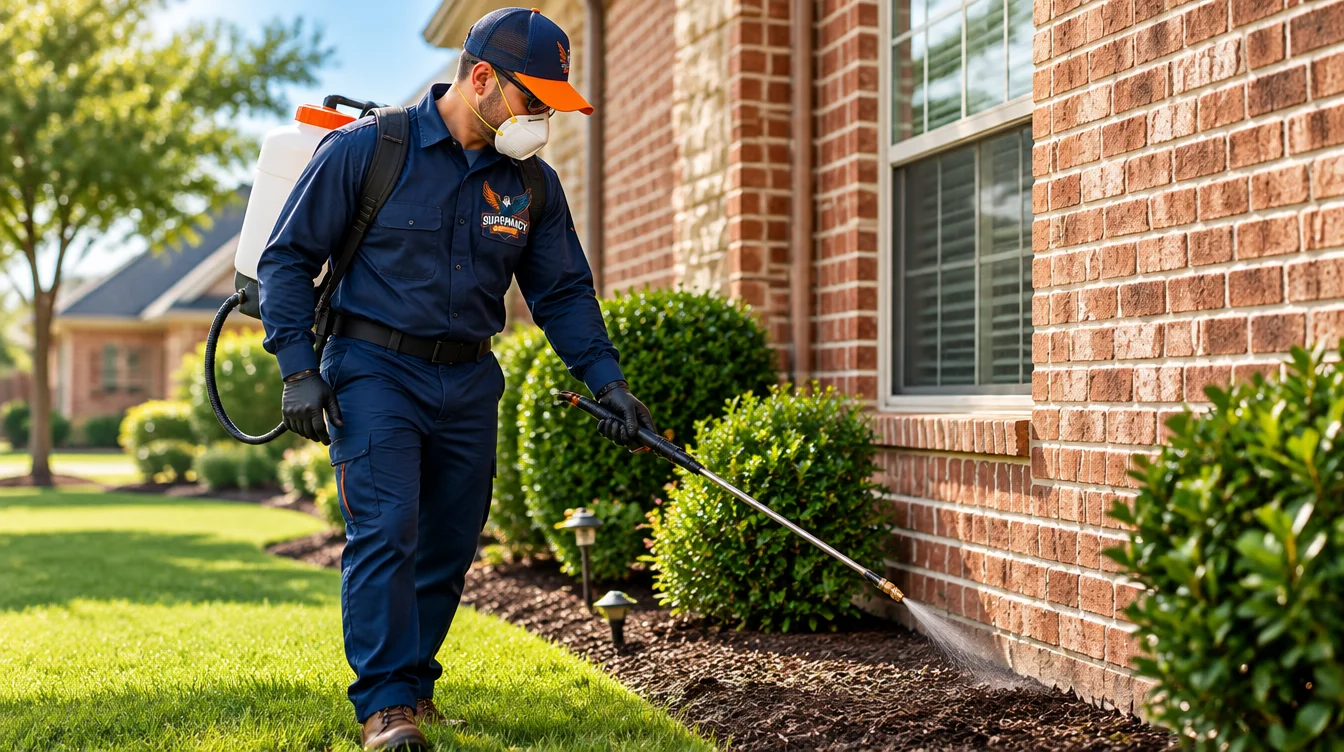
For many North Texas homes, quarterly perimeter pest control is a reasonable starting schedule, but treatments do not automatically last three months. Some properties need more frequent monitoring or targeted follow-up, while others may require fewer pesticide applications when pest activity is low.
The right interval depends on the pest species, the product’s approved application schedule, weather exposure, conditions around the foundation and whether pests are already entering the house.
For homeowners in Dallas, Plano, Frisco, Allen and surrounding DFW communities, the goal isn’t to spray as often as possible. It’s to maintain effective exterior protection without unnecessary pesticide use.
Table of Contents
- How often should perimeter pest control be applied?
- Why does treatment frequency vary?
- How long does perimeter pest control last?
- Does rain affect perimeter pest control?
- When should North Texas homes be treated?
- What signs indicate retreatment is needed?
- Is quarterly perimeter pest control enough?
- DIY vs. professional perimeter pest control
- What does professional perimeter pest control include?
- How can homeowners make treatments more effective?
- Frequently asked questions
How Often Should Perimeter Pest Control Be Applied?
For routine prevention, many homeowners begin with a professional inspection and consider an approximately three-month service review cycle. However, the appropriate pesticide application interval must follow the specific product label and actual pest conditions.
A quarterly service visit does not necessarily mean every area needs to be sprayed again.
The following table provides a practical planning framework, not a universal pesticide application schedule.
| Property condition | Suggested approach |
|---|---|
| Low pest activity, well-sealed home | Inspect periodically; treat when justified |
| Typical recurring exterior pest activity | Consider quarterly service reviews |
| Persistent ants, cockroaches or other invaders | Identify the pest and arrange targeted follow-up |
| Recent treatment with renewed activity | Reassess entry points and treatment effectiveness |
| Severe or established infestation | Use a pest-specific treatment and monitoring plan |
Why isn’t one schedule suitable for every home?
A Dallas property with recurring ant trails, foundation gaps and heavy landscaping may require a different approach from a well-maintained home with little pest activity.
Likewise, an exterior treatment targeting occasional crawling insects is not the same as a termite management program, mosquito treatment or indoor German cockroach control.
The best treatment frequency is based on inspection findings, not the calendar alone.
Homeowners who repeatedly notice insects entering around doors, windows or foundation gaps may benefit from a professional assessment of their home’s exterior pest protection.
Explore Supremacy Services’ professional pest control options to determine whether routine exterior maintenance is appropriate for your property.
What Factors Determine How Often Perimeter Pest Control Is Needed?
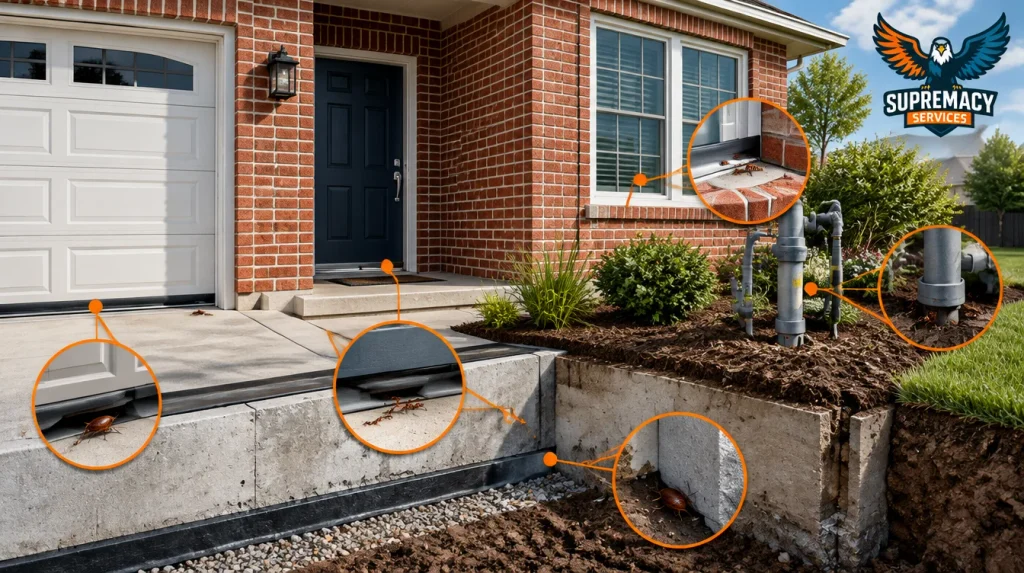
Several conditions influence how quickly a property may need follow-up attention.
1. The type of pest
Different pests respond to different control methods.
Ants may require colony-focused baiting or targeted treatments. Cockroaches can exploit moisture and gaps around utility penetrations. Spiders may continue appearing where other insects provide a food source.
An outdoor perimeter treatment alone may not resolve every pest problem.
2. Landscaping near the foundation
Dense vegetation, mulch, stored materials and debris can provide shelter for insects close to exterior walls.
Where landscaping creates favorable pest conditions, removing harborage may be more valuable than simply increasing spray frequency.
3. Moisture and drainage
Leaking outdoor faucets, poorly directed downspouts and persistently damp soil can make areas around a home more attractive to certain pests.
Correcting the moisture problem can reduce the need for repeated treatments.
4. Building entry points
Small gaps around pipes, weatherstripping, door thresholds, vents and siding can allow pests to enter even when an exterior pesticide treatment has been applied.
Homes with recurring entry problems should be evaluated for exclusion work.
5. Previous pest activity
A property with a history of repeated infestations may need closer monitoring than a home with occasional seasonal insects.
The appropriate response depends on whether the pests are entering from outdoors or already established inside.
How Long Does Perimeter Pest Control Last?
Perimeter pest control can provide residual activity after application, but there is no universal duration that applies to every product or property.
Effectiveness depends on the active ingredient, formulation, treated surface, environmental exposure, target pest and whether the application was performed according to the label.
A product may remain present on a surface without providing the same level of control against every insect.
Why can insects return before the next scheduled visit?
Pests may reappear because:
- New insects enter from surrounding areas.
- Untreated entry points remain accessible.
- Outdoor moisture or shelter continues attracting pests.
- The original treatment did not target the actual source.
- Environmental conditions or surface changes affect residual performance.
Seeing a single insect does not automatically mean an entire treatment has failed. Repeated activity in the same location is more useful evidence that follow-up is needed.
Does Rain Affect Perimeter Pest Control Treatments?
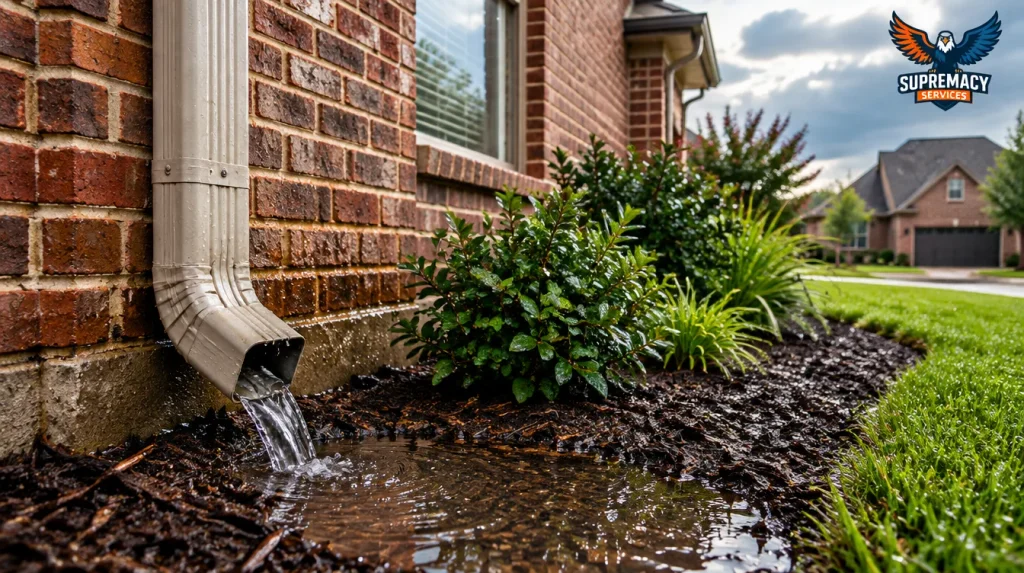
Yes. Rain can affect some outdoor pesticide applications, particularly when a product has not had sufficient time to dry or when runoff occurs. However, the effect depends on the product and its labeling.
The U.S. Environmental Protection Agency provides outdoor pesticide labeling guidance intended to reduce runoff into storm drains, drainage systems and surface waters.
Should homeowners reapply perimeter pest control after rain?
Not automatically. A rainy day does not mean the perimeter needs another full application.
Instead:
- Check whether the application occurred before or during the rain.
- Review the product’s rain-related label instructions.
- Monitor whether the original pest problem returns.
- Contact the applicator if significant activity continues.
- Avoid applying additional pesticide before the label permits retreatment.
Some products require watering after application, while others restrict treatment when rain is expected. Always follow the directions for the particular product.
What about North Texas thunderstorms?
Dallas-area storms can produce heavy rainfall and temporary drainage problems around homes.
After significant rain, inspect foundation drainage, standing water, wet mulch and damaged weatherstripping. Addressing these conditions can help prevent future pest problems without immediately adding more pesticide.
When Should North Texas Homes Receive Perimeter Pest Control?

North Texas homeowners should assess exterior pest conditions throughout the year rather than assuming every season requires the same treatment.
Seasonal planning guide
| Season | What to inspect | Recommended approach |
|---|---|---|
| Spring | Ant trails, moisture, foundation openings | Inspect and address emerging activity |
| Summer | Outdoor insect activity, irrigation leaks, shaded harborage | Monitor high-activity areas and use targeted control |
| Fall | Door gaps, utility penetrations, pests seeking shelter | Prioritize exclusion and exterior inspection |
| Winter | Protected areas, garages, stored materials | Monitor activity; treat only where needed |
Spring: Watch for increasing insect activity
As conditions warm, homeowners may notice more ants and other insects around foundations, patios and landscaping.
Inspect for moisture and emerging entry points before pest activity becomes established indoors.
Summer: Pay attention to irrigation and shelter
Hot weather and outdoor watering can create damp areas around foundations.
Check irrigation leaks, landscaping near exterior walls and areas where insects are repeatedly observed.
Fall: Focus on entry prevention
Changing weather conditions can influence where pests seek shelter.
Inspect garage-door seals, door sweeps, window gaps and utility openings. Exterior exclusion can help reduce indoor pest problems.
Winter: Continue monitoring
Pest activity does not necessarily stop during a North Texas winter.
Some insects remain active in protected areas, while others become less visible outdoors. Winter is a useful time to correct structural entry points and inspect storage areas.
What Signs Mean Your Home May Need Another Perimeter Treatment?
A retreatment assessment is appropriate when pests repeatedly appear in the same locations or when the original problem continues despite corrective measures.
Common warning signs include:
- Recurring ant trails near exterior doors or foundations.
- Cockroaches repeatedly appearing around garage or utility entrances.
- Increased crawling insects around patio doors and windows.
- Persistent pest activity after a previous treatment.
- Visible gaps or damaged exterior seals.
- Pest activity associated with moisture or debris near the home.
When should you call before your next scheduled visit?
Contact a pest control professional when activity is persistent, spreading or occurring indoors despite an existing prevention plan.
The next step may involve identifying the pest, repairing an entry point, using a baiting strategy or applying a targeted treatment.
If insects keep returning between scheduled visits, request a perimeter pest inspection from Supremacy Services to identify what may be allowing them back inside.
Is Quarterly Perimeter Pest Control Enough for North Texas Homes?
Quarterly pest control can be a practical maintenance framework for some Dallas-area homes, but it is not automatically sufficient or necessary for every property.
The value of a quarterly plan depends on whether each visit includes inspection, monitoring and adjustments based on current pest activity.
Quarterly vs. more frequent monitoring
| Consideration | Quarterly service review | More frequent follow-up |
|---|---|---|
| Best suited for | Routine preventive maintenance | Persistent or unresolved pest problems |
| Main objective | Monitor conditions and maintain control | Identify and correct ongoing activity |
| Treatment approach | Based on findings and product label | Pest-specific, targeted intervention |
| Homeowner involvement | Report changes between visits | Track activity and follow instructions |
| Potential limitation | Problems may develop between visits | More visits may increase cost without solving the cause |
Is monthly perimeter spraying better?
Not necessarily.
More frequent pesticide application does not guarantee better results. Some infestations require specialized treatment, while other problems can be reduced through exclusion, sanitation or moisture management.
A monthly service arrangement may involve inspections and monitoring rather than monthly application of the same pesticide.
Does quarterly service cost less?
The total cost depends on the property’s size, infestation severity, service scope, products, number of visits and whether additional pest-specific work is needed.
Rather than assuming a quarterly contract is always the least expensive choice, homeowners should compare what each plan includes and whether follow-up visits are covered.
DIY vs. Professional Perimeter Pest Control: Which Is Better?
Homeowners can perform many useful prevention tasks themselves. However, pesticide applications require careful product selection, identification of the target pest and compliance with label directions.
| DIY prevention | Professional pest control |
|---|---|
| Seal accessible gaps | Identify recurring pest entry patterns |
| Repair leaking faucets | Evaluate pest species and infestation sources |
| Remove debris near foundations | Select appropriate control methods |
| Maintain landscaping | Apply registered products according to their labels |
| Monitor pest activity | Develop a follow-up and maintenance plan |
When is DIY prevention enough?
If pest activity is occasional and no infestation is established, start with basic maintenance:
- Repair damaged weatherstripping.
- Seal accessible openings using suitable materials.
- Reduce excess moisture.
- Remove outdoor clutter.
- Keep food waste properly contained.
If using a consumer pesticide, select one labeled for the specific pest and application location. Follow all directions, including retreatment intervals, precautions and restrictions.
When should you hire a professional?
Professional assessment is appropriate when insects repeatedly enter the home, an infestation persists, the pest cannot be identified, or a previous treatment has not resolved the problem.
Texas regulates structural pest control businesses and professionals through the Texas Department of Agriculture.
What Does Professional Perimeter Pest Control Include?
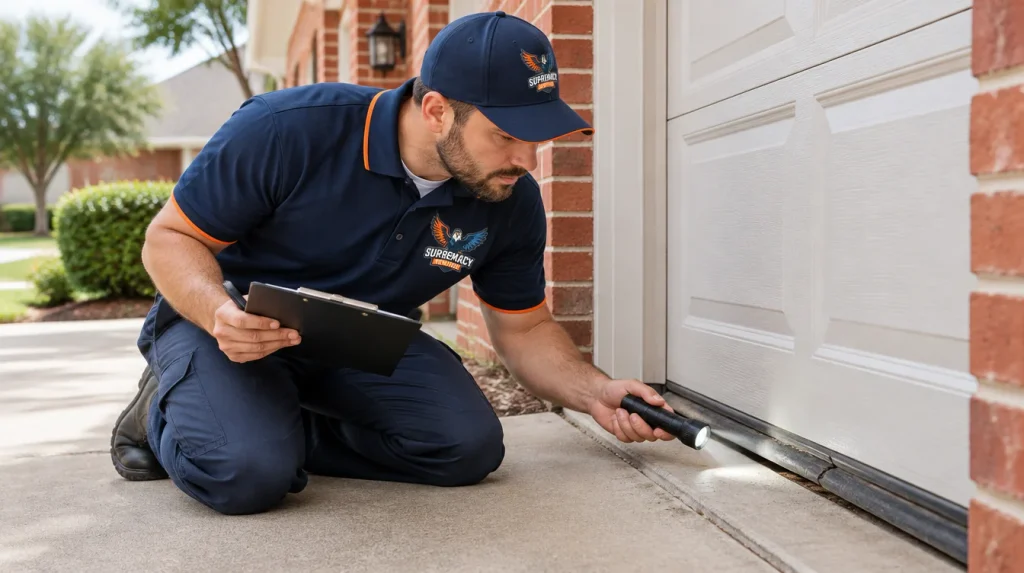
A professional exterior pest control visit should begin with understanding the problem, not automatically spraying every accessible surface.
Depending on the pest and service scope, the process may include:
- Exterior inspection: Examine foundation areas, door thresholds, window openings, landscaping and other potential entry locations.
- Pest identification: Determine which insects are present and whether exterior treatment is appropriate.
- Risk assessment: Review drainage, moisture, outdoor storage and conditions supporting pest activity.
- Targeted treatment: Apply suitable products only where authorized and needed, following label restrictions.
- Prevention recommendations: Identify sealing, sanitation and moisture-control improvements.
- Follow-up planning: Establish monitoring and reassessment based on activity and treatment instructions.
Before hiring a company, ask what pests are included, which areas will be inspected, whether additional visits cost extra and how treatment decisions are made.
A service plan should clearly distinguish scheduled visits from pesticide application frequency.
How Can Homeowners Make Perimeter Pest Control More Effective?
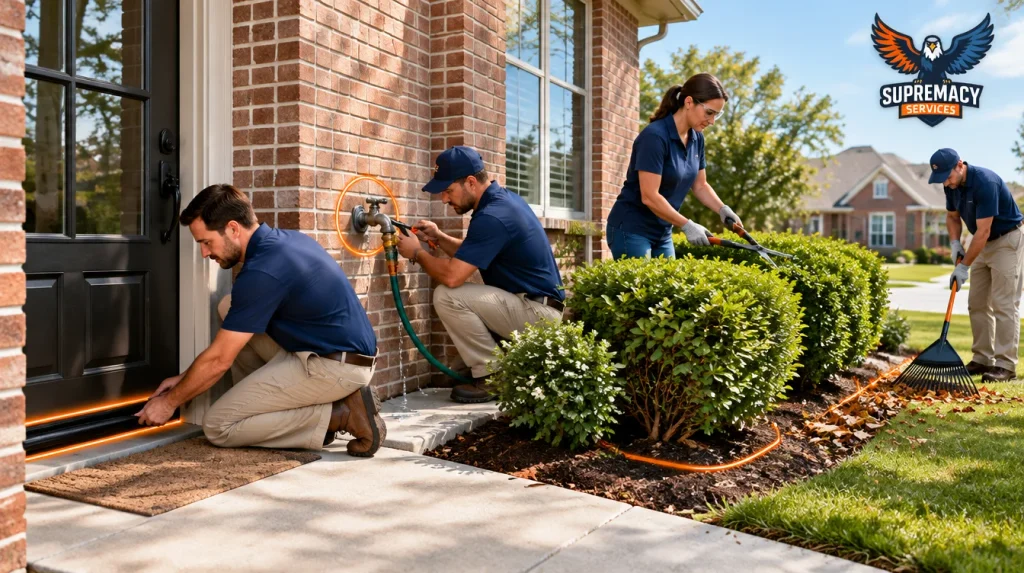
Perimeter treatments generally work best as part of a broader pest management strategy.
Exterior pest prevention checklist
Home maintenance checklist
0 of 8 completeInspect door sweeps and garage-door sealsRepair leaking outdoor faucets and irrigation linesKeep mulch and vegetation from covering foundation inspection areasRemove leaf litter and unnecessary storage against exterior wallsSeal accessible gaps around utility penetrationsKeep trash containers closed and cleanCheck exterior drainage after heavy rainfallRecord recurring pest activity and its location
Reset checklist
These steps help reduce the conditions that attract pests and create opportunities for insects to enter the home.
Why prevention matters more than repeated spraying
A pesticide treatment may control exposed pests without correcting the underlying reason they are present.
For example, if cockroaches repeatedly enter through a damaged door sweep near a damp garage, addressing the gap and moisture can be an important part of long-term control.
This combined approach is consistent with integrated pest management principles.
Frequently Asked Questions
1. How often should you spray the outside of your house for bugs?
There is no universal spraying interval. Quarterly service reviews are common as a planning approach, but actual pesticide applications should depend on pest activity, the product label and property conditions.
2. Is perimeter pest control needed every month?
Not for every home. Monthly monitoring may be useful for persistent problems, but monthly pesticide application is not automatically necessary or permitted for every product.
3. Can perimeter pest control last three months?
Some treatments may provide residual control over an extended period, but performance varies. Three months should not be treated as a guaranteed duration.
4. Should I spray again after heavy rain?
Not automatically. Review the product’s rain-related instructions and monitor pest activity. Contact the applicator before arranging retreatment if you are uncertain.
5. What time of year is best for perimeter pest control in Dallas?
The best timing depends on pest activity. Spring and summer often warrant attention to outdoor insects, while fall is a useful time to inspect entry points. Prevention and monitoring are valuable year-round.
6. Does perimeter pest control prevent all insects from entering?
No. It can help manage certain pests, but insects may still enter through gaps, untreated areas or other routes. Exclusion and moisture control remain important.
7. Is exterior-only pest control enough?
Sometimes, particularly for occasional outdoor invaders. Established indoor infestations, such as German cockroaches, generally require a different pest-specific approach.
8. How do I know if my perimeter treatment has stopped working?
Repeated pest activity, especially in the same entry locations, can indicate that the control strategy needs reassessment. A single insect does not necessarily mean the treatment failed.
9. Is quarterly pest control worth the cost?
It may be worthwhile for homes with recurring seasonal pest pressure, provided visits include meaningful inspection and appropriate prevention measures. Compare the actual services and follow-up terms rather than visit frequency alone.
Keep Your North Texas Home Protected With the Right Treatment Schedule
For many Dallas-area homeowners, quarterly pest control service reviews offer a useful starting point. However, the right maintenance plan depends on the pests involved, the home’s condition and the results of previous treatments.
A professional assessment can help determine whether your property needs regular exterior maintenance, targeted treatment or improvements to pest entry points.
Contact Supremacy Services to discuss perimeter pest control for your Dallas or DFW home and develop a maintenance approach based on your property’s needs.

