
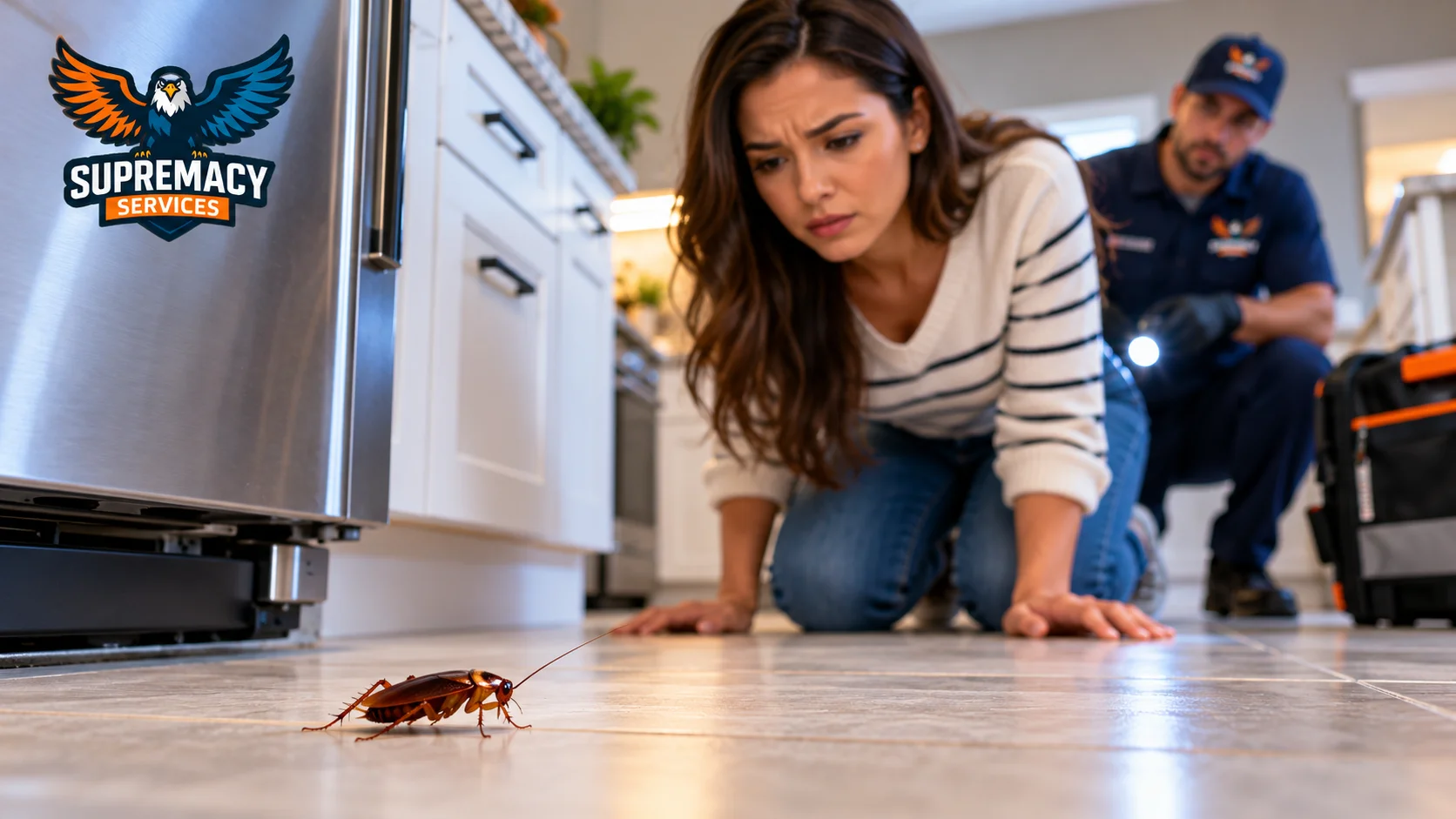
If cockroaches keep coming back after treatment, it usually means the conditions supporting the infestation—or the infestation itself—have not been completely eliminated. Hidden egg cases, untreated harborages, available food or moisture, new cockroaches entering from outdoors or neighboring units, poor bait placement, and relying on short-term sprays can all contribute to recurring activity.
Seeing a cockroach shortly after treatment also does not automatically mean the treatment failed. Some control methods take time, and cockroaches that were hidden behind appliances, inside cabinets, around plumbing penetrations or within wall voids may remain visible while the population declines.
For Dallas and DFW homeowners, the important question isn’t simply “Why are the roaches back?” It’s “Where are they coming from, what is allowing them to survive, and is the population actually declining?”
Table of Contents
- Why Cockroaches Come Back After Treatment
- Does Seeing Roaches After Treatment Mean It Failed?
- The 8 Most Common Reasons Cockroaches Keep Returning
- German vs. American Cockroaches
- How to Tell Whether Treatment Is Working
- What Homeowners Should Do After Treatment
- DIY vs. Professional Cockroach Control
- What Professional Cockroach Control Should Address
- How to Prevent Cockroaches From Returning
- When to Call a Pest Professional
- Frequently Asked Questions
Why Cockroaches Come Back After Treatment
Cockroaches usually return because treatment killed some of the visible insects without fully addressing the population, its hiding places, its resources or its route into the building.
Effective cockroach management therefore involves more than spraying the cockroach you can see.
The EPA recommends an Integrated Pest Management approach that reduces the food, water and shelter pests need while combining prevention with appropriate control methods. UC’s Integrated Pest Management program similarly notes that sanitation and exclusion are important because pesticides alone will not solve many cockroach problems.
That distinction explains why two homes receiving what appears to be the same “roach treatment” can have very different outcomes.
A home where leaks are repaired, food is protected, entry points are addressed and hidden populations are targeted is fundamentally different from a home where exposed surfaces are repeatedly sprayed while the underlying infestation remains undisturbed.
Does Seeing Roaches After Treatment Mean It Failed?
Not necessarily. A few cockroach sightings after treatment can occur while the treatment is working, particularly when bait-based control is being used. The more useful measure is whether activity consistently declines over time.
Some cockroach baits are deliberately slow acting. Cockroaches must locate and consume the bait before it can affect them. University of California IPM guidance notes that bait programs may require seven days or longer before homeowners notice fewer cockroaches.
You should therefore distinguish between:
| Situation | What It May Mean |
|---|---|
| Occasional sightings shortly after treatment | Existing hidden cockroaches may still be active |
| Fewer roaches appearing each week | Population may be declining |
| Small nymphs appearing | Reproduction or previously deposited egg cases may be involved |
| Activity remains unchanged | Treatment strategy or contributing conditions may need reassessment |
| Activity increases after initially declining | Reinfestation, untreated harborages or new entry may be occurring |
| Roaches repeatedly appear in the same area | A nearby food, water, entry or harborage source should be investigated |
Instead of judging treatment by one sighting, monitor frequency, location, size and overall trend.
The 8 Most Common Reasons Cockroaches Keep Returning
1. The Treatment Didn’t Reach the Main Harborage
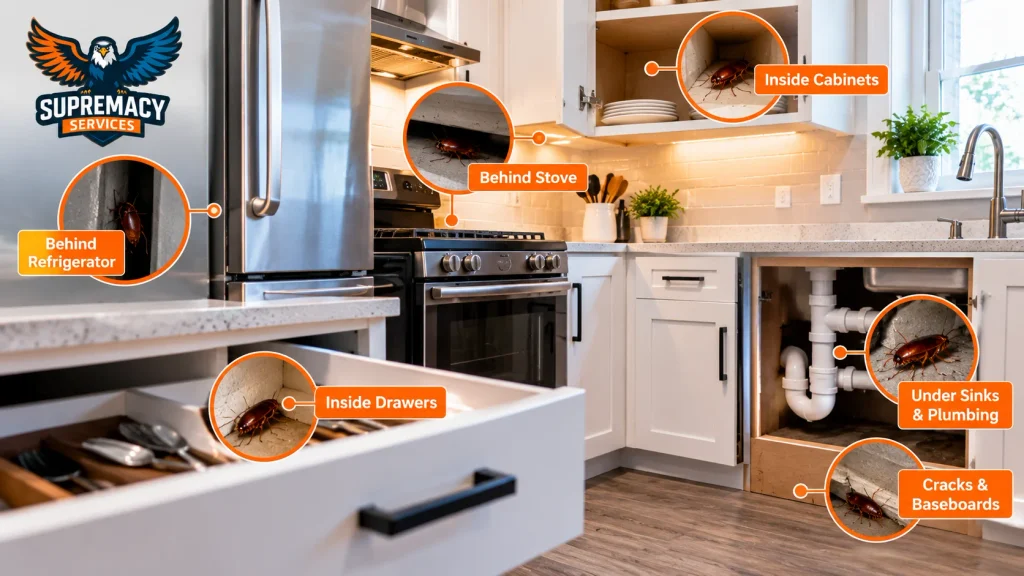
Cockroaches spend much of their time concealed.
Depending on the species and building, hiding areas can include cracks and crevices, cabinet voids, areas behind refrigerators and dishwashers, plumbing penetrations, utility spaces and other protected locations.
Killing insects crossing an exposed floor does not necessarily affect the cockroaches concealed nearby.
This is one reason inspection matters.
If sightings repeatedly occur around one kitchen cabinet, appliance, bathroom vanity or utility penetration, the pattern can provide more useful information than simply counting how many insects were killed.
If recurring roach activity suggests pests are entering from outside or exploiting exterior gaps, explore Supremacy Services’ Dallas pest control options to understand how inspection, prevention and targeted treatment can work together.
2. Egg Cases or Young Cockroaches Remain
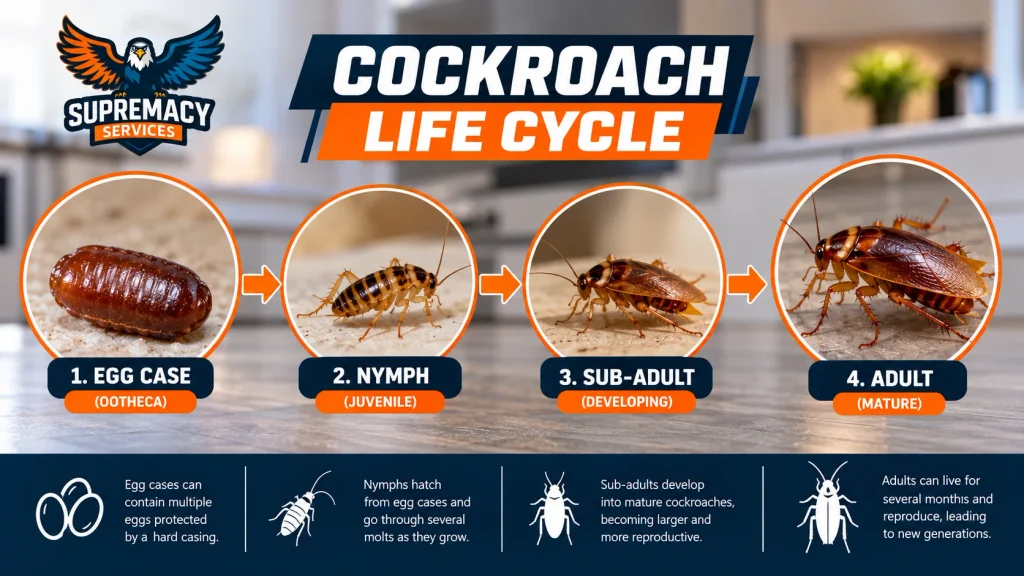
A treatment can reduce active cockroaches without instantly eliminating every stage of the population.
Cockroach reproduction complicates control because eggs are protected inside egg cases, called oothecae. The biology differs among species, which is one reason correct identification matters.
If small cockroach nymphs continue appearing, don’t assume they are simply new adults entering the home. Their presence can indicate that an established population still needs to be addressed.
The appropriate response is not automatically to spray more pesticide. It is to reassess where the insects are breeding and whether the control program is reaching those areas.
3. Food Is Still Available
Cockroaches don’t need a forgotten dinner plate to survive.
Food residues can accumulate:
- beneath appliances;
- along cabinet edges;
- under toasters and microwaves;
- behind stoves;
- around pet feeding areas;
- inside trash areas;
- beneath children’s high chairs;
- in pantry spills;
- around grease deposits.
EPA guidance recommends sealing food, removing food scraps and regularly taking out garbage as part of pest prevention.
The objective is not to maintain an unrealistically spotless house. It is to make alternative food sources less competitive with the pest-management strategy being used.
4. A Water Source Hasn’t Been Corrected
Moisture can be just as important as food.
Check for dripping faucets, leaking supply connections, moisture beneath sinks, refrigerator or dishwasher leaks, condensation, damp cabinets and other persistent water sources.
EPA specifically recommends fixing leaking plumbing and eliminating unnecessary water sources as part of pest prevention.
A cockroach treatment may therefore be undermined by something as simple as a slow plumbing leak hidden beneath the kitchen sink.
5. The Wrong Treatment Method Is Being Used
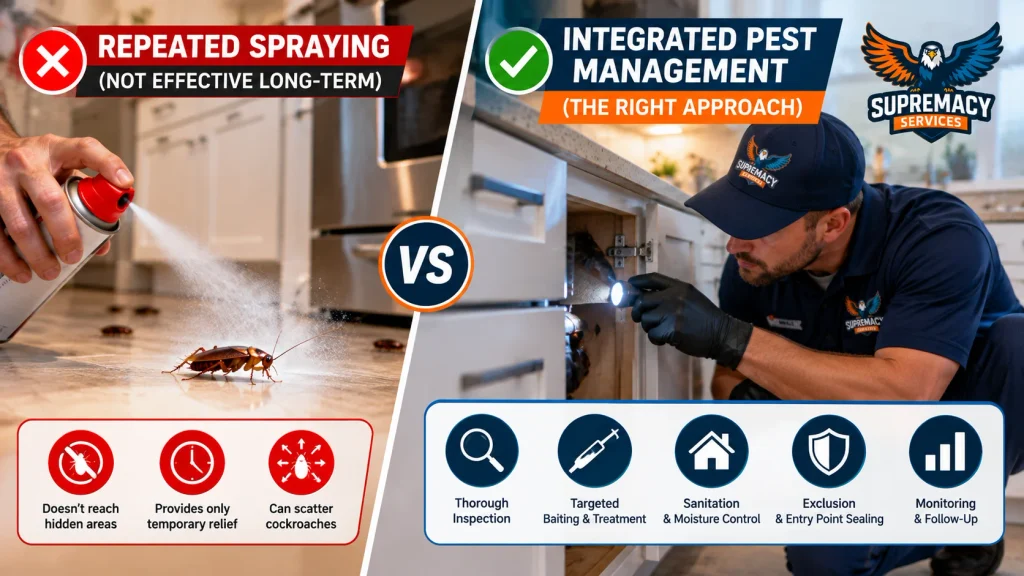
One of the biggest mistakes in recurring cockroach control is assuming that more pesticide automatically means better control.
It doesn’t.
UC IPM advises against relying on foggers, bombs and aerosol sprays for cockroach management. These treatments may fail to reach the cracks and crevices where cockroaches hide, and some sprays can disperse cockroaches into other areas.
EPA also recommends targeted pesticide use rather than indiscriminately spraying an entire room and encourages the use of baits and crack-and-crevice treatments where appropriate.
This is especially important when using cockroach bait.
Applying other products around bait locations can potentially interfere with the baiting strategy. Homeowners should follow every product label exactly rather than combining multiple treatments in an attempt to accelerate results.
6. Cockroaches Are Re-Entering From Outdoors
Not every cockroach problem originates inside the kitchen.
Some cockroach species primarily live outdoors and occasionally enter buildings. Entry points can include gaps beneath doors, damaged weather stripping, openings around utilities, cracks and other exterior vulnerabilities.
That makes species identification important.
If an outdoor species is repeatedly entering the house, concentrating exclusively on interior surfaces may treat the symptom rather than the route of entry.
Exterior sanitation, exclusion and targeted perimeter management may be more important.
For Dallas homeowners dealing with repeated outdoor pest entry, this is where perimeter pest control and structural prevention become relevant rather than simply scheduling another indoor spray.
7. Cockroaches Are Moving Between Units
Recurring cockroach activity can be particularly challenging in apartments, townhomes and other connected buildings.
Cockroaches may move through plumbing penetrations, utility pathways, wall voids and other connections between neighboring spaces.
A homeowner or tenant can improve sanitation and treat one area successfully yet continue experiencing new activity if the broader source remains untreated.
If you live in a multi-unit property, record where and when cockroaches appear and notify the appropriate property manager when activity appears to involve multiple units or common building areas.
8. Nobody Is Monitoring the Results
Cockroach control should not end when pesticide is applied.
Monitoring helps determine whether the infestation is actually shrinking.
Sticky monitoring traps can be placed in appropriate locations along walls, beneath appliances, inside cabinets or near suspected activity zones. Their purpose is not necessarily to eliminate an infestation by themselves; they help reveal where cockroaches are active and whether activity changes over time.
UC IPM recommends traps for identifying activity and tracking populations.
Without monitoring, homeowners often fall into a frustrating cycle:
See roach → spray roach → see another roach → spray again.
That provides very little information about whether the underlying population is improving.
German vs. American Cockroaches: Why Identification Matters
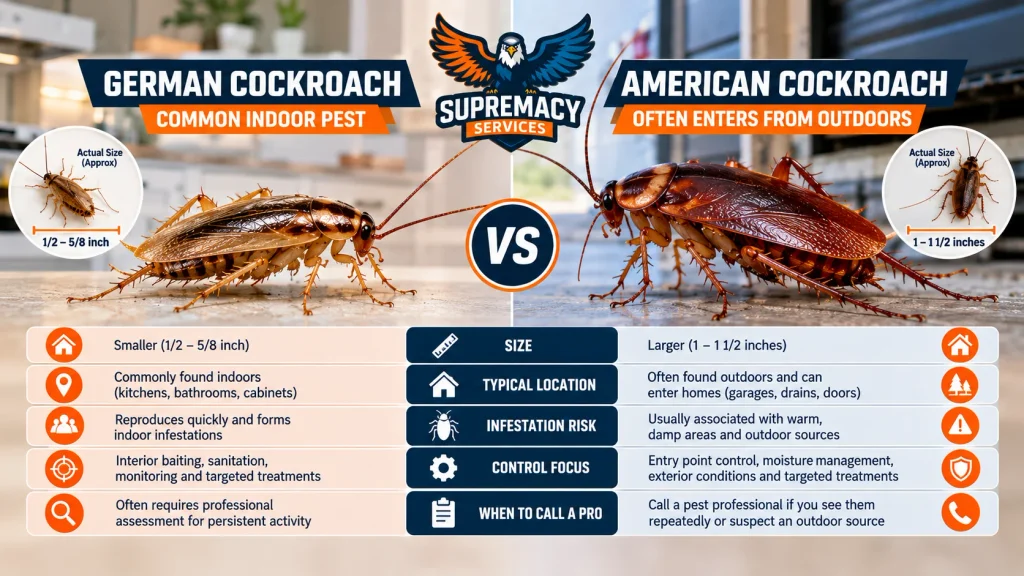
Different cockroach species can require different strategies.
| Characteristic | German Cockroach | American Cockroach |
|---|---|---|
| General size | Smaller | Considerably larger |
| Common pattern | Often associated with indoor infestations | Often associated with warm, damp areas and can invade from outside |
| Typical concern | Reproduction within the structure | Interior activity may involve outdoor or structural sources |
| Strategy emphasis | Interior inspection, sanitation, monitoring and targeted baiting | Entry-point investigation, moisture management, exterior conditions and targeted control |
| Why identification matters | Treating only exterior entry may miss an established indoor population | Treating only kitchen surfaces may miss the exterior source |
Texas A&M AgriLife specifically recommends understanding the species and biology involved before choosing control methods.
If you cannot identify the cockroach, photograph it or capture a specimen safely for identification rather than assuming every large or small roach represents the same problem.
How to Tell Whether Cockroach Treatment Is Working
Look for a downward trend, not necessarily immediate zero activity.
Useful indicators include:
Fewer sightings. You should eventually encounter fewer live cockroaches.
Lower monitoring counts. Sticky monitors should show declining activity.
Fewer locations affected. Activity that once occurred throughout the kitchen may become concentrated in one remaining area.
Less evidence. Droppings, egg cases and other signs should stop accumulating.
No continuing spread. New rooms should not begin developing activity.
If sightings remain frequent, spread to additional areas or rebound after declining, the problem should be reassessed.
The question becomes: Is there an untreated population, continuing food or moisture, an exterior source, neighboring-unit activity, poor bait placement or another condition sustaining the infestation?
What Homeowners Should Do After Cockroach Treatment
A successful treatment program usually requires cooperation between the control method and the conditions inside the home.
After treatment:
- Follow the technician’s or product label’s instructions exactly.
- Do not spray additional insecticide over or near bait unless the product directions or pest professional specifically allow it.
- Remove accessible food residues.
- Store pantry foods securely.
- Clean grease and crumbs beneath appliances.
- Empty trash regularly.
- Avoid leaving pet food out overnight.
- Repair plumbing leaks and other moisture sources.
- Reduce unnecessary cardboard and clutter.
- Monitor known activity areas.
- Seal appropriate gaps and entry points.
- Record continuing sightings by location and date.
This information becomes extremely useful if a follow-up visit is needed.
DIY vs. Professional Cockroach Control
Minor or isolated activity can sometimes be addressed through sanitation, exclusion, monitoring and properly labeled consumer products.
A widespread or persistent infestation is different.
| DIY May Be Reasonable When | Professional Assessment Is More Appropriate When |
|---|---|
| You see an occasional outdoor invader | Cockroaches appear repeatedly |
| The source is obvious | You cannot locate the source |
| Activity is limited | Several rooms are affected |
| Monitoring shows little activity | Traps repeatedly catch cockroaches |
| Entry gaps can be corrected | Activity appears to originate inside walls or inaccessible areas |
| There is no evidence of reproduction | Nymphs and multiple life stages are present |
| Activity decreases steadily | Treatment produces little or temporary improvement |
| Detached home with isolated activity | Connected/multi-unit structure with recurring activity |
Whatever approach you use, follow pesticide labels precisely.
The EPA recommends using only products approved for their intended setting and following all label instructions and safety warnings.
Why Repeated Bug Bombs Aren’t a Good Long-Term Strategy
Total-release foggers—commonly called bug bombs—should not be treated as a shortcut for locating and addressing a cockroach infestation.
EPA warns that foggers can create fire, explosion and exposure hazards when used improperly. UC IPM additionally notes that foggers may fail to reach cockroach hiding places and can disperse insects without producing effective long-term control.
The better question is not, “What can I spray everywhere?”
It is, “Where is the population living, and why can it continue surviving here?”
What Professional Cockroach Control Should Address
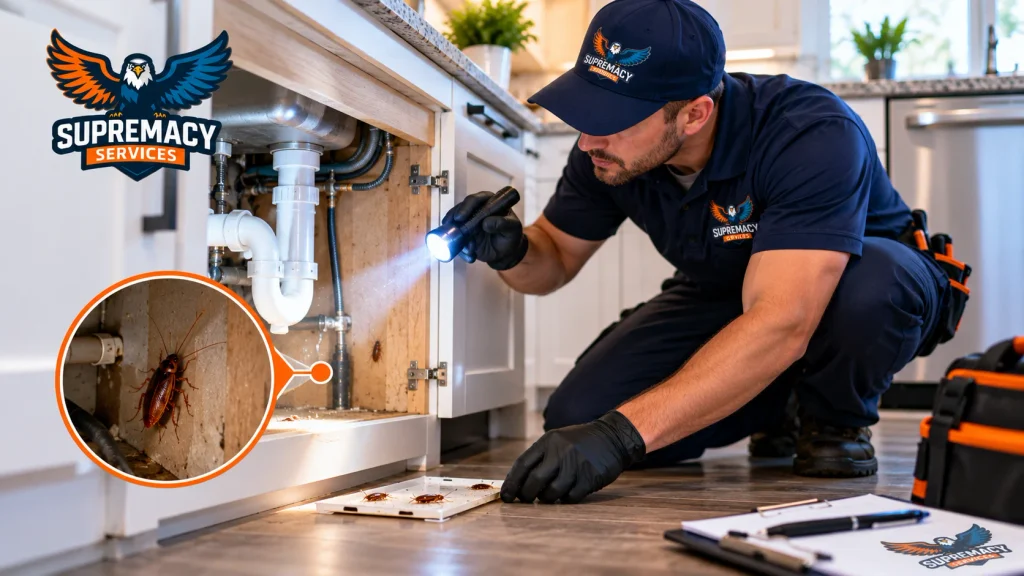
Professional cockroach management should begin with diagnosis.
A useful inspection should help determine:
1. Which cockroach is present?
Species influences likely harborages, entry routes and management methods.
2. Where is activity concentrated?
Monitoring and inspection can identify hotspots.
3. Is the infestation established indoors?
This helps distinguish reproduction inside the structure from occasional outdoor invaders.
4. What food, water or shelter is supporting the population?
Treatment alone may be undermined if these resources remain abundant.
5. How are cockroaches moving through the property?
Doors, plumbing penetrations, utility openings, wall voids and other pathways may matter.
6. Which targeted control measures are appropriate?
Depending on the situation, this can involve baiting, monitoring, crack-and-crevice treatment, dusts in appropriate inaccessible locations, exterior control or other label-compliant methods.
7. What needs to happen after treatment?
Follow-up monitoring is essential for persistent infestations.
If you’ve already treated your home but roaches continue appearing, consider scheduling a professional pest inspection in Dallas rather than simply repeating the same treatment. Identifying the species, source and conditions supporting the infestation can determine what needs to change.
Why Dallas and DFW Homes Can Experience Recurring Roach Activity
North Texas homes can experience both established indoor cockroach infestations and cockroaches entering from outdoor environments.
Rather than attributing every recurrence simply to “Texas weather,” look at the property itself.
Important areas to investigate include:
- exterior doors and garage entrances;
- plumbing and utility penetrations;
- kitchens and pantries;
- bathroom vanities;
- irrigation or moisture near the structure;
- trash storage areas;
- cardboard storage;
- cracks and protected exterior areas;
- connected walls in apartments or townhomes.
A detached Dallas home where large outdoor cockroaches occasionally enter through a garage requires a different approach from a kitchen supporting an established population of smaller German cockroaches.
That distinction is exactly why inspection and identification should come before repeated treatment.
How to Prevent Cockroaches From Returning
Long-term prevention is about making the home difficult to enter and difficult to live in.
Food
Keep food sealed, clean crumbs and grease from difficult-to-reach areas, manage trash and avoid leaving pet food available overnight.
Water
Repair leaks, investigate unexplained moisture and dry areas where water routinely accumulates.
Shelter
Reduce unnecessary cardboard, paper bags and clutter in cockroach-prone areas.
Entry Points
Repair damaged screens and door sweeps and address appropriate gaps around exterior penetrations.
Monitoring
Keep monitoring high-risk areas after activity appears to stop. Early detection is easier to address than another established infestation.
Exterior Conditions
Where outdoor cockroaches are involved, investigate moisture, debris, trash storage and structural entry routes around the home.
This prevention-first approach aligns with EPA Integrated Pest Management guidance: remove the conditions pests depend on while using targeted control where necessary.
When Should You Call a Pest Professional?
Consider professional evaluation when cockroaches continue appearing despite sanitation and properly performed treatment, when multiple rooms are affected, when small nymphs indicate continuing reproduction, or when you cannot identify where the insects are coming from.
Professional help is also useful when:
- activity returns repeatedly after temporary improvement;
- cockroaches are regularly seen during the day;
- several life stages are present;
- neighboring units may be involved;
- activity is occurring in inaccessible structural areas;
- DIY sprays and foggers have not solved the problem;
- you need help distinguishing indoor infestation from outdoor invasion.
Texas regulates structural pest-control businesses and applicators. The Texas Department of Agriculture’s Structural Pest Control Service oversees licensing for professionals providing structural pest-control services.
When choosing a provider, ask what the inspection includes, how the pest will be identified, what conditions need correction, how results will be monitored and what follow-up is included.
Frequently Asked Questions
Why am I still seeing roaches after pest control?
Some cockroaches may remain active while treatment takes effect, especially with slow-acting baits. Persistent or unchanged activity, however, can indicate untreated harborages, reproduction, continuing food or water sources, or reinfestation.
How long should I see cockroaches after treatment?
There is no universal timeline because treatment method, species and infestation severity differ. Some bait programs may take seven days or longer before noticeable reductions occur. Monitor the overall trend rather than relying on a single sighting.
Does seeing baby roaches mean treatment failed?
Not automatically. Young cockroaches may emerge from egg cases that were already present. Continued nymph activity over time can, however, indicate an established population requiring further assessment.
Why do cockroaches come back after spraying?
Spraying visible cockroaches may not reach insects hidden inside cracks, cabinets, wall voids or other harborages. Some sprays can also interfere with broader management strategies. Long-term control normally requires identifying and correcting the conditions supporting the infestation.
Can cockroaches become resistant to insecticides?
Cockroach populations can develop resistance to some insecticides. This is one reason repeatedly applying the same type of treatment without monitoring results is not a sound strategy. Persistent activity should be reassessed rather than automatically treated with more of the same product.
Should I use a bug bomb if roaches keep returning?
Foggers are generally not a preferred solution for persistent cockroach infestations. They may fail to reach hidden harborages, and improper use can create exposure, fire or explosion hazards. Targeted management is usually more appropriate.
Can roaches come through drains?
Cockroaches can be associated with drains, plumbing areas and other moist environments, but seeing one near a drain does not prove that the drain itself is the source. Inspect plumbing penetrations, moisture and nearby harborages before drawing that conclusion.
Why do I have roaches when my house is clean?
Clean homes can still experience cockroach activity. Cockroaches may enter from outdoors, arrive in packages, migrate from neighboring units or find moisture and shelter in places that are difficult to inspect. Sanitation helps control them, but cleanliness alone cannot eliminate every entry route or hidden infestation.
What attracts cockroaches to a house?
Food, moisture and protected hiding areas are major factors. Crumbs, grease, pet food, garbage, leaking plumbing, clutter and structural gaps can all contribute depending on the cockroach species involved.
When should I call an exterminator for roaches?
Professional assessment becomes especially useful when activity persists after treatment, multiple areas are affected, young cockroaches continue appearing, the infestation is established indoors or you cannot identify the source.
Stop Treating the Sightings and Find the Source
When cockroaches keep coming back after treatment, repeating the same spray is rarely the most informative next step.
Determine which cockroach is present, where it is hiding, what food or moisture supports it, how it is entering or moving through the building, and whether the population is actually declining.
That turns cockroach control from repeated reaction into a measurable pest-management strategy.
For Dallas and DFW homeowners dealing with recurring roaches, Supremacy Services can inspect the property, identify likely pest pressure and recommend an appropriate prevention and control plan.
Explore pest control services in Dallas and DFW or request an inspection if cockroach activity continues after previous treatment.

