
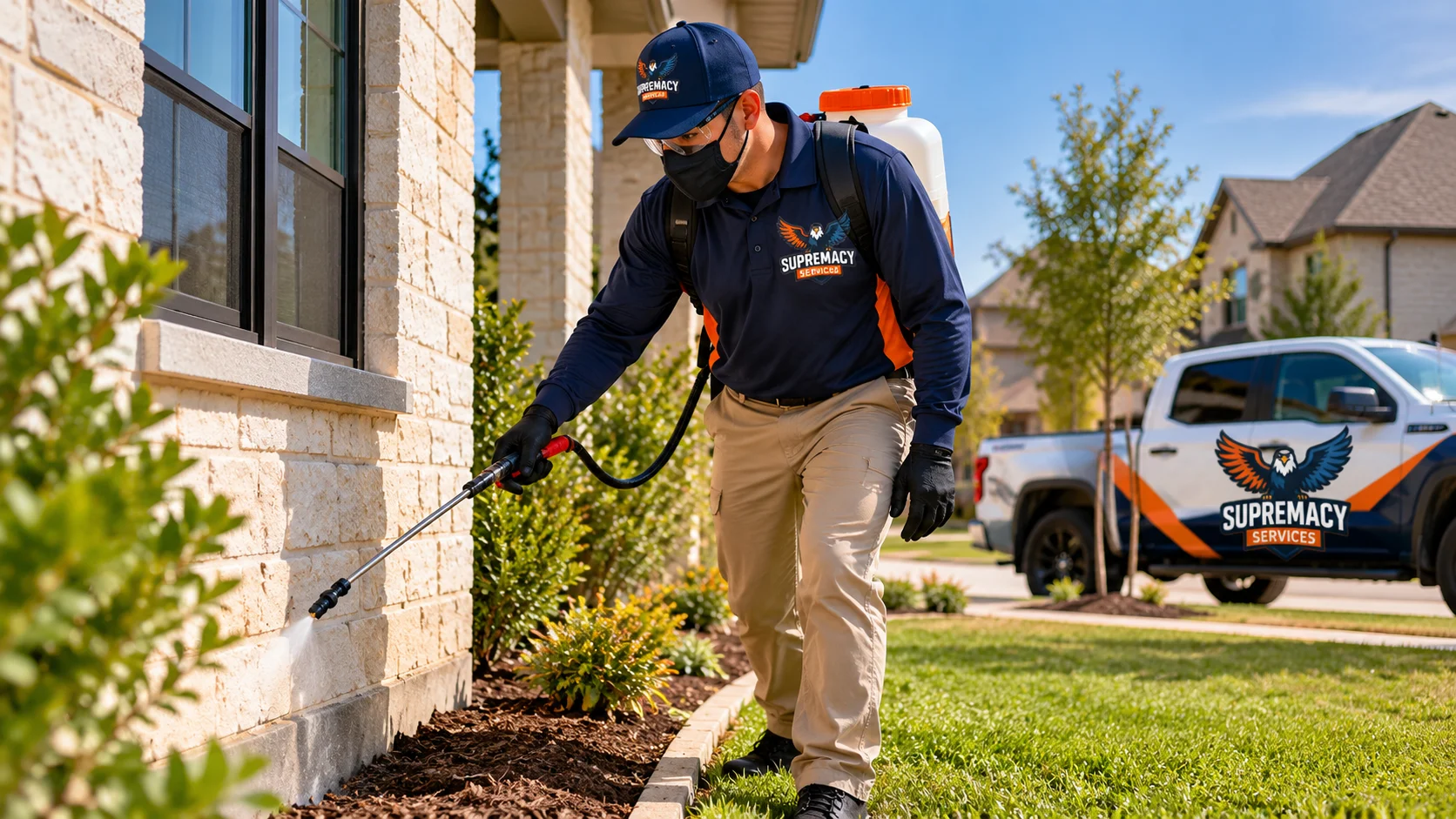
Perimeter pest control works by targeting the exterior areas where crawling insects live, travel or attempt to enter a house. Instead of waiting until ants, cockroaches, spiders and other occasional invaders appear indoors, the treatment focuses on the foundation, structural openings and other exterior transition points.
For Dallas-Fort Worth homeowners, the important point is that perimeter pest control is more than simply “spraying around the house.” An effective program starts with identifying pest pressure and entry points, then combines appropriately labeled exterior treatments with practical prevention such as sealing gaps, reducing moisture and correcting conditions that give pests food, water or shelter.
That approach is consistent with Integrated Pest Management, or IPM: identify the pest, reduce the conditions supporting it, block access where practical and use targeted control methods when needed.
Table of Contents
- What is perimeter pest control?
- How does perimeter pest control work?
- Where is perimeter pest control applied?
- What happens when insects cross the treatment?
- What pests can perimeter pest control help control?
- What perimeter treatment cannot solve
- Does the entire yard need to be sprayed?
- What should a professional perimeter service include?
- DIY vs. professional perimeter pest control
- How North Texas homeowners can improve exterior pest prevention
- Frequently asked questions
What Is Perimeter Pest Control?
Perimeter pest control is an exterior pest-management strategy that targets pest activity around a building’s foundation, entry points and other exterior areas where insects can approach or enter the structure.
The objective is preventive: reduce pest pressure before insects establish themselves inside the living space.
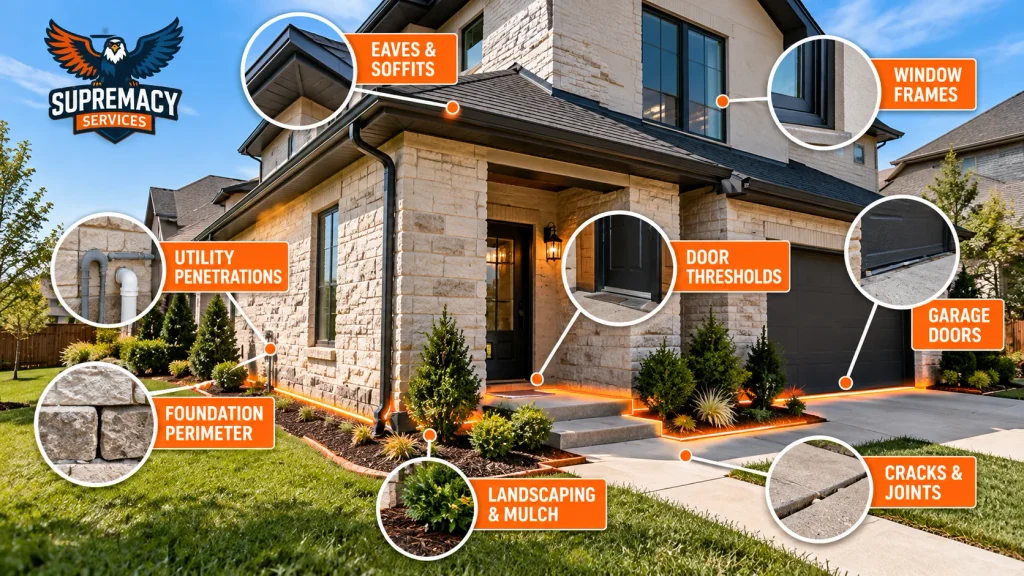
Depending on the pest, property and pesticide label, treatment may involve selected areas around:
- the foundation;
- doors and thresholds;
- window frames;
- garage entrances;
- utility penetrations;
- cracks and joints;
- eaves and sheltered exterior locations;
- landscaping immediately adjacent to the structure.
But treatment is only one part of prevention.
If a leaking hose bib keeps an area damp, vegetation touches the house, a door sweep has failed or insects can enter through an unsealed penetration, correcting those conditions can be just as important as applying a pesticide.
EPA’s Integrated Pest Management principles support this broader approach: understand the pest and use an appropriate combination of prevention, monitoring and control rather than depending automatically on pesticides alone.
How Does Perimeter Pest Control Work?
Perimeter pest control works by intercepting pest activity at the exterior of the structure while reducing the conditions and openings that allow pests to reach the interior.
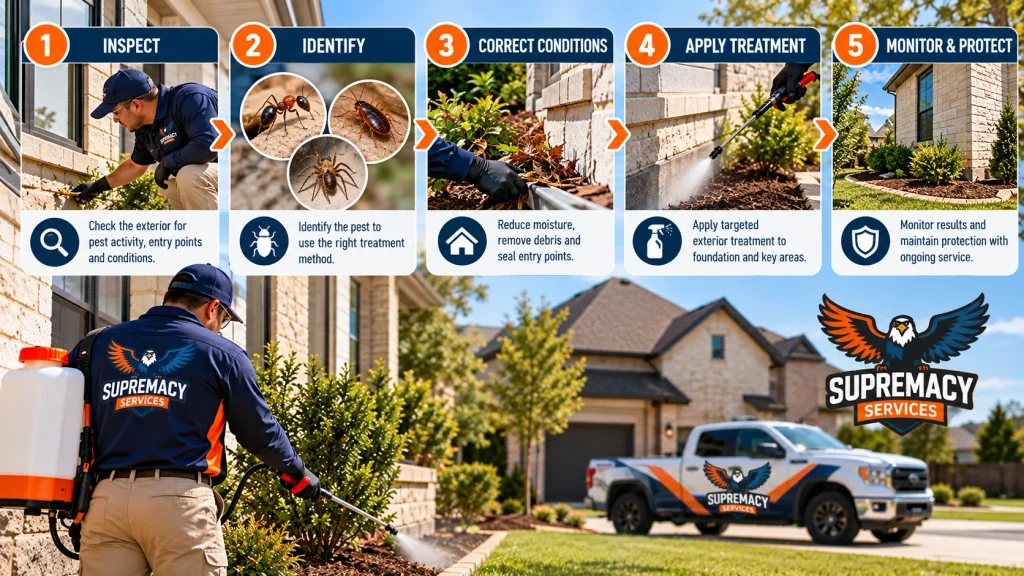
A professional program can be understood as five steps.
1. Inspect the exterior
The technician first needs to determine where pests are active and how the structure may be contributing to the problem.
That can mean looking at:
- foundation transitions;
- cracks and gaps;
- doors;
- windows;
- garages;
- utility lines;
- plumbing penetrations;
- exterior moisture;
- vegetation;
- mulch and debris;
- eaves;
- sheltered pest harborages.
Finding ten ants beside a driveway is different from finding a concentrated trail disappearing through a utility penetration.
The second observation gives the technician information about the route pests may actually be using.
2. Identify the pest
Identification matters because “bugs around the house” is not a diagnosis.
Ants, cockroaches, spiders, termites, fleas, mosquitoes and other pests behave differently and may require completely different control methods.
For example, some cockroach species commonly establish indoor infestations, while others primarily live outdoors and occasionally enter structures.
Likewise, ordinary perimeter insect treatment should never be assumed to substitute for a termite-control program.
3. Find pest routes and contributing conditions
Next comes the question: why are pests concentrating here?
A technician may find:
- moisture beside the foundation;
- vegetation contacting the building;
- damaged weather stripping;
- gaps beneath exterior doors;
- plumbing or utility openings;
- clutter or debris;
- protected landscaping;
- food sources;
- exterior lighting attracting insects;
- cracks or construction joints.
Correcting these conditions helps reduce future pressure rather than continually treating the symptoms.
4. Apply appropriate targeted exterior treatment
Where pesticide treatment is justified, the product must be labeled for the pest, location and application method.
Treatment can then be directed toward appropriate foundation zones and pest travel or entry areas.
This is why homeowners should be cautious about treating “perimeter spray” as one universal technique.
The legal treatment area, application rate, surfaces that may be treated, weather restrictions and environmental precautions depend on the actual pesticide label.
5. Monitor and adjust
Pest management should not end when the application is finished.
Recurring activity can indicate:
- an untreated source;
- an entry point;
- moisture or sanitation problems;
- incorrect pest identification;
- an established indoor infestation;
- a pest requiring a different treatment strategy.
The objective is not simply to spray the same locations indefinitely. It is to determine whether pest pressure is actually declining and why.
Where Is Perimeter Pest Control Applied?
Professional perimeter treatment is normally concentrated around pest-prone exterior areas rather than indiscriminately spraying every exterior surface.
Common inspection and potential treatment zones include:
| Area | Why it matters |
|---|---|
| Foundation perimeter | Crawling insects often travel near the structure |
| Door thresholds | Common transition point between outdoors and indoors |
| Window areas | Gaps and sheltered edges can provide access |
| Garage doors | Large openings and worn seals can admit pests |
| Utility penetrations | Pipes, cables and conduit can leave structural gaps |
| Cracks and joints | Small openings can become insect pathways |
| Eaves/sheltered areas | May support spiders, webs or other pest activity |
| Landscaping near house | Moisture and shelter can support insects |
| Patio/porch transitions | Structural joints may become pest routes |
The exact application must follow the label of the product being used.
Is there always a continuous chemical band around the house?
Not necessarily.
“Perimeter barrier” is useful homeowner terminology, but it should not be interpreted as permission to soak every surface surrounding a home.
EPA pesticide labeling can restrict outdoor applications on hard surfaces and near drains or areas where runoff could occur.
A professional should therefore select treatment areas according to the product label, pest pressure and conditions at the property.
What Happens When Insects Cross the Treatment?
This depends on the active ingredient, formulation, pest and application method.
Some exterior insecticides leave a residual deposit on treated surfaces. Susceptible insects may contact the treatment while crawling across or resting on those areas.
But homeowners should avoid assuming that every product:
- works immediately;
- repels insects;
- transfers through a colony;
- lasts the same amount of time;
- survives every weather condition equally;
- controls every insect.
Those claims are product-specific.
The correct question is therefore not simply, “What did you spray?”
Ask:
What pest are you targeting, where is the product being applied, and why is that treatment appropriate for this pest and location?
That question produces much more useful information.
Does Perimeter Pest Control Keep Bugs From Coming Inside?
It can significantly reduce exterior pest pressure and help prevent many crawling pests from entering, but no perimeter treatment should be presented as a physical force field around a house.
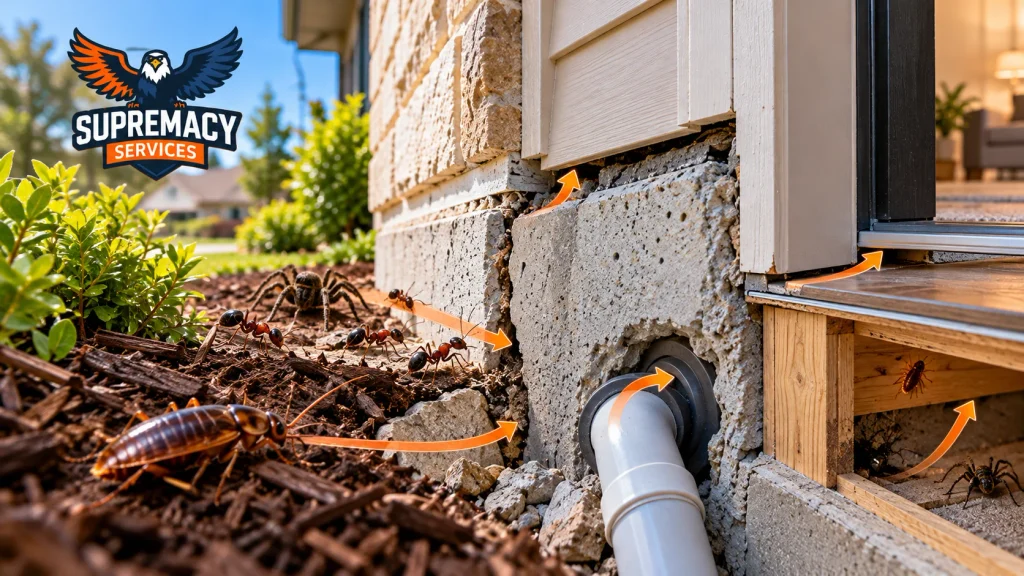
Pests can still exploit untreated or accessible routes.
Imagine a home with excellent foundation treatment but:
- a large gap beneath the garage door;
- tree branches touching the roof;
- standing water;
- an open plumbing penetration;
- torn screens;
- piles of debris beside the foundation.
The pesticide is addressing only part of the problem.
That is why the strongest approach combines treatment with exclusion and habitat modification.
Seeing ants, cockroaches or spiders repeatedly moving toward your home? Supremacy’s perimeter pest-control service targets exterior pest pressure around foundations and common structural entry areas before it becomes an indoor problem.
What Pests Can Perimeter Pest Control Help Control?
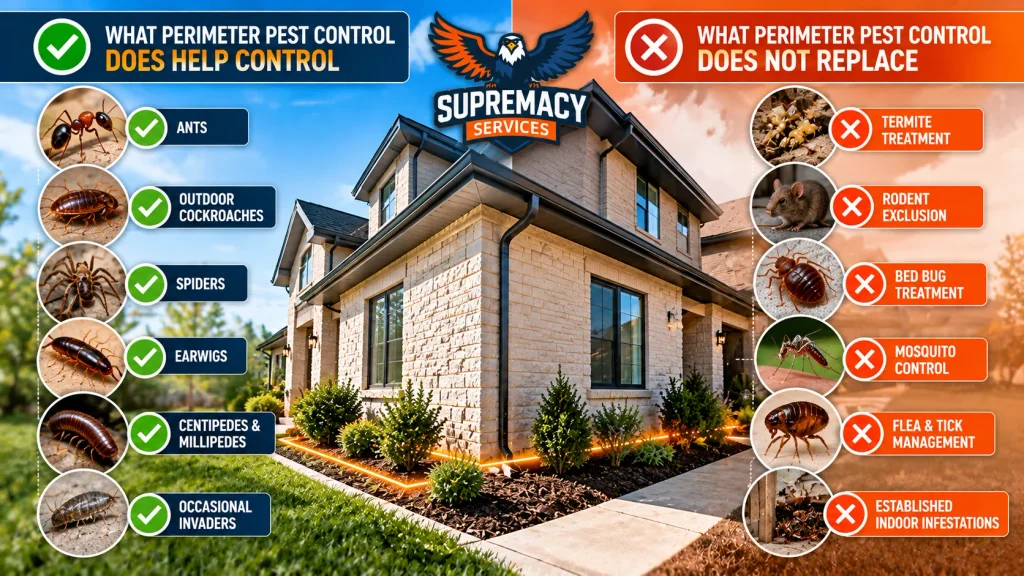
Exterior perimeter management is most relevant to pests that live outdoors or travel from outdoor areas toward a structure.
Depending on identification and the product being used, examples may include:
| Pest | Role of perimeter management |
|---|---|
| Ants | Can reduce trails and movement toward structural openings |
| Outdoor cockroaches | Helps target exterior activity and entry routes |
| Spiders | Exterior management can reduce activity around sheltered structural areas |
| Earwigs | Can help reduce occasional migration indoors |
| Centipedes/millipedes | May help where outdoor populations move toward structures |
| Some occasional invaders | Exterior prevention can reduce entry pressure |
Correct identification still matters.
For example, an established indoor cockroach infestation may require sanitation, monitoring, baits and targeted interior treatment rather than relying on the exterior alone.
What Perimeter Pest Control Does Not Replace
This distinction is particularly important for homeowners comparing pest-control services.
Termite treatment
Ordinary perimeter pest control is not the same as termite treatment.
Subterranean termite management is a specialized structural pest-control category with different inspection, treatment and regulatory considerations.
If you see mud tubes, swarmers, suspicious wood damage or other potential termite evidence, request a termite evaluation rather than assuming routine exterior pest service will address it.
Rodent exclusion
Spraying around the foundation will not seal a roof gap used by rats or mice. Supremacy services
Rodent problems can require:
- inspection;
- trapping or other control;
- monitoring;
- sanitation;
- structural exclusion.
Bed bugs
Bed bugs are primarily associated with sleeping and resting areas and require a completely different inspection and management strategy.
Mosquitoes
Mosquito management often focuses on breeding habitat, standing water, vegetation and other outdoor resting areas. It should not be treated as interchangeable with ordinary foundation-perimeter service. Supremacy services
Fleas and ticks
Outdoor flea and tick activity can involve lawns, shaded areas, wildlife or pets and may require a more specific yard-management strategy. Supremacy services
Established indoor infestations
If pests are already breeding indoors, exterior prevention alone may not correct the existing population.
This is especially important when activity occurs repeatedly in kitchens, bathrooms, wall voids or multiple rooms.
Does the Entire Yard Need to Be Sprayed?
No. A foundation-oriented perimeter treatment and a full-yard pest treatment are not automatically the same service.
Treatment should correspond to the target pest and the pesticide label.
Blanket application is not inherently better.
EPA recommends minimizing unnecessary pesticide use as part of IPM, and outdoor pesticide labels may contain restrictions designed to prevent runoff into storm drains, drainage ditches, gutters and surface water.
That matters in residential neighborhoods where driveways, sidewalks and curb systems can move water away from the property.
A homeowner should expect the applicator to know:
- which surfaces may legally be treated;
- where runoff could occur;
- applicable weather restrictions;
- the pest being targeted;
- the label application rate;
- whether spot, crack-and-crevice or broader treatment is permitted.
Does Rain Wash Away Perimeter Pest Control?
There is no accurate universal yes-or-no answer.
Rain restrictions and weather resistance depend on the product label, formulation, application surface and timing.
Some pesticide labels specifically prohibit application during rain or where runoff may occur.
EPA also advises consumers to prevent pesticides from entering storm drains, gutters, drainage ditches and surface waters.
For homeowners, the practical takeaway is simple:
Don’t judge an exterior treatment solely by whether it “looks waterproof.” Ask whether weather conditions and application timing comply with the product label.
How Long Does Perimeter Pest Control Last?
There is no universal lifespan for every perimeter pest treatment.
Residual performance can vary with:
- active ingredient;
- formulation;
- treated surface;
- sunlight;
- rainfall and irrigation;
- pest species;
- environmental conditions;
- label requirements.
Recurring service schedules should therefore not be interpreted as proof that every pesticide lasts exactly that long.
The treatment plan should reflect the product being used, pest pressure and what the technician observes at subsequent visits.
Supremacy’s existing perimeter service is structured around recurring exterior protection. Homeowners considering that program can review the dedicated Perimeter Pest Control in Dallas service page for the company’s current service scope.
Why Exterior Pest Pressure Matters in North Texas
North Texas homes can experience pest pressure around the structure throughout different parts of the year, but the conditions vary property by property.
A home with dense landscaping and frequent irrigation may present different conditions from a property with a dry, open perimeter.
Useful factors to inspect include:
Moisture
Look for:
- leaking outdoor faucets;
- irrigation overspray;
- poor drainage;
- damp mulch;
- standing water;
- plumbing leaks.
Many pests benefit from reliable moisture.
Vegetation
Shrubs, grass and tree branches touching the structure can provide shelter or routes toward the house.
Texas A&M’s homeowner ant guidance recommends keeping plants and grass away from foundations, repairing leaks, sealing cracks and trimming vegetation away from buildings.
Mulch, leaf litter and debris
Protected, damp organic material can create insect habitat immediately beside a house.
Exterior openings
North Texas homeowners should periodically inspect:
- door sweeps;
- window screens;
- garage seals;
- utility penetrations;
- plumbing openings;
- foundation cracks;
- vents and other accessible openings.
A pest problem can sometimes be reduced more effectively by correcting an entry route than repeatedly treating insects after they cross it.
What Should a Professional Perimeter Pest-Control Service Include?
A good professional service should begin with inspection and pest identification rather than automatically applying the same treatment to every property.
A useful process looks like this:
1. Property inspection
Identify current pest activity, entry routes and contributing conditions.
2. Pest identification
Determine what is actually present before selecting a control method.
3. Exterior pest-pressure assessment
Inspect the foundation, doors, windows, garage, utilities, vegetation and other relevant areas.
4. Web or nest management where appropriate
Exterior webs or accessible pest harborages may be addressed as part of some service plans.
5. Targeted treatment
Apply appropriately labeled products to locations relevant to the identified pest.
6. Prevention recommendations
Explain moisture, sanitation, vegetation or exclusion changes that could reduce recurrence.
7. Service documentation
Homeowners should know what was observed, what was treated and what follow-up is recommended.
8. Monitoring and follow-up
Recurring sightings should trigger investigation rather than simply repeating treatment without determining why activity continues.
If your home repeatedly develops exterior ants, cockroaches, spiders or other crawling-pest activity, request a perimeter pest assessment from Supremacy Services to determine where pests are approaching the structure and what treatment scope is appropriate.
DIY vs. Professional Perimeter Pest Control
Homeowners can perform many important parts of exterior pest prevention themselves.
DIY prevention makes sense for:
- replacing damaged door sweeps;
- repairing screens;
- sealing appropriate structural gaps;
- trimming vegetation;
- removing debris;
- correcting moisture problems;
- improving food and garbage storage;
- monitoring where pests appear.
If homeowners use pesticides themselves, EPA advises them to read the label first and follow all directions, precautions and restrictions.
Do not assume that using more pesticide improves control.
Professional service becomes more useful when:
- pests repeatedly return;
- you cannot identify the insect;
- activity is widespread;
- several entry routes are involved;
- indoor activity continues despite exterior prevention;
- specialized pests are suspected;
- pesticide use requires knowledge you do not have;
- previous DIY treatments have not solved the problem.
Texas regulates structural pest control performed for compensation, and pest-control businesses and applicable professionals performing this work must meet state licensing requirements. Supremacy services
How North Texas Homeowners Can Improve Perimeter Pest Prevention
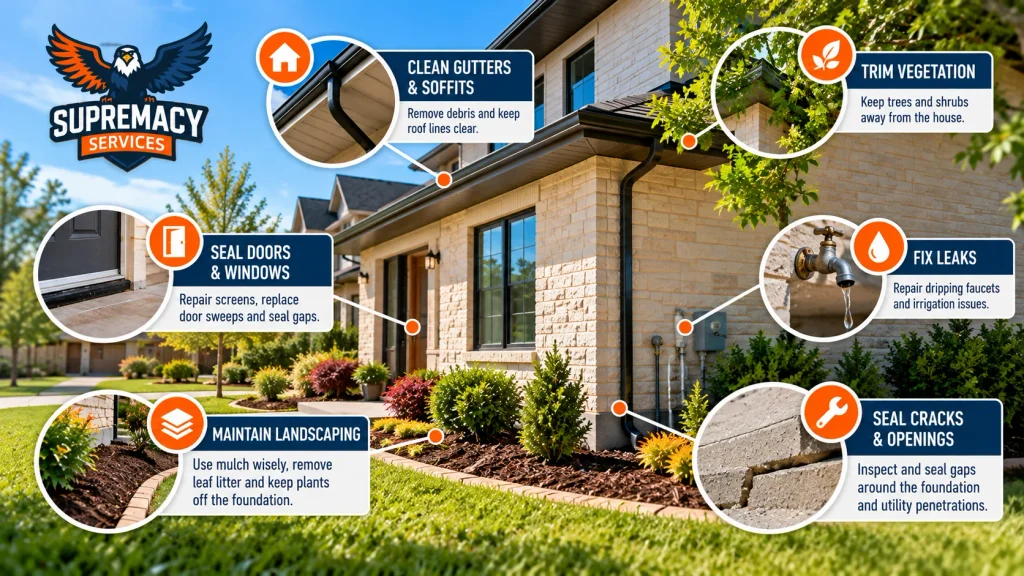
Treatment works best when the home itself is made less attractive and accessible to pests.
Use this exterior checklist:
Around the foundation
- Remove unnecessary debris.
- Inspect cracks and openings.
- Check utility penetrations.
- Avoid allowing vegetation to press against the structure.
- Investigate persistently damp areas.
Doors and windows
- Replace damaged screens.
- Check weather stripping.
- Inspect door sweeps.
- Look for daylight beneath exterior doors.
- Seal appropriate gaps.
Landscaping
- Trim vegetation away from the house where practical.
- Remove unnecessary leaf litter.
- Avoid creating consistently damp shelter beside the foundation.
- Correct irrigation that continually wets the building perimeter.
Water and sanitation
- Repair leaks.
- Remove unnecessary standing water.
- Keep garbage containers closed.
- Clean food spills.
- Avoid leaving pet food accessible overnight.
Monitor activity
Note:
- what pest you see;
- where you see it;
- time of day;
- whether it appears indoors or outdoors;
- where trails disappear;
- whether sightings increase after rain or irrigation.
Those observations can make a professional inspection substantially more useful.
Perimeter Pest Control vs. Indoor Pest Control
The two strategies solve different problems.
| Perimeter/exterior control | Interior control |
|---|---|
| Focuses on pest pressure outside | Focuses on pests already inside |
| Targets approach and entry areas | Targets indoor activity zones |
| Strong preventive role | Often corrective |
| Works well with exclusion | May require sanitation and monitoring |
| Can reduce need for routine indoor treatment | May be necessary for established infestations |
The best approach is not automatically “inside” or “outside.”
It depends on where the pest is living and how it is entering.
A few outdoor cockroaches moving through a damaged garage seal present a different problem from an established German cockroach population reproducing inside a kitchen.
Treatment should follow the evidence.
How Is Perimeter Pest Control Different From Preventive Pest Control?
Perimeter pest control is a method or treatment zone.
Preventive pest control is a broader strategy.
Preventive pest management can include:
- exterior treatment;
- inspection;
- monitoring;
- exclusion;
- sanitation;
- moisture correction;
- vegetation management;
- recurring evaluation.
That distinction matters because pesticide application alone cannot correct every condition responsible for pest activity.
Is Perimeter Pest Control Worth It?
Perimeter pest control can be worthwhile when a house experiences recurring exterior pest pressure from ants, outdoor cockroaches, spiders or other crawling insects that approach the structure.
Its value is highest when the service is based on inspection and combined with prevention.
It is less likely to solve the problem by itself when:
- pests are already breeding indoors;
- rodents are entering through structural openings;
- termites are involved;
- bed bugs are present;
- mosquitoes are the main concern;
- moisture or sanitation problems remain uncorrected.
The question isn’t simply, “Should my house be sprayed?”
A better question is:
Where are the pests coming from, and what combination of treatment and prevention will interrupt that route?
Frequently Asked Questions
How does perimeter pest control work around a house?
It targets pest activity around the exterior foundation and common entry areas so crawling insects are less likely to move indoors. Effective programs also address entry points, moisture, vegetation and other conditions supporting pests.
Where do pest-control technicians spray outside a house?
Treatment locations depend on the pest and pesticide label but may include permitted areas around foundations, cracks, door and window transitions, utility penetrations and other exterior pest routes.
Does perimeter pest control stop all bugs?
No. Different pests require different strategies. Termites, bed bugs, rodents, mosquitoes and established indoor infestations may require specialized treatment rather than ordinary perimeter control.
Do I still need indoor pest control if the outside is treated?
Not necessarily. Exterior prevention may be sufficient where the problem originates outside and no established indoor infestation exists. Active indoor infestations may require additional inspection and targeted treatment.
Can I spray my own house perimeter?
Homeowners can use consumer pesticide products where legally permitted, but the product must be labeled for the pest, location and intended application. Read and follow the complete label rather than copying a professional application method.
Does rain wash away exterior pest control?
It depends on the product, surface and timing. Some labels prohibit application during rain or where runoff can occur. Always follow the specific pesticide label.
How often should perimeter pest control be applied?
There is no universal interval that applies to every product and property. Frequency should reflect the pesticide label, pest pressure, environmental conditions and treatment plan.
Is perimeter pest control the same as termite treatment?
No. Termite management is a specialized category involving different inspection and treatment methods. Routine general perimeter pest service should not be assumed to provide termite protection.
What can I do between professional treatments?
Reduce moisture, repair screens and door sweeps, seal appropriate openings, trim vegetation away from the structure, remove debris and monitor where pests are appearing.
Protect the House by Understanding the Route In
Perimeter pest control works best when it is treated as part of a pest-management system rather than simply a line of pesticide around a house.
Start by identifying the pest.
Find where it is living and traveling.
Correct the moisture, shelter or structural opening that supports the problem.
Then use targeted treatment where appropriate.
That combination gives Dallas-Fort Worth homeowners a more sustainable approach to preventing pests from moving from the yard and exterior environment into the home.
Seeing recurring ants, cockroaches, spiders or other crawling pests around your Dallas-Fort Worth home? Explore Supremacy Services’ Perimeter Pest Control program or request an exterior pest assessment to identify entry areas and build the right prevention plan for your property.

