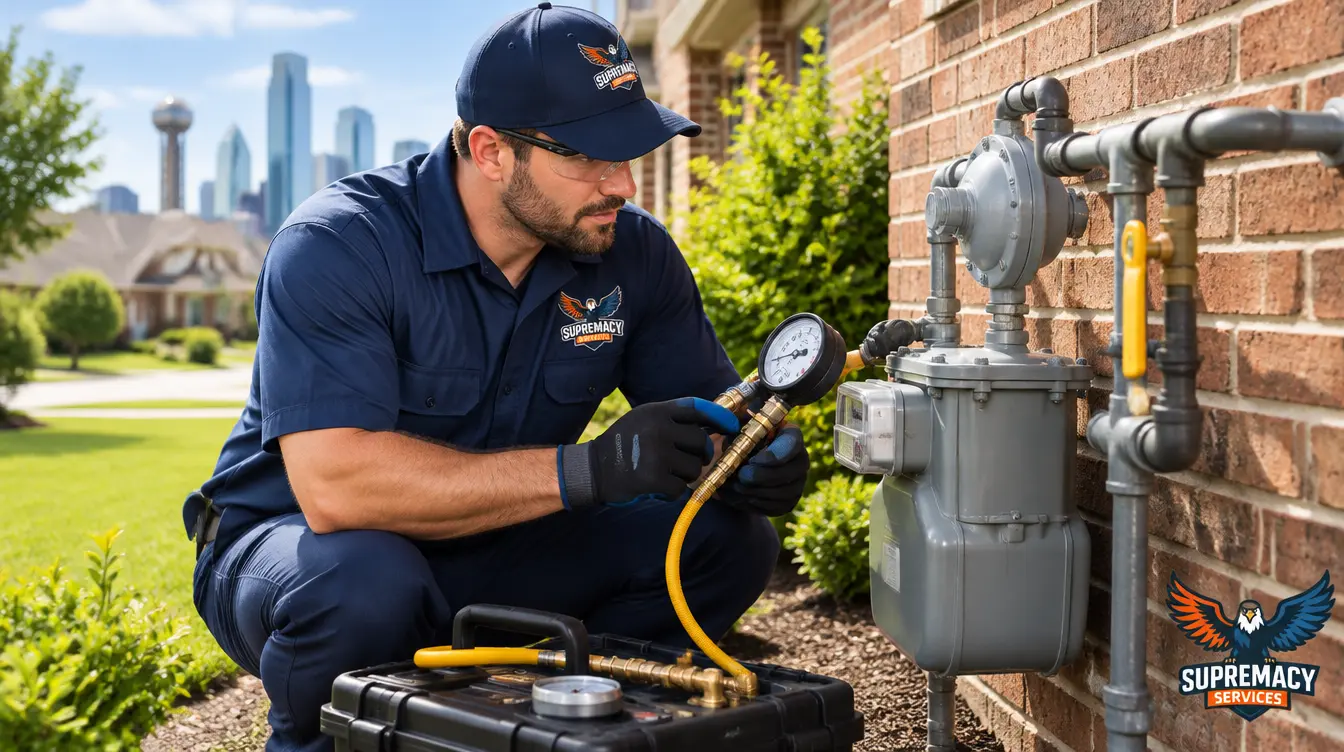
Gas line repair is usually appropriate when damage is limited to a specific section of piping and the remaining system is in good condition. Gas line replacement becomes the better option when pipes have widespread corrosion, multiple leaks, extensive deterioration, or other conditions that make isolated repairs unreliable.
For Dallas homeowners, choosing between gas line repair vs. replacement requires more than identifying where a leak occurs. A qualified plumber must evaluate the condition of the piping, determine whether the problem is isolated, and verify that the proposed work meets applicable safety requirements.
The right decision depends on the extent of damage, the pipe material, accessibility, inspection findings, and long-term reliability.
This guide explains how to compare both options, recognize warning signs, understand potential costs, and prepare for professional gas piping work in the Dallas–Fort Worth Metroplex.
Table of Contents
- What Is the Difference Between Gas Line Repair and Replacement?
- When Is Gas Line Repair Enough?
- When Should a Gas Line Be Replaced?
- What Warning Signs Require Immediate Attention?
- What Causes Residential Gas Lines to Fail?
- How Much Does Repair vs. Replacement Cost in Dallas?
- How Do Plumbers Decide Between Repair and Replacement?
- Do Gas Line Repairs Require Permits in Dallas?
- What Should Dallas Homeowners Consider?
- Can You Repair a Gas Line Yourself?
- How Can You Prevent Gas Line Problems?
- Frequently Asked Questions
- Schedule a Professional Gas Line Assessment
What Is the Difference Between Gas Line Repair and Replacement?
Gas line repair corrects a specific defect in an existing piping system. Gas line replacement involves removing, abandoning where permitted, or bypassing defective piping and installing new piping.
The distinction matters because a localized repair may restore the integrity of an otherwise serviceable system, while replacing a deteriorated section can reduce the likelihood of recurring problems. Supremacy services
Gas line repair vs. replacement comparison
| Factor | Gas line repair | Gas line replacement |
|---|---|---|
| Primary purpose | Correct a localized problem | Replace defective or unsuitable piping |
| Best suited for | Isolated leaks or damaged fittings | Extensive corrosion, recurring leaks, widespread damage |
| Work involved | Repair or replace an affected component or section | Install a new section, branch or piping run |
| Disruption | Often more limited | May require greater access or excavation |
| Upfront cost | Often lower for accessible, isolated defects | Often higher for longer or complex projects |
| Long-term outcome | Depends on the condition of remaining piping | Provides new piping in the replaced portion |
| Inspection | Testing and applicable approvals | Testing and applicable approvals |
| Main consideration | Is the remaining pipe sound? | How much piping must be replaced? |
Important: Replacing one damaged section does not necessarily mean replacing the entire home’s gas piping system.
The scope should be determined by inspection results rather than an assumption that every older gas line needs replacement.
When Is Gas Line Repair Enough?
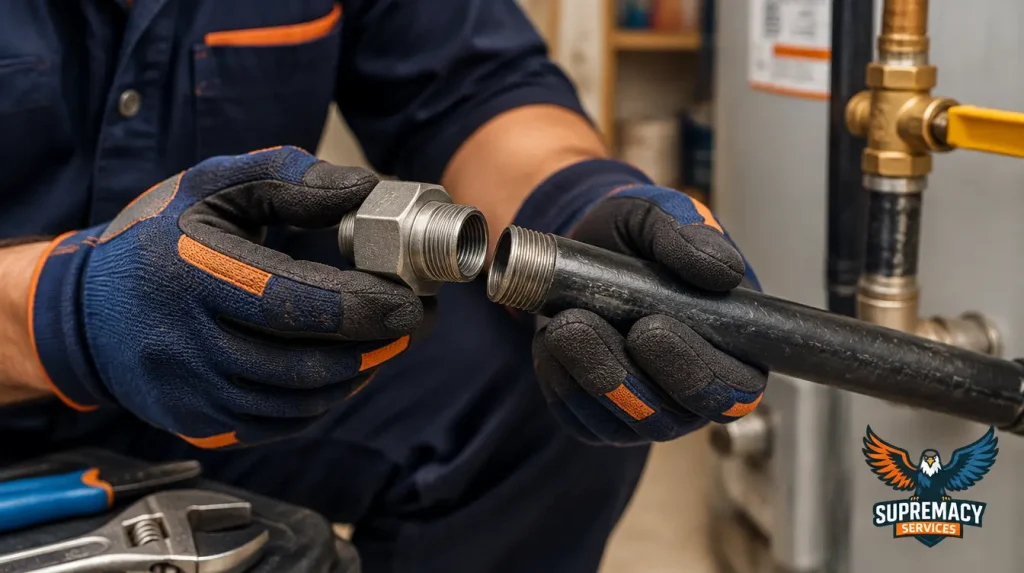
Gas line repair may be sufficient when a licensed professional identifies an isolated defect and determines that the remaining piping can continue operating safely.
The decision depends on the type of damage, the piping material, and whether an approved repair can restore the system’s integrity.
1. A leak is isolated to one fitting or connection
Gas piping systems contain joints, fittings, valves and connections.
A defect may be confined to one accessible connection rather than the entire line.
In that situation, a plumber may be able to correct the connection or replace the affected component without installing a completely new piping run.
The repair must be appropriate for the piping system and verified through required testing.
2. A short section of pipe is damaged
Localized damage can occur during construction, remodeling or excavation.
If inspection confirms that the damage is confined to a small section and the surrounding pipe remains suitable for service, replacing only the affected section may be reasonable.
For example, a contractor working near an underground gas line might damage a limited portion of piping.
The repair scope should still account for any additional damage discovered during excavation.
3. A valve or fitting has failed
Sometimes the problem involves a component rather than the pipe itself.
A qualified plumber may recommend replacing a defective valve, fitting or approved connector, depending on its location and condition.
However, homeowners should not assume that every gas odor near an appliance originates from the building’s gas piping.
The appliance and its connections may require separate evaluation.
4. The surrounding piping is in acceptable condition
The strongest argument for a localized repair is evidence that the rest of the affected system remains serviceable.
A plumber should consider the pipe’s condition, material, installation, accessibility and test results before recommending repair.
A successful repair is not simply one that stops an immediately detectable leak. It must restore a safe, code-compliant installation.
Need a professional assessment? Supremacy Services offers gas line repair and diagnostic services in Dallas to help homeowners identify the affected piping and discuss appropriate repair or replacement options.
When Should a Gas Line Be Replaced?
Gas line replacement is generally worth considering when damage extends beyond one isolated defect, when corrosion affects the reliability of existing piping, or when an appropriate localized repair cannot be made.
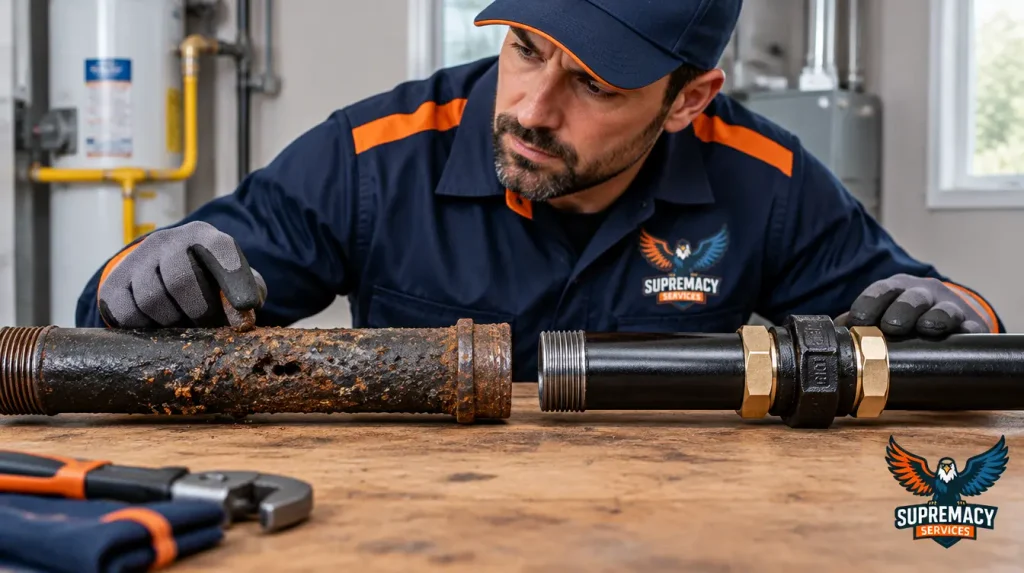
Replacement can involve a short section, an underground run, an appliance branch or a larger portion of the system.
1. Extensive corrosion affects the piping
Corrosion can weaken metallic piping over time.
The condition is particularly important when deterioration affects multiple sections, connections or locations that are difficult to inspect.
Visible surface rust does not automatically mean a gas line must be replaced. A professional must distinguish cosmetic corrosion from deterioration that compromises the pipe.
If the piping has lost structural integrity or shows widespread damage, replacement may be preferable to repeatedly repairing individual locations.
2. Multiple leaks have developed
A single isolated leak may support a repair recommendation.
Multiple leaks across different sections raise concerns about the overall condition of the piping.
If a plumber discovers repeated failures in the same run, replacing the affected run may be more practical than performing several separate repairs.
3. Underground piping has deteriorated
Buried gas lines can be affected by corrosion, physical damage and ground movement.
An underground leak may require excavation or another approved access method to locate and evaluate the defective section.
Replacement may be recommended when the existing buried pipe is unsuitable for continued use or when its condition makes a durable localized repair impractical.
4. The piping is unsuitable for the intended installation
A gas piping system may need modification when a homeowner adds appliances, relocates equipment or changes the layout of the home.
For example, a remodeled kitchen may require a different piping route or a professionally designed extension.
However, installing a new appliance does not automatically require replacing existing gas piping.
A qualified professional must determine whether the current system is appropriately sized, configured and compliant for the proposed appliance load.
5. Repeated repairs are becoming impractical
Recurring repairs can create additional costs and disruption.
If the same piping run develops problems repeatedly, homeowners should request a broader condition assessment instead of continuing to address each defect independently.
The decision should compare the scope of necessary repairs with the expected reliability of the remaining system.
Quick decision checklist
Questions to discuss with your plumberIs the damage limited to one fitting or pipe section?Does the surrounding piping show significant corrosion?Have leaks occurred in multiple locations?Is the damaged section accessible for an approved repair?Would replacement address a recurring failure?Have the required tests and approvals been identified?
0 of 6 reviewedReset
This checklist helps prepare for an assessment. It cannot determine whether a gas line is safe.
What Warning Signs Require Immediate Attention?
A rotten-egg or sulfur-like odor, hissing near gas equipment, or evidence of a damaged gas line can indicate a potentially dangerous leak.
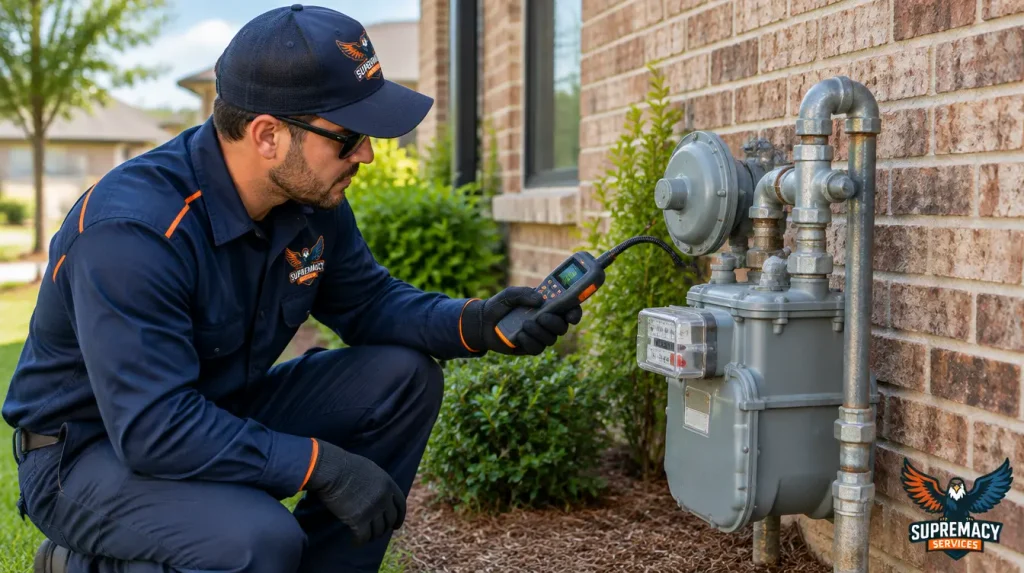
If you suspect an active gas leak:
- Leave the building or affected area immediately.
- Do not operate electrical switches, appliances, phones or vehicles near the suspected leak.
- Once you are safely away, call 911 or your gas utility’s emergency number.
- Keep others away and do not return until emergency responders or the gas utility confirm it is safe.
These precautions are consistent with Texas811 gas leak safety guidance.
Do not attempt to find the leak yourself or remain inside to arrange a routine plumbing appointment.
Other symptoms that deserve investigation
Some problems are less obvious and do not necessarily prove that a gas line is leaking.
| Observation | Possible explanation | Appropriate action |
|---|---|---|
| Unexpectedly high gas bill | Increased consumption, billing changes or possible leakage | Review usage and request professional evaluation |
| Repeated gas service interruptions | Utility issue, appliance fault or piping concern | Contact the utility or qualified professional |
| Visible pipe corrosion | Surface deterioration or potentially more serious corrosion | Arrange a professional inspection |
| Appliance ignition problems | Appliance, regulator, supply or combustion issue | Have the equipment professionally assessed |
| Recent excavation near gas piping | Potential physical damage | Stop work and contact the utility if damage is suspected |
A yellow burner flame or poor appliance performance does not, by itself, establish that a gas line needs replacement.
Appliance combustion problems and gas piping defects require different diagnostic approaches.
What Causes Residential Gas Lines to Fail?
Residential gas piping problems can result from corrosion, accidental damage, defective connections, installation deficiencies and movement affecting the piping system.
Understanding the cause helps determine whether the issue is isolated or likely to affect a larger section.
Corrosion and environmental exposure
Metallic gas piping may deteriorate when exposed to conditions that promote corrosion.
The severity depends on the pipe material, protective measures, installation and environment.
Buried metallic piping deserves particular attention because its condition may not be visible without investigation.
Accidental excavation damage
Landscaping, fence installation, trenching and construction can damage buried gas lines.
Texas homeowners are required to contact 811 before digging, including on private residential property.
The Railroad Commission of Texas specifies contacting 811 at least two business days before excavation, excluding weekends and holidays.
Movement and inadequate support
Ground movement or movement within a building can place stress on piping and connections.
The effect depends on how the piping was installed, supported and protected.
Movement alone does not prove that a gas line is damaged, but it can be relevant when a professional investigates a leak.
Installation or connection problems
Improperly installed or unsuitable fittings, inadequate support and other installation deficiencies may contribute to failures.
A qualified plumber should identify the underlying defect rather than merely address the visible symptom.
How Much Does Gas Line Repair vs. Replacement Cost in Dallas?
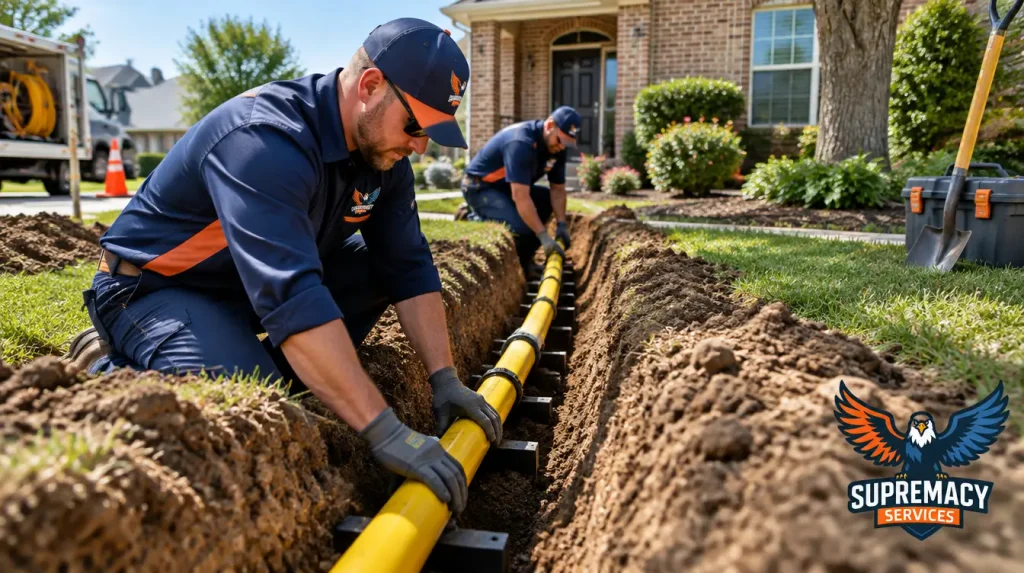
Gas line repair is often less expensive than replacement when the defect is small and accessible. However, an underground repair requiring excavation can cost more than replacing a short, accessible section of piping.
There is no reliable universal price for gas line repair or replacement in Dallas because the work varies significantly from one property to another.
A professional estimate should identify the required work before assigning a final price.
Factors affecting the cost
| Cost factor | Why it matters |
|---|---|
| Length of piping | Longer replacements generally require more materials and labor |
| Pipe location | Buried, concealed or difficult-to-reach piping requires additional access work |
| Extent of damage | Multiple defects can increase the scope of repairs |
| Pipe material | Approved materials and connection methods vary by installation |
| Excavation | Underground work may require digging and site restoration |
| Permits and inspections | Applicable local requirements affect scheduling and project costs |
| Appliance connections | Reconnecting or modifying multiple branches adds complexity |
| Property restoration | Landscaping, pavement or finished surfaces may need restoration |
Example: Comparing two possible situations
Scenario A: An isolated accessible fitting defect
A plumber identifies one defective connection, confirms the surrounding piping is suitable and determines that an approved localized repair is possible.
The homeowner may avoid replacing a longer piping run.
Scenario B: A deteriorated underground piping run
An inspection identifies multiple defects along an underground line, with corrosion affecting a substantial portion.
Replacing the affected run may be more practical than excavating and repairing each defect separately.
These examples illustrate how scope influences cost. They are not project estimates.
How to compare repair and replacement quotes
Ask whether each written estimate includes:
- The exact piping section being repaired or replaced
- Materials and installation labor
- Required access or excavation
- Permits and inspections, where applicable
- Pressure testing and service restoration coordination
- Restoration of disturbed areas
- Warranty terms and exclusions
The lowest upfront price is not always the best value if it leaves known defects unresolved.
Considering replacement because repairs keep recurring? Request a professional gas piping assessment from Supremacy Services and compare the recommended scope before authorizing work.
How Do Plumbers Decide Between Gas Line Repair and Replacement?
A qualified plumber determines the appropriate solution by evaluating the piping system, identifying defects and deciding whether an approved repair can restore safe operation.
A typical assessment may include the following stages.
Step 1: Identify the affected piping
The plumber determines which portion of the system requires evaluation.
This may involve an appliance branch, exposed interior piping, concealed piping or an underground run.
If the problem involves utility-owned infrastructure, the gas provider may need to handle the issue.
Step 2: Locate and evaluate defects
Professionals may use appropriate gas detection instruments, visual inspection and approved testing procedures.
Testing methods depend on the situation and applicable code requirements.
Homeowners should not attempt pressure testing or leak localization themselves.
Step 3: Assess the condition of the remaining pipe
Finding one leak does not establish whether the surrounding piping is sound.
The plumber should evaluate relevant factors such as corrosion, material condition, previous repairs and accessibility.
Step 4: Recommend the repair scope
The professional may recommend:
- Correcting an approved connection or component
- Replacing a short defective section
- Replacing an affected branch
- Installing a new piping run
- Replacing a larger system section when justified
Step 5: Complete required testing and approvals
Following authorized work, the system must undergo the testing and inspection required for that installation.
Gas service should only be restored through the appropriate process.
Do Gas Line Repairs or Replacements Require Permits in Dallas?
Yes, many gas piping repairs and replacements in Dallas require a permit, inspection and gas-service release. The exact requirements depend on the work and circumstances.
The City of Dallas Gas Test Guidelines identify repairs involving gas piping replacement, new installations, alterations and certain gas-service restoration situations as requiring inspection and release procedures.
The city’s published guidance also specifies requirements for permitted gas pressure testing and coordination with the gas provider.
Homeowners should not assume that a minor repair is automatically exempt.
What about Frisco, Plano and other DFW cities?
Permitting and inspection requirements are administered by the applicable local jurisdiction.
A Dallas permit procedure should not be assumed to apply identically in Frisco, Plano, Allen, McKinney or Fort Worth.
Before authorizing work, confirm who will obtain permits, arrange inspections and coordinate service restoration.
Who is responsible for the gas line?
Responsibility depends on the location of the defect, the gas utility’s service boundary and the ownership of the piping.
The utility generally handles its own infrastructure, while customer-owned piping is typically the property owner’s responsibility.
The precise boundary should be confirmed with the gas provider rather than assumed solely from the location of the meter.
What Should Dallas and DFW Homeowners Consider?
Local property conditions can influence how gas piping is inspected, accessed and repaired.
Older homes and existing piping
An older home may contain piping installed under previous code editions or using materials different from those selected for modern installations.
Age alone does not prove that a gas line is unsafe.
A professional should assess the actual material, installation condition and applicable requirements.
North Texas soil movement
Parts of North Texas contain expansive clay soils that can shrink and swell as moisture conditions change.
Where buried piping is exposed to ground movement, the installation’s design, support and protection can matter.
However, soil movement should not be assumed to be the cause of a gas leak without evidence.
Landscaping and outdoor improvements
Fence installation, irrigation work, tree planting and yard renovations can bring excavation equipment close to buried utilities.
Request utility locating before digging and make sure the contractor understands that private customer-owned lines may require separate locating arrangements.
Remodeling and appliance upgrades
Adding a gas range, furnace, water heater or outdoor appliance can require changes to piping layout or capacity.
A licensed professional should evaluate the system before a new gas load is connected.
Can You Repair a Gas Line Yourself?
Gas line repair and replacement should be handled by a properly qualified professional. Mistakes can create fire, explosion and serious injury hazards.
Gas piping work involves more than tightening a connection or installing a new section of pipe. It may require approved materials, proper joining methods, pressure testing, permits and inspections.
Although Dallas provides a limited homeowner permitting pathway under specified conditions, that does not make gas piping a suitable DIY repair project.
Do not attempt to seal an active leak with tape, adhesive, putty or an improvised fitting.
Homeowners can help by documenting previous repairs, gathering property information and requesting clear written estimates after the site has been declared safe.
How Can You Prevent Gas Line Problems?
Not every gas piping failure can be prevented, but homeowners can reduce avoidable damage and improve their awareness of potential problems.
- Contact 811 before excavation or landscaping work.
- Protect exposed piping from accidental impacts.
- Avoid hanging objects or placing unnecessary loads on gas piping.
- Arrange professional evaluation when corrosion, damage or recurring problems are noticed.
- Keep records of gas piping modifications and previous repairs.
- Have gas appliance installation and piping changes performed by qualified professionals.
- Follow manufacturer instructions for appliance maintenance and inspections.
Prevention does not eliminate the need for prompt action when a gas leak is suspected.
Frequently Asked Questions About Gas Line Repair vs. Replacement
1. Can a leaking gas line be repaired instead of replaced?
Yes, some leaking gas lines can be repaired when the defect is isolated and the remaining piping is suitable for continued service. A qualified plumber must determine whether an approved repair is appropriate.
2. How do I know if my gas line needs replacing?
Replacement may be necessary when piping has extensive corrosion, multiple leaks, serious physical damage or other conditions that make localized repairs unreliable. Professional inspection is required to determine the scope.
3. Do old gas lines always need to be replaced?
No. Pipe age alone does not establish that replacement is necessary. Material condition, corrosion, installation quality and inspection findings are more important.
4. Can only part of a gas line be replaced?
Yes. A plumber may replace a defective section, appliance branch or individual piping run without replacing the entire home’s system, provided the remaining installation is suitable.
5. Is gas line replacement more expensive than repair?
Replacement often costs more when it involves additional piping, labor and excavation. However, difficult repairs or repeated failures can change the comparison. Obtain written estimates based on the actual scope.
6. Can underground gas pipes be repaired?
Some underground gas piping defects can be repaired using approved methods. Replacement may be recommended when the pipe has extensive damage or deterioration.
7. Do I need a permit to replace a gas line in Dallas?
Many gas piping replacements require a plumbing permit, inspection and applicable gas-service release. Confirm requirements with the City of Dallas and the contractor performing the work.
8. How long does gas line replacement take?
The duration depends on pipe length, accessibility, excavation, permits, inspections and utility coordination. A small accessible replacement may be relatively straightforward, while an underground project may take longer.
9. Can I continue using gas appliances if a leak is suspected?
No. If you suspect an active gas leak, evacuate immediately and contact 911 or the gas utility from a safe location. Do not operate appliances or return until authorized.
10. Should I replace my gas line when installing a new appliance?
Not necessarily. A new appliance may require a capacity assessment, new branch or piping modification, but complete replacement is not automatically necessary.
Schedule a Professional Gas Line Assessment in Dallas
Choosing between gas line repair and replacement starts with understanding the condition of the piping—not assuming that the cheapest repair or largest replacement is automatically the right solution.
A qualified professional can identify the affected section, evaluate whether surrounding piping remains suitable, and explain the work required to restore safe operation.
Supremacy Services provides residential gas line diagnostics, repair and replacement services for homeowners throughout Dallas and the DFW Metroplex.
If you are dealing with recurring gas piping problems, damaged lines or concerns about aging piping, visit Supremacy Services’ Dallas gas line repair page to request a professional assessment.
Call: 945-777-3345
If you suspect an active gas leak, evacuate first and contact emergency services or your gas utility from a safe location.