10400 Clarence Drive, Frisco, TX 75033
Support 24/7: 945-777-3345
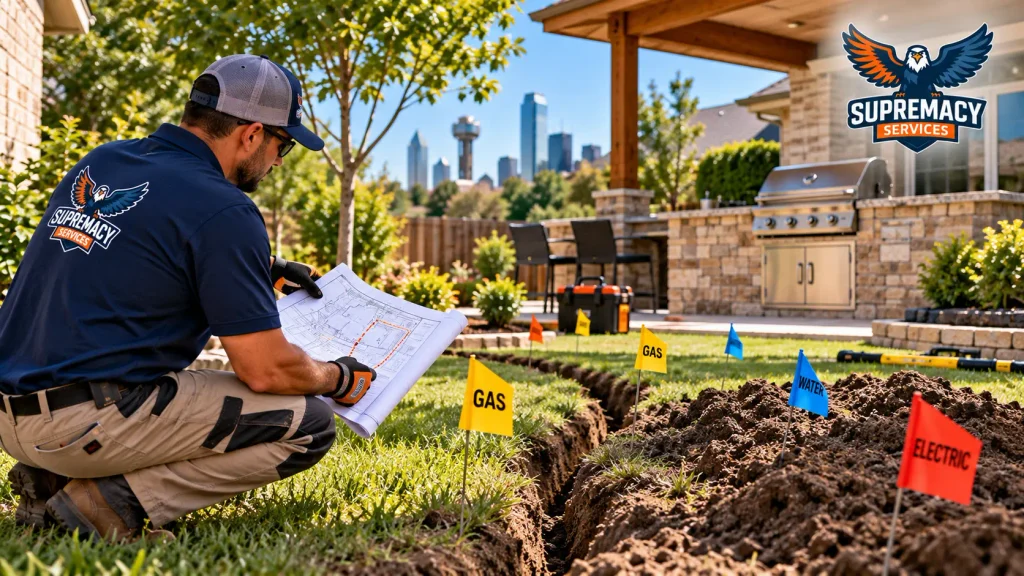
Supremacy Services technician reviewing a commercial pest control plan with a facility manager in Dallas

What Should a Commercial Pest Control Service Plan Include?

A good commercial pest control service plan should cover much more than scheduled pesticide applications. For a Dallas-Fort Worth business, a professional plan should normally define the property’s pest risks, inspection areas, monitoring strategy, prevention responsibilities, treatment procedures, service frequency, corrective actions and documentation.

The best programs are built around the actual facility rather than a standard checklist copied from one property to another.

A small Dallas office, for example, does not present the same pest-management challenges as a restaurant, warehouse, apartment community or hotel. Loading docks, food storage, floor drains, landscaping, shared walls, waste areas, deliveries and operating hours can all change where pests are likely to appear and how the property should be monitored.

The U.S. Environmental Protection Agency’s guidance on Integrated Pest Management recommends identifying pests correctly, monitoring activity, establishing action thresholds, preventing pest-conducive conditions and documenting control actions. US EPA

If you manage a commercial property in DFW and need a facility-specific program rather than a generic treatment schedule, explore Supremacy’s commercial pest-management options.

Table of Contents

  1. What should a commercial pest-control plan contain?
  2. Initial facility inspection
  3. Pest-risk assessment
  4. Monitoring program
  5. Prevention and exclusion
  6. Treatment strategy
  7. Service frequency
  8. Documentation and reporting
  9. Corrective-action procedures
  10. Responsibilities for staff and management
  11. Emergency response
  12. How commercial plans differ by facility
  13. What affects the cost?
  14. How to compare commercial pest-control proposals
  15. DIY vs professional commercial pest management
  16. Dallas and DFW considerations
  17. FAQs

What Should a Commercial Pest-Control Plan Contain?

A comprehensive plan should normally contain these core components:

ComponentWhat it should address
Facility inspectionCurrent activity, entry points and high-risk areas
Pest identificationSpecies or pest groups present or likely
MonitoringWhere and how activity will be tracked
PreventionSanitation, moisture, exclusion and maintenance issues
Treatment strategyAppropriate controls based on actual conditions
Service scheduleHow frequently inspections/service occur
DocumentationFindings, actions, trends and recommendations
Corrective actionWhat happens when pest activity exceeds an acceptable level
ResponsibilitiesTasks assigned to pest provider, management and staff
Follow-upHow results are reviewed and the program adjusted

EPA’s building IPM framework follows essentially this progression: identify and monitor pests, establish thresholds, prevent conducive conditions and use appropriate controls when intervention is necessary.

A commercial contract that simply says a technician will “spray monthly” leaves many of these questions unanswered.


1. Initial Facility Inspection

Every commercial pest-management program should begin with an inspection of the property and its operating conditions.

Pest-control technician inspecting a warehouse loading-door gap for pest entry points in Dallas-Fort Worth
A detailed commercial inspection should identify pest activity, structural entry points and conditions that may support future infestations.

The inspection establishes a baseline.

Rather than inspecting only areas where insects have already been reported, a commercial inspection may evaluate areas such as:

  • exterior walls;
  • doors and door sweeps;
  • loading docks;
  • delivery areas;
  • kitchens and break rooms;
  • food-storage areas;
  • floor drains;
  • plumbing penetrations;
  • mechanical rooms;
  • utility corridors;
  • trash and recycling areas;
  • landscaping next to the building;
  • roof or attic areas where applicable;
  • stockrooms;
  • tenant spaces;
  • common areas;
  • areas where previous pest activity has been reported.

Supremacy’s existing commercial service page already describes its process as beginning with a facility audit that looks for entry points, water leaks and high-risk zones. Supremacy Services


2. Pest-Risk Assessment

A pest-control plan should identify both current pest activity and conditions that could create future activity.

Those are not necessarily the same thing.

A warehouse may currently have no visible rats yet still have:

  • gaps around dock doors;
  • exterior vegetation touching walls;
  • accessible waste;
  • damaged door seals;
  • stored inventory providing harborage.

Likewise, a restaurant may have no obvious cockroach sightings while food debris, moisture or drain conditions increase future risk.

The assessment should therefore consider:

Pest evidence

Droppings, insects, damaged goods, nesting material, tracks, gnawing, spotting, webbing or monitoring-device captures.

Entry points

Door gaps, penetrations, cracks, utility openings, roofline gaps and poorly sealed loading areas.

Food

Ingredients, spills, employee food, pet food, waste, grease and improperly stored products.

Water

Leaks, condensation, drains, standing water and irrigation issues.

Shelter

Clutter, stored cardboard, wall voids, landscaping and rarely disturbed areas.

EPA specifically recommends focusing prevention on reducing pests’ access to food, water and shelter, along with sealing entry points and removing standing water.


3. Monitoring Program

A commercial pest-control plan should explain how pest activity will be measured between service visits.

Commercial pest-control technician checking a monitoring station inside a warehouse
Monitoring allows commercial properties to track pest activity over time and make treatment decisions based on actual findings.

This is one of the biggest differences between true pest management and reactive extermination.

Depending on the target pest and facility, monitoring may involve strategically located devices or inspection points.

The plan should identify:

  • what is being monitored;
  • monitoring locations;
  • inspection frequency;
  • how findings are recorded;
  • what level of activity triggers further action.

EPA guidance recommends maintaining records for each building that document monitoring techniques, monitoring locations, inspection schedules, findings and recommendations. It also states that pest-management plans should be adjusted based on monitoring results.

Why monitoring matters

Suppose three rodent monitoring points repeatedly show activity near one warehouse loading dock.

That pattern tells the pest professional considerably more than a single isolated sighting. The next step can focus on that specific zone: door sealing, exterior conditions, food sources, sanitation or additional control measures.

Without records, every visit risks becoming an isolated event rather than part of a long-term management program.


4. Prevention and Exclusion

Professional commercial pest management should address why pests are entering or surviving—not only kill the pests already present.
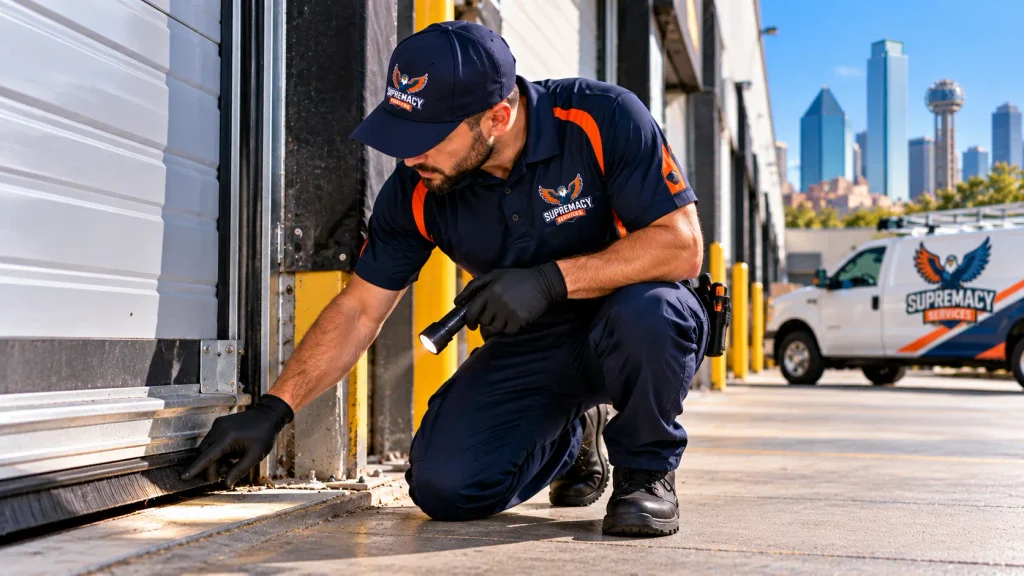
Technician inspecting and sealing a commercial loading-door gap to prevent pest entry
Closing structural gaps and correcting pest-conducive conditions can help reduce recurring pest activity in commercial buildings.

Potential preventive recommendations may include:

  • replacing damaged door sweeps;
  • sealing penetrations;
  • correcting gaps around utility lines;
  • reducing clutter;
  • correcting moisture sources;
  • improving waste handling;
  • adjusting exterior storage;
  • managing vegetation against structures;
  • repairing screens;
  • improving food-storage practices.

EPA’s IPM guidance specifically lists sealing pest entry points, removing trash and overgrown vegetation, maintaining clean food areas, installing barriers and removing standing water as prevention measures.

Is exclusion always included in the service price?

No assumption should be made.

Minor recommendations may be part of routine service, while larger structural repairs or rodent-exclusion projects may be separately scoped.

A commercial proposal should clearly state what is:

included, recommended, separately priced or the property owner’s responsibility.


5. Treatment Strategy

A service plan should state how active pest problems will be addressed without committing every visit to the exact same treatment.

An IPM-based approach may combine:

  • sanitation changes;
  • exclusion;
  • traps;
  • physical removal;
  • monitoring;
  • targeted pesticide applications where appropriate;
  • pest-specific interventions.

EPA emphasizes that IPM is not a single control method. Appropriate control methods are selected based on inspection and monitoring information.

That distinction matters commercially.

A recurring mouse problem caused by an open loading-door gap is not solved in the same way as German cockroach activity around a kitchen.


6. Service Frequency

There is no single ideal commercial pest-control frequency for every business.

The service interval should reflect:

  • property type;
  • pest history;
  • food availability;
  • occupancy;
  • sanitation conditions;
  • pest pressure;
  • monitoring requirements;
  • building layout;
  • seasonal activity;
  • operating environment.

A relatively low-risk professional office might require a different schedule from a restaurant, food facility or large warehouse.

Monthly vs. quarterly commercial pest control

FactorLower-frequency serviceHigher-frequency service
Limited foodMore feasible—
Low historical pest pressureMore feasible—
Simple office environmentOften lower complexity—
Food handling—May justify closer monitoring
Frequent deliveries—Increased inspection needs
Large loading areas—Increased rodent/insect exposure
Established infestation—Often requires corrective follow-up
High customer sensitivity—May warrant more monitoring

The correct question is therefore not simply:

“Should commercial pest control be monthly?”

It is:

“What monitoring and service interval is appropriate for this facility’s risks?”


7. Documentation and Reporting

Commercial pest control should create a usable record of what was found and what was done.

This becomes particularly valuable for:

  • property managers;
  • facilities teams;
  • multi-location companies;
  • food-service operations;
  • warehouses;
  • hospitality businesses;
  • healthcare environments;
  • businesses with internal audits or documented sanitation programs.

A useful service report may record:

  • service date;
  • areas inspected;
  • pest findings;
  • monitoring results;
  • actions taken;
  • application information where applicable;
  • recommendations;
  • areas requiring maintenance attention;
  • follow-up needs.

EPA recommends keeping an organized record of pest-control services and documenting control actions and preventive recommendations.

Supremacy’s current commercial offering also emphasizes digital service reports and ongoing documentation following visits. Supremacy Services

What should you ask a provider?

Ask:

“Can you show me an example of the service documentation I will receive after each visit?”

That question often reveals more about the quality of a commercial program than a vague promise of “complete pest protection.”


8. Corrective-Action Procedures

A professional plan should answer:

What happens when monitoring reveals a problem?

EPA uses the concept of an action threshold—the point at which pest presence becomes serious enough to warrant intervention.

Thresholds will vary by environment.

One pest sighting in a sensitive food or patient-care area may be treated differently from occasional activity in an exterior monitoring zone.

A corrective-action process may include:

  1. confirm the pest;
  2. identify the source or conducive condition;
  3. increase monitoring;
  4. address sanitation or structural deficiencies;
  5. perform targeted treatment;
  6. re-inspect;
  7. document the outcome.

This prevents commercial pest control from becoming a repetitive cycle of treating symptoms without investigating why activity keeps returning.


9. Responsibilities for Staff and Management

Commercial pest management works best when responsibilities are shared.

The pest-control provider cannot repair every leaking pipe, manage kitchen sanitation, control every delivery or enforce every employee storage practice.

A good plan should therefore explain who is responsible for what.

Pest-control providerProperty/business team
Inspect pest activityReport sightings promptly
Identify pestsMaintain sanitation
Maintain monitoring programCorrect maintenance issues
Recommend preventive measuresManage waste properly
Perform agreed treatmentsProvide access
Document findingsFollow preparation instructions
Review trendsComplete assigned corrective actions

EPA’s building guidance similarly assigns roles to pest-management professionals, cleaning staff, building management, maintenance staff and occupants.


10. Emergency Response

Recurring commercial service should also explain what happens outside normal scheduled visits.

Questions to ask include:

  • What constitutes an emergency?
  • How are urgent pest sightings reported?
  • Is emergency response included or separately charged?
  • What happens when activity appears between scheduled services?
  • Who is authorized to request extra service?
  • Does the provider handle specialized pests under the same agreement?

This is particularly important when a pest issue could disrupt operations or become visible to customers.


How Commercial Plans Differ by Facility
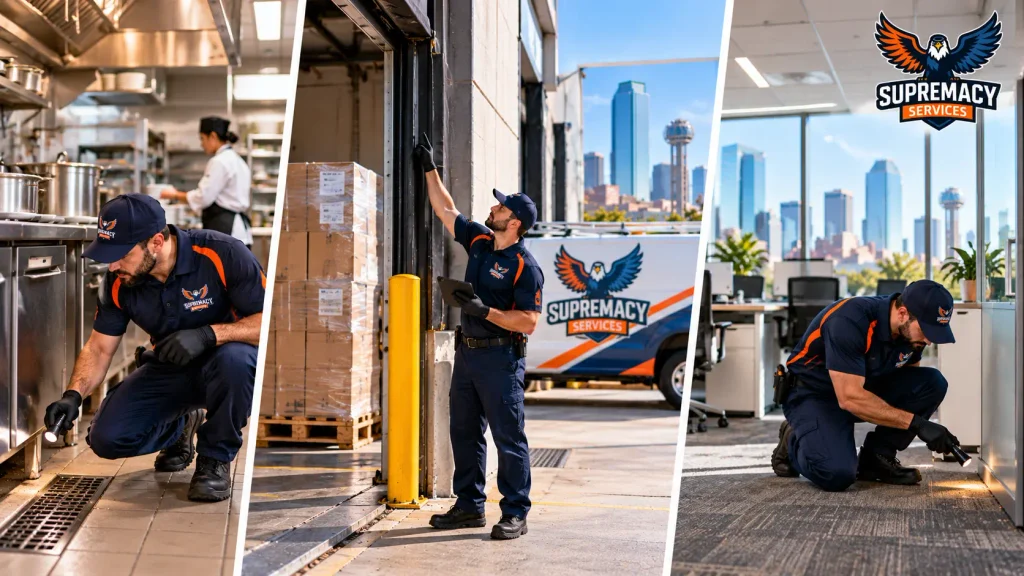
Pest-control inspections shown in a restaurant, warehouse and office environment
Restaurants, warehouses and offices often require different pest-management strategies because each facility presents different risks and operating conditions.

There should not be one identical program for every business.

Supremacy’s existing commercial page already differentiates restaurants, multifamily properties, hotels, warehouses, manufacturing facilities, offices, healthcare properties, retail businesses and property-management portfolios. Supremacy Services

Restaurants and food service

Attention may concentrate on:

  • receiving areas;
  • dry storage;
  • kitchens;
  • drains;
  • grease areas;
  • beverage stations;
  • dumpsters;
  • employee areas;
  • exterior delivery doors.

Warehouses and distribution facilities

Priorities often include:

  • loading docks;
  • overhead doors;
  • inventory storage;
  • exterior perimeter;
  • break rooms;
  • receiving;
  • wall penetrations;
  • rodent entry points.

Offices

Plans often emphasize:

  • kitchens and break rooms;
  • restrooms;
  • exterior doors;
  • utility penetrations;
  • landscaping;
  • employee food storage.

Multifamily properties

Shared walls and utility pathways can complicate pest activity, while turnover creates additional inspection opportunities. Supremacy’s general pest page currently highlights common areas, individual units, exterior perimeter programs and recurring inspection programs for multifamily properties. Supremacy Services

Hotels

Different zones may require different strategies:

  • guest rooms;
  • housekeeping areas;
  • kitchens;
  • laundry;
  • waste areas;
  • receiving;
  • common areas.

Bed bugs can also require a separate inspection and treatment protocol rather than being assumed to be part of standard general pest service. Supremacy’s bed-bug page specifically addresses commercial properties including hotels and multifamily facilities. Supremacy Services


What Does a Commercial Pest-Control Service Plan Cost?

There is no responsible way to assign one price to every commercial pest-control plan.

Supremacy already has a dedicated commercial pricing guide, which should own the commercial pest control cost Dallas informational intent rather than duplicating pricing detail here.

That page explains that commercial cost varies according to factors such as:

  • facility size and layout;
  • business type;
  • pest species;
  • infestation severity;
  • frequency;
  • monitoring requirements;
  • documentation;
  • structural conditions. Supremacy Services

For this article, keep the pricing discussion brief and link to the dedicated cost guide.

Recommended sentence

The cost of a commercial program depends on the property’s size, pest pressure, operating environment, service frequency and monitoring requirements; see our commercial pest-control pricing guide for a deeper breakdown.


How to Compare Commercial Pest-Control Proposals

Commercial pest-control plan showing inspection, monitoring, prevention, treatment, reporting and ongoing management
A complete commercial pest-control service plan should define how pests will be inspected, monitored, prevented, treated, documented and managed over time.

Do not compare commercial contracts solely by monthly price.

Use this checklist:

  1. Which pests are included?
  2. Which pests cost extra?
  3. What areas are inspected?
  4. How frequently are monitoring points checked?
  5. What type of service report is supplied?
  6. Does the program include prevention recommendations?
  7. Is structural exclusion included?
  8. What happens between scheduled visits?
  9. How are infestations handled?
  10. How are trends reviewed over time?
  11. Are specialized problems such as bed bugs or termites separate?
  12. Who performs the actual pest-control work?
  13. Is the pest-control business properly licensed in Texas?

Texas requires businesses performing structural pest control for hire to hold a Structural Pest Control Service business license and designate an appropriate certified applicator. texasagriculture.gov

Comparing commercial pest-control plans in DFW? Request a facility assessment from Supremacy Services to build the service scope around your property’s actual pest risks.


DIY vs. Professional Commercial Pest Management

A business can handle many preventive tasks internally.

Appropriate in-house measures

Staff can usually help by:

  • cleaning spills;
  • storing food correctly;
  • managing waste;
  • reporting leaks;
  • reducing clutter;
  • keeping doors closed;
  • reporting sightings;
  • correcting basic maintenance problems.

When professional pest control becomes appropriate

Professional support becomes increasingly important when:

  • pest sightings recur;
  • rodents are present;
  • cockroaches are established;
  • multiple parts of the building are affected;
  • pests are appearing in customer-facing spaces;
  • specialized treatment is required;
  • the business needs consistent monitoring and documentation;
  • pesticide applications or professional structural pest-control services are required.

Texas regulates businesses and individuals that provide structural pest-control services for compensation, including inspection, identification, devices and pesticide applications within the scope described by TDA.

Repeated use of consumer pesticides without diagnosing entry points, food, water and harborage conditions is not a substitute for a structured commercial pest-management program.


Dallas and DFW Considerations

Commercial properties across DFW range from small offices and restaurants to logistics facilities, warehouses, apartment communities and large retail properties.

The important local issue is not simply the Dallas ZIP code. It is how the property interacts with its surroundings.

A good DFW inspection should consider conditions such as:

  • doors that remain open during deliveries;
  • loading docks;
  • waste-storage locations;
  • irrigated landscaping;
  • exterior lighting;
  • plumbing and drainage;
  • neighboring tenant spaces;
  • food service;
  • large warehouse perimeters;
  • seasonal outdoor pest activity.

This is a better local-SEO strategy than repeatedly inserting “Dallas TX pest control” into paragraphs.


Commercial Pest Control vs. One-Time Extermination

One-time reactive serviceCommercial pest-management plan
Addresses an immediate problemManages ongoing risk
Often focused on visible activityIncludes monitoring
Limited trend informationTracks activity over time
May not address building conditionsIncludes preventive recommendations
Treatment-drivenInspection, prevention and treatment
Single eventRecurring program
Limited facility planningFacility-specific scope

The distinction supports featured snippets and AI-search answers while keeping the article educational.


Frequently Asked Questions

What should be included in commercial pest control?

A commercial program should generally include facility inspection, pest identification, monitoring, preventive recommendations, treatment procedures, service frequency, reporting, corrective actions and clearly defined responsibilities.

How often should commercial pest control be performed?

There is no universal frequency. The appropriate schedule depends on the type of business, pest pressure, building layout, food and moisture sources, pest history and monitoring requirements.

Should a commercial pest-control company inspect before quoting?

For complex or higher-risk properties, an inspection can produce a more meaningful scope because it reveals entry points, pest activity and conditions that cannot be determined from square footage alone.

Does regular commercial pest control include rodents?

Do not assume so. Ask whether rodent monitoring, trapping, exterior stations, exclusion and follow-up are included or priced separately.

Are bed bugs included in commercial pest-control contracts?

Frequently they require a separate treatment protocol. Hotels, apartments and other businesses should clarify this before signing a general pest-management agreement.

Should I receive a pest-control service report?

A useful commercial program should document relevant inspection findings, monitoring results, work performed and recommendations. EPA building-IPM guidance specifically emphasizes record keeping.

What is commercial Integrated Pest Management?

Integrated Pest Management combines inspection, monitoring, prevention and appropriate controls instead of relying only on routine pesticide treatment.

How do I know whether a pest-control company is licensed in Texas?

Structural pest-control businesses operating for compensation in Texas are regulated through the Texas Department of Agriculture’s Structural Pest Control Service. TDA provides information on business and applicator licensing.

What makes a restaurant pest-control plan different from an office plan?

Restaurants usually require more attention to food storage, drains, grease, receiving and waste areas, while office programs may concentrate more heavily on break rooms, entry points, landscaping and occasional pest activity.
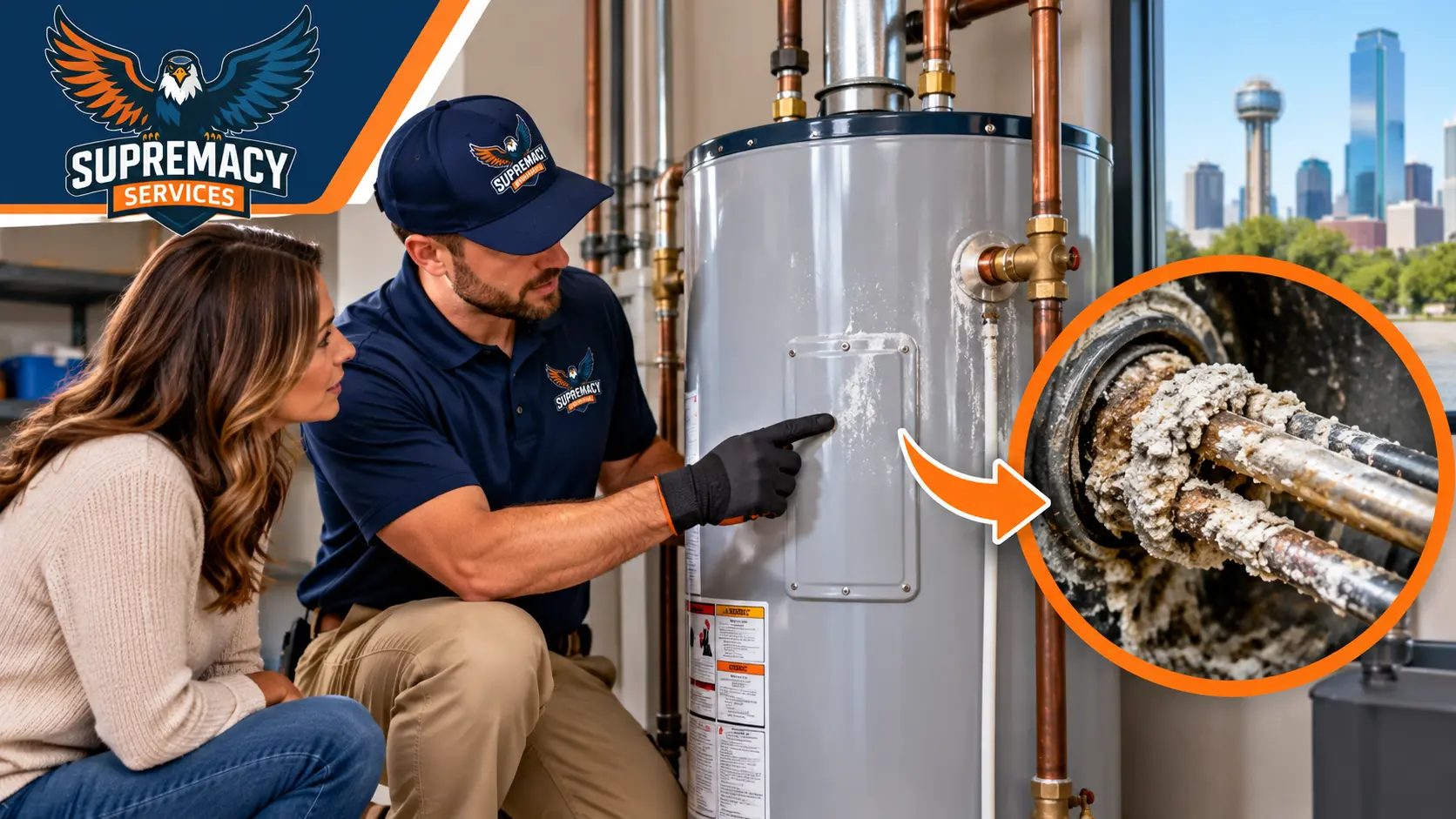
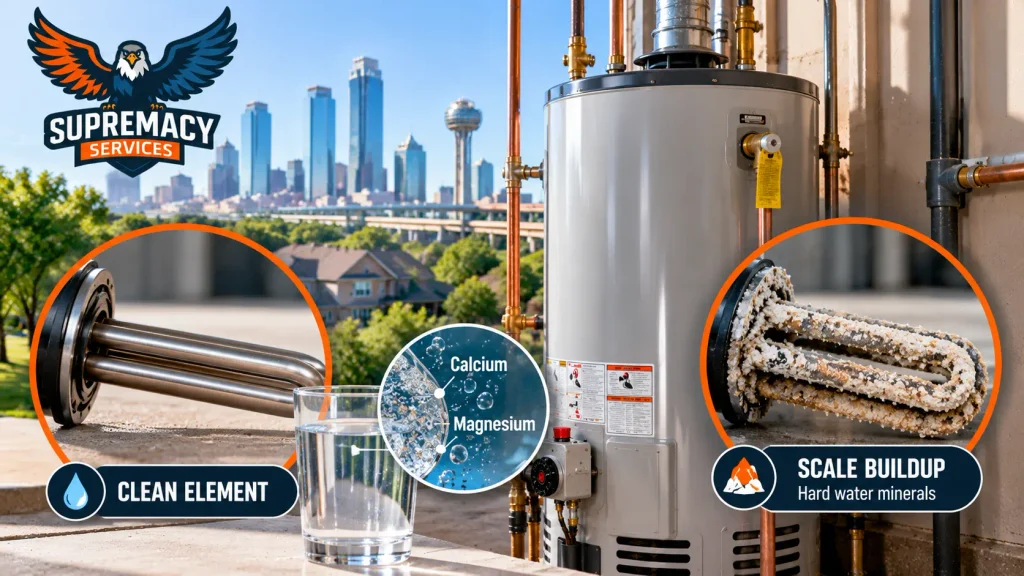
Supremacy Services water heater showing mineral scale buildup caused by hard water in Dallas and North Texas

Hard Water and Water Heaters: How North Texas Water Conditions Affect Performance

Hard water can affect both traditional and tankless water heaters by leaving calcium- and magnesium-based mineral deposits inside the equipment.

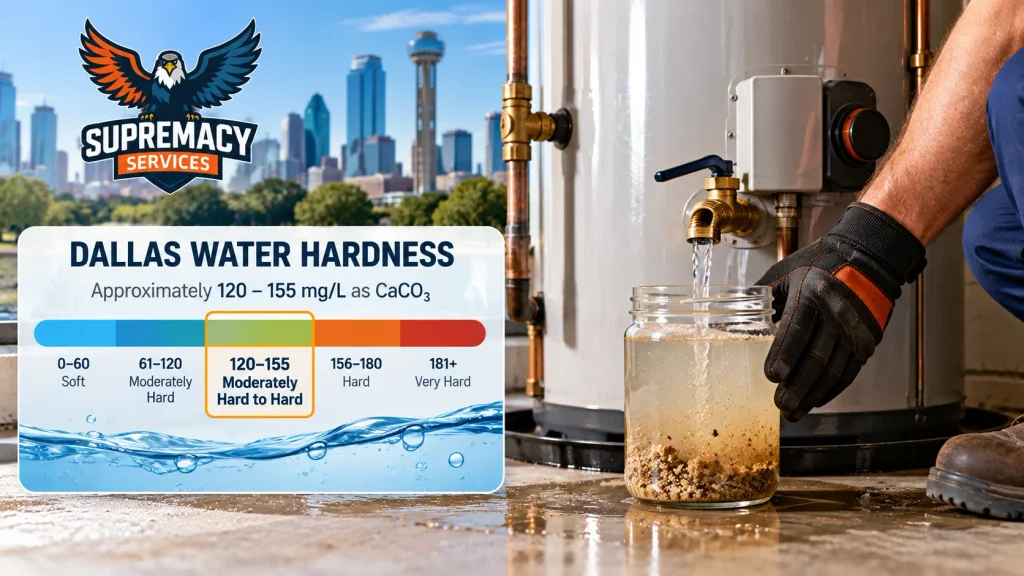
For Dallas homeowners, this is more than a theoretical maintenance issue. The City of Dallas has reported water hardness ranging from approximately 120 to 155 mg/L as calcium carbonate, putting the local supply across the moderately hard-to-hard range.

Over time, those dissolved minerals can contribute to sediment at the bottom of a storage tank and scale on heating elements, heat exchangers and internal water passages.

The result may be:

  • slower heat transfer;
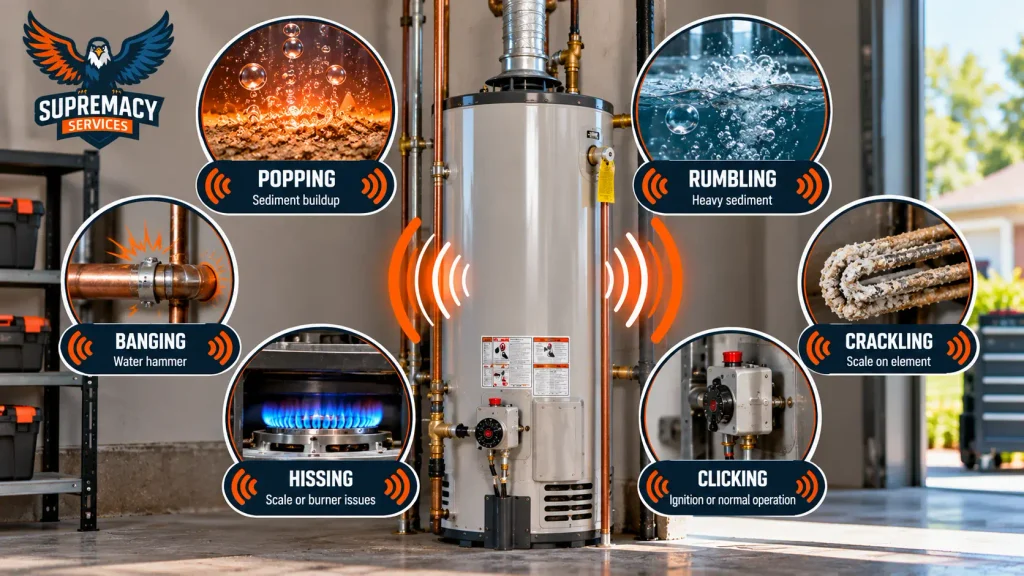
  • popping or rumbling noises;
  • longer heating cycles;
  • reduced usable hot-water capacity;
  • mineral deposits on components;
  • increased maintenance needs;
  • and, in some systems, reduced water flow.

Hard water does not mean Dallas drinking water is unsafe. Water hardness primarily describes dissolved mineral content. Dallas Water Utilities states that its municipal supply is drawn from surface-water sources and treated before entering the distribution system.

For a water heater, however, those minerals still matter.


Table of Contents

  1. What Is Hard Water?
  2. Does Dallas Have Hard Water?
  3. How Hard Water Affects Water Heaters
  4. Tank vs. Tankless: How Scale Affects Each
  5. Signs Hard Water Is Affecting Your Water Heater
  6. Can Hard Water Increase Energy Use?
  7. Does Hard Water Shorten Water-Heater Life?
  8. Flushing vs. Descaling
  9. Can a Water Softener Protect a Water Heater?
  10. DIY vs. Professional Maintenance
  11. What Professional Service Should Include
  12. How Dallas Homeowners Can Reduce Mineral Buildup
  13. When Scale Means Repair or Replacement
  14. FAQs

What Is Hard Water?

Hard water is water containing relatively high concentrations of dissolved calcium and magnesium. When that water is heated, some of those minerals can form deposits or scale on surfaces inside plumbing fixtures and water-heating equipment.

EPA guidance explains that hard water is associated primarily with calcium and magnesium and that the resulting scale can form inside pipes, water heaters and other equipment. EPA also notes that scale does not conduct heat well.

That distinction is important.

Hardness is not the same thing as dirt floating in the water.

The calcium and magnesium are dissolved. The problems become more visible as minerals precipitate, accumulate or form harder deposits inside equipment and around fixtures.

Typical household evidence includes:

  • white crust around faucets;
  • deposits on showerheads;
  • spots on glassware;
  • scale around aerators;
  • mineral residue on heating components;
  • and sediment discharged during water-heater maintenance.

Does Dallas Have Hard Water?

Yes. The City of Dallas has reported water hardness of approximately 120–155 mg/L as CaCO₃.

The City’s published hardness table classifies:

Hardness as CaCO₃Classification
0–60 mg/LSoft
61–120 mg/LModerately hard
121–180 mg/LHard
More than 180 mg/LVery hard

That places the reported Dallas range around the transition from moderately hard into hard water.

The precise hardness at a particular DFW property can vary with the utility serving the home and local water conditions, so homeowners outside the City of Dallas should not assume their number is identical.

Dallas Water Utilities also explains that Dallas draws its drinking-water supply from area surface-water reservoirs rather than groundwater.

Important distinction: hard water does not mean unsafe water

A mineral-hardness reading is not the same thing as a drinking-water contaminant violation.

The City of Dallas publishes annual drinking-water quality reports addressing regulated contaminants separately.

For homeowners, hardness is primarily important because of what those minerals can do to:

  • plumbing fixtures;
  • appliances;
  • valves;
  • heating elements;
  • heat exchangers;
  • and water heaters.

How Does Hard Water Affect a Water Heater?

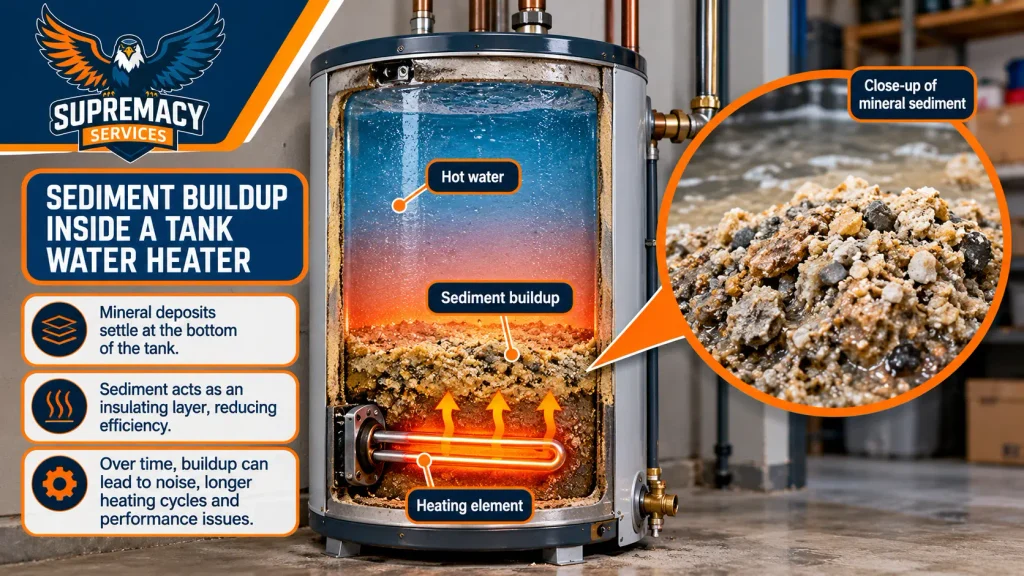
Hard water can leave mineral scale and sediment inside a water heater, creating an insulating layer between the heat source and the water or restricting passages through which water must flow.

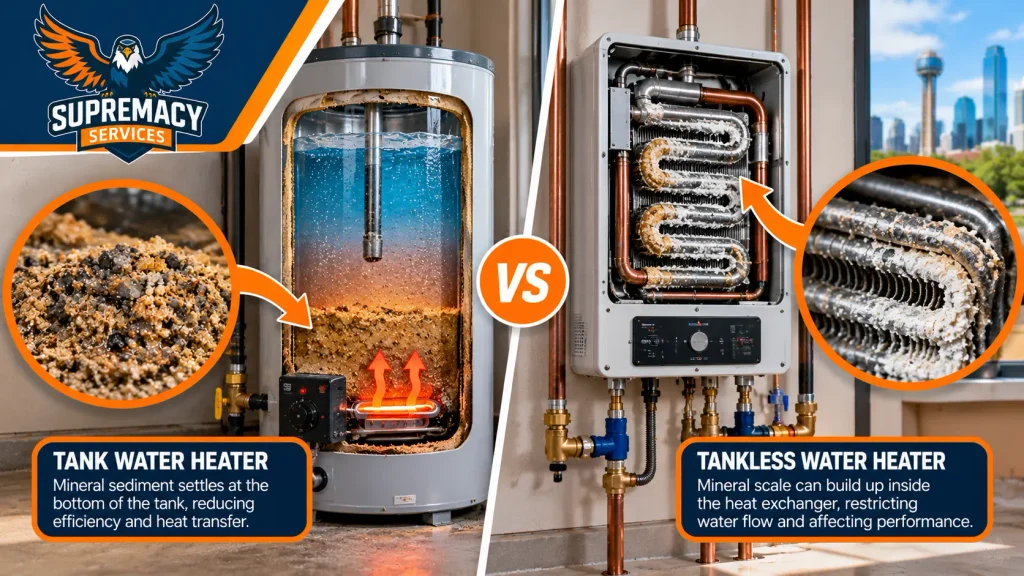
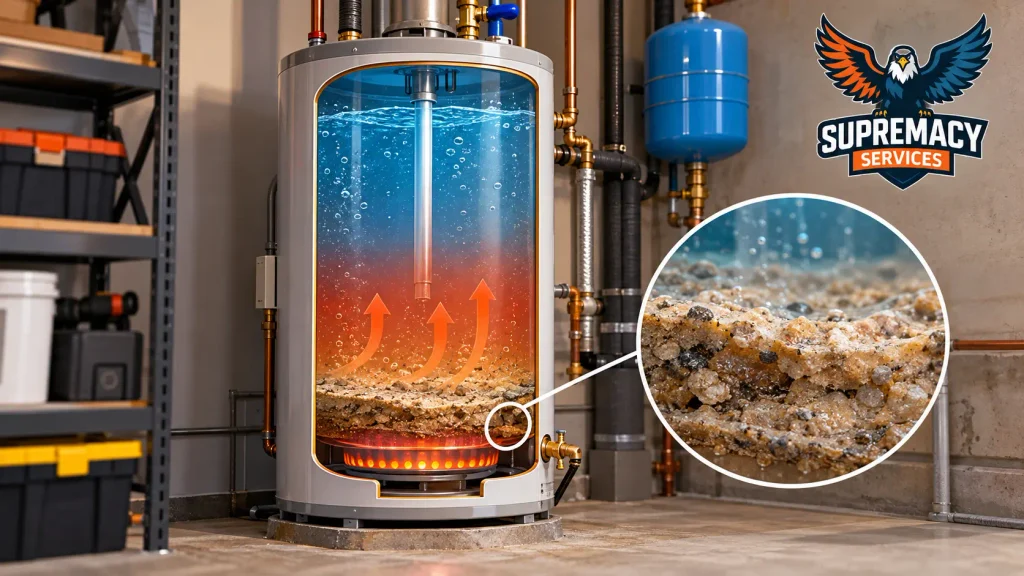
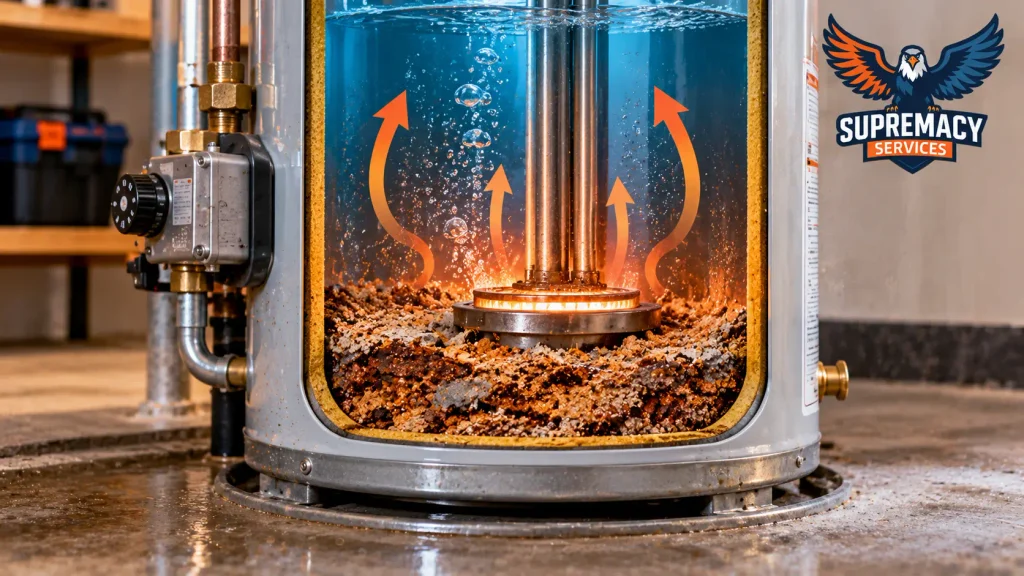
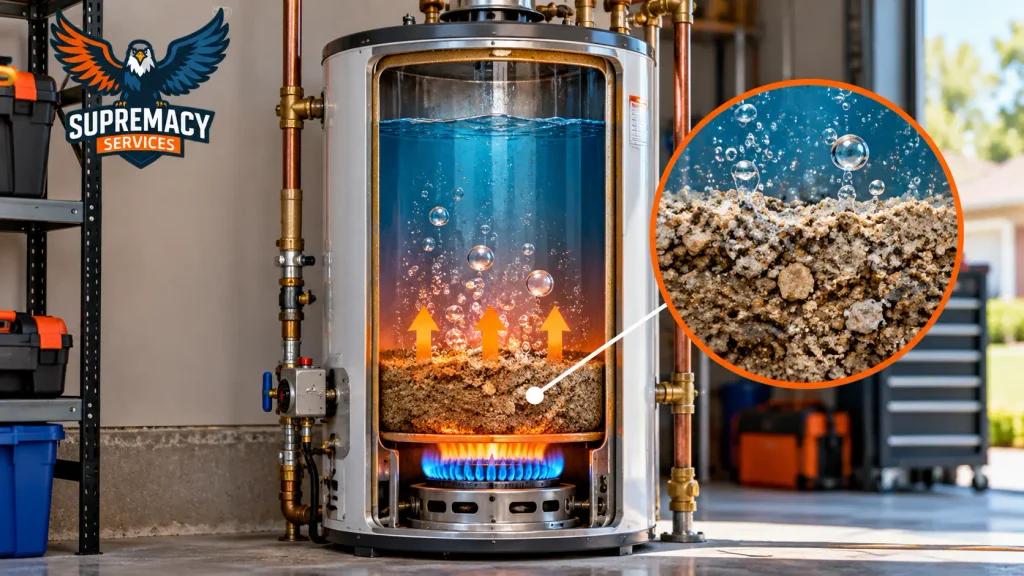
Cutaway of a tank water heater showing mineral sediment collecting near the heating area
Mineral-rich water can leave sediment at the bottom of a storage water heater, interfering with efficient heat transfer.

The exact effect depends heavily on whether the system is a storage tank or tankless unit.

A useful way to picture the process is:

hard water enters → water is heated → minerals precipitate or deposit → scale/sediment accumulates → heat transfer or water flow can deteriorate

1. Mineral sediment can accumulate in storage tanks

Storage water heaters repeatedly heat and store the same body of water.

Over time, mineral material and other sediment can settle near the bottom of the tank.

A. O. Smith warns that minerals and other substances in a water supply can lead to sediment buildup and states that sediment can reduce water-heater efficiency.

2. Scale can coat electric heating elements

Electric water heaters use submerged heating elements.

Mineral deposits can form directly around those elements, making heat transfer less effective.

Manufacturer maintenance guidance specifically identifies mineral deposits on electric elements as an issue technicians should inspect.

3. Tankless heat exchangers can develop scale

Tankless water heaters avoid storing dozens of gallons of hot water, but they are not immune to hardness.

Instead of settling in a storage tank, mineral deposits can form in or around narrow heat-exchanger passages.

That is why tankless systems may require descaling, even though they do not require storage-tank sediment flushing.

4. Water passages can become restricted

Scale can gradually narrow passages through fixtures or equipment.

EPA notes that hard-water scale can reduce water flow through pipes and fixtures.

Inside tankless equipment, similar mineral accumulation can affect water movement through the heat exchanger.


What Happens Inside a Tank Water Heater?

Imagine the bottom of the tank when it is relatively clean:

burner/element → tank surface or element → water

Now add a significant sediment layer:

burner/element → sediment/scale → water

The heater now has an additional material between the heat source and the water it is trying to heat.

That can contribute to:

  • longer recovery;
  • unusual operating sounds;
  • uneven heating;
  • greater stress on components;
  • and reduced performance.

Sediment can also occupy physical space at the bottom of the tank, effectively reducing the volume available for usable hot water when accumulation becomes significant.


Hard Water in Tank vs. Tankless Water Heaters

Both systems can be affected, but they experience mineral buildup differently.

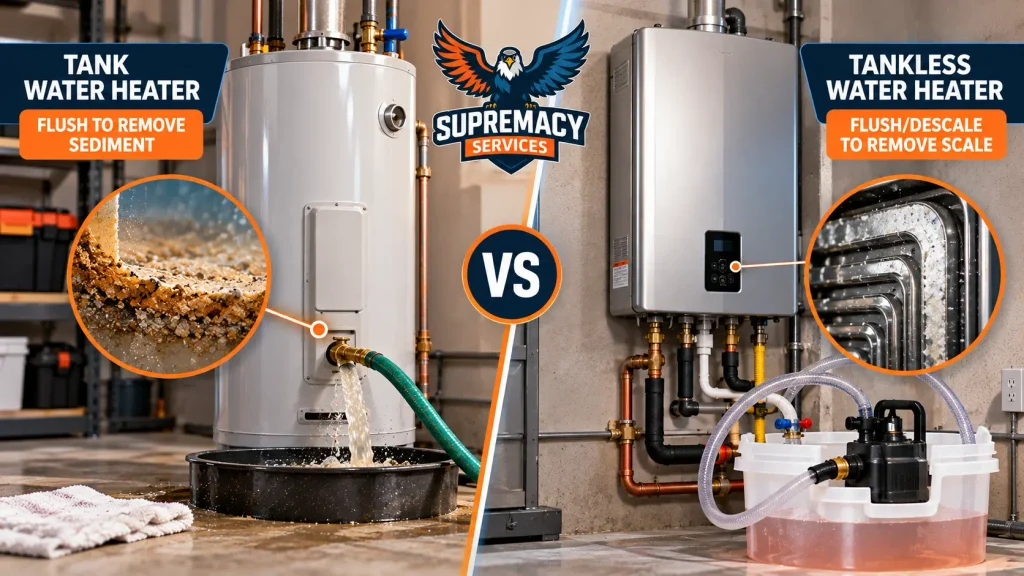
Comparison of sediment buildup in a tank water heater and mineral scale inside a tankless heat exchanger
Tank heaters commonly collect sediment, while tankless systems can develop mineral scale inside their heat exchangers.
IssueTank water heaterTankless water heater
Main mineral problemSediment + scaleScale
Where it collectsTank bottom and heating surfacesHeat exchanger and water passages
Typical maintenanceTank flushingDescaling/flushing procedure
Possible symptomPopping or rumblingReduced flow, performance issues or error conditions
Heat-transfer impactSediment insulates heating surfaceScale coats heat-transfer surfaces
Maintenance frequencyManufacturer-specificManufacturer-specific
Hard-water sensitivitySignificantCan be significant because of narrow passages/high heat transfer

Tankless heaters should therefore not be marketed as being immune to hard water.

They eliminate the large storage tank, not the minerals in the incoming supply.

Supremacy’s existing tank-versus-tankless content already identifies water quality, mineral deposits and maintenance as factors affecting both system types.


What Are the Signs Hard Water Is Affecting Your Water Heater?

Common warning signs include popping or rumbling, reduced hot-water performance, visible mineral scale, longer recovery times and sediment appearing during flushing.

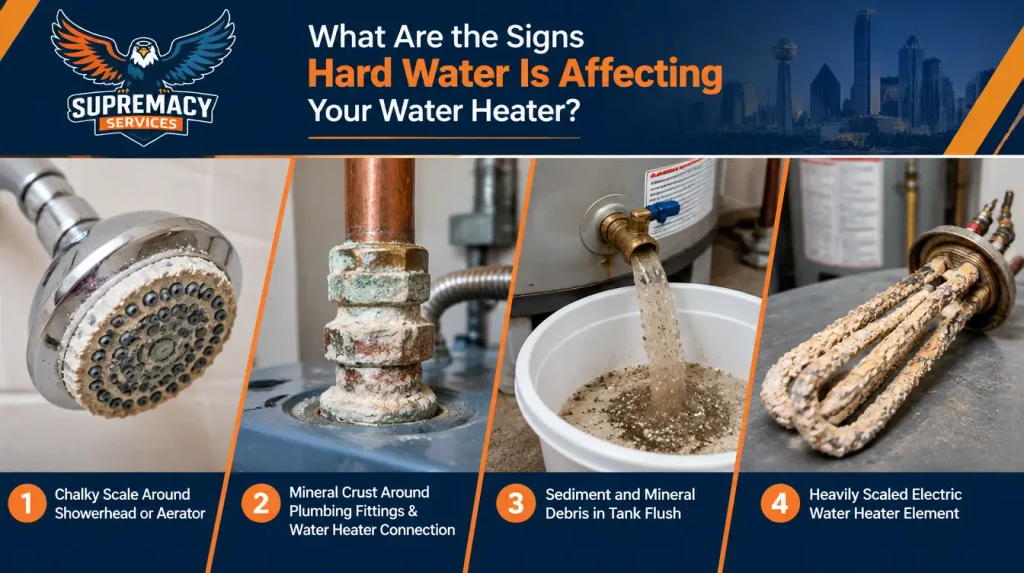
Mineral scale on shower fixtures, plumbing connections, water heater sediment and a scaled heating element
White deposits on fixtures, sediment during flushing and scaled heating components can indicate recurring hard-water buildup.

None of these symptoms proves hard water is the only cause, so diagnosis still matters.

Water-heater warning-sign checklist

Look for:

  • popping, cracking or rumbling during heating;
  • white or chalky deposits near plumbing connections;
  • scale on electric heating elements;
  • sediment discharged from the drain valve;
  • reduced hot-water volume;
  • showers turning cool sooner than they used to;
  • slower recovery after heavy hot-water use;
  • changing tankless flow performance;
  • increasingly frequent tankless maintenance;
  • inconsistent water temperature;
  • clogged faucet aerators or showerheads elsewhere in the home;
  • recurring scale on fixtures.

Not sure whether the problem is mineral buildup or a failing component? Have Supremacy Services inspect the water heater before replacing parts unnecessarily.

Recommended internal anchor:

professional water heater service in DFW

Link toward the water-heater commercial service/replacement page.


Does Hard Water Cause Popping or Rumbling?

It can.

Sediment at the bottom of a storage tank can trap heated water or bubbles underneath or within the deposits.

As the bubbles force their way through the sediment, homeowners may hear popping, crackling or rumbling.

A. O. Smith describes sediment as a common cause of popping noises and recommends flushing when sediment is responsible.

Supremacy already has a dedicated article explaining this symptom:

That article should remain the primary page for queries centered specifically on water-heater noises.

The new hard-water article should link to it rather than duplicate its detailed sound-by-sound troubleshooting content.


Can Hard Water Make a Water Heater Less Efficient?

Yes, mineral deposits can reduce effective heat transfer, particularly when scale coats heating surfaces or sediment separates the heat source from the water.

EPA states directly that hard-water scale does not conduct heat well.

A. O. Smith likewise explains that sediment accumulation can reduce water-heater energy efficiency.

That does not mean every Dallas homeowner with hard water will suddenly see a dramatic utility-bill increase.

Actual energy use depends on many variables:

  • heater efficiency;
  • tank size;
  • fuel type;
  • thermostat setting;
  • household demand;
  • incoming water temperature;
  • insulation;
  • equipment condition;
  • sediment severity;
  • and maintenance history.

The more useful conclusion is that keeping heat-transfer surfaces clean supports the equipment’s intended performance.


Can Hard Water Make Hot Water Run Out Faster?

Potentially—but mineral buildup is only one possible cause.

In a storage heater, heavy sediment can occupy part of the tank and interfere with heating.

In an electric unit, a mineral-coated or failed heating element can also reduce recovery.

But “not enough hot water” can also result from:

  • a failed heating element;
  • thermostat problems;
  • a damaged dip tube;
  • undersized equipment;
  • increased household demand;
  • mixing-valve problems;
  • or unusually low incoming water temperatures.

Do not assume mineral buildup is responsible until the system is evaluated.


Does Hard Water Shorten Water-Heater Life?

Mineral buildup can contribute to conditions that increase stress on water-heater components, but there is no reliable universal number of years that hard water removes from every heater.

Water-heater life depends on:

  • water chemistry;
  • equipment quality;
  • installation quality;
  • operating temperature;
  • usage;
  • maintenance;
  • corrosion;
  • anode condition;
  • fuel type;
  • and individual component failures.

This distinction is important because statements such as “hard water cuts five years off every water heater” are overly broad and should be avoided.

What can be stated confidently is that mineral accumulation affects equipment condition and maintenance requirements.

A. O. Smith recommends periodic flushing and specifically notes that homeowners in hard-water areas may need more frequent maintenance.


Water-Heater Flushing vs. Descaling: What Is the Difference?

Flushing primarily removes loose sediment, while descaling targets harder mineral deposits attached to internal surfaces.

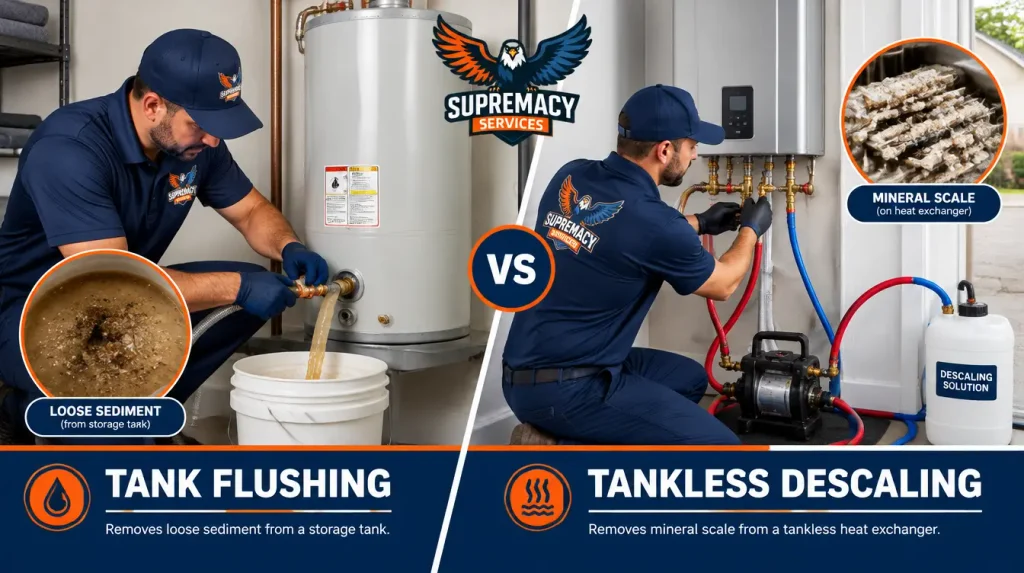
Technician flushing sediment from a tank water heater and descaling a tankless water heater
Flushing removes loose sediment from storage tanks, while descaling targets mineral deposits inside tankless heat exchangers.
MaintenancePrimary purposeCommon application
FlushingRemove loose sediment/debrisStorage water heaters
DescalingDissolve/remove mineral scaleTankless heat exchangers and scaled components
InspectionIdentify corrosion/component problemsTank and tankless
Anode inspectionEvaluate sacrificial corrosion protectionApplicable storage tanks
Water testingDetermine actual hardness/chemistryWhole-home diagnosis

Storage tank flushing

A typical tank flush drains accumulated material through the heater’s drain valve.

A. O. Smith states that most tank water heaters should generally be flushed at least annually, while also emphasizing that the correct interval depends on the model and that hard-water conditions may justify more frequent flushing.

Always follow the actual manufacturer’s instructions for the installed model.

Tankless descaling

Tankless equipment requires a different process.

Descaling normally involves isolating the water heater and circulating an approved cleaning solution through the heat exchanger according to manufacturer instructions.

The purpose is to remove mineral scale rather than tank-bottom sediment.


Should Dallas Homeowners Flush More Often Because of Hard Water?

Possibly.

The correct interval should come from:

  1. the manufacturer’s instructions;
  2. actual water hardness;
  3. equipment design;
  4. previous maintenance findings;
  5. household use;
  6. and how quickly deposits are returning.

Manufacturer guidance specifically notes that hard-water areas may require more frequent tank flushing.

Do not substitute a universal “every six months” or “once per year” rule for the manufacturer of the specific heater.

If substantial sediment is found during every annual service, shortening the interval may be reasonable.


Can a Water Softener Help Protect a Water Heater?

Yes. A conventional ion-exchange water softener removes calcium and magnesium hardness ions and can therefore reduce the minerals available to form scale.

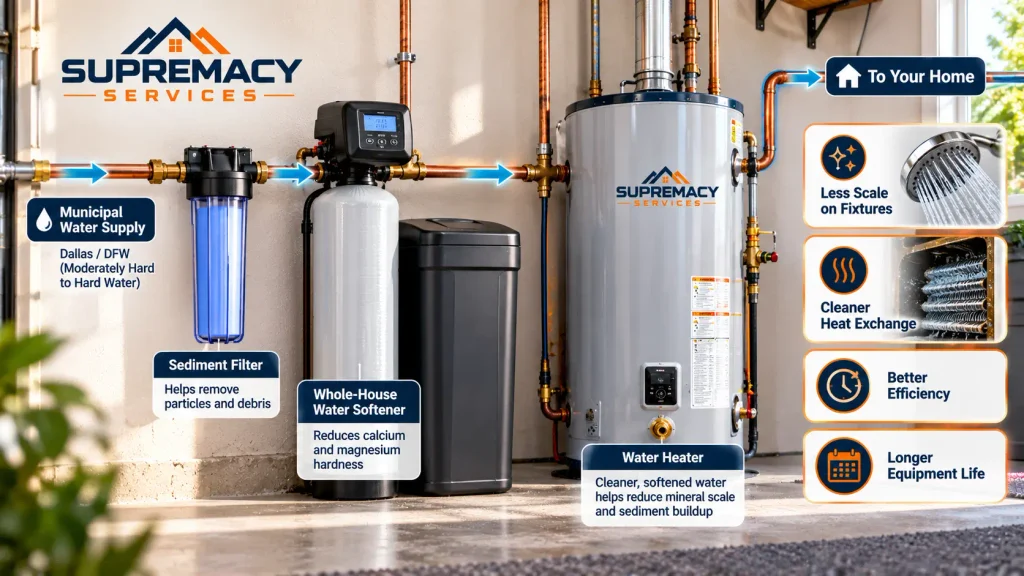
Whole-house water softener and sediment filter supplying treated water to a residential water heater
Reducing calcium and magnesium before water reaches the heater can help limit mineral scale and sediment buildup.

EPA explains that cation-exchange softeners remove calcium and magnesium by exchanging those ions for sodium or potassium.

That can reduce scale formation throughout the plumbing system.

However, homeowners should understand the difference between softening and filtration.

Water softener vs. water filter

SystemMain function
Water softenerReduces calcium/magnesium hardness
Sediment filterRemoves suspended particles
Carbon filtrationOften targets chlorine/chloramine, tastes, odors and selected chemicals depending on design
Specialty treatmentTargets specific water-quality conditions
Combination systemMay perform multiple treatment functions

A generic whole-house filter is not automatically a water softener.

The treatment method should match the water-quality problem.

Supremacy already has a relevant whole-house water-treatment page:

That page currently discusses hard water and whole-home water chemistry. It should link back to this article once published.


Does Every Dallas Home Need a Water Softener?

No.

The decision should depend on:

  • actual hardness at the property;
  • visible scale;
  • appliance problems;
  • homeowner preferences;
  • maintenance burden;
  • plumbing configuration;
  • water usage;
  • equipment requirements;
  • and the cost and upkeep of the treatment system.

If mineral scale is the main concern, homeowners should verify hardness rather than assuming every filtration product will address it.

EPA also points out that ion-exchange softeners themselves use water and salt during regeneration, making efficiency and proper sizing important.


Can You Remove Water-Heater Sediment Yourself?

Some routine maintenance can be DIY-friendly, but the answer depends heavily on the equipment.

DIY maintenance may be reasonable when:

  • you have the exact manufacturer instructions;
  • the heater is in good condition;
  • the drain valve operates properly;
  • there is no visible tank corrosion;
  • there are no gas-supply concerns;
  • there are no electrical faults;
  • the system is easily accessible;
  • and you understand the shutdown and restart procedure.

Professional service is safer when:

  • the tank is old or corroded;
  • the drain valve is blocked;
  • the heater is leaking;
  • the unit is installed in an attic or difficult location;
  • you smell gas;
  • wiring or breakers are behaving abnormally;
  • the tankless system requires specialized descaling;
  • the unit has error codes;
  • hot-water performance has deteriorated significantly;
  • or the heater has never been maintained.

Water heaters combine hot water with electricity, gas or combustion equipment depending on the model.

Improvising a procedure from a generic internet tutorial is not appropriate when the manufacturer’s process is unknown.


What If the Water Heater Has Never Been Flushed?

Do not assume aggressive flushing is automatically the correct first step.

An older heater that has operated for many years without maintenance may already have:

  • heavy mineral accumulation;
  • a partially clogged drain;
  • internal corrosion;
  • a deteriorated anode;
  • weakened valves;
  • or several age-related problems.

A professional inspection can determine whether maintenance is still sensible or whether the heater is approaching replacement territory.


What Should Professional Water-Heater Service Include?

A useful service visit should diagnose the equipment, not simply drain water from the tank.

Depending on the heater, an assessment may include:

  1. Confirming the make, model and approximate age.
  2. Looking for external leaks and corrosion.
  3. Evaluating sediment or mineral buildup.
  4. Checking hot-water performance.
  5. Inspecting heating elements or burner operation.
  6. Checking thermostatic controls.
  7. Inspecting the drain valve.
  8. Evaluating the anode rod where applicable.
  9. Inspecting temperature-and-pressure relief components.
  10. Checking gas connections and venting on applicable equipment.
  11. Checking relevant electrical components on electric systems.
  12. Evaluating tankless inlet screens and heat-exchanger scale.
  13. Reviewing maintenance history.
  14. Comparing repair, maintenance and replacement when appropriate.

Supremacy’s published water-heater process already includes inspection of sediment buildup, anode-rod condition, burner efficiency and tank integrity.
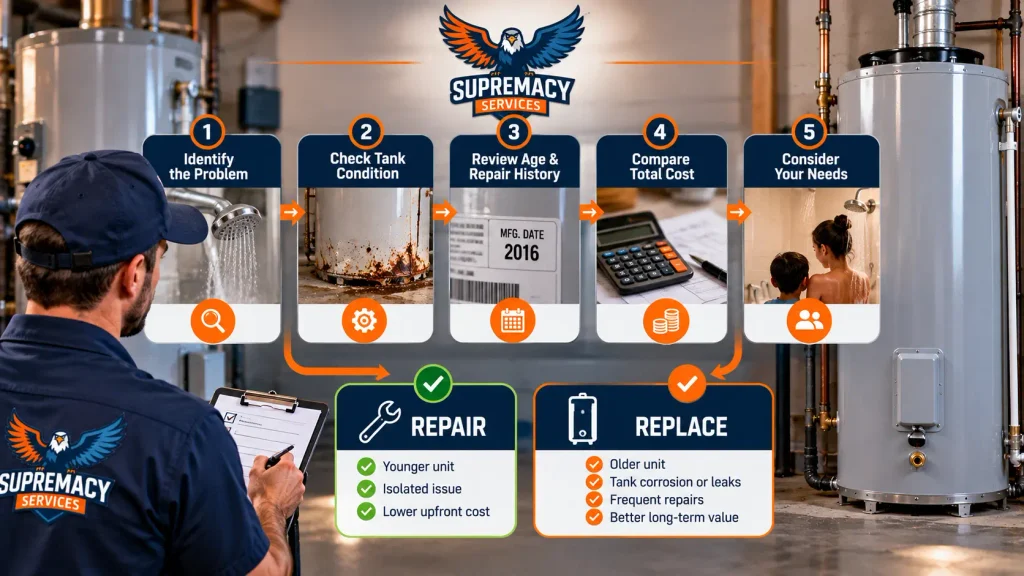
Seeing scale, sediment or declining hot-water performance? Schedule a water-heater diagnostic with Supremacy Services so you know whether maintenance, repair or replacement makes the most sense.


How Can North Texas Homeowners Reduce Water-Heater Mineral Buildup?

The best strategy is a combination of correct maintenance and, when justified, water treatment.

Water-heater hard-water prevention checklist

  • Determine the actual hardness of the home’s water.
  • Follow the heater manufacturer’s maintenance schedule.
  • Flush storage tanks as recommended.
  • Descale tankless equipment according to the manufacturer.
  • Inspect electric heating elements when performance declines.
  • Watch for scale around fixtures and aerators.
  • Investigate popping or rumbling rather than ignoring it.
  • Track changes in recovery time.
  • Inspect for leaks and corrosion.
  • Have the anode rod checked where appropriate.
  • Consider properly sized water treatment if hardness is creating recurring problems.
  • Keep records of maintenance and repairs.

Avoid unnecessarily high water temperatures

Higher temperature is not a substitute for better maintenance.

Setting a heater unnecessarily hot increases scald risk and should not be used to compensate for declining performance.

Follow the manufacturer instructions for temperature settings and equipment operation.


Hard Water vs. Other Problems That Can Look Similar

Not every water-heater problem in Dallas is caused by mineral buildup.

SymptomHard-water possibilityOther possibilities
PoppingSediment/scaleThermal expansion or other operating noises
Not enough hot waterSediment/scaleFailed element, undersizing, thermostat, household demand
Slow recoveryPoor heat transferBurner/element/control problem
Tankless reduced flowScale restrictionInlet filter, plumbing pressure, fixture restriction
Rust-colored waterPossible depositsCorrosion or piping
Higher energy useReduced heat transferUsage changes, equipment failure, rate changes
Water around heaterNot normally hardness aloneValve, fitting, T&P discharge or tank leak
Shutdown/error codeScale possibleIgnition, gas, electrical, flow or sensor problems

Diagnosis matters because replacing a water heater for a maintenance problem wastes money, while repeatedly flushing a structurally failing tank can delay a needed replacement.


When Does Hard-Water Damage Mean Repair or Replacement?

Mineral buildup alone does not automatically mean a water heater needs replacement.

A relatively healthy heater may respond well to maintenance.

Replacement deserves more consideration when mineral-related symptoms appear alongside:

  • tank leakage;
  • advanced corrosion;
  • repeated repair history;
  • deteriorated components;
  • ongoing performance problems after maintenance;
  • major heat-exchanger damage;
  • inability to meet household demand;
  • or several age-related failures.

The existing Supremacy repair-versus-replacement guide should own that decision-stage query:

The new article should therefore introduce the question and send readers there for the detailed economic comparison.


Does Hard Water Affect New Water-Heater Selection?

It should at least be part of the discussion.

When replacing a water heater in a home with recurring mineral problems, ask about:

  • tank vs. tankless maintenance requirements;
  • manufacturer water-quality specifications;
  • descaling access;
  • service valves on tankless equipment;
  • drain accessibility on storage tanks;
  • anode configuration;
  • whole-house treatment compatibility;
  • and maintenance intervals.

Selecting equipment without considering local water conditions can create unnecessary future maintenance problems.

Supremacy’s existing tank-versus-tankless guide already addresses water quality and maintenance as ownership factors.


What Does Hard-Water Maintenance Cost?

There is no responsible single price for hard-water-related water-heater service.

Cost depends on what the heater actually needs.

Potential services include:

  • routine tank flushing;
  • tankless descaling;
  • heating-element replacement;
  • anode replacement;
  • drain-valve repair;
  • diagnostic labor;
  • scale removal;
  • water testing;
  • whole-house water treatment;
  • or complete heater replacement.

The severity of buildup, heater design, accessibility and existing component damage can all change the scope of work.

For that reason, the article should not publish an unsupported “Dallas average” and imply every homeowner will pay that amount.

The correct path is diagnosis first, price second.


Dallas and DFW Water Conditions: What Homeowners Should Remember

Three local facts matter.

Dallas reports meaningful hardness

The City has reported approximately 120–155 mg/L as calcium carbonate.

Dallas uses surface-water supplies

Dallas Water Utilities identifies reservoirs including Lake Ray Hubbard, Lewisville, Grapevine, Ray Roberts, Tawakoni and Fork as supply sources.

DFW is not one identical water system

A homeowner in Dallas should not assume a property in Plano, Frisco, Fort Worth, McKinney, Coppell or another Metroplex city has exactly the same hardness.

Utilities and source blends vary.

For decisions such as water-softener sizing, use actual water testing or verified utility data for the property rather than a generic “DFW hardness” number.


Frequently Asked Questions

Does Dallas have hard water?

Yes. The City of Dallas has reported water hardness of approximately 120–155 mg/L as calcium carbonate, spanning moderately hard to hard classifications.

Can hard water damage a water heater?

Hard water can create mineral scale and sediment that interfere with heat transfer, restrict water passages and increase maintenance requirements. The severity depends on water chemistry, equipment design and maintenance.

Does hard water affect tankless water heaters?

Yes. Tankless heaters do not collect sediment in a storage tank, but mineral scale can build inside the heat exchanger and water passages. Manufacturer-specified descaling may be necessary.

Does hard water cause water-heater popping noises?

It can. Minerals and sediment can accumulate near the bottom of a tank and trap heated water or bubbles, producing popping or rumbling sounds.

How often should I flush a water heater in Dallas?

Follow the specific manufacturer’s maintenance instructions. Manufacturers commonly recommend periodic flushing and may recommend more frequent service in hard-water conditions.

Is flushing the same as descaling?

No. Flushing mainly removes loose sediment. Descaling targets mineral deposits that have bonded to internal heating surfaces or heat exchangers.

Can a water softener protect my water heater?

A properly selected ion-exchange softener can reduce calcium and magnesium hardness and therefore reduce the minerals available to form scale.

Will a whole-house water filter remove hardness?

Not necessarily. Standard sediment and carbon filtration are different from water softening. The treatment system must specifically address calcium and magnesium hardness if scale is the concern.

Does sediment mean my water heater needs replacement?

Not by itself. A structurally sound heater may simply need maintenance. Replacement becomes more likely when sediment problems occur alongside tank leakage, severe corrosion, recurring breakdowns or continued poor performance.

How do I know how hard the water is at my DFW home?

Start with your local utility’s water-quality information and, when treatment sizing matters, test the water at the property. Hardness can differ between utilities and service areas across the Metroplex.


Final Takeaway

North Texas water conditions can have a real effect on water-heater maintenance.

In Dallas, reported hardness levels mean calcium and magnesium deposits are worth considering whenever a tank begins rumbling, a tankless unit develops scale, hot-water performance declines or maintenance has been ignored.

The goal is not to blame every water-heater problem on hard water.

Instead, use a simple sequence:

confirm the water conditions → identify the symptom → inspect the equipment → remove sediment or scale when appropriate → evaluate damaged components → consider water treatment if buildup repeatedly returns

Routine maintenance may be enough for a healthy system.

A heater that is leaking, heavily corroded or repeatedly failing needs a broader repair-versus-replacement evaluation.

Final CTA

Mineral buildup, noisy operation or declining hot-water performance can be easier to address before they become a complete loss of hot water. Supremacy Services provides water-heater diagnostics, maintenance, replacement and installation throughout Dallas and the DFW Metroplex. Schedule an evaluation to find out whether your system needs maintenance, repair or replacement—and whether local water conditions are contributing to the problem.

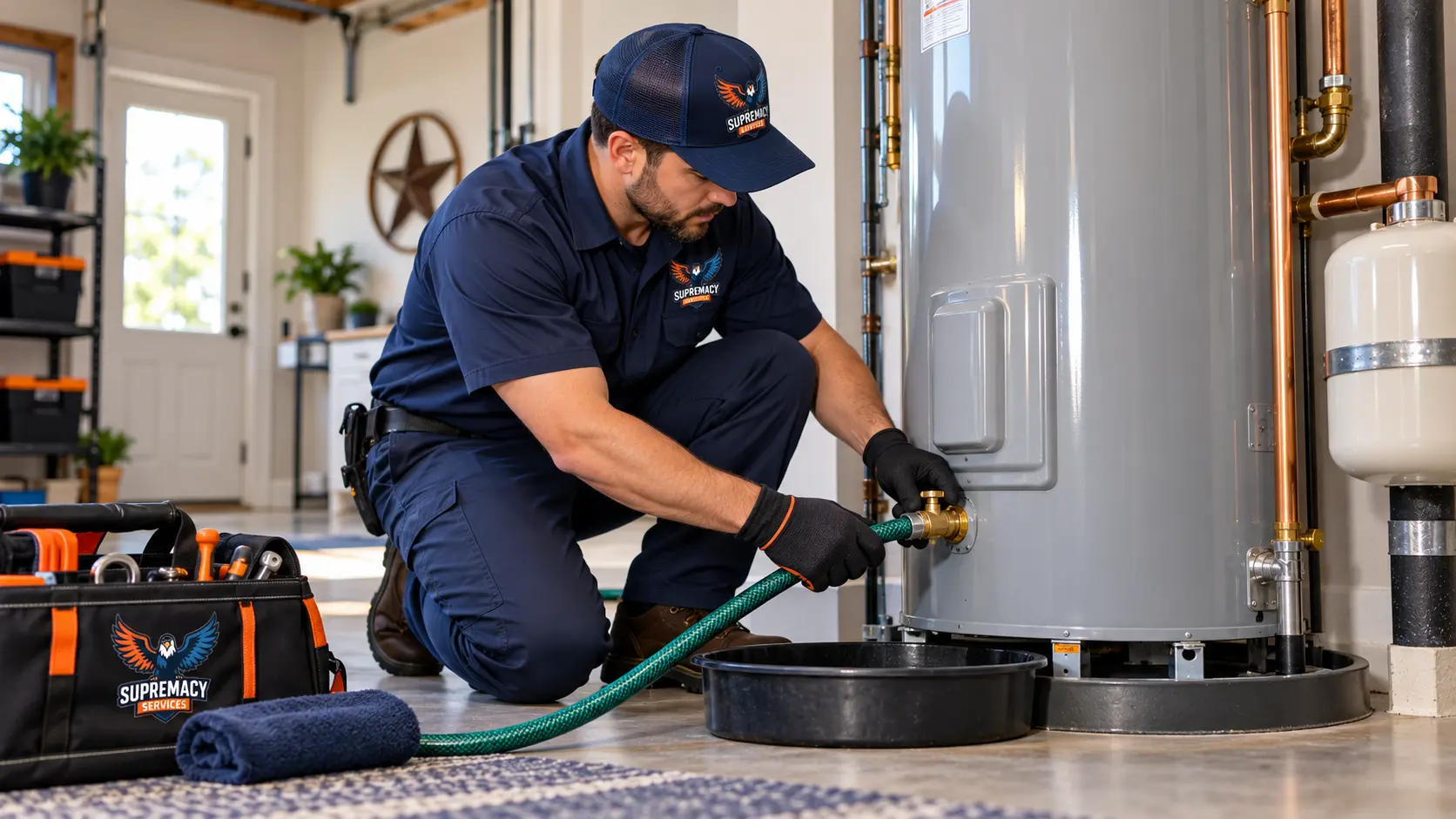
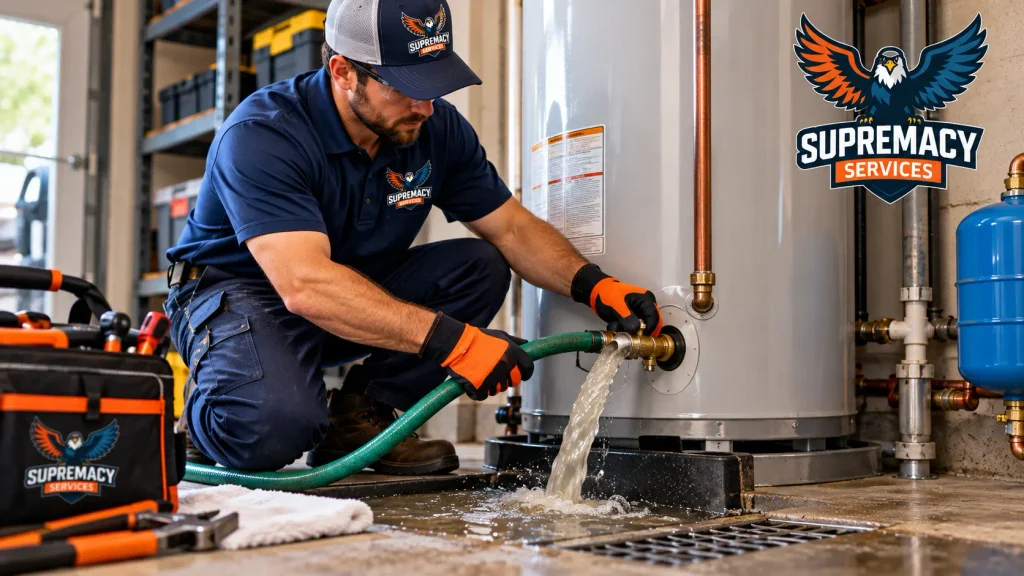
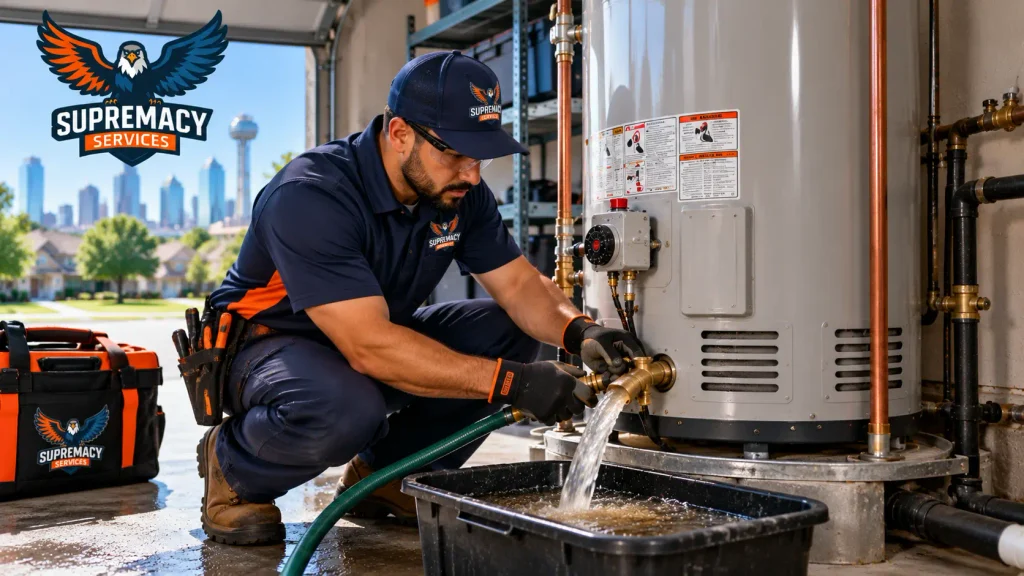
Supremacy Services technician flushing a residential tank water heater in a Dallas-area home

How Often Should You Flush a Water Heater in Dallas?

For most Dallas homes with a traditional tank-style water heater, flushing the tank about once a year is a sensible starting point. The exact interval should still follow the manufacturer’s instructions and may need to change depending on water conditions, sediment accumulation, household hot-water use and the condition of the heater.

That maintenance matters in Dallas because the City reports local water hardness ranging from approximately 120 to 155 mg/L as calcium carbonate (CaCO₃)—a range that extends from moderately hard into hard water. Minerals do not automatically mean your water heater has a problem, but they can contribute to deposits and sediment inside water-heating equipment over time.

Manufacturer guidance supports routine maintenance as well. Rheem currently recommends flushing most household storage water heaters once per year to help control sediment accumulation.

The important qualification is that not every water heater should be treated exactly the same way. A newer tank, a heavily neglected 12-year-old tank and a tankless water heater require different maintenance decisions.
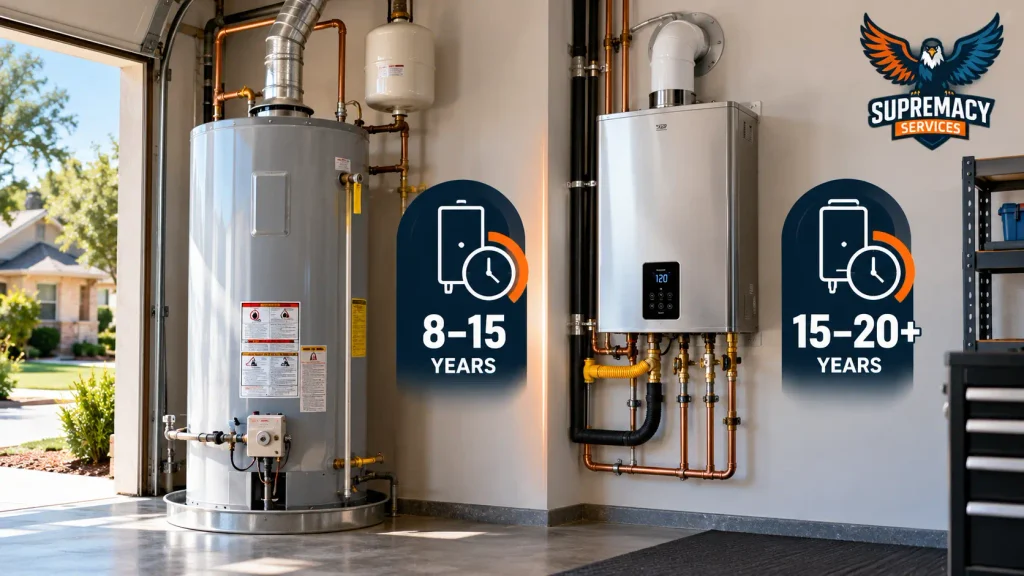
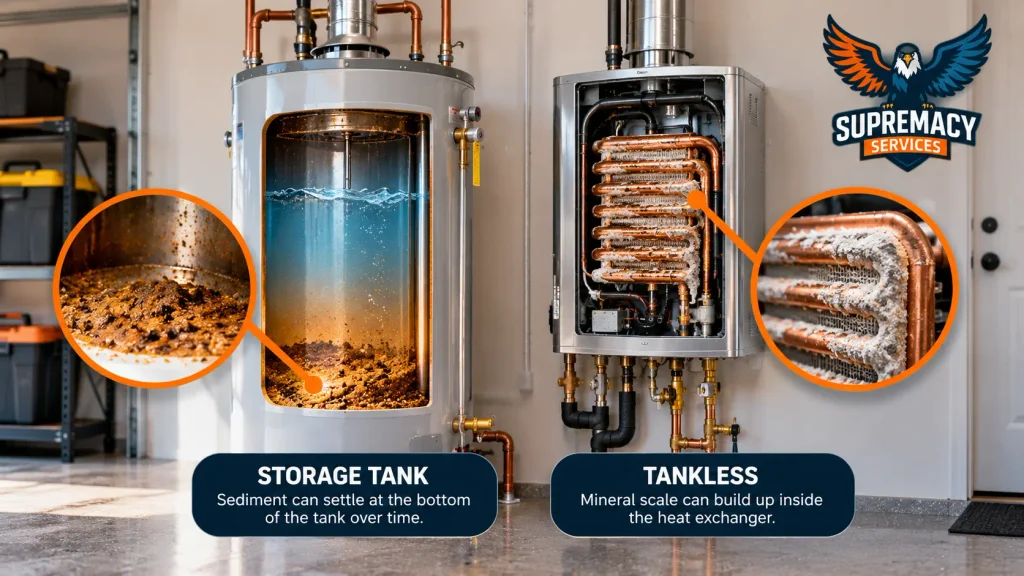
Table of Contents

  1. How often should a Dallas water heater be flushed?
  2. Why Dallas water conditions matter
  3. What sediment does inside a water heater
  4. Signs your water heater may need flushing
  5. Should you flush more than once a year?
  6. Can you wait longer than a year?
  7. Tank vs. tankless maintenance
  8. Can homeowners flush a water heater themselves?
  9. When you should not DIY
  10. What professional water-heater maintenance includes
  11. How much does water-heater flushing cost?
  12. Frequently asked questions

How Often Should You Flush a Water Heater in Dallas?

Most traditional storage water heaters should be evaluated for flushing roughly once every 12 months, unless the manufacturer specifies a different interval.

That should be treated as a maintenance baseline rather than an inflexible rule.

Your ideal schedule depends on:

  • the water heater manufacturer and model;
  • mineral and sediment accumulation;
  • household hot-water consumption;
  • the age and condition of the tank;
  • whether the unit has been regularly maintained;
  • unusual noises or reduced hot-water performance;
  • whether the heater is a conventional tank or tankless system.

Some manufacturer instructions call for more frequent draining or flushing under particular water conditions. Always check the maintenance section of the manual for your actual model before applying a generic schedule.

Quick Guide

SituationPractical approach
Normally operating tank with regular maintenance historyStart with annual inspection/flushing according to manufacturer guidance
Noticeable sediment during previous flushConsider whether the manufacturer/plumber recommends more frequent maintenance
Popping or rumbling tankInspect for sediment rather than simply waiting for the next scheduled service
Reduced hot-water capacityDiagnose the cause; sediment is only one possibility
Very old tank that has never been flushedHave its condition evaluated before aggressively disturbing heavy deposits
Tankless water heaterFollow manufacturer descaling/flushing instructions; do not use a storage-tank procedure

Why Does Dallas Water Make Flushing Worth Paying Attention To?

Dallas water hardness graphic showing approximately 120 to 155 mg/L as calcium carbonate beside water heater sediment
Dallas water falls within a moderately hard to hard range, making mineral buildup an important water-heater maintenance consideration.

Dallas Water Utilities obtains its municipal supply from surface-water reservoirs and treats the water before distribution. The City has reported Dallas water hardness in the 120–155 mg/L CaCO₃ range.

That matters because dissolved minerals can eventually contribute to deposits in water-heating equipment.

For a storage water heater, particles and mineral deposits can settle toward the bottom of the tank. A tankless system has no large reservoir, but scale can instead accumulate through narrow internal water passages and across the heat exchanger.

This does not mean every Dallas homeowner needs unusually aggressive maintenance.

A better approach is:

local water conditions + manufacturer instructions + actual equipment condition = appropriate maintenance schedule.

That distinction keeps the recommendation useful rather than simply labeling every North Texas home as a “hard-water problem.”

What Does Sediment Do Inside a Water Heater?

Cutaway illustration showing mineral sediment collecting at the bottom of a tank water heater
Sediment can settle at the bottom of a storage water heater and interfere with normal heat transfer over time.

Sediment is material that collects toward the bottom of a storage water-heater tank over time.

As the layer becomes more substantial, it can interfere with the normal transfer of heat into the stored water.

Depending on the heater and severity of the buildup, sediment may contribute to:

  • popping or rumbling sounds;
  • slower heating or recovery;
  • reduced effective hot-water capacity;
  • additional stress on heating components;
  • material discharged while draining the tank.

The U.S. Department of Energy has long identified sediment removal as a reason for periodically flushing storage-type water-heating equipment because accumulated material can interfere with heat-transfer efficiency.

Flushing is therefore not simply about making the water coming out of the tank look cleaner. Its main purpose is to remove loose accumulated material before it becomes a larger maintenance problem.

Signs Your Water Heater May Need Flushing

Popping or rumbling during heating is one of the clearest reasons to investigate sediment, but it is not the only sign.

Watch for:

1. Popping or rumbling noises

Water trapped around accumulated sediment can produce popping or rumbling as the unit heats.

If this is your main symptom, Supremacy’s separate guide to water-heater popping and rumbling noises explains sediment and the other conditions that can produce similar sounds.

2. Sediment coming from the drain valve

Visible particles during draining can confirm that material has collected in the tank.

3. Hot water running out sooner than expected

Heavy deposits can effectively reduce usable tank volume, although insufficient hot water can also result from heating-element problems, thermostat issues, household demand or an undersized system.

4. Slower recovery

If the tank seems to take longer to replenish hot water, mineral or sediment accumulation may be part of the problem.

Do not automatically assume flushing will solve it. Gas burner, heating-element and control problems can produce similar symptoms.

5. The heater has not been maintained in years

Even if there are no obvious symptoms, a long unknown maintenance history is a reason to inspect the equipment.

However, an older tank that has never been serviced deserves more caution than a newer heater on a regular maintenance program.

Hearing persistent rumbling or noticing declining hot-water performance? Have the water heater inspected before assuming sediment is the only problem. Supremacy Services can evaluate tank condition, sediment buildup and overall water-heater performance throughout Dallas–Fort Worth.

Should You Flush a Water Heater More Than Once a Year?

Possibly—but do it because the condition of the system or manufacturer guidance supports it, not simply because the property is in Texas.

A shorter maintenance interval may be worth discussing when:

  • substantial sediment returns quickly after flushing;
  • manufacturer documentation calls for more frequent service;
  • the household has unusually high hot-water demand;
  • mineral accumulation is repeatedly affecting performance;
  • a plumber sees significant deposits during maintenance.

For example, some manufacturer documentation specifies intervals different from the common annual recommendation. That is why your equipment manual should take priority over a generic online schedule.

What about every six months?

Some water-heater manuals and technical guidance recommend draining or flushing at six-month intervals.

That does not mean every Dallas heater needs twice-yearly service.

If the manufacturer of your exact heater specifies six months, follow that schedule. If it specifies annual maintenance, annual service may be appropriate unless equipment condition indicates otherwise.

Can You Wait Longer Than a Year?

You can physically leave a water heater unflushed for years, but that does not mean doing so is the best maintenance strategy.

Skipping maintenance allows sediment to accumulate without being evaluated.

The greater concern comes when homeowners wait until a tank has developed:

  • loud recurring noises;
  • poor hot-water output;
  • heavy corrosion;
  • leaking;
  • clogged drain components;
  • years of accumulated deposits.

At that point, “just flush it” may no longer be the right answer.

A plumber may first need to determine whether the tank is structurally sound and whether maintenance still makes sense.

Should You Flush a Water Heater That Has Never Been Flushed?

Do not automatically perform an aggressive DIY flush on an old, neglected tank without first considering its condition.

If a storage heater is many years old and has never been maintained, there may be extensive deposits, deterioration or a drain valve that has not been operated in years.

Before working on it, look for:

  • water around the tank;
  • corrosion;
  • rust-colored water;
  • damaged valves;
  • deteriorated connections;
  • previous leaks;
  • unusual burner or electrical problems.

A professional inspection is especially appropriate when the tank is already showing more than one warning sign.

Tank Water Heater Flushing vs. Tankless Descaling

Comparison of tank water heater sediment flushing and tankless water heater descaling
Tank water heaters are typically flushed to remove sediment, while tankless systems require model-specific flushing or descaling to control scale.

These are related maintenance procedures, but they are not the same job.

Maintenance issueTank water heaterTankless water heater
Large storage tankYesNo
Sediment settling on tank bottomCommon maintenance concernNot applicable in the same way
Mineral scalePossibleImportant heat-exchanger concern
Typical serviceDrain/flush tankFlush/descale internal water circuit
Maintenance intervalManufacturer-specific; annual is a common baselineManufacturer-specific and water-condition dependent
DIY procedureDepends on equipment and homeowner skillMore equipment/model-specific

Supremacy’s existing Tank vs. Tankless Water Heater in Dallas guide explains the broader differences between these systems, including efficiency, expected maintenance and service life.

Rheem, for example, recommends annual flushing for tank-style equipment while indicating that tankless units may require periodic draining/descaling at intervals influenced by the model and water conditions.

Do not use storage-tank flushing instructions on a tankless unit.

Can You Flush a Water Heater Yourself?

Plumber draining sediment-filled water from a residential tank water heater during professional maintenance
A professional flush involves safely shutting down, draining, flushing and restarting the water heater correctly.

Some experienced homeowners can maintain certain storage water heaters themselves, but flushing is not simply a matter of opening a faucet.

The job may involve:

  1. shutting down the heater correctly;
  2. preventing burner or heating-element operation during draining;
  3. allowing very hot water to cool or controlling it safely;
  4. isolating the cold-water supply;
  5. connecting the drain hose safely;
  6. opening and operating the drain valve;
  7. flushing sediment;
  8. refilling the tank completely;
  9. removing trapped air;
  10. restoring gas or electrical operation correctly.

The exact procedure differs among equipment types and manufacturers.

The most important DIY rule

Read the manufacturer’s instructions for the specific model before opening valves or disconnecting anything.

Hot water can cause severe burns. Gas equipment introduces combustion and fuel-supply concerns. Electric elements can be damaged if energized while the tank is empty.

If you cannot confidently identify the equipment, shutoffs and correct restart procedure, professional service is the safer choice.

When Should a Dallas Homeowner Call a Plumber Instead?

Professional water-heater service becomes more appropriate when flushing is no longer a straightforward maintenance task.

Call for inspection if:

  • the drain valve will not operate;
  • little or no water flows from the drain;
  • the tank is leaking;
  • significant corrosion is visible;
  • the heater repeatedly loses hot water;
  • noises continue after maintenance;
  • the burner behaves abnormally;
  • electrical components trip a breaker;
  • the heater is old and has never been flushed;
  • water temperatures fluctuate unexpectedly;
  • you are unsure whether the tank is safe to service;
  • the equipment is tankless and requires model-specific descaling.

Flushing cannot repair a failing tank

A flush removes loose deposits. It does not rebuild corroded steel, repair a leaking tank or correct a failed heating element, thermostat, gas valve or burner.

This distinction is important because flushing an already failing water heater can delay the diagnosis of the real problem.

Not sure whether your water heater needs maintenance, repair or replacement? Supremacy Services can inspect the system and explain the condition of the tank before you spend money on the wrong fix.

What Should Professional Water-Heater Maintenance Include?

A proper maintenance visit should involve more than simply attaching a hose.

The exact scope depends on the equipment, but evaluation may include:

  • identifying the heater type and model;
  • reviewing age and visible condition;
  • looking for corrosion or leakage;
  • checking sediment accumulation;
  • draining or flushing when appropriate;
  • evaluating accessible valves and connections;
  • checking the sacrificial anode where applicable and appropriate;
  • assessing burner or heating performance;
  • noting venting or combustion concerns on gas equipment;
  • identifying signs of tank deterioration;
  • restoring operation and confirming hot-water performance.

Supremacy’s current water-heater service process already identifies sediment buildup, anode-rod condition, burner efficiency and tank integrity among the areas considered during system diagnostics.

What should the homeowner expect afterward?

You should be able to answer:

  • Was significant sediment present?
  • Is the tank itself in good condition?
  • Are there signs of corrosion?
  • When should the next service be performed?
  • Does anything require repair?
  • Is replacement worth planning for?
  • Is the maintenance schedule consistent with the manufacturer’s recommendations?

How Much Does Water-Heater Flushing Cost in Dallas?

There is no responsible single price that applies to every Dallas property.

Professional maintenance cost can change according to:

  • tank vs. tankless equipment;
  • fuel type;
  • heater location and accessibility;
  • severity of deposits;
  • drain-valve condition;
  • whether the unit needs diagnosis in addition to maintenance;
  • additional components that require inspection or service;
  • whether a tankless system needs a model-specific descaling procedure.

Be cautious about comparing a basic “flush” advertisement with a more complete diagnostic and maintenance visit without confirming what each service actually includes.

If the heater is already noisy, leaking or struggling to provide hot water, ask whether the quoted service includes diagnosis rather than paying for flushing alone.

How to Reduce Water-Heater Problems Between Flushes

Flushing should be part of a larger maintenance plan.

Follow the actual manufacturer schedule

The heater’s manual should remain the primary source for required maintenance frequency.

Respond to noises early

A slight new rumble is easier to investigate than years of heavy sediment accumulation.

Watch for moisture

Inspect the area around the tank periodically. Water beneath the heater should not be dismissed as normal condensation without identifying the source.

Watch for corrosion

Check visible tank surfaces, pipe connections and fittings.

Track hot-water performance

Changes in recovery time or available hot water can help identify problems before complete failure.

Know the age of the unit

Record the model and serial number and keep installation/service documentation when available.

Plan rather than wait for emergency failure

If an aging unit begins developing corrosion, leakage, repeated repairs or declining performance, compare repair and replacement before the tank fails unexpectedly.

Supremacy’s separate Water Heater Repair vs. Replacement guide is better suited to that decision.

Flushing vs. Repair vs. Replacement

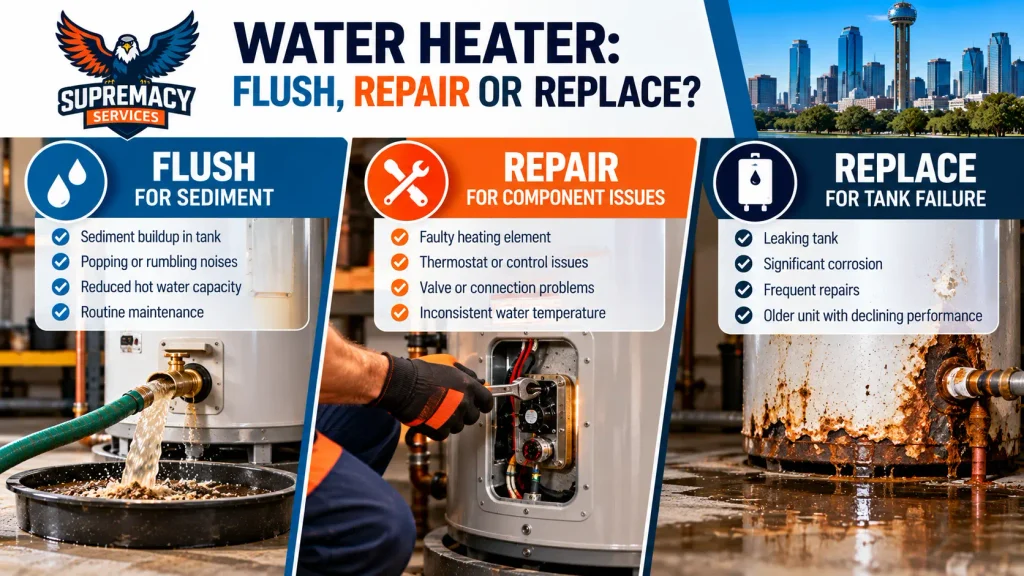
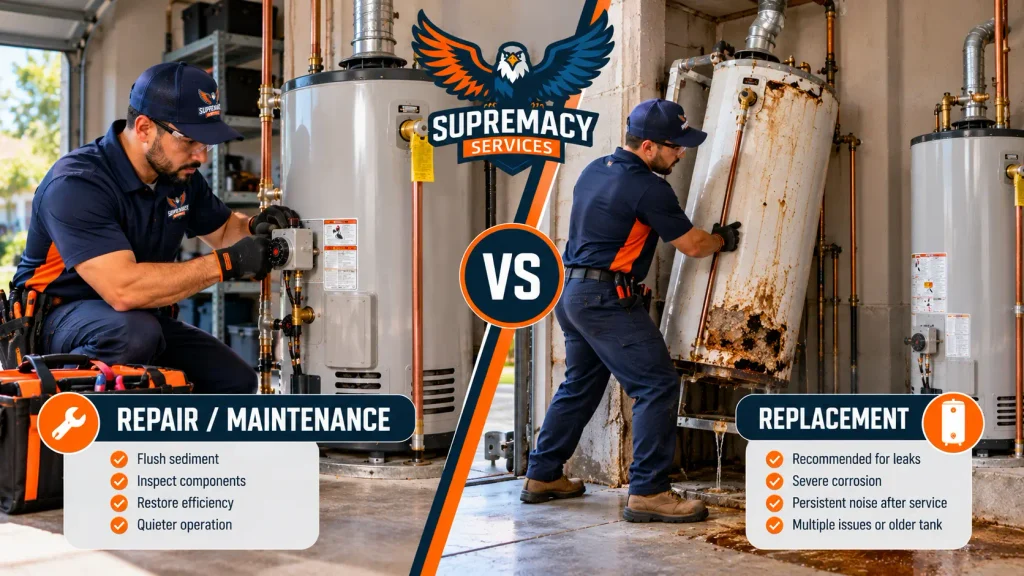
Water heater decision guide comparing flushing for sediment, repair for component problems and replacement for tank failure
Flushing treats sediment, repairs address failed components, and replacement may be necessary when the tank itself is leaking or badly corroded.
ConditionFlushingRepairReplacement
Routine loose sediment✓
Sediment-related rumblingOften appropriate after diagnosisSometimesSometimes
Failed heating element✓Depends on overall condition
Faulty thermostat/control✓Depends
Minor serviceable valve issue✓Depends
Tank itself leakingUsually required
Significant tank corrosionLimited valueOften appropriate
Repeated failures on an aging heaterLimited valueDependsIncreasingly worth considering

The purpose of maintenance is to preserve serviceable equipment—not to keep a deteriorated tank operating indefinitely.

Dallas Water-Heater Maintenance Checklist

For a typical tank-style heater:

  • Check the manufacturer’s maintenance schedule.
  • Record the installation date or approximate age.
  • Look for leaking or corrosion.
  • Listen for new popping or rumbling.
  • Watch for changing hot-water capacity.
  • Plan periodic tank flushing as specified for the unit.
  • Have unusual burner/electrical behavior diagnosed.
  • Ask whether the anode rod requires inspection.
  • Keep service records.
  • Begin replacement planning if multiple age-related problems develop.

Frequently Asked Questions

How often should you flush a water heater in Dallas?

For many traditional tank-style water heaters, about once a year is a reasonable baseline. Follow the manufacturer’s maintenance schedule for your specific model and adjust only when water conditions or equipment condition justify it.

Does Dallas have hard water?

Yes. The City of Dallas has reported water hardness ranging from approximately 120 to 155 mg/L as CaCO₃, spanning the moderately hard to hard classifications used in the City’s reference material.

Does hard water mean I should flush my water heater every six months?

Not automatically. Local mineral content makes sediment worth monitoring, but your manufacturer’s maintenance schedule, actual sediment accumulation and equipment condition should determine whether a shorter interval is appropriate.

What happens if you never flush a water heater?

Sediment can accumulate in storage tanks over time and may interfere with heat transfer, contribute to noise and reduce performance. The severity varies by water conditions, equipment and usage.

Can flushing stop a water heater from popping?

It can if loose sediment is the cause. Popping may also be associated with scale or other plumbing/equipment conditions, so persistent noise should be properly diagnosed.

Can flushing damage an old water heater?

The greater concern is usually that an old, neglected heater may already have deteriorated valves, heavy deposits, corrosion or tank damage. If an older unit has never been maintained, have its condition evaluated before undertaking aggressive DIY service.

Is flushing a tankless water heater the same thing?

No. Tankless systems generally require a model-specific flushing or descaling procedure for the heat exchanger and internal water passages. Follow the manufacturer’s instructions.

How do I know whether I need flushing or replacement?

Sediment alone may call for maintenance. A leaking tank, significant corrosion, recurring failures or multiple age-related problems are more important replacement indicators.

Should I flush the water heater if it is already leaking?

First determine where the leak originates. A loose connection or valve problem is different from leakage through a deteriorated storage tank. Flushing does not repair a failed tank.

Is professional water-heater maintenance worth it?

Professional maintenance is particularly useful when the heater has an unknown service history, significant sediment, difficult access, abnormal noises, tankless equipment, gas/electrical concerns or signs that a larger repair problem may exist.

Final Takeaway: Once a Year Is a Starting Point, Not a Universal Rule

For most Dallas homeowners with a conventional tank water heater, annual flushing is a practical maintenance baseline, supported by current manufacturer guidance.

Dallas water conditions make mineral and sediment buildup particularly relevant: the City reports hardness of approximately 120–155 mg/L as CaCO₃. But the smartest maintenance schedule still depends on the individual heater.

Use this order of priority:

manufacturer instructions → equipment condition → sediment accumulation → household use → local water conditions.

Do not assume every noise requires replacement—and do not assume every aging heater can be restored by flushing.

If your water heater is popping, losing capacity, showing corrosion or has gone years without maintenance, get the equipment evaluated before deciding what it needs.

Need water-heater maintenance or a clear assessment of an aging system? Supremacy Services provides water-heater diagnostics, maintenance, replacement and installation throughout Dallas and the DFW Metroplex. Schedule an evaluation to determine whether your heater needs flushing, repair or a replacement plan.

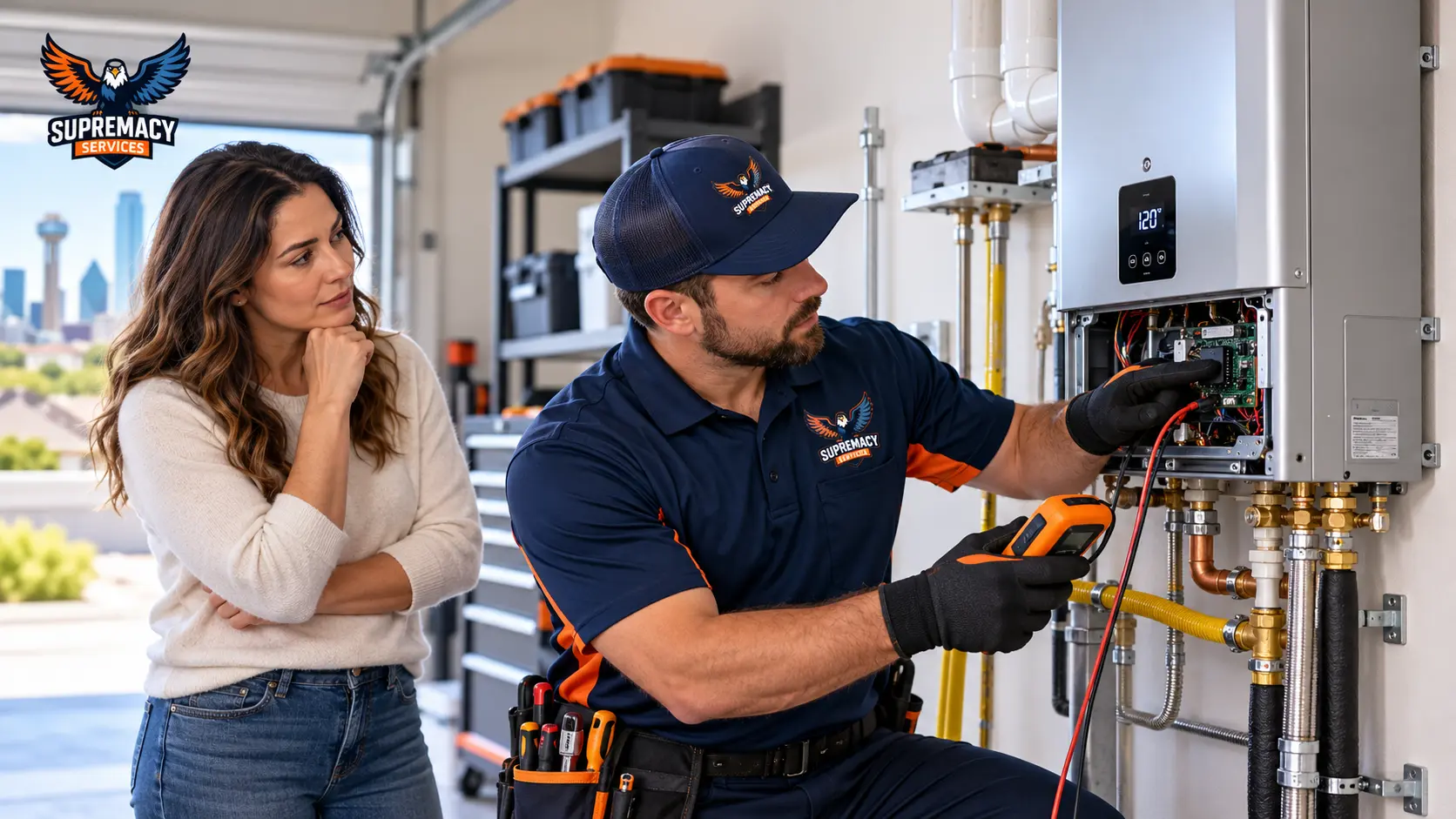
Supremacy Services technician diagnosing a tankless water heater that keeps shutting off in a Dallas-area home

Why Does My Tankless Water Heater Keep Shutting Off?

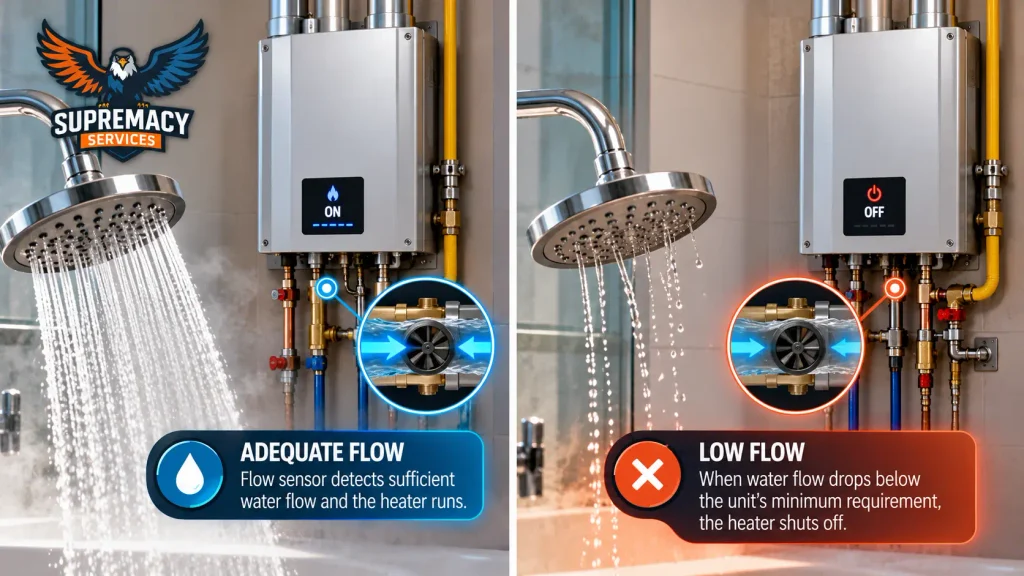
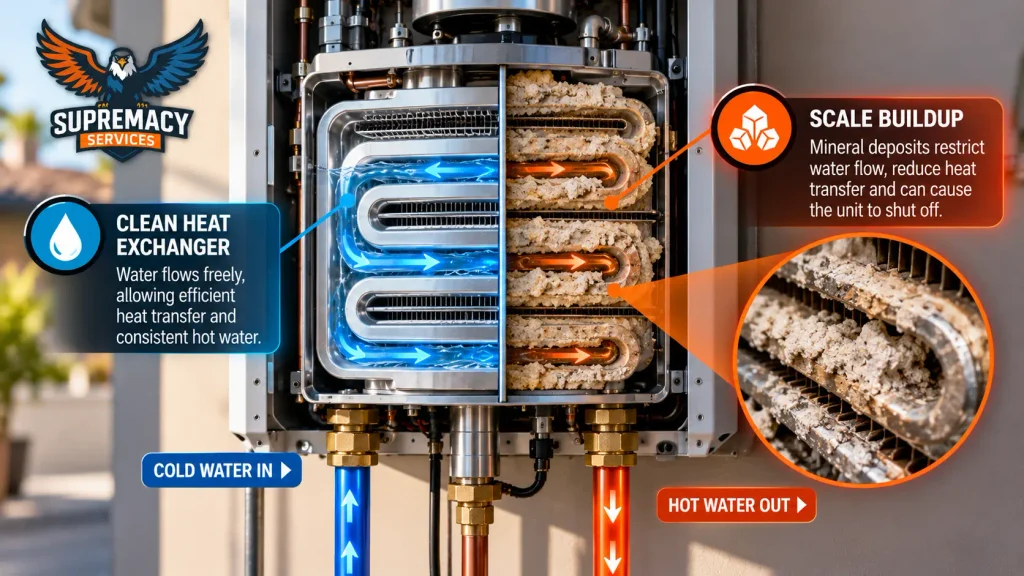
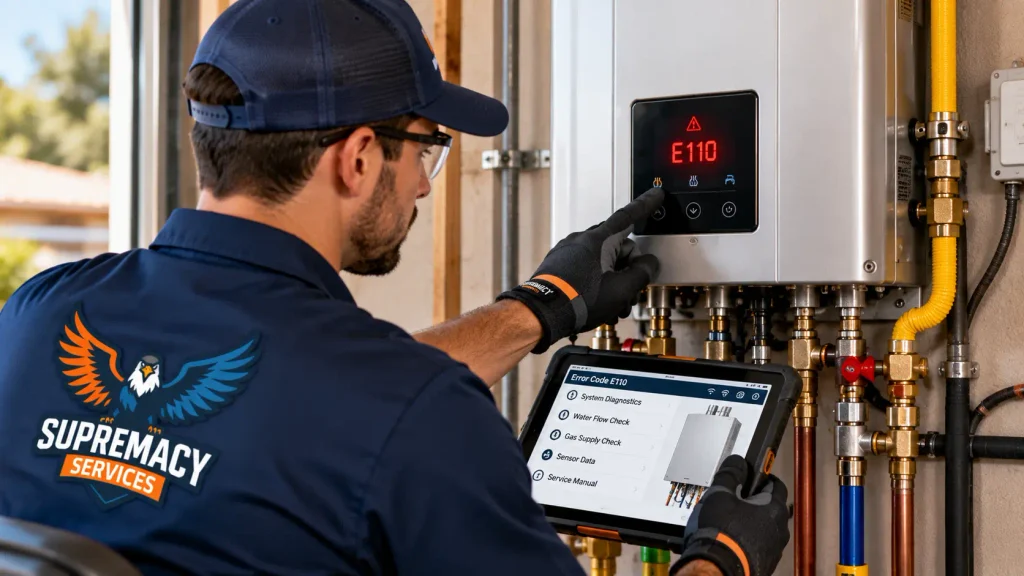
If your tankless water heater keeps shutting off, the problem often comes down to insufficient water flow, mineral scale, a dirty inlet filter, an ignition or gas-supply problem, blocked venting, an electrical fault, overheating, or a component that has triggered the unit’s safety controls.

Sometimes the cause is surprisingly simple: the hot-water flow drops below the heater’s minimum operating threshold when you reduce the faucet or mix in too much cold water. In other cases, repeated shutdowns indicate a problem that should be diagnosed by a qualified plumber.

For Dallas homeowners, mineral buildup deserves particular attention. The City of Dallas has reported water hardness of approximately 120–155 mg/L as CaCO₃, placing much of the range within the commonly defined hard-water category. That makes manufacturer-recommended flushing and descaling especially relevant for tankless equipment.

Table of Contents

  1. Quick answer: why tankless heaters shut off
  2. How a tankless water heater knows when to run
  3. Low water flow
  4. Mineral scale buildup
  5. Dirty inlet filter
  6. Gas or ignition problems
  7. Venting and combustion problems
  8. Electrical and control problems
  9. Overheating
  10. Why it shuts off during a shower
  11. Error codes
  12. What homeowners can safely check
  13. Repair versus replacement
  14. Prevention and maintenance
  15. Dallas and DFW considerations
  16. FAQs

Why Does a Tankless Water Heater Keep Shutting Off?

A tankless water heater usually shuts down because the control system no longer detects the conditions required for safe operation.

The most common categories are:

Possible causeWhat you may noticeTypical next step
Water flow is too lowHeater goes cold when faucet flow is reducedCheck fixture flow and inlet filter
Mineral scaleTemperature fluctuates or performance gradually worsensDescale according to manufacturer requirements
Dirty inlet filterReduced flow or inconsistent activationInspect/clean if permitted by manufacturer
Gas or ignition problemUnit attempts to fire but stopsProfessional diagnosis
Vent/intake issueShutdown or combustion-related errorInspect exterior termination; professional service
Electrical interruptionBlank display, rebooting or intermittent operationCheck normal household power conditions
OverheatingHeater works briefly, then shuts downProfessional diagnosis
Sensor/control faultRepeated error code or unpredictable cyclingManufacturer-specific troubleshooting
Demand exceeds capacityHot water drops under simultaneous useEvaluate sizing and peak GPM

Do not assume every shutdown means the heater itself has failed. Problems with water flow, fixtures, gas delivery, electrical power or installation conditions can produce similar symptoms.

How Does a Tankless Water Heater Know When to Turn On?

Diagram showing water flow activating the flow sensor, burner and heat exchanger inside a tankless water heater
A tankless water heater begins heating when the flow sensor detects sufficient water moving through the unit.

A tankless water heater does not keep a reservoir of hot water ready.

When a hot-water fixture opens, water begins moving through the heater. A flow sensor detects that demand and tells the unit to begin heating. On gas models, the burner heats a heat exchanger and water passes through it before traveling to the fixture.

ENERGY STAR describes essentially this sequence: incoming water activates a flow sensor, the burner heats the heat exchanger, and water leaves the unit at the selected temperature.

That operating principle explains several shutdown problems.

If flow falls too low, combustion becomes unsafe, the flame cannot be maintained, a sensor detects abnormal conditions, or another safety limit is exceeded, the unit can stop heating.

1. The Hot-Water Flow Is Too Low

Low flow is one of the first things to investigate when a tankless heater works at high faucet flow but turns off when the water is reduced.

Comparison showing adequate shower flow keeping a tankless water heater on versus low flow causing it to shut off
If hot-water flow falls below the heater’s minimum operating requirement, the unit may stop heating.

Tankless units have minimum operating-flow requirements.

The exact threshold depends on the manufacturer and model. ENERGY STAR’s product data even includes a specific minimum gallons-per-minute specification for tankless units.

For example, Rinnai states that its gas tankless heaters typically require approximately 0.4–0.6 GPM to ignite and around 0.26 GPM to remain operating. Those figures are Rinnai-specific and should not be assumed to apply to every brand.

Low-flow clues

You may have a flow-related problem if:

  • the heater works with the faucet fully open but stops when it is partially closed;
  • the shower gets cold after you mix in more cold water;
  • one fixture has the problem while another works normally;
  • the issue appeared after installing a very low-flow fixture;
  • performance improves after removing a clogged aerator; or
  • the unit repeatedly cycles on and off during small hot-water draws.

Why mixing cold water can contribute

Suppose the heater is set very hot.

You may compensate at the shower by reducing the hot side and adding substantial cold water. If hot-water flow through the heater falls beneath its activation or operating threshold, the burner can shut down.

That is why the correct temperature setting and fixture flow can matter.

Do not change manufacturer settings beyond normal user controls without consulting the manual.

Still losing hot water even with normal flow? Have Supremacy Services diagnose the water heater and confirm whether the problem is flow, scaling, ignition or another system fault.

2. Mineral Scale Is Restricting the Heat Exchanger

Scale buildup can reduce heat transfer and restrict water passages inside a tankless water heater, contributing to poor performance and shutdown-related symptoms.

Clean and mineral-scaled tankless water heater heat exchangers showing restricted water flow from scale buildup
Mineral deposits can restrict water passages, reduce heat transfer and contribute to poor tankless water heater performance.

Minerals carried by the water can precipitate onto heated surfaces inside the unit.

This matters particularly in Dallas because the City has reported water hardness of 120–155 mg/L as CaCO₃.

Scale buildup does not prove that every Dallas shutdown is a water-quality problem, but it makes maintenance worth taking seriously.

Signs that scale may be involved

Look for a pattern such as:

  • declining performance over time;
  • reduced hot-water flow;
  • fluctuating outlet temperature;
  • unusually long heating response;
  • shutdown or error events under heavier demand;
  • a unit that has not been flushed or descaled according to its required maintenance schedule.

Does a tankless water heater need flushing?

Potentially, yes.

The correct method and interval depend on the manufacturer, model and water conditions. Do not assume that one universal annual procedure applies to every unit.

Consult the manufacturer’s maintenance instructions.

Because tankless systems may involve gas, combustion, electricity and hot water, professional service may be appropriate when maintenance requires opening the appliance or working beyond normal owner procedures. Navien, for example, expressly warns that troubleshooting and service can involve hazardous gas, combustion, venting, electrical and plumbing systems.

3. The Cold-Water Inlet Filter Is Dirty

A restricted inlet filter can reduce the amount of water moving through the heater, potentially interfering with activation and performance.

Some tankless units include a screen or filter on the incoming-water side to keep debris from entering internal passages.

If that filter becomes clogged, symptoms may include:

  • lower hot-water flow;
  • inconsistent activation;
  • cycling;
  • reduced performance at distant fixtures.

Rinnai specifically includes cleaning the inlet water filter among its suggested responses to minimum-flow problems.

Check your specific owner’s manual before removing or servicing filters. Water isolation procedures differ between models.

4. The Heater Has a Gas-Supply or Ignition Problem

Gas-fired tankless heaters may shut down when they cannot establish or maintain proper combustion.

Possible causes can involve:

  • interrupted gas supply;
  • ignition problems;
  • flame-detection faults;
  • improper gas pressure;
  • gas piping that does not meet the appliance’s requirements;
  • burner or combustion-related problems.

These are not good DIY troubleshooting targets.

Never attempt to modify gas pressure, gas valves, burners, regulators or combustion components yourself.

Warning

If you smell gas:

  1. Do not attempt to troubleshoot the water heater.
  2. Avoid switches, flames or anything that could create an ignition source.
  3. Leave the area.
  4. Follow your gas utility’s emergency instructions.

A tankless unit displaying a flame or combustion-related code should be evaluated using the manufacturer’s exact diagnostic procedure for that model, rather than a generic list found online.

5. The Air Intake or Exhaust Vent Has a Problem

Gas tankless heaters require proper combustion air and exhaust venting. A restriction or installation problem can cause a safety shutdown.

ENERGY STAR notes that whole-home gas tankless systems use dedicated venting for combustion gases. Condensing systems also require condensate management.

Potential issues include:

  • debris at an exterior vent termination;
  • an intake obstruction;
  • improper installation;
  • damaged vent components;
  • exhaust recirculation;
  • condensate drainage problems on applicable systems.

What a homeowner can check

From a safe location, you can look for an obvious external obstruction such as leaves or debris around an accessible outdoor termination.

Do not:

  • dismantle the vent;
  • defeat a safety switch;
  • modify vent materials;
  • change combustion settings.

Improper combustion or venting can create serious safety risks.

6. The Heater Is Losing Electrical Power

Even a gas-fired tankless heater normally relies on electrical power for controls, ignition, sensors and other components.

Possible signs of a power-related problem include:

  • the display goes completely blank;
  • the system repeatedly reboots;
  • error history disappears after power interruptions;
  • operation is intermittent rather than linked to water flow.

A homeowner can check normal items such as whether the unit has household power or whether an accessible breaker has tripped.

Repeated breaker trips, damaged wiring or internal electrical faults require qualified service.

Do not repeatedly reset a breaker without determining why it is tripping.

7. The Water Heater Is Overheating

If internal temperatures become abnormal, the heater may shut down to protect itself and the home.

Possible contributors can include:

  • restricted water movement;
  • heat-exchanger scale;
  • incorrect sensor readings;
  • abnormal combustion;
  • component failure.

If the heater consistently runs for several minutes and then shuts down—particularly with a temperature or overheat code—record the code and arrange appropriate service.

Repeatedly resetting the appliance without correcting the underlying cause can mask an important diagnostic clue.

Why Does My Tankless Water Heater Shut Off During a Shower?

When a tankless water heater shuts off specifically during a shower, investigate flow and temperature mixing first.

A common sequence is:

  1. The heater produces very hot water.
  2. The homeowner adds significant cold water at the shower valve.
  3. Hot-water flow through the heater falls.
  4. Flow approaches the unit’s minimum operating requirement.
  5. The heater shuts down.
  6. Cold water reaches the shower.
  7. The cycle may repeat.

Other possible shower-specific causes include:

  • a restrictive showerhead;
  • a clogged showerhead;
  • a mixing-valve problem;
  • plumbing crossover;
  • an inlet-flow restriction.

Simple comparison test

Without altering the appliance, note whether:

  • a kitchen faucet can sustain hot water normally;
  • another shower has the same problem;
  • the heater fails only when flow is reduced.

That information can make professional diagnosis much faster.

8. The Unit Is Displaying an Error Code

Treat the error code as a diagnostic clue, not a generic repair instruction.

Supremacy Services technician checking a tankless water heater error code and performing model-specific diagnostics
Record recurring error codes before resetting the unit because they provide important diagnostic information.

Tankless-water-heater codes vary by:

  • brand;
  • product family;
  • fuel type;
  • model;
  • generation.

The same number may not mean the same thing on different manufacturers’ equipment.

Write down:

  • manufacturer;
  • exact model number;
  • complete error code;
  • whether the code appears immediately or after running;
  • which fixtures were operating;
  • whether the unit restores operation after a normal reset.

Then consult the manufacturer’s manual for that exact model.

Manufacturers such as Navien publish model-specific installation, operation and service documentation rather than one universal troubleshooting table.

If the same error code keeps returning, schedule tankless water-heater diagnosis with Supremacy Services before repeated resets turn a useful diagnostic clue into an intermittent problem.

What Can I Safely Check Before Calling a Plumber?

Start with observations rather than disassembly.

Safe homeowner checklist

  • Record any error code before resetting anything.
  • Confirm whether the display remains powered.
  • Test more than one hot-water fixture.
  • Notice whether higher flow keeps the heater operating.
  • Check whether a faucet aerator or showerhead is visibly clogged.
  • Look for an obvious obstruction around an accessible exterior vent termination.
  • Review when the unit was last maintained.
  • Find the manufacturer and model number.
  • Note whether multiple fixtures were running when the shutdown occurred.
  • Check the user manual for owner-approved maintenance steps.

Stop and call a professional if:

  • you smell gas;
  • the breaker repeatedly trips;
  • combustion or flame error codes return;
  • the appliance leaks internally;
  • venting appears damaged;
  • wiring is damaged;
  • the unit overheats;
  • shutdowns continue after basic flow checks;
  • service requires opening the appliance.

Manufacturer service documentation can include explicit warnings that diagnosis may involve gas, combustion, electrical, plumbing and venting hazards.


Could the Tankless Heater Be Undersized?

Possibly—but undersizing usually appears as a capacity problem during simultaneous demand, not simply a heater that randomly switches off.

Every tankless unit has a maximum flow capacity at a specified temperature rise.

If several fixtures run simultaneously, demand may exceed the unit’s ability to maintain the desired outlet temperature.

ENERGY STAR uses maximum GPM as a core tankless performance specification and currently requires qualifying gas-fired instantaneous water heaters to deliver at least 2.8 GPM over a 67°F temperature rise. Individual products can have considerably different capacities.

Capacity problem versus shutdown problem

SymptomMore likely explanation
Water gets cooler only when several fixtures operateCapacity/sizing
Heater turns off when flow becomes very lowMinimum-flow issue
Gradual performance declineScale/filter/maintenance issue
Repeated ignition codeGas/ignition diagnosis
Unit abruptly goes blankElectrical/power issue
Same safety code repeatedly returnsSpecific component/system fault

Professional sizing should consider peak simultaneous flow and required temperature rise, not simply household size.


Related Problems That Can Look Like a Tankless-Heater Failure

Do not assume the appliance is always responsible.

Fixture problem

A clogged aerator or showerhead can restrict flow.

Shower mixing-valve problem

A defective valve can cause temperature fluctuations that resemble heater cycling.

Plumbing crossover

An unintended connection between hot and cold plumbing can change delivered temperature.

Recirculation-system issue

Homes with recirculation equipment introduce pumps, check valves, controls and piping arrangements that can create symptoms different from a basic tankless installation.

Gas-supply problem

The water heater may be operating correctly but not receiving fuel under the required conditions.

Electrical problem

Loss of power can stop even a gas-fired heater because controls and ignition need electricity.

Correct diagnosis matters before replacing expensive equipment.


Should You Repair or Replace a Tankless Water Heater That Keeps Shutting Off?

Repair usually makes sense when the underlying issue is serviceable and the heater is otherwise in good condition. Replacement becomes more reasonable when the equipment has major component failure, recurring expensive problems, installation deficiencies that require substantial correction, or no longer meets the home’s hot-water needs.

Do not make the decision based on age alone.

Consider:

FactorFavors service/repairFavors replacement evaluation
ProblemMaintenance or replaceable componentMajor heat-exchanger/component failure
HistoryFirst significant issueRepeated breakdowns
InstallationProperly installed and sizedMajor vent/gas/sizing deficiencies
PerformanceMeets household demand when workingRegularly inadequate for demand
PartsReadily serviceableObsolete or difficult to source
ConditionOtherwise soundMultiple deteriorating systems

Supremacy’s existing water-heater page is the appropriate commercial destination when diagnosis indicates replacement or a new installation. The company states that its water-heater process includes diagnostics, sizing and selection, installation and performance verification.


What Does Professional Tankless Water-Heater Diagnosis Include?

The exact process depends on the heater and symptom, but professional diagnosis may involve checking:

Supremacy Services technician inspecting water flow, gas supply, valves and venting on a residential tankless water heater
Professional diagnosis can determine whether repeated shutdowns are caused by water flow, gas supply, venting, scale or equipment faults.
  1. stored or active error codes;
  2. actual fixture flow;
  3. inlet-water flow;
  4. inlet filter condition;
  5. temperature settings;
  6. heat-exchanger condition;
  7. evidence of mineral scale;
  8. ignition sequence;
  9. gas supply where applicable;
  10. combustion and venting conditions;
  11. electrical supply and controls;
  12. temperature and flow sensors;
  13. condensate system on applicable equipment;
  14. recirculation controls where installed;
  15. overall sizing and peak demand.

The goal should be to identify why the safety/control system is shutting the heater down, not simply reset it and hope the problem disappears.


How Much Does It Cost to Fix a Tankless Water Heater That Keeps Shutting Off?

There is no defensible one-price answer based only on the symptom.

The final cost depends on whether the cause is:

  • routine maintenance;
  • scale removal;
  • an inlet restriction;
  • sensor replacement;
  • ignition repair;
  • gas-supply correction;
  • venting correction;
  • electrical repair;
  • recirculation troubleshooting;
  • a major component; or
  • replacement of the appliance.

An online repair price that does not first identify the failure can therefore be misleading.

Homeowners should ask for a diagnosis that separates:

diagnostic/service cost + required parts + labor + any installation corrections

before comparing repair with replacement.


How Can You Prevent Repeated Tankless-Water-Heater Shutdowns?

1. Follow the manufacturer’s maintenance schedule

Maintenance requirements vary by manufacturer and model.

2. Address mineral scale

Dallas Water Utilities has documented relatively mineral-rich water, with reported hardness of 120–155 mg/L as CaCO₃.

If the manufacturer recommends descaling based on water conditions, do not ignore it.

3. Keep owner-serviceable filters clean

Only follow procedures specified for your model.

4. Do not ignore recurring codes

A recurring code is evidence, not an annoyance to be repeatedly erased.

5. Maintain proper fixture flow

If a heater only fails after installing a highly restrictive fixture, compare that fixture’s flow with the water heater’s minimum operating requirement.

6. Protect vent terminations from obstruction

Inspect accessible exterior terminations periodically without modifying or dismantling them.

7. Have installation problems corrected

An appliance cannot overcome gas, venting, electrical or sizing deficiencies simply because the heater itself is new.


Dallas & DFW Considerations for Tankless Water Heaters

Dallas water hardness makes scale worth monitoring

The City of Dallas has specifically reported water hardness of 120–155 mg/L as CaCO₃.

For a tankless heater, that makes heat-exchanger maintenance more relevant than a generic article might suggest.

The key distinction is important:

Hard water does not mean every shutdown is caused by scale.

It means scale should be one of the legitimate diagnostic possibilities when performance declines, flow becomes restricted or maintenance has been neglected.

DFW homes can have very different installations

One Dallas-area home may have:

  • an indoor condensing gas system;
  • an exterior tankless heater;
  • a recirculation loop;
  • a conventional gas system;
  • electric tankless equipment;
  • a former storage-heater installation converted to tankless.

That is why troubleshooting must start with the actual model and installation rather than treating every tankless system as identical.

Supremacy’s plumbing page states that the company services traditional and tankless water heaters throughout the Dallas–Fort Worth area.


Frequently Asked Questions

Why does my tankless water heater keep turning off and back on?

Frequent cycling can occur when water flow moves above and below the unit’s minimum operating threshold. Restricted flow, dirty filters, scale, sensor issues or other faults can also contribute. Record any error code and compare the symptoms across several fixtures.

Why does my tankless water heater shut off in the middle of a shower?

Low hot-water flow is one possibility, particularly if you are mixing large amounts of cold water into very hot water. A restrictive showerhead or mixing-valve problem can also contribute. If other fixtures have the same problem, the heater itself needs closer diagnosis.

Can low water pressure make a tankless water heater shut off?

Insufficient flow through the heater can prevent activation or cause heating to stop. However, water pressure and water flow are not exactly the same measurement, so the actual flow through the unit should be evaluated.

Can scale cause a tankless water heater to stop working?

Scale can accumulate inside the heat exchanger and reduce heat transfer or restrict passages. Whether it directly causes a particular shutdown must be determined from the heater’s symptoms, service history and diagnostic information.

Why does my tankless water heater only work when the faucet is fully open?

That strongly suggests investigating minimum flow. Some tankless heaters require a specific water flow before they ignite and a minimum flow to remain operating. The exact threshold depends on the model.

Should I keep resetting my tankless water heater?

An occasional reset specified by the owner’s manual may restore operation after a temporary event, but repeatedly resetting a unit that returns the same fault can hide useful diagnostic information. Write down the error code and investigate the cause.

Does a tankless water heater need to be flushed?

Many tankless manufacturers specify maintenance procedures related to mineral deposits, but the method and interval vary. Follow the manual for your exact model and local water conditions rather than assuming one maintenance schedule applies universally.

Why does my tankless water heater show an error code?

An error code means the control system has detected a condition it is programmed to identify. Because code definitions vary by manufacturer and model, consult the exact manufacturer’s documentation instead of relying on a generic error-code chart.

When should I call a plumber for a tankless water heater?

Arrange professional diagnosis when shutdowns continue after basic fixture/flow checks, the same error code returns, the unit leaks, electrical protection trips, venting appears damaged, combustion problems are suspected, or diagnosis requires opening the appliance.

Is a tankless water heater that keeps shutting off necessarily bad?

No. The heater itself may still be serviceable. Low fixture flow, an inlet restriction, scale, installation problems, fuel supply or another system condition can create similar symptoms. Diagnose the cause before deciding to replace the unit.

Final Takeaway

A tankless water heater that keeps shutting off is usually responding to a specific operating or safety condition—not simply deciding to stop producing hot water.

Start by looking at the pattern.

If the problem happens only at low fixture flow, investigate minimum-flow conditions first. If performance has gradually declined, scale or an inlet restriction deserves attention. If an error code, ignition problem, overheating condition, repeated power interruption or venting fault is involved, stop treating the problem as a simple reset issue and have the system properly diagnosed.

For Dallas homeowners, water hardness makes manufacturer-recommended scale maintenance particularly relevant, but good troubleshooting still means identifying the actual failure before replacing parts.

Final CTA

Tankless water heater still shutting down? Supremacy Services can diagnose water-flow, scaling, ignition, venting and system-performance issues throughout Dallas–Fort Worth and help determine whether service or replacement makes the most sense.

Supremacy Services technician inspecting a rusty residential water heater for signs of failure

Signs Your Water Heater Is About to Fail: 9 Warning Signs

A failing water heater often gives homeowners warning before it stops producing hot water or begins leaking. Common signs your water heater is failing include corrosion, rusty hot water, water around the tank, unusual rumbling or popping noises, reduced hot-water capacity, inconsistent temperatures and repeated component problems.

Age matters too. ENERGY STAR advises homeowners to pay closer attention once a storage water heater reaches roughly the 10-year mark, particularly when age appears alongside corrosion, leaks, rusty water, reduced hot-water supply or unusual noises. ENERGY STAR

For Dallas–Fort Worth homeowners, recognizing these symptoms early gives you time to determine whether the problem is a repairable component or a deteriorating tank that should be replaced before it fails unexpectedly.

Table of Contents

  1. Quick Answer: What Are the Signs a Water Heater Is Failing?
  2. Water Is Leaking or Pooling Around the Heater
  3. Rust or Corrosion Is Appearing
  4. Hot Water Looks Rusty or Discolored
  5. Your Water Heater Is Rumbling or Popping
  6. Hot Water Runs Out Faster Than It Used To
  7. Water Temperature Has Become Unpredictable
  8. Your Water Heater Needs Repeated Repairs
  9. Energy Use Appears to Be Increasing
  10. Your Water Heater Is Around 10 Years Old or Older
  11. Repair or Replace?
  12. What Should You Do if Your Water Heater Is Leaking?
  13. What a Professional Water-Heater Inspection Includes
  14. Dallas Water-Heater Installation Considerations
  15. How to Reduce the Risk of Premature Failure
  16. Frequently Asked Questions

What Are the Signs a Water Heater Is About to Fail?

The most important warning signs are water leakage, visible corrosion, rusty hot water, unusual noises, reduced hot-water capacity, inconsistent heating, repeated repair problems and advanced equipment age.

ENERGY STAR specifically identifies visible corrosion, leaking, rust in the water, loss of available hot water and rumbling noises as potential indications of water-heater failure.

One symptom does not automatically mean the entire heater needs replacing. A failed thermostat or heating element, for example, may be repairable. A storage tank that has corroded through is a very different problem.

The key is identifying where the symptom originates and whether the tank itself is still structurally sound.


1. Water Is Leaking or Pooling Around the Heater

Water around your heater should never be ignored. The source may be a repairable fitting or valve, but leakage from the tank itself can indicate deterioration that requires replacement.

Water leaking from a corroded residential water heater and pooling on the floor
Water around the base of a heater may indicate a leaking valve, connection or deteriorating tank.

Start by determining where the moisture appears to originate.

Possible sources include:

  • a water-supply connection;
  • the drain valve;
  • the temperature-and-pressure relief system;
  • condensation;
  • nearby plumbing;
  • or the water-heater tank itself.

ENERGY STAR lists leaking from joints, seals or seams as a warning that the system has a problem.

A fitting leak is different from a tank leak

A plumber may sometimes repair a leaking connection, valve or other external component.

A corroded storage tank is different. Once the tank itself loses structural integrity, replacing an external component does not restore the tank.

Look carefully for:

  • moisture repeatedly returning after the floor has been dried;
  • rust trails down the tank;
  • water appearing beneath the jacket;
  • corrosion around the lower portion of the heater;
  • or a growing puddle.

Not sure whether the water is coming from a valve, connection or the tank itself? Have the unit professionally diagnosed before a small leak becomes a larger water-damage problem.
Supremacy services


2. Rust or Corrosion Is Appearing on the Water Heater

Visible corrosion is one of the more important physical warning signs of an aging water heater.

Corroded water heater fittings beside a faucet producing rusty brown hot water
Rust around the heater or discolored hot water can indicate corrosion somewhere in the hot-water system.

Inspect areas including:

  • hot- and cold-water connections;
  • fittings;
  • valves;
  • the top of the tank;
  • the tank jacket;
  • and the area around the base.

ENERGY STAR advises homeowners to look for corrosion on both the water lines entering and leaving the heater and on the unit itself.

Surface discoloration on one replaceable fitting does not necessarily mean the tank is finished. Widespread deterioration deserves more attention.

Why corrosion matters

Traditional storage heaters contain a steel tank protected against corrosion through tank construction, lining and sacrificial components.

As protective systems deteriorate, corrosion may eventually reach components that cannot economically or safely be restored.

This is why corrosion should be evaluated alongside:

  • unit age;
  • water quality;
  • leakage;
  • repair history;
  • and condition of the tank.

3. Hot Water Looks Rusty, Brown or Discolored

Rust-colored water coming specifically from hot-water fixtures can indicate corrosion somewhere in the hot-water system.

ENERGY STAR identifies rust in hot water as a potential indication that the interior of the water-heating system is corroding.

Before assuming the tank has failed, compare the hot and cold water.

Simple diagnostic comparison

What you observeWhat it may suggest
Discoloration only from hot tapsInvestigate water heater/hot-water piping
Discoloration from hot and cold tapsProblem may be elsewhere in the water supply
Short burst of discoloration onlyCould involve localized piping or sediment
Persistent rusty hot water plus tank corrosionStronger reason for professional inspection

Do not diagnose tank failure solely from water color.

A plumber should determine whether the discoloration originates in:

  • the heater;
  • hot-water piping;
  • a corroded fitting;
  • sediment;
  • or another part of the plumbing system.

4. Your Water Heater Is Making Popping, Rumbling or Unusual Noises

Persistent popping or rumbling often indicates sediment or mineral deposits interfering with normal water-heater operation.

Cutaway view of sediment buildup at the bottom of a tank water heater causing heating problems
Sediment accumulation can reduce usable hot-water capacity and contribute to popping or rumbling noises.

ENERGY STAR specifically lists rumbling, unusual noises and vibration among potential warning signs, noting that sediment buildup can be involved.

Sediment can settle at the bottom of a storage tank.

When the burner or heating element heats the water, trapped water moving through or beneath those deposits can contribute to unusual sounds.

Supremacy’s existing water-heater service page already states that its diagnostic process checks sediment buildup, anode condition, burner efficiency and tank integrity. Supremacy Services

Does rumbling mean the heater must be replaced?

Not automatically.

The correct response depends on factors such as:

  • how much sediment is present;
  • the condition of the tank;
  • equipment age;
  • previous maintenance;
  • whether leakage or corrosion is also present;
  • and whether flushing is appropriate for that specific unit.

A relatively young system with sediment is a different situation from an old heater that is simultaneously rumbling, rusting and leaking.


5. Hot Water Runs Out Faster Than It Used To

A noticeable reduction in usable hot-water capacity can indicate sediment accumulation, a heating problem or an aging system that is no longer performing as expected.

ENERGY STAR notes that sediment accumulation in aging hot-water tanks can reduce available capacity.

For example, a shower routine that previously used only part of the tank may suddenly exhaust the available hot water.

Possible explanations include:

  • sediment occupying tank volume;
  • a failed electric heating element;
  • thermostat problems;
  • burner problems;
  • damaged internal components;
  • unusually high household demand;
  • or an undersized heater.

First rule out changed household demand

Before blaming the heater, ask:

  • Have more people been staying in the home?
  • Are showers longer?
  • Is the dishwasher running at the same time?
  • Has a new fixture been installed?
  • Has the thermostat setting changed?

If demand has not changed and capacity continues declining, the heater deserves inspection.


6. Water Temperature Has Become Unpredictable

Water that alternates between properly hot, lukewarm and cold can point to a control, heating or capacity problem.

Depending on the type of heater, possibilities can include:

  • thermostat trouble;
  • electric element failure;
  • burner or ignition trouble;
  • sediment;
  • flow or sizing issues;
  • sensor problems on tankless units;
  • or other internal faults.

An intermittent temperature problem does not automatically mean replacement is necessary.

Component-level faults can sometimes be repaired.

The decision becomes more complicated when inconsistent heating occurs on an older unit that also has corrosion, leakage, noise or a history of repeated repairs.


7. Your Water Heater Needs Repairs More and More Often

A single component failure can be reasonable to repair. Repeated failures on an aging water heater are a sign to compare future repair spending against replacement.

Think beyond the latest repair.

Ask:

  • How old is the heater?
  • What was repaired last time?
  • Are new components failing?
  • Is the tank itself still in good condition?
  • Is corrosion developing?
  • Does the heater still meet your household’s demand?
  • Would replacement improve reliability or efficiency?

The decision should be based on the condition of the entire system, not simply whether the current component can technically be changed.

If your water heater is accumulating repair issues, Supremacy Services can evaluate the system and help you compare repair versus replacement based on the tank condition, age and your household’s hot-water needs.


8. Energy Consumption Seems to Be Increasing

A water heater that takes longer to recover or transfers heat less effectively may use more energy, but higher utility bills alone do not prove the heater is failing.

Water heating is a major household energy use. The U.S. Department of Energy recommends measures such as appropriate thermostat settings, pipe insulation and sediment management to improve water-heating efficiency. The Department of Energy’s Energy.gov

Higher bills may also result from:

  • rate increases;
  • seasonal changes;
  • more occupants;
  • longer showers;
  • leaking hot-water fixtures;
  • or other gas/electrical loads.

Treat higher consumption as a supporting symptom rather than a stand-alone diagnosis.

It becomes more meaningful when paired with:

  • longer heating times;
  • reduced hot-water output;
  • sediment noise;
  • equipment age;
  • or visible deterioration.

9. Your Storage Water Heater Is Around 10 Years Old or Older

Age alone does not prove a water heater has failed, but an older heater deserves closer monitoring—especially when other warning signs appear.

ENERGY STAR advises homeowners with water heaters around 10 years old or older to consider planning ahead rather than waiting for an unexpected failure.

Supremacy’s existing Dallas tank-versus-tankless guide describes conventional storage-heater service life as commonly around 8–12 years, while also emphasizing that actual lifespan depends on water conditions, maintenance, installation quality, usage and equipment quality. Supremacy Services

The important distinction is:

Age is a risk factor, not an automatic replacement deadline.

A 10-year-old heater with no leakage, good tank condition and reliable operation is different from a similarly aged unit with rusty water, corrosion, noise and declining capacity.

Find the manufacturing information

The data plate normally contains:

  • manufacturer;
  • model number;
  • serial number;
  • fuel type;
  • capacity;
  • electrical or gas ratings.

If the installation date is unknown, the manufacturer may provide instructions for interpreting the serial number.


Should You Repair or Replace a Failing Water Heater?

Repair usually makes more sense when the problem involves a serviceable component and the tank itself remains sound. Replacement becomes more compelling when the tank is leaking, badly corroded or showing multiple age-related problems.

Use this framework:

SituationRepair may make senseReplacement deserves stronger consideration
Failed thermostat✓
Failed electric element✓
Repairable valve/fitting✓
Isolated ignition/control problem✓
Heavy sediment on otherwise sound unitPossiblyPossibly
Repeated repair history✓
Significant tank corrosion✓
Tank-body leak✓
Old unit plus multiple warning signs✓
No longer meets household demand✓

No table can replace a hands-on inspection because the actual condition of the tank, venting, connections and safety components matters.

Do not compare repair cost alone

A better decision compares:

current repair + likely remaining life + efficiency + reliability + future repair risk

against:

replacement + installation requirements + expected service life + improved reliability

Supremacy already has a dedicated commercial page for this next step, so this blog should educate homeowners and then hand them off rather than turning into another replacement sales page. Supremacy Services


What Should You Do if Your Water Heater Is Leaking?

If significant water is escaping from the heater, protect the property first and arrange professional evaluation promptly.

The exact shutdown procedure depends on whether the heater is gas or electric and on the equipment configuration.

Homeowners should avoid improvising around:

  • gas controls;
  • electrical panels;
  • hot pressurized water;
  • relief valves;
  • venting;
  • or damaged equipment.

For minor visible moisture, identify the source if it can be done safely.

For active or worsening leakage, professional diagnosis is appropriate.

If you smell gas

Do not continue diagnosing the water heater yourself. Leave the affected area and follow your gas utility’s emergency instructions.


What Does a Professional Water-Heater Inspection Look For?

A water-heater diagnosis should determine why the symptom is occurring instead of assuming that every old heater needs replacement.

Supremacy Services technician inspecting water heater controls and plumbing connections
A professional inspection can help determine whether a water-heater problem is repairable or whether replacement should be considered.

Depending on the equipment and complaint, an inspection may evaluate:

  • tank integrity;
  • corrosion;
  • signs of leakage;
  • water connections;
  • sediment buildup;
  • burner operation;
  • electric heating components;
  • thermostat/control operation;
  • ignition system;
  • venting for fuel-fired equipment;
  • T&P relief components;
  • water temperature;
  • hot-water capacity;
  • equipment sizing;
  • and installation condition.

Supremacy’s published water-heater replacement process currently states that its full-system diagnostic checks sediment buildup, anode condition, burner efficiency and tank integrity before selection and installation of replacement equipment. Supremacy Services

That diagnostic approach is useful because the correct answer may be repair, maintenance or replacement, depending on what is actually wrong.


What Should Dallas Homeowners Know About Water-Heater Replacement?

Water-heater replacement is not simply a matter of buying a tank with the same gallon capacity.

Old corroded water heater compared with modern tank and tankless replacement systems
Tank condition, age and reliability help determine whether repairing or replacing a water heater makes more sense.

The installation may also involve:

  • fuel supply;
  • plumbing connections;
  • venting;
  • drainage;
  • electrical requirements;
  • available space;
  • manufacturer clearances;
  • equipment sizing;
  • and applicable local construction requirements.

The City of Dallas currently identifies the 2021 International Plumbing Code with Dallas amendments, along with applicable mechanical, residential, energy and fuel-gas codes, as part of its adopted plumbing/mechanical framework.

Dallas also states that work involving the installation, alteration, repair or replacement of building service equipment generally requires the appropriate permit unless a specific exemption applies. Simple leak stopping that does not involve replacement or rearrangement of valves, pipes or fixtures is among the examples the city lists separately.

Permit requirements can depend on the exact scope and jurisdiction, so homeowners elsewhere in the DFW Metroplex should verify requirements with their own city.

Texas plumbing work is also regulated through the Texas State Board of Plumbing Examiners, which administers state plumbing licenses and registrations. tsbpe.texas.gov

Dallas/DFW takeaway

If replacement is required, evaluate the complete installation—not merely the appliance.

A contractor may need to assess:

  • existing venting;
  • fuel or electrical capacity;
  • drainage;
  • location;
  • tank size or tankless flow requirements;
  • and whether current installation details meet applicable requirements.

How Can You Reduce the Risk of Premature Water-Heater Failure?

Water heaters cannot last indefinitely, but maintenance may help preserve performance and identify problems earlier.

1. Inspect around the heater periodically

Look for:

  • moisture;
  • rust;
  • corrosion;
  • damaged connections;
  • and changes in normal operation.

2. Pay attention to new sounds

A heater that was previously quiet and begins popping or rumbling deserves investigation.

3. Follow manufacturer maintenance instructions

Maintenance requirements vary among:

  • conventional gas tanks;
  • electric tanks;
  • heat-pump water heaters;
  • and tankless systems.

Follow the schedule in the specific manufacturer’s documentation rather than relying on a universal interval.

4. Address sediment appropriately

The Department of Energy recommends periodic sediment management for storage water heaters because accumulated material can interfere with efficient operation.

Older tanks or neglected systems should be evaluated before aggressive flushing because the appropriate maintenance procedure depends on equipment condition.

5. Do not ignore small leaks

A slow drip may originate from something repairable.

Waiting until it becomes a major leak can increase the risk of surrounding property damage.


Problems That Can Be Mistaken for Water-Heater Failure

Not every hot-water complaint means the water heater itself is dying.

SymptomPossible issue besides complete heater failure
No hot waterBreaker, heating element, gas/ignition issue, control fault
Hot water runs out quicklyHigh household demand, sizing issue, heating-element failure
Discolored waterSupply or piping issue
Water near heaterNearby plumbing leak or condensation
High energy billUtility rate or usage changes
Temperature fluctuationsThermostat/control issue
Poor hot-water pressurePlumbing restriction or fixture problem

This distinction matters because replacing a functioning water heater will not solve a problem originating elsewhere in the plumbing system.


When Should You Call a Professional?

Arrange a professional inspection when you notice:

  • persistent water around the heater;
  • tank or connection corrosion;
  • rusty hot water;
  • loud or worsening noises;
  • rapidly declining hot-water capacity;
  • repeated loss of heat;
  • recurring component failures;
  • an older heater displaying several symptoms at once;
  • or uncertainty about whether the tank itself is leaking.

Homeowners can visually monitor equipment and note symptoms, but work involving gas, electrical connections, venting, pressurized hot water or safety devices is better handled by qualified professionals.


Final Takeaway: Water Heaters Usually Give You Clues

The most useful warning signs of water-heater failure are not mysterious.

Watch for:

  1. leaking water;
  2. visible corrosion;
  3. rusty or discolored hot water;
  4. rumbling or popping;
  5. declining hot-water capacity;
  6. inconsistent temperature;
  7. repeated repairs;
  8. abnormal operating performance;
  9. and advanced age combined with other symptoms.

The strongest case for replacement is generally not one isolated symptom. It is the combination of equipment age, tank condition and worsening performance.

If your Dallas–Fort Worth water heater is showing several warning signs, Supremacy Services can inspect the system and determine whether repair is practical or whether replacement is the better long-term option.

Concerned your water heater is approaching failure? Schedule a water-heater diagnostic with Supremacy Services and get a clear assessment of the tank, connections and system performance before a minor warning becomes an unexpected breakdown.


Frequently Asked Questions

How do you know when a water heater is about to fail?

Common signs include leaks, corrosion, rusty hot water, rumbling or popping noises, declining hot-water capacity, inconsistent temperatures and repeated repairs. Age becomes more important when several of these symptoms occur together.

Is a 10-year-old water heater too old?

Not necessarily, but it should be monitored more closely. ENERGY STAR specifically highlights water heaters around 10 years old or older as candidates for proactive replacement planning when signs of deterioration are present.

Does rusty hot water mean the water heater needs replacing?

Not always. Rusty water from hot taps can indicate corrosion within the water-heating system, but a plumber should first determine whether the discoloration comes from the heater, piping or another source.

Is a popping water heater dangerous?

Popping or rumbling commonly points to sediment-related problems and deserves investigation. The noise by itself does not prove the tank is unsafe or requires replacement, but it should not be ignored—especially on an older heater.

Can a leaking water heater be repaired?

Sometimes. A leaking fitting, connection or serviceable valve may be repairable. Leakage from a deteriorated tank itself generally creates a stronger case for replacement.

Why is my hot water suddenly running out faster?

Possible causes include sediment reducing usable tank capacity, a heating-element or burner problem, increased household demand or an undersized system.

Should I repair or replace an old water heater?

Consider the heater’s age, tank condition, repair history, reliability and cost of the current repair. Replacement becomes more reasonable when an aging unit develops tank leakage, serious corrosion or multiple recurring problems.

Can sediment damage a water heater?

Sediment can reduce usable capacity and interfere with heat transfer. ENERGY STAR identifies sediment as one possible cause of declining hot-water capacity and rumbling noises.

Who should replace a water heater in Texas?

Texas plumbing licensing is administered by the Texas State Board of Plumbing Examiners. Water-heater work should comply with applicable licensing, manufacturer and local jurisdiction requirements.

Homeowner listening to a noisy tank water heater making popping or rumbling sounds in a Dallas-area garage

Why Is My Water Heater Making Popping or Rumbling Noises?

If your water heater is making popping or rumbling noises, sediment or mineral buildup inside a tank-style water heater is one of the most common causes. As water heats beneath accumulated deposits, bubbles can form and escape through the sediment, producing popping, crackling or low rumbling sounds.

That deserves particular attention in Dallas because the City of Dallas has reported water hardness in the range of approximately 120–155 mg/L as calcium carbonate, placing much of that range within the commonly defined “hard water” category. Mineral content can therefore contribute to scale and sediment accumulation inside water-heating equipment over time.

A noisy water heater does not automatically mean the tank needs replacement. Sometimes professional flushing or maintenance is enough. But loud noises accompanied by leaking, corrosion, inconsistent hot water or an aging tank can justify a more complete inspection.

Table of Contents


What Causes a Water Heater to Pop or Rumble?

Popping and rumbling in a conventional tank water heater most commonly point to mineral sediment accumulating near the bottom of the tank. Other possibilities include scale on electric heating elements, normal thermal expansion, pressure-related noises, water hammer or component problems.

Manufacturer guidance from both Rheem and A. O. Smith identifies sediment accumulation as a common explanation for popping or rumbling in tank-style heaters.

Common causes at a glance

SoundPossible causeTypical response
PoppingSediment trapping heated water or steam bubblesInspect and consider flushing
Low rumblingHeavy sediment or scaleProfessional maintenance may be appropriate
CracklingSediment or scale around an electric elementInspect element and tank
Banging from pipesWater hammer rather than the tank itselfEvaluate plumbing pressure/flow
HissingScale on an element or, in some situations, water contacting hot componentsInspect promptly
Light clickingIgnition, controls or normal expansion on some systemsOften normal if brief and consistent
Screeching/whistlingRestricted water flow or valve-related issueProfessional diagnosis recommended

The sound alone is not always enough to identify the problem. Where the sound originates, when it happens and whether other symptoms appear at the same time are important clues.


Why Does Sediment Make a Water Heater Pop?

Cutaway of a tank water heater showing sediment buildup, trapped bubbles and heat causing popping noises
Sediment near the bottom of the tank can trap heated water and bubbles, creating the familiar popping or rumbling sound.

Sediment settles between the water and the heat source. As the heater operates, water trapped around or beneath those deposits can heat rapidly and force its way through the sediment, producing popping and rumbling.

A. O. Smith specifically explains that sediment near the tank bottom can trap bubbles, which then escape through the deposits and create a popping sound. The same buildup can interfere with efficient heat transfer.

Think of the bottom of the tank as the working surface where much of the heat transfer occurs.

In a clean system:

heat source → tank/water → hot water

With substantial sediment:

heat source → sediment layer → water

That additional layer can interfere with heat transfer and may make the equipment work harder to heat the stored water.

Manufacturer documentation also warns that sediment accumulation can create noise and contribute to premature tank deterioration.

Where does the sediment come from?

Water naturally carries dissolved minerals and small quantities of other material.

As water is repeatedly heated, minerals can precipitate and deposits can accumulate inside the tank.

The amount and rate of buildup depend on factors including:

  • Local water chemistry
  • Water temperature
  • Household hot-water consumption
  • Age of the water heater
  • Maintenance history
  • Equipment design
  • Whether the system has previously been flushed

Is a Popping or Rumbling Water Heater Dangerous?

Occasional mild expansion noises may be normal, but loud or worsening popping and rumbling should not simply be ignored.

Sediment itself does not mean the tank is about to explode. However, persistent noise can indicate that maintenance has been neglected or that heat transfer and internal components are being affected.

Rheem recommends further attention when a water heater develops persistent loud rumbling, screeching, sizzling, leaking or continued noise even after maintenance.

Call for professional inspection promptly if noise occurs with:

  • Water around the bottom of the heater
  • Visible tank corrosion
  • Rust-colored hot water
  • A burning smell
  • Hissing or sizzling near electrical or burner components
  • Repeated loss of hot water
  • Water temperatures that change unexpectedly
  • Frequent breaker trips
  • Burner or ignition problems
  • Significant vibration
  • Pressure-related symptoms
  • An older tank with multiple developing problems

Hearing loud popping or rumbling every time your water heater runs? Supremacy Services can inspect the system, determine whether sediment, scale or another component is responsible, and explain whether maintenance, repair or replacement makes the most sense for your DFW home.

What If the Noise Is Not Caused by Sediment?

Not every sound from a water heater means sediment.

Infographic comparing popping, rumbling, banging, hissing, crackling and clicking water heater noises
Different water-heater sounds can point to different causes, from sediment buildup and scale to water hammer or normal ignition.

Water hammer

A loud bang or thump that happens when a faucet, appliance or valve closes may originate in the plumbing rather than inside the water heater.

Water hammer happens when moving water changes velocity abruptly and creates a pressure shock through the piping.

This is different from the repetitive popping that occurs while a tank is actively heating.

Electric heating-element scale

Electric water heaters use immersed heating elements.

Mineral deposits can form around these elements. A. O. Smith notes that scale on heating elements may contribute to hissing or related noises.

Normal expansion and contraction

Metal components expand as they heat and contract as they cool.

Manufacturer documentation recognizes some expansion and contraction noises as part of normal water-heater operation.

Quiet, occasional ticks are therefore different from a tank that suddenly begins loudly rumbling throughout every heating cycle.

Leaking water contacting hot components

Hissing or sizzling deserves more attention, particularly if moisture is visible.

A. O. Smith notes that sizzling around gas water-heater components can be associated with water reaching the burner area and warrants professional inspection.

Tankless water-heater scale

Tankless equipment does not accumulate sediment in a large storage tank in the same way a conventional heater does.

However, mineral scale can form inside heat exchangers and water passages.

Tankless noises should therefore be diagnosed according to the specific model, error codes, flow characteristics and manufacturer maintenance requirements.


Does Dallas Water Contribute to Sediment Buildup?

Yes, Dallas water contains enough calcium and magnesium to make mineral accumulation a relevant maintenance consideration for water-heating equipment.

Clean heating element compared with mineral scale buildup caused by hard water in a Dallas water heater
Calcium and magnesium in hard water can accumulate on water-heater components and contribute to scale, sediment and noise.

A City of Dallas memorandum reports water hardness of approximately 120–155 mg/L as CaCO₃. The same document identifies 121–180 mg/L as the “hard” range.

That does not mean every Dallas water heater will develop severe sediment, nor does it mean Dallas drinking water is unsafe.

Dallas Water Utilities states that its drinking water meets or exceeds applicable federal, state and local requirements.

Water hardness is primarily a mineral-management and appliance-maintenance issue, not an indication that the municipal drinking water is unsafe.

What Dallas homeowners may notice

Mineral accumulation can appear as:

  • White or chalky scale around fixtures
  • Deposits on showerheads
  • Scale on heating elements
  • Sediment during tank flushing
  • Reduced hot-water performance
  • Increasing popping or rumbling from an older tank

Dallas obtains its municipal supply from surface-water reservoirs and treats the water before distribution.


Will Flushing a Water Heater Stop the Popping?

If loose sediment is causing the noise, properly flushing the tank may significantly reduce or eliminate the popping.

Supremacy Services technician flushing sediment from a residential tank water heater in a Dallas-area home
Flushing a tank can remove loose sediment when mineral buildup is responsible for popping or rumbling noises.

A. O. Smith recommends draining and flushing a tank when sediment is responsible for popping, while manufacturer documentation also identifies tank flushing as the remedy for sediment-related noise.

However, flushing is not guaranteed to solve every noisy-water-heater problem.

Flushing is most likely to help when:

  • The noise began gradually
  • The heater has not been flushed recently
  • There are no visible tank leaks
  • Sediment is discharged from the drain
  • Hot-water performance has gradually deteriorated
  • The tank is otherwise in serviceable condition

Flushing may not completely solve the problem when:

  • Deposits have hardened substantially
  • Heating elements are heavily scaled
  • The drain valve is clogged
  • Internal tank deterioration has occurred
  • Noise originates in the plumbing rather than the heater
  • Another component is failing
  • The tank has reached advanced age and developed several symptoms

A professional can determine whether flushing remains worthwhile before disturbing an older tank that may already have significant deterioration.


Can You Flush a Noisy Water Heater Yourself?

Some homeowners can perform routine tank flushing, but the correct procedure depends on the exact heater, fuel source and manufacturer instructions.

A water heater contains extremely hot water and may involve electricity or natural gas, so this is not a maintenance task to improvise.

DIY may be reasonable when:

  • You have the manufacturer instructions
  • The unit is in otherwise good condition
  • The drain valve operates normally
  • You understand how to safely shut down and restart the specific heater
  • You have a safe drainage location
  • There are no signs of leaking, gas problems or electrical faults

Call a plumber instead when:

  • The heater is very old
  • The drain valve will not operate
  • The tank is corroded
  • Water is already leaking
  • You smell gas
  • Electrical components show damage
  • The heater is located in a difficult attic or enclosed location
  • You are unsure how to shut down and restart it correctly
  • Flushing has not stopped the noise

Always follow the maintenance instructions for the actual make and model rather than a generic internet procedure.


What Does a Plumber Check on a Noisy Water Heater?

A professional diagnosis should determine the cause of the sound before recommending replacement.

Depending on the heater, an inspection may include:

  1. Listening to the noise during a heating cycle
  2. Checking for leaks or tank corrosion
  3. Reviewing the age and condition of the equipment
  4. Looking for sediment or scale accumulation
  5. Checking accessible burner or heating-element operation
  6. Evaluating thermostatic controls
  7. Inspecting the anode rod where appropriate
  8. Checking the temperature-and-pressure relief system
  9. Evaluating plumbing pressure and possible water hammer
  10. Flushing or descaling when appropriate
  11. Determining whether further component repair is justified
  12. Comparing continued repair with replacement if the tank is significantly deteriorated

Supremacy’s existing water-heater service page already describes its diagnostic process as including checks for sediment buildup, anode-rod condition, burner efficiency and tank integrity.


Does a Noisy Water Heater Need to Be Replaced?

Not necessarily. Noise caused primarily by removable sediment may be a maintenance problem rather than a replacement problem.

Comparison of water heater repair and maintenance versus replacement of a leaking or severely corroded tank
A noisy water heater may only need maintenance, but leaks, severe corrosion or repeated problems can make replacement the better option.

Replacement becomes more reasonable when popping or rumbling is only one symptom among several.

SituationMaintenance/repair may make senseReplacement deserves consideration
Sediment but no leak✓
Heater otherwise performs normally✓
Serviceable heating element or component✓
Noise stops after maintenance✓
Tank itself is leaking✓
Serious internal corrosion✓
Repeated repairs✓
Persistent performance problems✓
Older heater plus multiple failure symptoms✓
Noise persists after appropriate maintenanceDepends✓

Avoid using an arbitrary age alone as an automatic replacement rule.

The better decision considers:

equipment age + tank condition + repair history + leak status + hot-water performance + expected repair cost

If the tank is leaking, heavily corroded or still rumbling after appropriate maintenance, schedule a professional assessment before investing in repeated repairs. Supremacy Services provides water-heater diagnostics and replacement throughout Dallas–Fort Worth.


How Much Does It Cost to Fix a Popping Water Heater in Dallas?

The cost depends on whether the problem requires only flushing or involves a failed component, severe scale, leaking or complete replacement.

For a market benchmark—not a Supremacy quote—Angi’s May 2026 Dallas cost guide estimates professional water-heater flushing at approximately $113–$206 on average, with a broader reported range of about $75–$250, depending on heater type, size and labor requirements.

These are third-party consumer estimates, not fixed Supremacy pricing.

Factors affecting the actual cost

  • Tank versus tankless equipment
  • Tank size
  • Severity of sediment
  • Accessibility
  • Whether the drain valve is clogged or damaged
  • Gas versus electric equipment
  • Whether heating elements need attention
  • Additional plumbing problems
  • Need for anode-rod or valve replacement
  • Whether the tank has started leaking
  • Whether replacement becomes more economical

A diagnosis is therefore more useful than assuming every popping sound requires the same repair.


How Can You Prevent Water-Heater Sediment?

The most useful preventive strategy is to follow the maintenance schedule specified by the manufacturer for your particular water heater and local water conditions.

Manufacturer sources commonly recommend periodic flushing because sediment and mineral deposits can accumulate over time.

Practical prevention checklist

  • Follow your manufacturer’s flushing schedule
  • Do not wait for loud rumbling before considering maintenance
  • Check the heater periodically for leaks
  • Watch for rust or corrosion
  • Have the anode rod inspected according to manufacturer guidance
  • Address hard-water scale where appropriate
  • Have tankless equipment descaled as required by its manufacturer
  • Investigate sudden changes in hot-water recovery time
  • Do not ignore persistent pressure or water-hammer problems
  • Keep records of repairs and maintenance

Important distinction: flushing vs. descaling

Flushing a storage tank primarily helps remove loose sediment from the bottom.

Descaling generally involves removing mineral scale from components such as tankless heat exchangers.

The correct maintenance process depends on the equipment.


When Should You Call a Plumber?

Schedule professional water-heater service when:

  • Popping becomes louder or more frequent
  • Rumbling continues through most heating cycles
  • Flushing does not resolve the noise
  • Hot water runs out faster than before
  • Water takes unusually long to reheat
  • Rust-colored hot water appears
  • Moisture appears around the tank
  • Corrosion is visible
  • Hissing or sizzling develops
  • The heater repeatedly shuts down
  • The unit develops several symptoms at once

A small maintenance problem is generally easier to evaluate before it becomes a loss-of-hot-water or leaking-tank problem.
Supremacy services


Frequently Asked Questions

Why does my water heater sound like popcorn?

A popcorn-like popping sound commonly occurs when water and bubbles force their way through sediment accumulated near the bottom of a storage tank. Flushing may help if sediment is the primary cause.

Is it normal for a water heater to rumble?

Very mild operational sounds can be normal. Persistent or loud rumbling is different and commonly points to sediment or scale that deserves inspection.

Can sediment ruin a water heater?

Heavy sediment can interfere with heat transfer and place additional stress on a storage water heater. Manufacturer documentation also warns that sediment accumulation can contribute to premature tank deterioration.

Will flushing my water heater stop the popping noise?

Often, yes—when loose sediment is the cause. If the noise continues after proper flushing, another issue or more severe buildup may be present.

Why does my electric water heater crackle?

Mineral scale can accumulate around electric heating elements and contribute to crackling, popping or hissing. An element may need inspection if maintenance does not solve the problem.

Can hard water cause my water heater to make noise?

Yes. Calcium- and magnesium-related mineral deposits can accumulate in water-heating equipment. Dallas has documented water hardness around 120–155 mg/L as CaCO₃, making mineral buildup a relevant local maintenance consideration.

Should I replace a water heater because it is popping?

Not based on noise alone. A serviceable tank may simply need maintenance. Replacement becomes more compelling when the heater is leaking, heavily corroded, unreliable or repeatedly needs repairs.

How often should a Dallas water heater be flushed?

Use the maintenance interval specified by the heater manufacturer. Water conditions and equipment type can change the appropriate schedule, so a universal interval is not ideal for every home.

Can a tankless water heater make mineral-related noises?

Yes. Tankless systems do not collect bottom sediment like storage tanks, but mineral scale can accumulate within the heat exchanger and water passages and may require manufacturer-specified descaling.

Is a sizzling water heater more serious than popping?

Potentially. Hissing or sizzling can sometimes indicate water reaching hot components or scale affecting an element. If moisture, leaking, electrical problems or burner issues are present, professional inspection is appropriate.

Final Takeaway

A water heater making popping or rumbling noises is often telling you that sediment or mineral scale has accumulated somewhere it should not.

In Dallas and the wider DFW Metroplex, local water hardness makes mineral accumulation a legitimate maintenance consideration, but the noise does not automatically mean you need a new water heater.

Start by identifying:

what sound you hear → when it happens → whether other symptoms exist → condition and age of the heater → maintenance history

If sediment is the problem, maintenance may restore quieter operation. If the tank is leaking, badly corroded or continuing to malfunction despite maintenance, replacement may provide better long-term value.

Water heater still popping, rumbling or struggling to keep up? Supremacy Services can diagnose the cause and help you compare maintenance, repair and replacement options for your Dallas–Fort Worth home. Schedule professional water-heater service before a manageable issue becomes a larger plumbing problem.

Supremacy Services technician inspecting a residential water heater with a Dallas homeowner

Water Heater Repair vs. Replacement: Which Is More Cost-Effective?

When a water heater starts leaking, making noise or struggling to provide enough hot water, Dallas homeowners usually face the same question: Which is more cost-effective Water Heater Repair vs. Replacement?

The answer depends on more than the repair price.

A relatively young water heater with a replaceable thermostat, heating element, burner component or valve may be worth repairing. An older unit with tank corrosion, recurring breakdowns, declining performance or a leak from the storage tank itself is often a better candidate for replacement.

The most useful comparison is:

repair cost + expected remaining service life + future repair risk
versus
replacement cost + expected service life + operating cost + installation requirements

For homeowners throughout Dallas and the DFW Metroplex, the unit’s age, condition, fuel type, maintenance history and installation also affect that decision.

Table of Contents

  1. Repair vs. Replacement: Quick Answer
  2. How Much Does Repair vs. Replacement Cost?
  3. When Is Repair More Cost-Effective?
  4. When Does Replacement Make More Sense?
  5. Does the Age of the Water Heater Matter?
  6. Can a Leaking Water Heater Be Repaired?
  7. Common Problems: Repair or Replace?
  8. Dallas-Specific Considerations
  9. DIY vs. Professional Service
  10. What a Professional Diagnosis Should Include
  11. How to Make the Decision
  12. FAQs

Repair vs. Replacement: Quick Answer

Repair is usually more cost-effective when the water heater is relatively young, the tank itself is sound, the problem is isolated to a serviceable component, and the repair is likely to restore reliable operation for several more years.

Replacement becomes more attractive when the tank is leaking or corroded, the heater is approaching the later part of its expected life, repairs are becoming frequent, or a major repair would put substantial money into equipment that may soon fail for another reason.

Comparison of repairable water heater components and a severely corroded leaking storage tank
Some component failures can be repaired, while severe tank corrosion or leakage usually points toward replacement.

Here is the practical comparison:

SituationRepair usually makes more senseReplacement usually makes more sense
Minor electrical/control failure✓
Replaceable thermostat or heating element✓
Serviceable burner/ignition problem✓
Healthy tank with isolated valve problem✓
Unit is relatively young✓
Tank itself is leaking✓
Significant tank corrosion✓
Repeated repair history✓
Older system plus expensive repair✓
Unit no longer meets household demand✓
Major code/infrastructure improvements are already plannedDepends✓ may provide better long-term value

Age alone should never make the decision. A plumber should identify what failed and whether the rest of the system remains structurally sound before recommending replacement.


How Much Does Water Heater Repair vs. Replacement Cost?

There is no single reliable price for every Dallas home because equipment type, accessibility, fuel source, parts, venting, plumbing modifications and permit requirements can all change the final cost.

Infographic comparing water heater repair, replacement, upfront cost, expected lifespan and long-term value
The cheapest option today is not always the most cost-effective choice over the remaining life of the water heater.

For context—not as Supremacy Services pricing—Angi’s current Dallas consumer cost data reports an average water-heater repair cost of about $539, with a typical reported range of approximately $185–$894. Its Dallas replacement data reports an average around $1,487, with many reported projects around $1,037–$1,997. These are third-party market estimates, not quotes for a particular home.

The important question is therefore not simply:

“Which option costs less today?”

It is:

“What am I buying with that money?”

A $400 repair that produces several additional years of dependable service can be excellent value.

The same $400 spent on a badly deteriorated water heater shortly before another major failure may not be.

What affects repair cost?

Repair cost can change based on:

  • the failed component;
  • tank vs. tankless construction;
  • gas vs. electric equipment;
  • accessibility;
  • parts availability;
  • diagnostic time;
  • venting or combustion problems;
  • whether several components are failing at once.

What affects replacement cost?

Replacement can become more expensive when the project involves:

  • changing tank size or technology;
  • converting from tank to tankless;
  • modifying gas piping;
  • installing different venting;
  • electrical upgrades;
  • relocating the heater;
  • drain or condensate changes;
  • code corrections;
  • accessibility challenges;
  • permit and inspection requirements.

That is why comparing a repair quote with the retail price of a new appliance is misleading. The correct comparison is between the complete repair and the complete installed replacement.


When Is Water Heater Repair More Cost-Effective?

Repair is most attractive when the underlying tank or heat exchanger is healthy and the failed component can be replaced without putting excessive money into a declining system.

Examples can include certain problems involving:

Heating elements

Electric storage heaters generally use replaceable heating elements. If an otherwise healthy unit stops heating properly because an element has failed, replacing the component may make considerably more sense than replacing the entire heater.

Thermostats and controls

A thermostat or control failure can cause water to become too cool, excessively hot or inconsistent.

If testing confirms that the tank and other major components are sound, repairing the control system can extend useful service without the expense of full replacement.

Ignition or burner components

Gas water heaters can experience ignition, thermocouple, burner or control problems.

Some are repairable, but fuel-burning appliances require proper diagnosis because symptoms can also relate to gas supply, combustion or venting issues.

Valves and external connections

Water around a heater does not automatically mean the storage tank has ruptured.

A plumber should determine whether moisture is coming from:

  • a plumbing connection;
  • drain valve;
  • temperature and pressure relief system;
  • nearby piping;
  • condensation;
  • or the tank itself.

The source matters because some external leaks may be repairable while a compromised storage tank generally changes the economics completely.

A first significant repair on a younger unit

If the heater has otherwise performed reliably and remains structurally sound, one repair may be an entirely reasonable ownership expense.

The calculation changes when repairs become a pattern.

Not sure whether the problem is a replaceable component or a failing tank? Supremacy Services can diagnose the water heater and explain the repair and replacement options before you decide.


When Is Water Heater Replacement More Cost-Effective?

Replacement generally becomes more cost-effective when the existing heater has a serious non-serviceable failure, little expected life remaining or a history suggesting additional repair costs are likely.

1. The storage tank itself is leaking

This is one of the most important distinctions in the entire repair-vs.-replacement decision.

Water around a heater may come from a fitting or valve, but if the tank shell or internal tank has failed, replacing an external component will not restore the tank’s integrity.

ENERGY STAR identifies leaking, visible corrosion, rusty water, insufficient hot water and unusual rumbling as warning signs that an aging water heater may be approaching failure.

A leak should therefore be diagnosed promptly rather than assumed to be harmless.

2. Corrosion is affecting the tank

Visible corrosion around the heater or rust-related deterioration deserves investigation.

Storage tanks are designed to resist corrosion, often with protective linings and sacrificial anode rods, but those defenses do not last indefinitely.

Once structural tank corrosion has progressed far enough, investing heavily in unrelated components may provide poor long-term value.

3. Repairs are becoming frequent

One repair is very different from a sequence of breakdowns.

If you have recently replaced one component and another major issue appears shortly afterward, look at the total repair spending, not just the newest estimate.

Three modest repairs can collectively become more expensive than they first appear.

4. Hot-water performance no longer meets the home’s needs

Sometimes the heater still operates but no longer performs adequately.

That can happen because of:

  • sediment accumulation;
  • reduced usable tank capacity;
  • component deterioration;
  • a change in household demand;
  • incorrect original sizing;
  • or declining equipment performance.

Repairing an old system that was undersized from the beginning may restore operation without solving the homeowner’s actual problem.

5. A major repair is being considered on an aging unit

An expensive repair is harder to justify when several other age-related components could fail during the following years.

This is where remaining service life matters.

ENERGY STAR’s consumer guidance recommends planning ahead when an older water heater begins showing signs such as corrosion, leakage, rusty water, reduced hot-water availability or rumbling.


How Much Does Water Heater Age Matter?

Age matters because it changes how much future value you are likely to receive from a repair—but it should not be used as an automatic replacement deadline.

A nine- or ten-year-old heater that has been maintained and has a minor replaceable component failure may still warrant repair.

A similar-age heater showing tank corrosion, repeated breakdowns and poor hot-water performance presents a very different case.

Supremacy’s existing Dallas water-heater comparison also discusses typical tank and tankless lifespans and explains why maintenance, water conditions, installation quality, equipment quality and household demand can all change real-world service life.

Instead of asking only:

“How old is it?”

ask:

“How old is it, what failed, what condition is the rest of the unit in, and what is the realistic cost of keeping it dependable?”


Can a Leaking Water Heater Be Repaired?

Sometimes—but the source of the leak determines the answer.

Supremacy Services plumber inspecting a leaking and corroded residential water heater
Identifying the exact source of a water heater leak is critical before deciding whether repair or replacement makes sense.

A leaking pipe connection or serviceable valve may be repairable.

A leaking storage tank is a much more serious issue and typically points toward replacement because the tank itself is the pressure vessel holding the water.

Do not assume that every puddle beside a water heater means the tank has burst. Water can travel along piping or collect beneath equipment from another source.

A professional diagnosis should trace the moisture to its actual origin.

Treat active leakage as a priority

A storage water heater contains a significant volume of water, so an uncontrolled leak can damage surrounding materials and belongings.

If water is actively escaping, particularly near electrical equipment or gas-fired components, avoid attempting an improvised repair that could introduce additional safety risks.


Common Water Heater Problems: Repair or Replace?

SymptomPossible issueWhat usually decides repair vs. replacement
No hot waterElement, thermostat, ignition, burner/control issueComponent condition + unit age
Not enough hot waterSediment, failed element, sizing, dip-tube or control issueWhether performance can be restored economically
Water too hot/coldThermostat/control issueUsually diagnosis before replacement
Rumbling/poppingSediment/mineral accumulation or other issuesTank condition + severity + age
Rust-colored hot waterCorrosion or plumbing-related issueSource of rust and tank condition
Water around heaterValve, fitting, piping or tank leakExact leak source
Pilot/ignition failuresGas-control/ignition problemRepairability, venting and overall condition
Rising operating costEfficiency loss, sediment, controls or usageDiagnostic findings + replacement economics
Repeated breakdownsMultiple aging componentsCumulative repair cost + remaining life

This table is intentionally diagnostic rather than absolute. Similar symptoms can have different causes.

For example, “not enough hot water” could mean a failed electric heating element, accumulated sediment, an undersized tank or simply greater household demand than the system was designed to handle.

That is why replacing equipment before diagnosing the symptom can waste money.


Repair Cost vs. Remaining Life: A Better Way to Calculate Value

The cheapest immediate option is not automatically the cheapest long-term option.

A useful homeowner calculation is:

Repair value

Repair price ÷ realistic additional years of service

versus:

Replacement value

Total installed replacement cost ÷ realistic expected service life

Then consider:

  • expected energy use;
  • maintenance costs;
  • probability of another major repair;
  • warranty coverage;
  • improved hot-water capacity;
  • whether infrastructure changes are needed.

This does not produce a perfect forecast, but it is more rational than comparing only today’s invoices.

Example

Imagine two homeowners receive the same repair estimate.

Homeowner A has a relatively young water heater with one failed component and no tank deterioration.

Homeowner B has an older heater with corrosion, poor hot-water capacity and two recent repairs.

The identical repair price can represent good value for Homeowner A and poor value for Homeowner B.


Does a New Water Heater Save Enough Energy to Justify Replacement?

Potential energy savings should be considered, but energy efficiency alone usually should not determine whether a functioning water heater is replaced.

The U.S. Department of Energy notes that water heating represents a meaningful share of household energy use, so equipment efficiency can affect lifetime ownership cost.

However, savings depend on:

  • your existing heater’s efficiency;
  • replacement technology;
  • household hot-water consumption;
  • fuel type;
  • utility rates;
  • equipment size;
  • installation quality.

A homeowner should therefore compare installed cost and lifetime operating cost, not simply assume that the most efficient appliance is automatically the most economical purchase.

If replacement is already justified because the old unit is failing, that is an excellent time to compare higher-efficiency options.

If your real decision is whether to choose a storage tank, tankless unit or another technology, use Supremacy’s separate Tank vs. Tankless Water Heater in Dallas guide.


Dallas and DFW Considerations

Water-heater replacement requires attention to permits and code

Dallas treats water-heater replacement as plumbing work requiring a permit. Current City guidance also identifies water heaters within plumbing permit requirements and states that plumbing trade work is handled through properly registered professionals.

The City has adopted Dallas amendments to the 2021 International Plumbing, Residential, Fuel Gas and related construction codes.

That means replacement cost comparisons should account for the complete compliant installation, rather than comparing an appliance’s store price with a repair bill.

Mineral and sediment accumulation matter

Minerals and sediment can accumulate in water-heating equipment over time.

In storage heaters, deposits can settle in the tank. In tankless systems, scale can accumulate in the heat exchanger.

The practical lesson is not that every Dallas water heater will fail from scale. It is that the heater’s internal condition and manufacturer-recommended maintenance should be part of the diagnosis.

Different DFW homes create different installation conditions

Dallas–Fort Worth includes older properties, newer subdivisions, gas-equipped homes, all-electric homes, garages, utility rooms, closets and other water-heater locations.

Consequently, two homeowners purchasing the same replacement model can have different total installation costs because the surrounding system may require different work.


Can You Repair a Water Heater Yourself?

Some basic homeowner checks are reasonable, but water-heater repair can involve pressurized hot water, electricity, gas, combustion and venting.

A homeowner may safely verify simple things such as whether a breaker has tripped or whether another plumbing problem is affecting hot-water delivery, provided the manufacturer’s instructions are followed.

But opening electrical compartments, modifying gas components, altering venting or attempting to patch a leaking pressure vessel is a different category of work.

Texas regulates plumbing work through the Texas State Board of Plumbing Examiners, and licensed plumbers operate within defined scopes of practice.

For Dallas replacement work, local permit requirements also apply.

If the problem involves gas odor, combustion concerns, electrical damage, active leakage or uncertain equipment condition, professional diagnosis is the appropriate next step.


What Should a Professional Water Heater Diagnosis Include?

Supremacy Services technician explaining water heater repair and replacement options to a homeowner
A professional evaluation can help Dallas homeowners compare repair costs with the long-term value of replacement.

A useful diagnosis should answer more than “Can we make it run again?”

The technician should evaluate the failure and the condition of the system around it.

Supremacy’s published water-heater process includes checking sediment buildup, anode-rod condition, burner efficiency and tank integrity, followed by system sizing when replacement is appropriate.

Depending on the equipment, an assessment may also consider:

  • age and model;
  • tank integrity;
  • signs of corrosion;
  • leak source;
  • heating elements or burner operation;
  • controls and thermostat function;
  • ignition components;
  • T&P relief components;
  • venting on fuel-fired units;
  • gas or electrical supply;
  • hot-water demand;
  • prior repair history.

The goal should be to give the homeowner enough information to compare repair value with replacement value, not merely to sell the more expensive option.

“Get a water-heater diagnosis before putting more money into the wrong fix. Supremacy Services can evaluate the system and explain your repair and replacement options for your Dallas–Fort Worth home.”


A Simple Repair-vs.-Replacement Decision Process

Five-step guide for deciding whether to repair or replace a residential water heater
Check the failure, tank condition, age, repair history and total cost before choosing repair or replacement.

Step 1: Identify the actual failure

Do not decide based on symptoms alone.

“No hot water” and “water around the tank” each have several possible causes.

Step 2: Determine whether the tank is structurally sound

Tank deterioration has a much greater effect on the replacement decision than a replaceable thermostat.

Step 3: Confirm the age and maintenance history

Check the model/serial information, paperwork and prior service records when available.

Step 4: Obtain the complete repair cost

Include labor, parts and any related corrective work.

Step 5: Obtain the complete installed replacement cost

The replacement comparison should include the equipment and installation requirements—not merely the appliance price.

Step 6: Estimate remaining value

Ask what realistic service life the repair is expected to provide and whether other components show significant deterioration.

Step 7: Consider household needs

If the current heater has never provided enough hot water, repairing it may restore the original performance without solving inadequate capacity.

Step 8: Compare total ownership value

Consider reliability, operating cost, warranty, maintenance and expected years of service.


How to Make a Water Heater Last Longer

Good maintenance cannot make a failing tank new again, but it can help reduce avoidable problems and reveal deterioration earlier.

Follow the manufacturer’s maintenance instructions for your exact model.

Useful practices may include inspecting for leaks and corrosion, addressing unusual operating changes promptly, having applicable safety components checked, and performing manufacturer-recommended flushing or descaling.

Do not automatically apply the same maintenance procedure to every heater. Tank, tankless, heat-pump, gas and electric equipment have different requirements.


Repair or Replace? The Bottom Line for Dallas Homeowners

Repair the water heater when the problem is isolated, serviceable and the rest of the equipment still has enough useful life to justify the expense.

Consider replacement when the tank itself is failing, corrosion is significant, repairs are becoming frequent, performance no longer meets the household’s needs or a substantial repair would put more money into equipment already approaching the end of dependable service.

Do not make the decision from age or repair price alone.

The most cost-effective choice comes from comparing:

current condition + repair cost + expected remaining life + reliability

against:

installed replacement cost + expected life + efficiency + future maintenance.

For Dallas residents, remember that replacement is also an installation project subject to local plumbing requirements—not simply an appliance purchase.

Need a clear repair-or-replace recommendation for your water heater? Supremacy Services provides water-heater diagnostics, replacement and installation throughout Dallas and the DFW Metroplex. Schedule an evaluation to compare the condition of your existing unit with the real cost of replacement before you decide.


Frequently Asked Questions

Is it cheaper to repair or replace a water heater?

Repair costs less upfront in many cases, but replacement may provide better long-term value if the tank is failing, the heater needs frequent repairs or a major repair would only extend the life of an already deteriorating unit.

Is a 10-year-old water heater worth repairing?

Possibly. Age by itself does not determine the answer. A serviceable component failure on an otherwise healthy heater may be worth repairing, while tank corrosion, leakage or repeated failures can make replacement more economical.

Can you repair a water heater that is leaking?

It depends on where the leak originates. Some leaks from connections or serviceable components can be repaired. A leak from the storage tank itself is a much stronger indication that replacement is required.

How much does water heater repair cost in Dallas?

Third-party consumer cost data from Angi currently reports Dallas water-heater repairs averaging about $539, with many projects between roughly $185 and $894. Actual pricing depends on the failure, equipment and labor required.

How much does water heater replacement cost in Dallas?

Angi currently reports an average Dallas replacement cost near $1,487 and a common reported range of roughly $1,037–$1,997. Treat these as consumer market estimates rather than a quote; equipment, access, fuel type and installation modifications can change the actual cost considerably.

Should I replace my water heater before it completely fails?

Planning ahead can make sense when an aging heater shows warning signs such as corrosion, leakage, rusty water, reduced hot-water availability or abnormal noises. ENERGY STAR specifically identifies these as indicators homeowners should pay attention to.

Does a new water heater lower utility bills?

It can, particularly when the replacement is more efficient than the existing equipment, but savings vary according to technology, hot-water use, energy prices and installation. DOE recommends considering efficiency as part of the equipment-selection process.

Do I need a permit to replace a water heater in Dallas?

Yes. City of Dallas guidance specifically identifies water-heater replacement as work requiring a plumbing permit.

Should I switch to tankless when replacing my water heater?

Not automatically. Tankless equipment can offer advantages, but conversion may require gas, venting, electrical, condensate or plumbing changes. Compare household hot-water demand, infrastructure, installation cost and expected ownership period before deciding. Supremacy’s separate tank-vs.-tankless guide covers that decision in detail.

Supremacy Services technician inspecting an aging residential water heater in a Dallas-area garage

How Long Do Water Heaters Last in North Texas?

A traditional storage water heater will often provide roughly 8–15 years of service, while a properly maintained tankless water heater may operate for 15–20 years or longer. The U.S. Department of Energy has cited roughly 10–15 years for storage systems and more than 20 years for tankless equipment, while manufacturer guidance commonly places conventional tank systems around 8–12 years. Actual service life depends on the equipment, installation, household demand, maintenance and water conditions.

For Dallas and other North Texas homeowners, age alone should not decide whether a water heater needs replacement. An older unit that remains structurally sound and performs reliably may still have useful life left, while a younger heater exposed to scale, corrosion, poor installation or neglected maintenance can fail much sooner.

Dallas water conditions also deserve attention. City information has reported Dallas water hardness in the range of approximately 120–155 mg/L as calcium carbonate, placing much of that range around the moderately hard-to-hard boundary. Mineral accumulation does not mean your water heater will automatically fail early, but it makes scale and sediment management relevant to long-term performance.

Table of Contents


How Many Years Should a Water Heater Last?

For planning purposes, homeowners can often expect a conventional storage water heater to serve for roughly a decade or somewhat longer, while tankless systems generally have a longer potential service life.

The Department of Energy’s Energy Saver guidance states that most storage water heaters last approximately 10–15 years and tankless systems can last more than 20 years. Rheem’s 2026 homeowner guidance gives a somewhat more conservative estimate of 8–12 years for traditional tanks and 15–20+ years for tankless systems.

Those numbers are useful planning ranges—not expiration dates.

A heater does not automatically become unsafe or unusable on its tenth birthday. At the same time, homeowners should not assume that a tank will provide 15 trouble-free years simply because another homeowner’s did.

Its condition matters more than the calendar alone.


Water Heater Lifespan by Type

Traditional tank water heater and tankless water heater compared for expected service life
Traditional storage water heaters generally have a shorter expected service life than properly maintained tankless systems.
Water-heater typeGeneral planning rangeMain aging concerns
Conventional storage tankRoughly 8–15 yearsTank corrosion, sediment, anode deterioration, burner/heating-element issues
TanklessOften 15–20+ yearsMineral scale, heat-exchanger condition, controls, burner components
Heat pump water heaterSimilar general category to electric storage systemsTank condition plus air filter, condensate and heat-pump components
Older specialty/alternative equipmentVaries substantiallyModel, construction, water chemistry and parts availability

These ranges should not be treated as manufacturer warranties or guarantees.

ENERGY STAR notes that contemporary heat-pump water heaters require modest servicing that may include air-filter and condensate-line maintenance, and that many current models carry six- or ten-year limited equipment warranties. Warranty duration and useful service life are not the same thing.

Which Lasts Longer: Tank or Tankless?

Tankless water heaters generally have the longer potential service life.

A tankless heater avoids storing dozens of gallons of continuously heated water inside a steel vessel. That removes the storage tank itself as a major failure point.

Tankless equipment still ages, however.

Heat exchangers can accumulate mineral deposits, sensors and controls can fail, and burners, valves or electrical components can require service.

“Tankless” does not mean “maintenance-free.”


Why Do Some North Texas Water Heaters Fail Sooner?

Two identical water heaters installed on the same day can reach very different ages.

Important factors include:

1. Water conditions

Minerals can settle in a storage tank or deposit scale inside tankless heat exchangers.

2. Maintenance history

A heater that has never been inspected, flushed or serviced may age differently from one maintained according to manufacturer instructions.

3. Household demand

A unit serving a large household with frequent back-to-back hot-water use may operate much more heavily than one serving a one- or two-person household.

4. Installation quality

Sizing, gas supply, electrical connections, venting, drainage, pressure conditions and manufacturer clearances can all influence performance.

5. Equipment design and quality

Different models use different tank linings, heat exchangers, controls, anodes and components.

6. Operating conditions

High operating temperatures, abnormal pressure conditions and continual heavy demand can place additional stress on water-heating equipment.

7. Location

A unit installed where a leak can go unnoticed may create a much larger problem when the tank eventually fails.


Does Dallas Hard Water Shorten Water Heater Life?

Mineral-rich water can contribute to sediment and scale accumulation, which is one reason Dallas homeowners should pay attention to maintenance—but hardness alone does not determine exactly how long a heater will last.

Cutaway view showing sediment in a storage water heater and mineral scale in a tankless heat exchanger
Minerals can settle as sediment in storage tanks and form scale inside tankless heat exchangers over time.

A City of Dallas memorandum has reported local water hardness of approximately 120–155 mg/L as CaCO₃.

In a storage tank, minerals and debris can settle toward the bottom.

Excess accumulation may interfere with heat transfer and can be associated with symptoms such as:

  • popping or rumbling sounds;
  • longer heating cycles;
  • reduced usable hot-water performance;
  • sediment discharged during draining;
  • additional stress on components.

Tankless heaters face a somewhat different problem. Mineral deposits can form within the heat exchanger and water passages.

Rheem’s maintenance guidance specifically notes that storage tanks can accumulate sediment while tankless systems can develop mineral deposits inside their heat exchangers.

The appropriate maintenance interval should therefore come from the water-heater manufacturer’s instructions and an assessment of actual site conditions—not from a blanket internet rule.


How Can You Tell How Old Your Water Heater Is?

Start with the manufacturer’s data plate. It usually contains the model number, serial number and other equipment information needed to determine the manufacturing date.

Unfortunately, manufacturers do not all encode dates the same way.

A homeowner can:

  1. Locate the rating/data plate on the heater.
  2. Write down the manufacturer, model and serial number.
  3. Check the manufacturer’s official serial-number lookup or documentation.
  4. Review installation invoices, home-purchase records or permit records when available.
  5. Ask a plumber to identify the equipment during an inspection if the date remains unclear.

Do not guess based solely on the heater’s appearance.

A clean-looking water heater can be old, while surface rust around an external fitting may sometimes originate from a connection rather than the storage tank itself.


What Are the Warning Signs of an Aging Water Heater?

Supremacy Services plumber inspecting corrosion and moisture around an older water heater
around an older water heater Corrosion, moisture around the base and declining performance can indicate that an older water heater needs professional evaluation.

Age matters most when it appears together with changes in performance, leakage, corrosion or repeated repairs.

Watch for:

  • water collecting around the base;
  • visible tank corrosion;
  • rust-colored hot water;
  • hot water running out sooner than before;
  • inconsistent water temperature;
  • unusual popping or rumbling;
  • repeated ignition or burner problems;
  • failing electric heating elements;
  • recurring service calls;
  • unexplained deterioration in performance;
  • corrosion at valves or connections.

A Leak at the Tank Deserves Special Attention

If the steel storage vessel itself has corroded through, replacing external parts will not restore the integrity of the tank.

But not every puddle beside a water heater means the tank has failed.

Water can also come from:

  • supply connections;
  • drain valves;
  • relief-valve discharge;
  • condensate;
  • nearby plumbing;
  • expansion-related problems.

That is why identifying the actual leak source matters before deciding on replacement.

Not sure whether the tank or a repairable component is leaking? Have Supremacy inspect the water heater before deciding between repair and replacement.


An Old Water Heater Is Not Always the Reason You Have Less Hot Water

A common mistake is to assume that declining hot-water performance automatically means the heater has reached the end of its life.

Several other problems can produce similar symptoms.

SymptomPossible cause
Hot water runs out quicklyUndersized tank, sediment, failed element, dip-tube issue or unusually high demand
Water never gets hot enoughThermostat/control issue, heating element, burner problem or incorrect setting
Hot water fluctuatesControls, mixing problem, excessive simultaneous demand or tankless sizing issue
Popping/rumblingSediment accumulation in some storage systems
Discolored hot waterCorrosion, sediment or another plumbing issue
Water around heaterTank leak, fittings, valve, condensate or nearby plumbing

A diagnosis is more useful than replacing equipment simply because it is old.


Should You Repair or Replace an Old Water Heater?

Dallas homeowner reviewing water heater repair and replacement options with a Supremacy Services technician
The repair-or-replace decision should consider water-heater age, tank condition, repair history and household hot-water needs.

Replacement becomes more compelling when an aging heater combines structural deterioration, declining reliability and repeated repair needs.

Consider these questions.

How old is the equipment?

A relatively young unit with an isolated replaceable component may be a sensible repair candidate.

A storage tank already near or beyond its normal expected service range deserves closer evaluation.

Is the tank itself leaking?

A compromised storage tank is fundamentally different from a leaking fitting or replaceable valve.

Is the problem isolated?

A thermostat, heating element, igniter or other serviceable component may justify repair if the rest of the equipment remains in good condition.

Have repairs become frequent?

Repeated repairs can change the economics even when each individual repair remains technically possible.

Does the heater still meet household demand?

A functional but undersized system may still be the wrong system for the home.

Would replacement require infrastructure changes?

Moving from:

  • tank to tankless;
  • electric to gas;
  • gas to electric;
  • conventional electric to heat pump;

may affect venting, electrical capacity, gas piping, condensate drainage, space requirements or other project details.

That is why the correct comparison is not simply:

repair price vs. appliance price.

It is:

remaining service potential + repair scope + installation requirements + household demand + long-term operating goals.


How Much Does Replacing an Old Water Heater Cost?

There is no responsible single Dallas price that applies to every replacement.

Project cost can change according to:

  • tank vs. tankless equipment;
  • fuel type;
  • equipment capacity;
  • efficiency level;
  • installation location;
  • access;
  • venting requirements;
  • gas-pipe capacity;
  • electrical requirements;
  • drainage or condensate requirements;
  • code corrections;
  • permit requirements;
  • relocation;
  • removal of old equipment.

For that reason, this article should not publish a generic “Dallas average” as though it were a Supremacy quote.

A site-specific assessment is more useful.

Supremacy’s existing water-heater service page describes a process that includes system diagnostics, sizing, installation and performance verification.

If your heater is approaching the end of its expected life, request a water-heater assessment before an emergency replacement forces the decision. Compare repair, tank replacement and tankless options for your DFW home.


Can Maintenance Make a Water Heater Last Longer?

Proper maintenance can help address conditions that contribute to premature wear, but it cannot reverse corrosion or guarantee a specific lifespan.

Useful maintenance may include, where applicable:

  • inspecting for leaks and corrosion;
  • checking connections;
  • following manufacturer flushing procedures;
  • addressing sediment accumulation;
  • inspecting or servicing anode protection where the design permits;
  • maintaining combustion and venting components on fuel-fired units;
  • descaling tankless equipment where required;
  • checking valves and safety components;
  • maintaining heat-pump-water-heater filters and condensate drainage;
  • investigating unusual noises or performance changes early.

ENERGY STAR recommends referring to the manufacturer’s operation and maintenance instructions for the installed unit rather than assuming every water heater has the same maintenance requirements.

Should Every Tank Be Flushed Once a Year?

Not necessarily as a universal rule.

The correct procedure and interval can vary by manufacturer, model, equipment condition and water quality.

An older tank with significant sediment may also behave differently from a relatively new system.

Always follow the manufacturer’s instructions and use professional judgment when the tank’s condition is uncertain.


DIY vs. Professional Water-Heater Maintenance

Some homeowner observations are straightforward.

Reasonable homeowner checks

You can usually:

  • look for visible leakage;
  • note unusual sounds;
  • check whether hot-water capacity has changed;
  • record the model and serial number;
  • inspect the surrounding floor for moisture;
  • review the manufacturer’s manual;
  • keep the surrounding area accessible.

Work better left to a qualified professional

Professional service is appropriate when the task involves:

  • gas piping;
  • combustion;
  • venting;
  • electrical circuits;
  • internal controls;
  • relief-valve concerns;
  • tank leakage;
  • replacement;
  • code compliance;
  • diagnosing pressure problems;
  • unfamiliar flushing/descaling procedures.

Hot water, electricity, pressurized vessels and fuel gas create risks that are very different from ordinary appliance cleaning.


What Does Professional Water-Heater Service Include?

The exact scope depends on the equipment and the complaint, but a useful inspection can include:

  1. Confirming the heater’s age and model
  2. Inspecting for leakage and corrosion
  3. Evaluating hot-water performance
  4. Checking visible connections and valves
  5. Looking for sediment or scale-related symptoms
  6. Evaluating gas, venting or electrical requirements where applicable
  7. Checking whether the current heater is appropriately sized
  8. Identifying whether the complaint originates in the heater or elsewhere in the plumbing system
  9. Explaining repair versus replacement options
  10. Reviewing installation requirements if replacement is recommended

Supremacy’s current replacement page says its water-heater diagnostic process evaluates items including sediment buildup, anode condition, burner performance and tank integrity.


What Dallas Homeowners Should Know About Water-Heater Replacement

Supremacy Services technician performing a final inspection on a newly installed residential water heater
Proper installation, sizing and final system checks can help a new water heater start its service life correctly.

Plumbing Work May Require a Permit

Dallas’s current Planning & Development guidance identifies water-heater installation, modification or repair among plumbing work for which a trade permit may be required, with applicable permits handled through registered professionals. Homeowners should verify the requirements for their specific project and jurisdiction rather than assuming every DFW municipality follows identical procedures.

Dallas currently references the 2021 International Plumbing Code with local amendments among its adopted construction codes.

DFW is not one permitting authority. Plano, Frisco, Richardson, Allen, Fort Worth and other municipalities may have their own procedures.

Do Not Wait for the Calendar Alone

A 9-year-old tank showing active corrosion deserves a different response from a 9-year-old heater with no leakage and consistent performance.

Likewise, a 13-year-old tank should not be assumed to have several years remaining simply because it still heats water today.

For older equipment, the practical question becomes:

How much remaining reliability are you comfortable depending on?

That matters especially when a tank sits:

  • in an attic;
  • above finished living space;
  • inside a closet;
  • near stored belongings;
  • anywhere a leak could cause significant property damage.

Preventive replacement may make more sense in a high-consequence location than it would in a low-risk location with excellent drainage.


Should You Replace a Water Heater Before It Fails?

Sometimes. Preventive replacement is most reasonable when the heater is old, deterioration is visible, reliability is declining or a tank failure would create substantial water-damage risk.

You may want to plan replacement before failure when:

  • the storage tank is nearing the upper end of its expected service life;
  • corrosion is increasing;
  • repairs are becoming frequent;
  • hot-water performance is declining;
  • you are already remodeling the mechanical area;
  • you want to convert to tankless or heat-pump equipment;
  • an unplanned leak would create expensive damage;
  • you would rather compare equipment calmly than make an emergency decision.

You may reasonably continue monitoring a heater when:

  • the unit remains within its normal service range;
  • there is no evidence of tank deterioration;
  • performance remains reliable;
  • maintenance is current;
  • a professional inspection finds no reason for immediate replacement.

What Should You Consider When Choosing the Next Water Heater?

Do not choose solely on tank capacity or sticker price.

Compare:

Household hot-water demand

Consider simultaneous showers, laundry, dishwashing and other peak use.

Storage versus tankless

Storage systems provide a reservoir of hot water; tankless systems heat water on demand but are limited by rated flow and temperature rise.

First Hour Rating

For storage heaters, First Hour Rating helps describe how much hot water the system can deliver during a high-demand hour.

Fuel and utility infrastructure

Changing technology may require gas, electrical, venting or drainage work.

Installation space

Tankless equipment can save floor space, while heat-pump water heaters need appropriate installation conditions.

Efficiency

ENERGY STAR and DOE efficiency information can help compare technologies and qualifying products.

Expected ownership period

The value of paying more for higher-efficiency or longer-lived equipment can depend partly on how long you expect to remain in the property.


Quick Checklist: Is Your Water Heater Near the End of Its Life?

Consider scheduling an inspection when several of these apply:

  • Storage heater is around a decade old or older
  • Manufacturer date is unknown
  • Water appears around the tank
  • Tank shows visible corrosion
  • Hot water runs out faster than it used to
  • Temperature is inconsistent
  • Heater makes unusual noises
  • Repairs have become frequent
  • Equipment has not been maintained according to manufacturer guidance
  • The installation location would make a leak particularly damaging

One checked box does not automatically mean replacement.

Several together make professional evaluation more worthwhile.


Frequently Asked Questions

Is a 10-Year-Old Water Heater Old?

For a conventional storage water heater, 10 years is old enough that condition and replacement planning deserve attention. Some tanks operate longer, while others fail earlier. Inspect its maintenance history, tank condition and performance rather than replacing it solely because it reached its tenth birthday.

Can a Water Heater Last 20 Years?

Yes, but the likelihood depends heavily on the system. Tankless water heaters commonly have longer expected service lives and can reach 20 years or more under appropriate conditions. A conventional storage tank lasting 20 years would be beyond the typical range and should not be assumed to have substantial remaining life.

How Long Do Gas Water Heaters Last?

Conventional gas storage heaters generally fall within the broader storage-water-heater range of roughly a decade, with actual lifespan varying by installation, maintenance, usage and tank condition.

How Long Do Electric Water Heaters Last?

Traditional electric storage water heaters are also generally in the roughly decade-plus category. Heating elements are replaceable; deterioration of the steel storage tank is a different issue.

How Long Do Tankless Water Heaters Last?

Many tankless systems can provide roughly 15–20 years or longer when correctly installed and maintained. Mineral scale and maintenance still matter, especially in locations with harder water.

Does Hard Water Ruin Water Heaters?

Hard water does not determine an exact failure date, but dissolved minerals can contribute to sediment in storage tanks and scale inside tankless heat exchangers. Dallas has reported moderately hard to hard water conditions, making appropriate maintenance relevant.

Should I Replace My Water Heater Before It Starts Leaking?

It can make sense when an aging tank shows corrosion, declining reliability or sits in a location where a leak would cause extensive damage. Age alone should not be the only factor.

Is It Worth Repairing a 12-Year-Old Water Heater?

Possibly, but the decision should consider the specific failure, tank integrity, repair history, replacement cost and remaining expected service life. A minor replaceable component is different from a corroded or leaking tank.

How Do I Find Out How Old My Water Heater Is?

Locate the model and serial number on the manufacturer’s data plate and use the manufacturer’s official documentation or serial-number lookup. Installation paperwork or permit records may also help.


Final Takeaway: Plan Around Condition, Not Just Age

Most conventional water heaters should be viewed as equipment with a service life measured roughly in decades rather than something expected to last indefinitely.

For North Texas homeowners, the most useful approach is to combine:

age + condition + maintenance + performance + water conditions + consequences of failure.

If your storage water heater is approaching or exceeding its expected service range, start planning before a leak makes the decision for you.

A professional inspection can determine whether you are dealing with an isolated repair, maintenance issue, undersized heater or an aging system that is genuinely approaching replacement.

Have an older water heater in Dallas or the DFW Metroplex? Supremacy Services can inspect the existing system, identify repairable problems and help you compare replacement options based on your home’s hot-water demand and existing infrastructure.

Dallas homeowner checking lukewarm shower water with a residential water heater in the background

Why Is My Water Heater Not Producing Enough Hot Water?

If your water heater is not producing enough hot water, the problem may be as simple as unusually high household demand—or it may indicate sediment buildup, an incorrect temperature setting, a failed heating element, a damaged dip tube, burner trouble or a water heater that is undersized for your home.

For Dallas and DFW homeowners, one of the most useful clues is how the problem happens. If the hot water lasts normally until several fixtures run at once, capacity may be the issue. If a heater that previously worked well suddenly produces only a short shower’s worth of hot water, a component or maintenance problem is more likely.

Before replacing the heater, determine whether the problem is demand, temperature, capacity or equipment failure.

Table of Contents

  1. Quick answer: why am I running out of hot water?
  2. Is your household simply using more hot water?
  3. Is the water heater too small?
  4. Can sediment reduce hot-water capacity?
  5. Could a heating element or thermostat be failing?
  6. Can a damaged dip tube cause the problem?
  7. Why gas water heaters may not keep up
  8. Why tankless water heaters can still run short
  9. Could the problem be outside the water heater?
  10. What can homeowners safely check?
  11. Repair or replace?
  12. What a professional diagnostic should include
  13. Dallas and DFW considerations
  14. How to prevent recurring hot-water problems
  15. FAQs

Why Is My Water Heater Suddenly Not Producing Enough Hot Water?

The most common explanations are excessive demand, an undersized heater, sediment buildup, incorrect temperature settings, failed electric heating elements, thermostat problems, a damaged dip tube or a burner-related problem in a gas unit.

The pattern of the problem often narrows the possibilities.

What you noticePossible explanation
Hot water lasts normally until several showers or appliances runPeak demand exceeds heater capacity
Hot water has always run out quicklyWater heater may be undersized
Hot-water capacity has gradually decreasedSediment, scale or aging components
Electric heater suddenly produces much less hot waterOne heating element or thermostat may have failed
Water starts hot but becomes lukewarm unusually quicklyDip tube, sediment or capacity problem
Gas water takes much longer than before to recoverBurner, controls, venting or sediment may need inspection
Tankless system loses temperature when several fixtures runRequired GPM exceeds the heater’s output
Only one shower has the problemFixture or mixing-valve problem may be more likely

Manufacturer troubleshooting documentation specifically lists issues such as thermostat problems, damaged or shortened dip tubes, slow plumbing leaks and electric heating-element faults among potential causes of inadequate hot water.

If your water heater used to keep up but suddenly cannot, schedule a professional water-heater diagnostic before assuming the entire unit needs replacement.


1. Is Your Household Simply Using More Hot Water Than Before?

Water heater supplying two showers, a sink, dishwasher, and washing machine at the same time
Multiple fixtures and appliances operating at once can exceed a water heater’s available hot-water capacity.

A perfectly functioning water heater can run out of hot water when demand exceeds its available capacity or recovery rate.

This commonly happens when several hot-water uses overlap:

  • consecutive showers
  • filling a bathtub
  • running a dishwasher
  • washing clothes with warm or hot water
  • using multiple showers simultaneously
  • hosting additional family or guests

A storage heater does not provide unlimited hot water simply because its tank says 40 or 50 gallons. What matters is how much usable hot water it can deliver during periods of heavy demand and how quickly it reheats replacement water.

ENERGY STAR’s First Hour Rating is designed to describe this more realistically than tank volume alone.

A useful homeowner test

Ask yourself:

Did anything about our usage change before the problem started?

If the answer is yes, the water heater may simply be encountering a higher peak load.

If nothing changed and the heater previously supplied enough hot water, investigate equipment or maintenance problems instead.


2. Is Your Water Heater Too Small for the Household?

An undersized water heater can work exactly as designed and still leave the household without enough hot water.

For a storage heater, appropriate sizing depends on more than the number of people in the home. A plumber may consider:

  • expected peak-hour demand
  • First Hour Rating
  • fixture usage
  • tank capacity
  • fuel type
  • heater recovery rate

For a tankless heater, sizing depends primarily on:

  • simultaneous hot-water flow
  • required gallons per minute
  • incoming water temperature
  • desired outlet temperature
  • available heating capacity

That distinction is important.

A four-person household that showers at different times may have a very different peak demand from a four-person household where two showers, a dishwasher and a laundry cycle regularly overlap.

Signs the heater may be undersized

Consider sizing as a possible issue when:

  • the heater has never really kept up
  • hot water disappears predictably during busy mornings
  • the problem became noticeable after adding a bathroom
  • household occupancy increased
  • a large soaking tub was added
  • multiple showers are now used simultaneously
  • a tankless heater works well with one fixture but struggles with several

Supremacy’s existing water-heater page already positions professional sizing as part of selecting a replacement system.


3. Can Sediment Buildup Make a Water Heater Produce Less Hot Water?

Cutaway water heater showing a damaged dip tube and sediment buildup inside the tank
A damaged dip tube or sediment buildup can reduce the amount of usable hot water available from a storage water heater.

Yes. Deposits inside a storage water heater can interfere with effective heating and reduce usable tank volume, while mineral scale can affect heat transfer and water flow in tankless equipment.

Signs that deposits may be contributing include:

  • reduced hot-water performance that developed gradually
  • popping or rumbling from a storage heater
  • longer recovery times
  • inconsistent temperature
  • a heater that has gone years without maintenance

Supremacy already identifies sediment buildup as part of its water-heater diagnostic process, which makes this section a natural internal bridge to the commercial page.

Does Dallas water automatically mean you have a scale problem?

Avoid assuming that every Dallas home has identical water chemistry.

Dallas Water Utilities publishes annual drinking-water-quality reports, and the city notes that source water naturally contains dissolved minerals. Actual scale accumulation inside a specific water heater depends on water chemistry, temperature, household usage, treatment equipment and maintenance history.

So the defensible local recommendation is:

Inspect the equipment rather than assuming mineral buildup solely because the property is in North Texas.


4. Could a Bad Heating Element or Thermostat Be Causing the Problem?

Cutaway electric water heater showing upper and lower heating elements and thermostats
Electric water heaters use heating elements and thermostats to heat different portions of the tank and restore hot water after use.

Electric water heaters

Yes. An electric storage heater can sometimes continue producing some hot water even when one heating element is no longer operating correctly.

That can make the problem confusing.

Instead of receiving no hot water at all, the homeowner may notice:

  • a much shorter supply
  • slower recovery
  • lukewarm water
  • enough hot water for one short shower but not normal household demand

A. O. Smith’s technical guidance for inadequate hot water in electric models includes checking thermostats, heating-element operation and the dip tube when temperature or capacity tests indicate abnormal performance.

Electrical testing inside a water heater involves energized components and should not be treated as a casual DIY project.

Thermostat problems

An incorrectly set or malfunctioning thermostat can also result in water that is technically being heated but never gets hot enough to provide the expected usable volume once mixed with cold water at the fixture.

Do not compensate for a suspected malfunction by simply turning the thermostat progressively higher. Excessively hot water increases scald risk and does not repair a defective control. Supremacy services


5. Can a Broken Dip Tube Cause Hot Water to Run Out Quickly?

Yes. In a traditional tank water heater, the dip tube directs incoming cold water toward the bottom of the tank. If it is damaged, incoming cold water can mix with the hottest water near the outlet too early.

The result can feel like:

  • a normal burst of hot water
  • rapidly decreasing temperature
  • a tank that seems to “run out” faster than it should

Dip-tube problems are especially worth considering when the tank otherwise appears to heat normally but usable hot-water volume has fallen significantly.

A. O. Smith lists cracked, missing or short dip tubes among causes associated with inadequate hot water.


6. Why Might a Gas Water Heater Stop Keeping Up?

A gas water heater that produces some hot water but recovers unusually slowly may have a burner, control, combustion, venting or sediment-related issue.

Potential symptoms include:

  • much longer recovery between showers
  • unusual burner behavior
  • repeated shutdowns
  • abnormal noises
  • inconsistent water temperature

Homeowners should not disassemble a burner, gas valve or venting system to troubleshoot hot-water capacity.

Gas-fired equipment adds combustion and carbon-monoxide considerations that make professional diagnosis particularly important.

If you smell gas, treat that as a separate safety issue rather than an ordinary “not enough hot water” problem.


7. Why Is My Tankless Water Heater Not Producing Enough Hot Water?

Tankless water heater supplying two showers, a bathroom sink, and dishwasher simultaneously
Tankless systems can provide continuous hot water, but their output is still limited by flow rate and heating capacity.

Tankless does not mean unlimited hot water at unlimited flow. A tankless heater can operate continuously but still be overwhelmed when simultaneous demand exceeds its rated GPM at the required temperature rise.

This distinction is one of the most important things homeowners should understand about tankless systems.

ENERGY STAR defines tankless output in terms of gallons per minute at a specified temperature rise.

For example, the system may work normally with:

  • one shower

but struggle when the home simultaneously uses:

  • two showers
  • a bathroom faucet
  • dishwasher or washing machine

Possible tankless causes include:

  • excessive simultaneous demand
  • incorrect original sizing
  • mineral scale in the heat exchanger
  • restricted flow
  • an error condition
  • fuel-supply limitations
  • incoming-water conditions outside the design assumption

Tankless vs. storage: different symptoms

Storage heaterTankless heater
Can exhaust stored hot waterDoes not depend on a stored tank
Recovery time mattersContinuous heating capacity matters
Rated partly by FHRRated primarily by GPM/temperature rise
Sediment may accumulate in tankScale may accumulate in heat exchanger
Capacity may fade during long usageTemperature may drop when flow demand is excessive

For homeowners deciding whether their current equipment is fundamentally the wrong type or size, link to Supremacy’s existing Tank vs. Tankless Water Heater in Dallas comparison article rather than repeating that topic here.


8. What If the Water Heater Is Not Actually the Problem?

If insufficient hot water occurs at only one fixture, troubleshoot the fixture before assuming the water heater has failed.

Possible look-alikes include:

A shower mixing or pressure-balancing valve

A malfunctioning valve can blend too much cold water into one shower while every other hot-water fixture works normally.

A faucet cartridge

A defective cartridge can create poor temperature control at a single sink or shower.

Cross-connection between hot and cold plumbing

In some systems, a failed mixing component can allow cold water to migrate into the hot-water side.

Plumbing leaks

A concealed hot-water leak may increase demand on the heater and make recovery appear poor.

Manufacturer troubleshooting guidance also lists slow piping leaks among possible contributors to inadequate hot water.

Recirculation-system problems

Homes with dedicated hot-water recirculation systems can experience temperature problems when pumps, check valves or control settings malfunction.

How to narrow it down

If every hot-water fixture is affected, suspect the heater or central hot-water system.

If only one fixture is affected, investigate the fixture or nearby plumbing first.


9. What Can a Homeowner Safely Check Before Calling a Plumber?

Start with observations rather than disassembly.

Safe troubleshooting checklist

1. Compare several fixtures.
Determine whether the problem affects one shower or the entire house.

2. Note when the problem occurs.
Does the water run cold only when several fixtures operate?

3. Look for obvious leaks.
Check around the heater and visible hot-water piping.

4. Check the heater display.
For equipment with digital controls, note any error message before resetting anything.

5. Think about household demand.
Were several showers or appliances operating close together?

6. Compare the current performance with past performance.
A heater that has always struggled suggests a sizing issue. Sudden deterioration points more toward a malfunction.

7. Check whether a breaker has tripped.
For an electric water heater, a tripped breaker is useful diagnostic information—but repeatedly resetting a breaker that trips again is not a repair.

What homeowners should generally avoid

Avoid:

  • removing electrical access panels while power is on
  • testing live heating elements without proper training
  • disassembling gas controls
  • modifying venting
  • disabling safety devices
  • plugging or altering a temperature-and-pressure relief system
  • repeatedly resetting equipment that continues to fault
  • dramatically increasing thermostat temperature to “compensate”

Texas regulates the plumbing trade through the Texas State Board of Plumbing Examiners, which licenses plumbing professionals and establishes scopes of work for license holders.


10. Does Not Having Enough Hot Water Mean I Need a New Water Heater?

No. Insufficient hot water is a symptom, not a diagnosis.

Repair may be appropriate when the problem involves a serviceable component and the rest of the system is in good condition.

Possible repair scenarios include:

  • failed thermostat
  • failed electric element
  • burner or ignition problem
  • correctable control issue
  • damaged dip tube
  • scale or sediment maintenance
  • fixture-level mixing problem

Replacement becomes more reasonable when diagnostics show:

  • tank failure or active tank leakage
  • extensive corrosion
  • repeated component failures
  • chronic inability to meet household demand
  • inappropriate original sizing
  • replacement costs that no longer make economic sense compared with installing an appropriate new system

Do not replace an undersized heater with another undersized heater

This is especially important.

If household demand is the underlying problem, replacing a failed 40-gallon heater with another 40-gallon heater simply because it fits the existing space may reproduce the same complaint.

Proper sizing should be part of the replacement decision.

Still running out of hot water? Supremacy Services can evaluate the heater’s capacity, heating components, sediment or scale, controls and overall condition before recommending repair or replacement.


What Does Water-Heater Repair Cost in Dallas?

The correct repair cost depends on what failed—not on the symptom alone.

“Not enough hot water” could result from:

  • a thermostat
  • electric heating element
  • dip tube
  • gas-side component
  • scale maintenance
  • plumbing repair
  • complete heater replacement

Those jobs have materially different parts, labor and access requirements.

Other cost factors include:

  • gas vs. electric equipment
  • tank vs. tankless construction
  • heater location
  • equipment age
  • replacement-part availability
  • accessibility
  • whether code-related installation corrections are needed
  • whether the existing unit is correctly sized

For that reason, this article should not publish an unverified Dallas dollar range merely to capture a cost keyword.

A better conversion message is:

“Have the cause identified first, then compare the repair cost with the condition, age and suitability of the existing heater.”


11. What Should a Professional Water-Heater Diagnostic Include?

Supremacy Services plumber testing a residential water heater during a professional diagnostic
Professional testing can determine whether insufficient hot water is caused by sizing, sediment, controls, heating components, or another system issue.

A useful diagnostic should answer one central question:

Is the heater malfunctioning, or is the system simply unable to meet the home’s demand?

Depending on equipment type, a plumber may evaluate:

Hot-water output

Actual water temperature and usable hot-water duration help determine whether the heater is delivering expected performance.

Household demand

The technician should understand how many fixtures are commonly used at once.

Sizing

Storage systems can be evaluated in relation to First Hour Rating and peak demand. Tankless units should be compared with simultaneous GPM requirements and required temperature rise.

Heating components

Electric elements, thermostats, burners, ignition systems and controls may need inspection depending on the heater type.

Sediment or scale

Deposits may need to be evaluated where performance has gradually deteriorated.

Dip-tube condition

A failing dip tube may substantially reduce usable hot-water capacity in a storage heater.

Visible tank condition

Corrosion, leakage or deterioration can change the repair-versus-replacement decision.

Plumbing around the heater

The problem may involve a mixing valve, recirculation loop, piping leak or another component rather than the heater itself.

Supremacy’s published water-heater process includes system diagnostics, sizing and selection, installation and performance verification.


12. Are There Any Dallas-Specific Water-Heater Considerations?

Yes, but local recommendations should be based on conditions that genuinely affect the installation rather than inserting “Dallas” into every paragraph.

Local water conditions

Dallas Water Utilities publishes annual drinking-water quality information and notes that the city obtains its supply from regional surface-water reservoirs. Water chemistry can influence how minerals behave in water-heating equipment, but scale should be diagnosed at the actual heater rather than assumed from geography alone.

Permitting and code considerations

A repair that becomes a replacement or significant installation modification can involve municipal requirements.

The City of Dallas states broadly that permits are required for installing, replacing or altering building service equipment unless an exemption applies. Its listed plumbing exemption covers stopping certain leaks when valves, pipes or fixtures are not replaced or rearranged.

That means homeowners should not assume every water-heater project is permit-free.

Permit requirements can also differ elsewhere in the DFW Metroplex, so requirements should be verified with the municipality where the property is located.

Licensed plumbing work

Texas regulates plumbing professionals through the Texas State Board of Plumbing Examiners. A Journeyman Plumber, for example, may install, change, repair, service or renovate plumbing under the supervision of a Responsible Master Plumber.


13. How Can You Prevent Hot-Water Capacity Problems?

You cannot prevent every component failure, but you can reduce avoidable problems.

Match the system to actual demand

When replacing a heater, size it according to peak demand rather than simply buying the same tank capacity again.

Follow manufacturer maintenance instructions

Maintenance requirements differ by system.

Storage and tankless equipment should be serviced according to the specific manufacturer’s instructions rather than a universal schedule copied from the internet.

Investigate declining performance early

A system that once supplied two or three showers but gradually drops to one is telling you something changed.

That is generally easier to diagnose before complete failure.

Do not ignore leaks

Small hot-water leaks waste heated water and can make a healthy heater appear undersized.

Keep records

Record:

  • installation date
  • model number
  • maintenance
  • repairs
  • recurring error codes
  • unusual performance changes

That information becomes valuable when deciding between repair and replacement.


Quick Decision Guide

SituationFirst step
Only one shower lacks hot waterInspect fixture/mixing components
Whole house suddenly gets less hot waterDiagnose heater components
Heater has never kept upReview sizing
Multiple fixtures overwhelm tankless unitCheck peak GPM and sizing
Capacity declined graduallyInspect sediment/scale and components
Heater is leaking from the tank itselfProfessional assessment promptly
Breaker repeatedly tripsStop resetting and diagnose electrical fault
Gas odor is presentTreat as a gas-safety issue, not routine troubleshooting

When Should You Call a Professional?

Arrange professional diagnosis when:

  • the heater suddenly produces much less hot water
  • a breaker repeatedly trips
  • the burner does not operate normally
  • error codes keep returning
  • the unit leaks
  • water temperature fluctuates significantly
  • you suspect an electric element or gas-control problem
  • tankless output falls even at normal fixture demand
  • the system has become progressively slower to recover
  • you are unsure whether the heater is undersized or malfunctioning

The goal is not automatically to replace the heater.

The goal is to determine why the available hot water decreased and choose the appropriate repair, maintenance or replacement strategy.


Frequently Asked Questions

Why does my water heater run out of hot water so quickly?

A water heater can run out quickly because household demand exceeds its capacity, the heater is undersized, sediment has reduced performance, or a component such as an electric element, thermostat or dip tube is malfunctioning.

Why do I only get about 10 minutes of hot water?

If this represents a major change from normal performance, the heater may not be heating the full tank effectively. Electric-element problems, thermostat faults, dip-tube issues, sediment and unusually high flow are possible causes.

Can one bad heating element cause less hot water?

Yes. In some electric storage heaters, failure of one element can leave the unit producing some hot water while greatly reducing capacity or recovery performance. Manufacturer technical guidance lists element and thermostat testing as part of diagnosing insufficient hot water.

How do I know whether my water heater is too small?

If the system has always struggled during normal peak usage, compare household demand with the heater’s rated capacity. For storage heaters, First Hour Rating is particularly useful; for tankless equipment, compare simultaneous GPM demand with rated output at the required temperature rise.

Can sediment make my water heater run out faster?

Deposits can interfere with effective heat transfer and overall heater performance. If usable hot-water capacity has gradually declined or the tank makes unusual popping or rumbling sounds, inspection may be appropriate.

Why does my tankless water heater turn cold when two showers are running?

The combined fixture flow may exceed the tankless heater’s rated output for the required temperature rise. Tankless systems can heat continuously, but every unit still has a maximum heating and flow capacity.

Should I turn my water heater temperature higher if I keep running out?

Not as a substitute for diagnosis. Increasing temperature may increase usable mixed hot water in some situations, but excessive temperatures raise scald risk and will not correct a failed element, dip tube, burner, control or undersized system.

Why is one shower cold when the rest of the house has hot water?

When only one fixture is affected, the shower cartridge, mixing valve or another fixture-level component may be responsible rather than the water heater.

Should I repair or replace a water heater that cannot keep up?

That depends on the actual failure, condition of the heater and whether the unit is correctly sized. A serviceable component may justify repair, while leakage, severe corrosion, repeated failures or chronic undersizing may make replacement more appropriate.

Final Takeaway

Final Takeaway

A water heater that is not producing enough hot water does not automatically need replacement.

Start by identifying the pattern.

If hot water disappears only during periods of heavy simultaneous use, your household may be exceeding the system’s available capacity. If performance has deteriorated from what the heater previously provided, investigate sediment or scale, electric elements, thermostats, the dip tube, gas-heating components or plumbing problems outside the heater.

And if the equipment has never kept up with your household, treat sizing—not simply repair—as part of the diagnosis.

Running out of hot water in Dallas or the DFW Metroplex? Supremacy Services can diagnose your current tank or tankless system, determine whether the problem is capacity, maintenance or component failure, and explain whether repair or replacement makes the most sense for your home.

Supremacy Services technician reviewing a residential gas-line project with a homeowner outside a Dallas-area home.

Do You Need a Permit for Gas Line Installation in Dallas?

Yes. A new residential gas line in Dallas requires a plumbing permit and the applicable inspections before it is approved for use. Plan for permitting when adding, extending, rerouting, or replacing gas piping—not just when installing an entirely new gas system. Dallas’s permitting rules and gas-release guidance establish these requirements.

The important questions are who will obtain the permit, which inspections your project needs, and whether the gas utility must coordinate service or meter work.

Safety first: A suspected gas leak is not a permit-planning problem. Leave the area immediately. From a safe distance, call 911 and, for Atmos Energy service, 866-322-8667. Do not operate switches, use a phone near the suspected leak, or try to shut off a gas valve yourself. Follow Atmos Energy’s gas-leak safety instructions. atmosenergy.com

Table of contents

Which gas line projects need a permit?

Comparison showing new gas-line installation, appliance relocation, outdoor gas connection and existing pipe replacement.
New installations, appliance relocations, outdoor connections and piping replacements can involve Dallas permit and inspection requirements.

New piping and changes to an existing fuel-gas system belong in the permit-and-inspection process. Dallas’s gas test and release requirements cover new systems, piping replacement, and additions or alterations. Dallas City Hall

Proposed projectWhat to plan for
Installing a new residential fuel-gas systemPlumbing permit, inspections, and applicable utility coordination
Extending piping to a different appliance locationPermitted gas-piping alteration
Running a permanent line to an outdoor kitchenPermitted piping installation; confirm the rest of the outdoor project’s requirements
Replacing or rerouting existing gas pipingPermit and inspection requirements for the affected work
Repairing only an approved appliance connector downstream of its shutoffA narrower situation; confirm the exact scope rather than assuming all gas work is exempt

These distinctions follow Dallas’s gas-release guidance, including its specific treatment of approved appliance connectors. Dallas City Hall

Does a small or inexpensive job qualify for an exemption?

Do not assume that low cost makes gas piping permit-exempt. Dallas Chapter 52 includes a plumbing exemption for certain repairs or repiping costing no more than $1,000, but it expressly excludes gas piping. The small-job plumbing exemption does not include gas piping. Dallas City Hall

Before approving a short extension or replacement, ask the contractor to identify the required permit—not simply whether the work seems minor.

Planning a change to your home’s gas piping? Discuss your project with Supremacy’s gas-line service team and ask who will handle the permit, inspections, and any utility coordination.

Who can pull the permit?

Dallas allows a qualifying homeowner or an appropriately licensed, city-registered plumbing contractor to obtain the plumbing permit. The homeowner option does not waive code or inspection requirements. Dallas City Hall

Hiring a plumbing contractor

Ask for the company’s responsible master plumber’s name and license number. Use the Texas State Board of Plumbing Examiners’ consumer guidance to verify licensing, insurance information, and the company’s eligibility to work in your city. tsbpe.texas.gov

Your proposal should identify who is responsible for submitting the permit application and arranging inspections. Avoid relying on an undocumented assurance that someone else will handle it.

Applying as a homeowner

Dallas’s published homeowner conditions include owning and occupying the property and having a homestead exemption filed with the county tax office. The homeowner must meet the same applicable plumbing-code requirements as a contractor.

Texas law also provides a licensing exemption for an owner performing plumbing in their own homestead. A licensing exemption and a permit exemption are different things.

For most homeowners, using a qualified plumbing contractor is the more practical choice. Gas-system work involves more than assembling pipe: the project must be planned, tested, inspected, and coordinated with other affected equipment.

How does the Dallas permit process work?

Start with a defined scope of work, confirm the correct permit, and establish the inspection sequence before installation begins.

Five-step gas-line project workflow showing planning, permit application, installation, inspection and utility coordination.
A Dallas gas-line project typically moves from planning and permitting through installation, inspection and any required utility coordination.

1. Confirm the property and proposed work

Give the contractor the project address and explain what is changing: a new appliance, relocated connection, outdoor branch line, or replacement piping.

Prepare the appliance model information and a description of the proposed route. Dallas’s plumbing permit application checklist identifies piping layout, size, material, and equipment information as relevant plan-review details, depending on scope.

2. Check supply requirements before buying equipment

Ask whether the new equipment changes the gas demand enough to require utility review. Atmos requests information such as equipment type, quantity, gas pressure, and approximate BTU load for service and meter installations. Its service-line and meter requirements explain that coordination.

A larger appliance should not be treated as a simple connection change without checking the supply requirements.

3. Submit through DallasNow

Dallas uses DallasNow for permit applications, status tracking, and inspection management. Ask for the permit or record number so you can follow the project.

Keep the project description consistent across the estimate, permit application, and planned installation.

4. Agree on inspection and closeout responsibilities

Before work starts, ask when the inspector needs access and when finishes or landscaping can be restored.

For projects involving both plumbing and mechanical work, note Dallas’s inspection-scheduling update effective June 1, 2026: the city directs those rough inspections to be scheduled together, and likewise the corresponding finals. Confirm how that instruction applies to your remodel.

Request the final inspection results and any applicable gas-release confirmation as part of project closeout.

What inspections and gas releases are required?

Supremacy Services technician checking a pressure gauge during professional residential gas-piping testing.
Gas piping may require professional testing and inspection before the system can be approved for service.

A permit authorizes the work; inspection checks it; a gas release communicates city approval for utility service where required. These are related steps, not interchangeable documents.

Dallas’s published gas-test guidance describes an inspector-witnessed test at 3 psig for at least 15 minutes, with the specified system and appliance access requirements. Those figures are a description of the city’s guidance—not instructions for performing a homeowner pressure test. Have the contractor confirm the required test arrangement for your project.

A city inspector witnesses and evaluates the work; the inspector does not perform the contractor’s installation or repairs.

Where a city release is required, passing inspection is followed by the applicable utility connection or reconnection arrangements. Do not assume that an approved inspection automatically schedules a utility visit. Dallas’s guidance separates the release from the customer’s reconnect scheduling.

For questions about a specific permit or inspection, Dallas Planning and Development lists 214-948-4480 as its assistance number.

How much does a Dallas gas line permit cost?

The permit charge depends on the submitted project and applicable city fees. It is not the same as the total installed cost of the gas line.

Check the current Dallas permit fee guidance, rather than relying on an undated online estimate. The city’s published schedule states that final fees are calculated at submittal based on project specifics.

The linked fee guide currently lists a $75 reinspection fee and a $200-per-trade unauthorized-concealment fee. These are conditional charges—not a base price for every gas permit. Confirm the applicable charges before proceeding.

For an itemized proposal, ask the contractor to separate:

Estimate componentQuestion to ask
Permit and administrative workAre city fees included, and who submits the application?
Piping installationWhat route, materials, and connections are included?
Access and excavationDoes the quote include opening walls, trenching, or difficult access?
Testing and inspectionsWho schedules them, and how are corrections or return visits handled?
Restoration and utility workWhat is included, excluded, or handled by another party?

The Texas plumbing board recommends detailed written estimates that explain the work and payment terms.

For a separate discussion of repair pricing, see Supremacy’s gas-line repair cost guide.

Comparing proposals? Ask Supremacy Services for an itemized gas-line project assessment that identifies permitting, testing, access, and restoration responsibilities.

What happens if the work was not permitted?

Do not assume a permit can simply be purchased afterward with no additional review. Dallas’s administrative code provides for investigation of work begun without a required permit and allows stop-work orders. Additional fees can apply.

If you discover undocumented piping, collect the information you have: installation dates, contractor invoices, appliance changes, and photographs taken during the work. Ask Dallas and a qualified plumbing contractor how the installation should be evaluated.

A line that appears to work is not proof that its permit and inspection requirements were satisfied.

What should DFW homeowners check before starting?

Confirm the correct jurisdiction and code

Use Dallas requirements for property under City of Dallas permitting authority. For work in Plano, Frisco, Allen, Fort Worth, or another municipality, confirm that city’s requirements rather than carrying over Dallas fees or inspection instructions.

Dallas lists the 2021 plumbing, residential, and fuel-gas codes with local amendments among its adopted construction codes. A generic national-code summary is not a substitute for the locally adopted rules.

Plan underground work before digging

Technician reviewing plans beside utility-location flags and a trench leading toward a residential outdoor kitchen.
Utility locating and route planning should be completed before underground gas-line work begins.

Texas811 instructs excavators to contact it at least two working days before digging, excluding weekends and holidays, and to confirm utility responses before proceeding.

Utility markings also do not necessarily identify privately owned lines beyond the meter. Review Texas811’s digging and private-line guidance before planning an outdoor branch line.

Check exterior-work restrictions

For an outdoor kitchen or visible exterior piping, ask whether historic-district, conservation-district, or other site-specific review applies. Dallas identifies additional requirements for designated districts, including approval requirements for exterior work in historic districts.

Keep emergency symptoms separate from project planning

Odor or other suspected leak indications require the emergency response described above—not a wait for a routine appointment. After any immediate hazard has been addressed, Supremacy’s gas-leak warning signs and repair-process guide can support further planning.


Frequently asked questions

Does a gas line to an outdoor grill need a permit in Dallas?

A permanent new gas branch is an addition to the fuel-gas system, so plan for permitting and inspection. The outdoor location does not make new piping exempt.

Is replacing an appliance connector the same as installing a gas line?

No. Dallas’s guidance distinguishes repair or replacement of an approved connector on the appliance side of the shutoff from replacement of gas piping. Confirm the precise work scope before relying on that distinction.

Can I use the homeowner exemption for a rental property?

Do not assume so. Dallas’s stated homeowner conditions include owning and occupying the property and having the applicable homestead exemption. Confirm eligibility with the city.

Does my homeowner exemption allow me to hire anyone to do the work?

The Texas exemption concerns an owner performing plumbing in their own homestead. It is not a general exemption from licensing requirements for a contractor you hire.

Does opening a new gas account always require a city gas release?

Not necessarily. Dallas’s updated guidance describes certain service-establishment or restoration situations where Atmos may proceed without a city release, subject to system condition and utility discretion. That does not exempt new piping installation.

Does calling 811 replace the plumbing permit?

Ask for separate estimates for application review, installation, inspection, corrections, and utility scheduling. Track the actual permit record in DallasNow rather than treating a contractor’s installation time as the entire approval timeline. Dallas City Hall

What paperwork should I keep?

Request the written scope, permit number, inspection results, applicable gas-release record, final invoice, and any written warranty. Keep those documents together so future contractors can understand what was installed and approved.

Plan your gas line project with Supremacy Services

Supremacy Services technician and homeowner reviewing permit, inspection and gas-line project documentation.
Keep permit numbers, inspection records, invoices and project documentation together after gas-line work is completed.

Before approving new piping, establish who is responsible for the permit, inspections, utility coordination, and final documentation.

Contact Supremacy Services about your Dallas gas-line project or call 945-777-3345 to discuss the proposed work and request an assessment. Supremacy’s plumbing page lists this contact number and service throughout the Dallas–Fort Worth area. Supremacy Service

For a suspected gas leak, leave first and contact emergency services and the gas utility from a safe location.