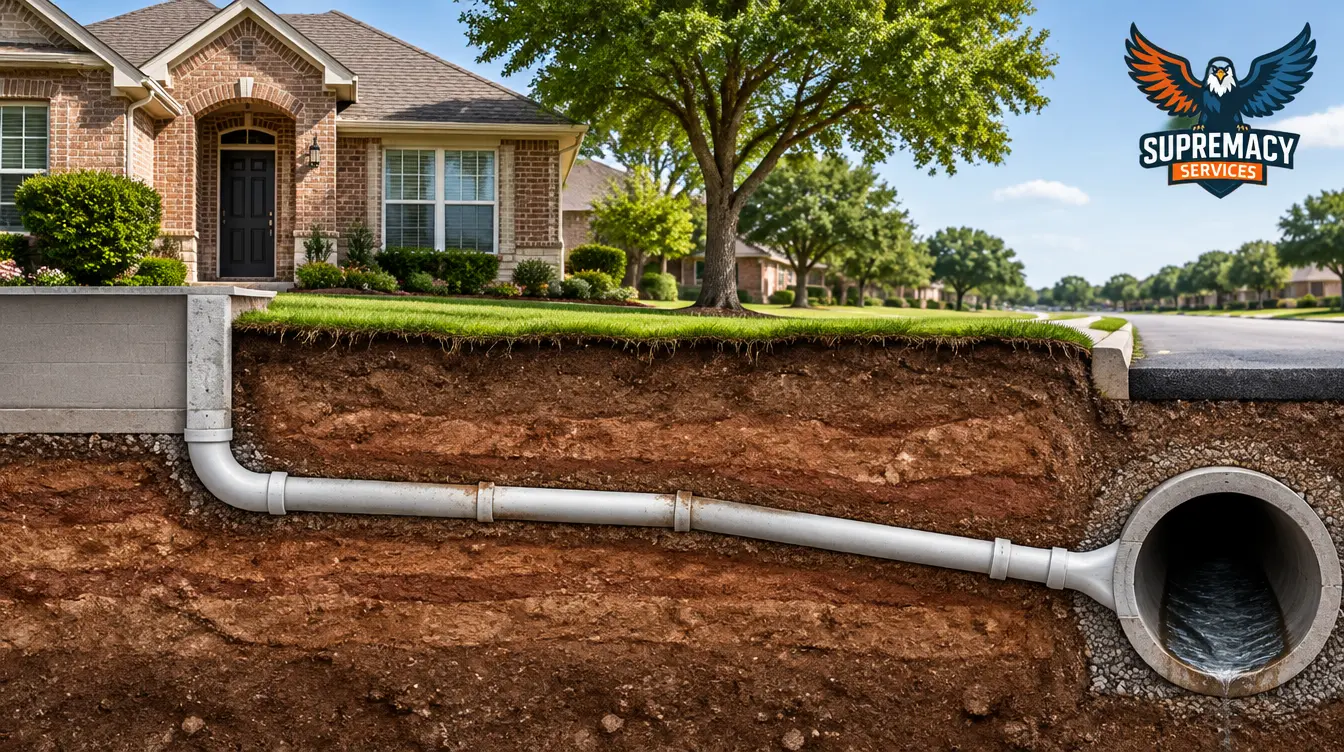
Wonder how long does a sewer line last?
A residential sewer line can last several decades, and some properly installed pipes remain functional for 75–100 years or longer. However, how long a sewer line lasts depends on its material, installation quality, soil conditions, corrosion exposure, and maintenance history.
For Dallas and North Texas homeowners, the age of the house is only one part of the picture. An older clay sewer line may still function well, while a newer pipe with poor support, defective joints, or significant ground movement can develop problems much earlier.
Cast iron, clay, and PVC sewer pipes also age differently. Knowing which material is buried beneath your property can help you decide when an inspection makes sense and whether repairs are likely to be needed.
This guide explains the expected lifespan of common sewer pipe materials, the conditions that shorten their useful life, warning signs to watch for, and how to determine whether an aging sewer line needs repair or replacement.
Table of Contents
- How long do different sewer pipe materials last?
- Why do sewer lines deteriorate in North Texas?
- What are the signs of an aging sewer line?
- How can you tell how old your sewer line is?
- When should an older sewer line be inspected?
- Can an old sewer line be repaired instead of replaced?
- How much does sewer line replacement cost?
- How can you extend the life of your sewer line?
- Who is responsible for the sewer line in Dallas?
- Frequently asked questions
How Long Do Different Sewer Pipe Materials Last?
The material is one of the most important factors affecting sewer line lifespan. Cast iron, vitrified clay, and PVC have different strengths, weaknesses, and deterioration mechanisms.
There is no universally guaranteed lifespan for residential sewer pipes. The following ranges are broad planning estimates, not replacement deadlines or predictions for a specific property.
| Sewer pipe material | Broad planning lifespan | Main concerns |
|---|---|---|
| Cast iron | Approximately 50–75 years | Corrosion, internal scaling, wall deterioration |
| Vitrified clay | Often 75–100+ years | Brittle sections, damaged joints, root intrusion |
| PVC | Often 50–100+ years | Installation defects, ground movement, joint failure |
| Orangeburg (bituminous fiber) | Often substantially shorter than modern materials | Deformation, delamination, collapse |
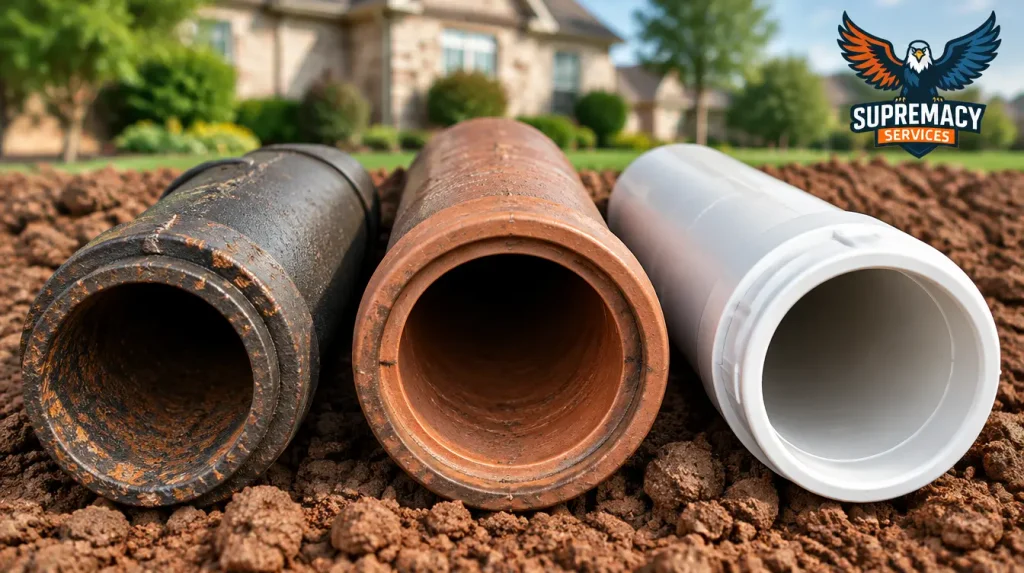
These are approximate industry planning ranges, not verified North Texas averages. EPA engineering materials show that service-life assumptions vary considerably by pipe material and modeling methodology. A camera inspection is more useful than a lifespan chart when evaluating an individual line.
How long do cast iron sewer pipes last?
Cast iron sewer pipes are often discussed in terms of a 50–75-year service life, although individual installations can perform for longer or fail sooner.
Cast iron is strong, but it is vulnerable to corrosion. Over time, corrosion and deposits can narrow the inside of the pipe, while deterioration of the pipe wall can eventually lead to leaks or structural weakness.
The EPA identifies oxidation and corrosive sewer environments as important concerns for iron piping.
For homeowners with older cast iron sewer lines, recurring blockages, visible deterioration, and inspection findings matter more than the installation date alone.
A 60-year-old cast iron pipe with significant wall loss may justify replacement. Another pipe of similar age may still be serviceable.
How long do clay sewer pipes last?
Vitrified clay sewer pipes can remain functional for 75–100 years or longer when properly installed and supported.
Clay is highly resistant to many forms of chemical corrosion, which is one reason older clay sewers can remain in service for decades.
However, clay is relatively brittle, and its joints can become vulnerable to separation, leakage, or root intrusion.
EPA sewer rehabilitation guidance describes both the chemical resistance of vitrified clay and the importance of joint and handling conditions.
For an older Dallas property, the condition of the joints may be just as important as the condition of the clay pipe itself.
How long do PVC sewer pipes last?
Properly installed PVC sewer pipes are generally designed for long service life, often measured in many decades.
PVC does not rust like cast iron and is resistant to many chemical conditions encountered in ordinary sanitary sewer service.
However, PVC is not immune to problems.
Poor bedding, inadequate backfill, incorrect slope, damaged connections, or substantial ground movement can create problems even when the pipe material itself remains sound.
The most important distinction is that a durable material does not compensate for poor installation.
What about Orangeburg sewer pipes?
Orangeburg is an older bituminous-fiber pipe material that can be encountered in some legacy sewer installations.
Unlike rigid clay or modern PVC, aging Orangeburg can soften, deform, or lose its structural shape.
If an inspection identifies Orangeburg, the homeowner should discuss the pipe’s actual condition and long-term repair options with a qualified plumber rather than relying on an assumed remaining lifespan.
The material should not be presumed present simply because a Dallas home is old.
Why Do Sewer Lines Deteriorate in North Texas?
North Texas sewer lines face a combination of aging materials, soil movement, tree roots, and installation-related stresses.
These factors do not affect every property equally. Two neighboring homes can have very different underground pipe conditions.
1. Expansive clay soil and ground movement
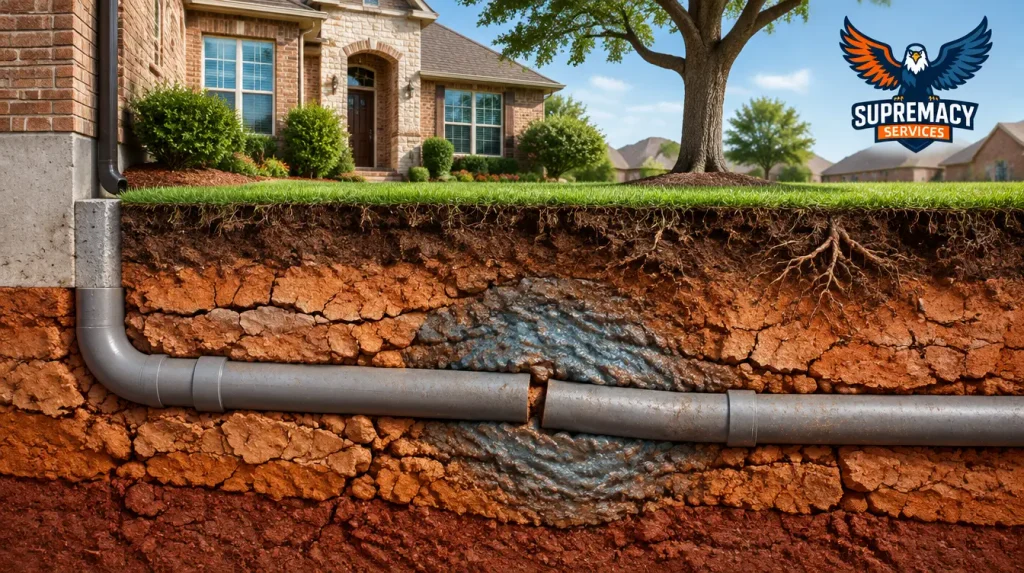
Many areas of North Texas contain expansive clay soils that change volume as their moisture content changes.
During prolonged dry periods, certain clay soils can shrink. When they absorb moisture, they can swell.
Movement of the soil surrounding a buried sewer pipe can contribute to joint displacement, changes in support, and stress on vulnerable sections.
A properly installed sewer system is designed with underground conditions in mind, but aging joints and previously damaged sections may be more susceptible to movement.
Not every sewer problem in Dallas is caused by expansive soil. A professional inspection is necessary to distinguish ground movement from other defects.
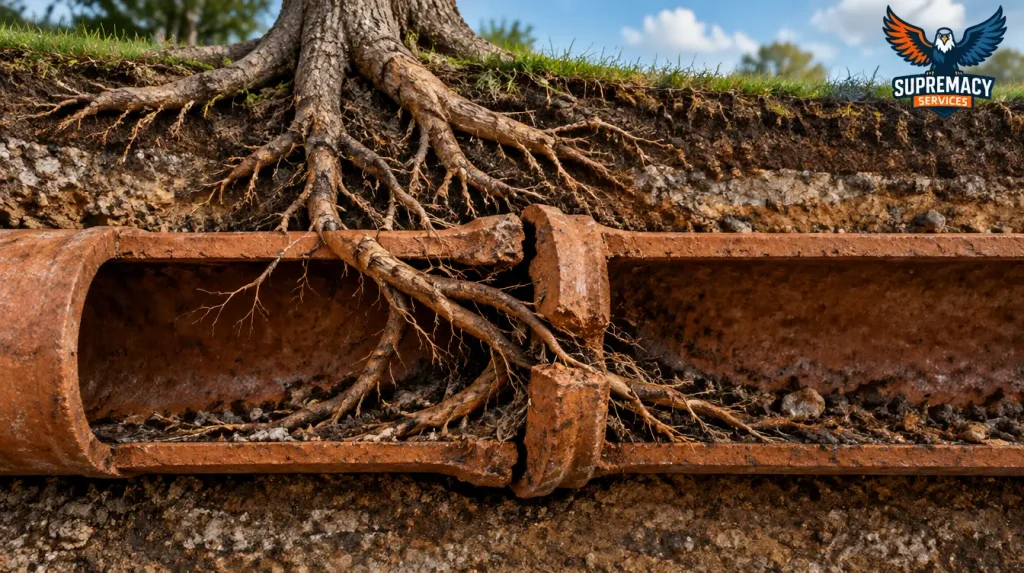
2. Tree roots entering damaged joints
Tree roots are another important concern for buried sewer lines.
Roots can exploit cracks, loose joints, and other openings where moisture and nutrients are available.
Once inside, they can expand and trap debris, gradually restricting wastewater flow.
A pipe with repeated root intrusion may have an underlying joint or structural defect that cleaning alone cannot permanently correct.
3. Corrosion inside older pipes
Corrosion is particularly relevant to older metal sewer lines.
Over time, deterioration can weaken pipe walls or contribute to rough interior surfaces where debris accumulates.
A camera inspection can identify many visible signs of deterioration, although additional evaluation may be needed to establish remaining structural strength.
4. Poor installation or inadequate slope
Residential sewer lines generally depend on gravity to carry wastewater away from the home.
If the pipe has insufficient slope, excessive sagging, or an improperly supported section, solids may collect instead of moving freely.
Dallas Water Utilities’ wastewater design guidance emphasizes appropriate lateral slope and installation conditions.
A low section of sewer pipe is often called a pipe belly. Repeated clogs caused by a belly are not necessarily resolved by ordinary drain cleaning.
5. Grease, wipes, and other inappropriate materials
A sewer line does not have to be old to develop a blockage.
Cooking grease, paper towels, hygiene products, and wipes can accumulate inside pipes or become trapped on existing defects.
These materials may accelerate drainage problems in an already compromised sewer line.
The practical prevention rule is simple: keep grease out of drains and flush only human waste and toilet paper.
What Are the Signs of an Aging Sewer Line?
An aging sewer line may show recurring drainage problems, sewage odors, or visible defects during a camera inspection. However, these symptoms do not automatically mean the entire line needs replacement.
The most useful warning signs include:
- Multiple drains becoming slow around the same time.
- Repeated blockages after professional drain cleaning.
- Toilets gurgling when other fixtures drain.
- Wastewater backing up into tubs, showers, or floor drains.
- Persistent sewage odors near the house or yard.
- Unexplained wet or sunken ground along the sewer route.
- Root intrusion discovered during cleaning or inspection.
- Cracks, displaced joints, corrosion, or collapse visible on sewer-camera footage.
Does a slow drain mean the sewer line is failing?
Not necessarily.
A single slow bathroom sink often has a localized obstruction. Several fixtures draining poorly at the same time raise greater concern about a shared drain or main sewer line.
Similarly, a sewer backup can result from a removable obstruction rather than structural deterioration.
For a more detailed explanation, see Supremacy Services’ guide to 10 warning signs of sewer line damage in Dallas.
If your older home has recurring drainage problems, Supremacy Services can help evaluate the condition of your sewer line. Explore our sewer inspection, repair, and replacement options before assuming the entire pipe needs replacing.
How Can You Tell How Old Your Sewer Line Is?
The age of the house provides a starting point, but it does not establish the age of the sewer pipe.
A previous homeowner may have replaced all or part of the line during renovations, foundation work, or earlier plumbing repairs.
To investigate the age of your sewer system:
- Review property records. Look for plumbing permits, renovation documentation, and sewer replacement invoices.
- Ask previous owners when possible. Find out whether underground plumbing was repaired or replaced.
- Check accessible piping. A plumber may be able to identify material at accessible cleanouts or exposed sections.
- Arrange a sewer camera inspection. This can help identify material transitions, deterioration, and defects.
- Compare findings with available records. Use the evidence to establish whether the line is original, partially replaced, or substantially newer.
A sewer camera generally cannot determine the exact installation year from the pipe’s appearance alone.
Does a 50-year-old house need a new sewer line?
No. A 50-year-old house does not automatically need sewer replacement.
The sewer line may have been replaced previously, and even original piping can remain serviceable if its condition is good.
A better question is whether the existing line has significant deterioration, recurring problems, or defects that threaten reliable operation.
When Should an Older Sewer Line Be Inspected?
A professional sewer inspection is particularly valuable when a home has an older or undocumented sewer system, recurring drainage problems, or an upcoming property transaction.
There is no universal age at which every residential sewer line must be inspected or replaced.
Consider an inspection in the following situations:
| Situation | Recommended action |
|---|---|
| Older home with no sewer replacement records | Consider a baseline camera inspection |
| Repeated whole-house drain blockages | Investigate promptly |
| Roots repeatedly removed from the main line | Inspect joints and structural condition |
| Buying an older Dallas property | Consider a sewer scope before purchase |
| Active sewage backup | Stop unnecessary water use and seek prompt assistance |
| Previous inspection showed developing defects | Follow a condition-based monitoring plan |
What happens during a professional sewer camera inspection?
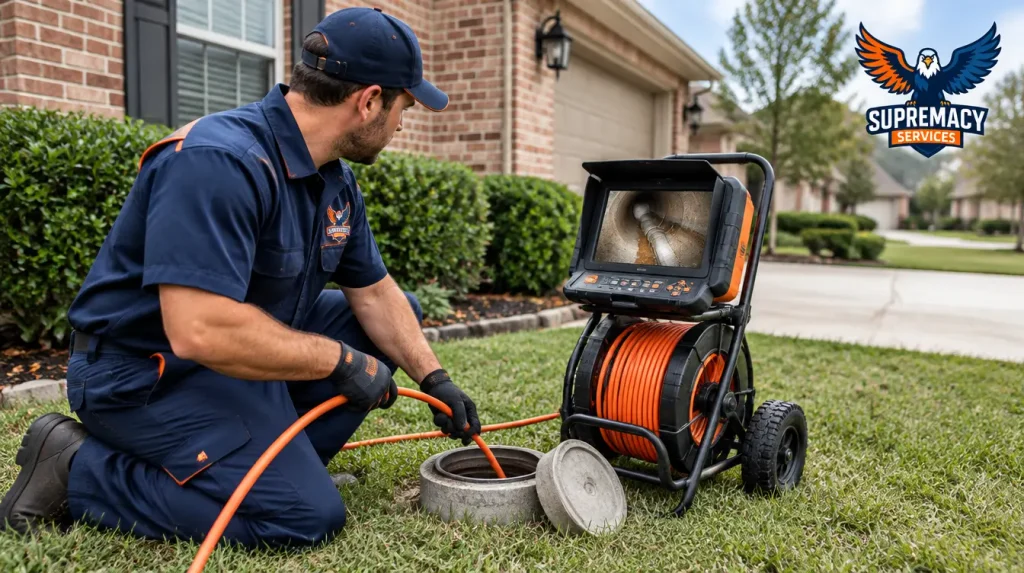
A typical evaluation involves reviewing the symptoms, accessing the drainage system through an appropriate cleanout, and using a sewer camera to inspect accessible sections.
The technician may identify:
- Pipe material and visible condition.
- Cracks or separated joints.
- Root intrusion and internal obstructions.
- Corrosion, deformation, or collapse.
- Low sections where wastewater accumulates.
- Transitions between different pipe materials.
If a significant defect is found, locating equipment can help determine its position underground.
The inspection findings should guide the next decision rather than automatically triggering a replacement recommendation.
Supremacy Services describes HD camera reconnaissance as the first step in its published sewer repair process.
Supremacy Services
Can an Old Sewer Line Be Repaired Instead of Replaced?
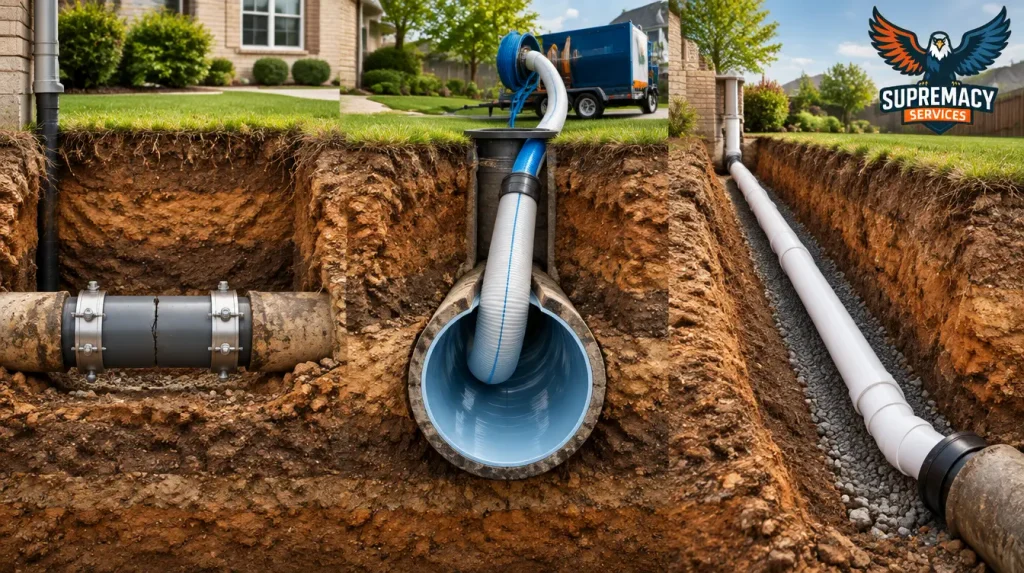
Yes. An older sewer line can sometimes be repaired without replacing the entire system.
The appropriate solution depends on the extent of damage, remaining pipe integrity, alignment, and whether the underlying problem is structural or simply a blockage.
| Condition | Potential approach | Important consideration |
|---|---|---|
| Isolated obstruction in sound piping | Drain cleaning | Does not correct structural defects |
| Localized crack or damaged joint | Sectional repair | Remaining pipe must be serviceable |
| Suitable deteriorated pipe with adequate shape | Trenchless lining | Requires appropriate host-pipe conditions |
| Extensive deterioration or multiple failures | Replacement | May offer a more reliable long-term solution |
| Severe collapse or significant loss of grade | Excavation or engineered replacement | Lining may not correct the problem |
When does localized repair make sense?
Localized repair can be appropriate when the damage affects a limited section and the surrounding pipe remains structurally sound.
For example, a short section with a failed joint may be repairable without replacing an otherwise healthy sewer lateral.
When is full sewer replacement more appropriate?
Replacement becomes a stronger consideration when a pipe has widespread deterioration, repeated structural failures, significant deformation, or extensive collapse.
If several sections are failing, repeatedly repairing individual locations may be less economical over time than replacing the deteriorated line.
Can trenchless repair extend sewer line life?
Trenchless rehabilitation can be an option for certain sewer defects.
Cured-in-place pipe lining creates a new liner inside a suitable existing pipe. Pipe bursting replaces a line by breaking apart the existing pipe while pulling a replacement into place.
Neither technique is appropriate for every situation. Pipe condition, grade, access, utility conflicts, and site conditions determine feasibility.
Supremacy Services lists both traditional excavation and trenchless methods among its sewer repair and replacement capabilities.
Not sure whether your aging sewer line needs a small repair or complete replacement? Review Supremacy Services’ Dallas–Fort Worth sewer repair and replacement services to understand the available options.
How Much Does It Cost to Replace an Aging Sewer Line in Dallas?
Sewer line replacement costs vary significantly because the work required at one property may be very different from another.
A short, accessible repair is not equivalent to replacing a deep sewer lateral beneath a driveway or other finished surface.
Without a site-specific assessment, it would be misleading to present one price as a reliable Dallas replacement cost.
What affects sewer replacement costs?
| Cost factor | Why it matters |
|---|---|
| Pipe length | Longer replacements require more materials and labor |
| Burial depth | Deeper excavation can require additional safety measures and equipment |
| Accessibility | Driveways, landscaping, and structures can complicate access |
| Existing pipe condition | Collapse or deformation can affect available methods |
| Repair method | Traditional excavation, lining, and pipe bursting have different requirements |
| Permits and inspections | Applicable local requirements affect project scope |
| Surface restoration | Concrete, paving, and landscaping may need restoration |
Is trenchless sewer replacement always cheaper?
No. Trenchless methods can reduce surface disruption in suitable conditions, but they are not automatically the least expensive option.
The comparison should consider the complete project, including access work, installation, permits, and restoration.
For an accurate estimate, homeowners should request a written proposal based on inspection findings and the actual condition of the pipe.
How Can You Extend the Life of Your Sewer Line?
You cannot prevent every underground plumbing failure, but good habits can reduce avoidable blockages and help identify problems before they become emergencies.
Sewer line maintenance checklist
Homeowner maintenance checklist
0 of 8Keep cooking grease and oils out of drainsAvoid flushing wipes, paper towels, and hygiene productsAddress recurring drainage problems instead of repeatedly using chemical cleanersKeep sewer cleanouts accessibleRetain camera inspection footage and plumbing repair recordsInvestigate recurring root intrusion rather than relying only on cleaningArrange professional evaluation when multiple fixtures back upAsk about pipe condition before undertaking major landscaping near the sewer route
Copy checklist
Should you use chemical drain cleaners on old pipes?
Frequent reliance on chemical drain cleaners is not a good maintenance strategy for a deteriorating sewer system.
These products do not repair cracked joints, corrosion, root intrusion, or a collapsed section.
For persistent drainage problems, identifying the cause is more useful than repeatedly attempting to dissolve the blockage.
Does hydro-jetting extend sewer pipe life?
Hydro-jetting can remove certain accumulations and restore flow, but it does not reverse corrosion or repair structural damage.
A plumber should evaluate the pipe’s condition before selecting high-pressure cleaning, particularly when older or compromised materials are involved.
Who Is Responsible for an Aging Sewer Line in Dallas?
Homeowners are generally responsible for the private portion of the sewer lateral serving their property, while the municipal wastewater system is managed by the appropriate utility.
However, responsibility can depend on the precise location of the problem, property configuration, and applicable utility rules.
Dallas Water Utilities’ published design guidance distinguishes between homeowner and utility responsibility for different portions of a typical wastewater lateral.
What if the problem is in the city sewer main?
If you suspect a clogged or overflowing public wastewater main in Dallas, the city directs residents to report it through 311 or 214-670-3111 when calling from outside city limits.
If the problem appears to involve your private building sewer, a licensed plumbing professional can help determine where the blockage or damage is located.
For significant sewer replacement work, confirm applicable permitting and inspection requirements before beginning construction. Dallas maintains residential permitting resources and wastewater connection guidance.
Frequently Asked Questions About Sewer Line Lifespan
1. Can a sewer line last 100 years?
Yes. Some sewer lines, particularly well-installed vitrified clay systems, can remain functional for 100 years or longer. However, age alone cannot establish the remaining life of an individual pipe.
2. How long does a main sewer line last?
A main residential sewer lateral can last several decades, with service life depending on material, installation, ground conditions, and maintenance. PVC, cast iron, and clay have different deterioration characteristics.
3. Should I replace a 50-year-old sewer line?
Not automatically. A 50-year-old pipe may still be serviceable. Replacement decisions should be based on structural condition, recurring failures, and inspection results.
4. How long do cast iron sewer pipes last in Texas?
Cast iron sewer pipes are commonly discussed in terms of approximately 50–75 years, but actual service life varies. Corrosion exposure and pipe condition are more important than a fixed age.
5. Are clay sewer pipes better than PVC?
Neither material is universally better. Clay offers strong chemical resistance and potentially long service life, while PVC resists rust and uses modern jointing systems. Installation quality and site conditions are critical for both.
6. Can tree roots shorten sewer line lifespan?
Yes. Roots entering through cracks or defective joints can contribute to blockages and damage. Repeated root intrusion may indicate a defect that needs more than routine cleaning.
7. Can a sewer camera tell how much life a pipe has left?
A camera can reveal visible defects and help assess condition, but it cannot reliably predict an exact remaining lifespan. It provides evidence for repair, monitoring, or replacement decisions.
8. Does homeowners insurance cover old sewer pipe replacement?
Coverage depends on the policy and the cause of damage. Gradual deterioration and ordinary wear are often treated differently from sudden covered events. Homeowners should review their policy and any sewer-line endorsements with their insurer.
9. Should I inspect the sewer line before buying an older Dallas home?
A sewer camera inspection can be a worthwhile part of due diligence, especially when the property has older piping or an unknown replacement history. A standard home inspection may not establish the condition of the buried sewer lateral.
Protect Your North Texas Home by Understanding Your Sewer Line’s Condition
A sewer line does not need replacement simply because it is old.
Many clay, cast iron, and PVC sewer systems remain functional for decades. The more important question is whether the existing pipe is structurally sound and capable of carrying wastewater reliably.
For Dallas and DFW homeowners, soil movement, aging joints, root intrusion, corrosion, and installation conditions can all influence sewer performance.
If your home has recurring drainage problems, unexplained sewage odors, or an older sewer system with no documented inspection history, evaluating the pipe can help you make a more informed decision.
Supremacy Services provides sewer line repair and replacement throughout Dallas and the DFW Metroplex, including camera-based evaluation and traditional or trenchless repair options where appropriate.
Explore your options and request a professional assessment before deciding whether an aging sewer line needs cleaning, repair, or replacement.