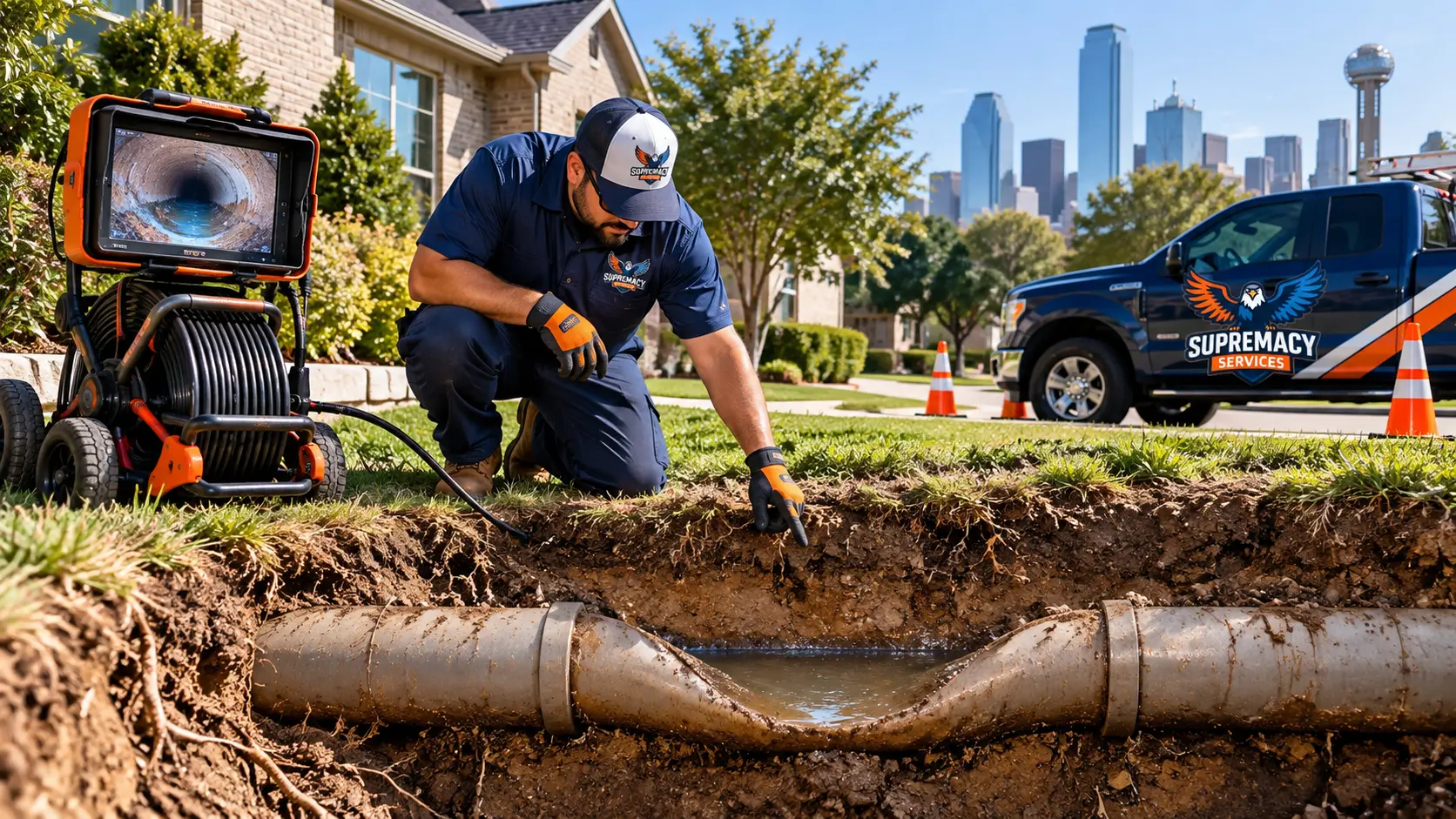
A sewer line belly is a low or sagging section of underground sewer pipe where wastewater collects instead of flowing steadily toward the municipal sewer main. In Dallas homes, this can contribute to recurring drain clogs, slow drainage, sewage backups, and repeated plumbing problems.
A sewer belly often develops when the ground beneath a pipe settles, the original pipe bedding fails, or a sewer line was installed without adequate support or slope.
Can plumbers fix a sewer line belly? Yes. A plumber can identify the affected section using a sewer camera inspection and, when necessary, excavate and reposition or replace the pipe to restore proper drainage. Minor bellies that do not cause drainage problems may only require monitoring.
Understanding the difference between a harmless low spot and a sewer defect requiring repair can help Dallas–Fort Worth homeowners avoid unnecessary work while addressing problems before they become more disruptive.
Table of Contents
- What Is a Sewer Line Belly?
- What Causes a Belly in a Sewer Line?
- What Are the Warning Signs?
- How Do Plumbers Diagnose a Sewer Belly?
- How Do Plumbers Fix a Sewer Line Belly?
- Can Trenchless Repair Fix a Sewer Belly?
- How Much Does Repair Cost?
- Does Every Sewer Belly Need Repair?
- Sewer Belly vs. Other Sewer Problems
- Dallas and North Texas Considerations
- Can You Prevent a Sewer Belly?
- When Should You Call a Plumber?
- Frequently Asked Questions
What Is a Sewer Line Belly?

A sewer line belly, also called a sewer pipe sag, is a section of drainage pipe that dips below its intended downward slope. The low area can hold standing wastewater after the rest of the line has drained.
Most residential sewer laterals rely on gravity to carry wastewater away from the house. To function properly, the pipe needs a suitable downward grade toward its destination.
When part of the pipe sinks, water and waste can accumulate in the depression.
How a sewer belly changes wastewater flowConceptual illustration, not to scale. A belly creates a depression where wastewater and solids may collect.
The pipe may remain intact, but its shape interferes with efficient drainage.
Why standing water matters
A properly graded sewer pipe allows wastewater to carry toilet paper and other solids downstream.
In a sagging section, water slows and solids may settle. Over time, accumulated material can restrict the pipe and contribute to recurring blockages.
A sewer belly is not necessarily a complete obstruction. Wastewater may still pass through the pipe, especially when a large volume of water enters the system.
That explains why some homeowners experience intermittent drainage problems rather than a constant backup.
Dallas Water Utilities’ published design guidance recognizes the importance of appropriate wastewater lateral grades, including a preferred 2% slope and minimum 1% grade in the referenced utility design context. Those figures should not be applied indiscriminately to every existing private residential drain, since applicable requirements depend on pipe configuration and governing code.
What Causes a Belly in a Sewer Line?
A sewer belly usually develops when a section of pipe loses its original support or was installed with an improper slope.
Several conditions can contribute.
1. Soil settlement beneath the pipe
Underground sewer pipes depend on the surrounding soil and bedding material for support.
If the supporting material settles unevenly, part of the pipe can drop below its original position.
In North Texas, changes in soil moisture and ground movement make the quality of underground pipe support particularly important.
However, soil movement alone does not prove that a sewer belly has developed.
2. Improper pipe installation
A sewer line installed without consistent grading or adequate bedding can develop drainage problems even when the pipe itself is relatively new.
Possible installation-related issues include:
- Inconsistent pipe slope
- Poorly compacted backfill
- Inadequate bedding material
- Unsupported pipe sections
- Movement at pipe connections
A newer PVC sewer line can develop a belly if the installation or underlying support is inadequate.
3. Soil erosion and loss of support
Water escaping from a damaged pipe joint, another underground leak, or drainage problems near the sewer trench may wash away supporting soil.
As the ground beneath the pipe loses stability, the line can settle.
In these situations, simply replacing the visible sagging section without addressing the cause of soil loss may leave the repair vulnerable to future movement.
4. Aging sewer systems and deteriorating connections
Older Dallas homes may have cast iron or clay sewer piping.
These materials can experience corrosion, cracking, joint movement, or other age-related deterioration.
A sewer belly is a grading problem, not a specific pipe-material defect. However, aging pipes and unstable joints can complicate an existing sag.
5. Ground disturbance and construction
Excavation, utility work, or changes to surrounding ground conditions can affect underground pipe support.
The significance depends on the location, depth, bedding, and nature of the disturbance.
What Are the Warning Signs of a Sewer Line Belly?
The most common warning sign is a sewer line that repeatedly clogs or backs up, even after professional drain cleaning.
Other symptoms may include:
- Multiple drains becoming slow around the same time
- Toilets gurgling when other plumbing fixtures are used
- Wastewater backing up into a shower or floor drain
- Recurring sewage odors
- Frequent need for sewer cleaning
- Standing water visible during a sewer camera inspection
These symptoms do not confirm a sewer belly. Tree roots, grease buildup, damaged pipe joints, and other blockages can produce similar problems.
Why does the same sewer clog keep returning?
A drain-cleaning machine or hydro jetting service may remove accumulated waste from a sagging pipe.
However, cleaning does not restore the pipe’s original slope.
If the low area continues collecting solids, the blockage may return.
This distinction matters when homeowners have already paid for several drain-cleaning visits without resolving the underlying problem.
For additional symptoms, read Supremacy Services’ guide to warning signs of sewer-line damage in Dallas.
How Do Plumbers Diagnose a Sewer Line Belly?

Plumbers commonly use a sewer camera inspection to identify standing water, inspect the pipe’s condition, and locate a suspected belly.
A camera inspection is particularly useful because the affected pipe is usually buried beneath a yard, driveway, or other surface.
Step 1: Access the sewer line
The plumber locates a suitable cleanout or other approved access point.
A flexible camera cable is inserted into the sewer line.
Step 2: Inspect the pipe interior
The camera moves through the pipe, allowing the technician to look for:
- Standing wastewater
- Accumulated debris
- Cracks or broken sections
- Offset or separated joints
- Root intrusion
- Corrosion or deterioration
When the camera reaches a significant belly, the water level may rise across the lens.
As the camera moves beyond the depression, visibility may improve again.
Step 3: Locate the affected section
A compatible camera transmitter and surface locator can help identify where the suspected defect lies underground.
The technician may estimate its position and depth before planning further investigation or excavation.
Step 4: Confirm the actual problem
Standing water does not always mean the pipe has a belly.
A downstream blockage can also cause wastewater to accumulate upstream.
For this reason, a reliable diagnosis may require clearing obstructions, repeating the camera inspection, and evaluating pipe grade where necessary.
Ask for a copy of the camera footage and an explanation of the suspected belly’s location, length, and severity before approving major excavation.
If recurring sewer problems are affecting your home, Supremacy Services offers sewer inspections and repair assessments in Dallas to help identify the underlying issue before choosing a repair method.
How Do Plumbers Fix a Sewer Line Belly?
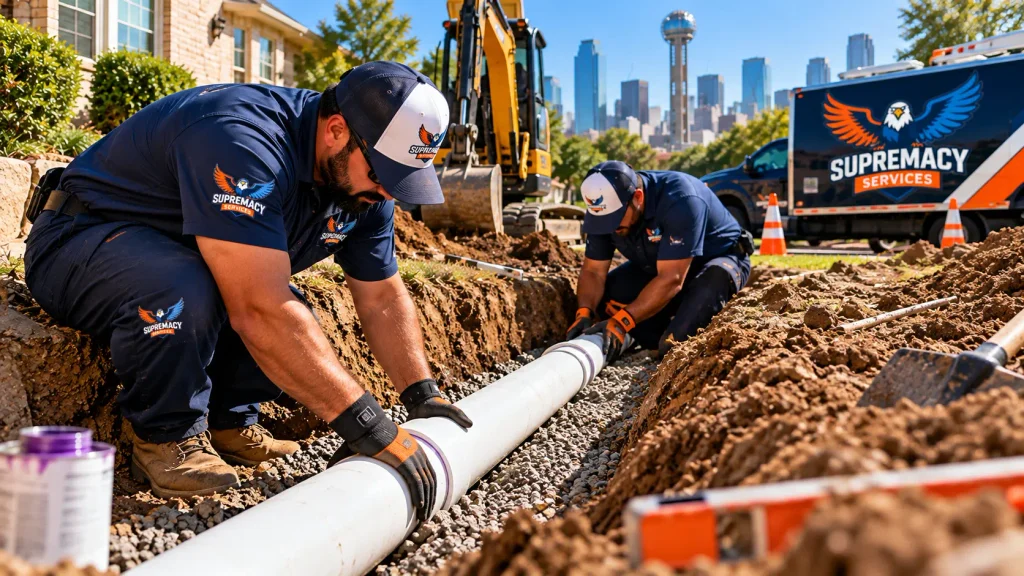
The most direct way to permanently correct a significant sewer belly is to expose the affected section and restore the proper pipe slope and support.
The appropriate repair depends on the length and severity of the sag, the pipe’s condition, available access, and surrounding site conditions.
Option 1: Excavation and pipe regrading
For a localized belly, a plumber may excavate the affected section and reposition or replace the pipe at the required grade.
The general process involves:
- Locating the affected pipe section.
- Identifying nearby utilities and arranging required excavation precautions.
- Excavating to expose the pipe.
- Removing or adjusting the defective section.
- Preparing stable pipe bedding.
- Installing the pipe at the correct slope.
- Testing and inspecting the repaired line.
- Backfilling and restoring the disturbed area.
Correct bedding and compaction matter because the repaired section must remain adequately supported.
Option 2: Partial sewer line replacement
If the pipe has deteriorated or the sagging section cannot be reliably repositioned, replacing the affected length may be the better option.
Partial replacement can be appropriate when the surrounding pipe remains serviceable.
The plumber should inspect adjacent sections to avoid connecting new piping to severely deteriorated material.
Option 3: Larger sewer line replacement
A more extensive replacement may be recommended when multiple sections have lost grade or the line also contains significant structural defects.
This can be particularly relevant when several problems exist together, such as:
- Multiple sewer bellies
- Extensive pipe deterioration
- Repeated joint separation
- Severe corrosion
- Collapsed sections
Replacing an entire sewer line is not automatically necessary because one belly has been discovered.
The decision should follow an assessment of the whole affected line.
Option 4: Cleaning and monitoring
Not every belly needs immediate excavation.
If a low spot is shallow, the pipe remains structurally sound, and wastewater flows adequately, a plumber may recommend monitoring.
Periodic cleaning may help manage accumulated debris, but it does not correct the pipe’s grade.
The distinction is between maintaining a functional pipe and permanently correcting its geometry.
Can Trenchless Sewer Repair Fix a Belly?
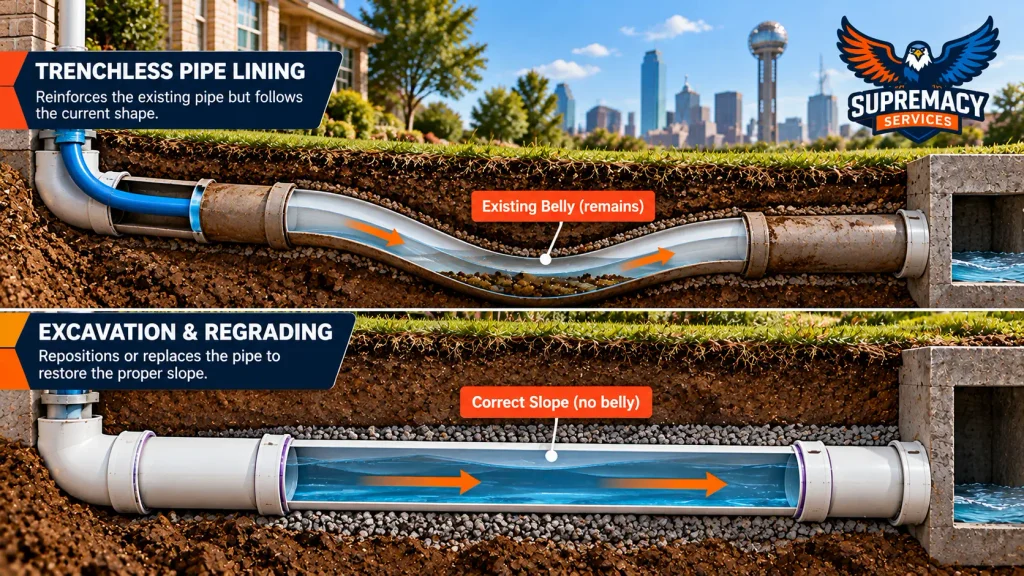
Standard cured-in-place pipe lining generally cannot correct a sewer belly because the liner follows the existing pipe’s shape.
Trenchless repair methods are valuable for certain types of pipe damage, but not every underground sewer problem can be corrected without excavation.
| Repair method | Corrects pipe slope? | Typical role |
|---|---|---|
| Hydro jetting | No | Removes debris and buildup |
| Drain snaking | No | Clears certain obstructions |
| CIPP pipe lining | Generally no | Rehabilitates suitable existing pipes |
| Pipe bursting | Not inherently | Replaces pipe along an existing route; grade must be assessed |
| Excavation and regrading | Yes | Corrects an improperly graded section |
| Excavation and replacement | Yes, when properly installed | Replaces damaged or sagging pipe at the required grade |
A new liner can improve the condition of a suitable host pipe without changing the low point that causes wastewater to pool.
Likewise, pipe bursting does not automatically solve a grading problem simply because it installs a new pipe.
When a sewer belly is responsible for recurring backups, homeowners should ask whether the proposed repair actually restores positive drainage slope.
Considering sewer repair in Dallas? Supremacy Services evaluates both traditional and trenchless options. A professional assessment can help determine whether your line needs localized regrading, replacement, or another appropriate solution.
How Much Does Sewer Line Belly Repair Cost in Dallas?
Sewer line belly repair costs depend primarily on how much pipe needs to be exposed, how deep it is buried, and what must be restored after the work.
There is no reliable flat price for every sewer belly. A short section beneath an accessible lawn is a different project from a deep sewer lateral beneath a concrete driveway.
Because no sufficiently verified current Dallas-specific pricing dataset was established for this article, a fixed dollar range is intentionally omitted.
Factors affecting the final cost
| Cost factor | Why it matters |
|---|---|
| Length of sagging pipe | Longer sections generally require more materials and excavation |
| Burial depth | Deep trenches may require additional excavation and safety measures |
| Pipe material | Connections and replacement methods differ by material |
| Surface above the line | Concrete, paving, and landscaping can increase restoration work |
| Additional pipe defects | Cracks, roots, and deterioration may expand the repair scope |
| Utility conflicts | Nearby underground utilities may complicate access |
| Permits and inspections | Applicable requirements can affect scheduling and costs |
| Site accessibility | Equipment access can influence labor and excavation methods |
What should a sewer belly repair estimate include?
Before approving work, request a written estimate explaining the diagnosis, proposed repair length, excavation requirements, replacement materials, testing, backfill, and surface restoration.
Ask whether permit costs and any unexpected repairs are included or handled separately.
A camera inspection and properly documented repair plan are more useful than an estimate based only on symptoms.
For Dallas homeowners comparing repair options, Supremacy Services’ sewer line repair and replacement service is the relevant starting point for an assessment.
Does Every Sewer Line Belly Need to Be Repaired?
No. A minor sewer belly does not necessarily require immediate repair if the pipe remains structurally sound and wastewater continues flowing without recurring problems.
The decision depends on the defect’s severity, symptoms, and overall pipe condition.
| Inspection finding | Reasonable next step |
|---|---|
| Small low spot, no symptoms | Document and monitor |
| Minor belly with occasional buildup | Evaluate cleaning and monitoring |
| Repeated clogs at the same location | Investigate corrective repair |
| Significant standing water and solids accumulation | Assess regrading or replacement |
| Belly with cracks or separated joints | Evaluate structural repair needs |
| Active sewage backup | Prompt professional attention |
A camera report should be interpreted alongside the home’s drainage history.
For example, a shallow sag discovered during a home purchase inspection may justify further evaluation without automatically requiring full replacement.
Conversely, a significant belly that repeatedly collects sewage and causes backups is more difficult to manage through cleaning alone.
Sewer Line Belly vs. Other Sewer Problems
A sewer belly can be confused with several other underground plumbing defects.
| Problem | What happens | Main distinction |
|---|---|---|
| Sewer belly | Pipe develops a low section | Wastewater pools because of lost grade |
| Tree root intrusion | Roots enter through openings | Roots physically obstruct the line |
| Collapsed sewer pipe | Pipe structure fails | The opening becomes damaged or restricted |
| Offset joint | Connected pipe sections shift | Misaligned edges can catch debris |
| Grease blockage | Waste accumulates inside pipe | Obstruction may exist without a slope defect |
| Back-pitched sewer line | Pipe slopes in the wrong direction | Wastewater must move uphill across the affected section |
A sewer camera inspection can help distinguish these conditions, although additional investigation may be needed when visibility is limited.
The distinction is important because a cleaning service, structural repair, and grading correction address different causes.
Why Sewer Line Bellies Matter in Dallas and North Texas
Dallas homeowners should consider local soil conditions, the age of underground plumbing, and the location of the sewer lateral when evaluating a suspected belly.
Expansive soils and ground movement
Parts of North Texas contain clay-rich soils that change volume as moisture conditions change.
Such movement can affect underground infrastructure, particularly where pipe support, bedding, or drainage conditions are inadequate.
However, a sewer belly cannot be attributed to expansive clay without investigating the actual site.
Older Dallas housing and sewer materials
Some older homes have sewer systems built with materials and installation practices different from those used today.
A plumber inspecting an older line should consider pipe material, joint condition, corrosion, prior repairs, and existing grade.
Replacing a small section without evaluating adjacent deterioration may not address all contributing problems.
Who is responsible for a sewer lateral in Dallas?
Responsibility depends on the location of the affected pipe and the applicable utility arrangement.
Dallas Water Utilities’ design manual illustrates a division between homeowner and utility responsibility for wastewater service connections. The exact boundary should be confirmed for the property rather than assumed.
If a suspected belly is near the street, property boundary, or public connection, confirm the relevant responsibilities before arranging excavation.
Permits and excavation
Sewer replacement work may require permits, inspections, utility coordination, or other approvals depending on the jurisdiction and project scope.
Dallas, Plano, Frisco, Allen, Fort Worth, and surrounding municipalities may have different administrative requirements.
A licensed plumbing professional should confirm the applicable requirements before starting work.
Can You Prevent a Sewer Line Belly?
Homeowners cannot prevent every instance of underground soil movement, but proper installation and early attention to drainage problems can reduce avoidable risks.
Practical precautions include:
- Ensure replacement sewer lines are installed with appropriate grading and bedding.
- Address known underground leaks and soil erosion.
- Avoid allowing stormwater to wash away soil around exposed utility trenches.
- Investigate repeated sewer backups instead of relying indefinitely on cleaning.
- Keep inspection footage and records of previous sewer repairs.
- Have underground pipe conditions evaluated before major landscaping or construction near the sewer route.
Avoid flushing wipes, grease, and other materials that can contribute to blockages. Although these materials do not create a belly, they can make a sagging pipe more troublesome.
Can homeowners repair a sewer belly themselves?
Diagnosing and correcting a buried sewer belly is generally not a suitable DIY project.
The work can involve excavation hazards, underground utilities, sewage exposure, pipe grading, and plumbing-code requirements.
Homeowners can document symptoms, reduce unnecessary water use during a backup, and arrange an inspection.
The actual underground repair should be handled by appropriately qualified professionals.
When Should You Call a Dallas Sewer Repair Professional?

Schedule a professional sewer evaluation if multiple drains are backing up, the same blockage keeps returning, or an inspection has identified a significant low section in the sewer line.
Seek prompt assistance if sewage is entering the home, wastewater is overflowing, or an underground leak is suspected.
A professional assessment should explain:
- Whether the problem is truly a sewer belly.
- Where the affected pipe is located.
- Whether other defects are present.
- Whether monitoring is reasonable.
- Which repair methods can restore reliable drainage.
- What excavation, testing, and restoration may involve.
Get the right diagnosis before replacing your sewer line
A sewer belly does not automatically mean you need a completely new sewer system.
The right repair depends on what the camera inspection reveals and whether the existing pipe can continue functioning reliably.
Supremacy Services provides sewer line repair and replacement services for Dallas and the surrounding DFW Metroplex, including camera-based assessments and evaluations of traditional and trenchless repair options.
If your sewer line repeatedly backs up or a previous inspection identified a sagging section, visit Supremacy Services’ sewer repair and replacement page to discuss the next steps.
Frequently Asked Questions About Sewer Line Bellies
1. Is a belly in a sewer line a serious problem?
It can be. A shallow belly without drainage symptoms may only require monitoring. A deeper sag that repeatedly traps waste can cause clogs and backups and may need corrective repair.
2. Can a sewer belly fix itself?
No. A buried sewer pipe generally will not return to its intended slope on its own. The symptoms may temporarily improve after cleaning, but the underlying low spot remains.
3. Can hydro jetting fix a sewer belly?
Hydro jetting can remove accumulated waste and restore flow, but it cannot lift or regrade a sagging pipe. It is a cleaning method rather than a permanent correction for lost slope.
4. Can a sewer line belly cause a backup?
Yes. Standing water in the low section can encourage solids to settle, eventually restricting flow and causing wastewater to back up into household drains.
5. Can a sewer camera detect a belly?
A sewer camera can reveal standing water and other evidence of a suspected belly. Additional investigation may be necessary to confirm the pipe’s grade and distinguish a sag from downstream obstruction.
6. Can a new PVC sewer pipe develop a belly?
Yes. Even a relatively new PVC line can sag if its bedding is inadequate, backfill settles, or the pipe was installed with an improper slope.
7. Will sewer pipe lining repair a belly?
Standard CIPP lining generally does not correct the slope of a sagging pipe. It follows the existing pipe’s path, so a significant low spot can remain after lining.
8. How long does sewer belly repair take?
The timeline depends on the depth, length, access, permitting, and surface restoration involved. A localized repair may be less extensive than replacing a long sewer lateral, but the contractor should provide a project-specific schedule.
9. Should I buy a house with a sewer line belly?
Not necessarily a reason to reject the property. Request the full camera inspection, evaluate the belly’s severity and drainage history, and obtain a repair opinion or estimate before deciding.
10. Does homeowners insurance cover sewer belly repair?
Coverage depends on the policy and cause of damage. Gradual settlement, wear, or poor installation may be excluded, while certain resulting damage may be treated differently. Review the policy and ask the insurer about the specific circumstances.