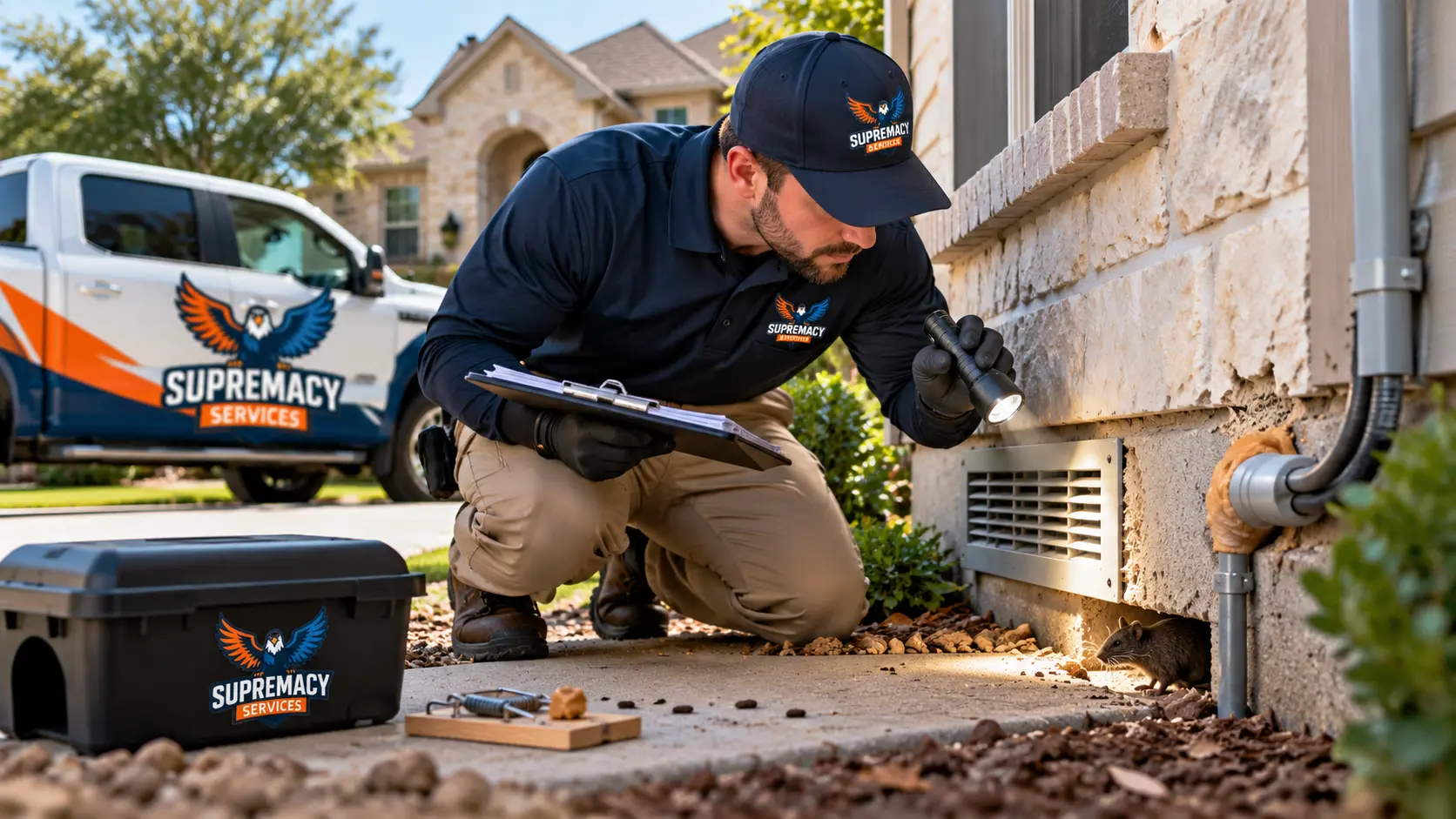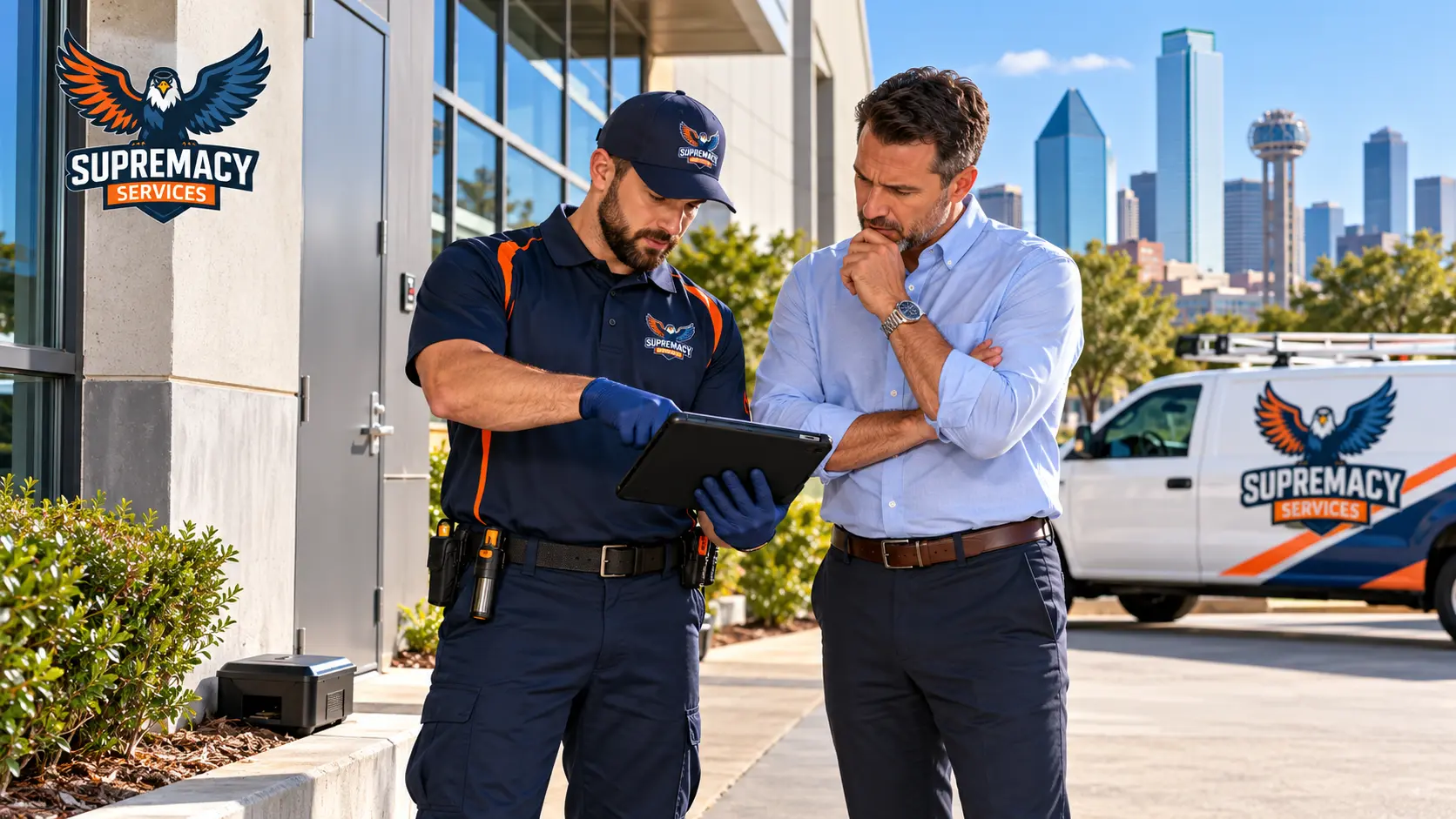
A good commercial pest control service plan should cover much more than scheduled pesticide applications. For a Dallas-Fort Worth business, a professional plan should normally define the property’s pest risks, inspection areas, monitoring strategy, prevention responsibilities, treatment procedures, service frequency, corrective actions and documentation.
The best programs are built around the actual facility rather than a standard checklist copied from one property to another.
A small Dallas office, for example, does not present the same pest-management challenges as a restaurant, warehouse, apartment community or hotel. Loading docks, food storage, floor drains, landscaping, shared walls, waste areas, deliveries and operating hours can all change where pests are likely to appear and how the property should be monitored.
The U.S. Environmental Protection Agency’s guidance on Integrated Pest Management recommends identifying pests correctly, monitoring activity, establishing action thresholds, preventing pest-conducive conditions and documenting control actions. US EPA
If you manage a commercial property in DFW and need a facility-specific program rather than a generic treatment schedule, explore Supremacy’s commercial pest-management options.
Table of Contents
- What should a commercial pest-control plan contain?
- Initial facility inspection
- Pest-risk assessment
- Monitoring program
- Prevention and exclusion
- Treatment strategy
- Service frequency
- Documentation and reporting
- Corrective-action procedures
- Responsibilities for staff and management
- Emergency response
- How commercial plans differ by facility
- What affects the cost?
- How to compare commercial pest-control proposals
- DIY vs professional commercial pest management
- Dallas and DFW considerations
- FAQs
What Should a Commercial Pest-Control Plan Contain?
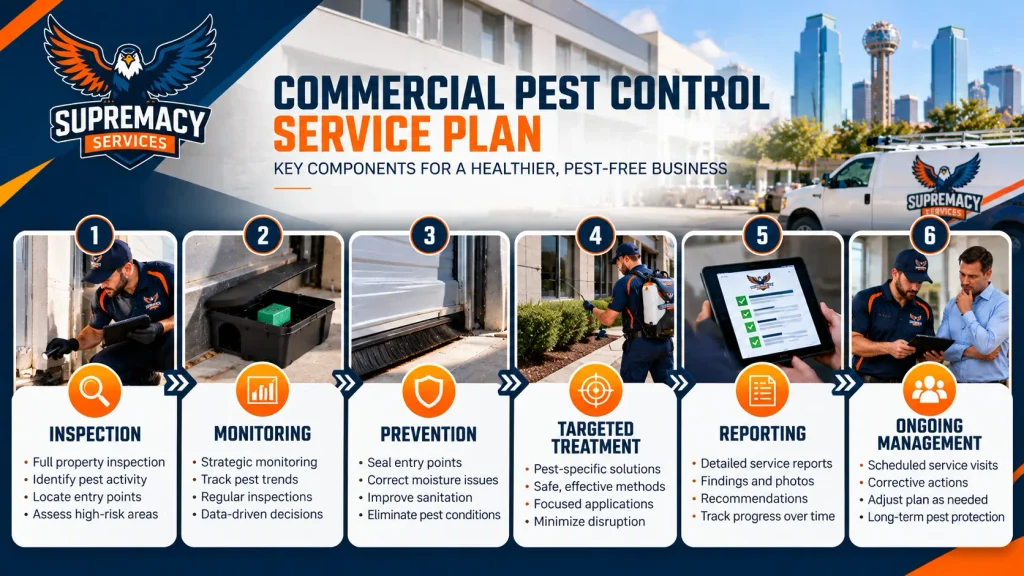
A comprehensive plan should normally contain these core components:
| Component | What it should address |
|---|---|
| Facility inspection | Current activity, entry points and high-risk areas |
| Pest identification | Species or pest groups present or likely |
| Monitoring | Where and how activity will be tracked |
| Prevention | Sanitation, moisture, exclusion and maintenance issues |
| Treatment strategy | Appropriate controls based on actual conditions |
| Service schedule | How frequently inspections/service occur |
| Documentation | Findings, actions, trends and recommendations |
| Corrective action | What happens when pest activity exceeds an acceptable level |
| Responsibilities | Tasks assigned to pest provider, management and staff |
| Follow-up | How results are reviewed and the program adjusted |
EPA’s building IPM framework follows essentially this progression: identify and monitor pests, establish thresholds, prevent conducive conditions and use appropriate controls when intervention is necessary.
A commercial contract that simply says a technician will “spray monthly” leaves many of these questions unanswered.
1. Initial Facility Inspection
Every commercial pest-management program should begin with an inspection of the property and its operating conditions.

The inspection establishes a baseline.
Rather than inspecting only areas where insects have already been reported, a commercial inspection may evaluate areas such as:
- exterior walls;
- doors and door sweeps;
- loading docks;
- delivery areas;
- kitchens and break rooms;
- food-storage areas;
- floor drains;
- plumbing penetrations;
- mechanical rooms;
- utility corridors;
- trash and recycling areas;
- landscaping next to the building;
- roof or attic areas where applicable;
- stockrooms;
- tenant spaces;
- common areas;
- areas where previous pest activity has been reported.
Supremacy’s existing commercial service page already describes its process as beginning with a facility audit that looks for entry points, water leaks and high-risk zones. Supremacy Services
2. Pest-Risk Assessment
A pest-control plan should identify both current pest activity and conditions that could create future activity.
Those are not necessarily the same thing.
A warehouse may currently have no visible rats yet still have:
- gaps around dock doors;
- exterior vegetation touching walls;
- accessible waste;
- damaged door seals;
- stored inventory providing harborage.
Likewise, a restaurant may have no obvious cockroach sightings while food debris, moisture or drain conditions increase future risk.
The assessment should therefore consider:
Pest evidence
Droppings, insects, damaged goods, nesting material, tracks, gnawing, spotting, webbing or monitoring-device captures.
Entry points
Door gaps, penetrations, cracks, utility openings, roofline gaps and poorly sealed loading areas.
Food
Ingredients, spills, employee food, pet food, waste, grease and improperly stored products.
Water
Leaks, condensation, drains, standing water and irrigation issues.
Shelter
Clutter, stored cardboard, wall voids, landscaping and rarely disturbed areas.
EPA specifically recommends focusing prevention on reducing pests’ access to food, water and shelter, along with sealing entry points and removing standing water.
3. Monitoring Program
A commercial pest-control plan should explain how pest activity will be measured between service visits.
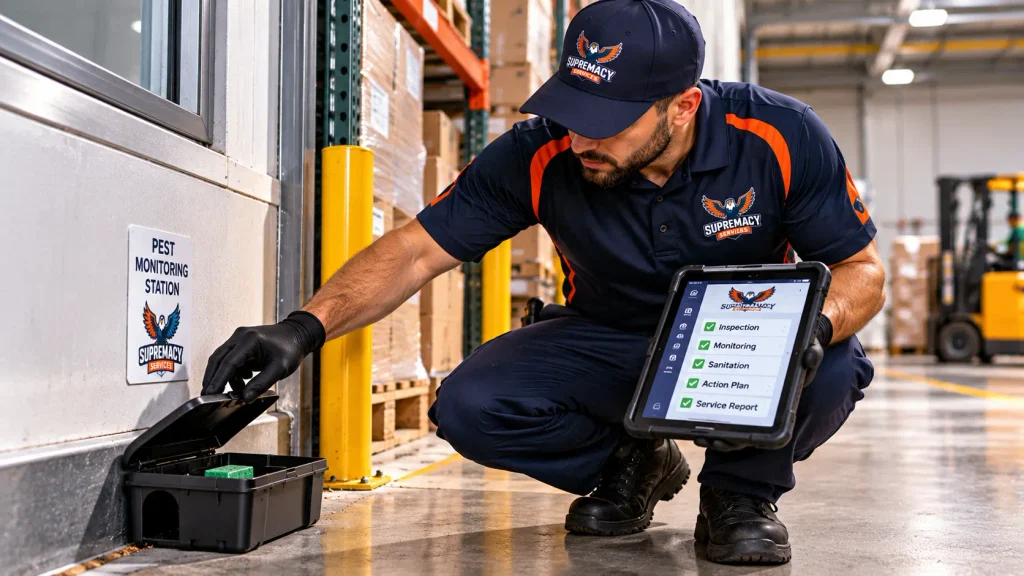
This is one of the biggest differences between true pest management and reactive extermination.
Depending on the target pest and facility, monitoring may involve strategically located devices or inspection points.
The plan should identify:
- what is being monitored;
- monitoring locations;
- inspection frequency;
- how findings are recorded;
- what level of activity triggers further action.
EPA guidance recommends maintaining records for each building that document monitoring techniques, monitoring locations, inspection schedules, findings and recommendations. It also states that pest-management plans should be adjusted based on monitoring results.
Why monitoring matters
Suppose three rodent monitoring points repeatedly show activity near one warehouse loading dock.
That pattern tells the pest professional considerably more than a single isolated sighting. The next step can focus on that specific zone: door sealing, exterior conditions, food sources, sanitation or additional control measures.
Without records, every visit risks becoming an isolated event rather than part of a long-term management program.
4. Prevention and Exclusion
Professional commercial pest management should address why pests are entering or surviving—not only kill the pests already present.
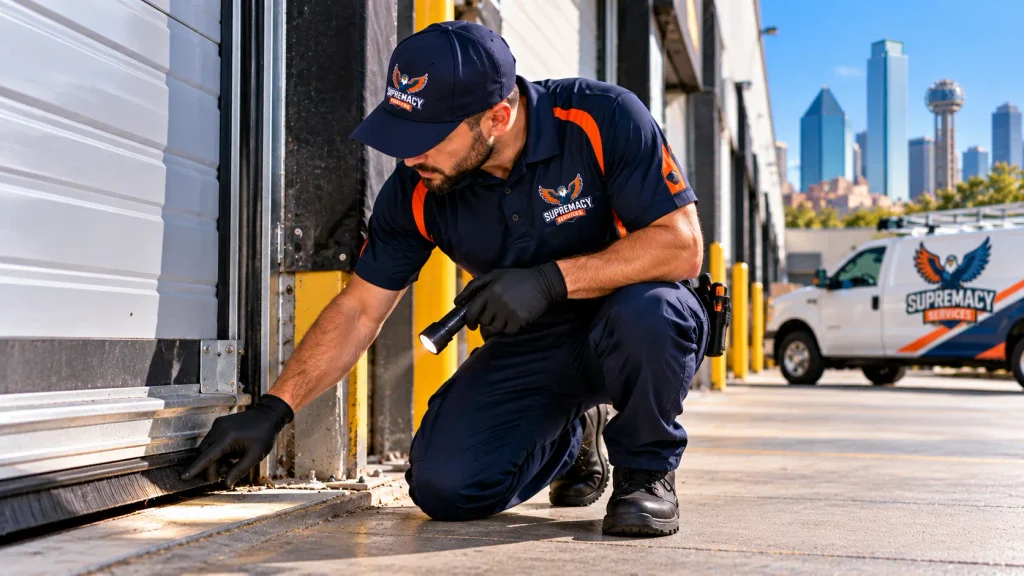
Potential preventive recommendations may include:
- replacing damaged door sweeps;
- sealing penetrations;
- correcting gaps around utility lines;
- reducing clutter;
- correcting moisture sources;
- improving waste handling;
- adjusting exterior storage;
- managing vegetation against structures;
- repairing screens;
- improving food-storage practices.
EPA’s IPM guidance specifically lists sealing pest entry points, removing trash and overgrown vegetation, maintaining clean food areas, installing barriers and removing standing water as prevention measures.
Is exclusion always included in the service price?
No assumption should be made.
Minor recommendations may be part of routine service, while larger structural repairs or rodent-exclusion projects may be separately scoped.
A commercial proposal should clearly state what is:
included, recommended, separately priced or the property owner’s responsibility.
5. Treatment Strategy
A service plan should state how active pest problems will be addressed without committing every visit to the exact same treatment.
An IPM-based approach may combine:
- sanitation changes;
- exclusion;
- traps;
- physical removal;
- monitoring;
- targeted pesticide applications where appropriate;
- pest-specific interventions.
EPA emphasizes that IPM is not a single control method. Appropriate control methods are selected based on inspection and monitoring information.
That distinction matters commercially.
A recurring mouse problem caused by an open loading-door gap is not solved in the same way as German cockroach activity around a kitchen.
6. Service Frequency
There is no single ideal commercial pest-control frequency for every business.
The service interval should reflect:
- property type;
- pest history;
- food availability;
- occupancy;
- sanitation conditions;
- pest pressure;
- monitoring requirements;
- building layout;
- seasonal activity;
- operating environment.
A relatively low-risk professional office might require a different schedule from a restaurant, food facility or large warehouse.
Monthly vs. quarterly commercial pest control
| Factor | Lower-frequency service | Higher-frequency service |
|---|---|---|
| Limited food | More feasible | — |
| Low historical pest pressure | More feasible | — |
| Simple office environment | Often lower complexity | — |
| Food handling | — | May justify closer monitoring |
| Frequent deliveries | — | Increased inspection needs |
| Large loading areas | — | Increased rodent/insect exposure |
| Established infestation | — | Often requires corrective follow-up |
| High customer sensitivity | — | May warrant more monitoring |
The correct question is therefore not simply:
“Should commercial pest control be monthly?”
It is:
“What monitoring and service interval is appropriate for this facility’s risks?”
7. Documentation and Reporting
Commercial pest control should create a usable record of what was found and what was done.
This becomes particularly valuable for:
- property managers;
- facilities teams;
- multi-location companies;
- food-service operations;
- warehouses;
- hospitality businesses;
- healthcare environments;
- businesses with internal audits or documented sanitation programs.
A useful service report may record:
- service date;
- areas inspected;
- pest findings;
- monitoring results;
- actions taken;
- application information where applicable;
- recommendations;
- areas requiring maintenance attention;
- follow-up needs.
EPA recommends keeping an organized record of pest-control services and documenting control actions and preventive recommendations.
Supremacy’s current commercial offering also emphasizes digital service reports and ongoing documentation following visits. Supremacy Services
What should you ask a provider?
Ask:
“Can you show me an example of the service documentation I will receive after each visit?”
That question often reveals more about the quality of a commercial program than a vague promise of “complete pest protection.”
8. Corrective-Action Procedures
A professional plan should answer:
What happens when monitoring reveals a problem?
EPA uses the concept of an action threshold—the point at which pest presence becomes serious enough to warrant intervention.
Thresholds will vary by environment.
One pest sighting in a sensitive food or patient-care area may be treated differently from occasional activity in an exterior monitoring zone.
A corrective-action process may include:
- confirm the pest;
- identify the source or conducive condition;
- increase monitoring;
- address sanitation or structural deficiencies;
- perform targeted treatment;
- re-inspect;
- document the outcome.
This prevents commercial pest control from becoming a repetitive cycle of treating symptoms without investigating why activity keeps returning.
9. Responsibilities for Staff and Management
Commercial pest management works best when responsibilities are shared.
The pest-control provider cannot repair every leaking pipe, manage kitchen sanitation, control every delivery or enforce every employee storage practice.
A good plan should therefore explain who is responsible for what.
| Pest-control provider | Property/business team |
|---|---|
| Inspect pest activity | Report sightings promptly |
| Identify pests | Maintain sanitation |
| Maintain monitoring program | Correct maintenance issues |
| Recommend preventive measures | Manage waste properly |
| Perform agreed treatments | Provide access |
| Document findings | Follow preparation instructions |
| Review trends | Complete assigned corrective actions |
EPA’s building guidance similarly assigns roles to pest-management professionals, cleaning staff, building management, maintenance staff and occupants.
10. Emergency Response
Recurring commercial service should also explain what happens outside normal scheduled visits.
Questions to ask include:
- What constitutes an emergency?
- How are urgent pest sightings reported?
- Is emergency response included or separately charged?
- What happens when activity appears between scheduled services?
- Who is authorized to request extra service?
- Does the provider handle specialized pests under the same agreement?
This is particularly important when a pest issue could disrupt operations or become visible to customers.
How Commercial Plans Differ by Facility
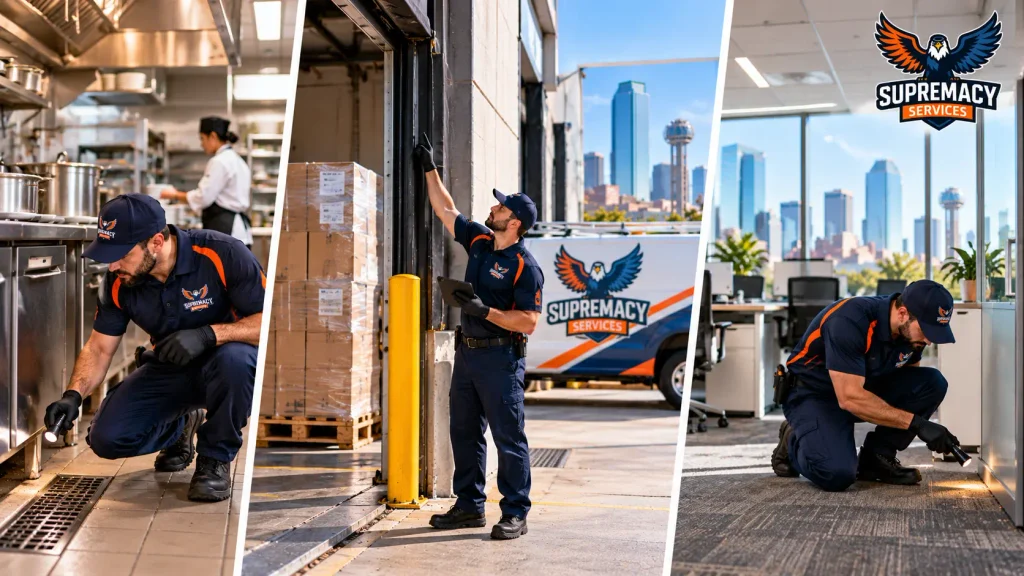
There should not be one identical program for every business.
Supremacy’s existing commercial page already differentiates restaurants, multifamily properties, hotels, warehouses, manufacturing facilities, offices, healthcare properties, retail businesses and property-management portfolios. Supremacy Services
Restaurants and food service
Attention may concentrate on:
- receiving areas;
- dry storage;
- kitchens;
- drains;
- grease areas;
- beverage stations;
- dumpsters;
- employee areas;
- exterior delivery doors.
Warehouses and distribution facilities
Priorities often include:
- loading docks;
- overhead doors;
- inventory storage;
- exterior perimeter;
- break rooms;
- receiving;
- wall penetrations;
- rodent entry points.
Offices
Plans often emphasize:
- kitchens and break rooms;
- restrooms;
- exterior doors;
- utility penetrations;
- landscaping;
- employee food storage.
Multifamily properties
Shared walls and utility pathways can complicate pest activity, while turnover creates additional inspection opportunities. Supremacy’s general pest page currently highlights common areas, individual units, exterior perimeter programs and recurring inspection programs for multifamily properties. Supremacy Services
Hotels
Different zones may require different strategies:
- guest rooms;
- housekeeping areas;
- kitchens;
- laundry;
- waste areas;
- receiving;
- common areas.
Bed bugs can also require a separate inspection and treatment protocol rather than being assumed to be part of standard general pest service. Supremacy’s bed-bug page specifically addresses commercial properties including hotels and multifamily facilities. Supremacy Services
What Does a Commercial Pest-Control Service Plan Cost?
There is no responsible way to assign one price to every commercial pest-control plan.
Supremacy already has a dedicated commercial pricing guide, which should own the commercial pest control cost Dallas informational intent rather than duplicating pricing detail here.
That page explains that commercial cost varies according to factors such as:
- facility size and layout;
- business type;
- pest species;
- infestation severity;
- frequency;
- monitoring requirements;
- documentation;
- structural conditions. Supremacy Services
For this article, keep the pricing discussion brief and link to the dedicated cost guide.
Recommended sentence
The cost of a commercial program depends on the property’s size, pest pressure, operating environment, service frequency and monitoring requirements; see our commercial pest-control pricing guide for a deeper breakdown.
How to Compare Commercial Pest-Control Proposals
Do not compare commercial contracts solely by monthly price.
Use this checklist:
- Which pests are included?
- Which pests cost extra?
- What areas are inspected?
- How frequently are monitoring points checked?
- What type of service report is supplied?
- Does the program include prevention recommendations?
- Is structural exclusion included?
- What happens between scheduled visits?
- How are infestations handled?
- How are trends reviewed over time?
- Are specialized problems such as bed bugs or termites separate?
- Who performs the actual pest-control work?
- Is the pest-control business properly licensed in Texas?
Texas requires businesses performing structural pest control for hire to hold a Structural Pest Control Service business license and designate an appropriate certified applicator. texasagriculture.gov
Comparing commercial pest-control plans in DFW? Request a facility assessment from Supremacy Services to build the service scope around your property’s actual pest risks.
DIY vs. Professional Commercial Pest Management
A business can handle many preventive tasks internally.
Appropriate in-house measures
Staff can usually help by:
- cleaning spills;
- storing food correctly;
- managing waste;
- reporting leaks;
- reducing clutter;
- keeping doors closed;
- reporting sightings;
- correcting basic maintenance problems.
When professional pest control becomes appropriate
Professional support becomes increasingly important when:
- pest sightings recur;
- rodents are present;
- cockroaches are established;
- multiple parts of the building are affected;
- pests are appearing in customer-facing spaces;
- specialized treatment is required;
- the business needs consistent monitoring and documentation;
- pesticide applications or professional structural pest-control services are required.
Texas regulates businesses and individuals that provide structural pest-control services for compensation, including inspection, identification, devices and pesticide applications within the scope described by TDA.
Repeated use of consumer pesticides without diagnosing entry points, food, water and harborage conditions is not a substitute for a structured commercial pest-management program.
Dallas and DFW Considerations
Commercial properties across DFW range from small offices and restaurants to logistics facilities, warehouses, apartment communities and large retail properties.
The important local issue is not simply the Dallas ZIP code. It is how the property interacts with its surroundings.
A good DFW inspection should consider conditions such as:
- doors that remain open during deliveries;
- loading docks;
- waste-storage locations;
- irrigated landscaping;
- exterior lighting;
- plumbing and drainage;
- neighboring tenant spaces;
- food service;
- large warehouse perimeters;
- seasonal outdoor pest activity.
This is a better local-SEO strategy than repeatedly inserting “Dallas TX pest control” into paragraphs.
Commercial Pest Control vs. One-Time Extermination
| One-time reactive service | Commercial pest-management plan |
|---|---|
| Addresses an immediate problem | Manages ongoing risk |
| Often focused on visible activity | Includes monitoring |
| Limited trend information | Tracks activity over time |
| May not address building conditions | Includes preventive recommendations |
| Treatment-driven | Inspection, prevention and treatment |
| Single event | Recurring program |
| Limited facility planning | Facility-specific scope |
The distinction supports featured snippets and AI-search answers while keeping the article educational.
Frequently Asked Questions
What should be included in commercial pest control?
A commercial program should generally include facility inspection, pest identification, monitoring, preventive recommendations, treatment procedures, service frequency, reporting, corrective actions and clearly defined responsibilities.
How often should commercial pest control be performed?
There is no universal frequency. The appropriate schedule depends on the type of business, pest pressure, building layout, food and moisture sources, pest history and monitoring requirements.
Should a commercial pest-control company inspect before quoting?
For complex or higher-risk properties, an inspection can produce a more meaningful scope because it reveals entry points, pest activity and conditions that cannot be determined from square footage alone.
Does regular commercial pest control include rodents?
Do not assume so. Ask whether rodent monitoring, trapping, exterior stations, exclusion and follow-up are included or priced separately.
Are bed bugs included in commercial pest-control contracts?
Frequently they require a separate treatment protocol. Hotels, apartments and other businesses should clarify this before signing a general pest-management agreement.
Should I receive a pest-control service report?
A useful commercial program should document relevant inspection findings, monitoring results, work performed and recommendations. EPA building-IPM guidance specifically emphasizes record keeping.
What is commercial Integrated Pest Management?
Integrated Pest Management combines inspection, monitoring, prevention and appropriate controls instead of relying only on routine pesticide treatment.
How do I know whether a pest-control company is licensed in Texas?
Structural pest-control businesses operating for compensation in Texas are regulated through the Texas Department of Agriculture’s Structural Pest Control Service. TDA provides information on business and applicator licensing.
What makes a restaurant pest-control plan different from an office plan?
Restaurants usually require more attention to food storage, drains, grease, receiving and waste areas, while office programs may concentrate more heavily on break rooms, entry points, landscaping and occasional pest activity.