
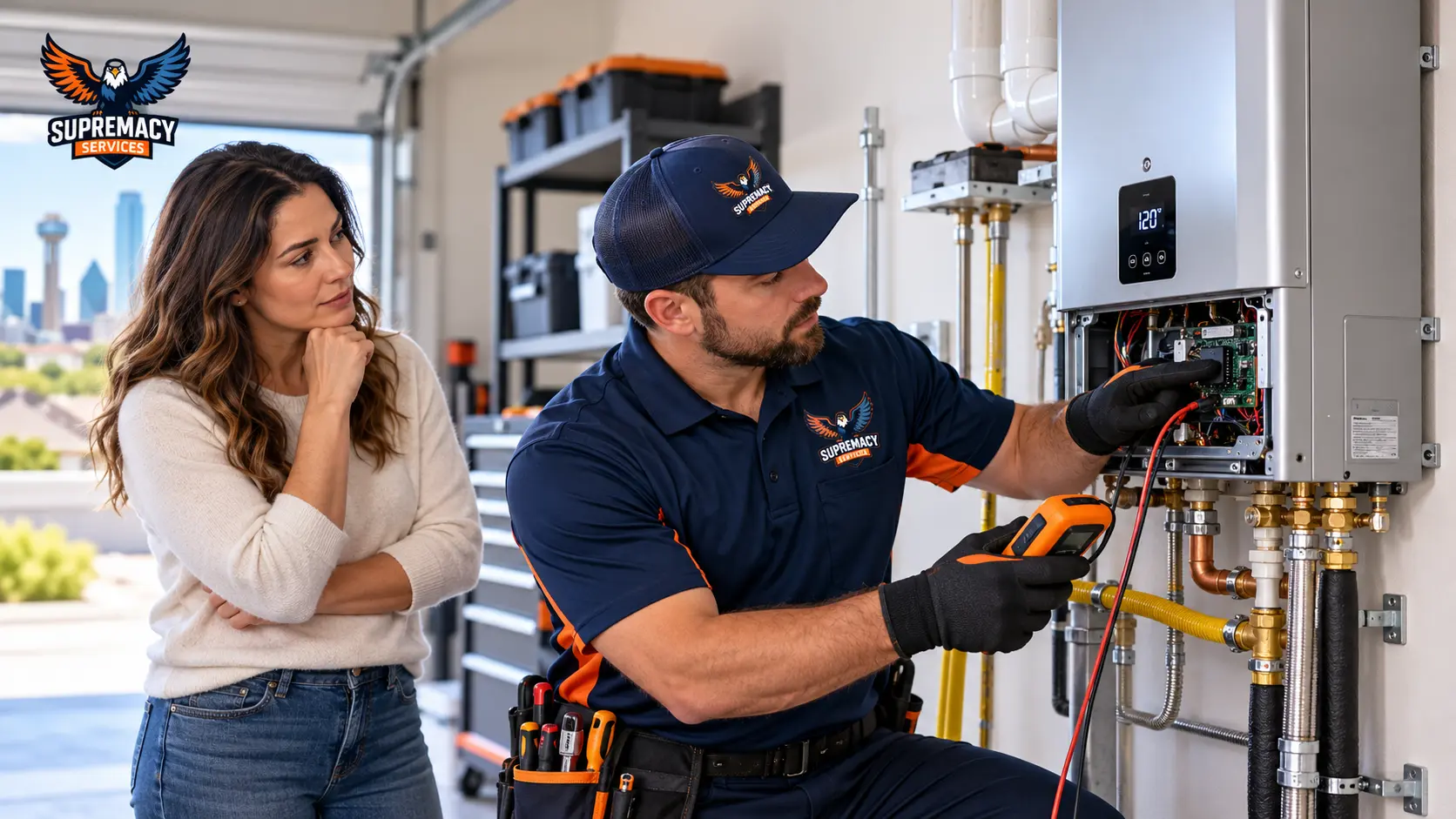
If your tankless water heater keeps shutting off, the problem often comes down to insufficient water flow, mineral scale, a dirty inlet filter, an ignition or gas-supply problem, blocked venting, an electrical fault, overheating, or a component that has triggered the unit’s safety controls.
Sometimes the cause is surprisingly simple: the hot-water flow drops below the heater’s minimum operating threshold when you reduce the faucet or mix in too much cold water. In other cases, repeated shutdowns indicate a problem that should be diagnosed by a qualified plumber.
For Dallas homeowners, mineral buildup deserves particular attention. The City of Dallas has reported water hardness of approximately 120–155 mg/L as CaCO₃, placing much of the range within the commonly defined hard-water category. That makes manufacturer-recommended flushing and descaling especially relevant for tankless equipment.
Table of Contents
- Quick answer: why tankless heaters shut off
- How a tankless water heater knows when to run
- Low water flow
- Mineral scale buildup
- Dirty inlet filter
- Gas or ignition problems
- Venting and combustion problems
- Electrical and control problems
- Overheating
- Why it shuts off during a shower
- Error codes
- What homeowners can safely check
- Repair versus replacement
- Prevention and maintenance
- Dallas and DFW considerations
- FAQs
Why Does a Tankless Water Heater Keep Shutting Off?
A tankless water heater usually shuts down because the control system no longer detects the conditions required for safe operation.
The most common categories are:
| Possible cause | What you may notice | Typical next step |
|---|---|---|
| Water flow is too low | Heater goes cold when faucet flow is reduced | Check fixture flow and inlet filter |
| Mineral scale | Temperature fluctuates or performance gradually worsens | Descale according to manufacturer requirements |
| Dirty inlet filter | Reduced flow or inconsistent activation | Inspect/clean if permitted by manufacturer |
| Gas or ignition problem | Unit attempts to fire but stops | Professional diagnosis |
| Vent/intake issue | Shutdown or combustion-related error | Inspect exterior termination; professional service |
| Electrical interruption | Blank display, rebooting or intermittent operation | Check normal household power conditions |
| Overheating | Heater works briefly, then shuts down | Professional diagnosis |
| Sensor/control fault | Repeated error code or unpredictable cycling | Manufacturer-specific troubleshooting |
| Demand exceeds capacity | Hot water drops under simultaneous use | Evaluate sizing and peak GPM |
Do not assume every shutdown means the heater itself has failed. Problems with water flow, fixtures, gas delivery, electrical power or installation conditions can produce similar symptoms.
How Does a Tankless Water Heater Know When to Turn On?
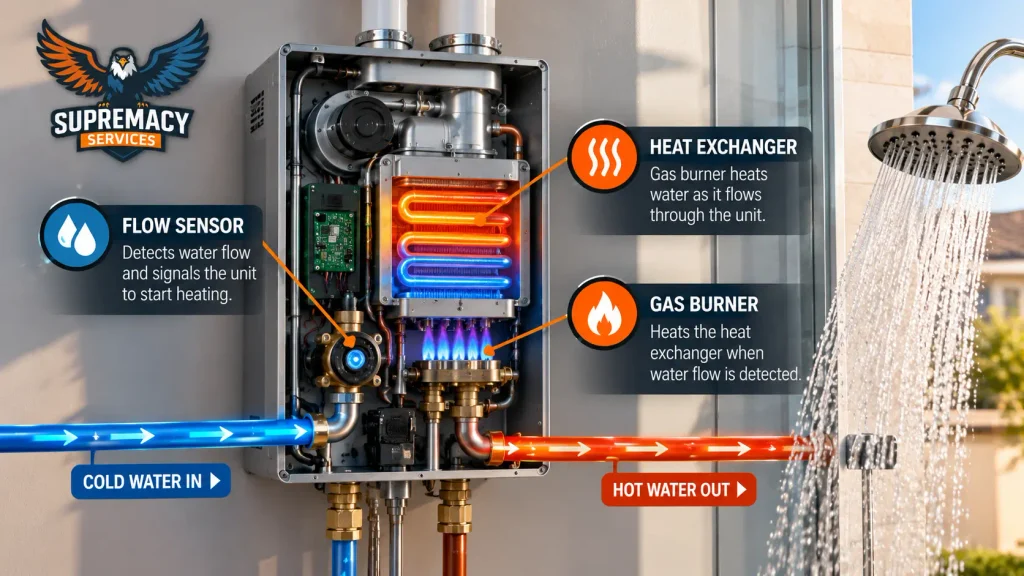
A tankless water heater does not keep a reservoir of hot water ready.
When a hot-water fixture opens, water begins moving through the heater. A flow sensor detects that demand and tells the unit to begin heating. On gas models, the burner heats a heat exchanger and water passes through it before traveling to the fixture.
ENERGY STAR describes essentially this sequence: incoming water activates a flow sensor, the burner heats the heat exchanger, and water leaves the unit at the selected temperature.
That operating principle explains several shutdown problems.
If flow falls too low, combustion becomes unsafe, the flame cannot be maintained, a sensor detects abnormal conditions, or another safety limit is exceeded, the unit can stop heating.
1. The Hot-Water Flow Is Too Low
Low flow is one of the first things to investigate when a tankless heater works at high faucet flow but turns off when the water is reduced.
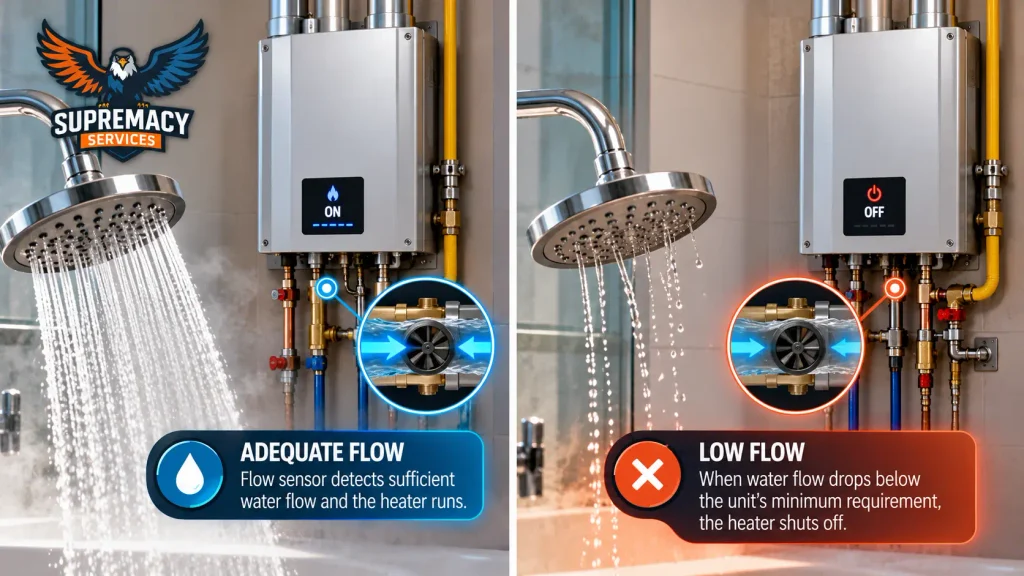
Tankless units have minimum operating-flow requirements.
The exact threshold depends on the manufacturer and model. ENERGY STAR’s product data even includes a specific minimum gallons-per-minute specification for tankless units.
For example, Rinnai states that its gas tankless heaters typically require approximately 0.4–0.6 GPM to ignite and around 0.26 GPM to remain operating. Those figures are Rinnai-specific and should not be assumed to apply to every brand.
Low-flow clues
You may have a flow-related problem if:
- the heater works with the faucet fully open but stops when it is partially closed;
- the shower gets cold after you mix in more cold water;
- one fixture has the problem while another works normally;
- the issue appeared after installing a very low-flow fixture;
- performance improves after removing a clogged aerator; or
- the unit repeatedly cycles on and off during small hot-water draws.
Why mixing cold water can contribute
Suppose the heater is set very hot.
You may compensate at the shower by reducing the hot side and adding substantial cold water. If hot-water flow through the heater falls beneath its activation or operating threshold, the burner can shut down.
That is why the correct temperature setting and fixture flow can matter.
Do not change manufacturer settings beyond normal user controls without consulting the manual.
Still losing hot water even with normal flow? Have Supremacy Services diagnose the water heater and confirm whether the problem is flow, scaling, ignition or another system fault.
2. Mineral Scale Is Restricting the Heat Exchanger
Scale buildup can reduce heat transfer and restrict water passages inside a tankless water heater, contributing to poor performance and shutdown-related symptoms.
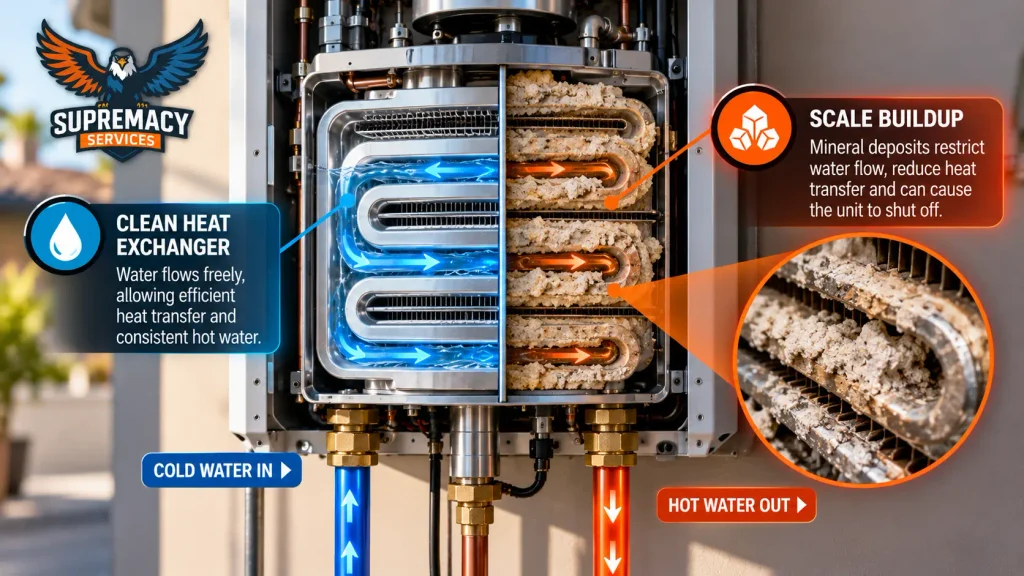
Minerals carried by the water can precipitate onto heated surfaces inside the unit.
This matters particularly in Dallas because the City has reported water hardness of 120–155 mg/L as CaCO₃.
Scale buildup does not prove that every Dallas shutdown is a water-quality problem, but it makes maintenance worth taking seriously.
Signs that scale may be involved
Look for a pattern such as:
- declining performance over time;
- reduced hot-water flow;
- fluctuating outlet temperature;
- unusually long heating response;
- shutdown or error events under heavier demand;
- a unit that has not been flushed or descaled according to its required maintenance schedule.
Does a tankless water heater need flushing?
Potentially, yes.
The correct method and interval depend on the manufacturer, model and water conditions. Do not assume that one universal annual procedure applies to every unit.
Consult the manufacturer’s maintenance instructions.
Because tankless systems may involve gas, combustion, electricity and hot water, professional service may be appropriate when maintenance requires opening the appliance or working beyond normal owner procedures. Navien, for example, expressly warns that troubleshooting and service can involve hazardous gas, combustion, venting, electrical and plumbing systems.
3. The Cold-Water Inlet Filter Is Dirty
A restricted inlet filter can reduce the amount of water moving through the heater, potentially interfering with activation and performance.
Some tankless units include a screen or filter on the incoming-water side to keep debris from entering internal passages.
If that filter becomes clogged, symptoms may include:
- lower hot-water flow;
- inconsistent activation;
- cycling;
- reduced performance at distant fixtures.
Rinnai specifically includes cleaning the inlet water filter among its suggested responses to minimum-flow problems.
Check your specific owner’s manual before removing or servicing filters. Water isolation procedures differ between models.
4. The Heater Has a Gas-Supply or Ignition Problem
Gas-fired tankless heaters may shut down when they cannot establish or maintain proper combustion.
Possible causes can involve:
- interrupted gas supply;
- ignition problems;
- flame-detection faults;
- improper gas pressure;
- gas piping that does not meet the appliance’s requirements;
- burner or combustion-related problems.
These are not good DIY troubleshooting targets.
Never attempt to modify gas pressure, gas valves, burners, regulators or combustion components yourself.
Warning
If you smell gas:
- Do not attempt to troubleshoot the water heater.
- Avoid switches, flames or anything that could create an ignition source.
- Leave the area.
- Follow your gas utility’s emergency instructions.
A tankless unit displaying a flame or combustion-related code should be evaluated using the manufacturer’s exact diagnostic procedure for that model, rather than a generic list found online.
5. The Air Intake or Exhaust Vent Has a Problem
Gas tankless heaters require proper combustion air and exhaust venting. A restriction or installation problem can cause a safety shutdown.
ENERGY STAR notes that whole-home gas tankless systems use dedicated venting for combustion gases. Condensing systems also require condensate management.
Potential issues include:
- debris at an exterior vent termination;
- an intake obstruction;
- improper installation;
- damaged vent components;
- exhaust recirculation;
- condensate drainage problems on applicable systems.
What a homeowner can check
From a safe location, you can look for an obvious external obstruction such as leaves or debris around an accessible outdoor termination.
Do not:
- dismantle the vent;
- defeat a safety switch;
- modify vent materials;
- change combustion settings.
Improper combustion or venting can create serious safety risks.
6. The Heater Is Losing Electrical Power
Even a gas-fired tankless heater normally relies on electrical power for controls, ignition, sensors and other components.
Possible signs of a power-related problem include:
- the display goes completely blank;
- the system repeatedly reboots;
- error history disappears after power interruptions;
- operation is intermittent rather than linked to water flow.
A homeowner can check normal items such as whether the unit has household power or whether an accessible breaker has tripped.
Repeated breaker trips, damaged wiring or internal electrical faults require qualified service.
Do not repeatedly reset a breaker without determining why it is tripping.
7. The Water Heater Is Overheating
If internal temperatures become abnormal, the heater may shut down to protect itself and the home.
Possible contributors can include:
- restricted water movement;
- heat-exchanger scale;
- incorrect sensor readings;
- abnormal combustion;
- component failure.
If the heater consistently runs for several minutes and then shuts down—particularly with a temperature or overheat code—record the code and arrange appropriate service.
Repeatedly resetting the appliance without correcting the underlying cause can mask an important diagnostic clue.
Why Does My Tankless Water Heater Shut Off During a Shower?
When a tankless water heater shuts off specifically during a shower, investigate flow and temperature mixing first.
A common sequence is:
- The heater produces very hot water.
- The homeowner adds significant cold water at the shower valve.
- Hot-water flow through the heater falls.
- Flow approaches the unit’s minimum operating requirement.
- The heater shuts down.
- Cold water reaches the shower.
- The cycle may repeat.
Other possible shower-specific causes include:
- a restrictive showerhead;
- a clogged showerhead;
- a mixing-valve problem;
- plumbing crossover;
- an inlet-flow restriction.
Simple comparison test
Without altering the appliance, note whether:
- a kitchen faucet can sustain hot water normally;
- another shower has the same problem;
- the heater fails only when flow is reduced.
That information can make professional diagnosis much faster.
8. The Unit Is Displaying an Error Code
Treat the error code as a diagnostic clue, not a generic repair instruction.
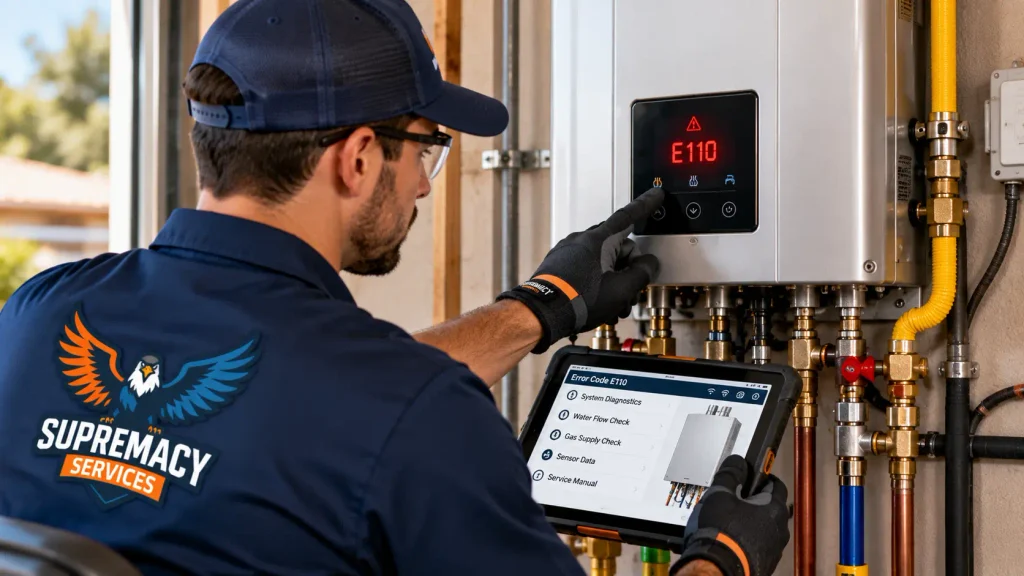
Tankless-water-heater codes vary by:
- brand;
- product family;
- fuel type;
- model;
- generation.
The same number may not mean the same thing on different manufacturers’ equipment.
Write down:
- manufacturer;
- exact model number;
- complete error code;
- whether the code appears immediately or after running;
- which fixtures were operating;
- whether the unit restores operation after a normal reset.
Then consult the manufacturer’s manual for that exact model.
Manufacturers such as Navien publish model-specific installation, operation and service documentation rather than one universal troubleshooting table.
If the same error code keeps returning, schedule tankless water-heater diagnosis with Supremacy Services before repeated resets turn a useful diagnostic clue into an intermittent problem.
What Can I Safely Check Before Calling a Plumber?
Start with observations rather than disassembly.
Safe homeowner checklist
- Record any error code before resetting anything.
- Confirm whether the display remains powered.
- Test more than one hot-water fixture.
- Notice whether higher flow keeps the heater operating.
- Check whether a faucet aerator or showerhead is visibly clogged.
- Look for an obvious obstruction around an accessible exterior vent termination.
- Review when the unit was last maintained.
- Find the manufacturer and model number.
- Note whether multiple fixtures were running when the shutdown occurred.
- Check the user manual for owner-approved maintenance steps.
Stop and call a professional if:
- you smell gas;
- the breaker repeatedly trips;
- combustion or flame error codes return;
- the appliance leaks internally;
- venting appears damaged;
- wiring is damaged;
- the unit overheats;
- shutdowns continue after basic flow checks;
- service requires opening the appliance.
Manufacturer service documentation can include explicit warnings that diagnosis may involve gas, combustion, electrical, plumbing and venting hazards.
Could the Tankless Heater Be Undersized?
Possibly—but undersizing usually appears as a capacity problem during simultaneous demand, not simply a heater that randomly switches off.
Every tankless unit has a maximum flow capacity at a specified temperature rise.
If several fixtures run simultaneously, demand may exceed the unit’s ability to maintain the desired outlet temperature.
ENERGY STAR uses maximum GPM as a core tankless performance specification and currently requires qualifying gas-fired instantaneous water heaters to deliver at least 2.8 GPM over a 67°F temperature rise. Individual products can have considerably different capacities.
Capacity problem versus shutdown problem
| Symptom | More likely explanation |
|---|---|
| Water gets cooler only when several fixtures operate | Capacity/sizing |
| Heater turns off when flow becomes very low | Minimum-flow issue |
| Gradual performance decline | Scale/filter/maintenance issue |
| Repeated ignition code | Gas/ignition diagnosis |
| Unit abruptly goes blank | Electrical/power issue |
| Same safety code repeatedly returns | Specific component/system fault |
Professional sizing should consider peak simultaneous flow and required temperature rise, not simply household size.
Related Problems That Can Look Like a Tankless-Heater Failure
Do not assume the appliance is always responsible.
Fixture problem
A clogged aerator or showerhead can restrict flow.
Shower mixing-valve problem
A defective valve can cause temperature fluctuations that resemble heater cycling.
Plumbing crossover
An unintended connection between hot and cold plumbing can change delivered temperature.
Recirculation-system issue
Homes with recirculation equipment introduce pumps, check valves, controls and piping arrangements that can create symptoms different from a basic tankless installation.
Gas-supply problem
The water heater may be operating correctly but not receiving fuel under the required conditions.
Electrical problem
Loss of power can stop even a gas-fired heater because controls and ignition need electricity.
Correct diagnosis matters before replacing expensive equipment.
Should You Repair or Replace a Tankless Water Heater That Keeps Shutting Off?
Repair usually makes sense when the underlying issue is serviceable and the heater is otherwise in good condition. Replacement becomes more reasonable when the equipment has major component failure, recurring expensive problems, installation deficiencies that require substantial correction, or no longer meets the home’s hot-water needs.
Do not make the decision based on age alone.
Consider:
| Factor | Favors service/repair | Favors replacement evaluation |
|---|---|---|
| Problem | Maintenance or replaceable component | Major heat-exchanger/component failure |
| History | First significant issue | Repeated breakdowns |
| Installation | Properly installed and sized | Major vent/gas/sizing deficiencies |
| Performance | Meets household demand when working | Regularly inadequate for demand |
| Parts | Readily serviceable | Obsolete or difficult to source |
| Condition | Otherwise sound | Multiple deteriorating systems |
Supremacy’s existing water-heater page is the appropriate commercial destination when diagnosis indicates replacement or a new installation. The company states that its water-heater process includes diagnostics, sizing and selection, installation and performance verification.
What Does Professional Tankless Water-Heater Diagnosis Include?
The exact process depends on the heater and symptom, but professional diagnosis may involve checking:
- stored or active error codes;
- actual fixture flow;
- inlet-water flow;
- inlet filter condition;
- temperature settings;
- heat-exchanger condition;
- evidence of mineral scale;
- ignition sequence;
- gas supply where applicable;
- combustion and venting conditions;
- electrical supply and controls;
- temperature and flow sensors;
- condensate system on applicable equipment;
- recirculation controls where installed;
- overall sizing and peak demand.
The goal should be to identify why the safety/control system is shutting the heater down, not simply reset it and hope the problem disappears.
How Much Does It Cost to Fix a Tankless Water Heater That Keeps Shutting Off?
There is no defensible one-price answer based only on the symptom.
The final cost depends on whether the cause is:
- routine maintenance;
- scale removal;
- an inlet restriction;
- sensor replacement;
- ignition repair;
- gas-supply correction;
- venting correction;
- electrical repair;
- recirculation troubleshooting;
- a major component; or
- replacement of the appliance.
An online repair price that does not first identify the failure can therefore be misleading.
Homeowners should ask for a diagnosis that separates:
diagnostic/service cost + required parts + labor + any installation corrections
before comparing repair with replacement.
How Can You Prevent Repeated Tankless-Water-Heater Shutdowns?
1. Follow the manufacturer’s maintenance schedule
Maintenance requirements vary by manufacturer and model.
2. Address mineral scale
Dallas Water Utilities has documented relatively mineral-rich water, with reported hardness of 120–155 mg/L as CaCO₃.
If the manufacturer recommends descaling based on water conditions, do not ignore it.
3. Keep owner-serviceable filters clean
Only follow procedures specified for your model.
4. Do not ignore recurring codes
A recurring code is evidence, not an annoyance to be repeatedly erased.
5. Maintain proper fixture flow
If a heater only fails after installing a highly restrictive fixture, compare that fixture’s flow with the water heater’s minimum operating requirement.
6. Protect vent terminations from obstruction
Inspect accessible exterior terminations periodically without modifying or dismantling them.
7. Have installation problems corrected
An appliance cannot overcome gas, venting, electrical or sizing deficiencies simply because the heater itself is new.
Dallas & DFW Considerations for Tankless Water Heaters
Dallas water hardness makes scale worth monitoring
The City of Dallas has specifically reported water hardness of 120–155 mg/L as CaCO₃.
For a tankless heater, that makes heat-exchanger maintenance more relevant than a generic article might suggest.
The key distinction is important:
Hard water does not mean every shutdown is caused by scale.
It means scale should be one of the legitimate diagnostic possibilities when performance declines, flow becomes restricted or maintenance has been neglected.
DFW homes can have very different installations
One Dallas-area home may have:
- an indoor condensing gas system;
- an exterior tankless heater;
- a recirculation loop;
- a conventional gas system;
- electric tankless equipment;
- a former storage-heater installation converted to tankless.
That is why troubleshooting must start with the actual model and installation rather than treating every tankless system as identical.
Supremacy’s plumbing page states that the company services traditional and tankless water heaters throughout the Dallas–Fort Worth area.
Frequently Asked Questions
Why does my tankless water heater keep turning off and back on?
Frequent cycling can occur when water flow moves above and below the unit’s minimum operating threshold. Restricted flow, dirty filters, scale, sensor issues or other faults can also contribute. Record any error code and compare the symptoms across several fixtures.
Why does my tankless water heater shut off in the middle of a shower?
Low hot-water flow is one possibility, particularly if you are mixing large amounts of cold water into very hot water. A restrictive showerhead or mixing-valve problem can also contribute. If other fixtures have the same problem, the heater itself needs closer diagnosis.
Can low water pressure make a tankless water heater shut off?
Insufficient flow through the heater can prevent activation or cause heating to stop. However, water pressure and water flow are not exactly the same measurement, so the actual flow through the unit should be evaluated.
Can scale cause a tankless water heater to stop working?
Scale can accumulate inside the heat exchanger and reduce heat transfer or restrict passages. Whether it directly causes a particular shutdown must be determined from the heater’s symptoms, service history and diagnostic information.
Why does my tankless water heater only work when the faucet is fully open?
That strongly suggests investigating minimum flow. Some tankless heaters require a specific water flow before they ignite and a minimum flow to remain operating. The exact threshold depends on the model.
Should I keep resetting my tankless water heater?
An occasional reset specified by the owner’s manual may restore operation after a temporary event, but repeatedly resetting a unit that returns the same fault can hide useful diagnostic information. Write down the error code and investigate the cause.
Does a tankless water heater need to be flushed?
Many tankless manufacturers specify maintenance procedures related to mineral deposits, but the method and interval vary. Follow the manual for your exact model and local water conditions rather than assuming one maintenance schedule applies universally.
Why does my tankless water heater show an error code?
An error code means the control system has detected a condition it is programmed to identify. Because code definitions vary by manufacturer and model, consult the exact manufacturer’s documentation instead of relying on a generic error-code chart.
When should I call a plumber for a tankless water heater?
Arrange professional diagnosis when shutdowns continue after basic fixture/flow checks, the same error code returns, the unit leaks, electrical protection trips, venting appears damaged, combustion problems are suspected, or diagnosis requires opening the appliance.
Is a tankless water heater that keeps shutting off necessarily bad?
No. The heater itself may still be serviceable. Low fixture flow, an inlet restriction, scale, installation problems, fuel supply or another system condition can create similar symptoms. Diagnose the cause before deciding to replace the unit.
Final Takeaway
A tankless water heater that keeps shutting off is usually responding to a specific operating or safety condition—not simply deciding to stop producing hot water.
Start by looking at the pattern.
If the problem happens only at low fixture flow, investigate minimum-flow conditions first. If performance has gradually declined, scale or an inlet restriction deserves attention. If an error code, ignition problem, overheating condition, repeated power interruption or venting fault is involved, stop treating the problem as a simple reset issue and have the system properly diagnosed.
For Dallas homeowners, water hardness makes manufacturer-recommended scale maintenance particularly relevant, but good troubleshooting still means identifying the actual failure before replacing parts.
Final CTA
Tankless water heater still shutting down? Supremacy Services can diagnose water-flow, scaling, ignition, venting and system-performance issues throughout Dallas–Fort Worth and help determine whether service or replacement makes the most sense.

