
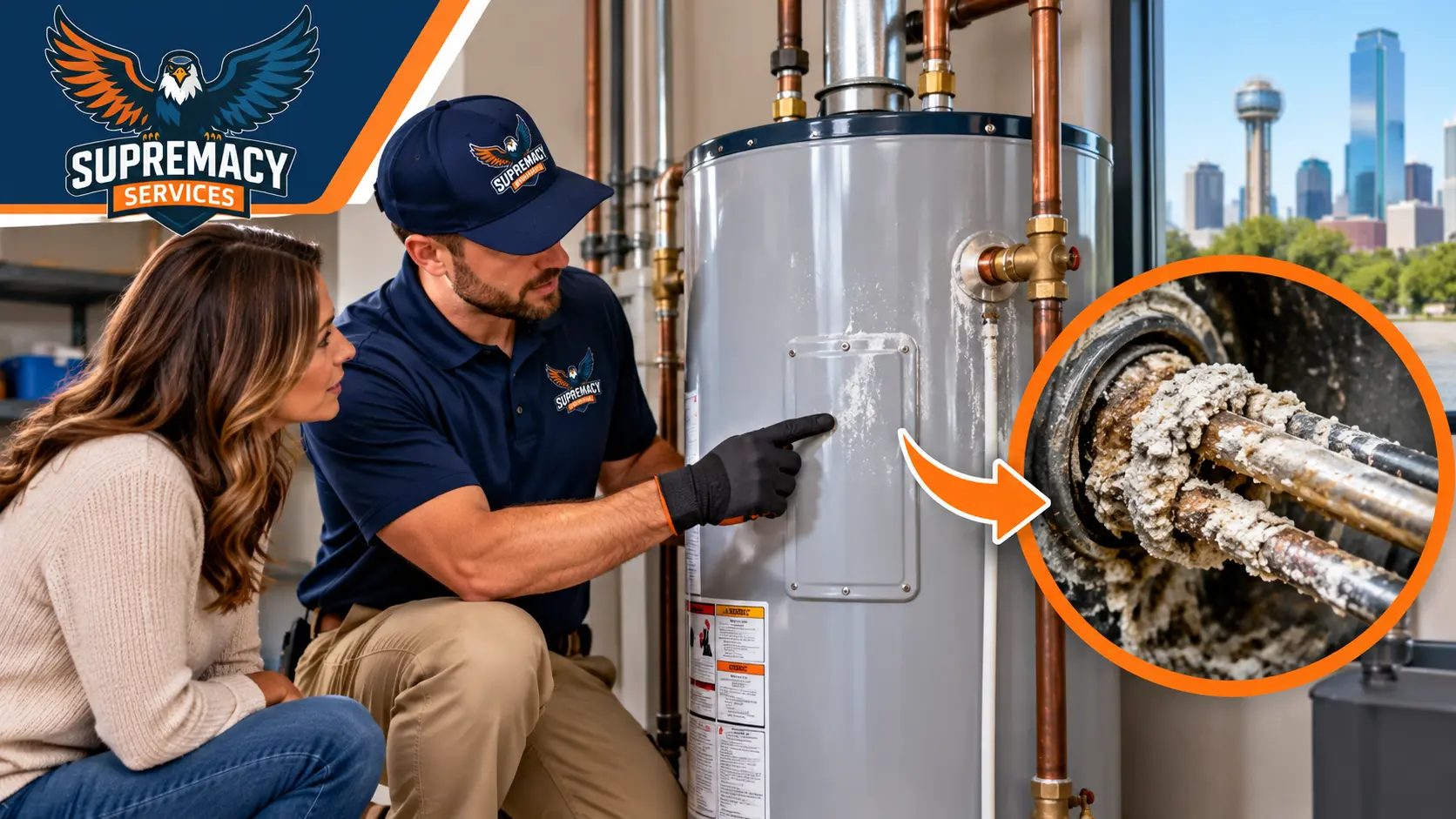
Hard water can affect both traditional and tankless water heaters by leaving calcium- and magnesium-based mineral deposits inside the equipment.
For Dallas homeowners, this is more than a theoretical maintenance issue. The City of Dallas has reported water hardness ranging from approximately 120 to 155 mg/L as calcium carbonate, putting the local supply across the moderately hard-to-hard range.
Over time, those dissolved minerals can contribute to sediment at the bottom of a storage tank and scale on heating elements, heat exchangers and internal water passages.
The result may be:
- slower heat transfer;
- popping or rumbling noises;
- longer heating cycles;
- reduced usable hot-water capacity;
- mineral deposits on components;
- increased maintenance needs;
- and, in some systems, reduced water flow.
Hard water does not mean Dallas drinking water is unsafe. Water hardness primarily describes dissolved mineral content. Dallas Water Utilities states that its municipal supply is drawn from surface-water sources and treated before entering the distribution system.
For a water heater, however, those minerals still matter.
Table of Contents
- What Is Hard Water?
- Does Dallas Have Hard Water?
- How Hard Water Affects Water Heaters
- Tank vs. Tankless: How Scale Affects Each
- Signs Hard Water Is Affecting Your Water Heater
- Can Hard Water Increase Energy Use?
- Does Hard Water Shorten Water-Heater Life?
- Flushing vs. Descaling
- Can a Water Softener Protect a Water Heater?
- DIY vs. Professional Maintenance
- What Professional Service Should Include
- How Dallas Homeowners Can Reduce Mineral Buildup
- When Scale Means Repair or Replacement
- FAQs
What Is Hard Water?
Hard water is water containing relatively high concentrations of dissolved calcium and magnesium. When that water is heated, some of those minerals can form deposits or scale on surfaces inside plumbing fixtures and water-heating equipment.
EPA guidance explains that hard water is associated primarily with calcium and magnesium and that the resulting scale can form inside pipes, water heaters and other equipment. EPA also notes that scale does not conduct heat well.
That distinction is important.
Hardness is not the same thing as dirt floating in the water.
The calcium and magnesium are dissolved. The problems become more visible as minerals precipitate, accumulate or form harder deposits inside equipment and around fixtures.
Typical household evidence includes:
- white crust around faucets;
- deposits on showerheads;
- spots on glassware;
- scale around aerators;
- mineral residue on heating components;
- and sediment discharged during water-heater maintenance.
Does Dallas Have Hard Water?
Yes. The City of Dallas has reported water hardness of approximately 120–155 mg/L as CaCO₃.
The City’s published hardness table classifies:
| Hardness as CaCO₃ | Classification |
|---|---|
| 0–60 mg/L | Soft |
| 61–120 mg/L | Moderately hard |
| 121–180 mg/L | Hard |
| More than 180 mg/L | Very hard |
That places the reported Dallas range around the transition from moderately hard into hard water.
The precise hardness at a particular DFW property can vary with the utility serving the home and local water conditions, so homeowners outside the City of Dallas should not assume their number is identical.
Dallas Water Utilities also explains that Dallas draws its drinking-water supply from area surface-water reservoirs rather than groundwater.
Important distinction: hard water does not mean unsafe water
A mineral-hardness reading is not the same thing as a drinking-water contaminant violation.
The City of Dallas publishes annual drinking-water quality reports addressing regulated contaminants separately.
For homeowners, hardness is primarily important because of what those minerals can do to:
- plumbing fixtures;
- appliances;
- valves;
- heating elements;
- heat exchangers;
- and water heaters.
How Does Hard Water Affect a Water Heater?
Hard water can leave mineral scale and sediment inside a water heater, creating an insulating layer between the heat source and the water or restricting passages through which water must flow.
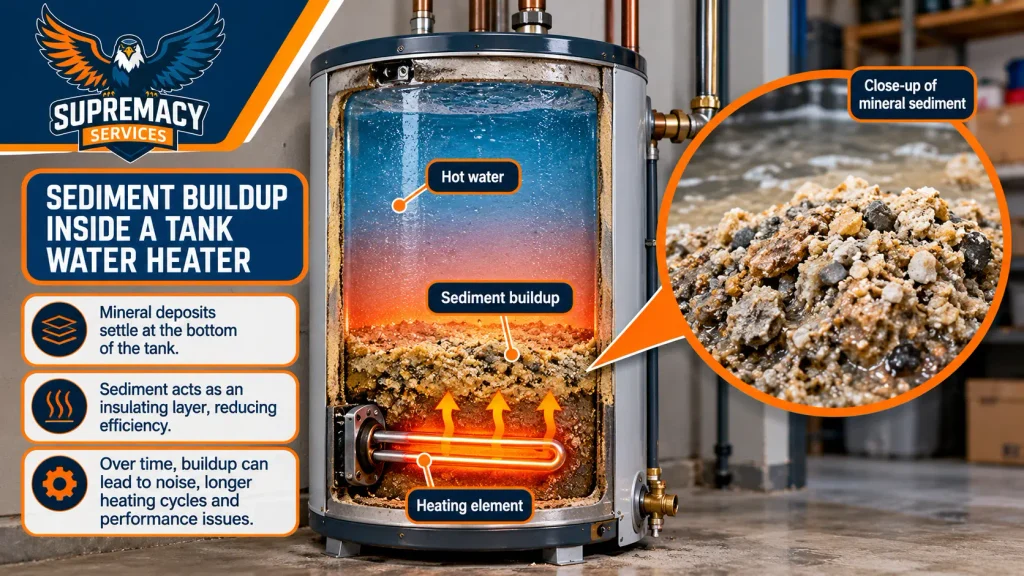
The exact effect depends heavily on whether the system is a storage tank or tankless unit.
A useful way to picture the process is:
hard water enters → water is heated → minerals precipitate or deposit → scale/sediment accumulates → heat transfer or water flow can deteriorate
1. Mineral sediment can accumulate in storage tanks
Storage water heaters repeatedly heat and store the same body of water.
Over time, mineral material and other sediment can settle near the bottom of the tank.
A. O. Smith warns that minerals and other substances in a water supply can lead to sediment buildup and states that sediment can reduce water-heater efficiency.
2. Scale can coat electric heating elements
Electric water heaters use submerged heating elements.
Mineral deposits can form directly around those elements, making heat transfer less effective.
Manufacturer maintenance guidance specifically identifies mineral deposits on electric elements as an issue technicians should inspect.
3. Tankless heat exchangers can develop scale
Tankless water heaters avoid storing dozens of gallons of hot water, but they are not immune to hardness.
Instead of settling in a storage tank, mineral deposits can form in or around narrow heat-exchanger passages.
That is why tankless systems may require descaling, even though they do not require storage-tank sediment flushing.
4. Water passages can become restricted
Scale can gradually narrow passages through fixtures or equipment.
EPA notes that hard-water scale can reduce water flow through pipes and fixtures.
Inside tankless equipment, similar mineral accumulation can affect water movement through the heat exchanger.
What Happens Inside a Tank Water Heater?
Imagine the bottom of the tank when it is relatively clean:
burner/element → tank surface or element → water
Now add a significant sediment layer:
burner/element → sediment/scale → water
The heater now has an additional material between the heat source and the water it is trying to heat.
That can contribute to:
- longer recovery;
- unusual operating sounds;
- uneven heating;
- greater stress on components;
- and reduced performance.
Sediment can also occupy physical space at the bottom of the tank, effectively reducing the volume available for usable hot water when accumulation becomes significant.
Hard Water in Tank vs. Tankless Water Heaters
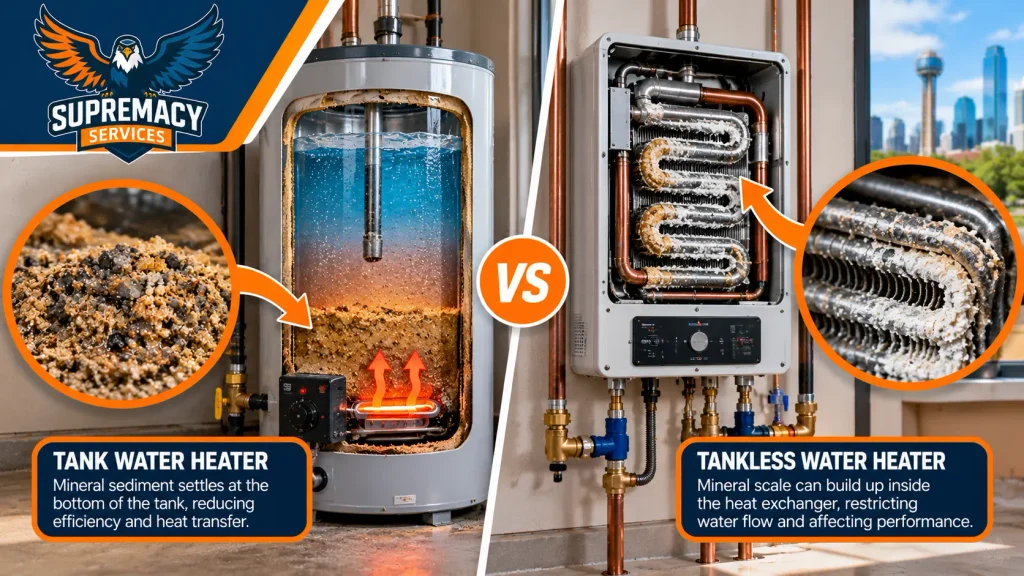
Both systems can be affected, but they experience mineral buildup differently.
| Issue | Tank water heater | Tankless water heater |
|---|---|---|
| Main mineral problem | Sediment + scale | Scale |
| Where it collects | Tank bottom and heating surfaces | Heat exchanger and water passages |
| Typical maintenance | Tank flushing | Descaling/flushing procedure |
| Possible symptom | Popping or rumbling | Reduced flow, performance issues or error conditions |
| Heat-transfer impact | Sediment insulates heating surface | Scale coats heat-transfer surfaces |
| Maintenance frequency | Manufacturer-specific | Manufacturer-specific |
| Hard-water sensitivity | Significant | Can be significant because of narrow passages/high heat transfer |
Tankless heaters should therefore not be marketed as being immune to hard water.
They eliminate the large storage tank, not the minerals in the incoming supply.
Supremacy’s existing tank-versus-tankless content already identifies water quality, mineral deposits and maintenance as factors affecting both system types.
What Are the Signs Hard Water Is Affecting Your Water Heater?
Common warning signs include popping or rumbling, reduced hot-water performance, visible mineral scale, longer recovery times and sediment appearing during flushing.
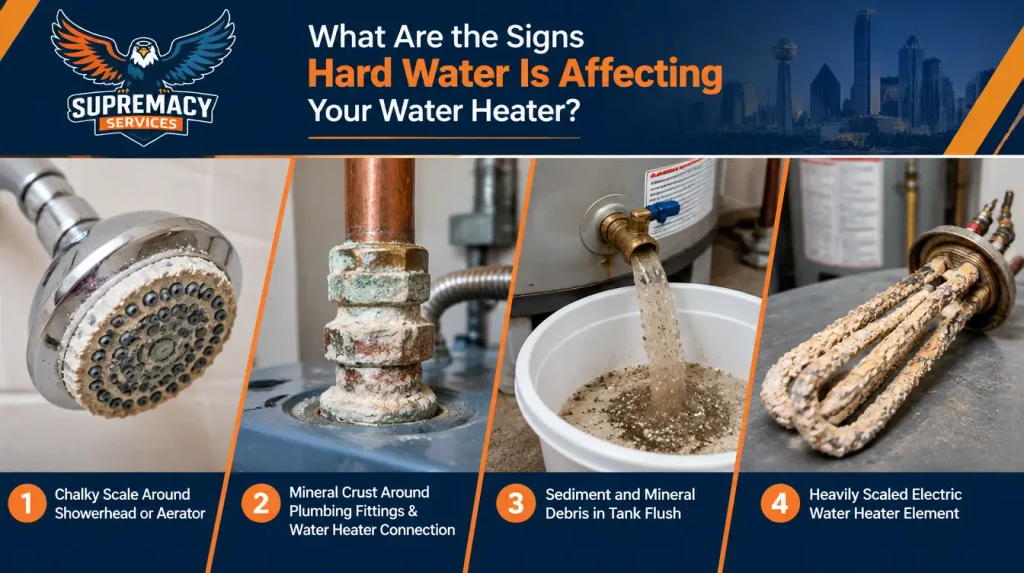
None of these symptoms proves hard water is the only cause, so diagnosis still matters.
Water-heater warning-sign checklist
Look for:
- popping, cracking or rumbling during heating;
- white or chalky deposits near plumbing connections;
- scale on electric heating elements;
- sediment discharged from the drain valve;
- reduced hot-water volume;
- showers turning cool sooner than they used to;
- slower recovery after heavy hot-water use;
- changing tankless flow performance;
- increasingly frequent tankless maintenance;
- inconsistent water temperature;
- clogged faucet aerators or showerheads elsewhere in the home;
- recurring scale on fixtures.
Not sure whether the problem is mineral buildup or a failing component? Have Supremacy Services inspect the water heater before replacing parts unnecessarily.
Recommended internal anchor:
professional water heater service in DFW
Link toward the water-heater commercial service/replacement page.
Does Hard Water Cause Popping or Rumbling?
It can.
Sediment at the bottom of a storage tank can trap heated water or bubbles underneath or within the deposits.
As the bubbles force their way through the sediment, homeowners may hear popping, crackling or rumbling.
A. O. Smith describes sediment as a common cause of popping noises and recommends flushing when sediment is responsible.
Supremacy already has a dedicated article explaining this symptom:
That article should remain the primary page for queries centered specifically on water-heater noises.
The new hard-water article should link to it rather than duplicate its detailed sound-by-sound troubleshooting content.
Can Hard Water Make a Water Heater Less Efficient?
Yes, mineral deposits can reduce effective heat transfer, particularly when scale coats heating surfaces or sediment separates the heat source from the water.
EPA states directly that hard-water scale does not conduct heat well.
A. O. Smith likewise explains that sediment accumulation can reduce water-heater energy efficiency.
That does not mean every Dallas homeowner with hard water will suddenly see a dramatic utility-bill increase.
Actual energy use depends on many variables:
- heater efficiency;
- tank size;
- fuel type;
- thermostat setting;
- household demand;
- incoming water temperature;
- insulation;
- equipment condition;
- sediment severity;
- and maintenance history.
The more useful conclusion is that keeping heat-transfer surfaces clean supports the equipment’s intended performance.
Can Hard Water Make Hot Water Run Out Faster?
Potentially—but mineral buildup is only one possible cause.
In a storage heater, heavy sediment can occupy part of the tank and interfere with heating.
In an electric unit, a mineral-coated or failed heating element can also reduce recovery.
But “not enough hot water” can also result from:
- a failed heating element;
- thermostat problems;
- a damaged dip tube;
- undersized equipment;
- increased household demand;
- mixing-valve problems;
- or unusually low incoming water temperatures.
Do not assume mineral buildup is responsible until the system is evaluated.
Does Hard Water Shorten Water-Heater Life?
Mineral buildup can contribute to conditions that increase stress on water-heater components, but there is no reliable universal number of years that hard water removes from every heater.
Water-heater life depends on:
- water chemistry;
- equipment quality;
- installation quality;
- operating temperature;
- usage;
- maintenance;
- corrosion;
- anode condition;
- fuel type;
- and individual component failures.
This distinction is important because statements such as “hard water cuts five years off every water heater” are overly broad and should be avoided.
What can be stated confidently is that mineral accumulation affects equipment condition and maintenance requirements.
A. O. Smith recommends periodic flushing and specifically notes that homeowners in hard-water areas may need more frequent maintenance.
Water-Heater Flushing vs. Descaling: What Is the Difference?
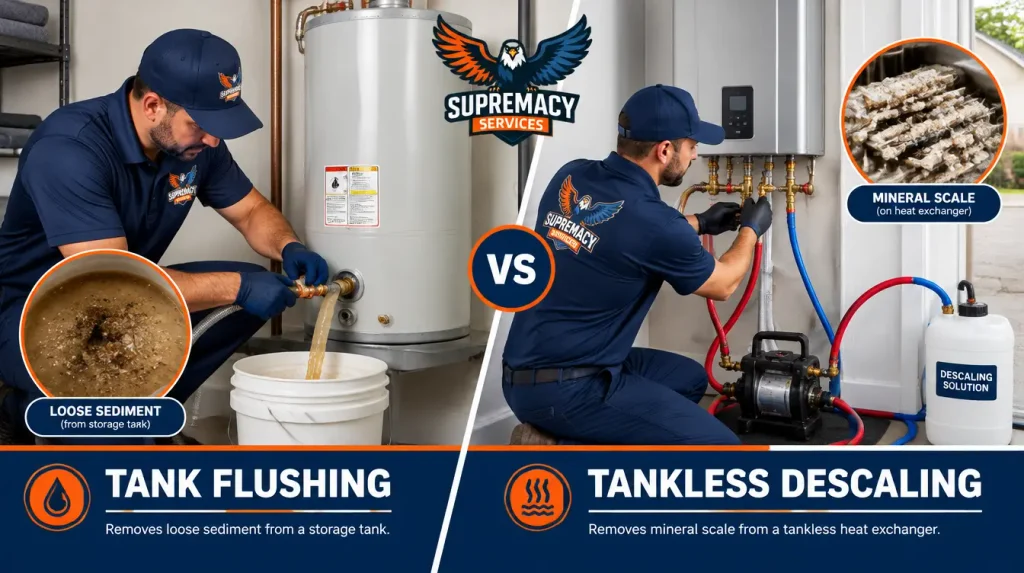
Flushing primarily removes loose sediment, while descaling targets harder mineral deposits attached to internal surfaces.
| Maintenance | Primary purpose | Common application |
|---|---|---|
| Flushing | Remove loose sediment/debris | Storage water heaters |
| Descaling | Dissolve/remove mineral scale | Tankless heat exchangers and scaled components |
| Inspection | Identify corrosion/component problems | Tank and tankless |
| Anode inspection | Evaluate sacrificial corrosion protection | Applicable storage tanks |
| Water testing | Determine actual hardness/chemistry | Whole-home diagnosis |
Storage tank flushing
A typical tank flush drains accumulated material through the heater’s drain valve.
A. O. Smith states that most tank water heaters should generally be flushed at least annually, while also emphasizing that the correct interval depends on the model and that hard-water conditions may justify more frequent flushing.
Always follow the actual manufacturer’s instructions for the installed model.
Tankless descaling
Tankless equipment requires a different process.
Descaling normally involves isolating the water heater and circulating an approved cleaning solution through the heat exchanger according to manufacturer instructions.
The purpose is to remove mineral scale rather than tank-bottom sediment.
Should Dallas Homeowners Flush More Often Because of Hard Water?
Possibly.
The correct interval should come from:
- the manufacturer’s instructions;
- actual water hardness;
- equipment design;
- previous maintenance findings;
- household use;
- and how quickly deposits are returning.
Manufacturer guidance specifically notes that hard-water areas may require more frequent tank flushing.
Do not substitute a universal “every six months” or “once per year” rule for the manufacturer of the specific heater.
If substantial sediment is found during every annual service, shortening the interval may be reasonable.
Can a Water Softener Help Protect a Water Heater?
Yes. A conventional ion-exchange water softener removes calcium and magnesium hardness ions and can therefore reduce the minerals available to form scale.
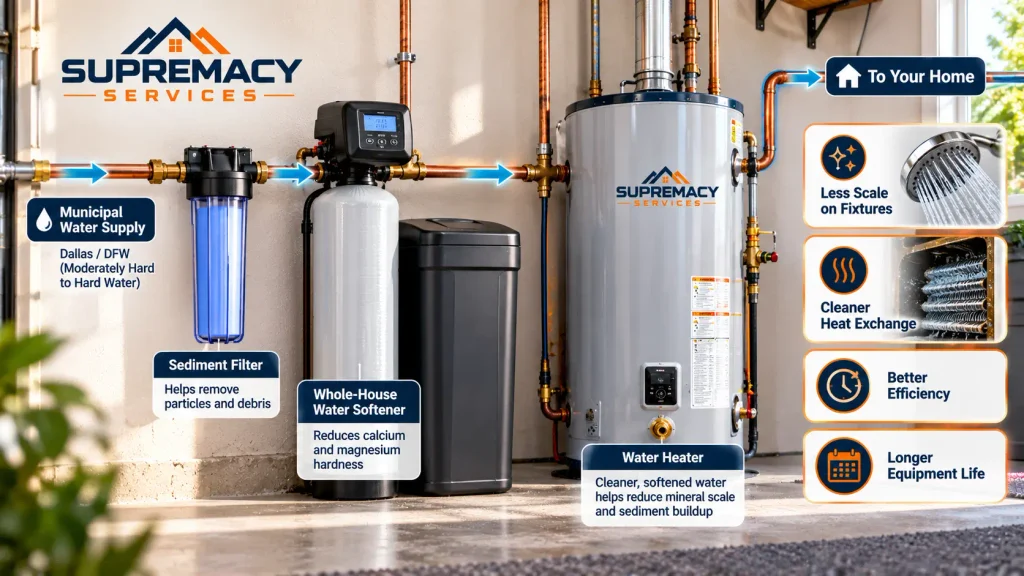
EPA explains that cation-exchange softeners remove calcium and magnesium by exchanging those ions for sodium or potassium.
That can reduce scale formation throughout the plumbing system.
However, homeowners should understand the difference between softening and filtration.
Water softener vs. water filter
| System | Main function |
|---|---|
| Water softener | Reduces calcium/magnesium hardness |
| Sediment filter | Removes suspended particles |
| Carbon filtration | Often targets chlorine/chloramine, tastes, odors and selected chemicals depending on design |
| Specialty treatment | Targets specific water-quality conditions |
| Combination system | May perform multiple treatment functions |
A generic whole-house filter is not automatically a water softener.
The treatment method should match the water-quality problem.
Supremacy already has a relevant whole-house water-treatment page:
That page currently discusses hard water and whole-home water chemistry. It should link back to this article once published.
Does Every Dallas Home Need a Water Softener?
No.
The decision should depend on:
- actual hardness at the property;
- visible scale;
- appliance problems;
- homeowner preferences;
- maintenance burden;
- plumbing configuration;
- water usage;
- equipment requirements;
- and the cost and upkeep of the treatment system.
If mineral scale is the main concern, homeowners should verify hardness rather than assuming every filtration product will address it.
EPA also points out that ion-exchange softeners themselves use water and salt during regeneration, making efficiency and proper sizing important.
Can You Remove Water-Heater Sediment Yourself?
Some routine maintenance can be DIY-friendly, but the answer depends heavily on the equipment.
DIY maintenance may be reasonable when:
- you have the exact manufacturer instructions;
- the heater is in good condition;
- the drain valve operates properly;
- there is no visible tank corrosion;
- there are no gas-supply concerns;
- there are no electrical faults;
- the system is easily accessible;
- and you understand the shutdown and restart procedure.
Professional service is safer when:
- the tank is old or corroded;
- the drain valve is blocked;
- the heater is leaking;
- the unit is installed in an attic or difficult location;
- you smell gas;
- wiring or breakers are behaving abnormally;
- the tankless system requires specialized descaling;
- the unit has error codes;
- hot-water performance has deteriorated significantly;
- or the heater has never been maintained.
Water heaters combine hot water with electricity, gas or combustion equipment depending on the model.
Improvising a procedure from a generic internet tutorial is not appropriate when the manufacturer’s process is unknown.
What If the Water Heater Has Never Been Flushed?
Do not assume aggressive flushing is automatically the correct first step.
An older heater that has operated for many years without maintenance may already have:
- heavy mineral accumulation;
- a partially clogged drain;
- internal corrosion;
- a deteriorated anode;
- weakened valves;
- or several age-related problems.
A professional inspection can determine whether maintenance is still sensible or whether the heater is approaching replacement territory.
What Should Professional Water-Heater Service Include?
A useful service visit should diagnose the equipment, not simply drain water from the tank.
Depending on the heater, an assessment may include:
- Confirming the make, model and approximate age.
- Looking for external leaks and corrosion.
- Evaluating sediment or mineral buildup.
- Checking hot-water performance.
- Inspecting heating elements or burner operation.
- Checking thermostatic controls.
- Inspecting the drain valve.
- Evaluating the anode rod where applicable.
- Inspecting temperature-and-pressure relief components.
- Checking gas connections and venting on applicable equipment.
- Checking relevant electrical components on electric systems.
- Evaluating tankless inlet screens and heat-exchanger scale.
- Reviewing maintenance history.
- Comparing repair, maintenance and replacement when appropriate.
Supremacy’s published water-heater process already includes inspection of sediment buildup, anode-rod condition, burner efficiency and tank integrity.
Seeing scale, sediment or declining hot-water performance? Schedule a water-heater diagnostic with Supremacy Services so you know whether maintenance, repair or replacement makes the most sense.
How Can North Texas Homeowners Reduce Water-Heater Mineral Buildup?
The best strategy is a combination of correct maintenance and, when justified, water treatment.
Water-heater hard-water prevention checklist
- Determine the actual hardness of the home’s water.
- Follow the heater manufacturer’s maintenance schedule.
- Flush storage tanks as recommended.
- Descale tankless equipment according to the manufacturer.
- Inspect electric heating elements when performance declines.
- Watch for scale around fixtures and aerators.
- Investigate popping or rumbling rather than ignoring it.
- Track changes in recovery time.
- Inspect for leaks and corrosion.
- Have the anode rod checked where appropriate.
- Consider properly sized water treatment if hardness is creating recurring problems.
- Keep records of maintenance and repairs.
Avoid unnecessarily high water temperatures
Higher temperature is not a substitute for better maintenance.
Setting a heater unnecessarily hot increases scald risk and should not be used to compensate for declining performance.
Follow the manufacturer instructions for temperature settings and equipment operation.
Hard Water vs. Other Problems That Can Look Similar
Not every water-heater problem in Dallas is caused by mineral buildup.
| Symptom | Hard-water possibility | Other possibilities |
|---|---|---|
| Popping | Sediment/scale | Thermal expansion or other operating noises |
| Not enough hot water | Sediment/scale | Failed element, undersizing, thermostat, household demand |
| Slow recovery | Poor heat transfer | Burner/element/control problem |
| Tankless reduced flow | Scale restriction | Inlet filter, plumbing pressure, fixture restriction |
| Rust-colored water | Possible deposits | Corrosion or piping |
| Higher energy use | Reduced heat transfer | Usage changes, equipment failure, rate changes |
| Water around heater | Not normally hardness alone | Valve, fitting, T&P discharge or tank leak |
| Shutdown/error code | Scale possible | Ignition, gas, electrical, flow or sensor problems |
Diagnosis matters because replacing a water heater for a maintenance problem wastes money, while repeatedly flushing a structurally failing tank can delay a needed replacement.
When Does Hard-Water Damage Mean Repair or Replacement?
Mineral buildup alone does not automatically mean a water heater needs replacement.
A relatively healthy heater may respond well to maintenance.
Replacement deserves more consideration when mineral-related symptoms appear alongside:
- tank leakage;
- advanced corrosion;
- repeated repair history;
- deteriorated components;
- ongoing performance problems after maintenance;
- major heat-exchanger damage;
- inability to meet household demand;
- or several age-related failures.
The existing Supremacy repair-versus-replacement guide should own that decision-stage query:
The new article should therefore introduce the question and send readers there for the detailed economic comparison.
Does Hard Water Affect New Water-Heater Selection?
It should at least be part of the discussion.
When replacing a water heater in a home with recurring mineral problems, ask about:
- tank vs. tankless maintenance requirements;
- manufacturer water-quality specifications;
- descaling access;
- service valves on tankless equipment;
- drain accessibility on storage tanks;
- anode configuration;
- whole-house treatment compatibility;
- and maintenance intervals.
Selecting equipment without considering local water conditions can create unnecessary future maintenance problems.
Supremacy’s existing tank-versus-tankless guide already addresses water quality and maintenance as ownership factors.
What Does Hard-Water Maintenance Cost?
There is no responsible single price for hard-water-related water-heater service.
Cost depends on what the heater actually needs.
Potential services include:
- routine tank flushing;
- tankless descaling;
- heating-element replacement;
- anode replacement;
- drain-valve repair;
- diagnostic labor;
- scale removal;
- water testing;
- whole-house water treatment;
- or complete heater replacement.
The severity of buildup, heater design, accessibility and existing component damage can all change the scope of work.
For that reason, the article should not publish an unsupported “Dallas average” and imply every homeowner will pay that amount.
The correct path is diagnosis first, price second.
Dallas and DFW Water Conditions: What Homeowners Should Remember
Three local facts matter.
Dallas reports meaningful hardness
The City has reported approximately 120–155 mg/L as calcium carbonate.
Dallas uses surface-water supplies
Dallas Water Utilities identifies reservoirs including Lake Ray Hubbard, Lewisville, Grapevine, Ray Roberts, Tawakoni and Fork as supply sources.
DFW is not one identical water system
A homeowner in Dallas should not assume a property in Plano, Frisco, Fort Worth, McKinney, Coppell or another Metroplex city has exactly the same hardness.
Utilities and source blends vary.
For decisions such as water-softener sizing, use actual water testing or verified utility data for the property rather than a generic “DFW hardness” number.
Frequently Asked Questions
Does Dallas have hard water?
Yes. The City of Dallas has reported water hardness of approximately 120–155 mg/L as calcium carbonate, spanning moderately hard to hard classifications.
Can hard water damage a water heater?
Hard water can create mineral scale and sediment that interfere with heat transfer, restrict water passages and increase maintenance requirements. The severity depends on water chemistry, equipment design and maintenance.
Does hard water affect tankless water heaters?
Yes. Tankless heaters do not collect sediment in a storage tank, but mineral scale can build inside the heat exchanger and water passages. Manufacturer-specified descaling may be necessary.
Does hard water cause water-heater popping noises?
It can. Minerals and sediment can accumulate near the bottom of a tank and trap heated water or bubbles, producing popping or rumbling sounds.
How often should I flush a water heater in Dallas?
Follow the specific manufacturer’s maintenance instructions. Manufacturers commonly recommend periodic flushing and may recommend more frequent service in hard-water conditions.
Is flushing the same as descaling?
No. Flushing mainly removes loose sediment. Descaling targets mineral deposits that have bonded to internal heating surfaces or heat exchangers.
Can a water softener protect my water heater?
A properly selected ion-exchange softener can reduce calcium and magnesium hardness and therefore reduce the minerals available to form scale.
Will a whole-house water filter remove hardness?
Not necessarily. Standard sediment and carbon filtration are different from water softening. The treatment system must specifically address calcium and magnesium hardness if scale is the concern.
Does sediment mean my water heater needs replacement?
Not by itself. A structurally sound heater may simply need maintenance. Replacement becomes more likely when sediment problems occur alongside tank leakage, severe corrosion, recurring breakdowns or continued poor performance.
How do I know how hard the water is at my DFW home?
Start with your local utility’s water-quality information and, when treatment sizing matters, test the water at the property. Hardness can differ between utilities and service areas across the Metroplex.
Final Takeaway
North Texas water conditions can have a real effect on water-heater maintenance.
In Dallas, reported hardness levels mean calcium and magnesium deposits are worth considering whenever a tank begins rumbling, a tankless unit develops scale, hot-water performance declines or maintenance has been ignored.
The goal is not to blame every water-heater problem on hard water.
Instead, use a simple sequence:
confirm the water conditions → identify the symptom → inspect the equipment → remove sediment or scale when appropriate → evaluate damaged components → consider water treatment if buildup repeatedly returns
Routine maintenance may be enough for a healthy system.
A heater that is leaking, heavily corroded or repeatedly failing needs a broader repair-versus-replacement evaluation.
Final CTA
Mineral buildup, noisy operation or declining hot-water performance can be easier to address before they become a complete loss of hot water. Supremacy Services provides water-heater diagnostics, maintenance, replacement and installation throughout Dallas and the DFW Metroplex. Schedule an evaluation to find out whether your system needs maintenance, repair or replacement—and whether local water conditions are contributing to the problem.

