
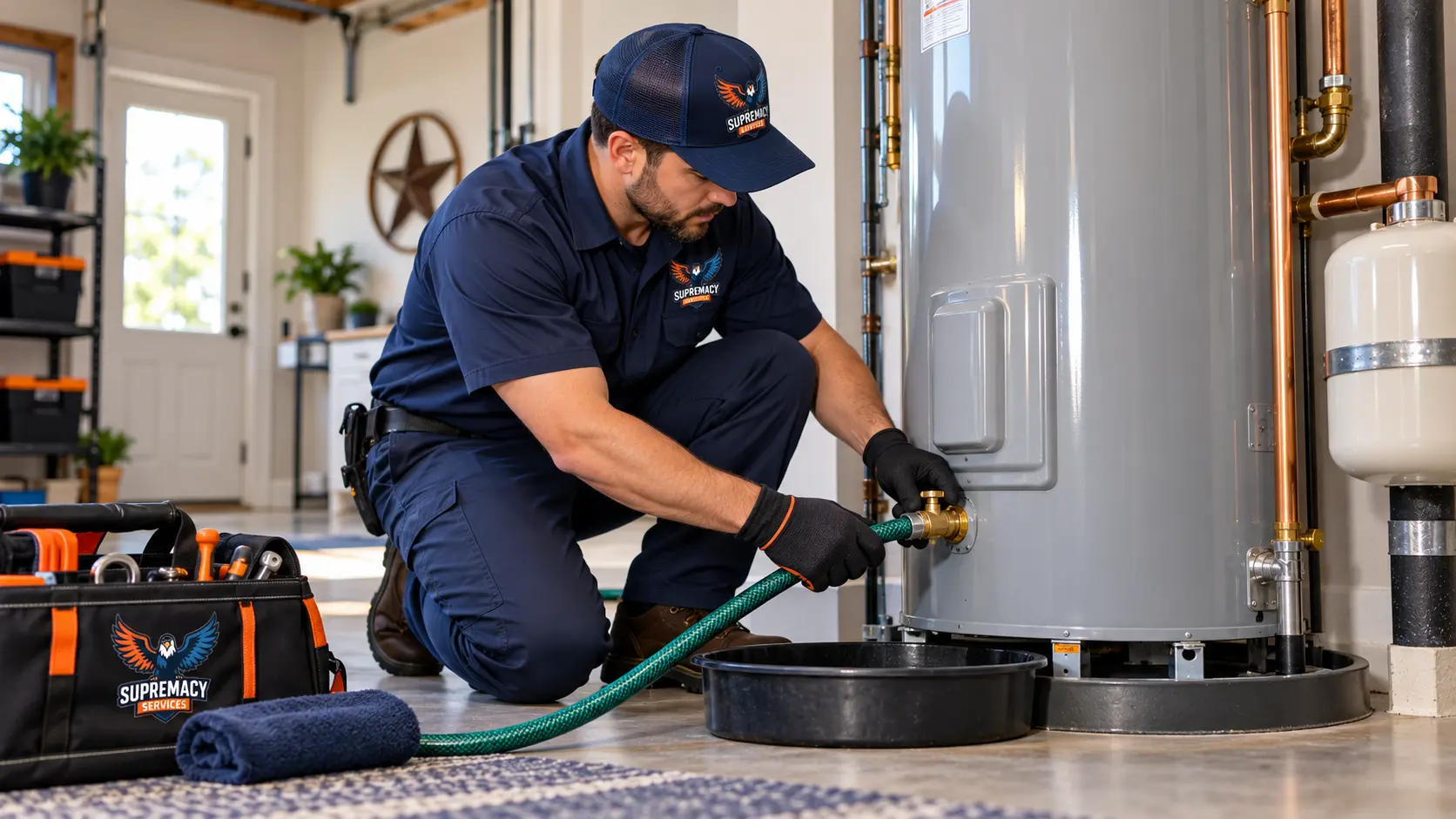
For most Dallas homes with a traditional tank-style water heater, flushing the tank about once a year is a sensible starting point. The exact interval should still follow the manufacturer’s instructions and may need to change depending on water conditions, sediment accumulation, household hot-water use and the condition of the heater.
That maintenance matters in Dallas because the City reports local water hardness ranging from approximately 120 to 155 mg/L as calcium carbonate (CaCO₃)—a range that extends from moderately hard into hard water. Minerals do not automatically mean your water heater has a problem, but they can contribute to deposits and sediment inside water-heating equipment over time.
Manufacturer guidance supports routine maintenance as well. Rheem currently recommends flushing most household storage water heaters once per year to help control sediment accumulation.
The important qualification is that not every water heater should be treated exactly the same way. A newer tank, a heavily neglected 12-year-old tank and a tankless water heater require different maintenance decisions.
Table of Contents
- How often should a Dallas water heater be flushed?
- Why Dallas water conditions matter
- What sediment does inside a water heater
- Signs your water heater may need flushing
- Should you flush more than once a year?
- Can you wait longer than a year?
- Tank vs. tankless maintenance
- Can homeowners flush a water heater themselves?
- When you should not DIY
- What professional water-heater maintenance includes
- How much does water-heater flushing cost?
- Frequently asked questions
How Often Should You Flush a Water Heater in Dallas?
Most traditional storage water heaters should be evaluated for flushing roughly once every 12 months, unless the manufacturer specifies a different interval.
That should be treated as a maintenance baseline rather than an inflexible rule.
Your ideal schedule depends on:
- the water heater manufacturer and model;
- mineral and sediment accumulation;
- household hot-water consumption;
- the age and condition of the tank;
- whether the unit has been regularly maintained;
- unusual noises or reduced hot-water performance;
- whether the heater is a conventional tank or tankless system.
Some manufacturer instructions call for more frequent draining or flushing under particular water conditions. Always check the maintenance section of the manual for your actual model before applying a generic schedule.
Quick Guide
| Situation | Practical approach |
|---|---|
| Normally operating tank with regular maintenance history | Start with annual inspection/flushing according to manufacturer guidance |
| Noticeable sediment during previous flush | Consider whether the manufacturer/plumber recommends more frequent maintenance |
| Popping or rumbling tank | Inspect for sediment rather than simply waiting for the next scheduled service |
| Reduced hot-water capacity | Diagnose the cause; sediment is only one possibility |
| Very old tank that has never been flushed | Have its condition evaluated before aggressively disturbing heavy deposits |
| Tankless water heater | Follow manufacturer descaling/flushing instructions; do not use a storage-tank procedure |
Why Does Dallas Water Make Flushing Worth Paying Attention To?

Dallas Water Utilities obtains its municipal supply from surface-water reservoirs and treats the water before distribution. The City has reported Dallas water hardness in the 120–155 mg/L CaCO₃ range.
That matters because dissolved minerals can eventually contribute to deposits in water-heating equipment.
For a storage water heater, particles and mineral deposits can settle toward the bottom of the tank. A tankless system has no large reservoir, but scale can instead accumulate through narrow internal water passages and across the heat exchanger.
This does not mean every Dallas homeowner needs unusually aggressive maintenance.
A better approach is:
local water conditions + manufacturer instructions + actual equipment condition = appropriate maintenance schedule.
That distinction keeps the recommendation useful rather than simply labeling every North Texas home as a “hard-water problem.”
What Does Sediment Do Inside a Water Heater?
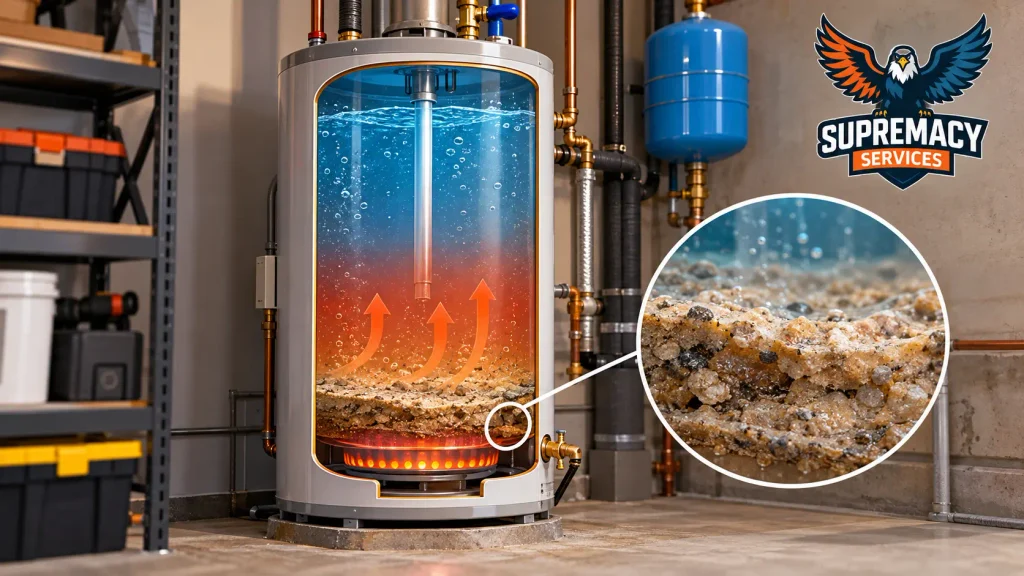
Sediment is material that collects toward the bottom of a storage water-heater tank over time.
As the layer becomes more substantial, it can interfere with the normal transfer of heat into the stored water.
Depending on the heater and severity of the buildup, sediment may contribute to:
- popping or rumbling sounds;
- slower heating or recovery;
- reduced effective hot-water capacity;
- additional stress on heating components;
- material discharged while draining the tank.
The U.S. Department of Energy has long identified sediment removal as a reason for periodically flushing storage-type water-heating equipment because accumulated material can interfere with heat-transfer efficiency.
Flushing is therefore not simply about making the water coming out of the tank look cleaner. Its main purpose is to remove loose accumulated material before it becomes a larger maintenance problem.
Signs Your Water Heater May Need Flushing
Popping or rumbling during heating is one of the clearest reasons to investigate sediment, but it is not the only sign.
Watch for:
1. Popping or rumbling noises
Water trapped around accumulated sediment can produce popping or rumbling as the unit heats.
If this is your main symptom, Supremacy’s separate guide to water-heater popping and rumbling noises explains sediment and the other conditions that can produce similar sounds.
2. Sediment coming from the drain valve
Visible particles during draining can confirm that material has collected in the tank.
3. Hot water running out sooner than expected
Heavy deposits can effectively reduce usable tank volume, although insufficient hot water can also result from heating-element problems, thermostat issues, household demand or an undersized system.
4. Slower recovery
If the tank seems to take longer to replenish hot water, mineral or sediment accumulation may be part of the problem.
Do not automatically assume flushing will solve it. Gas burner, heating-element and control problems can produce similar symptoms.
5. The heater has not been maintained in years
Even if there are no obvious symptoms, a long unknown maintenance history is a reason to inspect the equipment.
However, an older tank that has never been serviced deserves more caution than a newer heater on a regular maintenance program.
Hearing persistent rumbling or noticing declining hot-water performance? Have the water heater inspected before assuming sediment is the only problem. Supremacy Services can evaluate tank condition, sediment buildup and overall water-heater performance throughout Dallas–Fort Worth.
Should You Flush a Water Heater More Than Once a Year?
Possibly—but do it because the condition of the system or manufacturer guidance supports it, not simply because the property is in Texas.
A shorter maintenance interval may be worth discussing when:
- substantial sediment returns quickly after flushing;
- manufacturer documentation calls for more frequent service;
- the household has unusually high hot-water demand;
- mineral accumulation is repeatedly affecting performance;
- a plumber sees significant deposits during maintenance.
For example, some manufacturer documentation specifies intervals different from the common annual recommendation. That is why your equipment manual should take priority over a generic online schedule.
What about every six months?
Some water-heater manuals and technical guidance recommend draining or flushing at six-month intervals.
That does not mean every Dallas heater needs twice-yearly service.
If the manufacturer of your exact heater specifies six months, follow that schedule. If it specifies annual maintenance, annual service may be appropriate unless equipment condition indicates otherwise.
Can You Wait Longer Than a Year?
You can physically leave a water heater unflushed for years, but that does not mean doing so is the best maintenance strategy.
Skipping maintenance allows sediment to accumulate without being evaluated.
The greater concern comes when homeowners wait until a tank has developed:
- loud recurring noises;
- poor hot-water output;
- heavy corrosion;
- leaking;
- clogged drain components;
- years of accumulated deposits.
At that point, “just flush it” may no longer be the right answer.
A plumber may first need to determine whether the tank is structurally sound and whether maintenance still makes sense.
Should You Flush a Water Heater That Has Never Been Flushed?
Do not automatically perform an aggressive DIY flush on an old, neglected tank without first considering its condition.
If a storage heater is many years old and has never been maintained, there may be extensive deposits, deterioration or a drain valve that has not been operated in years.
Before working on it, look for:
- water around the tank;
- corrosion;
- rust-colored water;
- damaged valves;
- deteriorated connections;
- previous leaks;
- unusual burner or electrical problems.
A professional inspection is especially appropriate when the tank is already showing more than one warning sign.
Tank Water Heater Flushing vs. Tankless Descaling
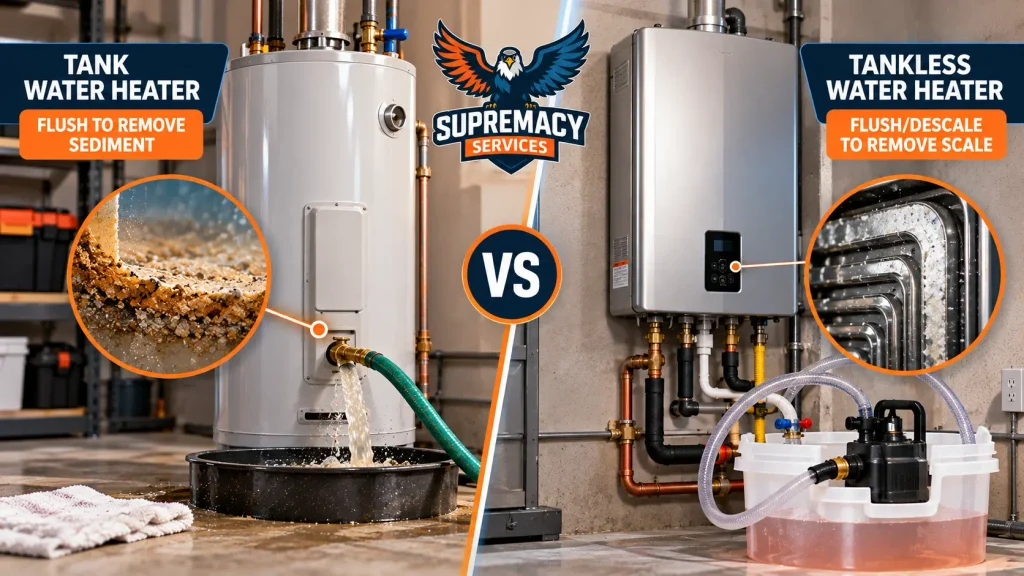
These are related maintenance procedures, but they are not the same job.
| Maintenance issue | Tank water heater | Tankless water heater |
|---|---|---|
| Large storage tank | Yes | No |
| Sediment settling on tank bottom | Common maintenance concern | Not applicable in the same way |
| Mineral scale | Possible | Important heat-exchanger concern |
| Typical service | Drain/flush tank | Flush/descale internal water circuit |
| Maintenance interval | Manufacturer-specific; annual is a common baseline | Manufacturer-specific and water-condition dependent |
| DIY procedure | Depends on equipment and homeowner skill | More equipment/model-specific |
Supremacy’s existing Tank vs. Tankless Water Heater in Dallas guide explains the broader differences between these systems, including efficiency, expected maintenance and service life.
Rheem, for example, recommends annual flushing for tank-style equipment while indicating that tankless units may require periodic draining/descaling at intervals influenced by the model and water conditions.
Do not use storage-tank flushing instructions on a tankless unit.
Can You Flush a Water Heater Yourself?
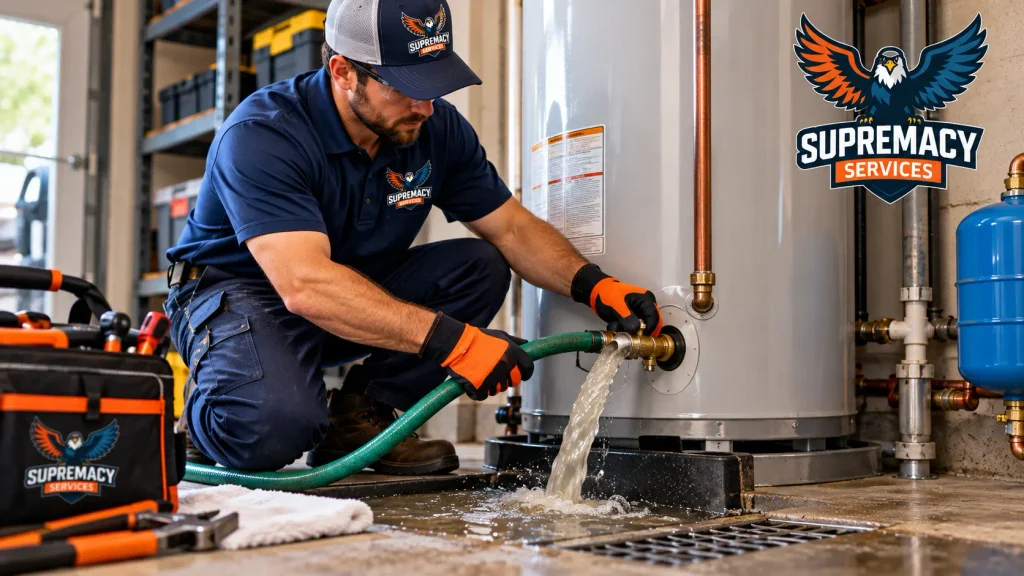
Some experienced homeowners can maintain certain storage water heaters themselves, but flushing is not simply a matter of opening a faucet.
The job may involve:
- shutting down the heater correctly;
- preventing burner or heating-element operation during draining;
- allowing very hot water to cool or controlling it safely;
- isolating the cold-water supply;
- connecting the drain hose safely;
- opening and operating the drain valve;
- flushing sediment;
- refilling the tank completely;
- removing trapped air;
- restoring gas or electrical operation correctly.
The exact procedure differs among equipment types and manufacturers.
The most important DIY rule
Read the manufacturer’s instructions for the specific model before opening valves or disconnecting anything.
Hot water can cause severe burns. Gas equipment introduces combustion and fuel-supply concerns. Electric elements can be damaged if energized while the tank is empty.
If you cannot confidently identify the equipment, shutoffs and correct restart procedure, professional service is the safer choice.
When Should a Dallas Homeowner Call a Plumber Instead?
Professional water-heater service becomes more appropriate when flushing is no longer a straightforward maintenance task.
Call for inspection if:
- the drain valve will not operate;
- little or no water flows from the drain;
- the tank is leaking;
- significant corrosion is visible;
- the heater repeatedly loses hot water;
- noises continue after maintenance;
- the burner behaves abnormally;
- electrical components trip a breaker;
- the heater is old and has never been flushed;
- water temperatures fluctuate unexpectedly;
- you are unsure whether the tank is safe to service;
- the equipment is tankless and requires model-specific descaling.
Flushing cannot repair a failing tank
A flush removes loose deposits. It does not rebuild corroded steel, repair a leaking tank or correct a failed heating element, thermostat, gas valve or burner.
This distinction is important because flushing an already failing water heater can delay the diagnosis of the real problem.
Not sure whether your water heater needs maintenance, repair or replacement? Supremacy Services can inspect the system and explain the condition of the tank before you spend money on the wrong fix.
What Should Professional Water-Heater Maintenance Include?
A proper maintenance visit should involve more than simply attaching a hose.
The exact scope depends on the equipment, but evaluation may include:
- identifying the heater type and model;
- reviewing age and visible condition;
- looking for corrosion or leakage;
- checking sediment accumulation;
- draining or flushing when appropriate;
- evaluating accessible valves and connections;
- checking the sacrificial anode where applicable and appropriate;
- assessing burner or heating performance;
- noting venting or combustion concerns on gas equipment;
- identifying signs of tank deterioration;
- restoring operation and confirming hot-water performance.
Supremacy’s current water-heater service process already identifies sediment buildup, anode-rod condition, burner efficiency and tank integrity among the areas considered during system diagnostics.
What should the homeowner expect afterward?
You should be able to answer:
- Was significant sediment present?
- Is the tank itself in good condition?
- Are there signs of corrosion?
- When should the next service be performed?
- Does anything require repair?
- Is replacement worth planning for?
- Is the maintenance schedule consistent with the manufacturer’s recommendations?
How Much Does Water-Heater Flushing Cost in Dallas?
There is no responsible single price that applies to every Dallas property.
Professional maintenance cost can change according to:
- tank vs. tankless equipment;
- fuel type;
- heater location and accessibility;
- severity of deposits;
- drain-valve condition;
- whether the unit needs diagnosis in addition to maintenance;
- additional components that require inspection or service;
- whether a tankless system needs a model-specific descaling procedure.
Be cautious about comparing a basic “flush” advertisement with a more complete diagnostic and maintenance visit without confirming what each service actually includes.
If the heater is already noisy, leaking or struggling to provide hot water, ask whether the quoted service includes diagnosis rather than paying for flushing alone.
How to Reduce Water-Heater Problems Between Flushes
Flushing should be part of a larger maintenance plan.
Follow the actual manufacturer schedule
The heater’s manual should remain the primary source for required maintenance frequency.
Respond to noises early
A slight new rumble is easier to investigate than years of heavy sediment accumulation.
Watch for moisture
Inspect the area around the tank periodically. Water beneath the heater should not be dismissed as normal condensation without identifying the source.
Watch for corrosion
Check visible tank surfaces, pipe connections and fittings.
Track hot-water performance
Changes in recovery time or available hot water can help identify problems before complete failure.
Know the age of the unit
Record the model and serial number and keep installation/service documentation when available.
Plan rather than wait for emergency failure
If an aging unit begins developing corrosion, leakage, repeated repairs or declining performance, compare repair and replacement before the tank fails unexpectedly.
Supremacy’s separate Water Heater Repair vs. Replacement guide is better suited to that decision.
Flushing vs. Repair vs. Replacement
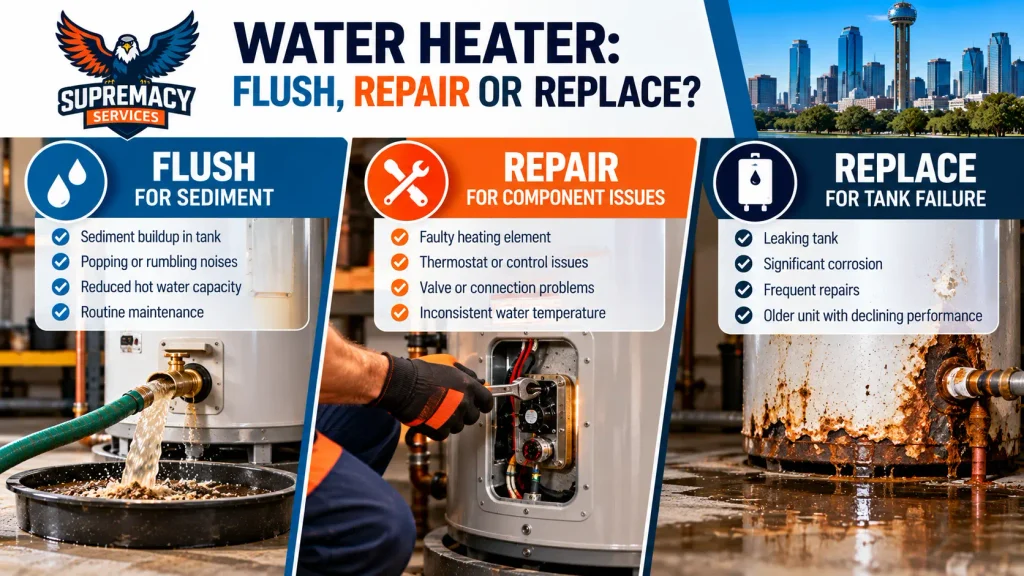
| Condition | Flushing | Repair | Replacement |
|---|---|---|---|
| Routine loose sediment | ✓ | ||
| Sediment-related rumbling | Often appropriate after diagnosis | Sometimes | Sometimes |
| Failed heating element | ✓ | Depends on overall condition | |
| Faulty thermostat/control | ✓ | Depends | |
| Minor serviceable valve issue | ✓ | Depends | |
| Tank itself leaking | Usually required | ||
| Significant tank corrosion | Limited value | Often appropriate | |
| Repeated failures on an aging heater | Limited value | Depends | Increasingly worth considering |
The purpose of maintenance is to preserve serviceable equipment—not to keep a deteriorated tank operating indefinitely.
Dallas Water-Heater Maintenance Checklist
For a typical tank-style heater:
- Check the manufacturer’s maintenance schedule.
- Record the installation date or approximate age.
- Look for leaking or corrosion.
- Listen for new popping or rumbling.
- Watch for changing hot-water capacity.
- Plan periodic tank flushing as specified for the unit.
- Have unusual burner/electrical behavior diagnosed.
- Ask whether the anode rod requires inspection.
- Keep service records.
- Begin replacement planning if multiple age-related problems develop.
Frequently Asked Questions
How often should you flush a water heater in Dallas?
For many traditional tank-style water heaters, about once a year is a reasonable baseline. Follow the manufacturer’s maintenance schedule for your specific model and adjust only when water conditions or equipment condition justify it.
Does Dallas have hard water?
Yes. The City of Dallas has reported water hardness ranging from approximately 120 to 155 mg/L as CaCO₃, spanning the moderately hard to hard classifications used in the City’s reference material.
Does hard water mean I should flush my water heater every six months?
Not automatically. Local mineral content makes sediment worth monitoring, but your manufacturer’s maintenance schedule, actual sediment accumulation and equipment condition should determine whether a shorter interval is appropriate.
What happens if you never flush a water heater?
Sediment can accumulate in storage tanks over time and may interfere with heat transfer, contribute to noise and reduce performance. The severity varies by water conditions, equipment and usage.
Can flushing stop a water heater from popping?
It can if loose sediment is the cause. Popping may also be associated with scale or other plumbing/equipment conditions, so persistent noise should be properly diagnosed.
Can flushing damage an old water heater?
The greater concern is usually that an old, neglected heater may already have deteriorated valves, heavy deposits, corrosion or tank damage. If an older unit has never been maintained, have its condition evaluated before undertaking aggressive DIY service.
Is flushing a tankless water heater the same thing?
No. Tankless systems generally require a model-specific flushing or descaling procedure for the heat exchanger and internal water passages. Follow the manufacturer’s instructions.
How do I know whether I need flushing or replacement?
Sediment alone may call for maintenance. A leaking tank, significant corrosion, recurring failures or multiple age-related problems are more important replacement indicators.
Should I flush the water heater if it is already leaking?
First determine where the leak originates. A loose connection or valve problem is different from leakage through a deteriorated storage tank. Flushing does not repair a failed tank.
Is professional water-heater maintenance worth it?
Professional maintenance is particularly useful when the heater has an unknown service history, significant sediment, difficult access, abnormal noises, tankless equipment, gas/electrical concerns or signs that a larger repair problem may exist.
Final Takeaway: Once a Year Is a Starting Point, Not a Universal Rule
For most Dallas homeowners with a conventional tank water heater, annual flushing is a practical maintenance baseline, supported by current manufacturer guidance.
Dallas water conditions make mineral and sediment buildup particularly relevant: the City reports hardness of approximately 120–155 mg/L as CaCO₃. But the smartest maintenance schedule still depends on the individual heater.
Use this order of priority:
manufacturer instructions → equipment condition → sediment accumulation → household use → local water conditions.
Do not assume every noise requires replacement—and do not assume every aging heater can be restored by flushing.
If your water heater is popping, losing capacity, showing corrosion or has gone years without maintenance, get the equipment evaluated before deciding what it needs.
Need water-heater maintenance or a clear assessment of an aging system? Supremacy Services provides water-heater diagnostics, maintenance, replacement and installation throughout Dallas and the DFW Metroplex. Schedule an evaluation to determine whether your heater needs flushing, repair or a replacement plan.

