

If your water heater is not producing enough hot water, the problem may be as simple as unusually high household demand—or it may indicate sediment buildup, an incorrect temperature setting, a failed heating element, a damaged dip tube, burner trouble or a water heater that is undersized for your home.
For Dallas and DFW homeowners, one of the most useful clues is how the problem happens. If the hot water lasts normally until several fixtures run at once, capacity may be the issue. If a heater that previously worked well suddenly produces only a short shower’s worth of hot water, a component or maintenance problem is more likely.
Before replacing the heater, determine whether the problem is demand, temperature, capacity or equipment failure.
Table of Contents
- Quick answer: why am I running out of hot water?
- Is your household simply using more hot water?
- Is the water heater too small?
- Can sediment reduce hot-water capacity?
- Could a heating element or thermostat be failing?
- Can a damaged dip tube cause the problem?
- Why gas water heaters may not keep up
- Why tankless water heaters can still run short
- Could the problem be outside the water heater?
- What can homeowners safely check?
- Repair or replace?
- What a professional diagnostic should include
- Dallas and DFW considerations
- How to prevent recurring hot-water problems
- FAQs
Why Is My Water Heater Suddenly Not Producing Enough Hot Water?
The most common explanations are excessive demand, an undersized heater, sediment buildup, incorrect temperature settings, failed electric heating elements, thermostat problems, a damaged dip tube or a burner-related problem in a gas unit.
The pattern of the problem often narrows the possibilities.
| What you notice | Possible explanation |
|---|---|
| Hot water lasts normally until several showers or appliances run | Peak demand exceeds heater capacity |
| Hot water has always run out quickly | Water heater may be undersized |
| Hot-water capacity has gradually decreased | Sediment, scale or aging components |
| Electric heater suddenly produces much less hot water | One heating element or thermostat may have failed |
| Water starts hot but becomes lukewarm unusually quickly | Dip tube, sediment or capacity problem |
| Gas water takes much longer than before to recover | Burner, controls, venting or sediment may need inspection |
| Tankless system loses temperature when several fixtures run | Required GPM exceeds the heater’s output |
| Only one shower has the problem | Fixture or mixing-valve problem may be more likely |
Manufacturer troubleshooting documentation specifically lists issues such as thermostat problems, damaged or shortened dip tubes, slow plumbing leaks and electric heating-element faults among potential causes of inadequate hot water.
If your water heater used to keep up but suddenly cannot, schedule a professional water-heater diagnostic before assuming the entire unit needs replacement.
1. Is Your Household Simply Using More Hot Water Than Before?
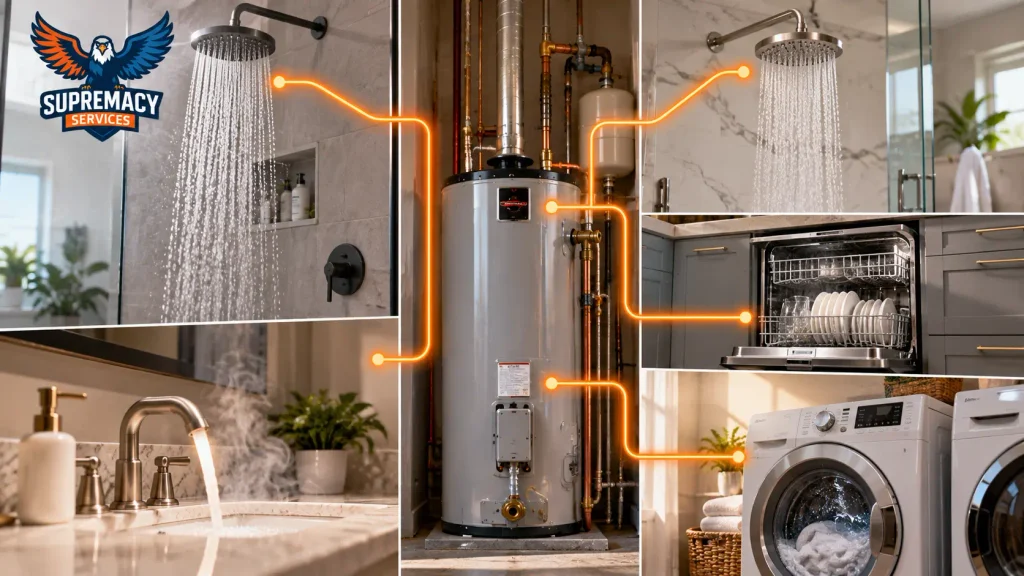
A perfectly functioning water heater can run out of hot water when demand exceeds its available capacity or recovery rate.
This commonly happens when several hot-water uses overlap:
- consecutive showers
- filling a bathtub
- running a dishwasher
- washing clothes with warm or hot water
- using multiple showers simultaneously
- hosting additional family or guests
A storage heater does not provide unlimited hot water simply because its tank says 40 or 50 gallons. What matters is how much usable hot water it can deliver during periods of heavy demand and how quickly it reheats replacement water.
ENERGY STAR’s First Hour Rating is designed to describe this more realistically than tank volume alone.
A useful homeowner test
Ask yourself:
Did anything about our usage change before the problem started?
If the answer is yes, the water heater may simply be encountering a higher peak load.
If nothing changed and the heater previously supplied enough hot water, investigate equipment or maintenance problems instead.
2. Is Your Water Heater Too Small for the Household?
An undersized water heater can work exactly as designed and still leave the household without enough hot water.
For a storage heater, appropriate sizing depends on more than the number of people in the home. A plumber may consider:
- expected peak-hour demand
- First Hour Rating
- fixture usage
- tank capacity
- fuel type
- heater recovery rate
For a tankless heater, sizing depends primarily on:
- simultaneous hot-water flow
- required gallons per minute
- incoming water temperature
- desired outlet temperature
- available heating capacity
That distinction is important.
A four-person household that showers at different times may have a very different peak demand from a four-person household where two showers, a dishwasher and a laundry cycle regularly overlap.
Signs the heater may be undersized
Consider sizing as a possible issue when:
- the heater has never really kept up
- hot water disappears predictably during busy mornings
- the problem became noticeable after adding a bathroom
- household occupancy increased
- a large soaking tub was added
- multiple showers are now used simultaneously
- a tankless heater works well with one fixture but struggles with several
Supremacy’s existing water-heater page already positions professional sizing as part of selecting a replacement system.
3. Can Sediment Buildup Make a Water Heater Produce Less Hot Water?
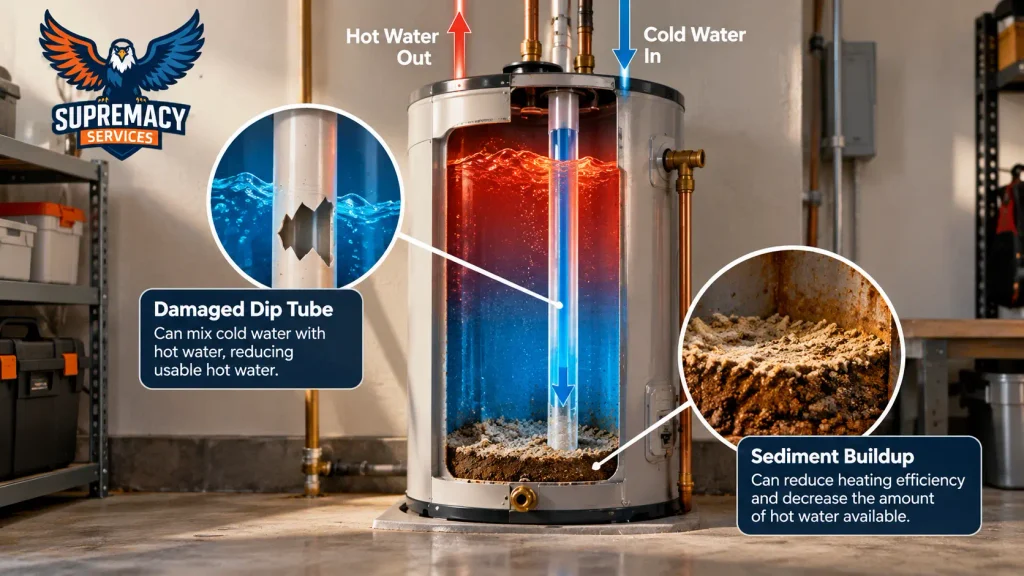
Yes. Deposits inside a storage water heater can interfere with effective heating and reduce usable tank volume, while mineral scale can affect heat transfer and water flow in tankless equipment.
Signs that deposits may be contributing include:
- reduced hot-water performance that developed gradually
- popping or rumbling from a storage heater
- longer recovery times
- inconsistent temperature
- a heater that has gone years without maintenance
Supremacy already identifies sediment buildup as part of its water-heater diagnostic process, which makes this section a natural internal bridge to the commercial page.
Does Dallas water automatically mean you have a scale problem?
Avoid assuming that every Dallas home has identical water chemistry.
Dallas Water Utilities publishes annual drinking-water-quality reports, and the city notes that source water naturally contains dissolved minerals. Actual scale accumulation inside a specific water heater depends on water chemistry, temperature, household usage, treatment equipment and maintenance history.
So the defensible local recommendation is:
Inspect the equipment rather than assuming mineral buildup solely because the property is in North Texas.
4. Could a Bad Heating Element or Thermostat Be Causing the Problem?
Electric water heaters
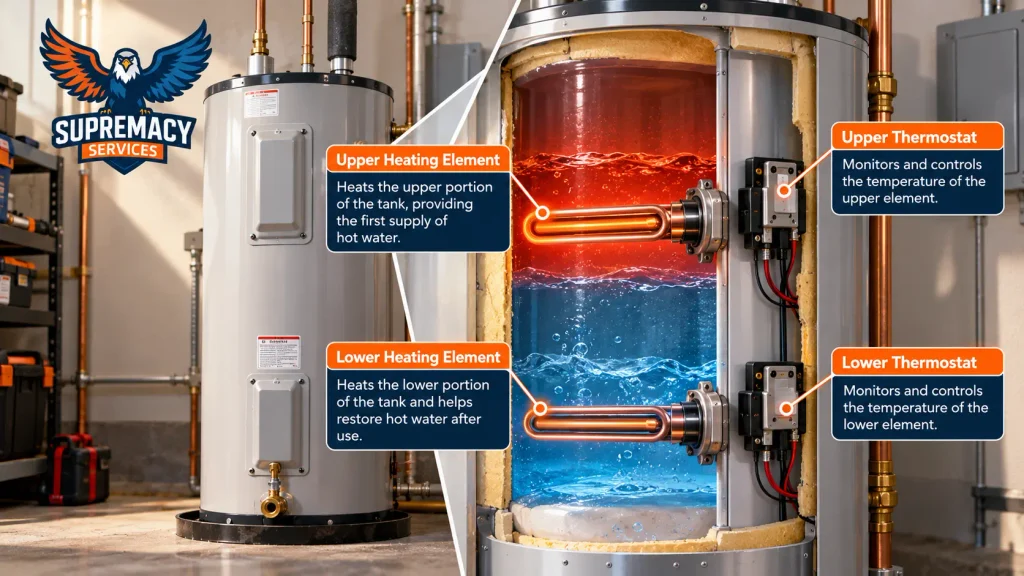
Yes. An electric storage heater can sometimes continue producing some hot water even when one heating element is no longer operating correctly.
That can make the problem confusing.
Instead of receiving no hot water at all, the homeowner may notice:
- a much shorter supply
- slower recovery
- lukewarm water
- enough hot water for one short shower but not normal household demand
A. O. Smith’s technical guidance for inadequate hot water in electric models includes checking thermostats, heating-element operation and the dip tube when temperature or capacity tests indicate abnormal performance.
Electrical testing inside a water heater involves energized components and should not be treated as a casual DIY project.
Thermostat problems
An incorrectly set or malfunctioning thermostat can also result in water that is technically being heated but never gets hot enough to provide the expected usable volume once mixed with cold water at the fixture.
Do not compensate for a suspected malfunction by simply turning the thermostat progressively higher. Excessively hot water increases scald risk and does not repair a defective control. Supremacy services
5. Can a Broken Dip Tube Cause Hot Water to Run Out Quickly?
Yes. In a traditional tank water heater, the dip tube directs incoming cold water toward the bottom of the tank. If it is damaged, incoming cold water can mix with the hottest water near the outlet too early.
The result can feel like:
- a normal burst of hot water
- rapidly decreasing temperature
- a tank that seems to “run out” faster than it should
Dip-tube problems are especially worth considering when the tank otherwise appears to heat normally but usable hot-water volume has fallen significantly.
A. O. Smith lists cracked, missing or short dip tubes among causes associated with inadequate hot water.
6. Why Might a Gas Water Heater Stop Keeping Up?
A gas water heater that produces some hot water but recovers unusually slowly may have a burner, control, combustion, venting or sediment-related issue.
Potential symptoms include:
- much longer recovery between showers
- unusual burner behavior
- repeated shutdowns
- abnormal noises
- inconsistent water temperature
Homeowners should not disassemble a burner, gas valve or venting system to troubleshoot hot-water capacity.
Gas-fired equipment adds combustion and carbon-monoxide considerations that make professional diagnosis particularly important.
If you smell gas, treat that as a separate safety issue rather than an ordinary “not enough hot water” problem.
7. Why Is My Tankless Water Heater Not Producing Enough Hot Water?
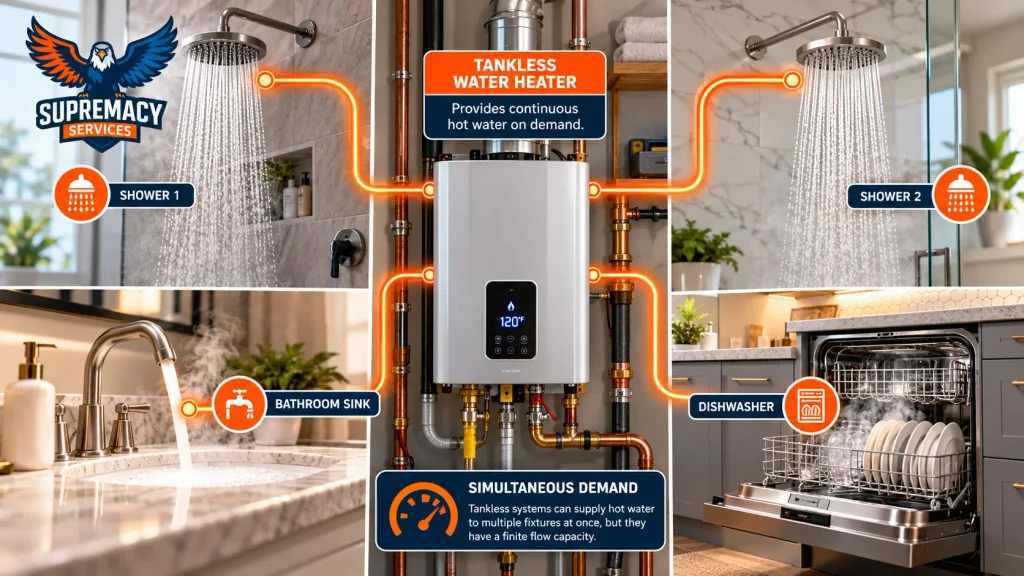
Tankless does not mean unlimited hot water at unlimited flow. A tankless heater can operate continuously but still be overwhelmed when simultaneous demand exceeds its rated GPM at the required temperature rise.
This distinction is one of the most important things homeowners should understand about tankless systems.
ENERGY STAR defines tankless output in terms of gallons per minute at a specified temperature rise.
For example, the system may work normally with:
- one shower
but struggle when the home simultaneously uses:
- two showers
- a bathroom faucet
- dishwasher or washing machine
Possible tankless causes include:
- excessive simultaneous demand
- incorrect original sizing
- mineral scale in the heat exchanger
- restricted flow
- an error condition
- fuel-supply limitations
- incoming-water conditions outside the design assumption
Tankless vs. storage: different symptoms
| Storage heater | Tankless heater |
|---|---|
| Can exhaust stored hot water | Does not depend on a stored tank |
| Recovery time matters | Continuous heating capacity matters |
| Rated partly by FHR | Rated primarily by GPM/temperature rise |
| Sediment may accumulate in tank | Scale may accumulate in heat exchanger |
| Capacity may fade during long usage | Temperature may drop when flow demand is excessive |
For homeowners deciding whether their current equipment is fundamentally the wrong type or size, link to Supremacy’s existing Tank vs. Tankless Water Heater in Dallas comparison article rather than repeating that topic here.
8. What If the Water Heater Is Not Actually the Problem?
If insufficient hot water occurs at only one fixture, troubleshoot the fixture before assuming the water heater has failed.
Possible look-alikes include:
A shower mixing or pressure-balancing valve
A malfunctioning valve can blend too much cold water into one shower while every other hot-water fixture works normally.
A faucet cartridge
A defective cartridge can create poor temperature control at a single sink or shower.
Cross-connection between hot and cold plumbing
In some systems, a failed mixing component can allow cold water to migrate into the hot-water side.
Plumbing leaks
A concealed hot-water leak may increase demand on the heater and make recovery appear poor.
Manufacturer troubleshooting guidance also lists slow piping leaks among possible contributors to inadequate hot water.
Recirculation-system problems
Homes with dedicated hot-water recirculation systems can experience temperature problems when pumps, check valves or control settings malfunction.
How to narrow it down
If every hot-water fixture is affected, suspect the heater or central hot-water system.
If only one fixture is affected, investigate the fixture or nearby plumbing first.
9. What Can a Homeowner Safely Check Before Calling a Plumber?
Start with observations rather than disassembly.
Safe troubleshooting checklist
1. Compare several fixtures.
Determine whether the problem affects one shower or the entire house.
2. Note when the problem occurs.
Does the water run cold only when several fixtures operate?
3. Look for obvious leaks.
Check around the heater and visible hot-water piping.
4. Check the heater display.
For equipment with digital controls, note any error message before resetting anything.
5. Think about household demand.
Were several showers or appliances operating close together?
6. Compare the current performance with past performance.
A heater that has always struggled suggests a sizing issue. Sudden deterioration points more toward a malfunction.
7. Check whether a breaker has tripped.
For an electric water heater, a tripped breaker is useful diagnostic information—but repeatedly resetting a breaker that trips again is not a repair.
What homeowners should generally avoid
Avoid:
- removing electrical access panels while power is on
- testing live heating elements without proper training
- disassembling gas controls
- modifying venting
- disabling safety devices
- plugging or altering a temperature-and-pressure relief system
- repeatedly resetting equipment that continues to fault
- dramatically increasing thermostat temperature to “compensate”
Texas regulates the plumbing trade through the Texas State Board of Plumbing Examiners, which licenses plumbing professionals and establishes scopes of work for license holders.
10. Does Not Having Enough Hot Water Mean I Need a New Water Heater?
No. Insufficient hot water is a symptom, not a diagnosis.
Repair may be appropriate when the problem involves a serviceable component and the rest of the system is in good condition.
Possible repair scenarios include:
- failed thermostat
- failed electric element
- burner or ignition problem
- correctable control issue
- damaged dip tube
- scale or sediment maintenance
- fixture-level mixing problem
Replacement becomes more reasonable when diagnostics show:
- tank failure or active tank leakage
- extensive corrosion
- repeated component failures
- chronic inability to meet household demand
- inappropriate original sizing
- replacement costs that no longer make economic sense compared with installing an appropriate new system
Do not replace an undersized heater with another undersized heater
This is especially important.
If household demand is the underlying problem, replacing a failed 40-gallon heater with another 40-gallon heater simply because it fits the existing space may reproduce the same complaint.
Proper sizing should be part of the replacement decision.
Still running out of hot water? Supremacy Services can evaluate the heater’s capacity, heating components, sediment or scale, controls and overall condition before recommending repair or replacement.
What Does Water-Heater Repair Cost in Dallas?
The correct repair cost depends on what failed—not on the symptom alone.
“Not enough hot water” could result from:
- a thermostat
- electric heating element
- dip tube
- gas-side component
- scale maintenance
- plumbing repair
- complete heater replacement
Those jobs have materially different parts, labor and access requirements.
Other cost factors include:
- gas vs. electric equipment
- tank vs. tankless construction
- heater location
- equipment age
- replacement-part availability
- accessibility
- whether code-related installation corrections are needed
- whether the existing unit is correctly sized
For that reason, this article should not publish an unverified Dallas dollar range merely to capture a cost keyword.
A better conversion message is:
“Have the cause identified first, then compare the repair cost with the condition, age and suitability of the existing heater.”
11. What Should a Professional Water-Heater Diagnostic Include?
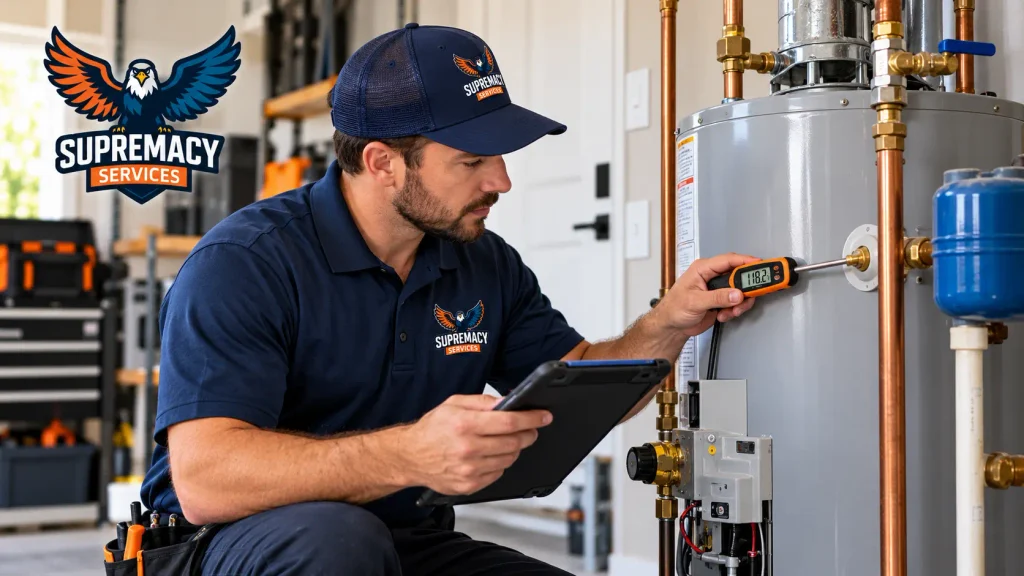
A useful diagnostic should answer one central question:
Is the heater malfunctioning, or is the system simply unable to meet the home’s demand?
Depending on equipment type, a plumber may evaluate:
Hot-water output
Actual water temperature and usable hot-water duration help determine whether the heater is delivering expected performance.
Household demand
The technician should understand how many fixtures are commonly used at once.
Sizing
Storage systems can be evaluated in relation to First Hour Rating and peak demand. Tankless units should be compared with simultaneous GPM requirements and required temperature rise.
Heating components
Electric elements, thermostats, burners, ignition systems and controls may need inspection depending on the heater type.
Sediment or scale
Deposits may need to be evaluated where performance has gradually deteriorated.
Dip-tube condition
A failing dip tube may substantially reduce usable hot-water capacity in a storage heater.
Visible tank condition
Corrosion, leakage or deterioration can change the repair-versus-replacement decision.
Plumbing around the heater
The problem may involve a mixing valve, recirculation loop, piping leak or another component rather than the heater itself.
Supremacy’s published water-heater process includes system diagnostics, sizing and selection, installation and performance verification.
12. Are There Any Dallas-Specific Water-Heater Considerations?
Yes, but local recommendations should be based on conditions that genuinely affect the installation rather than inserting “Dallas” into every paragraph.
Local water conditions
Dallas Water Utilities publishes annual drinking-water quality information and notes that the city obtains its supply from regional surface-water reservoirs. Water chemistry can influence how minerals behave in water-heating equipment, but scale should be diagnosed at the actual heater rather than assumed from geography alone.
Permitting and code considerations
A repair that becomes a replacement or significant installation modification can involve municipal requirements.
The City of Dallas states broadly that permits are required for installing, replacing or altering building service equipment unless an exemption applies. Its listed plumbing exemption covers stopping certain leaks when valves, pipes or fixtures are not replaced or rearranged.
That means homeowners should not assume every water-heater project is permit-free.
Permit requirements can also differ elsewhere in the DFW Metroplex, so requirements should be verified with the municipality where the property is located.
Licensed plumbing work
Texas regulates plumbing professionals through the Texas State Board of Plumbing Examiners. A Journeyman Plumber, for example, may install, change, repair, service or renovate plumbing under the supervision of a Responsible Master Plumber.
13. How Can You Prevent Hot-Water Capacity Problems?
You cannot prevent every component failure, but you can reduce avoidable problems.
Match the system to actual demand
When replacing a heater, size it according to peak demand rather than simply buying the same tank capacity again.
Follow manufacturer maintenance instructions
Maintenance requirements differ by system.
Storage and tankless equipment should be serviced according to the specific manufacturer’s instructions rather than a universal schedule copied from the internet.
Investigate declining performance early
A system that once supplied two or three showers but gradually drops to one is telling you something changed.
That is generally easier to diagnose before complete failure.
Do not ignore leaks
Small hot-water leaks waste heated water and can make a healthy heater appear undersized.
Keep records
Record:
- installation date
- model number
- maintenance
- repairs
- recurring error codes
- unusual performance changes
That information becomes valuable when deciding between repair and replacement.
Quick Decision Guide
| Situation | First step |
|---|---|
| Only one shower lacks hot water | Inspect fixture/mixing components |
| Whole house suddenly gets less hot water | Diagnose heater components |
| Heater has never kept up | Review sizing |
| Multiple fixtures overwhelm tankless unit | Check peak GPM and sizing |
| Capacity declined gradually | Inspect sediment/scale and components |
| Heater is leaking from the tank itself | Professional assessment promptly |
| Breaker repeatedly trips | Stop resetting and diagnose electrical fault |
| Gas odor is present | Treat as a gas-safety issue, not routine troubleshooting |
When Should You Call a Professional?
Arrange professional diagnosis when:
- the heater suddenly produces much less hot water
- a breaker repeatedly trips
- the burner does not operate normally
- error codes keep returning
- the unit leaks
- water temperature fluctuates significantly
- you suspect an electric element or gas-control problem
- tankless output falls even at normal fixture demand
- the system has become progressively slower to recover
- you are unsure whether the heater is undersized or malfunctioning
The goal is not automatically to replace the heater.
The goal is to determine why the available hot water decreased and choose the appropriate repair, maintenance or replacement strategy.
Frequently Asked Questions
Why does my water heater run out of hot water so quickly?
A water heater can run out quickly because household demand exceeds its capacity, the heater is undersized, sediment has reduced performance, or a component such as an electric element, thermostat or dip tube is malfunctioning.
Why do I only get about 10 minutes of hot water?
If this represents a major change from normal performance, the heater may not be heating the full tank effectively. Electric-element problems, thermostat faults, dip-tube issues, sediment and unusually high flow are possible causes.
Can one bad heating element cause less hot water?
Yes. In some electric storage heaters, failure of one element can leave the unit producing some hot water while greatly reducing capacity or recovery performance. Manufacturer technical guidance lists element and thermostat testing as part of diagnosing insufficient hot water.
How do I know whether my water heater is too small?
If the system has always struggled during normal peak usage, compare household demand with the heater’s rated capacity. For storage heaters, First Hour Rating is particularly useful; for tankless equipment, compare simultaneous GPM demand with rated output at the required temperature rise.
Can sediment make my water heater run out faster?
Deposits can interfere with effective heat transfer and overall heater performance. If usable hot-water capacity has gradually declined or the tank makes unusual popping or rumbling sounds, inspection may be appropriate.
Why does my tankless water heater turn cold when two showers are running?
The combined fixture flow may exceed the tankless heater’s rated output for the required temperature rise. Tankless systems can heat continuously, but every unit still has a maximum heating and flow capacity.
Should I turn my water heater temperature higher if I keep running out?
Not as a substitute for diagnosis. Increasing temperature may increase usable mixed hot water in some situations, but excessive temperatures raise scald risk and will not correct a failed element, dip tube, burner, control or undersized system.
Why is one shower cold when the rest of the house has hot water?
When only one fixture is affected, the shower cartridge, mixing valve or another fixture-level component may be responsible rather than the water heater.
Should I repair or replace a water heater that cannot keep up?
That depends on the actual failure, condition of the heater and whether the unit is correctly sized. A serviceable component may justify repair, while leakage, severe corrosion, repeated failures or chronic undersizing may make replacement more appropriate.
Final Takeaway
Final Takeaway
A water heater that is not producing enough hot water does not automatically need replacement.
Start by identifying the pattern.
If hot water disappears only during periods of heavy simultaneous use, your household may be exceeding the system’s available capacity. If performance has deteriorated from what the heater previously provided, investigate sediment or scale, electric elements, thermostats, the dip tube, gas-heating components or plumbing problems outside the heater.
And if the equipment has never kept up with your household, treat sizing—not simply repair—as part of the diagnosis.
Running out of hot water in Dallas or the DFW Metroplex? Supremacy Services can diagnose your current tank or tankless system, determine whether the problem is capacity, maintenance or component failure, and explain whether repair or replacement makes the most sense for your home.

