
When a water heater starts leaking, making noise or struggling to provide enough hot water, Dallas homeowners usually face the same question: Which is more cost-effective Water Heater Repair vs. Replacement?
The answer depends on more than the repair price.
A relatively young water heater with a replaceable thermostat, heating element, burner component or valve may be worth repairing. An older unit with tank corrosion, recurring breakdowns, declining performance or a leak from the storage tank itself is often a better candidate for replacement.
The most useful comparison is:
repair cost + expected remaining service life + future repair risk
versus
replacement cost + expected service life + operating cost + installation requirements
For homeowners throughout Dallas and the DFW Metroplex, the unit’s age, condition, fuel type, maintenance history and installation also affect that decision.
Table of Contents
- Repair vs. Replacement: Quick Answer
- How Much Does Repair vs. Replacement Cost?
- When Is Repair More Cost-Effective?
- When Does Replacement Make More Sense?
- Does the Age of the Water Heater Matter?
- Can a Leaking Water Heater Be Repaired?
- Common Problems: Repair or Replace?
- Dallas-Specific Considerations
- DIY vs. Professional Service
- What a Professional Diagnosis Should Include
- How to Make the Decision
- FAQs
Repair vs. Replacement: Quick Answer
Repair is usually more cost-effective when the water heater is relatively young, the tank itself is sound, the problem is isolated to a serviceable component, and the repair is likely to restore reliable operation for several more years.
Replacement becomes more attractive when the tank is leaking or corroded, the heater is approaching the later part of its expected life, repairs are becoming frequent, or a major repair would put substantial money into equipment that may soon fail for another reason.
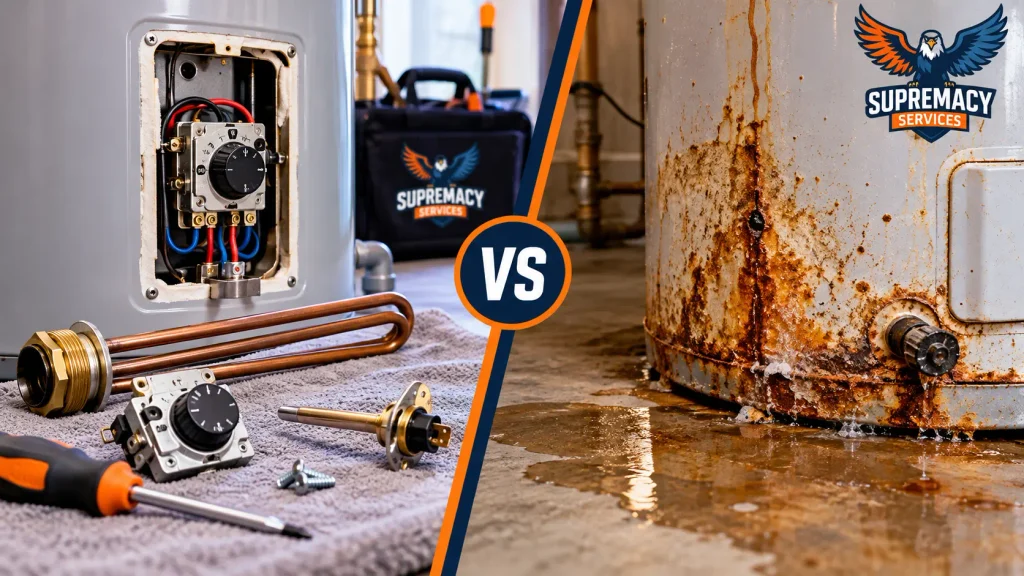
Here is the practical comparison:
| Situation | Repair usually makes more sense | Replacement usually makes more sense |
|---|---|---|
| Minor electrical/control failure | ✓ | |
| Replaceable thermostat or heating element | ✓ | |
| Serviceable burner/ignition problem | ✓ | |
| Healthy tank with isolated valve problem | ✓ | |
| Unit is relatively young | ✓ | |
| Tank itself is leaking | ✓ | |
| Significant tank corrosion | ✓ | |
| Repeated repair history | ✓ | |
| Older system plus expensive repair | ✓ | |
| Unit no longer meets household demand | ✓ | |
| Major code/infrastructure improvements are already planned | Depends | ✓ may provide better long-term value |
Age alone should never make the decision. A plumber should identify what failed and whether the rest of the system remains structurally sound before recommending replacement.
How Much Does Water Heater Repair vs. Replacement Cost?
There is no single reliable price for every Dallas home because equipment type, accessibility, fuel source, parts, venting, plumbing modifications and permit requirements can all change the final cost.
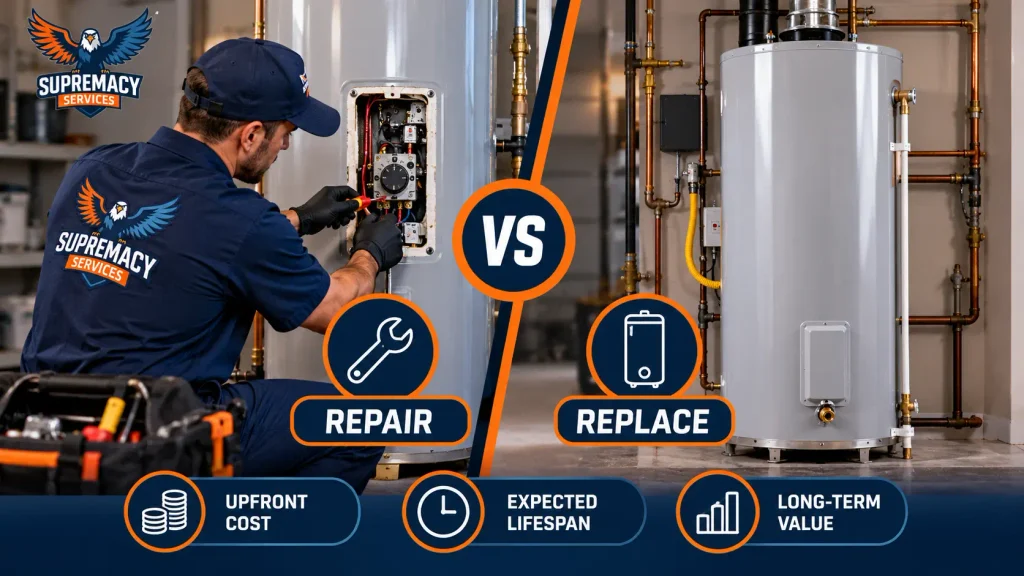
For context—not as Supremacy Services pricing—Angi’s current Dallas consumer cost data reports an average water-heater repair cost of about $539, with a typical reported range of approximately $185–$894. Its Dallas replacement data reports an average around $1,487, with many reported projects around $1,037–$1,997. These are third-party market estimates, not quotes for a particular home.
The important question is therefore not simply:
“Which option costs less today?”
It is:
“What am I buying with that money?”
A $400 repair that produces several additional years of dependable service can be excellent value.
The same $400 spent on a badly deteriorated water heater shortly before another major failure may not be.
What affects repair cost?
Repair cost can change based on:
- the failed component;
- tank vs. tankless construction;
- gas vs. electric equipment;
- accessibility;
- parts availability;
- diagnostic time;
- venting or combustion problems;
- whether several components are failing at once.
What affects replacement cost?
Replacement can become more expensive when the project involves:
- changing tank size or technology;
- converting from tank to tankless;
- modifying gas piping;
- installing different venting;
- electrical upgrades;
- relocating the heater;
- drain or condensate changes;
- code corrections;
- accessibility challenges;
- permit and inspection requirements.
That is why comparing a repair quote with the retail price of a new appliance is misleading. The correct comparison is between the complete repair and the complete installed replacement.
When Is Water Heater Repair More Cost-Effective?
Repair is most attractive when the underlying tank or heat exchanger is healthy and the failed component can be replaced without putting excessive money into a declining system.
Examples can include certain problems involving:
Heating elements
Electric storage heaters generally use replaceable heating elements. If an otherwise healthy unit stops heating properly because an element has failed, replacing the component may make considerably more sense than replacing the entire heater.
Thermostats and controls
A thermostat or control failure can cause water to become too cool, excessively hot or inconsistent.
If testing confirms that the tank and other major components are sound, repairing the control system can extend useful service without the expense of full replacement.
Ignition or burner components
Gas water heaters can experience ignition, thermocouple, burner or control problems.
Some are repairable, but fuel-burning appliances require proper diagnosis because symptoms can also relate to gas supply, combustion or venting issues.
Valves and external connections
Water around a heater does not automatically mean the storage tank has ruptured.
A plumber should determine whether moisture is coming from:
- a plumbing connection;
- drain valve;
- temperature and pressure relief system;
- nearby piping;
- condensation;
- or the tank itself.
The source matters because some external leaks may be repairable while a compromised storage tank generally changes the economics completely.
A first significant repair on a younger unit
If the heater has otherwise performed reliably and remains structurally sound, one repair may be an entirely reasonable ownership expense.
The calculation changes when repairs become a pattern.
Not sure whether the problem is a replaceable component or a failing tank? Supremacy Services can diagnose the water heater and explain the repair and replacement options before you decide.
When Is Water Heater Replacement More Cost-Effective?
Replacement generally becomes more cost-effective when the existing heater has a serious non-serviceable failure, little expected life remaining or a history suggesting additional repair costs are likely.
1. The storage tank itself is leaking
This is one of the most important distinctions in the entire repair-vs.-replacement decision.
Water around a heater may come from a fitting or valve, but if the tank shell or internal tank has failed, replacing an external component will not restore the tank’s integrity.
ENERGY STAR identifies leaking, visible corrosion, rusty water, insufficient hot water and unusual rumbling as warning signs that an aging water heater may be approaching failure.
A leak should therefore be diagnosed promptly rather than assumed to be harmless.
2. Corrosion is affecting the tank
Visible corrosion around the heater or rust-related deterioration deserves investigation.
Storage tanks are designed to resist corrosion, often with protective linings and sacrificial anode rods, but those defenses do not last indefinitely.
Once structural tank corrosion has progressed far enough, investing heavily in unrelated components may provide poor long-term value.
3. Repairs are becoming frequent
One repair is very different from a sequence of breakdowns.
If you have recently replaced one component and another major issue appears shortly afterward, look at the total repair spending, not just the newest estimate.
Three modest repairs can collectively become more expensive than they first appear.
4. Hot-water performance no longer meets the home’s needs
Sometimes the heater still operates but no longer performs adequately.
That can happen because of:
- sediment accumulation;
- reduced usable tank capacity;
- component deterioration;
- a change in household demand;
- incorrect original sizing;
- or declining equipment performance.
Repairing an old system that was undersized from the beginning may restore operation without solving the homeowner’s actual problem.
5. A major repair is being considered on an aging unit
An expensive repair is harder to justify when several other age-related components could fail during the following years.
This is where remaining service life matters.
ENERGY STAR’s consumer guidance recommends planning ahead when an older water heater begins showing signs such as corrosion, leakage, rusty water, reduced hot-water availability or rumbling.
How Much Does Water Heater Age Matter?
Age matters because it changes how much future value you are likely to receive from a repair—but it should not be used as an automatic replacement deadline.
A nine- or ten-year-old heater that has been maintained and has a minor replaceable component failure may still warrant repair.
A similar-age heater showing tank corrosion, repeated breakdowns and poor hot-water performance presents a very different case.
Supremacy’s existing Dallas water-heater comparison also discusses typical tank and tankless lifespans and explains why maintenance, water conditions, installation quality, equipment quality and household demand can all change real-world service life.
Instead of asking only:
“How old is it?”
ask:
“How old is it, what failed, what condition is the rest of the unit in, and what is the realistic cost of keeping it dependable?”
Can a Leaking Water Heater Be Repaired?
Sometimes—but the source of the leak determines the answer.
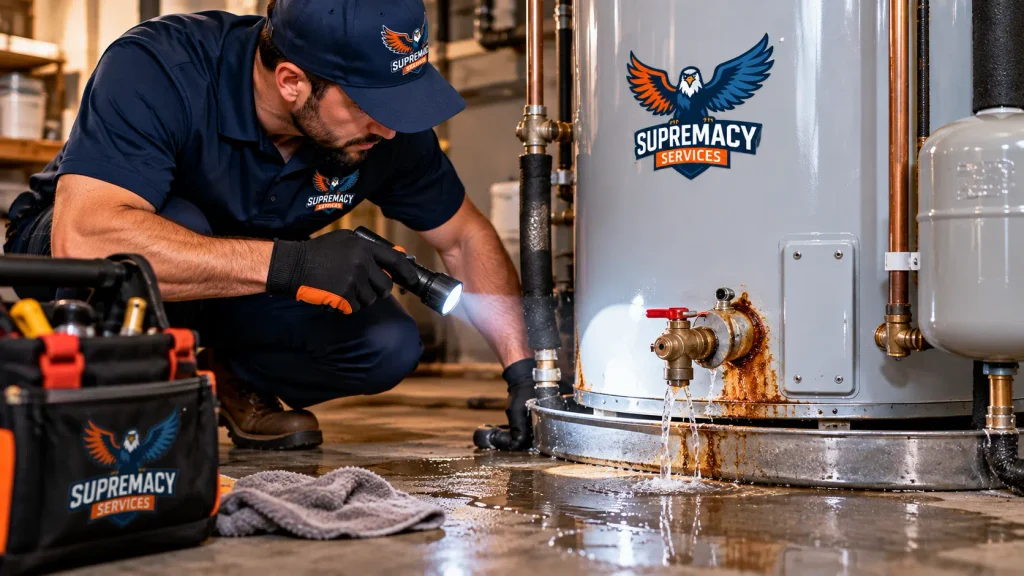
A leaking pipe connection or serviceable valve may be repairable.
A leaking storage tank is a much more serious issue and typically points toward replacement because the tank itself is the pressure vessel holding the water.
Do not assume that every puddle beside a water heater means the tank has burst. Water can travel along piping or collect beneath equipment from another source.
A professional diagnosis should trace the moisture to its actual origin.
Treat active leakage as a priority
A storage water heater contains a significant volume of water, so an uncontrolled leak can damage surrounding materials and belongings.
If water is actively escaping, particularly near electrical equipment or gas-fired components, avoid attempting an improvised repair that could introduce additional safety risks.
Common Water Heater Problems: Repair or Replace?
| Symptom | Possible issue | What usually decides repair vs. replacement |
|---|---|---|
| No hot water | Element, thermostat, ignition, burner/control issue | Component condition + unit age |
| Not enough hot water | Sediment, failed element, sizing, dip-tube or control issue | Whether performance can be restored economically |
| Water too hot/cold | Thermostat/control issue | Usually diagnosis before replacement |
| Rumbling/popping | Sediment/mineral accumulation or other issues | Tank condition + severity + age |
| Rust-colored hot water | Corrosion or plumbing-related issue | Source of rust and tank condition |
| Water around heater | Valve, fitting, piping or tank leak | Exact leak source |
| Pilot/ignition failures | Gas-control/ignition problem | Repairability, venting and overall condition |
| Rising operating cost | Efficiency loss, sediment, controls or usage | Diagnostic findings + replacement economics |
| Repeated breakdowns | Multiple aging components | Cumulative repair cost + remaining life |
This table is intentionally diagnostic rather than absolute. Similar symptoms can have different causes.
For example, “not enough hot water” could mean a failed electric heating element, accumulated sediment, an undersized tank or simply greater household demand than the system was designed to handle.
That is why replacing equipment before diagnosing the symptom can waste money.
Repair Cost vs. Remaining Life: A Better Way to Calculate Value
The cheapest immediate option is not automatically the cheapest long-term option.
A useful homeowner calculation is:
Repair value
Repair price ÷ realistic additional years of service
versus:
Replacement value
Total installed replacement cost ÷ realistic expected service life
Then consider:
- expected energy use;
- maintenance costs;
- probability of another major repair;
- warranty coverage;
- improved hot-water capacity;
- whether infrastructure changes are needed.
This does not produce a perfect forecast, but it is more rational than comparing only today’s invoices.
Example
Imagine two homeowners receive the same repair estimate.
Homeowner A has a relatively young water heater with one failed component and no tank deterioration.
Homeowner B has an older heater with corrosion, poor hot-water capacity and two recent repairs.
The identical repair price can represent good value for Homeowner A and poor value for Homeowner B.
Does a New Water Heater Save Enough Energy to Justify Replacement?
Potential energy savings should be considered, but energy efficiency alone usually should not determine whether a functioning water heater is replaced.
The U.S. Department of Energy notes that water heating represents a meaningful share of household energy use, so equipment efficiency can affect lifetime ownership cost.
However, savings depend on:
- your existing heater’s efficiency;
- replacement technology;
- household hot-water consumption;
- fuel type;
- utility rates;
- equipment size;
- installation quality.
A homeowner should therefore compare installed cost and lifetime operating cost, not simply assume that the most efficient appliance is automatically the most economical purchase.
If replacement is already justified because the old unit is failing, that is an excellent time to compare higher-efficiency options.
If your real decision is whether to choose a storage tank, tankless unit or another technology, use Supremacy’s separate Tank vs. Tankless Water Heater in Dallas guide.
Dallas and DFW Considerations
Water-heater replacement requires attention to permits and code
Dallas treats water-heater replacement as plumbing work requiring a permit. Current City guidance also identifies water heaters within plumbing permit requirements and states that plumbing trade work is handled through properly registered professionals.
The City has adopted Dallas amendments to the 2021 International Plumbing, Residential, Fuel Gas and related construction codes.
That means replacement cost comparisons should account for the complete compliant installation, rather than comparing an appliance’s store price with a repair bill.
Mineral and sediment accumulation matter
Minerals and sediment can accumulate in water-heating equipment over time.
In storage heaters, deposits can settle in the tank. In tankless systems, scale can accumulate in the heat exchanger.
The practical lesson is not that every Dallas water heater will fail from scale. It is that the heater’s internal condition and manufacturer-recommended maintenance should be part of the diagnosis.
Different DFW homes create different installation conditions
Dallas–Fort Worth includes older properties, newer subdivisions, gas-equipped homes, all-electric homes, garages, utility rooms, closets and other water-heater locations.
Consequently, two homeowners purchasing the same replacement model can have different total installation costs because the surrounding system may require different work.
Can You Repair a Water Heater Yourself?
Some basic homeowner checks are reasonable, but water-heater repair can involve pressurized hot water, electricity, gas, combustion and venting.
A homeowner may safely verify simple things such as whether a breaker has tripped or whether another plumbing problem is affecting hot-water delivery, provided the manufacturer’s instructions are followed.
But opening electrical compartments, modifying gas components, altering venting or attempting to patch a leaking pressure vessel is a different category of work.
Texas regulates plumbing work through the Texas State Board of Plumbing Examiners, and licensed plumbers operate within defined scopes of practice.
For Dallas replacement work, local permit requirements also apply.
If the problem involves gas odor, combustion concerns, electrical damage, active leakage or uncertain equipment condition, professional diagnosis is the appropriate next step.
What Should a Professional Water Heater Diagnosis Include?
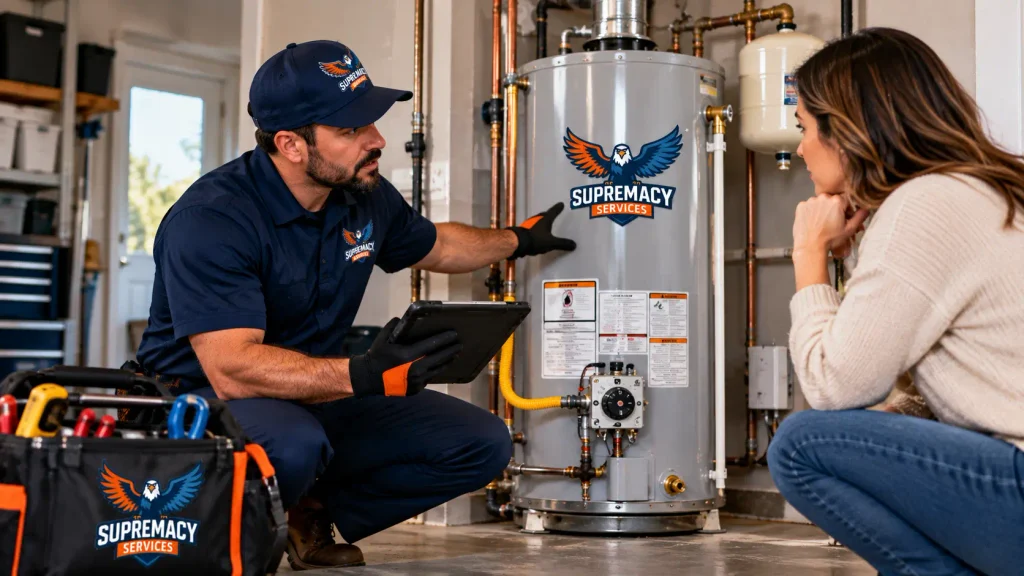
A useful diagnosis should answer more than “Can we make it run again?”
The technician should evaluate the failure and the condition of the system around it.
Supremacy’s published water-heater process includes checking sediment buildup, anode-rod condition, burner efficiency and tank integrity, followed by system sizing when replacement is appropriate.
Depending on the equipment, an assessment may also consider:
- age and model;
- tank integrity;
- signs of corrosion;
- leak source;
- heating elements or burner operation;
- controls and thermostat function;
- ignition components;
- T&P relief components;
- venting on fuel-fired units;
- gas or electrical supply;
- hot-water demand;
- prior repair history.
The goal should be to give the homeowner enough information to compare repair value with replacement value, not merely to sell the more expensive option.
“Get a water-heater diagnosis before putting more money into the wrong fix. Supremacy Services can evaluate the system and explain your repair and replacement options for your Dallas–Fort Worth home.”
A Simple Repair-vs.-Replacement Decision Process
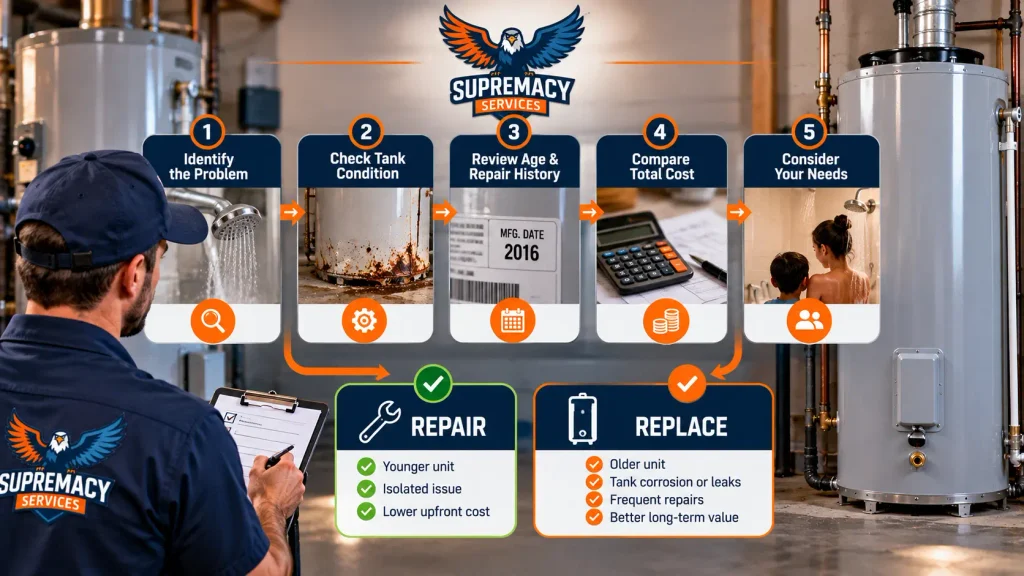
Step 1: Identify the actual failure
Do not decide based on symptoms alone.
“No hot water” and “water around the tank” each have several possible causes.
Step 2: Determine whether the tank is structurally sound
Tank deterioration has a much greater effect on the replacement decision than a replaceable thermostat.
Step 3: Confirm the age and maintenance history
Check the model/serial information, paperwork and prior service records when available.
Step 4: Obtain the complete repair cost
Include labor, parts and any related corrective work.
Step 5: Obtain the complete installed replacement cost
The replacement comparison should include the equipment and installation requirements—not merely the appliance price.
Step 6: Estimate remaining value
Ask what realistic service life the repair is expected to provide and whether other components show significant deterioration.
Step 7: Consider household needs
If the current heater has never provided enough hot water, repairing it may restore the original performance without solving inadequate capacity.
Step 8: Compare total ownership value
Consider reliability, operating cost, warranty, maintenance and expected years of service.
How to Make a Water Heater Last Longer
Good maintenance cannot make a failing tank new again, but it can help reduce avoidable problems and reveal deterioration earlier.
Follow the manufacturer’s maintenance instructions for your exact model.
Useful practices may include inspecting for leaks and corrosion, addressing unusual operating changes promptly, having applicable safety components checked, and performing manufacturer-recommended flushing or descaling.
Do not automatically apply the same maintenance procedure to every heater. Tank, tankless, heat-pump, gas and electric equipment have different requirements.
Repair or Replace? The Bottom Line for Dallas Homeowners
Repair the water heater when the problem is isolated, serviceable and the rest of the equipment still has enough useful life to justify the expense.
Consider replacement when the tank itself is failing, corrosion is significant, repairs are becoming frequent, performance no longer meets the household’s needs or a substantial repair would put more money into equipment already approaching the end of dependable service.
Do not make the decision from age or repair price alone.
The most cost-effective choice comes from comparing:
current condition + repair cost + expected remaining life + reliability
against:
installed replacement cost + expected life + efficiency + future maintenance.
For Dallas residents, remember that replacement is also an installation project subject to local plumbing requirements—not simply an appliance purchase.
Need a clear repair-or-replace recommendation for your water heater? Supremacy Services provides water-heater diagnostics, replacement and installation throughout Dallas and the DFW Metroplex. Schedule an evaluation to compare the condition of your existing unit with the real cost of replacement before you decide.
Frequently Asked Questions
Is it cheaper to repair or replace a water heater?
Repair costs less upfront in many cases, but replacement may provide better long-term value if the tank is failing, the heater needs frequent repairs or a major repair would only extend the life of an already deteriorating unit.
Is a 10-year-old water heater worth repairing?
Possibly. Age by itself does not determine the answer. A serviceable component failure on an otherwise healthy heater may be worth repairing, while tank corrosion, leakage or repeated failures can make replacement more economical.
Can you repair a water heater that is leaking?
It depends on where the leak originates. Some leaks from connections or serviceable components can be repaired. A leak from the storage tank itself is a much stronger indication that replacement is required.
How much does water heater repair cost in Dallas?
Third-party consumer cost data from Angi currently reports Dallas water-heater repairs averaging about $539, with many projects between roughly $185 and $894. Actual pricing depends on the failure, equipment and labor required.
How much does water heater replacement cost in Dallas?
Angi currently reports an average Dallas replacement cost near $1,487 and a common reported range of roughly $1,037–$1,997. Treat these as consumer market estimates rather than a quote; equipment, access, fuel type and installation modifications can change the actual cost considerably.
Should I replace my water heater before it completely fails?
Planning ahead can make sense when an aging heater shows warning signs such as corrosion, leakage, rusty water, reduced hot-water availability or abnormal noises. ENERGY STAR specifically identifies these as indicators homeowners should pay attention to.
Does a new water heater lower utility bills?
It can, particularly when the replacement is more efficient than the existing equipment, but savings vary according to technology, hot-water use, energy prices and installation. DOE recommends considering efficiency as part of the equipment-selection process.
Do I need a permit to replace a water heater in Dallas?
Yes. City of Dallas guidance specifically identifies water-heater replacement as work requiring a plumbing permit.
Should I switch to tankless when replacing my water heater?
Not automatically. Tankless equipment can offer advantages, but conversion may require gas, venting, electrical, condensate or plumbing changes. Compare household hot-water demand, infrastructure, installation cost and expected ownership period before deciding. Supremacy’s separate tank-vs.-tankless guide covers that decision in detail.

