
Daikin VRV systems require more than a basic filter change and thermostat check. A proper Daikin VRV maintenance visit in Dallas should evaluate the indoor units, outdoor equipment, filters and airflow, condensate drainage, controls, electrical components, refrigerant circuit and system-generated diagnostic information.
That matters particularly in North Texas because cooling equipment faces a substantial seasonal workload. Dallas/Fort Worth’s 1991–2020 climate normals include approximately 20 days per year reaching at least 100°F, with normal July and August highs near 96°F.
For a multi-zone VRV system, seemingly small problems—such as restricted airflow, a drainage issue or a communication fault—can therefore become much more noticeable during periods of sustained cooling demand.
This guide explains what Dallas property owners and facility managers should expect from Daikin VRV maintenance, which warning signs deserve attention, what can safely be checked without opening the equipment, and when a qualified HVAC professional should diagnose the system.
What Is Daikin VRV Maintenance?
Daikin VRV maintenance is the inspection, cleaning, testing and diagnostic servicing of the indoor units, outdoor units, controls and related components that make up a Daikin Variable Refrigerant Volume system.
VRV is Daikin’s terminology for its variable-refrigerant-volume technology. Depending on the system, one outdoor system can serve multiple indoor zones, while inverter technology adjusts system operation as building loads change.
Daikin describes VRV as a modular system that distributes refrigerant from outdoor equipment to multiple indoor units, providing individual zone control for multi-zone buildings.
Because those components operate as an interconnected system, maintenance should consider the network as a whole rather than treating each indoor unit as an unrelated air conditioner.
Quick Daikin VRV Maintenance Checklist
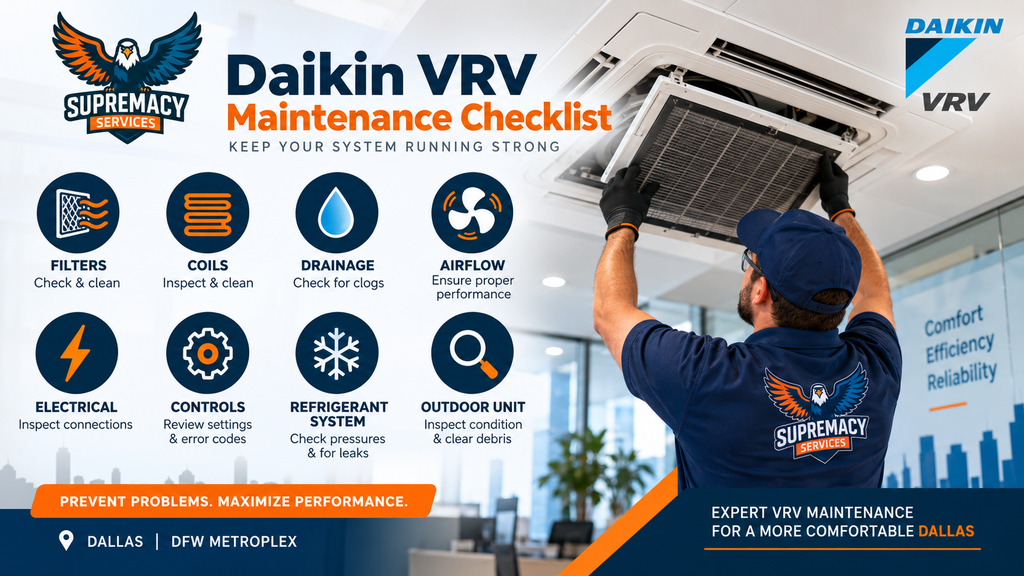
A professional inspection may include the following, depending on the exact model, configuration and manufacturer requirements:
| Maintenance item | What is checked | Why it matters |
|---|---|---|
| Indoor-unit filters | Dirt, restriction and filter condition | Supports airflow and heat transfer |
| Indoor heat exchangers | Dust and contamination | Dirty surfaces can reduce performance |
| Outdoor heat exchanger | Dirt, leaves and airflow obstructions | Outdoor airflow is necessary for heat rejection/absorption |
| Condensate system | Drain pans, drains and pumps where fitted | Helps prevent overflow and water damage |
| Indoor/outdoor airflow | Obstructions and fan operation | Restricted airflow can reduce capacity |
| Electrical system | Connections and operating condition | Identifies deterioration or abnormal electrical conditions |
| Controllers | Settings, warnings and error codes | Can reveal faults before unnecessary parts are replaced |
| Communication network | System communication where applicable | VRV equipment depends on coordinated control |
| Refrigerant circuit | Operating data and signs indicating a refrigerant problem | Incorrect refrigerant conditions can impair performance |
| Sensors/thermistors | Plausibility and system response | Incorrect readings can affect control decisions |
| Compressor/outdoor unit | Operation and diagnostic data | Central to system capacity |
| Overall operation | Cooling/heating response across zones | Confirms the system is functioning as intended |
The exact checklist should follow the documentation for the installed Daikin model rather than a generic HVAC checklist.
How Often Should a Daikin VRV System Be Maintained in Dallas?
There is no single maintenance interval that should be applied blindly to every Daikin VRV installation. The appropriate schedule depends on the equipment model, building use, operating hours, environment and manufacturer requirements.
As a general HVAC benchmark, ENERGY STAR recommends professional pre-season checkups and identifies tasks including checking controls and electrical connections, inspecting condensate drainage, cleaning coils and checking refrigerant-related performance.
For Dallas properties, it makes practical sense to have the cooling side evaluated before the period of greatest summer demand, especially in buildings where HVAC failure would interrupt business operations or affect many occupied zones.
Commercial properties with long operating hours, heavy occupancy, dusty conditions or mission-critical cooling may warrant a maintenance program tailored to their equipment and usage rather than relying only on an annual visit.
Need the system professionally evaluated? Supremacy Services provides VRV system service and maintenance for Dallas/DFW properties, including system diagnostics, refrigerant/EEV analysis, coil cleaning and control-system checks.
What Does a Professional Daikin VRV Maintenance Visit Include?
1. Review the Controllers and Diagnostic History
A VRV maintenance visit should begin with information rather than parts replacement.
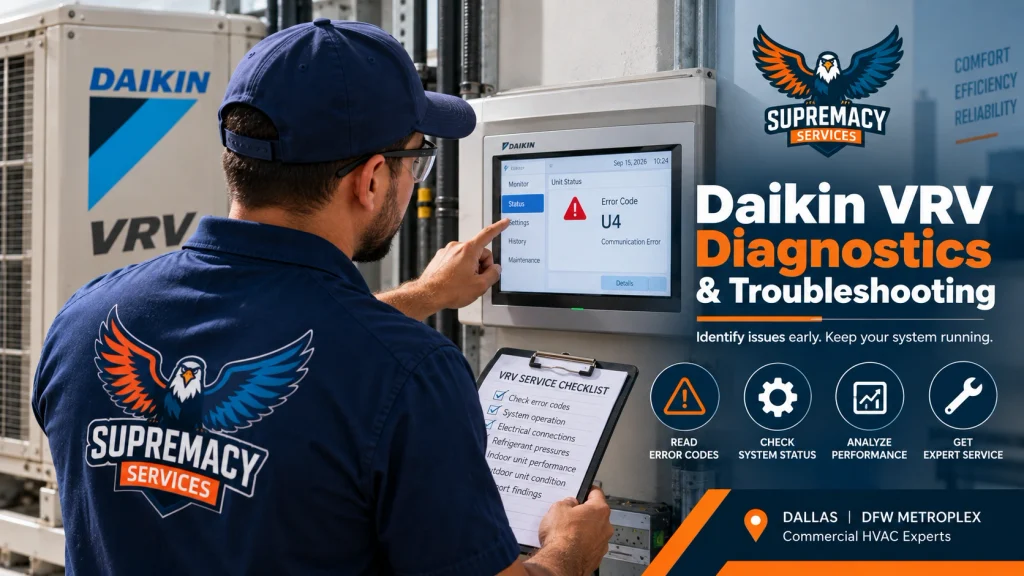
Technicians can review operating complaints, affected zones, controller information and available error codes. Daikin controllers can display error information, and Daikin’s current VRV operation documentation instructs users to provide the error code and model information when contacting a service provider.
This can significantly narrow the diagnostic process.
A useful technician question is:
“What operating data or fault history led you to this diagnosis?”
The answer should connect the recommended repair to observable system behavior.
2. Inspect and Service Indoor-Unit Filters
Dirty filters are one of the simplest problems to prevent.
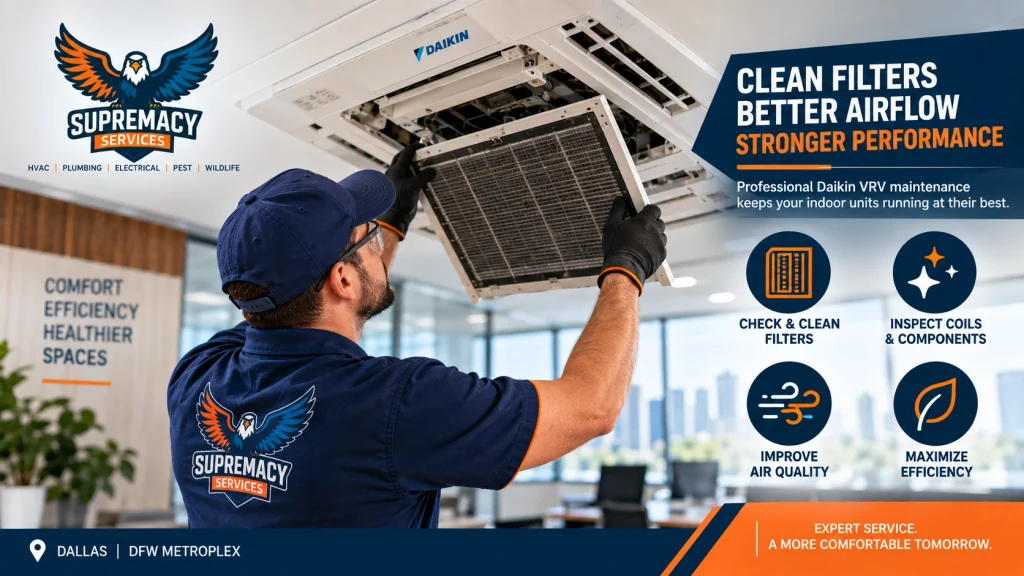
Daikin’s current VRV documentation shows filter-cleaning notifications through compatible controllers and directs users to clean or replace the applicable filter or element according to the indoor-unit instructions.
ENERGY STAR similarly notes that dirty HVAC filters restrict airflow and make equipment work harder.
Maintenance should therefore include inspection of the filters serving each applicable indoor unit—not simply the most accessible unit in the building.
3. Check Indoor Coils and Airflow
The indoor heat exchanger needs adequate airflow to transfer heat properly.
Technicians should inspect accessible coil surfaces and look for conditions such as dust accumulation, restricted airflow or abnormal fan operation.
This becomes particularly important when one zone has noticeably poorer cooling than the others.
However, poor zone performance does not automatically mean the indoor coil is dirty. The technician may also need to investigate controls, temperature sensing, refrigerant distribution or other system conditions.
4. Inspect the Condensate Drainage System
Water around an indoor cassette, concealed unit or wall-mounted unit should not be ignored.
Possible causes include:
- blocked condensate drainage;
- a drain-pump problem;
- drainage installation problems;
- excessive condensation associated with operating conditions;
- contamination within the indoor unit.
Daikin specifically warns that a clogged drainpipe can result in water leakage from indoor units and recommends stopping operation and contacting a dealer when drainage is not functioning correctly.
5. Inspect the Outdoor Unit and Heat Exchanger
The outdoor unit needs unobstructed airflow.
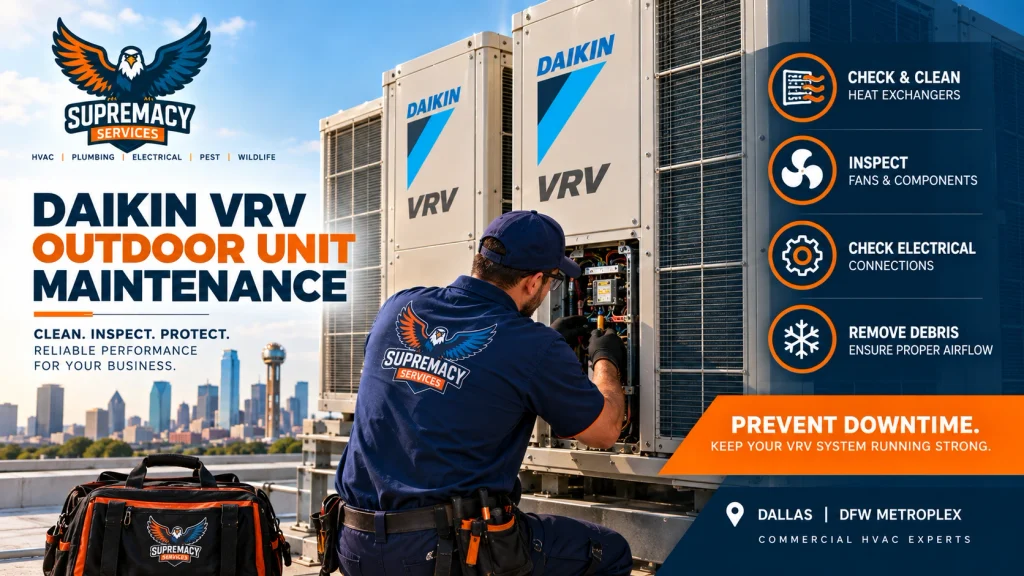
Daikin advises keeping objects and accumulated debris away from outdoor units and notes that nearby obstacles can reduce outdoor-unit performance or increase operating noise.
A maintenance visit should therefore examine:
- coil condition;
- leaves and debris;
- airflow clearance;
- fan operation;
- physical damage;
- unusual vibration or noise;
- electrical condition;
- equipment mounting and surrounding conditions.
This is especially useful before Dallas enters its highest-demand cooling months.
6. Evaluate Electrical Components
Electrical problems can create intermittent faults that initially look like refrigeration or control problems.
ENERGY STAR’s HVAC maintenance checklist recommends tightening electrical connections and measuring motor voltage and current during professional maintenance.
VRV systems also incorporate substantial control electronics, so electrical troubleshooting should be performed by properly qualified personnel.
Texas regulates air-conditioning and refrigeration contracting. TDLR states that contractors who install, repair or maintain air-conditioning, refrigeration or heating systems must have the required state licensing, while technicians performing work under a contractor must meet applicable registration or certification requirements.
7. Evaluate Refrigerant-System Performance
A VRV system should not be “topped off” with refrigerant simply because cooling feels weak.
Poor performance can have several causes, including airflow restriction, control problems, sensors, refrigerant-circuit problems or other component faults.
Professional diagnosis should therefore establish evidence for a refrigerant problem before corrective work is recommended.
Daikin also instructs owners to contact a dealer regarding refrigerant leakage rather than attempting refrigerant work themselves.
8. Test System Controls and Zone Operation
VRV systems rely heavily on controls.
Daikin’s commercial controls platform supports functions including operating monitoring, scheduling, error notification, maintenance support and building-management-system integration on compatible systems.
A technician may therefore need to evaluate not only mechanical equipment but also whether:
- zones respond to commands;
- controller settings are appropriate;
- communication is stable;
- temperature readings appear reasonable;
- centralized controls are commanding the system as expected.
7 Common Daikin VRV Problems to Watch For
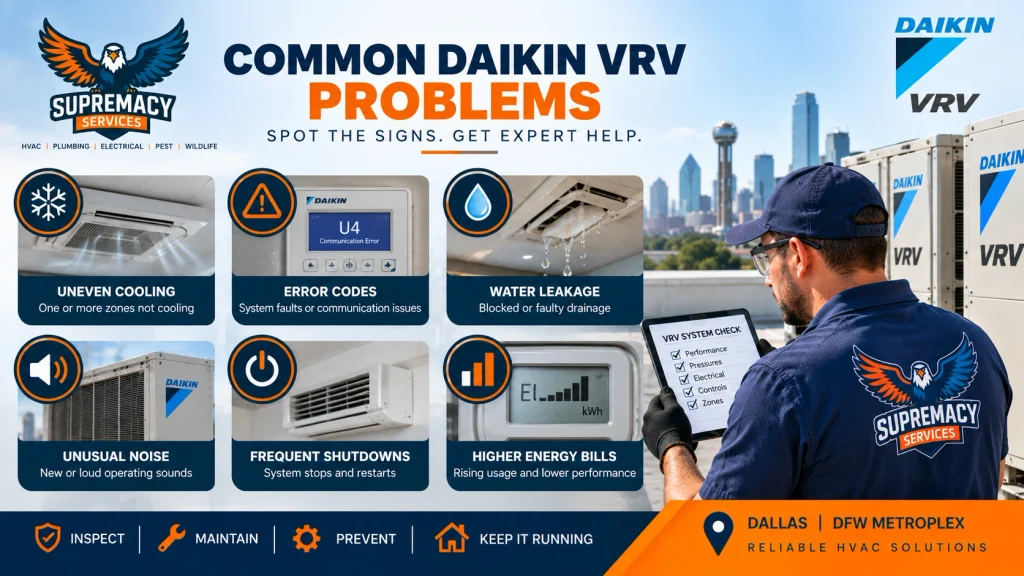
1. One Zone Is Not Cooling Properly
If most of the building is comfortable but one room or area is warm, the problem may be localized rather than an outdoor-unit failure.
Possible areas for investigation include the affected indoor unit’s:
- filter;
- airflow;
- fan;
- temperature sensor;
- controller;
- electronic expansion valve;
- communication;
- refrigerant distribution.
A zone-by-zone diagnostic approach can prevent unnecessary replacement of major equipment.
2. Multiple Indoor Units Stop or Display Errors
When several zones develop problems together, the technician should look beyond a single indoor fan coil.
Depending on the system, shared electrical, communication, control or outdoor-unit conditions may be involved.
Daikin controllers can provide error-code information that should be recorded before resetting or shutting down equipment where it is safe to do so.
3. The System Runs but Cooling Is Weak
Daikin’s troubleshooting guidance recommends checking for blocked indoor or outdoor air inlets/outlets, filter-cleaning notifications, temperature settings and fan-speed settings when cooling or heating is insufficient.
If those basic conditions are normal, professional diagnostics may be required.
4. Water Is Leaking From an Indoor Unit
Water leakage warrants prompt attention because the HVAC problem can become a building problem.
Stop operation if significant water leakage is occurring and arrange an inspection rather than repeatedly clearing alarms without determining the cause.
5. Unusual Noise Develops
Not every sound indicates a malfunction.
Daikin explains that refrigerant flow, electronic expansion valve operation and changes in outdoor-unit frequency can produce normal operating sounds.
However, a new, persistent or unusually loud sound deserves investigation—particularly if it appears with poor cooling, vibration, an error code or repeated shutdowns.
6. The System Repeatedly Stops and Restarts
Intermittent operation may involve control, protection, communication or electrical conditions.
Daikin documentation notes that some interruptions may be associated with communication or system-protection behavior, depending on the displayed code and model.
Recording the exact error message before service can help the technician considerably.
7. Energy Use Rises While Comfort Gets Worse
Higher electricity consumption by itself does not prove the VRV system is failing. Weather, schedules, occupancy and thermostat settings can all change energy use.
But rising consumption combined with longer runtimes, reduced comfort, dirty heat exchangers, restricted airflow or recurring faults is a good reason to have system performance evaluated.
What Can a Property Owner Check Before Calling for Service?
There are several useful checks that do not require opening refrigerant or electrical components.
Safe preliminary checks
- Check whether the problem affects one zone or multiple zones.
- Record any controller error code.
- Confirm the temperature and operating-mode settings.
- Look for a filter-maintenance notification.
- Check whether accessible filters are visibly dirty.
- Make sure indoor and outdoor air inlets/outlets are not obstructed.
- Look for visible water around indoor equipment.
- Note unusual sounds and when they occur.
- Determine whether a breaker has tripped—but do not repeatedly reset a breaker that continues to trip.
- Record the indoor/outdoor model information where safely accessible.
Giving this information to the technician can make the service call more efficient.
What Should You Not DIY on a Daikin VRV System?
Do not open electrical panels, bypass safety devices, manipulate the refrigerant circuit or attempt internal repairs without appropriate training and authorization.
Daikin’s current VRV documentation explicitly warns owners not to inspect or service the equipment themselves and states that servicing should be performed by trained personnel.
Professional service becomes especially appropriate when you have:
- refrigerant-related concerns;
- repeated error codes;
- electrical faults;
- repeated breaker trips;
- water leakage;
- compressor problems;
- control-network problems;
- multiple zones failing simultaneously;
- unexplained loss of capacity;
- burning odors or other abnormal operating conditions.
If your Daikin VRV system is showing recurring faults, uneven zone temperatures or declining cooling performance, schedule a VRV diagnostic before peak demand makes the problem more disruptive.
Dallas Climate and Daikin VRV Maintenance
Dallas HVAC maintenance should reflect the workload the equipment actually experiences.
National Weather Service 1991–2020 normals show average high temperatures of approximately 95.6°F in July and 95.8°F in August, along with about 20.2 days per year reaching at least 100°F.
For property owners and facility managers, that creates a straightforward maintenance priority:
Do not wait until the first major cooling failure of summer to find out whether the system has an airflow, drainage, electrical, control or outdoor-unit problem.
A pre-cooling-season inspection gives the service provider an opportunity to identify visible and measurable problems before the building is relying heavily on the equipment.
Daikin VRV Maintenance vs. Repair
| Maintenance | Repair |
|---|---|
| Scheduled proactively | Usually triggered by a fault or symptom |
| Inspects operating condition | Diagnoses a specific failure |
| Cleans applicable components | Replaces or corrects failed components where necessary |
| Reviews filters and airflow | Investigates abnormal airflow |
| Checks drainage | Clears or repairs drainage faults |
| Reviews controls/errors | Diagnoses persistent fault codes |
| Evaluates system operation | Restores failed or degraded operation |
Maintenance cannot guarantee that a system will never fail. Its value is in identifying conditions that deserve attention, keeping serviceable components clean and checking system operation before a small issue becomes more disruptive.
What Should You Expect From a Daikin VRV Service Company?
A good VRV service visit should result in more than “everything looks fine” or an unexplained recommendation to replace a component.
Property owners should expect the technician to explain:
- what symptoms were verified;
- which zones were affected;
- what diagnostic information was found;
- what was inspected or cleaned;
- whether an active fault remains;
- what corrective work is recommended;
- which recommendations are urgent and which can be monitored.
VRV systems are technically different from conventional single-zone HVAC equipment. Daikin itself maintains dedicated VRV installation, commissioning, controls, service and troubleshooting training within its contractor programs.
That makes relevant VRV experience an important question when selecting a contractor.
Frequently Asked Questions
How often should a Daikin VRV system be serviced?
Follow the maintenance requirements for your exact Daikin model and building conditions. As a general HVAC benchmark, ENERGY STAR recommends professional pre-season maintenance. High-use commercial VRV systems may require a schedule tailored to operating hours and site conditions.
What does Daikin VRV maintenance include?
Depending on the system, maintenance can include filters, coils, airflow, drainage, outdoor equipment, controls, electrical components, diagnostic codes, sensors and refrigerant-system operating checks.
Some filters are designed for owner-accessible cleaning or replacement, but procedures vary by indoor-unit model. Follow the specific Daikin indoor-unit manual and do not open electrical or refrigeration components.
Why is one Daikin VRV zone not cooling?
Possible causes include restricted airflow, a dirty filter, indoor-unit problems, sensor or controller issues, communication faults or refrigerant-distribution problems. The pattern of affected zones helps guide diagnosis.
Why is my Daikin VRV showing an error code?
The controller may display a code when the system detects an abnormal condition. Record the code and model information. Daikin recommends providing that information to the servicing dealer.
Should I reset a Daikin VRV error code?
Do not repeatedly clear or power-cycle a recurring fault simply to make the warning disappear. Record the code first and arrange diagnosis if it returns or the equipment is not operating normally.
Is a hissing sound from a VRV system a refrigerant leak?
Not necessarily. Daikin notes that refrigerant movement can create normal hissing sounds during certain operating conditions. A new sound accompanied by poor performance, alarms or other abnormal symptoms should still be investigated.
Who can service a VRV system in Texas?
Texas regulates air-conditioning and refrigeration contracting through the Texas Department of Licensing and Regulation. Verify that the company and personnel performing regulated HVAC work meet applicable state requirements.
Can normal HVAC companies work on Daikin VRV systems?
A licensed HVAC company may be legally able to perform applicable HVAC work, but VRV-specific training and diagnostic experience are useful because the equipment combines inverter-driven refrigeration, multiple indoor zones and sophisticated control systems.
Schedule Daikin VRV Service in Dallas
A Daikin VRV system is designed around coordinated multi-zone operation, so effective maintenance requires looking at more than the thermostat or the outdoor condenser.
If your Dallas or DFW property has uneven temperatures, recurring controller errors, drainage problems, unusual noise or declining system performance, Supremacy Services’ VRV system service and maintenance team can inspect the system and identify the appropriate next step.

