

Main water line repair cost in Dallas can vary considerably because an underground water-line problem may involve anything from repairing one accessible damaged section to excavating or replacing a long service line beneath landscaping, concrete or other obstacles. A 2026 Dallas market-cost estimate published by Angi places typical local main water line repairs at roughly $377–$948, with an average around $656, but reports a much wider potential range depending on the scope of work. Those figures are market estimates—not a Supremacy Services price—and a professional diagnosis is necessary before a homeowner can know what a specific repair will cost.
The biggest variables are usually the location and extent of the damage, pipe length, accessibility, excavation requirements, pipe material, repair versus replacement, and whether landscaping or hardscape must be disturbed or restored.
For Dallas homeowners, there is another important distinction: Dallas Water Utilities states that the water service line includes a utility-maintained public side, the meter and a private portion that is the property owner’s responsibility. That makes identifying which side of the meter has failed an important first step before paying for repairs.
This guide explains what Dallas homeowners should budget for, why estimates differ, how repair compares with replacement and what to check before authorizing underground plumbing work.
How Much Does Main Water Line Repair Cost in Dallas?
A useful starting point is to separate a localized repair from a complete service-line replacement.
According to Angi’s 2026 Dallas market estimate, local main water line repairs commonly fall around $377–$948, with a reported average of approximately $656. More difficult projects can fall outside that range.
Those numbers should be treated as budgeting information rather than a quote.
| Project situation | Typical cost effect |
|---|---|
| Small, accessible localized leak | Lower |
| Multiple damaged areas | Higher |
| Long section requiring replacement | Higher |
| Deep or difficult-to-access pipe | Higher |
| Pipe beneath driveway or hardscape | Potentially higher |
| Extensive excavation | Higher |
| Trenchless-compatible project | Different cost structure; may reduce surface disruption |
| Landscaping/restoration required | Additional project consideration |
| Permit/inspection requirements | May affect total project cost |
The important question therefore isn’t simply “What does water line repair cost?”
It is:
“What failed, where is it located, and how much work is required to restore the line correctly?”
Repair price vs. replacement price
Repairing one isolated failure is fundamentally different from replacing a deteriorated service line.
A localized repair may involve locating the leak, exposing a relatively small section of pipe, removing the damaged portion, installing the appropriate replacement material or fitting, testing the system and restoring the excavation.
Replacement can involve a much longer pipe run and considerably more material, labor and site preparation.
That is why homeowners should be cautious about comparing two prices without comparing the scope of work behind those prices.
What Factors Affect Water Line Repair Cost in Dallas?

1. Location of the leak
Accessibility can substantially change the job.
A damaged pipe beneath an open lawn may be easier to expose than one located beneath a driveway, patio, retaining structure or heavily landscaped area.
Before excavation begins, the leak should be located as accurately as practical.
If you know water is being lost but cannot identify its source, professional [water leak detection] can help distinguish a service-line problem from leaks elsewhere in the plumbing system before unnecessary excavation begins.
2. Amount of damaged pipe
A single crack or failed connection does not require the same scope of work as a line suffering from deterioration in multiple places.
This is also why a low initial repair price is not necessarily the least expensive long-term solution.
If the remaining pipe is in poor condition, repeatedly repairing isolated failures can eventually become less practical than replacing the affected line.
3. Repair versus full replacement
Repair tends to make more sense when:
- damage is localized;
- the surrounding pipe remains serviceable;
- there is no pattern of recurring failures;
- the failed section can be accessed reasonably; and
- the existing pipe is otherwise suitable to remain in service.
Replacement becomes worth discussing when:
- leaks have occurred repeatedly;
- deterioration affects a substantial portion of the line;
- several sections are compromised;
- the existing pipe condition makes another failure likely; or
- the economics of repeated excavation and repairs no longer make sense.
A plumber should evaluate the actual condition and configuration of the line rather than recommending replacement solely because one leak exists.
Need an assessment rather than another online estimate? Supremacy Services provides professional [water line repair and replacement in Dallas and DFW] with diagnosis before the repair scope is determined.
4. Pipe length
When replacement is necessary, length matters.
A house located close to the meter may require substantially less new piping and excavation than a property where the service line travels a long distance across the lot.
This is one reason neighboring homeowners can receive very different estimates for what appears to be the same problem.
5. Pipe material and existing plumbing
The existing pipe material, diameter, condition and connection requirements can influence both repair strategy and material cost.
A qualified plumber should determine which materials and fittings are appropriate for the actual installation rather than assuming that one pipe material is universally best for every Dallas property.
6. Excavation and site access
Underground pipe work is not priced only by the pipe.
The crew may also need to account for:
- excavation;
- safe access;
- locating nearby utilities;
- soil removal;
- equipment access;
- trench preparation;
- backfilling;
- compaction; and
- surface restoration.
A quote that appears cheaper may simply exclude work another estimate includes.
Ask for an itemized scope
When comparing water-line estimates, ask whether the quoted amount includes:
diagnosis → excavation/access → pipe and fittings → labor → testing → permit/inspection when required → backfill → cleanup → surface restoration.
That comparison is considerably more useful than comparing bottom-line numbers alone.
Does Dallas Soil Affect Underground Water Lines?
Soil movement should be considered when diagnosing underground plumbing problems in North Texas, but homeowners should avoid assuming that every leak is automatically caused by Dallas soil.
Changes in soil moisture can produce movement around buried infrastructure. At the same time, leaks can also result from pipe deterioration, connection failures, installation problems, physical damage, corrosion where applicable, pressure conditions or other site-specific factors.
The practical lesson is simple:
Diagnose the pipe before diagnosing the cause.
A plumber should identify the location and condition of the failed line and evaluate the surrounding conditions before recommending a repair method.
Who Is Responsible for the Water Line in Dallas?
Dallas Water Utilities provides a particularly useful distinction for homeowners.
The service line connecting the public water main to a property has a public side, a meter and a private side. Dallas Water Utilities states that the utility maintains the public side and meter, while the property owner is responsible for maintaining the private portion coming from the meter onto the property.
That distinction matters because a leak near the street does not automatically mean the utility will repair it.
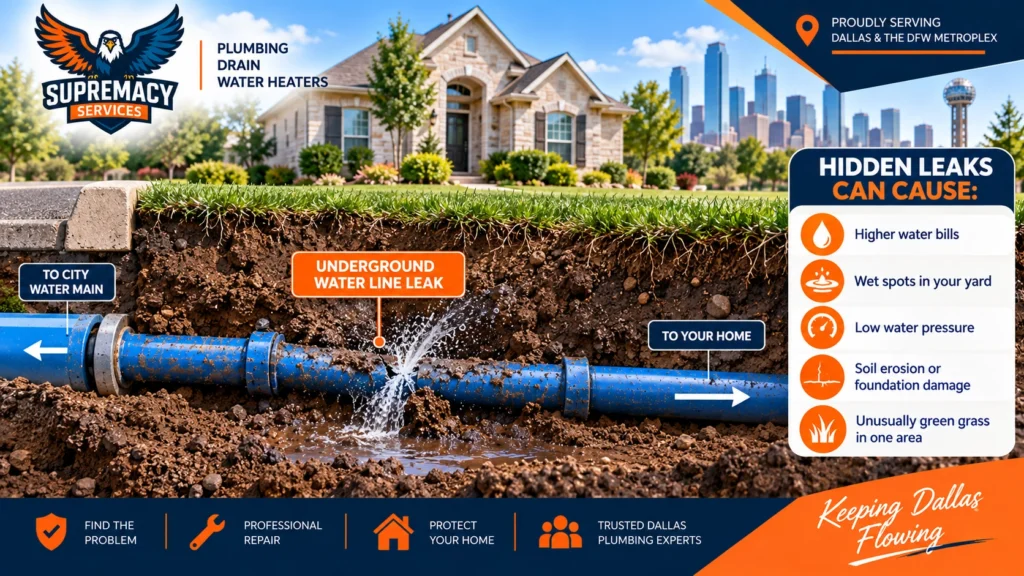
If you suspect a main water line leak, determine whether the failure is on the public or private portion before authorizing private repair work.
What Are the Warning Signs of a Main Water Line Leak?
Common warning signs include:
- unexplained increases in water use or the water bill;
- a water meter that continues registering usage when household water is off;
- persistent wet or unusually green areas of the yard;
- unexplained pooling or muddy areas;
- reduced water pressure affecting multiple fixtures;
- sounds of running water when fixtures are off; and
- visible water emerging from the ground.
No single symptom proves that the buried service line has failed.
For example, low pressure can have causes unrelated to an underground leak, and high water consumption can come from toilets, irrigation systems or indoor fixtures.
A simple homeowner leak test
The EPA recommends checking the water meter when no water is being used.
- Turn off faucets and water-using appliances.
- Make sure irrigation and other automatic water users will not operate during the test.
- Record the meter reading.
- Avoid using water for the test period.
- Check the meter again.
EPA WaterSense recommends comparing meter readings across a two-hour period with no water use. If the reading changes, a leak is likely somewhere on the property.
The test confirms unexplained water consumption—it does not identify the location of the leak.
If the meter indicates unexplained flow but you cannot locate the source, professional leak detection is the next logical step.
Main Water Line Leak vs. Sewer Line Problem
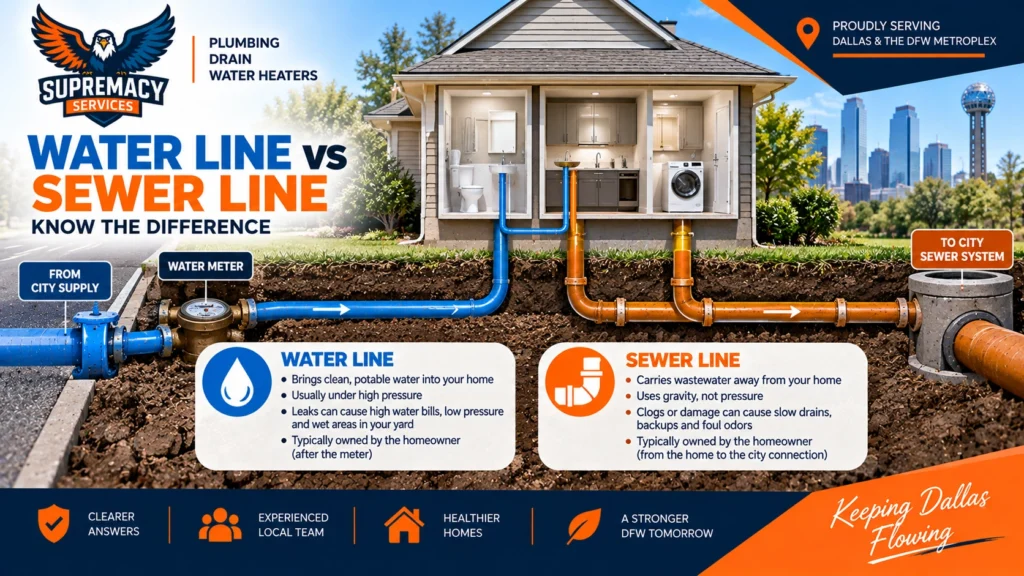
These problems are frequently confused, but they involve different systems.
| Symptom | Water supply line | Sewer/drain line |
|---|---|---|
| Unexplained metered water use | Common clue | Usually no |
| Clean water surfacing outdoors | Possible | Usually no |
| Reduced supply pressure | Possible | Usually unrelated |
| Sewage odor | Unlikely | Strong clue |
| Multiple slow drains | Unlikely | Common |
| Toilet/shower backup | Unlikely | Common |
| Wastewater surfacing | No | Possible |
| Water bill increase | Possible | Not usually from sewer failure |
Your main water/service line brings potable water toward the home.
Your sewer line carries wastewater away.
If toilets, tubs and drains are backing up or producing sewage odors, investigate a [sewer line problem] rather than assuming the incoming water line has failed.
Similarly, a slow kitchen or bathroom drain by itself usually points toward a drainage problem rather than a broken water service line.
Repair vs. Replacement: Which Does Your Water Line Need?
There is no universal rule that every underground leak requires replacement.
| Repair may be appropriate when | Replacement may be appropriate when |
|---|---|
| Damage is isolated | Damage is widespread |
| Pipe is otherwise in good condition | Pipe condition is broadly poor |
| First significant failure | Repeated leaks have occurred |
| Short damaged section | Multiple sections are compromised |
| Access is straightforward | Repeated excavation would be impractical |
| Repair offers reasonable remaining service life | Replacement offers better long-term economics |
A good estimate should explain why repair or replacement is being recommended.
Homeowners should be particularly cautious when a contractor recommends replacing an entire line without clearly explaining the condition of the existing pipe and why a localized repair would be inappropriate.
Traditional Excavation vs. Trenchless Water Line Replacement

When a line needs substantial replacement, homeowners may hear about both traditional excavation and trenchless methods.
Traditional excavation
Traditional replacement exposes the pipe by excavating along the necessary portion of its route.
It remains useful when direct access is necessary or site and pipe conditions make a trenchless technique unsuitable.
Trenchless replacement
Depending on the existing line, its route, condition and surrounding utilities, certain projects may qualify for trenchless techniques that reduce the amount of continuous open trench required.
The best method is not determined by marketing terminology.
It depends on the existing pipe, failure mode, route, access points, nearby utilities and site conditions.
Because Supremacy already has Search Console impressions for phrases such as “trenchless water main replacement Dallas TX,” homeowners researching replacement should be directed from this educational comparison to the dedicated water-line service page for project-specific evaluation.
Can You Repair a Main Water Line Yourself?
Finding evidence of a leak and performing underground service-line plumbing are two very different things.
Homeowners can reasonably:
- inspect the yard for unusual wet areas;
- compare current and previous water bills;
- perform a meter test;
- check toilets and visible fixtures for leaks;
- identify whether the problem affects one fixture or the whole house; and
- locate the home’s accessible shutoff.
Excavating and modifying the underground water service is another matter.
Underground work can involve other buried utilities, pressurized potable-water piping, municipal requirements, inspections and proper pipe/fitting installation.
Texas regulates plumbing work through the Texas State Board of Plumbing Examiners. When hiring a plumbing company, homeowners can also verify Texas plumbing license information through the state’s license resources.
For a suspected underground main-line failure, professional diagnosis and repair is the safer and more practical approach.
What Should Professional Main Water Line Repair Include?
A well-defined project should begin with diagnosis rather than excavation.
A typical process may include:
1. Confirm the problem
The plumber determines whether there is actually a supply-line leak and rules out obvious fixture, irrigation or interior plumbing problems.
2. Locate the leak
Appropriate diagnostic methods are used to narrow down the affected area and avoid unnecessary excavation where possible.
3. Evaluate the line
The plumber considers pipe condition, material, route, accessibility and whether the failure appears isolated or widespread.
4. Explain repair options
You should understand whether the recommendation is for:
- localized repair;
- partial replacement;
- full service-line replacement; or
- an appropriate trenchless alternative.
5. Provide a written scope and price
The estimate should identify what work is included and clarify potential additional costs.
6. Complete the repair
The affected line is exposed or accessed using the selected method and repaired or replaced with suitable materials.
7. Test the system
The repaired line should be checked for proper operation and leaks before the job is considered complete.
8. Restore the work area
Backfill, cleanup and agreed restoration work are completed according to the project scope.
If your diagnosis has already confirmed an underground service-line problem, request a water-line repair or replacement evaluation from Supremacy Services before deciding between patch repair, conventional replacement and trenchless options.
How to Compare Water Line Repair Quotes
Do not compare estimates using price alone.
Ask each contractor the same questions:
- Where exactly is the leak?
- What evidence supports the diagnosis?
- Is the estimate for repair or replacement?
- How much pipe is included?
- What pipe material will be installed?
- Is excavation included?
- Are permits or inspections required, and are they included?
- What happens if additional damage is discovered?
- Is backfill included?
- What landscaping, concrete or hardscape restoration is included?
- What warranty applies to the specific work?
- Who is responsible for locating utilities?
- What payment or financing terms apply?
A $1,000 estimate and a $3,000 estimate may not represent the same project at all.
The scope is what makes the price meaningful.
How Can Dallas Homeowners Reduce the Risk of Expensive Water-Line Damage?
Not every underground failure can be prevented, but early detection can limit water waste and secondary damage.
Monitor your water use

Watch for unexplained changes rather than waiting until a leak becomes visible.
EPA WaterSense notes that household leaks can waste substantial quantities of water and recommends checking bills and meters for evidence of hidden leakage.
Know where your shutoff is
Find the home’s main shutoff before an emergency occurs.
Do not wait until water is rapidly escaping to figure out how the system can be isolated.
Investigate persistent wet areas
A wet lawn is not automatically a broken water line—irrigation problems and drainage conditions can create similar symptoms—but unexplained persistent moisture deserves investigation.
Don’t ignore whole-house pressure changes
A problem affecting one faucet is usually different from a pressure change occurring throughout the house.
Sudden whole-house changes warrant investigation.
Consider leak-monitoring technology
EPA WaterSense identifies leak-detection and flow-monitoring devices as tools that can identify unusual water-use patterns and, depending on the system, alert homeowners to possible leaks.
These systems do not replace professional diagnosis, but earlier warnings can help homeowners respond sooner.
Frequently Asked Questions
How much does main water line repair cost in Dallas?
A 2026 Angi Dallas market estimate reports a typical range of roughly $377–$948, averaging about $656, although complicated repairs can cost considerably more. Treat those numbers as general market estimates rather than Supremacy Services pricing. The actual cost depends on the location and extent of damage, accessibility, excavation, materials and whether repair or replacement is required.
Who pays for a broken water line in Dallas?
Dallas Water Utilities states that property owners are responsible for maintaining the private portion of the service line from the meter onto their property, while the utility maintains the public portion and meter. Confirm where the failure is located before arranging private repair.
How do I know whether my main water line is leaking?
Possible signs include unexplained water consumption, a meter that moves while all water use is stopped, wet areas in the yard and whole-house pressure changes. These symptoms warrant investigation but do not individually prove that the main service line is leaking.
Can a main water line be repaired without replacing it?
Yes, depending on the type, location and extent of the damage and the condition of the remaining pipe. An isolated failure may be repairable, while widespread deterioration or repeated failures can make replacement more practical.
Is trenchless water line replacement always better?
No. Trenchless methods can reduce surface excavation for suitable projects, but feasibility depends on the existing pipe, route, failure, access and nearby utilities. Conventional excavation remains appropriate in some situations.
Why is my water line repair estimate so high?
Accessibility, excavation, long pipe runs, difficult site conditions, hardscape, restoration requirements and extensive deterioration can all increase the scope of work. Ask for an itemized explanation before comparing estimates.
Can a high water bill mean the main line is leaking?
It can, but it is not proof. Toilets, irrigation systems, faucets and other plumbing can also cause excessive consumption. A meter test and systematic leak investigation can narrow down the source.
Is a water main leak the same as a sewer-line leak?
No. The water service line supplies potable water to the property; the sewer line carries wastewater away. Sewer problems more commonly cause slow drains, backups and sewage odors, while a supply-line leak may produce unexplained metered water use, clean-water pooling or pressure problems.
Should I repair or replace an old water line?
That decision should be based on the condition of the entire line, not age alone. Localized damage in an otherwise serviceable line may justify repair; repeated failures or widespread deterioration can make replacement more economical.
Get a Main Water Line Evaluation in Dallas–Fort Worth
If you are seeing unexplained water use, wet areas in the yard, whole-house pressure changes or other signs of an underground leak, start by confirming the source rather than assuming the entire line needs replacement.
Supremacy Services provides water leak detection, water line repair and water line replacement across Dallas and the DFW Metroplex, including evaluation of conventional and trenchless options where appropriate.
Schedule a Dallas water-line evaluation with Supremacy Services to locate the problem, understand the repair options and receive a project-specific estimate before work begins.

