
Wildlife removal in Dallas typically costs about $225 to $1,003 for many standard projects, with a reported Dallas market average around $606, according to 2026 consumer-market data from Angi. The actual price can be considerably higher when animals are inside an attic, multiple entry points must be sealed, a bat colony is involved, or insulation and other building materials require cleanup or repair.
The animal itself is only one part of the estimate. Where it is living, how difficult it is to reach, whether young animals are present, how many visits are necessary, how it entered the house, and how much damage it caused can matter as much as the species.
For Dallas homeowners, the most useful question therefore isn’t simply “How much does animal removal cost?” It is:
What will it cost to remove the animal, solve the entry problem and prevent the same problem from happening again?
This guide breaks that question down animal by animal.
How Much Does Wildlife Removal Cost in Dallas?
For many Dallas projects, current third-party market data puts professional wildlife removal between roughly $225 and $1,003, averaging about $606. These are market estimates rather than Supremacy Services quotes, and an inspection is necessary to determine the price of a specific property.
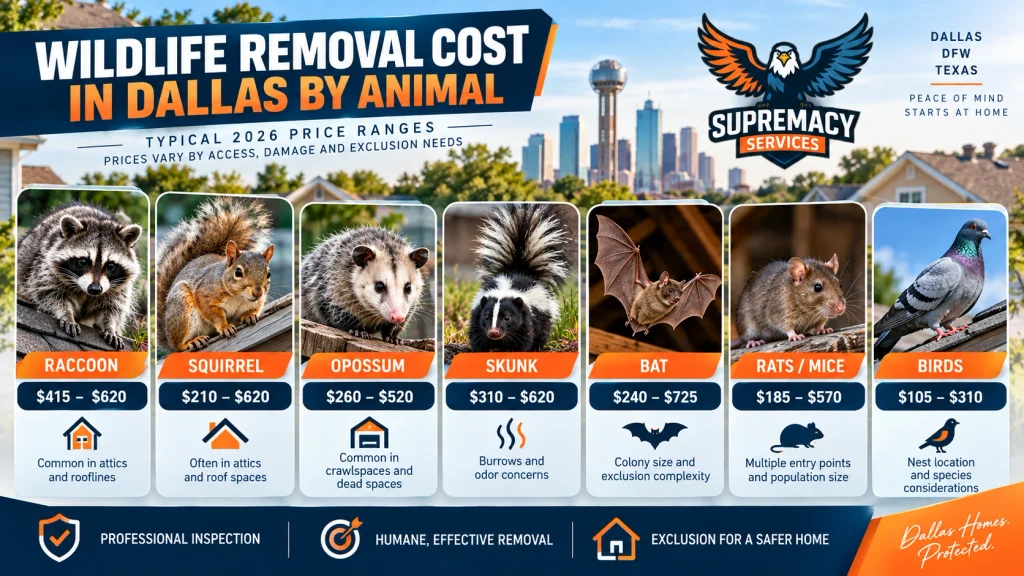
2026 Dallas Wildlife Removal Costs by Animal
| Wildlife problem | Dallas market-price estimate* | Common complication |
|---|---|---|
| Raccoon | $415–$620 | Attic access, young, roof/soffit damage |
| Squirrel | $210–$620 | Attic nesting and multiple entry points |
| Opossum | $260–$520 | Crawlspace/deck access |
| Skunk | $310–$620 | Burrows and odor issues |
| Bat | $240–$725 | Colony size and exclusion complexity |
| Rats/mice | $185–$570 | Multiple openings and population size |
| Birds | $105–$310 | Nest location and species considerations |
*These figures are Dallas-area market estimates reported by Angi in June 2026—not a Supremacy Services price list or guaranteed quote. More extensive exclusion, repairs, sanitation or restoration may be additional.
That distinction is important. A $400 animal-removal job and a house requiring removal plus roofline exclusion, contaminated-insulation work and repairs are fundamentally different projects.
Raccoon Removal Cost in Dallas
Current Dallas market data estimates professional raccoon removal at approximately $415–$620 for many projects, although a complex attic situation can cost more once exclusion, repair and cleanup are considered.
Raccoons can create more complicated projects because the technician may need to determine:
- whether the animal is actually living inside;
- whether young are present;
- where it entered;
- whether soffits, vents or roofing were damaged;
- whether contaminated nesting material requires removal;
- and how the opening can legally and safely be secured.
Why you should not simply trap and relocate a Dallas raccoon
Texas regulations deserve special attention here.
Raccoons are classified as fur-bearing animals in Texas. Texas Parks & Wildlife states that nuisance fur-bearing animals can be taken by landowners or their agents under applicable conditions, but relocation requires authorization. More importantly, Texas’ rabies-quarantine rules prohibit transporting live raccoons from, to or within the state.
That is one reason DIY capture can create a problem homeowners did not anticipate: catching an animal does not automatically mean you can legally drive it somewhere else and release it.
Squirrel Removal Cost in Dallas
Dallas-area market data puts squirrel removal at roughly $210–$620 for many standard projects.
A squirrel in the yard is different from squirrels nesting inside a roof system. Costs may rise when technicians need to investigate high or difficult rooflines, identify more than one access point, address nesting areas, or perform exclusion work after the animals are gone.
Typical places worth inspecting include:
- roof vents;
- soffit/fascia transitions;
- damaged screening;
- roof intersections;
- construction gaps;
- and openings around exterior penetrations.
Texas’ current 2026–27 regulations list Dallas among counties with a squirrel general season running September 1, 2026 through August 31, 2027, but homeowners should not interpret hunting regulations as a substitute for determining the appropriate legal method for a wildlife problem inside a structure.
Opossum Removal Cost in Dallas
Current Dallas consumer-market estimates place opossum removal around $260–$520 for many projects.
Opossums commonly create a different cost profile from roof-dwelling animals because the problem may involve an accessible ground-level area rather than a high attic.
Inspection areas may include:
- crawlspaces;
- spaces beneath decks;
- garages;
- sheds;
- foundation openings;
- and protected areas around a home.
Texas classifies opossums as fur-bearing animals, meaning nuisance-animal rules can apply to how they are captured, possessed and relocated.
The quote should therefore consider both removal and how the animal obtained access in the first place.
Skunk Removal Cost in Dallas
Current Dallas estimates put many skunk-removal projects at roughly $310–$620.
The complication with skunks is often location.
A skunk underneath a shed or deck may require a different approach from an animal merely passing through the yard. Burrowing, restricted access and odor problems can also affect the work required.
Texas classifies skunks as fur-bearing animals, and Texas health authorities identify skunks among the wildlife species commonly infected with rabies in the state. Direct contact with abnormal or aggressive wildlife should therefore be avoided.
Bat Removal Cost in Dallas
Dallas market estimates put many bat-removal projects around $240–$725, but bat work can become substantially more involved depending on the number of bats, building configuration and amount of exclusion work required.
Bat situations deserve separate treatment from ordinary nuisance-animal removal.
A bat flying through a living space may be a single-animal incident. Repeated bat activity around the same roofline, attic or wall cavity may point to a building-entry issue that requires a more thorough inspection.
What if a bat was inside a bedroom?
Do not treat that solely as a pest-control problem.
Texas DSHS advises against touching injured, sick or dead bats. Because bat bites can be difficult to see, certain situations—including waking to find a bat in the room—can require evaluation for possible rabies exposure. DSHS recommends contacting local animal control or the local health department when exposure may have occurred.
Do not release a bat when human or pet exposure may have occurred before getting appropriate public-health guidance, because testing may be needed.
What About Armadillo Removal?
Armadillos are another relevant North Texas nuisance species, but they should not simply be grouped with raccoons and opossums from a regulatory standpoint.
Texas lists armadillos as nongame animals, while raccoons, opossums and skunks are classified as fur-bearing animals.
An armadillo problem is also more likely to involve lawns, landscaping or areas around structures rather than an attic.
That means the inspection and treatment plan can be substantially different.
What Factors Affect Wildlife Removal Cost?
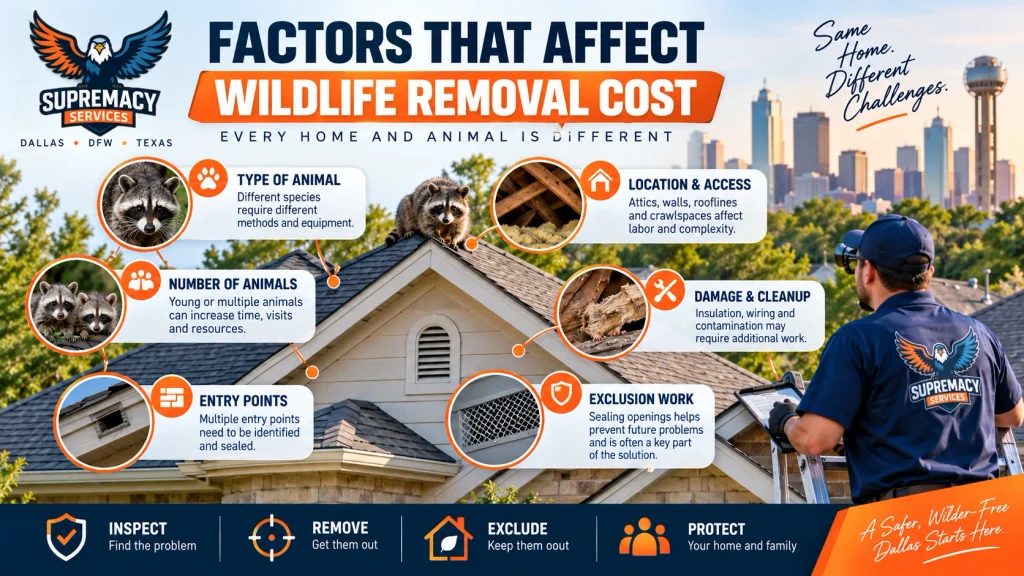
The biggest cost factors are species, location, accessibility, number of animals, removal complexity, exclusion work, property damage and cleanup requirements.
1. The animal
Removing a single accessible animal is not equivalent to resolving an established attic or wall infestation.
Species also affects equipment, inspection methods and legal handling considerations.
2. Where the animal is hiding
Accessibility can significantly affect labor.
An animal under an accessible deck may be relatively straightforward compared with wildlife behind a wall, beneath a difficult roof intersection or deep inside an attic.
3. Number of animals
Hearing one animal does not necessarily mean there is only one.
The inspection should establish whether there are young, multiple animals or signs suggesting an established nesting site before openings are closed.
4. Number of entry points
Finding the obvious hole is not necessarily enough.
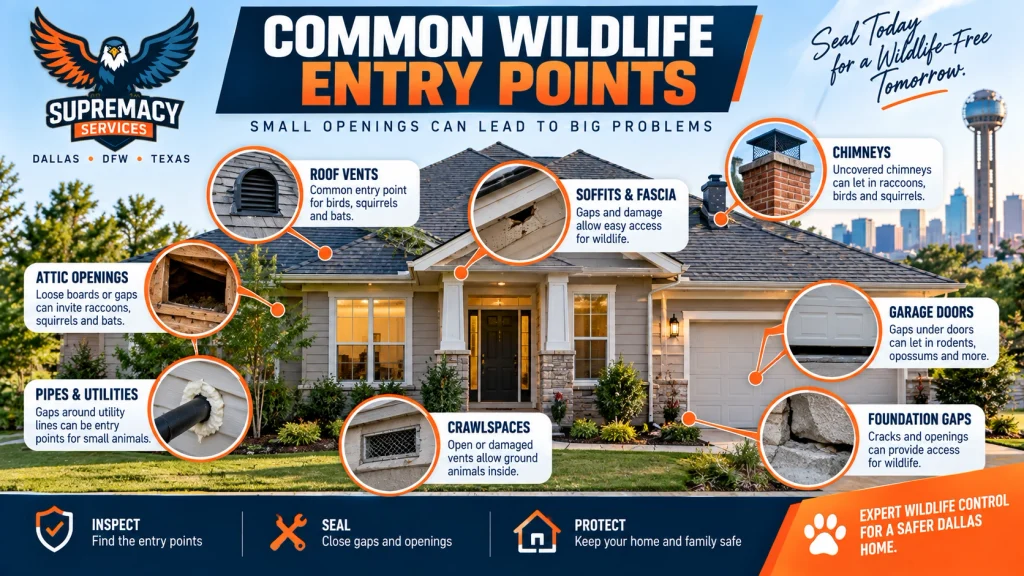
A thorough inspection may need to examine roof vents, soffits, fascia, chimneys, roof intersections, utility penetrations, crawlspace openings and foundation-level gaps.
5. Exclusion work
This is one of the most important distinctions when comparing quotes.
Removal gets wildlife out. Exclusion addresses how wildlife gets back in.
Supremacy’s current wildlife service specifically combines animal removal with inspection and entry-point sealing.
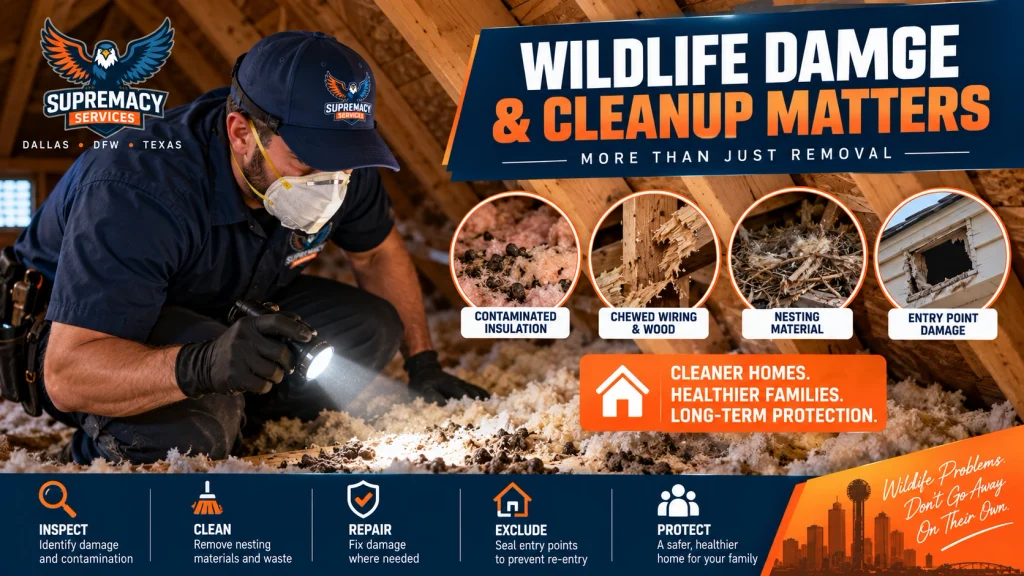
6. Damage and contamination
Wildlife may disturb insulation, leave nesting materials and waste, or damage building components.
When cleanup or repair is required, it should be clearly separated on the estimate so homeowners understand what they are paying for.
7. Follow-up visits
A job requiring inspection, trapping/monitoring and follow-up work will naturally differ from a one-visit service.
Removal vs. Exclusion: Why the Cheapest Quote May Not Be Comparable
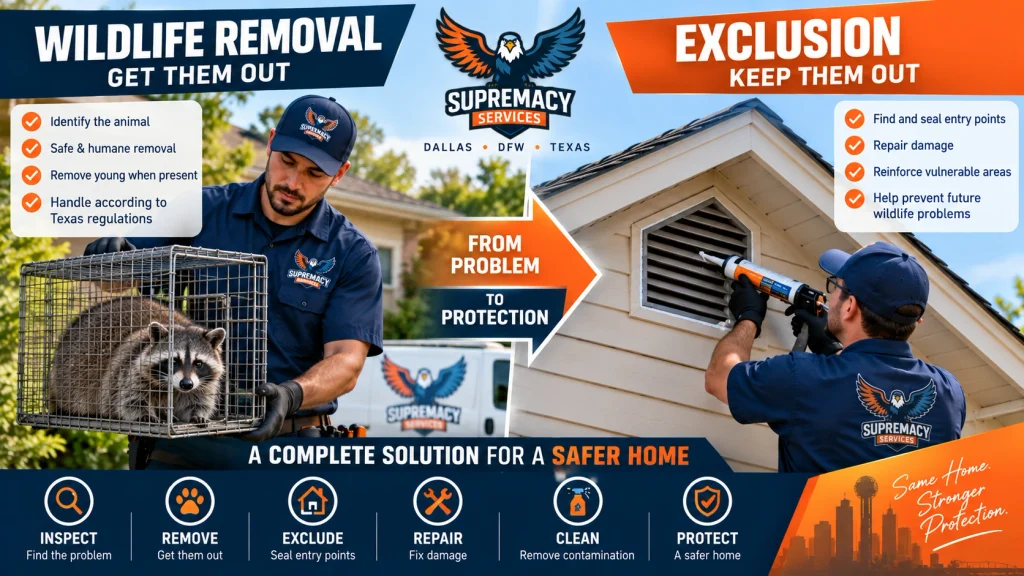
| Service | What it addresses |
|---|---|
| Inspection | Identifies animal, activity and likely entry points |
| Removal/control | Addresses animals currently present |
| Exclusion | Closes appropriate openings to reduce re-entry |
| Repair | Corrects animal-related structural damage where included |
| Cleanup | Removes affected nesting/debris where appropriate |
| Sanitation | Addresses affected areas when included and warranted |
| Follow-up | Confirms the wildlife problem has been resolved |
When comparing Dallas wildlife-removal estimates, ask every contractor the same question:
Does this quote include only removing the animal, or does it also include finding and addressing the entry points?
That single distinction can explain why two quotes appear dramatically different.
Signs Wildlife May Be Inside Your Dallas Home
An occasional animal crossing your yard does not necessarily require removal. The concern increases when evidence suggests wildlife has entered the structure.
Watch for:
- scratching, thumping or movement above ceilings;
- noises in walls;
- repeated activity near the same roof opening;
- damaged soffits or vent screens;
- nesting material;
- droppings in an attic or crawlspace;
- unusual odors;
- disturbed insulation;
- digging beneath a deck or shed;
- or visible wildlife entering and leaving an opening.
Timing can help identify the animal, but noise alone is not enough to reliably identify a species.
An inspection is more useful than guessing based solely on whether the sound occurs during the day or night.
DIY Wildlife Removal vs. Professional Removal
DIY action should focus first on safe observation and prevention, not grabbing or handling a wild animal.
Homeowners can reasonably:
- observe where activity occurs from a safe distance;
- remove accessible food attractants;
- secure trash;
- document noises and times;
- inspect the exterior from ground level;
- and keep pets away from wildlife.
Be cautious about trapping an animal yourself without knowing what species it is and what Texas rules apply.
Texas’ nuisance fur-bearing-animal rules include restrictions concerning possession, transport and relocation. Raccoons also fall under a specific rabies-related transportation restriction.
And if a bat may have contacted a person or pet, treat the situation as a potential public-health matter rather than simply releasing the bat.
What Should Professional Wildlife Removal Include?
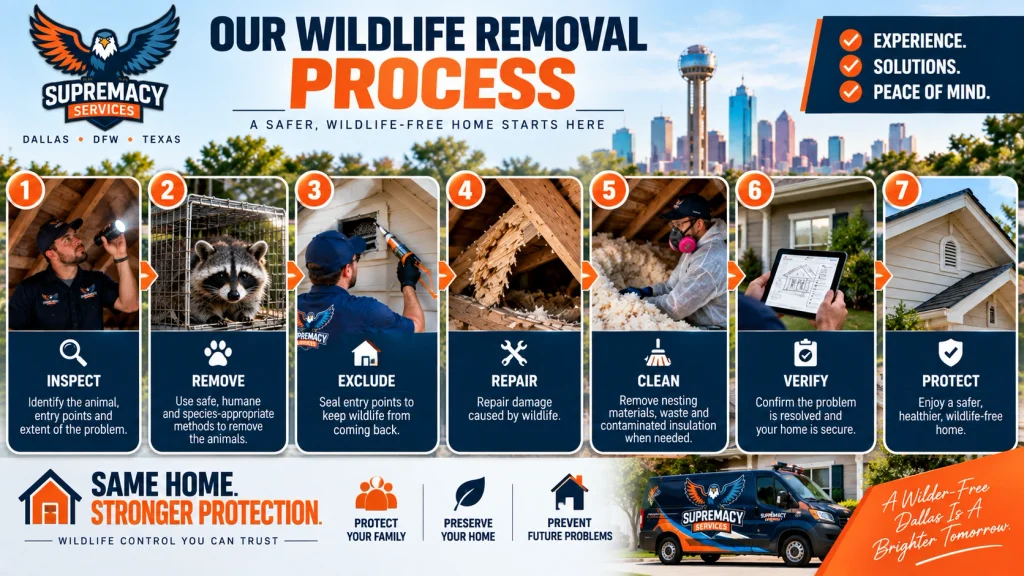
A complete wildlife-control project typically begins with identification rather than trapping.
Step 1: Inspect
Determine the likely species, location and points of entry.
Step 2: Determine the appropriate control method
The method should reflect the species, location, presence of young and applicable Texas rules.
Step 3: Address the animal
Remove or otherwise resolve the active wildlife problem using an appropriate method.
Step 4: Exclude
Close appropriate entry points after ensuring animals are not being sealed inside.
Step 5: Assess damage
Inspect insulation, vents, soffits, fascia and other affected areas.
Step 6: Clean affected areas when needed
Nesting material, waste or other contamination may require additional work.
Step 7: Reinspect
Verify that activity has stopped and repaired areas remain secure.
Supremacy’s wildlife page currently describes inspection, trapping/removal, sealing and cleanup as core components of its approach.
How to Compare Wildlife Removal Quotes in Dallas
Don’t compare only the number at the bottom of the estimate.
Ask:
- What animal do you believe is present?
- Where is it entering?
- Does the price include inspection?
- Is removal priced per animal, visit or project?
- How many visits are anticipated?
- Does the quote include exclusion?
- Which openings will be sealed?
- Are repairs included or separately priced?
- Is attic/crawlspace cleanup included?
- What happens if additional entry points are discovered?
- How will applicable Texas wildlife rules affect the method used?
A detailed scope is far more useful than an unexplained low estimate.
How Dallas Homeowners Can Reduce Future Wildlife Problems
Prevention starts with making the house less accessible and less attractive.
Inspect exterior areas such as:
- damaged vent screens;
- soffit/fascia gaps;
- roofline openings;
- chimney-related openings;
- crawlspace access;
- foundation penetrations;
- garage-door gaps;
- and damaged exterior materials.
Also secure outdoor food sources and trash where practical.
Do not automatically seal an opening while wildlife is actively using it. An animal—or dependent young—could remain inside.
Frequently Asked Questions
How much does wildlife removal cost in Dallas?
Current 2026 consumer-market data estimates many Dallas wildlife-removal projects at roughly $225–$1,003, averaging around $606. Species, access, number of animals, follow-up visits, exclusion, damage and cleanup can change the final price.
How much does raccoon removal cost in Dallas?
Angi’s current Dallas estimate is approximately $415–$620 for raccoon removal. Attic exclusion, repairs and cleanup can increase the total project cost.
How much does squirrel removal cost?
Current Dallas market estimates are approximately $210–$620. Location, accessibility and required exclusion work affect the actual quote.
How much does opossum removal cost?
Dallas market data currently estimates approximately $260–$520 for many opossum-removal projects.
Does wildlife removal include sealing entry holes?
Not necessarily. Ask whether the estimate covers removal alone or also includes exclusion. Supremacy’s wildlife service currently includes entry-point sealing as part of its stated process.
Can I trap a raccoon and release it somewhere else?
Do not assume so. Texas rules state that relocation of nuisance fur-bearing animals requires authorization, and live raccoons are subject to a rabies-quarantine transportation prohibition within Texas.
Should I remove a bat myself?
Avoid direct contact. Texas DSHS specifically warns against touching injured, sick or dead bats and provides additional guidance when human or animal exposure may have occurred.
Why can wildlife removal quotes vary so much?
Because contractors may be quoting different scopes. One quote may cover animal removal only, while another includes inspection, multiple visits, exclusion, repairs and cleanup.
Is wildlife removal the same as rodent control?
No. Raccoons, squirrels, opossums, skunks and bats can require different methods and regulatory considerations from rats and mice. Supremacy maintains a separate rodent-control service for the latter.
Wildlife inside a home is easier to price accurately once the species, access point and damage are known. If you’re hearing activity in your attic, walls or crawlspace, schedule a professional inspection with Supremacy Services to identify the problem and determine whether removal, exclusion or cleanup is needed.

