
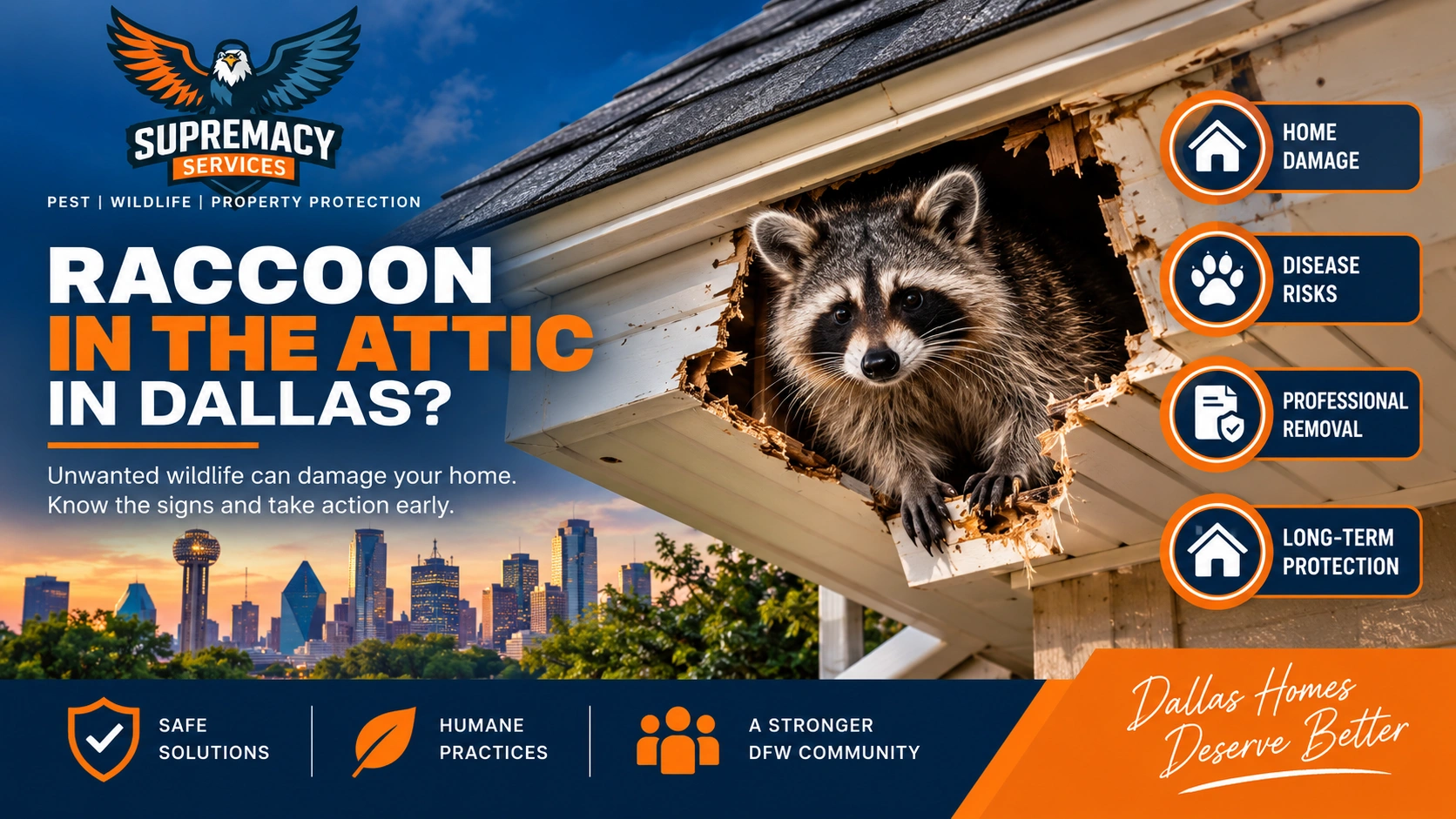
If you suspect a raccoon in the attic, avoid entering the attic or trying to corner, grab or chase the animal out. Keep children and pets away, look for signs of where the raccoon is entering from outside, and arrange for the attic and roofline to be inspected before sealing any opening.
The reason for the caution is simple: getting the raccoon out is only part of the solution. You also need to determine whether young raccoons are present, identify the entry point, evaluate contamination or damage, and prevent another animal from using the same opening.
Here is what Dallas and DFW homeowners should know.
What Should You Do If You Have a Raccoon in Your Attic?
If you hear or see evidence of a raccoon above your ceiling:
- Stay out of the attic and keep your distance.
- Keep children and pets away from the area.
- Do not corner or attempt to handle the raccoon.
- Do not immediately seal the suspected entry hole.
- Look for exterior evidence from ground level rather than climbing onto the roof.
- Arrange for a wildlife inspection to determine whether the animal—and potentially young—are still inside.
- After removal, address entry points, contamination and damage.
The goal should be removal + exclusion + cleanup, not simply making the noises stop.
Why You Shouldn’t Immediately Seal the Entry Hole
Finding a damaged soffit or roof opening may make sealing it seem like the obvious first step.
That can be premature.
If the raccoon is still inside, blocking its established exit can leave the animal trapped in the structure. If young raccoons are present, sealing an adult outside can separate the family.
The safer sequence is to identify what is inside, resolve the animal problem appropriately, verify that the space is clear and then perform exclusion repairs.
Need the attic and roofline professionally evaluated? Supremacy Services provides wildlife trapping, removal and entry-point exclusion for Dallas/DFW homes.
How Do You Know If a Raccoon Is in Your Attic?
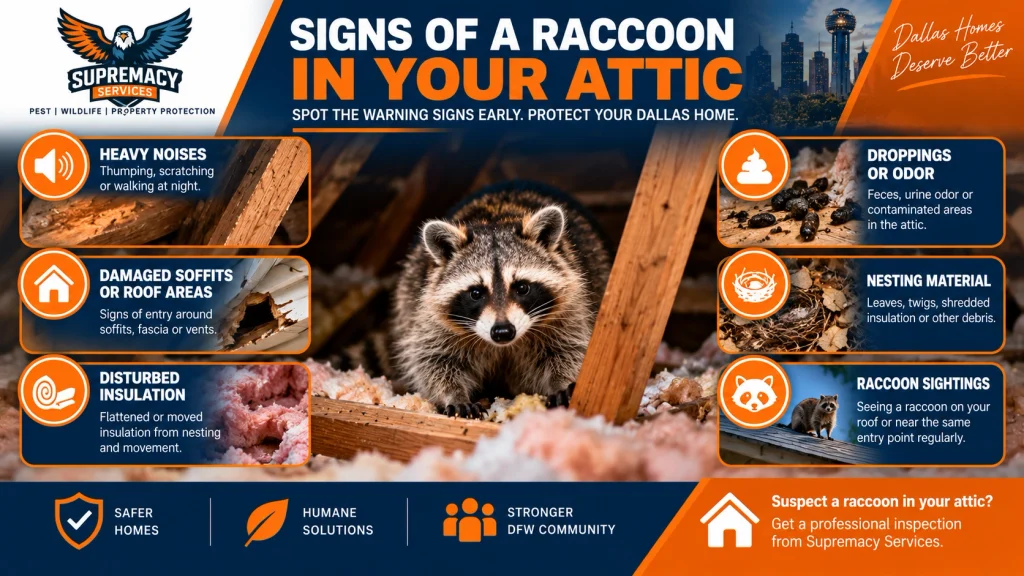
Common signs of a raccoon in an attic include heavy nighttime movement, thumping or scratching, disturbed insulation, damaged roof components, droppings, nesting material and visible entry damage around the roofline.
No single sign proves that the animal is a raccoon, however. Squirrels, rats, opossums and other wildlife can produce similar symptoms.
1. Heavy Noises at Night
Raccoons are relatively large compared with rats and squirrels. When one moves across ceiling joists or attic flooring, homeowners may hear:
- heavy footsteps;
- thumps;
- scratching;
- shuffling;
- movement around soffits or vents; or
- intermittent vocal sounds.
Timing helps with identification. Persistent activity after dark is more consistent with a nocturnal animal than the daytime movement commonly associated with squirrels.
But sound alone should not be treated as definitive identification.
2. Damaged Soffits, Fascia or Roof Components
Raccoons are capable climbers and can exploit vulnerable areas along a roofline.
Look from ground level for:
- displaced or damaged soffit panels;
- gaps around fascia;
- damaged roof vents;
- openings near roof intersections;
- loose exterior materials;
- disturbed chimney components; and
- enlarged pre-existing gaps.
The visible opening may not be the only vulnerable point, which is why a whole-roofline inspection is more useful than simply patching the most obvious hole.
3. Disturbed Attic Insulation
A raccoon using an attic for shelter can flatten, move or contaminate insulation.
Homeowners may notice compressed areas, pathways, nesting zones or insulation displaced near an entry point.
Damaged insulation can become part of the restoration scope after the animal has been removed.
4. Droppings or Urine Odor
Wildlife waste is another important clue.
Do not handle raccoon feces or contaminated attic material with bare hands. If substantial contamination is present, cleanup may require protective equipment and careful removal of affected materials.
A persistent odor can also indicate that wildlife has occupied the attic longer than the homeowner initially realized.
5. A Raccoon Seen on the Roof
Seeing a raccoon cross your yard does not mean it lives in your attic.
Seeing one repeatedly climbing the same section of your home, entering an opening, emerging from the roofline or spending time around the same soffit or vent is much stronger evidence.
Observe from a safe distance rather than approaching the animal.
Raccoon, Squirrel, Rat or Opossum? How to Tell the Difference
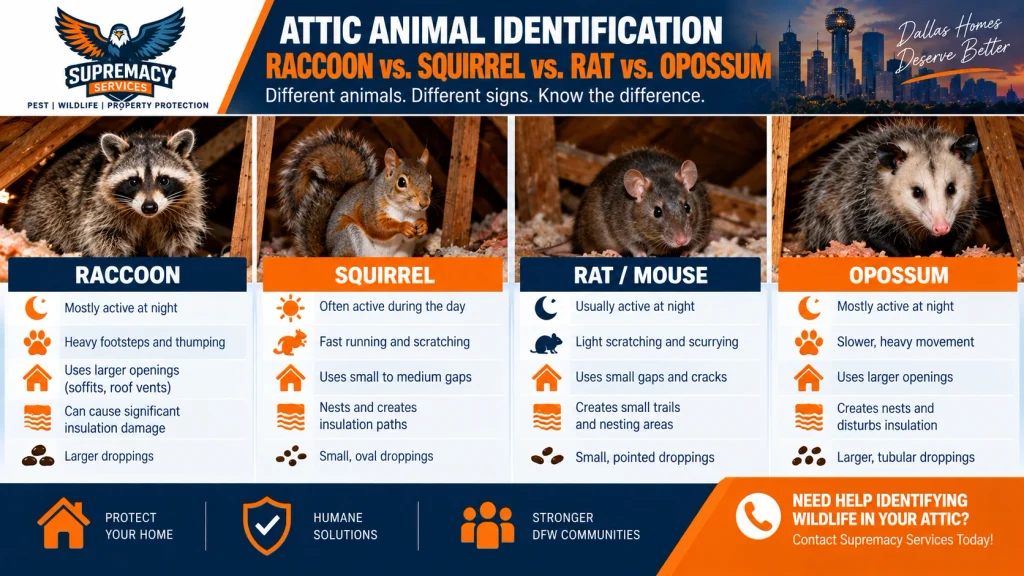
Several animals can make surprisingly similar noises above a ceiling.
| Clue | Raccoon | Squirrel | Rat/Mouse | Opossum |
|---|---|---|---|---|
| Typical activity | Mostly nighttime | Often daytime | Often nighttime | Mostly nighttime |
| Perceived movement | Heavy walking/thumping | Fast running/scratching | Light scratching/scurrying | Slower heavy movement |
| Likely opening | Larger roof/eave vulnerability | Roof/eave gaps | Small structural gaps | Larger accessible opening |
| Insulation disturbance | Can be substantial | Nesting/paths possible | Small trails/nesting | Nesting/disturbance possible |
| Best identification method | Inspection | Inspection | Inspection | Inspection |
Noise descriptions are useful clues—not a substitute for identifying the animal and entry point.
Why Do Raccoons Enter Attics?
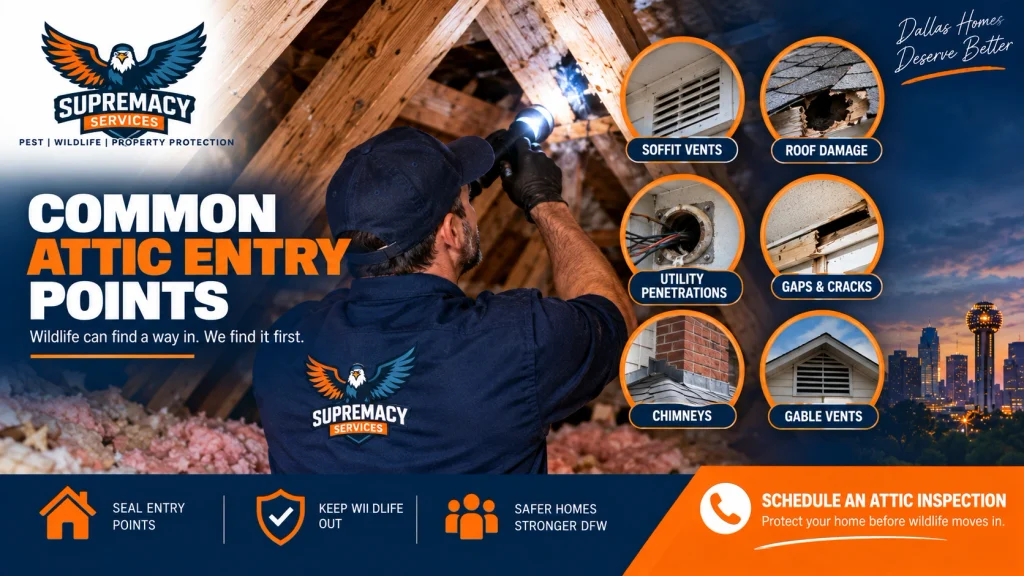
An attic can provide something wildlife actively seeks: shelter and a protected place to den.
The problem often begins with a vulnerable building component rather than a mysterious infestation.
Potential access areas include:
Soffits and Fascia
Loose, deteriorated or damaged eave components can create access into roof cavities.
Roof Vents
A damaged or inadequately protected vent can become a vulnerable location.
Roof Intersections and Construction Gaps
Where rooflines, additions or exterior components meet, small construction weaknesses can develop or enlarge over time.
Chimney Areas
Chimney caps, flashing and adjacent roof components should be checked as part of a complete inspection.
Existing Wildlife Damage
A previously used entry point can remain vulnerable if the earlier repair addressed the animal but not the opening.
This is why successful wildlife control is as much a building-exclusion problem as an animal-removal problem.
Why Raccoons in the Attics Should Be Taken Seriously
A raccoon occupying an attic can create problems beyond unwanted noise.
Insulation Damage
Repeated travel and nesting can compress or contaminate insulation. Depending on the extent of the damage, affected areas may need cleaning, removal or replacement.
Soffit and Roof Damage
Wildlife access may involve an existing weak spot, but repeated use can make the opening larger or worsen already damaged materials.
Waste Contamination
Droppings, urine and nesting debris may accumulate where an animal spends significant time.
Parasites and Other Biological Hazards
Wildlife can carry parasites and pathogens. Avoid direct contact with the animal or its waste and use appropriate precautions when contaminated materials are handled.
Rabies Exposure
Raccoons are among the wild mammals considered relevant in rabies exposure assessments. The practical takeaway is not that every raccoon has rabies—it does not—but that direct contact should be avoided.
If a raccoon bites or scratches a person, or saliva potentially contacts broken skin or the eyes, nose or mouth, wash the affected area and contact a healthcare professional or public-health authority promptly.
Do not attempt to determine whether an animal has rabies simply by looking at it.
Can You Remove a Raccoon From an Attic Yourself?
There is an important difference between wildlife prevention and handling an occupied attic.
Homeowners can do useful preventive work such as securing garbage, eliminating accessible food sources and monitoring exterior maintenance.
Direct removal becomes more complicated when:
- the animal is already inside;
- the location is difficult to access;
- young animals may be present;
- significant fecal contamination exists;
- the raccoon has entered living space;
- a person or pet may have had direct contact; or
- roof work is required.
Texas also has rules affecting the handling and transportation of raccoons. Do not assume that trapping a raccoon gives you unrestricted authority to transport and release it wherever you choose.
For an active attic problem, professional inspection is generally the more practical route because removal and structural exclusion need to be coordinated.
What Does Professional Raccoon Attic Removal Include?
The exact scope depends on the home and infestation, but a thorough wildlife-control process generally involves several stages.
Step 1: Confirm the Animal
The inspection should determine whether the evidence is consistent with raccoons or another species.
Correct identification matters because different animals require different removal and exclusion approaches.
Step 2: Locate Entry and Vulnerable Areas
The roofline, soffits, fascia, vents and other exterior transitions should be evaluated for current and potential access points.
Step 3: Check for Young
This is especially important when the attic may be functioning as a den.
A removal plan should account for all animals rather than simply the adult that happens to be visible.
Step 4: Remove the Wildlife
The appropriate method depends on the situation and applicable wildlife rules.
Step 5: Verify the Space Is Clear
Exclusion repairs should be coordinated with removal so that wildlife is not unintentionally trapped inside.
Step 6: Seal Entry Points
Once the animals are out, vulnerable openings should be repaired or reinforced with materials suitable for the specific part of the structure.
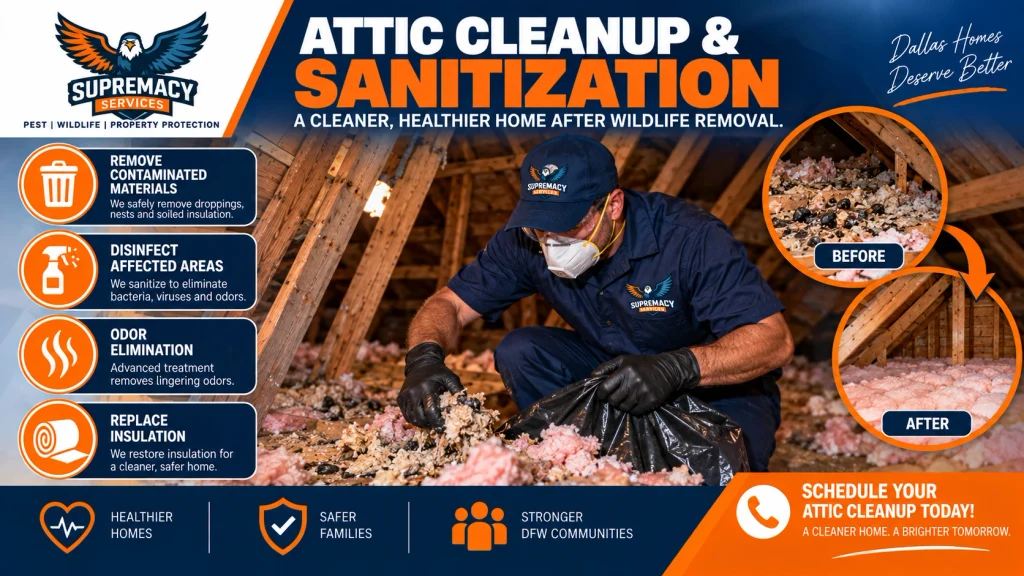
Step 7: Evaluate Cleanup and Restoration
The attic can then be assessed for:
- droppings;
- urine contamination;
- nesting debris;
- damaged insulation;
- odor; and
- physical damage.
If you’re hearing heavy nighttime movement or have found roofline damage, schedule a Dallas wildlife inspection before closing the opening. Identifying the animal and entry point first can prevent a removal problem from becoming a trapped-animal problem.
How Much Does Raccoon Removal Cost in Dallas?
There is no responsible single price for every raccoon-in-attic job because the work can range from a relatively straightforward removal to a more extensive project involving roofline exclusion, young animals, contaminated insulation and repairs.
Important cost factors include:
| Cost factor | Why it matters |
|---|---|
| Number of animals | Multiple animals can require additional work |
| Presence of young | Changes the removal strategy |
| Entry-point location | High or difficult roof access increases complexity |
| Number of openings | More exclusion work may be required |
| Attic contamination | Cleanup may expand the scope |
| Insulation damage | Restoration may be separate from removal |
| Soffit/roof damage | Building repairs can add work |
| Repeat infestation | Previous unsuccessful repairs may need correction |
For homeowners comparing estimates, ask what the quoted scope actually includes.
A low removal-only price is not equivalent to a proposal that includes inspection, removal, exclusion, cleanup and repair.
Does Homeowners Insurance Cover Raccoon Damage?
Coverage depends on the policy, cause of loss, exclusions and circumstances.
Do not assume that either wildlife removal or resulting attic damage is automatically covered. Review your policy and ask your insurer specifically about animal damage, cleanup, insulation and structural repairs.
Photograph visible damage before restoration begins when it is safe to do so.
What About Raccoons and Rabies in Texas?
Raccoons can contract rabies, but seeing a raccoon does not mean the animal is rabid.
The important distinction is between having wildlife somewhere in the structure and experiencing an actual potential exposure.
If you or another person is bitten or scratched, or may have had contact with potentially infectious saliva, wash the affected area with soap and water and contact a healthcare provider or local health authority promptly.
If a pet encounters the raccoon, separate the animals without putting yourself at risk and contact your veterinarian or appropriate local authority.
Do not handle a sick, injured, unusually tame or dead raccoon with bare hands.
Can You Relocate a Raccoon in Texas?
Texas rules make this more complicated than simply trapping an animal and driving it to a distant park.
State rabies-control rules restrict transportation of certain live high-risk wildlife, including raccoons. Specific exemptions and requirements apply to authorized individuals.
For Dallas homeowners, the practical lesson is straightforward: do not capture a raccoon and independently transport it somewhere else without first understanding the applicable rules.
Professional wildlife-control providers should use methods consistent with current Texas requirements.
How Do You Prevent Raccoons From Getting Back Into the Attic?
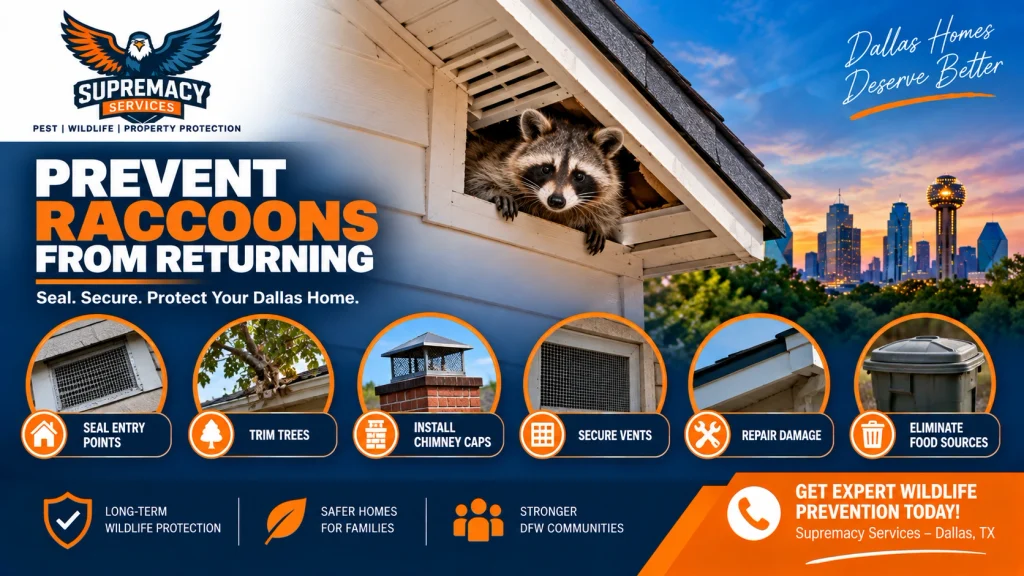
Long-term prevention depends on making the structure less accessible and reducing attractants around the property.
Inspect the Roofline
Periodically check:
- soffits;
- fascia;
- roof vents;
- chimney areas;
- roof intersections; and
- previous wildlife repairs.
Address deterioration before an animal turns it into an entry point.
Secure Trash
Keep garbage in securely closed containers and avoid leaving accessible food waste outside overnight.
Avoid Feeding Wildlife
Feeding raccoons encourages them to associate residential properties with food.
Manage Pet Food
Bring pet food indoors rather than leaving it accessible outside overnight.
Maintain Trees Near the Roof
Branches close to the roof can make roof access easier for several wildlife species. Appropriate tree maintenance can reduce those pathways, although raccoons are capable climbers and tree trimming alone will not wildlife-proof a home.
Protect Vulnerable Openings
Exterior repairs should be appropriate to the building component involved. The objective is durable exclusion rather than simply filling a visible gap with whatever material is available.
Dallas/DFW Considerations
Raccoons occur in Texas and adapt well to environments where food and shelter are available around people.
For Dallas and DFW homeowners, that makes routine exterior maintenance particularly valuable. Mature trees, roof complexity, accessible garbage, damaged soffits and other property-specific conditions can create opportunities for wildlife without the homeowner noticing immediately.
The correct response is therefore property-specific: identify the animal, determine how it entered and correct the structural weakness that allowed access.
When Should You Call a Wildlife Professional?
Consider professional wildlife service when:
- you hear heavy movement in the attic;
- you see a raccoon entering the roofline;
- young raccoons may be present;
- the animal enters your living space;
- there is significant attic contamination;
- you find multiple entry points;
- roof access is required;
- previous removal attempts have failed; or
- you are unsure which animal is inside.
For a potential bite, scratch or saliva exposure, contact healthcare/public-health professionals as well. Wildlife removal service is not a substitute for medical advice.
Frequently Asked Questions
Will a raccoon leave my attic on its own?
A raccoon may leave temporarily to forage, but that does not mean the attic has been abandoned. If it is using the attic as a den—particularly when young are present—the animal may return. Confirm vacancy before sealing the entry point.
What does a raccoon sound like in an attic?
Homeowners often describe relatively heavy footsteps, thumping, scratching and shuffling. Sound alone cannot reliably identify the species, so an inspection is preferable.
Should I seal the hole while the raccoon is outside?
Not until you are confident that no raccoons or young remain inside. Premature sealing can trap an animal or separate a mother from her young.
Are raccoons in Dallas dangerous?
Wild raccoons should not be handled or cornered. They can bite or scratch when threatened, and Texas health authorities advise avoiding direct contact with wildlife because of potential disease exposure
Can raccoons damage attic insulation?
Yes. Wildlife can compress, displace and contaminate insulation through movement, nesting, urine and feces. The extent should be evaluated after removal.
Can raccoons chew through a roof?
Raccoons frequently exploit existing vulnerable areas such as damaged soffits or other weak roofline components and can worsen an opening. A full exterior inspection helps identify both the active entrance and other vulnerabilities.
How much does raccoon removal cost in Dallas?
Cost depends on factors such as accessibility, number of animals, presence of young, exclusion work, contamination, insulation damage and structural repairs. Compare the scope of work rather than comparing removal prices alone.
Can I trap and relocate a raccoon myself in Texas?
Do not assume you can transport and release a captured raccoon wherever you choose. Texas has specific rules concerning the transport of live raccoons and other high-risk wildlife.
How do I keep raccoons out permanently?
Removal should be followed by exclusion. Repair the actual entry point, inspect other vulnerable roof areas and reduce food sources such as unsecured trash or outdoor pet food.
Have a Raccoon in Your Attic in Dallas?
A raccoon in the attic is not just an animal-removal problem. A complete solution requires determining what is inside, how it entered, whether young are present, what damage or contamination occurred and how the opening should be secured afterward.
Avoid direct contact and do not seal an active opening until the attic has been properly evaluated.
Contact Supremacy Services for professional wildlife trapping, attic inspection and exclusion in Dallas and across the DFW Metroplex.

