10400 Clarence Drive, Frisco, TX 75033
Support 24/7: 945-777-3345
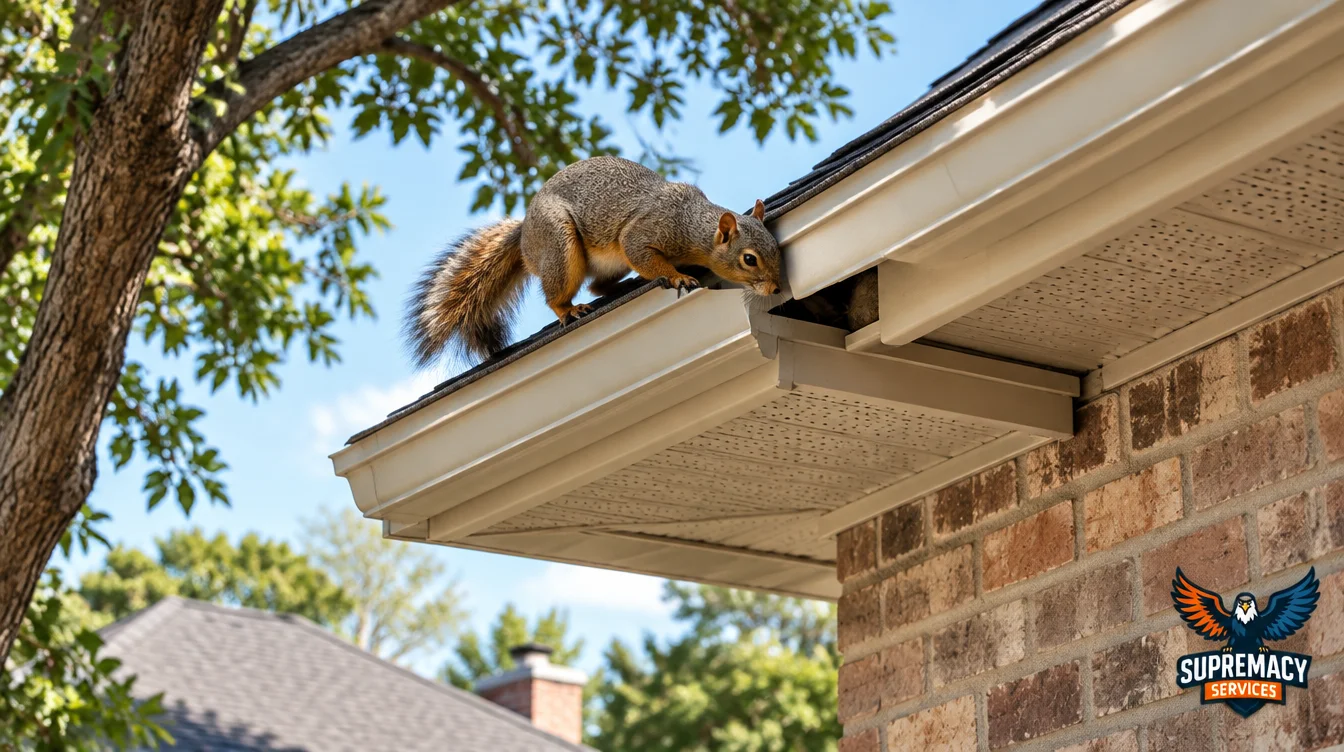
Squirrel approaching a roofline and attic entry point on a Dallas home

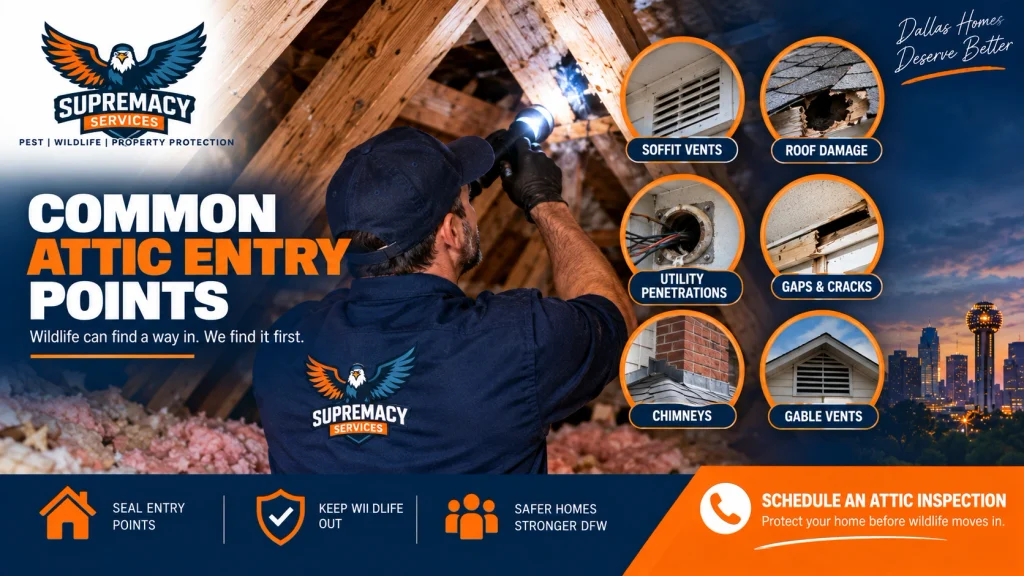
How Do Squirrels Get Into Attics? Common Roof Entry Points

How do Squirrels usually get into attics? Often through vulnerable areas along the roofline—including damaged soffits, loose fascia boards, unscreened vents, gaps around eaves and openings where different roof sections meet. They may use an existing opening or enlarge a weak spot by gnawing.

For Dallas–Fort Worth homeowners, the first challenge is not simply getting the squirrel out. It is finding how the squirrel is getting into the attic and correcting that opening without accidentally trapping an animal—or young squirrels—inside.

If you have heard scratching overhead or seen squirrels repeatedly disappearing around your roof, here are the areas worth checking first.

Table of Contents

  1. Why Squirrels Enter Attics
  2. 8 Common Squirrel Roof Entry Points
  3. How Squirrels Reach Your Roof
  4. Signs of a Squirrel Entry Point
  5. Squirrel vs. Rat or Raccoon
  6. Should You Seal the Hole Yourself?
  7. What Professional Squirrel Exclusion Includes
  8. How to Prevent Squirrels From Returning
  9. FAQs

Why Do Squirrels Enter Attics?

Squirrels may enter an attic because it offers a sheltered location away from weather and predators and can provide a suitable nesting space.

Texas Parks and Wildlife identifies the eastern fox squirrel as Texas’ most common squirrel and notes that fox squirrels naturally use tree cavities or leaf-and-twig nests. They are generally most active early in the morning and late in the afternoon.

An attic can become an attractive substitute when a squirrel discovers an accessible opening in a house.

The important distinction is that squirrels do not necessarily create every entry point from scratch. A house may already have:

  • deteriorated wood;
  • a damaged soffit;
  • an uncovered vent;
  • a construction gap;
  • storm-damaged roof components; or
  • an opening previously used by another animal.

Once a squirrel finds a vulnerable area, gnawing can enlarge or worsen the opening.


8 Common Squirrel Roof Entry Points
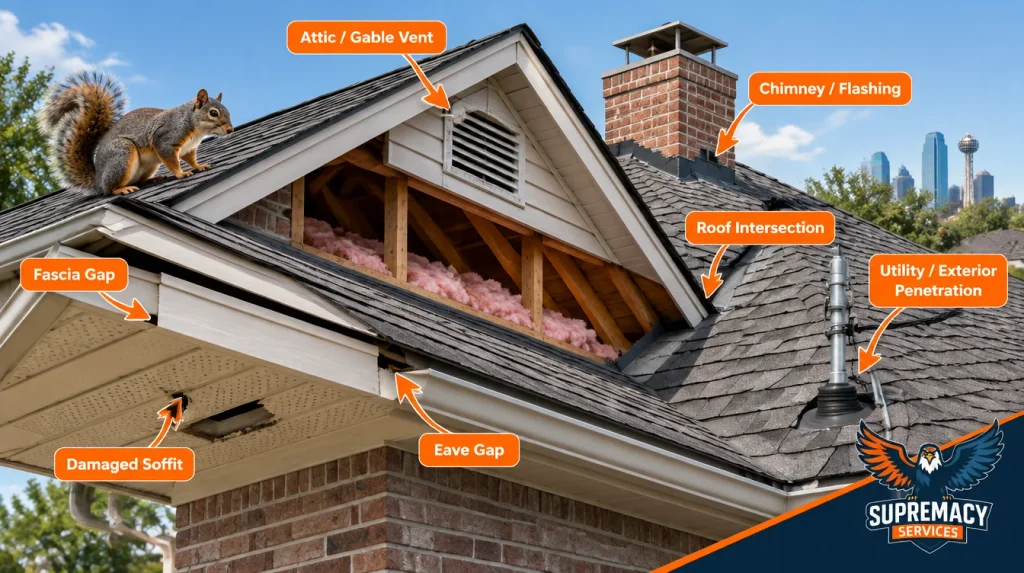
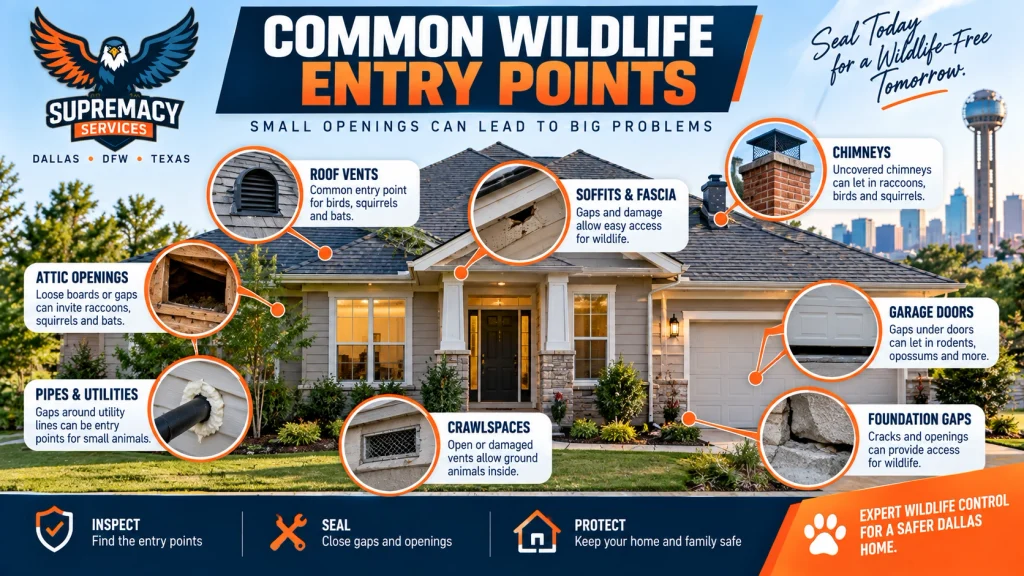
Common squirrel attic entry points around the roof of a Dallas home
Soffits, fascia gaps, vents, eaves and other roof openings can provide squirrels with access to an attic.

1. Damaged or Loose Soffits

Soffits are one of the first areas to inspect when squirrels repeatedly appear near the edge of a roof.

The soffit covers the underside of the roof overhang. Loose panels, deteriorated wood or openings where the soffit meets adjoining components can provide access to the space above.

Look for:

  • displaced soffit panels;
  • broken or rotting wood;
  • dark openings at corners;
  • chew marks;
  • staining around an opening; and
  • squirrels repeatedly visiting the same section of roof.

Simply pushing a loose panel back into place is not sufficient if an animal is already inside.

2. Fascia and Roof-Edge Gaps
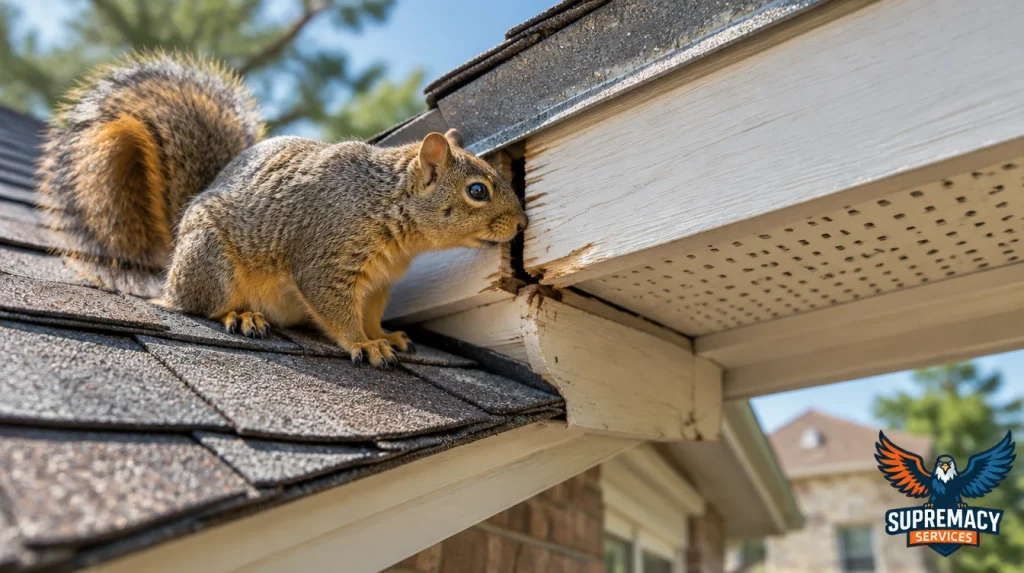
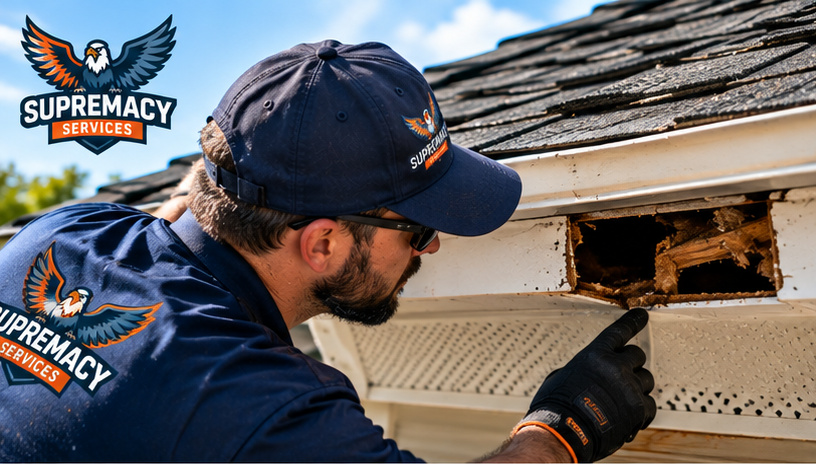
Squirrel entering attic through damaged soffit and fascia gap
Damaged soffits and gaps behind fascia boards are common places for squirrels to gain attic access.

The fascia runs along the edge of the roof and helps close the area around the ends of the rafters.

Deterioration or separation between fascia, soffit and roofing components can expose an opening into the roof structure.

These areas can be difficult to evaluate from the ground because a small-looking exterior defect may connect to a larger cavity behind it.

3. Attic, Gable and Roof Vents

An attic vent can become a wildlife entry point when its screen or cover is missing, loose or damaged.

Attics need ventilation, so vents cannot simply be sealed shut. Instead, the objective is to maintain their intended airflow while preventing wildlife from passing through.

University extension guidance specifically recommends protecting attic vents and similar openings with durable screening or hardware cloth appropriate for wildlife exclusion.
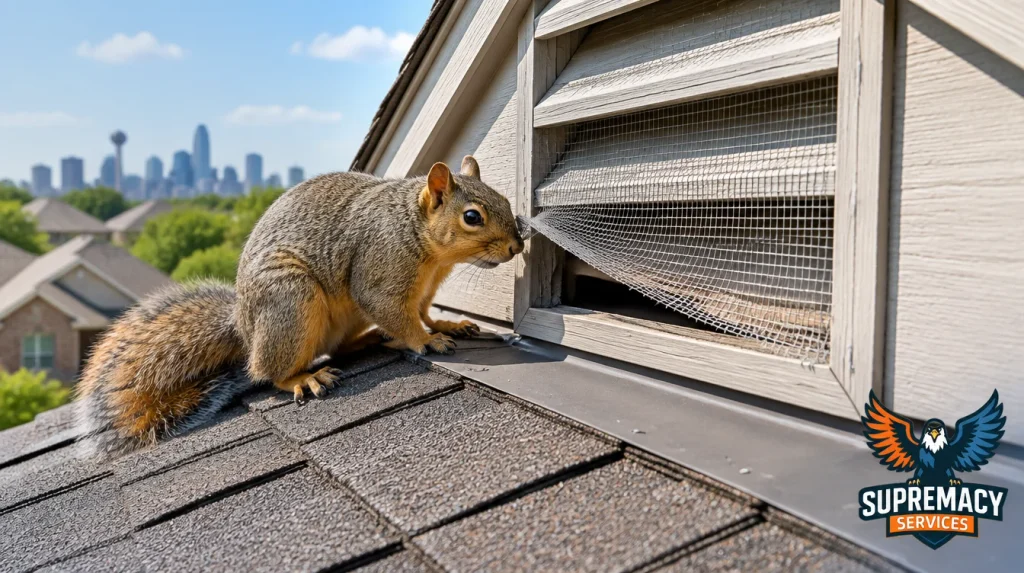
Squirrel near damaged attic vent screen on Dallas home
Loose or damaged vent screens can create vulnerable openings that allow squirrels into an attic.

Inspect:

  • gable vents;
  • roof vents;
  • turbine vents;
  • vent screens; and
  • surrounding roof material.

A bent screen or damaged vent assembly deserves attention if squirrels are active on the roof.

4. Gaps Around Eaves

Eaves contain multiple transitions between roofing, fascia, soffits and wall materials.

Those intersections can develop gaps as materials age, shift or deteriorate.

A squirrel moving along the roof edge can investigate these protected areas and repeatedly return once it finds an accessible cavity.

5. Roof Intersections and Construction Gaps

Complex rooflines contain valleys, dormers and intersections where one roof section meets another.

Not every gap is a defect, but poorly sealed or damaged transitions can create sheltered openings that are difficult to see from ground level.

This is one reason a proper wildlife inspection should evaluate the entire roofline, rather than patching only the first obvious hole.

6. Chimney and Flashing Areas

A chimney creates several potential areas of concern:

  • an uncapped chimney opening;
  • damaged chimney screening;
  • gaps near flashing;
  • deteriorated trim; or
  • openings where the chimney meets the roof structure.

Chimney caps and properly maintained surrounding materials can reduce wildlife access while still allowing the chimney system to function as designed.

7. Damaged Roofing or Roof Deck Openings

Missing or damaged roofing materials can expose vulnerable sections underneath.

A squirrel may also exploit deterioration near roof edges or other areas where damaged materials provide access to the underlying structure.

Seeing a squirrel on the shingles does not necessarily mean it is entering through the shingles themselves. Watch where the animal goes immediately before it disappears.

That location often provides a much better clue.

8. Utility and Exterior Penetrations Near the Roofline

Homes contain penetrations for cables, pipes and other building systems.

Where those components enter the structure, poorly sealed openings may provide access into wall or attic cavities.

University of Missouri Extension specifically recommends checking openings created for utility pipes and electrical wiring as part of squirrel-proofing a building.


How Do Squirrels Reach the Roof?

Finding an opening is only half of the investigation. You should also ask:

How is the squirrel reaching that part of the house?

Common access routes include:

Overhanging Tree Branches

Tree squirrels are exceptionally comfortable moving through elevated environments.

Branches extending toward a house can provide convenient access to the roof.

Trees do not need to touch the building for squirrels to investigate nearby roof areas, so pruning decisions should consider the overall route rather than only branches physically resting against shingles.

Fences and Nearby Structures

Fences, pergolas, sheds and other structures can create elevated travel routes around a property.

Utility Lines

Squirrels can also move along overhead lines.

Never attempt to modify electrical or utility lines yourself. Any work involving utility infrastructure should be handled by the appropriate utility or qualified professional.


What Does a Squirrel Entry Point Look Like?

A squirrel entry point may look like a hole, but sometimes the clues are subtler.

Watch for:

Exterior clueWhat it may indicate
Chewed woodAn opening may have been enlarged
Loose soffitPossible access behind the roof edge
Damaged vent screenPotential attic access
Repeated squirrel activityA frequently used route may be nearby
Nesting material near an openingPossible active nesting area
Worn or disturbed openingRepeated animal movement
Damaged fasciaPossible access to roof cavity

The strongest clue is often repeated behavior.

From a safe location, observe where squirrels travel. If the same animal repeatedly approaches one section of the roof and disappears beneath an edge, vent or soffit, that area deserves closer inspection.

Avoid climbing onto a steep roof simply to investigate wildlife activity.


What Are the Signs of Squirrels in an Attic?

Common signs can include:

  • scratching or scurrying overhead;
  • activity that is especially noticeable during daylight hours;
  • gnaw marks;
  • disturbed attic insulation;
  • nesting material;
  • droppings;
  • damage around a roof opening; and
  • squirrels repeatedly traveling to and from the same roof area.

Texas Parks and Wildlife notes that fox squirrels are commonly active early in the morning and late in the afternoon. That makes the timing of noises a useful clue, although timing alone cannot confirm which animal is present.

If you can safely observe the exterior, watch the roof around the time you normally hear activity.


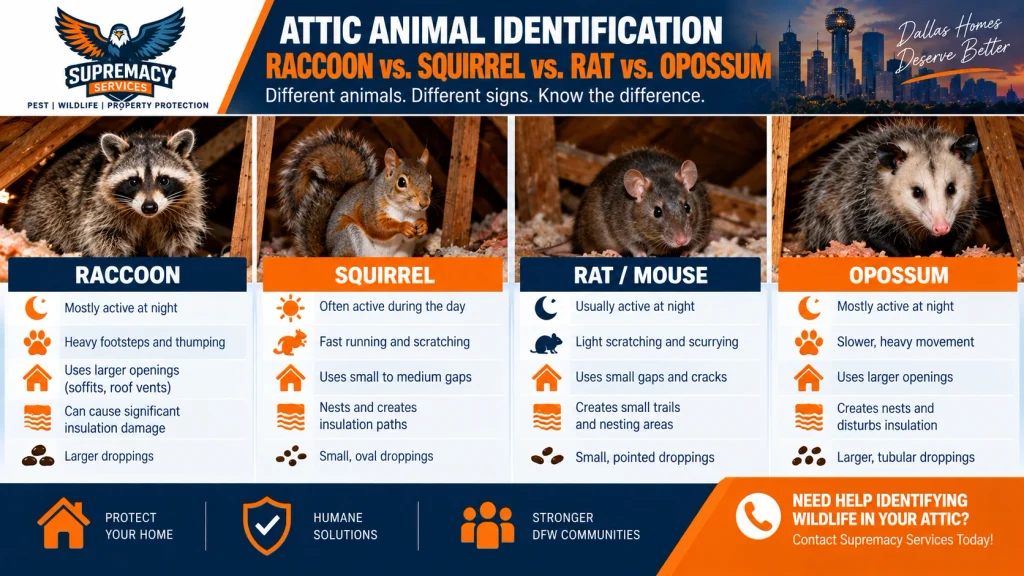
Is It a Squirrel, Rat or Raccoon in the Attic?

Several animals can produce scratching noises above a ceiling.

ClueSquirrelRat/MouseRaccoon
Typical activity clueOften daytime, especially morning/late afternoonMore commonly noticed at nightOften noticed at night
SoundRunning, scratching, gnawingLight scratching/scurryingHeavier movement or thumping
Entry areaRoofline, vents, soffits, eavesSmall gaps throughout structureLarger roof/soffit openings
Potential damageGnawing, insulation disturbanceGnawing, contaminationTorn materials, larger disturbance

These are diagnostic clues—not guarantees.

A homeowner hearing scratching should avoid assuming every attic noise is caused by squirrels. Rats, mice, raccoons, birds and other wildlife can occupy similar spaces.


Can Squirrels Damage an Attic?

Yes. Once inside, squirrels can disturb insulation and gnaw building materials.

University extension resources specifically identify damage to walls, insulation and electrical wiring as potential consequences of squirrels entering buildings.

Electrical wiring deserves particular attention. Visible animal-damaged wiring should be evaluated by a qualified electrical professional rather than taped over or treated as a wildlife repair.

The longer-term problem is also the opening itself. Removing an animal without addressing the route it used leaves the structure vulnerable to another animal.


Should You Seal a Squirrel Hole Yourself?

Do not permanently close a suspected active squirrel entry point until you know animals are no longer inside.

This is one of the most important steps in squirrel exclusion.

Penn State Extension specifically warns homeowners to make sure squirrels are not locked inside when attic openings are closed.

That becomes especially important when young squirrels may be present.

Closing the obvious entrance too early can create several problems:

  • an adult may attempt to force its way back inside;
  • an animal trapped indoors may cause additional damage trying to escape;
  • dependent young may remain in the attic; and
  • another unnoticed opening may continue to provide access.

For an old, clearly inactive opening, straightforward maintenance may be reasonable.

For an active infestation, removal and exclusion should be coordinated.

If squirrels are actively entering your attic, Supremacy Services can inspect the roofline, identify wildlife entry points and determine the appropriate removal and exclusion approach for your Dallas–Fort Worth home.


Why Spray Foam Alone Is Not a Squirrel-Proof Repair

Wildlife exclusion is different from ordinary gap filling.

Squirrels are rodents and can gnaw. A repair should therefore address the underlying structural opening using materials appropriate for that part of the building.

University extension guidance recommends durable barriers such as hardware cloth for appropriate openings and repair of damaged soffit/eave materials.

The correct repair depends on whether the opening involves:

  • ventilation;
  • roofing;
  • wood trim;
  • flashing;
  • masonry;
  • utility infrastructure; or
  • another building component.

The objective is not simply to make the hole disappear. The repair needs to prevent re-entry without interfering with drainage, ventilation or another intended building function.


What Does Professional Squirrel Exclusion Include?
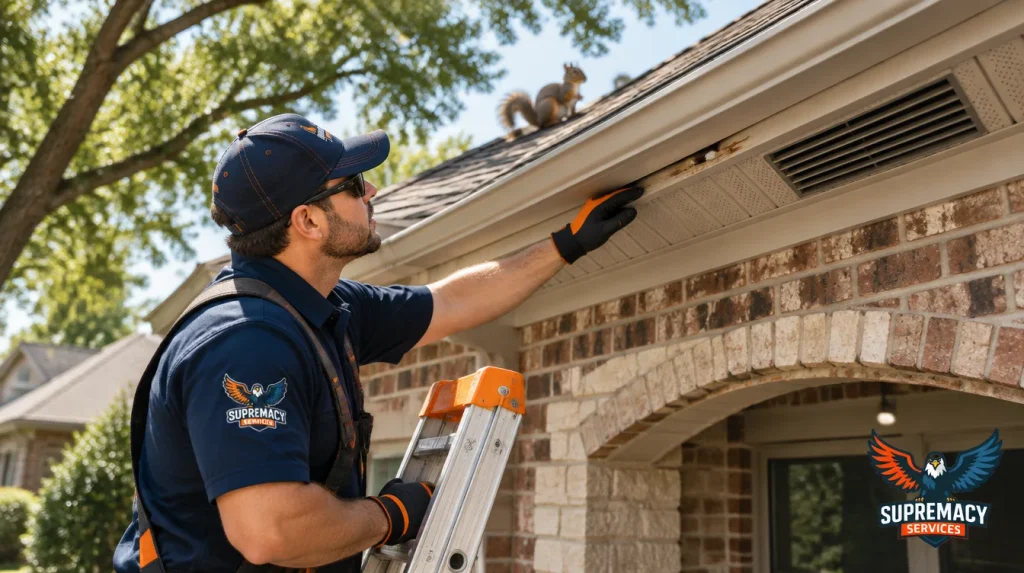
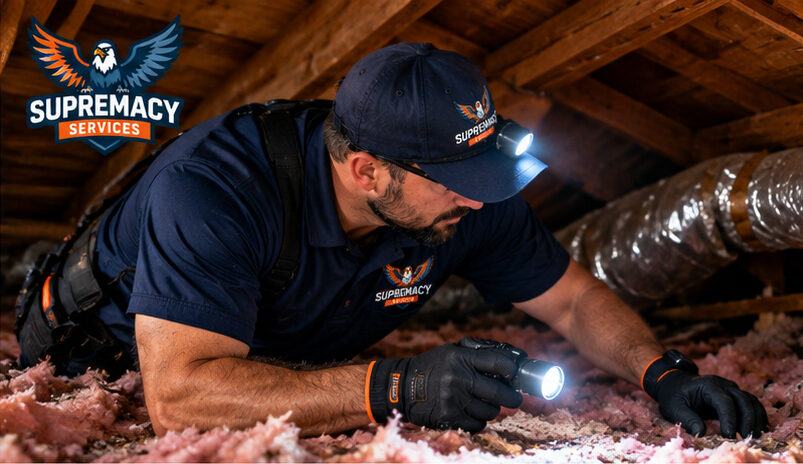
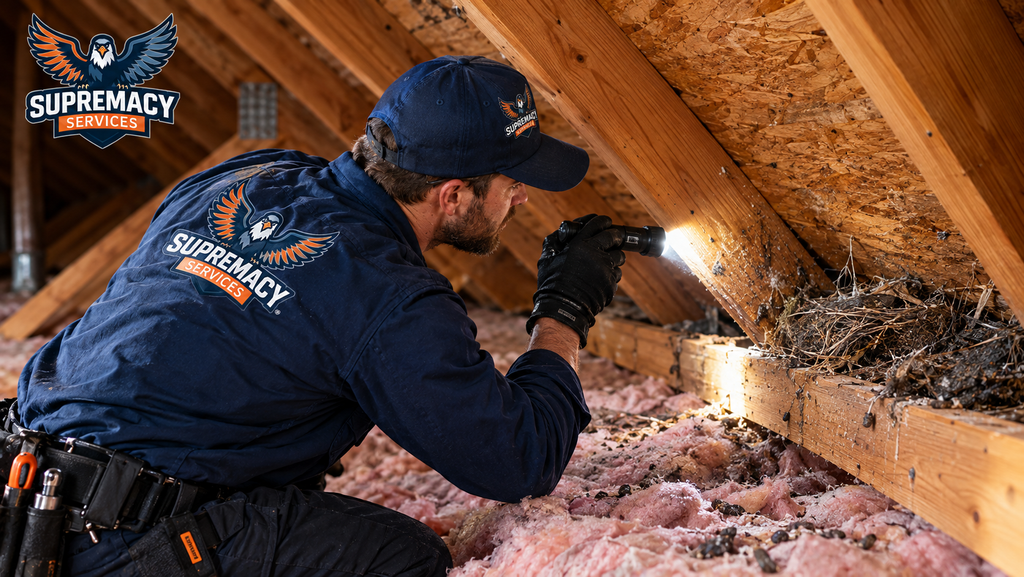
Wildlife technician inspecting Dallas home roof for squirrel attic entry points
A professional wildlife inspection can identify hidden squirrel entry points around soffits, fascia, vents and rooflines.

A thorough wildlife service should begin by determining both what animal is present and how it entered.

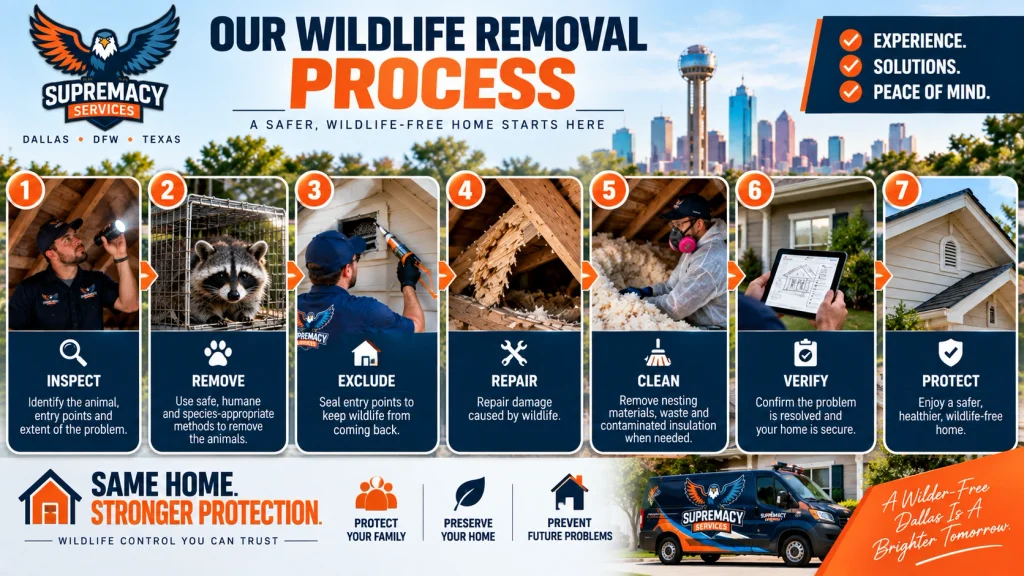
A typical process may involve:

1. Exterior and Roofline Inspection

The technician evaluates likely entry areas including:

  • soffits;
  • fascia;
  • eaves;
  • vents;
  • roof transitions;
  • chimney areas;
  • penetrations; and
  • other visible exterior defects.

2. Attic Inspection

Where accessible and appropriate, the attic is checked for signs such as nesting material, disturbed insulation, droppings, gnawing and travel paths.

3. Identification of Active Entry Points

The goal is to distinguish an active entrance from unrelated building damage.

4. Wildlife Removal or Exclusion

The appropriate approach depends on the species, conditions and whether young animals are present.

5. Entry-Point Repair

Once exclusion can be completed safely, vulnerable openings are repaired or protected with materials appropriate for the location.

6. Follow-Up Inspection

The property should be checked to confirm that activity has stopped and repaired areas remain secure.


If you are seeing squirrels repeatedly enter the same roof area, schedule a wildlife inspection and entry-point assessment before closing the opening.


How Can Dallas Homeowners Prevent Squirrels From Getting Into the Attic?

Prevention is primarily an exclusion and maintenance problem.
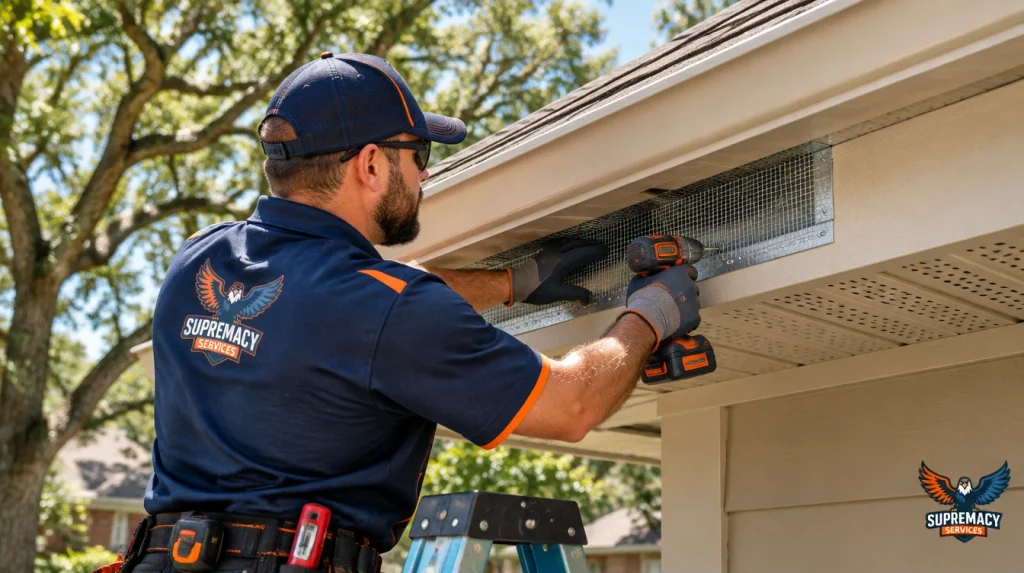
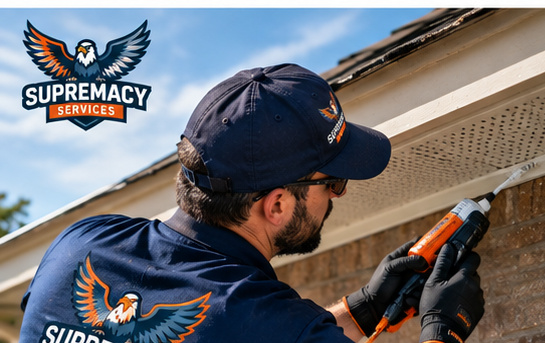
Technician sealing squirrel entry point in soffit on Dallas home
Wildlife exclusion repairs help close vulnerable roof openings and reduce the risk of squirrels returning to the attic.

Inspect the roofline periodically

Look for:

  • loose soffits;
  • deteriorating fascia;
  • damaged vent screens;
  • openings around roof transitions;
  • missing or damaged chimney protection; and
  • obvious exterior gaps.

Repair deterioration early

Small exterior defects are generally easier to correct before wildlife begins using them.

Protect ventilation openings correctly

Do not eliminate required attic ventilation. Instead, use appropriately designed wildlife-resistant screening or vent protection where needed.

Manage easy roof access

Evaluate branches and nearby structures that provide squirrels with convenient roof access.

University of Missouri Extension recommends trimming overhanging branches as part of squirrel prevention.

Do not rely on repellents instead of repairs

Making an attic unpleasant does not correct the opening that allowed an animal inside.

Physical exclusion and building maintenance address the actual access route.

Reinspect previously repaired areas

A house can develop new vulnerabilities over time. Roof work, storms, aging materials and repairs can all change exterior conditions.


Dallas–Fort Worth Considerations

Squirrels are a normal part of the North Texas environment.

Texas Parks and Wildlife describes the eastern fox squirrel as Texas’ most common squirrel and notes that it adapts to a variety of habitats. Fox squirrels are also among the urban wildlife documented by TPWD.

That means seeing squirrels in a Dallas neighborhood is not itself a pest problem.

The problem begins when wildlife gains access to the structure.

Homes with mature trees and complicated rooflines deserve particular attention because squirrels can move through elevated environments and multiple roof intersections create more locations that need to be checked during an exclusion inspection.

The practical goal is not eliminating squirrels from your property. It is keeping the boundary between the outdoor habitat and your attic intact.


Squirrel Attic Inspection Checklist

If you suspect an attic problem, use this checklist from ground level where possible:

  • Watch where squirrels travel across the roof.
  • Note where they disappear from view.
  • Check soffits for loose or damaged sections.
  • Look for fascia deterioration.
  • Inspect visible vent covers/screens.
  • Check chimney protection.
  • Look for gnawing or disturbed materials.
  • Note nearby tree branches and elevated access routes.
  • Listen for the time of day attic activity occurs.
  • Do not close an active opening until occupancy is resolved.
  • Arrange professional inspection when the entry point cannot be safely identified.

Frequently Asked Questions

How do squirrels usually get into attics?

Squirrels commonly exploit vulnerable roofline areas such as damaged soffits, fascia gaps, vents, eaves and other exterior openings. They may use an existing defect or enlarge a weak area by gnawing.

Can squirrels enter through roof vents?

Yes. A damaged, loose or inadequately protected roof or attic vent can provide access. Ventilation should be maintained while the opening is protected with an appropriate wildlife-resistant barrier.

Can squirrels chew through soffits?

Squirrels can gnaw vulnerable materials and enlarge existing weak points. Damaged or deteriorated soffit areas should therefore be inspected rather than simply covered temporarily.

What time of day are squirrels most active in an attic?

Tree squirrels are generally active during daylight. Texas Parks and Wildlife notes that fox squirrels are commonly active early in the morning and late in the afternoon. Activity timing is useful evidence but should not be used as the only identification method.

Should I seal the hole if I see a squirrel enter my attic?

Not immediately. First determine whether squirrels or dependent young remain inside. Sealing an active entrance prematurely can trap animals in the structure.

How do I find a squirrel’s entry point?

Observe the roof from a safe location and watch for repeated travel to one area. Then inspect accessible soffits, fascia, vents, eaves, chimney areas and roof transitions for damage, gnawing or openings.

Are squirrels in the attic dangerous?

The main structural concerns include damage to insulation and building materials and possible gnawing of electrical wiring. Avoid direct handling of wildlife and have damaged electrical components professionally evaluated.

Will squirrels leave an attic on their own?

An animal leaving temporarily does not mean the problem is resolved. If the entry point remains available, the attic can continue to be used. The long-term solution is appropriate removal or exclusion followed by repair of the access point.

How do I keep squirrels from returning?

Correct the entry points, maintain roofline materials, protect vents appropriately and reduce easy roof access where practical. Exclusion works by removing access rather than simply trying to repel squirrels.


Stop the Entry Point, Not Just the Noise

Hearing a squirrel leave the attic does not mean your house is protected.

The real solution is determining how the squirrel entered, confirming that the attic is clear and securing vulnerable roof openings so the problem does not repeat.

If you are hearing scratching, seeing squirrels disappear beneath the roofline or finding damage around your attic, Supremacy Services provides wildlife inspection, removal and exterior entry sealing throughout Dallas and the DFW Metroplex.
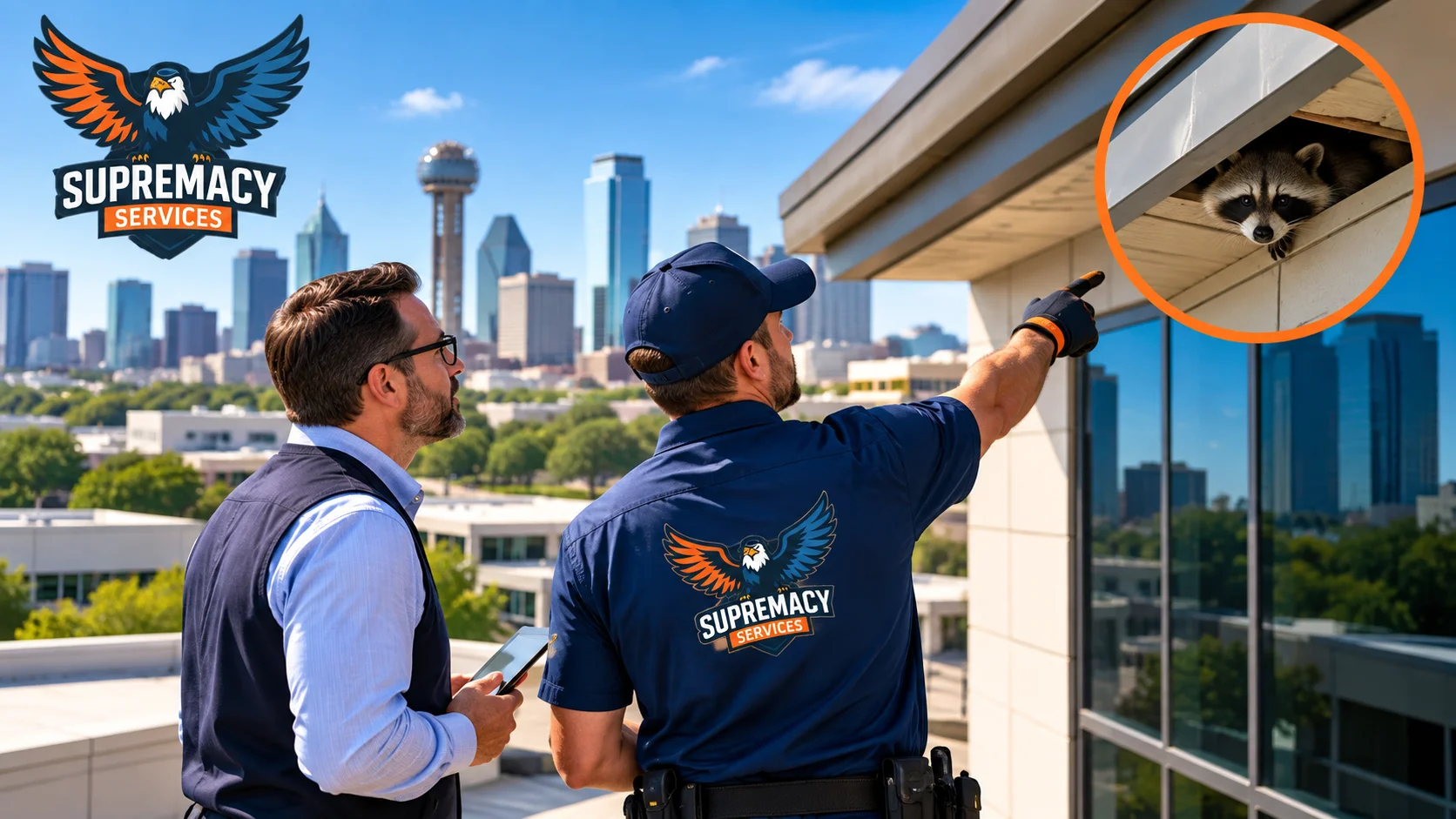
Supremacy Services technician and property manager inspecting a commercial building for wildlife entry points in Dallas

Commercial Wildlife Removal in Dallas: Property Manager’s Guide

Wildlife inside an apartment community, office, warehouse, retail center or other commercial property is more than an inconvenient animal sighting. Property managers may need to determine where the animal entered, whether people or pets have been exposed, whether the building has been damaged and how the entry point can be corrected without creating another problem.

Professional commercial wildlife removal in Dallas should therefore be approached as a property-management problem rather than simply a trapping job. Depending on the species and situation, the response can involve inspection, appropriate removal or exclusion, identification of entry points, contamination assessment and structural prevention.

Texas rules also matter. Different wildlife species are subject to different requirements, and Texas maintains specific restrictions on the transportation of several animals associated with rabies risk.

For a property manager, the objective is straightforward: resolve the immediate wildlife problem while identifying why the building became accessible in the first place.

Table of Contents

  1. What Is Commercial Wildlife Removal?
  2. Why Wildlife Problems Matter to Property Managers
  3. Common Wildlife Problems in Dallas Commercial Properties
  4. Warning Signs Property Managers Should Investigate
  5. What to Do When Wildlife Is Reported
  6. What Professional Wildlife Removal Includes
  7. Trapping vs. Exclusion
  8. DIY vs. Professional Wildlife Removal
  9. Texas Wildlife Rules Property Managers Should Know
  10. How to Prevent Wildlife Problems
  11. Choosing a Wildlife Removal Provider
  12. Frequently Asked Questions

What Is Commercial Wildlife Removal?

Commercial wildlife removal is the process of identifying, controlling and preventing nuisance wildlife activity at a business, apartment community, managed property or other non-residential facility.

The important distinction is that effective wildlife management does not end when an animal disappears.

A commercial response may need to answer five separate questions:

  1. What species is involved?
  2. Where is it entering?
  3. Is an animal currently inside?
  4. Has it damaged or contaminated part of the building?
  5. What building correction will reduce the likelihood of recurrence?

That last question is particularly important for property managers responsible for multiple buildings or recurring maintenance calls.

A raccoon removed from an attic, for example, does not repair the opening that allowed it into the structure.

Dealing with wildlife inside a managed property? Explore Supremacy Services’ professional wildlife trapping and removal options for Dallas and the DFW Metroplex.

Why Wildlife Problems Matter to Property Managers

A wildlife complaint should be investigated according to its actual risk rather than treated automatically as an ordinary pest-control ticket.

Building damage

Animals can exploit or enlarge vulnerable building openings around soffits, vents, roof edges and other penetrations.

Once access is established, the immediate removal problem and the building-envelope problem become two separate maintenance issues.

Tenant and customer concerns

A scratching sound above an apartment ceiling may initially affect one tenant.

An animal appearing in a common hallway, customer area or occupied office is a different situation and may require a faster response.

The property’s response procedure should therefore distinguish between:

  • wildlife observed outdoors;
  • noises inside a wall or ceiling;
  • animals in unoccupied service areas;
  • animals inside occupied spaces;
  • possible human or pet contact.

Contamination

Nesting material, feces, urine and animal remains can create cleanup concerns in attics, roof cavities and other concealed areas.

Property managers should avoid assuming that removing an animal automatically resolves contamination associated with the infestation.

Recurring maintenance costs

Repeated trapping without correcting accessible entry points can leave a property vulnerable to additional wildlife.

That makes exclusion an important part of long-term wildlife management.

Common Wildlife Problems in Dallas Commercial Properties

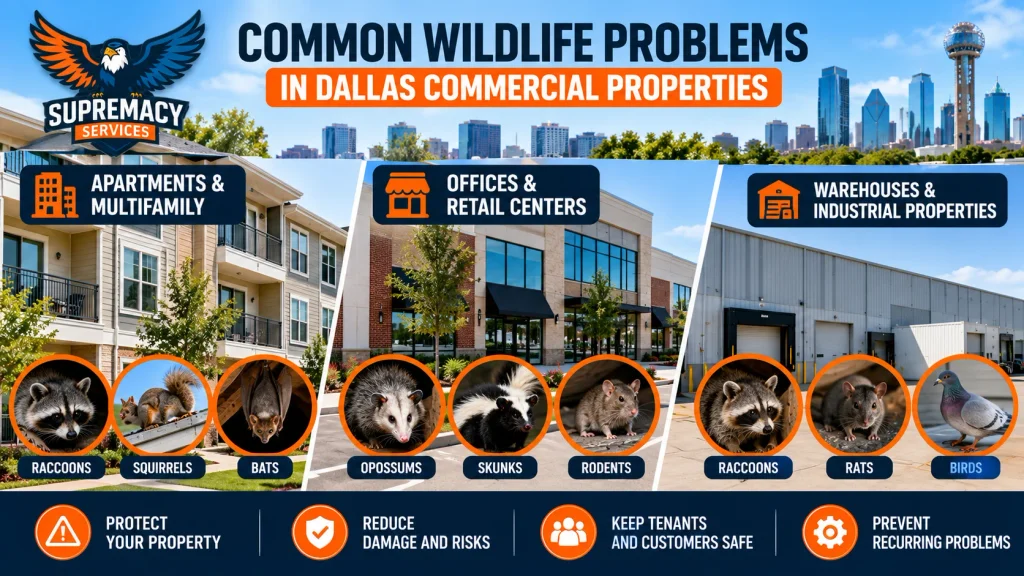
Common wildlife problems at Dallas apartments, offices, retail centers, warehouses and industrial properties
Different commercial properties can experience different wildlife pressures, making property-specific inspection important.

Different species require different responses. Identification should come before trapping, exclusion or structural repairs.

WildlifeCommon property concernAreas worth inspecting
RaccoonsEntry into roof/attic areas, disturbance around wasteRoof edges, vents, soffits, dumpsters
SquirrelsActivity in attic/roof cavitiesRooflines, vents, tree-adjacent areas
OpossumsShelter beneath or around structuresCrawlspaces, decks, service areas
BatsRoosting in structural openingsRooflines, gaps and upper building areas
SkunksDenning and odor complaintsGround-level voids and sheltered exterior areas
RodentsInterior activity and structural entryUtility penetrations, doors, roofs and service areas

This table is a diagnostic starting point, not a species-identification substitute.

Apartments and multifamily communities

Multifamily properties add complexity because complaints may originate from one unit even though the access point is elsewhere.

Managers may need to coordinate access to occupied units, attics, utility spaces, roofs and exterior areas.

Warehouses and distribution properties

Large exterior perimeters, loading areas and utility penetrations create many locations that may require inspection.

Wildlife management should be coordinated with broader rodent and pest prevention where appropriate.

Offices and retail centers

Suspended ceilings, roof penetrations and shared structural spaces can make the location of an animal difficult to determine from the complaint alone.

In multi-tenant buildings, documenting exactly where noises or sightings occur can make inspection substantially more efficient.

Restaurants and food-service properties

Waste areas and exterior food sources deserve particular attention.

Wildlife activity should also be distinguished from conventional rodent or insect problems requiring a commercial pest-management program.

Warning Signs Property Managers Should Investigate

Repeated noises, droppings, damaged exterior openings, strong unexplained odors and direct wildlife sightings are all reasons to investigate a commercial property.

Look for:

  • scratching, movement or thumping above ceilings;
  • recurring tenant reports from the same building area;
  • droppings in attics or mechanical spaces;
  • nesting material;
  • damaged vents or screening;
  • gaps around roof edges or soffits;
  • disturbed insulation;
  • animal tracks around service areas;
  • persistent unexplained odors;
  • repeated activity around dumpsters;
  • visible wildlife entering or leaving a structural opening.

The location and timing of observations can help narrow the inspection.

For example, a manager should document whether noises occur during daylight or overnight, which floor is affected and whether the complaint is near a roof, exterior wall or utility area.


What Should a Property Manager Do When Wildlife Is Reported?

First isolate the immediate risk, document what was observed and avoid handling the animal. Then determine whether there has been human or pet contact before arranging appropriate professional inspection or animal-control assistance.

Step 1: Document the report

Record:

  • building and unit/suite;
  • date and time;
  • animal description if observed;
  • location;
  • photographs or video when safely available;
  • sounds reported;
  • known entry point;
  • possible contact with a person or pet.

This gives the wildlife professional considerably more useful information than a work order that simply says “animal in attic.”

Step 2: Keep people away from the animal

Do not encourage maintenance staff or tenants to capture wildlife by hand.

Texas DSHS advises people not to handle wildlife, whether it appears healthy or sick.

Step 3: Treat possible exposure differently

A wildlife sighting and an animal bite are not equivalent maintenance events.

If a person may have been bitten or exposed to saliva from a potentially rabid animal, follow public-health guidance rather than treating the event solely as a wildlife-removal call.

Texas DSHS advises washing a bite thoroughly with soap and water and obtaining medical advice promptly.

Step 4: Identify the species and access point

Species identification affects both the appropriate control strategy and the rules that may apply.

Step 5: Do not prematurely seal an active opening

An opening should not simply be closed without determining whether animals remain inside and whether dependent young could be present.

This is particularly important with bats. TPWD currently discourages bat exclusion from May 1 through August 15 because young bats may be unable to fly and can become trapped.

Step 6: Correct the building vulnerability

Once removal or exclusion is appropriately completed, address the structural condition that provided access.

That converts a reactive wildlife call into preventive property maintenance.

What Does Professional Commercial Wildlife Removal Include?

A professional wildlife-control visit should begin with inspection and identification before a removal method is selected.

The exact scope depends on the species and property, but a comprehensive process may involve:

1. Property inspection

The technician investigates reported activity and potential entry locations.

2. Species identification

Treatment decisions should be based on the actual animal involved rather than assumptions from noises alone.

3. Entry-point assessment

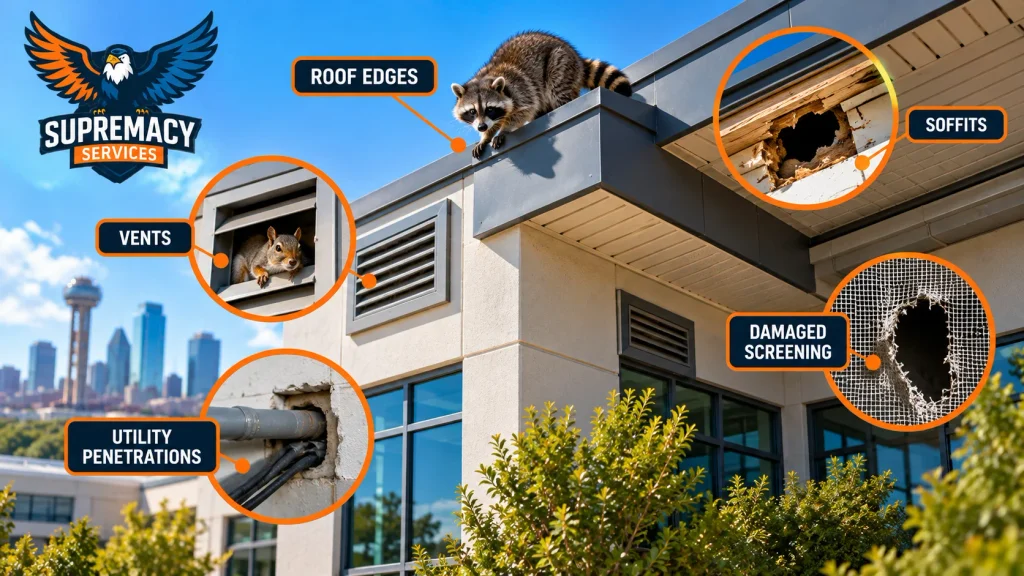
Common wildlife entry points on a commercial building including roof edges, soffits, vents and utility penetrations
Roof edges, damaged soffits, vents, utility penetrations and compromised screening can provide wildlife access to commercial properties.

Likely vulnerabilities may include vents, roof transitions, damaged screening, soffits and utility penetrations.

4. Removal or exclusion strategy

The appropriate technique varies by species, building and applicable regulations.

5. Follow-up inspection

The property may require confirmation that activity has stopped before final repairs are completed.

6. Entry sealing and prevention

Structural vulnerabilities are addressed where appropriate so the property is less accessible to future animals.

7. Contamination assessment

If nesting or waste is present, cleanup requirements can be evaluated separately from removal.

Supremacy’s existing wildlife service page describes its process as including trapping/removal, cleanup of nesting messes and exterior entry sealing.

Managing an apartment community, office, retail property or other DFW facility? Request a wildlife inspection to identify the animal, entry points and appropriate removal or exclusion strategy.


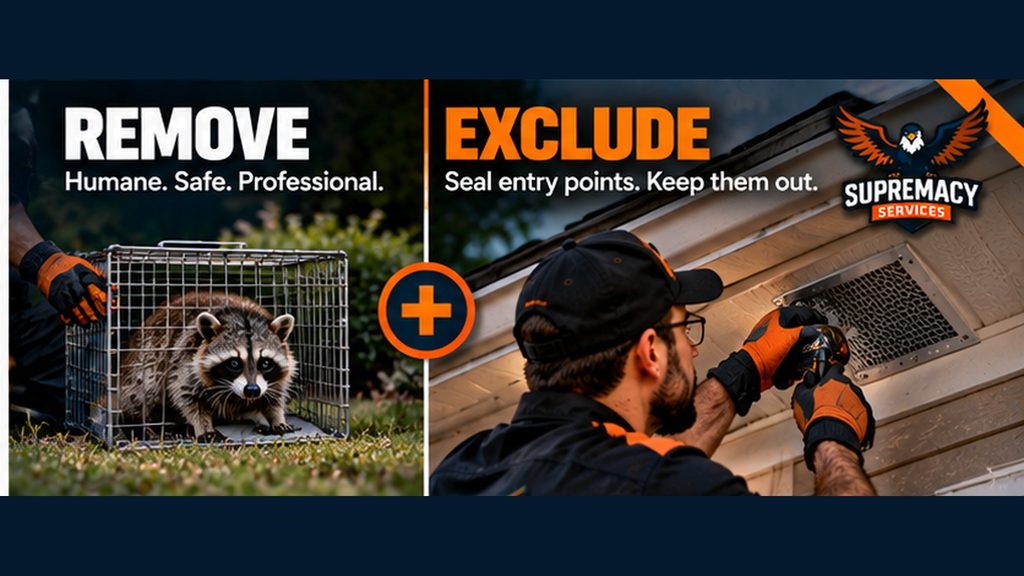
Wildlife Trapping vs. Exclusion: What Is the Difference?

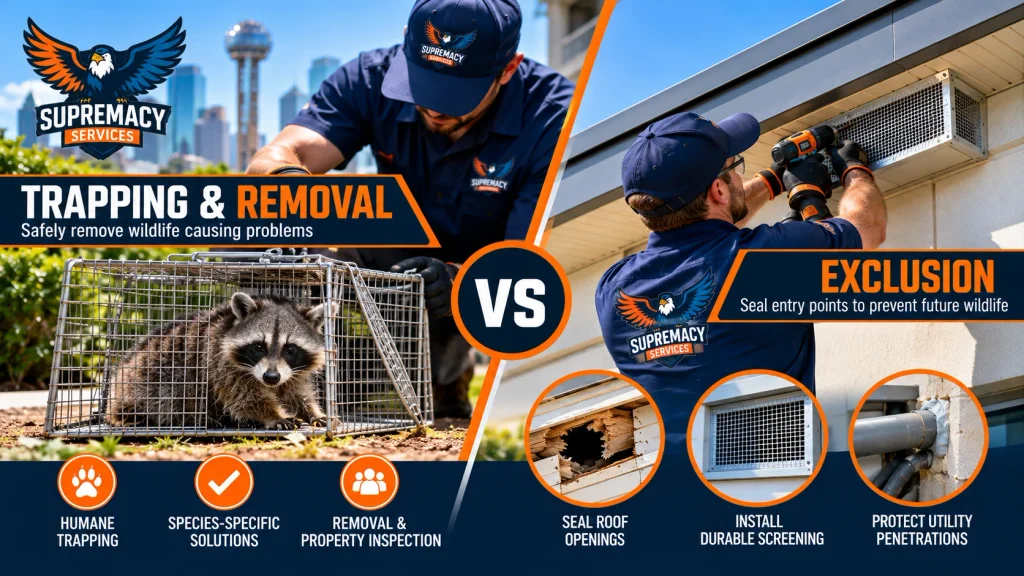
Wildlife trapping and removal compared with exclusion and entry-point sealing at a commercial property
Trapping addresses wildlife currently causing problems, while exclusion helps prevent animals from gaining access again.

Trapping addresses an animal; exclusion addresses access to the building. A commercial wildlife plan may require one or both depending on the species and circumstances.

Trapping/removalExclusion
Addresses wildlife currently presentAddresses how wildlife enters
Species-specificBuilding-focused
May require monitoring/follow-upMay involve sealing or screening
Subject to wildlife rulesPrimarily preventive
Does not inherently repair an openingDesigned to reduce future access

This distinction is especially important for property managers comparing contractor proposals.

A bid for “animal removal” and a bid for “removal + exclusion + cleanup” may describe very different scopes of work.

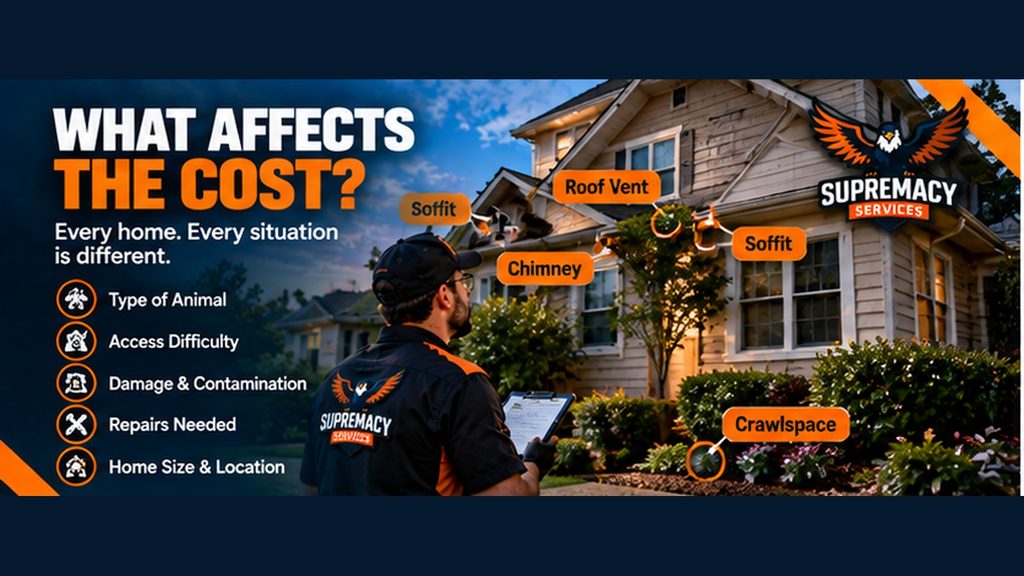
What Affects Commercial Wildlife Removal Cost?

There is no responsible single Dallas price that applies to every commercial wildlife problem.

Pricing can depend on:

  • species;
  • number of animals;
  • building size and complexity;
  • height and roof access;
  • location of the animal;
  • number of entry points;
  • trapping or exclusion method;
  • required follow-up;
  • contamination;
  • structural repairs;
  • number of buildings;
  • after-hours or operational constraints.

For property managers, the better procurement question is therefore not simply “How much per animal?”

Ask what the quote actually includes.

Commercial wildlife proposal checklist

QuestionWhy it matters
What species was identified?Determines appropriate response
Where is the entry point?Helps prevent recurrence
Is trapping or exclusion proposed?Clarifies methodology
How many follow-up visits are included?Affects total scope
Is entry sealing included?Removal alone may leave access
Is cleanup included?Contamination may be separate
Are structural repairs included?Avoids comparing unequal quotes
How will occupied areas be handled?Important for tenant operations
What documentation is provided?Useful for property records
Are applicable wildlife rules considered?Species requirements differ

DIY vs. Professional Wildlife Removal for Commercial Properties

Property staff can perform prevention and documentation, but capture, handling and relocation should not be improvised when wildlife regulations, potential rabies exposure or occupied-building risks are involved.

Maintenance teams can appropriately help by:

  • documenting sightings;
  • inspecting obvious building damage;
  • securing waste;
  • correcting sanitation conditions;
  • keeping exterior doors closed;
  • repairing routine building-envelope defects once appropriate;
  • trimming vegetation where property policy permits;
  • reporting new activity.

The risk increases when staff attempt to:

  • grab or corner an animal;
  • handle bats;
  • relocate trapped wildlife without understanding transport rules;
  • seal an opening while animals remain inside;
  • work around potentially contaminated nesting areas without appropriate precautions.

For a commercial property, professional assistance becomes especially appropriate when wildlife is inside occupied areas, the species is uncertain, there is potential human/pet exposure, activity keeps recurring or the access point cannot be identified.


Texas Wildlife Rules Dallas Property Managers Should Know

Wildlife removal in Texas is species-specific. Property managers should not assume that every nuisance animal can simply be trapped and driven somewhere else.

Raccoons, skunks, foxes and coyotes

Texas DSHS maintains statewide transport restrictions on live raccoons, foxes, skunks and coyotes because of rabies concerns. The state identifies specific exemptions, including certain appropriately licensed pest-management professionals and authorized entities. Release under an applicable exemption is also geographically restricted.

That makes “we’ll catch it and release it somewhere else” an inadequate property-management plan unless the person handling the animal is operating within applicable requirements.

Bats

Bats have specific protections and considerations under Texas wildlife regulations. TPWD states that bats generally may not be hunted, killed or possessed, while providing exceptions involving bats inside or on human-occupied buildings. TPWD also discourages building exclusion between May 1 and August 15 because non-flying young may become trapped.

Rabies exposure

Texas DSHS identifies bats, coyotes, foxes, raccoons and skunks among wildlife of particular rabies concern and advises against handling wild animals.

Property managers should establish a clear escalation procedure for suspected bites or exposures instead of treating these incidents as routine maintenance tickets.

Important: Wildlife regulations can change and circumstances differ by species. Verify current TPWD/DSHS requirements for the animal and situation rather than relying solely on a general property policy.

Wildlife Removal vs. Rodent Control vs. Commercial Pest Control

Not every scratching noise requires the same contractor scope.

ProblemPrimary service
Raccoon in atticWildlife removal/exclusion
Squirrel entering roofWildlife removal/exclusion
Bat colony/entrySpecies-appropriate wildlife exclusion
Rats inside warehouseRodent control and exclusion
Cockroaches in break roomCommercial pest management
Ants around building perimeterPest-control program
Wildlife repeatedly exploiting structural openingWildlife exclusion/building correction

How Can Property Managers Prevent Wildlife Problems?

Wildlife prevention focuses on reducing access, shelter and attractants around the property.

Inspect rooflines

Include vents, roof transitions, soffits and visible exterior openings in routine building inspections.

Maintain waste areas

Keep dumpster and waste-management areas appropriately maintained and address recurring spillage.

Check utility penetrations

Inspect areas where pipes, cables and mechanical services pass through exterior walls.

Maintain doors and loading areas

Large commercial doors and loading areas should close correctly when operations allow.

Manage landscaping

Vegetation should not unnecessarily obstruct inspection of the building perimeter or create easy pathways to vulnerable areas.

Document previous wildlife incidents

Keep records of:

  • species;
  • building;
  • entry point;
  • corrective work;
  • dates;
  • recurring complaints.

For multi-property managers, those records can reveal patterns that isolated work orders do not.

A Practical Wildlife Response Plan for Property Managers

A standardized procedure makes wildlife calls easier for maintenance, tenants and vendors.

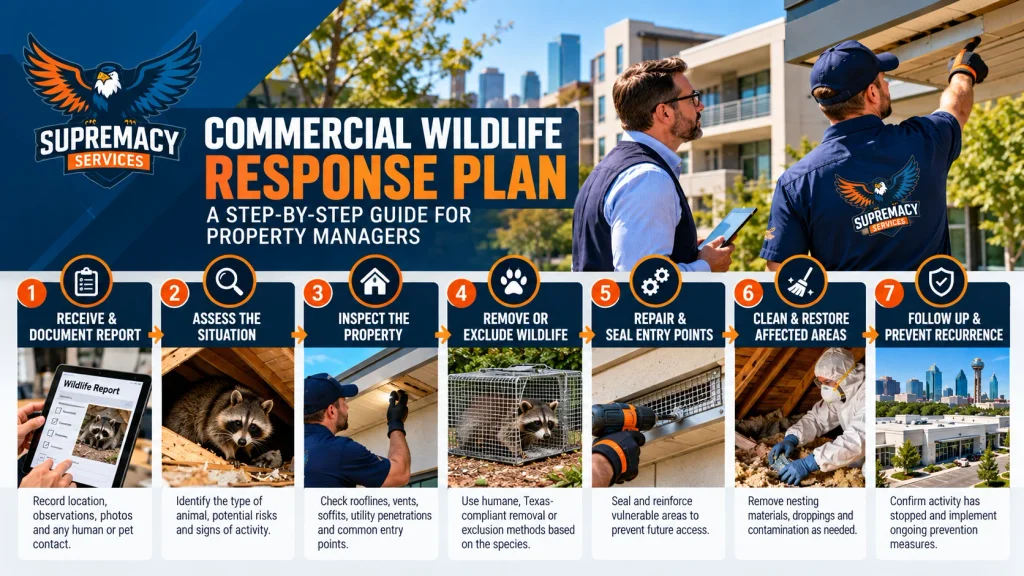
Seven-step commercial wildlife response plan for Dallas property managers
A structured response—from documenting the report through removal, repairs and follow-up—helps property managers manage wildlife problems effectively.

Report → Assess exposure → Document → Identify → Inspect → Remove/exclude → Repair → Verify → Record

A work-order template might capture:

FieldRecord
Property/buildingExact location
Unit/suiteIf applicable
Date/timeWhen activity occurred
Animal descriptionSpecies if confirmed
Photo/videoIf safely obtained
Human/pet contactYes / No / Unknown
Interior locationCeiling, attic, office, etc.
Suspected entryLocation
Vendor findingsDiagnosis
Removal methodDocumented response
Exclusion repairsCompleted/pending
Follow-upDate/result

That is far more useful operationally than repeatedly creating generic “wildlife problem” work orders.

How Should Property Managers Choose a Wildlife Removal Company?

Evaluate the scope and process, not merely the initial trapping charge.

Ask prospective providers:

  • How will you identify the species?
  • Will you inspect for entry points?
  • Is exclusion included?
  • How are follow-up visits handled?
  • How will you work around tenants or customers?
  • What happens if dependent young are present?
  • How is contamination handled?
  • Which structural repairs are included?
  • What documentation will management receive?
  • How do you comply with species-specific Texas requirements?

Supremacy already positions its commercial pest program around customized planning, discreet scheduling and reporting, while its wildlife page emphasizes removal plus entry sealing. Those existing pages make appropriate conversion destinations from this guide rather than duplicating their sales content here.

When Should a Dallas Property Manager Call for Wildlife Removal?

Arrange professional assessment when:

  • an animal is inside an occupied building;
  • repeated noises suggest animals inside ceilings or walls;
  • wildlife repeatedly enters the same structure;
  • roof or exterior damage suggests an entry point;
  • tenants repeatedly report wildlife activity;
  • an animal appears trapped or inaccessible;
  • the species cannot be confidently identified;
  • bats are inside or roosting in the structure;
  • contamination is present;
  • a bite or potential exposure has occurred.

Possible human or pet exposure should be handled according to appropriate public-health/animal-control guidance, not merely scheduled as an ordinary service appointment.


Frequently Asked Questions

What is commercial wildlife removal?

Commercial wildlife removal identifies and addresses nuisance wildlife at apartments, offices, warehouses, retail properties and other managed facilities. Effective service may combine inspection, removal or exclusion, entry-point identification and preventive repairs.

What animals commonly require wildlife removal from commercial buildings?

Problems can involve raccoons, squirrels, opossums, bats, skunks and other wildlife. Rats and mice are normally handled through rodent-control and exclusion programs rather than being treated identically to larger wildlife.

Can a Dallas property manager relocate a trapped raccoon?

Do not assume that a trapped raccoon can simply be transported elsewhere. Texas maintains statewide restrictions on transporting live raccoons and several other rabies-risk species, with specified exemptions and conditions.

Should maintenance staff remove a bat?

Staff should avoid handling bats directly. Texas has species-specific rules for bats, and possible human exposure also raises public-health considerations.

Can you seal a wildlife entry hole immediately?

Not necessarily. First determine whether animals remain inside and whether dependent young may be present. Premature sealing can trap animals within the structure.

What’s the difference between wildlife removal and wildlife exclusion?

Removal addresses the animal currently creating the problem. Exclusion addresses structural access points so animals are less likely to enter again.

Does commercial wildlife removal include repairs?

That depends on the contractor and proposal. Property managers should specifically determine whether trapping/removal, exclusion, cleanup and structural repairs are included or quoted separately.

How can apartment managers prevent recurring wildlife problems?

Track previous entry points, maintain rooflines and exterior openings, manage waste areas, inspect utility penetrations and correct structural access after wildlife activity is resolved.

Is commercial wildlife removal the same as commercial pest control?

No. They can overlap, but wildlife management often involves species-specific trapping or exclusion and building repairs, while conventional commercial pest management typically addresses insects and rodents through monitoring, sanitation, exclusion and targeted controls.


Get Commercial Wildlife Help in Dallas & DFW

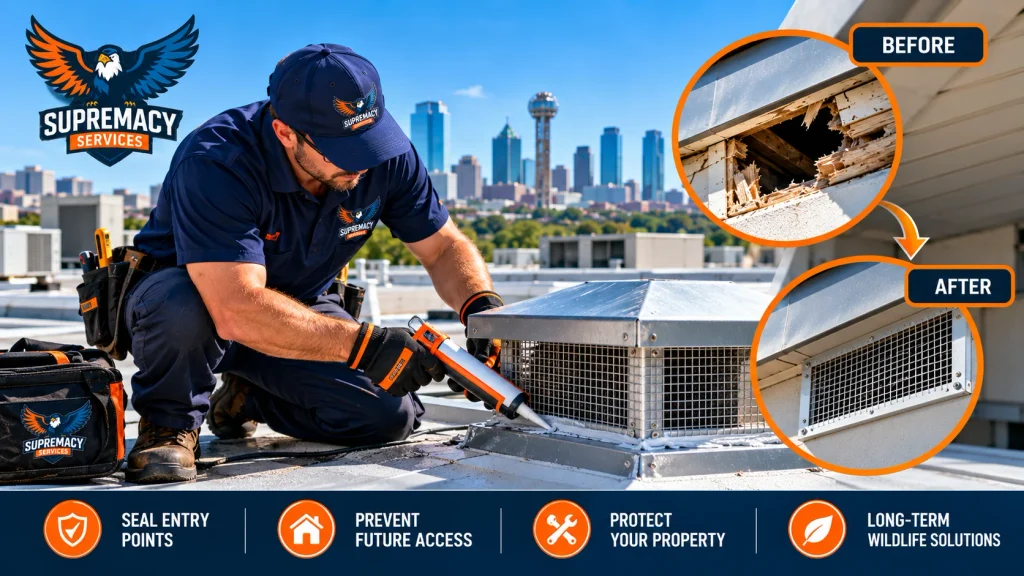
Supremacy Services technician sealing a commercial roof vent to help prevent future wildlife entry
Wildlife exclusion addresses vulnerable building openings after animal activity has been resolved, helping reduce opportunities for recurrence.

Wildlife management is most effective when the property manager solves both sides of the problem: the animal currently creating the complaint and the building condition that allowed access.

If you manage apartments, offices, retail properties, warehouses or other commercial facilities in Dallas or across the DFW Metroplex, Supremacy Services can inspect the property, identify wildlife activity and determine an appropriate removal and exclusion strategy.

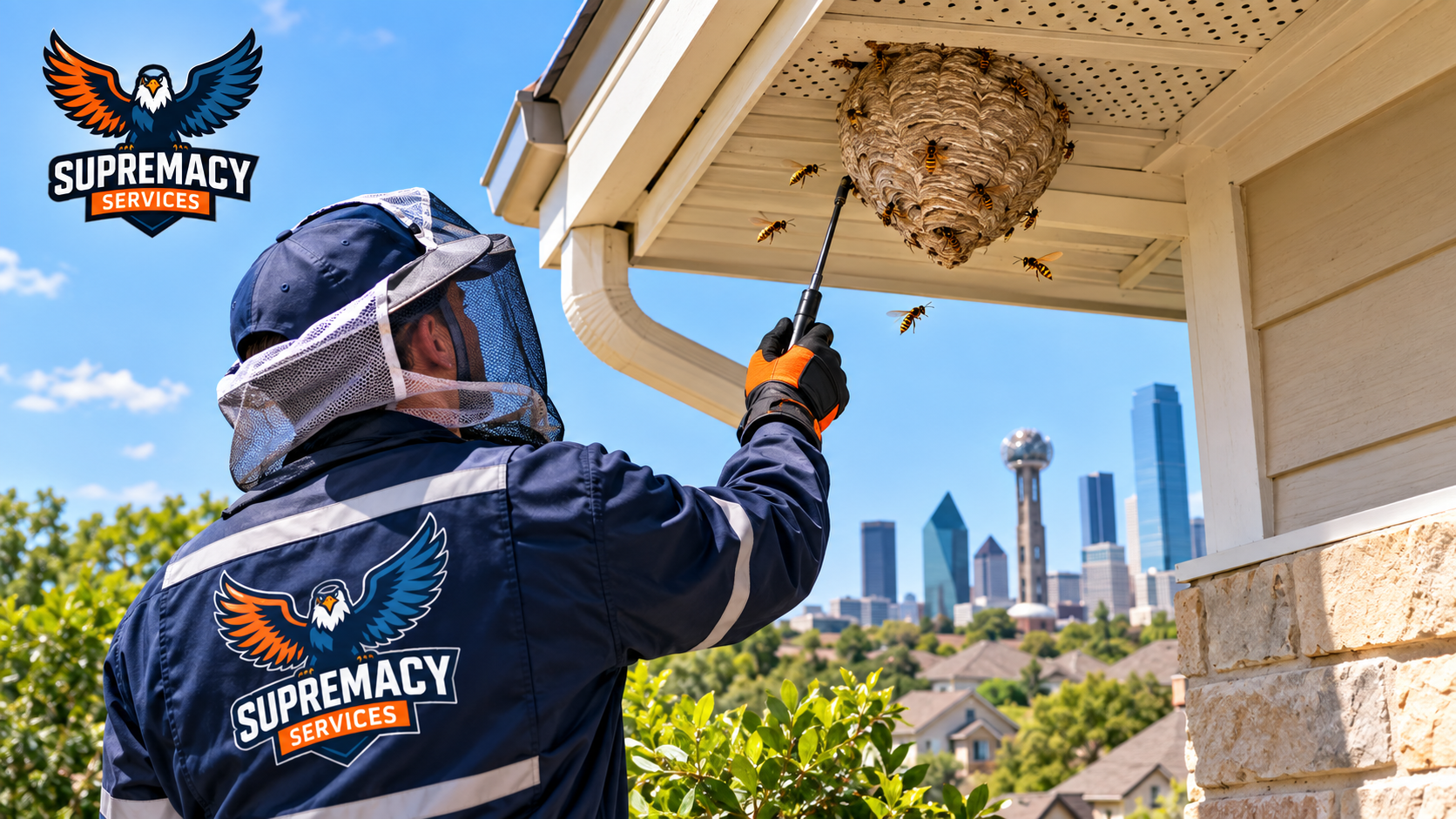
Pest control technician inspecting an active wasp nest beneath the roof eave of a Dallas home

Wasp Nest Removal Cost in Dallas: 2026 Pricing Guide

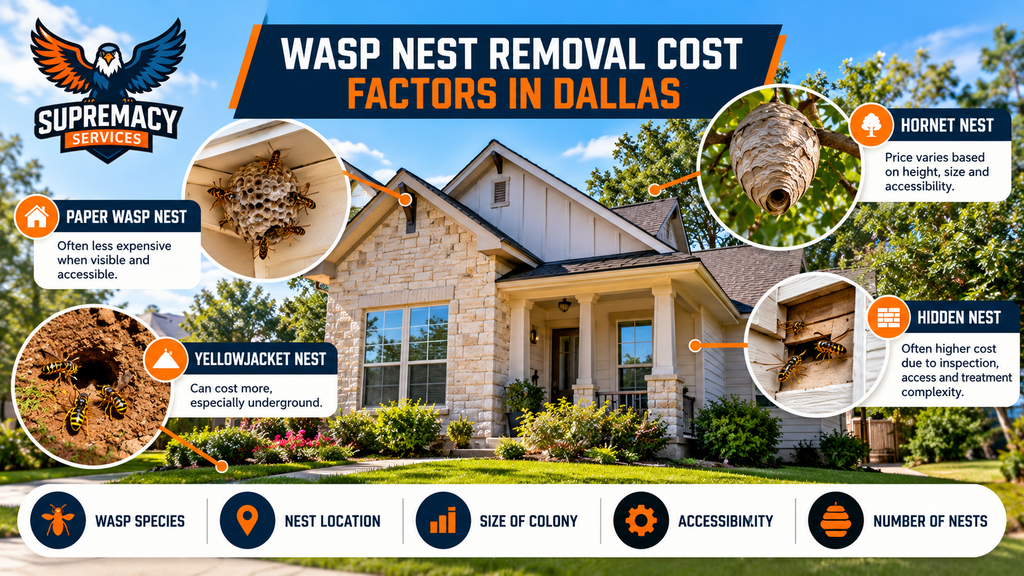
Wasp nest removal in Dallas generally costs about $309 to $722 in 2026, with a reported local average around $541. The actual price can be lower for a small, exposed paper-wasp nest and considerably higher when yellowjackets or other stinging insects are nesting underground, inside a wall, in an attic or high above the ground. Current Dallas market data places a typical mid-sized removal at roughly $515.

The biggest cost factors are not simply the size of the nest. Species, nest location, accessibility, number of nests, treatment requirements and whether structural access is needed can all change what a Dallas homeowner ultimately pays.

This guide explains what homeowners should reasonably expect to pay, what makes some removals more expensive, when DIY removal may be inappropriate and what professional wasp removal should actually include.

Table of Contents

  1. How Much Does Wasp Nest Removal Cost in Dallas?
  2. Wasp Removal Cost by Type
  3. What Affects Wasp Nest Removal Cost?
  4. Why Hidden Nests Cost More
  5. How to Tell What Kind of Wasp Nest You Have
  6. DIY vs. Professional Wasp Removal
  7. What Professional Wasp Removal Includes
  8. How to Prevent Wasps From Returning
  9. When Should You Call a Professional?
  10. Frequently Asked Questions

How Much Does Wasp Nest Removal Cost in Dallas?

Infographic showing how wasp species, nest location, colony size, accessibility and number of nests affect removal cost
Wasp removal pricing can vary based on the species, location, size, accessibility and number of active nests.

For Dallas homeowners, a useful 2026 market benchmark is approximately $309–$722 for professional wasp nest removal, with an average around $541 according to current Dallas-specific pricing data from Angi. These are market estimates rather than regulated prices or a Supremacy Services price list.

National cost guides provide a similar benchmark. HomeAdvisor reports a typical professional range of roughly $300–$700, while HomeGuide also places average removal around $300–$700.

Removal situationUseful 2026 market benchmark
Small/simple accessible nestMay begin around $100–$150 nationally
Typical professional removal$300–$700
Dallas reported range$309–$722
Dallas reported averageAbout $541
Difficult yellowjacket removalCan exceed the normal range
Hidden wall/attic nestOften higher because of access complexity

These figures should be treated as planning estimates rather than quotes. A technician needs to identify the insect and determine exactly where the colony is located before an accurate price can be established.

Why can two wasp nests have very different prices?

Imagine one small paper-wasp comb hanging beneath a first-floor porch roof and another colony disappearing through a gap beneath a second-story soffit.

Both homeowners might say, “I have a wasp nest.”

They are not necessarily the same job.

The first colony is visible and readily accessible. The second may extend into a concealed structural void, requiring additional investigation, treatment and access precautions.

That difference is why nest location and accessibility often matter as much as visible size.

Not sure whether the nest is exposed or hidden inside your home? See how professional wasp and hornet nest removal in Dallas works before attempting to disturb it.


Wasp Removal Cost by Type

The species matters because different wasps have different nesting habits and defensive behavior.

Current consumer pricing guides report substantial variation between paper-wasp, hornet and yellowjacket jobs. For example, HomeGuide reports paper-wasp removal at roughly $150–$350 nationally while more difficult yellowjacket work can run considerably higher. These are third-party market estimates, not fixed Dallas rates.

Paper wasps

Paper wasps commonly construct an exposed, open-cell paper nest beneath sheltered surfaces.

Texas A&M AgriLife describes paper-wasp nests as open underneath rather than surrounded by a papery envelope. They commonly nest under eaves and other protected locations.

Because the nest may be visible and accessible, a straightforward paper-wasp job can fall toward the lower end of professional removal pricing.

However, accessibility still matters. A nest beneath a two-story roofline is a different safety problem from one attached to an easily reached fence.

Yellowjackets

Yellowjackets can make removal substantially more complicated.

Texas A&M notes that southern yellowjackets may establish colonies underground, in walls or even indoors. They can sting repeatedly, and their concealed nesting behavior means homeowners may see only an entrance rather than the actual colony.

Consequently, underground and structural-void yellowjacket colonies can cost more to address than a small exposed paper-wasp nest.

Hornets and aerial nests

Some social wasps construct enclosed aerial nests in trees or beneath building surfaces. Height, colony activity and the equipment required to reach the nest safely can all affect the service scope.

Mud daubers and solitary wasps

Not every intimidating wasp around a Dallas home represents an aggressive social colony.

Many solitary wasps have very different behavior. University Extension guidance notes that solitary wasps generally do not defend their nests in the same way yellowjackets do. Mud-dauber nests, for example, may sometimes simply be removed when inactive.

Correct identification can therefore prevent homeowners from paying for — or attempting — treatment that is unnecessary.


What Affects Wasp Nest Removal Cost?

Six factors usually have the greatest effect on what a wasp-removal job costs.

1. Nest location

Location is one of the strongest pricing factors.

An exposed nest beneath a first-floor eave is normally easier to inspect and access than one located:

  • inside a wall void;
  • behind siding;
  • beneath a roof or soffit;
  • inside an attic;
  • underground;
  • inside a chimney;
  • high in a tree or roofline.

Hidden nests can require a different treatment approach because the visible opening may not be where the colony itself is located.

2. Height and accessibility

Second-story rooflines, steep roofs and confined areas can increase the amount of equipment, time and safety preparation required.

Avoid thinking of a high nest as simply “the same nest with a taller ladder.” Working at height while dealing with defensive stinging insects introduces another hazard.

3. Wasp species

Paper wasps, yellowjackets and solitary wasps do not behave identically.

Identification helps determine:

  • whether treatment is actually necessary;
  • how defensive the colony may be;
  • where the nest is likely located;
  • the appropriate treatment strategy;
  • whether physical nest removal is possible.

4. Colony and nest size

A newly developing exposed nest and a mature colony are different service calls.

Social-wasp colonies begin with queens establishing nests and increase as workers are produced. Texas A&M documents the seasonal colony development of common Texas wasps, making early identification useful before a nest becomes larger and more active.

5. One nest vs. multiple nests

A property inspection may reveal more than the nest that originally attracted attention.

Porches, sheds, fences, eaves and other sheltered areas can provide multiple potential nesting locations.

Ask whether the estimate covers:

  • one nest only;
  • inspection of the surrounding structure;
  • additional nests discovered during service;
  • nest removal after treatment;
  • follow-up treatment if activity remains.

6. Structural access or repairs

A colony behind siding or inside a wall may require more than exterior treatment.

If opening and subsequently repairing part of a structure is necessary, clarify whether that work is included in the pest-control quote or handled separately.


Why Hidden Wasp Nests Can Cost More

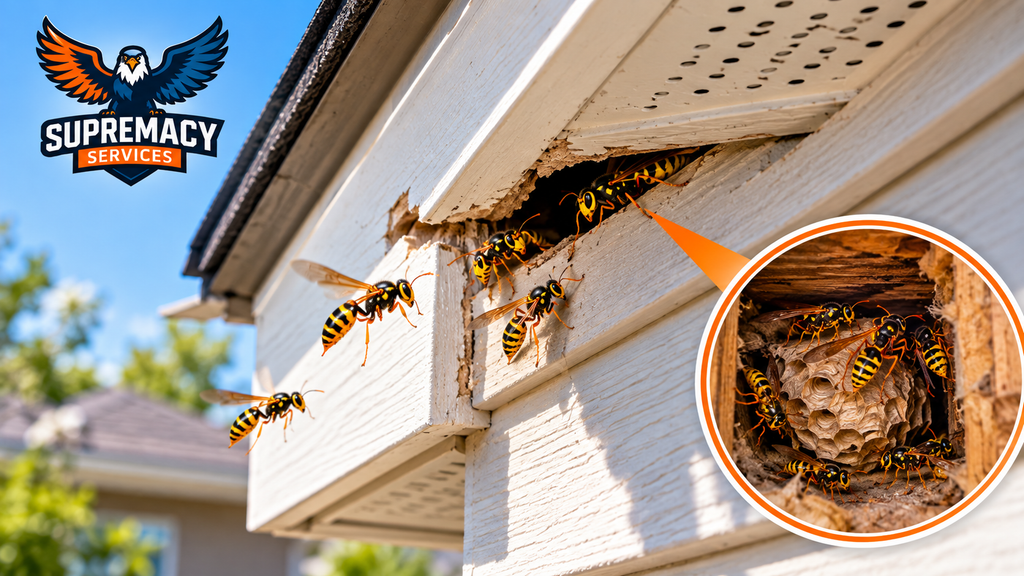
Wasps entering a damaged soffit opening with a concealed nest inside the roof cavity
Repeated wasp traffic through a soffit or wall opening can indicate a concealed nest inside the structure.

A hidden nest is usually more difficult because technicians must determine where the colony is located without relying solely on the visible entry point.

Yellowjackets can establish nests in wall voids, attics and other cavities. Extension guidance specifically describes hidden yellowjacket colonies inside buildings as more challenging to control and generally better suited to professional pest management.

One particularly important mistake to avoid is immediately sealing an active entry hole.

If insects are still using a structural cavity, blocking their normal route does not necessarily eliminate the colony. Extension guidance warns against sealing the opening until yellowjacket activity has been eliminated because displaced insects may seek another exit.

Signs the nest may be inside the structure

Look for repeated wasp traffic entering and leaving:

  • a soffit gap;
  • siding;
  • an attic vent;
  • a crack around exterior trim;
  • a wall penetration;
  • a roof intersection;
  • another small structural opening.

Seeing individual wasps indoors can also warrant further investigation, particularly when repeated activity occurs near the same wall or ceiling area.

If wasps are repeatedly entering a wall, soffit or roof opening, avoid sealing the opening until the colony has been assessed. Schedule a wasp-nest inspection with Supremacy Services to determine where the activity is coming from.


How to Tell What Kind of Wasp Nest You Have

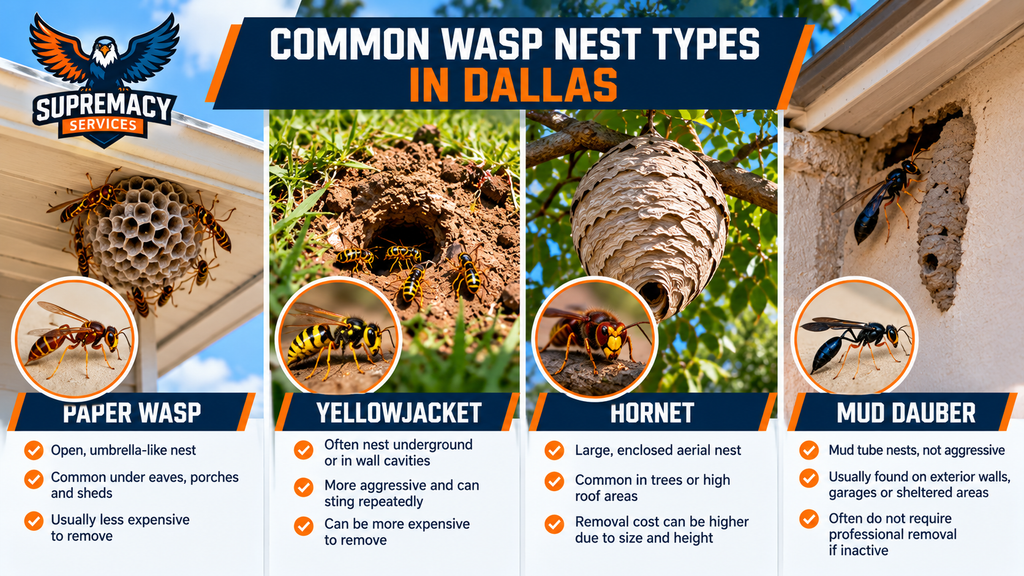
Comparison of paper wasp, yellowjacket, hornet and mud dauber nests found around Dallas homes
Identifying the type of wasp and nest helps determine the appropriate approach to removal.

Identification matters because homeowners often use “wasp,” “hornet,” “yellowjacket” and even “bee” interchangeably.

What you seePossible identificationTypical nesting pattern
Open umbrella-like paper combPaper waspEaves, porches, sheltered structures
Heavy traffic through a ground openingYellowjacketUnderground cavity
Repeated traffic through siding/soffitYellowjacket or another cavity-nesting waspStructural void
Enclosed paper aerial nestSocial wasp/hornet-type colonyTree, shrub or structure
Mud tubes/cellsMud dauberSheltered wall, garage or eave
Hairier insects entering wax-comb colonyPossibly honey beesTree or structural cavity

Texas A&M notes that honey bees tend to have hairier bodies, while wasps generally appear smoother and have more distinct narrow waists. Their nests also differ: honey bees construct wax comb, while social wasps construct paper-like nests.

Don’t automatically treat bees as wasps

A cluster of flying insects entering a building does not prove that you have yellowjackets.

If the insects appear to be honey bees, proper identification should come first. Texas A&M specifically recommends identifying the insects before deciding how a colony should be managed.


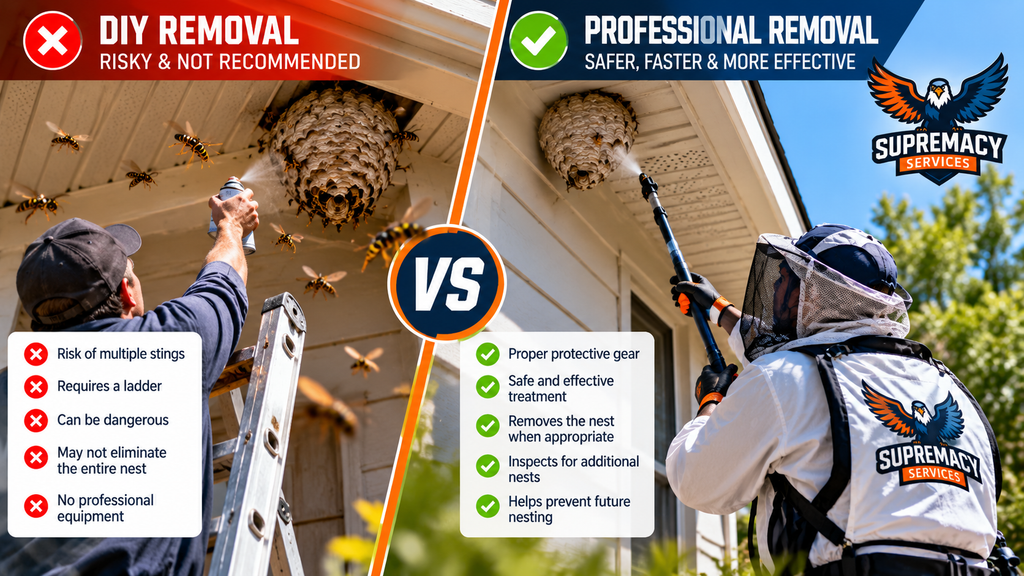
DIY vs. Professional Wasp Nest Removal

Comparison of homeowner DIY wasp removal from a ladder and a protected pest control technician treating a nest
High, concealed or heavily active nests can make professional wasp removal a safer option than attempting treatment from a ladder.

A small, readily accessible nest is very different from an active colony inside a wall or underground.

SituationDIY considerationProfessional service
Small, accessible exposed nestRetail products may exist for labeled applicationsOptional depending on risk
High roof/eave nestFall and sting risk increaseStrongly preferable
Underground yellowjacket colonyDifficult to judge colony position/sizeStrongly preferable
Nest inside wall/atticHidden colony complicates treatmentRecommended
Multiple active nestsHarder to assess extentRecommended
Known sting allergyAvoid disturbing nestProfessional assistance appropriate
Uncertain insect identificationAvoid unnecessary treatmentIdentification first

Anyone considering a pesticide should read and follow the product label exactly.

The Texas Department of Agriculture regulates structural pest-control businesses and professionals who provide pest-control services for compensation. TDA states that structural pest-control businesses must be licensed and have appropriately certified personnel for the categories in which they operate.

When DIY becomes a bad trade-off

The cost of an aerosol can is not the only variable.

Consider whether reaching the nest requires you to:

  • climb a ladder;
  • approach a highly active colony;
  • work near a doorway used by family members;
  • enter an attic;
  • disturb a concealed nest;
  • identify an insect you are uncertain about.

When several of those conditions apply, professional service is less about buying a stronger spray and more about managing access, identification and exposure safely.


What Does Professional Wasp Removal Include?

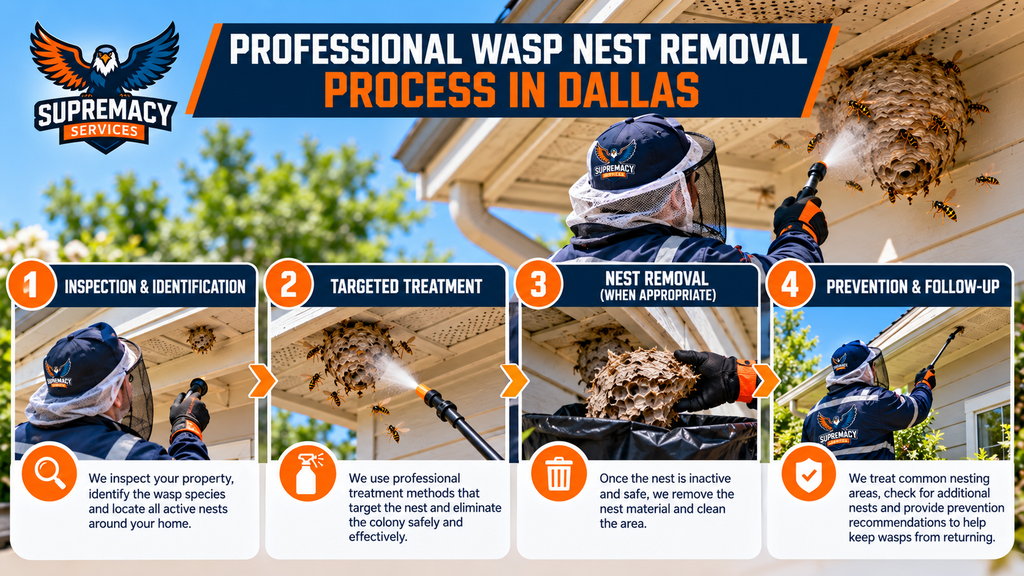
Supremacy Services wasp removal process showing inspection, targeted treatment, nest removal and prevention follow-up
Professional wasp control typically begins with identification and inspection, followed by appropriate treatment, nest removal when suitable and prevention recommendations.

The exact scope varies with the company and nest, so homeowners should ask what is included in the estimate.

A thorough service may involve:

1. Inspection and identification

The technician determines what insect is present and searches for active nesting locations.

2. Nest-location assessment

Visible nests are straightforward. Hidden activity may require tracing flight patterns to identify entry points and likely nesting cavities.

3. Appropriate treatment

The treatment method should match the species, nest location and pesticide label.

4. Confirmation of reduced activity

Physical nest removal should occur only when it can be performed safely.

5. Nest removal when appropriate

Accessible nest material may be removed after the colony has been controlled.

6. Inspection for additional activity

Nearby eaves, porches, rooflines and sheltered surfaces can be checked for additional nests.

7. Prevention recommendations

The technician may identify structural gaps or recurring nesting areas that can be addressed after active colonies have been eliminated.

Supremacy Services’ dedicated Dallas wasp and hornet service describes a process involving property and roofline inspection, targeted treatment, physical nest removal and preventative spot treatment.


Is Wasp Removal Included With Regular Pest Control?

It depends on the pest-control plan.

This is worth asking because prevention and emergency nest removal are not necessarily identical services.

Supremacy Services’ current Perimeter Pest Control program includes exterior inspection and high-reach sweeping of wasp nests and spider webs around windows and eaves.

That type of routine exterior service can help address small developing nests, while an established, concealed or difficult stinging-insect colony may require dedicated removal.

This distinction is useful when comparing quotes: ask whether you are buying one-time active-nest removal, ongoing exterior pest prevention, or both.


Dallas and DFW Wasp Considerations

North Texas homeowners can encounter several kinds of social and solitary wasps, including paper wasps and yellowjackets.

Rather than relying on calendar dates alone, pay attention to actual activity around the structure.

Repeated flight into the same opening is more informative than occasionally seeing a wasp cross the yard.

Common inspection points around Dallas-area homes include:

  • roof eaves;
  • soffits;
  • patio covers;
  • porch ceilings;
  • sheds;
  • fences;
  • attic and roof vents;
  • exterior light fixtures;
  • wall penetrations;
  • landscaping near high-traffic areas.

The concern becomes greater when an active nest is close to a doorway, patio, children’s play area or another location where people repeatedly pass near it.


How to Prevent Wasps From Returning

Prevention starts with making the property less attractive for nesting and detecting new nests early.

Inspect sheltered areas regularly

Look beneath eaves, porch roofs, patio structures and other protected surfaces for early nest construction.

Repair appropriate exterior gaps

After confirming that no active colony remains inside, repair openings that could provide access to wall or attic cavities.

Keep waste covered

Outdoor garbage and food residues can attract scavenging yellowjackets. Extension guidance recommends keeping food covered and using tightly closed garbage containers when yellowjackets are active.

Watch recurring nesting areas

If wasps repeatedly establish nests beneath the same porch or roofline, include that location in routine exterior pest inspections.

Consider perimeter pest management

Homeowners who repeatedly deal with insects around eaves, windows and the foundation may benefit from treating the problem as part of a broader exterior pest-management strategy rather than waiting for each individual infestation.


When Should You Call a Professional for a Wasp Nest?

Professional help is particularly appropriate when the nest is hidden, high, difficult to reach, aggressively defended or located where people cannot safely avoid it.

Consider calling a professional when:

  • wasps are entering a wall or soffit;
  • you suspect an underground yellowjacket colony;
  • the nest requires a ladder to reach;
  • activity is concentrated beside a doorway or patio;
  • multiple nests are present;
  • the species cannot be identified confidently;
  • wasps are appearing repeatedly inside the house;
  • someone who may encounter the nest has a history of severe sting reactions.

University Extension guidance similarly recommends professional pest management for difficult hidden nests and warns people with sting allergies not to attempt nest management themselves.


What Should You Ask Before Hiring a Wasp Exterminator?

Price matters, but the lowest number is difficult to compare unless the scope is identical.

Ask:

  • Is inspection included?
  • Does the quote cover treatment and physical nest removal?
  • Is the price for one nest or the entire inspected area?
  • What happens if another nest is discovered?
  • Is follow-up included?
  • Does the estimate include high-access work?
  • Are structural repairs separate?
  • What prevention work is included?
  • Is the pest-control business properly licensed in Texas?

Texas requires businesses performing structural pest control for hire to meet state licensing requirements.

A written estimate that clearly defines the work is more useful than comparing headline prices without knowing what each company includes.


Frequently Asked Questions

How much does wasp nest removal cost in Dallas?

Current 2026 Dallas market data puts typical professional wasp removal around $309–$722, with an average near $541. Small accessible nests may cost less, while concealed or difficult colonies can cost more.

What is the cheapest type of wasp nest to remove?

A small, exposed and easily accessible paper-wasp nest is generally among the simpler removal situations. Species, height and accessibility still affect the final quote.

Why does yellowjacket removal cost more?

Yellowjackets frequently establish colonies underground or inside structural cavities. Those concealed locations and the colony’s defensive behavior can make treatment more complicated than removing a visible paper-wasp nest.

Does the exterminator remove the actual nest?

It depends on accessibility and the service scope. Ask specifically whether physical nest removal is included rather than assuming treatment and removal mean the same thing.

Can I remove a wasp nest myself?

Some small, exposed nests may be manageable with a product specifically labeled for that application, but high, concealed, underground or aggressively defended nests present substantially greater risk. Anyone with a known serious sting allergy should not attempt removal.

Should I seal the hole where wasps are entering my wall?

Not while an active colony is still using it. Extension guidance warns that prematurely sealing an active yellowjacket entrance can cause insects to seek another exit, potentially toward the building interior.

Are wasps and yellowjackets the same thing?

Yellowjackets are a type of social wasp. Their nesting behavior differs from common paper wasps: many yellowjackets use underground or enclosed cavities, while paper wasps commonly build exposed open-comb nests.

What if I actually have honey bees?

Get the insect identified before treatment. Honey bees and wasps differ in appearance, nesting material and colony behavior, so the appropriate management approach may be different.

Is routine pest control enough to prevent wasp nests?

Routine exterior inspection can help catch developing nests early. Supremacy’s perimeter program currently includes exterior nest and web sweeping, while an established or concealed colony may require dedicated wasp-removal service.


Get a Dallas Wasp Nest Assessed Before It Gets Harder to Ignore

A visible nest beneath an accessible eave may be relatively straightforward. A stream of yellowjackets disappearing behind siding, into a soffit or underground can represent a much more complicated problem.

The most useful first step is determining what insect is present, where the colony is located and what the removal actually requires.

For homeowners across Dallas and the DFW Metroplex, Supremacy Services provides dedicated wasp and hornet nest removal alongside broader exterior pest-control services.

Wildlife removal technician inspecting a Dallas home with raccoon, squirrel, opossum, skunk and bat

Wildlife Removal Cost in Dallas by Animal: 2026 Price Guide

Wildlife removal in Dallas typically costs about $225 to $1,003 for many standard projects, with a reported Dallas market average around $606, according to 2026 consumer-market data from Angi. The actual price can be considerably higher when animals are inside an attic, multiple entry points must be sealed, a bat colony is involved, or insulation and other building materials require cleanup or repair.

The animal itself is only one part of the estimate. Where it is living, how difficult it is to reach, whether young animals are present, how many visits are necessary, how it entered the house, and how much damage it caused can matter as much as the species.

For Dallas homeowners, the most useful question therefore isn’t simply “How much does animal removal cost?” It is:

What will it cost to remove the animal, solve the entry problem and prevent the same problem from happening again?

This guide breaks that question down animal by animal.

How Much Does Wildlife Removal Cost in Dallas?

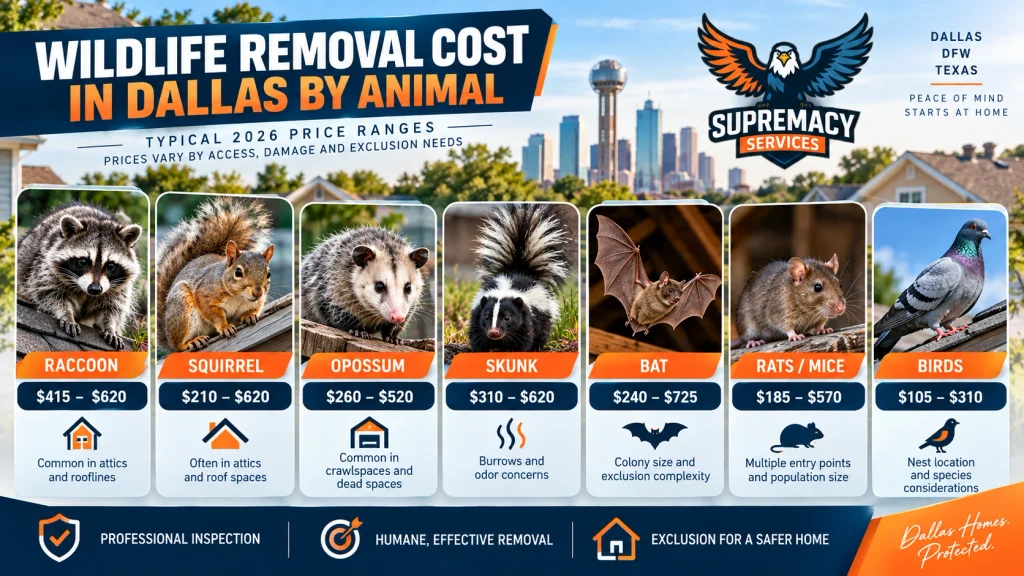
For many Dallas projects, current third-party market data puts professional wildlife removal between roughly $225 and $1,003, averaging about $606. These are market estimates rather than Supremacy Services quotes, and an inspection is necessary to determine the price of a specific property.

2026 Dallas wildlife removal cost comparison for raccoons, squirrels, opossums, skunks, bats, rodents and birds
Wildlife removal pricing can vary considerably depending on the species and complexity of the problem.

2026 Dallas Wildlife Removal Costs by Animal

Wildlife problemDallas market-price estimate*Common complication
Raccoon$415–$620Attic access, young, roof/soffit damage
Squirrel$210–$620Attic nesting and multiple entry points
Opossum$260–$520Crawlspace/deck access
Skunk$310–$620Burrows and odor issues
Bat$240–$725Colony size and exclusion complexity
Rats/mice$185–$570Multiple openings and population size
Birds$105–$310Nest location and species considerations

*These figures are Dallas-area market estimates reported by Angi in June 2026—not a Supremacy Services price list or guaranteed quote. More extensive exclusion, repairs, sanitation or restoration may be additional.

That distinction is important. A $400 animal-removal job and a house requiring removal plus roofline exclusion, contaminated-insulation work and repairs are fundamentally different projects.


Raccoon Removal Cost in Dallas

Current Dallas market data estimates professional raccoon removal at approximately $415–$620 for many projects, although a complex attic situation can cost more once exclusion, repair and cleanup are considered.

Raccoons can create more complicated projects because the technician may need to determine:

  • whether the animal is actually living inside;
  • whether young are present;
  • where it entered;
  • whether soffits, vents or roofing were damaged;
  • whether contaminated nesting material requires removal;
  • and how the opening can legally and safely be secured.

Why you should not simply trap and relocate a Dallas raccoon

Texas regulations deserve special attention here.

Raccoons are classified as fur-bearing animals in Texas. Texas Parks & Wildlife states that nuisance fur-bearing animals can be taken by landowners or their agents under applicable conditions, but relocation requires authorization. More importantly, Texas’ rabies-quarantine rules prohibit transporting live raccoons from, to or within the state.

That is one reason DIY capture can create a problem homeowners did not anticipate: catching an animal does not automatically mean you can legally drive it somewhere else and release it.

Squirrel Removal Cost in Dallas

Dallas-area market data puts squirrel removal at roughly $210–$620 for many standard projects.

A squirrel in the yard is different from squirrels nesting inside a roof system. Costs may rise when technicians need to investigate high or difficult rooflines, identify more than one access point, address nesting areas, or perform exclusion work after the animals are gone.

Typical places worth inspecting include:

  • roof vents;
  • soffit/fascia transitions;
  • damaged screening;
  • roof intersections;
  • construction gaps;
  • and openings around exterior penetrations.

Texas’ current 2026–27 regulations list Dallas among counties with a squirrel general season running September 1, 2026 through August 31, 2027, but homeowners should not interpret hunting regulations as a substitute for determining the appropriate legal method for a wildlife problem inside a structure.

Opossum Removal Cost in Dallas

Current Dallas consumer-market estimates place opossum removal around $260–$520 for many projects.

Opossums commonly create a different cost profile from roof-dwelling animals because the problem may involve an accessible ground-level area rather than a high attic.

Inspection areas may include:

  • crawlspaces;
  • spaces beneath decks;
  • garages;
  • sheds;
  • foundation openings;
  • and protected areas around a home.

Texas classifies opossums as fur-bearing animals, meaning nuisance-animal rules can apply to how they are captured, possessed and relocated.

The quote should therefore consider both removal and how the animal obtained access in the first place.

Skunk Removal Cost in Dallas

Current Dallas estimates put many skunk-removal projects at roughly $310–$620.

The complication with skunks is often location.

A skunk underneath a shed or deck may require a different approach from an animal merely passing through the yard. Burrowing, restricted access and odor problems can also affect the work required.

Texas classifies skunks as fur-bearing animals, and Texas health authorities identify skunks among the wildlife species commonly infected with rabies in the state. Direct contact with abnormal or aggressive wildlife should therefore be avoided.

Bat Removal Cost in Dallas

Dallas market estimates put many bat-removal projects around $240–$725, but bat work can become substantially more involved depending on the number of bats, building configuration and amount of exclusion work required.

Bat situations deserve separate treatment from ordinary nuisance-animal removal.

A bat flying through a living space may be a single-animal incident. Repeated bat activity around the same roofline, attic or wall cavity may point to a building-entry issue that requires a more thorough inspection.

What if a bat was inside a bedroom?

Do not treat that solely as a pest-control problem.

Texas DSHS advises against touching injured, sick or dead bats. Because bat bites can be difficult to see, certain situations—including waking to find a bat in the room—can require evaluation for possible rabies exposure. DSHS recommends contacting local animal control or the local health department when exposure may have occurred.

Do not release a bat when human or pet exposure may have occurred before getting appropriate public-health guidance, because testing may be needed.

What About Armadillo Removal?

Armadillos are another relevant North Texas nuisance species, but they should not simply be grouped with raccoons and opossums from a regulatory standpoint.

Texas lists armadillos as nongame animals, while raccoons, opossums and skunks are classified as fur-bearing animals.

An armadillo problem is also more likely to involve lawns, landscaping or areas around structures rather than an attic.

That means the inspection and treatment plan can be substantially different.


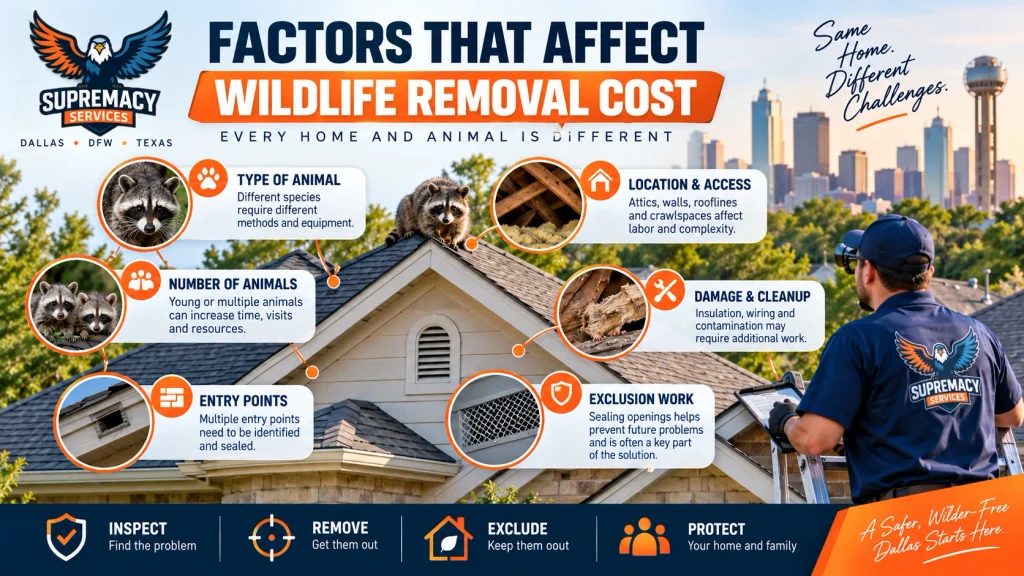
What Factors Affect Wildlife Removal Cost?

Factors affecting wildlife removal cost including animal type, attic access, entry points, damage and exclusion work
Species, accessibility, number of animals, property damage and exclusion needs can all influence the total cost of wildlife removal.

The biggest cost factors are species, location, accessibility, number of animals, removal complexity, exclusion work, property damage and cleanup requirements.

1. The animal

Removing a single accessible animal is not equivalent to resolving an established attic or wall infestation.

Species also affects equipment, inspection methods and legal handling considerations.

2. Where the animal is hiding

Accessibility can significantly affect labor.

An animal under an accessible deck may be relatively straightforward compared with wildlife behind a wall, beneath a difficult roof intersection or deep inside an attic.

3. Number of animals

Hearing one animal does not necessarily mean there is only one.

The inspection should establish whether there are young, multiple animals or signs suggesting an established nesting site before openings are closed.

4. Number of entry points

Finding the obvious hole is not necessarily enough.

A thorough inspection may need to examine roof vents, soffits, fascia, chimneys, roof intersections, utility penetrations, crawlspace openings and foundation-level gaps.

5. Exclusion work

This is one of the most important distinctions when comparing quotes.

Removal gets wildlife out. Exclusion addresses how wildlife gets back in.

Supremacy’s current wildlife service specifically combines animal removal with inspection and entry-point sealing.

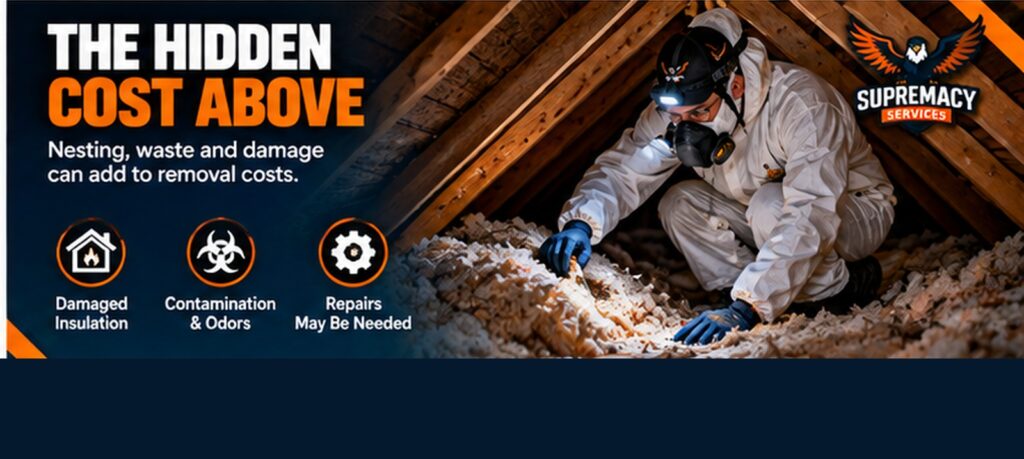
6. Damage and contamination

Wildlife may disturb insulation, leave nesting materials and waste, or damage building components.

When cleanup or repair is required, it should be clearly separated on the estimate so homeowners understand what they are paying for.

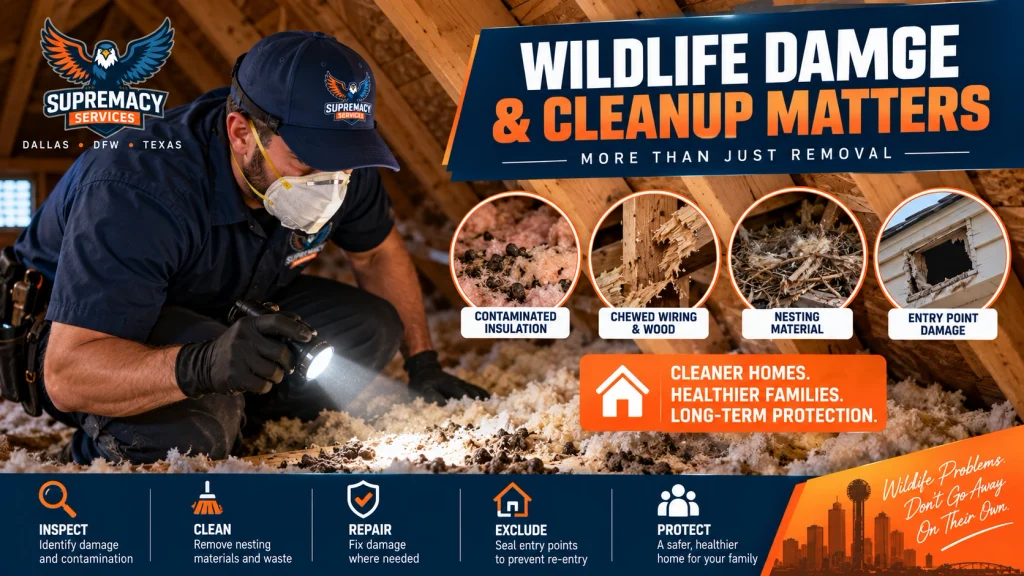
Wildlife technician inspecting damaged attic insulation, nesting material and possible animal contamination
Wildlife problems can extend beyond removal when nesting material, damaged insulation or building components also require attention.
7. Follow-up visits

A job requiring inspection, trapping/monitoring and follow-up work will naturally differ from a one-visit service.


Removal vs. Exclusion: Why the Cheapest Quote May Not Be Comparable

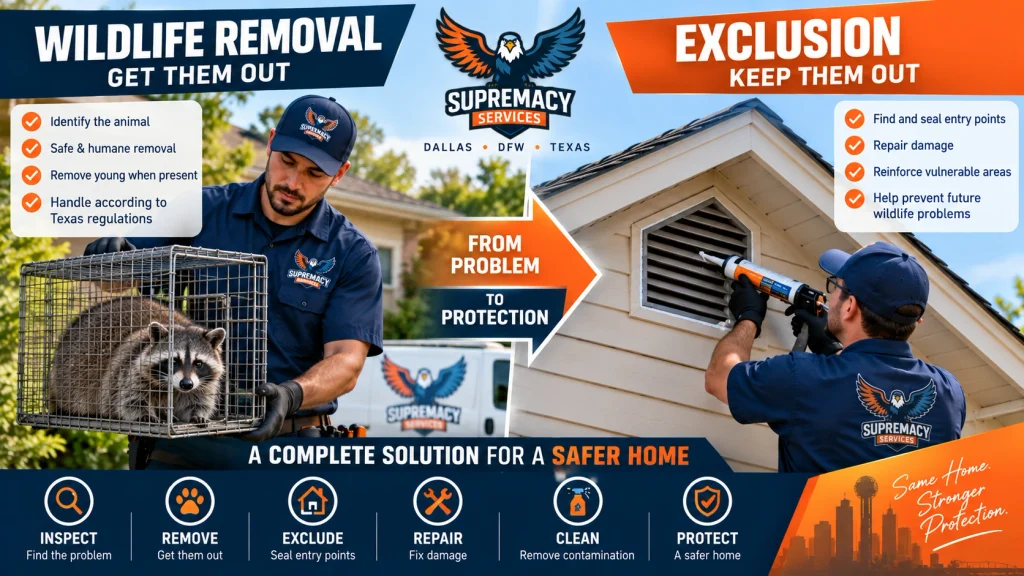
Wildlife technician removing a raccoon and sealing a roof vent to help prevent wildlife from returning
Removal addresses the wildlife currently present; exclusion addresses the openings that can allow animals back into the home.
ServiceWhat it addresses
InspectionIdentifies animal, activity and likely entry points
Removal/controlAddresses animals currently present
ExclusionCloses appropriate openings to reduce re-entry
RepairCorrects animal-related structural damage where included
CleanupRemoves affected nesting/debris where appropriate
SanitationAddresses affected areas when included and warranted
Follow-upConfirms the wildlife problem has been resolved

When comparing Dallas wildlife-removal estimates, ask every contractor the same question:

Does this quote include only removing the animal, or does it also include finding and addressing the entry points?

That single distinction can explain why two quotes appear dramatically different.


Signs Wildlife May Be Inside Your Dallas Home

An occasional animal crossing your yard does not necessarily require removal. The concern increases when evidence suggests wildlife has entered the structure.

Watch for:

  • scratching, thumping or movement above ceilings;
  • noises in walls;
  • repeated activity near the same roof opening;
  • damaged soffits or vent screens;
  • nesting material;
  • droppings in an attic or crawlspace;
  • unusual odors;
  • disturbed insulation;
  • digging beneath a deck or shed;
  • or visible wildlife entering and leaving an opening.

Timing can help identify the animal, but noise alone is not enough to reliably identify a species.

An inspection is more useful than guessing based solely on whether the sound occurs during the day or night.


DIY Wildlife Removal vs. Professional Removal

DIY action should focus first on safe observation and prevention, not grabbing or handling a wild animal.

Homeowners can reasonably:

  • observe where activity occurs from a safe distance;
  • remove accessible food attractants;
  • secure trash;
  • document noises and times;
  • inspect the exterior from ground level;
  • and keep pets away from wildlife.

Be cautious about trapping an animal yourself without knowing what species it is and what Texas rules apply.

Texas’ nuisance fur-bearing-animal rules include restrictions concerning possession, transport and relocation. Raccoons also fall under a specific rabies-related transportation restriction.

And if a bat may have contacted a person or pet, treat the situation as a potential public-health matter rather than simply releasing the bat.

What Should Professional Wildlife Removal Include?

Professional wildlife removal process showing inspection, removal, exclusion, repair, cleanup, verification and prevention
A complete wildlife-control project may involve inspection, removal, exclusion, repairs, cleanup and verification—not simply removing an animal.

A complete wildlife-control project typically begins with identification rather than trapping.

Step 1: Inspect

Determine the likely species, location and points of entry.

Step 2: Determine the appropriate control method

The method should reflect the species, location, presence of young and applicable Texas rules.

Step 3: Address the animal

Remove or otherwise resolve the active wildlife problem using an appropriate method.

Step 4: Exclude

Close appropriate entry points after ensuring animals are not being sealed inside.

Step 5: Assess damage

Inspect insulation, vents, soffits, fascia and other affected areas.

Step 6: Clean affected areas when needed

Nesting material, waste or other contamination may require additional work.

Step 7: Reinspect

Verify that activity has stopped and repaired areas remain secure.

Supremacy’s wildlife page currently describes inspection, trapping/removal, sealing and cleanup as core components of its approach.

How to Compare Wildlife Removal Quotes in Dallas

Don’t compare only the number at the bottom of the estimate.

Ask:

  1. What animal do you believe is present?
  2. Where is it entering?
  3. Does the price include inspection?
  4. Is removal priced per animal, visit or project?
  5. How many visits are anticipated?
  6. Does the quote include exclusion?
  7. Which openings will be sealed?
  8. Are repairs included or separately priced?
  9. Is attic/crawlspace cleanup included?
  10. What happens if additional entry points are discovered?
  11. How will applicable Texas wildlife rules affect the method used?

A detailed scope is far more useful than an unexplained low estimate.


Common wildlife entry points including roof vents, soffits, chimney, crawlspace, utility gaps and foundation openings
Roof vents, soffits, chimneys, crawlspaces and exterior gaps are among the areas worth checking during a wildlife inspection.

How Dallas Homeowners Can Reduce Future Wildlife Problems

Prevention starts with making the house less accessible and less attractive.

Inspect exterior areas such as:

  • damaged vent screens;
  • soffit/fascia gaps;
  • roofline openings;
  • chimney-related openings;
  • crawlspace access;
  • foundation penetrations;
  • garage-door gaps;
  • and damaged exterior materials.

Also secure outdoor food sources and trash where practical.

Do not automatically seal an opening while wildlife is actively using it. An animal—or dependent young—could remain inside.


Frequently Asked Questions

How much does wildlife removal cost in Dallas?

Current 2026 consumer-market data estimates many Dallas wildlife-removal projects at roughly $225–$1,003, averaging around $606. Species, access, number of animals, follow-up visits, exclusion, damage and cleanup can change the final price.

How much does raccoon removal cost in Dallas?

Angi’s current Dallas estimate is approximately $415–$620 for raccoon removal. Attic exclusion, repairs and cleanup can increase the total project cost.

How much does squirrel removal cost?

Current Dallas market estimates are approximately $210–$620. Location, accessibility and required exclusion work affect the actual quote.

How much does opossum removal cost?

Dallas market data currently estimates approximately $260–$520 for many opossum-removal projects.

Does wildlife removal include sealing entry holes?

Not necessarily. Ask whether the estimate covers removal alone or also includes exclusion. Supremacy’s wildlife service currently includes entry-point sealing as part of its stated process.

Can I trap a raccoon and release it somewhere else?

Do not assume so. Texas rules state that relocation of nuisance fur-bearing animals requires authorization, and live raccoons are subject to a rabies-quarantine transportation prohibition within Texas.

Should I remove a bat myself?

Avoid direct contact. Texas DSHS specifically warns against touching injured, sick or dead bats and provides additional guidance when human or animal exposure may have occurred.

Why can wildlife removal quotes vary so much?

Because contractors may be quoting different scopes. One quote may cover animal removal only, while another includes inspection, multiple visits, exclusion, repairs and cleanup.

Is wildlife removal the same as rodent control?

No. Raccoons, squirrels, opossums, skunks and bats can require different methods and regulatory considerations from rats and mice. Supremacy maintains a separate rodent-control service for the latter.


Wildlife inside a home is easier to price accurately once the species, access point and damage are known. If you’re hearing activity in your attic, walls or crawlspace, schedule a professional inspection with Supremacy Services to identify the problem and determine whether removal, exclusion or cleanup is needed.


Raccoon entering an attic through a damaged soffit on a Dallas home

Raccoon in the Attic in Dallas? What to Do, Signs & Removal

If you suspect a raccoon in the attic, avoid entering the attic or trying to corner, grab or chase the animal out. Keep children and pets away, look for signs of where the raccoon is entering from outside, and arrange for the attic and roofline to be inspected before sealing any opening.

The reason for the caution is simple: getting the raccoon out is only part of the solution. You also need to determine whether young raccoons are present, identify the entry point, evaluate contamination or damage, and prevent another animal from using the same opening.

Here is what Dallas and DFW homeowners should know.

What Should You Do If You Have a Raccoon in Your Attic?

If you hear or see evidence of a raccoon above your ceiling:

  1. Stay out of the attic and keep your distance.
  2. Keep children and pets away from the area.
  3. Do not corner or attempt to handle the raccoon.
  4. Do not immediately seal the suspected entry hole.
  5. Look for exterior evidence from ground level rather than climbing onto the roof.
  6. Arrange for a wildlife inspection to determine whether the animal—and potentially young—are still inside.
  7. After removal, address entry points, contamination and damage.

The goal should be removal + exclusion + cleanup, not simply making the noises stop.

Why You Shouldn’t Immediately Seal the Entry Hole

Finding a damaged soffit or roof opening may make sealing it seem like the obvious first step.

That can be premature.

If the raccoon is still inside, blocking its established exit can leave the animal trapped in the structure. If young raccoons are present, sealing an adult outside can separate the family.

The safer sequence is to identify what is inside, resolve the animal problem appropriately, verify that the space is clear and then perform exclusion repairs.

Need the attic and roofline professionally evaluated? Supremacy Services provides wildlife trapping, removal and entry-point exclusion for Dallas/DFW homes.

How Do You Know If a Raccoon Is in Your Attic?

Attic showing raccoon tracks, disturbed insulation, droppings and damaged soffit
Heavy nighttime noises, disturbed insulation, waste and roofline damage can indicate wildlife activity.

Common signs of a raccoon in an attic include heavy nighttime movement, thumping or scratching, disturbed insulation, damaged roof components, droppings, nesting material and visible entry damage around the roofline.

No single sign proves that the animal is a raccoon, however. Squirrels, rats, opossums and other wildlife can produce similar symptoms.

1. Heavy Noises at Night

Raccoons are relatively large compared with rats and squirrels. When one moves across ceiling joists or attic flooring, homeowners may hear:

  • heavy footsteps;
  • thumps;
  • scratching;
  • shuffling;
  • movement around soffits or vents; or
  • intermittent vocal sounds.

Timing helps with identification. Persistent activity after dark is more consistent with a nocturnal animal than the daytime movement commonly associated with squirrels.

But sound alone should not be treated as definitive identification.

2. Damaged Soffits, Fascia or Roof Components

Raccoons are capable climbers and can exploit vulnerable areas along a roofline.

Look from ground level for:

  • displaced or damaged soffit panels;
  • gaps around fascia;
  • damaged roof vents;
  • openings near roof intersections;
  • loose exterior materials;
  • disturbed chimney components; and
  • enlarged pre-existing gaps.

The visible opening may not be the only vulnerable point, which is why a whole-roofline inspection is more useful than simply patching the most obvious hole.

3. Disturbed Attic Insulation

A raccoon using an attic for shelter can flatten, move or contaminate insulation.

Homeowners may notice compressed areas, pathways, nesting zones or insulation displaced near an entry point.

Damaged insulation can become part of the restoration scope after the animal has been removed.

4. Droppings or Urine Odor

Wildlife waste is another important clue.

Do not handle raccoon feces or contaminated attic material with bare hands. If substantial contamination is present, cleanup may require protective equipment and careful removal of affected materials.

A persistent odor can also indicate that wildlife has occupied the attic longer than the homeowner initially realized.

5. A Raccoon Seen on the Roof

Seeing a raccoon cross your yard does not mean it lives in your attic.

Seeing one repeatedly climbing the same section of your home, entering an opening, emerging from the roofline or spending time around the same soffit or vent is much stronger evidence.

Observe from a safe distance rather than approaching the animal.


Raccoon, Squirrel, Rat or Opossum? How to Tell the Difference

Comparison of raccoon, squirrel, rat and opossum signs in residential attics
Timing, sound and entry-point evidence can help narrow down which animal is in the attic.

Several animals can make surprisingly similar noises above a ceiling.

ClueRaccoonSquirrelRat/MouseOpossum
Typical activityMostly nighttimeOften daytimeOften nighttimeMostly nighttime
Perceived movementHeavy walking/thumpingFast running/scratchingLight scratching/scurryingSlower heavy movement
Likely openingLarger roof/eave vulnerabilityRoof/eave gapsSmall structural gapsLarger accessible opening
Insulation disturbanceCan be substantialNesting/paths possibleSmall trails/nestingNesting/disturbance possible
Best identification methodInspectionInspectionInspectionInspection

Noise descriptions are useful clues—not a substitute for identifying the animal and entry point.

Why Do Raccoons Enter Attics?

An attic can provide something wildlife actively seeks: shelter and a protected place to den.

The problem often begins with a vulnerable building component rather than a mysterious infestation.

Potential access areas include:

Soffits and Fascia

Loose, deteriorated or damaged eave components can create access into roof cavities.

Roof Vents

A damaged or inadequately protected vent can become a vulnerable location.

Roof Intersections and Construction Gaps

Where rooflines, additions or exterior components meet, small construction weaknesses can develop or enlarge over time.

Chimney Areas

Chimney caps, flashing and adjacent roof components should be checked as part of a complete inspection.

Existing Wildlife Damage

A previously used entry point can remain vulnerable if the earlier repair addressed the animal but not the opening.

This is why successful wildlife control is as much a building-exclusion problem as an animal-removal problem.

Why Raccoons in the Attics Should Be Taken Seriously

A raccoon occupying an attic can create problems beyond unwanted noise.

Insulation Damage

Repeated travel and nesting can compress or contaminate insulation. Depending on the extent of the damage, affected areas may need cleaning, removal or replacement.

Soffit and Roof Damage

Wildlife access may involve an existing weak spot, but repeated use can make the opening larger or worsen already damaged materials.

Waste Contamination

Droppings, urine and nesting debris may accumulate where an animal spends significant time.

Parasites and Other Biological Hazards

Wildlife can carry parasites and pathogens. Avoid direct contact with the animal or its waste and use appropriate precautions when contaminated materials are handled.

Rabies Exposure

Raccoons are among the wild mammals considered relevant in rabies exposure assessments. The practical takeaway is not that every raccoon has rabies—it does not—but that direct contact should be avoided.

If a raccoon bites or scratches a person, or saliva potentially contacts broken skin or the eyes, nose or mouth, wash the affected area and contact a healthcare professional or public-health authority promptly.

Do not attempt to determine whether an animal has rabies simply by looking at it.


Can You Remove a Raccoon From an Attic Yourself?

There is an important difference between wildlife prevention and handling an occupied attic.

Homeowners can do useful preventive work such as securing garbage, eliminating accessible food sources and monitoring exterior maintenance.

Direct removal becomes more complicated when:

  • the animal is already inside;
  • the location is difficult to access;
  • young animals may be present;
  • significant fecal contamination exists;
  • the raccoon has entered living space;
  • a person or pet may have had direct contact; or
  • roof work is required.

Texas also has rules affecting the handling and transportation of raccoons. Do not assume that trapping a raccoon gives you unrestricted authority to transport and release it wherever you choose.

For an active attic problem, professional inspection is generally the more practical route because removal and structural exclusion need to be coordinated.

What Does Professional Raccoon Attic Removal Include?

Wildlife technician inspecting contaminated insulation and raccoon damage in an attic
Wildlife removal may need to be followed by cleanup and evaluation of contaminated or damaged insulation

The exact scope depends on the home and infestation, but a thorough wildlife-control process generally involves several stages.

Step 1: Confirm the Animal

The inspection should determine whether the evidence is consistent with raccoons or another species.

Correct identification matters because different animals require different removal and exclusion approaches.

Step 2: Locate Entry and Vulnerable Areas

The roofline, soffits, fascia, vents and other exterior transitions should be evaluated for current and potential access points.

Step 3: Check for Young

This is especially important when the attic may be functioning as a den.

A removal plan should account for all animals rather than simply the adult that happens to be visible.

Step 4: Remove the Wildlife

The appropriate method depends on the situation and applicable wildlife rules.

Step 5: Verify the Space Is Clear

Exclusion repairs should be coordinated with removal so that wildlife is not unintentionally trapped inside.

Step 6: Seal Entry Points

Once the animals are out, vulnerable openings should be repaired or reinforced with materials suitable for the specific part of the structure.

Step 7: Evaluate Cleanup and Restoration

The attic can then be assessed for:

  • droppings;
  • urine contamination;
  • nesting debris;
  • damaged insulation;
  • odor; and
  • physical damage.

If you’re hearing heavy nighttime movement or have found roofline damage, schedule a Dallas wildlife inspection before closing the opening. Identifying the animal and entry point first can prevent a removal problem from becoming a trapped-animal problem.


How Much Does Raccoon Removal Cost in Dallas?

There is no responsible single price for every raccoon-in-attic job because the work can range from a relatively straightforward removal to a more extensive project involving roofline exclusion, young animals, contaminated insulation and repairs.

Important cost factors include:

Cost factorWhy it matters
Number of animalsMultiple animals can require additional work
Presence of youngChanges the removal strategy
Entry-point locationHigh or difficult roof access increases complexity
Number of openingsMore exclusion work may be required
Attic contaminationCleanup may expand the scope
Insulation damageRestoration may be separate from removal
Soffit/roof damageBuilding repairs can add work
Repeat infestationPrevious unsuccessful repairs may need correction

For homeowners comparing estimates, ask what the quoted scope actually includes.

A low removal-only price is not equivalent to a proposal that includes inspection, removal, exclusion, cleanup and repair.

Does Homeowners Insurance Cover Raccoon Damage?

Coverage depends on the policy, cause of loss, exclusions and circumstances.

Do not assume that either wildlife removal or resulting attic damage is automatically covered. Review your policy and ask your insurer specifically about animal damage, cleanup, insulation and structural repairs.

Photograph visible damage before restoration begins when it is safe to do so.

What About Raccoons and Rabies in Texas?

Raccoons can contract rabies, but seeing a raccoon does not mean the animal is rabid.

The important distinction is between having wildlife somewhere in the structure and experiencing an actual potential exposure.

If you or another person is bitten or scratched, or may have had contact with potentially infectious saliva, wash the affected area with soap and water and contact a healthcare provider or local health authority promptly.

If a pet encounters the raccoon, separate the animals without putting yourself at risk and contact your veterinarian or appropriate local authority.

Do not handle a sick, injured, unusually tame or dead raccoon with bare hands.

Can You Relocate a Raccoon in Texas?

Texas rules make this more complicated than simply trapping an animal and driving it to a distant park.

State rabies-control rules restrict transportation of certain live high-risk wildlife, including raccoons. Specific exemptions and requirements apply to authorized individuals.

For Dallas homeowners, the practical lesson is straightforward: do not capture a raccoon and independently transport it somewhere else without first understanding the applicable rules.

Professional wildlife-control providers should use methods consistent with current Texas requirements.


How Do You Prevent Raccoons From Getting Back Into the Attic?

Wildlife removal process showing inspection, removal, attic cleanup and roofline exclusion
Long-term wildlife control combines identification, removal, exclusion and cleanup.

Long-term prevention depends on making the structure less accessible and reducing attractants around the property.

Inspect the Roofline

Periodically check:

  • soffits;
  • fascia;
  • roof vents;
  • chimney areas;
  • roof intersections; and
  • previous wildlife repairs.

Address deterioration before an animal turns it into an entry point.

Secure Trash

Keep garbage in securely closed containers and avoid leaving accessible food waste outside overnight.

Avoid Feeding Wildlife

Feeding raccoons encourages them to associate residential properties with food.

Manage Pet Food

Bring pet food indoors rather than leaving it accessible outside overnight.

Maintain Trees Near the Roof

Branches close to the roof can make roof access easier for several wildlife species. Appropriate tree maintenance can reduce those pathways, although raccoons are capable climbers and tree trimming alone will not wildlife-proof a home.

Protect Vulnerable Openings

Exterior repairs should be appropriate to the building component involved. The objective is durable exclusion rather than simply filling a visible gap with whatever material is available.

Dallas/DFW Considerations

Raccoons occur in Texas and adapt well to environments where food and shelter are available around people.

For Dallas and DFW homeowners, that makes routine exterior maintenance particularly valuable. Mature trees, roof complexity, accessible garbage, damaged soffits and other property-specific conditions can create opportunities for wildlife without the homeowner noticing immediately.

The correct response is therefore property-specific: identify the animal, determine how it entered and correct the structural weakness that allowed access.

When Should You Call a Wildlife Professional?

Consider professional wildlife service when:

  • you hear heavy movement in the attic;
  • you see a raccoon entering the roofline;
  • young raccoons may be present;
  • the animal enters your living space;
  • there is significant attic contamination;
  • you find multiple entry points;
  • roof access is required;
  • previous removal attempts have failed; or
  • you are unsure which animal is inside.

For a potential bite, scratch or saliva exposure, contact healthcare/public-health professionals as well. Wildlife removal service is not a substitute for medical advice.


Frequently Asked Questions

Will a raccoon leave my attic on its own?

A raccoon may leave temporarily to forage, but that does not mean the attic has been abandoned. If it is using the attic as a den—particularly when young are present—the animal may return. Confirm vacancy before sealing the entry point.

What does a raccoon sound like in an attic?

Homeowners often describe relatively heavy footsteps, thumping, scratching and shuffling. Sound alone cannot reliably identify the species, so an inspection is preferable.

Should I seal the hole while the raccoon is outside?

Not until you are confident that no raccoons or young remain inside. Premature sealing can trap an animal or separate a mother from her young.

Are raccoons in Dallas dangerous?

Wild raccoons should not be handled or cornered. They can bite or scratch when threatened, and Texas health authorities advise avoiding direct contact with wildlife because of potential disease exposure

Can raccoons damage attic insulation?

Yes. Wildlife can compress, displace and contaminate insulation through movement, nesting, urine and feces. The extent should be evaluated after removal.

Can raccoons chew through a roof?

Raccoons frequently exploit existing vulnerable areas such as damaged soffits or other weak roofline components and can worsen an opening. A full exterior inspection helps identify both the active entrance and other vulnerabilities.

How much does raccoon removal cost in Dallas?

Cost depends on factors such as accessibility, number of animals, presence of young, exclusion work, contamination, insulation damage and structural repairs. Compare the scope of work rather than comparing removal prices alone.

Can I trap and relocate a raccoon myself in Texas?

Do not assume you can transport and release a captured raccoon wherever you choose. Texas has specific rules concerning the transport of live raccoons and other high-risk wildlife.

How do I keep raccoons out permanently?

Removal should be followed by exclusion. Repair the actual entry point, inspect other vulnerable roof areas and reduce food sources such as unsecured trash or outdoor pet food.

Have a Raccoon in Your Attic in Dallas?

A raccoon in the attic is not just an animal-removal problem. A complete solution requires determining what is inside, how it entered, whether young are present, what damage or contamination occurred and how the opening should be secured afterward.

Avoid direct contact and do not seal an active opening until the attic has been properly evaluated.

Contact Supremacy Services for professional wildlife trapping, attic inspection and exclusion in Dallas and across the DFW Metroplex.
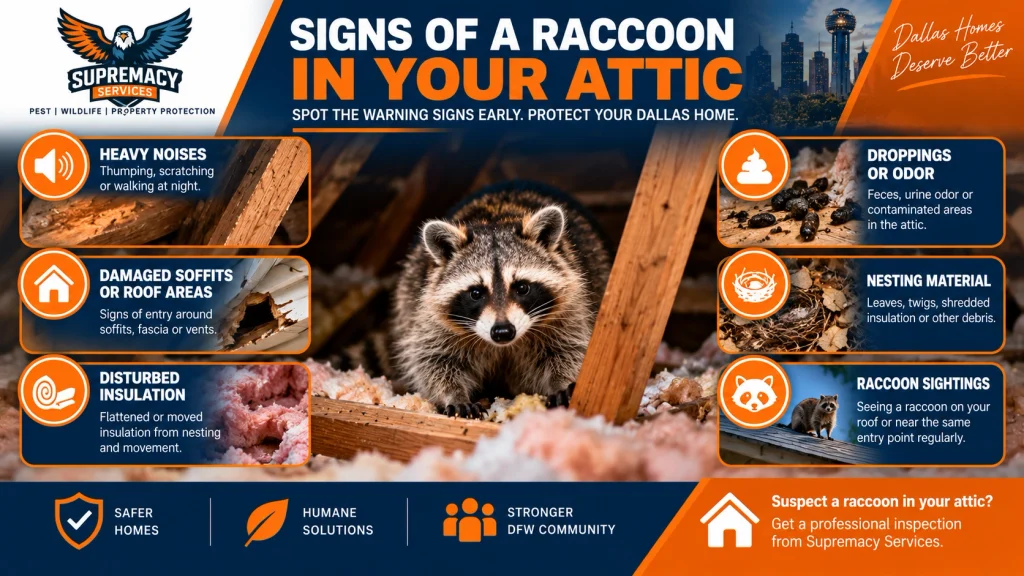
Opossum entering an attic through a damaged soffit on a Dallas-area home

Opossum in Your Attic? Signs, Removal & Prevention in Dallas

If you suspect an opossum in your attic, don’t seal the opening immediately or try to corner the animal. First confirm what is inside, determine how it entered, and make sure there are no dependent young before the entry point is permanently closed.
Opossums occur across much of Texas and may shelter in attics, underneath buildings and in other protected spaces. For Dallas–Fort Worth homeowners, the solution is usually more than simply getting the animal outside: the entry route and whatever attracted the animal also need to be addressed.

This guide explains how to recognize an opossum, what to do if one gets into your attic, how professional removal works, and how to make your home less inviting to wildlife afterward.

How Do You Know If an Opossum Is in Your Attic?

Disturbed attic insulation, wildlife droppings and an exterior opening indicating possible opossum activity
Noise, waste and disturbed insulation can indicate wildlife activity, but several species produce similar signs.

Common clues include heavy nighttime movement, disturbed insulation, droppings, odors, nesting material and an exterior opening large enough for a medium-sized animal.

No single sign proves you have an opossum. Raccoons, rats, squirrels and other animals can produce similar symptoms, which makes identification an important first step.

1. Heavy Noises Mostly at Night

Opossums are primarily nocturnal. If the activity happens mainly after dark, you might hear:

  • slow walking or shuffling;
  • scratching;
  • occasional heavier thumps;
  • movement above ceilings;
  • noises near soffits, roof edges or attic access areas.

Nighttime activity narrows the possibilities, but it does not identify the animal by itself.

2. A Noticeable Wildlife Odor

A persistent animal or waste odor can indicate that wildlife has spent time in the attic.

Odor may come from urine, feces, nesting materials or, in some situations, a dead animal. The location and intensity of the odor can help an inspector determine where activity is concentrated.

3. Droppings or Contaminated Attic Areas

Wildlife feces in an attic deserve caution.

Avoid handling unidentified droppings with bare hands or disturbing heavily contaminated insulation unnecessarily. Different animals can produce similar-looking waste, so photographs, tracks and other evidence should be considered before identifying the species.

4. Disturbed Insulation or Nesting Material

Compressed, displaced or dirty insulation can show where an animal has been traveling or resting.

An inspector may also find leaves or other materials associated with a sheltered resting area.

5. A Damaged or Open Entry Point

Look from ground level for problems around:

  • soffits;
  • fascia and roof edges;
  • attic and gable vents;
  • gaps around additions;
  • damaged screens;
  • openings around decks or crawlspaces;
  • garage doors;
  • other exterior gaps.

Do not climb onto a roof merely to investigate an animal. A professional inspection is safer when the suspected entry point is elevated or difficult to reach.

Contextual CTA: If you are hearing heavy nighttime movement and cannot identify the animal, schedule a [professional wildlife inspection and removal service] before closing any suspected opening.

Opossum vs. Raccoon vs. Rat vs. Squirrel: What Is in Your Attic?

Comparison of opossum, raccoon, rat and squirrel signs in a residential attic
Time of activity and movement patterns provide clues, but inspection is needed for reliable identification.

The time, weight and pattern of the noise can provide clues, but a physical inspection is the most reliable way to distinguish attic wildlife.

ClueOpossumRaccoonRat/MouseSquirrel
Typical activityMostly nighttimeMostly nighttimeOften nighttimeMostly daytime
SoundSlow/heavier movementHeavy walking/thumpingLight scratching/scurryingFast running/scratching
Relative sizeMediumLarger/heavierSmallSmall-medium
Attic possible?YesYesYesYes
Identification from noise alone?NoNoNoNo

This distinction matters because the correct removal and exclusion strategy depends on the species present.

For example, persistent light scratching may point toward a rodent problem rather than an opossum. Supremacy’s rodent control and exclusion service addresses mice and rats specifically, while larger wildlife belongs under wildlife removal.


Why Would an Opossum Get Into a Dallas Home?

An attic offers something wildlife constantly seeks: shelter.

Texas Parks & Wildlife notes that Virginia opossums can shelter in hollow trees, logs, under buildings, abandoned burrows and attics. Around homes, accessible food and an unprotected shelter can make the property even more attractive.

Accessible Food

Common attractants include:

  • pet food left outdoors overnight;
  • unsecured garbage;
  • fallen fruit;
  • accessible compost;
  • food spilled beneath bird feeders.

Removing these resources is an important part of long-term prevention.

An Existing Opening

An opossum does not need to create every opening it uses. A damaged soffit, poorly screened opening, accessible garage or other existing gap may provide shelter.

That is why successful wildlife control should ask two separate questions:

How does the animal leave?

and

Why was the structure accessible in the first place?

Solving only the first question leaves the house vulnerable to another animal.

Is an Opossum in the Attic Dangerous?

An opossum should be treated as wildlife rather than a pet, even if it appears calm.

The main concerns inside a house are direct animal contact, bites or scratches if the animal is cornered, waste contamination, odor and damage associated with repeated occupation or entry.

It is worth correcting one common misconception: homeowners should not automatically assume an opossum has rabies. Opossums are not among the wildlife species most frequently reported with rabies in the United States.

That does not mean handling one is appropriate.

If a person is bitten or scratched by wildlife, wash the wound promptly and seek medical/public-health advice about the exposure.

Keep children and pets away from the animal while arranging an appropriate response.

What Should You Do If You Find an Opossum in Your Attic?

The safest approach is to isolate the area, avoid direct contact, identify the animal and its entry point, check for young, then use an appropriate removal and exclusion strategy.

Step 1: Keep People and Pets Away

Do not chase the opossum through the attic or attempt to grab it.

Cornering wildlife increases the likelihood of defensive behavior and can push the animal deeper into inaccessible parts of the structure.

Step 2: Confirm What Animal You Have

Try to document:

  • when noises occur;
  • where they are loudest;
  • photographs from a safe distance;
  • visible exterior damage;
  • tracks or droppings without handling them.

A wildlife camera can sometimes help distinguish nocturnal visitors around an exterior entry route.

Step 3: Find the Entry Point

Inspect accessible areas from the ground for damaged soffits, vents, screens, roof-edge gaps, crawlspace openings and other vulnerabilities.

The objective is not merely to find an opening but to determine which opening is actively being used.

Step 4: Check for Dependent Young

This step is critical.

Do not permanently seal an entry simply because an adult animal appears to have left. If young remain inside, sealing the opening can separate them from the mother and turn a wildlife problem into an animal-welfare and odor problem.

Step 5: Choose the Correct Removal Method

Depending on the situation and applicable rules, professional management may involve direct removal, an appropriate exclusion method, or trapping.

Texas rules are especially important if relocation is contemplated.

Step 6: Seal the Structure After Removal Is Confirmed

Once the structure is confirmed clear, repair the access point with durable materials appropriate for that part of the building.

The goal is exclusion, not simply trapping.

Step 7: Address Contamination and Attractants

Remove nesting debris where appropriate, evaluate contaminated material and eliminate accessible food sources around the property.

That completes the cycle:

identify → remove → exclude → clean → prevent.

Can You Remove an Opossum Yourself in Texas?

Five-step wildlife removal process from attic inspection through exclusion and cleanup
Effective wildlife control addresses the animal, its entry route and the conditions that allowed access.

Some nuisance-wildlife situations can be addressed by property owners, but DIY relocation is not as simple as catching an opossum and releasing it somewhere else.

Texas classifies opossums as fur-bearing animals. Texas Parks & Wildlife states that nuisance fur-bearing animals may be taken by landowners or their agents under specific conditions, while relocation requires authorization from TPWD and permission from the owner of the release property.

That makes random off-site relocation a poor DIY strategy.

Homeowners should verify the current TPWD requirements before trapping or transporting wildlife because wildlife regulations can change.

DIY vs. Professional Opossum Removal

SituationDIY may be reasonableProfessional help is preferable
Opossum passing through yard✓
Outdoor food attracting wildlife✓
Garbage can needs securing✓
Animal inside attic✓
Species uncertain✓
Possible babies✓
High roof entry✓
Significant contamination✓
Repeated wildlife entry✓
Trapping/relocation contemplated✓

A homeowner can often make meaningful progress simply by eliminating food sources and correcting easy exterior maintenance issues. An occupied attic is different because removal, animal welfare, access, safety and legal considerations overlap.

How Does Professional Opossum Removal Work?

A thorough wildlife service should focus on both the animal and the building.

Common wildlife entry points around soffits, vents, roof edges and crawlspaces
Wildlife exclusion starts by identifying how the structure became accessible.

1. Property and Attic Inspection

The technician looks for evidence that identifies the animal, its travel route and potential entry points.

Inspection may include the attic, soffits, vents, roofline, garage, foundation or crawlspace depending on where activity is occurring.

2. Species Identification

Before a removal strategy is selected, the evidence should support the identification.

This prevents a homeowner from paying for an opossum solution when rats, raccoons, squirrels or another species are actually responsible.

3. Check for Young

The occupied area should be evaluated for dependent young before exclusion work is completed.

4. Appropriate Wildlife Removal

The technique should match the animal, location and applicable Texas wildlife rules.

5. Entry-Point Exclusion

Once animals are clear, vulnerable openings can be repaired or screened using materials suitable for the location.

This is one of the most important differences between temporary animal removal and long-term wildlife control.

6. Attic Evaluation and Cleanup

The attic should be checked for nesting material, waste, odor and affected insulation.

The appropriate amount of cleanup depends on the extent and location of contamination.

Mid-article CTA: If an opossum is already inside your Dallas-area home, learn how Supremacy’s wildlife trapping and removal service combines animal removal with inspection, entry sealing and attic cleanup.

How Much Does Opossum Removal Cost in Dallas?

There is no responsible single price for every opossum-in-attic situation without inspecting the property.

The total scope can change significantly depending on whether the job involves straightforward removal or removal plus extensive exclusion and attic remediation.

Important cost factors include:

Cost factorWhy it matters
Animal locationAccessible spaces are different from difficult attic or wall locations
Number of animalsA single visitor differs from a mother with young
Entry locationGround-level access differs from high roofline work
Number of openingsMultiple vulnerabilities require more exclusion work
Building constructionSoffits, vents and roof configurations affect access
Attic contaminationCleanup requirements vary
DamageRepairs may extend beyond basic exclusion
Follow-upSome situations require monitoring or return visits

For that reason, the most useful estimate should distinguish animal removal, exclusion repairs and cleanup rather than presenting one unexplained number.

Why Trapping Alone May Not Solve the Problem

Removing one opossum does not remove the reason your house was accessible.

Wildlife-management guidance emphasizes reducing food, water and shelter opportunities. If an accessible opening remains after an animal is removed, another opossum—or an entirely different species—can potentially use it later.

This is why exclusion is so important.

Think of wildlife control as two problems:

Occupancy problem: something is currently inside.

Building problem: something allowed wildlife to get inside.

A durable solution addresses both.

How to Prevent Opossums From Returning

Wildlife prevention measures including secured garbage, repaired vents and sealed structural openings
Reducing accessible food and shelter helps make a property less attractive to opossums and other wildlife.

Prevention should combine structural exclusion with attractant reduction.

Secure Garbage

Use containers with properly fitting lids and avoid leaving loose food waste accessible overnight.

Bring Pet Food Inside

Outdoor pet food is an unnecessary wildlife attractant. Feed pets indoors where practical or remove leftover food promptly.

Manage Fallen Fruit and Bird-Feeder Waste

Collect fallen fruit and clean spilled seed beneath feeders.

Protect Crawlspaces and Openings

Repair damaged screens and protect appropriate structural openings while maintaining required ventilation.

Repair Soffit and Roofline Damage

Loose soffits, damaged vents and deteriorated exterior components should be repaired before they become convenient wildlife access points.

Keep Garage Doors Closed

An open garage can provide access to shelter, pet food, garbage or additional routes into the building.

Inspect After Exterior Damage

Storms, roofing work and deterioration can create new openings. Periodically inspect accessible exterior areas, especially after repairs or weather damage.

Dallas/DFW Considerations for Opossum Problems

Opossums are established Texas wildlife, and TPWD documents the species across most of the state.

For Dallas homeowners, the useful local issue is therefore not whether opossums can occur here, but how the home and property provide access, shelter or food.

DFW includes a wide variety of housing—from older properties with aging exterior components to newer homes with complex rooflines, attached garages and numerous vents. Wildlife prevention should therefore be based on the actual building rather than a generic treatment.

The same principle applies across Dallas, Plano, Frisco, McKinney, Richardson, Carrollton, Allen, Southlake and surrounding Metroplex communities: identify the species, locate the access route and fix the structural vulnerability.

Could It Be Something Other Than an Opossum?

Yes. Attic noise alone cannot reliably identify an opossum.

Rats or Mice

Smaller, quicker scratching and scurrying—particularly inside walls—may indicate rodents.

If inspection confirms rats or mice rather than wildlife, a dedicated rodent control and exclusion approach is more appropriate.

Raccoons

Raccoons can produce much heavier movement and may occupy attic spaces.

Squirrels

Daytime running or scratching is more consistent with squirrels than with a primarily nocturnal opossum.

Birds or Bats

Fluttering or activity associated with vents and roof openings may indicate another type of wildlife entirely and requires a species-appropriate response.

Correct identification comes before treatment.


When Should You Call a Wildlife Professional?

Professional inspection is particularly appropriate when:

  • the animal is inside an attic or wall;
  • you cannot confidently identify the species;
  • there may be young present;
  • the entry point is on a high roof;
  • an animal has become trapped;
  • contamination is substantial;
  • wildlife keeps returning;
  • multiple openings need to be repaired;
  • trapping or relocation is being considered.

The objective should not simply be to make tonight’s scratching stop. It should be to determine what entered, how it entered and what needs to change so the structure is less likely to be occupied again.


Frequently Asked Questions About Opossums in Dallas Attics

Will an opossum leave an attic on its own?

It may leave to forage, but that does not mean it has permanently abandoned the shelter. Do not seal an opening until you have confirmed the space is clear and checked for dependent young.

What does an opossum sound like in an attic?

Homeowners may hear slow walking, scratching, shuffling or heavier movement, often at night. Noise alone cannot reliably distinguish an opossum from other attic wildlife.

Are opossums dangerous to people?

Opossums generally should be left alone rather than handled. Any wild mammal may defend itself if cornered. Keep children and pets away and seek medical advice after a bite or scratch.

Do opossums commonly have rabies?

CDC guidance notes that opossums are among animals that rarely have rabies, while bats, raccoons, skunks and foxes are more frequently associated with rabies in the United States. Any potential wildlife exposure should still be assessed appropriately.

Can I trap an opossum and release it somewhere else in Texas?

Do not assume you can. Texas Parks & Wildlife has specific rules for nuisance fur-bearing animals, and relocation requires authorization and permission from the owner of the release property. Check current TPWD requirements before acting.

Should I seal the hole while the opossum is outside?

Not until you know the structure is clear. Young or another animal could remain inside. Premature sealing can create a much more serious problem.

What attracts opossums to homes?

Accessible food and shelter are major factors. Pet food, garbage, fallen fruit, compost and bird-feed waste can encourage wildlife activity, while accessible structural openings provide shelter.

Does removing an opossum prevent another one from entering?

Not by itself. The entry point and attractants also need to be corrected. Exclusion is what turns removal into a longer-term solution.

Who removes opossums from attics in Dallas?

Wildlife-control professionals handle animals occupying attics and other structures. Look for a provider that identifies the animal, checks for young, addresses applicable Texas wildlife rules and provides exclusion recommendations instead of focusing only on trapping.


Need Help With an Opossum in Your Dallas-Area Home?

If you’re hearing unexplained nighttime movement, finding wildlife waste or have discovered an animal entering your roofline, the next step is to identify what is inside and how it is getting in.

Supremacy Services provides wildlife inspection, removal, exclusion and related attic services throughout Dallas and surrounding DFW communities.

Final CTA: Schedule a Dallas wildlife inspection with Supremacy Services to identify the animal, locate entry points and determine the appropriate removal and exclusion plan.

Wildlife removal technician inspecting a Dallas home for raccoons, squirrels and other nuisance wildlife

Wildlife Removal Cost in Dallas: What Dallas Homeowners Should Expect to Pay in 2026

How much does wildlife removal cost in Texas? For homeowners in Dallas, Plano, Frisco, McKinney, Allen, Richardson, and surrounding North Texas communities, professional wildlife removal can range from a few hundred dollars for a straightforward animal removal to several thousand dollars when exclusion, attic cleanup, insulation replacement, or extensive repairs are involved.

In the Dallas–Fort Worth area, a typical wildlife removal project may fall somewhere around $300 to $1,500, while complicated situations involving raccoon families, bat colonies, extensive entry-point repairs, or contaminated attic spaces can cost considerably more.

The important question, however, is not simply “How much does wildlife removal cost?”

It is:

What is included in the wildlife removal price?

Wildlife technician inspecting roof vents, soffits and other areas that affect wildlife removal cost in Dallas
Animal type, access difficulty, property damage and necessary repairs can all affect wildlife removal pricing.

A low-cost trap may remove an animal temporarily. A professional wildlife-control solution should identify how the animal entered, address the active infestation, secure the structure against re-entry, and determine whether cleanup or repairs are necessary.

This guide explains the factors that influence wildlife removal costs in Texas and what Dallas-area homeowners should expect before hiring a wildlife-control company.


Wildlife Removal Cost in Dallas: Quick Answer

For a general 2026 planning estimate, Dallas-area homeowners can expect approximately:

Wildlife problemTypical Texas/DFW range*
Opossum removal$250–$600
Squirrel removal$300–$700
Raccoon removal$400–$1,200+
Skunk removal$300–$900+
Snake removal$100–$500+
Armadillo removal$150–$700+
Rat or mouse wildlife exclusion$300–$800+
Bat exclusion$500–$2,000+
Extensive bat colony work$2,000–$6,000+
Attic sanitation$500–$2,000+
Structural repairs/exclusion$300–$3,000+

*These are general market-planning ranges, not a fixed Supremacy Services price list. Actual pricing depends on the animal, number of animals, access points, location, structural damage, exclusion requirements, cleanup, and local regulations.

Current Dallas pricing data published by Angi places many common wildlife-removal jobs in the several-hundred-dollar range, including approximately $260–$520 for possums, $415–$620 for raccoons, and $210–$620 for squirrels. Other Texas-focused cost references show substantially wider ranges once exclusion, babies, structural repairs, and attic restoration are included.


What Determines the Cost of Wildlife Removal?

There is no single price for wildlife removal because the animal itself is only one part of the problem.

A professional estimate normally considers several factors.

1. What Animal Is Involved?

A squirrel in an attic is a different job from a raccoon family living behind a soffit.

Raccoons are larger, stronger animals capable of damaging roofing materials, soffits, vents, insulation, and other parts of a home. Squirrels can chew electrical wiring and structural materials, while opossums commonly shelter beneath decks, porches, crawlspaces, and other protected areas.

The species determines the appropriate capture or exclusion strategy, equipment, safety precautions, and amount of work required.

2. How Many Animals Are Present?

Removing one adult animal is generally much simpler than dealing with a mother and several young.

This is particularly important during nesting periods. A technician may need to locate hidden young before sealing an opening because permanently closing an occupied entry point can create a larger animal-welfare and property problem.

A proper wildlife inspection therefore looks beyond the animal homeowners can see.

3. Where Is the Animal Getting Inside?

Entry-point accessibility is one of the biggest cost variables.

Common access points include:

  • Damaged soffits
  • Roof vents
  • Fascia gaps
  • Chimney areas
  • Roof intersections
  • Attic vents
  • Plumbing penetrations
  • Crawlspace openings
  • Foundation gaps
  • Damaged siding
  • Garage openings
  • Gaps beneath decks or porches

A single accessible opening may require relatively little exclusion work.

A two-story home with several rooflines, multiple damaged vents, deteriorated soffits, and several animal entry points can require significantly more labor and materials.


Wildlife Removal vs. Wildlife Exclusion

Professional raccoon removal and wildlife exclusion work sealing an entry point on a Dallas home
Removing the animal solves the immediate problem; professional exclusion helps prevent wildlife from getting back inside.

This is one of the most important differences homeowners should understand before comparing quotes.

Wildlife Removal

Removal focuses on getting the animal out of the immediate problem area.

That may involve:

  • Inspection
  • Humane trapping
  • Capture
  • Safe handling
  • Removal from the structure
  • Follow-up monitoring

Wildlife Exclusion

Exclusion goes one step further.

It focuses on preventing the animal from getting back inside.

That can involve:

  • Identifying entry points
  • Installing one-way exclusion devices where appropriate
  • Reinforcing weak areas
  • Installing chew-resistant materials
  • Repairing vents and soffits
  • Sealing roofline openings
  • Closing crawlspace access points

This distinction explains why two companies can quote very different prices for what initially sounds like the same service.

A $300 trapping job and a $1,200 removal-plus-exclusion project may both involve the same species, but they are not necessarily solving the same problem.

For homeowners looking for a longer-term solution, see Supremacy Services’ wildlife trapping and removal service.


Wildlife Removal Cost by Animal

Dallas wildlife removal cost guide for raccoons, squirrels, opossums, skunks and bats
Wildlife removal costs vary by species, access, infestation complexity, damage and the exclusion work required.

Raccoon Removal Cost

Raccoon removal in the Dallas area commonly falls around $400–$1,200 or more, depending on the number of animals, location, exclusion requirements, and whether young are present.

Raccoons frequently exploit rooflines, attic openings, soffits, chimneys, and other protected parts of residential structures.

A basic removal can be relatively straightforward.

A raccoon family living inside an attic can be substantially more complicated because the technician may need to locate the young, remove the animals safely, secure the entry point, and address contaminated nesting material.

Current Texas-focused pricing references place basic raccoon removal with exclusion around several hundred dollars, while more involved family and attic cases can reach $1,000–$2,000 or more.

For more information, read our detailed guide to Raccoon Removal in Dallas.

Opossum Removal Cost

Opossum removal typically costs around $250–$600 for straightforward situations, although difficult access, multiple animals, exclusion, or cleanup can increase the final price.

Opossums often shelter under decks, porches, sheds, crawlspaces, garages, and other low-protection areas.

Because they may use an opening repeatedly, removing the animal without addressing the access point can leave the property vulnerable to another wildlife intrusion.

For more information, read our detailed guide to Opossum removal in Dallas.

Squirrel Removal Cost

Squirrel removal commonly falls around $300–$700, although larger infestations and extensive exclusion can increase the cost.

Squirrels can become particularly destructive when they establish themselves inside an attic.

They may:

  • Chew electrical wiring
  • Damage insulation
  • Gnaw wood
  • Destroy vents
  • Build nests
  • Contaminate insulation with urine and feces

A wildlife inspection should therefore look at both the animal and the damage it may have caused.

Skunk Removal Cost

Skunk removal can range from roughly $300 to $900 or more, depending on location and whether odor treatment or exclusion is required.

Skunks frequently use sheltered spaces beneath decks, sheds, porches, and structures.

The removal itself may not be the most expensive part of the job.

If the animal has sprayed near an occupied area, homeowners may also need odor treatment and sanitation.

Bat Removal and Exclusion Cost

Bat situations require particular care because Texas regulations apply to bats and because bat exposure can create a public-health concern.

A smaller bat exclusion project may cost approximately $500–$2,000, while larger colonies involving extensive exclusion and attic contamination can reach several thousand dollars.

Texas Parks and Wildlife states that bats generally may not be hunted, killed, possessed, purchased, or sold, although bats inside or on a building occupied by people may be handled under specific exceptions. TPWD also discourages exclusion from buildings from May 1 through August 15 when young bats may be unable to fly and could become trapped.

That means homeowners should not assume that a bat problem can simply be sealed immediately.

For questions involving possible human exposure, the CDC recommends prompt medical assessment following potentially significant contact with bats or other high-risk wildlife.


Why Wildlife Removal Can Cost More Than Expected

Attic Contamination

Above
Wildlife technician inspecting damaged and contaminated attic insulation in a Dallas home
Wildlife in the attic can leave behind damaged insulation, contamination and repair needs that increase the total cost of service.

Wild animals do more than make noise.

Animals living in an attic can leave behind:

  • Feces
  • Urine
  • Nesting materials
  • Food remains
  • Odors
  • Parasites
  • Damaged insulation

Removing the animal does not automatically make the attic clean.

If contamination is significant, professional sanitation may become a separate part of the project.

Damaged Insulation

Insulation can absorb urine, collect feces, and become heavily contaminated by nesting activity.

In severe situations, simply removing the animal may not restore the attic to a suitable condition.

Insulation removal and replacement can therefore add substantially to the final project cost.

Structural Damage

Wildlife can damage the very structure that allowed it inside.

Common examples include:

  • Torn soffits
  • Broken roof vents
  • Damaged fascia
  • Chewed siding
  • Openings around pipes
  • Damaged attic screens
  • Broken chimney caps
  • Roofline gaps

A professional exclusion job should address the pathway that allowed the animal to enter.


Why Cheap Wildlife Removal Quotes Can Become Expensive

A very low quote deserves careful examination.

Ask exactly what the price includes.

For example:

Does it include trapping?

Does it include follow-up visits?

Does it include entry-point sealing?

Does it include removal of nesting material?

Does it include attic sanitation?

Does it include repairs to damaged soffits or vents?

What happens if babies are discovered?

What happens if the animal returns?

A $250 quote may sound attractive until the homeowner discovers that exclusion and follow-up work cost several hundred dollars more.

The better comparison is not simply:

“Who is cheapest?”

It is:

“Which company is solving the entire wildlife problem?”


Is Wildlife Removal Covered by Homeowners Insurance?

Homeowners should not assume wildlife damage is automatically covered.

Insurance coverage can depend on:

  • The type of animal
  • The cause of the damage
  • The policy language
  • Whether the damage was sudden or gradual
  • Whether maintenance or structural deterioration contributed to the problem

Some policies may treat certain animal damage differently from sudden covered events.

Before filing a claim, homeowners should review their policy or speak directly with their insurance provider.

Wildlife removal itself is also not necessarily the same thing as repairing damage caused by wildlife.


Can You Remove Wildlife Yourself?

Professional wildlife technician safely removing a raccoon instead of attempting DIY wildlife removal
Wildlife removal can involve bites, disease exposure and property damage. Professional handling provides a safer approach.

Sometimes homeowners discover an animal before the situation becomes serious.

However, DIY wildlife removal can become dangerous when the animal is inside an attic, wall, chimney, crawlspace, or roof structure.

There is also the possibility of encountering an animal that is sick, injured, defensive, or protecting young.

The CDC identifies bats, raccoons, skunks, and foxes among wildlife associated with rabies exposure in the United States and recommends appropriate medical assessment following potential exposure.

Texas also has specific wildlife rules governing different species. Texas Parks and Wildlife regulations should therefore be considered before trapping, transporting, or relocating wildlife.

For homeowners, the safest approach is usually to avoid direct contact and have the animal professionally identified and removed when the situation involves a structure, potentially hazardous species, or uncertain circumstances.


Texas Wildlife Laws Matter

Wildlife removal is not simply a matter of catching an animal and taking it somewhere else.

Texas Parks and Wildlife regulates wildlife differently depending on the species.

For example, TPWD identifies raccoons, opossums, skunks, and other animals as fur-bearing animals and provides specific rules concerning nuisance animals and relocation.

Bats have additional protections and restrictions, including seasonal considerations surrounding exclusion.

That is one reason homeowners should be cautious about companies that promise to “trap and relocate anything anywhere” without discussing species identification or applicable regulations.

For the current Texas rules, homeowners can review the Texas Parks and Wildlife Department wildlife regulations.


How to Get an Accurate Wildlife Removal Estimate

The fastest way to get a realistic price is to provide the wildlife professional with as much information as possible.

Tell them:

  • What animal you have seen
  • Where you saw it
  • When you noticed activity
  • Whether you hear scratching or movement
  • Whether there are droppings or odors
  • Whether you have seen babies
  • Whether there is visible roof or soffit damage
  • Whether the animal appears to be entering an attic, crawlspace, wall, or other area

Photos of suspected entry points can also help technicians prepare for the inspection.

However, a professional inspection is still important because animals can use openings that are difficult for homeowners to see from ground level.


Dallas Wildlife Removal: What Homeowners Should Really Pay For

Wildlife control process showing inspection, removal, exclusion, repair, sanitation and home protection
Effective wildlife control goes beyond removal—inspect, remove, exclude, repair, sanitize and protect.

The cheapest wildlife-removal service is not always the least expensive solution.

A proper wildlife-control project should protect the home from repeat intrusion.

That means the goal should be:

Identify → Remove → Exclude → Repair → Sanitize → Prevent

This approach is especially important in North Texas, where homes can have multiple rooflines, open attic ventilation systems, mature landscaping, aging soffits, and numerous potential wildlife access points.

Supremacy Services provides wildlife trapping and removal for Dallas and surrounding DFW communities, including Plano, Frisco, McKinney, Allen, Richardson, Southlake, Grapevine, Colleyville, Coppell, Flower Mound, Rockwall, and University Park.

For related pest and rodent problems, homeowners can also see Supremacy Services’ DFW rodent control and exclusion service.


Wildlife Removal Cost FAQ

How much does wildlife removal cost in Dallas?

Most straightforward wildlife removal jobs fall within several hundred dollars, while complex exclusion, attic sanitation, structural repairs, and larger animal colonies can push the total into the thousands.

How much does raccoon removal cost in Texas?

A basic raccoon removal and exclusion project may cost roughly $400–$1,200 or more. Family groups, difficult attic access, contamination, and structural repairs can increase the total substantially.

How much does squirrel removal cost?

Squirrel removal commonly falls around $300–$700, with larger infestations and extensive exclusion potentially costing more.

How much does opossum removal cost?

Straightforward opossum removal commonly falls around $250–$600, although difficult access, exclusion, and cleanup can increase the final price.

How much does bat removal cost?

Bat exclusion can range from several hundred dollars to several thousand dollars depending on colony size, building design, exclusion requirements, and cleanup. Texas regulations also affect when exclusion should be performed.

Why is wildlife exclusion more expensive than trapping?

Trapping addresses the animal. Exclusion addresses the reason the animal was able to enter.

Sealing roofline gaps, repairing vents, reinforcing soffits, and installing appropriate barriers requires additional labor and materials.

Does wildlife removal include attic cleanup?

Not necessarily. Homeowners should ask whether sanitation, contaminated insulation removal, odor treatment, and repairs are included or quoted separately.

Can wildlife come back after removal?

Yes, if the entry point remains open.

That is why identifying and securing access points is one of the most important parts of long-term wildlife control.

Should I remove an animal from my attic myself?

DIY removal can expose homeowners to bites, scratches, contaminated materials, and potentially dangerous wildlife. If the species is unknown or the animal is inside a structure, professional assessment is the safer option.


Final Takeaway: What Does Wildlife Removal Really Cost?

For Dallas-area homeowners, a reasonable starting expectation is a few hundred dollars for a straightforward wildlife problem and $1,000 or more for complicated removal and exclusion projects.

However, the animal itself is only part of the equation.

The final price depends on:

Species + number of animals + location + entry points + exclusion + damage + sanitation + repairs.

A trustworthy wildlife-control company should explain those factors rather than simply giving a low number over the phone.

If wildlife has entered your Dallas-area home, the most valuable first step is to determine what animal is present, where it is entering, and whether there are additional animals or structural damage that cannot be seen from the outside.

That information turns a vague “wildlife removal cost” question into an accurate property-specific solution.

Dallas raccoon removal service providing safe and humane wildlife control

Dallas Raccoon Removal : Safe and Humane Wildlife Control

Dallas Raccoon Removal : Safe and Humane Wildlife Control

Dealing with wildlife in your home can be a nightmare. For professional raccoon removal in Dallas, TX, turn to Supremacy Service. We are your premier provider of safe, humane, and permanent wildlife control. If you are hearing thumping, scratching, or rolling sounds in your attic at night, you likely have uninvited guests. Raccoons are highly intelligent and destructive pests that seek the warmth and security of your home to den and raise their young.

While they may look cute, raccoons in Dallas pose significant risks to your property and your family’s health. From tearing through roof decking to contaminating insulation with feces and urine, the damage escalates quickly.

Do not attempt to handle these wild animals yourself. Raccoons can be aggressive and carry diseases like Rabies and Raccoon Roundworm. For fast, safe, and guaranteed raccoon removal in Dallas, trust the licensed experts at Supremacy Service.

Raccoons in Dallas: A Growing Problem for Homeowners

Raccoons are highly adaptable and have found a perfect urban environment in Dallas. Whether you live in a historic home in Lakewood or a newer build in North Dallas, your attic provides a warm, safe, and quiet place for raccoons to nest, especially during breeding season (January through March).

Beyond the noise and sleepless nights, raccoons cause significant damage to Dallas properties. They tear through roof vents, chew electrical wiring, and contaminate insulation with feces and urine, which poses serious health risks like Roundworm and Salmonella to your family and pets.

Common attractions around Dallas properties include:

  • Open garbage or unsecured trash
  • Pet food left outdoors
  • Fallen fruit from trees
  • Compost and food waste
  • Accessible attics
  • Damaged soffits and fascia
  • Unscreened roof vents
  • Open chimneys
  • Gaps around roof penetrations
  • Crawl spaces and sheds
  • Dense vegetation near structures

The important point for homeowners is that removing the raccoon without correcting the attraction or entry point can leave the property vulnerable to another wildlife intrusion.


Signs You May Have Raccoons in Your Dallas Home

Raccoons are predominantly nocturnal, so homeowners frequently notice evidence before they actually see the animal.

1. Scratching or Heavy Movement at Night

One of the most common indications of a raccoon inside a Dallas home is repeated noise coming from the attic, ceiling or roof area after dark.

Raccoons are predominantly nocturnal and have excellent night vision and hearing. They are also considerably larger and heavier than many animals that commonly enter attics, so their movement can produce noticeably heavier sounds. Texas Parks and Wildlife describes raccoons as agile climbers that have adapted well to developed environments.

A homeowner may hear:

  • Heavy footsteps above the ceiling
  • Scratching against wood or roofing materials
  • Thumping or bumping sounds
  • Movement across attic insulation
  • Sounds coming from a soffit or roof vent
  • Repeated activity around the same section of the roof
  • Chattering, vocalizations or fighting sounds
  • Movement that becomes noticeably louder after sunset

The timing and character of the noise matter. Light scratching during the day could indicate rodents, birds or squirrels, while heavier intermittent movement at night may be more consistent with a larger nocturnal animal such as a raccoon.

However, sound alone cannot positively identify the animal. Squirrels, opossums and other wildlife can occupy similar areas and produce overlapping noises.

Why repeated nighttime noise matters

If the same noises continue for several nights, the issue may be more than a wild animal simply passing across the roof.

Repeated activity in one location can indicate that the animal has found a sheltered access point or denning location. Once a raccoon discovers that an attic provides protection from weather and predators, it may continue returning to that location.

Texas Parks and Wildlife specifically warns that raccoons occupying attics and outbuildings can become destructive and difficult to remove.

Do not open an attic access panel or reach into an unknown nesting area to investigate the animal yourself. A cornered raccoon may defend itself, particularly if young are present.

2. Damaged Soffits, Fascia or Roof Areas

Damaged roofline showing a potential raccoon entry point on a Dallas home
Damaged roofline and raccoon entry point

A second major warning sign is fresh or unexplained damage around the roofline.

Raccoons are strong climbers and use their front paws to manipulate objects and investigate potential openings. Their ability to climb and adapt to buildings makes rooflines particularly important areas to inspect.

Look carefully for:

  • Torn or displaced soffit panels
  • Damaged fascia boards
  • Bent or missing vent screens
  • Gaps beneath roof edges
  • Damaged attic vents
  • Loose roofing materials
  • Disturbed chimney covers
  • Torn screening
  • Gaps around roof penetrations
  • Scrape marks near suspected entry points
  • Insulation or nesting material protruding from an opening

A particularly important clue is damage that appears concentrated around one access point.

For example, if a soffit has been pulled away from the structure and you are also hearing heavy movement in the attic at night, the two observations may be related.

Why roof damage should not simply be patched

One of the biggest mistakes homeowners can make is repairing the visible hole before determining whether the animal is still inside.

If a raccoon is occupying the attic, sealing the opening prematurely can trap the animal inside or separate a mother from dependent young.

The better approach is to determine:

  1. Whether wildlife is currently inside
  2. Which animal is responsible
  3. Whether young are present
  4. Which opening is being used
  5. Whether there are additional access points

Only after the wildlife situation has been properly addressed should permanent exclusion repairs be considered.

3. Droppings or Strong Odors

Signs of raccoon activity and odors in a Dallas home attic
Signs and odors of raccoon activity

Unusual odors are another important indication of established wildlife activity.

A raccoon that repeatedly uses an attic, crawl space or enclosed structure can leave behind feces, urine, nesting material and other organic debris.

Instead of finding a single dropping, homeowners may notice a concentrated accumulation in one area.

Possible indicators include:

  • Strong animal odors
  • Persistent ammonia-like smells
  • Droppings concentrated in an attic
  • Urine staining
  • Contaminated insulation
  • Nesting debris mixed with waste
  • Odors becoming stronger in warm weather
  • Odors coming from a ceiling or wall cavity

A persistent odor is especially significant when it occurs alongside nighttime movement or visible entry damage.

Why odors can become worse in Dallas heat

Dallas-area summer temperatures can make odors from accumulated animal waste substantially more noticeable.

An attic that remains hot for long periods can intensify unpleasant smells and make previously unnoticed wildlife contamination obvious to occupants below.

That is one reason homeowners should not simply mask the odor with air fresheners.

The odor may be coming from contaminated insulation or a concentrated wildlife den, rather than from the animal itself.

Droppings should be treated carefully

Homeowners should avoid handling wildlife feces or contaminated nesting material without appropriate precautions.

If the material is extensive, professional wildlife cleanup may be appropriate after the animal has been removed and the area is safe to access.

It is also important not to assume that every dropping found in an attic belongs to a raccoon. Rodents and other wildlife can leave different types of waste, so identification should be based on the overall evidence rather than one isolated sample.

4. Nesting Material

Another strong indication of an established wildlife presence is disturbed or newly arranged nesting material.

Raccoons may use protected spaces to rest and raise young. In a home, that can mean an attic, crawl space, chimney, shed or another sheltered location.

A homeowner may discover:

  • Pulled-apart insulation
  • Shredded paper or cardboard
  • Leaves and plant material
  • Fabric or other soft materials
  • Displaced attic insulation
  • Concentrated debris in one corner
  • A flattened area within insulation
  • Nesting material near a roof or soffit opening

The location of the material can be particularly useful.

If nesting debris is concentrated directly beneath a roof penetration or damaged soffit, it may help identify the area being used to enter or exit the structure.

Be especially cautious if babies may be present

A den containing young raccoons requires additional care.

Texas Parks and Wildlife reports that female raccoons can produce litters of up to four young, and that the young remain with their mothers well beyond the earliest weeks of life.

That means a homeowner who hears small repetitive noises in addition to the movement of a larger animal should not assume that there is only one raccoon.

Possible signs of a den with young can include:

  • Repeated adult movement
  • Smaller vocalizations
  • Activity concentrated in one protected location
  • A mother repeatedly entering and leaving the same opening
  • Nesting material concentrated in an enclosed space

This is one reason professional inspection should precede exclusion work.

Sealing an active entry point without determining whether young are inside can create an animal-welfare problem and potentially leave the mother outside while the young remain inside.

5. Daytime Raccoon Activity

Raccoon showing unusual daytime activity near a Dallas home
Unusual daytime raccoon activity

Seeing a raccoon during the day deserves attention, but it requires context rather than panic.

Texas Parks and Wildlife describes raccoons as almost exclusively nocturnal.

Texas Department of State Health Services also lists unusual daytime activity by normally nocturnal wildlife—including raccoons—as one of the behaviors that can be associated with rabies and advises people not to handle wildlife.

However, a raccoon being visible during daylight does not by itself prove that the animal has rabies.

There can be other explanations for daytime activity, including:

  • The animal being disturbed from its den
  • Searching for food
  • A mother caring for young
  • Environmental disturbance
  • Competition with another animal
  • An animal that has become accustomed to human food sources

The concern increases when daytime activity is accompanied by abnormal behavior.

Watch for signs such as:

  • Unusual aggression
  • Unusual tameness or lack of fear
  • Staggering or difficulty walking
  • Disorientation
  • Repeated circling
  • Apparent paralysis
  • Difficulty swallowing
  • Excessive or abnormal vocalization
  • Unprovoked attempts to approach or attack people or pets

Texas DSHS advises avoiding contact with wildlife, and CDC guidance similarly recommends staying away from wild animals that appear sick, injured or unusually active during the day.

What to do if a raccoon behaves abnormally

Do not attempt to capture, corner, feed or handle the animal.

Keep children and pets away from the area and contact the appropriate local animal-control or wildlife authority.

If a person or pet has been bitten or scratched, the wound should be washed immediately with soap and water and medical or veterinary advice should be obtained promptly. Texas DSHS identifies raccoons among wildlife species for which rabies exposure can require testing and public-health evaluation.

CDC also emphasizes that rabies is preventable when appropriate post-exposure care is provided before symptoms develop.


When Several Signs Appear Together

One sign by itself may not prove that raccoons are inside your Dallas home.

The evidence becomes much stronger when multiple signs occur in the same location.

For example:

Nighttime heavy movement + damaged soffit + disturbed insulation + strong odor

is considerably more concerning than simply seeing a raccoon walking across the backyard.

Likewise:

Roof damage + nesting material + repeated animal sounds

may indicate an established den rather than occasional wildlife activity.

This is why a professional wildlife inspection should look at the whole pattern of evidence, rather than relying on a single observation.

A practical homeowner checklist

SignWhat it may indicate
Heavy nighttime movementLarger nocturnal wildlife may be inside
Damaged soffit/fasciaPossible entry point
Torn vent screeningWildlife access to attic
Strong persistent odorEstablished wildlife activity or contamination
Disturbed insulationMovement or nesting
Concentrated droppingsRepeated use of an area
Nesting materialDenning activity
Repeated daytime activityRequires additional behavioral assessment
Aggressive/disoriented behaviorPotential health/public-safety concern

The key takeaway

Don’t wait until you actually see the raccoon to investigate.

In many Dallas homes, the animal itself may remain hidden while the evidence around it becomes increasingly obvious.

Early identification of sounds, roof damage, odors, nesting material and behavioral changes gives homeowners an opportunity to address the entry point before the problem develops into more extensive attic contamination or structural damage.


Why Raccoons in the Attic Are a Serious Problem

Raccoon entering a Dallas home attic through a roof opening
Raccoon entering a Dallas home attic

A raccoon den inside a home can create several separate problems at once.

Structural Damage

Raccoons are highly destructive creatures with significant physical strength and manual dexterity. Once they breach an attic, they can rapidly compromise the building’s integrity. They may rip apart soffits, chew through roof vents, and tear holes in the exterior walls to create entry points and ventilation. Inside the attic, their constant digging, nesting, and movement can displace roofing materials and damage support beams. Over time, this concentrated activity can weaken the overall structure of the roof and walls, leading to expensive repairs and potentially compromising the safety of the entire home..

Insulation Damage

The attic insulation serves as a primary target for raccoons seeking nesting materials and comfort. These animals will trample, flatten, and tear up insulation batting, significantly reducing its thermal efficiency (R-value) and increasing the home’s heating and cooling costs. Beyond physical destruction, raccoons often use the insulation as a latrine, soaking large areas with urine and feces. Contaminated insulation loses its insulating properties entirely, emits terrible odors, and becomes a breeding ground for parasites, posing a significant health hazard and necessitating complete removal and replacement.

Electrical and Building-System Risks

Raccoons are omnivores and possess a natural instinct to chew and investigate their environment. This behavior creates severe, immediate risks when directed at attic infrastructure. They frequently chew on electrical wiring, stripping the protective casing and exposing live wires, which creates a very high risk of short circuits and electrical fires. Furthermore, they can damage HVAC ductwork, vent pipes, and plumbing lines, leading to water leaks, inefficient climate control, and the spread of contaminated air throughout the home.

Odors and Contamination

A raccoon den is not merely a place to sleep; it becomes a central hub for all their life functions. Accumulations of urine, feces, food remnants (including decaying animal carcasses), and nesting debris create overwhelming and pervasive odors. This foul stench can quickly permeate the living spaces below, making the home unpleasant and often unbearable to inhabit. The contamination is more than just odorous; raccoon scat commonly contains roundworm eggs (

BaylisascarisprocyonisBaylisascarisprocyonis

) which, if inhaled or ingested by humans, can cause severe, permanent neurological damage and disease.

Family and Pet Safety

The presence of raccoons in an attic creates a direct and unacceptable risk to the household occupants. Raccoons are wild animals that can be fiercely aggressive, especially females with kits (cubs). They will not hesitate to defend their territory and young, attacking humans or pets that venture too close to their den. They are also vectors for several serious zoonotic diseases, including rabies, leptospirosis, and distemper. While direct attacks in living spaces are rare, the risk is elevated if a cornered or rabid raccoon enters the main part of the house, or if pets access the attic area.

Raccoon Breeding and Baby Raccoons in Dallas

One of the most important considerations during raccoon removal is determining whether dependent young are present.

Female raccoons may establish dens in protected areas such as attics, chimneys, wall voids, crawl spaces and other sheltered locations.

If a mother and babies are present, simply sealing the visible opening can create a much bigger problem.

A professional inspection should determine:

  1. Whether an adult raccoon is present
  2. Whether dependent young are present
  3. Where the den is located
  4. How the animal is entering and exiting
  5. Whether additional entry points exist

The objective should be to resolve the wildlife problem without unnecessarily separating dependent young from their mother.


Professional Raccoon Removal Dallas Process

Wildlife technician inspecting a Dallas attic for raccoon activity
Dallas attic inspection for raccoon activity

Effective raccoon control is not simply about putting a trap somewhere near the house.

A professional approach begins with understanding the animal’s behavior and the structure of the property.

01 — Inspect

The first step is a detailed inspection of the property.

We examine areas such as:

  • Rooflines
  • Soffits
  • Fascia
  • Roof vents
  • Chimneys
  • Attic spaces
  • Crawl spaces
  • Garages
  • Foundations
  • Exterior walls
  • Potential nesting locations

The goal is to identify both the active wildlife problem and the route being used to access the structure.

02 — Identify

Not every animal making noise in an attic is a raccoon.

Squirrels, opossums, rodents and other wildlife can produce similar signs.

Correct identification helps determine the appropriate control strategy and prevents homeowners from spending money treating the wrong animal.

03 — Remove

Once the situation is understood, appropriate wildlife-control measures can be implemented.

Raccoon handling requires particular care because of the potential for bites, scratches and disease exposure.

Texas regulations also matter. Raccoons are classified as fur-bearing animals, and Texas has specific restrictions concerning the transport and relocation of live raccoons.

That means professional wildlife work should follow applicable Texas requirements rather than treating relocation as an informal step.

04 — Exclude

Removing the animal is only half the solution.

The next step is identifying and securing the entry point.

Depending on the structure, exclusion may involve repairing or reinforcing:

  • Soffit openings
  • Roof vents
  • Fascia gaps
  • Chimney openings
  • Roof penetrations
  • Attic vents
  • Crawl-space openings
  • Other vulnerable exterior locations

The goal is to make the structure substantially harder for another raccoon to enter.

Why Trapping Alone Does Not Solve a Raccoon Problem

One of the biggest mistakes homeowners can make is treating wildlife removal as a simple trapping exercise.

Imagine a raccoon is caught and removed but the damaged soffit remains open.

Another raccoon may eventually discover the same shelter.

That is why a complete wildlife-control strategy should connect inspection + removal + exclusion + cleanup.

Supremacy’s broader wildlife-removal service follows this same principle by combining wildlife removal with entry-point sealing and attic cleanup.

For homeowners dealing with several types of wildlife, our broader Wildlife Trapping and Removal in Dallas service can address raccoons, squirrels, opossums, skunks and other nuisance wildlife.

How to Prevent Raccoons From Returning

Once an active raccoon problem has been addressed, prevention becomes extremely important. Raccoons are creatures of habit and possess strong spatial memory. If they successfully utilized your home as a den site, they—or other raccoons in the area—will continually attempt to regain access. Successful, long-term prevention requires a multi-layered strategy that combines habitat modification with proactive structural defense. The goal is to make your property an uninviting and difficult target, encouraging wildlife to move on to more suitable, natural territories.

Secure Your Trash

Use secure lids and avoid leaving exposed food waste accessible overnight.

Raccoons are consummate urban foragers, and unsecured trash is their primary food magnet. A standard plastic lid is no match for a raccoon’s strength and manual dexterity; they can easily pry or lift lids to access a smorgasbord of decomposing waste. Simply placing a heavy rock on top of a bin is often insufficient. To truly secure your trash, you must use bins with locking mechanisms or latching lids that require thumbs to operate. If locking bins are unavailable, store garbage cans inside a closed garage or shed until the morning of pickup. For external storage, consider weighted bins or investing in a secure outdoor enclosure. Never set bagged trash outside overnight, as this constitutes an open invitation for foraging animals.

Remove Outdoor Food Sources

Bring pet food indoors and clean up fallen fruit when possible.

Your property can provide significant, unintended nutritional subsidies that act as a siren call for local wildlife. Pet food bowls left on a porch or deck overnight are a major attractant, not only for raccoons but also for skunks, opossums, and coyotes. Always feed pets indoors, or immediately remove bowls after designated feeding times. In addition to pet food, bird feeders are a frequent and often overlooked source. Seed and suet attract birds during the day, but the spilled waste below attracts raccoons at night. Cease bird feeding if a raccoon problem is suspected. Lastly, if you have fruit trees, regularly harvest ripe fruit and clean up all dropped produce from the ground, as fermenting fruit is a high-value food item for these animals.

Inspect Your Roofline

Regularly check soffits, fascia, vents, roof penetrations and other areas where wildlife could gain access.

The roofline is the perimeter of your home’s upper defenses. Raccoons are agile climbers capable of exploiting even the smallest gaps. A seasonal roof inspection is critical for identifying potential breach points before they become active entryways. Walk the perimeter of your home with binoculars, or carefully use a ladder, to inspect for compromised areas. Look for loose or rotted fascia boards, gaps in the soffit where the roof overhangs the walls, and any damage around plumbing vents and electrical conduits. These structural weaknesses are often enlarged by raccoons or squirrels to create access to the warm, dry attic space. Early detection and repair of these vulnerabilities are key to preventing costly wildlife infestations.

Protect Roof Vents

Damaged or unscreened vents can create opportunities for wildlife intrusion.

Standard roof and gable vents are among the most common entry points for raccoons. Many vents are constructed with light-gauge plastic or flimsy metal screens that are easily torn or ripped off by a persistent raccoon. Older, unscreened vents offer no resistance at all. To fortify these critical points, all roof vents (especially ridge vents and gable louvers) should be covered with heavy-duty, galvanized steel screening or specialized raccoon-proof vent guards. These reinforced covers allow for proper airflow while creating an impenetrable barrier against wildlife. Do not rely on the pre-existing vent structure alone; installing these protective measures is a vital preventative upgrade.

Keep Tree Limbs Trimmed

Branches that provide easy access to the roof can make your home easier for wildlife to reach.

Raccoons are arboreal by nature and prefer to travel via an aerial route. A large tree limb that overhangs or even just touches your roof acts as a highway, allowing wildlife to bypass ground defenses and reach your roofline effortlessly. By maintaining a substantial gap between all tree limbs and your house, you remove this direct, easy access. The general recommendation is to trim branches so they are at least 6 to 8 feet away from the structure. This not only deters raccoons but also protects your roof from abrasion and reduces the likelihood of other pests like rats and carpenter ants from using the tree as a bridge. Consult with a professional arborist for significant tree trimming.

Do Not Feed Raccoons

Feeding wildlife can reduce their natural fear of humans and encourage them to remain around residential properties. Texas Parks and Wildlife specifically notes that raccoons accustomed to being fed may move closer to homes in search of food.

This is arguably the most important rule of wildlife coexistence. Feeding raccoons—whether intentionally or unintentionally—disrupts their natural behavior and survival instincts. When raccoons associate humans with a steady food supply, they lose their innate fear and become habituated, often leading to aggressive behavior and demands for food. This habituation inevitably causes them to become “problem animals” that frequent patios, decks, and windows. Such behavior increases the risk of direct conflict, potential bites, and the transmission of diseases like rabies. As noted by wildlife agencies, feeding wildlife does them a disservice by making them dependent and putting them at greater risk of being trapped or euthanized. Respecting wildlife means allowing them to remain wild and self-sufficient.

What to Do If You See a Raccoon in Your Yard

Seeing a raccoon outside does not automatically mean you need wildlife removal.

If the animal is simply passing through, the safest response is generally to give it space.

Do not approach it, corner it, feed it or attempt to capture it.

The situation becomes more concerning when a raccoon:

  • Enters the home
  • Establishes an attic or crawl-space den
  • Damages the roof or exterior
  • Repeatedly returns to the property
  • Appears injured or sick
  • Acts unusually aggressive or tame
  • Has direct contact with a person or pet

If a raccoon bites or scratches a person, seek medical advice promptly and notify the appropriate local animal-control or public-health authority. CDC guidance emphasizes urgent medical evaluation after possible rabies exposure.


Raccoon Removal in Dallas vs. DIY Trapping

Raccoon on a residential roof during Dallas wildlife removal
Raccoon on a Dallas residential roof

DIY wildlife control can look straightforward until the animal is actually inside the structure.

The biggest challenges are usually not the trap itself.

They include:

  • Correct animal identification
  • Locating the actual den
  • Determining whether young are present
  • Safe animal handling
  • Avoiding unnecessary exposure
  • Finding secondary entry points
  • Repairing the structure afterward
  • Complying with Texas wildlife regulations

A trap that catches one animal does not necessarily solve the underlying access problem.

For homeowners, the more useful question is not:

“How do I catch this raccoon?”

It is:

“Why did this raccoon enter my home, and how do I prevent another one from doing the same thing?”


Why Choose Supremacy Services for Raccoon Removal?

Supremacy approaches wildlife problems as a property-protection issue, not simply an animal-removal job.

Our Dallas wildlife service is built around:

Complete Property Inspection

We investigate the roofline, exterior and potential denning areas rather than relying only on where the animal was seen.

Humane Wildlife Handling

The objective is to resolve the wildlife problem responsibly while minimizing unnecessary harm.

Entry-Point Exclusion

Once the active problem is addressed, vulnerable access points can be identified and secured.

Attic & Nest Cleanup

Wildlife can leave behind nesting material, waste and odors. Addressing the contaminated area is an important part of restoring the space.

DFW Local Knowledge

Dallas-area homes vary significantly in construction, roof design, landscaping and age. Wildlife entry points can therefore look very different from property to property.


Raccoon Removal Service Areas

Supremacy Services serves Dallas and surrounding DFW communities, including:

Dallas • Plano • Frisco • McKinney • Allen • Richardson • Carrollton • Southlake • Grapevine • Colleyville • Coppell • Flower Mound • Rockwall • University Park

Our existing wildlife service page also identifies these communities within the broader DFW service area.

Frequently Asked Questions About Raccoon Removal Dallas

How do I know if a raccoon is living in my attic?

Common indicators include nighttime scratching or heavy movement, damaged roofline components, disturbed insulation, nesting materials, droppings, odors and visible entry damage.

A professional inspection is the most reliable way to determine whether the activity is actually caused by a raccoon.

Are raccoons dangerous?

Raccoons can bite or scratch when threatened, and raccoons are among the wildlife species associated with rabies surveillance in the United States.

That does not mean every raccoon is rabid. It does mean homeowners should avoid direct contact with wild raccoons.

Can I remove a raccoon myself?

DIY wildlife removal can expose homeowners to bites, scratches and contaminated nesting material. It can also fail to address the entry point.

For an established attic or structural intrusion, professional wildlife control is the safer approach.

Will a raccoon come back after removal?

It can if the original entry point remains accessible.

That is why exclusion is an important part of long-term raccoon control.

Is raccoon relocation legal in Texas?

Texas has specific rules governing nuisance fur-bearing animals and the transportation of live raccoons. Texas DSHS states that transporting live raccoons is restricted, with exemptions for certain authorized individuals and entities.

Wildlife removal should therefore be performed in accordance with applicable Texas requirements rather than assuming unrestricted relocation is permitted.

What should I do if a raccoon bites me?

Wash the wound immediately and seek urgent medical advice. CDC guidance recommends prompt medical evaluation after possible rabies exposure.

Report the incident to the appropriate local animal-control or public-health authority so the animal can be handled according to applicable rabies protocols.

Can raccoons damage my roof?

Yes. Raccoons can exploit and enlarge weak points around rooflines and other exterior components when attempting to enter a structure.

Damage around soffits, vents, fascia and roof penetrations should be inspected rather than simply patched from the outside.

What is the difference between raccoon removal and raccoon exclusion?

Removal addresses the active wildlife problem.

Exclusion addresses how the animal gained access and reinforces those vulnerable areas to reduce the chance of another animal entering.

A complete wildlife-control strategy should consider both.

Final Thoughts: Raccoon Removal Is More Than Catching the Animal

A raccoon inside your Dallas home is rarely just an animal problem.

It can indicate a weakness somewhere in the building envelope, whether that is a damaged soffit, open vent, roof gap, chimney opening or another vulnerable point.

The most effective long-term approach is therefore to identify the animal, understand how it entered, address the active problem responsibly, inspect for damage and secure the property against future wildlife intrusion.

If you are hearing movement in your attic, finding evidence of raccoon activity or seeing repeated raccoon activity around your Dallas property, do not wait until the animal causes significant damage.

Start with a professional inspection and address the underlying access point.

Supremacy Services provides wildlife trapping, removal and entry-point sealing for Dallas and surrounding DFW communities.

Learn more about Supremacy’s Dallas wildlife removal service

Supremacy Services technician inspecting a Dallas home for opossum entry points

Opossum Removal Dallas: Safe, Humane & Permanent Wildlife Control

Seeing an opossum in your Dallas yard is not necessarily a reason for alarm. These nocturnal animals are highly adaptable and are a familiar part of the wildlife population across North Texas.

The problem begins when an opossum moves beyond the yard and takes shelter beneath a deck, inside a crawlspace, around a garage, or in another part of a home. At that point, simply getting the animal out is only part of the solution. The property also needs to be inspected, vulnerable entry points identified, and access secured so another animal cannot move into the same space.

For Dallas homeowners, effective opossum removal should therefore focus on three things: identifying the animal correctly, removing the immediate wildlife conflict safely, and addressing the conditions that allowed it to enter in the first place.

Supremacy Services provides wildlife trapping, removal, exclusion, and cleanup services throughout Dallas and surrounding DFW communities. Our broader Dallas wildlife trapping and removal service covers opossums as well as other common urban wildlife such as raccoons, squirrels and skunks.

Table of Contents

  1. Why Opossums Are Common Around Dallas Homes
  2. What Does a Dallas Opossum Look Like?
  3. Where Opossums Hide Around Dallas Homes
  4. Signs You May Have an Opossum Problem
  5. Why Opossums Enter Homes
  6. Can Opossums Damage a Dallas Home?
  7. Are Opossums Dangerous?
  8. Opossum Removal vs. Opossum Exclusion
  9. Our Opossum Removal Process in Dallas
  10. What Happens If There Are Baby Opossums?
  11. How to Prevent Opossums From Returning
  12. Texas Opossum Removal Regulations
  13. Why Dallas Homeowners Choose Professional Wildlife Removal
  14. Frequently Asked Questions
  15. Final Thoughts

1.Why Opossums Are Common Around Dallas Homes

The Virginia opossum (Didelphis virginiana) is the only opossum species native to the United States and is well established in Texas.

Texas Parks & Wildlife describes the animal as a nocturnal, generally solitary mammal with a broad diet that includes insects, fruits, vegetables and other animal matter.

Dallas provides many of the conditions an adaptable urban wildlife species can use: food around residential properties, sheltered areas beneath structures, mature trees, garages, decks, crawlspaces and other protected locations.

Local wildlife observations also document Virginia opossums as abundant throughout the Dallas-Fort Worth area.

That means seeing an opossum outdoors occasionally does not automatically indicate an infestation.

The concern increases when the animal repeatedly appears around the same structure, disappears underneath the house, enters a garage, or leaves evidence of nesting or activity.

2.What Does a Dallas Opossum Look Like?

Virginia opossum near a Dallas residential property at night
Virginia opossum in a Dallas neighborhood

The Virginia opossum is usually recognizable by several distinctive characteristics:

  • Grayish fur
  • A pointed snout
  • Small ears
  • A long, scaly tail
  • Opposable digits on the feet
  • A cat-sized body

Texas Parks & Wildlife notes that males are generally larger than females and that opossums are primarily active at night.

Because they are nocturnal, homeowners may never see the animal directly. Instead, the first indication may be scratching, movement around the exterior of the house, disturbed materials, droppings, or an animal repeatedly appearing near a particular access point.

This is one reason proper identification matters before deciding how to address the problem.


3.Where Opossums Hide Around Dallas Homes

Opossums are opportunistic animals. They do not need a sophisticated den to take shelter.

Common locations around residential properties include:

Under Decks and Porches

The space underneath decks, porches and raised structures can provide darkness, shelter and protection from weather.

Crawlspaces

An opening around a foundation, vent or access door can give an opossum an easy route into a crawlspace.

Garages

An open garage door or damaged exterior opening can provide temporary access to food and shelter.

Beneath Sheds and Outbuildings

Gaps beneath sheds and similar structures can become attractive hiding areas.

Attics

Although opossums are more commonly associated with ground-level shelter, they can enter attics through vulnerable exterior openings. Wildlife damage research identifies attics and crawlspaces as potential areas used by opossums and other nuisance wildlife.

Around Roofline Entry Points

Damaged soffits, vents, roofline gaps and other openings can provide access to protected parts of a home.

The important point is that the animal’s location is often only part of the problem.

The entry point is what needs to be found and corrected.

4.Signs You May Have an Opossum Problem

Not every nighttime noise is an opossum. Mice, rats, raccoons, squirrels and other wildlife can create similar symptoms.

Look for a combination of signs rather than relying on one clue.

Common signs include:

  • Scratching or movement after dark
  • Animal activity around decks or crawlspaces
  • Disturbed insulation or nesting material
  • Droppings or strong animal odors
  • Damaged screening or vents
  • Openings beneath decks or structures
  • Repeated nighttime activity around garbage or pet food
  • Tracks around suspected entry points
  • An opossum repeatedly returning to the same location

Time of day can also provide a useful clue. Extension wildlife guidance notes that nocturnal wildlife such as opossums commonly creates signs of activity during the night.

When the animal itself is not visible, professional wildlife inspection or monitoring can help distinguish an opossum problem from another type of wildlife intrusion.


5.Why Opossums Enter Homes

Opossums generally are not trying to invade a house for the sake of damaging it.

They are looking for basic survival resources:

Food + shelter + protection = opportunity.

Food sources around residential properties can include accessible garbage, fallen fruit, pet food, bird-feeder debris and other edible material.

Texas A&M AgriLife Extension specifically identifies pet food, tree fruit, pecans, bird-feeder seed and garbage among food sources that can attract opossums.

Shelter can be equally important.

A dark crawlspace beneath a house or a protected area beneath a deck can offer a safer resting location than an exposed yard.

This is why successful opossum control should examine both the animal and the property conditions attracting it.


6.Can Opossums Damage a Dallas Home?

Opossums are not normally considered major structural destroyers like some larger wildlife species.

However, that does not mean an animal living around or inside a home should simply be ignored.

Potential problems can include:

  • Disturbed insulation
  • Damaged screening
  • Nesting materials
  • Contamination from feces and urine
  • Persistent odors
  • Damage to vulnerable entry points
  • Secondary pest activity associated with animal waste
  • Repeated wildlife intrusion if access remains open

The larger concern is often what happens after the first animal leaves.

If a home has a hole large enough for one opossum to enter, another animal may eventually discover the same opening.

That is why exclusion is an important part of professional wildlife management.

7.Are Opossums Dangerous?

Opossums are generally not aggressive animals, but homeowners should not attempt to handle or corner wild animals.

Like other wildlife, an opossum can bite or scratch when threatened or restrained.

Texas A&M AgriLife also notes that opossums can carry and transmit certain diseases, including murine typhus, to people and pets.

The practical rule is simple:

Do not attempt to pick up, corner, or physically handle a wild opossum.

Keep children and pets away from the animal and allow trained wildlife professionals to determine the appropriate response.

An animal that appears slow or harmless can still react unpredictably when frightened.


8.Opossum Removal vs. Opossum Exclusion

These two terms are often treated as if they mean the same thing.

Opossum Removal

Removal addresses the immediate wildlife problem.

The animal is located, the situation is assessed, and appropriate capture or removal procedures are used.

Opossum Exclusion

Exclusion addresses the reason the animal was able to enter.

This can involve securing openings, reinforcing vulnerable areas and correcting access points around the structure.

Research-based wildlife management guidance identifies exclusion as one of the primary methods for preventing recurring opossum conflicts. Recommended measures include securing crawlspaces and other openings with appropriate hardware cloth or similar barriers.

Removal solves the immediate problem. Exclusion helps prevent the next one.

9.Our Opossum Removal Process in Dallas

At Supremacy Services, our approach is built around inspection, identification, removal and prevention.

01. Property & Entry-Point Inspection

Opossum hiding beneath a residential deck in Dallas Texas
Opossum beneath a Dallas deck

We begin by examining the areas where wildlife activity is occurring.

Depending on the situation, this may include:

  • Roofline
  • Soffits
  • Vents
  • Foundation areas
  • Crawlspaces
  • Decks
  • Porches
  • Garages
  • Outbuildings
  • Other potential access points

The objective is not simply to find the animal.

It is to understand how the animal is using the property.

02. Wildlife Identification

Different wildlife species behave differently.

An opossum, raccoon, squirrel or other animal may leave similar-looking evidence, but the appropriate management strategy can differ.

Correct identification helps prevent homeowners from spending money on the wrong solution.

03. Safe Wildlife Removal

Once the situation is understood, appropriate wildlife-management techniques are used to address the active animal.

Supremacy’s Dallas wildlife service covers opossums alongside other common nuisance wildlife. See our complete wildlife trapping and removal service.

The objective is to resolve the wildlife conflict while following applicable Texas requirements.

04. Entry-Point Exclusion

Removing an animal without addressing the opening creates an incomplete solution.

Our technicians identify vulnerable access points and recommend or perform appropriate exclusion work to reduce the likelihood of another animal entering through the same location.

Research from the University of California’s Integrated Pest Management program similarly recommends securing access beneath structures and confirming that an animal has left before permanently closing an opening.

05. Cleanup & Odor Control

Wildlife activity can leave behind nesting material, waste and odors.

Where required, the affected area should be cleaned and sanitized after removal.

This is particularly important in enclosed areas where contamination may remain after the animal is gone.

For homeowners dealing with broader animal intrusion, our Dallas wildlife removal service also includes attic sanitation and odor-removal services.


10.What Happens If There Are Baby Opossums?

This is one of the most important reasons homeowners should avoid sealing an active entry point immediately.

Female opossums can produce multiple litters, and newborn young are extremely undeveloped at birth. Texas Parks & Wildlife notes that young are born after a very short gestation period and enter the mother’s pouch immediately after birth.

If a mother and young are using a structure, simply blocking the opening can create a much bigger problem.

The correct response is to determine whether the structure is actively occupied before exclusion work is completed.

A professional inspection can help establish whether young are present and whether additional wildlife-management steps are necessary.


11.How to Prevent Opossums From Returning

Long-term prevention begins with making the property less attractive and less accessible.

Secure Garbage

Use tightly closed trash containers.

Accessible garbage can become an easy food source for opportunistic wildlife.

Remove Outdoor Pet Food

Do not leave pet food outside overnight where wildlife can access it.

Texas A&M AgriLife specifically identifies pet food as a potential attractant for opossums.

Manage Fallen Fruit

Pick up fallen fruit and nuts around the property.

Fruit and pecans can provide an accessible food source.

Maintain Bird Feeders

Birdseed that falls onto the ground can attract wildlife.

Keep feeding areas clean and consider how feeder placement affects access from trees and structures.

Inspect Crawlspaces and Decks

Look for:

  • Torn screening
  • Foundation gaps
  • Damaged vents
  • Openings beneath decks
  • Gaps around pipes
  • Damaged access doors

Secure Structural Openings

Wildlife exclusion materials should be durable enough to resist repeated animal access.

Research-based wildlife management guidance recommends appropriately sized hardware cloth and other physical exclusion measures for vulnerable areas.

12.Texas Opossum Removal Regulations

Texas wildlife regulations matter when dealing with nuisance wildlife.

Texas Parks & Wildlife classifies opossums as fur-bearing animals.

Texas regulations also contain specific provisions concerning nuisance fur-bearing animals. Landowners or their agents may take nuisance fur-bearing animals on their property under the conditions established by state law. However, live relocation is subject to specific authorization requirements, including authorization from the department and the property owner where the animal would be released.

That distinction is important.

A professional wildlife company should not treat wildlife relocation as a simple matter of catching an animal and releasing it wherever convenient.

For current requirements, homeowners can consult Texas Parks & Wildlife Department’s nuisance fur-bearing animal regulations.


13.Why Dallas Homeowners Choose Professional Wildlife Removal

DIY wildlife removal can appear straightforward until the animal is inside a crawlspace, attic, wall void or another difficult location.

Professional wildlife management provides several advantages.

Correct Identification

The first step is determining what animal is actually causing the problem.

Property-Focused Inspection

The goal is not simply to remove the animal but to identify the conditions that allowed it to enter.

Safer Wildlife Handling

Wild animals should not be handled casually, particularly when children, pets or enclosed living spaces are involved.

Exclusion

A properly secured entry point can be more valuable than repeatedly removing individual animals.

Cleanup

Wildlife activity can leave behind odors, nesting material and contamination that should be addressed after removal.

Supremacy Services’ broader Dallas wildlife program combines trapping, removal, exclusion and cleanup rather than treating wildlife intrusion as a one-step trapping job.


14.Opossum Removal Dallas: Frequently Asked Questions

How do I know if the animal under my deck is an opossum?

Opossums are nocturnal, generally solitary animals with grayish fur, pointed snouts and long scaly tails. Tracks, nighttime activity and direct observation can help, but professional identification is useful when several wildlife species could be responsible.

Are opossums common in Dallas?

Yes. Virginia opossums are well established in the Dallas-Fort Worth area and are frequently encountered in urban and suburban environments.

Can an opossum get into my attic?

Yes. Opossums can use vulnerable openings to access protected portions of residential structures, although ground-level locations such as crawlspaces, decks and areas beneath structures are also common shelter sites.

Should I seal the hole where the opossum entered?

Not until you are confident the animal and any young have left.

Premature exclusion can trap an animal inside the structure. Wildlife management guidance recommends confirming that the animal has exited before permanently closing an opening.

Will removing one opossum solve the problem?

Not necessarily.

If the property continues to provide accessible food, shelter or an open entry point, another animal may eventually use the same area.

That is why professional wildlife management should include inspection and exclusion where appropriate.

Do opossums damage houses?

They generally cause less structural damage than some larger nuisance wildlife species, but they can disturb insulation, damage vulnerable screening, leave waste and create odors.

Are opossums dangerous to pets?

A wild opossum should never be allowed to interact closely with pets. Keep dogs and cats away from wildlife and contact a qualified wildlife professional if an animal is trapped, cornered or behaving abnormally.

Does Supremacy Services remove opossums in Dallas?

Yes. Opossums are among the wildlife species addressed through Supremacy Services’ Dallas wildlife trapping and removal service.

Learn more about Dallas wildlife trapping and removal.

Do you only remove the animal?

No. A complete wildlife solution should look beyond the animal itself.

Where appropriate, the process can include inspection, removal, exclusion and cleanup to address both the immediate wildlife problem and the conditions that allowed the animal to enter.


15.Final Thoughts: Solve the Entry Point, Not Just the Opossum

An opossum wandering through your Dallas yard is usually part of normal urban wildlife activity.

An opossum living beneath your house, inside a crawlspace or within another protected part of the structure is a different situation.

The strongest solution is not simply to remove the animal and leave.

It is to identify the wildlife correctly, address the immediate problem, locate the access point, secure the structure and clean the affected area when necessary.

That is the difference between temporary wildlife removal and long-term wildlife control.

If you are seeing an opossum repeatedly around your Dallas home or suspect one has entered the structure, contact Supremacy Services for professional wildlife trapping and removal in Dallas.

Dallas wildlife technician inspecting a home's roof for animal entry points

Wildlife Removal in Dallas: How to Safely Remove Animals From Your Home

Wildlife Removal in Dallas: What Homeowners Need to Know

Hearing scratching in your attic, seeing an animal around your roof, or finding droppings near your home can be more than an annoyance. Raccoons, squirrels, opossums, and other wildlife can enter through small openings around roofs, soffits, vents, chimneys, and other vulnerable areas.

For Dallas homeowners, the solution is not simply removing the animal. A proper wildlife removal process should identify what animal is present, how it entered, whether there are babies or nesting materials, what damage has occurred, and how the entry point can be secured.

Quick Answer: What Is Wildlife Removal?

Wildlife removal is the professional process of identifying, safely removing, and preventing nuisance wild animals from entering a home or property.

For a Dallas home, effective wildlife control should generally involve inspection, animal identification, safe removal, entry-point exclusion, and cleanup of affected areas rather than simply trapping an animal and leaving the opening exposed.

This distinction is important because removing one animal without addressing the entry point can allow another animal to enter later.

Why Are Wild Animals Getting Into Dallas Homes?

Dallas homes provide wildlife with three things animals naturally look for: shelter, warmth, and access to food or water.

Attics are particularly attractive because they are enclosed, quiet, and protected from weather and predators.

Animals may enter through:

  • Damaged roof sections
  • Loose soffits and fascia
  • Broken attic vents
  • Roof and wall gaps
  • Chimney openings
  • Damaged screens
  • Gaps around utility penetrations
  • Openings created by previous construction
  • Weak areas around garages and crawl spaces

A small roof defect can become a much bigger problem once an animal discovers it.

6 Signs You May Have Wildlife in Your Attic

1. Scratching or Thumping Sounds
Raccoon inside an attic showing signs of wildlife activity and scratching sounds
Strange noises from your attic may indicate wildlife activity.

Hearing scratching, running, or heavy movement above the ceiling can indicate animal activity.

The timing can provide clues. Nocturnal animals may become more active after dark, while squirrels are commonly heard during daylight hours.

2. Droppings or Urine Odors
Wildlife droppings and soiled attic insulation indicating possible animal activity
Unusual odors or droppings can be signs of wildlife in your attic.

Animal waste in an attic or crawl space can produce persistent odors and may indicate that wildlife has been using the area as a nesting or shelter site.

3. Damaged Insulation
Damaged and disturbed attic insulation caused by wildlife activity
Torn, displaced, or soiled insulation can signal wildlife activity.

Wildlife may disturb insulation while creating nests or moving through the attic.

Flattened, torn, or displaced insulation deserves closer inspection.

4. Chewed Wiring or Building Materials
Animal damage to electrical wiring and wood inside an attic
Chewed wires and building materials can create serious safety concerns.

Some animals chew wood, plastic, insulation, and electrical wiring. Damaged wiring is particularly concerning because it can create a potential electrical and fire hazard.

5. Visible Entry Holes
Visible opening beneath a roof where wildlife may enter an attic
Gaps and openings around the roof can provide wildlife with access to your attic.

Look around rooflines, vents, soffits, fascia, and other exterior areas for damaged or displaced materials.

An opening does not necessarily mean an animal is still inside—but it can explain how wildlife gained access.

6. Unusual Animal Activity Around Your Roof
Hawk perched on a residential roof indicating unusual wildlife activity
Animals frequently appearing around your roof may indicate activity inside the attic.

Repeatedly seeing squirrels, raccoons, birds, or other wildlife climbing onto the roof can be a warning sign, particularly when combined with attic noises or visible damage.

What Animals Commonly Get Into Dallas Homes?

Dallas homeowners can encounter several types of nuisance wildlife.

Raccoons

Raccoons are strong climbers and can exploit weak areas around roofs, soffits, vents, and other openings. Once inside an attic, they can disturb insulation, create nesting areas, and leave behind waste.

Squirrels

Squirrels can access attics through relatively small openings and may chew through building materials and wiring while establishing nests.

Opossums

Opossums may shelter around crawl spaces, garages, decks, and other protected areas. They can also enter structures when suitable openings are available.

Skunks

Skunks are more commonly associated with yards, crawl spaces, decks, and areas beneath structures. Their presence can create odor problems when they feel threatened.

Birds and Bats

Birds and bats can enter through roof openings, vents, chimneys, and other structural gaps. Because some wildlife species are protected under state or federal rules, species identification matters before removal or exclusion work begins. Texas Parks and Wildlife notes that indigenous birds are protected and that bat exclusion has seasonal considerations

Where Do Animals Enter a Dallas Home?

Animal entry point near Dallas home roof and attic
Finding wildlife entry points

Wildlife rarely enters a home through the front door.

Instead, technicians commonly investigate vulnerable areas such as:

Roofline

Damaged shingles, roof edges, flashing, and construction gaps can create access points.

Soffits and Fascia

Loose or damaged soffits can provide a direct route into attic spaces.

Attic Vents

Broken screens or damaged vent covers can allow animals to enter.

Chimneys

Open or damaged chimney areas can provide access to birds, raccoons, and other wildlife.

Utility Openings

Gaps around pipes, cables, and other penetrations may become entry routes.

Foundation and Crawl Spaces

Some animals prefer lower, sheltered areas beneath porches, decks, garages, or homes.

What Happens During a Professional Wildlife Inspection?

Wildlife technician inspecting Dallas attic for animal activity
Inspecting an attic for wildlife

A proper wildlife inspection should look beyond the location where you first noticed the animal.

Step 1: Exterior Inspection

The technician inspects the roofline, soffits, vents, fascia, chimney, foundation, and other areas where wildlife may gain access. This helps identify visible damage, signs of activity, and potential entry points..

Step 2: Attic Inspection

The attic is carefully checked for droppings, nesting materials, disturbed insulation, tracks, unusual odors, and other signs of animal activity. These clues help determine whether wildlife is currently present and whether damage has occurred.

Step 3: Identify the Animal

Proper identification is essential because different wildlife species have different behaviors, nesting habits, and removal requirements. Identifying the animal helps ensure the appropriate approach is used for the situation.

Step 4: Locate Entry Points

The technician traces how the animal gained access and checks for additional openings around the structure. Finding all potential entry points helps prevent animals from returning after removal.

Step 5: Determine the Removal Approach

The removal method is selected based on the species, location, level of activity, and condition of the property. Special consideration is given to situations where young animals or nesting wildlife may be present.

Wildlife Removal Is More Than Trapping

Trapping or removing an animal does not necessarily solve the problem.

If the opening remains accessible, another animal may eventually discover the same route.

That is why professional wildlife control should address the entire problem, not just the animal.

A complete approach may include:

  1. Inspection
  2. Animal identification
  3. Safe removal
  4. Entry-point exclusion
  5. Damage assessment
  6. Attic cleanup or sanitation where necessary
  7. Final inspection

Supremacy’s existing Dallas wildlife service follows this broader inspection → removal → exclusion → cleanup approach.

What Is Wildlife Exclusion?

Wildlife technician sealing an animal entry point on a Dallas home
Sealing wildlife entry points

Wildlife exclusion is the process of securing the openings that allow animals to enter a home.

Depending on the location and type of opening, exclusion work may involve repairing or reinforcing:

  • Roof gaps
  • Soffits
  • Fascia
  • Attic vents
  • Chimney openings
  • Foundation openings
  • Crawl-space access points
  • Other vulnerable exterior areas

The objective is simple:

Remove the access route so the wildlife problem does not repeat itself.

What Damage Can Wildlife Cause in an Attic?

Wildlife can cause more than noise.

Potential problems include:

Damaged insulation

Nesting and repeated movement can disturb attic insulation and reduce its effectiveness.

Chewed electrical wiring

Some animals chew wiring, creating a potential electrical hazard.

Contamination

Droppings, urine, nesting materials, and carcasses can create unpleasant odors and sanitation concerns.

Damaged roofing materials

Animals may exploit weak roofing areas and enlarge openings while entering and leaving.

Damaged ductwork

Animals moving through attic spaces can damage exposed HVAC components.

Repeated infestations

If the original entry point remains open, the problem may return.

Raccoon or Opossum Evidence: What Should You Look For?

accoon and opossum evidence found during attic wildlife inspection
Signs of wildlife in an attic

If you suspect a raccoon or opossum, look for multiple signs rather than relying on one clue.

Possible evidence includes:

  • Heavy scratching or movement
  • Droppings
  • Strong odors
  • Disturbed insulation
  • Nesting materials
  • Tracks or paw prints
  • Damage around entry points
  • Repeated nighttime activity
  • Visible animals entering or leaving the structure

If the evidence suggests wildlife is inside your attic, avoid approaching or handling the animal yourself.

Should You Remove Wildlife Yourself?

DIY removal can create unnecessary risks.

An animal that feels trapped may scratch or bite, while disturbing a nest can create another problem if young animals are present.

There is also a legal consideration: Texas regulates wildlife species differently. Raccoons and opossums are classified as fur-bearing animals, while certain birds and bats receive additional protections.

For Texas-specific wildlife rules, homeowners can consult the Texas Parks and Wildlife Department’s wildlife regulations.

When Should You Call a Wildlife Removal Professional?

Call a professional when:

  • You hear repeated animal activity in the attic.
  • You see an animal entering your roof or home.
  • You find droppings or nesting materials.
  • You discover a damaged roof or attic vent.
  • You find chewed wiring.
  • You smell persistent animal odors.
  • You suspect an animal may have babies inside.
  • You have tried basic deterrents and the problem continues.

The sooner the source is identified, the easier it generally is to prevent additional damage.

Why Dallas Homeowners Should Take Attic Wildlife Seriously

Wildlife technician inspecting Dallas attic for animal activity
Inspecting an attic for wildlife

Dallas and the surrounding DFW area combine established neighborhoods, mature trees, varied home construction, and abundant residential shelter.

That means wildlife can find opportunities around roofs, attics, fences, garages, crawl spaces, and other parts of a property.

A homeowner may not notice the problem until the animal has already established a nesting area.

That’s why inspection and exclusion are just as important as removal.

Attic informational hub
  • How to Tell If You Have a Raccoon in Your Attic
  • How to Keep Squirrels Out of Your Dallas Attic
  • How to Tell If an Opossum Is Living Under Your House
  • How Animals Get Into Your Roof and Attic
  • Raccoon Removal in DallasWildlife Exclusion: How to Keep Animals Out of Your Home
  • Signs You Have an Animal in Your Attic
  • How Much Does Wildlife Removal Cost in Dallas?

How Supremacy Services Handles Wildlife Removal in Dallas

At Supremacy Services, the focus should be presented as solving the cause of the wildlife problem, not simply removing an animal.

Wildlife technician inspecting exterior of Dallas home for animal entry points
Exterior wildlife inspection

1. Inspect

We begin with a thorough inspection of the property, attic, roofline, soffits, vents, crawl spaces, and other areas where wildlife may gain access. We look for droppings, nesting materials, damage, unusual odors, tracks, disturbed insulation, and visible entry points. This helps us understand the extent of the problem rather than treating only the most obvious sign of wildlife activity.

2. Identify

Different animals require different handling methods, so identifying the wildlife involved is an important part of the process. We assess the signs we find to determine whether the problem involves raccoons, squirrels, opossums, skunks, birds, bats, or other nuisance wildlife. We also consider whether young animals may be present before determining the safest and most appropriate removal approach.

3. Remove

Once the situation has been assessed, we use appropriate professional methods to address the active wildlife problem. The goal is to remove the animal safely while minimizing stress, property damage, and unnecessary disruption to your home. We also consider the animal’s behavior and location to help ensure the removal is handled responsibly.

4. Exclude

Removing the animal is only part of the solution if the property remains accessible. We identify vulnerable areas such as roof gaps, damaged vents, soffits, fascia, chimneys, and other openings that wildlife can use to get inside. These access points are secured as part of the exclusion process to reduce the likelihood of the same or another animal returning.

5. Restore

Wildlife can leave behind more than just an animal that needs to be removed. Nesting materials, droppings, urine, odors, damaged insulation, and other contamination may remain after the animal is gone. We assess affected areas and identify any necessary cleanup, sanitation, odor treatment, or restoration work to help return the space to a cleaner and safer condition.

homeowners can arrange a Dallas wildlife removal inspection

Frequently Asked Questions

How do I know if an animal is in my attic?

Scratching, running, thumping, unusual odors, droppings, damaged insulation, or visible entry holes can indicate wildlife activity. Because different animals make similar sounds, an inspection is the best way to identify the problem.

What animals commonly get into Dallas attics?

Common attic invaders in Dallas include raccoons, squirrels, opossums, birds, and bats. Each animal requires a different removal and prevention approach.

Can wildlife damage my electrical wiring?

Yes. Animals such as squirrels and rodents may chew electrical wiring, creating a potential fire hazard. Any suspected wiring damage should be inspected and repaired by a qualified professional.

Will removing the animal stop it from coming back?

Not necessarily. If the animal can still access the property, it may return. Sealing entry points and addressing other vulnerabilities helps prevent future wildlife problems.

How do I find where an animal entered my house?

Check rooflines, soffits, fascia, vents, chimneys, crawl spaces, and other exterior openings for gaps or damage. Some entry points are difficult to spot, so a professional inspection can help locate them.

Should I seal the hole while the animal is still inside?

No. Sealing an opening before confirming the animal is out can trap it inside or separate a mother from her young. The animal should be safely removed before permanent exclusion work is completed.

How much does wildlife removal cost in Dallas?

Wildlife removal costs depend on the animal, location, level of activity, property access, damage, and amount of exclusion work needed. An inspection can determine the scope of work and provide a more accurate estimate.

Does Supremacy remove raccoons and opossums?

Yes. Supremacy provides Dallas wildlife removal for nuisance animals such as raccoons, opossums, squirrels, and skunks, along with wildlife exclusion and attic cleanup services.

Hearing Scratching in Your Dallas Attic?

Don’t wait for a small entry point to become a bigger wildlife problem. Contact Supremacy for a professional inspection and safe wildlife removal.